GenAI Secret Sauce Daily Digest - 2026-05-08

DeepSeek Seeks $7.35 Billion in Funding as It Prepares Revenue Push · Skymizer Unveils 384GB AI Inference Card That Runs 700B Models on a Single PCIe Slot · Spotify Says AI Agents Can Now Create Personal Podcasts Saved to Your Library
GenAI Secret Sauce Daily Digest - 2026-05-08

Watch today's digest as a video summary (generated by NotebookLM)

Statistically Speaking
$7.35 billion would rank among the largest AI
DeepSeek Seeks $7.35 Billion in Funding as It Prepares Reven
Top Story
4.1 arriving next month suggests continued rapid iteration
DeepSeek Seeks $7.35 Billion in Funding as It Prepares Reven
4 billion to 700 billion parameters using decode
Skymizer Unveils 384GB AI Inference Card That Runs 700B Mode
240 watts for 384GB is remarkably power
Skymizer Unveils 384GB AI Inference Card That Runs 700B Mode
240 watts for 384GB
Skymizer Unveils 384GB AI Inference Card That Runs 700B Mode
174 points on Hacker News signals this resonated
AI Is Breaking Both Major Approaches to Vulnerability Disclo
One Thing to Tell Your Friends
A Taiwanese startup just built a memory card for AI that holds 384 gigabytes on a single slot - enough to run models that normally need a room full of servers.
TL;DR
Trends
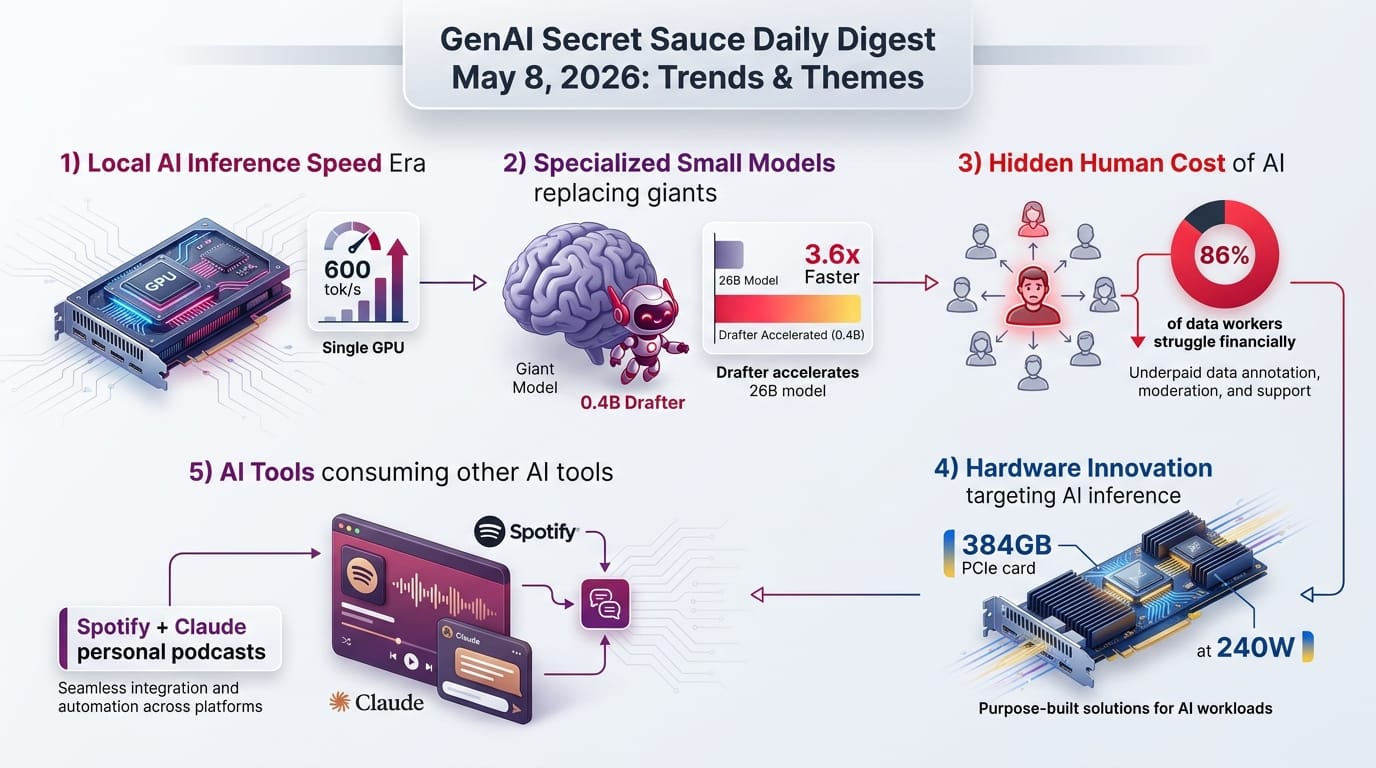
Local AI Inference Is Entering Its Speed Era, Specialized Small Models Are Replacing General, and The Hidden Human Cost of AI Gets Its Closeup.
Creative AI
Qwen 3.6 Generates Closed.
GitHub
Leading repos: anthropics/financial (+3,662), addyosmani/agent (+1,794), and Hmbown/DeepSeek (+3,827).
HuggingFace
Leading models: SulphurAI/Sulphur-2 (93K), deepseek-ai/DeepSeek-V4 (1.06M), and Zyphra/ZAYA1 (6.8K).
Product Hunt
Top launches: RankSpot (467), Monid 2.0 (360), and Minions (273).
API Pricing
What this means:** The price gap between frontier and open models continues to widen.
arXiv
Agent Capsules: Quality-Gated Granularity Control for Multi — On a 14-agent competitive intelligence pipeline, Agent Capsules used 51% fewer input tokens than a hand-tuned LangGraph implementation at equivalent quality.
Hot off the Presses
01
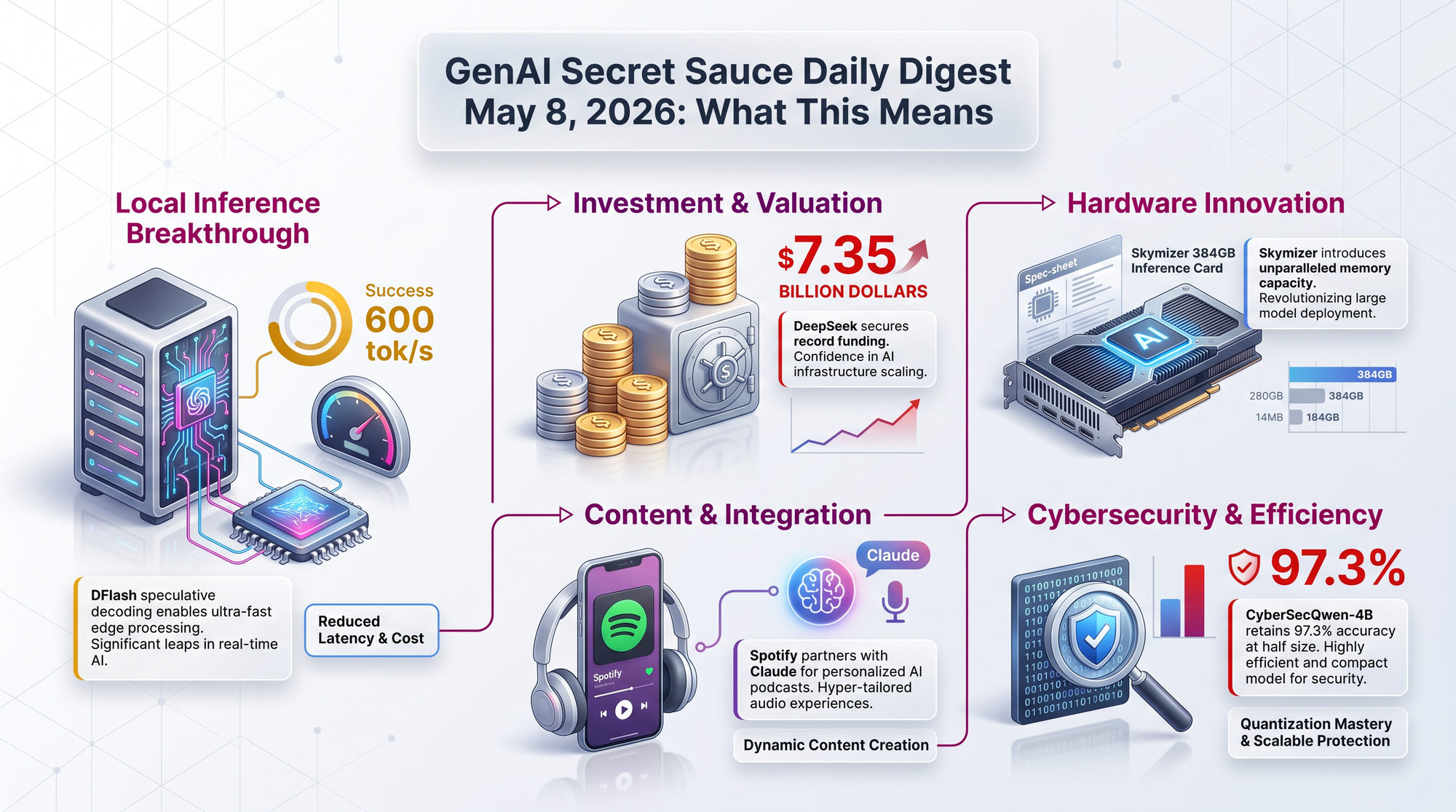
DeepSeek Seeks $7.35 Billion in Funding as It Prepares Revenue Push
What this means for you: The lab behind the models that made frontier AI free to download is about to become a real company - expect new products, pricing, and competition with Western labs.

DeepSeek, the Chinese AI lab originally funded by quantitative hedge fund High-Flyer, is raising more than $7 billion while simultaneously launching revenue initiatives. The company plans to release its V4.1 model update next month.

> "$7.35 billion" - from a lab that spent an estimated $6 million training its breakout model

  • $7.35 billion would rank among the largest AI funding rounds ever, putting DeepSeek alongside Anthropic and OpenAI in fundraising scale
  • The shift from research lab to venture-backed company signals DeepSeek sees a path to monetization beyond releasing free models
  • V4.1 arriving next month suggests continued rapid iteration on their architecture
02
Skymizer Unveils 384GB AI Inference Card That Runs 700B Models on a Single PCIe Slot
What this means for you: Running the largest AI models could shift from needing a data center to needing a single card in a standard server - dramatically cutting costs for businesses that want to keep AI in-house.

Taiwanese company Skymizer announced the HTX301, their first chip built on the HyperThought platform. Six chips deliver 384 gigabytes (GB) of memory on a single Peripheral Component Interconnect Express (PCIe) card at approximately 240 watts.

  • Supports models from 4 billion to 700 billion parameters using decode-first silicon with LISA (Language Instruction Set Architecture) software orchestration
  • Disaggregates prefill and decode workloads for higher utilization and lower latency - a design choice that mirrors how hyperscalers run inference but on a single card
  • 240 watts for 384GB is remarkably power-efficient compared to GPU-based inference setups that consume thousands of watts for similar memory capacity
  • On-premises deployment addresses the growing demand from companies that want AI capabilities without sending data to cloud providers
03
Spotify Says AI Agents Can Now Create Personal Podcasts Saved to Your Library
What this means for you: Your Spotify library is about to include audio content that didn't exist until you asked for it - personalized briefings, study guides, and travel episodes generated by AI.

Spotify Chief Technology Officer (CTO) Gustav Soderstrom announced that AI agents can now generate personalized audio content and save it directly to users' Spotify libraries. The content remains private and plays across all Spotify platforms.

  • Works with Claude Code, OpenClaw, and Codex via a command-line interface (CLI) tool on GitHub
  • Use cases include morning briefings combining your calendar and inbox, academic deep dives before exams, and travel itineraries
  • Content plays everywhere Spotify does - phone, car, smart speaker - making AI-generated audio a first-class citizen alongside music and traditional podcasts
  • Represents one of the first major consumer platforms treating AI-generated content as equivalent to human-created content in its library system
04
Simon Willison: Stop Asking AI for Markdown, Start Asking for HTML
What this means for you: If you use AI coding tools, switching one word in your prompts - "HTML" instead of "Markdown" - gives you interactive diagrams, navigation, and widgets for free.

Simon Willison, one of the most-read voices in AI development, wrote about Thariq Shihipar's (Anthropic, Claude Code team) argument that Hypertext Markup Language (HTML) output from AI models is dramatically more useful than Markdown. Willison had favored Markdown since GPT-4 when token limits made its efficiency valuable, but HTML unlocks capabilities Markdown cannot express.

  • Scalable Vector Graphics (SVG) diagrams, interactive widgets, and in-page navigation all become possible when you ask for HTML
  • Willison tested the approach by having a model explain a Linux privilege-escalation exploit, getting an interactive walkthrough rather than a flat document
  • The insight is counterintuitive - Markdown feels simpler, but HTML's richer capabilities mean the AI does more useful work per prompt
05
AI Is Breaking Both Major Approaches to Vulnerability Disclosure
What this means for you: Software security practices that have worked for decades are failing - AI makes it easier for attackers to find the exact commits that fix security bugs, even when maintainers try to hide them.

Jeff Kaufman argues that AI is destabilizing both major vulnerability disclosure models. Coordinated disclosure gives maintainers 90 days to patch before public announcement. The Linux kernel community takes the opposite approach: deploying fixes quietly in high-volume commits to obscure which ones are security-critical.

  • AI undermines the quiet-fix approach by making it practical to scan every commit for security-relevant changes, extracting signal from noise
  • Coordinated disclosure faces pressure too as AI tools accelerate the window between patch release and exploit development
  • Neither model was designed for a world where automated analysis can review thousands of commits in minutes
  • 174 points on Hacker News signals this resonated deeply with the security community
Trends & Themes
Trends & Themes
Local AI Inference Is Entering Its Speed Era
Why this matters to you: Running AI privately on your own hardware is no longer a compromise - it's getting fast enough to compete with cloud services.

A year ago, running a 26-billion parameter model locally meant waiting seconds per token. Today, a single consumer Graphics Processing Unit (GPU) generates faster than most people can read.

  • DFlash speculative decoding hits 600 tokens/second on Gemma 4 26B using a single RTX 5090, a 2.76x speedup over baseline with only 29GB of Video Random Access Memory (VRAM)
  • Antirez (creator of Redis) released DS4 - a specialized Metal inference engine that runs DeepSeek V4 Flash on 128GB MacBooks at 27-37 tokens/second with 1 million token context
  • CUDA inference on Apple Silicon via PCIe passthrough gives a MacBook Air M4 a 7x speed boost with an external RTX 5090
  • Custom CUDA kernels achieve 82+ tokens/second on Qwen 3.6 27B at 262,000 token context on a single RTX 4090 using fused 4-bit KV cache compression
Specialized Small Models Are Replacing General-Purpose Giants
Why this matters to you: The most capable AI for specific tasks is increasingly a small, focused model - not a massive general-purpose one.

The trend is clear: instead of throwing more parameters at problems, researchers are finding architectural shortcuts that let small, cheap models punch far above their weight.

  • CyberSecQwen-4B retains 97.3% of its parent model's accuracy at half the parameter count, outperforming specialized security models by 8.7 percentage points
  • DFlash is a 0.4 billion parameter drafter that accelerates a 26 billion parameter model by 3.6x - a tiny model making a big one faster
  • DomLoRA discovers a single "dominant adaptation module" in each model architecture, achieving full fine-tuning quality with just 0.7% of the usual adapter parameters
  • EMO (Allen AI) shows MoE models can drop 75% of experts with only 1% accuracy loss when trained with document-level expert pooling
The Hidden Human Cost of AI Gets Its Closeup
Why this matters to you: The AI tools you use every day depend on a workforce that earns less than $23,000 a year - and the industry is growing, not shrinking.

The uncomfortable truth: AI is not eliminating low-wage work. It is creating a new category of it, at global scale, largely invisible to the people who benefit from the products.

  • Data annotation is among the fastest-growing US jobs, with Scale AI claiming 700,000+ graduates and Mercor reporting ~30,000 active professionals
  • 86% of data workers struggle financially, with median earnings well under the poverty line in the countries where most work is done
  • The four largest data work startups each report ~$1 billion in growth, suggesting massive demand for human labor behind AI systems
  • An investigative video documenting these conditions drew attention across Reddit and YouTube
Hardware Innovation Is Targeting AI Inference Specifically
Why this matters to you: New chips and cards designed solely for running AI models (not training them) are arriving - and they could make on-premises AI dramatically cheaper.

The training-focused GPU shortage dominated 2024-2025. In 2026, the hardware race is shifting to inference: who can run models fastest and cheapest once they're already trained.

  • Skymizer's HTX301 puts 384GB on a single PCIe card at 240 watts, using decode-first silicon optimized specifically for inference workloads
  • NVIDIA's DGX Spark community is building open-source inference management tools (Sparkrun) for multi-node tensor parallelism without Kubernetes
  • An RTX 5090 connected to a MacBook via Thunderbolt delivers 7x inference speedup, showing consumer hardware can serve as AI accelerators
  • MiniMax M2.7's mixed-bit quantization fits a massive model in 74GB - a compression technique designed for inference, not training
AI Tools Are Consuming Other AI Tools
Why this matters to you: AI products are increasingly built on top of other AI products - creating new capabilities neither could offer alone.

The AI ecosystem is becoming layered: models on top of models, tools on top of tools. Each layer adds capability, but also dependency.

  • Spotify + Claude generates personal podcasts by combining AI text generation with Spotify's audio platform and library system
  • Monid positions itself as "OpenRouter for agent tools" - a marketplace where AI agents discover, compare, and pay for 200+ tools on demand
  • PageIndex replaces vector embeddings with Large Language Model (LLM) reasoning for document retrieval, hitting 98.7% accuracy on financial benchmarks - using one AI technique to replace another
  • Monid 2.0 processed 3,000+ tool purchases in 15 days as AI agents start buying access to other services on demand
Creative AI & Media
Qwen 3.6 Generates Closed-Loop SVG Images
What this means for you: A free, downloadable AI model can now create vector graphics from text descriptions - useful for diagrams, icons, and illustrations without paying for image generation APIs.

Previously: May 6 - Qwen 3.6 27B launched with Multi-Token Prediction (MTP) support.

  • Runs locally on consumer hardware at the 27-billion parameter size
  • SVG output means infinitely scalable images that can be edited in any vector editor
  • Community benchmarks show 80+ tokens/second generation speed on RTX 4090
Developer Tools & Infrastructure
Antirez Releases DS4: DeepSeek V4 on a MacBook
What this means for you: The creator of Redis built a dedicated inference engine that runs one of the most capable open models on a standard MacBook Pro - no GPU required.
  • 26.68 tokens/second on MacBook Pro M3 Max, 36.86 on Mac Studio M3 Ultra
  • 1 million token context window on 128GB RAM with 2-bit quantization
  • Deliberately not a generic model runner - purpose-built Metal graph executor for DeepSeek V4 Flash architecture
  • Asymmetrical quantization treats expert layers differently from attention layers for better quality
Sparkrun: Inference Management for NVIDIA DGX Spark Without Kubernetes
What this means for you: Running AI models on NVIDIA's new personal supercomputer just got simpler - one command to launch, automatic multi-node scaling, no container orchestration required.
  • CLI tool with automatic container orchestration and VRAM estimation
  • Multi-node tensor parallelism across DGX Sparks using InfiniBand/RDMA
  • YAML recipe system for community-shared model configurations
  • Growing community of developers on the DGX Spark forum building open tools (252 upvotes on r/LocalLLaMA)
Research & Models
Ring-2.6-1T: A Free Trillion-Parameter Thinking Model
What this means for you: A model with one trillion parameters - the largest class of AI available - is now free to use on OpenRouter, with 63 billion parameters active per query.
  • 262,000 token context window with $0 per million tokens for both input and output
  • Built by InclusionAI for agent workflows including coding, tool use, and extended reasoning
  • Available immediately on OpenRouter for testing and integration
Irminsul: Content-Addressed Caching Cuts Agent Latency by 83%
What this means for you: AI agents that re-read the same documents on every call waste enormous compute - this paper shows how to cache intelligently and recover 83% of wasted tokens.
  • Exploits Multi-Head Latent Attention (MLA) architecture to separate position-dependent from position-independent key-value components
  • Content-addressed caching replaces prefix matching, so identical content at different positions still hits the cache
  • Time To First Token drops from 10-16 seconds to near-instant on unchanged content
  • 63% energy savings in agentic workloads where the same context appears repeatedly
LatentRAG Cuts Retrieval Latency 90% by Moving Reasoning to Latent Space
What this means for you: AI systems that search documents before answering (Retrieval Augmented Generation, or RAG) could get 10x faster without losing accuracy.
  • Shifts reasoning and retrieval from text to continuous latent space - one forward pass of hidden states instead of generating intermediate text
  • Parallel latent decoding maintains transparency while skipping token-by-token generation
  • End-to-end joint optimization aligns the language model with the retrieval model
EMO: Allen AI Shows MoE Models Can Drop 75% of Experts
What this means for you: Mixture of Experts (MoE) models - the architecture behind DeepSeek and many frontier models - can be made dramatically smaller for deployment by removing most of their expert modules.
  • 1 billion active / 14 billion total parameters with 8 of 128 experts active
  • Document-level pooling routes all tokens in a document through the same expert subset
  • At 25% of experts (32), performance drops only ~1% absolute
  • Clusters correspond to semantic domains (health, news, science) enabling domain-specific pruning
Business & Industry
Marc Andreessen Mocked for Prompt That Tells AI Not to Hallucinate
What this means for you: One of Silicon Valley's most powerful investors publicly revealed an AI prompt that experts say demonstrates a fundamental misunderstanding of how the technology works.
  • The custom prompt instructs the AI it is a world-class expert and should never hallucinate
  • Critics noted instructing AI not to hallucinate doesn't address the technical mechanisms that cause hallucinations
  • 672 upvotes on r/artificial and widespread coverage across tech media
  • Raises questions about AI literacy among the people making billion-dollar investment decisions
MiniMax M2.7 Compressed to 74GB via Mixed-Bit Quantization
What this means for you: A model with 20 billion active parameters and 196,000 token context just became runnable on high-end consumer hardware.
  • Compressed from ~230GB to ~74GB using selective quantization that treats different layer types differently
  • 256 routed experts with top-8 routing across 62 layers
  • Down projections at 4-bit, gate/up projections at 3-bit - an approach that preserves quality where it matters most
GenAI in Education
Agentic AI Arrives in Education - and It Actually Works
What this means for you: AI tools that independently execute tasks (not just generate text) are starting to solve real administrative problems in education.
  • Claude Code organized 1,200+ randomly-named PDF research articles by title and semantic analysis in approximately 15 minutes
  • The author tested Claude Code, ChatGPT Codex, and MS Copilot Agents and found meaningful capability differences
  • MS Copilot Agents are custom AI instructions, not true agentic systems that take independent action
  • Practical demonstrations include building forms and automating workflows that previously required manual effort
Surprising & Under-the-Radar
You Can Run CUDA on a MacBook Now - Via Thunderbolt
What this means for you: An engineer connected an RTX 5090 to a MacBook Air via Thunderbolt and got 7x faster AI inference through a Linux virtual machine with PCIe passthrough.
  • 155 tokens/second with eGPU versus 22 native on Qwen 3.6 inference
  • Prompt processing for 4,000 tokens: 150 milliseconds versus 17 seconds
  • Gaming results were less impressive - 27 frames per second in Cyberpunk 2077 at 4K versus 100+ natively
  • Proves the concept that Apple Silicon machines can access NVIDIA's CUDA ecosystem when needed
A Single LoRA Adapter Position Outperforms the Standard Approach

DomLoRA discovers that gradient energy concentrates on a single shallow layer in most model architectures. Placing one adapter there achieves full fine-tuning quality at 0.7% of the usual parameter count. The dominant layer's position depends on architecture but stays consistent across tasks.

Disillusionment With Mechanistic Interpretability Goes Mainstream

A discussion post on r/MachineLearning (45 upvotes) questioning the value of mechanistic interpretability research drew significant attention, linking to Anthropic's Transformer Circuits research. The debate centers on whether understanding individual neurons and circuits actually leads to safer or more controllable AI systems.

CFS: A Deduplication Technique for AI Memory Systems

Conditional Field Subtraction solves a specific problem in conversational AI: when you ask for relevant memories, cosine similarity returns multiple rewordings of the same fact, wasting context slots. CFS scores candidates by both relevance and coverage gaps, ensuring each retrieved memory adds new information.

Signals to Track
Worth Watching
01
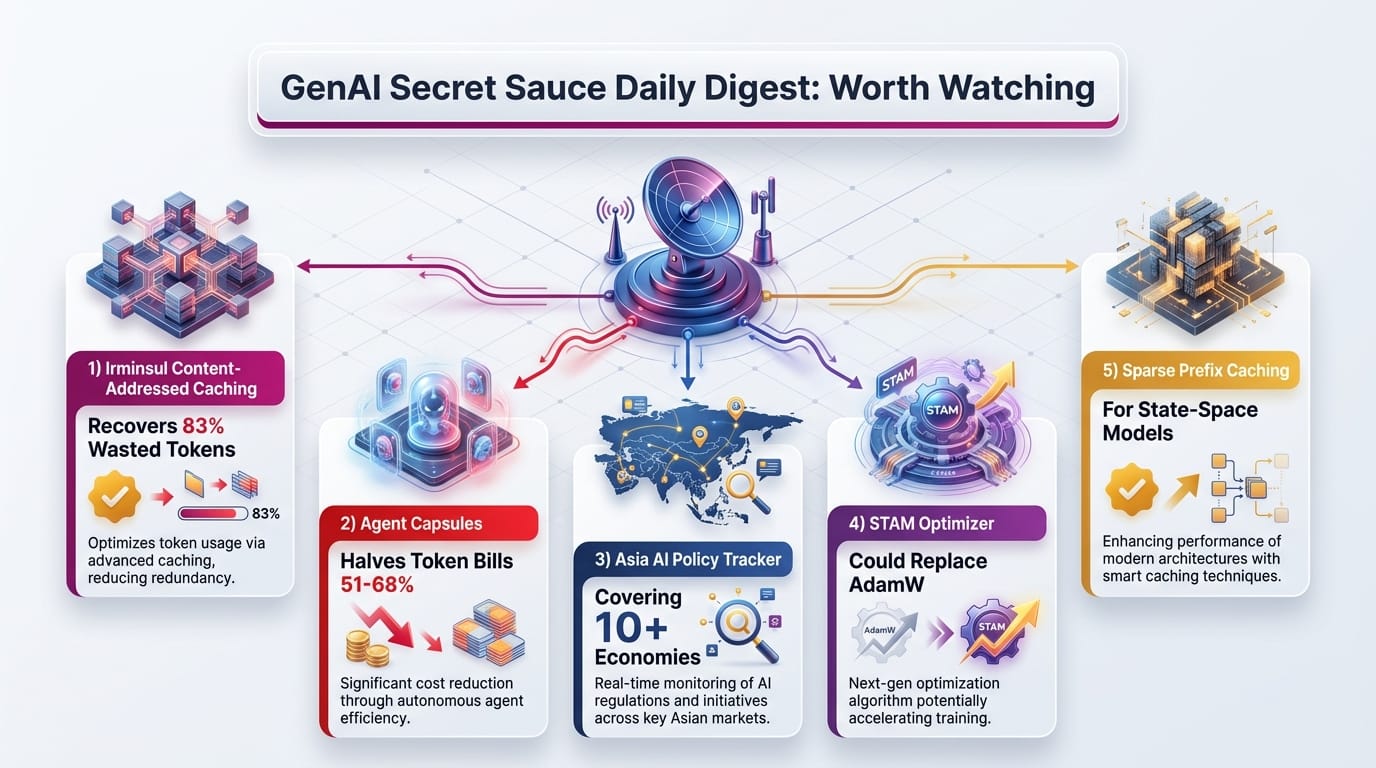
Irminsul Could Reshape How AI Agents Handle Repeated Context
A caching technique that recovers 83% of wasted tokens in agent workloads could make AI assistants dramatically cheaper to run.

Content-addressed caching for Multi-Head Latent Attention means identical documents at different positions in a conversation still hit the cache. Current prefix-based systems void the entire cache when a single token shifts position. If widely adopted, this could cut the cost of running AI agents in production by more than half. For users, it means faster responses when an agent re-reads files it has seen before.

02
Agent Capsules Halves Token Bills for Multi-Agent Pipelines
A runtime that dynamically merges or splits agent calls used 51-68% fewer tokens than hand-tuned LangGraph and DSPy setups.

Most multi-agent systems issue one Language Model (LLM) call per agent, wasting tokens on redundant context. Agent Capsules monitors rolling quality scores and merges calls when quality won't suffer. On a 14-agent pipeline, it matched LangGraph quality at half the token cost. No per-pipeline tuning or training data required.

03
Asia's AI Policy Landscape Is More Diverse Than You Think
A comprehensive tracker covering 10+ Asian economies reveals wildly different approaches to AI regulation - from China's $98 billion investment to Japan's penalty-free AI Act.

Vietnam has the most comprehensive standalone AI strategy. South Korea finalized a 99-task action plan. Japan's AI Promotion Act has no enforcement mechanism. India treats AI regulation as sector-by-sector rather than comprehensive. These policy differences will determine where AI companies can operate and what products they can build across the world's fastest-growing tech markets.

04
STAM Optimizer Could Replace AdamW for Large Model Training
A new optimizer dynamically adjusts momentum based on gradient variance, addressing a fundamental limitation of AdamW that causes training instability.

AdamW's fixed momentum coefficient causes overshooting when gradients are noisy and misses faster convergence when they stabilize. STAM adapts beta1 in real time using a gradient variance proxy. If validated at scale, this could reduce training costs and improve model quality without changing architectures.

05
Sparse Prefix Caching Makes State-Space Models Practical for Long Context
A checkpoint-based caching approach for recurrent/hybrid architectures recomputes only between sparse checkpoints, making Mamba-style models viable for long-context serving.

State-space models and hybrid architectures can't use standard key-value caching because they don't have persistent key-value pairs. This paper stores exact recurrent states at sparse positions and recomputes the gaps, with an optimal placement algorithm that outperforms fixed-budget heuristics.

Top Repos Today
Rank yesterday: #2 - Rising
Stars today: +3,662  ·  📦 Total: 15,000
📜 License: Apache-2.0  ·  👤 By: Anthropic (company)
🎯 Time to value: 15 minutes
What it is: Reference agents, skills, and data connectors for financial services workflows. Includes 11 named agents covering investment banking, equity research, private equity, and wealth management. Deploys as Claude Cowork plugins or via the Managed Agents API, with 40+ skills and 11 MCP data connectors for Bloomberg, FactSet, and Morningstar. Why you'd want it: If you work in finance and use Claude, this gives you production-ready agents for tasks like equity research summaries, deal screening, and portfolio analysis without building from scratch. Previously: May 6 - Anthropic launched 10 Financial Services Agents.
✓ Pros✗ Cons
Production-ready with real data connectorsLocked to Anthropic's ecosystem
11 specialized agents cover most finance workflowsBloomberg/FactSet connectors require existing licenses
Apache-2.0 means full customization rightsEnterprise setup requires Managed Agents API access
GitHub - anthropics/financial-services
Contribute to anthropics/financial-services development by creating an account on GitHub.
Rank yesterday: N/A - New entry
Stars today: +1,794  ·  📦 Total: 35,274
📜 License: MIT  ·  👤 By: Addy Osmani (individual, Google Chrome team)
🎯 Time to value: 5 minutes
What it is: Production-grade engineering skills for AI coding agents. 20 core skills across six development phases (Define, Plan, Build, Verify, Review, Ship), 3 specialist agent personas, and 7 slash commands. Encodes workflows, quality gates, and best practices from senior engineers. Why you'd want it: Drop these skills into Claude Code or Cursor to get structured development workflows rather than ad-hoc coding assistance. Previously: May 6 - agent-skills first covered.
✓ Pros✗ Cons
Battle-tested patterns from Google-scale engineeringOpinionated workflow may conflict with existing team practices
Works with multiple agent platforms (Claude Code, Cursor, Codex)20 skills is a lot to learn and configure
MIT license, fully customizableSkills assume senior-level development context
GitHub - addyosmani/agent-skills: Production-grade engineering skills for AI coding agents.
Production-grade engineering skills for AI coding agents. - addyosmani/agent-skills
Rank yesterday: N/A - New entry
Stars today: +3,827  ·  📦 Total: 21,688
📜 License: MIT  ·  👤 By: Hmbown (individual)
🎯 Time to value: 10 minutes
What it is: A Rust-based terminal coding agent built specifically for DeepSeek V4 models. Supports 1 million token context windows, streaming reasoning blocks, and multiple operation modes (Plan, Agent, YOLO). Integrates with file operations, shell, git, web search, sub-agents, and MCP servers. Why you'd want it: If you prefer DeepSeek models over Claude or GPT for coding, this gives you a Claude Code-like terminal experience optimized for DeepSeek V4's architecture. Previously: May 6 - First covered as gaining 6,184 stars in one day.
✓ Pros✗ Cons
Rust performance with native terminal UIDeepSeek-specific - doesn't support other model families
1M context window matches DeepSeek V4's full capabilityNewer and less battle-tested than Claude Code or Codex CLI
YOLO mode for rapid prototyping without confirmationsRequires DeepSeek API access or local deployment
GitHub - Hmbown/DeepSeek-TUI: Coding agent for DeepSeek models that runs in your terminal
Coding agent for DeepSeek models that runs in your terminal - Hmbown/DeepSeek-TUI
Rank yesterday: N/A - New entry
Stars today: +388  ·  📦 Total: 3,834
📜 License: MIT  ·  👤 By: Z-Lab (research lab)
🎯 Time to value: 20 minutes
What it is: Block diffusion models for speculative decoding that draft multiple tokens in parallel rather than sequentially. Pre-trained draft models available for Qwen, Gemma, and Llama families. Supports vLLM, SGLang, Transformers, and MLX backends. Why you'd want it: Drop-in 2.8-3.6x inference speedup for popular open models with a 0.4 billion parameter drafter that uses minimal additional VRAM.
✓ Pros✗ Cons
3.6x speedup demonstrated on Gemma 4 26BRequires compatible draft model for each model family
Works with major serving frameworks (vLLM, SGLang)Research-stage project with rapid iteration
MLX support enables Apple Silicon deploymentQuality validation still emerging from community
GitHub - z-lab/dflash: DFlash: Block Diffusion for Flash Speculative Decoding
DFlash: Block Diffusion for Flash Speculative Decoding - z-lab/dflash
Rank yesterday: N/A - New entry
Stars today: +189  ·  📦 Total: 14,581
📜 License: MIT  ·  👤 By: HKU Data Science Lab (university research)
🎯 Time to value: 30 minutes
What it is: Agent-native trading platform where AI agents publish trading signals, collaborate on strategies, and participate in copy trading across stocks, crypto, forex, options, and futures. Includes paper trading with $100,000 in simulated capital. Why you'd want it: Test AI-driven trading strategies with real market data but simulated money before risking actual capital. Supports Claude Code, Cursor, and custom agent integrations.
✓ Pros✗ Cons
Paper trading removes financial risk while testingResearch project, not production trading infrastructure
Multi-market support (stocks, crypto, forex, options)Agent trading strategies are unproven at scale
Claude Code and MCP integrationCC-BY-NC-SA license restricts commercial use
GitHub - HKUDS/AI-Trader: “AI-Trader: 100% Fully-Automated Agent-Native Trading”
“AI-Trader: 100% Fully-Automated Agent-Native Trading” - HKUDS/AI-Trader
Rank yesterday: N/A - New entry
Stars today: +572  ·  📦 Total: 6,709
📜 License: MIT  ·  👤 By: LearningCircuit (individual)
🎯 Time to value: 10 minutes
What it is: Privacy-focused AI research assistant that performs deep, multi-source research using local models (Ollama, llama.cpp, LM Studio) or cloud providers. Integrates 10+ search engines including arXiv and PubMed. Encrypted database, zero telemetry. Why you'd want it: Run thorough research workflows entirely on your own hardware with proper citations, without sending queries to cloud AI providers.
✓ Pros✗ Cons
Fully local option with zero data leakageLocal models produce lower-quality research than cloud
10+ search engine integrations including academic sourcesSetup requires installing local model infrastructure
MCP server available for Claude integrationResearch depth depends heavily on model quality
GitHub - LearningCircuit/local-deep-research: ~95% on SimpleQA (e.g. Qwen3.6-27B on a 3090). Supports all local and cloud LLMs (llama.cpp, Ollama, Google, ...). 10+ search engines - arXiv, PubMed, your private documents. Everything Local & Encrypted.
~95% on SimpleQA (e.g. Qwen3.6-27B on a 3090). Supports all local and cloud LLMs (llama.cpp, Ollama, Google, ...). 10+ search engines - arXiv, PubMed, your private documents. Everything Local &amp…
Rank yesterday: N/A - Holding steady
Stars today: +74  ·  📦 Total: 76,472
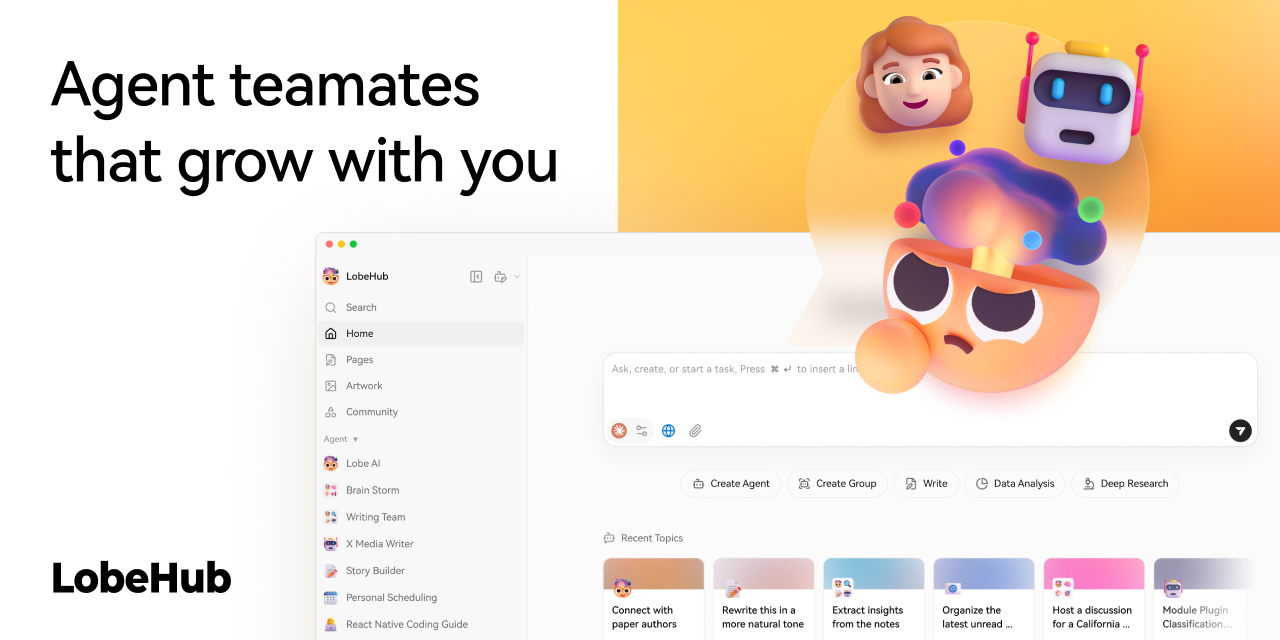
📜 License: Apache-2.0  ·  👤 By: LobeHub (company)
🎯 Time to value: 5 minutes
What it is: Multi-agent collaboration platform with 40+ plugin integrations, MCP marketplace, voice conversation support (text-to-speech/speech-to-text), and knowledge base management. Agents work together within structured workflows. Why you'd want it: A self-hosted alternative to ChatGPT Teams or Claude for organizations that want multi-agent workflows with plugin ecosystems without vendor lock-in.
✓ Pros✗ Cons
76K stars and mature ecosystemComplex setup for full feature utilization
Self-hosted with no vendor lock-inPlugin quality varies across the marketplace
Multi-agent collaboration built-inTypeScript codebase may be unfamiliar to Python-focused teams
GitHub - lobehub/lobehub: The ultimate space for work and life — to find, build, and collaborate with agent teammates that grow with you. We are taking agent harness to the next level — enabling multi-agent collaboration, effortless agent team design, and introducing agents as the unit of work interaction.
The ultimate space for work and life — to find, build, and collaborate with agent teammates that grow with you. We are taking agent harness to the next level — enabling multi-agent collaboration, e…
Rank yesterday: N/A - Rising
Stars today: +645  ·  📦 Total: 44,525
📜 License: CC-BY-NC-SA-4.0  ·  👤 By: Datawhale (community, China)
🎯 Time to value: 15 minutes
What it is: Free 16-chapter tutorial for building AI agents, from foundational LLM theory through multi-agent systems. Hands-on Python and Jupyter Notebook examples. Primarily Chinese-language. Why you'd want it: Comprehensive, structured learning path for agent development with working code examples at every step.
✓ Pros✗ Cons
44K stars signal strong community validationPrimarily Chinese-language content
16 chapters from basics to advanced multi-agentCC-BY-NC-SA restricts commercial derivative use
Hands-on code examples throughoutFocuses on Chinese AI ecosystem tools
GitHub - datawhalechina/hello-agents: 📚 《从零开始构建智能体》——从零开始的智能体原理与实践教程
📚 《从零开始构建智能体》——从零开始的智能体原理与实践教程. Contribute to datawhalechina/hello-agents development by creating an account on GitHub.
Top Models Today
Open-source uncensored video generation model with 93K downloads in its first week, supporting both text-to-video and image-to-video natively.
📥 Downloads (30d): 93K  ·  📜 License: Unknown
👤 By: SulphurAI  ·  🎯 Task: text-to-video
📐 Size: 9B
What it is: Built on LTX 2.3, Sulphur-2 generates video from text or images without content restrictions. Includes a built-in prompt enhancer for improved output quality. Supports deployment via Diffusers, llama.cpp, and Ollama. Why you'd want it: The first uncensored open video generation model with mainstream adoption, giving creators full control over content without platform restrictions. Previously: May 4 - First covered alongside LTX 2.3 release.
✓ Pros✗ Cons
No content restrictions on generationLicense terms unclear
Multiple deployment options including Ollama9B parameters requires significant VRAM
Built-in prompt enhancementQuality gap vs commercial video gen (Sora, Veo)
SulphurAI/Sulphur-2-base · Hugging Face
We’re on a journey to advance and democratize artificial intelligence through open source and open science.
Flagship 1.6T parameter open MoE model with 93.5% LiveCodeBench and 1M token context, featuring novel hybrid attention architecture.
📥 Downloads (30d): 1.06M  ·  📜 License: MIT
👤 By: DeepSeek  ·  🎯 Task: text-generation
📐 Size: 1.6T total / 49B active
What it is: DeepSeek's frontier open-source model combines three reasoning modes (Non-think, Think High, Think Max) with hybrid attention mixing Compressed Shared Attention (CSA) and Hybrid Chunked Attention (HCA). Scores 87.5% on MMLU-Pro and 93.5% on LiveCodeBench. Why you'd want it: The most capable open-weight model available, matching or exceeding many closed models on coding and reasoning benchmarks, with a permissive MIT license.
✓ Pros✗ Cons
Frontier performance with MIT license1.6T total parameters requires serious hardware
1M token context window49B active parameters still substantial per query
Three reasoning modes for cost/quality tradeoffQuantization community still optimizing deployment
deepseek-ai/DeepSeek-V4-Pro · Hugging Face
We’re on a journey to advance and democratize artificial intelligence through open source and open science.
Achieves 89.1% on AIME'26 math benchmark with only 760M active parameters - frontier reasoning that runs on a phone.
📥 Downloads (30d): 6.8K  ·  📜 License: Apache-2.0
👤 By: Zyphra  ·  🎯 Task: text-generation
📐 Size: 8.4B total / 760M active
What it is: A Mixture-of-Experts reasoning model that concentrates capability in a tiny active parameter footprint. Designed for on-device deployment where compute and memory are severely constrained. Why you'd want it: Frontier-level math and coding performance (89.1% AIME'26, 65.8% LiveCodeBench) running on edge devices or phones without cloud connectivity. Previously: May 6 - First covered as achieving frontier performance on AMD hardware.
✓ Pros✗ Cons
Only 760M active params enables mobile deploymentNarrow specialization in math/code reasoning
Apache-2.0 license allows commercial use8.4B total still needs careful quantization for phones
Trained on AMD MI300X, proving non-NVIDIA viabilityLimited general knowledge compared to larger models
Zyphra/ZAYA1-8B · Hugging Face
We’re on a journey to advance and democratize artificial intelligence through open source and open science.
Rare open-source release from OpenAI: a browser-deployable model that masks personal information in documents up to 128K tokens.
📥 Downloads (30d): 173K  ·  📜 License: Apache-2.0
👤 By: OpenAI  ·  🎯 Task: PII detection
📐 Size: 1.5B total / 50M active
What it is: Bidirectional token-classification model detecting 8 categories of Personally Identifiable Information (PII) - names, emails, phones, addresses - in a single forward pass. The 50M active parameter count makes it lightweight enough for browser deployment. Why you'd want it: Sanitize documents before sending them to AI services, entirely on your own device, using a model built by one of the largest AI companies.
✓ Pros✗ Cons
Browser-deployable at 50M active parametersLimited to 8 PII categories
128K context handles long documentsOpenAI rarely open-sources - long-term support uncertain
Apache-2.0 licensePII detection accuracy not publicly benchmarked
openai/privacy-filter · Hugging Face
We’re on a journey to advance and democratize artificial intelligence through open source and open science.
Xiaomi's 1T parameter agentic model achieves 78.9% SWE-Bench with 3x inference speedup via multi-token prediction.
📥 Downloads (30d): 26.6K  ·  📜 License: MIT
👤 By: Xiaomi  ·  🎯 Task: agentic/code
📐 Size: 1T total / 42B active
What it is: Purpose-built for software engineering and long-context agent tasks. Features hybrid attention with 7x KV-cache reduction and multi-token prediction for faster output. Supports 1 million token context. Why you'd want it: Strong alternative to Claude and GPT for automated software engineering, with a permissive MIT license and architecture optimized for agent workflows.
✓ Pros✗ Cons
78.9% SWE-Bench competitive with frontier closed models1T parameters requires enterprise hardware
MIT license enables commercial deploymentXiaomi's model ecosystem less established than competitors
Multi-token prediction provides real speedupCommunity tooling still catching up
XiaomiMiMo/MiMo-V2.5-Pro · Hugging Face
We’re on a journey to advance and democratize artificial intelligence through open source and open science.
Mistral's largest dense model replaces three predecessors with unified vision, reasoning, and code capabilities across 24+ languages.
📥 Downloads (30d): 21.3K  ·  📜 License: Modified MIT
👤 By: Mistral AI  ·  🎯 Task: multimodal text-generation
📐 Size: 128B
What it is: Dense 128 billion parameter model with configurable reasoning effort, native function calling, and vision capabilities. Replaces Mistral Medium 3.1, Magistral, and Devstral 2 in a single unified release. Supports 256K context. Why you'd want it: One model for instruction-following, deep reasoning, and code generation without switching between specialized variants. Powers both Le Chat and Mistral's Vibe coding agent.
✓ Pros✗ Cons
Replaces three models with one128B dense requires significant serving infrastructure
256K context with vision supportModified MIT license has usage restrictions
24+ languages including non-Latin scriptsDense architecture less efficient than MoE alternatives
mistralai/Mistral-Medium-3.5-128B · Hugging Face
We’re on a journey to advance and democratize artificial intelligence through open source and open science.
Native multimodal model that generates 2048x2048 images in 9 seconds on H100, without needing separate visual encoders or VAEs.
📥 Downloads (30d): 2.9K  ·  📜 License: Apache-2.0
👤 By: SenseTime  ·  🎯 Task: any-to-any
📐 Size: 8B
What it is: Uses a novel NEO-Unify architecture that eliminates traditional adapter-based multimodal integration. Handles visual understanding, reasoning, text-to-image generation, and image editing in a single model with native interleaved image-text output. Why you'd want it: A single 8B model that both understands and creates images, replacing the need for separate vision and generation models. Previously: May 4 - First covered as SenseNova U1.
✓ Pros✗ Cons
True unified multimodal - no adapter overhead2.9K downloads indicates early adoption stage
8B parameter footprint is manageableImage quality gap vs specialized generators (DALL-E, Midjourney)
Apache-2.0 licenseDocumentation primarily in Chinese
sensenova/SenseNova-U1-8B-MoT · Hugging Face
We’re on a journey to advance and democratize artificial intelligence through open source and open science.
Enterprise omni-modal model processing video, audio, image, and text with only 3B active parameters per token.
📥 Downloads (30d): 89.8K  ·  📜 License: NVIDIA Open Model Agreement
👤 By: NVIDIA  ·  🎯 Task: any-to-any
📐 Size: 31B total / 3B active
What it is: Mamba2-Transformer hybrid MoE architecture designed for meeting transcription, document intelligence, and GUI automation. 76% improvement on computer-use tasks over predecessors. 256K context window. Why you'd want it: Enterprise teams that need a single model handling documents, meetings, and screen automation at minimal compute cost per query.
✓ Pros✗ Cons
Only 3B active parameters keeps inference cheapNVIDIA-specific license terms
Video + audio + image + text in one modelHybrid Mamba2 architecture is newer and less tooling support
76% improvement on computer-use benchmarks31B total parameters still significant for deployment
nvidia/Nemotron-3-Nano-Omni-30B-A3B-Reasoning-BF16 · Hugging Face
We’re on a journey to advance and democratize artificial intelligence through open source and open science.
AI Launches Today
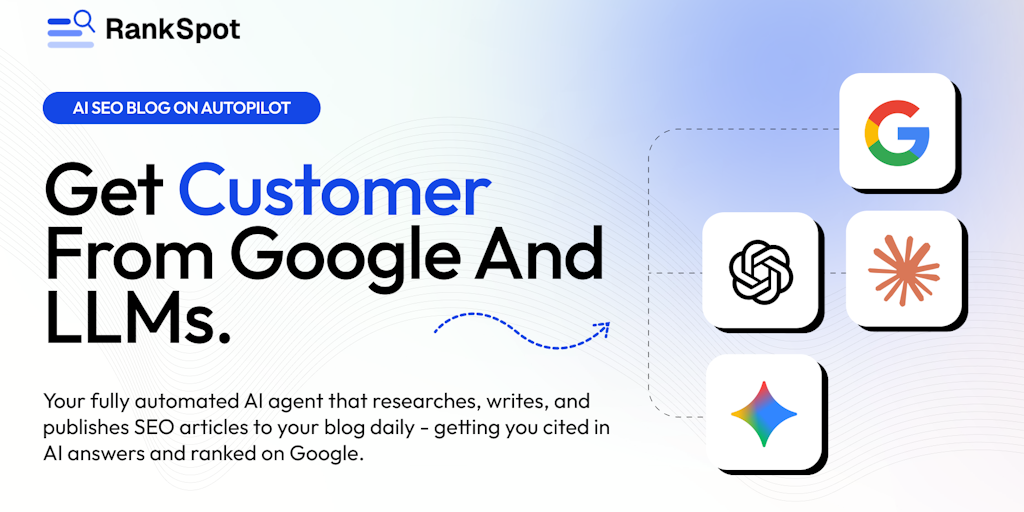
AI SEO Blog driven by deep competitor intelligence
🔥 Upvotes: 467  ·  👤 By: Daniil Poletaev, Yaroslav Chuykov, Olga Isaeva
💰 Pricing: Freemium  ·  🏷 Category: AI Workflow Automation
Fully autonomous AI agent that handles the complete Search Engine Optimization (SEO) pipeline. Researches competitor keywords, writes 1,500+ word optimized articles daily, adds quotes and statistics, and publishes directly to WordPress, Webflow, and Shopify. Tracks competitor rankings biweekly and clusters similar keywords to prevent content overlap. Verdict: Useful for solo founders who need consistent content but lack time - though the "fully automated SEO content" approach raises questions about content quality and authenticity.
AI SEO Blog driven by deep competitor intelligence | RankSpot | Product Hunt
RankSpot is your fully automated AI agent that researches, writes, and publishes SEO articles to your blog daily - getting you cited in AI answers and ranked on Google.
OpenRouter for agent tools
🔥 Upvotes: 360  ·  👤 By: Shengkun Ye, Feiyou Guo
💰 Pricing: Freemium  ·  🏷 Category: Developer Tools
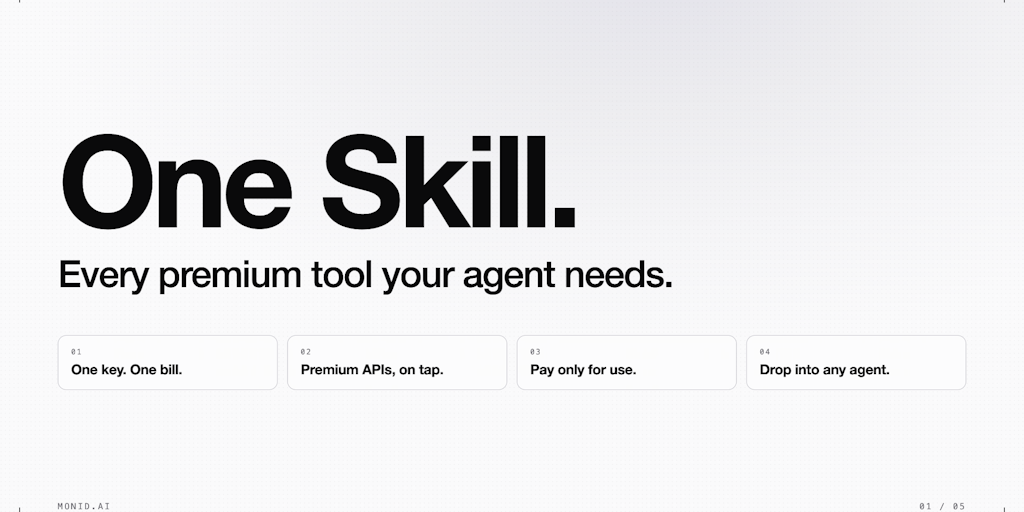
Unified platform where AI agents discover, compare, and pay for 200+ Application Programming Interface (API) tools on demand. Supports social media scrapers, search, ecommerce data, and blockchain monitoring. Agents operate under customizable budget controls. 3,000+ purchases processed since launch 15 days ago. Verdict: Solves a real friction point - agents currently need individual API keys for each service. The "app store for agent capabilities" model has legs.
OpenRouter for agent tools - Monid | Product Hunt
One skill, every tool your agent needs. Social scraping, market trends, lead gen, competitor tracking, sentiment analysis, all unlocked with one balance. No subscriptions. No API keys.
Open source mission control for parallel AI agents
🔥 Upvotes: 273  ·  👤 By: Vishnu
💰 Pricing: Free/Open Source  ·  🏷 Category: AI Workflow Automation
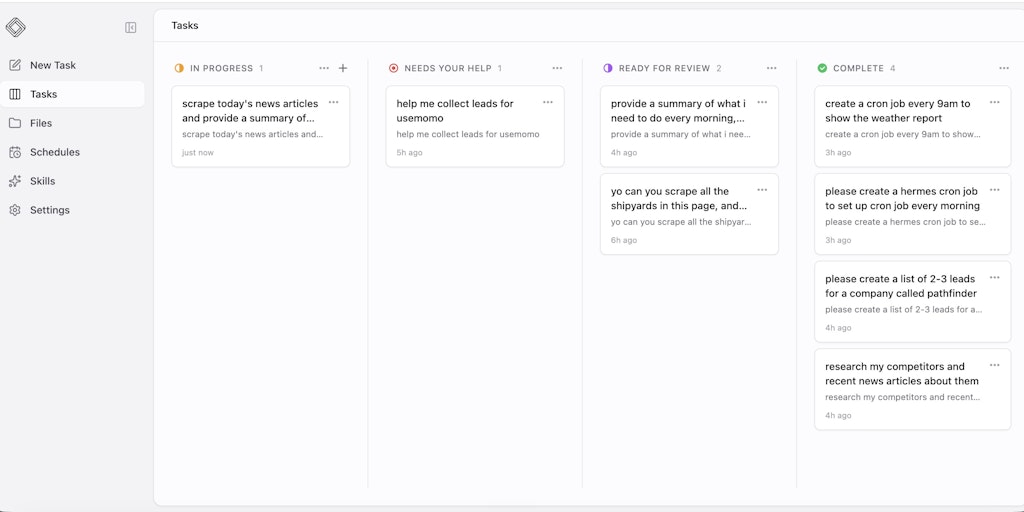
Supervision layer for managing multiple parallel AI agent tasks. Heartbeat monitoring catches silent failures, automatic retry handles stuck tasks, and human escalation triggers only after alternatives are exhausted. Runs locally with SQLite, no account required. Verdict: Addresses a genuine operational gap - when you scale beyond one agent, knowing what's stuck versus what's working becomes the bottleneck. Clean, focused scope.
Open source mission control for Hermes agent | Minions | Product Hunt
Your Hermes Agent works great for one task. Try managing 20 in parallel? It’s chaos. Cron jobs fail silently, tasks are blocked and you’re spending more time fixing your agent than getting results. Minions gives you a single task board to view it all. Every running task gets periodic check-ins, retry if stuck, and escalate only when it’s genuinely exhausted alternatives Works with Hermes Agent today, more runtimes coming.
Find gaps in your AI agents before users do
🔥 Upvotes: 138  ·  👤 By: Former Meta and Monzo engineers
💰 Pricing: Paid  ·  🏷 Category: Developer Tools
Adversarial testing platform that launches 1,000+ adaptive strategies against AI agents in real-time. Identifies hallucinations, broken handoffs, incorrect tool calls, and security vulnerabilities. Pure blackbox approach works with any agent or multi-agent system without requiring integration. Verdict: Agent testing is an underserved market. The blackbox approach removes integration friction, but the paid model may limit adoption among indie developers who need it most.
Find gaps in your AI agents before users do - Fabraix | Product Hunt
AI agents fail in ways traditional software doesn’t. Our agents help you find all the ways in which your AI agents fail by adversarially testing them in a dedicated environment. Point it at any AI agent, or multi-agent system, and it launches 1,000+ strategies that adapt to your system in real time - pure blackbox, no integration needed. Built by ex-Meta engineers.
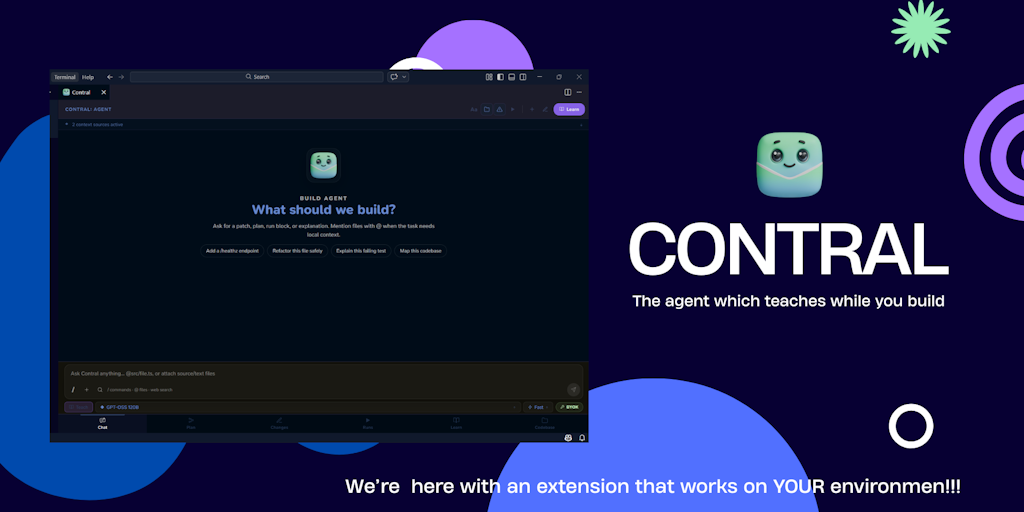
The agent which teaches while you build
🔥 Upvotes: 119  ·  👤 By: Samagra Gune, Devansh Ranjan
💰 Pricing: Freemium  ·  🏷 Category: AI Coding
AI coding agent for VS Code, Cursor, and Windsurf that provides real-time explanations alongside code generation. Build Mode assists active coding; Learn Mode guides developers through tasks with live explanations tied to the editor. Verdict: Bridges the gap between learning and building - instead of switching between tutorials and code, the explanation appears in context. Most valuable for junior developers and career switchers.
Contral: The agent which teaches while you build. | Product Hunt
Contral is the agent that teaches you while you build. Most developers study tutorials that have nothing to do with the code they actually work on. When they open their editor, they are on their own. Contral lives inside your existing environment and fixes that. Build Mode gives you context aware assistance as you write real code, supporting your thinking instead of replacing it. Learn Mode guides you through actual tasks with real time explanations tied to your editor. No new tools.
Snapshot
ProviderModelInput $/1MOutput $/1MContext
AnthropicClaude Opus 4.7$5.00$25.001M
AnthropicClaude Sonnet 4.6$3.00$15.001M
AnthropicClaude Haiku 4.5$1.00$5.00200K
OpenAIGPT-4.1$2.00$8.001M
OpenAIo3$2.00$8.00200K
OpenAIo4-mini$1.10$4.40200K
OpenAIGPT-4.1 Mini$0.40$1.601M
GoogleGemini 3.1 Pro Preview$2.00$12.00200K
GoogleGemini 2.5 Pro$1.25$10.00200K
GoogleGemini 2.5 Flash$0.30$2.50N/A
GroqGPT OSS 120B$0.15$0.60128K
GroqLlama 4 Scout$0.11$0.34128K
GroqQwen3 32B$0.29$0.59131K
What this means: The price gap between frontier and open models continues to widen. Groq's Llama 4 Scout costs 45x less per input token than Claude Opus 4.7. For applications where Llama-class quality suffices, the economic case for open models on fast inference hardware is overwhelming. Meanwhile, Ring-2.6-1T is available for free on OpenRouter - a trillion-parameter model at $0.00 per token, subsidized to build adoption.

Agent Capsules: Quality-Gated Granularity Control for Multi-Agent LLM Pipelines
Aninda Ray - arXiv:2605.00410
What it claims: Multi-agent pipelines waste tokens by issuing one LLM call per agent, but naively merging calls degrades quality. Agent Capsules dynamically merges or splits agent calls based on rolling quality scores, cutting token usage without sacrificing output.

Key finding: On a 14-agent competitive intelligence pipeline, Agent Capsules used 51% fewer input tokens than a hand-tuned LangGraph implementation at equivalent quality. On a 5-agent due diligence pipeline, it used 68% fewer tokens than DSPy MIPROv2 at +0.052 higher quality.

Why practitioners should care: If you run multi-agent systems in production using LangGraph, DSPy, or custom frameworks, this offers a drop-in runtime that halves your token bill without per-pipeline tuning or training data. It validates against real frameworks and real workloads, not toy benchmarks.
Subscribe to GenAI Secret Sauce newsletter and stay updated.

Don't miss anything. Get all the latest posts delivered straight to your inbox. It's free!
Great! Check your inbox and click the link to confirm your subscription.
Error! Please enter a valid email address!