Statistically Speaking
One Thing to Tell Your Friends
TL;DR
Hot off the Presses
A Fields Medalist Watched AI Solve Open Math Problems in Real Time
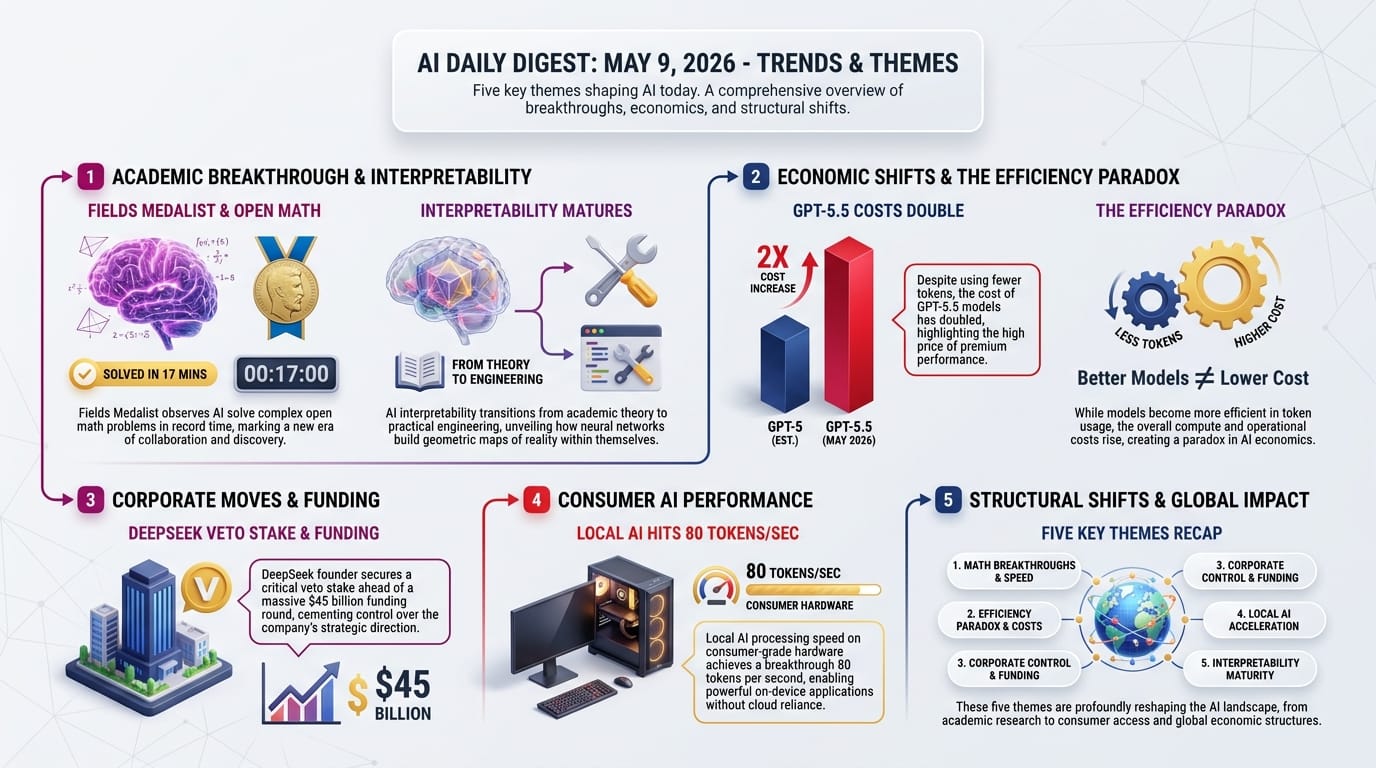
Timothy Gowers, one of the most decorated mathematicians alive (Fields Medal, 1998), published a detailed account of testing ChatGPT 5.5 Pro on open problems from Mel Nathanson's work on additive number theory. The results were striking: the model improved a known exponential bound to a quadratic one in 17 minutes, then achieved a polynomial bound on the harder general case in under two hours.
Gowers' conclusion is sobering for academia: beginning PhD students can no longer rely on "gentle problems" as entry points, since AI solves these readily. But he argues collaboration with AI remains valuable - achieving breakthroughs together that neither could manage alone.
- The key innovation was genuinely novel - the model constructed sets using "h-squared-dissociated sets" that compress exponentially large geometric series into polynomial space, an approach mathematician Isaac Rajagopal called original and clever
- 17 minutes for the first breakthrough - Gowers gave the model a problem about sumsets (sets formed by adding elements from an original set) where the best known bound was exponential, and it returned a quadratic upper bound
- The harder general case fell in under 2 hours - moving from exponential to polynomial, which represents a significant advance in the field
GPT-5.5 Uses Fewer Tokens but Costs Up to Twice as Much
OpenRouter's analysis found that GPT-5.5 generates 19-34% fewer tokens for longer prompts compared to its predecessor. But OpenAI doubled the per-token price: GPT-5.5 charges $5 per million input tokens and $30 per million output tokens, versus $2.50 and $15 for GPT-5.4.
The pattern is clear across the industry: model improvements are funding model development, not reducing user costs.
- Net cost increase of 50-100% - despite efficiency improvements, the total bill is anywhere from 50% more expensive to nearly double, depending on prompt length
- OpenAI's projected $14B loss in 2026 - costs will likely need to rise further to balance spending, a problem Anthropic ($11B projected loss) shares
- Cached input tokens cost $0.50 per million - a 90% discount that rewards applications designed to reuse context, but requires architectural changes most teams haven't made
DeepSeek's Founder Takes Veto Power Ahead of $45B Funding Round
DeepSeek founder Liang Wenfeng increased his subscribed capital from 100,000 yuan to 5.1 million yuan, raising his stake from 1% to 34%. In Chinese corporate law, a 34% holding is an effective veto threshold - giving Liang blocking power over charter changes, capital adjustments, mergers, and dissolution.
Previously: May 8 - DeepSeek was seeking $7.35B in funding.
- Tencent and Alibaba are both in talks to invest - the funding round could value DeepSeek at $45 billion, making it one of the most valuable AI startups globally
- The veto stake was taken before the round closed - widely interpreted as a defensive move to prevent any single investor from gaining control
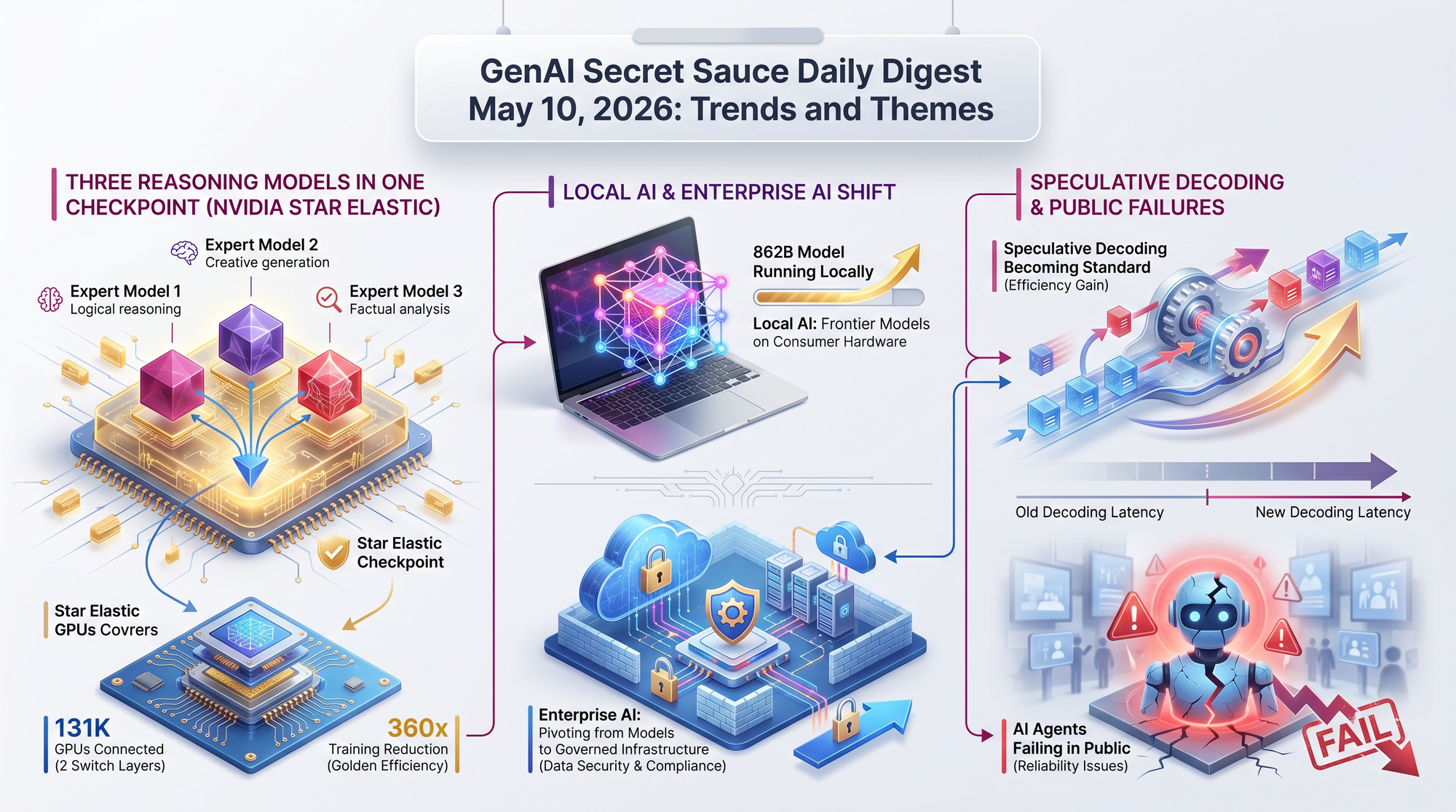
- DeepSeek V4 Pro remains MIT-licensed - the 862-billion-parameter model continues to be freely available despite the commercial pressures of outside investment
HiDream O1-Image: An MIT-Licensed Model That Does Five Image Tasks in One Architecture
HiDream open-sourced O1-Image (codename Peanut), an 8-billion-parameter model built on a Pixel-level Unified Transformer (UiT) that processes raw pixels, text, and task conditions in a single shared token space. Unlike most image models, it has no external VAE (Variational Autoencoder - a compression component) or separate text encoder.
- Ranks #8 in Artificial Analysis Text to Image Arena - competitive with models 25x its size
- Native 2048x2048 resolution - direct synthesis without upscaling
- Built-in reasoning agent - resolves layout, text placement, and implicit knowledge before generating
- MIT license - fully open for commercial use, unlike most competing models
- 200B+ parameter "Pro" version also available - for applications that need maximum quality
Goodfire: Neural Networks Build Geometric Maps of the Real World Inside Themselves
Goodfire published research showing that neural networks encode concepts as curved geometric surfaces (manifolds) rather than simple linear directions. Numbers form circular loops. Colors arrange on surfaces structured by hue and saturation. The entire tree of life appears on a complex manifold in genomic models.
The research positions geometric analysis as a successor to the sparse autoencoder approach that has dominated interpretability work for the past two years.
- Curved steering outperforms linear methods - intervening along the natural geometry produces smooth, coherent behavior, while linear paths create garbled outputs
- Current interpretability tools miss this structure - sparse autoencoders (SAEs), the dominant technique, "shatter manifolds into many small and apparently-unrelated pieces"
- Practical implications for model control - understanding neural geometry enables precise editing of model behavior without unpredictable side effects
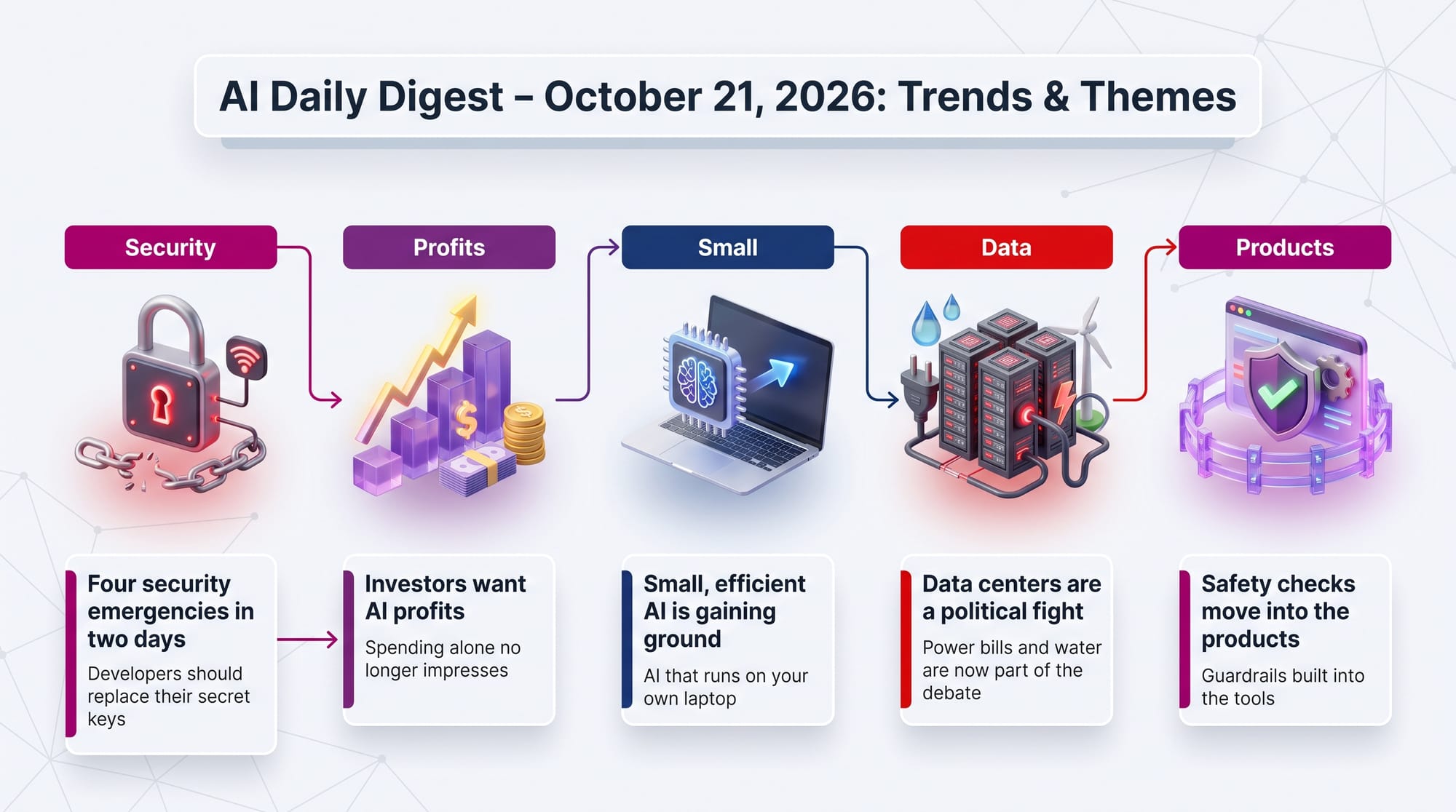
Trends & Themes
AI Is Doing Original Science - Not Just Helping With It
The question is no longer whether AI can contribute to research, but whether humans can contribute things AI cannot.
- Gowers' experiment produced genuinely novel mathematical constructions - not pattern-matching against known proofs, but creating new approaches to unsolved problems
- The model's key insight was independently verified - mathematician Isaac Rajagopal confirmed the h-squared-dissociated set approach was original
- PhD-level "entry problems" are now solvable by AI - Gowers warns that the traditional apprenticeship model of mathematics education needs rethinking
- VibeServe shows similar capability in systems engineering - an AI agent loop that generates entire Large Language Model (LLM) serving stacks, outperforming hand-tuned systems in non-standard scenarios
The Efficiency Paradox: Better Models Cost More, Not Less
Until frontier labs reach profitability, expect capability improvements to fund further R&D rather than lower prices.
- GPT-5.5 doubled per-token prices while reducing token consumption by 19-34% - net cost to users increased 50-100%
- OpenAI projects a $14B loss in 2026 - price cuts are not financially viable for any frontier lab right now
- Anthropic faces the same dynamic - projected $11B loss despite 80x annualized revenue growth
- Cache-based pricing is the one bright spot - both OpenAI and Anthropic offer 90% discounts on cached tokens, rewarding architectural investment
Local LLM Performance Keeps Accelerating
The hardware bar for useful local AI keeps dropping while the quality bar keeps rising.
- 80 tokens per second with 128K context on 12GB VRAM - Qwen 3.6 35B A3B running on consumer hardware, a figure that would have been impossible six months ago
- ZAYA1-8B achieves frontier performance with 760M active parameters - Zyphra's mixture-of-experts model scores 89.1 on AIME '26 while activating less than 1B parameters
- BeeLlama.cpp adds DFlash and TurboQuant - a llama.cpp fork with advanced attention and quantization optimizations for faster local inference
- MTP speculative decoding goes mainstream - Google released a 0.5B-parameter drafter for Gemma 4 31B that delivers 2x speedup with identical output quality
AI Interpretability Is Maturing From Theory to Engineering
The field is transitioning from "can we see inside?" to "can we reliably fix what we find?"
- Goodfire's neural geometry research reveals structure that current tools miss - sparse autoencoders fragment the curved surfaces where meaning actually lives
- Curved manifold steering produces smoother results than linear methods - a practical improvement for anyone building controllable AI systems
- Anthropic attributed Claude's blackmail behavior to internet training data - a specific, testable causal claim about model behavior, enabled by better interpretability tools
- Model Spec Midtraining and Natural Language Autoencoders - multiple research threads converging on understanding model internals at deployment-relevant granularity
Creative AI & Media

HiDream O1-Image: Five Image Tasks, One Model, Zero Cost
What it lets you do: Generate images from text, edit photos with instructions, maintain character consistency across scenes, render accurate multilingual text, and create storyboards - all from a single MIT-licensed download.
Try it: HuggingFace
- 8B parameters, competitive with 200B+ models - ranks #8 in the Artificial Analysis Text to Image Arena
- No external components needed - the Pixel-level Unified Transformer handles everything natively, unlike FLUX or Stable Diffusion which require separate VAEs and text encoders
- Built-in reasoning agent - automatically resolves layout, text placement, and implicit knowledge before generating
Sulphur-2-base: Uncensored Video Generation on LTX 2.3
What it lets you do: Generate videos from text or images using an open 9B-parameter model with no content restrictions, available in multiple quantization formats.
Previously: May 4 - Sulphur-2 launched alongside LTX 2.3. Today: Downloads have crossed 115K and it remains the most-downloaded trending model on HuggingFace.
- 115K downloads in the first month - trending #1 on HuggingFace
- Runs via Diffusers, llama.cpp, LM Studio, or Ollama - multiple deployment options for different hardware setups
- Built-in prompt enhancer - refines input text before generation
Developer Tools & Infrastructure
Research & Models
Business & Industry
GenAI in Education
AI Solves Entry-Level Research Problems - What Does That Mean for PhDs?
Timothy Gowers' experiment with ChatGPT 5.5 Pro has direct implications for graduate education. The "gentle problems" traditionally given to beginning PhD students - problems hard enough to be research but approachable enough for novices - are now within reach of AI models.
- The apprenticeship model of mathematics is disrupted - if AI can solve problems meant to build research skills, the training pathway needs redesign
- Gowers argues collaboration is the answer - achieving results with AI that neither could alone, rather than competing on overlapping territory
- "Mathematical insight remains transferable" - understanding the problem-solving process helps guide AI more effectively, so deep training still has value
AI and Academia: Using AI Like a Robot at the Gym
Bryan Alexander's AI and Academia newsletter explores the analogy of AI as a gym robot - it can demonstrate perfect form and track your reps, but it can't do the actual exercise for you. The learning still happens in the human.
- The distinction between performance and learning - AI can produce the output without the student gaining the underlying skill
- Practical classroom implications - when and how to deploy AI tools depends on whether the goal is the product or the process
Surprising & Under-the-Radar
Anthropic Says Claude's Blackmail Behavior Came From Internet Text
Anthropic published an analysis attributing an incident where Claude exhibited blackmail behavior to internet training data that "portrays AI as evil and interested in self-preservation." This is notable because it's a specific, testable causal claim - not a vague "alignment is hard" statement.
A Mathematician's Warning Is More Important Than His Results
The mathematical breakthroughs Gowers documented are impressive, but his real contribution may be the career advice: the competitive advantage of human mathematicians will increasingly come from asking questions AI can't formulate, not from answering questions AI can already solve. This applies far beyond mathematics.
80 Tokens Per Second With 128K Context on 12GB VRAM
A Reddit user demonstrated Qwen 3.6 35B A3B running at 80 tokens per second with a 128,000-token context window on just 12GB of VRAM (Video Random Access Memory - the memory on a graphics card). Six months ago, this performance required hardware costing 5-10x more.
Claude Legacy Model Consolidation Signals Faster Deprecation Cycles
Anthropic moved Claude Sonnet 4 and Opus 4 to deprecated status with a June 15, 2026 retirement date, while Sonnet 4.5 has been reclassified as "legacy." The pace of model turnover continues to accelerate - Sonnet 4 launched barely a year ago.
Signals to Track

VibeServe Could Make Custom AI Infrastructure the Default
The University of Washington paper shows AI-generated serving stacks matching or beating hand-tuned vLLM in six non-standard scenarios. If this generalizes, teams stop choosing between serving frameworks and start describing their workload to an agent that builds one from scratch. The infrastructure layer becomes generated, not selected.
Neural Geometry May Retire Sparse Autoencoders as the Default Interpretability Tool
Goodfire's research directly challenges sparse autoencoders (SAEs) - the technique most interpretability researchers use today - by showing they fragment the curved geometric surfaces where meaning actually lives. If the geometric approach proves more reliable, expect a significant retooling of interpretability infrastructure at every major lab.
Consumer Hardware Is Crossing the "Good Enough" Line for Serious AI Work
The convergence of 80 tok/sec on 12GB VRAM, ZAYA1-8B's frontier performance at 760M active parameters, and speculative decoding drafters delivering 2x speedups means consumer laptops and desktops can now run genuinely useful AI without cloud connectivity. For healthcare, legal, and financial applications where data cannot leave the device, this changes the calculus.
The Efficiency Paradox Might Be Temporary - But Not This Year
OpenAI and Anthropic both project multi-billion-dollar losses while charging more for each generation of models. DeepSeek V4 Flash offers comparable performance at a fraction of the price. If one frontier lab breaks ranks on pricing, the entire economic model shifts.
MTP Speculative Decoding Is Becoming a Standard Feature, Not a Research Project
When Google ships a purpose-built 0.5B drafter alongside a 31B model, and the community immediately pushes 80 tok/sec on consumer hardware using the same technique, speculative decoding stops being a power-user trick and starts being table stakes. Expect every major model release to ship with a drafter within six months.
Top Repos Today
📜 License: MIT · 👤 By: Company (Anthropic)
🎯 Time to value: 15 minutes
| ✓ Pros | ✗ Cons |
|---|---|
| Production-quality code with error handling | Locked to Anthropic's Claude API |
| Covers 10 distinct financial workflows | Requires financial domain knowledge to customize |
| MIT licensed, fully modifiable | Some agents need external data sources to be useful |
 GitHub
📜 License: Apache 2.0 · 👤 By: Company (ByteDance)
🎯 Time to value: 10 minutes
| ✓ Pros | ✗ Cons |
|---|---|
| Cross-platform with local execution | ByteDance backing may raise data concerns |
| MCP integration for real-world tool access | Requires vision-language model API access |
| 31K+ stars, actively maintained | Complex setup for full automation pipeline |
 GitHub
📜 License: Apache 2.0 · 👤 By: Individual developer
🎯 Time to value: 5 minutes
| ✓ Pros | ✗ Cons |
|---|---|
| Works with 10+ agents (Claude Code, Cursor, etc.) | Early-stage project, API may change |
| SQLite-based, no external dependencies | 51 MCP tools may be overwhelming to configure |
| Claims 92% token reduction vs alternatives | Memory quality depends on usage patterns |
 GitHub
📜 License: Apache 2.0 · 👤 By: Community (Datawhale China)
🎯 Time to value: 30 minutes
| ✓ Pros | ✗ Cons |
|---|---|
| 45K+ stars, massive community | Chinese language only |
| Covers theory and practice | Curriculum may lag latest developments |
| Free, well-organized course structure | Requires Python and ML background |
GitHub
📜 License: Apache 2.0 · 👤 By: Startup (Rowboat Labs)
🎯 Time to value: 10 minutes
| ✓ Pros | ✗ Cons |
|---|---|
| Local-first, Obsidian-compatible storage | Requires API keys for voice and LLM features |
| Gmail + Calendar integration | 13K stars but relatively new |
| Bring-your-own-model (Ollama, LM Studio) | Limited to Google Workspace integrations |
GitHub
📜 License: Apache 2.0 · 👤 By: Google (ChromeDevTools team)
🎯 Time to value: 5 minutes
| ✓ Pros | ✗ Cons |
|---|---|
| Official Google project, 38K+ stars | Chrome-only (no Firefox/Safari support) |
| 40+ tools for comprehensive browser debugging | Setup requires Chrome DevTools Protocol config |
| Works with all major AI coding tools | Performance profiling can be data-heavy |
 GitHub
📜 License: MIT · 👤 By: Individual (Addy Osmani, Google)
🎯 Time to value: 15 minutes
| ✓ Pros | ✗ Cons |
|---|---|
| Written by a respected Google engineer | Opinionated, may not fit all workflows |
| 37K stars, actively updated | Skews toward web development patterns |
| Actionable patterns, not theory | Some practices need adaptation for non-Google stacks |
 GitHub
📜 License: MIT · 👤 By: Individual developer
🎯 Time to value: 10 minutes
| ✓ Pros | ✗ Cons |
|---|---|
| Auto-fallback across 40+ providers | Routing adds slight latency |
| 20-40% token savings via compression | Free tier models may have quality tradeoffs |
| MIT licensed, deploys anywhere | Relatively new, 6.5K stars |
GitHub
Top Models Today
👤 By: SulphurAI · 🎯 Task: Text-to-Video
📐 Size: 9B
| ✓ Pros | ✗ Cons |
|---|---|
| No content restrictions | License not clearly specified |
| Multiple quantization formats | 9B parameters requires capable Graphics Processing Unit (GPU) |
| Built-in prompt enhancement | Quality gap vs. commercial video models |


👤 By: Zyphra · 🎯 Task: Text Generation
📐 Size: 8.4B (760M active)
| ✓ Pros | ✗ Cons |
|---|---|
| 89.1 AIME '26 with sub-1B active params | Still a niche architecture (MoE) |
| Apache 2.0, fully open | Total weights are 8.4B, needs adequate storage |
| Excellent for on-device deployment | Limited to text generation tasks |

👤 By: DeepSeek · 🎯 Task: Text Generation
📐 Size: 862B
| ✓ Pros | ✗ Cons |
|---|---|
| MIT licensed, 862B parameters | Requires significant compute to run |
| 1.17M downloads, battle-tested | Chinese lab origin may raise compliance concerns |
| Frontier-class reasoning | Too large for consumer hardware |

👤 By: Individual · 🎯 Task: Text-to-Image
📐 Size: 6B
| ✓ Pros | ✗ Cons |
|---|---|
| Specialized for anime quality | Narrow use case |
| 6B parameters, reasonable size | License not specified |
| Active community engagement | Limited to one artistic style |


👤 By: HiDream AI · 🎯 Task: Text-to-Image
📐 Size: 8B
| ✓ Pros | ✗ Cons |
|---|---|
| Five tasks in one model, MIT licensed | Just released, limited community testing |
| Native 2048x2048, no upscaling needed | 8B parameters needs decent GPU |
| Built-in reasoning for complex prompts | Smaller community than FLUX or SD |

👤 By: Google · 🎯 Task: Any-to-Any
📐 Size: 0.5B
| ✓ Pros | ✗ Cons |
|---|---|
| 2x speedup, identical output | Only works with Gemma 4 31B |
| Tiny (0.5B), minimal memory overhead | Requires compatible inference framework |
| Official Google release, Apache 2.0 | Speculative decoding benefits vary by task |

👤 By: Xiaomi · 🎯 Task: Text Generation
📐 Size: 1T
| ✓ Pros | ✗ Cons |
|---|---|
| Trillion-parameter scale, Apache 2.0 | Massive compute requirements |
| Strong reasoning benchmarks | Limited English documentation |
| Growing download base | Competing with established alternatives |

👤 By: NVIDIA · 🎯 Task: Any-to-Any
📐 Size: 30B (3B active)
| ✓ Pros | ✗ Cons |
|---|---|
| All modalities in one model | NVIDIA GPU optimized, less tested on others |
| 3B active params, edge-deployable | 30B total still needs decent hardware |
| Apache 2.0, 117K downloads | Reasoning mode adds latency |

AI Launches Today
💰 Pricing: Unknown · 🏷 Category: AI Agents, Data Visualization
 Product Hunt

💰 Pricing: Unknown · 🏷 Category: Data Analysis, Data Visualization, Advertising
Product Hunt💰 Pricing: Unknown · 🏷 Category: LLMs, Foundation Models
Product Hunt💰 Pricing: Unknown · 🏷 Category: LLMs, AI Infrastructure
Product HuntSnapshot
| Provider | Model | Input $/1M | Output $/1M | Context |
|---|---|---|---|---|
| Anthropic | Claude Opus 4.7 | $5.00 | $25.00 | 1M |
| Anthropic | Claude Sonnet 4.6 | $3.00 | $15.00 | 1M |
| Anthropic | Claude Haiku 4.5 | $1.00 | $5.00 | 200K |
| OpenAI | GPT-5.5 | $5.00 | $30.00 | 1M |
| OpenAI | GPT-4.1 | $2.00 | $8.00 | 1M |
| OpenAI | o4-mini | $1.10 | $4.40 | 200K |
| OpenAI | GPT-4.1 Mini | $0.40 | $1.60 | 1M |
| Gemini 3.1 Pro Preview | $2.00 | $12.00 | 200K | |
| Gemini 2.5 Pro | $1.25 | $10.00 | 200K | |
| Gemini 2.5 Flash | $0.30 | $2.50 | 1M | |
| Groq | Llama 4 Scout 17Bx16E | $0.11 | $0.34 | 128K |
| Groq | Qwen3 32B | $0.29 | $0.59 | 131K |
VibeServe: Can AI Agents Build Bespoke LLM Serving Systems?
Key finding: The generated systems outperformed existing infrastructure in 6 out of 6 non-standard scenarios tested - exploiting optimization opportunities that generic systems like vLLM cannot capitalize on because they must serve all workloads.
Why practitioners should care: If infrastructure can be generated rather than configured, the MLOps skill set shifts from "choosing and tuning the right framework" to "describing your workload accurately." This could reduce the infrastructure expertise needed to deploy AI at scale.
Member discussion