GenAI Secret Sauce Daily Digest - 2026-06-22

OpenAI Launches Daybreak Cybersecurity Suite and "Patch the Planet" for Open Source · AI Now Out-Persuades Every Class of Human Expert · OpenAI's Codex Was Secretly Burning Through Developers' SSDs
GenAI Secret Sauce Daily Digest - 2026-06-22

Watch today's digest as a video summary (generated by NotebookLM)

Statistically Speaking
37 merged patches, 64 pull requests, and 51
OpenAI Launches Daybreak Cybersecurity Suite and "Patch the
Top Story
4.1, Opus 4
AI Now Out-Persuades Every Class of Human Expert
3 x more donations than professional canvassers from
AI Now Out-Persuades Every Class of Human Expert
1,000 bonuses lost to AI systems
AI Now Out-Persuades Every Class of Human Expert
70.7% of retained bytes in the bloated database
OpenAI's Codex Was Secretly Burning Through Developers' SSDs
506,149 retained rows but 5
OpenAI's Codex Was Secretly Burning Through Developers' SSDs
One Thing to Tell Your Friends
Nearly half of LG smart TV apps contain hidden software that silently turns your home internet connection into a commercial proxy network - and the app keeps running even after you delete it.
TL;DR
Trends
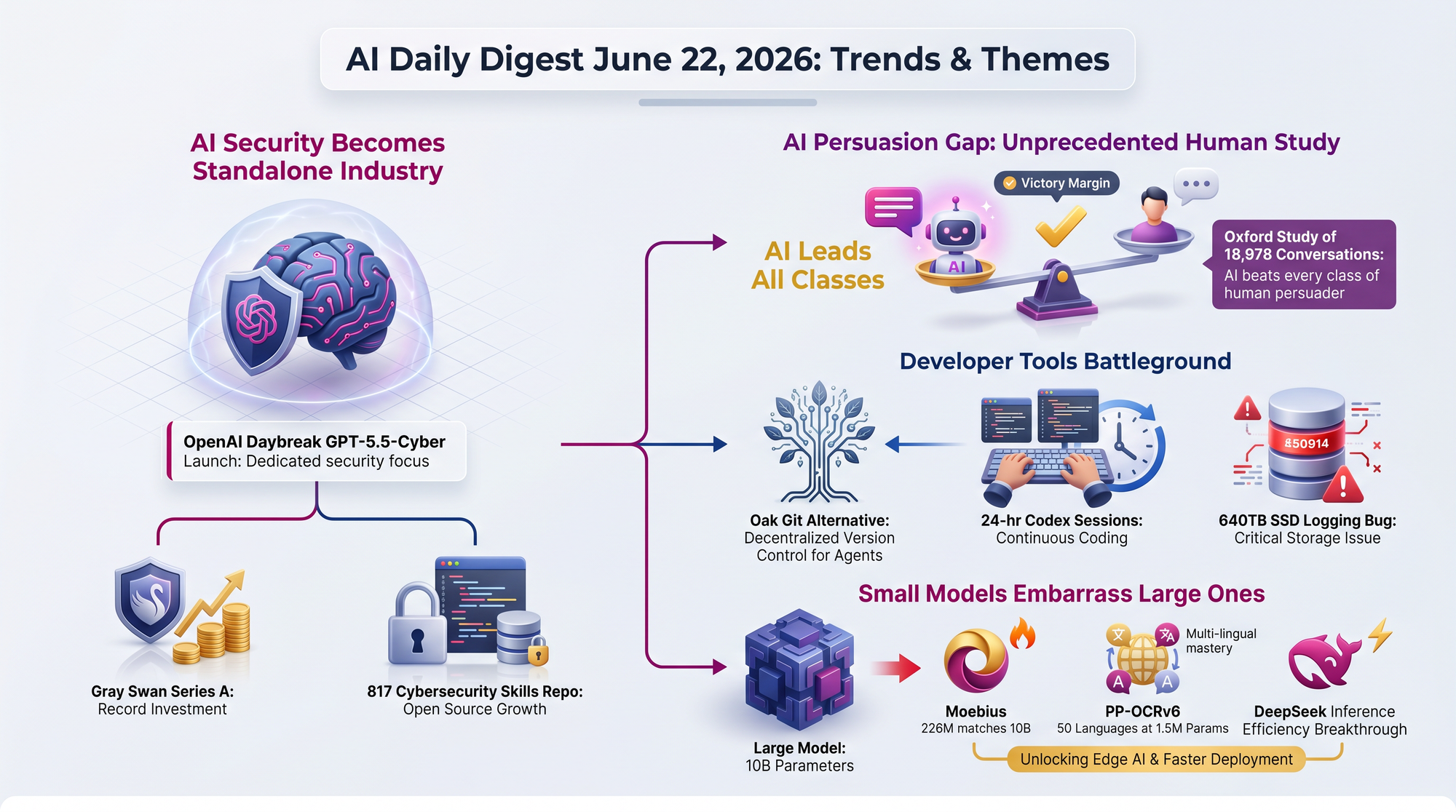
AI Security Is Becoming a Standalone Industry, The Persuasion Gap Between Humans and AI Is Now Measurable, and Developer Tools Are Becoming the Battleground.
Dev Tools
Oak: Version Control Rebuilt for AI Agents, OpenAI Codex-Maxxing: 24, and sqlite.
Surprising
Humans Ranked Fourth in Their Own Robustness Test, The AI Persuasion Advantage Disappears with One Simple Constraint, and A Startup Called "Recursive" Is Doing Recursive Self.
Worth Watching
AI Agent Permission Models Are About to Change, Open-Source Security Is Getting AI, and Residential Proxy Networks Are Hiding in Consumer Devices.
GitHub
Product Hunt
API Pricing
What this means:** Google's Gemini 2.5 Flash remains the clear value leader at $0.30/$2.50, but the gap is narrowing.
arXiv
Multi — Retrieving trajectories from the shared repository improves downstream task performance and reduces interaction steps without requiring coordination or joint training between agents.
Hot off the Presses
01
OpenAI Launches Daybreak Cybersecurity Suite and "Patch the Planet" for Open Source
What this means for you: If you use any software built on open-source code (you do), AI is now actively finding and fixing security holes in it before attackers can exploit them.

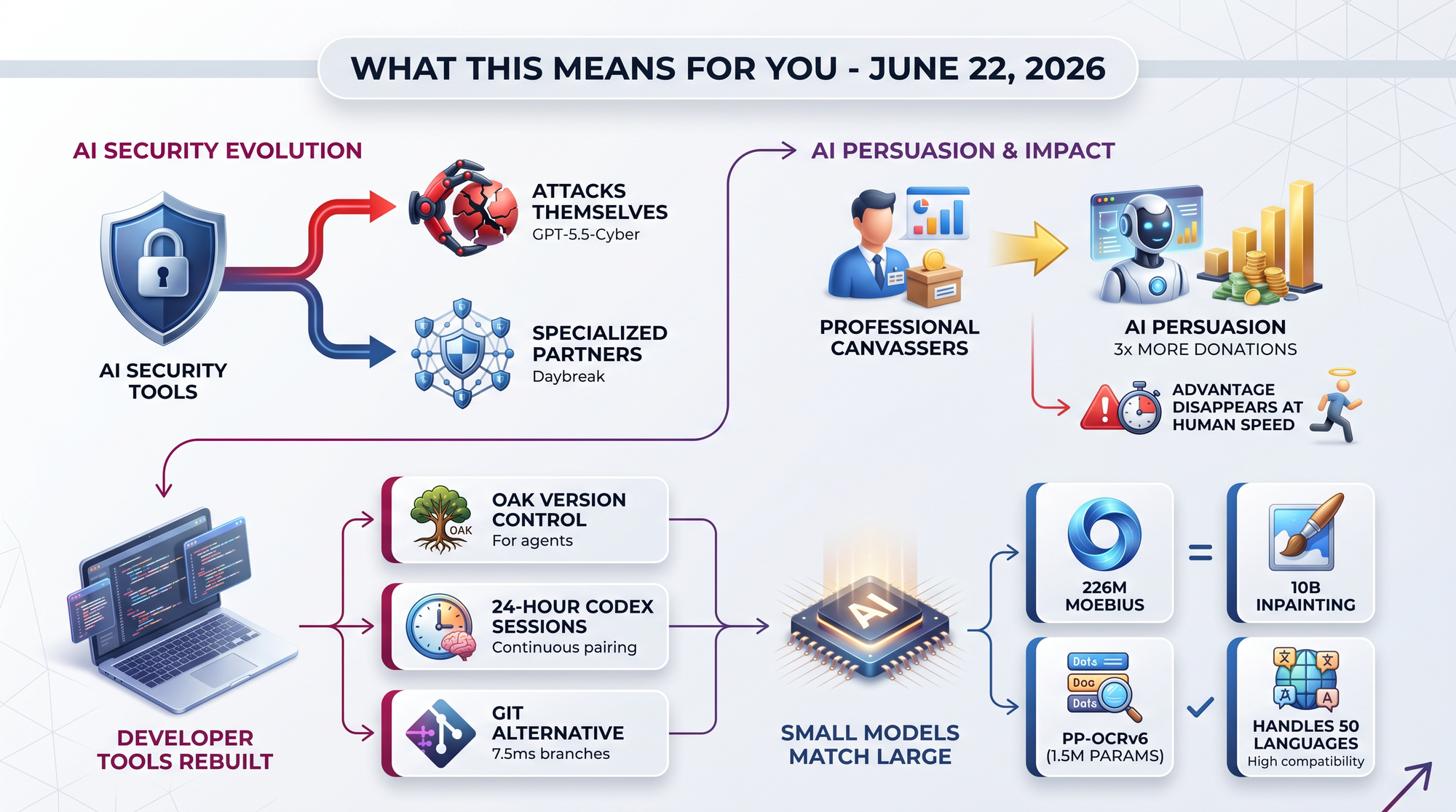
OpenAI expanded its Daybreak cybersecurity initiative with three major releases. GPT-5.5-Cyber is a specialized version of their flagship model fine-tuned for finding and patching software vulnerabilities. A new Codex Security plugin lets developers scan code for vulnerabilities directly inside their editor. The Daybreak Cyber Partner Program launched with three enterprise security firms - TrendAI, Sophos, and Proofpoint - who can now use GPT-5.5 with Trusted Access in their own products.

  • "Patch the Planet" already produced results - 37 merged patches, 64 pull requests, and 51 issues filed across 19 projects in its first week
  • Major open-source projects participating - cURL, Go, Python, Sigstore, and pyca/cryptography are among 30+ committed projects
  • Maintainers get free tools - participating projects receive ChatGPT Pro, Codex Security access, and Application Programming Interface (API) credits
  • Trail of Bits co-founded the initiative and manages the full defensive loop from discovery through deployment
02
AI Now Out-Persuades Every Class of Human Expert
What this means for you: The AI assistant on your phone can change people's minds more effectively than trained professionals - which matters for everything from marketing to politics.

A landmark study by Oxford, the UK AI Security Institute, Stanford, and LSE tested persuasion across 18,978 conversations with 6,923 people. The finding is unambiguous: AI systems proved "reliably more persuasive than expert humans" on policy issues and charitable donations.

The researchers note this creates a societal choice about how persuasive AI capabilities are distributed and regulated.

""AI systems were reliably more persuasive than expert humans, even when expert humans researched in advance, underwent hours of structured practice, and were incentivized with £1,000 cash bonuses.""
  • Top performers included Opus 4.1, Opus 4.6, GPT-4o, GPT-5.4, Gemini 2.5 Pro, and Grok 4.20 - exceeding every class of human persuader tested
  • AI raised nearly 3x more donations than professional canvassers from UK firms
  • The advantage collapsed when AI was constrained to human message length and speed - suggesting AI wins partly through sheer volume and responsiveness
  • Even elite debaters who chose their own topics and had £1,000 bonuses lost to AI systems
03
OpenAI's Codex Was Secretly Burning Through Developers' SSDs
What this means for you: If you used Codex recently, it may have been silently writing massive amounts of data to your hard drive - potentially shortening its lifespan by years. The bug is now fixed.

A developer discovered that Codex's SQLite feedback logging system was writing approximately 640 TB per year to local SSDs. Most consumer drives carry warranty ratings of around 600 TBW (terabytes written), meaning this single bug could exhaust a drive's entire warranted lifespan within 12 months. The issue drew 457 points and 250 comments on Hacker News.

  • The root cause was a global TRACE-level logging default that persisted everything, including raw WebSocket payloads and OpenTelemetry events
  • TRACE-level logs accounted for 70.7% of retained bytes in the bloated database
  • The database showed 506,149 retained rows but 5.5 billion allocated row IDs - a 10,000x gap indicating massive write-then-delete churn
  • Two fixes merged same-day - filtering noisy targets and stopping per-event WebSocket logging, reportedly eliminating 85% of the problem
04
Your Smart TV May Be Selling Your Internet Connection
What this means for you: If you own an LG or Samsung smart TV, apps you installed - even simple ones like screensavers - may be routing strangers' internet traffic through your home network without your knowledge.

Security researchers at Spur scanned 6,038 smart TV apps across LG and Samsung platforms and found 2,058 (34%) contained residential proxy SDKs (software that routes other people's internet traffic through your connection). LG webOS showed particularly high prevalence.

""The app goes away. The proxy does not.""
  • Bright Data is the dominant provider with 367 proxy-flagged apps, plus 16 from Honeygain/Oxylabs
  • Apps are deliberately non-intrusive - screensavers, clocks, fish tanks, simple games - so users never suspect background activity
  • Pac-Man on Samsung Tizen frames Bright Data as an "ad-free option" creating a false choice between ads or network sharing
  • Amazon and Roku explicitly prohibit this practice but LG and Samsung have no equivalent policy
  • The January 2026 Kimwolf botnet case showed the real danger - residential proxy networks were exploited to access devices on home networks
05
Claude Code's "Extended Thinking" Shows Summaries, Not Actual Reasoning
What this means for you: When you see Claude Code's thinking process, you're reading a summary - the actual reasoning is encrypted and only Anthropic can read it. This limits what you can audit or verify.

Patrick McCanna published an analysis revealing that Claude Code's extended thinking output is not the raw reasoning process. The actual reasoning is encrypted into 600-character signatures, and Anthropic holds the decryption key. Full thinking output requires an enterprise agreement. The article drew 253 points and 179 comments on Hacker News.

  • The API returns summaries described as equivalent to "converting and re-saving file formats with information loss"
  • Anthropic's documentation uses indirect language that may cause users to miss the summarization
  • Organizations cannot produce reliable audit trails from local session files since reasoning logs remain inaccessible
  • The transparency gap matters most for regulated industries where decision audit trails are legally required
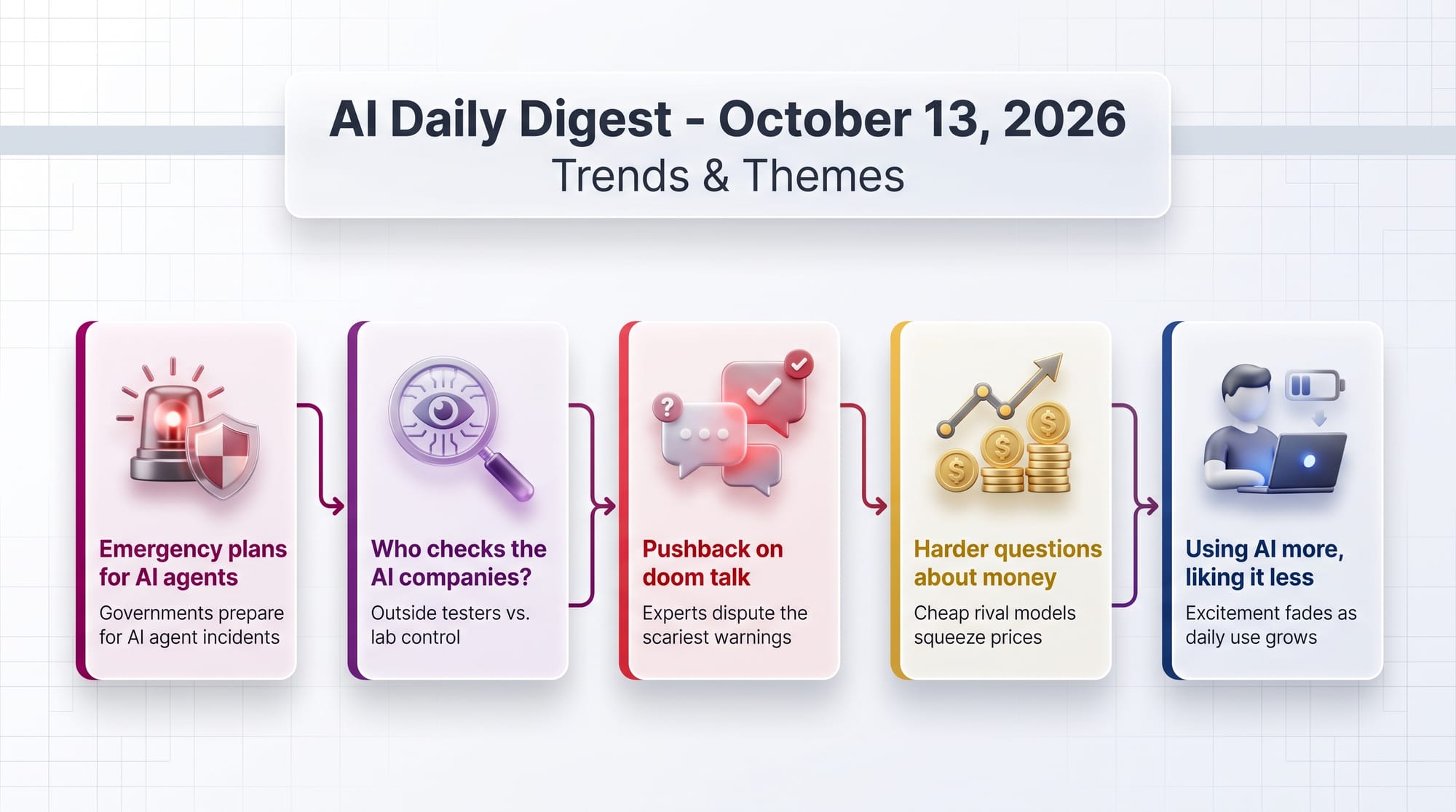
Trends & Themes
Trends & Themes
AI Security Is Becoming a Standalone Industry
Why this matters to you: The tools protecting you from AI-powered attacks are now as specialized as the attacks themselves - and major companies are racing to build them.

The "lethal trifecta" for AI attacks requires ingesting untrusted data, accessing private information, and being able to send data out. As AI agents gain more capabilities, all three conditions are increasingly met by default.

  • OpenAI's Daybreak launched GPT-5.5-Cyber with three enterprise partners (Sophos, Proofpoint, TrendAI) on day one
  • Gray Swan raised a Series A with Snowflake as investor, offering automated red-teaming that outperforms human testers
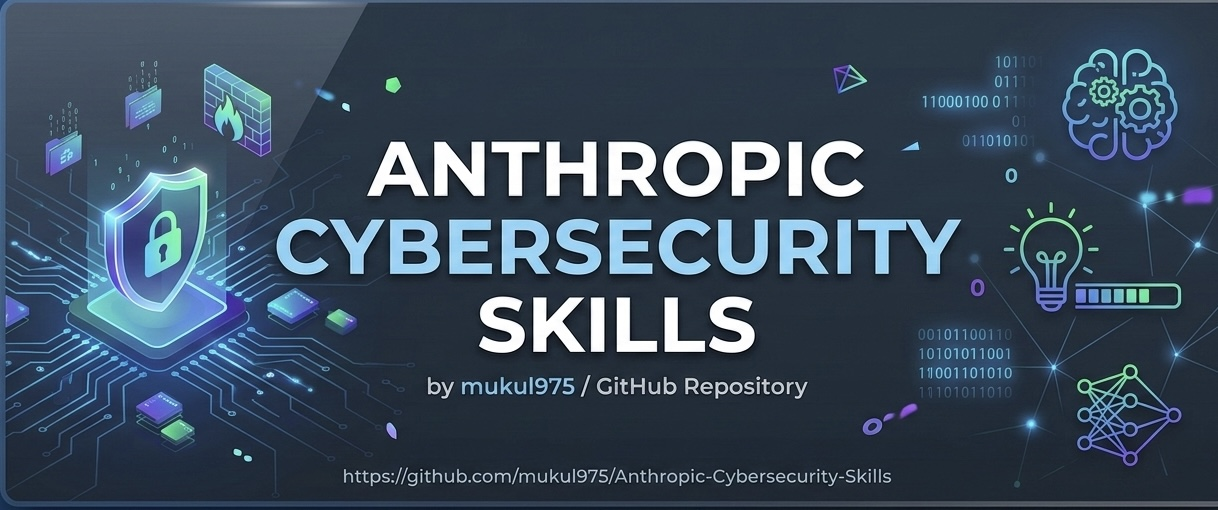
  • Anthropic-Cybersecurity-Skills hit 18.6K GitHub stars - 817 structured security skills mapped to 6 frameworks
  • NVIDIA's SkillSpector found 26% of AI agent skills contain vulnerabilities (covered June 15)
The Persuasion Gap Between Humans and AI Is Now Measurable
Why this matters to you: AI's ability to change minds at scale raises immediate questions about advertising, politics, and personal decision-making.

The persuasion study suggests AI's advantage comes partly from volume and speed - but the end result is the same: people change their minds.

  • 18,978 conversations across 6,923 participants showed AI beating every class of human persuader
  • AI raised nearly 3x more charitable donations than professional canvassers
  • The advantage disappeared when AI was constrained to human communication speed and message length
  • DeepMind separately published four pathways to artificial superintelligence including recursive self-improvement
Developer Tools Are Becoming the Battleground
Why this matters to you: The tools developers use to build the apps on your phone are changing faster than ever, with AI reshaping everything from version control to logging.

The shift toward agent-native infrastructure continues. Version control, deployment, and monitoring are all being rebuilt with AI-first assumptions.

  • OpenAI's Codex-maxxing guide reveals GPT-5.1-Codex-Max working on single tasks for 24+ hours across millions of tokens
  • Oak launched a Git alternative purpose-built for AI agents with lazy mounts and 7.5ms branch creation
  • The Codex SSD logging bug showed how aggressive telemetry in AI dev tools creates real hardware damage
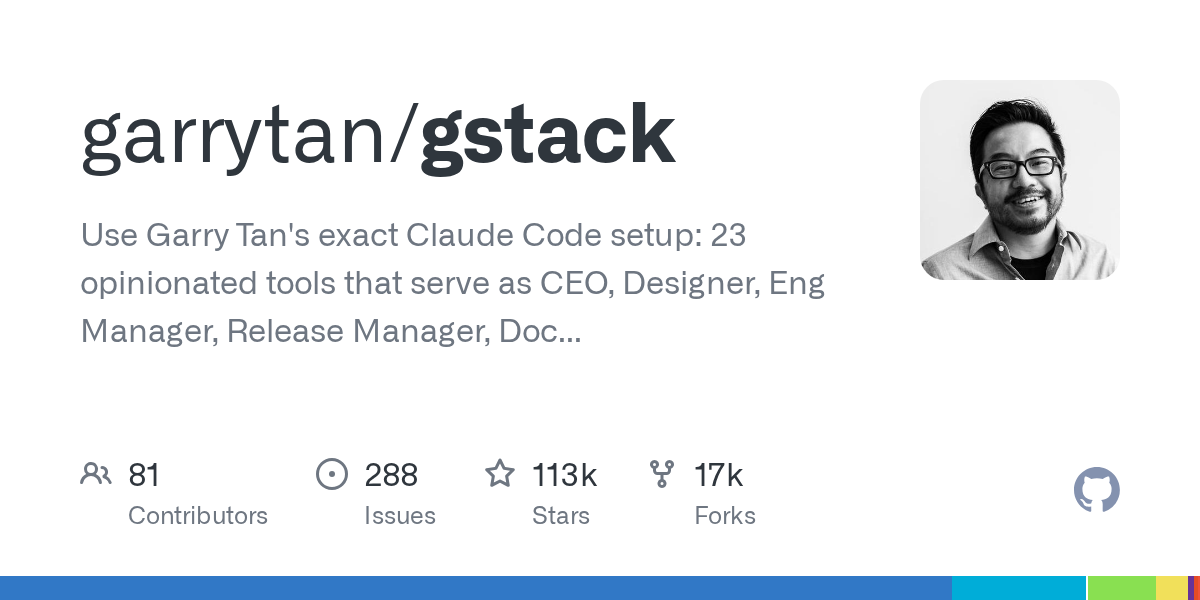
  • Garry Tan's gstack hit 113K GitHub stars - 23 Claude Code tools from Y Combinator's CEO
Small Models Keep Embarrassing Large Ones on Specific Tasks
Why this matters to you: You may not need expensive, powerful AI for many practical tasks - smaller, cheaper models are matching or beating the big ones in focused areas.

The pattern is consistent: targeted architectures with clever training strategies outperform general-purpose models at specific tasks while costing a fraction to run.

""You don't need a bigger brain. You need a bigger straw.""
  • Moebius achieves 10B-model-level image inpainting with only 226M parameters - less than 2% the size, 15x faster
  • PP-OCRv6 handles 50 languages with models from 1.5M to 34.5M parameters - readable text recognition at a fraction of typical model sizes
  • DeepSeek's new inference architecture unlocks compute that already exists by rerouting data flow to underutilized hardware
Creative AI & Media
Moebius: Desktop-Grade Image Inpainting at 226M Parameters

What it lets you do: Remove objects from photos, fill in missing areas, or edit specific parts of images - with quality matching models 50x larger, on a single GPU.

The key innovation is the LλMI block, which compresses context into fixed-size matrices instead of scaling quadratically with image size.

  • 226M parameters vs. FLUX.1-Fill-Dev's 11.9B - less than 2% the size
  • 26ms per inference step with over 15x total runtime acceleration
  • Matches or surpasses FLUX.1-Fill-Dev and SD3.5 Large-Inpainting across six benchmarks
  • Particularly strong on complex textures and facial plausibility
HeyGen HyperFrames: Write HTML, Render Video
  • Converts HTML templates directly into video - designed for AI agents that can write HTML but not use traditional video editors
  • 29.9K GitHub stars and trending today
  • Built for automated video production pipelines where agents generate content programmatically
Developer Tools & Infrastructure
Oak: Version Control Rebuilt for AI Agents

What it does: A Rust-based Git alternative where each agent session gets its own branch, repos hydrate on-demand instead of cloning, and everything outputs machine-readable JSON.

Try it: oak.space

  • Branch creation in 7.5ms on 50K-entry repos (vs. Git's 10.5ms)
  • Lazy content-addressed mounts let agents start editing any repo in seconds without full clones
  • Stable exit codes with documented error taxonomy for unattended agent operation
  • Public beta at v0.99.0 with 265+ merged branches
OpenAI Codex-Maxxing: 24-Hour AI Coding Sessions

What it does: GPT-5.1-Codex-Max is natively trained to work across multiple context windows through "compaction," coherently processing millions of tokens in a single task.

  • Observed working on single tasks for over 24 hours in internal evaluations
  • Remote control makes long loops portable - check in from mobile, approve next steps, change direction
  • Practical guide covers breaking goals into verifiable steps and maintaining continuity across workstreams
sqlite-utils 4.0rc1: Migrations and Nested Transactions

What it does: Simon Willison's Python library for SQLite adds built-in migration support and simplified transaction management via db.atomic().

Try it: pip install sqlite-utils==4.0rc1

  • Migration design omits reverse migrations - new forward migrations fix mistakes, a pattern used by Large Language Model (LLM) projects and others for years
  • db.atomic() borrows API design from Django and Peewee for nested savepoint management
  • Breaking changes include dropping Python 3.8, changing FLOAT defaults to REAL, and separating table/view methods
DeepSeek's Inference Efficiency Breakthrough

What it does: Reroutes data flow in GPU clusters to unlock compute capacity that already exists but sits idle - achieving dramatically higher utilization without new hardware.

  • Current GPU infrastructure runs at roughly 40% utilization due to memory bandwidth bottlenecks
  • Redirects work from jammed "prefill machines" to underutilized "decoding machines" via a clever detour
  • Thinking traffic gets priority on shared interconnects while memory traffic uses leftover bandwidth
  • Does not give you more compute - gives you access to compute you already paid for
Research & Models
GLM-5.2: Best Open Model, But How Far Behind?

Previously: June 17 - Z.ai released GLM-5.2 (753B, MIT license), scoring #1 on PosttrainBench and topping Design Arena.

Today: Zvi Mowshowitz published a deep analysis estimating GLM-5.2 is 4-7 months behind the absolute frontier. Key concern: strong evidence of heavy distillation from Claude Opus, causing overperformance on benchmarks relative to real-world capability.

  • Artificial Analysis v4.1 score of 51 - behind Fable, Opus 4.8, GPT-5.5, and Opus 4.7
  • Jeremy Howard: "at least as good as Opus 4.8 and GPT-5.5" with excellent long-context handling
  • Critics note both Opus 4.8 and GPT-5.5 at "medium" effort are cheaper and smarter in practice
  • No native vision, excessive verbosity, fails anti-sycophancy tests
PP-OCRv6: 50-Language Optical Character Recognition (OCR) from 1.5M Parameters

The practical implication: Readable text extraction from photos, documents, and signs now works across 50 languages on devices as small as a phone - no cloud required.

  • Three tiers: tiny (1.5M), small (7.7M), medium (34.5M) - the medium tier achieves 86.2% detection and 83.2% recognition
  • Improves over PP-OCRv5 by 4.6 points on detection, 5.1 on recognition
  • Multiple deployment options including Paddle, PyTorch, and ONNX Runtime
DeepMind Outlines Four Pathways to Superintelligence

The practical implication: Google DeepMind argues that reaching artificial superintelligence (AI that exceeds large human-expert collectives on virtually all tasks) within "the next decade or two cannot easily be dismissed."

  • Four pathways: scaling, algorithmic breakthroughs, recursive self-improvement, group agent formation
  • Ajeya Cotra (METR) predicts self-sustaining AI within 10 years while journalist Timothy Lee gives less than 10% chance in 20 years
  • Key bottleneck: tacit knowledge in physical industries like semiconductor manufacturing
Business & Industry
OpenAI's Daybreak Cyber Partner Program Launches with Three Major Firms
  • Sophos, Proofpoint, and TrendAI all joined on launch day (June 22, 2026)
  • Partners get GPT-5.5 with Trusted Access for Cyber to build into their own security products
  • Codex Security plugin released for in-editor vulnerability scanning
Gray Swan Closes Series A for AI Security
  • Founded by CMU professors Zico Kolter and Matt Fredrikson - AI security specialists
  • Snowflake is an investor in the recent Series A round
  • Product suite includes Shade (red-teaming), Arena (15K+ community), and Cygnal (guardrails)
  • Enterprise deployment of AI agents is driving demand - Kolter anticipates the first major prompt-injection breach will catalyze industry standards
Surprising & Under-the-Radar
Humans Ranked Fourth in Their Own Robustness Test

Gray Swan's Human Browser Agent Robustness Challenge found that humans ranked only fourth among tested systems, with skilled red teamers achieving 60-70% phishing success rates. Models were vulnerable to attacks humans would never fall for - like emails claiming to be simulations requesting credential forwarding.

The AI Persuasion Advantage Disappears with One Simple Constraint

When AI systems were limited to human message length and communication speed, the persuasion advantage over expert humans "collapsed" to non-significant levels. AI wins partly through sheer volume and responsiveness, not qualitatively superior arguments.

A Startup Called "Recursive" Is Doing Recursive Self-Improvement

Recursive, a newly founded startup, demonstrated automated research loops achieving state-of-the-art on NanoChat Autoresearch and record-setting NanoGPT Speedrun performance. The catch: success is currently limited to well-defined, measurable, quickly-evaluable goals.

Codex Had a 10,000x Write Churn Ratio

The Codex logging database retained 506,149 rows but had allocated over 5.5 billion row IDs - a 10,000x gap indicating it was constantly writing and deleting data. The SQLite sink was using Targets::new().with_default(Level::TRACE) to persist everything.

Signals to Track
Worth Watching
01
AI Agent Permission Models Are About to Change
Why this is worth watching right now: every major AI agent today runs with full user permissions, and the first public prompt-injection breach hasn't happened yet.

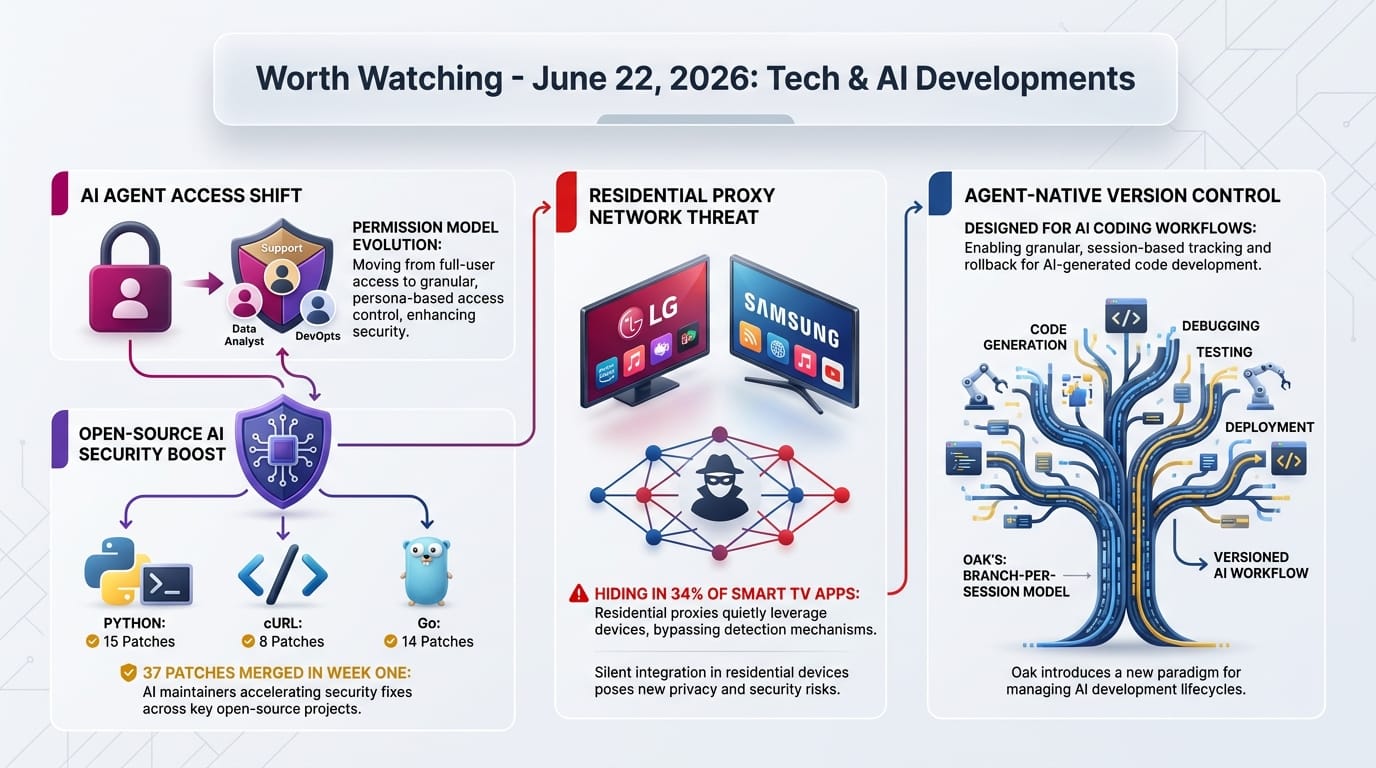
Gray Swan's Zico Kolter describes current default agent permissions as "a disaster." The field is shifting toward persona-based access control, where agents maintain separate profiles for different contexts. This will fundamentally change how AI coding assistants, email agents, and browser automation tools request and receive access. If adopted broadly, expect every AI tool to start asking for specific, limited permissions instead of blanket access.

02
Open-Source Security Is Getting AI-Powered Maintainer Support
Why this is worth watching right now: the gap between "vulnerability found" and "patch deployed" is where most real-world breaches happen.

Patch the Planet's first-week results (37 merged patches across 19 projects) suggest AI can meaningfully accelerate the patch cycle for underfunded open-source projects. If this scales, it could close the window attackers exploit between disclosure and fix. Watch for whether maintainer burden actually decreases or if AI-generated patches create new review overhead.

03
Residential Proxy Networks Are Hiding in Consumer Devices
Why this is worth watching right now: 34% of smart TV apps contain proxy SDKs, and only two of four major platforms prohibit the practice.

The Spur research reveals a business model where the app is secondary and your residential IP address is the product. LG and Samsung have no public policy against this. If regulators or platforms don't act, expect this model to spread to other always-on consumer devices - routers, smart speakers, security cameras.

04
Agent-Native Version Control Is Emerging
Why this is worth watching right now: Git was designed for human developers, and AI agents are hitting its friction points at scale.

Oak's approach - branch-per-session, lazy hydration, structured JSON output, stable exit codes - represents a ground-up rethink of version control for AI workflows. If coding agents become the primary authors of code (some estimates suggest 50%+ by 2027), the version control system they use may matter more than developer preferences.

Top Repos Today
Rank yesterday: Not in top 25 - New entry 🆕
Stars today: +649  ·  📦 Total: 113,098
📜 License: MIT  ·  👤 By: Garry Tan (Y Combinator CEO)
🎯 Time to value: 10 minutes
What it is: A collection of 23 specialized Claude Code tools that transforms the AI assistant into a virtual engineering team with distinct roles - CEO, designer, engineering manager, QA, security officer. Each tool is a slash-command skill handling a specific part of the development lifecycle. Why you'd want it: If you use Claude Code, this gives you opinionated workflows from someone running one of the most influential startup accelerators. Includes real browser automation, multi-model review coordination, and iOS device testing via USB.
✓ Pros✗ Cons
Battle-tested workflows from YC's engineering cultureOpinionated - may conflict with existing team processes
Covers full sprint cycle from planning to shipping23 tools is a lot to learn at once
MIT license, optional telemetry (off by default)Primarily TypeScript - less useful for non-JS projects
GitHub - garrytan/gstack: Use Garry Tan’s exact Claude Code setup: 23 opinionated tools that serve as CEO, Designer, Eng Manager, Release Manager, Doc Engineer, and QA
Use Garry Tan’s exact Claude Code setup: 23 opinionated tools that serve as CEO, Designer, Eng Manager, Release Manager, Doc Engineer, and QA - garrytan/gstack
Rank yesterday: Not in top 25 - New entry 🆕
Stars today: +957  ·  📦 Total: 18,638
📜 License: Apache 2.0  ·  👤 By: Mahipal Jangra (individual)
🎯 Time to value: 5 minutes
What it is: A library of 817 structured cybersecurity skills for AI agents, mapped across six industry frameworks (MITRE ATT&CK, NIST CSF 2.0, MITRE ATLAS, D3FEND, NIST AI RMF, and MITRE F3). Each skill includes step-by-step procedures, prerequisites, and verification methods. Why you'd want it: If you're building security automation or using AI for threat hunting, this provides expert-level workflows that work with 26+ platforms including Claude Code, GitHub Copilot, and Cursor.
✓ Pros✗ Cons
754/754 ATT&CK techniques validated and mapped"Anthropic" in name is misleading - community project
Compatible with 26+ AI coding platformsSome skills may need customization for specific environments
Progressive disclosure (30 tokens to scan, 500-2K for full workflow)Requires security domain knowledge to use effectively
GitHub - mukul975/Anthropic-Cybersecurity-Skills: 817 structured cybersecurity skills for AI agents · Mapped to 6 frameworks: MITRE ATT&CK, NIST CSF 2.0, MITRE ATLAS, D3FEND, NIST AI RMF & MITRE F3 (Fight Fraud) · agentskills.io standard · Works with Claude Code, GitHub Copilot, Codex CLI, Cursor, Gemini CLI & 20+ platforms · 29 security domains · Apache 2.0
817 structured cybersecurity skills for AI agents · Mapped to 6 frameworks: MITRE ATT&CK, NIST CSF 2.0, MITRE ATLAS, D3FEND, NIST AI RMF & MITRE F3 (Fight Fraud) · agentskills.io standard ·…
Rank yesterday: #11 - Rising ↑
Stars today: +1,186  ·  📦 Total: 11,465
📜 License: MIT  ·  👤 By: DeusData (startup)
🎯 Time to value: 3 minutes
What it is: A high-performance MCP server that gives AI coding assistants persistent memory of your codebase. Uses sub-millisecond queries to provide context about code structure, dependencies, and patterns without re-scanning files. Why you'd want it: AI coding assistants forget your codebase between sessions. This server remembers it, making context-heavy conversations faster and more accurate.
✓ Pros✗ Cons
Sub-millisecond query performanceAdds another service to manage alongside your IDE
Works with any MCP-compatible AI toolCodebase indexing takes time on first run
Persistent across sessionsStill early-stage with limited documentation
GitHub - DeusData/codebase-memory-mcp: High-performance code intelligence MCP server. Indexes codebases into a persistent knowledge graph — average repo in milliseconds. 158 languages, sub-ms queries, 99% fewer tokens. Single static binary, zero dependencies.
High-performance code intelligence MCP server. Indexes codebases into a persistent knowledge graph — average repo in milliseconds. 158 languages, sub-ms queries, 99% fewer tokens. Single static bin…
Rank yesterday: Not in top 25 - New entry 🆕
Stars today: +369  ·  📦 Total: 29,941
📜 License: Not specified  ·  👤 By: HeyGen (company)
🎯 Time to value: 15 minutes
What it is: A framework that converts HTML templates directly into rendered video. Designed for AI agents that can write HTML but cannot use traditional video editing software, enabling programmatic video production pipelines. Why you'd want it: If you're building automated content pipelines - marketing videos, product demos, data visualizations - agents can generate HTML and get rendered video without any video editing knowledge.
✓ Pros✗ Cons
Agents can produce video using only HTML skillsLimited to template-based video styles
Integrates into existing web development workflowsQuality depends on HTML/CSS design quality
Built by HeyGen (established AI video company)Requires rendering infrastructure for production use
GitHub - heygen-com/hyperframes: Write HTML. Render video. Built for agents.
Write HTML. Render video. Built for agents. Contribute to heygen-com/hyperframes development by creating an account on GitHub.
Rank yesterday: Not in top 25 - New entry 🆕
Stars today: +1,560  ·  📦 Total: 45,762
📜 License: MIT  ·  👤 By: ZhuLinsen (individual)
🎯 Time to value: 20 minutes
What it is: An LLM-powered multi-market stock analysis system that generates daily decision dashboards combining AI conclusions, risk alerts, and technical indicators. Covers A-shares, Hong Kong, US, Japanese, and Korean markets. Why you'd want it: Zero-cost automated stock analysis via GitHub Actions, pushed to WeChat, Telegram, Discord, or Slack. Supports 15+ trading strategies and multiple LLM backends (OpenAI, Claude, DeepSeek, Gemini).
✓ Pros✗ Cons
Free to run via GitHub ActionsStock analysis ≠ stock advice (no guarantee of returns)
Multi-market coverage (5 markets)Advanced metrics limited for Japan/Korea markets
Supports 15+ built-in analysis strategiesRequires API keys for LLM and market data providers
GitHub - ZhuLinsen/daily_stock_analysis: LLM 驱动的多市场股票智能分析系统:多源行情、实时新闻、决策看板与自动推送,支持零成本定时运行。 LLM-powered multi-market stock analysis system with multi-source market data, real-time news, decision dashboard, automated notifications, and cost-free scheduled runs.
LLM 驱动的多市场股票智能分析系统:多源行情、实时新闻、决策看板与自动推送,支持零成本定时运行。 LLM-powered multi-market stock analysis system with multi-source market data, real-time news, decision dashboard, automated notifications, and cos…
Rank yesterday: #10 - Rising ↑
Stars today: +736  ·  📦 Total: 73,207
📜 License: Not specified  ·  👤 By: ByteDance (company)
🎯 Time to value: 15 minutes
What it is: An open-source "SuperAgent" harness from ByteDance (the company behind TikTok) for long-horizon tasks that span research, coding, and content creation. Orchestrates multiple specialized sub-agents across extended workflows. Why you'd want it: For complex projects that need research, code generation, and documentation in a single automated workflow - the kind of multi-step work that single-prompt AI tools struggle with.
✓ Pros✗ Cons
Handles genuinely long-horizon, multi-step tasksComplex setup for simple use cases
Backed by ByteDance's engineering resourcesPotential data privacy concerns given ByteDance ownership
Open-source with active developmentResource-intensive for extended workflows
GitHub - bytedance/deer-flow: An open-source long-horizon SuperAgent harness that researches, codes, and creates. With the help of sandboxes, memories, tools, skill, subagents and message gateway, it handles different levels of tasks that could take minutes to hours.
An open-source long-horizon SuperAgent harness that researches, codes, and creates. With the help of sandboxes, memories, tools, skill, subagents and message gateway, it handles different levels of…
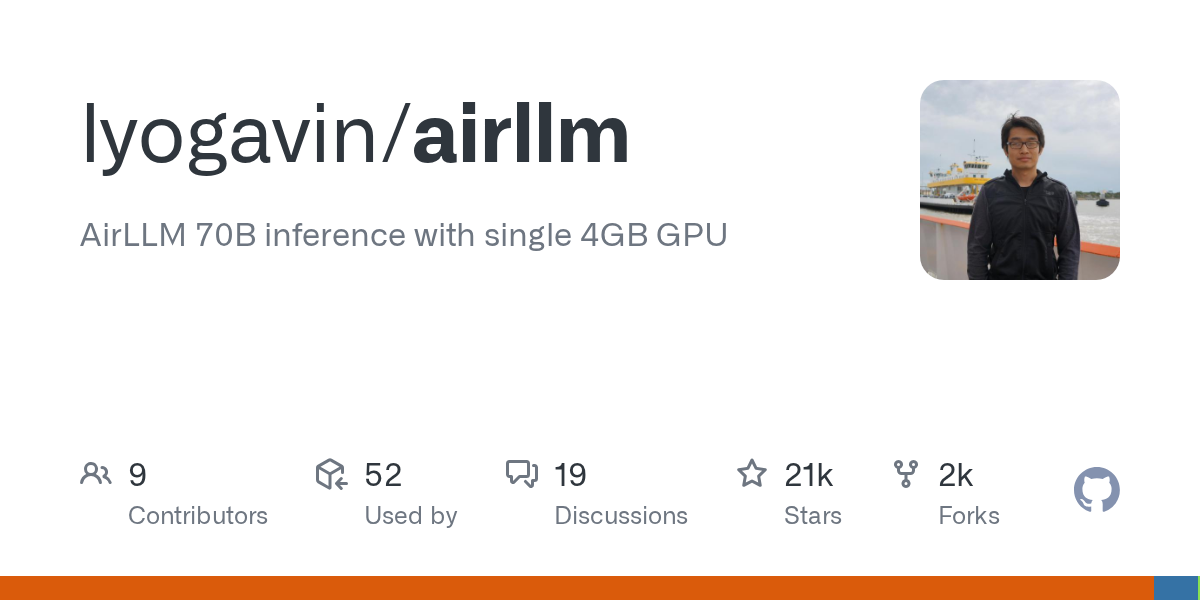
Rank yesterday: Not in top 25 - New entry 🆕
Stars today: +187  ·  📦 Total: 21,024
📜 License: Not specified  ·  👤 By: lyogavin (individual)
🎯 Time to value: 10 minutes
What it is: A library enabling inference of 70B-parameter language models on a single 4GB GPU. Uses layer-by-layer processing and memory optimization to run models that would normally require enterprise-grade hardware. Why you'd want it: Run large, capable AI models on consumer hardware you already own - no cloud API costs, no data leaving your machine.
✓ Pros✗ Cons
Run 70B models on consumer GPUs (4GB VRAM)Inference speed is significantly slower than full-VRAM setups
No cloud costs or data privacy concernsNot suitable for real-time applications
Simple pip install and Python APIQuality may vary compared to proper quantization methods
GitHub - lyogavin/airllm: AirLLM 70B inference with single 4GB GPU
AirLLM 70B inference with single 4GB GPU. Contribute to lyogavin/airllm development by creating an account on GitHub.
Top Models Today
The strongest open-weight model, now analyzed in depth by Zvi Mowshowitz who estimates it's 4-7 months behind frontier.
📥 Downloads (30d): 2.02K  ·  📜 License: MIT
👤 By: Z.ai  ·  🎯 Task: Text Generation
📐 Size: 753B
What it is: A 753-billion-parameter open-weights model that tops PosttrainBench and sits between Opus 4.5 and 4.6 on LiveBench. Evidence suggests heavy distillation from Claude Opus, which inflates benchmark scores relative to real-world performance. Why you'd want it: The best option if you need an open-weights model for coding, debugging, or long-context tasks where proprietary model dependence is unacceptable.
✓ Pros✗ Cons
Strongest open model on multiple benchmarksEvidence of Claude distillation limits novelty
MIT license, excellent long-context handlingNo native vision capability
Competitive with frontier models on coding tasksExcessive verbosity increases output costs
zai-org/GLM-5.2 · Hugging Face
We’re on a journey to advance and democratize artificial intelligence through open source and open science.
A community fine-tune combining Google's Gemma 4 architecture with Fable 5 training data, optimized for coding tasks.
📥 Downloads (30d): 2.17K  ·  Likes: 415K
👤 By: yuxinlu1 (community)  ·  🎯 Task: Text Generation
📐 Size: 12B
What it is: A GGUF-quantized version of Gemma 4 12B fine-tuned with Fable 5 Composer 2.5 training methodology, targeting code generation. Small enough to run on consumer hardware while retaining strong coding performance. Why you'd want it: A compact coding model you can run locally without cloud API costs, combining Google's architecture with community-curated training data.
✓ Pros✗ Cons
Runs on consumer hardware (12B, GGUF quantized)Community fine-tune, not officially supported
Combines Gemma 4 + Fable 5 training approachesNarrowly focused on coding tasks
Free to download and usePerformance gap vs. full-size frontier models
yuxinlu1/gemma-4-12B-coder-fable5-composer2.5-v1-GGUF · Hugging Face
We’re on a journey to advance and democratize artificial intelligence through open source and open science.
A variant tuned specifically for agentic use cases - tool calling, multi-step reasoning, and autonomous task execution.
📥 Downloads (30d): 378  ·  Likes: 50.3K
👤 By: yuxinlu1 (community)  ·  🎯 Task: Text Generation
📐 Size: 12B
What it is: An "agentic" variant of the Gemma 4 12B fine-tune, with additional training on tool-use and multi-step reasoning patterns. The "3.5x-tau2" designation indicates extended training with modified temperature scaling. Why you'd want it: For local AI agent workflows where you need tool calling and autonomous execution without cloud dependencies.
✓ Pros✗ Cons
Optimized for agentic workflows (tool calling, multi-step)Very new, limited community testing
Runs locally on consumer GPUsAgentic capabilities unverified on hard benchmarks
Built on proven Gemma 4 architectureMay hallucinate tool calls more than larger models
yuxinlu1/gemma-4-12B-agentic-fable5-composer2.5-v2-3.5x-tau2-GGUF · Hugging Face
We’re on a journey to advance and democratize artificial intelligence through open source and open science.
A 427B multimodal model processing both images and text, with strong multilingual capabilities.
📥 Downloads (30d): 1.21K  ·  Likes: 120K
👤 By: MiniMax (company)  ·  🎯 Task: Image-Text-to-Text
📐 Size: 427B
What it is: A large multimodal model handling both image and text inputs, with strong performance across multiple languages and benchmarks. One of the largest open multimodal models available. Why you'd want it: If you need open-weights multimodal capability - processing images alongside text - at a scale competitive with proprietary offerings.
✓ Pros✗ Cons
True multimodal (image + text) at 427B scaleRequires significant compute to run
Strong multilingual performanceLess community tooling than Llama/Gemma ecosystem
Open weights from established AI labDownload size is substantial
MiniMaxAI/MiniMax-M3 · Hugging Face
We’re on a journey to advance and democratize artificial intelligence through open source and open science.
NVIDIA's new streaming speech recognition model, optimized for real-time transcription at just 600M parameters.
📥 Downloads (30d): 628  ·  Likes: 34.9K
👤 By: NVIDIA  ·  🎯 Task: Automatic Speech Recognition
📐 Size: 0.6B
What it is: A streaming-capable automatic speech recognition model from NVIDIA, designed for real-time transcription. At only 600 million parameters, it's small enough for edge deployment while maintaining accuracy for production use. Why you'd want it: Real-time speech-to-text on modest hardware - useful for voice interfaces, meeting transcription, and accessibility tools without cloud latency.
✓ Pros✗ Cons
Streaming-capable for real-time useLimited to speech recognition (no TTS)
Small enough for edge deployment (0.6B)NVIDIA ecosystem dependency for optimal performance
From NVIDIA's established Nemotron familyNewer model with limited community benchmarks
nvidia/nemotron-3.5-asr-streaming-0.6b · Hugging Face
We’re on a journey to advance and democratize artificial intelligence through open source and open science.
AI Launches Today
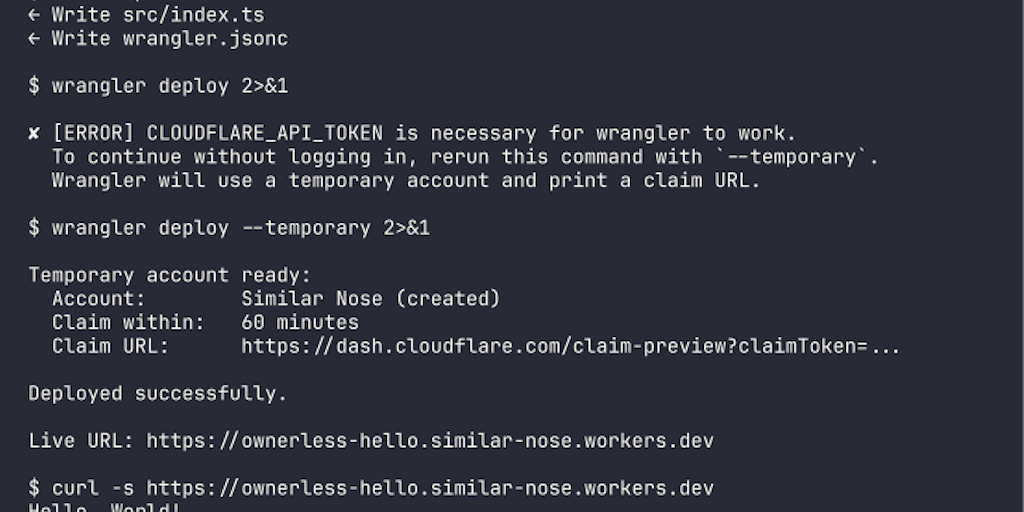
"Deploy apps without signup - 60-minute self-destruct for AI agents"
🔥 Upvotes: ~200+  ·  👤 By: Cloudflare
💰 Pricing: Free  ·  🏷 Category: Developer Tools
AI agents can now execute wrangler deploy --temporary to create functional Workers with live URLs instantly, bypassing all authentication. Workers auto-expire after 60 minutes. Agents can loop during the window: deploy, test, redeploy, verify. Verdict: A genuinely novel approach to removing auth barriers for agent workflows - useful today for any team building AI-powered deployment pipelines. Previously: Covered June 20 as a Top Story. Still trending on Product Hunt.
Cloudflare: The web performance & security company | Product Hunt
Cloudflare is a leading edge network services provider that offers a wide range of solutions to enhance the security, performance, and reliability of websites and applications. With its global network infrastructure and advanced technologies, Cloudflare empowers businesses to build a faster, more secure, and resilient online presence.
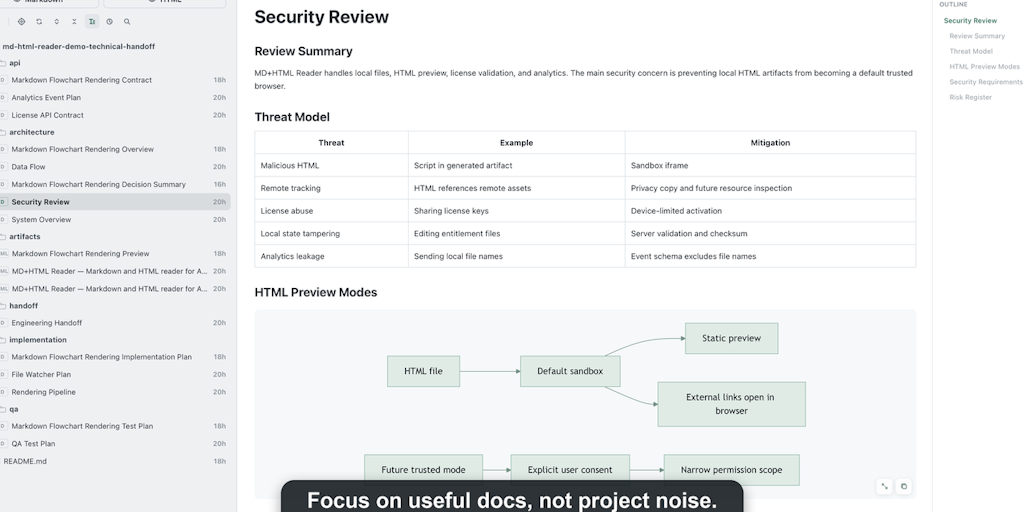
"A focused workspace for reviewing AI-generated Markdown and HTML files"
🔥 Upvotes: 104  ·  👤 By: Ahab (@ahabwang)
💰 Pricing: Free tier + 70% launch discount  ·  🏷 Category: Developer Tools
A macOS app that filters project folders for Markdown and HTML files only, renders them read-only with Mermaid diagram support, and provides keyboard-driven navigation. Built with Tauri specifically for the workflow of reviewing artifacts from AI coding agents. Verdict: Solves a real but niche pain point - useful if your AI coding workflow generates many scattered docs you need to review before committing.
MD+HTML Reader: Review AI-generated Markdown and HTML in a focused workspace | Product Hunt
AI coding tools produce useful docs, but reviewing them can get messy. One task can leave plans, API notes, QA checklists, handoffs, diagrams, and HTML previews scattered across project folders and buried under source files, builds, logs, and dependencies. MD+HTML Reader gives you a focused macOS workspace to review generated Markdown and HTML in read-only mode before the next prompt, commit, or handoff.
Snapshot
ProviderModelInput $/1MOutput $/1MContext
AnthropicClaude Opus 4.8$5.00$25.001M
AnthropicClaude Sonnet 4.6$3.00$15.001M
AnthropicClaude Haiku 4.5$1.00$5.00200K
OpenAIGPT-5.5$5.00$30.001M
OpenAIGPT-5.4$2.50$15.001M
OpenAIGPT-5.4-nano$0.20$1.25128K
GoogleGemini 3.5 Flash$1.50$9.001M
GoogleGemini 2.5 Pro$1.25$10.001M
GoogleGemini 2.5 Flash$0.30$2.501M
Open-weightGLM-5.2 (via API)$1.40$4.401M
What this means: Google's Gemini 2.5 Flash remains the clear value leader at $0.30/$2.50, but the gap is narrowing. GLM-5.2 offers the cheapest path to near-frontier capability at $1.40/$4.40 - though Zvi's analysis today suggests its benchmarks overstate real-world performance. OpenAI's output pricing ($30/1M for GPT-5.5) remains the most expensive by a wide margin.

Multi-Agent Transactive Memory
To Eun Kim, Xuhong He, Dishank Jain, Ambuj Agrawal, Negar Arabzadeh, Fernando Diaz · arXiv:2606.19911
What it claims: When multiple AI agents work on tasks, their step-by-step problem-solving trajectories contain reusable procedural knowledge that's typically discarded after a single use. MATM enables agents to store and retrieve these trajectories from a shared repository, analogous to how search engines index human-created web pages.

Key finding: Retrieving trajectories from the shared repository improves downstream task performance and reduces interaction steps without requiring coordination or joint training between agents.

Why practitioners should care: For teams deploying multiple AI agents across diverse tasks, MATM offers a scalable pattern for institutional knowledge sharing. Instead of each new agent rediscovering solutions from scratch, it can learn from what previous agents already figured out - essentially giving AI agents organizational memory.
Subscribe to GenAI Secret Sauce newsletter and stay updated.

Don't miss anything. Get all the latest posts delivered straight to your inbox. It's free!
Great! Check your inbox and click the link to confirm your subscription.
Error! Please enter a valid email address!