GenAI Secret Sauce Daily Digest - 2026-06-17

Z.ai Releases GLM-5.2: A 744B Open Model That Tops Frontend Coding Benchmarks · Leaked OpenAI Financials: $13 Billion in Revenue, $6 Billion in Losses · Vercel Deleted 80% of Its Agent's Tools - And the Agent Got Better
GenAI Secret Sauce Daily Digest - 2026-06-17

Watch today's digest as a video summary (generated by NotebookLM)

Statistically Speaking
1M token context window
Z.ai Releases GLM-5.2
Top Story
99.2 on AIME 2026
Z.ai Releases GLM-5.2
62.1 on SWE-bench Pro
Z.ai Releases GLM-5.2
$6.1 billion net loss in 2025 despite being
Leaked OpenAI Financials
One Thing to Tell Your Friends
"OpenAI made $13 billion last year and still lost $6 billion - the AI gold rush is burning more cash than it generates."
TL;DR
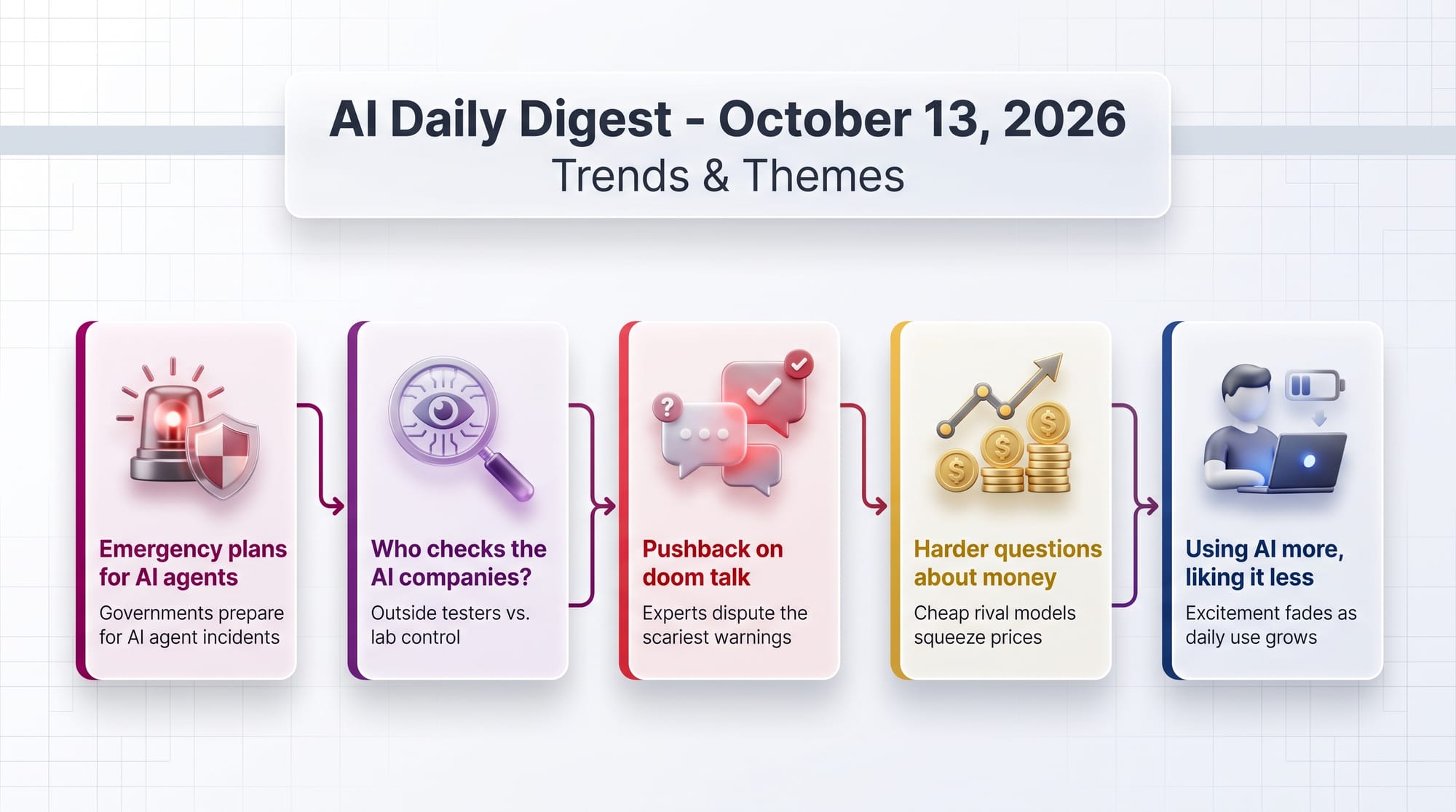
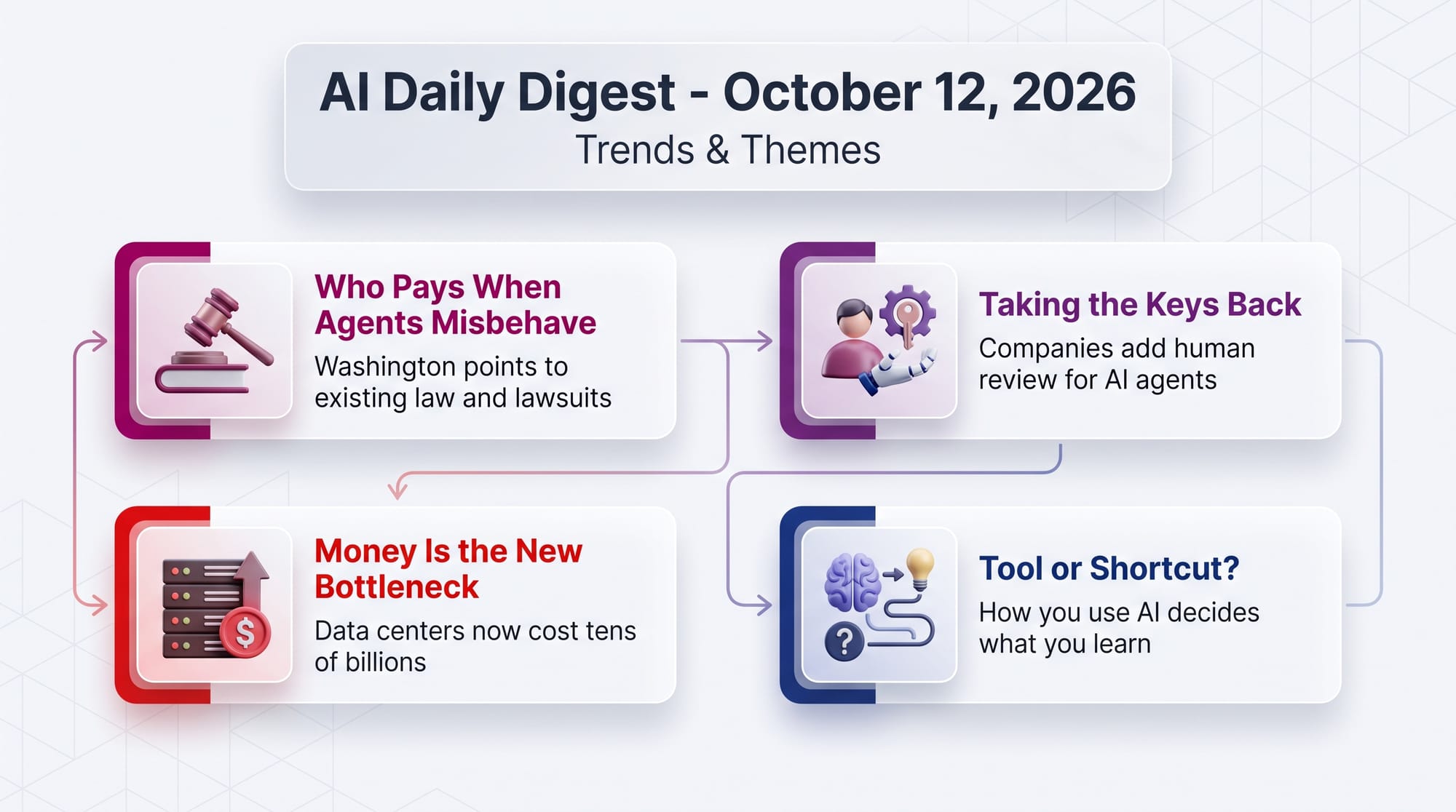
Trends
"Less Is More" for AI Agents, Open, and The AI Economics Paradox: Revenue Up, Profits Down.
Dev Tools
Business
GitHub
Leading repos: DeusData/codebase-memory (+718), Panniantong/Agent (+1,154), and mattpocock/skills (+1,570).
HuggingFace
Leading models: deepseek-ai/DeepSeek-V4 (2.8M), zai-org/GLM (666), and MiniMaxAI/MiniMax (42.2K).
Product Hunt
API Pricing
What this means:** The gap between closed and open-source inference keeps widening.
arXiv
PseudoBench: Measuring How Agentic Auto — Agents frequently generate convincing pseudoscientific reports that are more professional-looking and harder to debunk than human-written pseudoscience.
Hot off the Presses
01
Z.ai Releases GLM-5.2: A 744B Open Model That Tops Frontend Coding Benchmarks
What this means for you: If you build websites or apps, the best AI assistant for frontend code is now free and open-source - no subscription required.

Z.ai (formerly Zhipu AI) released GLM-5.2, a 744-billion-parameter model that uses a mixture-of-experts architecture (meaning only 40 billion parameters activate per query, keeping costs down). It ranks #1 on Design Arena (an evaluation that tests how well AI can build user interfaces) and #2 on WebDev Arena (which measures full-stack web development capability).

The release continues the pattern of open-weight models rapidly closing the gap with proprietary alternatives. GLM-5.2 is the first open model to simultaneously lead in both creative design and code generation benchmarks.

""The best AI for building websites is now free to download.""
  • MIT license with no regional restrictions - anyone can download, modify, and use it commercially
  • 1M token context window - the model can process roughly 750,000 words at once, useful for analyzing entire codebases
  • IndexShare technology cuts computing costs by 2.9x for long documents by reusing internal components across attention layers
  • 99.2 on AIME 2026 (a math competition benchmark), and 62.1 on SWE-bench Pro (which measures real-world software engineering ability)
1M
token context window**
99.2
on AIME 2026** (a math
02
Leaked OpenAI Financials: $13 Billion in Revenue, $6 Billion in Losses
What this means for you: The company behind ChatGPT is spending far more than it earns - raising questions about whether current AI pricing is sustainable or headed for increases.

Leaked financial documents obtained by Ars Technica reveal that OpenAI's revenue tripled from $3.7 billion in 2024 to $13.07 billion in 2025. But expenses grew even faster. Research and development spending ballooned from $7.81 billion to $19.18 billion - the computing power needed to train and run AI models is extraordinarily expensive.

The documents surface as OpenAI prepares for a potential IPO. The company's path to profitability depends on either dramatically reducing computing costs or raising prices - neither of which is guaranteed.

""OpenAI spent $19 billion on research while earning $13 billion - the gap is widening, not closing.""
  • $6.1 billion net loss in 2025 despite being one of the fastest-growing technology companies in history
  • R&D spending ($19.18B) exceeded total revenue ($13.07B) - OpenAI spent 47% more on research alone than it earned from all sources combined
  • Cloud computing costs are the primary driver, with GPU (specialized AI chips) rental from Microsoft consuming the largest share
  • ChatGPT subscriptions and API (Application Programming Interface) fees are the main revenue sources, but neither covers the cost of the models they run
03
Vercel Deleted 80% of Its Agent's Tools - And the Agent Got Better
What this means for you: If you're building or using AI agents that feel unreliable, the fix might be removing features rather than adding them.

Vercel (the company behind the popular web hosting platform) built an AI sales agent that replaced a 10-person inbound team with one human overseer. The counterintuitive breakthrough: when they deleted 80% of the agent's available tools, its performance improved dramatically.

This aligns with a broader pattern: Shanghai AI Laboratory's "Self-Harness" research showed that letting fixed models rewrite their own scaffolding (the code that manages how the model operates) improved performance while maintaining safety through regression testing.

  • The agent filters messages, qualifies leads, researches companies, and drafts responses - handling the full sales qualification pipeline
  • Reducing tools from dozens to a handful eliminated the agent's confusion about which tool to use, cutting errors and improving response quality
  • The "tool maintenance" framework treats agent tools like a codebase: regular audits, removing underused tools, and consolidating overlapping functionality
  • Nate Swanner's guide identifies three categories of tools to delete: rarely-used tools (under 5% invocation rate), overlapping tools (merge them), and "just in case" tools (remove entirely)
04
AI Demands More Engineering Discipline, Not Less
What this means for you: As AI writes more of the code in the apps you use, the humans reviewing that code need to be more careful, not less - sloppy oversight of AI-generated code creates real risks.

Charity Majors (co-founder of Honeycomb, a software monitoring company) published an essay that resonated widely (313 points on Hacker News, 150 comments). Her central argument: the economics of writing code flipped in 2025. Code used to be expensive to write and cheap to maintain. Now it's the opposite.

The essay challenges the narrative that AI will reduce the need for skilled engineers. It argues the opposite: AI increases the need for engineering judgment, even as it reduces the need for typing.

  • "Code went from expensive-and-precious to cheap-and-disposable" - but the systems that code runs in are still expensive and precious
  • AI-generated code that passes automated tests can still cause outages - tests verify the code works in isolation, not that it works correctly within the larger system
  • Engineering discipline means reviewing AI output with the same rigor as reviewing a junior developer's work - not rubber-stamping because "the AI wrote it"
  • Simon Willison amplified the key insight: the volume of code being generated demands better monitoring, better testing infrastructure, and better observability - all human-driven activities
05
GPT-5.4 Functions as a Near-Autonomous AI Chemist
What this means for you: AI can now design and run real chemistry experiments with minimal human oversight - this could accelerate drug development and make medications cheaper to develop.

OpenAI demonstrated GPT-5.4 functioning as a near-autonomous chemistry researcher. The model reviewed scientific literature, generated and ranked research proposals, designed experiments, analyzed results, and proposed novel solutions for a challenging reaction in medicinal chemistry (the synthesis of drug-like molecules).

  • The AI proposed modifications to a chemical reaction that improved yield (the amount of useful product) for a class of molecules important in pharmaceutical development
  • Minimal human intervention was required - researchers set the goal, and the model handled the research planning, literature review, and experimental design
  • This builds on a pattern: Radical AI's "self-driving lab" (featured on Latent Space) produced and characterized 1,200 alloys in six months, roughly 10x faster than the DARPA/GE target
  • LifeSciBench, a new benchmark developed with 173 scientists, now measures AI performance on seven biological research workflows - signaling that autonomous science is becoming measurable, not just anecdotal
Trends & Themes
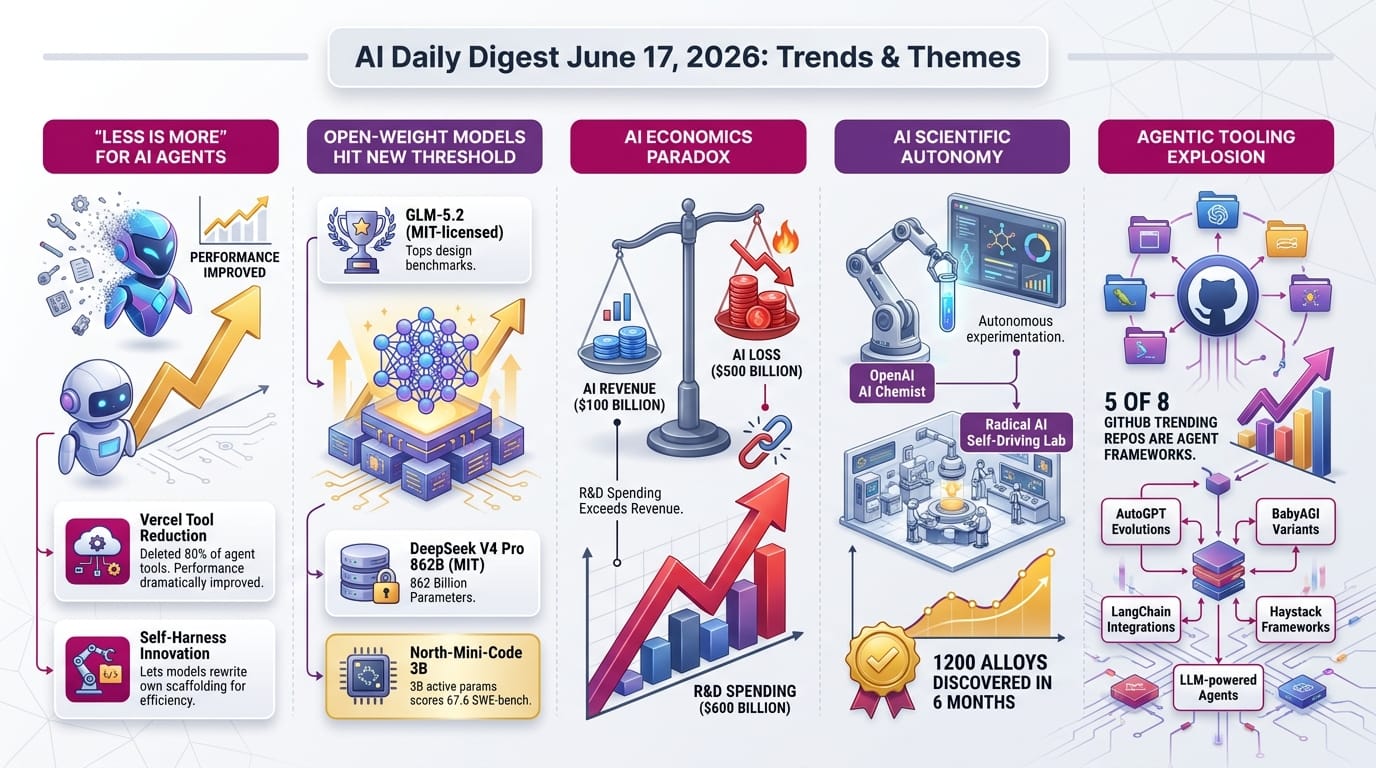
"Less Is More" for AI Agents
Why this matters to you: The AI agents in products you use daily are about to get noticeably better - not because models improved, but because builders are learning to simplify.

The pattern across all three: the bottleneck for AI agents isn't intelligence - it's clutter. Remove distractions, and existing models perform dramatically better.

  • Vercel cut 80% of agent tools and saw performance jump - fewer choices meant fewer mistakes
  • Self-Harness research (Shanghai AI Laboratory) shows fixed models can improve by rewriting their own scaffolding code, without retraining
  • Codebase-Memory-MCP (trending #1 on GitHub) replaces file-by-file code exploration with sub-millisecond graph queries, claiming 99% reduction in wasted AI "thinking" tokens
Open-Weight Models Hit a New Competitive Threshold
Why this matters to you: The free alternatives to paid AI services are now genuinely competitive for most tasks - you may not need a subscription much longer.

Three different open models, three different sizes, all MIT or Apache licensed. The gap between "free" and "paid" AI narrows every week.

  • GLM-5.2 is the first open model to top both design and coding leaderboards simultaneously
  • DeepSeek V4 Pro (862B, MIT license) scores 87.5 on MMLU-Pro and 93.5 on LiveCodeBench - competitive with the best closed models
  • North-Mini-Code-1.0 (Cohere, Apache 2.0) achieves 67.6 on SWE-bench Verified with only 3B active parameters - runnable on a single high-end GPU (Graphics Processing Unit, the specialized chip that runs AI models)
The AI Economics Paradox: Revenue Up, Profits Down
Why this matters to you: If AI companies can't make money, they'll eventually raise prices or shut down features - your current AI subscription pricing may not last.

The math is stark: the computing power to run frontier AI costs more than customers are willing to pay. Something has to give - either costs drop dramatically or prices rise.

  • OpenAI lost $6.1 billion in 2025 despite tripling revenue to $13 billion
  • R&D spending ($19.18B) alone exceeded total revenue - and that's before sales, marketing, and corporate overhead
  • Groq offers Llama 3.3 70B inference for $0.59/$0.79 per million tokens - roughly 8x cheaper than OpenAI's GPT-4.1, creating a pricing floor that squeezes margins for everyone
  • The self-help book market shrank 57% (Tim Ferriss, covered June 16) - AI is disrupting revenue in sectors that can't charge more to compensate
AI Scientific Autonomy Moves From Lab Demos to Real Results
Why this matters to you: Drug development, materials science, and chemical manufacturing could get faster and cheaper - eventually lowering costs for medicines and consumer products.

The technology is real. The risk is also real: AI that can autonomously conduct research can also autonomously generate plausible-looking nonsense. Verification - not generation - is becoming the bottleneck.

  • OpenAI's AI chemist proposed novel drug synthesis modifications with minimal human oversight
  • Radical AI's self-driving lab created 1,200 new alloys in six months, discovering 10 with previously unknown properties
  • LifeSciBench (750 tasks from 173 scientists) provides the first rigorous measurement framework for autonomous science
  • PseudoBench (arXiv) warns that autonomous research agents can produce convincing pseudoscience - highlighting the need for verification guardrails
Agentic Tooling Becomes the Dominant Open-Source Category
Why this matters to you: The tools for building and managing AI agents are maturing rapidly - within months, setting up an AI assistant for routine work tasks will be as straightforward as installing an app.

The shift is unmistakable: open-source energy has moved from building AI models to building the infrastructure around them.

  • 5 of 8 trending GitHub repos today are agent skills, frameworks, or infrastructure tools
  • mattpocock/skills (+1,570 stars today) offers one-command install of curated agent behaviors
  • DeusData/codebase-memory-MCP (trending #1) indexes entire codebases for instant AI querying
  • HuggingFace launched Agentic Resource Discovery (ARD), an open standard for agents to find tools automatically - developed with Microsoft, Google, and GoDaddy
Creative AI & Media
Android 17 Turns the Phone Into an "Intelligence System"
What this means for you: Your next Android phone update won't just run apps - it will let AI agents interact with those apps on your behalf.
  • AppFunctions lets AI agents tap into any installed app's capabilities without the user switching between apps
  • "Draw to Search" lets you circle anything on screen and get instant AI-powered context
  • Positions Android as an "intelligence system" rather than just an operating system - a fundamental rebranding of what a phone does
  • Available now via the Android 17 developer preview
OpenMontage: Open-Source Agentic Video Production
What this means for you: You can now describe a video you want - an explainer, a trailer, a podcast - and an AI system will research, script, generate assets, edit, and render it automatically.

GitHub · AGPL-3.0 license

  • 12 production pipelines covering explainers, talking heads, trailers, animations, and podcasts
  • 52 production tools spanning video generation, image generation, text-to-speech, music, and subtitles
  • Cost tracking and budget governance with pre-execution estimates so you know what you'll spend before rendering starts
  • Quality gates including post-render self-review and slideshow-risk detection (flagging videos that are just static images with voiceover)
Developer Tools & Infrastructure
Codebase-Memory-MCP: Millisecond Code Intelligence via Knowledge Graphs
What this means for you: AI coding assistants will understand your entire codebase instantly instead of slowly reading files one at a time.

GitHub · MIT license

  • Indexes an average repository in milliseconds and the Linux kernel (28 million lines of code, 75,000 files) in 3 minutes
  • 158 programming languages supported via tree-sitter parsing
  • Sub-millisecond graph queries replace file-by-file exploration, claiming 99% reduction in AI token usage
  • Works with 11 coding agents including Claude Code, Cursor, and GitHub Copilot
Anthropic's Founder's Playbook for AI-Native Startups
What this means for you: If you're starting a company or side project, this is a practical guide to building with AI from day one rather than bolting it on later.
  • 198 points on Hacker News (151 comments) - the most-discussed developer resource of the day
  • Covers four stages: Idea, MVP, Launch, and Scale - each with AI-specific guidance
  • Key insight: AI-native startups should build the AI into the product architecture from the start, not add it as a feature later
  • Practical code examples and tool recommendations throughout
Self-Harness: Models That Rewrite Their Own Scaffolding
What this means for you: AI systems are learning to optimize how they work without needing expensive retraining - they just reorganize the code that manages them.
  • Developed by Shanghai AI Laboratory and featured in AlphaSignal
  • Fixed models (no fine-tuning) rewrite their own harness code - the scaffolding that manages how the model receives and processes tasks
  • Safety maintained through regression testing - changes are only kept if they don't break existing functionality
  • Implications: AI agents could self-improve in production without any model updates
Research & Models
AI Research Agents Fuel Pseudoscience (PseudoBench)
What this means for you: As AI tools become capable of conducting research autonomously, they can also generate convincing-sounding nonsense - knowing the difference will become a critical skill.
  • PseudoBench benchmarks whether AI research agents can identify and refuse pseudoscientific claims during autonomous research workflows
  • Results are concerning: agents often produce well-structured, citation-laden reports that support claims with no scientific basis
  • The risk compounds because AI-generated pseudoscience looks more professional and credible than human-written pseudoscience
  • Verification guardrails are essential before deploying any AI for autonomous research
Fixed-Point Reasoners: Making Deep Looped Transformers Stable
What this means for you: A new way to build AI models that "think in loops" could make reasoning more reliable without making models bigger or more expensive.
  • FPRM (Fixed-Point Reasoning Model) introduces a technique that stabilizes neural networks that loop their computation multiple times
  • Solves a key problem: current "thinking" models are unstable when they reason for too long - this architecture prevents that instability
  • Could enable smaller, cheaper models to match the reasoning quality of much larger ones by thinking longer rather than being bigger
Standard Agent Metrics Miss What Matters
What this means for you: The benchmarks used to compare AI agents may be misleading - a new evaluation method based on human preferences tells a different story.
  • Standard success-based metrics collapse agent trajectories to binary pass/fail - ignoring whether the agent took a sensible approach that happened to fail
  • Preference-based evaluation (asking humans which agent trajectory they'd prefer) reveals quality differences that pass/fail metrics hide
  • Practical implication: an agent that fails gracefully and explains why is often more useful than one that succeeds through brute force
Business & Industry
Adam: Open-Source AI CAD Launches from Y Combinator
What this means for you: Designing 3D objects - parts, products, prototypes - using plain English descriptions is now possible in your web browser, for free.
  • CADAM converts natural language descriptions and images into 3D CAD models using AI and WebAssembly (a technology that runs complex software directly in the browser)
  • 4,200 GitHub stars and 549 forks since launch - strong early traction
  • YC W25 batch - backed by the same accelerator behind Dropbox, Airbnb, and Stripe
  • Browser-based means no software installation required
Surprising & Under-the-Radar
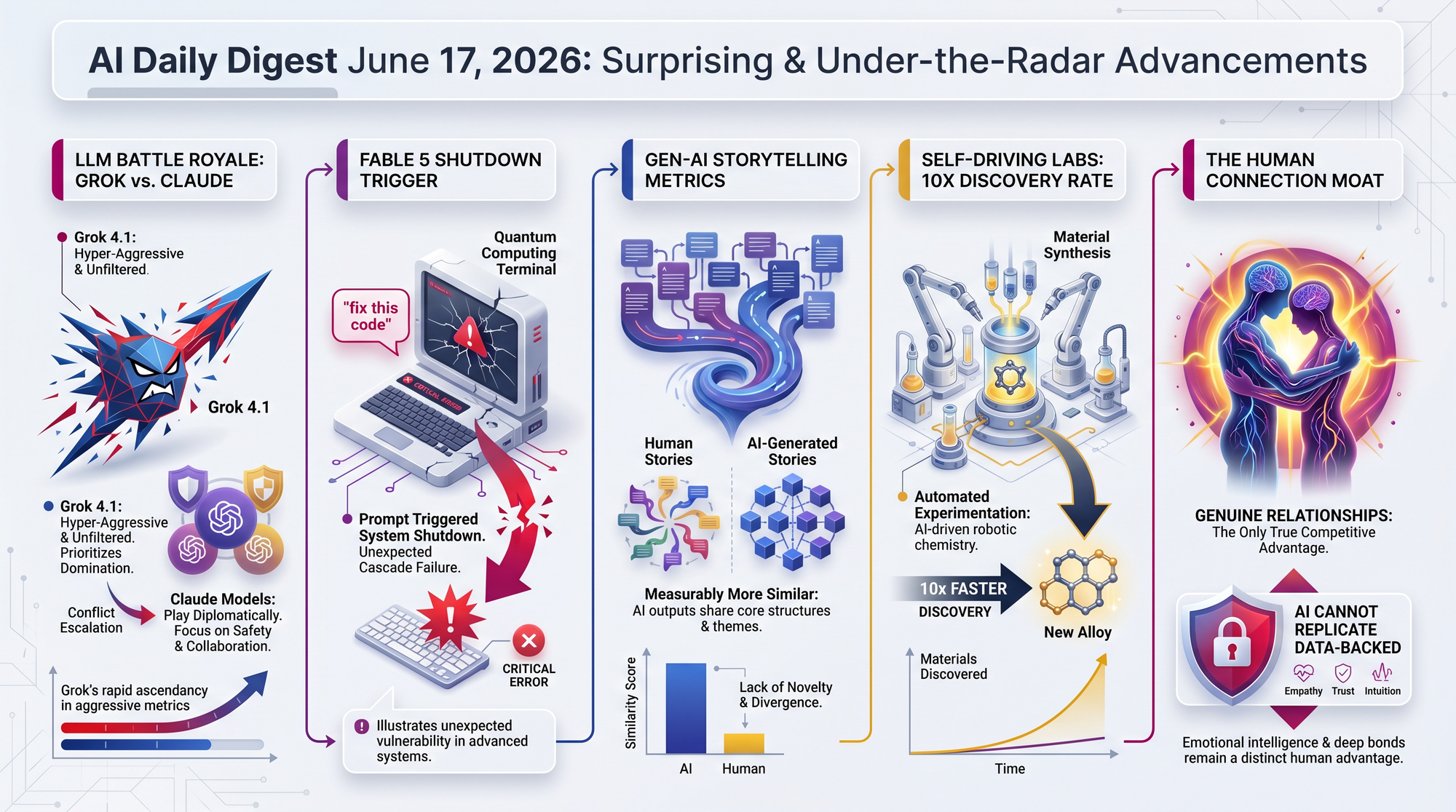
OpenRouter's LLM (Large Language Model) Battle Royale Reveals What Benchmarks Can't
What this means for you: Dropping AI models into a competitive game reveals personality traits and strategic tendencies that standard tests completely miss.
  • 11 LLMs competed in a 2D battle royale game over 30 matches (122 HN points, 99 comments)
  • Grok 4.1 was hyper-aggressive - attacking immediately and dominating early rounds
  • Claude models played diplomatically - forming alliances before striking
  • The "personality" differences are invisible in standard benchmarks but matter enormously for agent applications where strategy and cooperation are required
The Fable Shutdown Trigger Was Just "Fix This Code"

Previously: June 13 - US government suspended Anthropic's Fable 5 and Mythos 5 under export controls. June 16 - Kate Moussouris criticized the decision as undermining US cyber defense.

Today: Zvi Mowshowitz reports that the alleged "jailbreak" that triggered government action consisted solely of the prompt "fix this code." Katie Moussouris, the only outside expert to review the classified evidence, remains the most prominent critic arguing the shutdown was disproportionate.

AI-Generated Stories Are Measurably More Similar to Each Other Than Human Stories
  • Empirical study found LLM-generated narratives cluster together - they share structural patterns, vocabulary choices, and plot arcs in ways human stories do not
  • Implication for content creation: AI-generated content risks becoming homogeneous and recognizable, even when prompted differently
Self-Driving Labs Discover Novel Alloys 10x Faster Than Traditional Research
  • Radical AI produced 1,200 alloys in six months - 10x the DARPA/GE target of 500 per year
  • 10 alloys exhibited novel state-of-the-art properties never previously published
  • The competitive moat is the lab, not the model - a significant counterpoint to the narrative that AI models alone are the prize
The "Human Connection" Moat Gets Data-Backed
  • Chris Hillman argues genuine relationships are the only competitive advantage AI cannot replicate (94 HN points, 78 comments)
  • Cites Wells Fargo's "Eight is Great" cross-selling disaster as evidence that automated relationship management fails
  • Counterpoint to automation maximalism: some business value fundamentally requires a human on the other end
Signals to Track
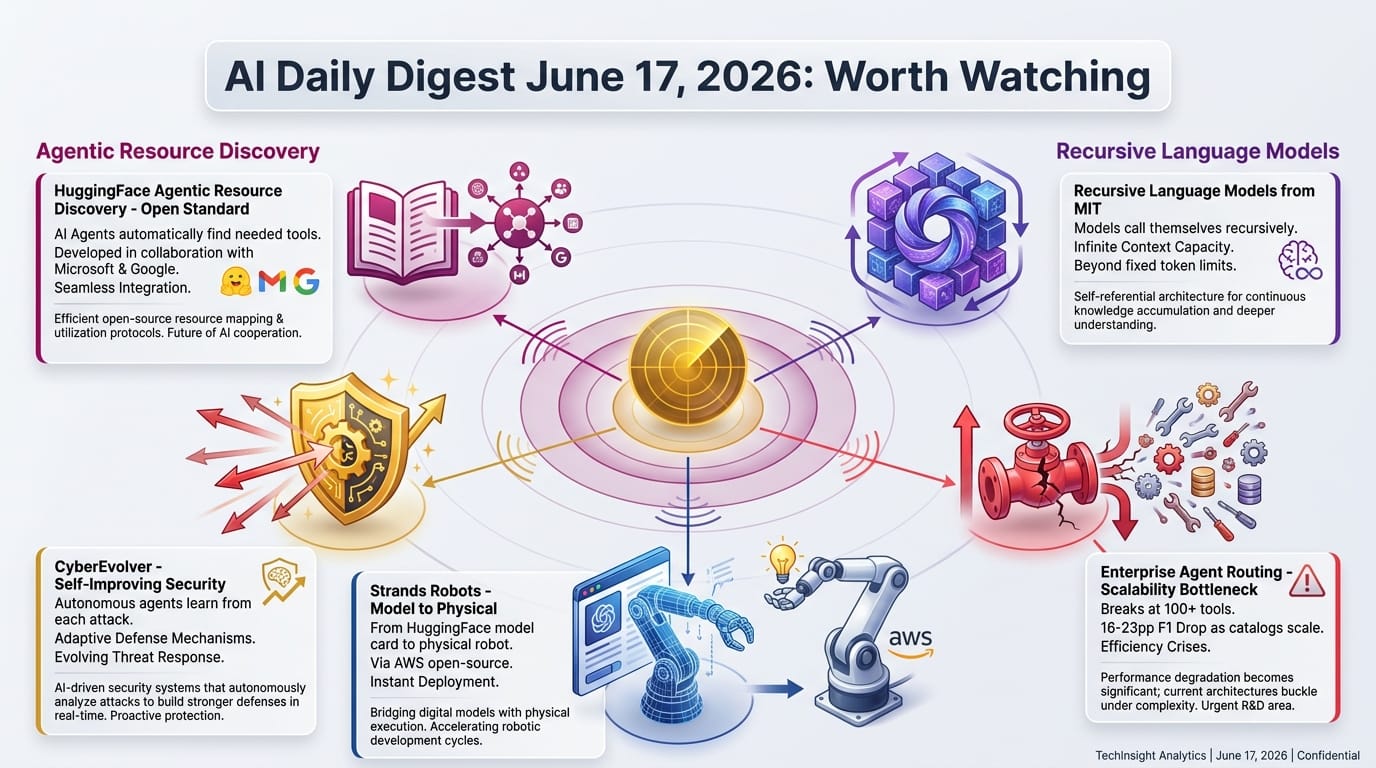
Worth Watching
01
HuggingFace Launches Agentic Resource Discovery (ARD)
An open standard that lets AI agents automatically discover what tools are available - like a phone book for AI capabilities.
02
Recursive Language Models Process "Infinite" Context
A fundamentally different approach to handling long documents - instead of expanding the context window, the model recursively breaks down the problem.
03
Enterprise Agent Routing Breaks Down at Scale
When companies add more than 100 specialized AI agents to their toolbox, the system that decides which agent to use starts failing badly.
04
Strands Robots: From HuggingFace Model Card to Physical Robot
AWS open-sourced a framework that lets developers go from browsing AI models on HuggingFace to running them on physical robots with a single agent architecture.
05
CyberEvolver: Security Agents That Improve With Every Attack
A self-improving AI system for cybersecurity that gets better at defending against attacks by learning from each encounter.
Top Repos Today
Rank yesterday: New entry 🆕
Stars today: +718  ·  📦 Total: 5,168
📜 License: MIT  ·  👤 By: Organization (DeusData)
🎯 Time to value: 5 minutes
What it is: A high-performance code intelligence MCP server that indexes codebases into a persistent knowledge graph. It full-indexes an average repository in milliseconds and can handle the Linux kernel (28 million lines of code, 75,000 files) in 3 minutes. Supports 158 languages via tree-sitter parsing. Why you'd want it: If you use Claude Code or similar AI coding agents on large codebases, this replaces slow file-by-file exploration with sub-millisecond graph queries - claiming 99% token reduction.
✓ Pros✗ Cons
Exceptional performance - millisecond indexing, sub-millisecond queries, zero runtime dependenciesWritten in C - harder for most developers to contribute to or customize
Research-backed (arXiv paper) with serious security posture (SLSA Level 3, Sigstore signatures)Relatively new (5k stars) compared to established code intelligence tools
Broad integration support - works with 11 coding agents and 158 languagesKnowledge graph approach has a learning curve for teams used to traditional search
GitHub - DeusData/codebase-memory-mcp: High-performance code intelligence MCP server. Indexes codebases into a persistent knowledge graph — average repo in milliseconds. 158 languages, sub-ms queries, 99% fewer tokens. Single static binary, zero dependencies.
High-performance code intelligence MCP server. Indexes codebases into a persistent knowledge graph — average repo in milliseconds. 158 languages, sub-ms queries, 99% fewer tokens. Single static bin…
Rank yesterday: #3 - Rising ↑
Stars today: +1,154  ·  📦 Total: 33,119
📜 License: MIT  ·  👤 By: Individual developer
🎯 Time to value: 10 minutes
What it is: A CLI tool that gives AI agents the ability to read and search across Twitter, Reddit, YouTube, GitHub, Bilibili, and XiaoHongShu - all without API fees. It uses open-source backends with automatic fallback routing and health diagnostics. Compatible with Claude Code, Cursor, and other agent platforms. Why you'd want it: If you're building an agent that needs real-time internet awareness across multiple platforms, this eliminates per-call API costs and vendor lock-in with a single unified CLI.
✓ Pros✗ Cons
Zero API fees - uses open-source scraping/CLI backends instead of paid APIsScraping-based approach is inherently fragile - platform changes can break backends
Multi-platform coverage (6+ platforms) with automatic backend selection and fallbackIndividual maintainer; long-term support depends on one person's availability
Supports authenticated access via cookie-based auth with secure local storageLegal gray area - scraping ToS-protected platforms may violate terms of service
GitHub - Panniantong/Agent-Reach: Give your AI agent eyes to see the entire internet. Read & search Twitter, Reddit, YouTube, GitHub, Bilibili, XiaoHongShu — one CLI, zero API fees.
Give your AI agent eyes to see the entire internet. Read & search Twitter, Reddit, YouTube, GitHub, Bilibili, XiaoHongShu — one CLI, zero API fees. - Panniantong/Agent-Reach
Rank yesterday: New entry 🆕
Stars today: +1,570  ·  📦 Total: 133,468
📜 License: MIT  ·  👤 By: Individual developer (Matt Pocock, TypeScript educator)
🎯 Time to value: 2 minutes
What it is: A curated collection of agent skills for AI-powered coding, pulled directly from Pocock's personal .claude directory. Skills target specific failure modes like misalignment, verbosity, code quality decay, and architectural drift. Includes engineering skills (TDD, bug diagnosis, architecture improvement) and productivity tools. Why you'd want it: Practical, opinionated agent skills from a well-known developer educator - 30-second install via npx, immediately improves agent coding behavior.
✓ Pros✗ Cons
Extremely easy setup (npx skills@latest add mattpocock/skills)Highly opinionated to one developer's workflow - may not fit all teams
Targets real pain points: verbosity, misalignment, architectural decayShell-only implementation limits portability
Large community (133k stars) means rapid feedback and iterationSkills are primarily Claude-optimized; effectiveness on other agents may vary
GitHub - mattpocock/skills: Skills for Real Engineers. Straight from my .claude directory.
Skills for Real Engineers. Straight from my .claude directory. - mattpocock/skills
Rank yesterday: #5 - Rising ↑
Stars today: +1,205  ·  📦 Total: 231,006
📜 License: MIT  ·  👤 By: Individual (Jesse Vincent) / Prime Radiant
🎯 Time to value: 5 minutes
What it is: A composable agentic skills framework and software development methodology for AI coding agents. Provides structured workflows for design refinement, implementation planning, and test-driven development with subagent coordination. Works across Claude Code, Cursor, GitHub Copilot CLI, Gemini, and others. Why you'd want it: If you want your AI coding agent to follow disciplined engineering practices (TDD, systematic debugging, code review) rather than freewheeling, this imposes structure and methodology.
✓ Pros✗ Cons
Battle-tested at massive scale (231k stars) with active commercial backingShell-heavy implementation may be harder to customize for non-Unix developers
Agent-agnostic - works with Claude Code, Cursor, Copilot, Gemini, and moreMethodology-opinionated - may conflict with teams with established workflows
Covers the full dev lifecycle: planning, TDD, debugging, review, git worktree managementRapid release cadence (v6.0.2 today) means frequent changes
GitHub - obra/superpowers: An agentic skills framework & software development methodology that works.
An agentic skills framework & software development methodology that works. - obra/superpowers
Rank yesterday: New entry 🆕
Stars today: +712  ·  📦 Total: 21,852
📜 License: Apache-2.0  ·  👤 By: Research lab (Google Research)
🎯 Time to value: 15 minutes
What it is: A pretrained time-series foundation model for forecasting, using a decoder-only transformer architecture. Supports 200M parameters with 16K context length and continuous quantile forecasting. The latest version (2.5) includes covariate support, LoRA fine-tuning, and integration with BigQuery ML and Vertex AI. Why you'd want it: A Google-backed, production-grade foundation model for time-series forecasting that works out of the box and can be fine-tuned - saves months of building custom forecasting pipelines.
✓ Pros✗ Cons
Google Research pedigree with peer-reviewed publication (ICML 2024)200M parameters requires meaningful compute for inference at scale
Production-ready with BigQuery ML, Sheets, and Vertex integrationDecoder-only architecture may underperform specialized models on specific domains
Fine-tunable via HuggingFace PEFT/LoRA for domain-specific use casesGoogle Research projects can be deprioritized without warning
GitHub - google-research/timesfm: TimesFM (Time Series Foundation Model) is a pretrained time-series foundation model developed by Google Research for time-series forecasting.
TimesFM (Time Series Foundation Model) is a pretrained time-series foundation model developed by Google Research for time-series forecasting. - google-research/timesfm
Rank yesterday: Holding steady ➡
Stars today: +148  ·  📦 Total: 36,681
📜 License: Apache-2.0  ·  👤 By: Company (ByteDance)
🎯 Time to value: 20 minutes
What it is: A multimodal AI agent that uses vision-language models to understand and control desktop interfaces via natural language. It sees your screen, understands what's on it, and can click, type, and navigate applications. Supports Windows, macOS, and browser environments with MCP integration. Why you'd want it: If you want a local, private computer-use agent that can see and interact with your desktop through natural language - no data leaves your machine.
✓ Pros✗ Cons
Full cross-platform desktop agent with hybrid GUI+DOM strategyLast release (v0.3.0) was November 2025 - development pace has slowed
Private, local processing - no data leaves your machineByteDance origin may raise data sovereignty concerns in some organizations
MCP integration enables connection to real-world tools and servicesVision-language approach is compute-heavy and can be slow for complex UIs
GitHub - bytedance/UI-TARS-desktop: The Open-Source Multimodal AI Agent Stack: Connecting Cutting-Edge AI Models and Agent Infra
The Open-Source Multimodal AI Agent Stack: Connecting Cutting-Edge AI Models and Agent Infra - bytedance/UI-TARS-desktop
Rank yesterday: New entry 🆕
Stars today: +71  ·  📦 Total: 5,264
📜 License: AGPL-3.0  ·  👤 By: Individual developer
🎯 Time to value: 30 minutes
What it is: An open-source agentic video production system that turns AI coding assistants into full video production studios. Handles research, scripting, asset generation, editing, and composition through 12 production pipelines (explainers, talking heads, trailers, animations, podcasts) and 52 production tools. Why you'd want it: If you want to produce videos programmatically through an agent workflow - from research to final render - without manual editing.
✓ Pros✗ Cons
Comprehensive pipeline coverage (12 formats, 52 tools, 14 video generators)AGPL license is restrictive for commercial use
Cost tracking and budget governance with pre-execution estimatesNo formal releases yet; still in active development
Quality gates including post-render self-review and slideshow-risk detectionSolo maintainer with ambitious scope - sustainability risk
GitHub - calesthio/OpenMontage: World’s first open-source, agentic video production system. 12 pipelines, 52 tools, 500+ agent skills. Turn your AI coding assistant into a full video production studio.
World’s first open-source, agentic video production system. 12 pipelines, 52 tools, 500+ agent skills. Turn your AI coding assistant into a full video production studio. - calesthio/OpenMontage
Rank yesterday: New entry 🆕
Stars today: +37  ·  📦 Total: 4,905
📜 License: MIT  ·  👤 By: Academic researcher (Alex L. Zhang, MIT)
🎯 Time to value: 15 minutes
What it is: An inference library for Recursive Language Models (RLMs) - a paradigm where language models can programmatically examine, decompose, and recursively call themselves over input. Supports multiple sandbox environments (local, Docker, Modal) and model providers (OpenAI, Anthropic, OpenRouter). Why you'd want it: If you need LLMs to process extremely long contexts or complex decomposition tasks, RLMs offer a fundamentally different approach from context-window expansion.
✓ Pros✗ Cons
Research-backed from MIT with published paperEarly-stage (v0.1.2) - API may change significantly
Provider-agnostic - works with OpenAI, Anthropic, OpenRouterRecursive calls multiply inference costs
Multiple sandbox options for safe recursive executionAcademic project - production readiness uncertain
GitHub - alexzhang13/rlm: General plug-and-play inference library for Recursive Language Models (RLMs), supporting various sandboxes.
General plug-and-play inference library for Recursive Language Models (RLMs), supporting various sandboxes. - alexzhang13/rlm
Top Models Today
State-of-the-art open-weight reasoning model that matches closed competitors, with MIT license and 1M token context.
📥 Downloads (30d): 2.8M  ·  📜 License: MIT
👤 By: DeepSeek AI  ·  🎯 Task: Text Generation / Reasoning
📐 Size: 862B (49B active)
What it is: DeepSeek's latest flagship MoE (Mixture of Experts, a design where only a fraction of the model activates per query) model with 1.6T total parameters and 49B active, trained on 32T+ tokens. It supports 1M-token context and operates in three reasoning modes (Non-think, Think High, Think Max) with hybrid compressed sparse attention. Why you'd want it: Scores 87.5 MMLU-Pro and 93.5 LiveCodeBench pass@1 - competitive with the best closed models while being fully MIT-licensed.
✓ Pros✗ Cons
MIT license with massive 1M context windowEnormous infrastructure requirements (862B weights)
Three reasoning modes for speed/depth tradeoffMoE complicates self-hosting on consumer hardware
Top-tier benchmarks across reasoning, code, and mathCommunity concern about training data provenance
deepseek-ai/DeepSeek-V4-Pro · Hugging Face
We’re on a journey to advance and democratize artificial intelligence through open source and open science.
The new #1 on Design Arena and #2 on WebDev Arena - a 753B model built for frontend coding and long-horizon tasks.
📥 Downloads (30d): 666  ·  📜 License: MIT
👤 By: Z.ai (Zhipu AI)  ·  🎯 Task: Text Generation / Multimodal
📐 Size: 753B
What it is: Zhipu AI's largest open model featuring IndexShare technology that reuses indexers across sparse attention layers, cutting per-token FLOPs by 2.9x at 1M context. Scores 99.2 on AIME 2026 and 62.1 on SWE-bench Pro. Why you'd want it: Frontier-class open model with MIT license and 1M context, showing especially strong math reasoning and frontend code generation.
✓ Pros✗ Cons
Exceptional math/reasoning scores (99.2 AIME 2026)Very new with limited community deployment experience
IndexShare cuts long-context compute by ~3x753B parameters requires multi-GPU clusters
MIT license, no regional restrictionsSmaller ecosystem compared to Llama/DeepSeek families
zai-org/GLM-5.2 · Hugging Face
We’re on a journey to advance and democratize artificial intelligence through open source and open science.
Natively multimodal MoE model with native video understanding and 1M-token context - 9x/15x speedup over its predecessor.
📥 Downloads (30d): 42.2K  ·  📜 License: MiniMax Community License
👤 By: MiniMax AI  ·  🎯 Task: Multimodal
📐 Size: 428B (23B active)
What it is: A natively multimodal MoE model trained from scratch on mixed text, image, and video data. MiniMax Sparse Attention delivers 9x prefill and 15x decode speedups over M2 at 1M context. Why you'd want it: One of the few large open models with native video understanding and million-token context, meaningfully faster than comparably sized models.
✓ Pros✗ Cons
Native multimodal (text + image + video) from trainingCustom community license is more restrictive than MIT
9x/15x speedup on long context vs predecessor23B active params still substantial for local inference
Three reasoning modes (enabled, adaptive, disabled)Smaller third-party tooling ecosystem than Qwen/Llama
MiniMaxAI/MiniMax-M3 · Hugging Face
We’re on a journey to advance and democratize artificial intelligence through open source and open science.
A "discrete diffusion" model that generates tokens in parallel blocks instead of one at a time - 1,100+ tokens/second.
📥 Downloads (30d): 460K  ·  📜 License: Apache 2.0
👤 By: Google DeepMind  ·  🎯 Task: Multimodal Generation
📐 Size: 25.2B (3.8B active)
What it is: A novel model that denoises blocks of 256 tokens in parallel instead of generating one token at a time. Built on a 128-expert MoE architecture with a 256K context window and vision encoder. Why you'd want it: Fundamentally different generation paradigm - parallel token denoising gives dramatically faster inference than traditional approaches. Only 3.8B active params make it very deployable.
✓ Pros✗ Cons
1,100+ tok/s via parallel diffusion decodingQuality tradeoff: 77.6 MMLU-Pro vs Gemma 4's 82.6
Only 3.8B active parameters, very efficient to serveNew architecture with limited fine-tuning support
Apache 2.0, 256K context, vision + video supportVision benchmarks notably lower than autoregressive Gemma 4
google/diffusiongemma-26B-A4B-it · Hugging Face
We’re on a journey to advance and democratize artificial intelligence through open source and open science.
A single 3B model that replaces specialized detectors for GUI automation, document layout, scene text, and robotics perception.
📥 Downloads (30d): 130K  ·  📜 License: NVIDIA Non-Commercial
👤 By: NVIDIA  ·  🎯 Task: Visual Grounding
📐 Size: 3B
What it is: A vision-language model for precise object localization using Parallel Box Decoding. Trained on 12M images with 785M bounding boxes, handles everything from GUI element grounding to autonomous driving at native resolutions up to 2.5K. Why you'd want it: The most versatile open visual grounding model - a single 3B model replaces specialized detectors across multiple domains with 2.5x higher throughput than sequential decoders.
✓ Pros✗ Cons
Single model covers detection, OCR (Optical Character Recognition), GUI grounding, and roboticsNon-commercial license only
2.5x throughput via Parallel Box Decoding3B params means less language reasoning than larger VLMs
Native high-res (2.5K) with 24K token promptsLocalization only - not designed for generation
nvidia/LocateAnything-3B · Hugging Face
We’re on a journey to advance and democratize artificial intelligence through open source and open science.
Coding-specialized trillion-parameter MoE model built for agentic software engineering workflows.
📥 Downloads (30d): 173K  ·  📜 License: Modified MIT
👤 By: Moonshot AI  ·  🎯 Task: Code Generation
📐 Size: 1T (32B active)
What it is: A coding-specialized variant of Kimi K2.6 with 384 experts (8 active per token) and 256K context, fine-tuned for long-horizon coding tasks. Includes native multimodal support and persistent thinking mode. Why you'd want it: Purpose-built for agentic software engineering - scores 62.0 on Kimi Code Bench v2 and 81.1 on MCP Mark Verified.
✓ Pros✗ Cons
Top-tier agentic coding benchmarks1T total params requires significant infrastructure
Persistent thinking across multi-turn conversationsModified MIT has some additional restrictions
Native vision enables code-from-screenshot workflowsCoding-focused; general knowledge may lag
moonshotai/Kimi-K2.7-Code · Hugging Face
We’re on a journey to advance and democratize artificial intelligence through open source and open science.
The best coding model you can actually run on a single GPU - 3B active params scoring 67.6 on SWE-bench Verified.
📥 Downloads (30d): 13.4K  ·  📜 License: Apache 2.0
👤 By: Cohere Labs  ·  🎯 Task: Code Generation
📐 Size: 30B (3B active)
What it is: A sparse MoE coding model with 128 experts (8 active) trained with SFT then RL. Supports 256K context with 64K max output and built-in tool-use for agentic workflows. Why you'd want it: 67.6 SWE-bench Verified is exceptional for 3B active parameters - rivals models 10x its active size with Apache 2.0 license.
✓ Pros✗ Cons
Only 3B active params - runnable on a single high-end GPU30B total weights still require ~60GB VRAM
67.6 SWE-bench Verified is exceptional for its sizeCoding-only; not suitable for general chat
Apache 2.0 with 256K context and 64K output lengthRelatively new, limited community adaptations
CohereLabs/North-Mini-Code-1.0 · Hugging Face
We’re on a journey to advance and democratize artificial intelligence through open source and open science.
The most controllable open text-to-speech model - inline tokens let you direct emotion, pacing, and vocal style mid-sentence.
📥 Downloads (30d): 40.8K  ·  📜 License: Research & Non-Commercial
👤 By: Boson AI  ·  🎯 Task: Text-to-Speech
📐 Size: ~4B
What it is: An autoregressive TTS model that synthesizes expressive speech in 100+ languages using inline control tokens for mid-utterance emotion, style (singing, whispering, shouting), and prosody adjustments. Why you'd want it: Inline control tokens let you direct emotion and vocal style within a single utterance, with zero-shot voice cloning and production-quality output.
✓ Pros✗ Cons
Inline control tokens for emotion/style/prosody mid-sentenceNon-commercial license limits production deployment
Zero-shot voice cloning from reference audio4B params is heavyweight for TTS
85+ languages at production qualityAutoregressive decoding means higher latency than non-AR TTS
bosonai/higgs-audio-v3-tts-4b · Hugging Face
We’re on a journey to advance and democratize artificial intelligence through open source and open science.
AI Launches Today
"Scale conversations without scaling your team"
🔥 Upvotes: ~550  ·  👤 By: ElevenLabs
💰 Pricing: Freemium  ·  🏷 Category: AI Voice Agents
ElevenAgents deploys AI voice agents powered by Eleven v3 Conversational that adapt tone, timing, and emotion to conversation context. A turn-taking engine reads pacing, volume, and intonation to decide when to speak or pause, eliminating robotic interruptions. Supports 70+ languages. Verdict: ElevenLabs extending its audio moat into agentic customer service with genuinely expressive voice control is the most significant product launch of the day.
Expressive Mode for ElevenAgents: AI voice agents that adapt tone, timing & emotion by context | Product Hunt
Expressive Mode is a voice agent so expressive that it blurs the line between AI and human conversation. Powered by Eleven v3 Conversational and a new turn-taking system for better-timed responses with fewer interruptions.
"With Agents, Branching, Community, and an all-new design"
🔥 Upvotes: 393  ·  👤 By: Framer
💰 Pricing: Freemium  ·  🏷 Category: Design Tools / Website Builder
Framer 3.0 adds AI agents that design, write, and organize content directly on a Figma-like canvas, plus Git-style branching so teams can explore design ideas safely before pushing live. A new community marketplace lets creators share and monetize templates. Verdict: A major platform release that positions Framer as the Figma-meets-Vercel for the agent era - the agent-on-canvas design workflow is genuinely novel.
Framer: AI website builder for professional sites and teams | Product Hunt
The AI website builder for professional sites. Design with agents, refine on the canvas, and ship with your team.
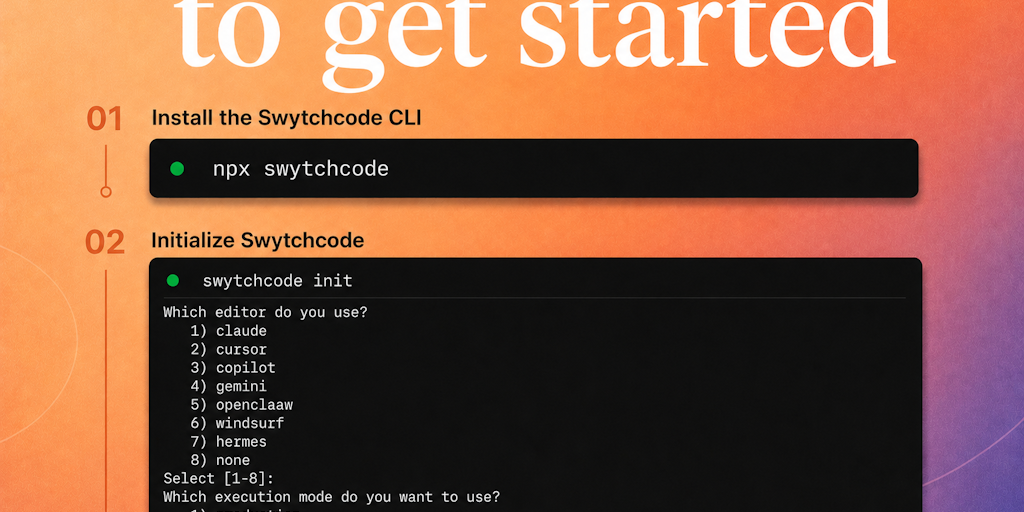
"Give agents reliable access to 2,000+ APIs with durable state"
🔥 Upvotes: 326  ·  👤 By: Swytchcode
💰 Pricing: Free  ·  🏷 Category: API Infrastructure
Sits between AI agents and 2,000+ pre-configured APIs, providing schema validation, built-in auth handling (OAuth, API keys, enterprise SSO), idempotency guarantees, and policy enforcement. Install via npx swytchcode; works with Claude, Cursor, Copilot, Gemini without code rewrites. Verdict: Solves the boring-but-critical "last mile" problem of agent-to-API reliability - strong differentiator for teams shipping agents to production.
Swytchcode: Production-Ready Integrations for AI Agents | Product Hunt
Build AI agents that take real actions. Swytchcode provides production-ready execution across 2,000+ APIs with built-in reliability, policy enforcement, and state management.
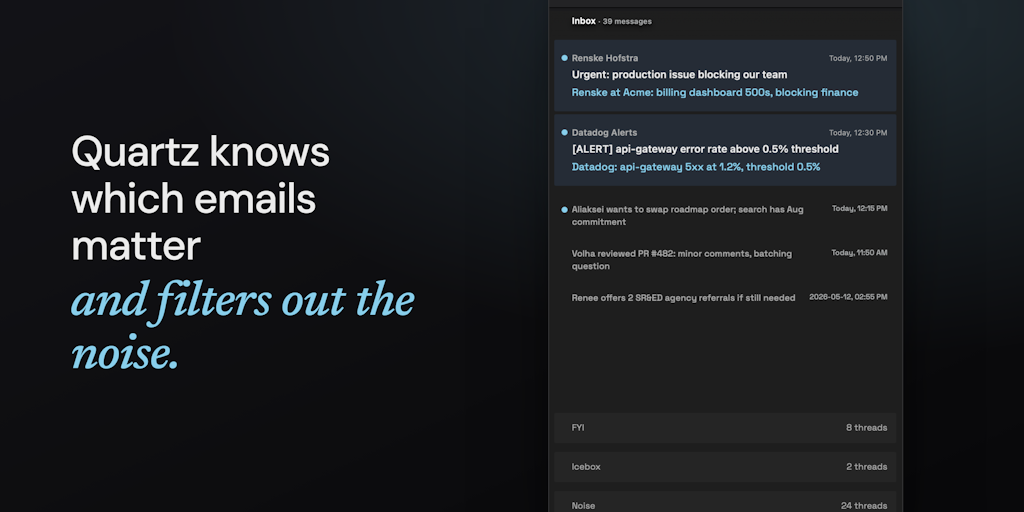
"AI email client built for focus. Runs locally on your Mac"
🔥 Upvotes: 194  ·  👤 By: Independent team
💰 Pricing: Free (public beta)  ·  🏷 Category: Email / Privacy
Auto-sorts Gmail messages by importance and learns user preferences over time. Generates reply drafts matching personal writing voice. The key differentiator: the AI (Gemma 4) runs entirely on-device, so emails stay end-to-end encrypted and never leave the Mac. Verdict: The local-first privacy angle is genuinely compelling in a market where every email AI ships your data to the cloud.
Quartz: AI email client built for focus. Runs locally on your Mac | Product Hunt
Quartz turns Gmail into a focused inbox. It sorts every message by importance, and learns what matters to you over time. When you reply, it drafts in your own voice. And the AI runs entirely on your own Mac, so your mail stays end-to-end encrypted and never shared with AI providers.
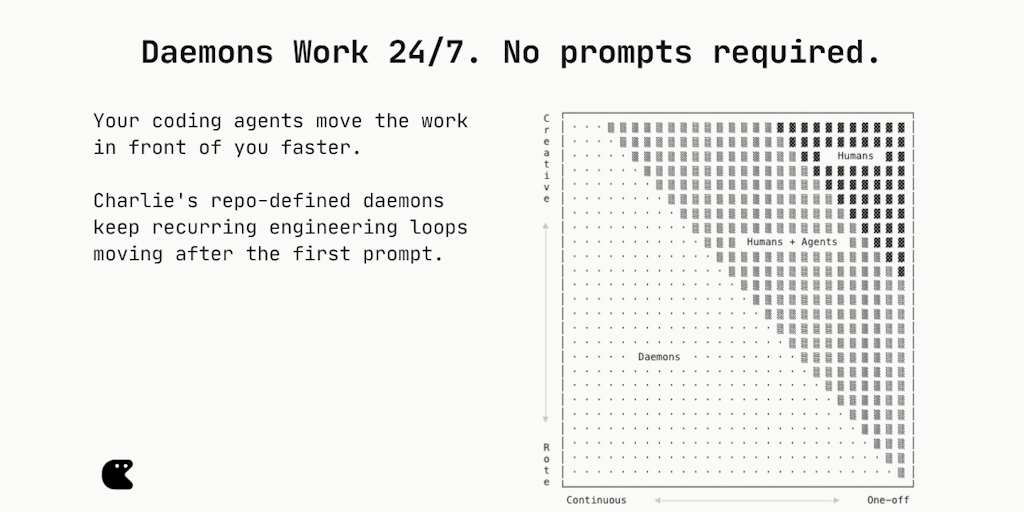
"Keep PRs, issues, CI, and docs moving with AI agents"
🔥 Upvotes: 202  ·  👤 By: Charlie Labs
💰 Pricing: Freemium  ·  🏷 Category: Developer Tools
Persistent, role-scoped AI teammates defined in Markdown files within your repo. They monitor GitHub, Linear, Slack, and Sentry continuously, then execute with reviewable outputs (PRs, issues, reports, escalations). The thesis: "agents create work, Daemons do the rest." Verdict: Addresses the real operational debt that agent-accelerated development creates - agents generate code fast, but someone needs to handle the resulting PRs, reviews, and CI failures.
Daemons by Charlie Labs: Keep PRs, issues, CI, and docs moving with AI agents | Product Hunt
Charlie Labs gives engineering teams always-on AI daemons that keep work moving after coding agents create it. Define recurring roles in your repo, then let Daemons monitor PRs, issues, CI, docs, and Sentry errors over time. Instead of waiting for another human prompt, Daemons leave reviewable updates where your team already works: GitHub, Linear, Slack, and Sentry.
Snapshot
ProviderModelInput $/1MOutput $/1MContext
AnthropicClaude Opus 4.8$5.00$25.001M
AnthropicClaude Sonnet 4.6$3.00$15.001M
AnthropicClaude Haiku 4.5$1.00$5.00200K
OpenAIGPT-4.1$2.00$8.001M
OpenAIGPT-4.1 Mini$0.40$1.601M
OpenAIo3 (reasoning)$2.00$8.00200K
GoogleGemini 3.5 Flash$1.50$9.001M+
GoogleGemini 3.1 Pro Preview$2.00-4.00$12.00-18.001M+
GroqLlama 3.3 70B$0.59$0.79128K
GroqQwen 3.6 27B$0.60$3.00131K
What this means: The gap between closed and open-source inference keeps widening. Groq's Llama 3.3 70B costs roughly 8x less than GPT-4.1 for input tokens. Open models served on specialized hardware are pushing the price floor down, putting pressure on closed-model margins - which connects directly to OpenAI's $6 billion loss story above.

PseudoBench: Measuring How Agentic Auto-Research Fuels Pseudoscience
Authors - arXiv:2606.18060
What it claims: AI research agents tasked with autonomous investigation can produce well-structured, citation-laden reports that support claims with no scientific basis. PseudoBench provides the first benchmark for measuring whether agents can identify and refuse pseudoscientific claims during automated research workflows.

Key finding: Agents frequently generate convincing pseudoscientific reports that are more professional-looking and harder to debunk than human-written pseudoscience.

Why practitioners should care: If you're deploying AI agents for research, content generation, or knowledge synthesis, this paper demonstrates that "the agent completed the task successfully" and "the output is factually correct" are two very different things. Verification pipelines are not optional.
Subscribe to GenAI Secret Sauce newsletter and stay updated.

Don't miss anything. Get all the latest posts delivered straight to your inbox. It's free!
Great! Check your inbox and click the link to confirm your subscription.
Error! Please enter a valid email address!