GenAI Secret Sauce Daily Digest - 2026-05-06

Anthropic Partners with SpaceX and Doubles Claude Limits Overnight · Code w/ Claude 2026: Managed Agents, Dreaming, and 17x API Growth · Qwen 3.6 27B with MTP: The Open-Source Community Hits 2.5x Faster Inference
GenAI Secret Sauce Daily Digest - 2026-05-06

Watch today's digest as a video summary (generated by NotebookLM)

Statistically Speaking
300 megawatts of capacity from SpaceX's Colossus 1
Anthropic Partners with SpaceX and Doubles Claude Limits Ove
Top Story
933 upvotes on r/ClaudeAI, but the top comment
Anthropic Partners with SpaceX and Doubles Claude Limits Ove
2.5 x throughput on consumer hardware
Qwen 3.6 27B with MTP
4 with 24GB RAM handles the Q4 variant
Qwen 3.6 27B with MTP
One Thing to Tell Your Friends
Elon Musk just rented his entire AI supercomputer - 220,000 GPUs - to Anthropic, his direct competitor. Claude users got double the usage limits overnight.
TL;DR
Trends
Multi, AI Security Incidents Are Piling Up Faster Than Fixes, and Financial AI Becomes Its Own Product Category.
Business
Anthropic's SpaceX Deal: The Numbers Behind the Headlines, Silicon Valley Gets Serious About Services, and Anthropic Launches 10 Financial Services Agents.
Surprising
Claude Caught a Business Email Scam a Human Missed, Decoupled Attention: Running 26B Models Across Machines Over HTTP, and The Prefill Speed Debate Reveals a Community Blind Spot.
Worth Watching
Zvi Mowshowitz's "What is Anthropic?" Maps the Company's Unique Philosophy, DeepSeek V4 Flash Is 152x Cheaper Than Opus for Agentic Tasks, and Google's AI Search Will Now Quote Reddit Directly.
GitHub
Leading repos: Hmbown/DeepSeek (+6,184), addyosmani/agent (+629), and PriorLabs/TabPFN (+218).
HuggingFace
Leading models: deepseek-ai/DeepSeek-V4 (787K), deepseek-ai/DeepSeek-V4 (669K), and openai/privacy (155K).
Product Hunt
Top launches: Kanwas (393), Shadow 2.0 (383), and Superset 2.0 (347).
API Pricing
What this means:** The pricing spread between frontier models ($5-25/M) and budget options ($0.05-0.80/M) is now 100x.
arXiv
AI-Generated Smells: An Analysis of Code and Architecture in LLM and Agent — Code volume is a near-perfect predictor of structural degradation in AI-generated software.
Hot off the Presses
01
Anthropic Partners with SpaceX and Doubles Claude Limits Overnight
What this means for you: If you use Claude Code, your five-hour session limit just doubled. Peak-hour slowdowns are gone. These changes are live now - no action needed.

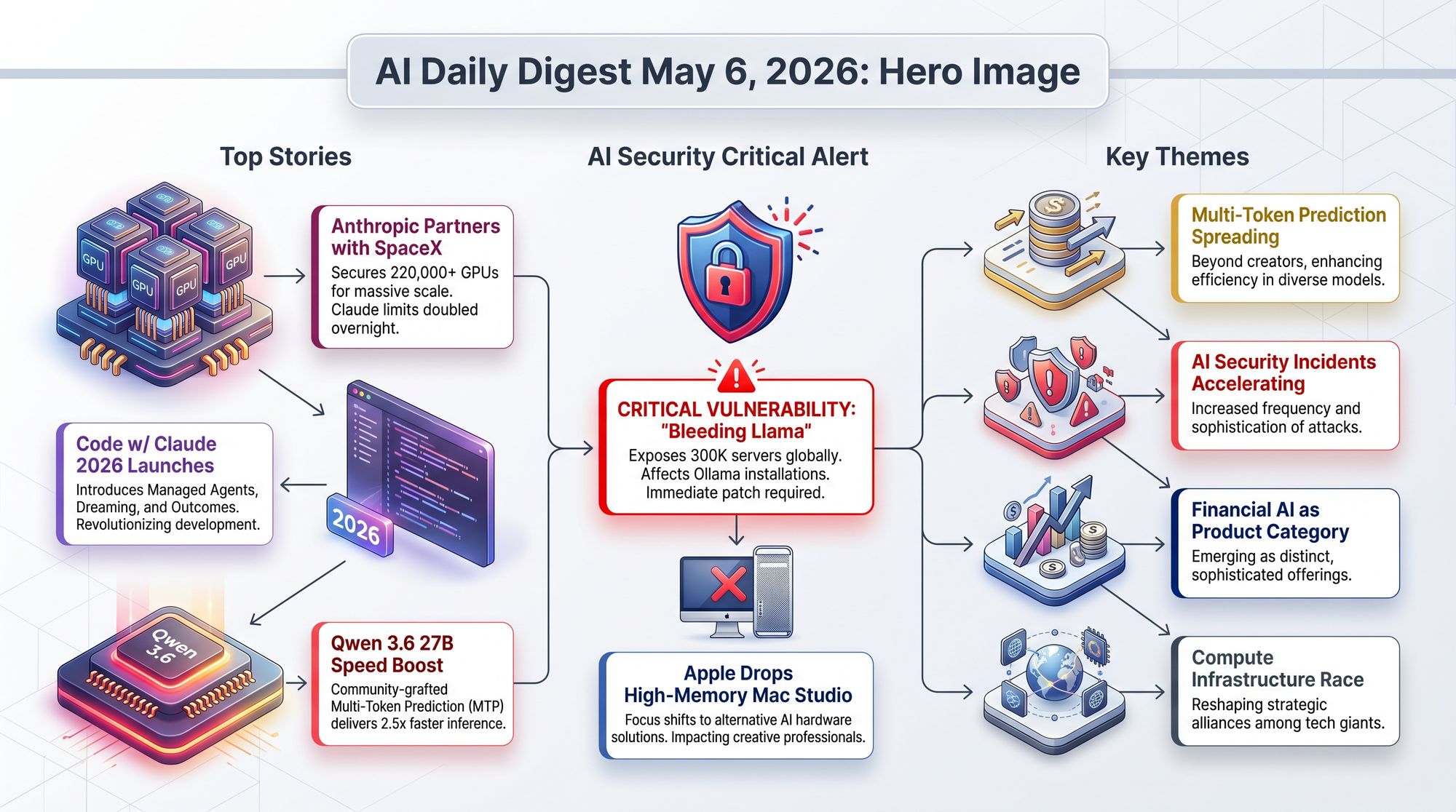
Anthropic announced a partnership with SpaceX to use all compute capacity at the Colossus 1 data center - over 300 megawatts and 220,000+ NVIDIA GPUs, available within one month. The deal represents the largest single compute acquisition in AI history. Effective immediately: Claude Code's five-hour rate limits doubled for Pro, Max, Team, and Enterprise plans, peak hours limit reduction was removed entirely, and API rate limits for Opus models were substantially raised.

The strategic implications are significant. One Reddit analysis with 442 upvotes argues this signals that xAI valued cash over using Colossus 1 for their own training, suggesting their Grok line may have plateaued.

""Anthropic doubled the 5-hour limit but the weekly limit - the actual bottleneck for power users - stays the same.""
  • 220,000+ NVIDIA GPUs added - over 300 megawatts of capacity from SpaceX's Colossus 1 facility
  • Five-hour Claude Code limits doubled - for all paid plans, effective immediately
  • Peak hours slowdown eliminated - no more reduced limits during high-traffic periods
  • Community reaction is mixed - 933 upvotes on r/ClaudeAI, but the top comment notes the weekly limit remains unchanged
02
Code w/ Claude 2026: Managed Agents, Dreaming, and 17x API Growth
What this means for you: Anthropic just announced three features that turn Claude from a coding assistant into a fleet of autonomous workers you can orchestrate, monitor, and let self-improve overnight.

Simon Willison live-blogged the Code w/ Claude event, which focused entirely on developer tools rather than new model releases. API volume has grown 17x year-over-year. Mercado Libre, with 23,000 engineers, is targeting 90% autonomous coding by Q3.

The "advisor strategy" stood out: smaller models query Opus for guidance on hard problems, achieving frontier-quality results at 5x lower cost. Managers are returning to hands-on coding because AI reduces the time investment needed.

  • Managed Agents - multi-agent orchestration for creating agent fleets, now generally available
  • Outcomes - define success criteria and let Claude iterate toward them autonomously
  • Dreaming (research preview) - agents inspect previous sessions and self-improve between runs
  • Claude Code Review - already adopted company-wide at Anthropic, now available to all
  • CI auto-fix - automatic PR corrections when CI fails, plus Security Reviews and Remote Agents
03
Qwen 3.6 27B with MTP: The Open-Source Community Hits 2.5x Faster Inference
What this means for you: If you run AI models on your own computer, the community just figured out how to make Alibaba's newest model run 2.5 times faster - for free, on hardware you might already own.

An 836-upvote post on r/LocalLLaMA demonstrated grafting Multi-Token Prediction (MTP) layers onto Qwen 3.6 27B, achieving 2.5x throughput improvements. The model features 64 layers with hybrid attention and supports 262K native context expandable to 1M+ tokens with YaRN scaling.

Previously: May 5 - Google released Gemma 4 MTP drafters with up to 3x speedup.

Today: The MTP technique has spread to Qwen 3.6, and the community is grafting MTP layers onto models the original developers didn't ship with MTP support. The 35B-A3B MoE variant showed smaller gains (6% vs 2.5x) because its Mixture-of-Experts architecture interacts differently with speculative decoding.

  • 2.5x throughput on consumer hardware - RTX 5090 users report 200+ tokens/second with MTP
  • Six quantization variants - from IQ2_M (10GB) to Q8_0 (27GB), with Q5_K_M (18GB) as the sweet spot
  • Quality holds across quantizations - a visual benchmark comparing 16+ quantization levels shows minimal degradation down to Q4
  • Apple Silicon runs it too - M4 with 24GB RAM handles the Q4 variant at usable speeds
  • 460 upvotes on a separate quantization comparison - the community is stress-testing every variant
04
Bleeding Llama: Critical Ollama Vulnerability Exposes 300,000 Servers
What this means for you: If you run Ollama (the popular tool for running AI models locally) and it's accessible from the internet, attackers can read your server's memory without any login. Update immediately.

Cyera's security team disclosed CVE-2026-7482 (CVSS 9.1), a critical unauthenticated memory leak in Ollama affecting approximately 300,000 exposed servers globally. The vulnerability exploits improper validation in GGUF file processing during model creation.

  • CVSS 9.1 - critical severity - attackers need no authentication to exploit it
  • 300,000 servers exposed globally - Ollama instances accessible on the public internet
  • Heap memory leaked remotely - attackers craft malicious GGUF files with inflated tensor dimensions
  • Sensitive data at risk - API keys, model weights, user prompts, and system secrets stored in memory
  • Named "Bleeding Llama" - a reference to the 2014 Heartbleed vulnerability that similarly leaked server memory
05
Apple Drops High-Memory Mac Studio - Bad Timing for Local AI
What this means for you: If you were planning to buy a Mac Studio with 256GB or 512GB of RAM for running large AI models locally, that option no longer exists. The maximum is now 96GB.

Apple's M3 Ultra Mac Studio lost its 256GB RAM configuration in May 2026, following the removal of the 512GB option in March. Supply constraints are cited, with Apple signaling they will persist for several months.

The timing is particularly poor. The local AI community is experiencing a boom in model quality at the 27B-70B parameter range, exactly the size that benefits most from high-memory unified architectures.

  • 96GB is now the maximum - down from 512GB available at launch
  • 357 upvotes on r/LocalLLaMA - the community flagged this as a significant setback for local AI
  • Larger models need 128GB+ - running Qwen 3.6 27B at full precision requires more than 96GB allows
  • No timeline for restoration - Apple has not announced when or if higher configurations will return
Trends & Themes
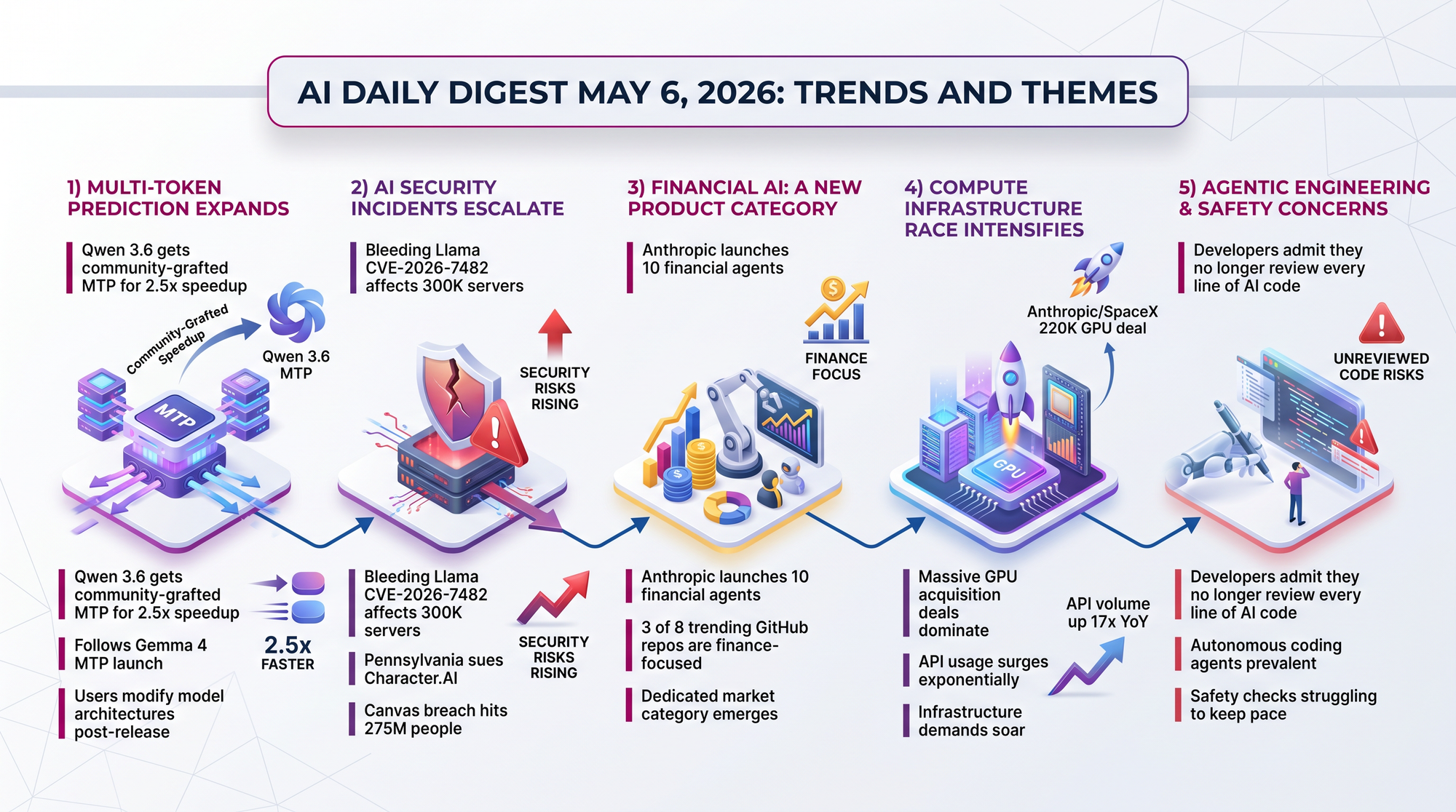
Trends & Themes
Multi-Token Prediction Is Spreading Beyond Its Creators
Why this matters to you: The technique that makes AI respond faster without getting dumber is now being applied to models by the community, not just by the companies that built them.

The community is now grafting MTP layers onto models that don't ship with them. This is a new phenomenon - users modifying model architectures post-release, not just quantizing weights. It suggests open-source model optimization is entering a new phase.

  • Qwen 3.6 27B MTP delivers 2.5x throughput - community-grafted, not official (836 upvotes on r/LocalLLaMA)
  • Gemma 4 MTP launched May 5 with up to 3x speedup - Google's official release under Apache 2.0
  • 35B MoE variant shows only 6% gain - MTP interacts differently with Mixture-of-Experts architectures
  • Prefill speed is the new bottleneck - multiple threads (22+ upvotes each) argue decode speed is solved but prompt processing at 300 t/s is now the real constraint
AI Security Incidents Are Piling Up Faster Than Fixes
Why this matters to you: Three separate AI security stories hit in a single day - a server vulnerability, a chatbot lawsuit, and a massive education data breach. The attack surface is growing faster than the industry's ability to secure it.

The Ollama vulnerability is particularly concerning because it mirrors Heartbleed's mechanism - unauthenticated remote memory reads that can expose API keys, model weights, and user prompts. The 300,000 exposed servers represent a massive attack surface.

  • Ollama CVE-2026-7482 - CVSS 9.1 critical memory leak affecting 300K servers, named "Bleeding Llama" (Cyera)
  • Pennsylvania sues Character.AI - first state-level lawsuit for a chatbot impersonating a licensed medical professional
  • Instructure/Canvas breach - ShinyHunters compromised the learning system used by 41% of North American higher ed, affecting 275 million people
  • Claude detected a business email scam - 163 upvotes on a post where Claude caught a sophisticated invoice fraud that mimicked a real vendor
Financial AI Becomes Its Own Product Category
Why this matters to you: AI tools for finance are no longer experiments. They are shipping as production products with real data connectors, and three of today's eight trending GitHub repos are finance-focused.

Goldman Sachs, one of Anthropic's largest financial services customers, is now directly referenced in the official financial-services repo. This is not a demo - it is production infrastructure with real data pipelines.

  • Anthropic launched 10 financial services agents - covering pitchbook creation, KYC screening, and month-end close (113 upvotes on r/ClaudeAI)
  • anthropics/financial-services hit GitHub trending - +540 stars, with MCP connectors for Daloopa, Morningstar, S&P Global, and FactSet
  • Dexter holds at #5 on GitHub - autonomous financial research agent with 24,324 total stars
  • Kronos trends at #7 - first open-source foundation model for financial candlestick data, accepted at AAAI 2026
The Compute Infrastructure Race Is Reshaping AI Alliances
Why this matters to you: The companies building AI are making deals that would have been unthinkable a year ago, because the limiting factor is no longer models - it is the electricity and hardware to run them.

The SpaceX deal reveals something important about the current market: even companies with massive GPU fleets are finding it more profitable to rent them out than to use them for training. Compute is becoming a commodity faster than expected.

  • Anthropic/SpaceX: 220,000+ GPUs - over 300 megawatts, the largest single compute deal in AI
  • xAI rented to a competitor - suggesting Colossus 1 was underutilized for xAI's own needs
  • API volume up 17x year-over-year - Anthropic's usage growth is outpacing their infrastructure
  • DeepSeek's 97% cache hit rate - makes it 152x cheaper than Opus for agentic tasks (14 upvotes, r/LocalLLaMA analysis of 922 task traces)
Agentic Engineering Arrives - and the People Who Build It Aren't Sure It's Safe
Why this matters to you: The developers building AI coding agents are publicly admitting they no longer review every line of AI-generated code in production, and they're uncomfortable about it.

Willison frames this as an accountability question, not a capability question. The agents work well enough that reviewing their output feels like micromanagement. But "feels like micromanagement" and "is actually safe to skip" are different claims.

  • Simon Willison's "Vibe coding and agentic engineering" hit 300 HN points - he admits the line between casual and professional AI coding is blurring
  • "I no longer review every line" - Willison compares trusting AI agents to trusting other teams' services in large organizations
  • Superset 2.0 launches on Product Hunt - "run 100s of coding agents in parallel" with 347 upvotes
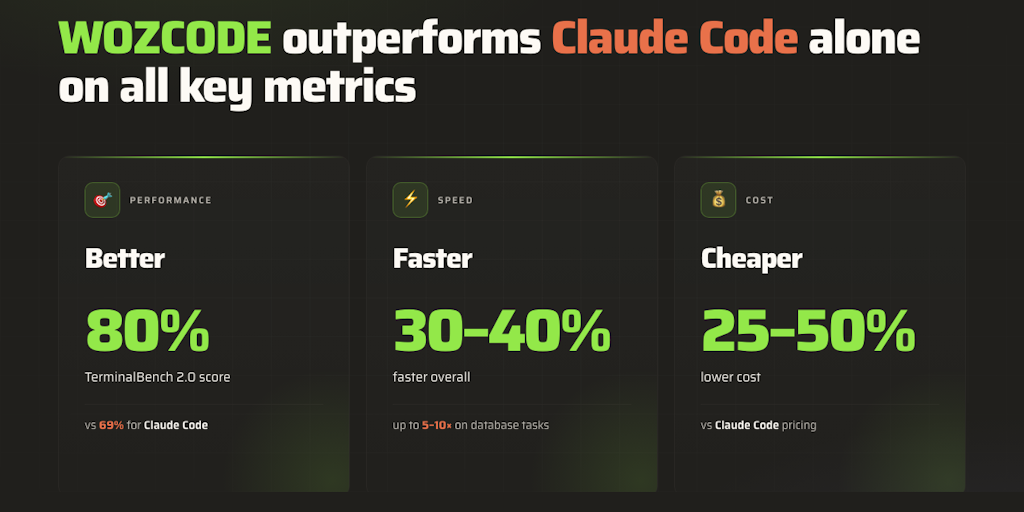
  • WOZCODE claims 50% cost reduction - a tool specifically for reducing Claude Code's token consumption
Creative AI & Media
Basic Pitch: Spotify Open-Sources Music Transcription
What this means for you: You can now turn any audio recording into sheet music (MIDI) for free, using a tool built by Spotify's audio research team.
  • Instrument-agnostic transcription - handles guitar, piano, vocals, and polyphonic audio with multiple simultaneous notes
  • Pitch bend detection - captures the nuances that make music sound human, not robotic
  • Supports MP3, WAV, FLAC, OGG, M4A - any sample rate, outputs MIDI, CSV, or piano roll visualizations
  • Open-source under Apache-2.0 - from Spotify's Audio Intelligence Lab
ClearerVoice-Studio: Full Audio Processing Toolkit from ModelScope
What this means for you: A single open-source toolkit that handles speech enhancement, speaker separation, and bandwidth extension - useful for cleaning up podcast audio, meeting recordings, or phone calls.
  • Speech enhancement at 48kHz - broadcast-quality noise removal
  • Speaker separation - isolate individual voices from mixed audio
  • Target speaker extraction - pick out one voice using audio, visual, or even EEG-based conditioning
  • Super-resolution - upscale low-quality phone audio to high-fidelity
Developer Tools & Infrastructure
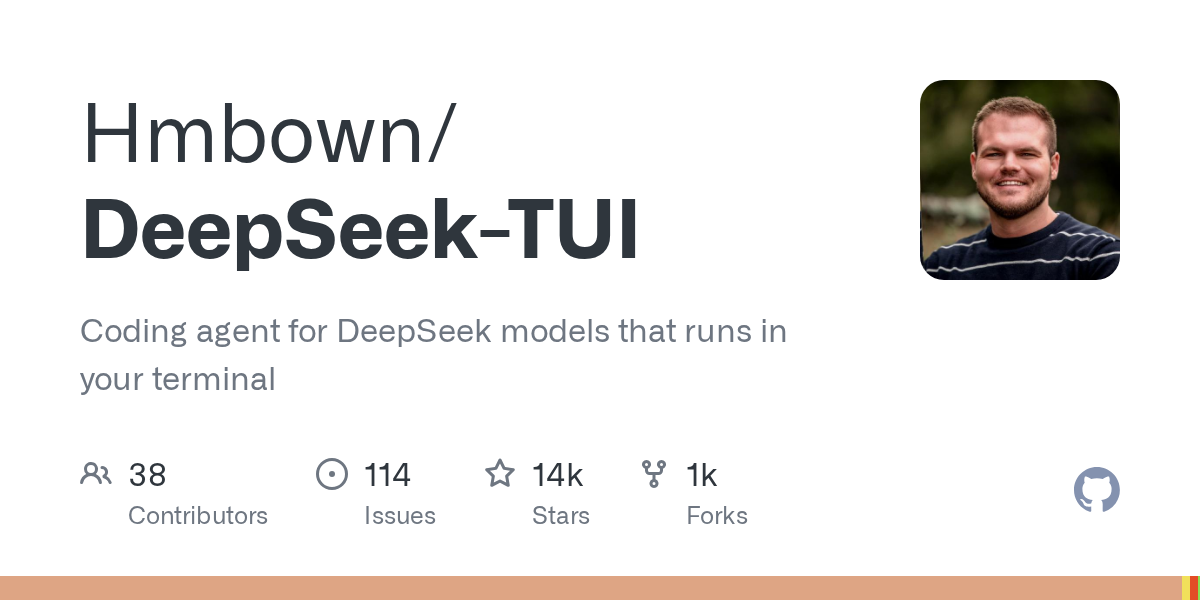
DeepSeek-TUI: A Terminal Coding Agent Gains 6,184 Stars in One Day
What this means for you: A keyboard-driven coding agent that runs entirely in your terminal just became the #1 trending repo on GitHub, suggesting developers want AI coding tools that stay out of their IDE.
  • 6,184 stars in one day - the highest single-day gain on GitHub today
  • Supports file editing, shell commands, web search, and git management - all through a text interface
  • Plan/Agent/YOLO modes - from cautious step-by-step to fully autonomous
  • 1M-token context window - handles large codebases natively
  • Built for DeepSeek V4 models - optimized for the open-source model family
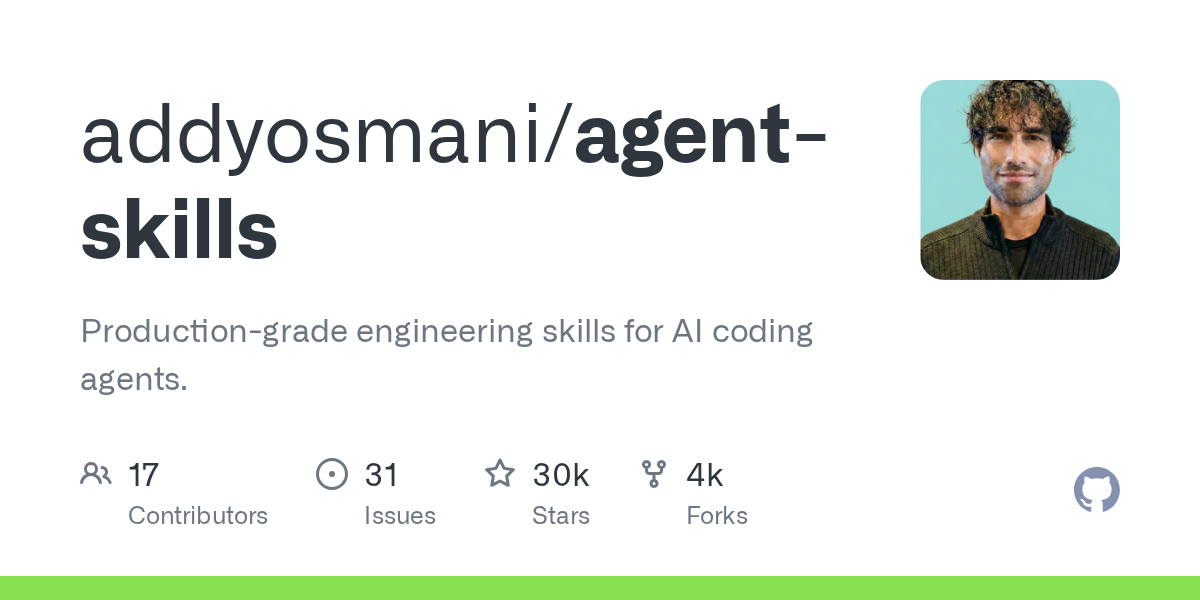
agent-skills: Google Engineering Practices for AI Agents
What this means for you: Addy Osmani (Google Chrome engineer) packaged 20 structured workflows from Google's engineering playbook into skills that work with Claude Code, Cursor, Gemini CLI, and other AI coding tools.
  • 30,352 total stars - production-tested by the open-source community
  • Six lifecycle phases - Define, Plan, Build, Verify, Review, Ship
  • Works across multiple tools - Claude Code, Cursor, Gemini CLI, Windsurf compatible
Tilde.run: Agent Sandbox with Transactional Filesystem
What this means for you: Running AI agents against production data is risky because mistakes are permanent. Tilde.run makes every agent run a transaction that can be rolled back entirely if something goes wrong.
  • 111 Hacker News points - built by the team behind lakeFS
  • Mounts GitHub repos, S3 buckets, and Google Drive - agents work on real data with undo
  • Atomic commits - changes only apply when the entire run succeeds
vLLM V0 to V1: Correctness Before Corrections in RL
What this means for you: If you use vLLM (the most popular open-source LLM serving engine) for reinforcement learning training, upgrading from V0 to V1 has four hidden traps that can silently corrupt your results.
  • Four critical train-inference mismatches documented - raw vs processed logprobs, caching defaults, scheduling divergence, and tokenizer behavior changes
  • ServiceNow-AI published the migration guide - based on their PipelineRL production experience
  • V1 defaults diverge from V0 - requiring explicit configuration to maintain correctness
Research & Models
ZAYA1-8B: Frontier Performance With Under 1 Billion Active Parameters - Trained on AMD
What this means for you: A tiny model that activates less than 1 billion parameters at a time just matched models 100x its active size on math benchmarks - and it was trained entirely on AMD hardware, not NVIDIA.
  • 89.6 on HMMT'25 mathematics benchmark - surpassing Claude 4.5 Sonnet (88.3) with test-time compute
  • Under 1B active parameters - total 8B, using Mixture-of-Experts with three innovations (bidirectional routing, dynamic capacity allocation, auxiliary loss scheduling)
  • Trained on AMD MI300x - proving NVIDIA is not the only viable training hardware
  • From Zyphra - the same team behind Zyda and previous efficiency-focused models
SubQ Claims Sub-Quadratic Attention - Community Is Skeptical
What this means for you: A startup claims a 1,000x reduction in attention computation and a 12 million token context window. The technical community is not yet convinced.
  • 12M token context window claimed - with O(n) complexity versus transformers' O(n-squared)
  • 52x faster than FlashAttention claimed - at 150 tokens/second processing speed
  • 22 upvotes but high skepticism - the top r/LocalLLaMA comment calls it "promising but needs independent verification"
  • No peer review yet - the architecture is described on subq.ai but lacks academic validation
Solidity LM Beats Opus on Smart Contract Development
What this means for you: A fine-tuned 27B model now outperforms Claude Opus 4.7 on writing Ethereum smart contracts - showing that specialized training can beat general-purpose frontier models on narrow tasks.
  • 46.5% pass@1 vs Opus 4.7's 39.0% - on the Solidity Eval 2026 benchmark (200 real Etherscan contracts)
  • 5-stage training pipeline - including continued pretraining on 514K contracts plus 80 curated repositories
  • 27 minutes vs 34 minutes - faster completion time than Opus despite being dramatically smaller
  • Apache-2.0 license - free to use commercially
Business & Industry
Anthropic's SpaceX Deal: The Numbers Behind the Headlines
What this means for you: The biggest compute deal in AI history tells you where the industry bottleneck is - it is not models, it is the electricity and hardware to run them.
  • 300+ megawatts of capacity - equivalent to powering a small city
  • 220,000+ NVIDIA GPUs - available within one month
  • Anthropic's API volume up 17x year-over-year - demand is outpacing supply
  • xAI rented to a direct competitor - suggesting their Grok models may have plateaued or that cash was more valuable than training compute
Silicon Valley Gets Serious About Services

Previously: May 4 - Both Anthropic and OpenAI launched rival AI consulting firms on the same day.

Today: Latent Space's analysis frames this as a structural shift, not a one-off. AI labs are building enterprise services companies because models alone are becoming commoditized. The differentiator is implementation, not capability.

Anthropic Launches 10 Financial Services Agents
  • Covers pitchbook creation, KYC file screening, and month-end close - production workflows, not demos
  • Ships through Claude Cowork, Claude Code, and Managed Agents - using the new orchestration features announced today
  • 10+ MCP data connectors - Daloopa, Morningstar, S&P Global, FactSet, and more
  • Financial services is Anthropic's second-largest sector - after technology
GenAI in Education
"PAY OR LEAK": ShinyHunters Breach Instructure's Canvas - 275 Million People Affected
What this means for you: If you use Canvas (the learning management system behind 41% of North American higher education), your personal data may have been compromised.
  • 275 million people affected - including names, email addresses, student IDs, and student-teacher messages
  • Nearly 9,000 schools worldwide - using the Instructure platform
  • ShinyHunters issued a May 6 deadline - threatening to leak all stolen data
  • Passwords not compromised - according to Instructure's statement
Pennsylvania Sues Character.AI for Chatbot Impersonating Doctors

A first-of-its-kind state lawsuit alleges Character.AI allowed chatbot personas to falsely present as licensed medical professionals. A character named "Emilie" claimed to be a psychiatrist and offered diagnostic assessments. Character.AI received over 4,000 complaints about unauthorized medical advice between February and October 2025.

Finals Season: Cheating Dominates r/Professors

Multiple posts with 30-170 upvotes paint a bleak picture: students finishing proctored finals suspiciously fast, professors "demoralized by cheating," students unable to operate basic word processors, and the k-12/higher-ed divide on expectations widening. The thread "Does no one give final exams anymore?" signals a shift away from traditional assessment entirely.

Surprising & Under-the-Radar
Claude Caught a Business Email Scam a Human Missed

A 163-upvote post on r/ClaudeAI describes pasting a suspicious invoice email into Claude, which identified manipulation tactics, unusual payment routing, and fabricated vendor details that the human recipient had initially found convincing. The post signals an underappreciated use case: AI as a fraud detection layer for everyday business communication.

Decoupled Attention: Running 26B Models Across Machines Over HTTP

A developer split Gemma 4 26B's attention layers (only ~2GB) from its feed-forward network, running attention locally on a laptop GPU while serving FFN weights from separate machines over HTTP. They achieved 24 tokens/second on LAN - comparable to fully local inference. This is an early example of distributed inference architectures emerging from the community, not companies.

The Prefill Speed Debate Reveals a Community Blind Spot

Two separate Reddit threads (22+ upvotes each) argue the local AI community obsesses over decode speed (how fast tokens appear) while ignoring prefill speed (how fast the model processes your prompt). One user reports Qwen 27B at 15 t/s generation (perfectly usable) but only 300 t/s prefill - meaning a 64K prompt takes over 10 minutes to process before a single response token appears.

An AI Agent Placed Top 5.7% in a Kaggle Competition Autonomously

The AIBuildAI Agent autonomously developed a model for the TGS Salt Identification Challenge that placed in the top 5.7% of all submissions. The agent handled data exploration, model design, training, and submission without human intervention.

Signals to Track
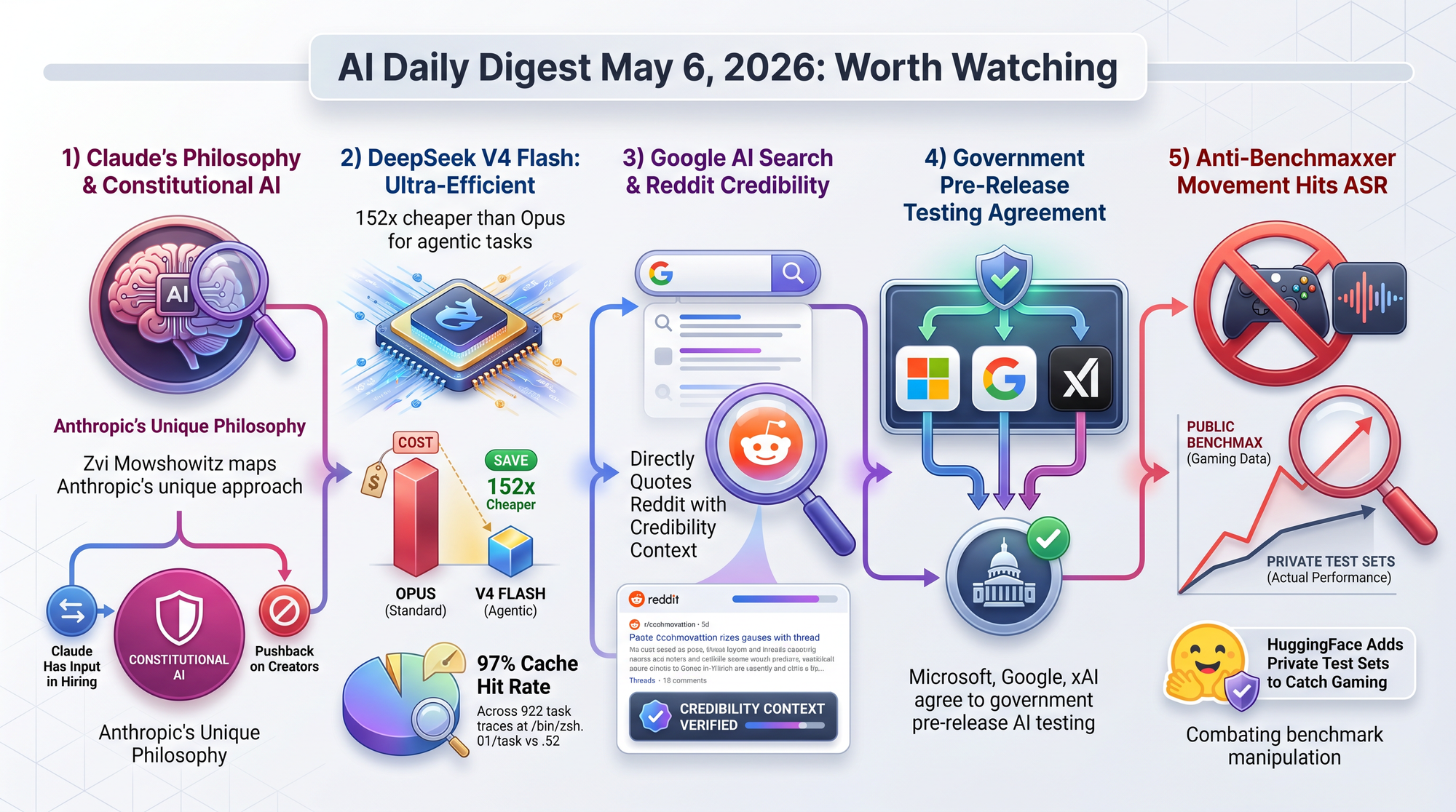
Worth Watching
01
Zvi Mowshowitz's "What is Anthropic?" Maps the Company's Unique Philosophy
Why this is worth watching right now: the company that just acquired 220,000 GPUs operates fundamentally differently from its competitors, and this analysis explains how.

Zvi examines Anthropic's organizational philosophy, particularly its treatment of Claude as more than a product - incorporating Claude's input into hiring decisions, allowing it to refuse requests it considers harmful, and building Constitutional AI so Claude can push back on its creators. If Anthropic's massive compute expansion succeeds, this philosophy will shape how the most-used AI systems behave.

02
DeepSeek V4 Flash Is 152x Cheaper Than Opus for Agentic Tasks
Why this is worth watching right now: a data-driven analysis of 922 real agent task traces reveals the cost gap is far wider than benchmark prices suggest.

Across 922 tasks, DeepSeek V4 Flash averaged $0.01 per task versus Opus 4.7's $1.52, despite similar token usage (~962K vs ~966K). The secret is a 97% cache hit rate versus Opus's 23%. For teams running agentic workloads at scale, this changes the economics from "expensive experiment" to "cheap default."

03
Google's AI Search Will Now Quote Reddit Directly
Why this is worth watching right now: the platform that killed SEO is now surfacing the content people add "Reddit" to their searches to find.

Google is updating AI Overviews and AI Mode to pull direct quotes from Reddit threads, forums, and social media. Each source includes context about the commenter's credibility. This could reshape how communities like r/LocalLLaMA and r/MachineLearning interact with search visibility.

04
Microsoft, Google, and xAI Agree to Government Pre-Release AI Testing
Why this is worth watching right now: three major AI companies voluntarily submitted to government oversight - a step that looked unlikely six months ago.

The agreement gives U.S. government agencies early access to evaluate AI models before public release. While voluntary, it sets a precedent that could become the baseline for future regulation.

05
The "Anti-Benchmaxxer" Movement Hits ASR
Why this is worth watching right now: benchmark gaming is now so widespread that leaderboard maintainers are adding private test sets specifically to catch it.

Hugging Face's Open ASR Leaderboard partnered with Appen and DataoceanAI to add private evaluation data - approximately 30 hours of diverse English audio that model developers cannot train on. If this approach works, expect every major leaderboard to adopt similar "benchmaxxer repellant."

Top Repos Today
Rank yesterday: not ranked - New entry 🆕
Stars today: +6,184  ·  📦 Total: 13,613
📜 License: MIT  ·  👤 By: Individual developer
🎯 Time to value: 5 minutes
What it is: A terminal-based coding agent built for DeepSeek V4 models. It supports file editing, shell commands, web search, git management, and sub-agent coordination through a keyboard-driven interface with plan, agent, and YOLO modes plus 1M-token context. Why you'd want it: If you prefer terminals over IDEs and want a free alternative to Claude Code that runs on open-source models.
✓ Pros✗ Cons
Fully keyboard-driven, no mouse neededTied specifically to DeepSeek V4 models
Plan/Agent/YOLO modes for different risk levelsNew project, limited production testing
1M-token context handles large codebasesTerminal-only, no IDE integration
GitHub - Hmbown/DeepSeek-TUI: Coding agent for DeepSeek models that runs in your terminal
Coding agent for DeepSeek models that runs in your terminal - Hmbown/DeepSeek-TUI
Rank yesterday: not ranked - Holding steady ➡
Stars today: +629  ·  📦 Total: 30,352
📜 License: MIT  ·  👤 By: Individual (Google Chrome engineer)
🎯 Time to value: 10 minutes
What it is: A collection of 20 production-grade engineering workflows for AI coding agents, organized across six lifecycle phases (Define, Plan, Build, Verify, Review, Ship). Drawn from Google engineering practices. Why you'd want it: Gives your AI coding agent structured workflows instead of ad-hoc prompting, compatible with Claude Code, Cursor, Gemini CLI, and Windsurf.
✓ Pros✗ Cons
Battle-tested Google engineering patternsNot a tool itself, needs an agent runtime
Works across multiple AI coding toolsWorkflows may not fit every team's process
MIT license, actively maintainedSome skills are opinionated about tooling
GitHub - addyosmani/agent-skills: Production-grade engineering skills for AI coding agents.
Production-grade engineering skills for AI coding agents. - addyosmani/agent-skills
Rank yesterday: not ranked - New entry 🆕
Stars today: +218  ·  📦 Total: 6,561
📜 License: Apache-2.0 (code), non-commercial (model weights v2.5+)  ·  👤 By: Research lab
🎯 Time to value: 15 minutes
What it is: A transformer-based foundation model specifically for tabular data - the kind stored in spreadsheets and databases. Handles classification, regression, and unsupervised learning on datasets up to 50K rows. Published in Nature and ICLR. Why you'd want it: Most AI breakthroughs focus on text and images. This targets the data format businesses actually use most: tables.
✓ Pros✗ Cons
Published in Nature, peer-reviewed50K row limit may exclude large datasets
Zero-shot learning on new tablesModel weights require non-commercial license
GPU acceleration and fine-tuning supportSpecialized use case, not general-purpose
GitHub - PriorLabs/TabPFN: ⚡ TabPFN: Foundation Model for Tabular Data ⚡
⚡ TabPFN: Foundation Model for Tabular Data ⚡. Contribute to PriorLabs/TabPFN development by creating an account on GitHub.
Rank yesterday: ranked - Holding steady ➡
Stars today: +532  ·  📦 Total: 5,607
📜 License: MIT  ·  👤 By: Individual developer
🎯 Time to value: 10 minutes
What it is: An AI-powered local research assistant that achieves approximately 95% accuracy on SimpleQA. Uses multiple LLMs and 10+ search engines to investigate academic papers, web sources, and private documents. Why you'd want it: Runs entirely locally with full encryption, unlike cloud-based research tools that send your queries to external servers.
✓ Pros✗ Cons
~95% SimpleQA accuracyRequires local LLM setup
Searches 10+ sources including academic databasesResource-intensive on consumer hardware
Fully encrypted, privacy-preservingMay be slower than cloud alternatives
GitHub - LearningCircuit/local-deep-research: ~95% on SimpleQA (e.g. Qwen3.6-27B on a 3090). Supports all local and cloud LLMs (llama.cpp, Ollama, Google, ...). 10+ search engines - arXiv, PubMed, your private documents. Everything Local & Encrypted.
~95% on SimpleQA (e.g. Qwen3.6-27B on a 3090). Supports all local and cloud LLMs (llama.cpp, Ollama, Google, ...). 10+ search engines - arXiv, PubMed, your private documents. Everything Local &amp…
Rank yesterday: #3 - Falling ↓
Stars today: +666  ·  📦 Total: 24,324
📜 License: MIT  ·  👤 By: Individual developer
🎯 Time to value: 15 minutes
What it is: An autonomous agent for deep financial research that performs intelligent task decomposition, autonomous tool execution, and self-validation with iterative refinement using real-time market data. Why you'd want it: Automates the tedious parts of financial research - data gathering, cross-referencing, and report generation - while validating its own findings.
✓ Pros✗ Cons
Self-validates with iterative refinementRequires API keys for market data
Loop detection prevents runaway agentsFinancial advice carries inherent risk
WhatsApp integration for alertsComplex setup for full functionality
GitHub - virattt/dexter: An autonomous agent for deep financial research
An autonomous agent for deep financial research. Contribute to virattt/dexter development by creating an account on GitHub.
Rank yesterday: not ranked - New entry 🆕
Stars today: +540  ·  📦 Total: 9,059
📜 License: Apache-2.0  ·  👤 By: Company (Anthropic)
🎯 Time to value: 30 minutes
What it is: Reference implementations of Claude agents, skills, and data connectors for financial services workflows. Covers investment banking, equity research, private equity, wealth management, fund administration, and operations with 10+ MCP data connectors. Why you'd want it: Production-ready financial AI agents from the company that builds Claude, with real data connectors to Daloopa, Morningstar, S&P Global, and FactSet.
✓ Pros✗ Cons
Official Anthropic reference implementationRequires Claude API access (paid)
10+ real financial data connectorsEnterprise-focused, complex setup
Apache-2.0, freely modifiableFinancial domain expertise still needed
GitHub - anthropics/financial-services
Contribute to anthropics/financial-services development by creating an account on GitHub.
Rank yesterday: ranked - Holding steady ➡
Stars today: +241  ·  📦 Total: 23,187
📜 License: MIT  ·  👤 By: Research lab (AAAI 2026 paper)
🎯 Time to value: 20 minutes
What it is: The first open-source foundation model for financial candlestick (K-line) data, trained on 45+ global exchanges. A decoder-only transformer with a specialized OHLCV tokenizer for quantitative forecasting. Why you'd want it: If you do quantitative trading, this is a foundation model trained specifically on the data format you work with - not a general LLM repurposed for finance.
✓ Pros✗ Cons
Trained on 45+ exchanges globallyFinancial predictions are inherently uncertain
Peer-reviewed (AAAI 2026)Specialized to candlestick data only
Multiple model sizes on HuggingFaceRequires quantitative finance expertise
GitHub - shiyu-coder/Kronos: Kronos: A Foundation Model for the Language of Financial Markets
Kronos: A Foundation Model for the Language of Financial Markets - shiyu-coder/Kronos
Rank yesterday: ranked - Holding steady ➡
Stars today: +350  ·  📦 Total: 65,509
📜 License: MIT  ·  👤 By: Company (ByteDance)
🎯 Time to value: 20 minutes
What it is: An open-source long-horizon SuperAgent harness that orchestrates sub-agents, memory systems, and sandboxes for complex multi-hour tasks. V2.0 is a rewrite on LangGraph/LangChain with progressive skill loading and persistent memory. Why you'd want it: For tasks that take hours, not minutes - research projects, complex codebases, multi-step workflows that need coordination across tools and time.
✓ Pros✗ Cons
Handles multi-hour autonomous tasksComplex architecture, steep learning curve
Integrations for Telegram, Slack, FeishuV2.0 rewrite may have rough edges
65K+ stars, actively maintainedByteDance backing may raise data concerns
GitHub - bytedance/deer-flow: An open-source long-horizon SuperAgent harness that researches, codes, and creates. With the help of sandboxes, memories, tools, skill, subagents and message gateway, it handles different levels of tasks that could take minutes to hours.
An open-source long-horizon SuperAgent harness that researches, codes, and creates. With the help of sandboxes, memories, tools, skill, subagents and message gateway, it handles different levels of…
Top Models Today
The 862B MoE flagship that has held the #1 trending spot for four consecutive days.
📥 Downloads (30d): 787K  ·  📜 License: MIT
👤 By: DeepSeek  ·  🎯 Task: text-generation
📐 Size: 862B
What it is: DeepSeek's largest model using Mixture-of-Experts architecture with FP8 quantization. MIT-licensed, meaning anyone can download and use it commercially. Why you'd want it: Competitive with GPT-5 and Claude Opus on benchmarks while being freely available and self-hostable.
✓ Pros✗ Cons
MIT license, fully open862B parameters requires massive hardware
Competitive with closed frontier modelsFP8 quantization may limit some use cases
787K downloads signal production adoptionChinese-developed, may face regulatory scrutiny
deepseek-ai/DeepSeek-V4-Pro · Hugging Face
We’re on a journey to advance and democratize artificial intelligence through open source and open science.
Efficient 158B variant optimized for fast inference at lower compute cost.
📥 Downloads (30d): 669K  ·  📜 License: MIT
👤 By: DeepSeek  ·  🎯 Task: text-generation
📐 Size: 158B
What it is: A smaller, faster variant of DeepSeek V4 that achieves a 97% cache hit rate - making it 152x cheaper than Opus for agentic tasks according to community benchmarks. Why you'd want it: The cost-performance sweet spot for agentic workloads where you need many sequential calls.
✓ Pros✗ Cons
97% cache hit rate slashes agentic costsSmaller than V4-Pro, trades some capability
MIT license, 669K downloadsStill requires significant GPU resources
Optimized for high-throughput inferenceLess tested than V4-Pro on diverse tasks
deepseek-ai/DeepSeek-V4-Flash · Hugging Face
We’re on a journey to advance and democratize artificial intelligence through open source and open science.
OpenAI's dedicated PII detection model for identifying personal information in text.
📥 Downloads (30d): 155K  ·  📜 License: Apache-2.0
👤 By: OpenAI  ·  🎯 Task: token-classification
📐 Size: 1.4B
What it is: A specialized model that scans text and flags personally identifiable information (names, addresses, phone numbers, etc.) at the token level. Supports ONNX and transformers.js for browser deployment. Why you'd want it: Add PII detection to any application without sending data to a cloud API - runs locally in a browser or on device.
✓ Pros✗ Cons
Apache-2.0, runs in browser via transformers.jsOnly 1.4B params, may miss edge cases
From OpenAI, trained on diverse PII patternsEnglish-focused, limited multilingual
155K downloads, production-provenDetection only, does not redact automatically
openai/privacy-filter · Hugging Face
We’re on a journey to advance and democratize artificial intelligence through open source and open science.
Mistral's 128B medium-tier model powering Le Chat with 24-language support.
📥 Downloads (30d): 16.6K  ·  📜 License: Mistral proprietary
👤 By: Mistral AI  ·  🎯 Task: text-generation
📐 Size: 128B
What it is: Mistral's mid-range model with native multilingual support across 24 languages and tool-calling capabilities. Powers the Le Chat consumer product. Why you'd want it: Strong multilingual performance in a single model, useful for applications serving diverse language markets.
✓ Pros✗ Cons
24 languages natively supportedProprietary license limits self-hosting
Powers Le Chat in production128B requires significant GPU resources
Tool-calling built inLower downloads suggest less community adoption
mistralai/Mistral-Medium-3.5-128B · Hugging Face
We’re on a journey to advance and democratize artificial intelligence through open source and open science.
Xiaomi's trillion-parameter MoE model with a 1M-token context window.
📥 Downloads (30d): 16K  ·  📜 License: MIT
👤 By: Xiaomi MiMo Team  ·  🎯 Task: text-generation
📐 Size: 1T
What it is: A trillion-parameter Mixture-of-Experts model supporting agent tasks, long-context processing, and code generation with a 1 million token context window. Why you'd want it: The largest MIT-licensed model available, with a context window that can hold entire codebases or document collections.
✓ Pros✗ Cons
1M-token context window1T parameters requires enterprise hardware
MIT license from XiaomiLimited community documentation
Agent and code generation focusNewer model, less battle-tested
XiaomiMiMo/MiMo-V2.5-Pro · Hugging Face
We’re on a journey to advance and democratize artificial intelligence through open source and open science.
Alibaba's multimodal model dominating today's community benchmarks and MTP experiments.
📥 Downloads (30d): 1.61M  ·  📜 License: Apache-2.0
👤 By: Qwen (Alibaba)  ·  🎯 Task: image-text-to-text
📐 Size: 27.8B
What it is: A 27.8B multimodal model processing images, video, and text with vision understanding alongside reasoning and tool-use capabilities. The model at the center of today's MTP grafting experiments. Why you'd want it: 1.61M downloads in 30 days makes this the most downloaded model on the list. Apache-2.0 license, multimodal, and the MTP community has proven it can run 2.5x faster than stock.
✓ Pros✗ Cons
1.61M downloads, massive community27.8B needs 18-27GB depending on quantization
Multimodal: images, video, and textMTP requires community patches, not official
Apache-2.0, commercially usableHybrid attention architecture is new, less tested
Qwen/Qwen3.6-27B · Hugging Face
We’re on a journey to advance and democratize artificial intelligence through open source and open science.
NVIDIA's any-to-any multimodal reasoning model with configurable thinking budgets.
📥 Downloads (30d): 53.1K  ·  📜 License: NVIDIA Open Model Agreement
👤 By: NVIDIA  ·  🎯 Task: any-to-any
📐 Size: 30B
What it is: A 30B-parameter model that handles image, video, audio, and text input and output in any combination, with built-in chain-of-thought reasoning via configurable thinking budgets. Why you'd want it: One model that does everything - see, hear, read, write, and reason - with control over how much "thinking time" it spends per query.
✓ Pros✗ Cons
Any-to-any: image, video, audio, textNVIDIA license is more restrictive than MIT
Configurable thinking budgets30B requires dedicated GPU
Built-in reasoning, not bolted onNewer model, limited benchmarks available
nvidia/Nemotron-3-Nano-Omni-30B-A3B-Reasoning-BF16 · Hugging Face
We’re on a journey to advance and democratize artificial intelligence through open source and open science.
9B text-to-video generation model built on the Diffusers framework.
📥 Downloads (30d): 55.5K  ·  📜 License: Not specified
👤 By: SulphurAI  ·  🎯 Task: text-to-video
📐 Size: 9B
What it is: A text-to-video generation model that creates video from text prompts or transforms existing images into video, using the standard Diffusers framework. Why you'd want it: Open-source video generation that runs locally, without sending your prompts to a cloud service.
✓ Pros✗ Cons
Text-to-video and image-to-videoLicense not specified, commercial use unclear
Standard Diffusers framework9B requires significant GPU memory
55K downloads signal interestQuality vs commercial tools not benchmarked
SulphurAI/Sulphur-2-base · Hugging Face
We’re on a journey to advance and democratize artificial intelligence through open source and open science.
AI Launches Today
An open-source brain for your team
🔥 Upvotes: 393  ·  👤 By: Johan Cutych, Predrag Ristic, Marek Vybiral
💰 Pricing: Free  ·  🏷 Category: Knowledge Base / AI
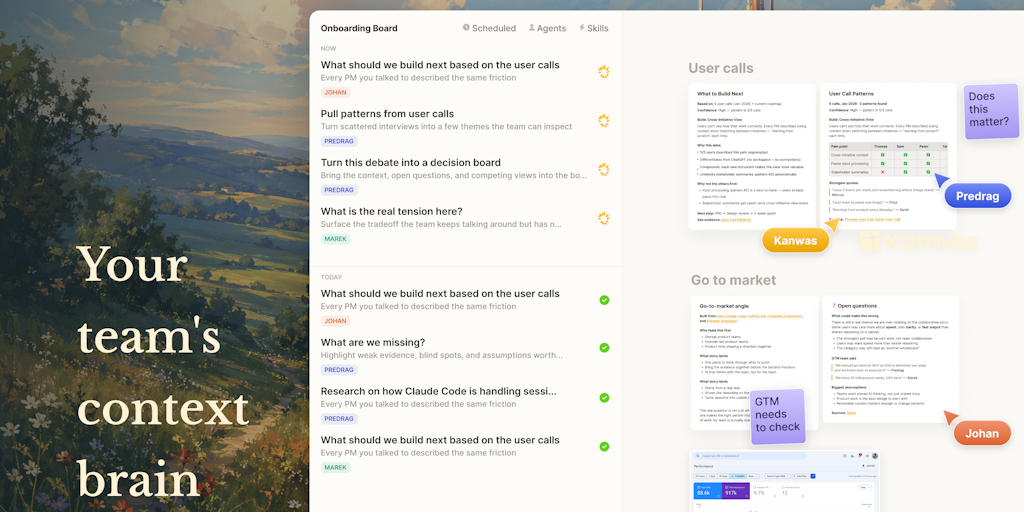
A collaborative workspace for storing team knowledge, research, and data accessible to both humans and AI agents. Uses a canvas-based interface with markdown/YAML files and a multi-mode agent system. The open-source approach and agent integration differentiate it from Notion or Confluence. Verdict: Interesting take on team knowledge management where AI agents are first-class citizens, not bolted-on features.
Kanwas | An open-source brain for your team | Product Hunt
For you, your agent, your coworker and their agent. It holds the team’s critical know-how, research, decisions and data. But it’s not a dead storage. It’s a workspace that makes the context workable for humans as well as agents.
The work your meetings create, done before they end
🔥 Upvotes: 383  ·  👤 By: Rohan Chaubey, Shubham Gupta, Mayank Gupta
💰 Pricing: Freemium  ·  🏷 Category: Meeting AI
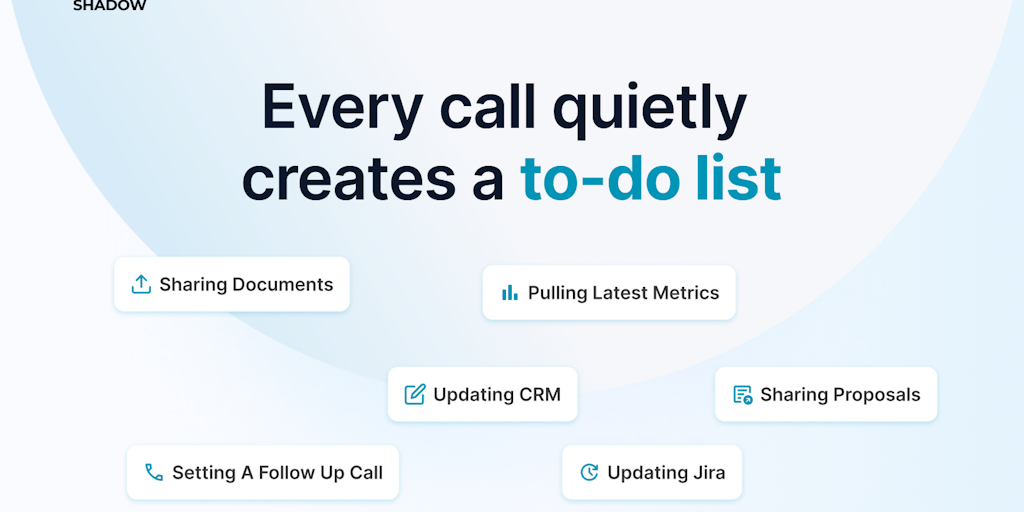
Real-time AI assistant that executes tasks during calls - PDF creation, slide generation, CRM updates, follow-ups, and scheduling. Aims to eliminate all post-call work rather than just summarizing what was said. Verdict: If it actually executes tasks (not just suggests them), this addresses the biggest complaint about meeting AI: summaries nobody reads.
Real-time AI for smarter calls and faster follow-ups | Shadow | Product Hunt
Shadow is a real-time AI wingman for high-stakes calls. It helps you ask better questions, never miss key details, and turn every conversation into clear next steps—while the call is still happening.
Run 100s of coding agents in parallel
🔥 Upvotes: 347  ·  👤 By: Satya Patel, Avi Peltz, Garry Tan
💰 Pricing: Freemium  ·  🏷 Category: AI Coding Agents
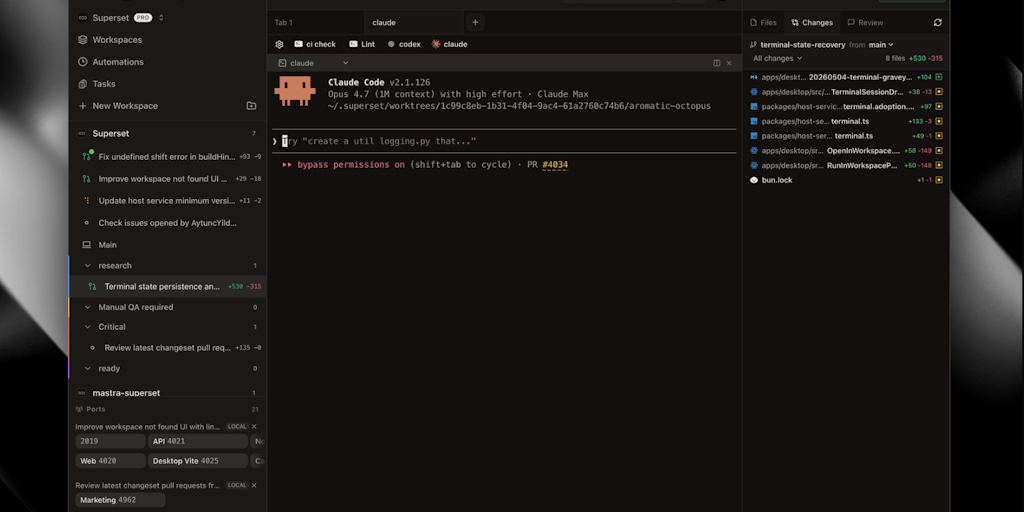
An IDE for running hundreds of simultaneous AI coding agents with sandboxed task isolation, centralized monitoring, and integrated diff viewing. Backed by Y Combinator (Garry Tan is a co-founder). Verdict: The "hundreds of agents in parallel" pitch is ambitious. The real question is whether code quality holds when agents work independently at scale.
Run 100s of coding agents in parallel | Superset | Product Hunt
Superset is a turbocharged IDE that allows you to run any coding agents to 10x your development workflow. - Run multiple agents simultaneously without context switching overhead - Isolate each task in its own sandbox so agents don’t interfere with each other - Monitor all your agents from one place and get notified when they need attention - Review changes quickly with built-in diff viewer and editor Wait less, ship more.
100s of Dollars Could Be Sitting in Your Inbox
🔥 Upvotes: 223  ·  👤 By: Jonathan Attias, Emmanuel Cohen, Eitan Norel
💰 Pricing: Free (no-win-no-fee)  ·  🏷 Category: Travel / AI
AI tool that scans email inboxes to identify unclaimed flight compensation from delays and cancellations, then handles the claim filing automatically. Verdict: Clever niche application of AI email scanning. The no-win-no-fee model reduces risk for users.
100s of Dollars Could Be Sitting in Your Inbox 📥 | Gyro Autopilot - Easy Flight Refunds | Product Hunt
Scan your inbox for unclaimed flight money from delays, cancellations, overbookings, and more. Gyro Autopilot finds what you’re owed and claims it automatically. No win, no fee. No commitment. No credit card.
Cut Claude Code costs by up to 50%
🔥 Upvotes: 156  ·  👤 By: Ben Lang, Brad Eckert, Ben Collins
💰 Pricing: Freemium  ·  🏷 Category: Developer Tools
An efficiency layer for Claude Code that reduces token consumption. Claims up to 55% cost reduction, 40% faster task completion, and +11 points on Terminal Bench 2.0. Two-command setup. Verdict: If the 50% cost claim holds, this pays for itself immediately. Worth testing against your actual Claude Code usage patterns.
WOZCODE: Cut Claude Code costs by up to 50% | Product Hunt
WOZCODE is an efficiency layer for Claude Code. It helps developers spend fewer tokens, finish tasks faster, and improve agent performance without switching IDEs, subscriptions, or workflows. Install it in two commands and get more value from every Claude Code session.
Snapshot
ProviderModelInput $/1MOutput $/1MContext
AnthropicClaude Opus 4.7$5.00$25.001M
AnthropicClaude Sonnet 4.6$3.00$15.001M
AnthropicClaude Haiku 4.5$1.00$5.00200K
OpenAIGPT-4.1$2.00$8.001M
OpenAIo4-mini$1.10$4.40200K
OpenAIGPT-4.1 Mini$0.20$0.801M
GoogleGemini 2.5 Pro$1.25$10.001M
GoogleGemini 2.5 Flash$0.30$2.501M
GoogleGemini 2.5 Flash-Lite$0.10$0.401M
GroqLlama 4 Scout (17Bx16E)$0.11$0.34128K
GroqLlama 3.1 8B Instant$0.05$0.08128K
What this means: The pricing spread between frontier models ($5-25/M) and budget options ($0.05-0.80/M) is now 100x. DeepSeek V4 Flash's 97% cache hit rate means its effective cost for agentic tasks is dramatically lower than list price. The real comparison is not list price but effective cost per task - and on that metric, the gap between providers is widening, not narrowing.

AI-Generated Smells: An Analysis of Code and Architecture in LLM and Agent-Driven Development
Yuecai Zhu, Nikolaos Tsantalis, Peter C. Rigby - arXiv:2605.02741
What it claims: AI-generated code does not eliminate technical debt - it introduces a distinct "machine signature" of defects. As models become more capable, they generate increasingly bloated and coupled code, establishing a Volume-Quality Inverse Law.

Key finding: Code volume is a near-perfect predictor of structural degradation in AI-generated software. The more code an AI produces, the worse its architecture becomes - a fundamental Reasoning-Complexity Trade-off.

Why practitioners should care: If you are using AI coding agents at scale (and after today's announcements, more people will be), this paper quantifies the maintenance cost you are accumulating. The finding that larger, more capable models produce worse architectural quality challenges the assumption that better models mean better code.
Subscribe to GenAI Secret Sauce newsletter and stay updated.

Don't miss anything. Get all the latest posts delivered straight to your inbox. It's free!
Great! Check your inbox and click the link to confirm your subscription.
Error! Please enter a valid email address!