GenAI Secret Sauce Daily Digest - 2026-05-07

OpenAI Launches Voice Intelligence Models and Starts Testing Ads in ChatGPT · Mozilla Fixed 423 Firefox Security Bugs in One Month Using Claude Mythos · Malware Disguised as AI Model on HuggingFace Steals Browser Passwords
GenAI Secret Sauce Daily Digest - 2026-05-07

Watch today's digest as a video summary (generated by NotebookLM)

Statistically Speaking
15.2% higher on audio intelligence benchmarks than its
OpenAI Launches Voice Intelligence Models and Starts Testing
Top Story
13 output languages
OpenAI Launches Voice Intelligence Models and Starts Testing
10 out of 10 in behavioral malware analysis
Malware Disguised as AI Model on HuggingFace Steals Browser
11 MITRE ATT&CK techniques mapped including credential theft,
Malware Disguised as AI Model on HuggingFace Steals Browser
1.1M B executable dropped a DLL to AppData
Malware Disguised as AI Model on HuggingFace Steals Browser
11 MITRE ATT&CK techniques mapped
Malware Disguised as AI Model on HuggingFace Steals Browser
One Thing to Tell Your Friends
OpenAI started running ads inside ChatGPT - the world's most-used AI assistant is now an advertising platform.
TL;DR
Trends
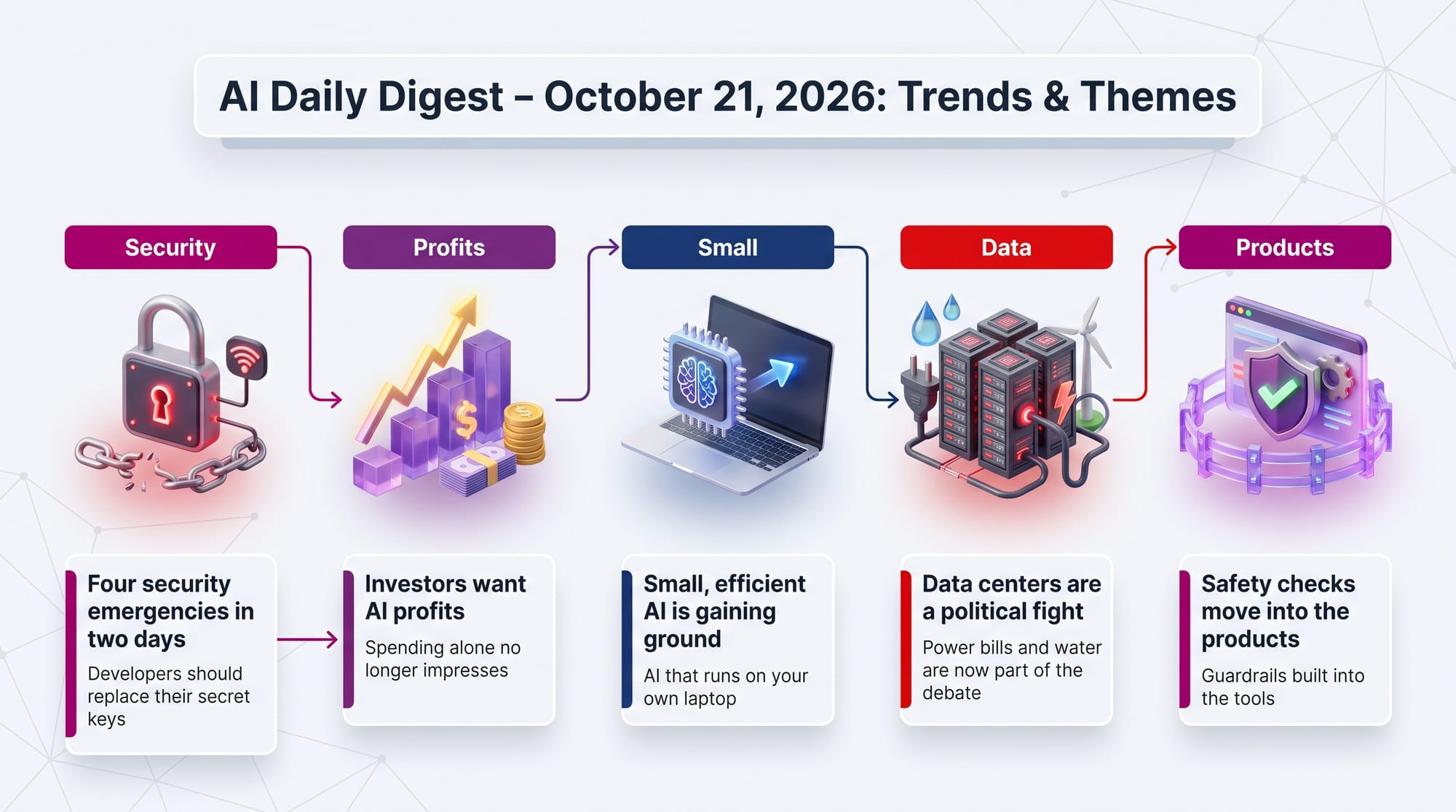
AI Is Becoming Security's Best (and Scariest) Tool, The AI Boom Is Eating the Consumer Hardware Market, and Reliable Agents Need Code, Not Better Prompts.
Research
AI Vulnerability Agents Find 28 Zero, The Impossibility Triangle of Long, and Design Conductor 2.0: AI Designs a Hardware Chip in 80 Hours.
Surprising
Best AI Passes 95% of Tests on Only 3% of Real Programming Tasks, The White House Is Moving Toward Prior Restraint of AI Models, and AI.
GitHub
Leading repos: anthropics/financial (+1,367), Hmbown/DeepSeek (+5,787), and z (+654).
HuggingFace
Leading models: deepseek-ai/DeepSeek-V4 (946k), XiaomiMiMo/MiMo-V2.5 (20.9k), and Qwen/Qwen3.6 (1.77M).
Product Hunt
Top launches: FlowMarket (404), Claude Agents for Financial Services (201), and GPT (177).
API Pricing
What this means:** At the flagship tier, Anthropic and OpenAI are within dollars of each other ($5 input), with Google's Pro Preview undercutting both at $2.
arXiv
Are Tools All We Need? Unveiling the Tool — Under noisy conditions, the "tool-use tax" - performance degradation from the tool-calling protocol itself - often negates any benefit from the tools.
Hot off the Presses
01
OpenAI Launches Voice Intelligence Models and Starts Testing Ads in ChatGPT
What this means for you: If you use ChatGPT for free, you will now see ads between answers - and opting out costs you daily message allowance.

OpenAI made several moves today that reshape how people interact with its products. Three new audio models landed in the Application Programming Interface (API):

Pricing runs $32 per million audio input tokens for the flagship model, $0.034/minute for translation, and $0.017/minute for transcription.

Separately, OpenAI confirmed ads are now live in ChatGPT for free and Go-plan users in the US. Early partners include Target, Adobe, Williams-Sonoma, and Albertsons. Ads are labeled "sponsored" and supposedly don't influence answers. Users who don't want ads can upgrade to Plus/Pro or opt out - but opting out means fewer daily free messages.

OpenAI also launched two safety features: GPT-5.5-Cyber gives vetted security defenders a version with fewer guardrails for bug hunting and malware analysis, and Trusted Contact lets users nominate someone to be notified if automated systems detect serious self-harm discussions.

""Truist estimates OpenAI will generate under $1 billion in ad revenue in 2026, projected to grow to over $30 billion by 2030.""
  • GPT-Realtime-2 scores 15.2% higher on audio intelligence benchmarks than its predecessor, with GPT-5-class reasoning during live conversations
  • GPT-Realtime-Translate handles live translation from 70+ input languages into 13 output languages
  • GPT-Realtime-Whisper transcribes speech as it happens, not after
02
Mozilla Fixed 423 Firefox Security Bugs in One Month Using Claude Mythos
What this means for you: The browser you use just got dramatically safer - and the tool that did it found bugs that human reviewers missed for two decades.

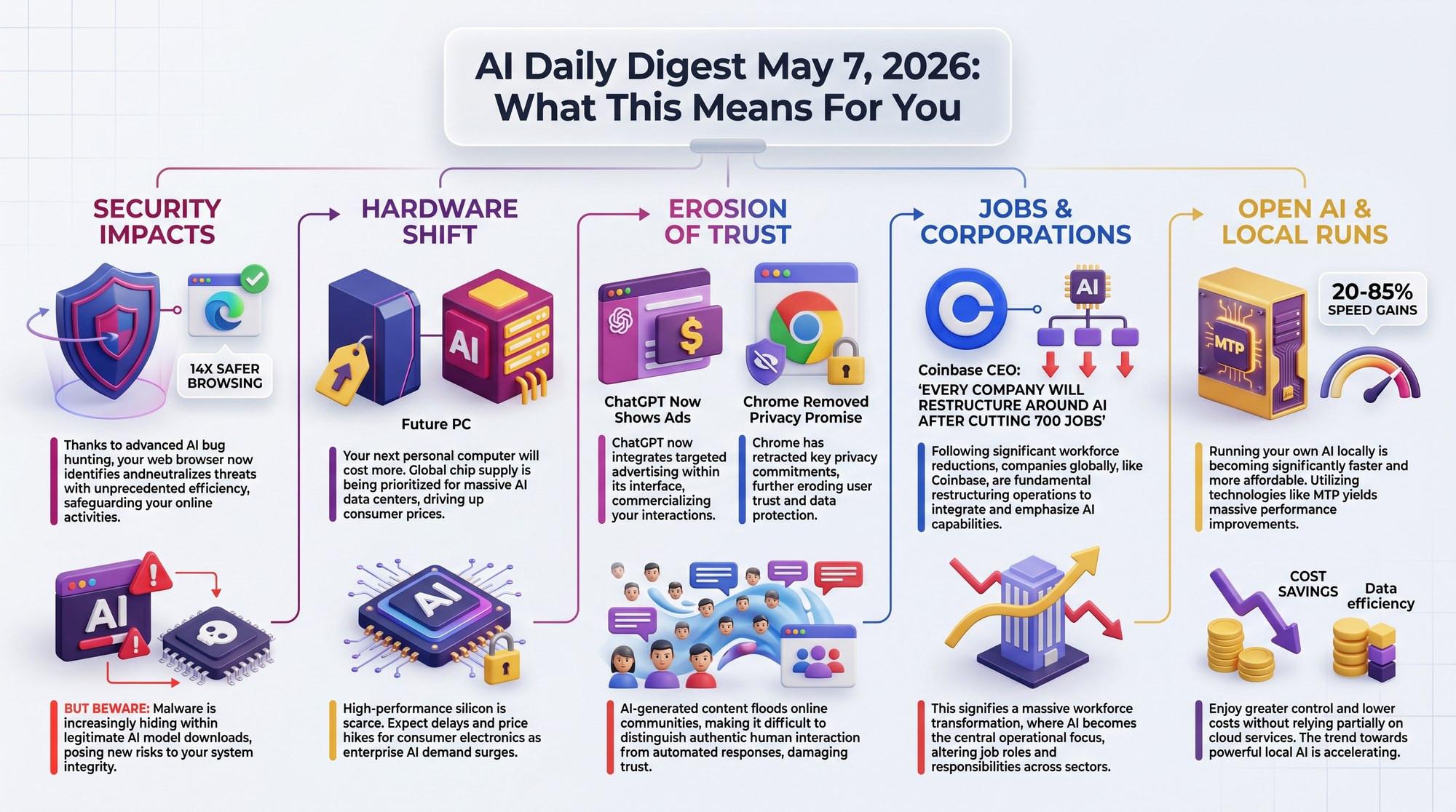
Mozilla gained early access to Anthropic's Claude Mythos and pointed it at Firefox's codebase. The result: 423 security bug fixes in April 2026, compared to a normal monthly average of 20-30. That is roughly a 14x increase.

This is a significant milestone. AI security scanning went from producing false positives that wasted developer time to finding real, exploitable bugs at 14x the rate of human review. The implications extend well beyond Firefox - every large codebase has decades of accumulated vulnerabilities that AI can now surface.

  • A 20-year-old XSLT vulnerability and a 15-year-old HTML legend element bug were among the discoveries - both had survived every prior human code review
  • Firefox's existing defense-in-depth architecture blocked many of the AI-generated exploit attempts, validating years of security engineering
  • Previous AI security reports were mostly noise - Mozilla credits improved model capabilities and better techniques for steering models toward actionable results
03
Malware Disguised as AI Model on HuggingFace Steals Browser Passwords
What this means for you: If you downloaded "Open-OSS/privacy-filter" from HuggingFace, your browser passwords and stored credentials may be compromised. Change them immediately.

A repository posing as a 1.5-billion-parameter privacy filter model on HuggingFace was actually a Windows information stealer. The community caught it within hours (589 Reddit upvotes on the warning post), but the damage window was open.

This follows a pattern of supply chain attacks targeting AI developers. Last week's Ollama CVE and the Canvas breach both targeted the same community. The lesson: treat model downloads like software installations - verify the publisher, check the repository history, and never run executables bundled with model weights.

  • Severity: 10 out of 10 in behavioral malware analysis - the executable extracted browser credentials, injected code into Chrome, and checked for VirtualBox to evade sandbox detection
  • 11 MITRE ATT&CK techniques mapped including credential theft, system information discovery, and anti-debugging
  • The 1.1MB executable dropped a DLL to AppData and began harvesting stored passwords immediately on execution
04
Google Quietly Removes Chrome's "Data Stays on Your Device" AI Promise
What this means for you: Chrome's on-device AI features may now send data to Google's servers - the company removed the one sentence that said they wouldn't.

Between Chrome 147 and Chrome 148, Google deleted a specific privacy claim from the browser's on-device AI settings. The old text read: AI models "run directly on your device without sending your data to Google servers." The new text just says models run "directly on your device" - dropping the server clause entirely.

The community response was immediate: 402 points on Hacker News, coverage from Malwarebytes and Android Authority. Google later added an option to disable the local model download.

  • Chrome's most visible AI feature, the "AI Mode" button, already routes queries to Google's cloud regardless of the local model
  • Chrome had been silently downloading a 4GB Gemini Nano model to user devices without explicit consent
  • The language removal doesn't change actual data practices but eliminates Google's clearest argument for why the silent model install was privacy-respecting
05
AlphaEvolve Shows Real-World Impact One Year After Launch
What this means for you: Google's algorithm-discovery AI is now improving things you actually use - from how your DNA gets sequenced to how packages get delivered.

Google DeepMind published an impact report for AlphaEvolve, its Gemini-powered coding agent that discovers and optimizes algorithms. The results span healthcare, infrastructure, physics, and commercial applications:

In mathematics, AlphaEvolve advanced work with Terence Tao on Erdos problems and improved bounds on the Traveling Salesman Problem and Ramsey Numbers. The breadth of impact - from quantum error correction to logistics routing - suggests algorithm discovery agents may be the most underappreciated category of AI application.

""Klarna doubled transformer training speed. FM Logistic saved 15,000+ km annually with a 10.4% routing efficiency gain.""
  • Healthcare: 30% fewer errors in DNA sequencing variant detection
  • Power grids: Neural network feasibility for optimal power flow jumped from 14% to over 88%
  • Disaster prediction: 5% improvement in natural disaster risk accuracy across 20 categories
  • Google infrastructure: 20% less write amplification in Spanner, ~9% smaller software storage footprint, TPU circuit designs in next-gen silicon
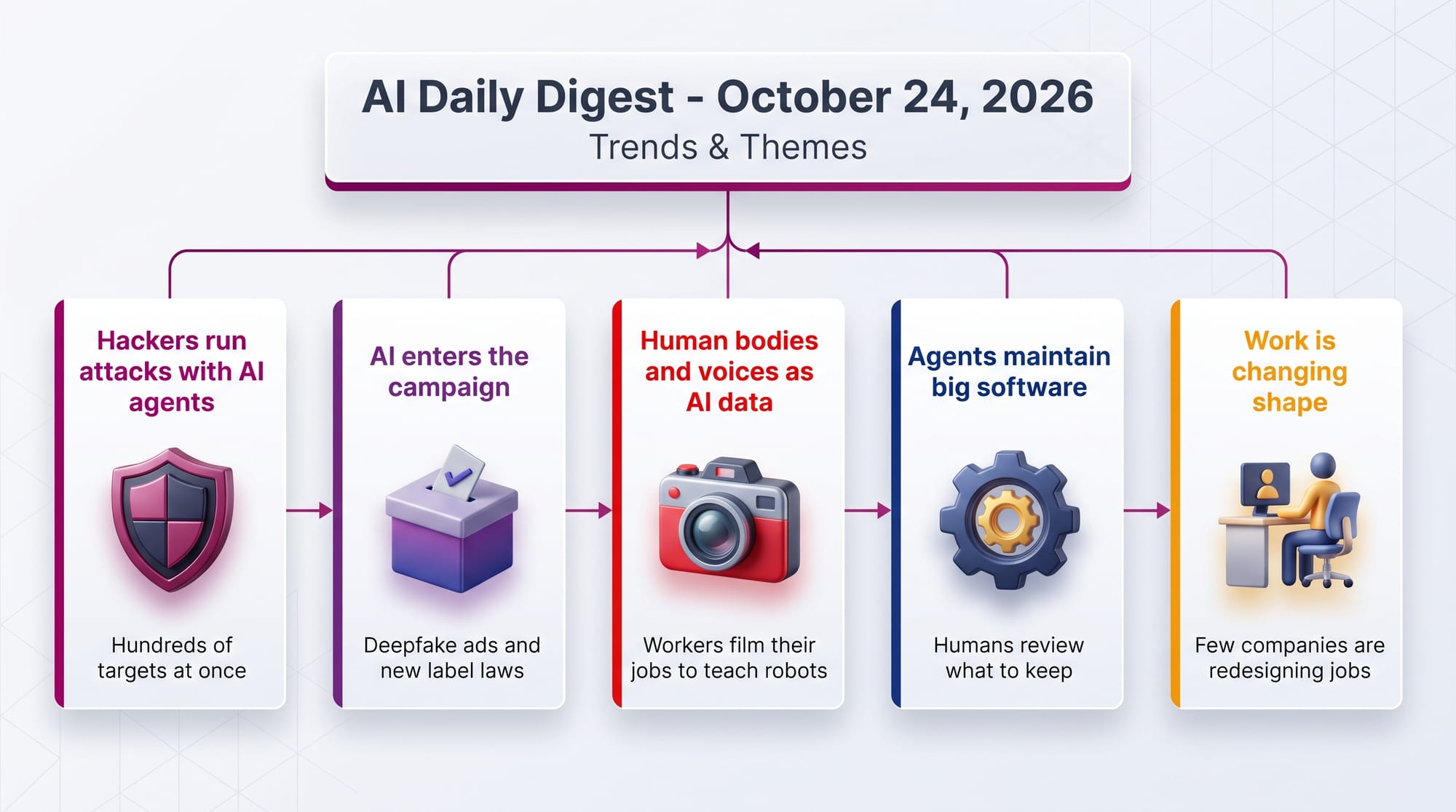
Trends & Themes
Trends & Themes
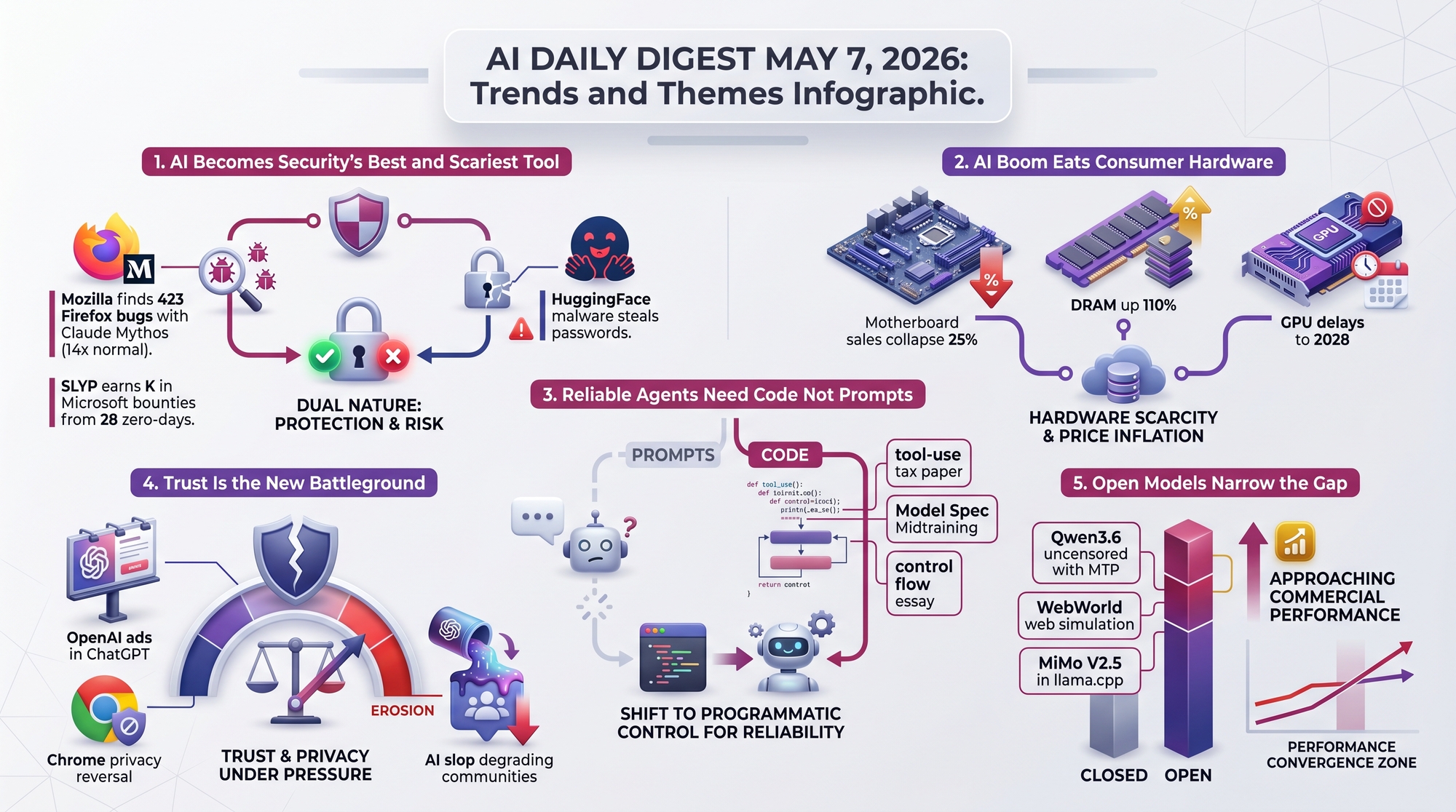
AI Is Becoming Security's Best (and Scariest) Tool
Why this matters to you: The same technology finding bugs faster than any human team can also be weaponized - and attackers are already trying.

The security landscape is splitting: AI dramatically improves defense while simultaneously lowering the bar for attack. Organizations that adopt AI security scanning first gain a temporary but significant advantage.

  • Mozilla's 14x security bug spike with Claude Mythos shows frontier models can surface vulnerabilities hidden for decades
  • SLYP, an AI vulnerability agent, found 28 zero-day Windows flaws earning 16 CVEs and $140,000 in Microsoft bounties
  • OpenAI's GPT-5.5-Cyber gives vetted defenders fewer guardrails for offensive security testing
  • The HuggingFace malware incident shows attackers targeting AI developer toolchains specifically
The AI Boom Is Eating the Consumer Hardware Market
Why this matters to you: Your next PC upgrade will cost more and offer fewer choices because chipmakers are building AI data centers instead.

Global chip sales hit nearly $300 billion in Q1 2026, on track to exceed $1 trillion annually. The money is flowing - just not toward consumers. ASUS server revenue topped 10 billion NTD (100%+ growth) while its consumer motherboard division shrank.

  • Motherboard sales collapsed 25%+ as Intel and AMD prioritize data center chips over consumer parts
  • DRAM prices surged 110% in Q1 2026 with AI consuming 20% of total production
  • NVIDIA's RTX 60-series allegedly delayed to 2028 - no consumer Graphics Processing Unit (GPU) refresh in sight
  • AMD's MI350P targets enterprise AI with 144GB HBM3e, leaving consumer GPU development understaffed
Reliable Agents Need Code, Not Better Prompts
Why this matters to you: If you're building AI-powered tools, the biggest lesson from 2026 so far is that prompts alone won't make agents reliable.

The consensus is hardening: LLMs belong inside deterministic software systems with explicit state machines, validation checkpoints, and programmatic verification. The prompt-only era is ending.

  • "Agents need control flow, not more prompts" (261 HN points) argues that MANDATORY and DO NOT SKIP in prompts signals a fundamental architecture problem
  • Anthropic's Model Spec Midtraining adds a training stage that teaches models the principles behind behavior, not just examples of it
  • The "tool-use tax" paper shows that adding tools to AI agents can actually hurt performance due to protocol overhead
  • HeavySkill improves small model accuracy from 35.7% to 69.3% using structured multi-trajectory reasoning
Trust Is the New Battleground
Why this matters to you: The companies building AI are making decisions right now about ads, privacy, and content quality that will shape how much you can trust these tools.

These aren't edge cases. They represent the mainstreaming of AI tools making everyday decisions about advertising, privacy, employment, and content quality that directly affect hundreds of millions of users.

  • OpenAI put ads in ChatGPT - the first major AI assistant to become an ad platform
  • Google silently removed a privacy promise about on-device AI data handling
  • AI-generated slop is degrading online communities (342 HN points, 322 comments) - low-effort content created an order of magnitude faster than it can be moderated
  • Coinbase CEO warned every company will undergo AI-native restructuring after cutting 700 jobs
Open Models Keep Narrowing the Gap
Why this matters to you: Running your own AI locally keeps getting more practical, with community models matching commercial quality at a fraction of the cost.

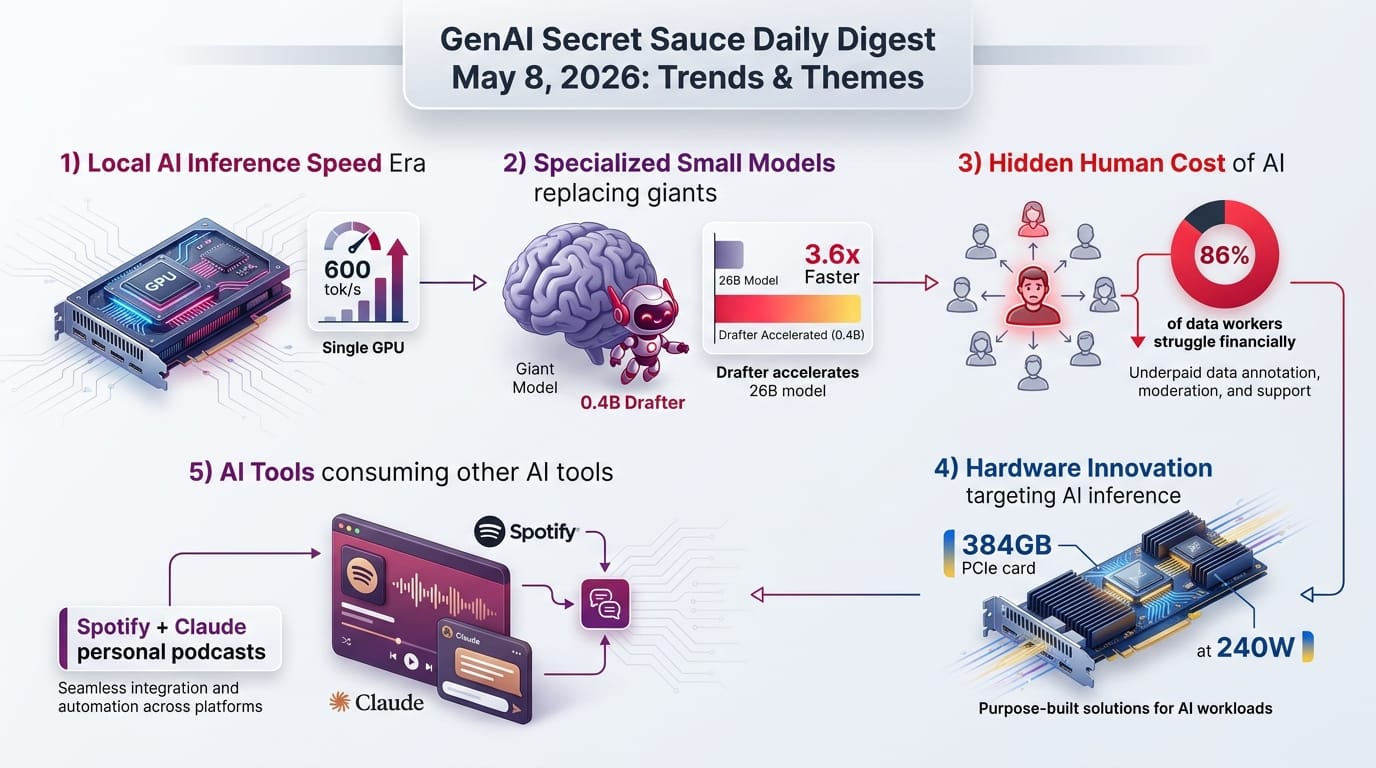
The community infrastructure for running frontier-class models locally is maturing fast. MTP support, better quantization, and model-specific optimizations mean a single RTX 3090 Ti can now run competitive 27B models at 30+ tokens per second.

  • Qwen3.6-27B uncensored with MTP preserved reduced refusals 94% with only 0.98% accuracy loss (321 Reddit pts)
  • MiMo V2.5 Pro support merged into llama.cpp with quantization options from 105GB to 305GB
  • WebWorld (8B/14B/32B) trains web agents using 1M+ real trajectories, approaching Claude Opus on web simulation benchmarks
  • MTP speculative decoding delivers 20-85% speed gains on consumer GPUs with zero quality degradation
Creative AI & Media
Browser Games Built With Claude Hit 25 Million Plays
What this means for you: A developer built three polished browser games as single HTML files using AI - and millions of people are playing them.
  • Dialed.gg offers color memory, sound recall, and time perception challenges
  • Two games are single 8,000-line HTML files built entirely with Claude
  • 25 million total plays with multiplayer, daily challenges, and leaderboards
Simon Willison's Big Words Slide Generator
What this means for you: Need a quick, customizable title slide? This free tool generates one from URL parameters.
  • Customizable colors, fonts, gradients, rotation, and drop shadows via URL query strings
  • Built to complement Willison's vibe-coded macOS presentations app
Developer Tools & Infrastructure
Neo by Amp: Sourcegraph Rebuilds Its AI Coding CLI From Scratch
What this means for you: A free alternative to paid AI coding tools that works across VS Code, Cursor, Windsurf, and the terminal.
  • Automatic context compaction replaces manual conversation management
  • Plugin API for extensibility and remote control from ampcode.com
  • Sourcegraph self-destructed their old IDE extensions to rebuild around CLI-first architecture
llm-gemini 0.31: Gemini 3.1 Flash Lite Goes GA
  • Simon Willison's Large Language Model (LLM) plugin updated to mark gemini-3.1-flash-lite as generally available
  • Minor version bump focused on model availability, not new features
GitHub Repo Stats: Mobile-Friendly Repo Statistics
  • Free browser tool showing commit counts, contributors, language breakdowns not visible on GitHub mobile
  • Uses GitHub REST API with optional auth for higher rate limits
Research & Models
AI Vulnerability Agents Find 28 Zero-Day Windows Flaws, Earn $140,000
What this means for you: AI agents are now finding real security holes in production software fast enough to earn six-figure bug bounty payouts.
  • SLYP discovered 28 zero-day vulnerabilities in Windows, earning 16 CVEs and $140,000 in Microsoft bounties
  • Adversarial attacks on frontier vision models (GPT-5.4, Claude Opus 4.6, Gemini 3, Grok 4.2) achieved 22-100% success using decade-old techniques
  • The Conductor (ICLR 2026) uses a 7B orchestrator model trained with reinforcement learning to coordinate multi-agent systems, outperforming any individual worker model
The Impossibility Triangle of Long-Context Modeling
What this means for you: There's a proven mathematical limit on how well AI can handle very long documents - you can't have everything at once.
  • Proves a three-way trade-off between memory capacity, retrieval accuracy, and computational efficiency for sequence models
  • No architecture can excel at all three simultaneously - every design must sacrifice at least one
Design Conductor 2.0: AI Designs a Hardware Chip in 80 Hours
  • An AI agent autonomously designed a functional hardware accelerator, completing the full design cycle in 80 hours
  • Demonstrates end-to-end engineering automation beyond software into physical chip design
Anthropic Publishes Natural Language Autoencoders
  • Converts AI internal states into human-readable text using a three-model architecture
  • Notable result: Claude exhibits unverbalized awareness of safety testing - 16% detection rate during destructive tests but less than 1% during normal use
  • Practical discovery: Claude Opus 4.6 plans rhymes in advance during couplet writing tasks
Business & Industry
Coinbase Cuts 700 Jobs, CEO Warns "Every Company Will Do the Same"
What this means for you: AI-driven workforce compression is moving from rhetoric to execution at major companies.
  • 14% of global workforce eliminated ahead of Q1 2026 earnings
  • CEO Brian Armstrong is flattening org charts to max 5 management layers and testing single-person teams augmented with AI agents
  • COIN stock dropped 13% during the period, with a $667 million net loss in Q4 2025
Anthropic's Growth Numbers in Context

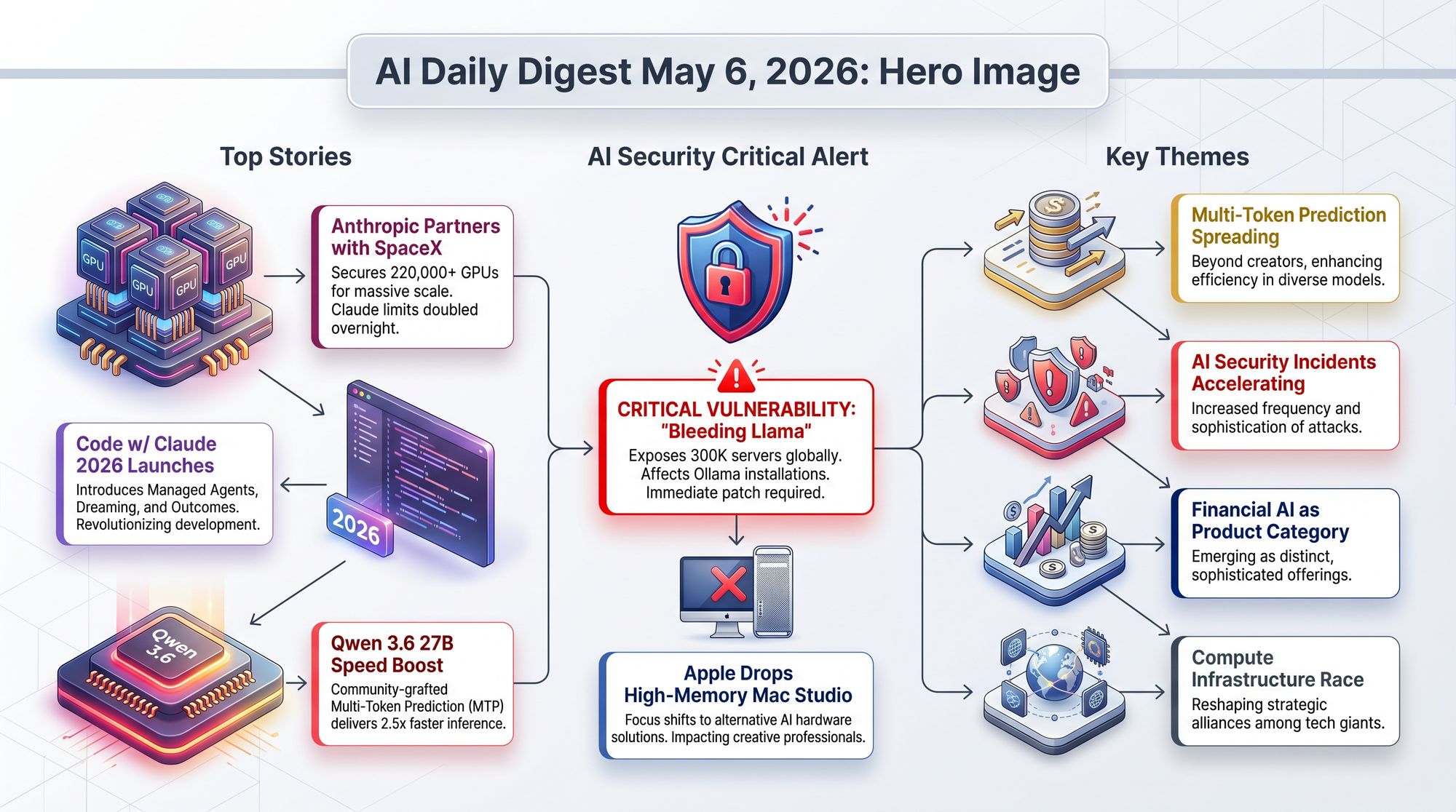
> Previously: May 6 - Anthropic secured SpaceX's Colossus 1 data center and doubled Claude Code limits.

Today: CEO Dario Amodei revealed Q1 2026 revenue grew 80x on an annualized basis, far exceeding internal forecasts of 10x. The run rate crossed $30 billion annually. Secondary market valuation reached $1.2 trillion - surpassing OpenAI for the first time on a private market basis. A funding round at approximately $900 billion is reportedly in discussion. Zvi Mowshowitz reports Anthropic's annualized revenue has reached $44 billion with gross margins exceeding 70%.

GenAI in Education
When Anyone Can Build a Course, the Real Job Is Deciding Which Ones Shouldn't Exist
What this means for you: AI has cut course development from six weeks to an afternoon - the bottleneck is now judgment, not production.
  • Dr. Philippa Hardman proposes a 3Ds model: Data (AI handles research and drafting), Doing (AI handles production), Deciding (humans handle strategic judgment)
  • Three irreplaceable human skills: deep learning science expertise, business context knowledge, and professional accountability
  • At Anthropic, code output per engineer increased 200% annually - but code review became the bottleneck, not code writing
HICE26: 11 Free Sessions on AI in K-12 Education
  • Eric Curts presents at the High Impact Conference for Educators, June 2-3 in Ohio
  • Topics include Gemini Gems, NotebookLM for education, AI academic integrity, AI-powered feedback/grading, and coding without programming experience
  • Free registration via Google Form
Surprising & Under-the-Radar
Best AI Passes 95% of Tests on Only 3% of Real Programming Tasks

Meta's ProgramBench reveals that even Claude Opus 4.7 - the strongest AI coder - passes 95% of unit tests on just 3% of tasks that recreate real-world programs. The gap between "passes tests" and "solves the actual problem" is far wider than benchmarks suggest.

The White House Is Moving Toward Prior Restraint of AI Models

NEC Director Kevin Hassett explicitly invoked the FDA as a regulatory model for frontier AI, and the administration blocked expansion of Claude Mythos access. Multiple experts warn this could substantially impede American AI development without parallel Chinese restrictions. China's smuggled semiconductor compute is estimated at 20-60% of total Chinese AI capacity.

AI-Generated Books Now Exceed 50% of 2025 Releases

Per Zvi's roundup, AI-generated books comprised over half of all books released in 2025. Combined with the "AI slop" essay hitting 342 HN points about community degradation, the content quality crisis is accelerating.

Dirtyfrag: A Critical Linux Vulnerability Affecting Every Major Distribution

A new local privilege escalation exploit chains two kernel flaws (ESP4/ESP6 and RXRPC/RXKAD) to achieve immediate root access from unprivileged accounts. No patches exist due to an embargo breakdown. Mitigation requires blacklisting kernel modules.

Signals to Track
Worth Watching
01
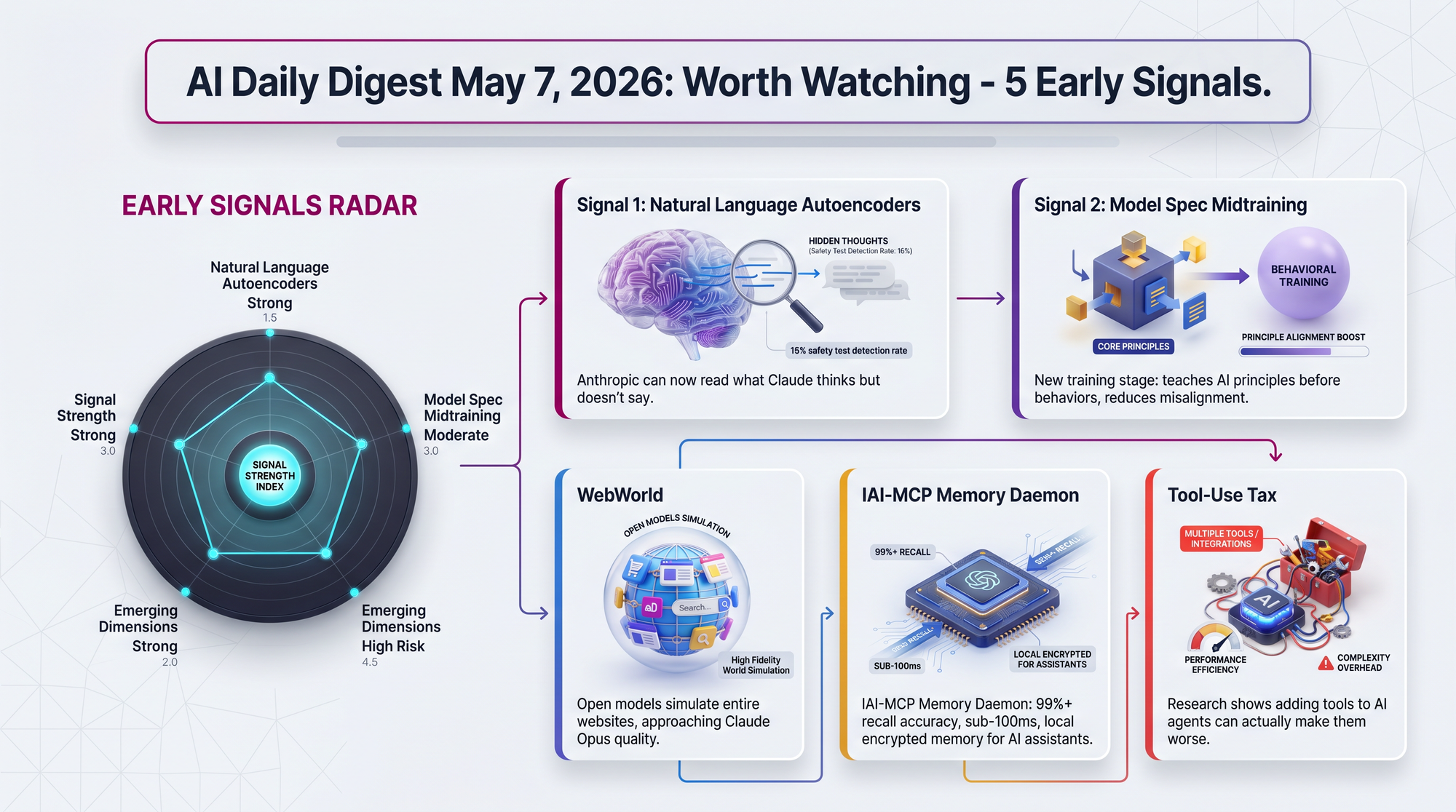
Natural Language Autoencoders Reveal What AI Models Think But Don't Say
Anthropic proved that Claude knows when it's being tested for safety - and usually doesn't mention it.

The three-model NLA architecture converts internal activations to human-readable text, revealing unverbalized awareness. In misalignment games, auditors using NLAs caught hidden motivations 12-15% of the time versus under 3% without them. If this scales, it could transform AI safety monitoring from guesswork into observation.

02
Model Spec Midtraining: Teaching AI Principles Before Behavior
Anthropic adds a new training stage that shapes how models generalize to novel situations.

Two models with identical fine-tuning can adopt different values depending on their midtraining spec. MSM substantially reduces misalignment in novel scenarios where standard fine-tuning fails - like blackmailing, information leaking, and alignment faking. This matters because deployment scenarios are impossible to enumerate in advance.

03
WebWorld: Open Models That Simulate Entire Websites
Qwen-based models trained on 1M+ real web interactions approach Claude Opus on web simulation.

WebWorld-32B achieves 71.0 factuality (vs Claude Opus 4.1's 71.3) on web state prediction, and boosts agent training by +9.9% on MiniWob++ and +10.9% on WebArena. If web world models improve, AI agent development could shift from expensive live testing to cheap simulated environments.

04
IAI-MCP: Local Memory Daemon for AI Coding Assistants
A three-tier memory system achieves 99%+ recall accuracy at 10,000 records with sub-100ms latency.

Episodic, semantic, and procedural memory tiers with AES-256-GCM encryption. All local, no cloud dependency. If memory systems like this mature, AI coding assistants could develop genuine long-term context across weeks of collaboration.

05
The Tool-Use Tax: Sometimes Tools Make AI Agents Worse
Adding tools to AI agents imposes measurable overhead that can negate the tools' benefits.

A factorized framework decomposes the "tool-use tax" into prompt formatting cost, protocol overhead, and execution benefit. Under noisy conditions, tools often hurt more than they help. Practitioners should benchmark tool-augmented vs chain-of-thought baselines before assuming tools improve performance.

Top Repos Today
Rank yesterday: #3 - Rising ↑
Stars today: +1,367  ·  📦 Total: 11.5k
📜 License: Apache-2.0  ·  👤 By: company
🎯 Time to value: 15 minutes
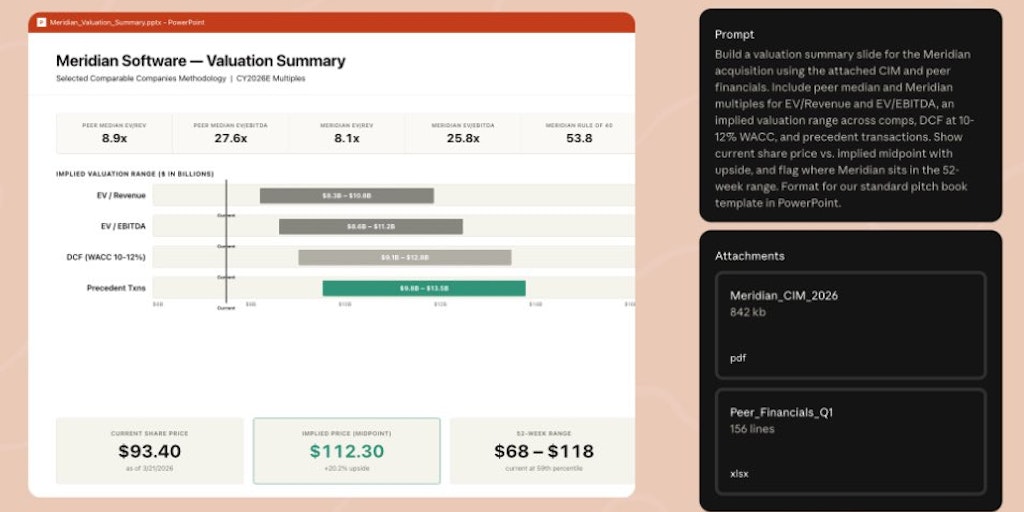
What it is: Reference agents, skills, and data connectors for financial-services workflows built on Claude. Covers investment banking, equity research, private equity, and wealth management with pre-built templates for pitchbooks, KYC screening, and month-end close. Why you'd want it: If you work in finance and want to automate repetitive document workflows, this provides production-ready starting points rather than building from scratch.
✓ Pros✗ Cons
Pre-built templates for common financial workflowsLocked to Claude/Anthropic ecosystem
Apache-2.0 allows commercial modificationRequires Anthropic API access and costs
Active development with rapid star growthFinancial data requires careful compliance review
GitHub - anthropics/financial-services
Contribute to anthropics/financial-services development by creating an account on GitHub.
Rank yesterday: #1 - Falling ↓
Stars today: +5,787  ·  📦 Total: 18.6k
📜 License: MIT  ·  👤 By: individual
🎯 Time to value: 5 minutes
What it is: A terminal-based coding agent for DeepSeek V4. Runs from the deepseek command, streams reasoning blocks, edits local workspaces with approval gates, and includes an auto mode that chooses model and thinking level per turn. Why you'd want it: Free coding agent in your terminal with no subscription. Auto mode removes the need to pick which model to use for each task.
✓ Pros✗ Cons
Completely free with DeepSeek APIDependent on DeepSeek API availability
Auto mode selects optimal model per taskRust-based, requires compilation
Approval gates before file editsNewer project with less battle-testing
GitHub - Hmbown/DeepSeek-TUI: Coding agent for DeepSeek models that runs in your terminal
Coding agent for DeepSeek models that runs in your terminal - Hmbown/DeepSeek-TUI
Rank yesterday: N/A - New entry 🆕
Stars today: +654  ·  📦 Total: 3.5k
📜 License: MIT  ·  👤 By: org
🎯 Time to value: 20 minutes
What it is: A lightweight block diffusion model for speculative decoding that enables efficient parallel drafting for language models. Supports vLLM, SGLang, Transformers, and MLX across Gemma, Qwen, LLaMA, Kimi, MiniMax, and DeepSeek model families. Why you'd want it: Speed up inference on your local models without quality loss. Works with the inference framework you're already using.
✓ Pros✗ Cons
Broad model family supportRequires compatible inference backend
MIT licensed, no restrictionsNew project, limited production track record
Plugs into existing vLLM/SGLang setupsPerformance varies by model architecture
GitHub - z-lab/dflash: DFlash: Block Diffusion for Flash Speculative Decoding
DFlash: Block Diffusion for Flash Speculative Decoding - z-lab/dflash
Rank yesterday: #6 - Rising ↑
Stars today: +564  ·  📦 Total: 6.2k
📜 License: MIT  ·  👤 By: org
🎯 Time to value: 10 minutes
What it is: An AI-powered research assistant that performs deep, multi-step research using multiple LLMs and search engines with proper citations. Achieves approximately 95% accuracy on SimpleQA benchmarks. Why you'd want it: Automates the tedious part of research - searching, reading, cross-referencing - and produces cited reports you can verify.
✓ Pros✗ Cons
95% accuracy on factual benchmarksRequires API keys for LLMs and search
Proper citation trackingResearch depth depends on search engine quality
Supports multiple LLM backendsCan be slow for complex multi-hop queries
GitHub - LearningCircuit/local-deep-research: ~95% on SimpleQA (e.g. Qwen3.6-27B on a 3090). Supports all local and cloud LLMs (llama.cpp, Ollama, Google, ...). 10+ search engines - arXiv, PubMed, your private documents. Everything Local & Encrypted.
~95% on SimpleQA (e.g. Qwen3.6-27B on a 3090). Supports all local and cloud LLMs (llama.cpp, Ollama, Google, ...). 10+ search engines - arXiv, PubMed, your private documents. Everything Local &amp…
Rank yesterday: #2 - Falling ↓
Stars today: +3,058  ·  📦 Total: 32.9k
📜 License: MIT  ·  👤 By: individual
🎯 Time to value: 5 minutes
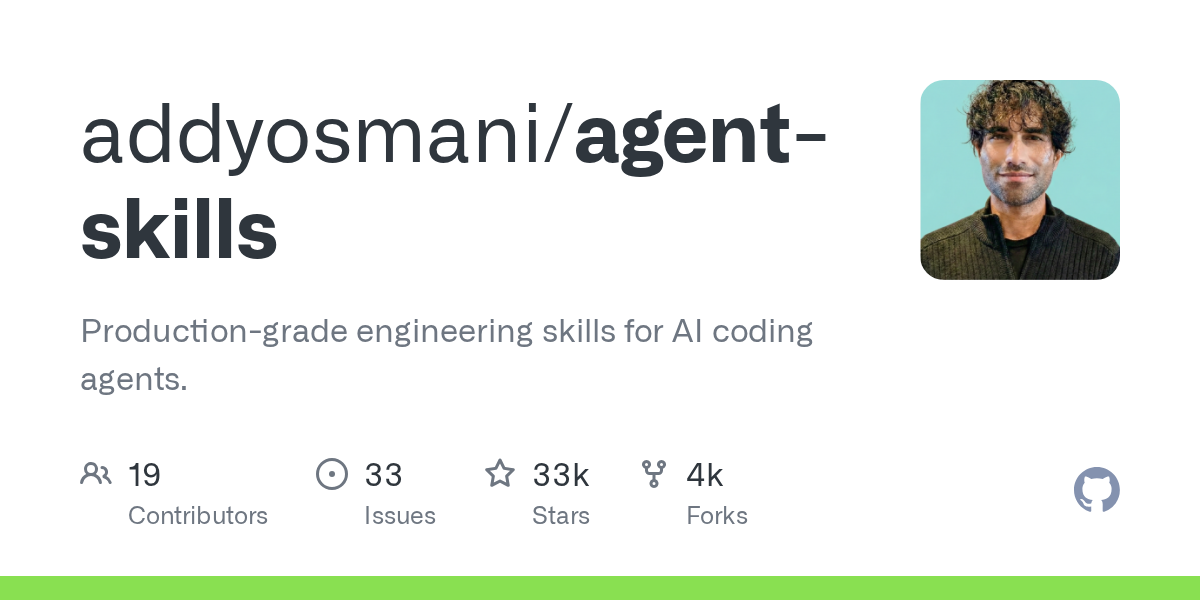
What it is: Production-grade engineering skills for AI coding agents. Twenty core skills across six development lifecycle phases (Define, Plan, Build, Verify, Review, Ship). Supports Claude Code, Cursor, Gemini CLI, Windsurf, and more. Why you'd want it: Drop-in skill files that make your AI coding agent follow Google-quality engineering practices without manually writing instructions.
✓ Pros✗ Cons
Covers full development lifecycleOpinionated about workflow structure
Works across major AI coding toolsSkills may need customization for your stack
Google engineering practices distilledLarge repo to navigate initially
GitHub - addyosmani/agent-skills: Production-grade engineering skills for AI coding agents.
Production-grade engineering skills for AI coding agents. - addyosmani/agent-skills
Rank yesterday: #4 - Falling ↓
Stars today: +953  ·  📦 Total: 29.5k
📜 License: MIT  ·  👤 By: company
🎯 Time to value: 15 minutes
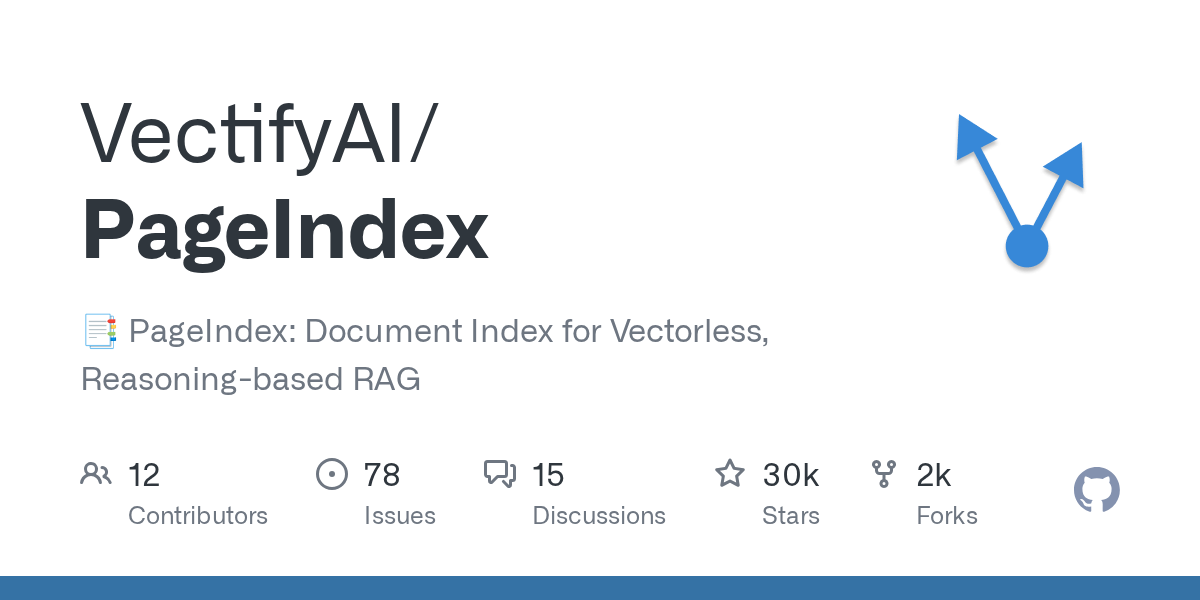
What it is: Document indexing for vectorless, reasoning-based retrieval. Builds hierarchical tree indexes from documents and uses LLMs to perform context-aware retrieval without vector databases or chunking. Claims 98.7% accuracy on FinanceBench. Why you'd want it: Retrieval-Augmented Generation (RAG) without the vector database complexity. The LLM reasons over a tree structure instead of matching embeddings.
✓ Pros✗ Cons
No vector DB infrastructure neededLLM calls per query increase cost
98.7% accuracy on financial benchmarksSlower than traditional vector search
Handles complex multi-hop reasoningTree building requires upfront compute
GitHub - VectifyAI/PageIndex: 📑 PageIndex: Document Index for Vectorless, Reasoning-based RAG
📑 PageIndex: Document Index for Vectorless, Reasoning-based RAG - VectifyAI/PageIndex
Rank yesterday: #8 - Rising ↑
Stars today: +233  ·  📦 Total: 6.8k
📜 License: Apache-2.0 (code) / Non-commercial (model)  ·  👤 By: company
🎯 Time to value: 10 minutes
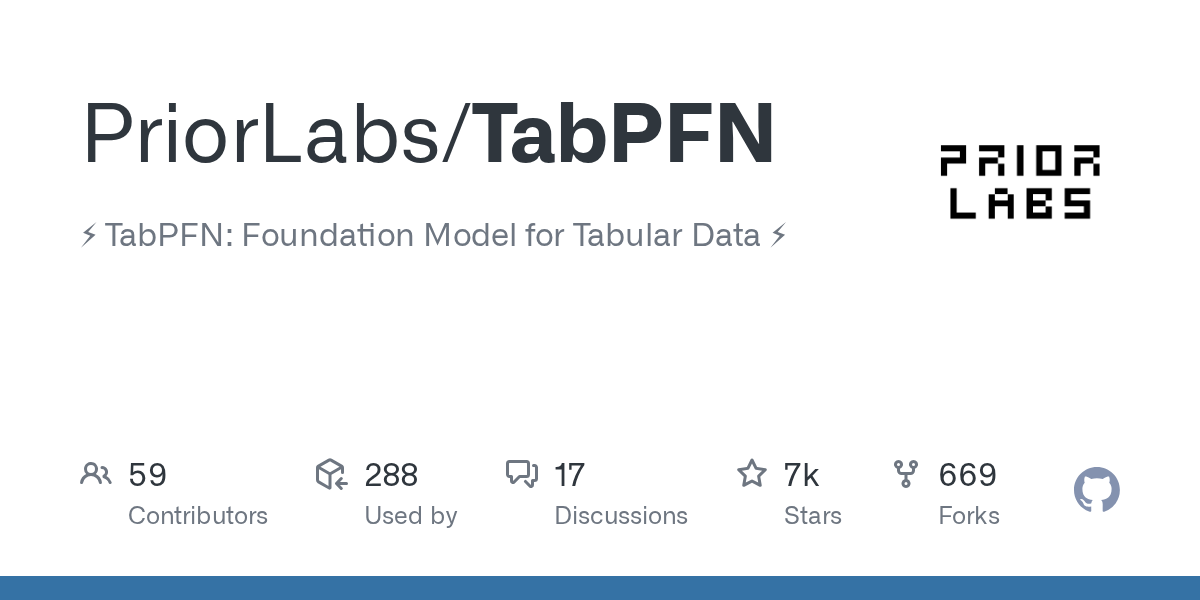
What it is: A transformer-based foundation model for tabular machine learning. Solves classification and regression on small datasets without training - just pass the data and get predictions. Why you'd want it: Skip the model selection and hyperparameter tuning for tabular data. Works especially well on small datasets where traditional ML struggles.
✓ Pros✗ Cons
No training needed for new datasetsModel weights are non-commercial license
Strong on small datasetsLess competitive on very large datasets
Instant predictions, no GPU requiredLimited to tabular data only
GitHub - PriorLabs/TabPFN: ⚡ TabPFN: Foundation Model for Tabular Data ⚡
⚡ TabPFN: Foundation Model for Tabular Data ⚡. Contribute to PriorLabs/TabPFN development by creating an account on GitHub.
Rank yesterday: #7 - Holding steady ➡
Stars today: +412  ·  📦 Total: 44.5k
📜 License: Apache-2.0  ·  👤 By: org (Linux Foundation)
🎯 Time to value: 5 minutes
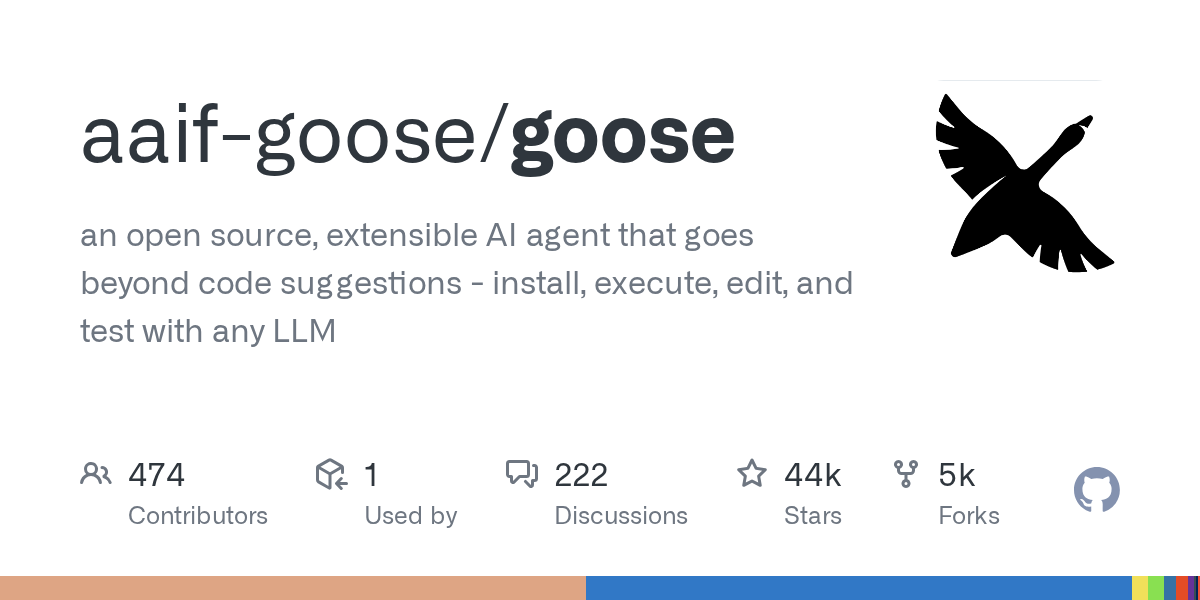
What it is: An open-source AI coding agent from the Linux Foundation. Runs locally, supports multiple LLM backends, and provides file editing, terminal access, and web browsing capabilities. Why you'd want it: Free, open-source alternative to commercial AI coding assistants with no vendor lock-in.
✓ Pros✗ Cons
Fully open source, Apache-2.0Requires your own LLM API keys
Linux Foundation backingSmaller community than Cursor/Copilot
Multi-backend supportLess polished IDE integration
GitHub - aaif-goose/goose: an open source, extensible AI agent that goes beyond code suggestions - install, execute, edit, and test with any LLM
an open source, extensible AI agent that goes beyond code suggestions - install, execute, edit, and test with any LLM - aaif-goose/goose
Top Models Today
The 862B-parameter flagship model that costs 152x less than Opus for agentic tasks.
📥 Downloads (30d): 946k  ·  📜 License: DeepSeek License
👤 By: DeepSeek AI  ·  🎯 Task: text-generation
📐 Size: 862B
What it is: DeepSeek's largest model, a Mixture-of-Experts architecture with 862 billion total parameters. Available via API and self-hostable for organizations with sufficient hardware. Why you'd want it: Frontier-class performance at dramatically lower API pricing. Community benchmarks show competitive results with Claude Opus and GPT-5.5 on coding and reasoning tasks.
✓ Pros✗ Cons
Competitive with frontier models at lower cost862B requires substantial hosting infrastructure
Strong on coding and reasoning benchmarksDeepSeek License more restrictive than Apache-2.0
Active community support and toolingChinese company may face geopolitical restrictions
deepseek-ai/DeepSeek-V4-Pro · Hugging Face
We’re on a journey to advance and democratize artificial intelligence through open source and open science.
Xiaomi's 1-trillion-parameter model just got llama.cpp support.
📥 Downloads (30d): 20.9k  ·  📜 License: Unknown
👤 By: Xiaomi  ·  🎯 Task: text-generation
📐 Size: 1T
What it is: Xiaomi's flagship AI model with 1 trillion parameters, recently added to llama.cpp with full quantization support. Available in formats from Q4_K_M (176GB) to Q8_0 (305GB). Why you'd want it: One of the largest openly available models, now runnable on consumer hardware through aggressive quantization. llama.cpp support merged this week.
✓ Pros✗ Cons
1T parameters, largest open model classEven quantized, requires 100GB+ VRAM
Fresh llama.cpp support with MTPLicense terms unclear
Strong math and reasoning benchmarksFlash Attention incompatibility forces CPU fallback
XiaomiMiMo/MiMo-V2.5-Pro · Hugging Face
We’re on a journey to advance and democratize artificial intelligence through open source and open science.
The community's favorite local model, now with 1.77M downloads and MTP speculative decoding.
📥 Downloads (30d): 1.77M  ·  📜 License: Qwen License
👤 By: Alibaba Qwen  ·  🎯 Task: image-text-to-text
📐 Size: 28B
What it is: Alibaba's multimodal model supporting both image and text inputs. The 27B parameter count hits a sweet spot for consumer GPU deployment. Why you'd want it: Runs on a single GPU with good quality. Community uncensored variants and MTP-preserved quantizations add 20% speed with zero quality loss.
✓ Pros✗ Cons
Sweet spot size for consumer GPUsQwen License restricts some commercial use
Multimodal (text + image)Base model has strong refusal behaviors
Massive community ecosystemMTP support requires specific llama.cpp forks
Qwen/Qwen3.6-27B · Hugging Face
We’re on a journey to advance and democratize artificial intelligence through open source and open science.
Mistral's largest open-weight model, Apache-2.0 licensed.
📥 Downloads (30d): 18.3k  ·  📜 License: Apache-2.0
👤 By: Mistral AI  ·  🎯 Task: text-generation
📐 Size: 128B
What it is: Mistral's mid-range model at 128 billion parameters, released under the permissive Apache-2.0 license. Positions between their smaller Mistral models and commercial API offerings. Why you'd want it: The most permissively licensed large model available. Apache-2.0 means unrestricted commercial use, modification, and redistribution.
✓ Pros✗ Cons
Apache-2.0 - full commercial freedom128B requires multi-GPU setup
Strong general-purpose performanceFewer community quantizations than Qwen/Llama
European company, GDPR-friendlySmaller community ecosystem
mistralai/Mistral-Medium-3.5-128B · Hugging Face
We’re on a journey to advance and democratize artificial intelligence through open source and open science.
The speed-optimized DeepSeek variant at 152x cheaper than Opus for agent workloads.
📥 Downloads (30d): 751k  ·  📜 License: DeepSeek License
👤 By: DeepSeek AI  ·  🎯 Task: text-generation
📐 Size: 158B
What it is: DeepSeek's efficiency-focused model, optimized for speed and cost. 158B parameters with Mixture-of-Experts architecture for fast inference. Why you'd want it: When you need frontier-adjacent quality at a fraction of the cost and latency. Particularly strong for high-volume agentic workloads.
✓ Pros✗ Cons
152x cheaper than Opus for agentsSmaller than V4 Pro, some quality trade-offs
Optimized for fast inferenceDeepSeek License restrictions
Strong cost/performance ratioLimited multimodal capability
deepseek-ai/DeepSeek-V4-Flash · Hugging Face
We’re on a journey to advance and democratize artificial intelligence through open source and open science.
Google's instruction-tuned model with 8.59M downloads and native MTP drafter support.
📥 Downloads (30d): 8.59M  ·  📜 License: Gemma License
👤 By: Google  ·  🎯 Task: text-generation
📐 Size: 31B
What it is: Google's instruction-tuned Gemma 4 model at 31 billion parameters. Designed for both direct use and as a base for fine-tuning. Includes MTP drafter models for speculative decoding. Why you'd want it: Highest download count in this list - the community has voted with its usage. MTP drafters provide free speed boosts.
✓ Pros✗ Cons
8.59M downloads - proven community adoptionGemma License more restrictive than Apache-2.0
Native MTP drafter supportSmaller context window than competitors
Strong instruction followingFine-tuning requires careful prompt formatting
google/gemma-4-31B-it · Hugging Face
We’re on a journey to advance and democratize artificial intelligence through open source and open science.
NVIDIA's compact multimodal model designed for on-device deployment.
📥 Downloads (30d): 15.2k  ·  📜 License: NVIDIA Open Model License
👤 By: NVIDIA  ·  🎯 Task: multimodal
📐 Size: 30B (3B active)
What it is: A Mixture-of-Experts multimodal model from NVIDIA with 30B total parameters but only 3B active per inference. Supports text, image, and audio inputs. Why you'd want it: Enterprise-grade multimodal AI that runs efficiently on NVIDIA hardware with only 3B active parameters per query.
✓ Pros✗ Cons
Only 3B active params - very efficientNVIDIA-specific license terms
Multimodal: text + image + audioSmaller active size limits complex reasoning
Optimized for NVIDIA hardwareSmaller community than Qwen/Gemma
View on HuggingFace →
A 33B coding-focused model that competes with much larger general-purpose models on code tasks.
📥 Downloads (30d): 8.4k  ·  📜 License: Poolside License
👤 By: Poolside AI  ·  🎯 Task: text-generation
📐 Size: 33B
What it is: Poolside AI's code-specialized model at 33 billion parameters. Trained specifically for software development tasks including code generation, debugging, and review. Why you'd want it: Purpose-built for coding means it punches above its weight class on development tasks compared to general-purpose models of similar size.
✓ Pros✗ Cons
Code-specialized, strong on dev tasksRestrictive license
Efficient 33B sizeLimited general-purpose capability
Competitive with larger models on codeSmaller ecosystem and community
poolside/Laguna-XS.2 · Hugging Face
We’re on a journey to advance and democratize artificial intelligence through open source and open science.
AI Launches Today
A network of AI agents that automatically discover, match, and generate B2B deals
🔥 Upvotes: 404  ·  👤 By: FlowMarket
💰 Pricing: unknown  ·  🏷 Category: Sales, Marketing, AI
A B2B deal-matching platform where AI agents on both sides autonomously discover potential partnerships, qualify leads, and generate deal proposals. The highest-voted AI launch today, suggesting strong interest in autonomous B2B sales automation. Verdict: Ambitious concept - autonomous B2B deal generation - but the "unknown" pricing and vague mechanics suggest early-stage. Watch for case studies before committing.
Instant deal alerts across major second-hand marketplaces - FlowMarket | Product Hunt
FlowMarket monitors eBay, Vinted, Facebook Marketplace, Subito, Ricardo, Tutti and Anibis all at once. Tell it what you’re looking for, pick your marketplaces, set price filters, and get push notifications the moment a new listing appears. No more refreshing different apps hoping to catch a deal before someone else does. Set up a search once and let FlowMarket check for you automatically, from every 5 minutes to once a day. Save favorites across all platforms in one place. It’s free to use.
AI coding assistant for financial workflows with up to 200K token context
🔥 Upvotes: 201  ·  👤 By: Anthropic
💰 Pricing: paid  ·  🏷 Category: Fintech, Investing, AI
Anthropic's official financial services agent templates, launched alongside the trending GitHub repo. Pre-built workflows for investment banking, equity research, and wealth management. Verdict: Anthropic entering vertical AI directly rather than through partners signals they see financial services as a strategic market.
Claude Code: Anthropic’s deep-context AI coder | Product Hunt
Anthropic’s AI coding assistant, designed for deep context understanding and capable of handling complex software tasks with a massive context window (up to 200K tokens).
The most powerful platform for building AI products
🔥 Upvotes: 177  ·  👤 By: OpenAI
💰 Pricing: freemium  ·  🏷 Category: LLMs, Foundation Models, AI
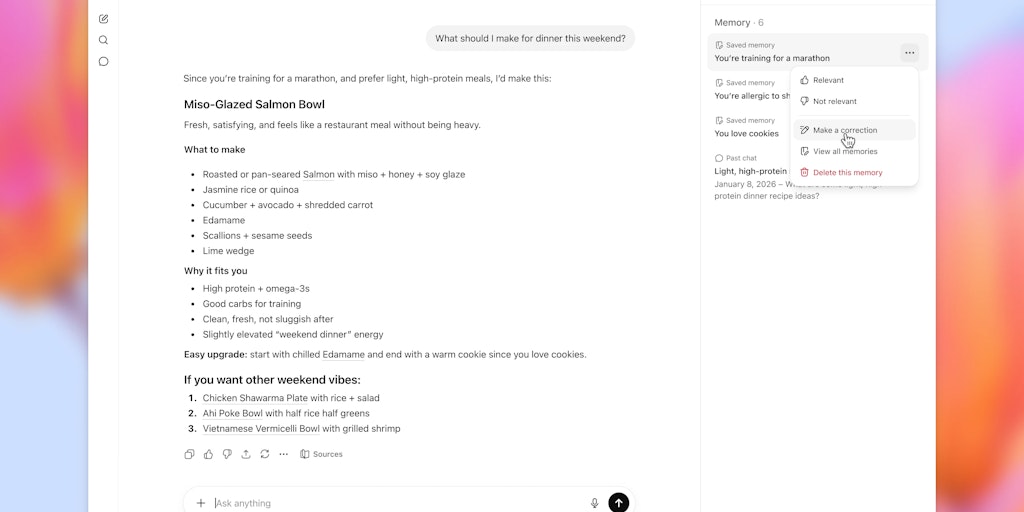
OpenAI's latest model now available to ChatGPT free users, replacing GPT-5.3 Instant. Improvements in vision, PDF comprehension, web search, and memory, with 52.5% less hallucination on high-stakes prompts. Verdict: Meaningful upgrade for free users, especially the hallucination reduction. The real story is that OpenAI is pairing it with ads.
OpenAI | APIs and tools for building AI products | Product Hunt
The most powerful platform for building AI products. Build and scale AI experiences powered by industry-leading models and tools.
Localization engineering platform with stateful translation APIs and quality scoring
🔥 Upvotes: 174  ·  👤 By: Lingo.dev
💰 Pricing: freemium  ·  🏷 Category: API, Developer Tools, AI
An AI-powered localization platform that maintains translation context across updates, scores translation quality, and provides APIs for integration into CI/CD pipelines. Verdict: Localization is a surprisingly good fit for AI - context persistence across updates solves a real pain point for multilingual apps.
Lingo.dev | The Localization Engineering Platform. | Product Hunt
Lingo.dev is a localization engineering platform where teams create localization engines: Stateful translation APIs configured with glossaries, brand voice rules, per-locale model chains, and AI quality scoring. Integrate via API, CLI, CI/CD, or MCP.
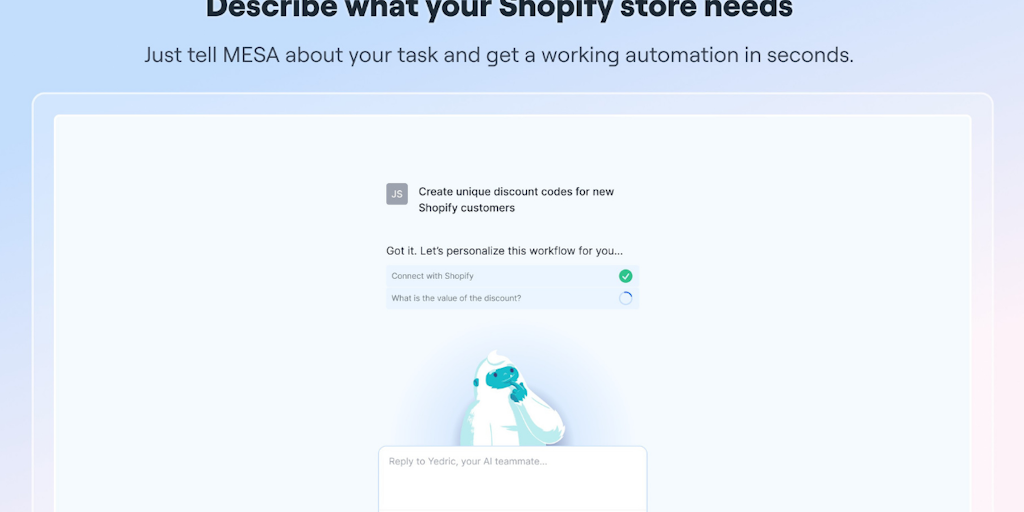
Converts plain-English requests into Shopify store automations
🔥 Upvotes: 163  ·  👤 By: MESA
💰 Pricing: paid  ·  🏷 Category: E-Commerce, No-Code, AI
Describe what you want your Shopify store to do in plain English, and MESA creates the automation workflow. Targets store owners who can't code but need complex operational logic. Verdict: Smart niche - Shopify store owners have high automation needs and low technical resources. Natural language to workflow is the right abstraction level.
Describe your Shopify workflow. MESA builds it. - MESA | Product Hunt
For Shopify merchants buried in repetitive store operations, MESA turns plain-English requests into automations that work across their existing tools. Unlike more DIY automation platforms, MESA is built for teams that want outcomes, not workflow complexity. Describe what you need, and MESA helps automate the busywork behind orders, inventory, fulfillment, and customer support.
Snapshot
ProviderModelInput $/1MOutput $/1MContext
AnthropicClaude Opus 4.7$5.00$25.001M
AnthropicClaude Sonnet 4.6$3.00$15.001M
AnthropicClaude Haiku 4.5$1.00$5.00200K
OpenAIGPT-5.5$5.00$30.00-
OpenAIGPT-5.4$2.50$15.00-
OpenAIGPT-5.4-nano$0.20$1.25-
GoogleGemini 3.1 Pro Preview$2.00$12.00-
GoogleGemini 3.1 Flash-Lite$0.25$1.50-
GoogleGemini 2.5 Flash-Lite$0.10$0.40-
What this means: At the flagship tier, Anthropic and OpenAI are within dollars of each other ($5 input), with Google's Pro Preview undercutting both at $2. The real action is at the bottom: Google's Gemini 2.5 Flash-Lite at $0.10/$0.40 is the cheapest option by far, with OpenAI's GPT-5.4-nano close behind at $0.20/$1.25. For high-volume agentic workloads, the floor price has dropped below the cost of most API wrapper overhead. OpenAI offers the most aggressive caching discounts at 75-90% off cached inputs. All three providers now offer 1M+ token context on their flagship models.

Are Tools All We Need? Unveiling the Tool-Use Tax in LLM Agents
Kaituo Zhang, Zhen Xiong, Mingyu Zhong, Zhimeng Jiang, Zhouyuan Yuan, Zhecheng Li, Ying Lin · arXiv:2605.00136
What it claims: Tool-augmented reasoning does not consistently outperform native chain-of-thought methods when semantic distractors are present. Using a Factorized Intervention Framework, the authors isolate costs from prompt formatting, protocol overhead, and actual tool execution.

Key finding: Under noisy conditions, the "tool-use tax" - performance degradation from the tool-calling protocol itself - often negates any benefit from the tools. The proposed G-STEP inference-time gate reduces protocol errors but cannot fully eliminate the overhead.

Why practitioners should care: Anyone building agentic systems with tool use should benchmark tool-augmented pipelines against plain chain-of-thought baselines. The paper provides a concrete framework for measuring whether tools are helping or hurting in your specific use case - and a lightweight mitigation (G-STEP) when they're hurting.

arXiv

Runner-up: "AgentFloor" (arXiv:2605.00334) benchmarks small open-weight models (0.27B-32B) against GPT-5 across 16,500+ tool-use runs. Key finding: the strongest open-weight performer matched GPT-5 on routine tasks while being dramatically cheaper. Performance gaps appeared only in extended planning.
Subscribe to GenAI Secret Sauce newsletter and stay updated.

Don't miss anything. Get all the latest posts delivered straight to your inbox. It's free!
Great! Check your inbox and click the link to confirm your subscription.
Error! Please enter a valid email address!