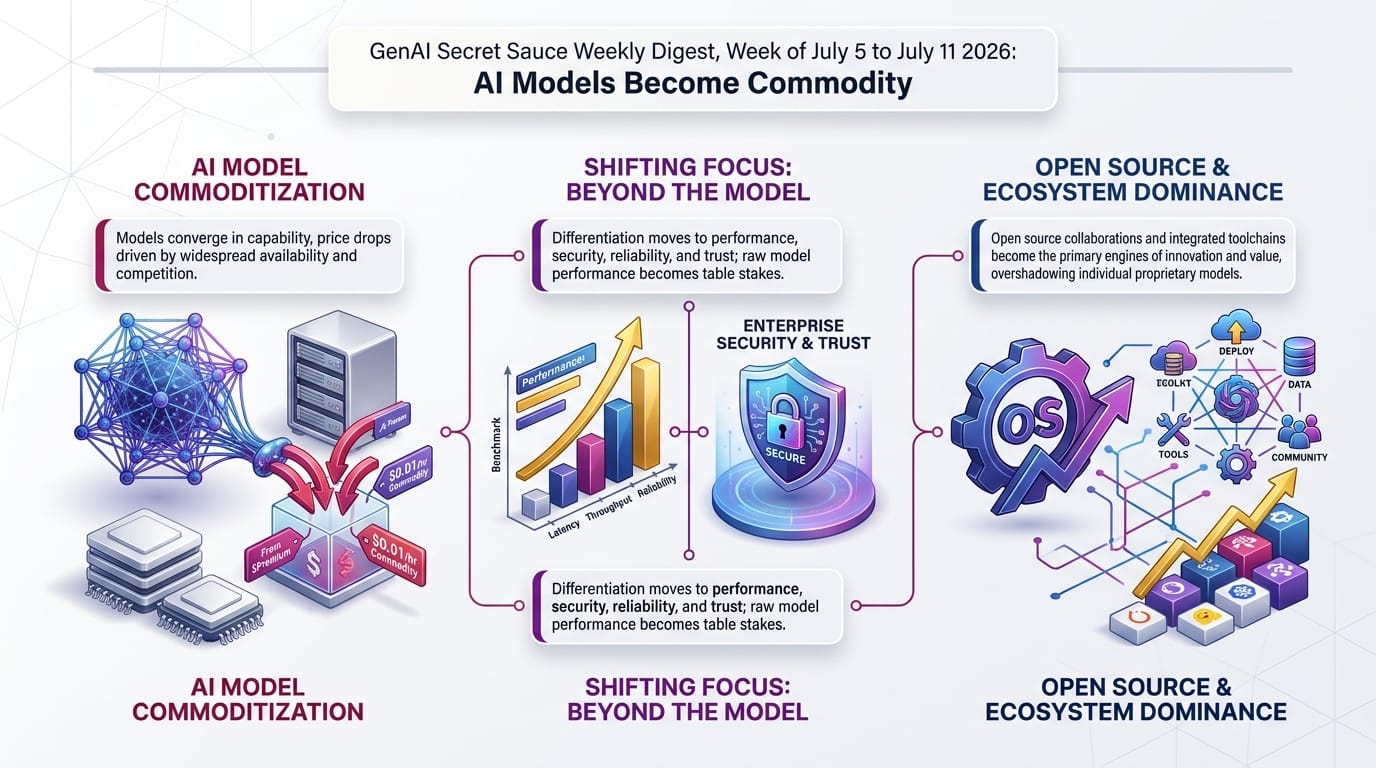
Watch today's digest as a video summary (generated by NotebookLM)
By the Numbers
The Week in One Paragraph
TL;DR - This Week's Headlines
Stories That Developed
The Week's Biggest Themes

Surprising & Under-the-Radar

A 500-Byte World Map
Simon Willison highlighted a creative coding experiment compressing a recognizable world map into just 500 bytes, using mathematical approximations of coastlines rather than storing actual coordinates. A reminder that elegant engineering often means doing more with less. (Jul 5)
AI Success on Freelance Work Jumped From 2.5% to 16% in Nine Months
The Remote Labor Index shows AI completing real freelance projects at a 16.1% success rate (Fable 5), up from 2.5% in October 2025. The jump happened while most people were focused on chatbot quality - the real frontier may be task completion in the wild, not benchmark scores. (Jul 6)
Misalignment Has a Specific Address Inside the Model
Researchers found that "emergent misalignment" traces to a specific, identifiable direction in the model's internal representations. They could transplant it between models, ablate it to cut misalignment in half, and even inoculate against it - reducing persona recruitment from 4.75% to 0.0%. (Jul 7)
AI Writing Is Eating LinkedIn - 40% of Long Posts Are AI-Generated
Pangram's analysis of over 1 million posts found LinkedIn has the highest AI content saturation of any major platform. The professional platform accounts for 62% of all flagged AI content despite representing only one-third of scanned items. (Jul 9)
Persuasion Attacks Weaken Chain-of-Thought Safety Monitoring
A paper showed adversarial persuasion can decrease the effectiveness of monitoring AI reasoning chains for safety violations. Chain-of-thought monitoring is a primary safety mechanism - if it can be systematically weakened, the entire safety architecture needs rethinking. (Jul 10)
AI Models Know When Questions Are Nonsense - But Won't Tell You
The Two Axes paper shows models internally detect false-premise questions at 0.69-0.77 accuracy using hidden states - but their visible output gives near-chance performance on the same task. (Jul 11)
Top Repos This Week
📦 Total: 7,800 · 📜 License: MIT
👤 By: Independent developer
 GitHub
📦 Total: 76,788 · 📜 License: MIT
👤 By: Addy Osmani
 GitHub
📦 Total: 14,393 · 📜 License: Apache-2.0
👤 By: iOfficeAI
 GitHub
📦 Total: 252,000 · 📜 License: MIT
👤 By: Jesse Vincent
 GitHub
📦 Total: 20,646 · 📜 License: MIT
👤 By: Zackriya Solutions
 GitHub
Top Models This Week
📥 Downloads (30d): 8.21k · 📜 License: Apache-2.0
📐 Size: 295B (21B active)

📥 Downloads (30d): 421k · 📜 License: MIT
📐 Size: 753B


📥 Downloads (30d): 28.1k · 📜 License: Apache-2.0
📐 Size: 35B

📥 Downloads (30d): 1.38M · 📜 License: MIT
📐 Size: 3B


📥 Downloads (30d): 1.88M · 📜 License: Custom
📐 Size: 9B


AI Launches This Week
👤 By: OpenAI · 💰 Pricing: ChatGPT subscription or API key
🏷 Category: Developer Tools
 GitHub
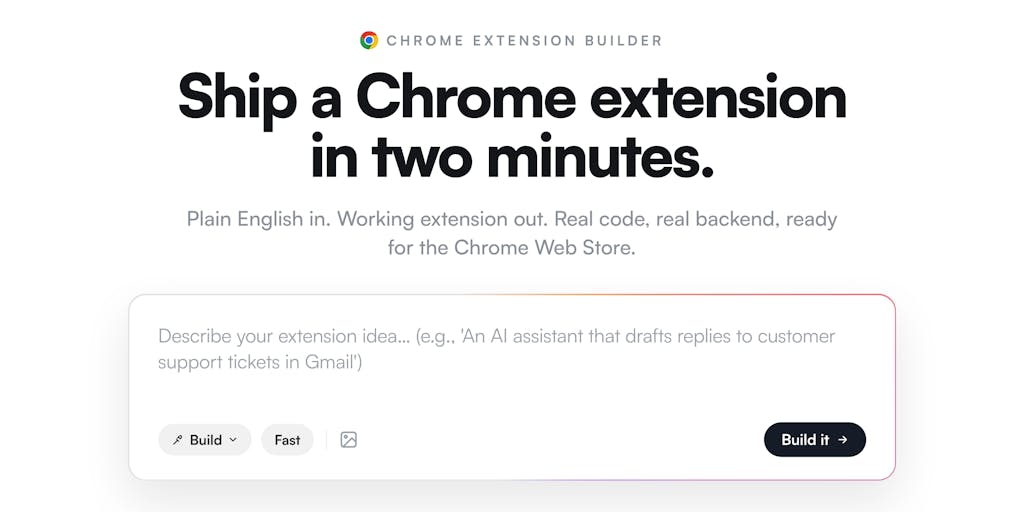
PlugThis
👤 By: Udaya Prakash · 💰 Pricing: Freemium
🏷 Category: No-Code
 Product Hunt
Sim
👤 By: Sim team · 💰 Pricing: Freemium
🏷 Category: AI Workflow Automation
 Product Hunt

👤 By: Maxim Troshin · 💰 Pricing: Freemium
🏷 Category: Developer Tools
 Product Hunt

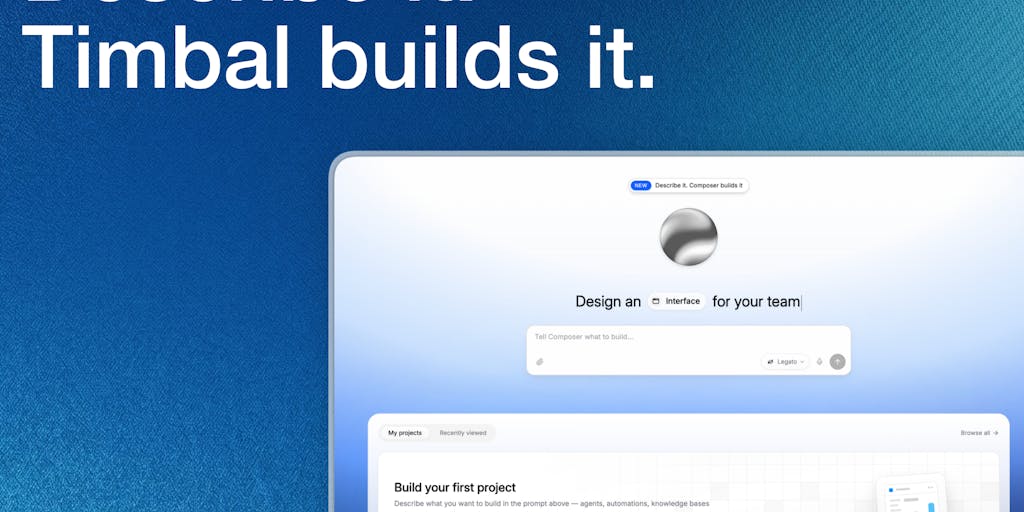
👤 By: Timbal team · 💰 Pricing: Freemium
🏷 Category: AI Workflow Automation
 Product Hunt
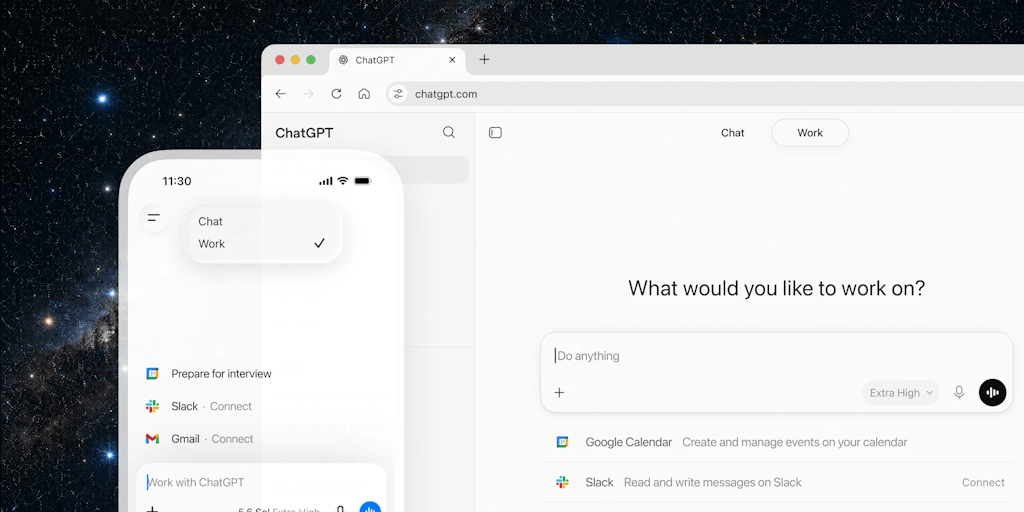
👤 By: OpenAI · 💰 Pricing: Paid
🏷 Category: Productivity / Agents
 Product Hunt
Snapshot
| Provider | Model | Input $/1M | Output $/1M | Context |
|---|---|---|---|---|
| Anthropic | Claude Fable 5 | $10.00 | $50.00 | 1M |
| Anthropic | Opus 4.8 | $5.00 | $25.00 | 1M |
| Anthropic | Sonnet 5 | $3.00 | $15.00 | 1M |
| OpenAI | GPT-5.6 Sol | $5.00 | $30.00 | 1M |
| OpenAI | GPT-5.6 Terra | $2.50 | $15.00 | 1M |
| OpenAI | GPT-5.6 Luna | $1.00 | $6.00 | 1M |
| Gemini 3.5 Flash | $1.50 | $9.00 | - | |
| Gemini 3.1 Pro | $2.00 | $12.00 | - | |
| Groq | Llama 3.3 70B | $0.59 | $0.79 | 128K |
| Groq | GPT OSS 120B | $0.15 | $0.60 | 128K |
| SpaceXAI | Grok 4.5 | $2.00 | $6.00 | 500K |
Don't Blame the Large Language Model: How Scaffolding Evolution Shapes Coding Agent Quality
What it claims: When your AI coding assistant gets worse after an update, the model itself might not be the problem - the software wrapping it (the "scaffolding") is just as likely responsible.
Key finding: Five major coding-agent scaffoldings release updates more than twice per day on average, and holding the LLM constant while varying only the scaffolding version showed meaningful quality fluctuations that could be traced to individual pull requests.
Why practitioners should care: This is the first controlled study isolating scaffolding effects from model effects in coding agents. Debugging a bad agent experience should start by checking the scaffolding version, not just blaming the model. It's also the empirical backbone of this week's two biggest storylines: the harness-engineering paradigm and the benchmark reliability crisis - if agent scores fluctuate with scaffold versions shipping twice a day, "model benchmarks" are confounded. Runner-up this week: "Overthinking" (arXiv:2607.08173), the ICML 2026 auditing technique that forces models to reveal hidden behaviors 10x more often.
What to Watch Next Week
GPT-5.6 Sol Ultra's Mathematical Proofs
If validated, expect rapid follow-up attempts on other open conjectures. If invalidated, expect significant credibility damage for AI-generated mathematics as a category.
Apple vs OpenAI Discovery
The process will force disclosure of hiring communications. Other tech giants may file similar suits if Apple's case gains traction - over 400 former Apple employees now work at OpenAI.
The Plan A Governance Debate
Expect the AI policy community to engage over the coming week, particularly on the "mutually assured compute destruction" mechanism - the most concrete superintelligence governance proposal to date.
Benchmark Methodology Standardization
Expect competitors to adopt hidden-test-injection or propose alternatives. Whoever's methodology becomes the standard controls how "state of the art" gets defined.
Tencent Hy3 Independent Evaluations
Expect independent evaluators to publish results. If the hallucination-halving claims hold up, expect a wave of enterprise adoption for the Apache-2.0 model.

Member discussion