GenAI Secret Sauce Daily Digest - 2026-07-05

One Developer, Two AI Models, and a Major Software Release for $149 · An AI Tutor Just Got Within Striking Distance of Human Tutoring · Together AI Raises $800 Million to Bet That Open-Source Models Will Win
GenAI Secret Sauce Daily Digest - 2026-07-05

Watch today's digest as a video summary (generated by NotebookLM)

Statistically Speaking
37 prompts, 34 commits, 30 files changed
One Developer, Two AI Models, and a Major Software Release f
Top Story
5.5 to review Fable's work
One Developer, Two AI Models, and a Major Software Release f
3 each
One Developer, Two AI Models, and a Major Software Release f
1984, Benjamin Bloom found that one
An AI Tutor Just Got Within Striking Distance of Human Tutor
1.30 SD gets closer than any previous technology
An AI Tutor Just Got Within Striking Distance of Human Tutor
106 points and 70 comments on Hacker News,
An AI Tutor Just Got Within Striking Distance of Human Tutor
One Thing to Tell Your Friends
One developer just shipped a major software release - 1,321 lines of code across 30 files - using an AI model for $149, and then hired a second AI to check the first one's work.
TL;DR
Trends
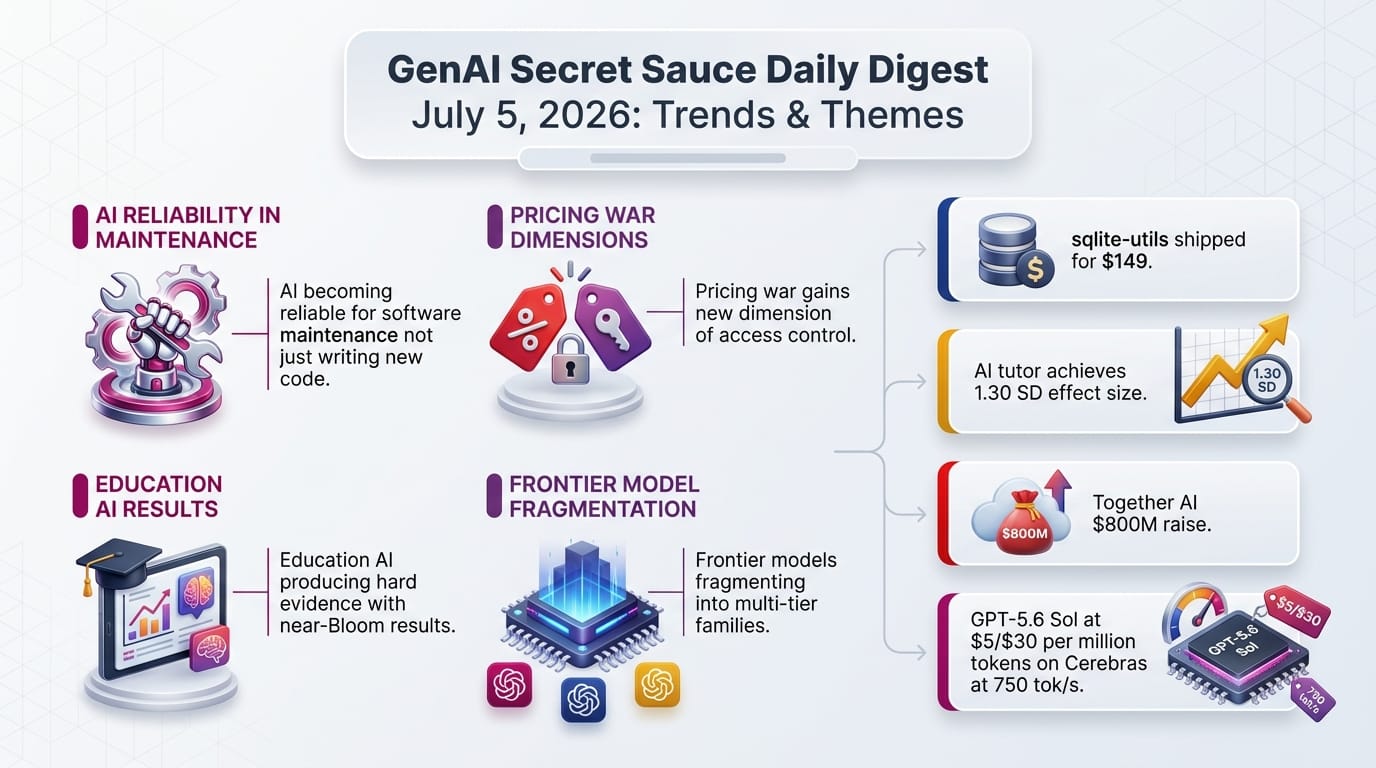
AI is becoming a reliable tool for maintaining existing software, The pricing war for AI inference has a new dimension: who controls access, and Education AI is producing hard evidence.
Dev Tools
Claude Code Passes 136,000 GitHub Stars, Meetily: Privacy, and Alibaba's page.
Research
ICML 2026 Opens in Seoul on July 6, Claude Science Begins Producing Early Results, and Ornith 1.0: A New Open.
Education
AI Tutoring Approaches Bloom's 2.
Surprising
Anthropic Is Quietly Closing Chinese Access Loopholes, The Pentagon Contract That Drew Red Lines, and A 500.
Worth Watching
Cerebras Is About to Run Frontier Models at 750 Tokens Per Second, The White House Voluntary AI Standards Could Land Any Day, and EU AI Act High.
GitHub
Leading repos: Zackriya (+1,409), usestrix/strix (+1,121), and alibaba/page (+801).
HuggingFace
Leading models: empero-ai/Qwythos-9B-Claude-Mythos-5-1M (1.53M), zai-org/GLM (220K), and baidu/Unlimited (1.04M).
Product Hunt
Top launches: Vida (320) and Termi Protocol (163).
API Pricing
What this means:** GPT-5.6 Sol matches Opus 4.8 on input pricing ($5/1M) but costs 20% more on output ($30 vs.
arXiv
From Chatbot to Digital Colleague — Current agent architectures lack standardized protocols for long-running task memory, error recovery, and inter-agent communication - the same gaps that held back distributed computing in the 1990s until protocols like HTTP and TCP/IP matured.
Hot off the Presses
01
One Developer, Two AI Models, and a Major Software Release for $149
What this means for you: A single person can now ship professional-grade software releases that would have taken a team weeks - and the cost of a cross-model quality check is less than a nice dinner.

Simon Willison, one of the most respected voices in open-source Python development, used Claude Fable to prepare sqlite-utils (a widely-used Python library for working with SQLite databases) for its 4.0 release. The entire project cost $149.25 in API fees.

The most striking detail: Willison did this remotely on his phone using Claude Code for web, checking in between events at a Fourth of July parade.

  • 37 prompts, 34 commits, 30 files changed - Fable made +1,321/-190 code changes, equivalent to weeks of focused developer time
  • Fable found a severe data-loss bug - the delete_where() method failed to commit transactions, silently losing data. This bug had existed undetected in production code
  • Willison then hired GPT-5.5 to review Fable's work - it caught two additional issues: db.query() committing writes before validating input, and INSERT ... RETURNING statements not committing until generators were exhausted
  • The cross-model review cost under $8 - three review agent sessions at $2-3 each
02
An AI Tutor Just Got Within Striking Distance of Human Tutoring
What this means for you: The dream of giving every student access to a personal tutor - something only wealthy families could afford - may be closer than anyone expected.

A study presented at the Intelligent Textbooks 2026 workshop reports that an AI tutoring system achieved effect sizes of 0.71 to 1.30 standard deviations in a Dartmouth College course. These numbers matter because of a famous finding from education research.

If these results replicate across courses and institutions, the implications for educational equity are enormous. Private tutoring in the US costs $40-80 per hour. An AI tutor costs pennies.

""1.30 standard deviations - the AI tutor's upper effect size at Dartmouth, approaching what was thought to require a human sitting next to you.""
  • In 1984, Benjamin Bloom found that one-on-one human tutoring improves performance by 2 standard deviations - meaning a tutored student performs better than 98% of students in a conventional classroom. This became known as Bloom's "2 sigma problem" because nobody could replicate that effect at scale
  • The AI tutor's upper range of 1.30 SD gets closer than any previous technology - effect sizes above 0.40 are generally considered educationally meaningful
  • The study gained strong community attention - 106 points and 70 comments on Hacker News, with debate focused on reproducibility and whether the results generalize beyond a single course
03
Together AI Raises $800 Million to Bet That Open-Source Models Will Win
What this means for you: The company making it cheapest to run open-source AI models just got enough money to scale massively - which means the free alternatives to ChatGPT and Claude are about to get faster and more accessible.

Together AI closed an $800 million Series C on July 1 at an $8.3 billion valuation, more than doubling its previous $3.3 billion valuation from 16 months ago.

The timing is notable: this round closed the same week GPT-5.6's restricted rollout reminded enterprise buyers that access to closed frontier models can be revoked by governments at any time.

""$1.15 billion in annual bookings - Together AI's revenue from helping companies avoid paying OpenAI and Anthropic prices.""
  • Annual bookings now exceed $1.15 billion - the company has thousands of paying customers including Cursor, Cognition, and Decagon
  • Aramco Ventures led the round with Vista Equity Partners, General Catalyst, Nvidia, and others participating
  • The thesis: open-source models are good enough - Together AI hosts models like DeepSeek, MiniMax, and Kimi that cost a fraction of closed alternatives
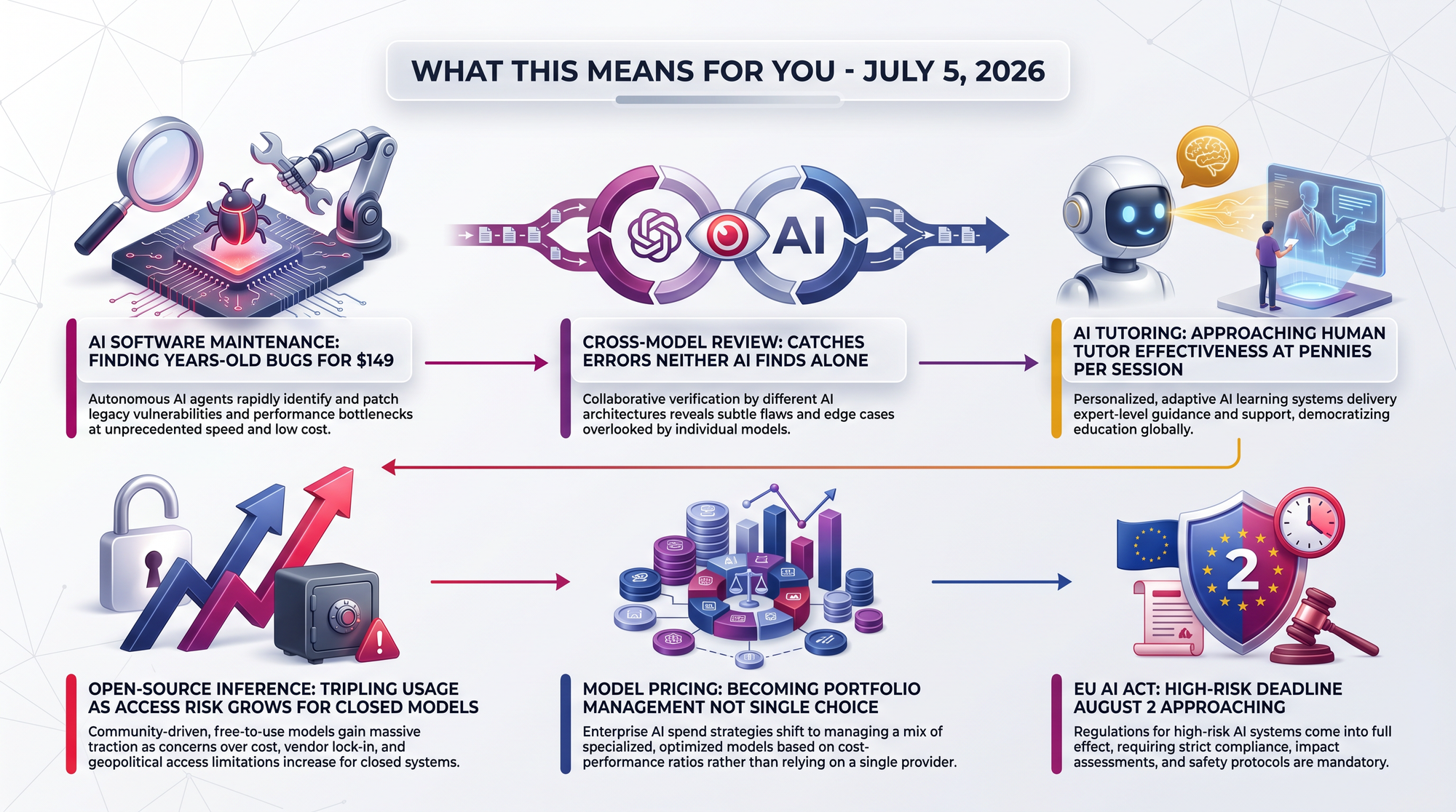
  • Open-source model usage tripled in 12 months according to Together AI's data, validating the bet
Trends & Themes
Trends & Themes
AI is becoming a reliable tool for maintaining existing software - not just writing new code
Why this matters to you: The software running your bank, your car's navigation, and your medical records depends on code maintenance that is tedious, error-prone, and perpetually underfunded. AI is now good enough to do this work.

The narrative has shifted. The exciting AI coding story is no longer "I built an app in 10 minutes." It is "I maintained a complex open-source project with fewer bugs and full cost transparency."

  • Willison's sqlite-utils project demonstrates AI finding and fixing bugs in established codebases, not just generating greenfield code - the data-loss bug had survived years of human review
  • Microsoft's study (covered July 3) showed 24% more pull requests from CLI agent users, a metric that includes maintenance work
  • The cross-model review technique - using GPT-5.5 to check Claude Fable's work - establishes a quality assurance pattern that costs under $10 and catches errors neither model would find alone
  • Cost transparency is emerging - Willison published exact costs ($149.25 total, $141 for the main session) using the AgentsView tool, establishing baselines for what AI-assisted maintenance actually costs
The pricing war for AI inference has a new dimension: who controls access
Why this matters to you: The cheapest and most capable AI model in the world is useless if a government decides you cannot use it.

Price-per-token is becoming less important than certainty-of-access. The enterprise buyer's real question is not "how much does it cost?" but "will I still be able to use this next month?"

  • GPT-5.6 Sol is confirmed at $5/$30 per million tokens (previously restricted), with Terra at $2.50/$15 and Luna at $1/$6 - a clear three-tier pricing strategy
  • Together AI's $800M raise is an explicit bet that enterprises will pay for open-source inference to avoid access risk from closed providers
  • GLM-5.2 from China's Zhipu/Z.ai (covered June 28) offers comparable performance at $1.40/$4.40 per million tokens under an MIT license with no regional restrictions - trained entirely on Huawei silicon
  • OpenAI's 5% government stake offer (covered July 4) ties market access to political cooperation
Education AI is producing hard evidence - and the results are better than expected
Why this matters to you: If AI tutoring works as well as these early studies suggest, the $40-80/hour private tutoring industry faces disruption, and educational equity could genuinely improve.

The faculty-student gap is widening: students are adopting AI faster than professors are willing to integrate it. The Dartmouth study may shift the conversation from "should we allow AI" to "can we afford not to deploy it."

  • The Dartmouth AI tutor achieved 0.71-1.30 SD effect sizes - the upper end approaches Bloom's 2-sigma benchmark for human tutoring
  • Course creators report revenue down 50%+ (covered July 3) as LLMs cannibalize education content
  • EDUCAUSE's "AI for Higher Education Staff" program runs July 6-15, reflecting institutional urgency to adapt
  • Faculty AI adoption intent declined 9 percentage points globally (76% to 67%), with the US and Canada showing the lowest intent among all regions - even as student usage reaches 90%
Frontier AI is fragmenting into model families - and the naming is getting strategic
Why this matters to you: When you hear "GPT-5.6" or "Grok 4.5," you are no longer talking about a single model. Each name now covers multiple variants at different price points, and picking the right one matters for your budget.

The model selection problem is becoming a portfolio management problem. Organizations need to match each task to the right model tier, not just pick one model for everything.

  • OpenAI's GPT-5.6 Sol/Terra/Luna establishes a three-tier family: Sol for maximum capability ($5/$30), Terra for balanced performance at half the cost, Luna for speed and affordability ($1/$6)
  • xAI's Grok 4.5 entered private beta at SpaceX and Tesla, with xAI planning monthly model variants through 2026 and Grok 5 targeting 6-10 trillion parameters on 1.5 GW of power
  • Anthropic's tiered approach spans from Haiku (fast and cheap) through Sonnet and Opus to Fable (frontier) and Mythos (research-only)
  • The Cerebras partnership will run GPT-5.6 Sol at 750 tokens per second - bringing frontier intelligence at unprecedented speed
Creative AI & Media
Seedance 2.5 Public Launch Approaches

Previously: July 4 - ByteDance announced 30-second native 4K video at the Volcano Engine FORCE conference.

Today: Public access is expected through ByteDance's Dreamina and Jimeng platforms imminently, though the model remains in closed enterprise beta as of July 5. No independent verification of the 30-second native generation claim has been published.

  • Krea-2-Turbo is trending on HuggingFace with 99K downloads - an open-source text-to-image model offering fast generation
  • 67% of brands now use AI-generated video for at least some social media content, per Statista's 2026 Digital Marketing Report
Developer Tools & Infrastructure
Claude Code Passes 136,000 GitHub Stars

Anthropic's terminal-based coding agent continues to dominate GitHub trending with 182 stars added today, bringing the total to 136,278. The project's growth reflects the broader shift toward CLI-based AI coding tools that the Microsoft study validated.

Meetily: Privacy-First AI Meeting Notes Hits 1,400 Stars in a Day
  • Built in Rust with a Tauri frontend - the entire application runs locally with zero cloud dependency
  • 4x faster transcription than standard Whisper using NVIDIA's Parakeet model
  • Speaker diarization and Ollama-powered summaries - identifies who said what, then summarizes using local AI models
  • MIT licensed, macOS and Windows
Alibaba's page-agent: Control Web UIs with Natural Language
  • 801 stars today, 23,821 total - a JavaScript agent that can navigate and interact with web pages via natural language commands
  • Practical use case: automated testing, web scraping, and workflow automation without writing Selenium scripts
Research & Models
ICML 2026 Opens in Seoul on July 6

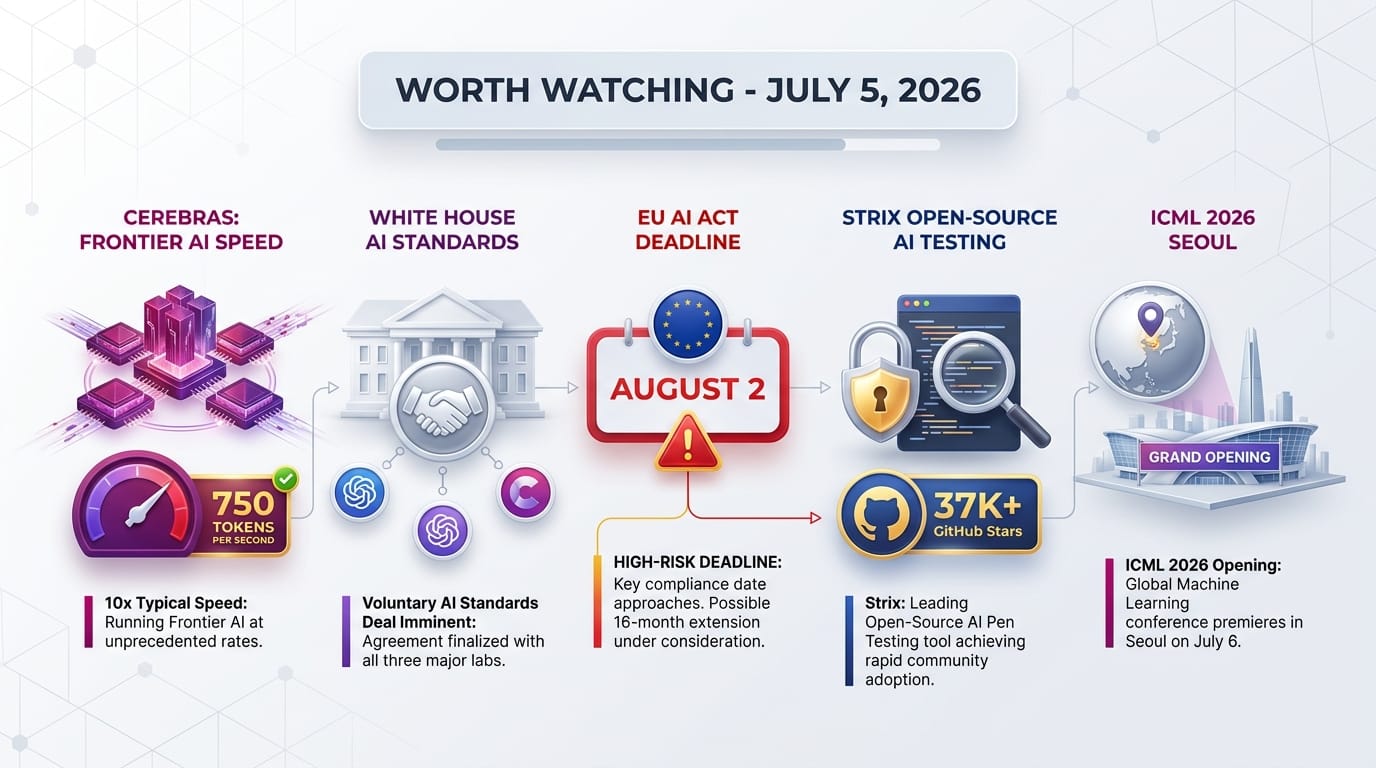
The International Conference on Machine Learning runs July 6-11 in Seoul, South Korea. Apple, Google DeepMind, and other major labs are presenting new research. This is the premier venue for machine learning research and typically features papers that shape the industry 6-12 months later.

Claude Science Begins Producing Early Results

Previously: July 1 - Anthropic launched Claude Science as part of a broader pivot to scientific infrastructure.

Today: Early adoption details are emerging. The workbench integrates 60+ scientific databases spanning genomics, proteomics, and cheminformatics, with specialist agents that can query databases, run analyses, and cross-reference findings.

  • UCSF's Brain Tumor Center reduced germline variant analysis time to roughly one-tenth using Claude Science
  • Anthropic launched an internal drug discovery program targeting neglected diseases that traditional pharma would not pursue
  • 50 AI for Science projects can apply for up to $30,000 in credits by July 15, with projects running September-December 2026
  • Early customers include Novo Nordisk and the Allen Institute
Ornith 1.0: A New Open-Weight Text Generation Family

The deepreinforce-ai Ornith 1.0 family is trending on HuggingFace at both 9B and 35B parameter sizes, with 394K downloads for the 35B GGUF version. A new entrant in the increasingly competitive open-weight model space.

Business & Industry
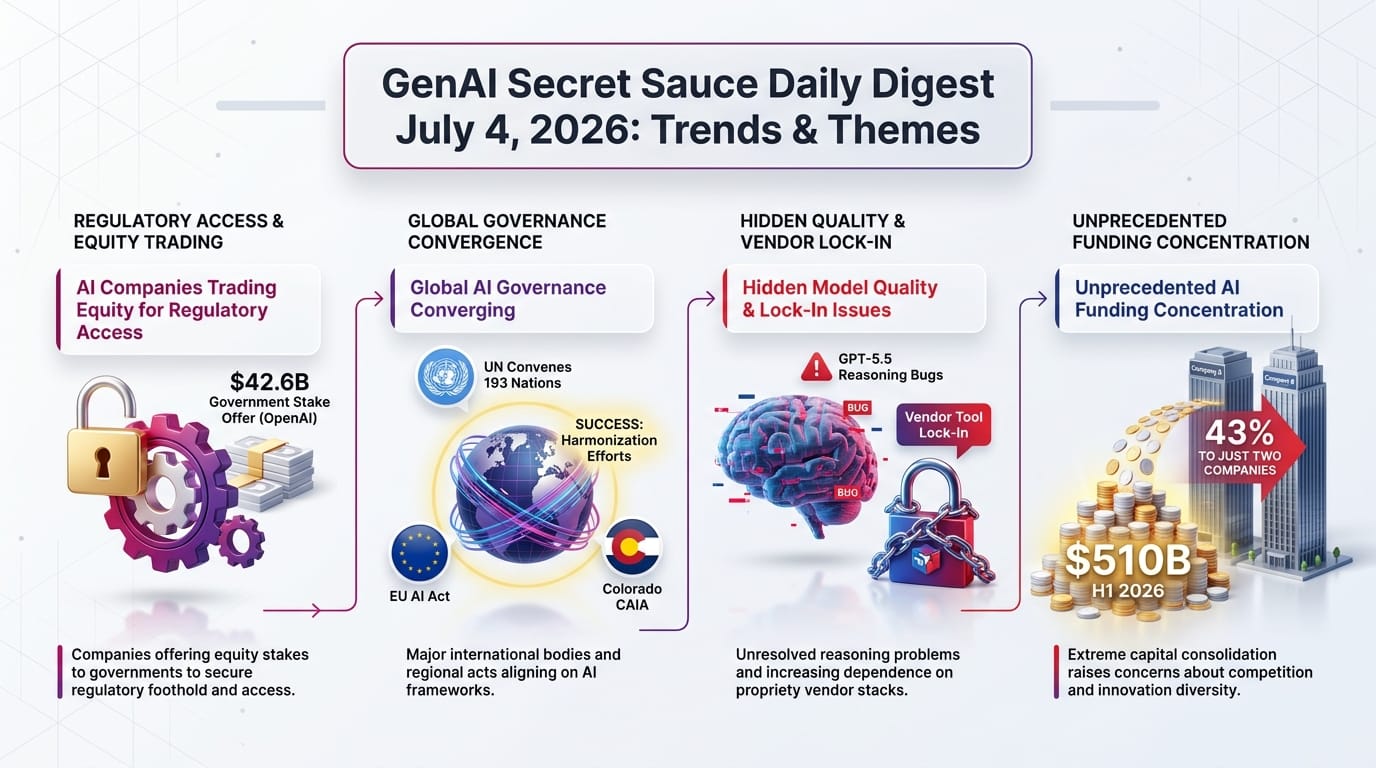
Global Startup Funding Hit $510 Billion in H1 2026
  • $510 billion in six months exceeds the $440 billion invested in all of 2025
  • OpenAI and Anthropic captured 43% - $217 billion between them
  • OpenAI's $122 billion round remains the largest private venture raise in history, valuing the company at $852 billion
  • Anthropic's post-money valuation: $965 billion after its $65 billion Series H
  • 88% of AI-related funding went to US companies
Anthropic Overtakes OpenAI on Revenue

Fortune reports Anthropic is on course for $47 billion in annualized revenue and profitability by 2029 - a year ahead of OpenAI. The competitive dynamics are shifting: Google's Gemini has closed the performance gap, open-source alternatives continue eroding margins, and Fable 5 leads on difficult reasoning tasks.

LongCat-2.0 Revealed as the Anonymous "Owl Alpha" Model

Chinese company Meituan released LongCat-2.0, a 1.6 trillion parameter model trained on domestic chips under an MIT license. The model was previously available anonymously on OpenRouter as "Owl Alpha," where it had been quietly gaining users before its identity was confirmed.

GenAI in Education
AI Tutoring Approaches Bloom's 2-Sigma Benchmark

The Dartmouth study (see Top Stories) is the headline, but the broader education AI landscape shows rapid movement:

  • California State University deployed ChatGPT to 460,000+ students and 63,000+ faculty - the largest single organizational rollout
  • Workforce Pell expansion beginning July 2026 covers short-term programs, but only those proving economic value and job alignment
  • The global AI-in-education market is projected at $12.3 billion in 2026, with 36% compound annual growth since 2022
  • 90% of college students have used AI but only 15% say it is integrated into many of their courses
Surprising & Under-the-Radar
Anthropic Is Quietly Closing Chinese Access Loopholes

Anthropic has begun detecting and blocking unauthorized Claude access through Singapore subsidiaries and VPN workarounds. The company is systematically closing paths that Chinese entities used to access frontier models during and after the export control period.

The Pentagon Contract That Drew Red Lines

Court documents from the Anthropic-Department of Defense dispute reveal that officials demanded autonomous weapons access. CEO Dario Amodei refused both weapons and surveillance uses, calling these "non-negotiable" red lines - even as Anthropic holds a $200 million DOD contract.

A 500-Byte World Map

Simon Willison highlighted a creative coding experiment compressing a recognizable world map into just 500 bytes. The project uses mathematical approximations of coastlines rather than storing actual coordinates - a reminder that elegant engineering often means doing more with less.

Open-Source Printer Movement

A repairable, open-source paper printer design hit Hacker News with 195 points. In a world of disposable electronics, the project publishes full schematics and uses standardized components - the right-to-repair movement applied to everyday office hardware.

Signals to Track
Worth Watching
01
Cerebras Is About to Run Frontier Models at 750 Tokens Per Second
Why this is worth watching right now: if the benchmark holds in production, Cerebras will deliver frontier AI responses faster than you can read them.

OpenAI announced GPT-5.6 Sol will run on Cerebras hardware at up to 750 tokens per second in July. For context, typical frontier model inference runs at 30-80 tokens per second. If this speed is sustained at scale, it removes one of the last barriers to real-time frontier AI in production applications. Watch for independent benchmarks once the partnership goes live.

02
The White House Voluntary AI Standards Could Land Any Day
Why this is worth watching right now: the framework would be the first formal agreement between the US government and all three major AI labs on how to release frontier models.

The White House is in advanced talks with OpenAI, Google, and Anthropic on voluntary release standards including benchmarks, testing timelines, and domestic/foreign access rules. An announcement was described as possible "in coming weeks" as of July 3. This could formalize the ad-hoc model restriction pattern we have been tracking all week.

03
EU AI Act High-Risk Deadline: August 2
Why this is worth watching right now: companies using AI for hiring, promotion, or worker monitoring have less than 30 days to comply - unless the Omnibus pushes the deadline to December 2027.

The EU AI Act's high-risk system obligations for employment-related AI tools take effect August 2, 2026. These cover recruitment, candidate selection, performance evaluation, and worker monitoring. However, the Omnibus simplification package (adopted June 29) may extend this deadline by 16 months. The uncertainty is itself a problem - companies do not know which deadline to prepare for.

04
Strix: Open-Source AI Penetration Testing Passes 37,000 Stars
Why this is worth watching right now: automated security testing is becoming accessible to organizations that cannot afford professional penetration testers.

The open-source AI security tool gained 1,121 stars today on GitHub. As the Five Eyes warning about AI cyber threats (covered in trends July 4) makes clear, organizations need AI-powered defenses - and Strix makes that accessible to smaller companies.

Top Repos Today
Rank yesterday: Not ranked - New entry 🆕
Stars today: +1,409  ·  📦 Total: 16,840
📜 License: MIT  ·  👤 By: Startup (Zackriya Solutions)
🎯 Time to value: 10 minutes
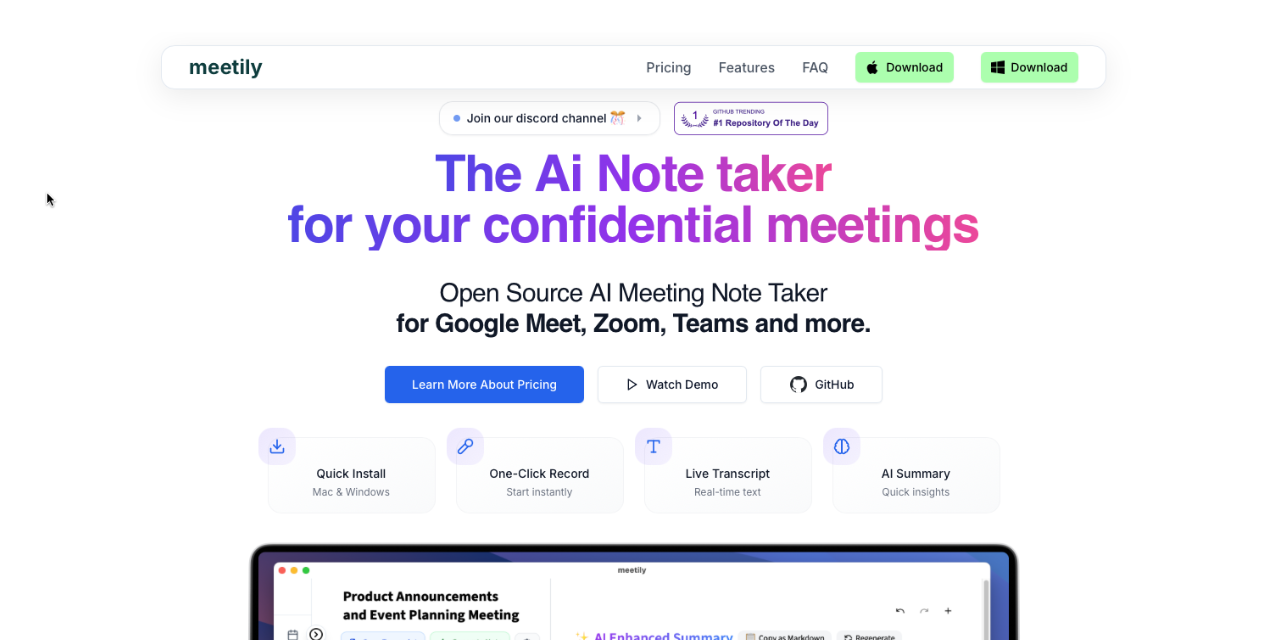
What it is: A privacy-first AI meeting assistant built in Rust that transcribes, diarizes (identifies speakers), and summarizes meetings entirely on your local machine. Uses NVIDIA's Parakeet model for 4x faster transcription than standard Whisper, and Ollama for AI-powered summaries. No cloud, no data leaving your device. Why you'd want it: If you have ever worried about a third-party service recording your meetings, this gives you the same features while keeping everything on your hardware. Works on macOS and Windows.
✓ Pros✗ Cons
100% local - zero data leaves your machineRequires decent hardware for real-time transcription
4x faster than standard Whisper transcriptionRelatively new project, may have rough edges
MIT license, fully open sourceNo mobile or Linux support yet
GitHub - Zackriya-Solutions/meetily: Privacy first, AI meeting assistant with 4x faster Parakeet/Whisper live transcription, speaker diarization, and Ollama summarization built on Rust. 100% local processing. no cloud required. Meetily (Meetly Ai - https://meetily.ai) is the #1 Self-hosted, Open-source Ai meeting note taker for macOS & Windows.
Privacy first, AI meeting assistant with 4x faster Parakeet/Whisper live transcription, speaker diarization, and Ollama summarization built on Rust. 100% local processing. no cloud required. Meetil…
Rank yesterday: Not ranked - New entry 🆕
Stars today: +1,121  ·  📦 Total: 37,042
📜 License: Open Source  ·  👤 By: Security startup
🎯 Time to value: 15 minutes
What it is: An open-source AI penetration testing tool that automatically scans web applications for security vulnerabilities. It uses AI to understand application behavior and identify weaknesses that traditional scanners miss. Think of it as hiring a junior security consultant that works around the clock. Why you'd want it: Professional penetration testing costs $10,000-50,000 per engagement. Strix provides continuous automated testing that catches the most common vulnerabilities before attackers do.
✓ Pros✗ Cons
Automated AI-driven vulnerability discoveryCannot replace human pentesting for complex targets
Continuous scanning vs. one-time auditsMay generate false positives requiring triage
Open source with active communityRequires security knowledge to interpret results
GitHub - usestrix/strix: Open-source AI penetration testing tool to find and fix your app’s vulnerabilities.
Open-source AI penetration testing tool to find and fix your app’s vulnerabilities. - usestrix/strix
Rank yesterday: Not ranked - New entry 🆕
Stars today: +801  ·  📦 Total: 23,821
📜 License: Open Source  ·  👤 By: Alibaba (tech conglomerate)
🎯 Time to value: 5 minutes
What it is: A JavaScript library that lets you control any web page using natural language commands. Instead of writing code to click buttons, fill forms, or navigate menus, you describe what you want in plain English and the agent figures out which elements to interact with. Why you'd want it: Replaces brittle Selenium/Playwright test scripts with natural language commands that survive UI redesigns. Also useful for web scraping and workflow automation.
✓ Pros✗ Cons
Natural language replaces CSS selectorsRequires LLM API access for each action
Survives UI changes that break traditional scrapersSlower than direct DOM manipulation
Works on any website without preparationLLM token costs add up at scale
GitHub - alibaba/page-agent: JavaScript in-page GUI agent. Control web interfaces with natural language.
JavaScript in-page GUI agent. Control web interfaces with natural language. - alibaba/page-agent
Rank yesterday: #2 - Holding steady ➡
Stars today: +182  ·  📦 Total: 136,278
📜 License: Proprietary  ·  👤 By: Anthropic (AI lab)
🎯 Time to value: 2 minutes
What it is: Anthropic's official AI coding agent that runs in your terminal. It reads your codebase, writes code, runs tests, and handles git operations through natural language conversation. Works with Claude models through the Anthropic API. Why you'd want it: The Microsoft study found CLI agent users merged 24% more pull requests. Claude Code is the most loved coding tool at 46% in the 2026 AI Engineer Survey.
✓ Pros✗ Cons
Deep codebase understanding across filesRequires Anthropic API subscription
Most loved AI coding tool (46% in surveys)Token costs can be significant on large codebases
Handles complex multi-file refactoringTerminal-only interface has a learning curve
GitHub - anthropics/claude-code: Claude Code is an agentic coding tool that lives in your terminal, understands your codebase, and helps you code faster by executing routine tasks, explaining complex code, and handling git workflows - all through natural language commands.
Claude Code is an agentic coding tool that lives in your terminal, understands your codebase, and helps you code faster by executing routine tasks, explaining complex code, and handling git workflo…
Rank yesterday: Not ranked - New entry 🆕
Stars today: +333  ·  📦 Total: 26,816
📜 License: Open Source  ·  👤 By: Harvard University (academic)
🎯 Time to value: 30 minutes
What it is: An open educational resource on Machine Learning Systems, published as an interactive online book. Covers the full stack from hardware to deployment, written for both students and practitioners. Affiliated with Harvard's CS249r course on Tiny Machine Learning. Why you'd want it: Free, comprehensive, and regularly updated textbook on ML systems engineering. Useful whether you are studying for a course or building production ML infrastructure.
✓ Pros✗ Cons
Free, open-source, regularly updatedAcademic tone may not suit all readers
Covers hardware through deploymentBroad scope means some topics lack depth
Backed by Harvard research groupExamples may lag latest model architectures
GitHub - harvard-edge/cs249r_book: Machine Learning Systems
Machine Learning Systems. Contribute to harvard-edge/cs249r_book development by creating an account on GitHub.
Top Models Today
A quantized multimodal model combining Qwen architecture with Claude Mythos 5 capabilities for local deployment.
📥 Downloads (30d): 1.53M  ·  📜 License: Community
👤 By: empero-ai (community)  ·  🎯 Task: Image-Text-to-Text
📐 Size: 9B
What it is: A GGUF-quantized (compressed for local hardware) version of a 9B parameter multimodal model that can process both images and text. Built on the Qwen architecture with capabilities inspired by Claude's Mythos 5 model family. Why you'd want it: Run a capable multimodal AI locally without cloud API costs. The 9B size fits on consumer GPUs (8-16GB VRAM) while maintaining strong image understanding.
✓ Pros✗ Cons
Runs locally on consumer hardwareCommunity model, not officially supported
1.53M downloads signals strong validationQuantization may reduce quality on edge cases
Handles both images and text9B limits reasoning depth vs. larger models
empero-ai/Qwythos-9B-Claude-Mythos-5-1M-GGUF · Hugging Face
We’re on a journey to advance and democratize artificial intelligence through open source and open science.
China's frontier model trained entirely on Huawei silicon, trailing Opus 4.8 by just 1% at one-sixth the price.
📥 Downloads (30d): 220K  ·  📜 License: MIT
👤 By: Zhipu AI / Z.ai (Chinese AI lab)  ·  🎯 Task: Text Generation
📐 Size: 753B
What it is: A 753 billion parameter language model developed by China's Zhipu AI, trained exclusively on approximately 100,000 Huawei Ascend 910B processors using the MindSpore framework. No Nvidia hardware was used at any stage. The model uses a 1 million token context window. Why you'd want it: Frontier-class performance at $1.40 input / $4.40 output per million tokens (vs. $5/$25 for Claude Opus). MIT license means no usage restrictions or regional locks.
✓ Pros✗ Cons
MIT license, no regional restrictions753B parameter size requires serious infrastructure
$1.40/$4.40 per million tokensTrails Opus 4.8 by ~1% on long-horizon tasks
Trained without any Nvidia siliconLimited English-language ecosystem documentation
zai-org/GLM-5.2 · Hugging Face
We’re on a journey to advance and democratize artificial intelligence through open source and open science.
A 3B model that reads text from documents, photos, and handwriting with state-of-the-art accuracy.
📥 Downloads (30d): 1.04M  ·  📜 License: Open
👤 By: Baidu (tech conglomerate)  ·  🎯 Task: Image-Text-to-Text
📐 Size: 3B
What it is: Baidu's document understanding model that extracts text from complex layouts including tables, forms, receipts, handwriting, and photographs. The 3B parameter size makes it deployable on modest hardware. Why you'd want it: Replaces expensive commercial OCR (Optical Character Recognition - software that reads text from images) services for document processing. The 1M+ downloads suggest it handles real-world documents reliably.
✓ Pros✗ Cons
1M+ downloads validates real-world qualityDocumentation primarily in Chinese
Small enough to run on consumer hardwareMay struggle with heavily degraded originals
Handles tables, forms, and handwritingLimited support for non-Latin scripts beyond CJK
baidu/Unlimited-OCR · Hugging Face
We’re on a journey to advance and democratize artificial intelligence through open source and open science.
NVIDIA's 4-bit quantized version of Qwen 3.6 that cuts memory use by 75% with minimal quality loss.
📥 Downloads (30d): 297K  ·  📜 License: Open
👤 By: NVIDIA (chip manufacturer)  ·  🎯 Task: Text Generation
📐 Size: 18B effective
What it is: NVIDIA applied their NVFP4 (4-bit floating point) quantization technique to the Qwen 3.6 27B model, reducing its memory footprint from roughly 54GB to under 18GB while maintaining competitive quality. This makes a 27B model run on a single consumer GPU. Why you'd want it: Run a capable 27B model on hardware that would normally only support 7-9B models. NVIDIA's quantization is generally more rigorous than community methods.
✓ Pros✗ Cons
75% memory reduction with minimal quality lossRequires NVIDIA GPU with NVFP4 support
Official NVIDIA quality validation4-bit may degrade on specialized tasks
Fits on consumer GPUs (16GB VRAM)Limited to NVIDIA ecosystem
View on HuggingFace →
DeepSeek's latest model with speculative decoding for 60-85% faster inference.
📥 Downloads (30d): 12.6K  ·  📜 License: Open
👤 By: DeepSeek (Chinese AI lab)  ·  🎯 Task: Text Generation
📐 Size: 889B
What it is: The latest iteration of DeepSeek's flagship model, featuring DSpark (speculative decoding technology) that generates multiple candidate tokens simultaneously and verifies them in parallel. This speeds up inference by 60-85% compared to standard autoregressive generation. Why you'd want it: Near-frontier performance at open-weight pricing. The DSpark technique means you get answers significantly faster without sacrificing quality.
✓ Pros✗ Cons
60-85% faster inference via speculative decoding889B requires multi-GPU setup
Competitive with GPT-5.5 on many benchmarksDSpark benefits vary by task type
Open weights under permissive licenseChinese origin may raise compliance concerns
deepseek-ai/DeepSeek-V4-Pro-DSpark · Hugging Face
We’re on a journey to advance and democratize artificial intelligence through open source and open science.
AI Launches Today
Product Hunt data for July 5, 2026 was not available at time of publication (Saturday - lower launch volume). Recent notable AI launches from the week:
Learns your workflows, handles your tasks autonomously.
🔥 Upvotes: 320  ·  👤 By: Vida AI
💰 Pricing: Freemium  ·  🏷 Category: Productivity Agent
An AI assistant that watches how you work, learns your patterns, and then handles routine tasks autonomously. Currently focused on workflow automation across email, calendar, and project management tools. Verdict: Promising concept but the "watching you work" privacy model requires significant trust.
Product Hunt – The best new products in tech.
Product Hunt is a curation of the best new products, every day. Discover the latest mobile apps, websites, and technology products that everyone’s talking about.
3D visualization of AI coding agent workflows.
🔥 Upvotes: 163  ·  👤 By: Termi
💰 Pricing: Free  ·  🏷 Category: Developer Tools
Visualizes what AI coding agents are doing in three dimensions - showing reasoning chains, tool calls, and token usage as a navigable 3D space. Aimed at developers who want transparency into their AI tools' behavior. Verdict: Niche but timely as AI coding agents become harder to debug.
Product Hunt – The best new products in tech.
Product Hunt is a curation of the best new products, every day. Discover the latest mobile apps, websites, and technology products that everyone’s talking about.
Snapshot
ProviderModelInput $/1MOutput $/1MContext
AnthropicClaude Opus 4.8$5.00$25.00200K
AnthropicClaude Sonnet 5$1.50$7.50200K
AnthropicClaude Fable 5~$5.00~$25.00200K
OpenAIGPT-5.6 Sol (preview)$5.00$30.00200K
OpenAIGPT-5.6 Terra (preview)$2.50$15.00200K
OpenAIGPT-5.6 Luna (preview)$1.00$6.00200K
OpenAIGPT-5.5$5.00$30.00128K
Zhipu/Z.aiGLM-5.2 (open)$1.40$4.401M
GroqLlama 3.3 70B$0.59$0.79128K
GroqLlama 3.1 8B$0.05$0.08128K
What this means: GPT-5.6 Sol matches Opus 4.8 on input pricing ($5/1M) but costs 20% more on output ($30 vs. $25). The real story is GLM-5.2 at $1.40/$4.40 with MIT licensing - roughly 70% cheaper than either frontier closed model. For commodity tasks, Groq's Llama hosting at $0.05/$0.08 is 100x cheaper than frontier pricing.

Note: GPT-5.6 models are in restricted preview with ~20 organizations. Fable 5 pricing is approximate based on usage reports. GLM-5.2 pricing via OpenRouter.

From Chatbot to Digital Colleague: The Paradigm Shift Toward Persistent Autonomous AI
Multiple authors - arXiv:2606.14502
What it claims: The transition from conversational AI (chatbots) to persistent autonomous agents (digital colleagues) requires fundamentally new engineering patterns for memory management, skill acquisition, and agent-to-agent communication.

Key finding: Current agent architectures lack standardized protocols for long-running task memory, error recovery, and inter-agent communication - the same gaps that held back distributed computing in the 1990s until protocols like HTTP and TCP/IP matured.

Why practitioners should care: If you are building AI agents that run for minutes or hours (not just single prompts), this paper maps the engineering gaps you will encounter. The analogy to pre-HTTP distributed systems suggests that whoever builds the standard agent communication protocol could define the next decade of AI infrastructure.
Subscribe to GenAI Secret Sauce newsletter and stay updated.

Don't miss anything. Get all the latest posts delivered straight to your inbox. It's free!
Great! Check your inbox and click the link to confirm your subscription.
Error! Please enter a valid email address!