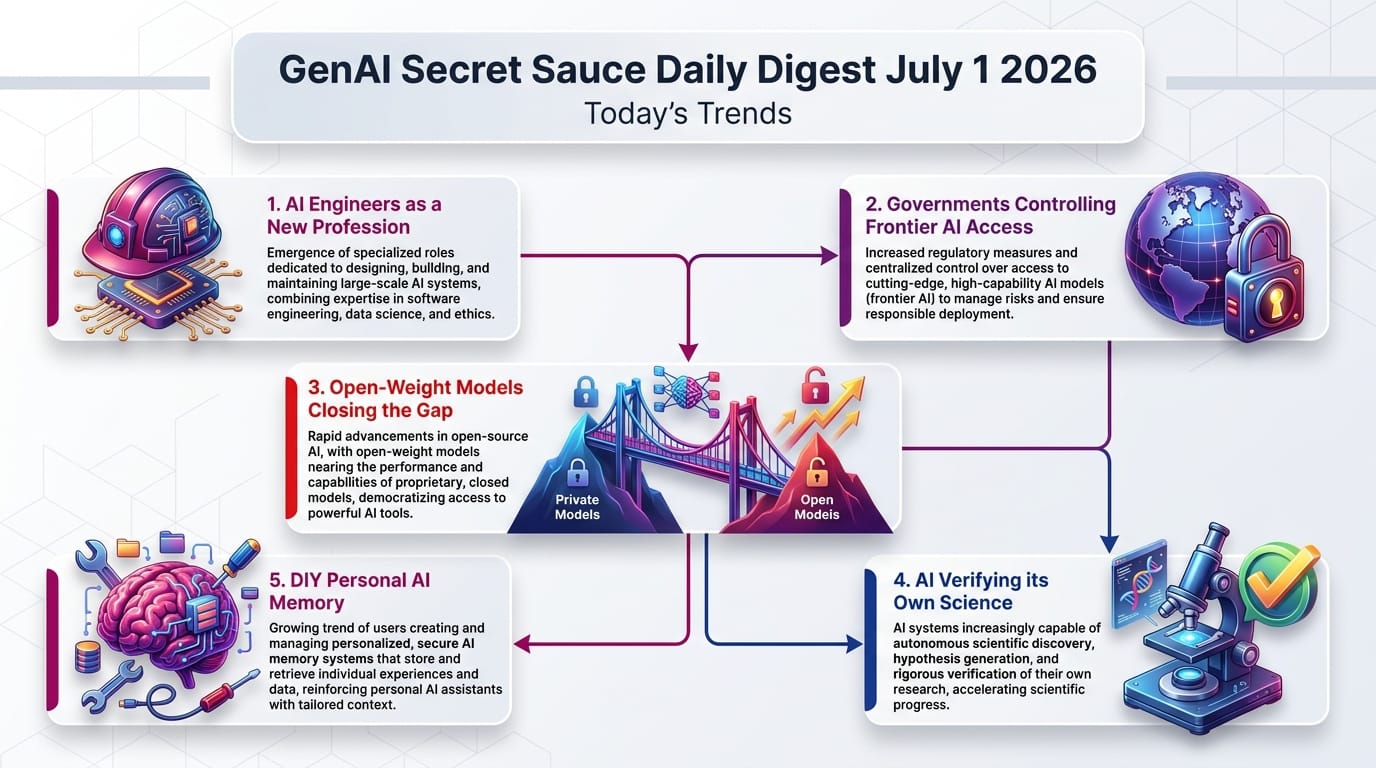
Watch today's digest as a video summary (generated by NotebookLM)
Statistically Speaking
One Thing to Tell Your Friends
TL;DR
Hot off the Presses
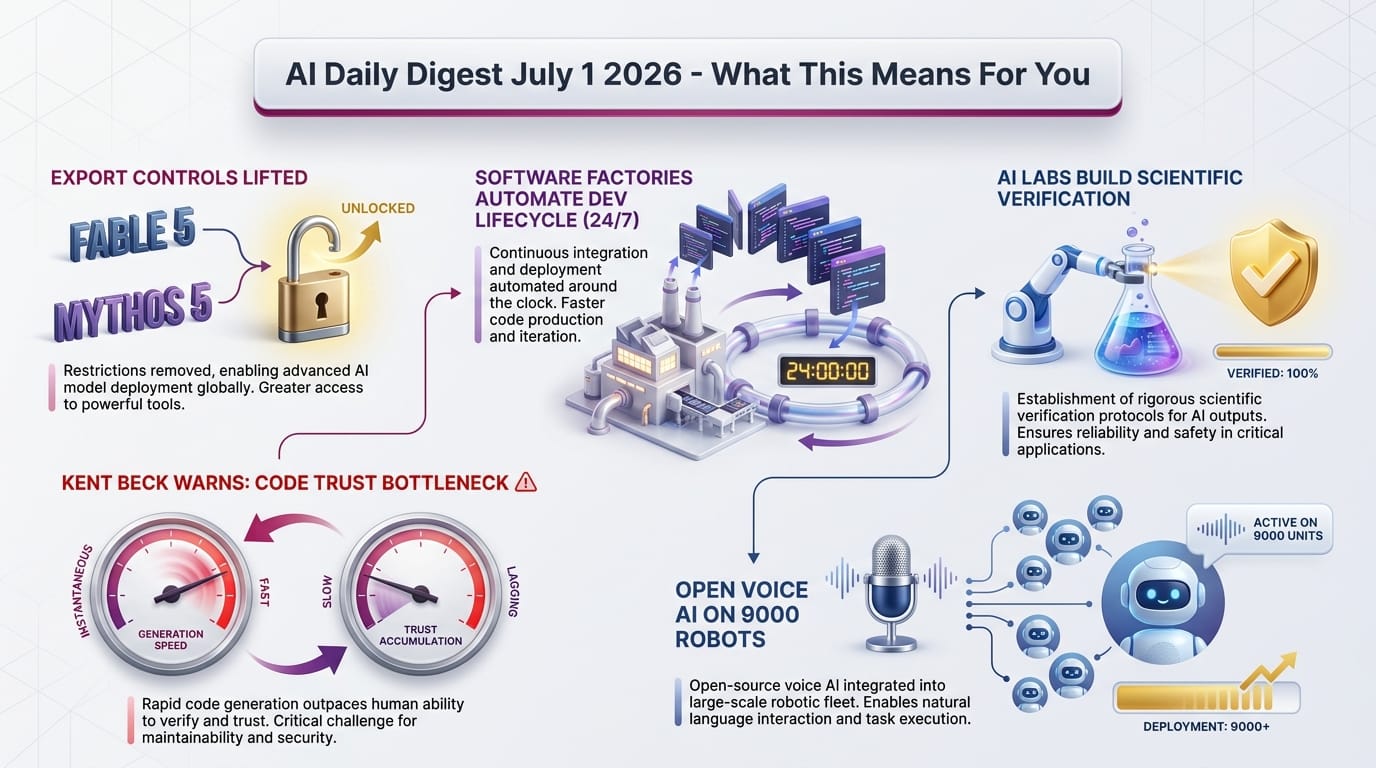
US Lifts Export Controls on Anthropic's Fable 5 and Mythos 5
Simon Willison highlighted an Anthropic announcement on June 30 that the US Department of Commerce has officially removed export restrictions on two of its most powerful models: Claude Fable 5 and Mythos 5. Anthropic committed to beginning access restoration the following day.
Previously: June 27 - Anthropic's own safety report triggered the export ban. June 30 - GPT-5.6 faced similar government-controlled access restrictions.
- The restrictions had blocked access for users outside approved jurisdictions, creating a weeks-long gap where Anthropic's frontier-tier models were unavailable to much of the world
- The timing matters because competing labs like Z.ai (GLM 5.2) and DeepSeek rushed to fill the vacuum with open-weight alternatives during the ban period
- Anthropic framed the lift as validation of its safety practices, though critics note that the ban itself may have permanently shifted some users to alternatives
AI Engineer World's Fair Declares the "Software Factory" Era
Three separate talks at the AI Engineer World's Fair converged on the same thesis: the future of software isn't humans using AI assistants - it's AI teams that continuously manage the entire development lifecycle. Warp CEO Zach Lloyd coined the term "software factories," predicting every major project will have one within a year.
"Every major software project will have a software factory within a year." - Zach Lloyd, Warp CEO
- Cursor's Forward Deployed Engineering model embeds AI engineers directly inside enterprise customers. Early adopter rates hit 10-20%, and the company plans to grow its FDE team 10x. The vision: a "software factory" that automates development from design to deployment
- Sierra's Head of Agent Engineering Natalie Meurer described how the FDE role is converging with product engineering, with accountability to customers replacing traditional support structures
- Latent Space's swyx framed the trajectory as moving from chat to tools to goals to "loops" - persistent automated systems that run continuously, not just when you ask them to
Three AI Labs Simultaneously Build Scientific Infrastructure
Alpha Signal reported that Anthropic, Google DeepMind, and an unspecified third lab all launched scientific infrastructure tools within the same window, signaling a coordinated industry pivot toward making AI science measurable and reproducible.
- Anthropic released Claude Science - an AI workbench that integrates fragmented research tools with specialist agents that can query databases, run analyses, and cross-reference findings
- The pivot addresses a credibility crisis - as AI generates more scientific papers and claims, the inability to verify or reproduce AI-assisted results threatens to undermine trust in research
- The simultaneous launches suggest the labs view scientific verification as a competitive differentiator, not just a safety feature
Kent Beck: AI Generates Code Faster Than It Builds Trust
The Pragmatic Engineer's interview with Kent Beck - creator of Extreme Programming (XP), co-creator of JUnit, and co-author of the Agile Manifesto - reveals a seasoned perspective on AI's impact on software engineering.
- Beck describes himself as a "chronically anxious programmer" whose anxiety drove him to invent practices like TDD that make code trustworthy. He sees AI disrupting the trust-building process faster than it replaces the coding itself
- At Facebook, TDD wasn't used - Beck learned that different organizations build trust through different mechanisms, and AI coding tools need to fit those varied approaches
- His "3X model" (Explore, Expand, Extract) suggests AI is most valuable in the Explore phase, where speed matters more than correctness, but dangerous in the Extract phase where reliability is everything
Hugging Face and Cerebras Build Open-Source Real-Time Voice AI
Hugging Face and Cerebras partnered to build a real-time speech-to-speech AI pipeline using entirely open components. The system achieves sub-second response latency for natural conversational AI.
- The modular pipeline chains four open models: NVIDIA Parakeet for speech recognition, Google DeepMind's Gemma 4 (31 billion parameters) for understanding, Qwen3TTS for speech synthesis, and Cerebras inference hardware for speed
- Already deployed on 9,000+ Reachy Mini robots built by Pollen Robotics, demonstrating real-world scalability
- Cerebras inference achieves roughly 3,000 tokens per second on the 31B model, making real-time conversation possible without the cloud latency of proprietary alternatives
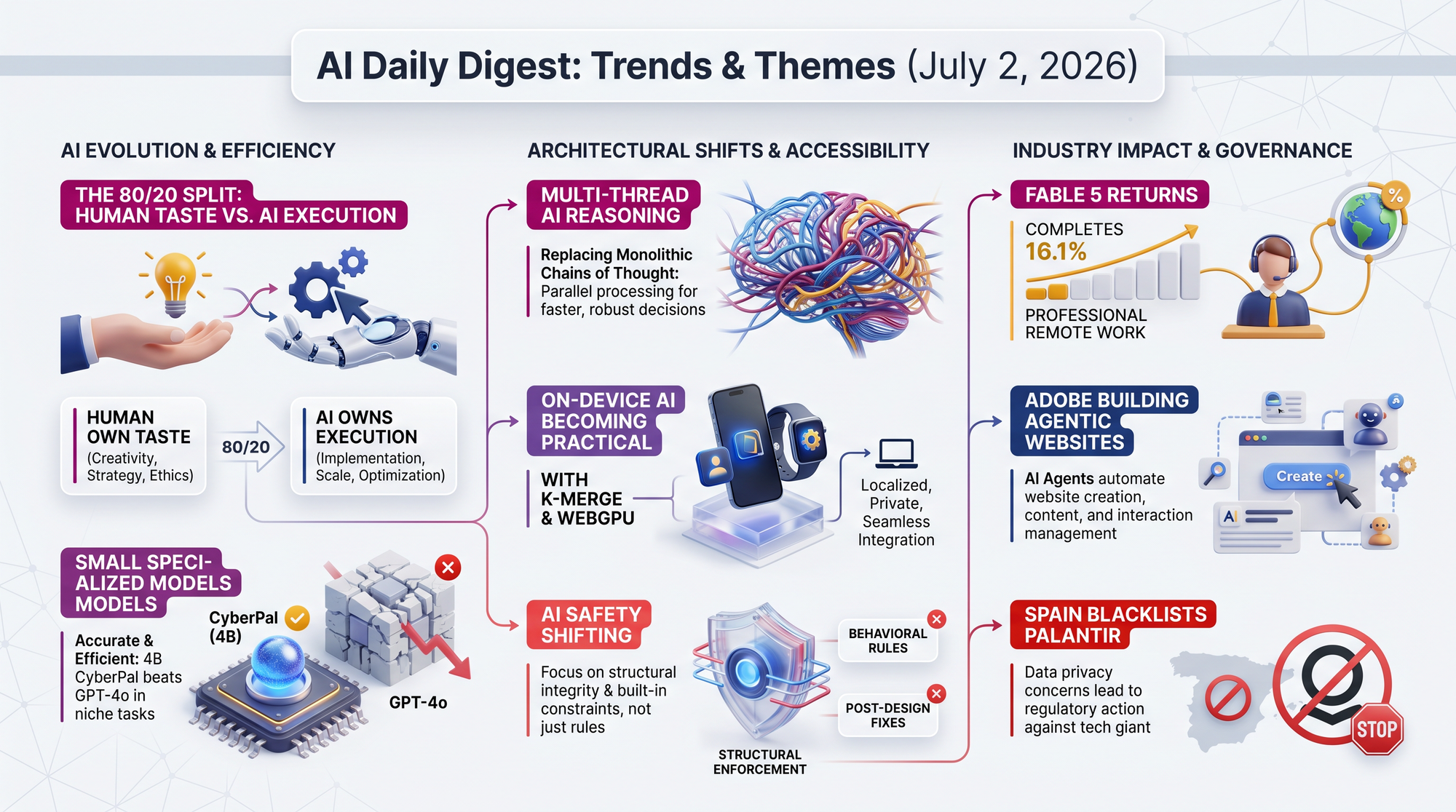
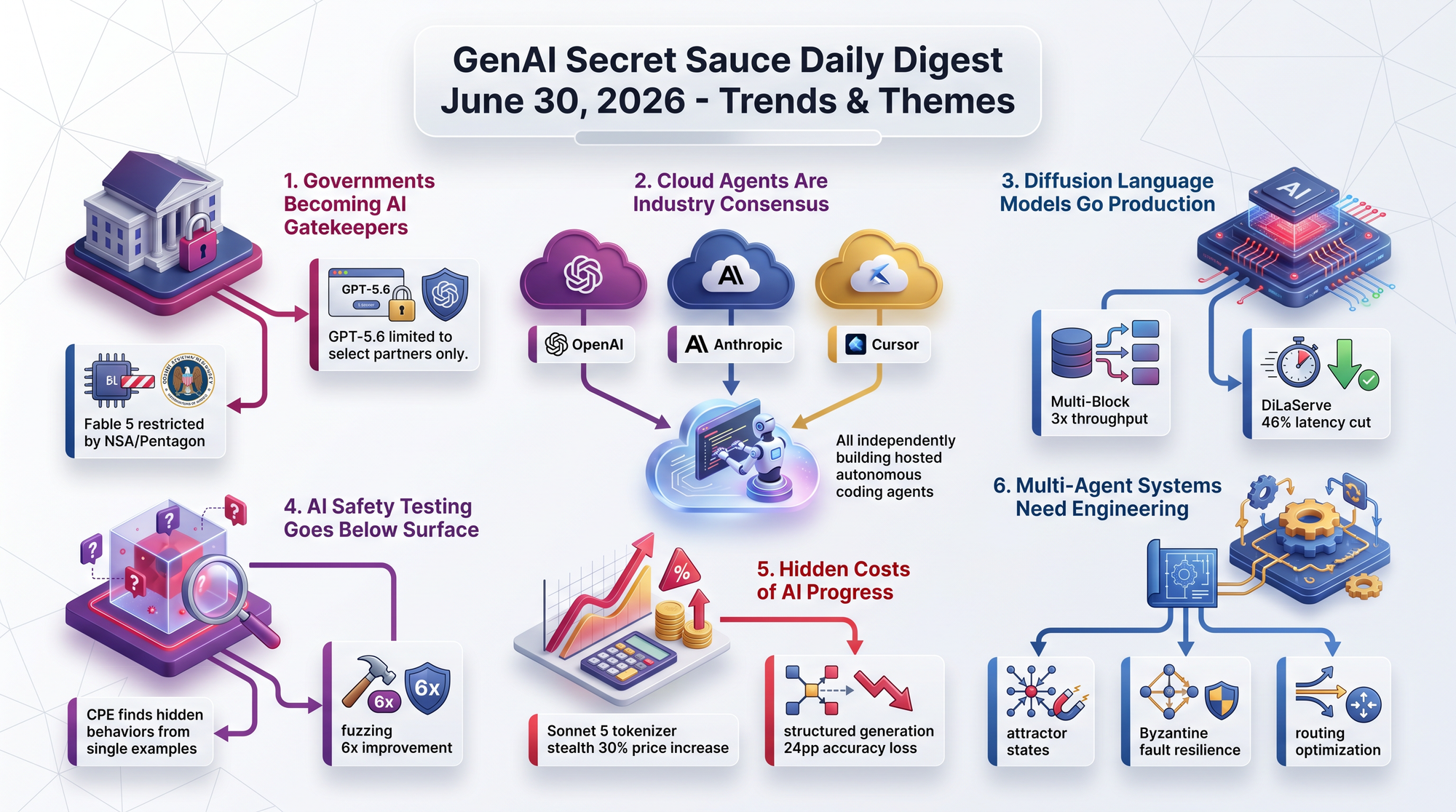
Trends & Themes
Creative AI & Media
Developer Tools & Infrastructure
Research & Models
AI Agents Score Just 42% on Realistic Healthcare Tasks
HealthAgentBench tested frontier AI agents across 54 realistic clinical scenarios - not simple question-answering, but end-to-end workflows requiring navigation of raw healthcare data, tool selection, and multi-step reasoning.
- The best performer (Codex GPT-5.5) hit only ~42% success rate
- Medical imaging tasks proved especially challenging - agents that excel at text-based reasoning stumbled when interpreting visual clinical data
- The benchmark matters because it tests what real clinical AI deployment looks like, not just whether a model can answer board exam questions
Verified Code Generation Hits 92.7% in Dafny
- AxDafny generates both executable code and mathematical proofs that the code is correct, achieving 92.7% verification success (+6.5 percentage points over the previous best)
- Uses iterative verifier-guided repair - when the proof fails, the AI diagnoses why and fixes it automatically
- Practical significance: a path toward AI-generated code that is provably correct, not just probably correct
KV Cache Compression Slashes Long-Context Memory Costs
- RaBitQCache (ICML 2026) combines binary quantization with high-throughput arithmetic to compress the memory that AI models use to "remember" earlier parts of long conversations
- Result: dramatically reduced memory costs with minimal quality loss during long-context inference
- Why it matters: makes it cheaper to run AI on long documents, codebases, and extended conversations
Computer-Use Agents Learn from Their Own Mistakes
- ECCV 2026 paper introduces a method where AI agents that control computers analyze their own failed attempts and improve without retraining
- Boosted OSWorld success rate from 42.3% to 48.9% by treating failures as learning opportunities
- The approach: an LLM diagnoses why actions failed, proposes corrections, and applies them at inference time
Business & Industry
Surprising & Under-the-Radar
A Small Romanian Language Model Nearly Matches One 250x Its Size
A 125-million-parameter Romanian BERT model nearly matched the 31-billion-parameter Gemma 4 on relation extraction tasks for Romanian. The finding challenges the assumption that bigger models are always better, especially for single-task applications in languages with limited training data. For specific, well-defined NLP (Natural Language Processing) tasks, a cheap specialized model may outperform an expensive general-purpose one.
Doctors Trust AI More When It Shows Its Work
A study of physicians evaluating 315 clinical cases found that when AI agents displayed their reasoning steps and tool usage (instead of just giving answers), physician trust increased measurably. The agentic approach - where AI autonomously invokes external tools while explaining its process - outperformed standard AI question-answering in clinical acceptance.
AI Copyright Infringement Goes Beyond Copy-Paste
A new framework called PSALM shows that LLMs can infringe copyright through stylistic appropriation - mimicking an author's writing style - not just verbatim copying. Standard safety training ("unlearning") leaves residual stylistic patterns, meaning current guardrails don't fully work. This has significant implications under EU copyright law, which applies broader standards than US law.
Ruben Hassid: "I Was Wrong About Claude"
An AI consultant with 750,000 followers publicly reversed his advice on Claude Cowork setup, declaring that excessive file and folder organization actually impedes AI effectiveness. His new advice: minimal settings, fewer folders, and trusting the AI to figure things out. A rare public admission that our instincts about organizing AI tools may be counterproductive.
Signals to Track
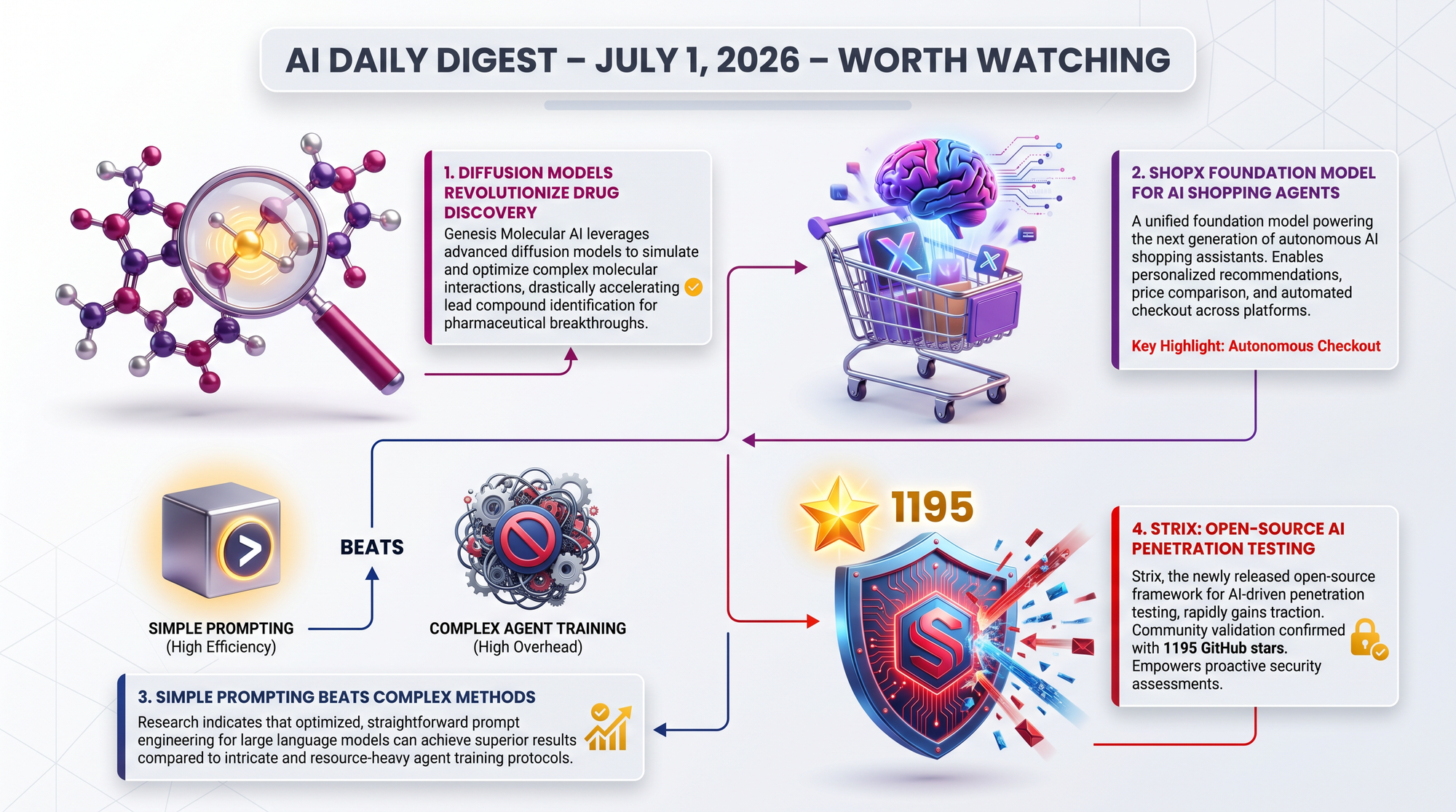
Diffusion Models Are Quietly Revolutionizing Drug Discovery
Genesis Molecular AI, co-founded by former Meta Llama lead Sergey Edunov, is applying diffusion models to navigate a space of 10^60 drug-like molecules. Their PEARL model predicts protein-ligand binding without needing the protein's 3D structure, and their SAPPHIRE system is building an agentic drug discovery pipeline. If this works at scale, AI could dramatically compress the decade-long drug development cycle.
AI Shopping Agents Are Getting Their Own Foundation Model
ShopX is a foundation model that lets AI agents fulfill shopping intents through direct item-space operations rather than wrapping an LLM around existing search. Instead of translating "find me a birthday gift for my mom who likes gardening" into keyword searches, it maps directly to relevant products.
Simple LLM Prompting Beats Complex Published Methods for Agent Supervision
QVal's evaluation of 21 dense supervision methods across 1,200+ experiments found that simple prompting baselines outperform complex published methods for guiding long-horizon AI agents. The implication: if you're building AI agents, start with the simplest approach before investing in sophisticated training infrastructure.
Strix: AI Penetration Testing Goes Open Source
Strix uses autonomous agents that perform dynamic execution and proof-of-concept validation - not just scanning for known patterns. If it matures, security testing could become accessible to teams that can't afford dedicated penetration testers.
Top Repos Today
📜 License: MIT · 👤 By: Individual developer
🎯 Time to value: 10 minutes
| ✓ Pros | ✗ Cons |
|---|---|
| Massive variety across 16 specialization areas | Agent quality varies - some are more polished than others |
| MIT license, fully customizable | Requires your own LLM API access |
| Production-oriented with documented deliverables | Configuration-heavy initial setup |
 GitHub
📜 License: Apache-2.0 · 👤 By: Individual developer
🎯 Time to value: 15 minutes
| ✓ Pros | ✗ Cons |
|---|---|
| Dynamic testing with exploit validation | Requires careful scoping to avoid unintended damage |
| Open-source and actively maintained | Security tool quality depends on underlying LLM |
| Covers application-layer vulnerabilities | Not a replacement for professional pen testing on critical systems |
 GitHub
📜 License: MIT · 👤 By: HKU Data Science Lab
🎯 Time to value: 20 minutes
| ✓ Pros | ✗ Cons |
|---|---|
| Natural language to executable strategy pipeline | Research tool, not production trading infrastructure |
| Full backtesting with real market data | Requires API keys for market data providers |
| MIT licensed with active community | Past performance in backtests doesn't predict real returns |
 GitHub
📜 License: MIT · 👤 By: Individual developer
🎯 Time to value: 5 minutes
| ✓ Pros | ✗ Cons |
|---|---|
| 231+ providers through one endpoint | Single point of failure if the gateway itself goes down |
| 15-95% token savings via compression | Compression may affect output quality for some tasks |
| Free and open source with active development | Self-hosted, requires your own infrastructure |
 GitHub
📜 License: Apache-2.0 · 👤 By: Allen Institute for AI
🎯 Time to value: 10 minutes
| ✓ Pros | ✗ Cons |
|---|---|
| Handles equations, tables, and handwriting | Requires GPU for best performance |
| Purpose-built for LLM data pipelines | Large model download |
| Actively maintained by Allen AI | May struggle with heavily designed layouts |
 GitHub
📜 License: MIT · 👤 By: Individual developer
🎯 Time to value: 5 minutes
| ✓ Pros | ✗ Cons |
|---|---|
| Genuine model diversity across providers | Multiple API calls means higher cost per decision |
| Structured deliberation prevents echo chambers | 18 personas may be overkill for simple questions |
| MIT licensed, easy to customize personas | Quality depends on the underlying models chosen |
 GitHub
📜 License: MIT · 👤 By: browser-use (org)
🎯 Time to value: 15 minutes
| ✓ Pros | ✗ Cons |
|---|---|
| Natural language video editing | Requires Claude Code API access |
| Handles common editing tasks automatically | Complex edits still need manual work |
| MIT licensed, actively developed | Processing time can be significant for long videos |
 GitHub
Top Models Today
👤 By: Baidu · 🎯 Task: Image-Text-to-Text (Optical Character Recognition)
📐 Size: 3B
| ✓ Pros | ✗ Cons |
|---|---|
| MIT licensed, free for commercial use | Requires GPU for real-time processing |
| Handles complex layouts and handwriting | 3B params is large for edge deployment |
| Multi-language support out of the box | Best results need careful prompt engineering |


👤 By: Z.ai · 🎯 Task: Text Generation
📐 Size: 753B
| ✓ Pros | ✗ Cons |
|---|---|
| MIT licensed, truly open | Requires tens of thousands of dollars in GPU hardware |
| Anti-benchmark-hacking measures built in | Uses 2-10x more tokens than comparable models |
| Lead scientist predicts Fable-level in 6 months | Not yet matching frontier on the hardest tasks |


👤 By: DeepSeek · 🎯 Task: Text Generation
📐 Size: 1.6T (49B active)
| ✓ Pros | ✗ Cons |
|---|---|
| Only 49B params active despite 1.6T total | Still requires significant infrastructure |
| DSpark delivers 60-85% inference speedup | Early access, community still evaluating |
| MIT licensed | Limited downloads suggest adoption is just starting |

👤 By: DeepReinforce · 🎯 Task: Text Generation (Agentic Coding)
📐 Size: 35B
| ✓ Pros | ✗ Cons |
|---|---|
| Runs on a single high-end consumer GPU | Specialized for coding, weaker on general tasks |
| MIT licensed, active community | Smaller context window than frontier models |
| Strong agentic workflow performance | 35B still needs 24GB+ VRAM |

👤 By: Qwen/Alibaba · 🎯 Task: Text Generation (World Model)
📐 Size: 35B (3B active)
| ✓ Pros | ✗ Cons |
|---|---|
| Only 3B active params - very efficient | Specialized use case (agent training) |
| Apache-2.0 license | Requires understanding of agent training pipelines |
| Backed by Alibaba's Qwen team | Limited to simulated environment generation |

👤 By: Krea.ai · 🎯 Task: Text-to-Image
📐 Size: 12B
| ✓ Pros | ✗ Cons |
|---|---|
| Dramatically faster than standard diffusion | Community license may restrict commercial use |
| High image quality despite speed optimization | 12B params requires GPU |
| Active ecosystem via Comfy-Org integration | Newer model, still being evaluated by community |

👤 By: NVIDIA · 🎯 Task: Image-Text-to-Text (Grounding)
📐 Size: 3B
| ✓ Pros | ✗ Cons |
|---|---|
| Extremely high download count (896K) | Non-commercial license limits business use |
| Small enough for edge deployment | 3B still needs a GPU for real-time use |
| State-of-the-art grounding accuracy | NVIDIA-specific licensing terms |

👤 By: InternScience · 🎯 Task: Text Generation (Agentic)
📐 Size: 35B
| ✓ Pros | ✗ Cons |
|---|---|
| Apache-2.0 license for commercial use | Very few downloads - brand new and unproven |
| Focused on agentic capabilities | Limited community evaluation so far |
| 35B is a practical deployment size | Competing with well-established Ornith and Qwen |


AI Launches Today
💰 Pricing: Freemium ($20 in free tokens) · 🏷 Category: API/Developer Tools
 Product Hunt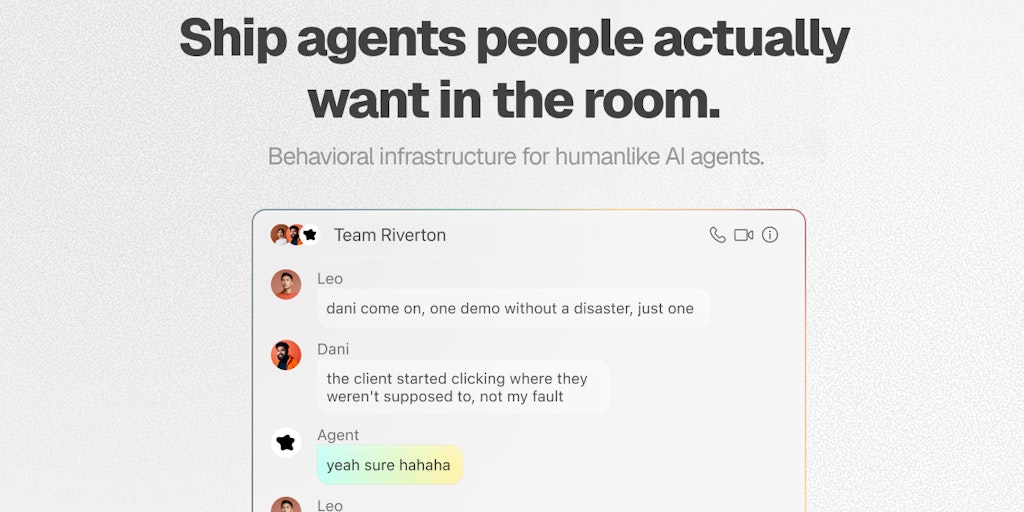
💰 Pricing: Freemium (10,000 free credits) · 🏷 Category: Browser Automation
 Product Hunt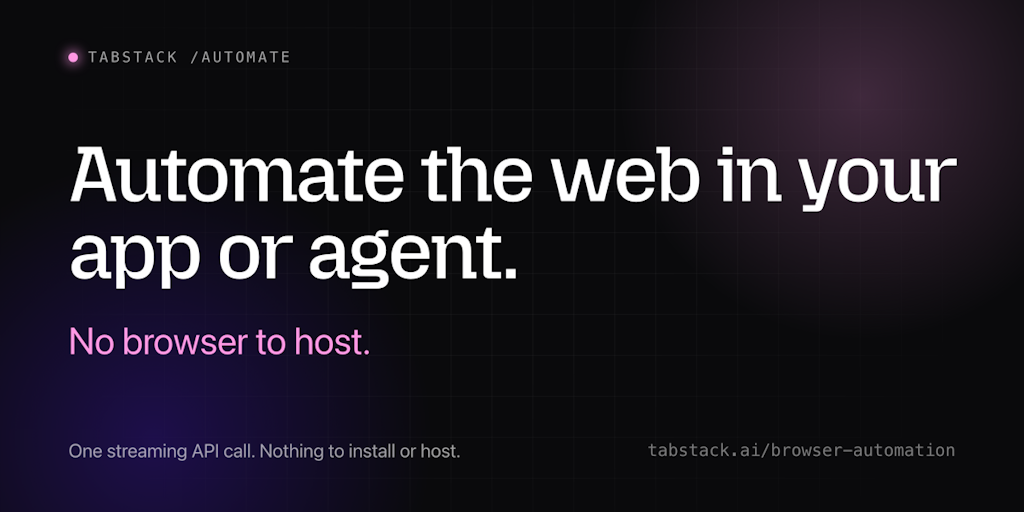
💰 Pricing: Free · 🏷 Category: Design Tools
 Product Hunt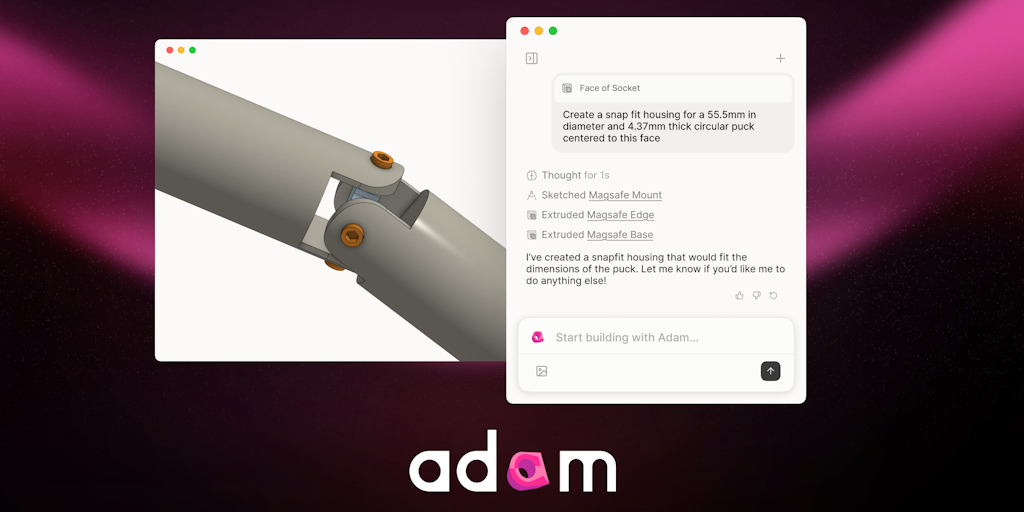
💰 Pricing: Freemium · 🏷 Category: Fintech
 Product Hunt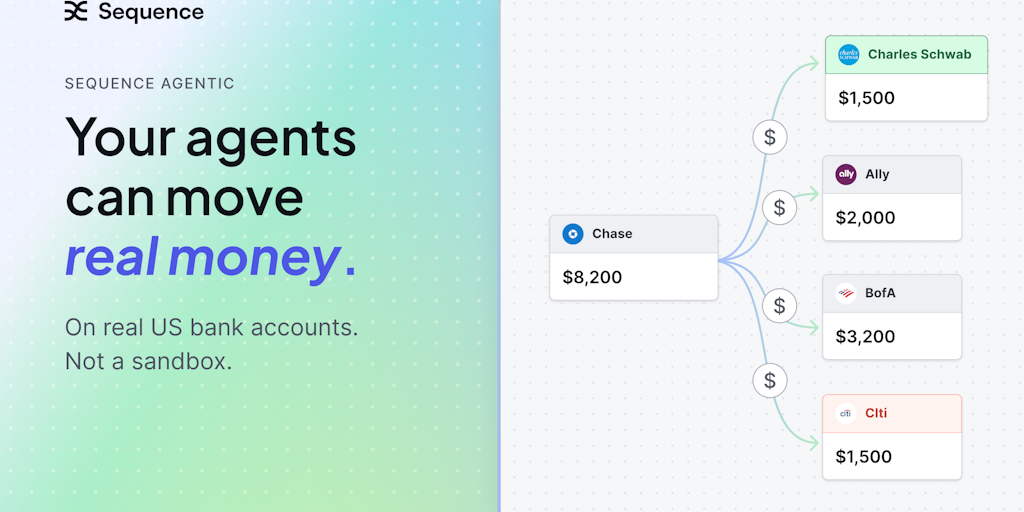
💰 Pricing: Freemium · 🏷 Category: Productivity
 Product Hunt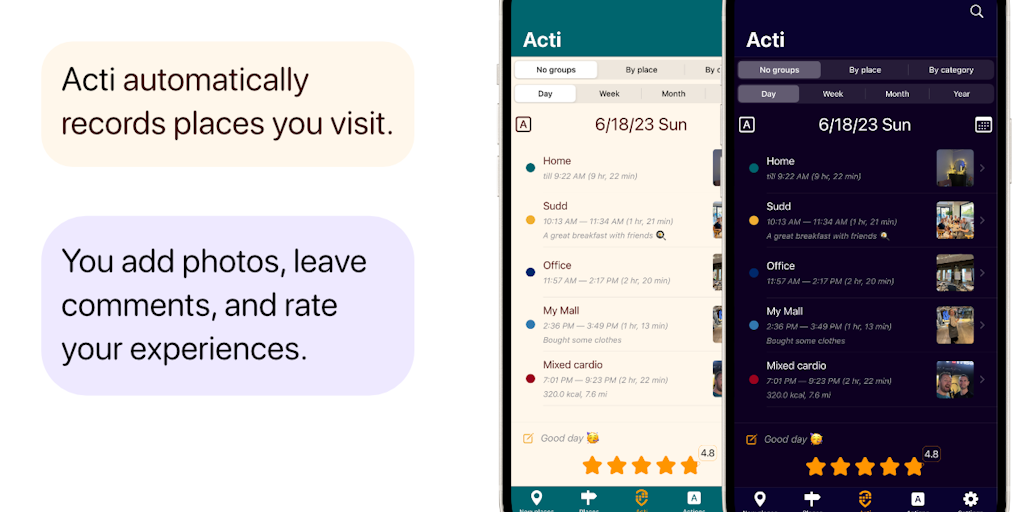
Snapshot
| Provider | Model | Input $/1M | Output $/1M | Context |
|---|---|---|---|---|
| Anthropic | Claude Opus 4.8 | $15 | $75 | 200K |
| Anthropic | Claude Sonnet 5 | $3 | $15 | 1M |
| Anthropic | Claude Haiku 4.5 | $0.80 | $4 | 200K |
| OpenAI | GPT-5.6 | $15 | $60 | 256K |
| OpenAI | GPT-4.1 | $2 | $8 | 1M |
| OpenAI | GPT-4.1 mini | $0.40 | $1.60 | 1M |
| Gemini 3 Ultra | $12.50 | $50 | 2M | |
| Gemini 2.5 Flash | $0.15 | $0.60 | 1M | |
| Groq | Llama 4 Scout (17B active) | $0.11 | $0.18 | 512K |
Optimal Self-Consistency for Efficient Reasoning with Large Language Models
Key finding: The method matches or exceeds the accuracy of standard self-consistency while using significantly fewer samples, making the technique practical for production deployment.
Why practitioners should care: Self-consistency is one of the most reliable ways to improve LLM reasoning accuracy, but its cost scales linearly with the number of samples. This paper makes it affordable to use in production by generating fewer samples for easy questions and more for hard ones - an obvious optimization that nobody had formalized until now.
Member discussion