GenAI Secret Sauce Daily Digest - 2026-07-04

OpenAI Offers the U.S. Government a $42.6 Billion Stake in Exchange for Political Goodwill · GPT-5.5's Hidden Bug: The Model That Stops Thinking at Exactly 516 Tokens · Meta Claims Its Secret "Watermelon" Model Has Caught GPT-5.5 - But Nobody Can Check
GenAI Secret Sauce Daily Digest - 2026-07-04

Watch today's digest as a video summary (generated by NotebookLM)

Statistically Speaking
5.5 accounts for 82% of exact
GPT-5.5's Hidden Bug
Top Story
96.1% on HumanEval (a coding test) and 94
Meta Claims Its Secret "Watermelon" Model Has Caught GPT-5.5
8,000 layoffs and 7,000 employee reassignments to AI
Meta Claims Its Secret "Watermelon" Model Has Caught GPT-5.5
5%
equity offer would create a government
AI companies are trading equity for regulatory access - and
2
Executive Order established a voluntary framework where
AI companies are trading equity for regulatory access - and
One Thing to Tell Your Friends
OpenAI just offered the U.S. government a $42.6 billion stake in the company - and wants every major AI lab to do the same.
TL;DR
Trends
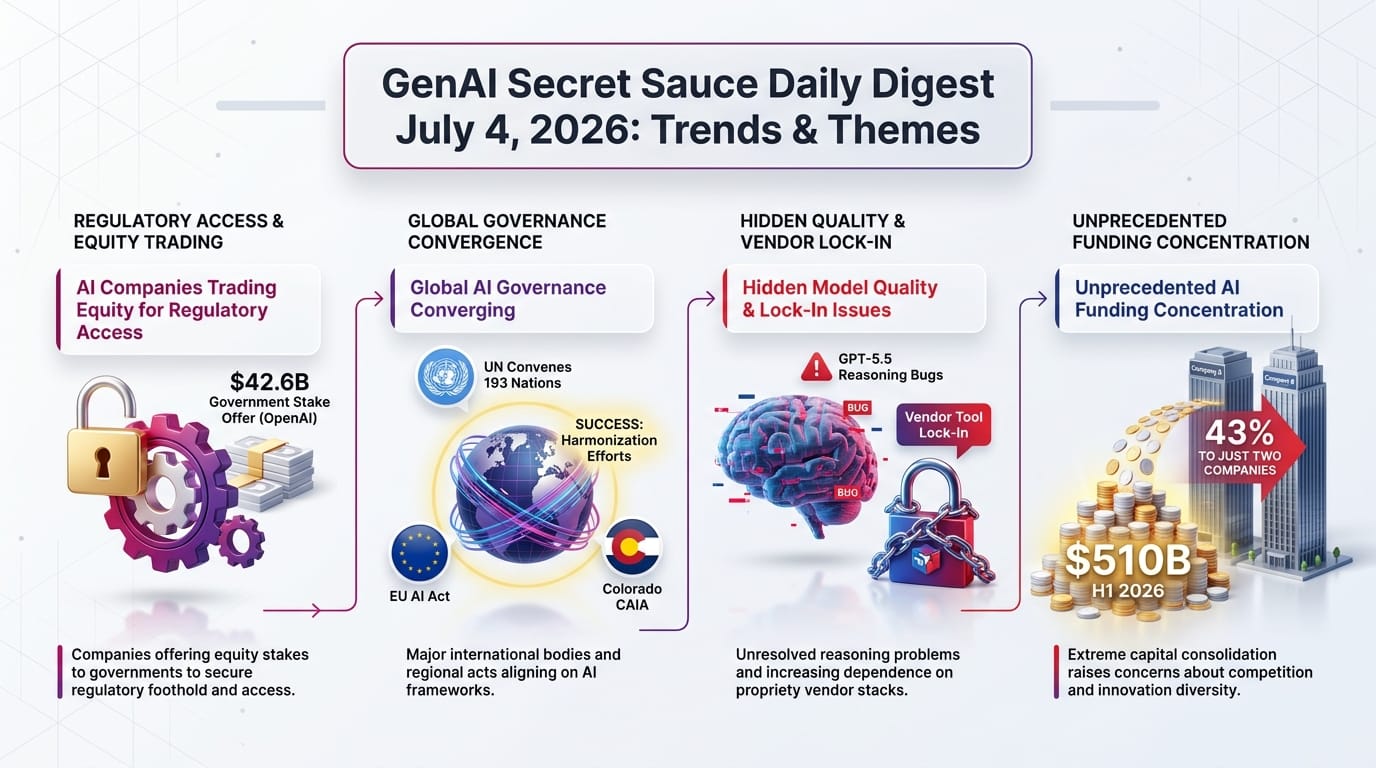
AI companies are trading equity for regulatory access, Global AI governance is entering its most consequential week, and AI model quality is becoming harder to trust as hidden behaviors emerge.
Creative AI
Surprising
GitHub
Leading repos: usestrix/strix (+1,910), mattpocock/skills (+1,013), and alibaba/page (+726).
HuggingFace
Leading models: zai-org/GLM (209k), baidu/Unlimited (988k), and empero-ai/Qwythos-9B-Claude-Mythos-5-1M (1.46M).
Product Hunt
Top launches: Vida (320), ChecklistFox (211), and Termi Protocol (163).
API Pricing
What this means:** At the frontier tier, GPT-5.5 is the most expensive per output token at $30/M.
arXiv
Evaluation and Benchmarking of LLM Agents — Most agent benchmarks measure task completion on synthetic environments, but production agent failures overwhelmingly come from error recovery, memory management, and multi-step reasoning chains - capabilities that current benchmarks barely test.
Hot off the Presses
01
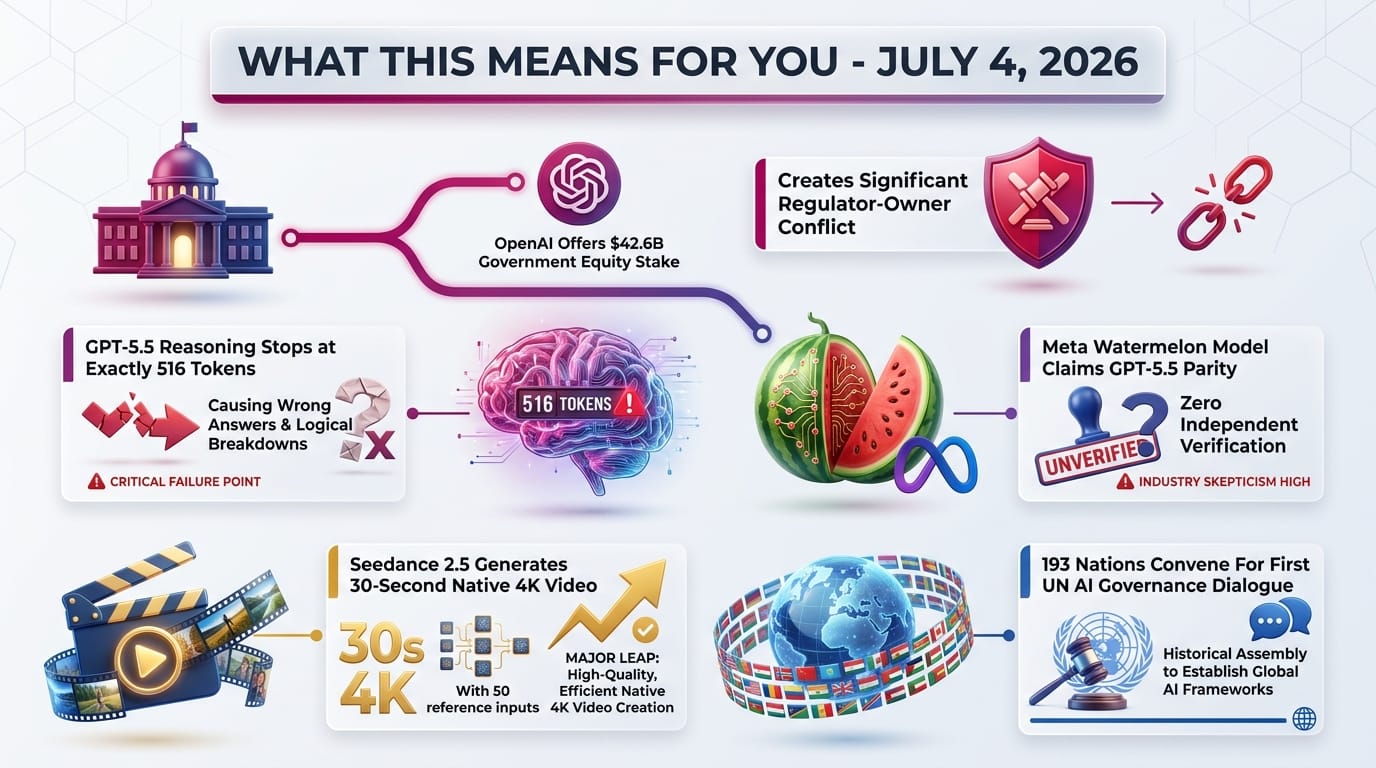
OpenAI Offers the U.S. Government a $42.6 Billion Stake in Exchange for Political Goodwill
What this means for you: If this goes through, your tax dollars would earn dividends from AI companies - but the same government writing AI rules would also profit from AI companies following those rules.

The Financial Times reported on July 2 that OpenAI proposed giving the U.S. government a 5% equity stake, worth roughly $42.6 billion at the company's $852 billion valuation. CEO Sam Altman envisions a "Public Wealth Fund" modeled on Alaska's Permanent Fund, which pays annual dividends to state residents from oil revenue. He wants every leading AI lab to contribute the same share.

""$42.6 billion - the value of the stake OpenAI offered the U.S. government to smooth its path to IPO.""
  • The timing is political - the offer came days after Washington delayed GPT-5.6's broader rollout, suggesting Altman is negotiating access to market through equity
  • Precedent exists - the U.S. already holds a 10% stake in Intel and takes a cut of Nvidia and AMD's China AI chip sales
  • Critics flag a structural conflict - a regulator with an equity stake cannot enforce rules impartially; the proposal asks Anthropic, Google, and xAI to cede the same stake
  • Implementation may require Congress - the Financial Times characterized the discussions as conceptual and early-stage
  • OpenAI's September 2026 IPO looms - the equity offer shapes the regulatory environment ahead of going public
02
GPT-5.5's Hidden Bug: The Model That Stops Thinking at Exactly 516 Tokens
What this means for you: If you are using OpenAI's Codex for complex coding tasks and getting wrong answers, the model may be cutting its reasoning short at a fixed threshold rather than thinking as long as the problem requires.

A community investigation uncovered a statistical anomaly in GPT-5.5's reasoning behavior. The model's reasoning tokens cluster at fixed values spaced 518 apart - exactly 516, 1,034, and 1,552 tokens - instead of varying naturally by task complexity.

""82% of exact-516 reasoning events come from GPT-5.5 - a model that represents only 19.3% of responses.""
  • GPT-5.5 accounts for 82% of exact-516 token events despite representing only 19.3% of all responses - a 33.6x clustering rate versus baseline
  • May 2026 saw clustering spike to 53.3% from 4.25% in April, while reasoning intensity simultaneously fell
  • Task reproductions confirm the link - runs ending at exactly 516 reasoning tokens returned wrong answers
  • Suspected cause: a budget or scheduler cap that artificially truncates reasoning rather than letting it run naturally
  • The Codex team is investigating the issue, which was reported about a week ago
03
Meta Claims Its Secret "Watermelon" Model Has Caught GPT-5.5 - But Nobody Can Check
What this means for you: Meta says it has built an AI model as powerful as OpenAI's best - which, if true, means the best AI tools could become free to download. But the claim is unverified.

Meta's superintelligence chief Alexandr Wang told an internal town hall on July 3 that the company's next AI model, codenamed Watermelon, matches OpenAI's GPT-5.5 on key benchmarks. Watermelon is the successor to Avocado (the model behind Muse Spark, Meta's first closed AI product) and uses an order of magnitude more computing power.

  • Reported scores are razor-thin margins - 96.3% vs. 96.1% on HumanEval (a coding test) and 94.7% vs. 94.5% on GSM8K (a math reasoning test)
  • No independent evaluation exists - the exact benchmarks are undisclosed, no model card has been published, and no third-party testers have confirmed the claims
  • The timing coincides with Meta's AI restructuring - 8,000 layoffs and 7,000 employee reassignments to AI teams
  • If Meta open-sources Watermelon (as it did with Llama), it would be the first freely downloadable model matching GPT-5.5 performance
Trends & Themes
Trends & Themes
AI companies are trading equity for regulatory access - and it is reshaping the industry
Why this matters to you: The companies building the AI you use every day are now negotiating directly with governments over who gets access to frontier models - and those negotiations involve billions of dollars.

The pattern is clear: access to the most powerful AI models is becoming a negotiating chip between technology companies and governments. For users, this means new AI features may arrive on a political schedule, not a technical one.

  • OpenAI's 5% equity offer would create a government-seeded wealth fund worth $42.6 billion, modeled on Alaska's oil dividends
  • Washington delayed GPT-5.6's rollout days before the equity proposal, connecting market access to political cooperation
  • The White House is in advanced talks with OpenAI, Google, and Anthropic on voluntary frontier model release standards
  • The June 2 Executive Order established a voluntary framework where developers provide government access to frontier models for up to 30 days before public release
Global AI governance is entering its most consequential week
Why this matters to you: Three major governance events are converging in early July that will shape what AI tools you can use, how your data is handled, and what rules AI companies follow.

This is the first time that US, EU, and UN governance frameworks are maturing simultaneously. Which rules win could determine whether AI development stays concentrated in a few countries or spreads globally.

  • The UN Global Dialogue on AI Governance convenes 193 nations in Geneva on July 6-7, co-chaired by ambassadors from El Salvador and Estonia, with a Scientific Panel led by Yoshua Bengio
  • The EU AI Act simplification package received final green light from the Council of the EU on June 29, with formal adoption expected in July ahead of the August 2, 2026 deadline
  • The Colorado Artificial Intelligence Act took effect June 30, requiring companies using AI in hiring decisions to conduct risk management and annual impact assessments
  • Five Eyes intelligence agencies warned that frontier AI cyber capabilities are "months, not years away," adding urgency to governance discussions
AI model quality is becoming harder to trust as hidden behaviors emerge
Why this matters to you: The AI tools you rely on may be silently cutting corners - and the bugs are subtle enough that you would not notice unless you measured carefully.

The lesson for users: benchmark scores and pricing sheets do not tell the full story. Real-world reliability requires independent testing under your specific conditions.

  • GPT-5.5's reasoning tokens cluster at fixed thresholds (516, 1,034, 1,552), suggesting artificial caps on how long the model thinks - and the clustering is worsening monthly
  • Newer Anthropic models hallucinate tool parameters when used outside Claude Code, a side effect of specialized training that breaks third-party integrations
  • Meta's Watermelon benchmark claims are unverified - internal scores mean little without independent testing, yet headlines treat them as fact
  • Sonnet 5's tokenizer inflates costs 30% (covered July 2) despite lower per-token pricing, creating a hidden cost trap
The AI funding market has become the most concentrated in venture history
Why this matters to you: Two companies now control 43% of all startup funding on Earth. That concentration determines which AI products get built, which stay underfunded, and how much competition exists.

The concentration raises questions about competition and innovation. When two companies absorb nearly half of all venture capital, thousands of smaller AI startups struggle for their first round.

  • $510 billion in H1 2026 exceeds all of 2025's $440 billion total
  • OpenAI ($122B) and Anthropic ($65B) together took $217 billion - 43% of all H1 venture funding
  • 88% of AI funding went to US companies - leaving the rest of the world fighting over 12%
  • Anthropic is now valued at $965 billion post-money - the most valuable standalone AI startup
Creative AI & Media
Seedance 2.5: 30-Second Native 4K Video from ByteDance
What this means for you: You can now generate a half-minute video clip at cinema-quality resolution, with targeted edits to specific scenes, from a single text prompt.

Public availability is expected in early July 2026.

  • 30 seconds of native 4K video in a single generation - a major leap from previous 5-10 second limits
  • 10-bit color depth provides over 1 billion color values versus 16.7 million at 8-bit, giving much more room for color grading in post-production
  • 50 simultaneous reference inputs - feed images, audio clips, 3D models, and style references to control every aspect of the output
  • Controllable editing lets you change one part of a video without breaking the rest - a persistent pain point in AI video that Seedance addresses directly
  • 20% better prompt adherence than its predecessor, meaning fewer wasted generations
Developer Tools & Infrastructure
Better Models: Worse Tools - The Vendor Lock-In Nobody Saw Coming
What this means for you: If you use a coding assistant that is not Claude Code or OpenAI Codex, newer AI models may actually perform worse at editing your code than older ones did.

Armin Ronacher identified a paradox: Anthropic's newest models (Opus 4.8, Sonnet 5) frequently break custom edit tools by adding hallucinated parameters to tool calls. The edits themselves are correct, but the tool calls fail.

  • Root cause: specialized training - Anthropic models are optimized for Claude Code's search-and-replace format; OpenAI models are optimized for Codex's apply_patch format
  • Third-party tools suffer - when models encounter different tool schemas, they default to the format they were trained on, inserting fields that do not exist
  • The implication: coding harnesses may need to implement multiple edit tool variants to match whatever model the user selects
  • This is vendor lock-in at the tool-calling level - more subtle and harder to escape than API (Application Programming Interface) lock-in
Vercel Gives AI Agents the Ability to Debug Themselves
What this means for you: AI coding agents on Vercel can now inspect their own reasoning, tool calls, and costs - a step toward agents that fix their own mistakes.
  • Agent Runs observability launched July 3 for Vercel's Eve framework via MCP and CLI
  • Agents can query their own traces - reasoning steps, tool calls, token usage, and input/output
  • CLI output in JSON or markdown so agents without MCP can call the CLI directly
  • Self-debugging agents can now programmatically inspect what they did, how much it cost, and where they went wrong
Research & Models
GPT-5.5's Reasoning Bug Exposes Invisible Quality Control Problems
What this means for you: The model powering many coding tools may be giving wrong answers because of an internal budget cap on reasoning - and the problem is getting worse each month.
  • 44% of GPT-5.5 responses cluster at exactly 516 reasoning tokens versus 1.3% for other models
  • The clustering worsened from 4.25% in April to 53.3% in May 2026
  • Tasks ending at 516 tokens produce wrong answers in documented reproductions
  • Possible causes include routing, truncation, or scheduler behavior that caps reasoning artificially
From Chatbot to Digital Colleague
What this means for you: A new paper maps the architectural gaps between today's AI chatbots and the persistent, proactive AI agents that companies are starting to deploy.
  • Persistent agents maintain memory across sessions rather than starting fresh each conversation
  • Key gaps identified: no standard protocol for agent-to-agent communication, inadequate memory management for long-running tasks, and missing error recovery mechanisms
  • Practical recommendations include trust calibration frameworks, supervision models, and integration patterns for existing business workflows
Business & Industry
H1 2026: $510 Billion in Startup Funding, 43% to Two Companies
  • $510 billion in H1 2026 versus $440 billion for all of 2025
  • OpenAI's $122 billion round is the largest private venture round in history, pushing its valuation to $852 billion
  • Anthropic's $65 billion Series H makes it the most valuable standalone AI startup at $965 billion post-money
  • Together AI raised $800 million for enterprise open-source model training and deployment
  • Over 70% of Q2 capital went to AI-focused companies
Anthropic Overtakes OpenAI on Revenue
  • Anthropic is on course for $47 billion in revenue and profitability by 2029 - a year ahead of OpenAI's timeline
  • Fortune reports OpenAI is "slowly losing ground" to both Anthropic and Google
  • The competitive shift reflects Fable 5's performance lead on reasoning tasks and the growing enterprise adoption of Claude
Meta Restructures: 8,000 Laid Off, 7,000 Reassigned to AI

Previously: This restructuring began in May 2026.

  • 8,000 employees laid off - about 10% of the workforce
  • 7,000 reassigned to new AI teams including Applied AI Engineering and Agent Transformation Accelerator
  • Largest cuts since 2022-2023 when 21,000 positions were eliminated
  • The money funds the Watermelon model and Meta's broader AI infrastructure push
Surprising & Under-the-Radar
AI Models Are Being Trained to Be Good at Their Own Company's Tools - and Bad at Everyone Else's

Armin Ronacher's discovery that Anthropic models hallucinate parameters in non-Claude-Code tools is not a bug - it is a side effect of specialized training. OpenAI does the same with Codex's apply_patch. This creates a new form of vendor lock-in that nobody planned: your AI model works brilliantly in its home environment and breaks in competing ones.

The Five Eyes Intelligence Alliance Issued Its Strongest AI Warning Yet

Western spy agencies rarely issue joint public statements. On June 22, the Five Eyes declared that AI models capable of overwhelming government cyber defenses are "months, not years" away. Security professionals now rank self-mutating malware (55.9%) as their top concern. This is not a think-tank report - it is a formal intelligence assessment from five governments.

Anthropic's $200 Million Pentagon Contract Comes with Non-Negotiable Red Lines

Dario Amodei's statement on the Department of War is remarkable: Anthropic accepted a $200 million defense contract while refusing to budge on autonomous weapons and mass surveillance. The Trump administration responded by ordering agencies to stop using Anthropic's technology entirely. Most companies would have caved - Anthropic accepted the financial hit.

Grok 4.5 Enters Private Beta with 1.5 Trillion Parameters

Elon Musk's xAI announced Grok 4.5 on June 28, built on a 1.5 trillion parameter V9 foundation model with Cursor data added in supplemental training. The model entered private beta at SpaceX and Tesla only - a 50% scale increase from Grok 4.4 in roughly one month. The pace of iteration, if sustained, would represent the fastest parameter scaling of any lab.

Signals to Track
Worth Watching
01
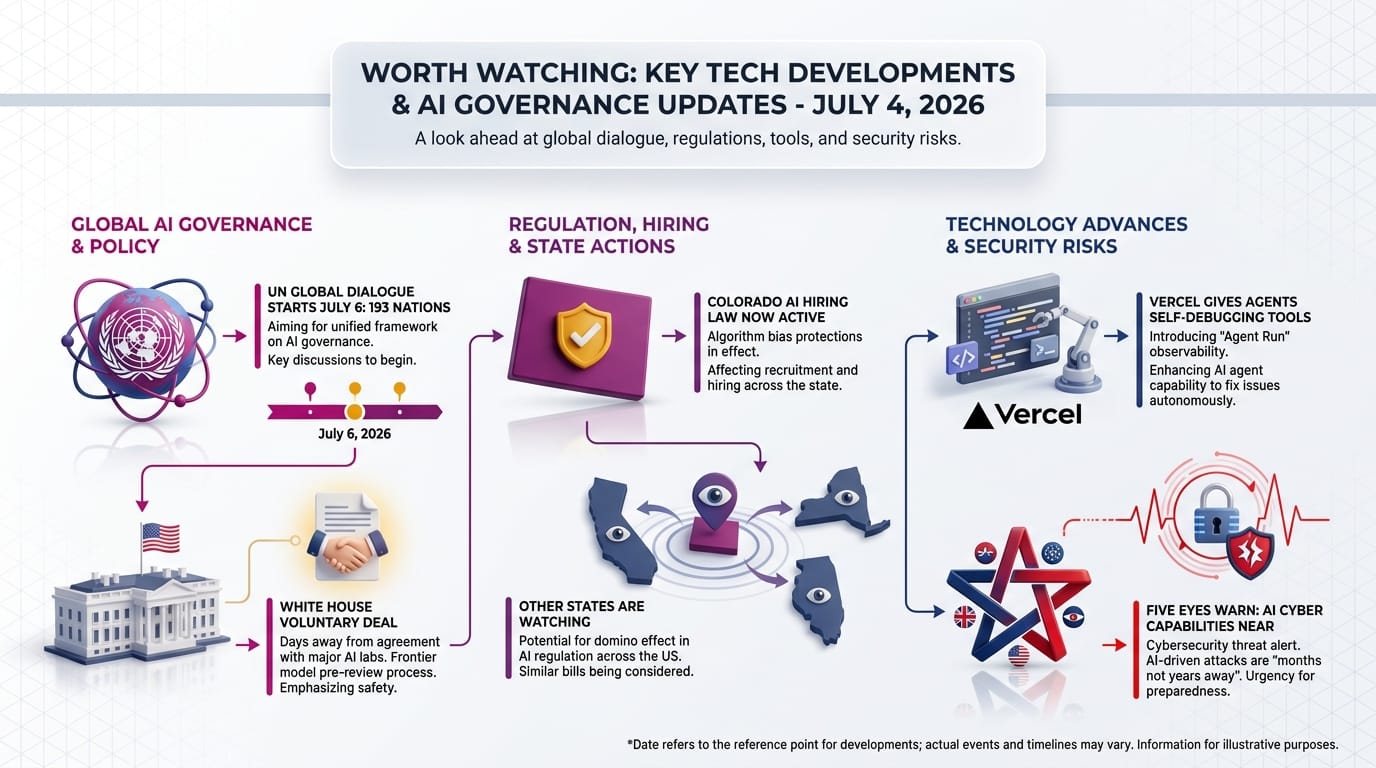
The UN's First AI Governance Summit Could Set the Template for Global Rules
Why this is worth watching right now: 193 nations are about to negotiate AI governance for the first time, and whoever shapes the early framework shapes everything that follows.

The Global Dialogue on AI Governance convenes in Geneva on July 6-7, alongside the WSIS Forum and ITU's AI for Good Summit. Co-chaired with a Scientific Panel led by Yoshua Bengio and Maria Ressa. The Dialogue exists to ensure governance reflects all nations' priorities, not just the most technologically advanced. If it produces consensus language, that language will likely appear in future national regulations worldwide.

02
The White House Is Days Away from a Voluntary Deal with AI Labs
Why this is worth watching right now: The deal would create the first formal process for government pre-review of frontier AI models before public release.

Advanced talks with OpenAI, Google, and Anthropic could produce an announcement in coming weeks. The voluntary framework lets developers provide government access to frontier models for up to 30 days before broader release. NSA and CISA are developing classified benchmarks to identify models with advanced cyber capabilities. The voluntary nature contrasts sharply with the EU's mandatory approach.

03
Colorado's AI Hiring Law Is Now Active - Other States Are Watching
Why this is worth watching right now: Colorado is the first US state to enforce AI hiring transparency rules, and how it plays out will determine whether other states copy or modify the approach.

The Colorado Artificial Intelligence Act (CAIA) took effect June 30, 2026. Companies using AI in hiring, promotion, or termination decisions must conduct risk management and annual impact assessments. If enforcement creates compliance costs without clear benefits, other states may take a lighter approach. If it catches genuine bias, expect rapid adoption.

04
Coding Agents Are Getting Self-Debugging Tools
Why this is worth watching right now: Vercel's Agent Run observability lets AI agents inspect their own reasoning and tool calls for the first time, pointing toward agents that fix their own mistakes.

This is early-stage but directionally significant. If agents can diagnose why they failed, they can retry with different strategies - reducing the need for human supervision. Vercel's Eve framework is the first major platform to ship this capability. Expect competitors to follow.

Top Repos Today
Rank yesterday: New entry 🆕
Stars today: +1,910  ·  📦 Total: 35,983
📜 License: Apache 2.0  ·  👤 By: Open-source community
🎯 Time to value: 10 minutes
What it is: An AI-powered penetration testing tool that uses multi-agent orchestration to find and validate security vulnerabilities in your applications. Instead of flagging possible issues like a traditional scanner, it runs dynamic code to generate working proof-of-concept exploits - so you know which vulnerabilities are real. Why you'd want it: Security testing traditionally requires expensive consultants or tools with high false-positive rates. Strix gives developers OWASP Top 10 coverage with CI/CD integration (especially GitHub Actions) and automated remediation guidance.
✓ Pros✗ Cons
Working PoC exploits, not just warningsRequires Large Language Model (LLM) API key (OpenAI, Anthropic, etc.)
CI/CD integration catches issues before deployAI-driven testing can miss logic-specific flaws
Covers full OWASP Top 10 automaticallyCloud features at app.strix.ai are separate product
GitHub - usestrix/strix: Open-source AI penetration testing tool to find and fix your app’s vulnerabilities.
Open-source AI penetration testing tool to find and fix your app’s vulnerabilities. - usestrix/strix
Rank yesterday: Holding steady ➡
Stars today: +1,013  ·  📦 Total: 156,521
📜 License: MIT  ·  👤 By: Individual (Matt Pocock)
🎯 Time to value: 2 minutes
What it is: A collection of Claude Code skills designed for professional software engineering, not rapid prototyping. Skills include /grill-me (structured interviews before coding), /tdd (test-driven development workflows), and /improve-codebase-architecture for systematic design improvement. Why you'd want it: These skills encode engineering discipline into your AI assistant. Instead of jumping straight to code generation, they force planning, testing, and architectural thinking first - the habits that separate reliable software from quick demos.
✓ Pros✗ Cons
Enforces engineering fundamentals before codingClaude-specific, not model-agnostic
Composable - mix and customize skills freelyShell-based, minimal documentation
Planning and interview skills catch misunderstandings earlyRequires Claude Code CLI setup
GitHub - mattpocock/skills: Skills for Real Engineers. Straight from my .claude directory.
Skills for Real Engineers. Straight from my .claude directory. - mattpocock/skills
Rank yesterday: New entry 🆕
Stars today: +726  ·  📦 Total: 23,074
📜 License: MIT  ·  👤 By: Alibaba (company)
🎯 Time to value: 5 minutes
What it is: A JavaScript library that lets you control web interfaces using natural language, entirely from within the browser page. No browser extension, no Python, no headless browser required - just client-side JavaScript that manipulates the DOM (the structure of a web page) based on text commands. Why you'd want it: Web automation typically requires complex setups with Selenium or Puppeteer. Page Agent runs in any browser with a few lines of JavaScript, making it accessible for form automation, accessibility enhancement, and SaaS integration.
✓ Pros✗ Cons
Zero infrastructure - just in-page JavaScriptRequires your own LLM API key
Text-based DOM parsing, no screenshot analysis neededSingle-page focus without Chrome extension
MCP server integration for external agentsLimited to what the DOM exposes
GitHub - alibaba/page-agent: JavaScript in-page GUI agent. Control web interfaces with natural language.
JavaScript in-page GUI agent. Control web interfaces with natural language. - alibaba/page-agent
Rank yesterday: Holding steady ➡
Stars today: +303  ·  📦 Total: 45,755
📜 License: Apache 2.0  ·  👤 By: Google (company)
🎯 Time to value: 5 minutes
What it is: An MCP (Model Context Protocol) server that gives AI coding agents direct access to Chrome DevTools. Agents can inspect page elements, read console output, monitor network requests, and debug web applications - the same tools developers use manually, but accessible programmatically by AI. Why you'd want it: AI coding agents that build web apps currently work blind - they write code but cannot see the result. This gives agents eyes into what the browser is actually doing, making debugging web issues far more effective.
✓ Pros✗ Cons
Full DevTools access for AI agentsChrome-only, no Firefox or Safari
Google-maintained, likely long-term supportRequires Chrome with debugging enabled
Fits naturally into agent workflows via MCPPrivacy considerations with page inspection
GitHub - ChromeDevTools/chrome-devtools-mcp: Chrome DevTools for coding agents
Chrome DevTools for coding agents. Contribute to ChromeDevTools/chrome-devtools-mcp development by creating an account on GitHub.
Rank yesterday: Rising ↑
Stars today: +446  ·  📦 Total: 26,544
📜 License: CC BY-SA  ·  👤 By: Academic (Harvard)
🎯 Time to value: 15 minutes
What it is: An open-source textbook on Machine Learning Systems from Harvard's CS249r course. Covers the full stack from model architecture to deployment on edge devices, written for practitioners who need to build and ship ML systems rather than just train models. Why you'd want it: Most ML education focuses on model training. This book covers the parts that matter in production - deployment, optimization, hardware constraints, and systems engineering. Free, community-maintained, and regularly updated.
✓ Pros✗ Cons
Covers full ML systems stack, not just modelsAcademic style may be dense for beginners
Free and open-source with community updatesPython-centric, limited other language coverage
Production-focused, not just researchSome chapters assume systems background
GitHub - harvard-edge/cs249r_book: Machine Learning Systems
Machine Learning Systems. Contribute to harvard-edge/cs249r_book development by creating an account on GitHub.
Top Models Today
The largest open-weight model ever released, from the Chinese lab that built GLM-4.
📥 Downloads (30d): 209k  ·  📜 License: Apache 2.0
👤 By: Zhipu AI (company)  ·  🎯 Task: Text Generation
📐 Size: 753B
What it is: A 753 billion parameter open-weight text generation model from Zhipu AI. GLM-5.2 is the successor to GLM-4 and represents the largest openly available model by parameter count, competing with closed models from OpenAI and Anthropic. Why you'd want it: If you need frontier-class reasoning without paying per-token API fees, and you have the hardware to run a 753B model, this is the most capable open-weight option available.
✓ Pros✗ Cons
Largest open-weight model availableRequires massive hardware (multiple GPUs)
Apache 2.0 license for commercial useChinese-origin model raises some compliance questions
Competes with closed frontier modelsLimited English-language community support
zai-org/GLM-5.2 · Hugging Face
We’re on a journey to advance and democratize artificial intelligence through open source and open science.
A 3B multimodal model that reads text from images with exceptional accuracy across languages.
📥 Downloads (30d): 988k  ·  📜 License: Apache 2.0
👤 By: Baidu (company)  ·  🎯 Task: Image-Text-to-Text
📐 Size: 3B
What it is: A compact 3 billion parameter model specialized in optical character recognition (reading text from images). Despite its small size, it handles multiple languages, complex layouts, and degraded image quality. Why you'd want it: OCR (optical character recognition - converting images of text into actual text) has been a solved problem for clean documents but struggles with real-world images. This model handles receipts, handwriting, screen captures, and multilingual documents at a fraction of the size of general-purpose vision models.
✓ Pros✗ Cons
Runs on consumer hardware at 3B paramsSpecialized for OCR, not general vision tasks
Nearly 1M downloads signals production reliabilityBaidu model, documentation primarily in Chinese
Apache 2.0 for commercial useMay struggle with extremely degraded images
baidu/Unlimited-OCR · Hugging Face
We’re on a journey to advance and democratize artificial intelligence through open source and open science.
A 9B distillation of Claude Mythos 5 that runs on a laptop.
📥 Downloads (30d): 1.46M  ·  📜 License: Community
👤 By: Community (Empero AI)  ·  🎯 Task: Image-Text-to-Text
📐 Size: 9B
What it is: A quantized (compressed for efficiency) version of a model trained to mimic Claude Mythos 5's capabilities at just 9 billion parameters. The GGUF format means it runs locally on consumer hardware through tools like Ollama or llama.cpp. Why you'd want it: If you want Claude-quality reasoning without the API cost, this community distillation brings frontier-adjacent capabilities to hardware you already own. The 1.46 million downloads suggest it works well enough for real use.
✓ Pros✗ Cons
Runs locally on consumer hardwareDistillation, not the real Mythos 5
1.46M downloads validate qualityCommunity license, not Apache/MIT
GGUF format works with popular tools9B cannot match 100B+ on hard tasks
empero-ai/Qwythos-9B-Claude-Mythos-5-1M-GGUF · Hugging Face
We’re on a journey to advance and democratize artificial intelligence through open source and open science.
DeepSeek's latest flagship at 889B parameters, pushing the open-weight frontier.
📥 Downloads (30d): 10.3k  ·  📜 License: DeepSeek
👤 By: DeepSeek (company)  ·  🎯 Task: Text Generation
📐 Size: 889B
What it is: The newest model in DeepSeek's V4 line at 889 billion parameters. DSpark appears to be an enhanced reasoning variant of the V4 Pro architecture. Why you'd want it: DeepSeek models have consistently punched above their weight on coding and math benchmarks. At 889B, this is among the largest models with weights available for download.
✓ Pros✗ Cons
Strong coding and math performanceRequires datacenter-class hardware
DeepSeek track record of quality at scaleDeepSeek license, not fully open
Active development and communityLimited downloads suggest very new release
deepseek-ai/DeepSeek-V4-Pro-DSpark · Hugging Face
We’re on a journey to advance and democratize artificial intelligence through open source and open science.
NVIDIA's 4-bit quantized version of Qwen 3.6, optimized for inference speed.
📥 Downloads (30d): 185k  ·  📜 License: Apache 2.0
👤 By: NVIDIA (company)  ·  🎯 Task: Text Generation
📐 Size: 27B (18B effective)
What it is: NVIDIA's NVFP4 quantization of the Qwen 3.6 27B model, compressed to roughly 18B effective parameters while preserving most of the original model's quality. Designed for fast inference on NVIDIA hardware. Why you'd want it: If you run NVIDIA GPUs and want a capable mid-size model with minimal latency, this gives you near-27B quality at 18B compute cost.
✓ Pros✗ Cons
NVIDIA-optimized for fast inferenceNVIDIA GPUs only
Apache 2.0 licenseQuantization loses some quality
185k downloads validate the approachTied to NVIDIA hardware ecosystem
nvidia/Qwen3.6-27B-NVFP4 · Hugging Face
We’re on a journey to advance and democratize artificial intelligence through open source and open science.
AI Launches Today
"Clone yourself. Let AI do the work before you ask"
🔥 Upvotes: 320  ·  👤 By: Vida team
💰 Pricing: Freemium  ·  🏷 Category: Productivity
An AI assistant that learns your workflows and habits, eventually handling repetitive tasks autonomously before you ask. Launch features five use cases including Reply Rescue (drafts email replies), Prompt Rescue (suggests prompts based on context), and Resume Rescue (auto-formats resumes). Verdict: Ambitious vision of proactive AI assistance, but the gap between "learns your habits" marketing and actual workflow learning typically takes months to close.
Best of Product Hunt: July 4, 2026 | Product Hunt
Explore the top products launched on Product Hunt on July 4, 2026.
"AI checklist maker for beautiful PDFs, free & instant"
🔥 Upvotes: 211  ·  👤 By: ChecklistFox
💰 Pricing: Free  ·  🏷 Category: Productivity
Input a prompt, get a customizable planner PDF with themes for weddings, moves, and major life transitions. Simple and focused. Verdict: A clean execution of a narrow idea. Free and instant makes it easy to try; the question is whether AI-generated checklists are better than the thousands of existing templates online.
Best of Product Hunt: July 4, 2026 | Product Hunt
Explore the top products launched on Product Hunt on July 4, 2026.
"Watch your AI coding agents build, live in 3D"
🔥 Upvotes: 163  ·  👤 By: Termi Protocol
💰 Pricing: Free  ·  🏷 Category: Developer Tools
A 3D simulation environment that visualizes AI agent workflows in real-time. Watch agents reading files, writing code, and executing commands in a rendered 3D space. Verdict: Visually striking and genuinely useful for understanding what opaque coding agents are doing. Whether the 3D visualization adds insight beyond a well-formatted log remains to be proven.
Best of Product Hunt: July 4, 2026 | Product Hunt
Explore the top products launched on Product Hunt on July 4, 2026.
Snapshot
ProviderModelInput $/1MOutput $/1MContext
AnthropicClaude Opus 4.8$5.00$25.00200K
AnthropicClaude Fable 5$5.00$25.00200K
AnthropicClaude Sonnet 5$3.00$15.001M
AnthropicClaude Haiku 4.5$0.80$4.00200K
OpenAIGPT-5.5$5.00$30.00256K
OpenAIGPT-4.1$2.00$8.001M
OpenAIGPT-4.1 mini$0.40$1.601M
OpenAIGPT-4.1 nano$0.10$0.401M
GoogleGemini 3.1 Pro$2.00$12.002M
Groq/OpenDeepSeek V4 Flash$0.14$0.28128K
What this means: At the frontier tier, GPT-5.5 is the most expensive per output token at $30/M. Anthropic's Opus and Fable match GPT-5.5 on input ($5) but are 17% cheaper on output ($25). The real price war is in the mid-tier: OpenAI's GPT-4.1 nano at $0.10/$0.40 has no Anthropic equivalent, making it the cheapest option for high-volume, lower-complexity tasks. Reminder: Sonnet 5's 30% token inflation (covered July 2) means per-task costs exceed Opus despite lower per-token pricing.

Evaluation and Benchmarking of LLM Agents: A Survey
Multiple authors - arXiv:2507.21504
What it claims: Current evaluation methods for AI agents are fundamentally insufficient because they test isolated capabilities rather than the end-to-end workflows that matter in production. The survey covers 44 benchmarks released between February 2023 and February 2026.

Key finding: Most agent benchmarks measure task completion on synthetic environments, but production agent failures overwhelmingly come from error recovery, memory management, and multi-step reasoning chains - capabilities that current benchmarks barely test.

Why practitioners should care: If you are deploying AI agents, the benchmarks you use to select models probably do not measure what will make those agents fail in production. This survey identifies which evaluation gaps matter most and proposes frameworks for testing real-world agent reliability.
Subscribe to GenAI Secret Sauce newsletter and stay updated.

Don't miss anything. Get all the latest posts delivered straight to your inbox. It's free!
Great! Check your inbox and click the link to confirm your subscription.
Error! Please enter a valid email address!