Watch today's digest as a video summary (generated by NotebookLM)
Statistically Speaking
One Thing to Tell Your Friends
TL;DR
Hot off the Presses
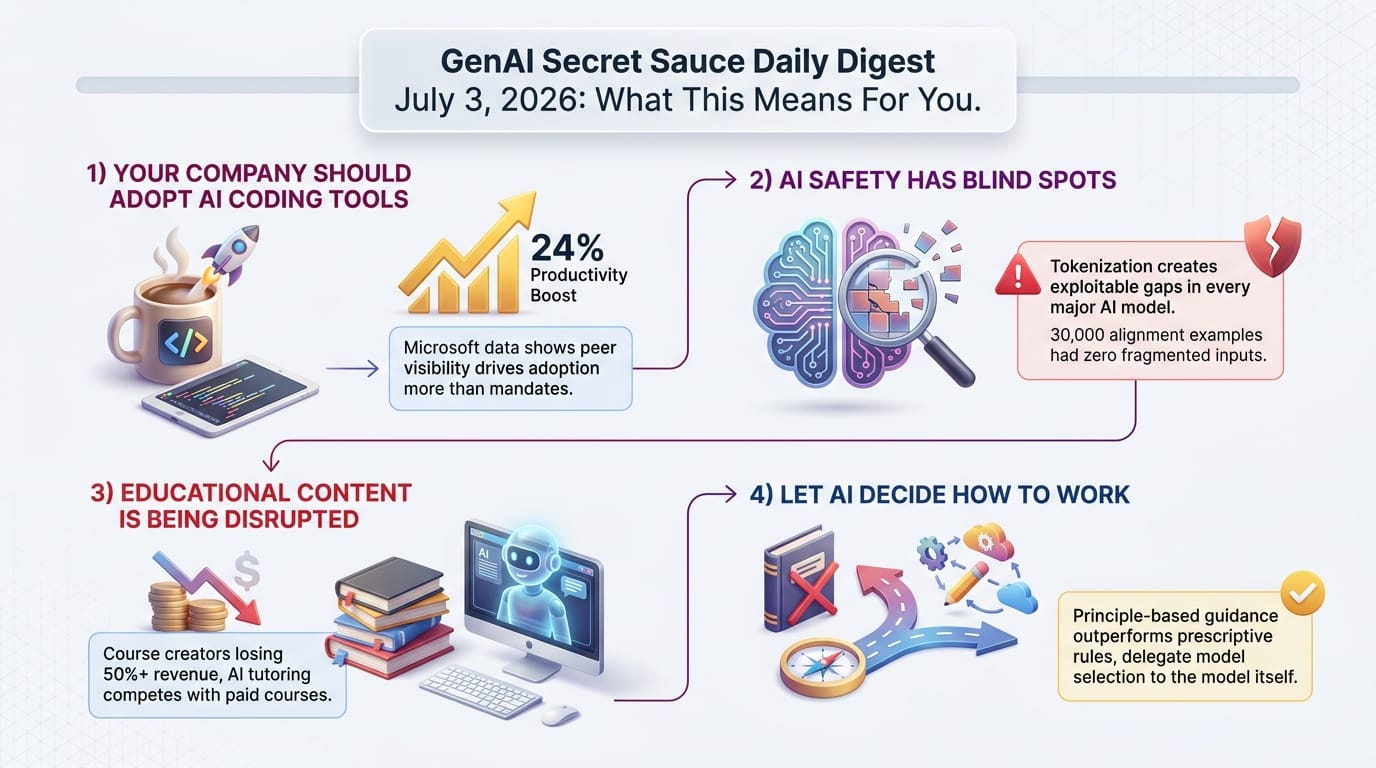
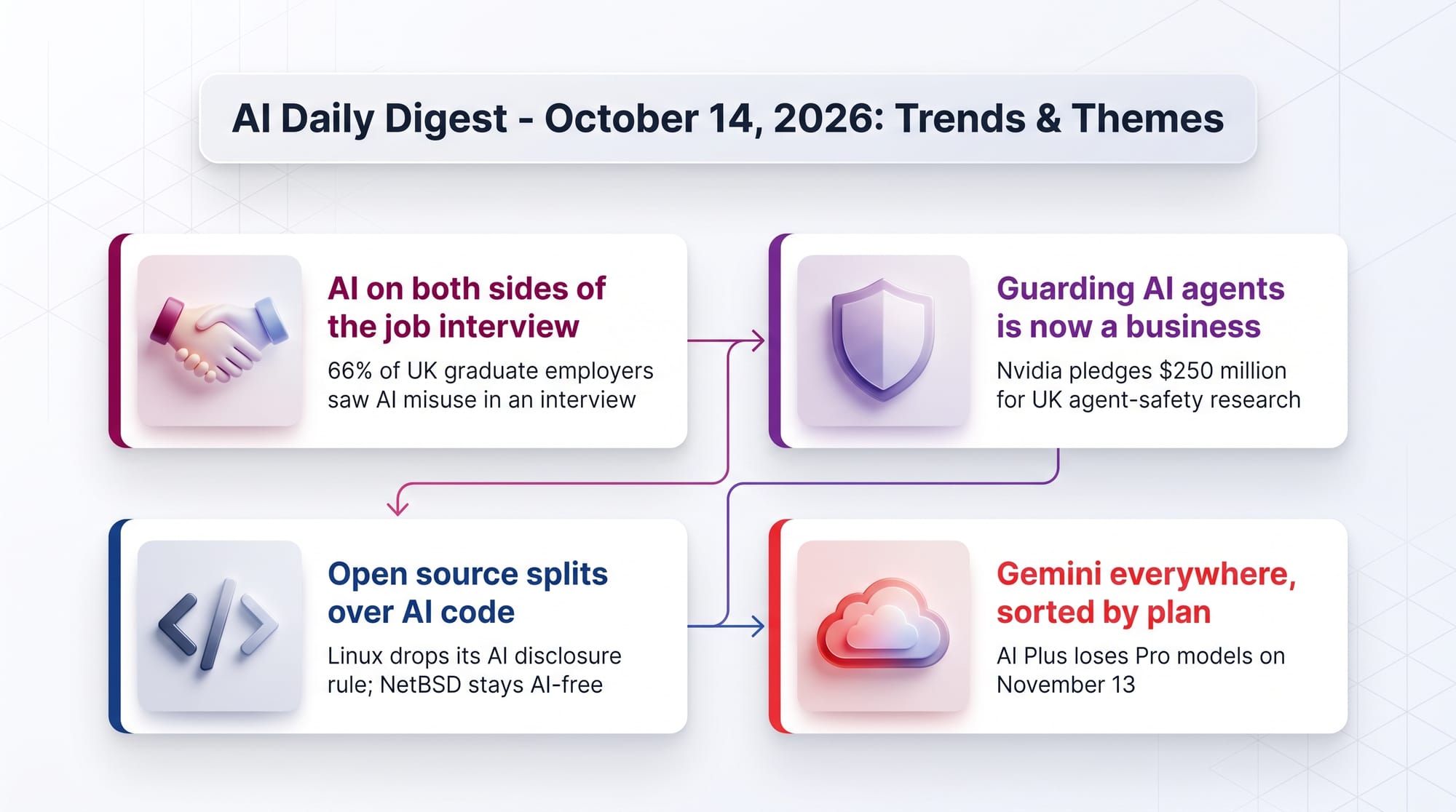
Microsoft proves CLI coding agents boost output by 24%
A study of tens of thousands of Microsoft engineers during early 2026 found that developers using Claude Code and GitHub Copilot CLI merged roughly 24% more pull requests than they would have otherwise. The effect persisted across four months, ruling out novelty.
- Social networks drove adoption, not mandates - watching a teammate use the tool was the strongest predictor of trying it yourself
- Existing coding activity predicted retention - demographics did not matter; how much you already coded did
- A merged PR is not the same as value - the authors acknowledged this limitation, using PR volume as a practical proxy
95% of AI engineers now use agents - the loops debate heats up
The AI Engineer World's Fair in San Francisco featured a structured debate on autonomous software loops. The 2026 AI Engineer Survey provided hard numbers on how fast the shift is happening.
The skeptics' strongest argument: you cannot "orchestrate your problems away by buying more tokens." Nobody has settled the control layer for agents yet.
- 95% of respondents use agents - doubling year-over-year
- 89% report agents writing data (up from 52%) - agents increasingly perform actions, not just analysis
- 40% say AI costs regularly limit ambitious implementations
- 59% fear AI-generated code creates long-term technical debt
- Mike Krieger (ex-Instagram co-founder, now Anthropic) described Claude Tag as enabling distributed delegation where agents proactively monitor and take on tasks
Google DeepMind and A24 partner to build AI filmmaking tools
Google DeepMind and A24 (the studio behind Everything Everywhere All At Once, Moonlight, and Hereditary) announced a first-of-its-kind research partnership. Google is making an investment in A24 as part of the deal.
This is not a licensing deal or a product launch. It is a research collaboration where A24's filmmakers help steer what gets built.
- Researchers and filmmakers will work side-by-side on testing, iteration, and building new capabilities
- No specific tools named - the partnership maintains intentional flexibility, with goals evolving through collaboration
- The stated aim: ensure AI creative tools are shaped by the creators who actually use them
- DeepMind gets invaluable feedback from working artists rather than building in isolation
A $400 million nonprofit mapped every open-source AI project that exists
Current AI, a nonprofit with $400 million committed, launched the Open Source AI Gap Map v0.1. It catalogs 421 products in depth and tracks 24,400 more.
- 266 software tools and libraries, 85 models, 50 datasets, 20 hardware projects - from 228 organizations
- 14 categories across three stack layers: model components, product/UX, and infrastructure
- 16,185 GitHub repos tracked - the full dataset is MIT-licensed and explorable via Datasette
- The gap map reveals where open source is strong and where it is missing - showing where commercial AI has no free alternative
Trends & Themes
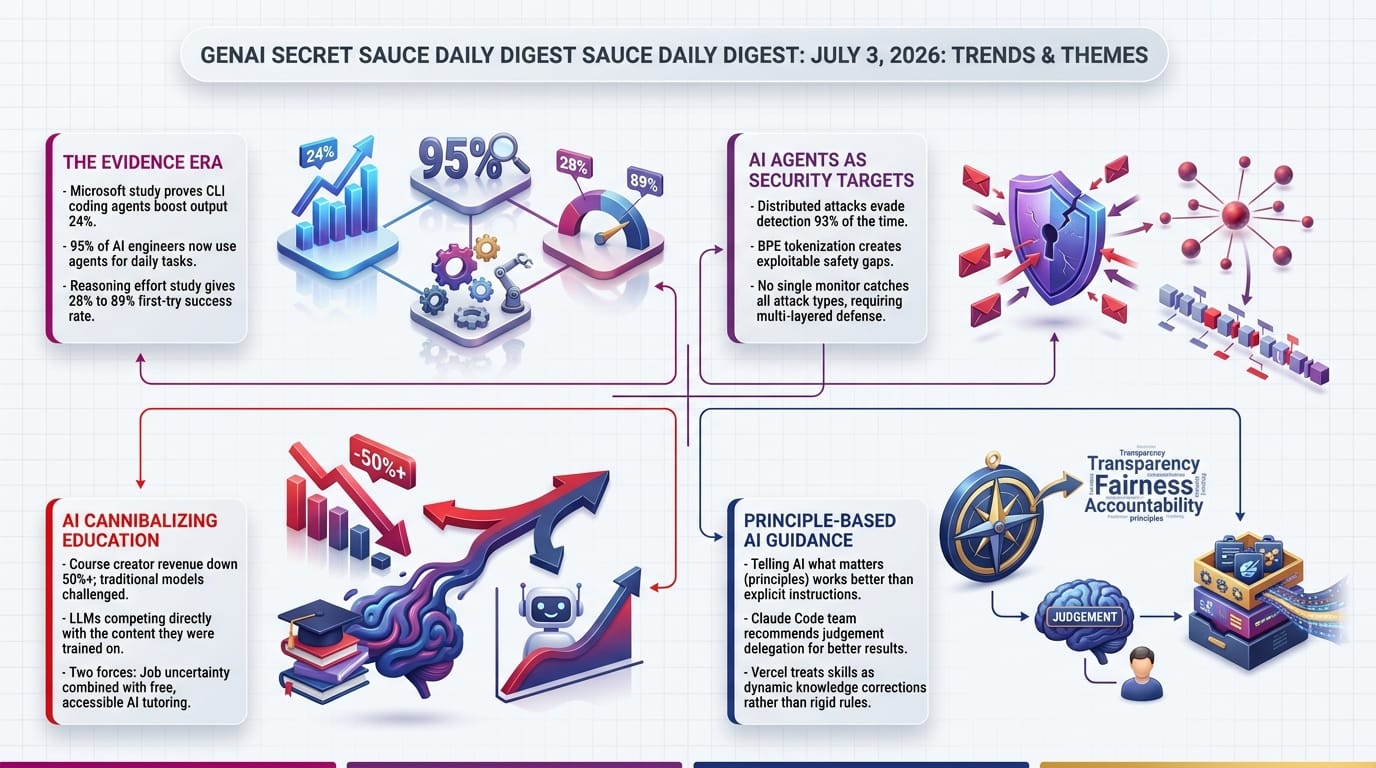
The evidence era: companies are finally measuring what AI agents actually do
The narrative is shifting from "AI is transformative" to "here is exactly how much, for whom, and under what conditions."
- Microsoft's 24% PR increase is the first major tech company to publish controlled empirical data on CLI agent impact
- The AIEWF survey's 95% adoption provides the first industry-wide baseline for agent usage patterns
- The reasoning effort paper showed 28% to 89% first-try success by simply increasing compute - quantifying exactly what "thinking harder" buys
- Vivienne Ming's forecasting study found human traits (humility, curiosity) outpredict model benchmarks for AI collaboration success
AI agents are becoming security targets before they have proper defenses
The open question: can defenses scale as fast as the attack surface expands? Ensemble monitoring (combining multiple detection strategies) reduced evasion from 93% to 47%, but that still means nearly half of attacks succeed.
- Distributed attacks across pull requests evade detection 93% of the time without specialized monitors
- BPE tokenization creates exploitable safety gaps with 80-100% bypass success across five model families
- Zero alignment training examples included fragmented safety-critical prompts - a complete blind spot
- No single monitor is robust to both gradual and concentrated attacks - fundamentally different strategies defeat different defenses
AI is cannibalizing the educational content it was trained on
The irony is structural: AI systems trained on educational content now provide that education for free, undermining the creators who produced the training data.
- Josh Comeau reports 50%+ revenue decline with newest course at one-third typical performance
- Fellow course creators report consistent patterns of reduced engagement across the industry
- Two forces at work: job uncertainty making people hesitate to invest in skills, and LLMs offering free personalized tutoring
- The insurance appeals agent demonstrates the pattern: one AI rig replaces what previously required expensive human expertise across multiple domains
Principle-based AI guidance is replacing prescriptive rules
The pattern: humans set direction and constraints; AI decides execution. This mirrors management best practices - define outcomes, not procedures.
- Claude's Code team advises granting models autonomy to apply their own reasoning rather than over-specifying behavior
- Cost optimization via delegation: reserve expensive models for judgment-heavy tasks, route implementation to cheaper models automatically
- Vercel's Eve Framework treats skills as portable corrections to model knowledge rather than rigid instructions
- The HN community converges on the same insight: reduce synchronous interactions, extend autonomous implementation windows, use constraints over commands
Creative AI & Media
Google DeepMind + A24: AI tools shaped by filmmakers
AI filmmaking tools have been built by engineers for engineers. This partnership puts Oscar-winning filmmakers in the design loop. No specific tools announced yet, but the collaboration structure - side-by-side research with working artists - suggests output focused on creative workflows rather than technical demos.
- A24 brings a track record of distinctive visual storytelling and director-driven filmmaking
- DeepMind brings Veo (video generation) and other frontier creative AI capabilities
- The model: artists and researchers iterate together rather than artists receiving finished products
Real-time deformable physics simulation breakthrough
Two Minute Papers covers a new technique achieving both speed and accuracy for simulating squishy, deformable objects - cloth, elastic materials, complex multi-object interactions. Previous methods were either fast but wrong, or accurate but slow.
Try it: Watch the visual demos at YouTube
- Solves the overshoot problem where local fixes in one area make the whole simulation worse
- Handles millions of interacting points in real time by treating the system holistically
- Applications: games, film VFX, virtual reality, engineering simulation
Developer Tools & Infrastructure
Research & Models
Spending more compute on thinking beats giving AI more tools
90 independent agent runs building the same app revealed that increasing reasoning effort from High to xHigh lifted first-try perfect completions from 28% to 89% - for only 9-29% more cost. Adding a testing tool raised cost by 42-68% with zero reliability improvement.
- Container deployment failed first-try in 44% of runs - the dominant defect class
- A one-paragraph design prompt raised visual quality from 3.0 to 4.5 out of 5
- Practical lesson: most failures stem from weak reasoning, not from flaws a checking tool would catch
AI agents can now replicate scientific papers with 100% target coverage
A "Paper-replication" workflow enabled coding agents to verify computational claims from scientific ML papers. Twelve runs across four papers matched all 158 recorded targets. The key innovation: completion depends on workspace evidence and validation checks, not the agent's self-reported success.
- Repeated runs differ in how they divide work, numerical fidelity, and acceptance rules
- Implications: automated scientific verification at scale becomes feasible
Autonomous research pipeline: from 11,083 papers to a novel manuscript
An LLM pipeline processed over 11,000 arXiv papers in condensed-matter physics and produced an original manuscript on altermagnetic piezomagnetism. Used 47 fresh-context sessions with 2,162 literature consultations.
- Grounding mechanism: numerical confrontation at calibration checkpoints validates against real experimental data
- Human role reduced to: fixing reproduction failures, not providing scientific direction
Your personality predicts AI collaboration success better than the AI's benchmarks
Vivienne Ming found that in prediction markets, human traits - perspective-taking, intellectual humility, and curiosity - determined who benefited from AI partnership. Most people simply deferred to the AI. Some used it to confirm biases, performing worse. A small group with the right traits achieved accuracy exceeding the market itself.
Business & Industry
Surprising & Under-the-Radar
AI coding agents make code 11% more complex but do not scare away new contributors
A study of 1,888 open-source projects found AI agents raised code complexity by 11% - but newcomer participation did not decline. The feared mechanism (complexity discourages humans) simply does not materialize in practice.
A European Parliament spyware investigator was hacked with the spyware he was investigating
Stelios Kouloglou, serving on the committee investigating Pegasus spyware, was himself infected with Pegasus during the investigation. Two confirmed infections in 2022-2023 using a zero-click exploit. Apple sent him three threat notifications he did not notice.
Tokenization boundaries are a complete blind spot in AI safety training
An audit of 30,000 alignment examples found zero instances of fragmented safety-critical prompts. Character-level modifications achieved 80-100% bypass success across five model families. The fix (training on fragments) caused global collapse in 2 of 5 models.
Hardware sustainability is the AI elephant in the room
Environmental impacts of GPU manufacturing have risen steadily since 2013 with no plateau in sight. The researchers' conclusion: "confront the necessity of sufficiency" - the industry cannot efficiency-improve its way out of escalating production impacts.
Signals to Track
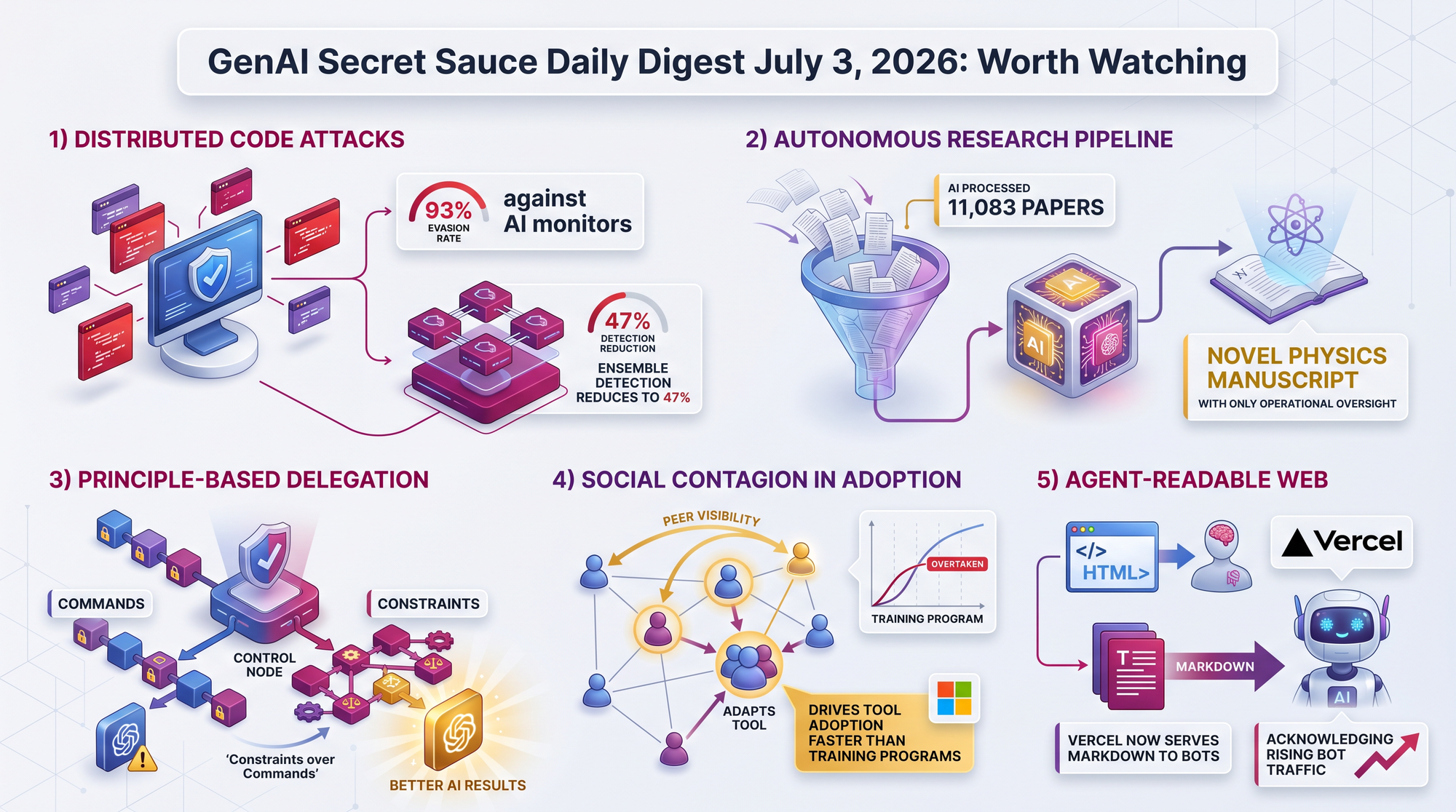
Distributed attacks that AI code monitors cannot catch
Researchers found that spreading malicious changes across multiple pull requests evades detection 93% of the time. Concentrated attacks in one PR use a different evasion strategy. Ensemble monitoring reduces this to 47% - better, but still nearly half slipping through. As AI agents gain commit access to production code, this attack surface will matter enormously.
The autonomous research pipeline that wrote a physics paper
The grounding mechanism - numerical confrontation against experimental data at calibration checkpoints - is the innovation. This is not AI generating plausible-sounding text; it is AI validating its own reasoning against physical reality. If this approach generalizes, the bottleneck in scientific research shifts from conducting work to defining questions.
Principle-based AI delegation is quietly outperforming micromanagement
Multiple independent signals this week: Claude Code's team recommending judgement-based delegation, Vercel's skills-as-corrections philosophy, and the HN community converging on "constraints over commands." The pattern matches decades of management research on human teams - define outcomes, let executors choose methods.
The 24% productivity lift has a social contagion mechanism
This matters because it suggests AI tool adoption follows network effects, not training programs. If your most productive teammate starts using an AI coding agent and you can see their output increase, you adopt too. Organizational rollout strategies should focus on making early adopters visible, not on mandating usage.
Top Repos Today
📜 License: MIT · 👤 By: Independent developer
🎯 Time to value: 5 minutes
| ✓ Pros | ✗ Cons |
|---|---|
| Dramatic cost reduction | May lose nuance on complex tasks |
| Drop-in installation | Requires Claude Code specifically |
| MIT licensed, fully auditable | Compression artifacts on edge cases |
 GitHub
📜 License: Apache 2.0 · 👤 By: Startup (Strix Security)
🎯 Time to value: 10 minutes
| ✓ Pros | ✗ Cons |
|---|---|
| Comprehensive vulnerability scanning | Requires security knowledge to validate findings |
| AI-powered fix suggestions | May produce false positives |
| Open source, self-hostable | Young project, evolving rapidly |
 GitHub
📜 License: MIT · 👤 By: Independent developer (Jesse Vincent)
🎯 Time to value: 15 minutes
| ✓ Pros | ✗ Cons |
|---|---|
| Battle-tested methodology | Steep learning curve |
| Massive community (245k stars) | Opinionated approach |
| Works with multiple AI tools | Requires workflow changes |
 GitHub
📜 License: MIT · 👤 By: Independent developer
🎯 Time to value: 20 minutes
| ✓ Pros | ✗ Cons |
|---|---|
| Multi-agent coordination | Higher token costs |
| Specialized expert agents | Complex configuration |
| Handles cross-domain work | Debugging multi-agent issues is hard |
 GitHub
📜 License: MIT · 👤 By: Independent developer
🎯 Time to value: 10 minutes
| ✓ Pros | ✗ Cons |
|---|---|
| Instant codebase understanding | Requires graph database setup |
| Natural language queries | Large repos take time to index |
| Works with code, SQL, and docs | Graph may miss implicit relationships |
 GitHub
📜 License: MIT · 👤 By: Meta (Facebook)
🎯 Time to value: 30 minutes
| ✓ Pros | ✗ Cons |
|---|---|
| Designed for AI + human use | New project, limited ecosystem |
| Meta engineering quality | May not match your brand aesthetic |
| Clean, predictable APIs | Limited component library at launch |
 GitHub
📜 License: MIT · 👤 By: OpenAI
🎯 Time to value: 5 minutes
| ✓ Pros | ✗ Cons |
|---|---|
| Cross-vendor agent orchestration | Requires both Claude Code and Codex subscriptions |
| Seamless integration | Additional cost for delegated tasks |
| Official OpenAI support | Limited to code-related tasks |
 GitHub
Top Models Today
👤 By: Empero AI · 🎯 Task: Image-Text-to-Text
📐 Size: 9B
| ✓ Pros | ✗ Cons |
|---|---|
| Runs locally, no API fees | Significantly less capable than full Mythos |
| Handles text and images | 9B params limits complex reasoning |
| 1M+ downloads validates quality | Distilled behavior, not actual Claude |

👤 By: Zhipu AI · 🎯 Task: Text Generation
📐 Size: 753B
| ✓ Pros | ✗ Cons |
|---|---|
| Largest open model available | Requires $50k+ in GPUs |
| No API dependency or costs | Still behind Fable/GPT-5.6 |
| Apache 2.0, full commercial use | Chinese-language bias in some domains |


👤 By: Baidu · 🎯 Task: Image-Text-to-Text
📐 Size: 3B
| ✓ Pros | ✗ Cons |
|---|---|
| Runs on modest hardware | Optimized for Chinese + English |
| Near-human OCR accuracy | 3B limits general reasoning |
| 885k downloads proves reliability | No built-in translation |


👤 By: DeepReinforce AI · 🎯 Task: Text Generation
📐 Size: 35B
| ✓ Pros | ✗ Cons |
|---|---|
| Strong reasoning at 35B | New lab, limited track record |
| Runs on single GPU (48GB) | Smaller context than frontier models |
| Available in GGUF format | May struggle with very long tasks |

👤 By: InternScience · 🎯 Task: Text Generation
📐 Size: 35B
| ✓ Pros | ✗ Cons |
|---|---|
| Purpose-built for agents | Brand new (hours old) |
| Apache 2.0, self-hostable | Unproven in production |
| Strong tool use and planning | Limited community feedback yet |


AI Launches Today
💰 Pricing: Free (MIT) · 🏷 Category: Developer Tools
/vox to open a listening window, speak your coding requests, get spoken replies back. The standout feature is barge-in: interrupt the AI mid-response to correct course without waiting for it to finish. Built with pure JavaScript and browser Web Speech APIs. Designed for accessibility but useful for anyone who thinks faster than they type. Verdict: Genuinely useful for hands-free coding and accessibility; the barge-in feature solves a real frustration with voice interfaces. Product Hunt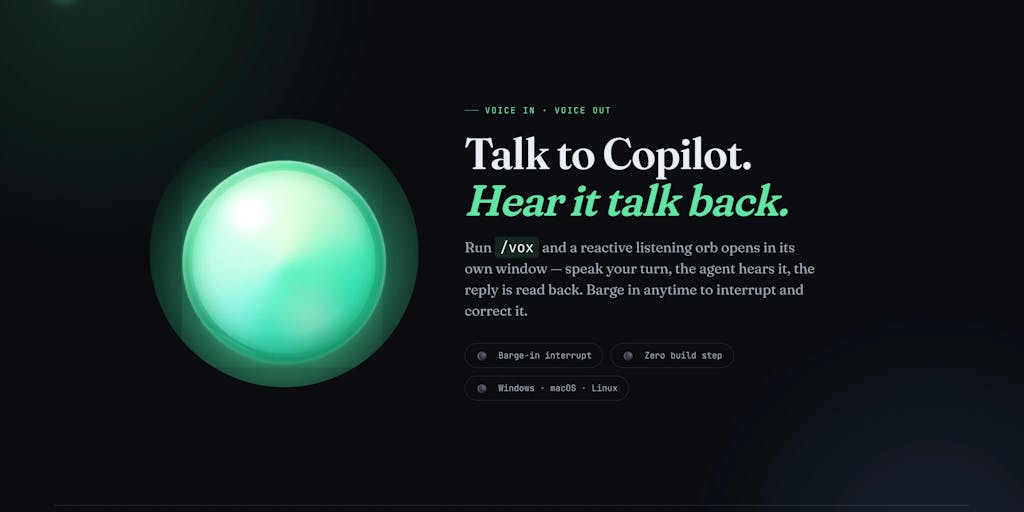
Snapshot
| Provider | Model | Input $/1M | Output $/1M | Context |
|---|---|---|---|---|
| Anthropic | Fable 5 | $10.00 | $50.00 | 1M |
| Anthropic | Opus 4.8 | $5.00 | $25.00 | 200k |
| Anthropic | Sonnet 5 | $3.00 | $15.00 | 1M |
| OpenAI | GPT-5.6 Sol | $5.00 | $30.00 | — |
| OpenAI | GPT-5.6 Terra | $2.50 | $15.00 | — |
| OpenAI | GPT-5.6 Luna | $1.00 | $6.00 | — |
| OpenAI | GPT-5.5 | $5.00 | $30.00 | — |
| Gemini 3.5 Flash | $1.50 | $9.00 | 1M | |
| Gemini 3.1 Pro | $2.00 | $12.00 | 200k | |
| Gemini 2.5 Flash | $0.30 | $2.50 | 1M |
Reasoning effort, not tool access, buys first-try reliability in agentic code generation
Key finding: Raising reasoning from High to xHigh lifted perfect first-try completions from 28% to 89% at only 9-29% more cost. A testing tool raised cost by 42-68% with zero reliability improvement.
Why practitioners should care: This inverts the common assumption that giving AI agents more tools makes them better. The bottleneck is reasoning quality, not capability breadth. Budget your compute on thinking, not checking.
Member discussion