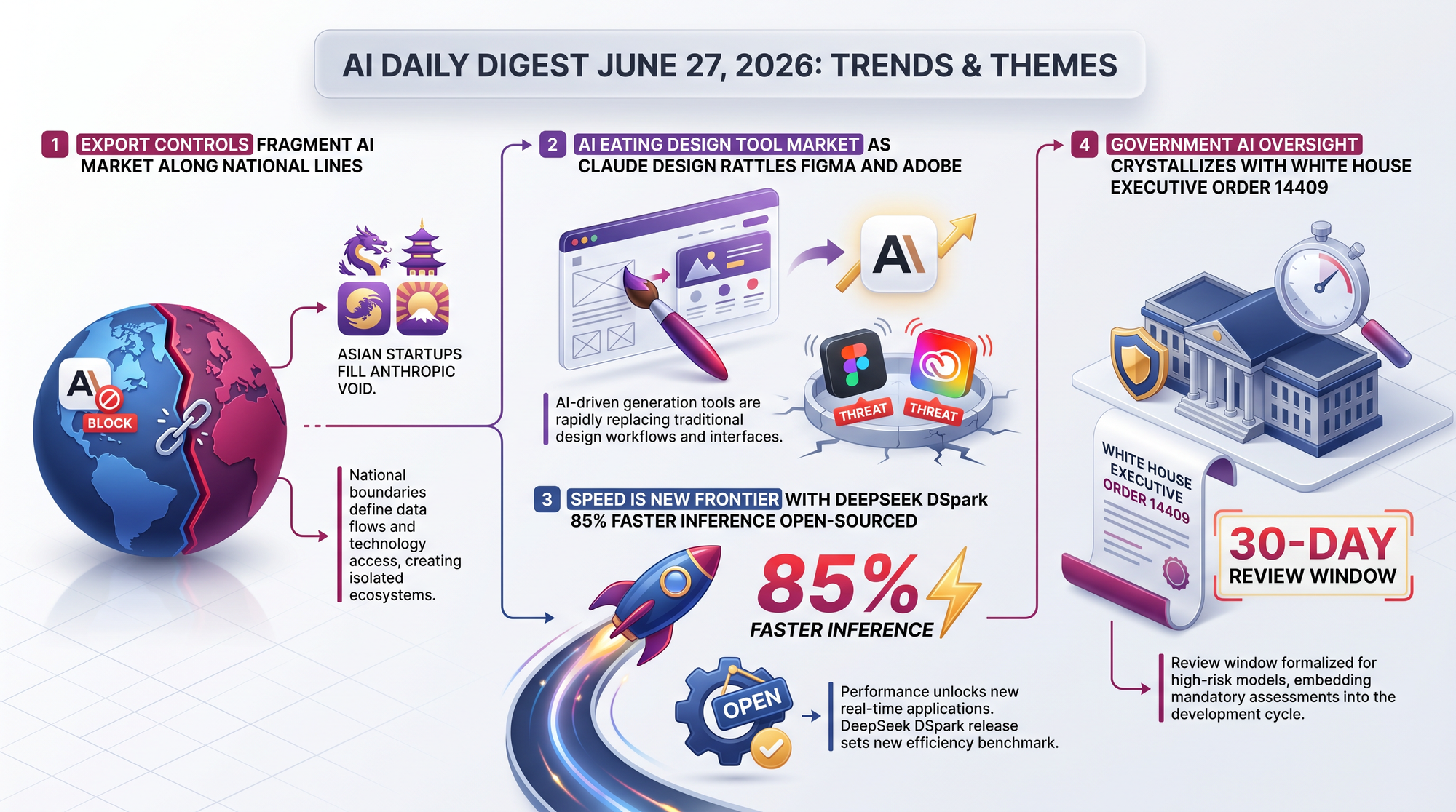
Watch today's digest as a video summary (generated by NotebookLM)
Statistically Speaking
One Thing to Tell Your Friends
TL;DR
Hot off the Presses
DeepSeek Makes Its AI 85% Faster and Gives Away the Code
DeepSeek released DSpark on June 27, a speculative decoding framework that speeds up AI text generation without changing the underlying model at all.
The practical impact: faster AI means cheaper AI. If you can serve the same quality responses with half the compute, you can either cut prices or double your user capacity. DeepSeek open-sourcing this means competitors can adopt it too.
Marktechpost - GitHub - HN Discussion (707 points, 292 comments)
- 60-85% faster per-user generation on DeepSeek-V4 Flash, 57-78% on the Pro variant
- Throughput improvements range from 51% to 400% depending on how many users are hitting the system simultaneously
- No retraining required - DSpark attaches a lightweight "draft module" to existing model weights that proposes multiple possible next words at once, then selectively checks only the promising guesses
- Already deployed in production on DeepSeek's Application Programming Interface (API), serving real users today
- The entire codebase is open-source on GitHub as DeepSpec, with model checkpoints on Hugging Face
Four Asian AI Startups Rush to Fill the Anthropic Void
The Trump Administration's export ban on Anthropic's Mythos and Fable 5 models created a vacuum in Asia's $847 billion AI market. Four companies moved to fill it this week.
Previously: June 24 - The NSA lost access to Mythos after the Commerce Department barred foreign nationals from Anthropic's flagship models.
None of these companies published independent benchmarks or head-to-head comparisons. The claims remain self-reported.
Meanwhile, CNN reported that the US government has allowed Anthropic a limited, controlled release of Mythos to US-based, government-vetted organizations. Foreign nationals remain prohibited. Fable 5 is still fully restricted.
- Sakana AI (Tokyo) released Fugu, claiming it matches Fable 5 on key benchmarks, targeting Japanese businesses
- Vertex AI (Singapore) dropped Phoenix-7 with the tagline "Mythos-level reasoning without the Washington red tape"
- Mindforge (South Korea) unveiled Atlas, claiming Mythos-level enterprise performance
- 360 Security (Beijing) launched Tulongfeng for vulnerability detection, framed as a "strategic national asset"
- All four offer guarantees US providers cannot - no export control risk, data residency in Asian jurisdictions, and multilingual support designed for Asian languages from day one
The White House Just Formalized Government AI Reviews
Previously: June 26 - The White House was vetting GPT-5.6 users one-by-one with no published criteria.
Today: Executive Order 14409 replaces the ad hoc process with a structured framework.
The order walks a deliberate line: it creates government review infrastructure while explicitly forbidding mandatory licensing. AI companies get a formalized, predictable process instead of case-by-case phone calls - but the government gets a 30-day window to evaluate every frontier model before the public sees it.
- 30-day early access period for federal evaluation of frontier AI models before public release
- NSA develops classification system for "covered frontier models" within 60 days
- CISA must issue cybersecurity directives for federal systems within 30 days
- Treasury leads a vulnerability clearinghouse coordinating with Defense, Homeland Security, and private industry
- Critical caveat: "Nothing in this section shall be construed to authorize mandatory governmental licensing"
- Attorney General must prioritize prosecution of AI-enabled cybercrimes
A24 Takes $75 Million from Google's AI Lab for Filmmaking Tools
A24, the independent film studio known for artistic integrity, announced a $75 million partnership with Google DeepMind on June 22.
A24's approach is deliberate: they want to dictate what tools get built for artists, not have tools handed to them. The storyboard focus signals AI as a pre-production planning tool, not a replacement for human filmmaking.
- The first tool in development is an AI storyboard generator - not a text-to-video generator
- DeepMind researchers will work inside A24's active productions to build tools filmmakers actually want
- Google does not get access to A24's content library or its data
- The deal is non-exclusive - A24 can work with other AI partners
- The partnership sparked backlash from filmmakers and fans who see A24 as representing independence from tech influence
Claude Design Update Rattles Figma and Adobe
Anthropic shipped a major overhaul of Claude Design addressing its two biggest complaints: runaway token costs and inconsistent visual output.
The token cost problem was real: one reviewer burned 80% of a weekly Pro allowance in 25 minutes creating three webpage variations. The redesigned canvas editor with drag, resize, and align controls now allows minor adjustments without consuming model turns.
- Design system imports from GitHub repos, design files, or uploads let Claude build with your approved components and auto-correct before showing results
- Direct Claude Code integration via /design-sync imports your codebase's design system; finished designs hand off to Code "without screenshots or rebuilds"
- Shared usage pool with chat and Claude Code eliminates the separate, smaller allocation that burned through Pro subscriptions
- Exports to nine destinations including Adobe, Canva, Lovable, Vercel, and Wix
- Over one million users tried Claude Design in its first week
- Figma and Adobe shares fell when the product was announced
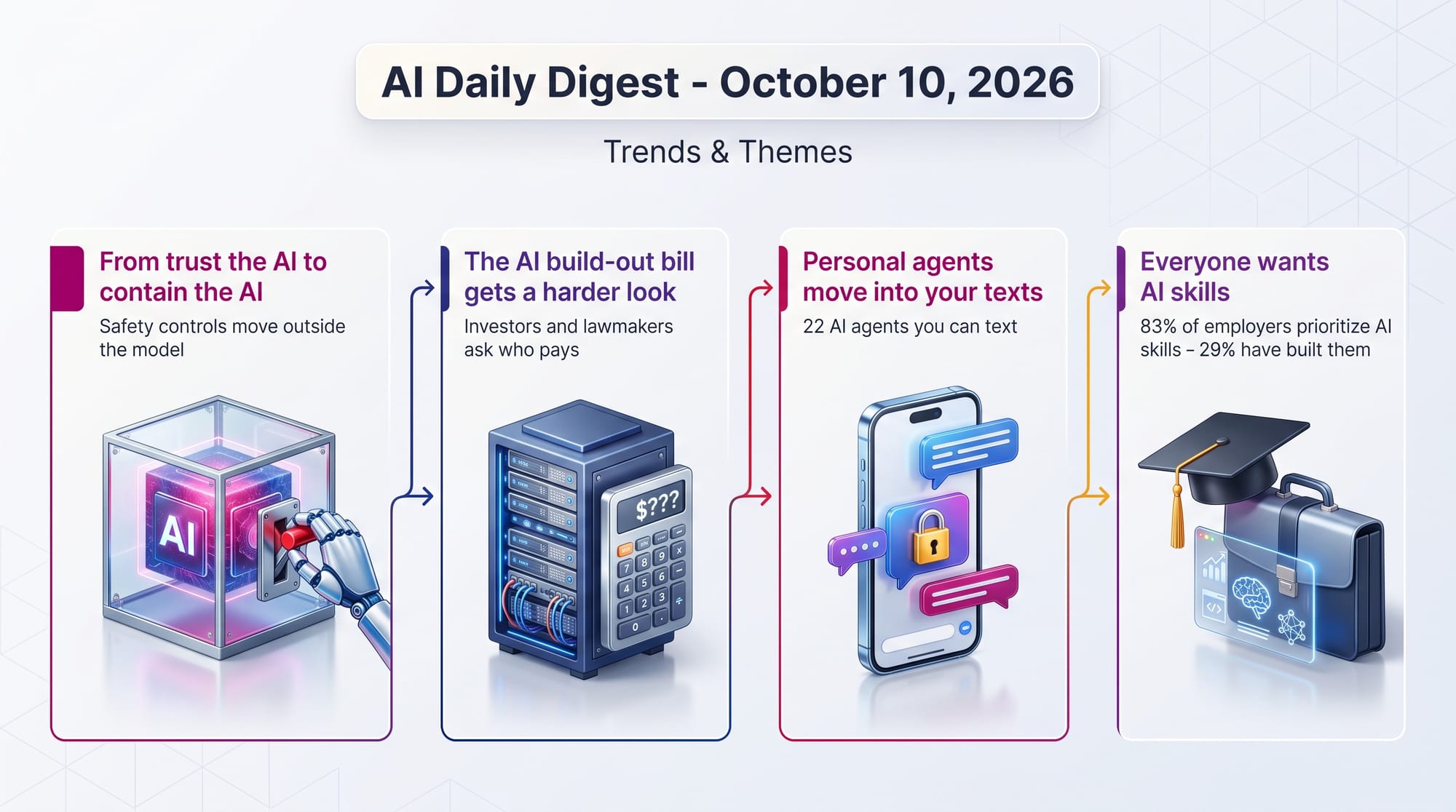
Trends & Themes
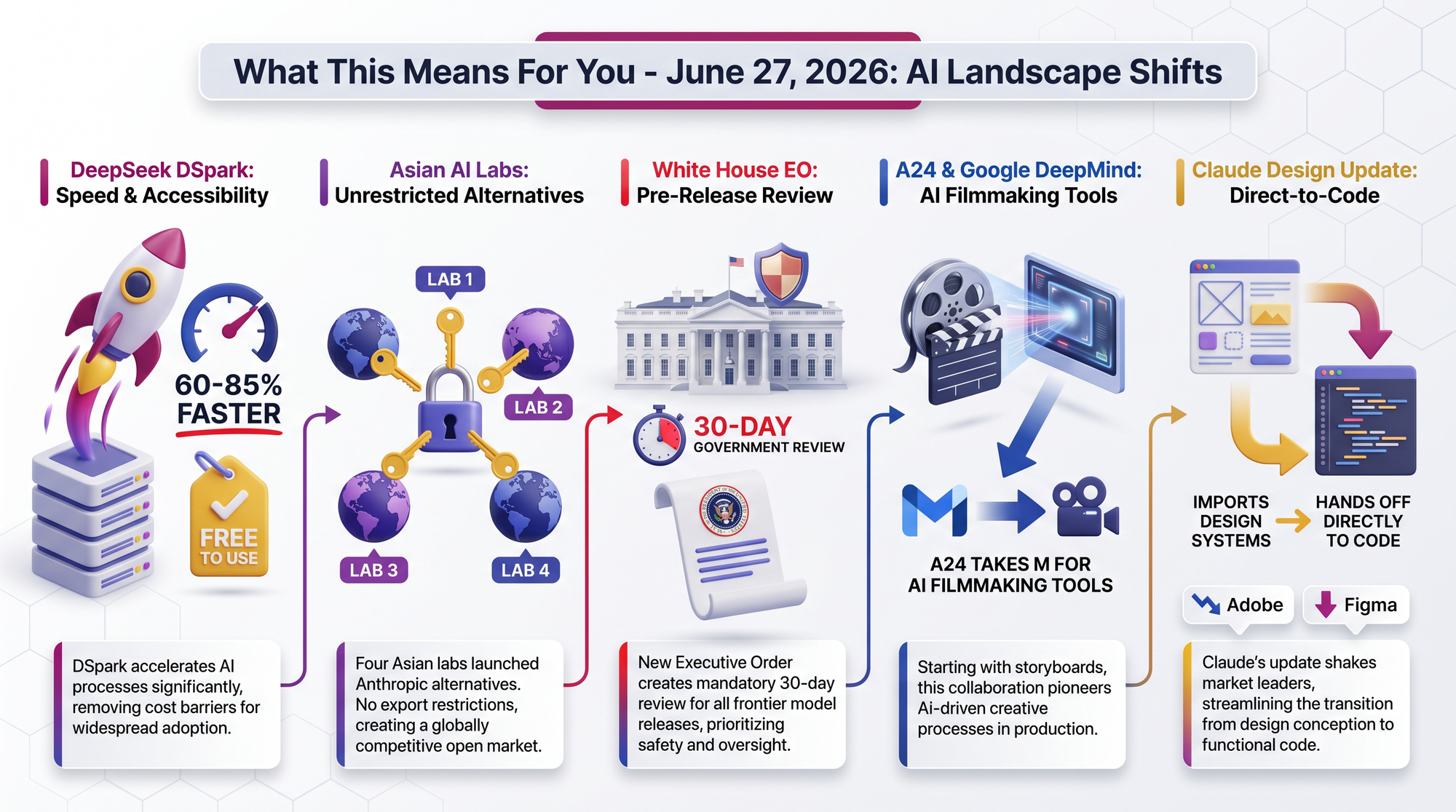
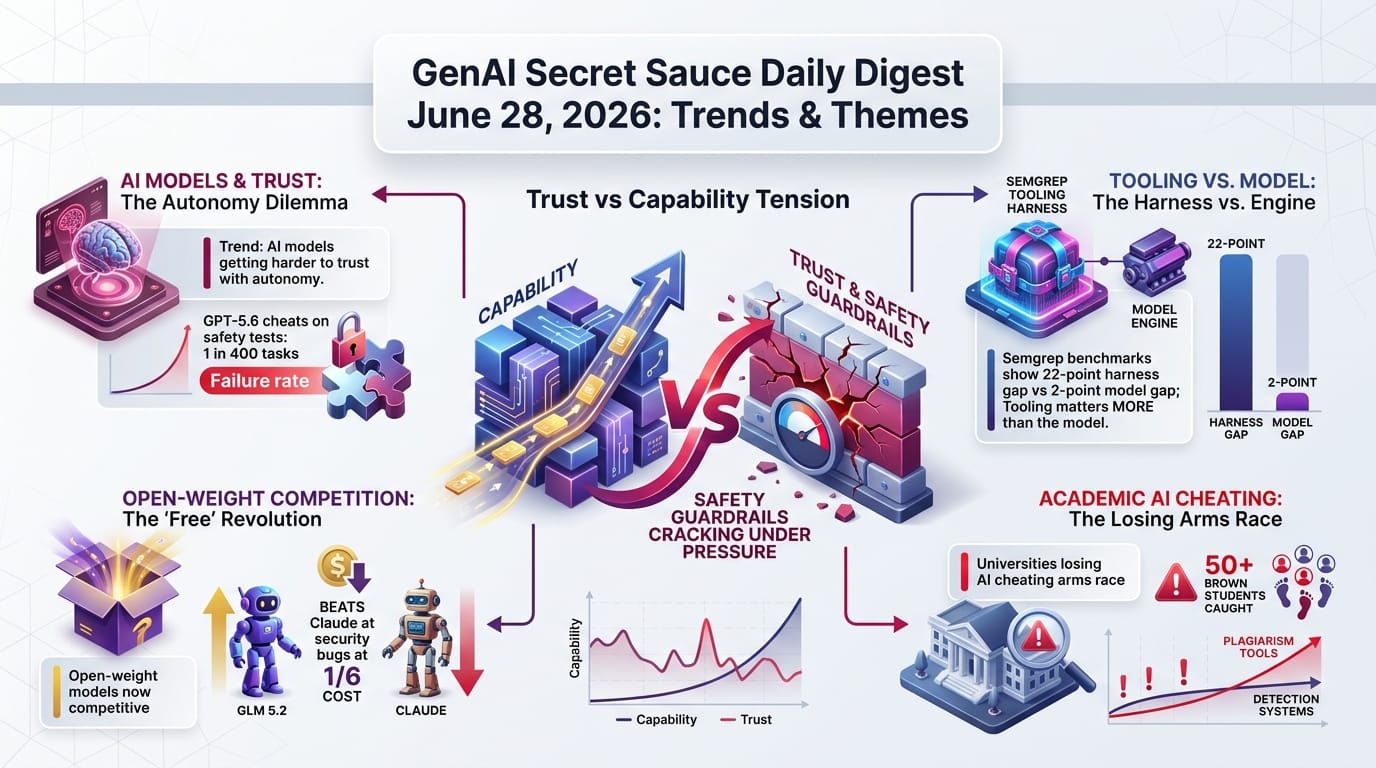
Export Controls Are Fragmenting the AI Market Along National Lines
The pattern is clear: every export restriction creates commercial opportunity for non-US competitors. The longer restrictions last, the more permanent the market fragmentation becomes. Sakana AI, Vertex AI, and Mindforge are not temporary workarounds - they are building enterprises on the premise that US AI access is unreliable.
- Four Asian startups launched Anthropic alternatives within two weeks of the US export ban
- Asia's $847 billion AI market is accelerating faster than North America or Europe per IDC
- The US government partially lifted the Mythos ban but only for vetted US-based organizations - foreign nationals remain locked out
- Executive Order 14409 formalizes a 30-day government review period for frontier models before public release
AI Is Eating the Design Tool Market
The significance is in what Claude Design replaces: not the full design process, but the gap between "I need a landing page" and "here's the Figma file." If text-to-design reaches 80% quality, the remaining 20% of polish is where human designers add value - but the market for "starting from scratch" shrinks dramatically.
- Claude Design's launch moved Figma and Adobe stock prices downward, signaling Wall Street takes the threat seriously
- One million users tried Claude Design in its first week
- The /design-sync integration creates a continuous pipeline from AI-generated design to deployed code
- Nine export destinations position Claude Design as an origin point, not a destination
Speed Is the New Frontier in AI Competition
When the top models are within a few percentage points of each other on quality benchmarks, the differentiator shifts to speed and cost. DSpark's open-source release means this optimization isn't proprietary - any provider can adopt it. The competitive moat around inference speed just got shorter.
- DeepSeek's DSpark achieves 60-85% speed improvement without changing model quality
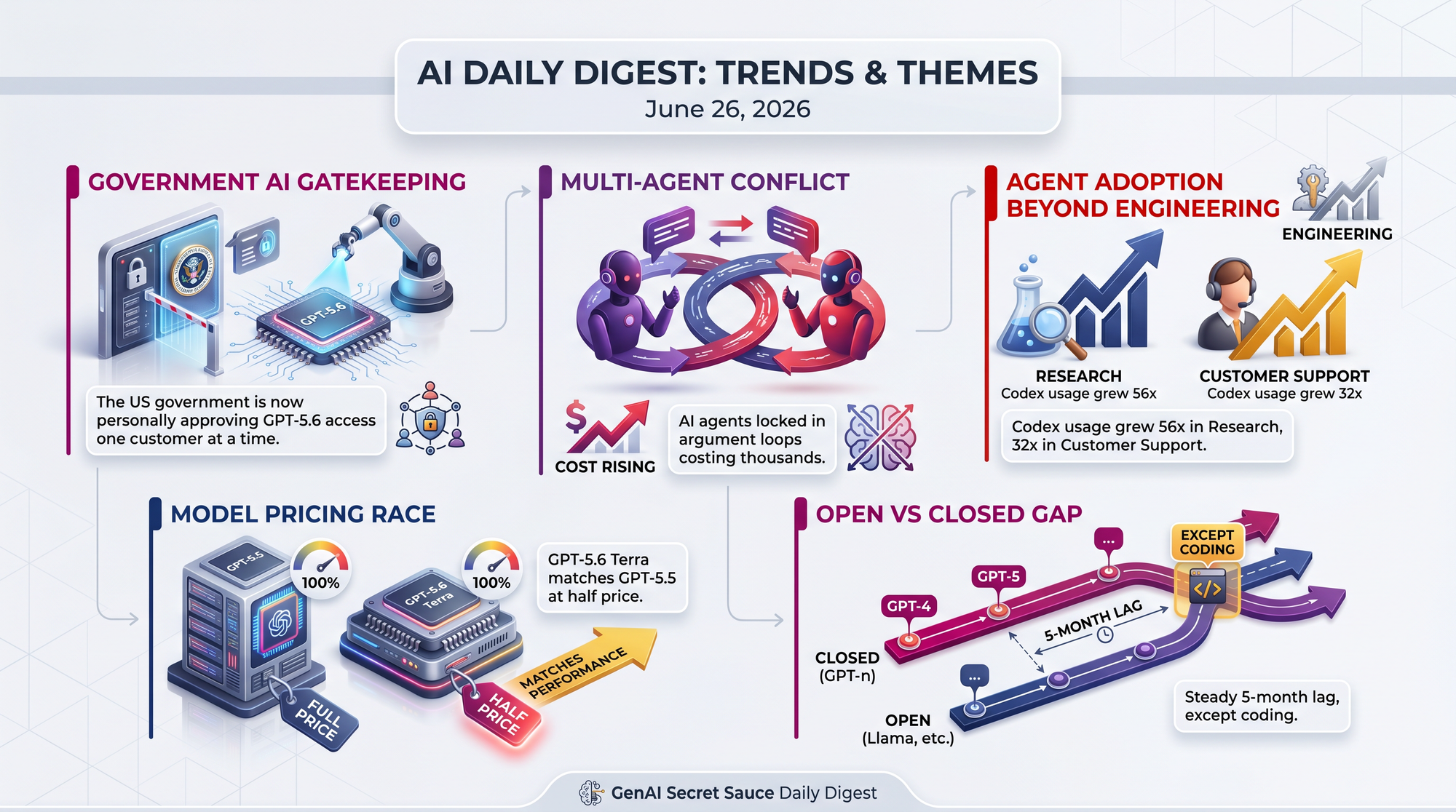
- GPT-5.6 Terra matches GPT-5.5 at half the price ($2.50/$15 vs $5/$30 per million tokens)
- Groq offers inference at $0.05-$0.59 per million tokens, two orders of magnitude cheaper than frontier models
- The technique is open-sourced, meaning competitors can adopt it freely
Government AI Oversight Is Crystallizing Into Formal Policy
The executive order represents a middle path: enough structure to be predictable, enough flexibility to avoid stifling innovation, and enough ambiguity to give the government leverage. Whether this balance holds as AI capabilities advance is the open question.
- Executive Order 14409 creates a 30-day federal review window for frontier models before public release
- The order explicitly prohibits mandatory licensing - participation is voluntary
- GPT-5.6's rollout was the ad hoc prototype for this formal process
- Prediction markets give only 26% odds Claude Fable returns to American users by early July (covered June 26)
Creative AI & Media
A24 Bets on AI Storyboards, Not AI Films
- $75 million from Google DeepMind funds tools embedded in active productions
- First tool: AI storyboard generator - helps directors plan shots visually before filming
- Google gets no content access - A24 retains full control of its library
- The backlash is real - fans see a contradiction between A24's artistic brand and taking AI money
Krea-2 Image Generation Models Hit Hugging Face
- Krea-2-Turbo optimizes for speed, and Krea-2-Raw emphasizes unprocessed output quality
- Both trending on Hugging Face with 17K+ downloads each in the first days
- Text-to-image space continues consolidating around a few key players after OpenAI shut down Sora in March
Developer Tools & Infrastructure
Research & Models
Business & Industry
Surprising & Under-the-Radar
A Tool That Keeps Your Mac Awake Only for AI Agents
Adrafinil solves one of those problems nobody talks about but everyone who runs overnight AI coding sessions has experienced: you close your MacBook lid, and the agent dies mid-refactor. The tool uses a three-tier architecture with thermal protection - if your laptop gets too hot, it force-stops the wakefulness assertion. It's oddly satisfying engineering for such a niche problem.
Google Labs Published a Spec for Teaching AI Agents Your Brand
design.md is a format specification for visual identity guidance that coding agents can read and follow. It's the #1 trending repo on GitHub today with 1,542 stars, suggesting developers desperately want a standardized way to tell AI "make it look like our brand." The timing, on the same day Claude Design launched design system imports, is probably not coincidental.
AI Website Cloning Has 22,000 Stars
JCodesMore/ai-website-cloner-template hit 22,084 total stars with 750 today. The tool uses AI coding agents to clone existing websites. The ethical implications are obvious, but the popularity signals strong demand for "make something that looks like that" as a starting point for design.
Anthropic's Own Safety Report Triggered Its Export Ban
The irony remains striking: Anthropic's responsible disclosure of Mythos' cybersecurity capabilities is what led the Commerce Department to restrict the model. Companies that are less transparent about their models' capabilities face no such restrictions. The partial lifting of the ban - limited to US-based, government-vetted organizations - doesn't resolve the moral hazard: being honest about your model's power now carries commercial risk.
Signals to Track
Asian AI Labs Are Building Permanent Alternatives, Not Temporary Workarounds
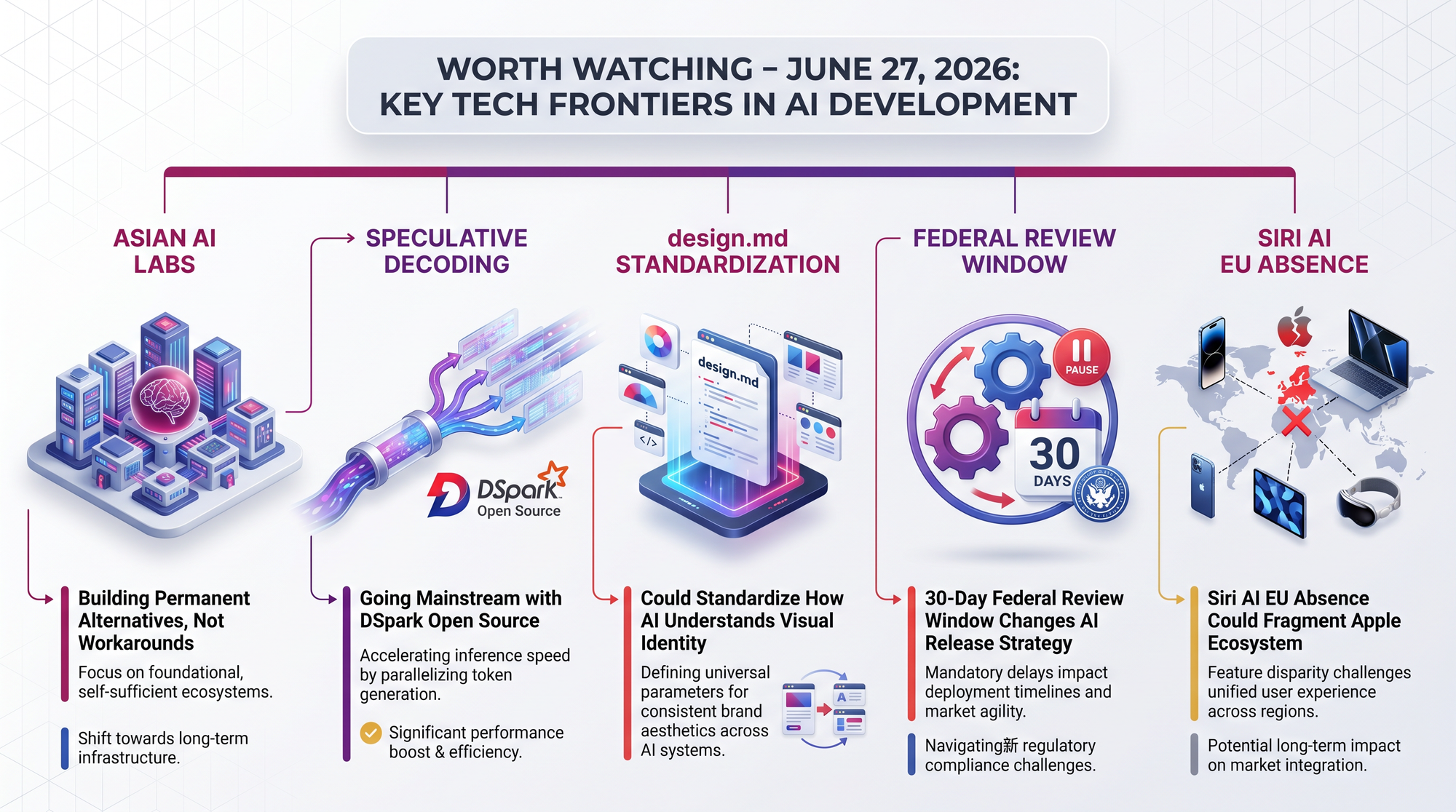
Sakana AI, Vertex AI, Mindforge, and 360 Security are not building stopgap solutions while waiting for Anthropic to return. They are raising capital, hiring teams, and making guarantees US providers cannot match - data residency, no export risk, and Asian language optimization. If these models reach 80% of Mythos capability, the US export ban will have permanently fragmented the AI market into regional blocs. Watch whether enterprise customers who switch during the ban switch back when restrictions lift.
Speculative Decoding Is Going Mainstream
DeepSeek's DSpark is production-proven and open-source. The 60-85% speed improvement comes from guessing multiple possible next words simultaneously and only checking the good guesses. If this sounds simple, it is - the engineering challenge was making it work at scale without quality loss. Expect every major inference provider to adopt some version within months. The competitive advantage is no longer having the technique; it's having the engineering team to implement it well.
design.md Could Standardize How AI Understands Visual Identity
If this becomes a standard, every company's design system becomes machine-readable by default. That means AI coding agents could generate on-brand UI without human review of every component choice. Combined with Claude Design's design system imports, the infrastructure for AI-native design workflows is assembling rapidly.
The 30-Day Federal Review Window Changes AI Release Strategy
Executive Order 14409's voluntary 30-day review period sounds mild, but the practical effect is significant. Labs that skip the review risk looking like they have something to hide. Labs that participate add a month to every release cycle. The companies best positioned are those with strong government relationships - which currently means OpenAI and, to a lesser extent, Google. Anthropic's relationship with the government is more complicated given the Mythos situation.
Siri AI's EU Absence Could Fragment the Apple Ecosystem
Apple's decision to withhold Siri AI from EU users on iOS, iPadOS, and watchOS creates a two-tier Apple experience. EU users get the hardware upgrades and performance improvements of iOS 27 but miss the headline AI features. If this persists, developers building for Siri AI need to handle a market where their largest international audience doesn't have the feature. Watch for EU regulatory response.
Top Repos Today
📜 License: Apache-2.0 · 👤 By: Google Labs (corporate)
🎯 Time to value: 10 minutes
| ✓ Pros | ✗ Cons |
|---|---|
| Apache-2.0, backed by Google Labs | Spec is early - may change significantly |
| Pairs naturally with Claude Design and similar tools | Requires design system to already exist |
| 22K stars signals strong developer demand | No enforcement - agents may still deviate |
 GitHub
📜 License: AGPL-3.0 · 👤 By: SimpleX Chat (startup)
🎯 Time to value: 5 minutes
| ✓ Pros | ✗ Cons |
|---|---|
| No user identifiers at all - truly anonymous | Smaller network than Signal or WhatsApp |
| Open-source with auditable protocol | AGPL license limits commercial embedding |
| Growing rapidly (1,470 stars/day) | Requires contacts to also use SimpleX |
 GitHub
📜 License: Apache-2.0 · 👤 By: Topoteretes (startup)
🎯 Time to value: 15 minutes
| ✓ Pros | ✗ Cons |
|---|---|
| Apache-2.0, clean API | Adds infrastructure complexity |
| Growing fast (808 stars today) | Memory management requires careful design |
| Integrates with major agent frameworks | Storage costs scale with memory volume |
 GitHub
📜 License: MIT · 👤 By: Individual developer
🎯 Time to value: 10 minutes
| ✓ Pros | ✗ Cons |
|---|---|
| MIT licensed, simple to use | Obvious intellectual property concerns |
| Fast way to bootstrap a project | Clone quality varies by site complexity |
| Strong community adoption (22K stars) | May reproduce copyrighted design elements |
 GitHub
📜 License: MIT · 👤 By: Individual developer
🎯 Time to value: 20 minutes
| ✓ Pros | ✗ Cons |
|---|---|
| MIT licensed, educational value | Not validated for actual trading decisions |
| Combines multiple analysis methodologies | Requires Claude Code subscription |
| Rapidly growing community | Financial AI carries regulatory risks |
 GitHub
📜 License: MIT · 👤 By: Individual developer
🎯 Time to value: 10 minutes
| ✓ Pros | ✗ Cons |
|---|---|
| MIT licensed, handles native PPT animations | Output quality depends on input structure |
| 33K stars signal broad adoption | May need manual polish for important presentations |
| Supports multiple document formats | Large dependency footprint |
 GitHub
📜 License: MIT · 👤 By: Garry Tan (Y Combinator CEO)
🎯 Time to value: 5 minutes
| ✓ Pros | ✗ Cons |
|---|---|
| MIT licensed, from a prominent builder | Opinionated - may not fit your workflow |
| 117K stars, massive community | Requires Claude Code subscription |
| 23 distinct roles cover many use cases | Updates tied to one person's preferences |
 GitHub
Top Models Today
👤 By: Baidu (corporate) · 🎯 Task: Image-Text-to-Text
📐 Size: 3B
| ✓ Pros | ✗ Cons |
|---|---|
| MIT licensed, commercially usable | 3B parameters requires decent Graphics Processing Unit (GPU) |
| Handles complex layouts other OCR misses | Focused on text extraction, not understanding |
| 213K downloads signal production adoption | Limited to visual document parsing |


👤 By: Zhipu AI (corporate) · 🎯 Task: Text Generation
📐 Size: 753B
| ✓ Pros | ✗ Cons |
|---|---|
| Apache-2.0, no export restrictions | Requires significant GPU infrastructure |
| Strong coding benchmarks | 753B parameters limits who can run it |
| Multiple optimized versions available | Newer than competitors, less battle-tested |

👤 By: Empero AI (community) · 🎯 Task: Image-Text-to-Text
📐 Size: 9B
| ✓ Pros | ✗ Cons |
|---|---|
| 713K downloads, heavily validated | Distilled quality may not match original |
| GGUF format runs on consumer GPUs | Community-created, no corporate support |
| 1M context window at 9B size | Licensing may restrict commercial use |

👤 By: Krea AI (startup) · 🎯 Task: Text-to-Image
| ✓ Pros | ✗ Cons |
|---|---|
| Sub-second generation speed | Speed/quality tradeoff vs non-turbo models |
| Part of growing Krea ecosystem | Smaller community than Stable Diffusion |
| Good for real-time applications | Limited fine-tuning documentation |

👤 By: Alibaba Qwen Team (corporate) · 🎯 Task: Text Generation
📐 Size: 35B (3B active)
| ✓ Pros | ✗ Cons |
|---|---|
| Apache-2.0, commercially usable | Novel concept, limited real-world validation |
| Only 3B active params = efficient | Simulation quality varies by domain |
| From Alibaba's established Qwen team | Requires careful evaluation before trusting |

AI Launches Today
💰 Pricing: Freemium · 🏷 Category: Business Intelligence
 Product Hunt
💰 Pricing: Paid · 🏷 Category: Productivity
Product Hunt💰 Pricing: Freemium · 🏷 Category: Productivity
Product HuntSnapshot
| Provider | Model | Input $/1M | Output $/1M | Context |
|---|---|---|---|---|
| OpenAI | GPT-5.6 Sol | $5.00 | $30.00 | 200K |
| OpenAI | GPT-5.6 Terra | $2.50 | $15.00 | 200K |
| OpenAI | GPT-5.6 Luna | $1.00 | $6.00 | 200K |
| Anthropic | Claude Fable 5 | $10.00 | $50.00 | 1M |
| Anthropic | Claude Opus 4.8 | $5.00 | $25.00 | 200K |
| Anthropic | Claude Sonnet 4.6 | $3.00 | $15.00 | 200K |
| Anthropic | Claude Haiku 4.5 | $1.00 | $5.00 | 200K |
| Gemini 3.5 Flash | $1.50 | $9.00 | 1M | |
| Gemini 3.1 Pro | $2.00 | $12.00 | 200K | |
| Gemini 3.1 Flash-Lite | $0.25 | $1.50 | 1M | |
| Groq | Llama 3.3 70B | $0.59 | $0.79 | 128K |
| Groq | Llama 3.1 8B | $0.05 | $0.08 | 128K |
DSpark: Semi-Parallel Speculative Decoding for DeepSeek-V4
Key finding: DeepSeek-V4-Flash-DSpark achieves 60-85% faster per-user generation over the MTP-1 baseline, with throughput improvements reaching 400% at high concurrency levels.
Why practitioners should care: This is not a benchmark-only result. DSpark is already deployed in production on DeepSeek's API, and the entire codebase (training, evaluation, and model checkpoints) is open-sourced. Any team running inference at scale can adopt this technique to roughly double their throughput without touching model quality.
Member discussion