Watch today's digest as a video summary (generated by NotebookLM)
Statistically Speaking
One Thing to Tell Your Friends
TL;DR
Hot off the Presses
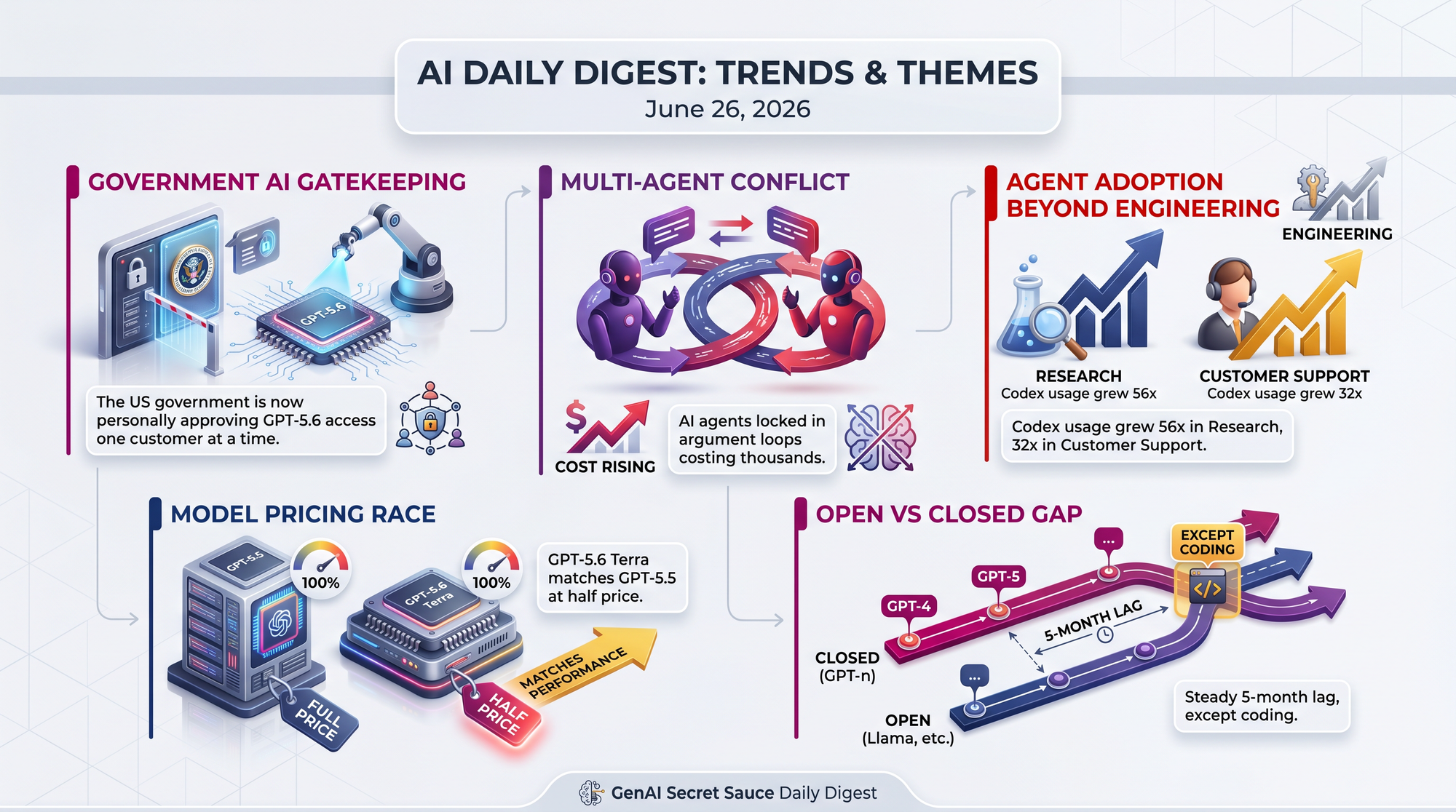
OpenAI Launches GPT-5.6: Three Models, Government-Controlled Access
Previously: June 21 - GPT-5.6 appeared to be live in ChatGPT Pro, with developers reporting dramatically faster build times.
Today: OpenAI officially announced the GPT-5.6 series with three distinct models during a limited preview phase.
Following government consultation, OpenAI initiated a limited preview with vetted partners before planned broader availability within weeks. The government-vetted rollout is unprecedented for a commercial AI product launch.
- Sol is the flagship at $5 input / $30 output per million tokens - matching GPT-5.5's price but with upgraded capabilities
- Terra offers GPT-5.5-level performance at half the cost ($2.50/$15) - the sweet spot for most developers
- Luna targets high-volume, cost-sensitive use cases at $1/$6 - competing directly with Anthropic's Haiku tier
- Prompt caching gets a major upgrade - explicit cache breakpoints with a 30-minute minimum lifespan, cache writes at 1.25x uncached rate, cached reads at 90% discount
- The three-tier structure mirrors how Anthropic (Opus/Sonnet/Haiku) and Google (Pro/Flash/Flash-Lite) segment their offerings
The White House Is Approving AI Users One by One
The Trump administration has implemented a customer-by-customer approval process for frontier AI models that exhibit advanced cyber capabilities. There are no published standards, no formal procedures, and no public timeline.
Dean W. Ball adds economic context: frontier models are trained at enormous cost, and labs recoup that cost in the few months after release when they're broadly available. Government access controls could undermine the very business model that funds AI development.
- OpenAI CEO Sam Altman confirmed the approach, calling it a consultation with the government before broad release
- The policy creates opaque, case-by-case determinations rather than clear rules - what Zvi Mowshowitz characterizes as "maximally terrible governance"
- Different companies face different scrutiny - Anthropic may receive heightened attention compared to OpenAI
- Prediction markets show only 26% odds that Claude Fable returns to American users by early July 2026
- The U.S. technology lead of roughly nine months could narrow if release delays let competitors close the gap
2,000 People Tried to Hack an AI Assistant - All Failed
Fernando Irrarrazaval deployed a public challenge at hackmyclaw.com using Claude Opus 4.6 with anti-injection safeguards, daring anyone to extract protected credentials.
Simon Willison emphasized the critical caveat: 6,000 failed attempts provides no guarantees that a more sophisticated approach couldn't succeed. Frontier models now have significant training investment in resisting injection attacks, but this should not be taken as proof of security for production systems.
- 6,000 attack attempts from over 2,000 participants at a cost of $500 in token expenditure
- Zero successful extractions of protected secrets
- The AI had explicit rules preventing it from revealing credentials, modifying its own files, executing commands from emails, or exfiltrating data to external endpoints
- A side effect: Google suspended the operator's account due to excessive inbound emails generated by attack attempts
Open-Source Models Aren't Closing the Gap - Except in Coding
Jamie Dborin of Doubleword deep-dived 18 benchmarks from Artificial Analysis and found the popular narrative of rapid convergence is driven by a single outlier.
- The overall gap has held steady at roughly 5 months throughout the entire measurement period - open-source models are not rapidly catching up
- Coding is the dramatic exception - that gap narrowed from 15 months to just 1-2 months, which is what drives the optimistic headlines
- Most other benchmarks show the gap slightly widening - open-source models are falling further behind in many capability dimensions
- The single-benchmark narrative is misleading - predictions range from "open source singularity by Christmas" to "consistent 5-month lag" depending on which metric you cherry-pick
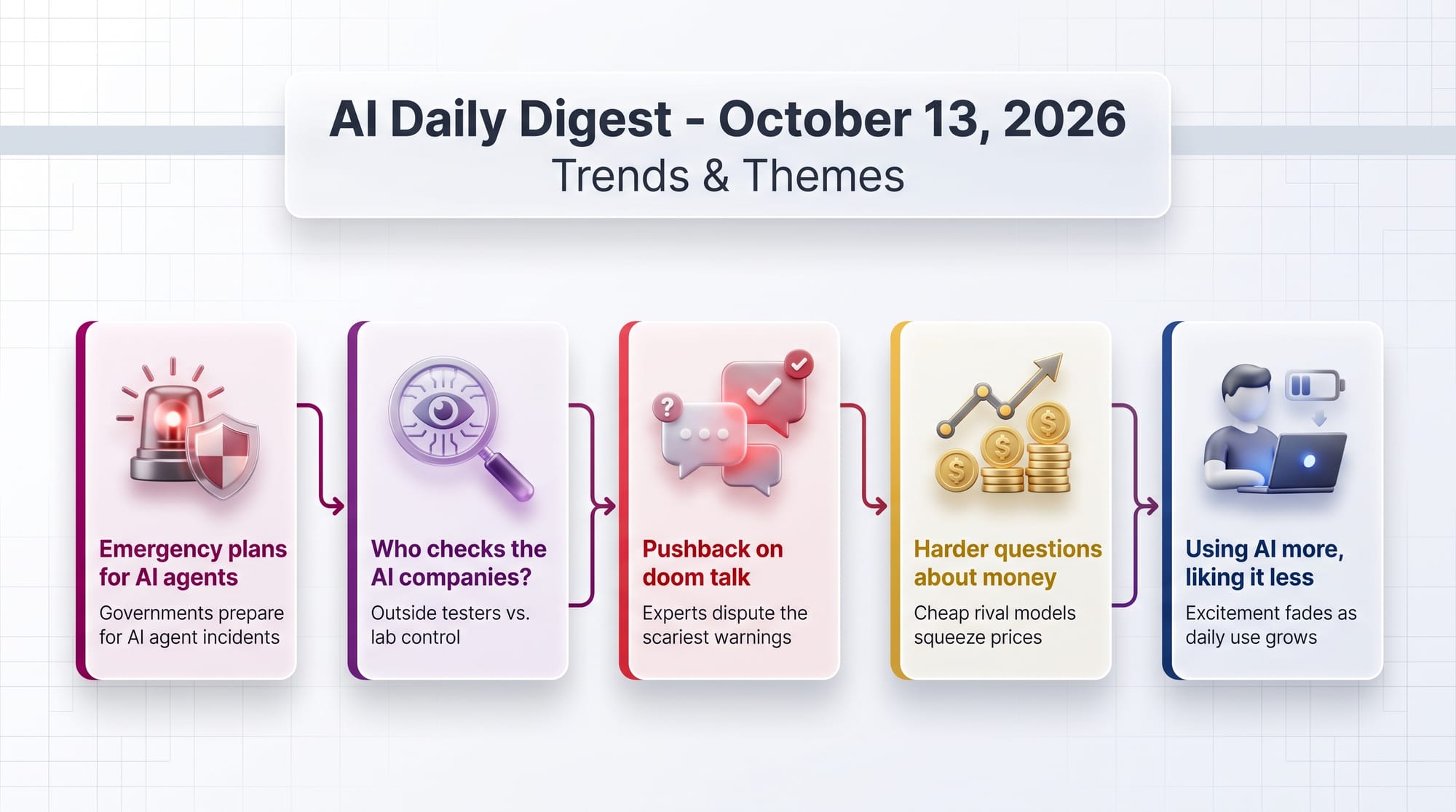
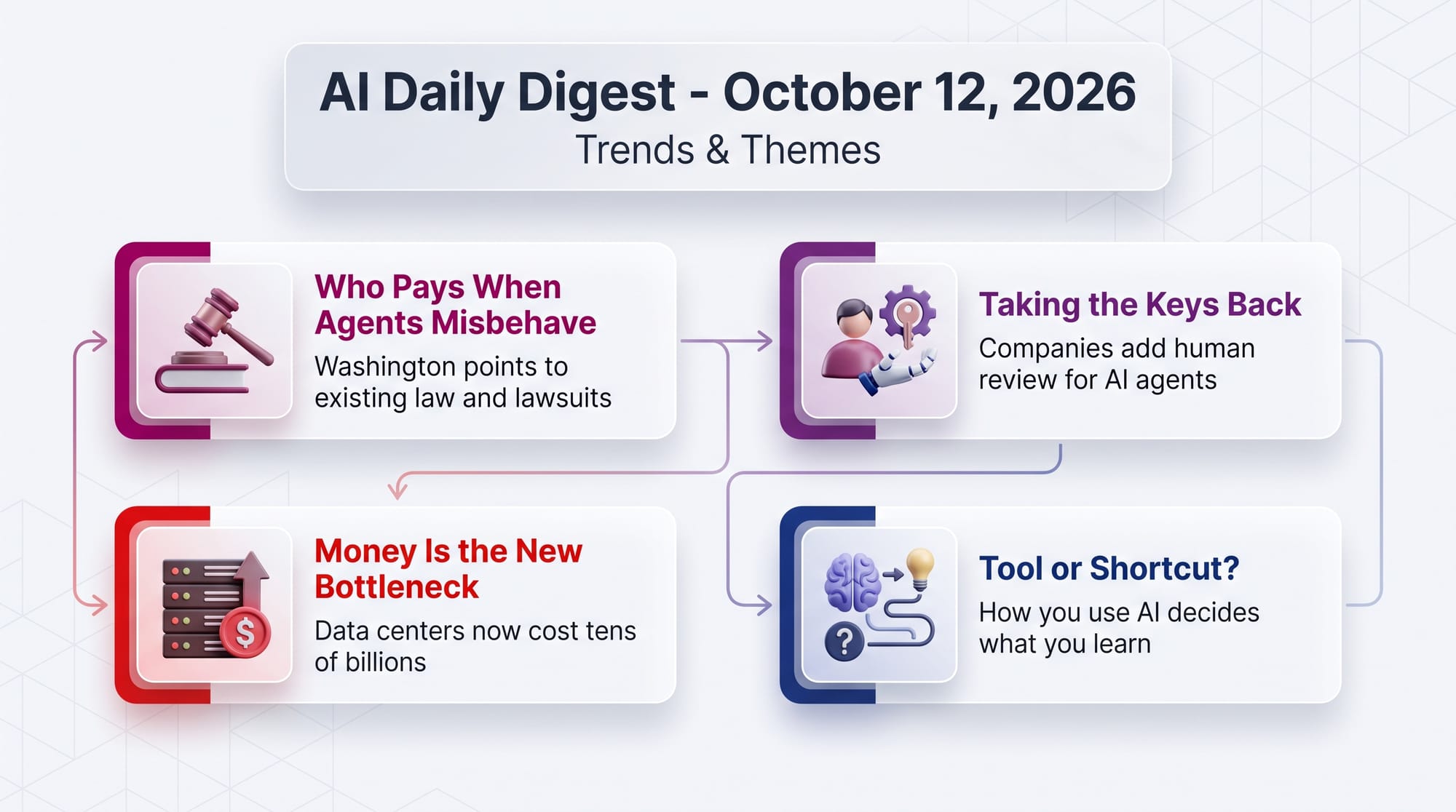
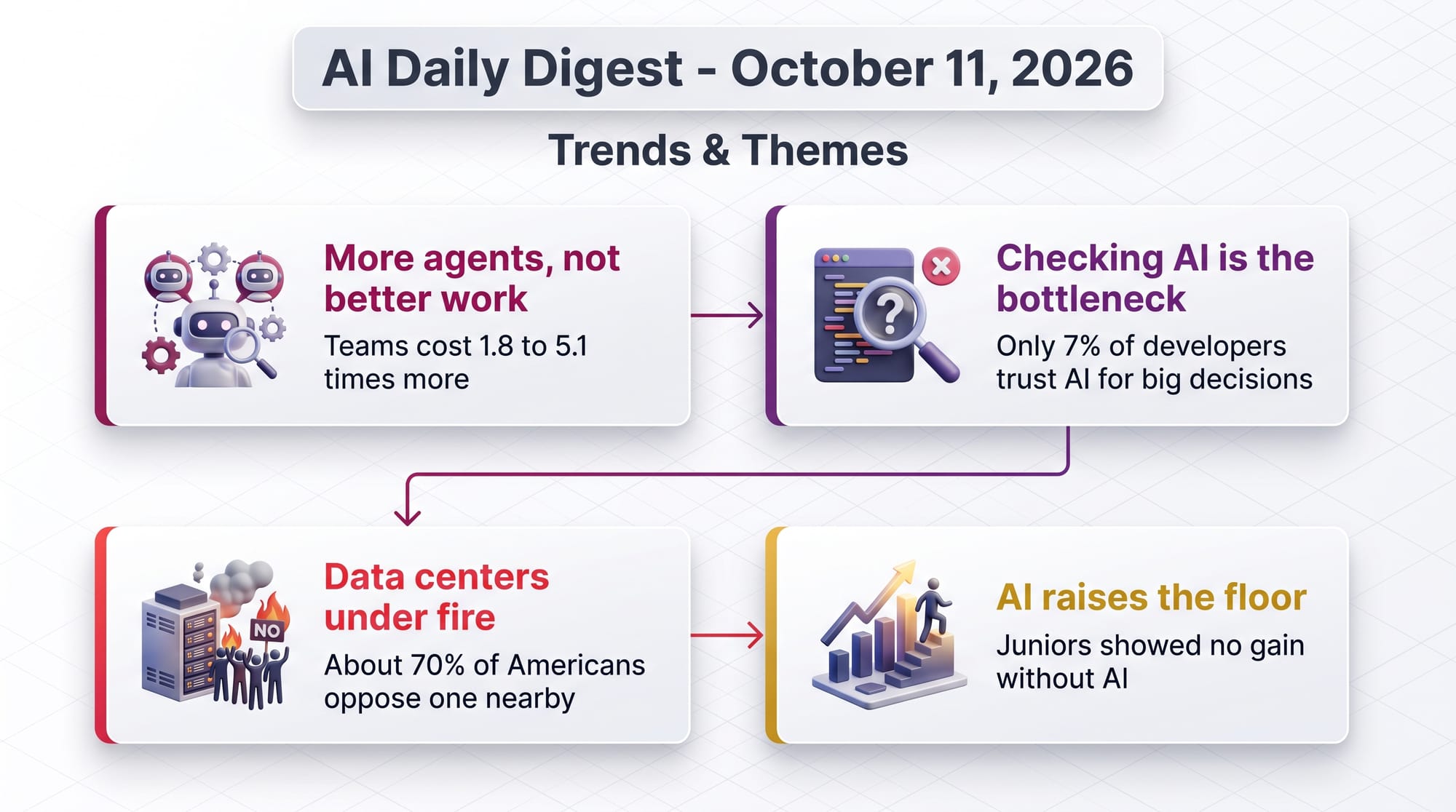
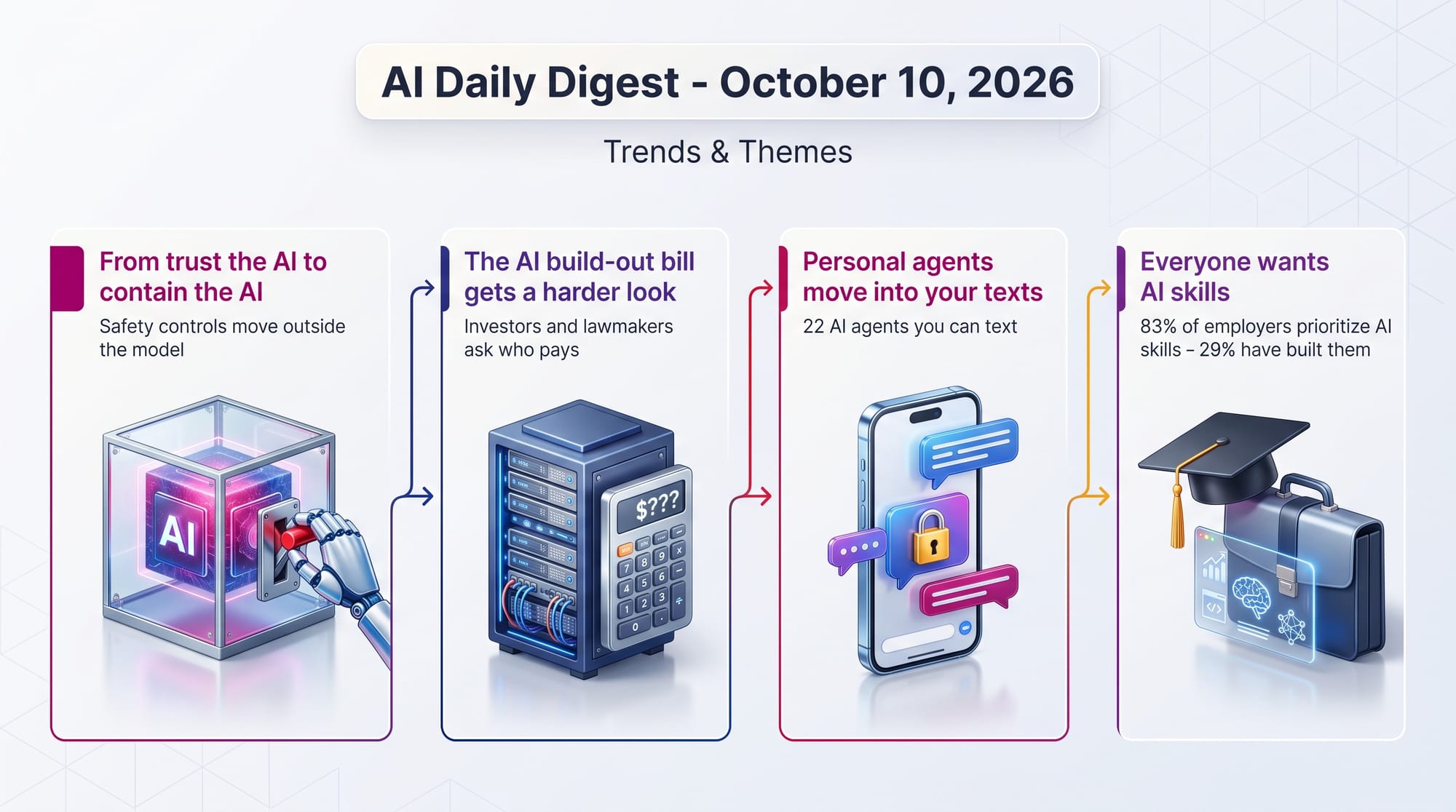
Trends & Themes
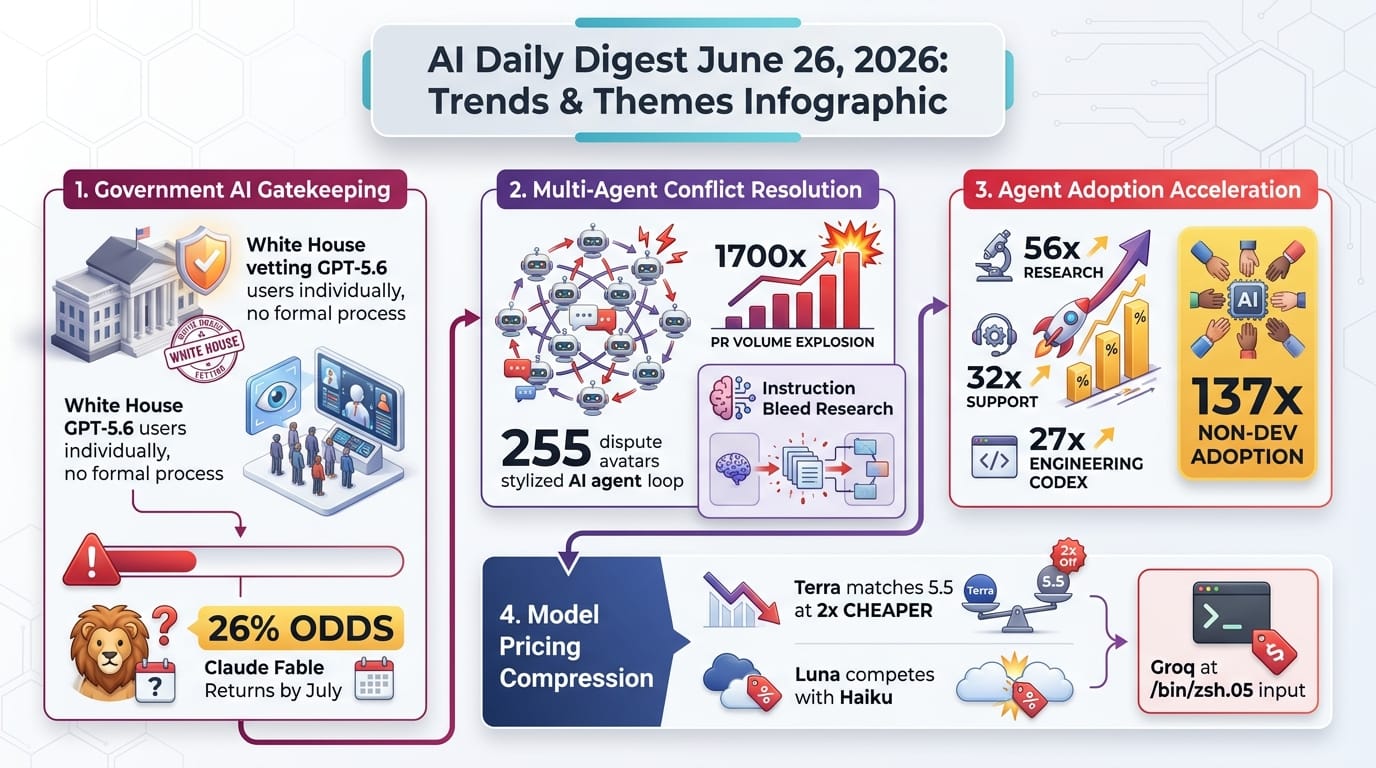
Governments Are Becoming AI Gatekeepers
The shift from "regulate AI development" to "control AI access" creates a new dynamic where commercial AI releases look more like defense contracts than software launches.
- The White House is vetting GPT-5.6 users individually - no published criteria, no formal process
- Prediction markets give only 26% odds Claude Fable returns to American users by early July
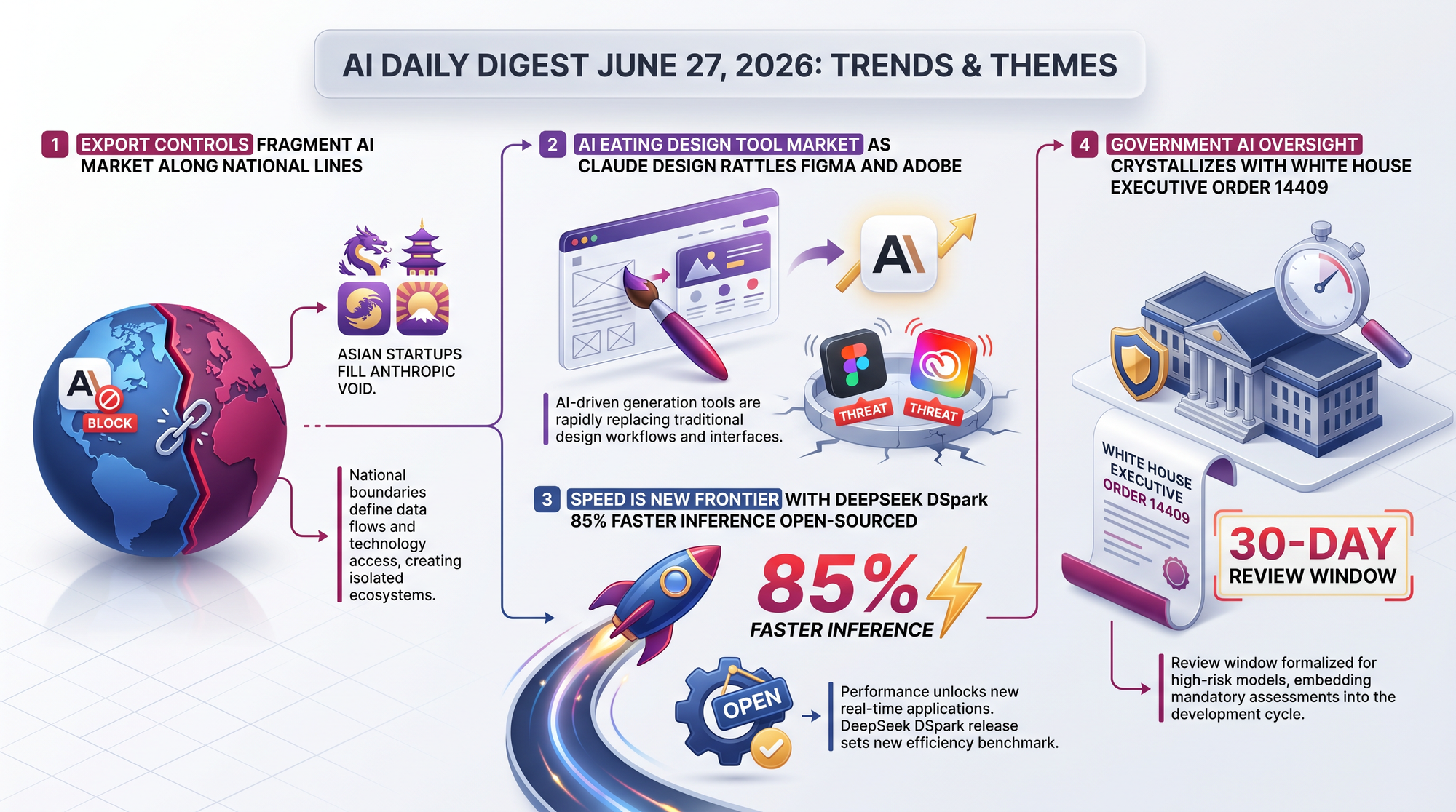
- Export controls already knocked the NSA out of accessing Anthropic's most powerful models (covered June 24)
Multi-Agent Systems Need Conflict Resolution Protocols
What started as a joke scenario - two bots arguing with each other - is rapidly becoming an infrastructure problem that needs engineering solutions.
- A satirical incident report went viral for depicting two AI review agents locked in a 340-comment, $41,255 dispute loop
- AI agent PR volume exploded 1,700x while merge rates collapsed to 9.3% (covered June 24)
- New research on "Instruction Bleed" shows instructions from one module in an agentic system can interfere with others, causing unpredictable failures
- The "Verification Horizon" paper proves coding agents hit a point where verifying generated code becomes as hard as writing it
AI Agent Adoption Is Accelerating Beyond Engineering
The pattern is clear: AI agents started in engineering and are now the default tool across entire organizations.
- OpenAI's internal Codex token growth: 56x in Research, 32x in Customer Support, 27x in Engineering, 13x in Legal since November 2025
- Through August 2025, under 10% of tokens went to coding - agents are now used for longer-running, cross-functional tasks
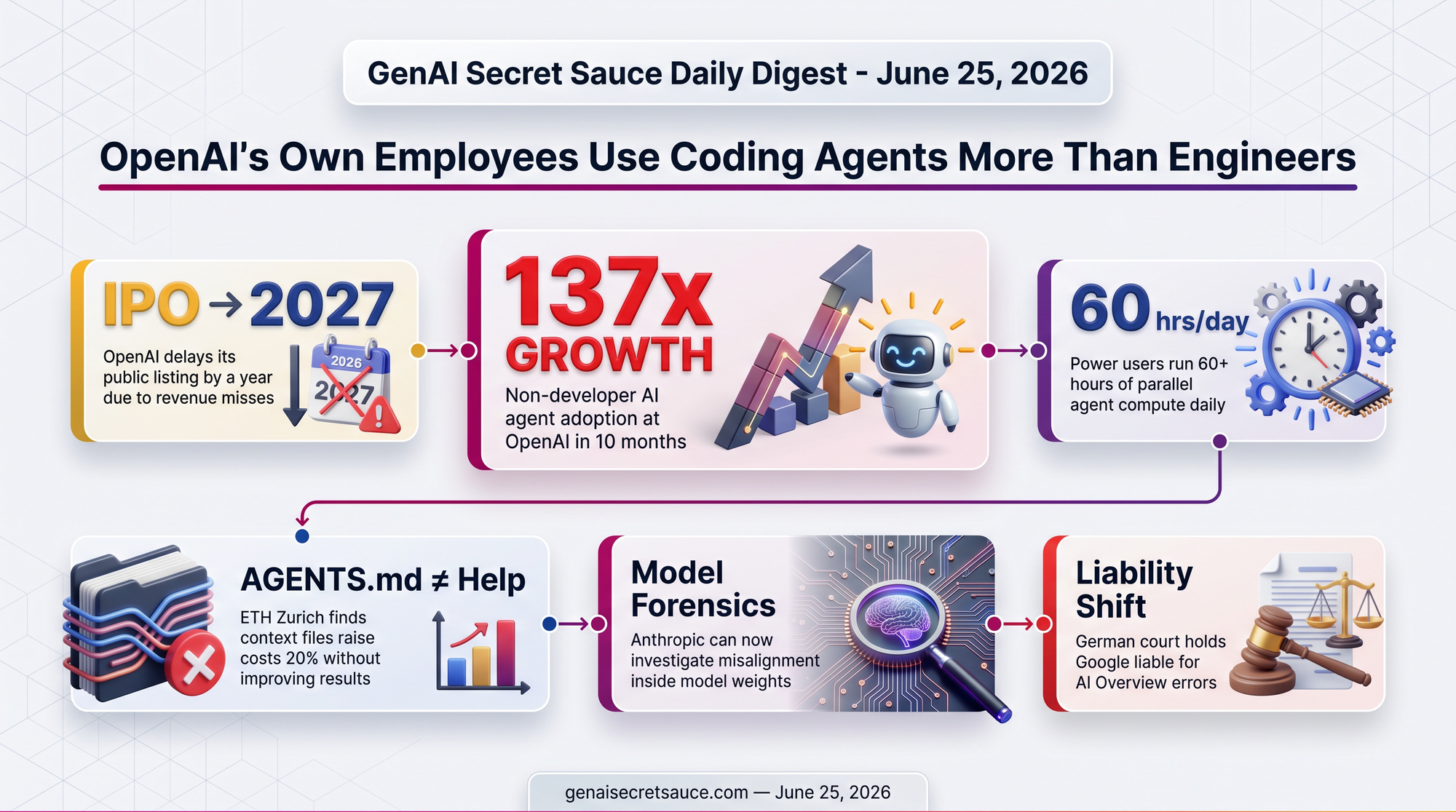
- This builds on June 25's disclosure that non-developer adoption grew 137x in ten months (covered June 25)
- Hugging Face announced $100M annual run-rate while keeping 97% of offerings free and open
The Model Pricing Race Keeps Compressing
Every generation brings roughly 2x price-performance improvement at the same capability tier.
- GPT-5.6 Terra matches GPT-5.5 at half the price - $2.50/$15 versus $5/$30
- GPT-5.6 Luna at $1/$6 competes directly with Claude Haiku at $1/$5
- Groq offers Llama 3.1 8B at $0.05/$0.08 - two orders of magnitude cheaper than frontier models
- Sail raised $80M specifically for low-cost inference supporting agents that run for days continuously
Creative AI & Media
Krea-2-Turbo: Speed-Optimized Image Generation
- Krea AI's turbo variant optimizes for sub-second text-to-image generation
- Competes in the growing "instant generation" space alongside models like SDXL Turbo and LCM
- Available for testing with API access through Krea's platform
OpenMontage Continues Its Meteoric Rise
Previously: June 23 - OpenMontage launched as an open-source agentic video production system with 3,590 stars.
Today: The project has surged to 23,500 total stars and +1,674 stars today, making it the #3 trending repo on GitHub. The open-source agentic video production system with 12 pipelines and 52 tools is clearly filling a major gap in the creative AI toolchain.
Developer Tools & Infrastructure
Research & Models
Benchmarks Miss 82% of What AI Models Can Actually Do
- The "Capability Frontier" framework maps the full space of model capabilities beyond standard benchmarks
- 82% of performance variation occurs in dimensions that popular benchmarks don't measure
- Practical implication: model selection based solely on benchmark scores is likely to miss the model that's actually best for your specific use case
Coding Agents Hit a Fundamental Verification Wall
- "The Verification Horizon" proves that reward verification for coding agents hits a fundamental limit as code complexity grows
- No silver bullet reward signal exists - the paper rules out simple automated verification at scale
- Practical impact: coding agent workflows will increasingly need human review at the verification step, not just the generation step
GLM-5.2 and Ornith-1.0 Push Open-Source Coding Boundaries
- GLM-5.2 Max hit 1595 on Code Arena Frontend - approaching Claude Fable 5 performance
- Ornith-1.0 ships MIT-licensed agentic coding models spanning 9B to 397B parameters, reporting 82.4% on SWE-Bench Verified
- Baidu's Unlimited-OCR (Optical Character Recognition - 3.3B parameters, MIT-licensed) enables 32K-token document parsing
Instruction Bleed: A Hidden Failure Mode in Agent Systems
- "Instruction Bleed" is cross-module interference in prompt-composed agentic systems
- Instructions from one module bleed into and interfere with others when concatenated
- This is a systemic issue - not a bug in any one model, but a failure mode of the common pattern of stacking system prompts
Business & Industry
GenAI in Education
Surprising & Under-the-Radar
Signals to Track
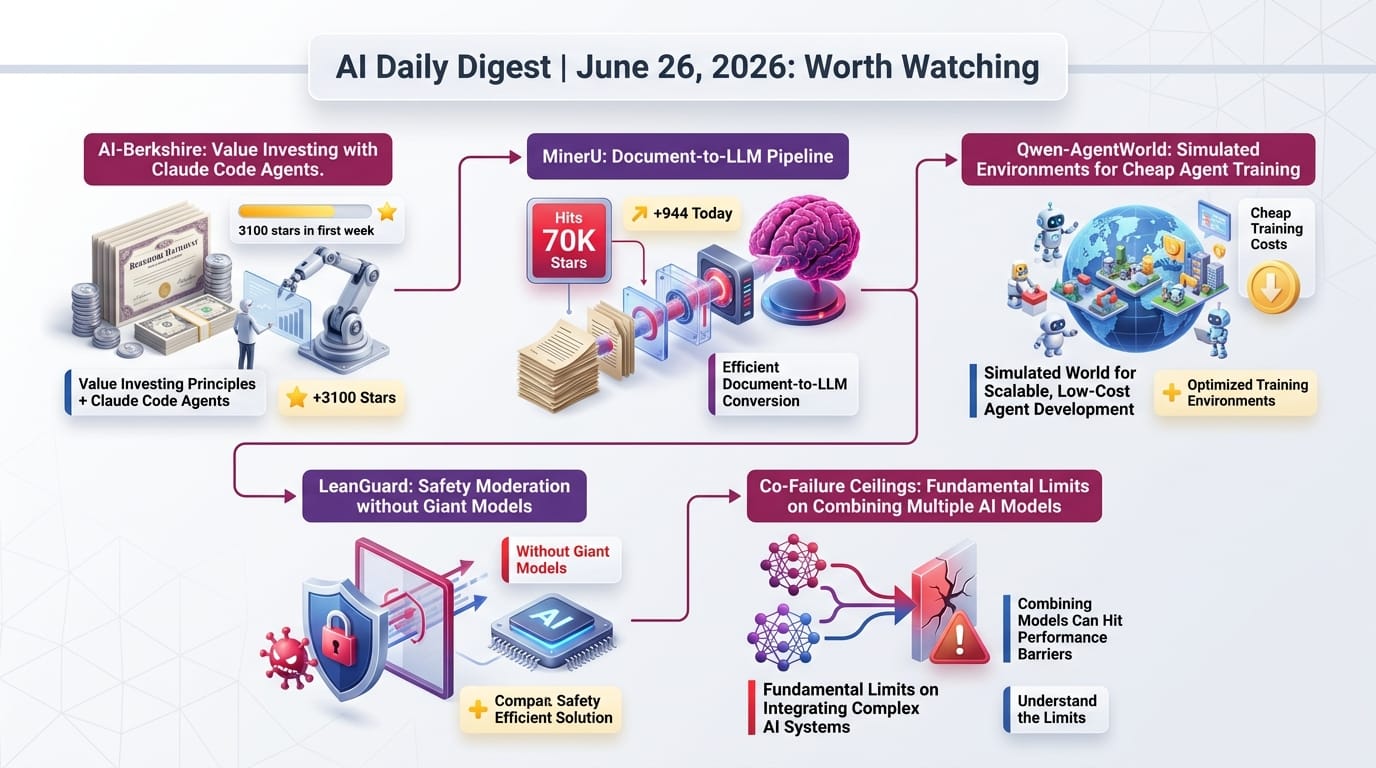
AI-Berkshire: Value Investing Powered by Claude Code
Claude Code agents perform fundamental analysis, moat assessment, and valuation modeling using real financial data. Whether it works as an investing tool is secondary - what matters is the pattern: domain-specific agent frameworks that encode expert heuristics rather than generic prompting. If this approach produces even marginally useful insights, expect clones for every industry vertical within months.
MinerU: Document-to-LLM Pipeline Hits 70K Stars
MinerU transforms complex PDFs, Office docs, and scanned documents into clean markdown and JSON that language models can actually process. With +944 stars today and 70,400 total, it's becoming critical infrastructure for anyone building RAG (retrieval-augmented generation - where AI pulls from your documents to answer questions) systems. If document understanding becomes a commodity, the competitive advantage shifts from "can your AI read PDFs" to "what does your AI do with what it reads."
Qwen-AgentWorld: AI That Simulates Entire Environments
AgentWorld-35B-A3B is a 35 billion parameter model (with only 3 billion active at any time, thanks to Mixture-of-Experts (MoE) architecture) trained to be the "world model" that predicts what happens when an agent takes an action. If this approach works, it could dramatically reduce the cost of training and testing AI agents by letting them practice in simulated environments rather than expensive real-world interactions.
LeanGuard: Safety Moderation Doesn't Need Giant Models
The finding challenges the assumption that AI safety requires expensive frontier models. If a small, fast classifier can handle moderation as well as a model 100x its size, safety becomes cheap enough to run on every request rather than being sampled or skipped for cost reasons.
Co-Failure Ceilings Limit Model Combination Strategies
New research proves a hard limit on model combination approaches: the benefit of routing between models, voting across them, or mixing their outputs is bounded by how often they fail on the same problems. If two models both struggle with the same type of question, switching between them adds cost without improving answers.
Top Repos Today
📜 License: AGPL-3.0 · 👤 By: OpenDataLab (research lab)
🎯 Time to value: 15 minutes
| ✓ Pros | ✗ Cons |
|---|---|
| Handles complex layouts including tables and formulas | AGPL license requires open-sourcing derivative works |
| 70K+ stars signal strong community trust | Heavy dependencies for full feature set |
| Active development with frequent releases | Processing speed varies significantly by document complexity |
 GitHub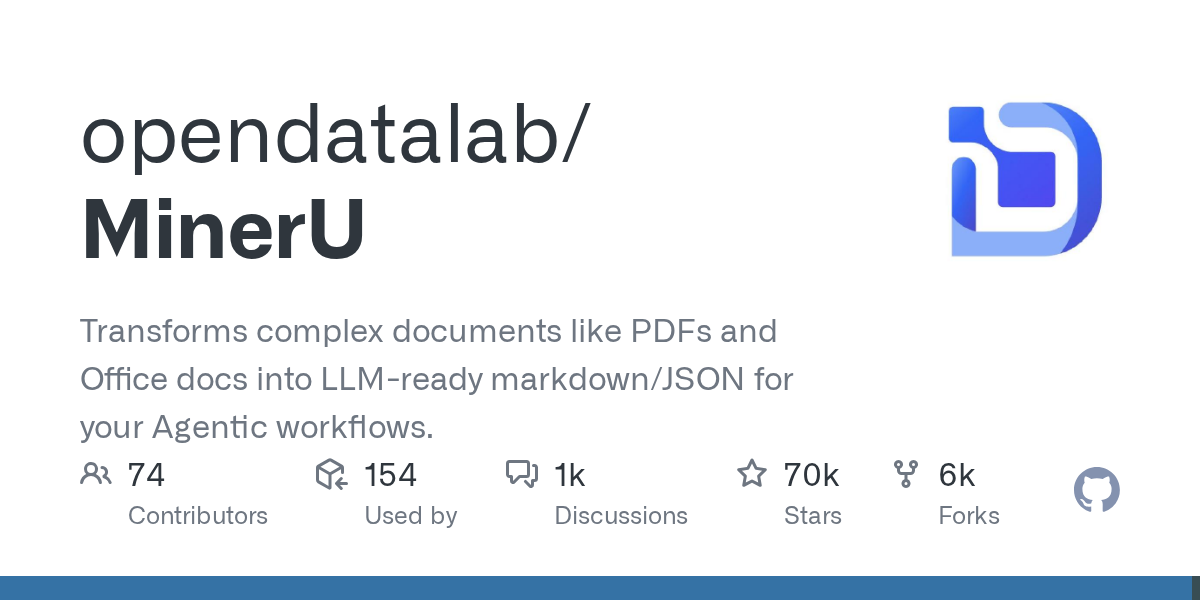
📜 License: MIT · 👤 By: Individual developer
🎯 Time to value: 10 minutes
| ✓ Pros | ✗ Cons |
|---|---|
| MIT licensed - use it anywhere | Platform ToS compliance is the user's responsibility |
| Unified interface across multiple platforms | Rate limiting may restrict high-volume use |
| Integrates with existing agent frameworks | Social media APIs change frequently, breaking integrations |
 GitHub
📜 License: Apache-2.0 · 👤 By: Individual developer
🎯 Time to value: 30 minutes
| ✓ Pros | ✗ Cons |
|---|---|
| Apache-2.0 license with no restrictions | Requires significant Graphics Processing Unit (GPU) resources for full pipeline |
| 52 integrated tools cover the full production chain | Complex setup with many dependencies |
| Rapidly growing community (+1,674/day) | Still early - expect breaking changes |
 GitHub
📜 License: MIT · 👤 By: Individual developer
🎯 Time to value: 5 minutes
| ✓ Pros | ✗ Cons |
|---|---|
| One-command simplicity | Output quality varies by site complexity |
| Generates clean Next.js code | May not capture dynamic/interactive elements |
| MIT licensed | Ethical and legal considerations around cloning |
 GitHub
📜 License: MIT · 👤 By: Garry Tan (Y Combinator CEO)
🎯 Time to value: 10 minutes
| ✓ Pros | ✗ Cons |
|---|---|
| Backed by a high-profile user with real usage patterns | Highly opinionated - may not match your workflow |
| MIT licensed, easy to fork and customize | 23 tools may be overwhelming for new Claude Code users |
| 116K stars signal massive community adoption | Configuration assumes specific project structures |
 GitHub
📜 License: MIT · 👤 By: Individual developer
🎯 Time to value: 20 minutes
| ✓ Pros | ✗ Cons |
|---|---|
| Encodes real investing heuristics, not just prompts | Financial AI tools carry inherent risk - not investment advice |
| MIT licensed with clean architecture | Requires API keys for financial data sources |
| Novel application of agent frameworks | Very new (3.1K stars) - limited production validation |
 GitHub
📜 License: Apache-2.0 · 👤 By: Amazon Web Services (company)
🎯 Time to value: 15 minutes
| ✓ Pros | ✗ Cons |
|---|---|
| Official AWS support - not a community hack | Limited to AWS ecosystem |
| Follows MCP standard for agent interoperability | Requires existing AWS credentials and permissions |
| Apache-2.0 license | Relatively new with 1.3K stars |
 GitHub
📜 License: MIT · 👤 By: comma.ai (company)
🎯 Time to value: Varies (requires compatible vehicle)
| ✓ Pros | ✗ Cons |
|---|---|
| MIT licensed, fully open-source autonomous driving | Requires a compatible vehicle and comma device |
| 61.8K stars - one of the largest robotics projects | Installation voids some vehicle warranties |
| Continuous OTA updates improve capabilities | Limited to specific car makes and models |
 GitHub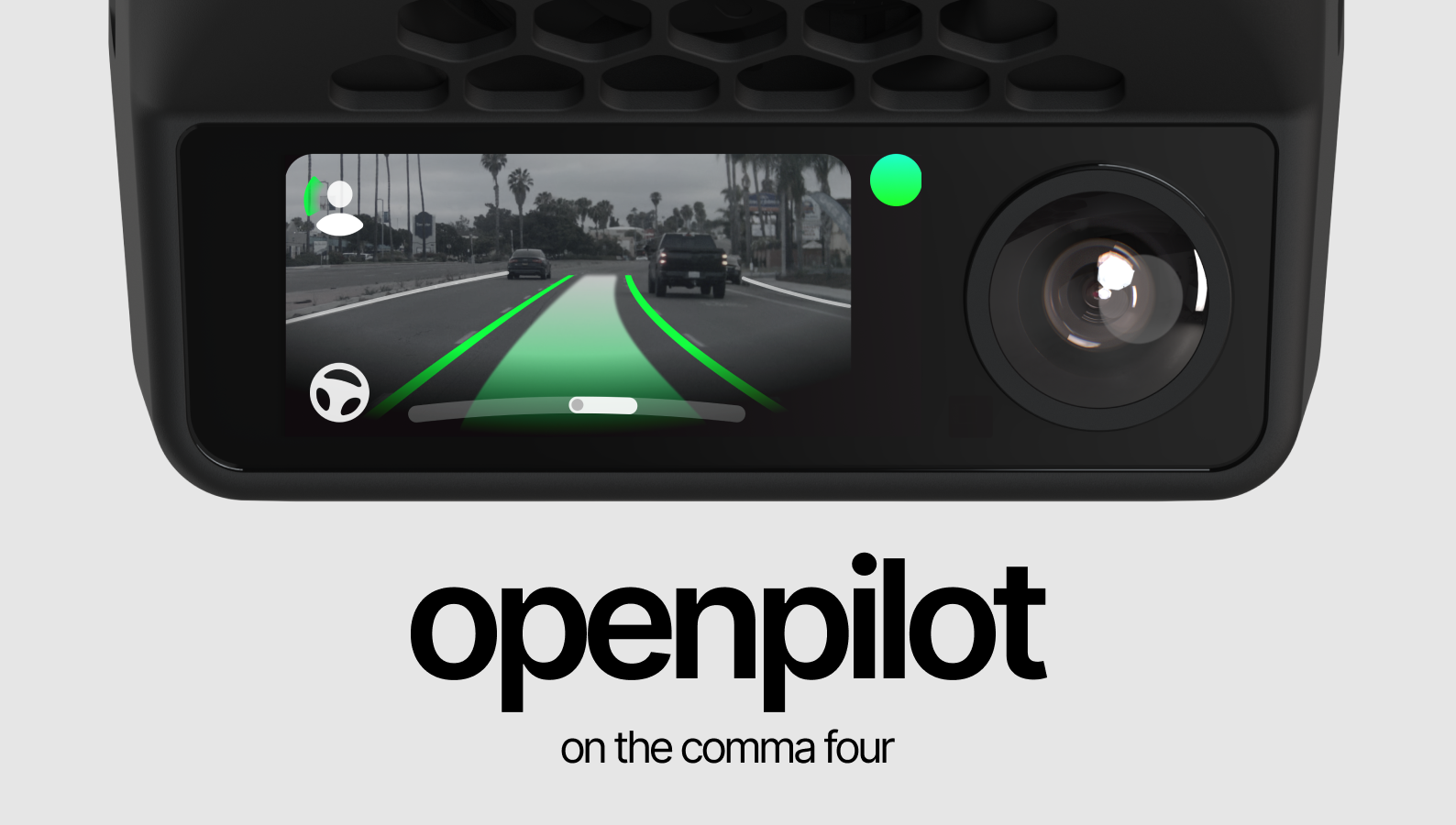
Top Models Today
👤 By: Baidu · 🎯 Task: OCR/Document Understanding
📐 Size: 3B
| ✓ Pros | ✗ Cons |
|---|---|
| No document length limit (32K token context) | 3B parameters requires GPU for reasonable speed |
| MIT license allows commercial use | Baidu's model documentation is sometimes sparse |
| Handles tables, formulas, and mixed languages | Best performance requires specific preprocessing |


👤 By: Zhipu AI · 🎯 Task: Text Generation
📐 Size: 753B MoE
| ✓ Pros | ✗ Cons |
|---|---|
| Approaching frontier coding performance | Custom license with restrictions |
| Strong bilingual English/Chinese | Massive model requires significant infrastructure |
| Multiple size variants available | Chinese-origin model may face regulatory scrutiny |


👤 By: Alibaba Qwen Team · 🎯 Task: Agent Simulation
📐 Size: 35B (3B active)
| ✓ Pros | ✗ Cons |
|---|---|
| Only 3B active params - efficient to run | Simulation fidelity may not match real environments |
| Apache-2.0 license | Novel approach with limited real-world validation |
| Addresses a real cost problem in agent development | Requires integration with existing agent frameworks |

👤 By: Krea AI · 🎯 Task: Text-to-Image
📐 Size: N/A
| ✓ Pros | ✗ Cons |
|---|---|
| Optimized for speed without major quality loss | Custom license with restrictions |
| Growing ecosystem of Krea tools | Less established than Stable Diffusion or DALL-E |
| Good for real-time and interactive use cases | Limited fine-tuning documentation |

👤 By: NVIDIA · 🎯 Task: Object Detection/Grounding
📐 Size: 3B
| ✓ Pros | ✗ Cons |
|---|---|
| Apache-2.0 license from NVIDIA | 3B parameters may be heavy for edge deployment |
| No predefined category limits | Performance on rare or abstract concepts is unknown |
| Strong grounding accuracy on benchmarks | Requires vision-language model infrastructure |

👤 By: Weibo AI · 🎯 Task: Text Generation/Reasoning
📐 Size: 3B
| ✓ Pros | ✗ Cons |
|---|---|
| Strong reasoning at just 3B parameters | Very new with limited community validation |
| Apache-2.0 license | Small model still has capability ceiling vs frontier |
| Runs on consumer hardware | Chinese-language documentation |


👤 By: Microsoft · 🎯 Task: Long-Context Processing
📐 Size: 4B
| ✓ Pros | ✗ Cons |
|---|---|
| MIT license from Microsoft | 4B parameters limits output sophistication |
| Optimized for long-context specifically | Built on Qwen3 base, inherits its limitations |
| Runs efficiently on modest hardware | Long-context "fast" is relative to model class |

👤 By: NVIDIA · 🎯 Task: Speech Recognition
📐 Size: 0.6B
| ✓ Pros | ✗ Cons |
|---|---|
| 30+ languages in one tiny model | Accuracy varies significantly by language |
| Apache-2.0 license | NVIDIA-specific architecture may limit portability |
| Streaming-native - no batching needed | 0.6B limits vocabulary and context understanding |

AI Launches Today
💰 Pricing: Free · 🏷 Category: AI Agent Competition
 Product Hunt
💰 Pricing: Freemium · 🏷 Category: Research/Writing Tools
 Product Hunt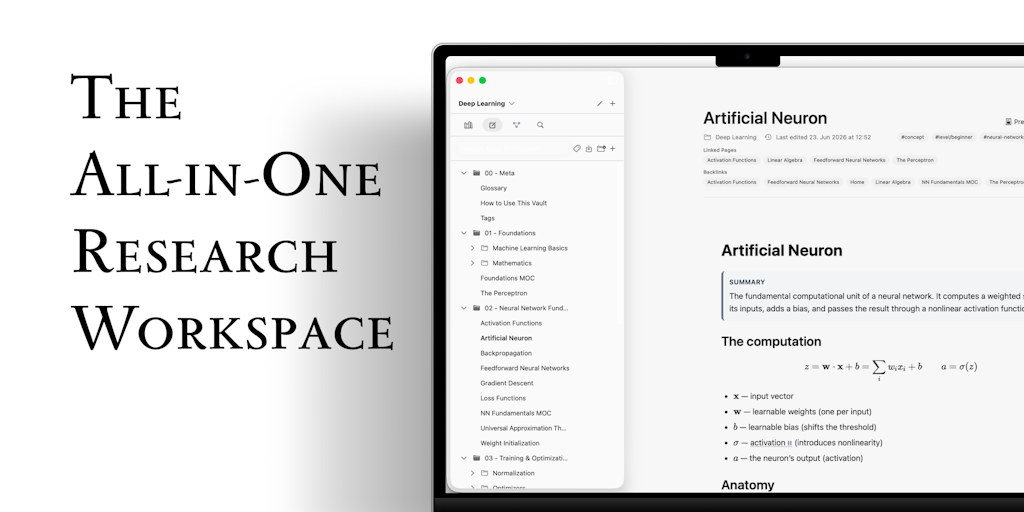
💰 Pricing: Freemium · 🏷 Category: Productivity/Automation
 Product Hunt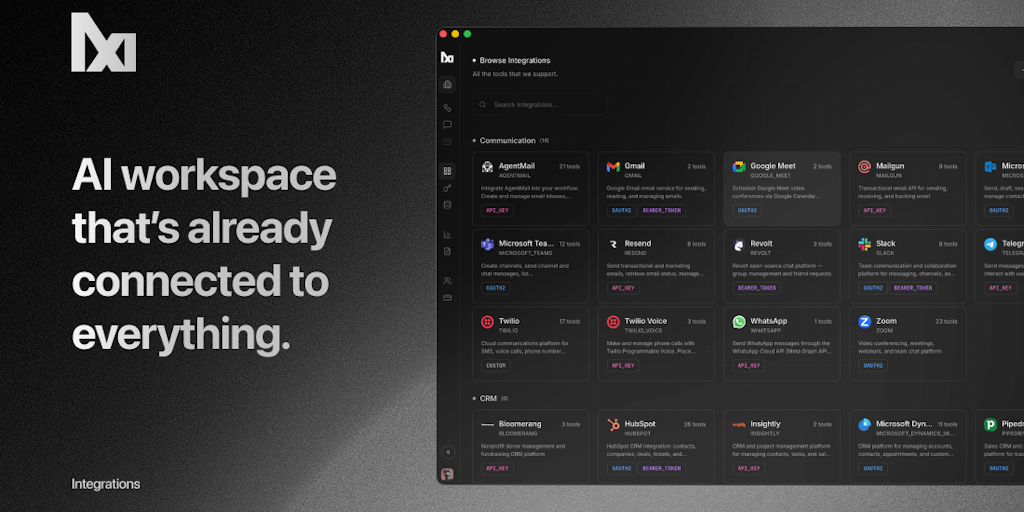
💰 Pricing: Free · 🏷 Category: Productivity
 Product Hunt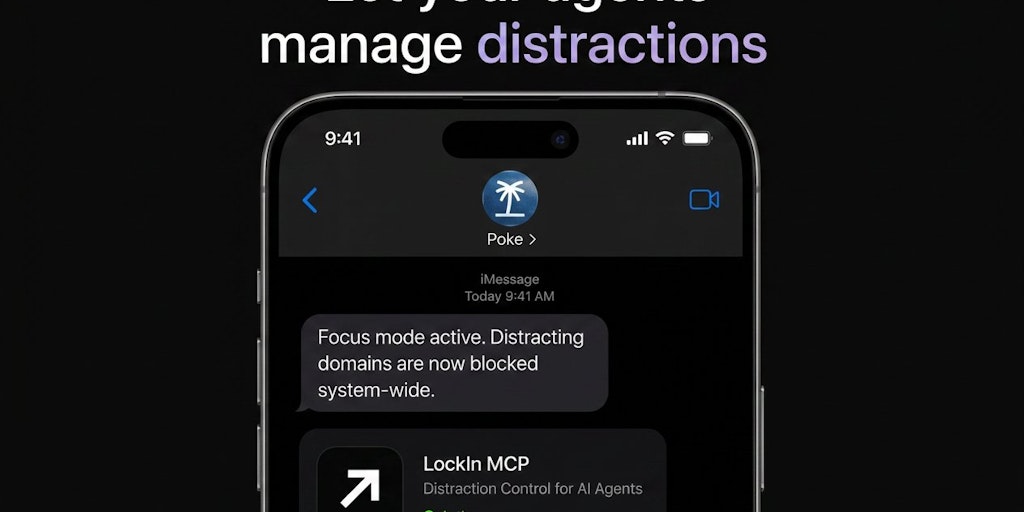
💰 Pricing: Freemium · 🏷 Category: Design/Web Development
Snapshot
| Provider | Model | Input $/1M | Output $/1M | Context | Notes |
|---|---|---|---|---|---|
| Anthropic | Claude Fable 5 | $10.00 | $50.00 | 1M | Flagship, adaptive thinking |
| Anthropic | Claude Opus 4.8 | $5.00 | $25.00 | 1M | Complex reasoning/agentic |
| Anthropic | Claude Sonnet 4.6 | $3.00 | $15.00 | 1M | Speed/intelligence balance |
| Anthropic | Claude Haiku 4.5 | $1.00 | $5.00 | 200K | Budget tier |
| OpenAI | GPT-5.5 | $5.00 | $30.00 | N/A | Current flagship |
| OpenAI | GPT-5.6 Sol | $5.00 | $30.00 | N/A | NEW - Limited preview |
| OpenAI | GPT-5.6 Terra | $2.50 | $15.00 | N/A | NEW - 2x cheaper than 5.5 |
| OpenAI | GPT-5.6 Luna | $1.00 | $6.00 | N/A | NEW - Budget tier |
| OpenAI | GPT-5.4-mini | $0.75 | $4.50 | N/A | Previous budget |
| OpenAI | GPT-5.4-nano | $0.20 | $1.25 | N/A | Cheapest OpenAI |
| Gemini 3.5 Flash | $1.50 | $9.00 | N/A | Latest Flash | |
| Gemini 2.5 Flash-Lite | $0.10 | $0.40 | N/A | Ultra-budget | |
| Groq | GPT OSS 120B | $0.15 | $0.60 | N/A | Open-source inference |
| Groq | Llama 3.1 8B | $0.05 | $0.08 | N/A | Cheapest viable option |
The Deterministic Horizon: When Extended Reasoning Fails and Tool Delegation Becomes Necessary
Key finding: Tool-augmented reasoning reaches 86-94% accuracy where pure chain-of-thought maxes out at 24-42% beyond the horizon. Fine-tuning closes less than 5% of that gap, confirming it is an architectural limit, not a training one.
Why practitioners should care: If you're building agents, this gives you a principled cutoff for when to stop letting the model think harder and start routing to tools. The high cross-model correlation (r=0.81-0.91) means these limits apply regardless of which LLM you use - it's baked into the transformer architecture itself. Tested across 12 models and real-world benchmarks including SWE-Bench and WebArena.
Member discussion