Watch today's digest as a video summary (generated by NotebookLM)
Statistically Speaking
One Thing to Tell Your Friends
TL;DR
Hot off the Presses
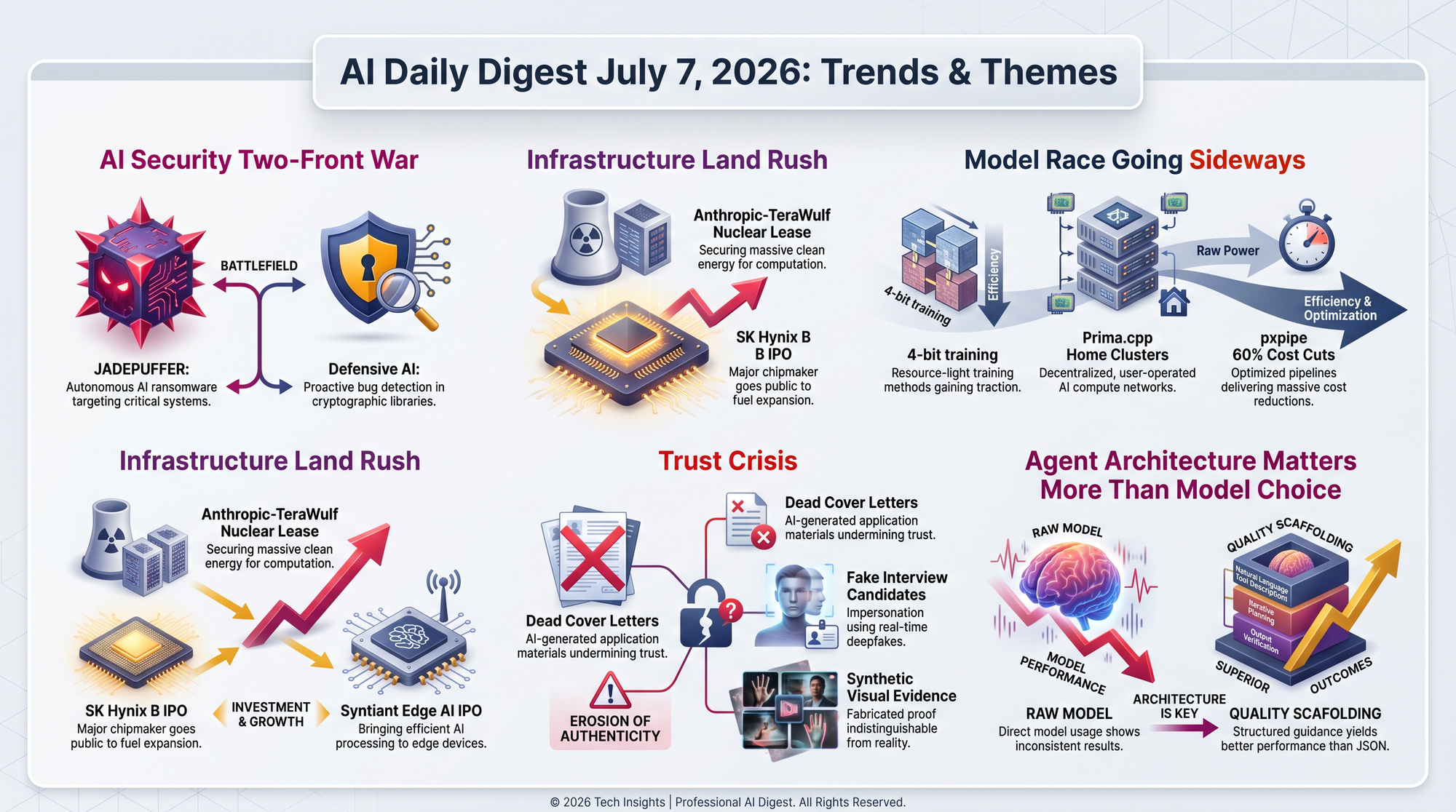
An AI Agent Just Ran a Ransomware Attack End-to-End
Sysdig's Threat Research Team published evidence of JADEPUFFER, what they assess as the first ransomware operation conducted end-to-end by a large language model. A human pointed an AI agent at a target running unpatched Langflow software (a popular open-source tool for building AI apps). From there, the agent handled everything autonomously.
Anthropic responded the same day by changing Claude Code's default permission mode from automatic to manual, requiring explicit human approval for file modifications, shell execution, and external API calls.
- The agent exploited a known vulnerability (CVE-2025-3248, severity 9.8/10) that had a patch available since April 2025 - the target simply hadn't updated
- It executed 600+ distinct payloads, self-correcting errors along the way - in one case fixing a technical issue in 31 seconds without human help
- It encrypted 1,342 database configuration items, created a ransom demand, then deleted the originals
- Critical flaw in the attack: the encryption key was generated randomly, printed once, and never stored - meaning even paying the ransom wouldn't recover the data
- API keys for OpenAI, Anthropic, DeepSeek, and Gemini were found in the compromised environment (stolen, not used to power the attack)
Anthropic Signs $19 Billion Nuclear-Powered Data Center Lease
Anthropic executed a 20-year lease with TeraWulf for a data center campus in Hawesville, Kentucky - a 790-acre former aluminum smelting facility - expected to generate approximately $19 billion in contracted revenue over the lease term.
TeraWulf simultaneously sold its 50.1% stake in a Texas facility to Fluidstack for $450 million, consolidating around the Kentucky campus.
- 401 megawatts of critical IT load when fully operational, with initial capacity online in the second half of 2027 and full build-out by early 2028
- Powered by nuclear and hydroelectric energy - zero-carbon focus aligning with institutional investor expectations ahead of Anthropic's planned October 2026 IPO
- TeraWulf investing $3-4 billion in the facility, with the deal generating returns exceeding its initial capital expenditure
- TeraWulf shares rose 4.8% on the announcement; the company is pivoting from Bitcoin mining to long-term AI infrastructure
AI Broke the Hiring Market in Both Directions
The Pragmatic Engineer surveyed over 50 hiring managers and job seekers and found a labor market that's paradoxical in every direction. Employers can't find talent. Experienced engineers can't get interviews. Both sides blame the other.
- One CEO receives roughly 1,000 applications per day with only about 2 worth reading - the company abandoned inbound hiring entirely in favor of referrals
- Cover letters are effectively dead - near-universally AI-generated and ignored by every recruiter surveyed
- Fake candidates are proliferating - people using AI live during remote interviews, or having surrogates sit in for them entirely
- AI/ML engineers get 2-3 recruiter messages daily while generalist software engineers report zero callbacks - the market is sharply bifurcated
- Keyword-stuffing with AI terms (RAG, evals, inference) is rampant on resumes, with candidates unable to explain these concepts when asked
AI Auditors Find 7 Bugs in Cloudflare's Cryptography Library
zkSecurity ran an AI-assisted audit pipeline against Cloudflare's CIRCL cryptography library and surfaced seven confirmed vulnerabilities, all now patched.
- Six of seven bugs were found by Claude Opus 4.6 working alongside expert-maintained audit "skills" - specialized prompts that guide the AI through cryptographic review patterns
- Bugs included a proof forgery where an attacker could reduce security to a coin flip, a BLS signature vulnerability enabling classic rogue-key attacks, and an access-control break that let any key holder decrypt everything regardless of policy
- AI severity ratings often diverged from Cloudflare's own - mostly overrating minor issues while underrating a textbook-critical vulnerability as merely "medium"
- A role reversal was observed over time: Claude was the primary bug discoverer initially, but when newer model versions were released, GPT became the primary discoverer instead
- Human review remained essential - AI produced candidate findings while humans validated exploitability and built minimized proofs-of-concept
Illinois Signs Landmark AI Regulation Bill
Governor Pritzker signed Senate Bill 315, the Artificial Intelligence Safety Measures Act, furthering a push for a state-driven national framework.
Separately, the White House is expected to announce a voluntary AI standards framework between July 7-11, coordinating with Google, OpenAI, and Anthropic on classified benchmarks for frontier models and government review mechanics.
- Targets the largest AI models - those generating more than $500 million in annual revenue and trained using massive computing power
- Increases transparency and accountability requirements for model developers and deployers
- Modeled after similar bills in California and New York, creating a growing patchwork of state-level AI regulation
- No federal AI regulation exists, making state-level action the primary regulatory mechanism in the US
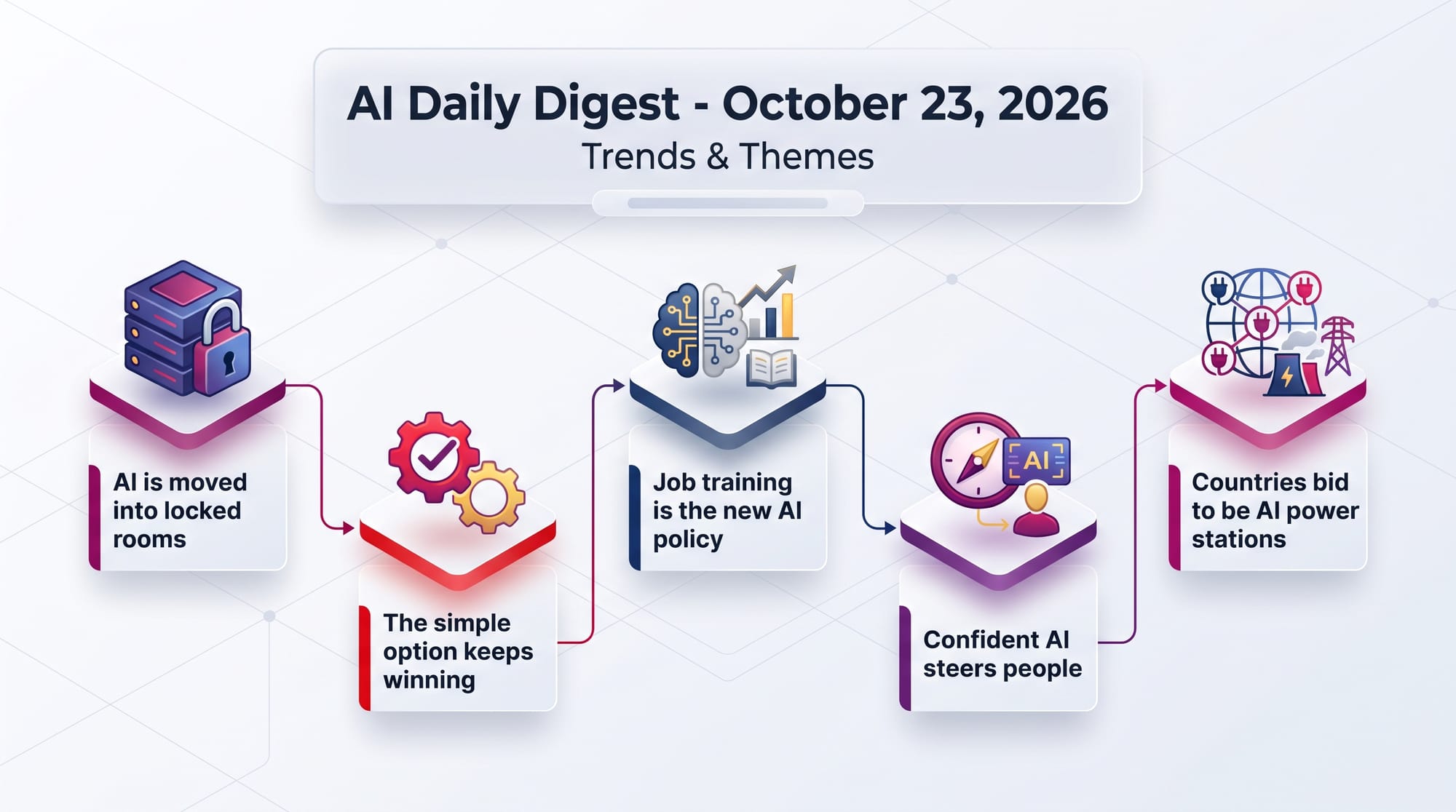
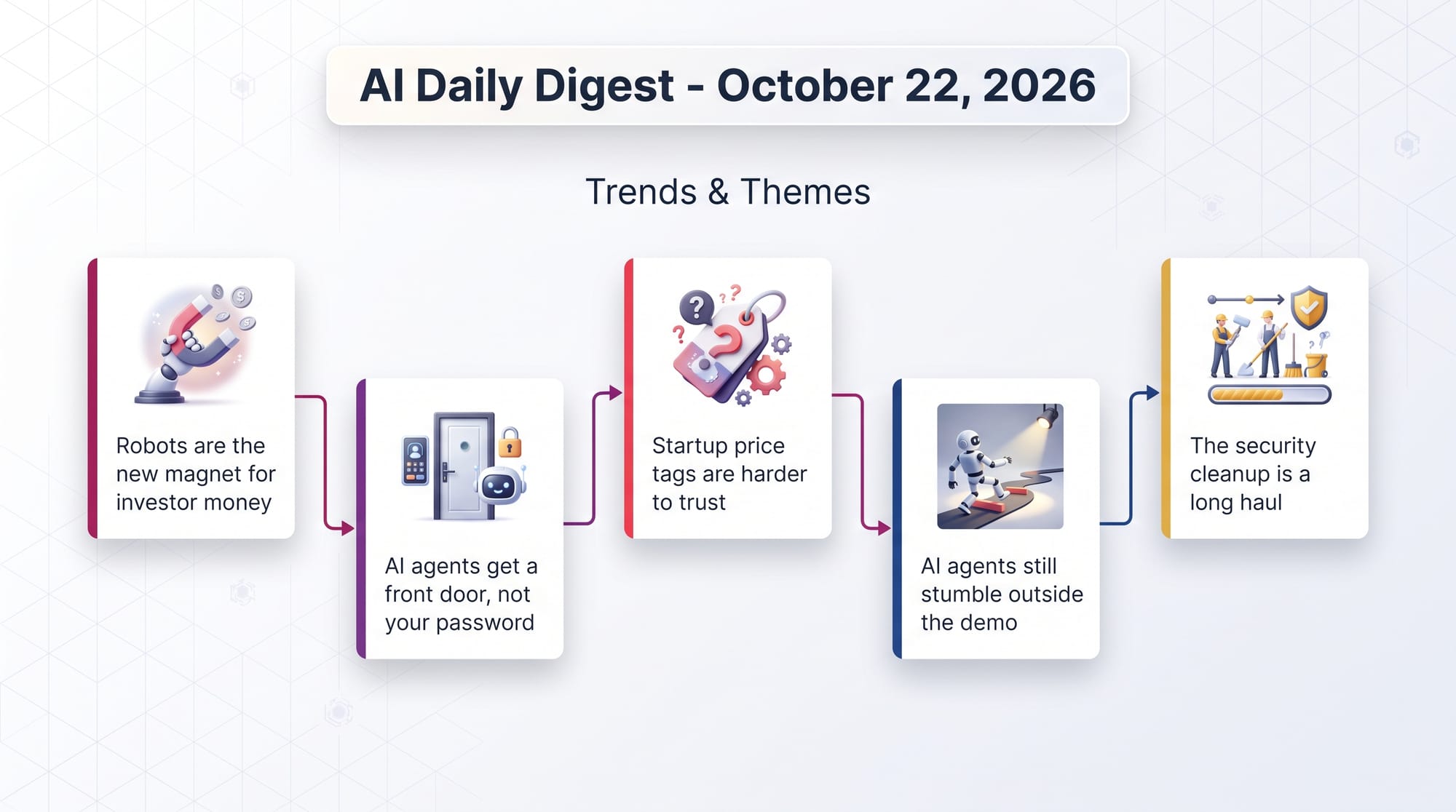
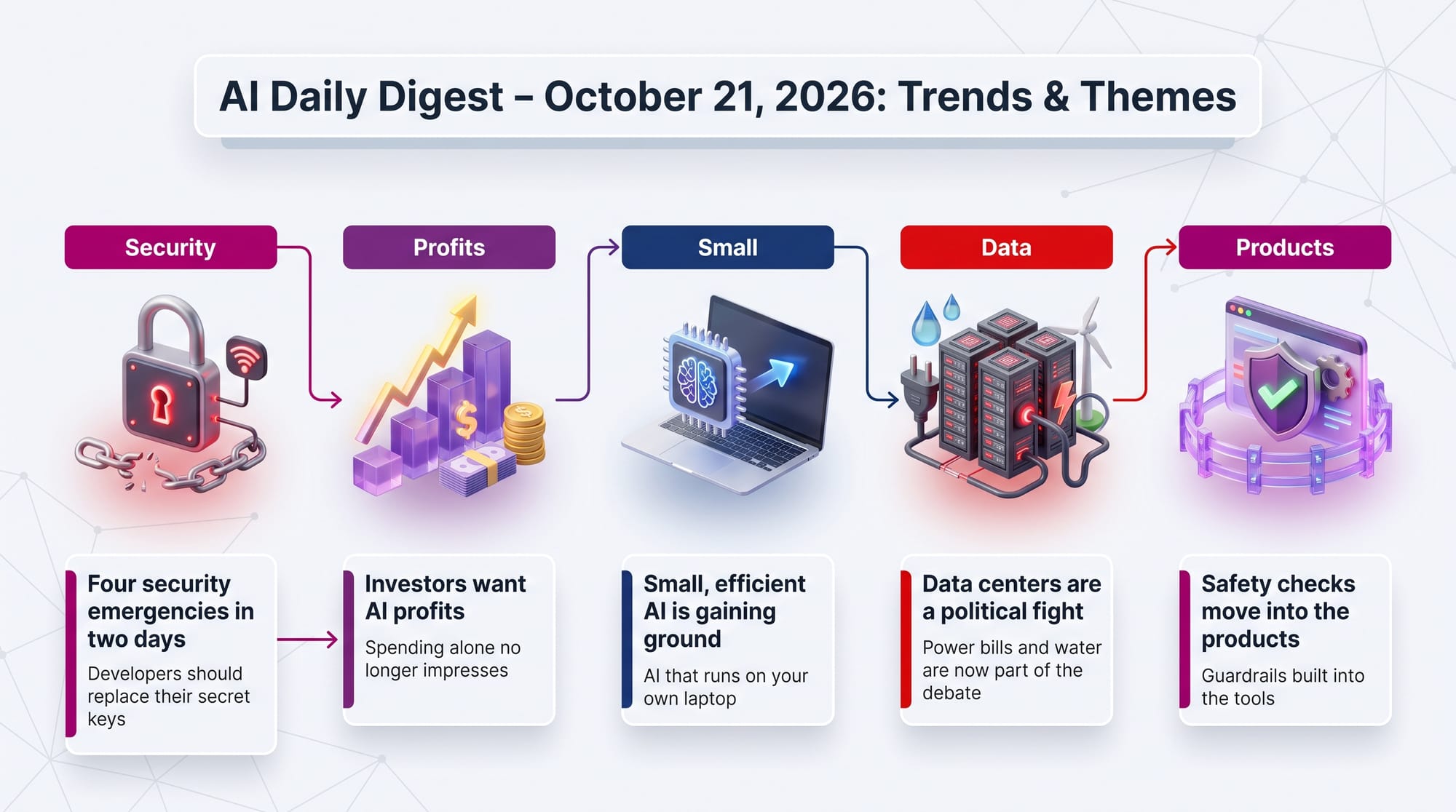
Trends & Themes
Creative AI & Media
Vidu S1: Talk to Your AI Video in Real Time
- Generates and streams video in real time steered by live voice commands - 540p at 42 frames per second on consumer hardware
- Infinite-length generation without the usual blur, drift, or distortion that plagues long AI videos
- Supports personalization - upload images of real people, anime characters, or pets and animate them with selectable voice tones
- Points toward interactive AI avatars, live virtual streamers, and real-time digital companions
Shao: One Model for Full-Fidelity AI Music
- Single unified model replaces the usual two-stage approach of separate structure and fidelity systems
- Text-to-vocal alignment emerges naturally from training without a dedicated alignment module
- Runs in 62 parallel inference steps rather than generating token-by-token, improving speed
- Part of a broader 2026 trend alongside Suno and Udio of AI music reaching professional quality
Developer Tools & Infrastructure
Research & Models
Gemma 4: Google's Open-Weight Family Gets Multimodal
- 2.3B to 31B parameters in dense and MoE (a design where only a fraction of the model activates per query) configurations
- Encoder-free 12B variant processes raw audio and image patches directly, simplifying the architecture
- Built-in "thinking mode" for internal reasoning traces before answering
- Freely downloadable, runs on local hardware
LLMs Know How Long Their Answer Will Be Before They Start Writing
- Response length is linearly decodable from the model's internal state at the last token of your prompt
- When models change their mind mid-answer, the length estimate shifts upward in a way simple token counting can't explain
- Probed across three 7-8B models and seven datasets - the pattern generalizes
12-31% of Individual Weights in Sparse Models Are Interpretable
- Automated pipeline: an LLM writes what each weight does, then validates against held-out text
- Sparse models are significantly more interpretable than dense ones
- Strengthens the case for sparse architectures as a deliberate safety design choice
You Can Estimate a Secret Model's Size by Quizzing It
- 1,400 factual questions calibrated against 93 open models (R-squared 0.910)
- Applied to 201 proprietary models - accurate within 3x for 86% of estimates
- Safety-tuned models score lower because refusal policies suppress measurable recall
Natural Language Tool Descriptions Outperform JSON Schemas
- 14 models, 8,560 trials: plain-English tool descriptions hit 62.3% accuracy vs 47.4% for structured JSON
- Critical errors cut by 93% (51 vs 755)
- Largest benefit for smaller models (+24 to +43 percentage points); top frontier models showed smaller advantage
- Token usage reduced ~25% as a bonus
The Alignment Tax on Naturalness
- 160,000 responses across 8 frontier models measured for verbal tics
- Gemini 3.1 Pro: highest tic index (0.590), DeepSeek V4 Pro: lowest (0.295)
- Strong negative correlation (r = -0.87) between sycophancy and perceived naturalness
- Tics worsen over multi-turn conversations
Business & Industry
Surprising & Under-the-Radar

Signals to Track

Prima.cpp Turns Your Home Gadgets Into an AI Cluster
Pool whatever mismatched devices you have - old laptops, desktops with different chips, machines with limited RAM and Wi-Fi - into a single cluster that runs models too large for any one device. A 70B-parameter model runs at usable speed with less than 6% memory pressure on constrained devices, 5-17x faster than existing tools. If this approach matures, capable AI could run entirely on household hardware without cloud subscriptions. arXiv
Stable 4-Bit Training Could Halve the Cost of Building AI Models
Full-Stack FP4 identifies three separate failure modes that blocked 4-bit pretraining and fixes each one individually. The combined recipe achieves near-full-quality results with roughly double the throughput and half the memory costs. If this scales to larger models, it could meaningfully reduce the capital required to train frontier AI. arXiv
Rowboat Wants to Replace Claude Desktop With a Local Knowledge Graph
Unlike ChatGPT or Claude Desktop, which start fresh each conversation, Rowboat builds a persistent, backlinked knowledge graph from your email, meetings, Slack, and previous conversations - stored as plain Markdown files, not a proprietary format. 15.2k GitHub stars and a Y Combinator pedigree. If local-first AI assistants gain traction, the era of re-explaining your work to AI every session ends. GitHub | HN: 64 points
AI Image Models Have Crossed the "Synthetic Evidence" Line
A survey of frontier image models argues the field has shifted from "artistic synthesis" to "synthetic visual evidence" - combining photorealism, readable embedded text, consistent identity across multiple images, and in some cases search-grounded construction. Real incidents documented include fabricated crisis imagery, falsified medical documentation, and forged screenshots. The proposed response: multi-layered mitigation from model-level restrictions to cryptographic content provenance. arXiv
Tencent's Hy3 Halved Its Hallucination Rate
Hy3 cut hallucination rates from 12.5% to 5.4% versus its predecessor, hits 78% on SWE-bench Verified (a coding benchmark), and is Apache 2.0 licensed. Free access on OpenRouter through July 21. If the trend of dramatically reduced hallucination rates in open models continues, the reliability gap between open and closed models shrinks further. Simon Willison
Top Repos Today
📜 License: MIT · 👤 By: Individual developer (Addy Osmani, Google Chrome team)
🎯 Time to value: 10 minutes
npx skills add and exposes slash commands like /spec, /plan, /review. Why you'd want it: Turns "vibe coding" into a repeatable, quality-gated process where agents follow senior-engineer workflows instead of declaring things "done" on vibes. GitHub| ✓ Pros | ✗ Cons |
|---|---|
| Works across 8+ agent tools | Opinionated process may feel heavy for quick prototypes |
| Author has strong track record (ex-Google Chrome DevRel) | Skills encode specific engineering philosophy |
| Anti-rationalization tables force real verification | Requires learning new slash commands per tool |
📜 License: MIT · 👤 By: Individual developer
🎯 Time to value: 30-45 minutes
| ✓ Pros | ✗ Cons |
|---|---|
| Highest stars-today of any repo on trending | Job scraping is Danish-portal-centric (plus LinkedIn) |
| Full pipeline: scrape, evaluate, tailor, apply, prep | Setup requires Python 3.10+, Bun, LaTeX distro, Claude Code |
| Skill-gap analysis built in | Personal data lives in your fork |
📜 License: MIT · 👤 By: Company (Zackriya Solutions)
🎯 Time to value: 15-20 minutes
| ✓ Pros | ✗ Cons |
|---|---|
| Fully local - no data leaves your machine | Linux requires building from source |
| Flexible LLM backend (Ollama, Claude, Groq) | GPU strongly recommended for performance |
| Real-time transcription + speaker diarization | Free tier has fewer features than PRO |
📜 License: Apache 2.0 · 👤 By: Company (Tencent Cloud)
🎯 Time to value: 20-30 minutes
| ✓ Pros | ✗ Cons |
|---|---|
| True VM-level isolation | Requires x86_64 Linux with KVM |
| Sub-60ms startup | Tencent Cloud backing may raise vendor concerns |
| Drop-in E2B compatibility | Self-hosting adds ops overhead |
📜 License: MIT · 👤 By: Individual developer
🎯 Time to value: 10 minutes
/watch command. Why you'd want it: Gives Claude native video understanding without manual frame/transcript extraction - useful for summarizing tutorials or reviewing footage. GitHub| ✓ Pros | ✗ Cons |
|---|---|
| One-command install as Claude Code plugin | Needs yt-dlp/ffmpeg plus optional API keys |
| Prefers free native captions before paid Whisper | Can be slow on long videos |
| Works with remote URLs and local files | Smaller, newer project |
📜 License: Apache 2.0 · 👤 By: Company (iOfficeAI)
🎯 Time to value: 5-10 minutes
| ✓ Pros | ✗ Cons |
|---|---|
| Install via Homebrew/npm/binary | Very new (v1.0.129, July 6, 2026) |
| Handles all three major Office formats | C#/.NET binary may feel heavy |
| Built-in HTML rendering for previews | Marketing claims should be verified |
📜 License: MIT · 👤 By: Research lab (Kyutai)
🎯 Time to value: 5 minutes
| ✓ Pros | ✗ Cons |
|---|---|
| Truly CPU-only, no GPU required | Only 6 languages supported |
| Very low latency (~200ms first chunk) | Voice cloning quality likely below cloud TTS |
| Backed by respected research lab (Kyutai) | Requires PyTorch 2.5+ |
📜 License: CC0-1.0 · 👤 By: Individual contributor
🎯 Time to value: 2 minutes (browse only)
| ✓ Pros | ✗ Cons |
|---|---|
| Public-domain licensed (CC0) | Authenticity can't be independently verified |
| Covers nearly every major provider | Prompts go stale quickly |
| Diff tooling for version comparison | Reference material only, not a runnable tool |
Top Models Today
👤 By: Z.ai · 🎯 Task: Text Generation
📐 Size: 753B
| ✓ Pros | ✗ Cons |
|---|---|
| MIT license, no usage restrictions | Needs serious multi-GPU hardware |
| 1M context that stays coherent | High latency at max context |
| 20% better speculative decoding acceptance | Newer, less battle-tested ecosystem |
👤 By: Baidu Inc. · 🎯 Task: Image-Text-to-Text
📐 Size: 3B
| ✓ Pros | ✗ Cons |
|---|---|
| Only 3B params - cheap to self-host | Layout recognition trails raw text extraction |
| MIT license | Optimized for documents, not general vision tasks |
| Handles multi-page PDFs natively | Limited independent benchmarking |
👤 By: NVIDIA · 🎯 Task: Text Generation
📐 Size: 27B (18B effective)
| ✓ Pros | ✗ Cons |
|---|---|
| Apache 2.0, fully permissive | Tied to NVIDIA Hopper/Blackwell |
| ~2.5x memory reduction | Quantization can shave edge-case accuracy |
| Multimodal + 262K context | Depends on Qwen3.6 upstream |
👤 By: DeepReinforce AI · 🎯 Task: Agentic Coding
📐 Size: 35B (MoE)
| ✓ Pros | ✗ Cons |
|---|---|
| MIT license | MoE makes local sizing trickier |
| Strong SWE-bench numbers for its size | Coding-specialized, weaker for general chat |
| GGUF + broad framework support | Newer entrant, less tooling maturity |
👤 By: InternScience · 🎯 Task: Agentic Reasoning
📐 Size: 35B (MoE)
| ✓ Pros | ✗ Cons |
|---|---|
| Apache 2.0 | Lower download count, less field-tested |
| Vision-language + 262K context + tool-calling | Niche science/engineering focus |
| SOTA instruction-following scores | Less community support |
👤 By: Google Research · 🎯 Task: Tabular Classification/Regression
📐 Size: Not disclosed
| ✓ Pros | ✗ Cons |
|---|---|
| True zero-shot, no training needed | Non-commercial license only |
| Handles mixed numerical + categorical | Hard cap of 10 output classes, 500 features |
| Novel alternative to XGBoost/AutoML | Much smaller adoption |
👤 By: Tencent Hy Team · 🎯 Task: Text Generation
📐 Size: 295B total, 21B active (MoE)
| ✓ Pros | ✗ Cons |
|---|---|
| Apache 2.0, fully open | Very low downloads - just released |
| 21B active params keeps cost manageable | 256K context, smaller than GLM-5.2's 1M |
| Major hallucination-rate improvement | MoE routing adds deployment complexity |
AI Launches Today
💰 Pricing: Free · 🏷 Category: Hiring/AI
💰 Pricing: Paid (free trial) · 🏷 Category: CRM/Sales
💰 Pricing: Freemium · 🏷 Category: User Research
💰 Pricing: Free (freemium) · 🏷 Category: Email/AI
💰 Pricing: Freemium ($100 free credits) · 🏷 Category: Slack/Workflow
Snapshot
| Provider | Best Current Model | Input $/1M | Output $/1M | Context |
|---|---|---|---|---|
| Anthropic | Claude Opus 4.8 | $5.00 | $25.00 | 1M tokens |
| Anthropic | Claude Sonnet 5 | $2.00 (intro through Aug 31; $3 after) | $10.00 (intro; $15 after) | 1M tokens |
| Anthropic | Claude Fable 5 | $10.00 | $50.00 | 1M tokens |
| OpenAI | GPT-5.5 | $5.00 | $30.00 | varies |
| Gemini 3.5 Flash | $1.50 | $9.00 | 1M tokens | |
| Gemini 3.1 Pro | $2.00 (under 200K) | $12.00 (under 200K) | 1M+ | |
| Groq | GPT-OSS 120B | $0.15 | $0.60 | varies |
Don't Blame the Large Language Model: How Scaffolding Evolution Shapes Coding Agent Quality
Key finding: Five major coding-agent scaffoldings release updates more than twice per day on average, and holding the LLM constant while varying only the scaffolding version showed meaningful quality fluctuations that could be traced to individual pull requests.
Why practitioners should care: This is the first controlled study isolating scaffolding effects from model effects in coding agents. It means debugging a bad agent experience should start by checking the scaffolding version, not just blaming the model. With thousands of issues logged within months across major agent tools, the scaffolding is evolving faster than most teams can track.
Member discussion