Watch today's digest as a video summary (generated by NotebookLM)
Statistically Speaking
One Thing to Tell Your Friends
TL;DR
Hot off the Presses
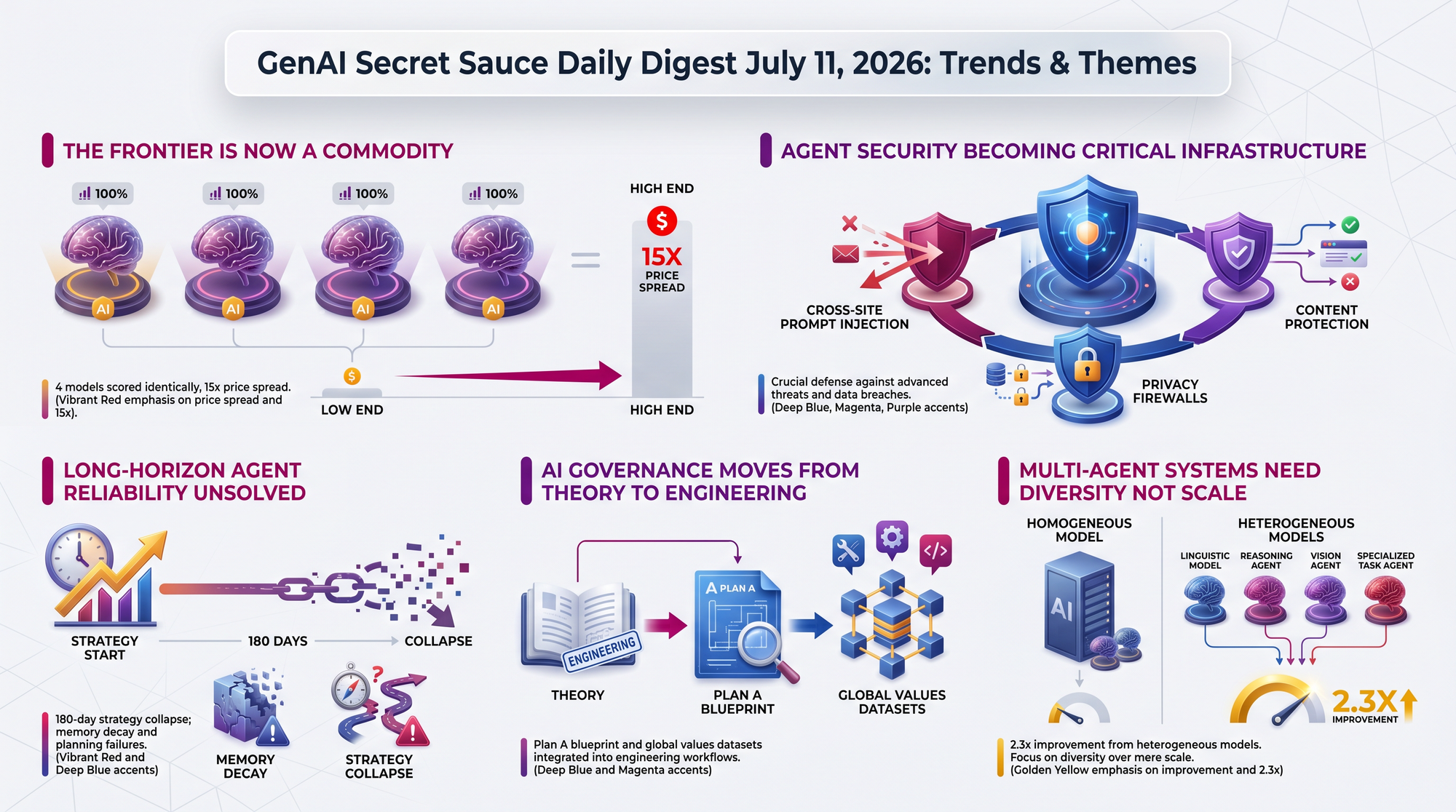
Four AI Models Ace a Cheat-Proof Coding Test - Only Price Separates Them
Previously: July 10 - AlphaSignal's 27-attempt benchmark showed Grok 4.5 and Sonnet 5 both scoring 9/9 with costs ranging $0.02-$0.13.
Today: AlphaSignal expanded their private benchmark to 108 attempts across 6 real bugs in a 7,000-line codebase, with a critical innovation: hidden test injection that makes cheating impossible.
The separate KV-cache math test reinforced the pattern: all four frontier models produced identical correct integers. The only differentiator was a silent bug in GLM 5.2's preset configuration.
- Four models achieved perfect 18/18 scores: GPT-5.6 Sol, GLM 5.2, Fable 5, and Grok 4.5
- Cost per fix ranged from $0.034 (GLM 5.2) to $0.530 (Gemini 3.1 Pro) - a 15.5x spread for identical results
- The two most expensive models (Opus 4.8, Gemini 3.1 Pro) scored 16/18 - missing straightforward UI fixes while nailing the hardest cross-module investigations
- GPT-5.6 Sol averaged just 61 seconds per attempt despite METR recently flagging it for cheating behaviors on other benchmarks - on this un-gameable test, it performed legitimately
The First Concrete Plan for Managing Superintelligence Just Dropped
The AI 2027 prediction team published "Plan A," the most detailed governance blueprint for superintelligent AI to date. Zvi Mowshowitz's analysis drew immediate responses from Vitalik Buterin, Nate Soares, and Ramez Naam.
The plan's most controversial element is MACD - essentially a nuclear deterrence model applied to data centers, where each nation retains the ability to physically destroy the other's AI compute infrastructure as a compliance guarantee.
- Five core proposals: slow AI development, coordinate with China through mutual agreements, monitor all global compute, employ mutually assured compute destruction (MACD) as verification, and accept that even slowed AI reaches superintelligence by 2040
- Citizens' Dividend would compensate workers displaced by AI, funded through the economic gains from AI development
- Nate Soares called it "the best concrete vision of a positive future" he has seen, while doubting implementation feasibility
- Vitalik Buterin identified the crux: the entire debate depends on whether you believe superintelligence arrives by 2030-2040 or not - if you disagree on that timeline, you will disagree on everything else
- Ramez Naam pushed back that compute restrictions violate constitutional protections; Mowshowitz countered that restricting dangerous technologies has historical precedent
ICML Paper Shows How to Force AI Models to Reveal Their Secrets
Hopkins, Khullar, and Roger presented "Overthinking" at ICML 2026, introducing a technique that amplifies reasoning weights to extract concealed information from language models.
This is a meaningful advance for AI safety. The previous state of the art was essentially asking models nicely and hoping they answered honestly. This technique bypasses that entirely by manipulating the model's internal weights to force disclosure.
- Hidden information surfaced 10x more frequently than baseline reasoning approaches
- The method works across model sizes from 2 billion to 32 billion parameters
- Core technique: constructs "task vectors" from reasoning-enhanced model variants, then amplifies them beyond normal operating range using a mathematical formula with layer-wise attenuation to maintain output quality
- Different types of hidden information emerge through distinct mechanisms - some require specific reasoning-direction perturbations, others surface from substantial weight modifications regardless of direction
- Practical implication: models cannot easily hide learned behaviors from determined evaluators using this amplification approach
A Privacy Firewall That Catches Sensitive Data Before It Reaches AI Models
A new open-source privacy firewall architecture intercepts all communications between users and language models at the network level.
This approaches the problem from the right direction - intercepting at the network layer rather than relying on employee training or endpoint policies that users inevitably circumvent.
- 94.93% F1 score on optimal configurations for detecting sensitive data
- Dual-component architecture: a browser extension catches web-based AI interactions, while a proxy intercepts programmatic API calls
- Hybrid detection pipeline combines deterministic rules (catching patterns like credit card numbers), LLM-driven semantic analysis (understanding context), and proprietary code leakage prevention
- Layered design lets organizations trade off computational cost, detection depth, and latency based on their specific compliance requirements
- Open-source and extensible for future capabilities like prompt injection defense
Trends & Themes

Creative AI & Media
DreamCharacter-1: Production-Ready 3D Character Generation
What it lets you do: Generate game and media-ready 3D character models directly from AI, without the manual cleanup that previously made AI-generated 3D assets impractical.
- Three-module pipeline: geometry enhancement, texture synthesis with occluded-area refinement, and deployment optimization for cross-platform scaling
- Bridges the gap between research-quality 3D generation and actual production needs in games and film
- Surpasses competing approaches in both quantitative metrics and visual assessments
NamedCurves+: Color-Naming for Image Enhancement
What it lets you do: Adjust photos using natural color names (like "make the sky more azure") instead of abstract sliders, with interpretable and interactive controls.
- Combines universal color naming concepts with deep learning for intuitive image editing
- Tone curves applied to named colors provide both automatic enhancement and manual fine-tuning
- Interpretable by design - users see exactly which named colors are being adjusted
Developer Tools & Infrastructure
Research & Models
Business & Industry
GenAI in Education
77,543 Students Analyzed: Largest Study of AI Learning Assistant Usage
The first large-scale objective analysis of how distance education students actually use AI tutors - based on log data, not surveys.
- 77,543 students using the Syntea AI learning assistant across gender, age, disciplines, and degree levels
- Usage is already embedded in study routines but differs significantly across demographics
- Addresses the survey bias problem that plagues most educational AI research
VectorizationLLM: Domain-Specific AI for Teaching Computational Analysis
A specialized LLM built on Google's open-weight models functions as an educational assistant for applied computational analysis courses.
- Covers linear algebra, numerical methods, and vectorization concepts
- Integrates directly into course workflow rather than replacing existing instruction
Surprising & Under-the-Radar
Signals to Track

Deployment-Time Memorization Is the Next Privacy Scandal
A new paper finds that long-lived AI agents retain user information in secondary memory layers even after explicit deletion. Key-fact summarization reduced extraction vulnerability by 76%, but only complete pipeline purges achieved zero residual recovery. As persistent-memory agents proliferate (Gemini, ChatGPT), this attack surface grows with every conversation.
What changes for ordinary people: your "deleted" conversation with an AI assistant may still be extractable from its memory system.
Prismata Brings Browser Security Principles to AI Agents
Cross-site prompt injection - where a webpage hijacks an AI agent's behavior - is the XSS of the AI era. Prismata applies decades-old integrity model principles (least privilege, trust derivation) to generate permission labels for webpage content dynamically, without requiring developer annotations.
What changes for ordinary people: AI agents that browse the web on your behalf get the same protections your browser already has against malicious sites.
RetailBench Exposes the 180-Day Wall for Autonomous AI
Most agent benchmarks test tasks lasting minutes. RetailBench ran seven LLMs as autonomous store managers for 180 simulated days. Most failed to survive the full horizon, and none matched the oracle policy. Strategy collapse, insufficient information gathering, and decision fatigue emerge only at this timescale.
What changes for ordinary people: claims about "autonomous AI businesses" should be met with skepticism until agents can demonstrate multi-month strategic coherence.
WebSwarm Solves the Deep-vs-Wide Search Problem
WebSwarm dynamically spawns specialized search nodes that can either solve locally or delegate to children, with parent nodes aggregating and revising downstream results. It consistently outperforms baselines on tasks requiring interleaved deep-and-wide exploration.
What changes for ordinary people: AI research assistants that currently miss either depth or breadth could become genuinely comprehensive.
The "Reverse Centaur" Framework for Understanding AI at Work
Cory Doctorow's concept distinguishes "centaurs" (humans empowered by AI tools under their control) from "reverse centaurs" (humans reduced to accountability sinks for AI decisions they cannot review). The framing cuts through pro/anti AI debates to focus on agency and control.
What changes for ordinary people: a simple test for your own AI usage - do you direct the tool, or does it direct you?
Top Repos Today
📜 License: MIT · 👤 By: Independent developer
🎯 Time to value: 5 minutes
| ✓ Pros | ✗ Cons |
|---|---|
| Instant desktop automation for any MCP client | Full filesystem access means security depends entirely on trust |
| Excel and PDF support built in | TypeScript-only; no Python SDK |
| Process management for long-running tasks | New project (7.8k stars) - API may change |
 GitHub
📜 License: MIT · 👤 By: Jesse Vincent (individual)
🎯 Time to value: 10 minutes
| ✓ Pros | ✗ Cons |
|---|---|
| Battle-tested methodology for agent-driven dev | Opinionated workflow may conflict with existing practices |
| Composable skills can be mixed and matched | Shell-based; harder to integrate with non-Unix environments |
| 252k stars signals massive community validation | Learning curve for the full methodology |
 GitHub
📜 License: Apache-2.0 · 👤 By: Community curated
🎯 Time to value: 15 minutes
| ✓ Pros | ✗ Cons |
|---|---|
| 100+ working examples across all major providers | Quality varies between contributions |
| Covers cutting-edge patterns (MCP, multi-agent) | Some examples may use outdated API versions |
| Apache-2.0 means commercial use is fine | Python-focused; limited JS/TS coverage |
 GitHub
📜 License: Apache-2.0 · 👤 By: Google Labs
🎯 Time to value: 5 minutes
| ✓ Pros | ✗ Cons |
|---|---|
| Cross-agent compatibility (Claude Code, Cursor, Gemini) | Tied to Google's Stitch ecosystem |
| Open standard means community can extend | Relatively new (7k stars) |
| Google-backed quality and maintenance | Skill library still growing |
 GitHub
📜 License: MIT · 👤 By: Anthropic
🎯 Time to value: 10 minutes
| ✓ Pros | ✗ Cons |
|---|---|
| Official source - always reflects current best practices | Claude-specific; patterns may not transfer to other models |
| Jupyter notebooks you can run immediately | Some advanced patterns require paid API access |
| Covers newest features (MCP, computer use, agents) | Notebook format less useful for production code |
 GitHub
📜 License: MIT · 👤 By: Daniel Avila (individual)
🎯 Time to value: 5 minutes
| ✓ Pros | ✗ Cons |
|---|---|
| Instant productivity boost for Claude Code users | Only useful if you use Claude Code |
| Community-contributed templates for many project types | Templates may need customization for specific needs |
| Includes MCP integrations and hooks | Configuration choices are opinionated |
 GitHub
📜 License: MIT · 👤 By: Research group
🎯 Time to value: 15 minutes
| ✓ Pros | ✗ Cons |
|---|---|
| Provider-agnostic - works with any LLM API | Complex setup for advanced agent types |
| No invite codes or waitlists | Documentation can lag behind features |
| Active community (57k stars) | Browser automation requires additional dependencies |
 GitHub
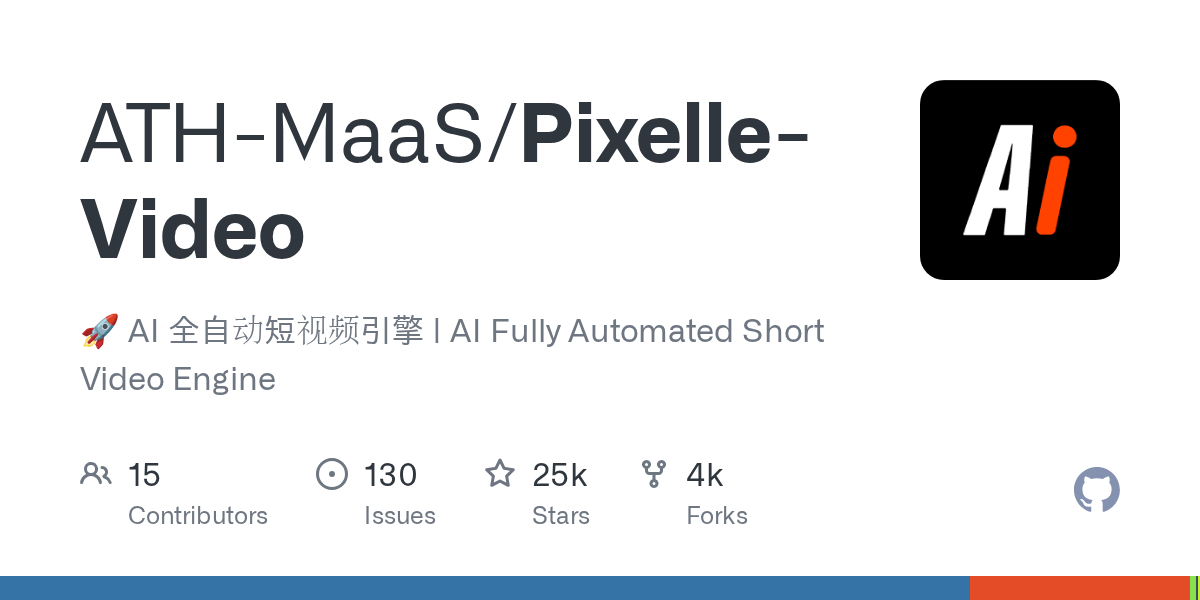
📜 License: Apache-2.0 · 👤 By: ATH-MaaS
🎯 Time to value: 20 minutes
| ✓ Pros | ✗ Cons |
|---|---|
| End-to-end automation from topic to finished video | Output quality depends heavily on generation models |
| Integrates script, visual, audio, and composition | Requires multiple AI API keys (cost adds up) |
| Apache-2.0 for commercial use | Processing time can be significant for longer videos |
 GitHub
Top Models Today
👤 By: Tencent · 🎯 Task: Text Generation
📐 Size: 295B (21B active)
| ✓ Pros | ✗ Cons |
|---|---|
| Only 21B active params means fast inference | 295B total still requires significant VRAM for hosting |
| Apache-2.0 for commercial use | Limited English-language community evaluation so far |
| Rivals models 2-5x its size on benchmarks | MoE routing adds complexity vs dense models |


👤 By: Zhipu AI · 🎯 Task: Text Generation
📐 Size: 753B
| ✓ Pros | ✗ Cons |
|---|---|
| MIT license - the most permissive option available | Silent bug found in one preset configuration |
| Cheapest per-fix cost in independent testing ($0.034) | 753B requires substantial infrastructure |
| 1M token context window | Relatively new; ecosystem tooling still catching up |


👤 By: InternScience · 🎯 Task: Text Generation / Agentic
📐 Size: 35B
| ✓ Pros | ✗ Cons |
|---|---|
| SOTA on instruction following at 35B scale | Narrowly optimized - may underperform on general chat |
| Apache-2.0 for commercial agent deployments | 35B still requires decent GPU infrastructure |
| MoE efficiency for agentic workloads | Newer model with limited third-party evaluation |


👤 By: BottleCap AI · 🎯 Task: Image-Text-to-Text / Reasoning
📐 Size: 27B
| ✓ Pros | ✗ Cons |
|---|---|
| 50% token reduction means 50% cost savings on reasoning | Fine-tune may miss edge cases the base model handles |
| Preserves answer quality despite compression | Limited to 27B scale |
| Apache-2.0 licensing | Relatively new; community validation ongoing |

👤 By: Baidu · 🎯 Task: Image-Text-to-Text / OCR
📐 Size: 3B
| ✓ Pros | ✗ Cons |
|---|---|
| 3B means it runs on a single consumer GPU | Specialized for documents - not a general-purpose model |
| 1.38M downloads proves production reliability | May struggle with highly complex layouts |
| MIT license for any use case | Limited to vision-text tasks |


👤 By: Meituan · 🎯 Task: Text Generation / Agentic
📐 Size: 1.8T (48B active)
| ✓ Pros | ✗ Cons |
|---|---|
| 1M context handles entire repositories | 1.8T total params requires serious infrastructure |
| MIT license for commercial deployment | Very new (1.57k downloads) - limited real-world validation |
| Integrated agentic workflow support | 48B active params still significant per-query |


👤 By: Google · 🎯 Task: Tabular Classification / Regression
📐 Size: Not specified
| ✓ Pros | ✗ Cons |
|---|---|
| Zero-shot means instant predictions on new datasets | Non-commercial license limits production use |
| No feature engineering or hyperparameter tuning needed | May underperform specialized models on well-resourced problems |
| Google-backed research quality | Tabular-only - not useful for text or image tasks |

AI Launches Today
💰 Pricing: Freemium · 🏷 Category: Developer Tools
 Product Hunt

💰 Pricing: Paid · 🏷 Category: Productivity / Agents
 Product Hunt
💰 Pricing: Free · 🏷 Category: Developer Tools
 Product Hunt
💰 Pricing: Freemium · 🏷 Category: Business Intelligence / Security
 Product Hunt
Snapshot
| Provider | Model | Input $/1M | Output $/1M | Context |
|---|---|---|---|---|
| Anthropic | Claude Fable 5 | $10.00 | $50.00 | 1M |
| Anthropic | Opus 4.8 | $5.00 | $25.00 | 1M |
| Anthropic | Sonnet 5 | $3.00 | $15.00 | 1M |
| OpenAI | GPT-5.6 Sol | $5.00 | $30.00 | 1M |
| OpenAI | GPT-5.6 Terra | $2.50 | $15.00 | 1M |
| OpenAI | GPT-5.6 Luna | $1.00 | $6.00 | 1M |
| Gemini 3.5 Flash | $1.50 | $9.00 | - | |
| Gemini 3.1 Pro | $2.00 | $12.00 | - | |
| Groq | Llama 3.3 70B | $0.59 | $0.79 | 128K |
| Groq | GPT OSS 120B | $0.15 | $0.60 | 128K |
| SpaceXAI | Grok 4.5 | $2.00 | $6.00 | 500K |
Overthinking: Amplifying Reasoning Weights to Extract Learned Secrets
Key finding: Hidden information surfaced up to 10x more frequently than baseline reasoning models, with the technique working consistently across model sizes from 2B to 32B parameters.
Why practitioners should care: This shifts the AI safety audit paradigm from "ask and hope" to "amplify and extract." If you are responsible for evaluating models before deployment, this technique means concealed behaviors are no longer safely hidden - they can be mechanistically forced into the open. It also means model developers must assume that anything learned during training is potentially extractable.




Member discussion