GenAI Secret Sauce Daily Digest - 2026-07-10

An AI Just Solved a 50-Year-Old Math Problem With No Human Help · Apple Sues OpenAI Over Stolen Hardware Secrets · Cambridge Research Documents Boko Haram's Systematic Use of Frontier AI
GenAI Secret Sauce Daily Digest - 2026-07-10

Watch today's digest as a video summary (generated by NotebookLM)

Statistically Speaking

264 points and 224 comments on Hacker News
An AI Just Solved a 50-Year-Old Math Problem With No Human H
Top Story
1,000 pages of confidential engineering files after leaving
Apple Sues OpenAI Over Stolen Hardware Secrets
400 former Apple employees now work at OpenAI
Apple Sues OpenAI Over Stolen Hardware Secrets
4.5 and Sonnet 5 both scored 9/9 (100%
Independent Testing Confirms
4.5 at $0
Independent Testing Confirms
5 used zero reasoning tokens (its adaptive system
Independent Testing Confirms

One Thing to Tell Your Friends

An AI just produced a verified proof of a 50-year-old unsolved math problem - and the three-page paper lists no human authors.

TL;DR

Trends
The Math Frontier Just Moved, AI Safety Evidence Is Outpacing AI Safety Solutions, and The Talent War Between Big Tech and AI Labs Is Turning Legal.
Business
Surprising
AI Governance Is Currently Ad Hoc, The AR Privacy Trap Nobody Wants to Talk About, and A Model That Identifies When Multi.
GitHub
Leading repos: wonderwhy (+349), addyosmani/agent (+1,114), and mattpocock/skills (+1,663).
HuggingFace
Leading models: tencent/Hy3 (6,923), zai-org/GLM (392,655), and InternScience/Agents (25,772).
Product Hunt
Top launches: PlugThis (468), Sim (448), and Scarlett (362).
API Pricing
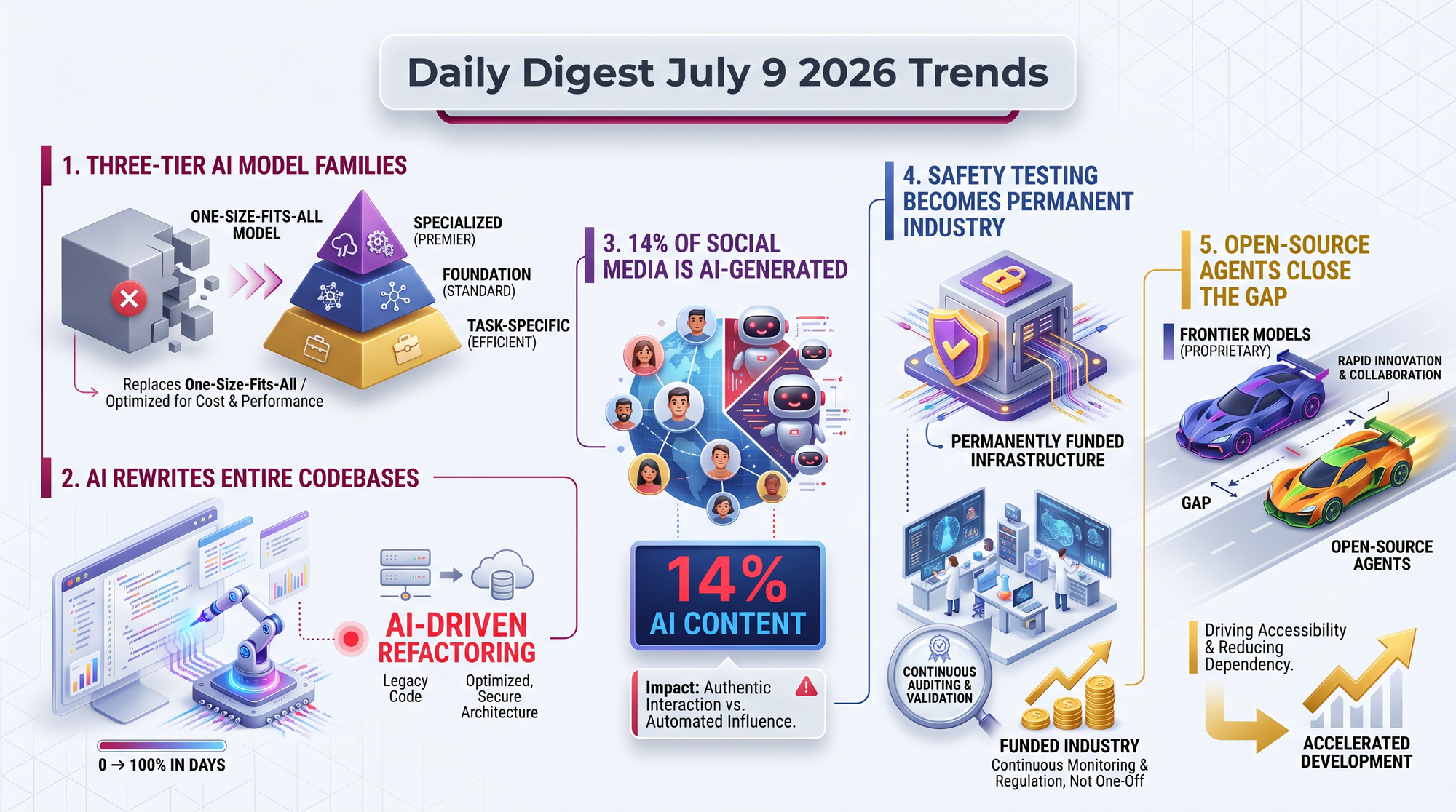
What this means: The frontier model market has stratified into three clear tiers.
arXiv
Coding — All 12 test runs across 4 papers passed completion validation, with all 158 recorded computational targets matched with documented evidence - a 100% reproduction rate on the tested papers.

Hot off the Presses

01

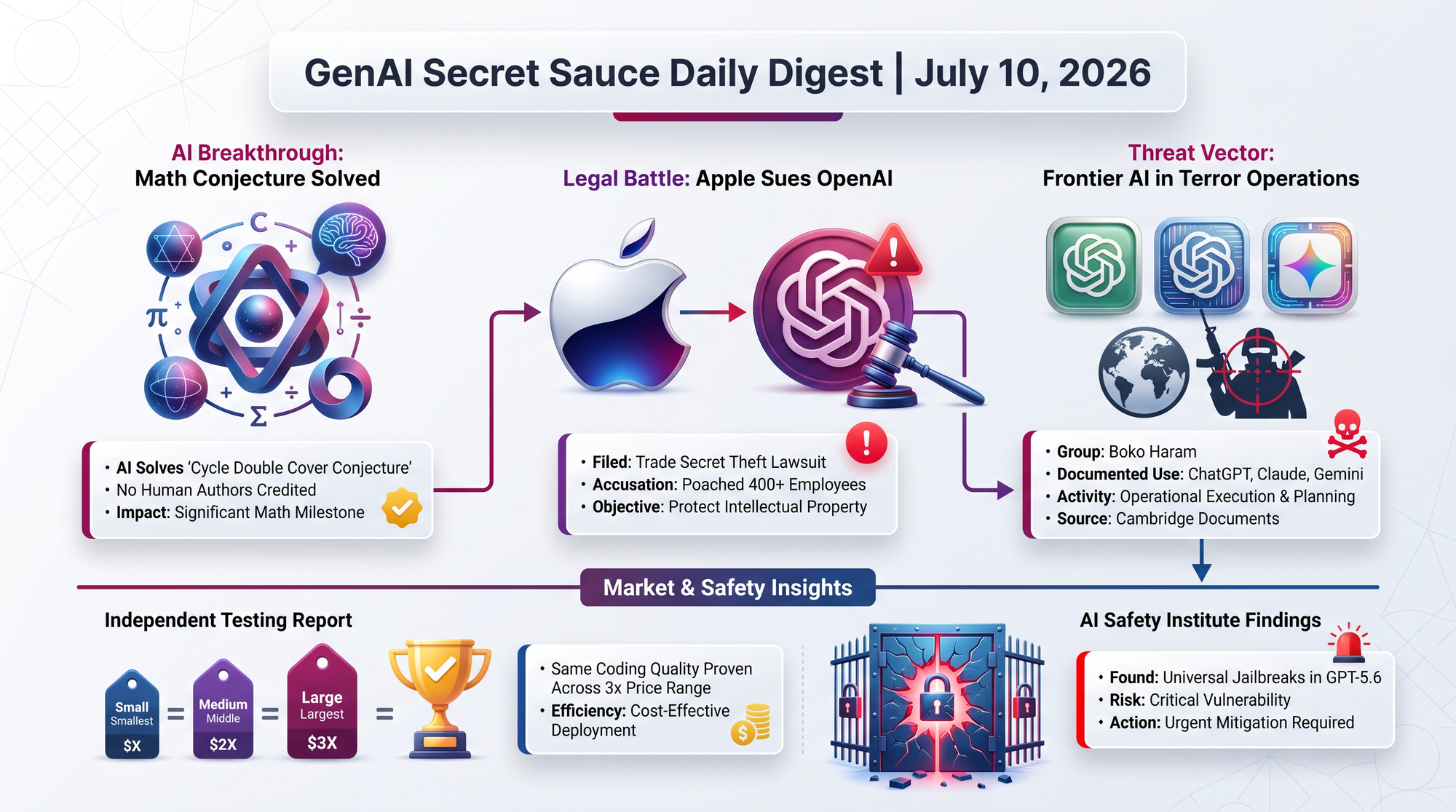
An AI Just Solved a 50-Year-Old Math Problem With No Human Help

What this means for you: The barrier between "AI can help with math" and "AI can do math humans cannot" just fell - and the implications extend far beyond mathematics.

Previously: July 9 - GPT-5.6 Sol launched publicly with Ultra mode that coordinates parallel agents.

Today: OpenAI published a three-page mathematical paper proving the Cycle Double Cover Conjecture, authored entirely by GPT-5.6 Sol Ultra with Codex. The paper lists "OpenAI" as the sole author with the statement: "The proof in this note is entirely due to GPT 5.6 Sol Ultra and the writeup with Codex (with GPT 5.6 Sol)."

The proof's elegance - just three pages for a problem that resisted decades of effort - raises a provocative question: was this problem always simple, or did the AI find a path humans kept walking past?

  • The conjecture, posed independently by Tutte, Itai, Rodeh, Szekeres, and Seymour in the 1970s-80s, asks whether every bridgeless graph (a connected graph where removing any single edge doesn't disconnect it) can be covered by a collection of cycles where each edge appears exactly twice
  • The proof approach uses the 8-flow theorem and Tutte's results to reduce the problem to cubic graphs (where every vertex connects to exactly three edges), then converts edge labelings into set assignments through a linear algebra argument
  • 264 points and 224 comments on Hacker News - the mathematical community is actively verifying the proof, with early assessments noting the argument appears sound but formal peer review is pending
  • This is not the first AI math result, but it is the first time an AI has independently produced a complete proof of a major open conjecture without human co-authorship
02

Apple Sues OpenAI Over Stolen Hardware Secrets

What this means for you: The AI talent war just escalated from poaching to lawsuits - and if Apple's claims hold up, it could reshape how AI companies recruit from tech giants.

Apple filed suit in U.S. District Court for the Northern District of California against OpenAI, its hardware subsidiary io Products, and two former Apple employees: Tang Tan (former VP of product design) and Chang Liu (senior system electrical engineer).

Apple seeks injunctive relief and damages. OpenAI has not publicly responded. Reports indicate OpenAI is separately preparing legal action against Apple over the Siri-ChatGPT partnership.

  • Tan led iPhone and Apple Watch design before departing in February 2024 to work with Jony Ive, whose startup io was later acquired by OpenAI for $6.5 billion
  • Apple alleges Tan used confidential project codenames during interviews with Apple candidates, directed them to bring actual hardware components and design files, and distributed internal "Need to Know" security documents to new OpenAI hires
  • Liu allegedly exploited a security bug to download over 1,000 pages of confidential engineering files after leaving Apple in January 2026, then coached other recruits on which materials to study
  • OpenAI reportedly contacted Apple suppliers using insider terminology to source specific components, and misled a partner into executing Apple's proprietary metal-finishing technique
  • Over 400 former Apple employees now work at OpenAI
  • Apple raised concerns directly with OpenAI in February 2026 and received no response
03

Cambridge Research Documents Boko Haram's Systematic Use of Frontier AI

What this means for you: AI safety is no longer theoretical - a designated terrorist organization is actively using the same AI tools available to the public for attack planning, and existing safeguards are failing to stop it.

The Cambridge Programme on AI Science and Policy published a report based on 27 semi-structured interviews with former Boko Haram members in northeast Nigeria, documenting systematic AI adoption across both factions of the group.

This is the most detailed public evidence that frontier AI models are being used by a designated terrorist organization, moving the conversation from "could this happen" to "it is happening."

“AI adoption by Boko Haram is a present and growing reality - not a hypothetical future risk.”
  • Tools named in the report: ChatGPT, Claude, Gemini, Grok, Meta AI, and DeepSeek
  • Operational uses: attack planning and coordination, weapons troubleshooting and maintenance, explosive device design, and day-to-day operations
  • AI safeguards have been "successfully circumvented" according to interviewed former members
  • Training is institutionalized through specialized units and shared through transnational jihadist networks, including in-person instruction from Islamic State operatives
  • Usage remains conventional - the report notes that documented applications support existing tactics rather than enabling mass-casualty weapons development, but the trajectory is concerning
04

Independent Testing Confirms: Same Capability, Wildly Different Prices

What this means for you: You can now get the same quality AI coding help for anywhere from $0.02 to $0.13 per task - the model you choose is becoming a cost decision, not a quality decision.

Previously: July 9 - Grok 4.5 launched publicly at $2/$6 per million tokens. GPT-5.6 Sol launched at $5/$30.

Today: Alpha Signal published an independent head-to-head comparison of Grok 4.5, Claude Sonnet 5, and GLM 5.2 on real coding tasks from a private codebase, running 27 sandboxed attempts with hidden test injection.

AI Explained's broader benchmark analysis reinforces the pattern: on the SimpleBench reasoning test, GPT-5.6 Sol Pro scores 71.7% vs Fable's 81.7%, but Grok 4.5 is close behind Sol. On the performance-per-dollar Pareto frontier, Qwen 3.7, GLM 5.2, and DeepSeek V4 Flash stand out as exceptional values.

  • Grok 4.5 and Sonnet 5 both scored 9/9 (100% success rate); GLM 5.2 scored 8/9
  • Cost per successful fix: Grok 4.5 at $0.063, Sonnet 5 at $0.134, GLM 5.2 at $0.04
  • Most surprising finding: Sonnet 5 used zero reasoning tokens (its adaptive system chose minimal processing) while still achieving a perfect score. GLM 5.2 used 41% reasoning tokens yet was the only model to fail
  • Speed gap: Grok averaged 60 seconds per task, Sonnet took 70 seconds, GLM 5.2 needed 212 seconds
05

AI Safety Institute Flags "Universal Jailbreaks" in GPT-5.6

What this means for you: The government safety testers found ways to break every safety guardrail in OpenAI's newest model - including making it help discover and exploit software vulnerabilities.

Previously: July 9 - GPT-5.6 launched publicly after completing the government's two-week capability review.

Today: Latent Space's deep analysis of the GPT-5.6 launch reveals that the AI Safety Institute flagged universal jailbreaks across all testing rounds, specifically enabling agentic vulnerability discovery and exploit development. This was identified as the highest-stakes safety issue of the release.

This finding lands just three days after the Cambridge report documented Boko Haram using frontier AI, and four days after JADEPUFFER demonstrated fully autonomous AI ransomware.

  • "Universal jailbreaks in all testing rounds" - the safety filters could be bypassed consistently, not just occasionally
  • The concern is specifically about agentic capabilities - Sol Ultra's ability to coordinate parallel agents means a jailbroken instance could orchestrate multi-step attack chains
  • OpenAI responded with review pauses for dual-use requests but did not block the capability
  • Internally, OpenAI researchers doubled experiment throughput and increased agentic token usage 22-fold over six months - the same capabilities that make the model productive also make it dangerous when guardrails fail

Trends & Themes

Trends & Themes

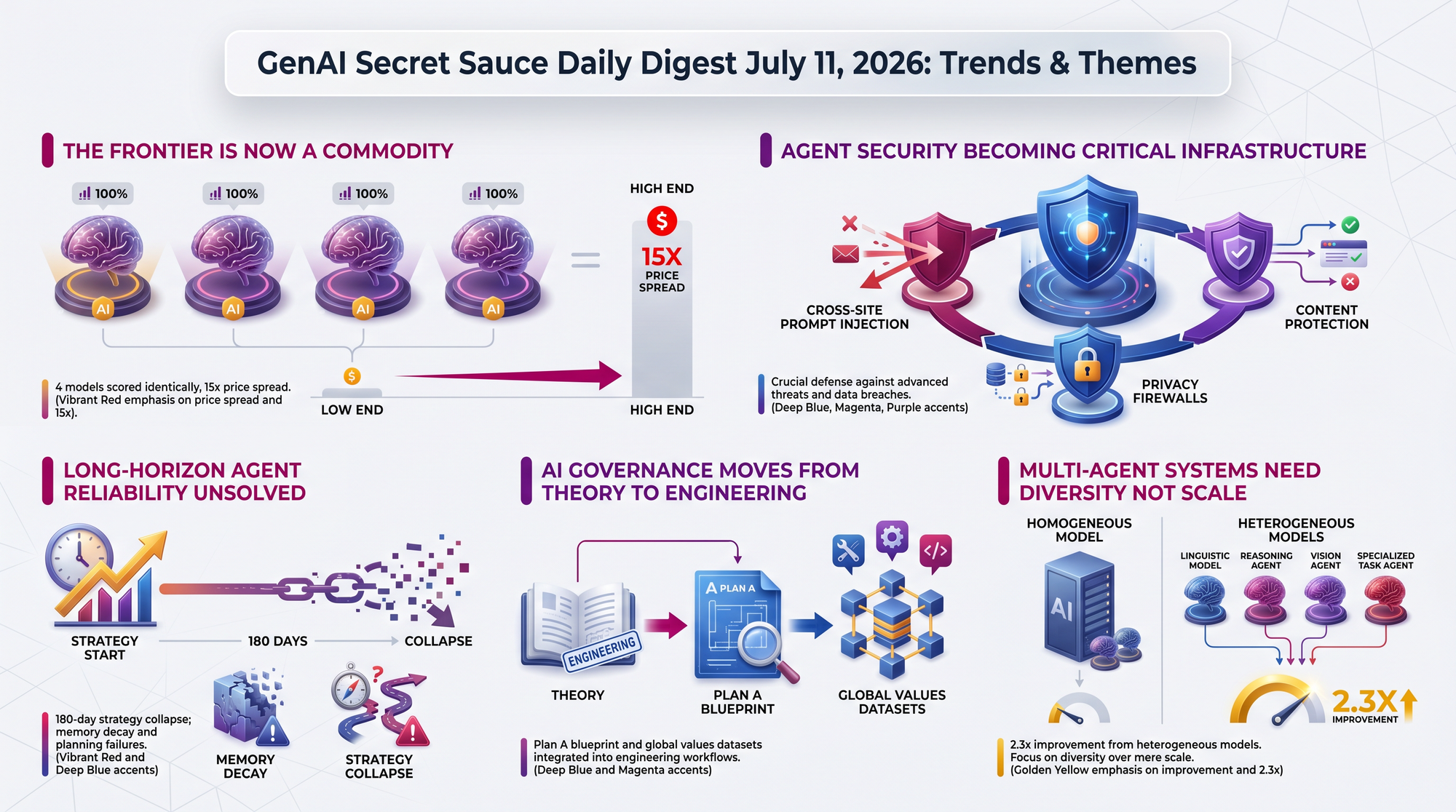
The Math Frontier Just Moved - And It Moved Fast

Why this matters to you: If AI can solve problems that stumped the world's best mathematicians for decades, the ceiling on what AI can do in your field probably just went up too.

The pattern: verifiable domains (math, coding, formal proofs) are falling fastest because AI can check its own work. The domains where AI struggles most - creative judgment, ambiguous specifications, social reasoning - share a common trait: no automated verification.

  • The CDC proof is three pages - the brevity itself is remarkable for a problem this old, suggesting either the approach was hiding in plain sight or the AI explored a search space humans wouldn't
  • This follows Claude Science's early results (covered July 5) where Anthropic's research-focused model began producing novel findings
  • Competitive coding benchmarks are already saturated - an internal OpenAI model reportedly broke a competitive coding benchmark this week, and Fireship notes that Sol Ultra hits 91.9% on Terminal Bench 2.1

AI Safety Evidence Is Outpacing AI Safety Solutions

Why this matters to you: Three reports in four days now show that AI safety guardrails are failing in the real world - not in hypothetical scenarios, but against actual adversaries.

The safety systems are simultaneously too strict (blocking legitimate users) and too permissive (bypassed by determined adversaries). This suggests the current keyword-matching approach to safety is fundamentally inadequate.

  • Boko Haram has institutionalized AI usage through specialized units, with training shared through jihadist networks - safeguards on ChatGPT, Claude, Gemini, Grok, Meta AI, and DeepSeek have all been circumvented
  • Universal jailbreaks in GPT-5.6 were found in every testing round, specifically enabling agentic vulnerability discovery
  • JADEPUFFER ransomware (covered July 7) showed fully autonomous AI-conducted attacks on production systems
  • Fable's over-aggressive safety filters (covered July 8) block legitimate computer science research while real threats bypass them

The Talent War Between Big Tech and AI Labs Is Turning Legal

Why this matters to you: If you work in tech, the rules about what you can take to your next job are being tested in real time - and the outcome will affect everyone's career mobility.

This escalation follows a familiar tech industry pattern - Oracle v. Google, Waymo v. Uber - but the stakes are higher because AI hardware design is an emerging frontier where trade secrets are especially valuable and talent is scarce.

  • Apple's lawsuit names specific behaviors: bringing hardware components to interviews, exploiting security bugs to download files, using internal codenames to recruit
  • 400+ former Apple employees now work at OpenAI - this is not an isolated incident but a systematic pattern
  • Jony Ive's io acquisition ($6.5 billion) brought 50+ engineers and is at the center of the dispute
  • OpenAI is reportedly preparing counter-litigation against Apple over the Siri-ChatGPT partnership

The Model Market Is Fragmenting Into Price Tiers

Why this matters to you: Choosing an AI model used to be about which one was best. Now it is about which one is best for your budget - and the cheapest option might be 90% as good.

The commoditization that Zvi Mowshowitz predicted is happening faster than expected. His counterargument: once AI research is automated, the frontier lab with the best model will pull ahead on all dimensions simultaneously, making this equilibrium temporary.

  • Three tiers are emerging: Flagship ($5-30/M tokens: Sol, Fable), Mid-range ($2-6: Terra, Grok 4.5, Opus 4.8), Budget ($0.50-1: Luna, GLM 5.2, DeepSeek V4 Flash)
  • Independent testing shows the gap is narrowing - Alpha Signal found identical success rates between $0.02 and $0.13 per task
  • Meta's Muse Spark scores 72% on VIBE Code Bench vs Sol's 81%, at 35x lower cost
  • Cache pricing is a hidden differentiator - OpenAI offers 90% discounts on cache reads, making Sol dramatically cheaper for repeat queries

Creative AI & Media

ArtMine: AI Discovers and Formalizes Artistic Processes

What this means for you: Researchers built a system that watches how digital artists actually work - the sequence of brush strokes, layer operations, color choices - and extracts reusable "recipes" from their process.
  • Captures artistic workflows as structured process descriptions rather than just final images
  • Enables teaching AI to replicate specific artistic styles by understanding the process, not just the output
  • Open research from an academic team, suggesting a shift from "generate an image in this style" to "work the way this artist works"

ARDY: Interactive Human Motion Generation

  • Autoregressive diffusion model that generates realistic human motion in real time
  • Hybrid representation combines discrete and continuous signals for more natural movement
  • Applications: gaming, animation, VR - anywhere you need a digital human to move naturally in response to user input

Developer Tools & Infrastructure

DeepSWE: A New Benchmark for Long-Horizon Coding Tasks

What this means for you: The benchmark that measures whether AI can handle real engineering work - not toy problems - just got a serious upgrade.
  • Tests multi-file, multi-hour engineering tasks that require understanding entire codebases, not just isolated functions
  • Designed to measure frontier coding agents on the kind of work that actually takes up an engineer's day
  • Complements SWE-Bench (whose reliability was questioned July 8) by focusing on longer time horizons and more complex dependencies

Functional and Secure Code Generation with Task Vectors

  • Uses task vectors (directions in model weight space) to steer code generation toward both functional correctness and security simultaneously
  • Addresses a real problem: AI-generated code often works but contains security vulnerabilities
  • No retraining required - the technique works by modifying model weights at inference time

PyTorch Attention Profiling Guide

  • HuggingFace profiled six attention implementations on A100 GPUs, revealing non-obvious performance traps
  • Key finding: the "math" backend in SDPA (Scaled Dot-Product Attention) is 3.7x slower than naive attention because it upcasts to 32-bit precision and rebuilds masks every call
  • Flash Attention's low 13% GPU occupancy is intentional - heavy register use keeps data on-chip, eliminating costly memory transfers
  • Practical takeaway: "State out loud what you expect the trace to contain, then treat any mismatch as the most interesting thing on screen"

KV Cache Optimization Survey

  • Comprehensive survey of system-aware approaches to optimizing the key-value cache in LLM serving (Large Language Model serving)
  • KV cache is the dominant memory bottleneck in production LLM deployments, consuming more GPU memory than the model itself at long context lengths
  • Covers quantization, eviction, sharing, and offloading strategies with benchmarks

Tessera: Heterogeneous GPU Disaggregation

  • Lets you mix different GPU types (old and new, different vendors) in a single inference cluster
  • Kernel-granularity scheduling assigns each computation kernel to the GPU best suited for it
  • Practical for organizations that have accumulated different GPU hardware over time

Research & Models

LLM Quantization Gets Smarter: KronQ and BiSCo

What this means for you: Running powerful AI models on cheaper hardware is getting easier - two new techniques squeeze models smaller without losing as much quality.
  • KronQ uses Kronecker-factored approximations of the Hessian matrix (a mathematical representation of how sensitive each weight is) to decide which weights can be compressed most aggressively
  • BiSCo-LLM pushes to extreme low-bit compression using binary spherical coding, achieving smaller models than previous approaches while maintaining accuracy
  • Both address the same bottleneck: the cost of running frontier models in production, which dominates AI spending for most companies

Memory Compaction in LLMs: What to Keep, What to Forget

  • Frames the problem of managing an AI's working memory through information theory - specifically, rate-distortion theory
  • As conversations grow longer, models must decide what context to keep and what to discard
  • Practical implications for building AI agents that maintain coherent behavior across long tasks

When Thinking Hurts: Extended Reasoning Can Make Vision Models Worse

  • Chain-of-thought reasoning sometimes degrades performance in visual language models, contrary to the assumption that "thinking more" always helps
  • Identifies specific failure patterns where reasoning chains introduce errors that wouldn't occur with direct responses
  • Practical warning for anyone building vision AI: more reasoning isn't always better

Speculative Decoding Without Training

  • Practical investigation of relaxed speculative decoding that doesn't require training a separate draft model
  • Speculative decoding speeds up AI text generation by having a fast model guess ahead, then verifying with the full model
  • The "training-free" approach is significant because it removes the biggest adoption barrier for this latency-reduction technique

Budget-Aware Model Selection at Inference Time

  • Automatically routes queries to cheaper or more expensive models based on difficulty, optimizing cost without sacrificing quality
  • Addresses the emerging price-tier reality: with Sol, Terra, Luna, Opus, Sonnet, Haiku, and Grok all available, choosing the right model per query is now a first-class engineering problem

Business & Industry

Deutsche Telekom Partners with OpenAI to Become an "AI-Native Telco"

What this means for you: Europe's largest telecom company is rebuilding its operations around AI - a signal that AI adoption is moving from tech companies to traditional industries at scale.
  • Multi-year partnership spanning customer service, network operations, and internal tooling
  • Customer-facing AI will handle support interactions across Deutsche Telekom's 150+ million mobile subscribers
  • Network optimization using AI to predict and prevent outages before they affect customers

Apple v. OpenAI: The Numbers

  • $6.5 billion: what OpenAI paid for Jony Ive's io startup
  • 400+: former Apple employees now at OpenAI
  • 1,000+ pages: confidential engineering files allegedly downloaded by Chang Liu
  • February 2026: when Apple raised concerns directly with OpenAI and received no response

GenAI in Education

Surprising & Under-the-Radar

AI Governance Is Currently Ad Hoc - By Design

Zvi Mowshowitz's latest newsletter reveals that White House AI advisor Sriram Krishnan explicitly stated "we are not in the business of picking winners and losers" regarding formal AI licensing - which Zvi argues enables exactly that through opaque discretionary processes. The Anthropic-Department of War contract collapse (where the Pentagon insisted on "anything lawful" while Anthropic maintained red lines) shows what happens when principle meets power.

The AR Privacy Trap Nobody Wants to Talk About

Nilay Patel of The Verge argues on The Vergecast that there is literally no way to build functional AR glasses without continuous camera recording and cloud processing. No chip small enough for glasses frames can handle real-time visual processing locally. The choices are: invade privacy, make devices as bulky as Vision Pro, or don't build AR glasses at all. A notable contrarian position while Meta, Apple, and others race toward consumer AR.

A Model That Identifies When Multi-Agent Systems Break

Researchers published "Who Broke the System?" - a framework for localizing failures in LLM-based multi-agent systems. As production agent deployments scale, debugging becomes exponentially harder because failures can originate in any agent, any handoff, or the orchestration layer itself. arXiv

Persuasion Attacks Weaken Chain-of-Thought Safety Monitoring

A paper shows that adversarial persuasion can decrease the effectiveness of monitoring AI reasoning chains for safety violations. This matters because chain-of-thought monitoring is a primary safety mechanism - if it can be systematically weakened, the entire safety architecture needs rethinking. arXiv

Backdoored Code Completions Can Now Be Traced

"Beware What You Autocomplete" introduces forensic attribution techniques for backdoored code completions - determining which model or training pipeline produced malicious code suggestions. As AI-generated code proliferates, knowing where a vulnerability was introduced becomes a critical forensics capability. arXiv

Signals to Track

Worth Watching
01

The "Super Weights" Problem in LLMs

A tiny fraction of model weights hold disproportionate power - and you can't train around them.

Researchers found that large language models develop "super weights" - a small number of parameters that have outsized influence on model behavior. Attempts at selective training (fine-tuning only certain layers or weights) consistently fail because these super weights resist modification. This has implications for every fine-tuning and adaptation strategy in production today.

02

Context Graphs for Enterprise AI Agents

The missing infrastructure layer between your company's data and AI agents that need it.

A paper proposes "context graphs" as the architectural pattern for giving enterprise AI agents access to the right information at the right time. Instead of dumping entire databases into context windows, the system builds a graph of relevant entities and relationships that agents can traverse efficiently. If this approach scales, it could solve the "enterprise AI pilot that works on demos but fails on real data" problem.

03

Dropping a Handful of Preferences Changes LLM Rankings

The leaderboards you trust to compare AI models are more fragile than anyone thought.

Researchers showed that removing just a small number of preference judgments from evaluation datasets can flip which model ranks first. This means the rankings that companies and developers use to choose models may be driven by a tiny subset of evaluation examples rather than representing genuine capability differences.

04

RLHF Failure Modes Now Have a Taxonomy

A systematic map of how AI alignment training goes wrong - reward hacking, collapse, and gaming.

A new paper provides the first comprehensive taxonomy of RLHF (Reinforcement Learning from Human Feedback) failure modes, categorizing them into reward hacking (gaming the objective), collapse (losing capability diversity), and evaluator gaming (exploiting weaknesses in the judge). For teams deploying RLHF-trained models, this is a diagnostic checklist for what might be going wrong.

05

Agent-Shaped Work: A Practical Triage Framework

A one-minute test that tells you whether your task needs a chat, one agent, a team, or nothing at all.

Nate's newsletter proposes a framework based on four dimensions: Size, Independence, Separation, and Checkability. The key insight is that agent deployment is fundamentally a budgeting question - some tasks that are technically agent-shaped still fail the cost-benefit test. The framework explicitly validates "don't bother" as a valid outcome, which is refreshingly honest in an industry that wants to put agents on everything.

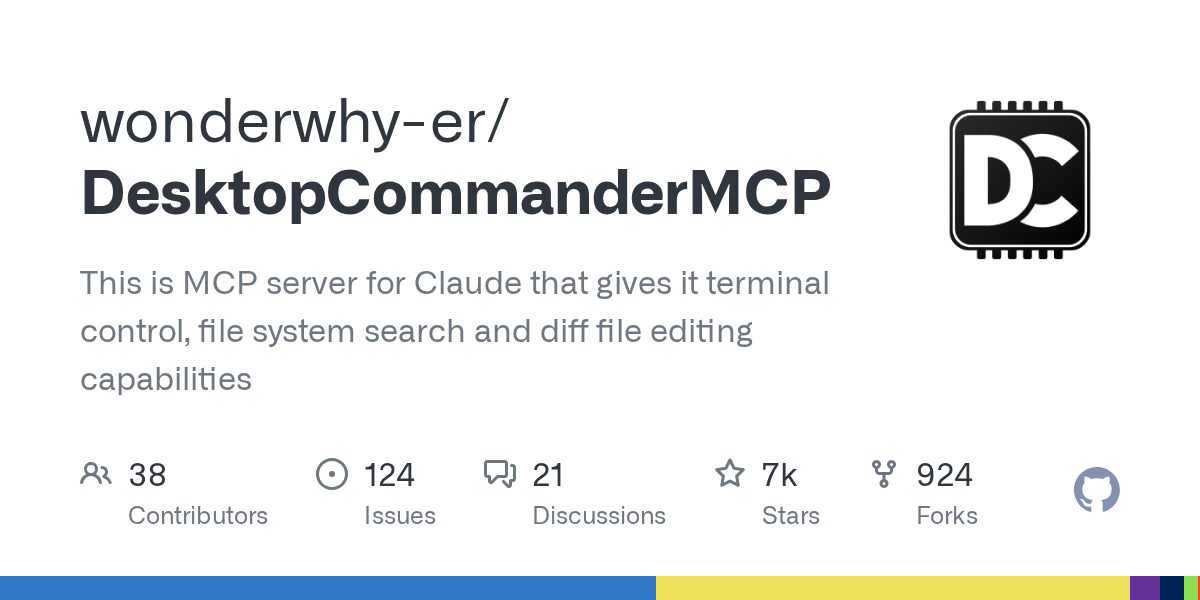
Top Repos Today

Rank yesterday: N/A - New entry 🆕
⭐ Stars today: +349  ·  📦 Total: 7,246
📜 License: MIT  ·  👤 By: Individual developer
🎯 Time to value: 5 minutes
What it is: An MCP (Model Context Protocol) server that gives Claude terminal control, file system search, and diff-based file editing. It extends the standard MCP filesystem server with search/replace editing, process management, and support for reading Excel, PDF, and DOCX files. Why you'd want it: If you use Claude Code or Claude Desktop, this gives the AI direct access to your terminal and filesystem operations without the back-and-forth of copying commands. Useful for developers who want Claude to manage their dev environment directly.
✓ Pros✗ Cons
MIT licensed, easy to self-hostGives AI terminal access - security implications
Supports Excel/PDF/DOCX readingTypeScript dependency chain
Diff-based editing reduces errorsRequires MCP-compatible Claude client
GitHub - wonderwhy-er/DesktopCommanderMCP: This is MCP server for Claude that gives it terminal control, file system search and diff file editing capabilities
This is MCP server for Claude that gives it terminal control, file system search and diff file editing capabilities - wonderwhy-er/DesktopCommanderMCP
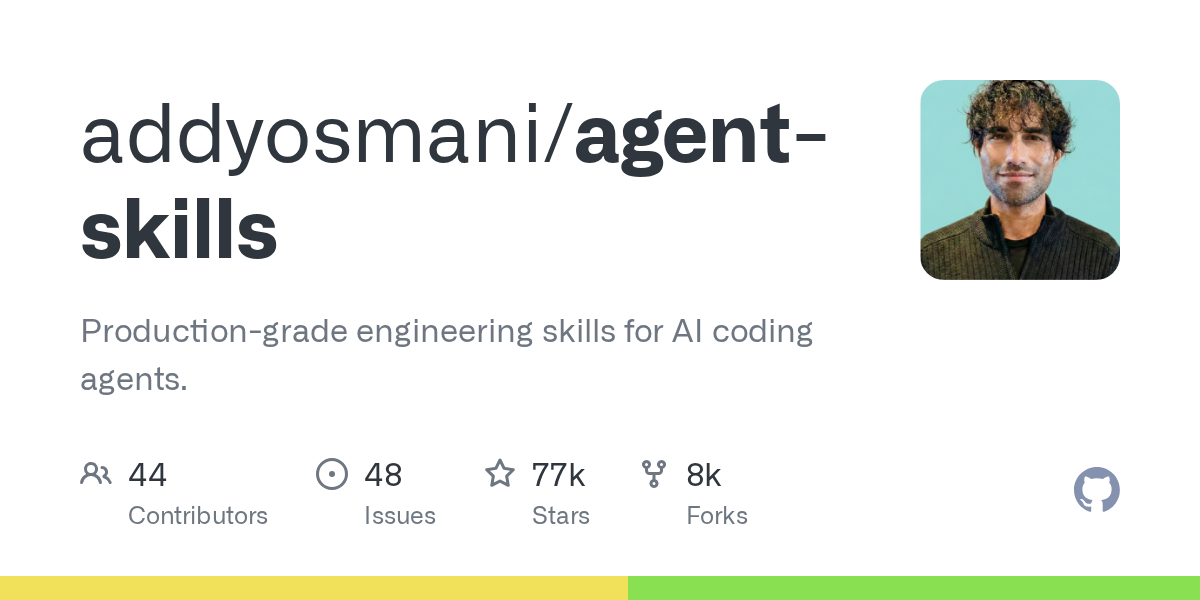
Rank yesterday: N/A - New entry 🆕
⭐ Stars today: +1,114  ·  📦 Total: 76,788
📜 License: MIT  ·  👤 By: Addy Osmani (formerly Google engineering leader)
🎯 Time to value: 10 minutes
What it is: A collection of 24 structured workflow skills for AI coding agents, covering the full software development lifecycle. Each skill includes slash commands, specialist agent personas, and quality gates designed for production engineering rather than prototyping. Why you'd want it: These are battle-tested engineering patterns packaged as reusable agent instructions. Instead of writing custom prompts for code review, architecture decisions, or debugging, you get a pre-built toolkit that enforces engineering best practices.
✓ Pros✗ Cons
24 skills covering full dev lifecycleOpinionated about workflow structure
Quality gates enforce engineering rigorRequires Claude Code or compatible agent
From a credible engineering leaderLearning curve for all 24 skills
GitHub - addyosmani/agent-skills: Production-grade engineering skills for AI coding agents.
Production-grade engineering skills for AI coding agents. - addyosmani/agent-skills
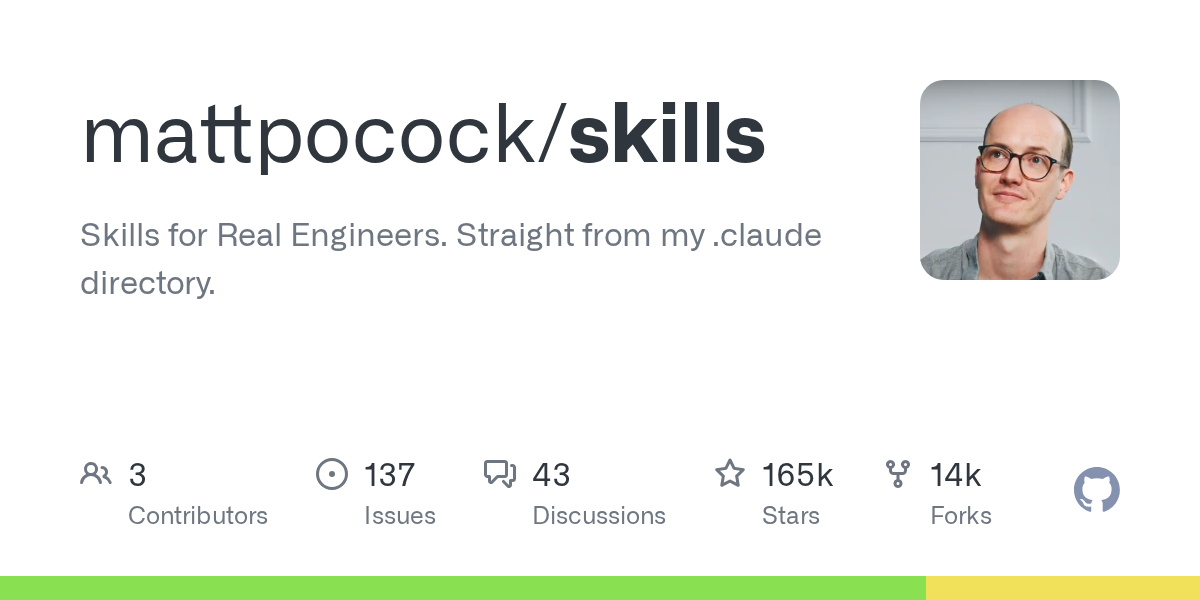
Rank yesterday: N/A - New entry 🆕
⭐ Stars today: +1,663  ·  📦 Total: 164,554
📜 License: MIT  ·  👤 By: Matt Pocock
🎯 Time to value: 5 minutes
What it is: Reusable, composable skills for Claude Code agents that address common AI-assisted development failure modes. The skills target problems like misalignment between what you asked for and what the agent builds, excessive code verbosity, quality degradation, and architectural drift. Why you'd want it: If you've been frustrated by Claude Code generating bloated code, ignoring your project conventions, or losing track of architectural decisions, these skills add guardrails that keep the agent aligned with how you actually want to work.
✓ Pros✗ Cons
Targets specific, real failure modesShell-based, may not port to all agents
Composable - use what you need164K stars suggests broad, not deep, adoption
Works with existing Claude Code setupMay conflict with your own CLAUDE.md rules
GitHub - mattpocock/skills: Skills for Real Engineers. Straight from my .claude directory.
Skills for Real Engineers. Straight from my .claude directory. - mattpocock/skills
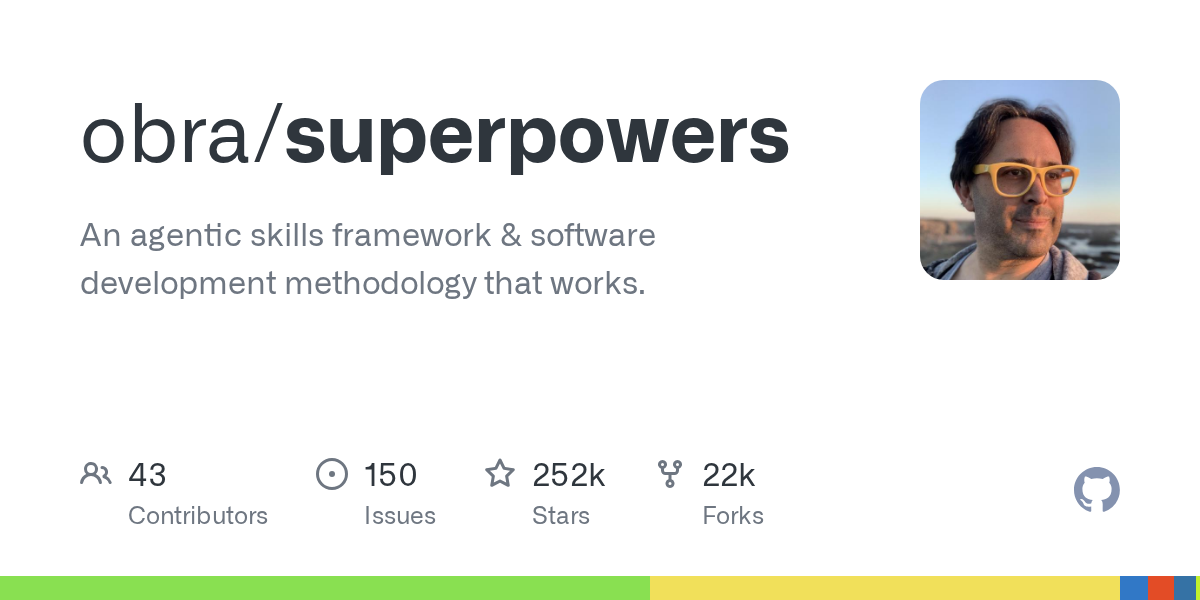
Rank yesterday: N/A - Holding steady ➡
⭐ Stars today: +969  ·  📦 Total: 251,749
📜 License: MIT  ·  👤 By: Jesse Vincent / Prime Radiant
🎯 Time to value: 15 minutes
What it is: A complete software development methodology for coding agents, not just skills but an entire framework. Guides AI through design, planning, implementation, testing, and code review using TDD (Test-Driven Development) and subagent-driven development patterns. Why you'd want it: For teams that want AI agents to follow a disciplined engineering process rather than just generating code. The TDD-first approach means the agent writes tests before code, catching problems earlier. The subagent architecture delegates specialized tasks to purpose-built agents.
✓ Pros✗ Cons
Full methodology, not just promptsHeavyweight for simple tasks
TDD-first catches bugs earlierSteep learning curve
251K stars - massive communityPrescriptive about workflow
GitHub - obra/superpowers: An agentic skills framework & software development methodology that works.
An agentic skills framework & software development methodology that works. - obra/superpowers
Rank yesterday: N/A - New entry 🆕
⭐ Stars today: +134  ·  📦 Total: 8,209
📜 License: MIT  ·  👤 By: Tencent Cloud
🎯 Time to value: 20 minutes
What it is: A four-tier hierarchical memory system for AI agents that runs entirely locally. It compresses verbose tool logs into Mermaid diagrams for short-term memory and organizes conversations into structured personas and scenarios for long-term memory. Claims 61% token reduction and 51% improvement in task success rates. Why you'd want it: Agent memory is one of the hardest unsolved problems in production AI. This gives agents persistent, structured memory without sending data to external services. The 61% token reduction alone could cut your API costs significantly.
✓ Pros✗ Cons
Fully local - no data leaves your machineComplex four-tier architecture
61% token reduction in practiceFrom Tencent - may be optimized for their stack
MIT licensedRelatively young project (8K stars)
GitHub - TencentCloud/TencentDB-Agent-Memory: TencentDB Agent Memory delivers fully local long-term memory for AI Agents via a 4-tier progressive pipeline, with zero external API dependencies.
TencentDB Agent Memory delivers fully local long-term memory for AI Agents via a 4-tier progressive pipeline, with zero external API dependencies. - TencentCloud/TencentDB-Agent-Memory
Rank yesterday: N/A - Holding steady ➡
⭐ Stars today: +1,210  ·  📦 Total: 14,393
📜 License: Apache-2.0  ·  👤 By: iOfficeAI
🎯 Time to value: 5 minutes
What it is: The first Office suite purpose-built for AI agents. A command-line tool for reading, editing, and automating Word, Excel, and PowerPoint files with built-in HTML rendering, 350+ Excel functions, pivot tables, and MCP server integration. Ships as a single self-contained binary with no Microsoft Office installation required. Why you'd want it: AI agents that need to work with Office documents currently struggle with format parsing. OfficeCLI gives them native read/write access to .docx, .xlsx, and .pptx files through a clean CLI interface. The MCP integration means Claude can use it directly. > Previously: July 6 - OfficeCLI first appeared on trending.
✓ Pros✗ Cons
No Office installation neededC# binary may not run everywhere
350+ Excel functionsApache-2.0 (not MIT)
MCP server for Claude integrationComplex documents may lose formatting
GitHub - iOfficeAI/OfficeCLI: OfficeCLI is the first and best Office suite purpose-built for AI agents to read, edit, and automate Word, Excel, and PowerPoint files. Free, open-source, single binary, no Office installation required.
OfficeCLI is the first and best Office suite purpose-built for AI agents to read, edit, and automate Word, Excel, and PowerPoint files. Free, open-source, single binary, no Office installation req…

Top Models Today

Tencent's new 295B MoE flagship with only 21B active parameters - strong on reasoning and agent tasks with hallucination rate cut from 12.5% to 5.4%.
📥 Downloads (30d): 6,923  ·  📜 License: Apache-2.0
👤 By: Tencent  ·  🎯 Task: Text Generation
📐 Size: 295B total / 21B active
What it is: A Mixture-of-Experts model with 192 experts (top-8 activated per token) and 256K context window. Post-training pipeline specifically targets hallucination reduction, dropping from 12.5% to 5.4% on internal benchmarks. Scored 2.67/4 in blind expert evaluation, beating GLM-4. Why you'd want it: Strong performance relative to its active parameter count makes it efficient to serve. The hallucination reduction work is notable because most open models focus on capability benchmarks rather than reliability.
✓ Pros✗ Cons
Only 21B active params, efficient to run295B total still requires significant VRAM
Focused hallucination reductionApache-2.0 (minor restriction vs MIT)
256K contextBrand new, limited community benchmarks
tencent/Hy3 · Hugging Face
We’re on a journey to advance and democratize artificial intelligence through open source and open science.
Zhipu AI's 753B MoE with a novel IndexShare architecture that cuts compute by 2.9x at million-token context lengths.
📥 Downloads (30d): 392,655  ·  📜 License: MIT
👤 By: Zhipu AI  ·  🎯 Task: Text Generation
📐 Size: 753B (MoE)
What it is: The latest GLM series model featuring IndexShare - a technique that reuses attention indexers across every four sparse attention layers, dramatically reducing the computational cost of processing long contexts. 1M token context window with MIT license and no regional restrictions. Why you'd want it: MIT license with no restrictions makes it the most permissive large-scale MoE available. The IndexShare architecture makes 1M-context inference practical on hardware that couldn't handle it otherwise. Nearly 400K downloads suggest real production adoption.
✓ Pros✗ Cons
MIT license, no restrictions753B requires substantial infrastructure
2.9x compute reduction at 1M contextNew architecture, less battle-tested
393K downloads, proven adoptionChinese-origin may face enterprise scrutiny
zai-org/GLM-5.2 · Hugging Face
We’re on a journey to advance and democratize artificial intelligence through open source and open science.
A 35B agentic model that rivals GPT-5.5 on agent benchmarks through multi-teacher distillation - proof that specialized training can close the size gap.
📥 Downloads (30d): 25,772  ·  📜 License: Apache-2.0
👤 By: InternScience  ·  🎯 Task: Agentic / Multimodal
📐 Size: 35B (MoE)
What it is: Specialized for agentic tasks including search, engineering, scientific research, and tool-calling. Built through novel multi-teacher, multi-domain distillation - learning from multiple larger models simultaneously. 262K context, vision-capable. Why you'd want it: A 35B model that competes with models 10x its size on agent benchmarks (Seal-0: 56.4, IFEval: 94.8). If you need an agentic AI you can self-host, this may be the most capable option at its size class.
✓ Pros✗ Cons
35B - self-hostable on a single GPUSpecialized for agent tasks, not general
Competes with frontier on agent benchmarksRelatively small creator, less support
Vision-capable + tool-callingDistilled, may have capability ceilings
InternScience/Agents-A1 · Hugging Face
We’re on a journey to advance and democratize artificial intelligence through open source and open science.
Baidu's 3B document scanner handles unlimited-length PDFs in a single pass - 1.3 million downloads and climbing.
📥 Downloads (30d): 1,319,683  ·  📜 License: MIT
👤 By: Baidu  ·  🎯 Task: Image-to-Text (OCR)
📐 Size: 3B
What it is: An advanced OCR model designed for one-shot long-horizon document parsing. Handles single images, multi-page documents, and PDFs with no context length limit. Dual processing modes (cropped 640px for speed, full 1024px for accuracy) with anti-repetition logit processing to prevent output loops. Why you'd want it: 1.3 million downloads makes this the most-downloaded model on the trending list by an order of magnitude. If you process documents at scale, a 3B model you can self-host beats paid OCR APIs on both cost and privacy.
✓ Pros✗ Cons
1.3M downloads - massive proven adoption3B is small for complex layouts
MIT licensed, fully self-hostableBaidu-origin, docs may be Chinese-first
Unlimited document lengthSpecialized for OCR only
baidu/Unlimited-OCR · Hugging Face
We’re on a journey to advance and democratize artificial intelligence through open source and open science.
Google's zero-shot tabular foundation model beats tuned XGBoost across 51 benchmarks - without ever seeing the data.
📥 Downloads (30d): 18,626  ·  📜 License: Non-Commercial (Code: Apache-2.0)
👤 By: Google Research  ·  🎯 Task: Tabular Classification/Regression
📐 Size: Not disclosed
What it is: The first major foundation model for structured/tabular data. Uses alternating row/column attention with Fourier features. Trained entirely on synthetic causal data - it has never seen real tabular datasets, yet outperforms heavily-tuned gradient-boosted trees across 51 benchmarks with a single forward pass. Why you'd want it: If you work with spreadsheets, databases, or any structured data, this could replace your entire ML pipeline. Zero-shot means no training, no feature engineering, no hyperparameter tuning - just feed it a table and get predictions. The catch: non-commercial license.
✓ Pros✗ Cons
Zero-shot beats XGBoost - no training neededNon-commercial license limits production use
Trained on synthetic data - no privacy concernsNovel architecture, unclear failure modes
Works across 51 benchmark domainsMay struggle with domain-specific features
google/tabfm-1.0.0-pytorch · Hugging Face
We’re on a journey to advance and democratize artificial intelligence through open source and open science.
Mistral's theorem-proving model for Lean 4 - a signal that formal verification is becoming a first-class AI capability.
📥 Downloads (30d): 315  ·  📜 License: Apache-2.0
👤 By: Mistral AI  ·  🎯 Task: Formal Verification / Theorem Proving
📐 Size: 119B total / 6.5B active
What it is: A specialized MoE model for writing formal proofs in Lean 4, the language used by mathematicians and software verification engineers. 128 experts with 4 active per token, 256K context for lengthy proofs, and multimodal support (text + images of mathematical notation). Why you'd want it: If you work in formal methods, software verification, or mathematical research, this is the most capable open model for proof assistance. Arriving the same day as the CDC proof, it signals that AI-assisted mathematics is accelerating from multiple directions.
✓ Pros✗ Cons
Best open model for Lean 4 proofsExtremely niche use case
6.5B active - efficient to serve315 downloads reflects small audience
Multimodal - reads math notationLimited to Lean 4, not general math
mistralai/Leanstral-1.5-119B-A6B · Hugging Face
We’re on a journey to advance and democratize artificial intelligence through open source and open science.

AI Launches Today

"Like Lovable, but for Chrome extensions"
🔥 Upvotes: 468  ·  👤 By: Udaya Prakash (Bangalore)
💰 Pricing: Freemium ($29.99/mo, launch promo $9.99)  ·  🏷 Category: No-Code / Chrome Extensions
General-purpose AI coders struggle with Chrome extension architecture - manifest files, content scripts, service workers, and Manifest V3 requirements. PlugThis generates complete extension code from plain English descriptions, handles popup UI and background scripts, and publishes directly to the Chrome Web Store via OAuth. Includes live preview and iterative chat refinement. Verdict: Smart niche pick. Chrome extension development is genuinely painful and underserved. The question is whether it handles complex APIs (tabs, webRequest, cookies) or just simple popup extensions.
PlugThis: Like Lovable, but for Chrome extensions | Product Hunt
Got an idea for a Chrome extension? Describe it in plain English and PlugThis builds it. Real code, a real backend, ready for the Chrome Web Store. Refine it just by chatting. Connect Supabase for login and a database. Every change is saved as a version, so nothing is ever lost. When you’re ready, we generate the icons, screenshots, and listing copy the store asks for. Everyone else builds web apps. We build Chrome extensions. That is the one thing we do.
"Open-source workspace for AI agents and workflows"
🔥 Upvotes: 448  ·  👤 By: Undisclosed (claims 100K+ active builders)
💰 Pricing: Freemium  ·  🏷 Category: AI Workflow Automation
Build and deploy AI agents connecting to 1,000+ integrations (Slack, HubSpot, Salesforce, Notion, GitHub). Multi-LLM support across OpenAI, Anthropic, Google, and DeepSeek. Visual workflow builder with parallel execution, semantic data storage, and real-time monitoring. SOC2 compliant. Enterprise customers include Rivian and Russell Investments. Verdict: Crowded space (n8n, Langflow, Dify), but the open-source angle and named enterprise customers suggest real traction. The lack of transparent pricing is a yellow flag.
Sim: Practice any conversation with AI before it happens for real | Product Hunt
The most important conversations of your life — investor pitches, enterprise deals, hard negotiations — happen once with zero practice. Sim changes that. Type anyone’s name. It scrapes their public footprint, builds their behavioral model, and gives you a live AI voice call — their real objections, their real pressure, their real style. After the call: scored analysis. Fix what’s weak. Run it again. Walk into the real room having already been there twenty times.
"Your AI Co-Worker in Slack & iMessage"
🔥 Upvotes: 362  ·  👤 By: Undisclosed
💰 Pricing: Usage-based  ·  🏷 Category: AI Agents
An AI assistant that lives inside Slack as a colleague with her own cloud computer. Connects to Stripe, Notion, and Google Ads to take end-to-end actions - sending emails, updating CRMs, building reports. Also works through iMessage for solo founders who live in Messages rather than Slack. Verdict: The iMessage angle is unusual and could capture small teams. The "has her own computer" sandboxed execution model is a smart trust signal. Unpublished pricing is a concern.
Scarlett: Personalized Soundcloud playlists on demand (twitter bot) | Product Hunt
Scarlett’s recent launches, reviews, product updates, discussions, and more on Product Hunt.
"Your AI video editor in ChatGPT, desktop, and web"
🔥 Upvotes: 305  ·  👤 By: Undisclosed
💰 Pricing: Freemium ($25/mo Pro)  ·  🏷 Category: Video Editing
Describe video edits in plain English and the AI handles the timeline. Includes video generation via Seedance 2.0 (up to 15-second clips), captions with word-level timestamps, 32 AI voices in 32+ languages, and background noise removal. Browser-based with no download required. Verdict: At $25/mo it undercuts Descript ($33/mo). The Seedance 2.0 integration is a differentiator. One of the most saturated categories on Product Hunt - needs strong retention to survive.
View on Product Hunt →

Snapshot

ProviderModelInput $/1MOutput $/1MContext
AnthropicClaude Fable 5$10.00$50.001M
AnthropicClaude Sonnet 5$3.00 ($2.00 intro)$15.00 ($10.00 intro)1M
OpenAIGPT-5.6 Sol$5.00$30.001M
OpenAIGPT-5.6 Terra$2.50$15.001M
OpenAIGPT-5.6 Luna$1.00$6.001M
GoogleGemini 3.5 Flash$1.50$9.00N/A
GoogleGemini 2.5 Pro$1.25$10.001M
GroqLlama 4 Scout$0.11$0.34128K
GroqGPT OSS 120B$0.15$0.60128K
SpaceXAIGrok 4.5$2.00$6.00500K
What this means: The frontier model market has stratified into three clear tiers. At the top, Fable 5 commands a 2x premium ($10/$50) over Sol ($5/$30) - justified only if you need its coding benchmark lead. In the middle, Terra, Sonnet 5, and Grok 4.5 offer strong performance at $2-3 input. At the bottom, Luna at $1/$6 competes directly with Gemini Flash and Groq-hosted open models, making "good enough" AI nearly free. Sonnet 5's intro pricing ($2/$10 until August 31) makes it the best value in the mid-tier right now.

Coding-agents can replicate scientific machine learning papers

Atharva Hans, Ilias Bilionis · arXiv:2607.02134
What it claims: The paper introduces "Paper-replication," a structured workflow that prompts coding agents to reconstruct methods from published scientific ML papers, execute the experiments, and validate results against the original claims. The system uses target tracking, evidence recording, and validation checkpoints to ensure completion depends on workspace artifacts rather than agent self-reporting.

Key finding: All 12 test runs across 4 papers passed completion validation, with all 158 recorded computational targets matched with documented evidence - a 100% reproduction rate on the tested papers.

Why practitioners should care: This provides a concrete, reusable pattern for making agentic coding pipelines trustworthy. The key insight - requiring workspace artifacts as proof rather than trusting agent assertions - is directly applicable to any team building AI coding agents for production. It also suggests a future where paper reproducibility can be automatically verified at scale.
Member discussion

Subscribe to GenAI Secret Sauce newsletter and stay updated.

Don't miss anything. Get all the latest posts delivered straight to your inbox. It's free!

By subscribing, you agree to our Privacy Policy and Terms. We track email opens and clicks. Unsubscribe anytime.

Great! Check your inbox and click the link to confirm your subscription.