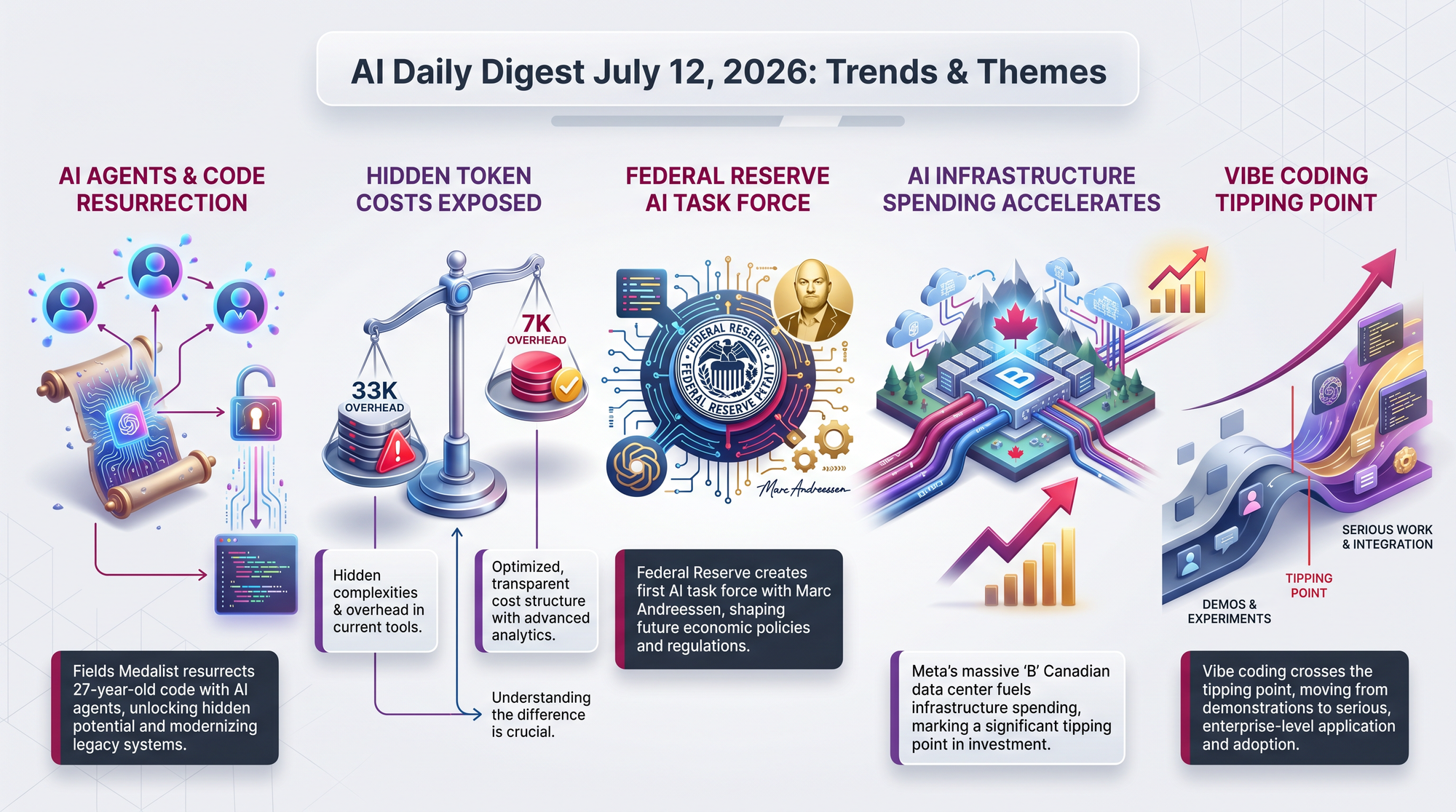
Watch today's digest as a video summary (generated by NotebookLM)
Statistically Speaking
One Thing to Tell Your Friends
TL;DR
Hot off the Presses
A Fields Medalist Used AI to Resurrect 27-Year-Old Programs - and Build New Ones He Once Thought Impossible
Terence Tao, a Fields Medal winner (the highest prize in mathematics), used AI coding agents to convert approximately two dozen Java applets from 1999 to modern JavaScript. The applets include a honeycomb visualization co-created with Allen Knutson, a Besicovitch set visualization now colorized, and various complex analysis teaching tools.
This is not a startup demo or a benchmark result. It is a working mathematician using AI to create educational materials he has wanted for decades - and finding the bottleneck has shifted entirely from implementation to ideas.
- Most striking result: he built a special relativity spacetime diagram tool that he abandoned in 1999 because it was too complex to implement alone
- Only one minor bug (a drag-event problem) emerged across roughly twenty converted applications
- His key observation: "High level code design decisions still remain in the vibe coding model; it is the lower level syntax and implementation issues that have been largely automated away"
- Language choice is now irrelevant for building interactive tools, provided adequate documentation or source code context exists
Claude Code's Hidden Tax: 33,000 Tokens Before Your Prompt Even Arrives
Systima placed logging proxies between coding harnesses and the API to measure exact token consumption. The findings reveal the hidden economics of AI coding tools.
The practical implication: organizations should implement API-boundary logging before drawing conclusions about which AI tool costs more. The tool's orchestration overhead often dwarfs the model's actual work.
- Claude Code loads 33,000 tokens of system prompts, tool schemas, and injected scaffolding before the user's prompt arrives; OpenCode loads 7,000
- 27 tools versus 10 - Claude Code registers nearly 3x more tool definitions, each consuming tokens on every request
- On a single file-reading task: Claude Code used 199,000 input tokens across six requests; OpenCode used 41,000 across four requests (5x difference)
- The gap reverses on complex tasks: for write-run-test-fix loops, Claude Code finished in three requests (121,000 tokens) while OpenCode needed nine requests (132,000 tokens)
- Cache instability is the real cost multiplier: Claude Code rewrote cache tokens mid-session at up to 54x the rate of OpenCode, and cache writes charge premium rates
The Federal Reserve Just Created Its First AI Task Force
Fed Chair Kevin Warsh announced five working groups on July 9, with "Productivity and Jobs" focused specifically on AI's economic impact. The group is co-led by Marc Andreessen (a16z co-founder and Trump adviser), Stanford economist Charles I. Jones, and Microsoft Xbox CEO Asha Sharma.
This is the first formal Fed structure dedicated to AI-driven economic effects. Whether you agree with the panel's composition or not, its conclusions will directly influence interest rate decisions.
- The mandate: "Assess the economic impact of new general-purpose technologies, including artificial intelligence, to inform the Federal Reserve's policy judgments"
- Warsh's thesis (from a November 2025 WSJ op-ed): AI will be a "significant disinflationary force" - meaning it could hold prices down
- First findings expected by autumn 2026
- The controversy: Andreessen is one of Silicon Valley's most aggressive AI promoters and a Trump adviser, raising questions about whether the panel will produce genuinely independent analysis or provide political cover for deregulation
George Hotz: AI Labs Are Overvalued and Won't Capture the Value They Create
George Hotz published "I Love LLMs, I Hate Hype" - now at 266 points with 145 comments on Hacker News - distinguishing between genuine AI utility and harmful narratives.
The post resonates with a growing community sentiment that the gap between open-source and proprietary AI is closing faster than company valuations reflect.
- What he loves: LLMs as practical productivity tools comparable to compilers or Stack Overflow, tested a local GLM-5.2 coding agent and found it genuinely useful for natural language commands
- What he hates: negative-valence hype about "closing windows" designed to push people toward San Francisco, and existential claims that leap from "fancy autocomplete" to superintelligent takeover
- His core argument: AI progress stems from Moore's law and general computing advancement, not specific companies' efforts - frontier labs "won't capture" the value they create
- On open-source opposition: "masks anxiety about commodification and reduced profits"
- On programming: models increase cognitive fatigue and haven't produced the promised "magical software" despite real productivity boosts
Trends & Themes

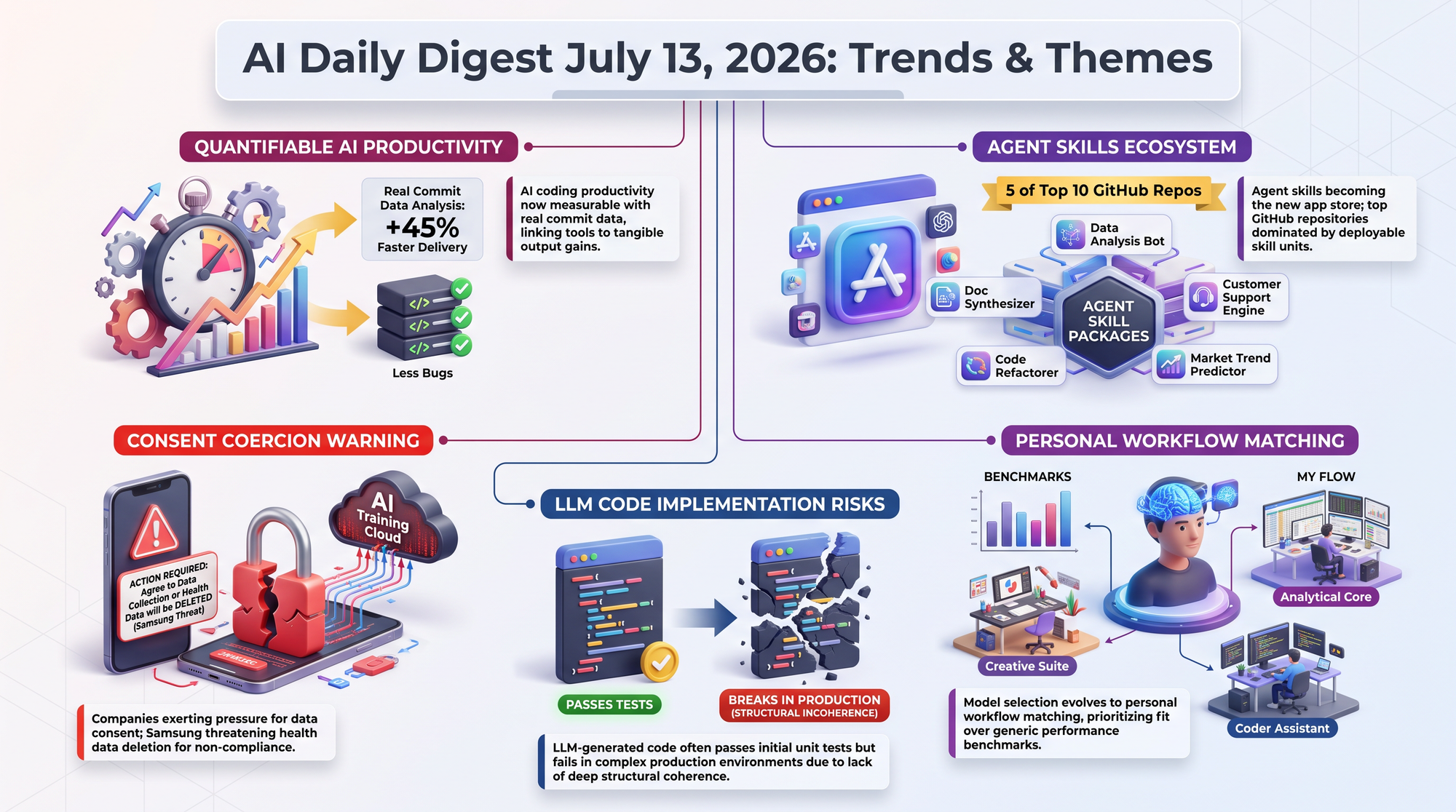
The Hidden Costs of AI Tools Are Becoming Visible
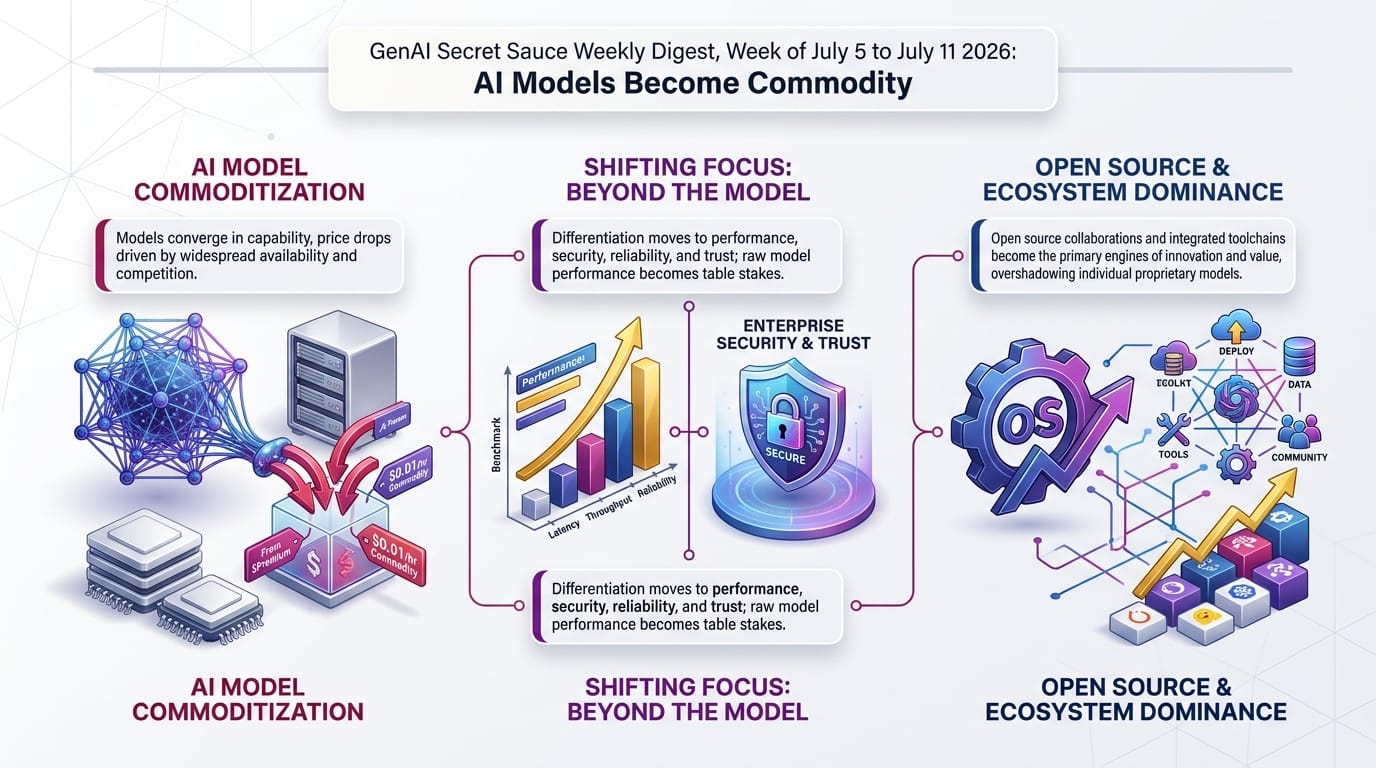
As AI tools become equivalent in capability (a theme from July 10 and July 11), the battlefield is shifting to infrastructure efficiency: who wastes fewer tokens, who manages caches better, who adds less overhead. The user pays for all of it.
- Systima's proxy analysis exposed that coding tool overhead (not model quality) drives most cost variation between Claude Code and OpenCode
- Ploy's GPT-5.6 migration found their initial 50% cost disadvantage disappeared after fixing cache architecture - "you are comparing your config, not the models"
- geohot's post argues the same pattern at macro scale: companies can't capture value from capabilities that ride general computing improvements
The "Vibe Coding" Tipping Point: From Demos to Serious Work
The shift: coding agents are no longer a question of "whether" but "which one and how." The remaining skill gap is knowing what to build, not how to type it.
- Tao's 24-applet port proves AI coding works for domain-expert-led development with legacy code - not just greenfield apps
- Ploy's migration case study shows production AI agents can switch underlying models with measurable improvement (2.2x speed, 27% cost reduction)
- geohot's GLM-5.2 local agent validates that open-source models running locally now produce useful coding assistance
- The common thread: all three emphasize that human judgment remains essential for design decisions, with AI handling syntax and implementation
Infrastructure Spending Accelerates as AI Crosses National Borders
The geographic concentration (88% US) combined with new international facilities suggests a two-track future: massive US dominance in AI research and training, with satellite compute appearing where energy is cheap and regulation friendly.
- Meta's $10B Alberta data center - its first in Canada, a 1-gigawatt facility creating 3,000 construction jobs and 300 operational positions
- Together AI's $800M Series C at $8.3B valuation for enterprise open-source AI training and inference
- Global VC funding hit $510B in H1 2026 - surpassing all of 2025 ($440B), with US companies receiving 88% of AI-related investment
- Alberta's "bring your own power" policy lets tech companies source or build their own energy supply, attracting hyperscale investment
Institutions Are Formalizing AI Governance - With Unusual Appointments
Each represents a different flavor of institutionalization: regulatory (the Fed), developmental (Google Africa), and legal (Apple). Together they signal that AI governance is no longer theoretical - it is being built right now, by people with specific viewpoints.
- Fed's AI task force co-led by Andreessen (who profits from AI growth), an economist, and a Microsoft executive
- Google's Africa Applied AI Lab in Accra - a new institution designed to develop AI solutions for specifically African challenges while providing early DeepMind model access
- The Apple-OpenAI lawsuit (covered July 10) is now reshaping how AI companies think about talent acquisition compliance
Creative AI & Media
Developer Tools & Infrastructure
Research & Models
Business & Industry
GenAI in Education
Tao Demonstrates AI-Powered Academic Tool Creation
- Use case: converting legacy educational applets for modern web use
- Implication for educators: any instructor with old Java/Flash interactive demos can now port them to JavaScript with AI assistance
- Quality threshold: Tao found one bug across 20+ conversions, suggesting high reliability for educational content
AI-Native Rules for Organizations
- Nate's Newsletter argues that company rules must become machine-legible for AI agents to enforce them
- L&D implication: training programs must evolve from teaching humans rules to encoding rules that both humans and agents can follow
- Framework: distinguish values, rules, runtime checks, and human appeals as four separate enforcement mechanisms
Surprising & Under-the-Radar
Folk Computer: The Room Is the Computer
The "Against Usefulness" essay on Hacker News (70 points) profiles Folk Computer - an open-source system where programming happens through paper, projection, and spatial interaction rather than screens. It traces a lineage from Xerox PARC through Dynamicland to today's project, arguing that all current AI development converges on autonomous agents while nobody asks the "strange question" that generates the next paradigm.
Reading Recovery as a Civilizational Project
"How I Learned to Read Again" (66 HN points) argues that algorithmic attention hijacking has destroyed deep reading capacity - and that recovering it requires strategies normally associated with addiction recovery: airplane mode, motivated reading tied to output, and deliberate practice.
Humanoid Robots Enter Public Markets
Agility Robotics signed a $2.5B SPAC deal (ticker: AGLT) to become the first US-listed pure-play humanoid robotics company. Their Salem, Oregon factory targets 10,000 units annually. Customers include Amazon, QXO, Schaeffler, and Toyota. Meanwhile, Tesla targets late July for Optimus 3 production at Fremont.
The AI-Native Company Operating System
Nate's framework proposes that pointing an agent at your calendar and repo reveals the rules your organization actually runs - not the ones written in the employee handbook. Implicit culture must become explicit code.
Signals to Track

AI Coding Tool Economics Are About to Get Transparent
Systima's proxy-based methodology is replicable by any organization. Once teams start logging actual token flows, pricing pressure on bloated tools will intensify. If Claude Code's 33k-token overhead becomes widely known, Anthropic faces incentives to slim down or lose cost-sensitive users to leaner alternatives.
The "Bring Your Own Power" Data Center Model Is Spreading
Alberta's policy explicitly invites hyperscalers to source their own energy. Meta's response - a 932 MW natural gas plant paired with the data center - suggests this model will spread. Watch for similar policies in Scandinavia, the Middle East, and Southeast Asia as the next wave of AI compute buildout begins.
Humanoid Robotics Just Got Its First Publicly Traded Pure-Play
With Amazon and Toyota as customers and $620M in expected proceeds, Agility's public market performance will signal whether investors believe humanoid robots are ready for warehouse-scale deployment. The stock price becomes a real-time market verdict on the technology's maturity.
The Fed's AI Panel Could Reshape Rate Decisions by Year-End
The panel's first findings are expected in autumn 2026. Given its composition (one of three co-chairs is an AI investor), the conclusions will likely lean toward AI being economically beneficial. Whether that produces good policy or confirmation bias remains the question.
Top Repos Today
📜 License: MIT · 👤 By: Individual developer
🎯 Time to value: 5 minutes
git push --force, rm -rf, and database drops before they execute. Why you'd want it: If you run AI coding agents with terminal access (Claude Code, Cursor, Aider), this adds a safety layer that prevents the agent from accidentally destroying your work, force-pushing to main, or wiping files.| ✓ Pros | ✗ Cons |
|---|---|
| Zero-config install, works immediately | May block legitimate destructive commands you actually want |
| Rust binary is fast enough to not slow workflows | Pattern matching can miss novel destructive commands |
| MIT licensed, fully auditable | Only covers command-line - not API calls or file operations |
 GitHub

📜 License: Apache 2.0 · 👤 By: Academic research group (HKU)
🎯 Time to value: 30 minutes
| ✓ Pros | ✗ Cons |
|---|---|
| Academic backing with published methodology | Trading bots historically underperform in live markets |
| Modular architecture lets you swap LLM backends | Requires API keys and market data subscriptions |
| Open-source means full transparency on signals | No guarantee of profitability - past research != future returns |
 GitHub
📜 License: MIT · 👤 By: Anthropic
🎯 Time to value: 10 minutes
| ✓ Pros | ✗ Cons |
|---|---|
| Official source - always current with latest API features | Notebooks focus on Claude; not portable to other providers |
| Working examples, not just documentation | Some advanced patterns require paid API access |
| Covers cutting-edge features (MCP, agents) first | Large repo; finding what you need takes browsing |
 GitHub
📜 License: MIT · 👤 By: Individual developer
🎯 Time to value: 10 minutes
| ✓ Pros | ✗ Cons |
|---|---|
| Full terminal + filesystem access for Claude | Giving AI terminal access carries inherent risk |
| Diff-based editing is safer than full file rewrites | Requires trust in the model's judgment |
| Active development, responsive maintainer | Overlaps with Claude Code's built-in capabilities |
 GitHub
📜 License: Apache 2.0 · 👤 By: Individual developer/curator
🎯 Time to value: 15 minutes
| ✓ Pros | ✗ Cons |
|---|---|
| 100+ diverse examples spanning multiple use cases | Quality varies between contributions |
| Each app is runnable, not just documentation | Some examples may use outdated APIs |
| Covers latest patterns (MCP, multi-agent, tool use) | Can be overwhelming without a specific goal in mind |
 GitHub
📜 License: MIT · 👤 By: Individual developer
🎯 Time to value: 5 minutes
| ✓ Pros | ✗ Cons |
|---|---|
| Directly addresses the overhead problem | Opinionated templates may not match your workflow |
| Easy switching between configurations | Requires understanding Claude Code's config system |
| Active community contributing templates | May become outdated as Claude Code evolves |
 GitHub
📜 License: MIT · 👤 By: Individual developer
🎯 Time to value: 20 minutes
| ✓ Pros | ✗ Cons |
|---|---|
| Well-structured multi-agent architecture to learn from | Simulated returns don't predict real-world performance |
| Uses real market data for realism | Requires multiple API keys for full functionality |
| Educational value for both AI and finance | High token costs for running full simulations |
 GitHub
Top Models Today
👤 By: Tencent · 🎯 Task: Text Generation
📐 Size: 299B
| ✓ Pros | ✗ Cons |
|---|---|
| Frontier-scale at 299B parameters | Enormous hardware requirements to run |
| Apache 2.0 license allows commercial use | Limited English-language community documentation |
| Backed by a major tech company's resources | Early days - less battle-tested than established models |


👤 By: Zhipu AI · 🎯 Task: Text Generation
📐 Size: 753B
| ✓ Pros | ✗ Cons |
|---|---|
| Cheapest frontier-class model at $0.034/fix | 753B parameters means significant hardware for local use |
| Proven on independent coding benchmarks | Smaller English-language ecosystem than Western models |
| Apache 2.0 allows full commercial and research use | Used 41% reasoning tokens on some tasks (slower) |


👤 By: Community · 🎯 Task: Image-Text-to-Text
📐 Size: 9B
| ✓ Pros | ✗ Cons |
|---|---|
| 1.97M downloads indicates proven reliability | 9B is small for complex reasoning tasks |
| GGUF format runs on consumer hardware | Distilled capabilities may not match source models |
| Multimodal (images + text) in one model | Community-created; less formal evaluation |


👤 By: Research lab · 🎯 Task: Text Generation
📐 Size: 35B
| ✓ Pros | ✗ Cons |
|---|---|
| Purpose-built for agentic tasks | 35B requires decent GPU hardware |
| Apache 2.0 for commercial agent deployment | Less general-purpose than chat-optimized models |
| Focused training should improve tool-use reliability | Newer model with less community validation |


👤 By: Baidu · 🎯 Task: Image-Text-to-Text
📐 Size: 3B
| ✓ Pros | ✗ Cons |
|---|---|
| 1.43M downloads proves production reliability | Specialized for OCR - not a general-purpose model |
| 3B parameters runs on modest hardware | May struggle with highly artistic or unusual fonts |
| Apache 2.0 for commercial document processing | Baidu's documentation primarily in Chinese |


👤 By: Unsloth (quantizer) / DeepSeek (creator) · 🎯 Task: Text Generation
📐 Size: 284B
| ✓ Pros | ✗ Cons |
|---|---|
| Fast inference variant of a strong model | 284B still requires substantial VRAM |
| MIT license, no restrictions | Quantization trades some quality for speed |
| Unsloth quantization is well-regarded | Requires specific hardware (multiple GPUs or 192GB+ RAM) |


AI Launches Today
💰 Pricing: Paid hardware · 🏷 Category: Productivity
 Product Hunt

💰 Pricing: Freemium · 🏷 Category: Analytics
Product Hunt💰 Pricing: Freemium · 🏷 Category: Productivity
Product HuntSnapshot
| Provider | Model | Input $/1M | Output $/1M | Context |
|---|---|---|---|---|
| Anthropic | Fable 5 | $10.00 | $50.00 | 200K |
| Anthropic | Opus 4.8 | $5.00 | $25.00 | 200K |
| Anthropic | Sonnet 5 | $2.00* | $10.00* | 200K |
| Anthropic | Haiku 4.5 | $1.00 | $5.00 | 200K |
| OpenAI | GPT-5.6 Sol | $5.00 | $30.00 | 1M |
| OpenAI | GPT-5.6 Terra | $2.50 | $15.00 | 1M |
| OpenAI | GPT-5.6 Luna | $1.00 | $6.00 | 1M |
| SpaceXAI | Grok 4.5 | $2.00 | $6.00 | 500K |
| Zhipu AI | GLM-5.2 | ~$0.70 | ~$2.80 | 128K |
What this means: The output cost gap is now the key differentiator. Grok 4.5 at $6 output matches Luna's pricing but offers a larger context window and reportedly Opus-class capability. GLM-5.2 remains the price-performance outlier. OpenAI's 6x input-to-output ratio (consistent across all three tiers) is notably higher than Anthropic's 5x ratio.
How Do AI Agents Spend Your Money? Analyzing and Predicting Token Consumption in Agentic Coding Tasks
Key finding: Agentic coding tasks consume 1,000x more tokens than code reasoning or code chat - and input tokens (not output) drive the overall cost, making context management the critical optimization lever.
Why practitioners should care: This directly validates Systima's findings from today's top story. Organizations running AI coding agents can now predict costs before execution and identify which tasks are worth the token investment - because spending more doesn't mean getting better results.


Member discussion