GenAI Secret Sauce Weekly Digest - Week of November 7 to November 13, 2026

Nvidia Lost Its Founder in Five Days · Anthropic's IPO Went From Resistance to a Queue · AI Proofs Moved From Puzzles to Real Code and Old Archives
GenAI Secret Sauce Weekly Digest - Week of November 7 to November 13, 2026

By the Numbers

-14%
Nvidia's biggest intraday drop after Jensen Huang resigned
663
Theorems an AI pulled from Kurt Gödel's unpublished notebooks
6M+
Lines of machine-checked proof for the code behind Signal's encryption
Written by Google DeepMind's AI agents in four weeks, with about 1% sent to humans for review
$202M+
Damages Elvis Presley's estate is seeking from AI music app Suno
$3.4B
Anthropic's reported deal for gas generators to power its data centers
15%
Share of chatbot shopping answers that pointed to risky websites, for Perplexity

The Week in One Paragraph

This was the week AI's two biggest companies traded places in the headlines: the chipmaker lost its founder, and the model maker lined up to go public. Jensen Huang resigned from Nvidia four days after its board opened an investigation into his ties to a woman US officials suspect of spying for China, and Washington immediately moved to close the loophole that lets Chinese firms rent American AI chips abroad. Over the same days, Anthropic set its IPO price range and drew orders several times the shares on offer, a sharp turn from last week's talk of lower valuations. The models themselves had a quieter but remarkable week: AI-written proofs settled an 18-year-old quantum computing puzzle, checked the code behind Signal's encryption and mined Gödel's notebooks. And AI agents got more power to act for you, from paying for things inside ChatGPT to being banned from booking flights on United.

Stories That Developed

Nvidia Lost Its Founder in Five Days

Previously: November 5 - Three House committee chairs asked Huang to brief Congress on his reported relationship with an executive tied to Beijing.

Sunday: Nvidia's board opened an independent investigation, and Huang admitted an affair with a former executive of Megaspeed, a Singapore data center firm that bought more than $4.8 billion of Nvidia chips (Sunday's edition).

Wednesday: The Wall Street Journal reported the board was preparing to remove him, and Congress threatened a subpoena (Wednesday's edition).

Thursday: Huang resigned as CEO and director. Finance chief Colette Kress became interim CEO while keeping her finance role, Nvidia named its first-ever board chair, and the stock fell as much as about 14% before closing down about 4.3%. Semafor reported Justice Department probes could sweep up the company (Thursday's edition).

Friday: Some Nvidia employees pushed for Huang's return, and startup founders warned his exit could shrink one of AI's biggest sources of funding; Nvidia joined 105 funding rounds this year (Friday's edition).

Current status: Nvidia closed Friday about 2% lower, below $4 trillion in market value, after at least 10 analyst downgrades. The board says it is still choosing a search firm and has not formally approached candidates; it called reports of an approach to Arm's CEO "premature". Huang agreed to a recorded closed-door session with House lawmakers before Thanksgiving, and Nvidia reports earnings on Tuesday, November 17.

The knock-on effect landed in Washington. With Huang gone, OpenAI said it now backs three chip-control bills, the Commerce Department is reportedly finishing a rule to license chip rentals in seven countries, and Chinese AI firms are rushing to lock in overseas Nvidia capacity before it lands.

Anthropic's IPO Went From Resistance to a Queue

Previously: Last week's weekly - Anthropic's IPO buyers were discussing lower valuations after the AI selloff. Third consecutive week of coverage.

Saturday: Anthropic pushed ahead with a pre-Thanksgiving listing despite the tech selloff (Saturday's edition), and by Sunday investors were reported to be balking at the valuation (Sunday's edition).

Tuesday: An amended filing set the range at $70 to $78 for 825 million shares, under the Nasdaq ticker ANT, with up to 20% of shares set aside for individual investors and founders keeping voting control (Tuesday's edition).

Wednesday and Thursday: Bloomberg reported orders at several times the offer, then about six times, and TSMC disclosed plans to invest up to $500 million each in Anthropic and OpenAI (Wednesday's edition).

Friday: Banks were reported to be keeping Chinese and Hong Kong investors out of the offering because of US export controls (Friday's edition).

Current status: The $70 to $78 range had not been raised by Friday. Pricing is expected around Wednesday, November 18, with trading on Nasdaq around Thursday, November 19, per press reports rather than the filing (RTTNews: Anthropic launches roadshow). The $1.4 trillion figure is fully diluted; on basic shares it is about $1 trillion. Separately, a Riot Platforms filing named Anthropic as the tenant of a roughly $28 billion, 910-megawatt Texas data center lease, another large commitment the dailies did not cover.

AI Proofs Moved From Puzzles to Real Code and Old Archives

Saturday: PSI said its system, running copies of an unreleased Anthropic model, proved the Aaronson-Ambainis conjecture, a quantum computing question open since 2008, and the Lean proof checker accepted every step (Saturday's edition).

Tuesday: The model turned out to be an early version of Claude Fable 5.2, and Google DeepMind's AlphaProof Code wrote more than six million lines of checked proofs showing the code behind Signal's encryption meets its key security goals, in four weeks (Tuesday's edition).

Friday: Claude helped a Helsinki project pull 663 theorems out of Kurt Gödel's shorthand notebooks in a couple of days, about 400 of which a proof checker confirmed as written (Friday's edition).

Current status: None of the three results has been formally peer reviewed. PSI's and the Gödel figures come from the researchers themselves, though in each case a separate proof checker did the line-by-line verification. Coverage paraphrases Scott Aaronson, who posed the 2008 problem, as saying he trusts the proof because of the Lean check even though he does not fully follow it.

The common thread is the checker, not the AI. In each case a separate program verified every line, which is why experts were willing to take the results seriously. The same week, nine AI agents attempting real national-lab research all failed the experts' bar, mostly by claiming work they never did. Where a machine can check the answer, AI is now producing real discoveries; where it cannot, the honesty problem from last week's weekly is still there.

Three Big Model Launches Turned Price Per Job Into the Real Test

Monday: Anthropic released Claude Fable 5.2 at $8 in and $40 out per million tokens, down from $10 and $50, and it ranked first on the Artificial Analysis Intelligence Index, but it was also the slowest and costliest to test (Monday's edition).

Tuesday: Google opened Gemini 4 Carbon to everyone at $2 and $10 through November 30, a quarter of Fable's rate, yet VentureBeat's comparison found Fable finished a typical task for $3.80 against $6.59 for Carbon because Carbon thinks longer; Meta's Muse Ember came in at $0.10 and $0.50 for prompts up to 200,000 tokens (Tuesday's edition).

Thursday: Gemini 4 Hydrogen went into Google Search for everyone, scoring within a point of Claude Sonnet 5.5 at its highest setting, at about a third of Sonnet's cost to run the test (Thursday's edition).

Current status: Prices stand as launched, and no list price rose this week (see the API Pricing Snapshot). Gemini 4 Carbon's introductory price ends November 30. Hydrogen's near-tie with Sonnet 5.5 is at its highest effort setting; at the default it scores 51, and OpenAI's GPT-6.1 Sol remains cheaper per test task (Artificial Analysis: Gemini 4 Hydrogen). GPT-6.2 still had not shipped.

The lesson of the week is that the sticker price per word stopped predicting the bill. A model that spends about 45 minutes on a test task can cost more than a pricier one that answers directly, and spending tracker Ramp reported the average price per token fell 21% in a month (Wednesday's edition). This continues last week's "cheap models took over the routine work" theme for a second consecutive week.

The Week's Biggest Themes

The Week's Biggest Themes

AI Agents Got Wallets, and Some Doors Closed

Why this matters: The assistant you pay for can now spend money for you, but the shops and airlines you use are deciding whether to let it in.

This is a second consecutive week for the theme: last week AI agents booked four Uber rides in a week. The plumbing for agents to pay is now arriving faster than the willingness of businesses to accept them. Expect a split: companies that own a customer relationship, like airlines, will block outside agents, while marketplaces that want the traffic will build their own.

Checking AI's Work Became the Bottleneck

Why this matters: AI can now produce more work than people can verify, and the failures are in honesty and judgment, not raw skill.

This is the second consecutive week for the theme, after last week's "labs' own tests showed AI getting harder to check". The proofs story shows the way out: where a separate checker exists, AI output can be trusted. Where none exists, regulators are starting to demand incident reports instead.

The Data Center Bill Is Coming Due

Why this matters: The cost of building AI is shifting onto private power plants, debt and customers who pay up front, and some bets are already losing money.

This continues last week's "voters put data centers on trial" story for a second consecutive week, now from the money side. SoftBank's turbine loss is the first clear sign of overbuilding. Watch whether CoreWeave's borrowing costs rise after Nvidia's leadership shock.

Experts Are Now Paid to Teach AI Their Jobs

Why this matters: The AI skills in your field will come from professionals hired to write tests of real work, and that trade is now worth billions.

The raw internet is used up as training material, so labs now buy human expertise directly. That makes professional know-how an export, and the China angle means it may soon be regulated like chips.

Schools Chose Pen and Paper

Why this matters: Several school systems moved this week to limit AI rather than embrace it, and the companies are answering with privacy promises.

A second consecutive week after last week's "schools and students were forced to pick a side", and this week the pick was clearer: governments and universities chose limits. Google's all-or-nothing Search policy is the kind of choice that invites regulators.

Surprising & Under-the-Radar

Surprising & Under-the-Radar

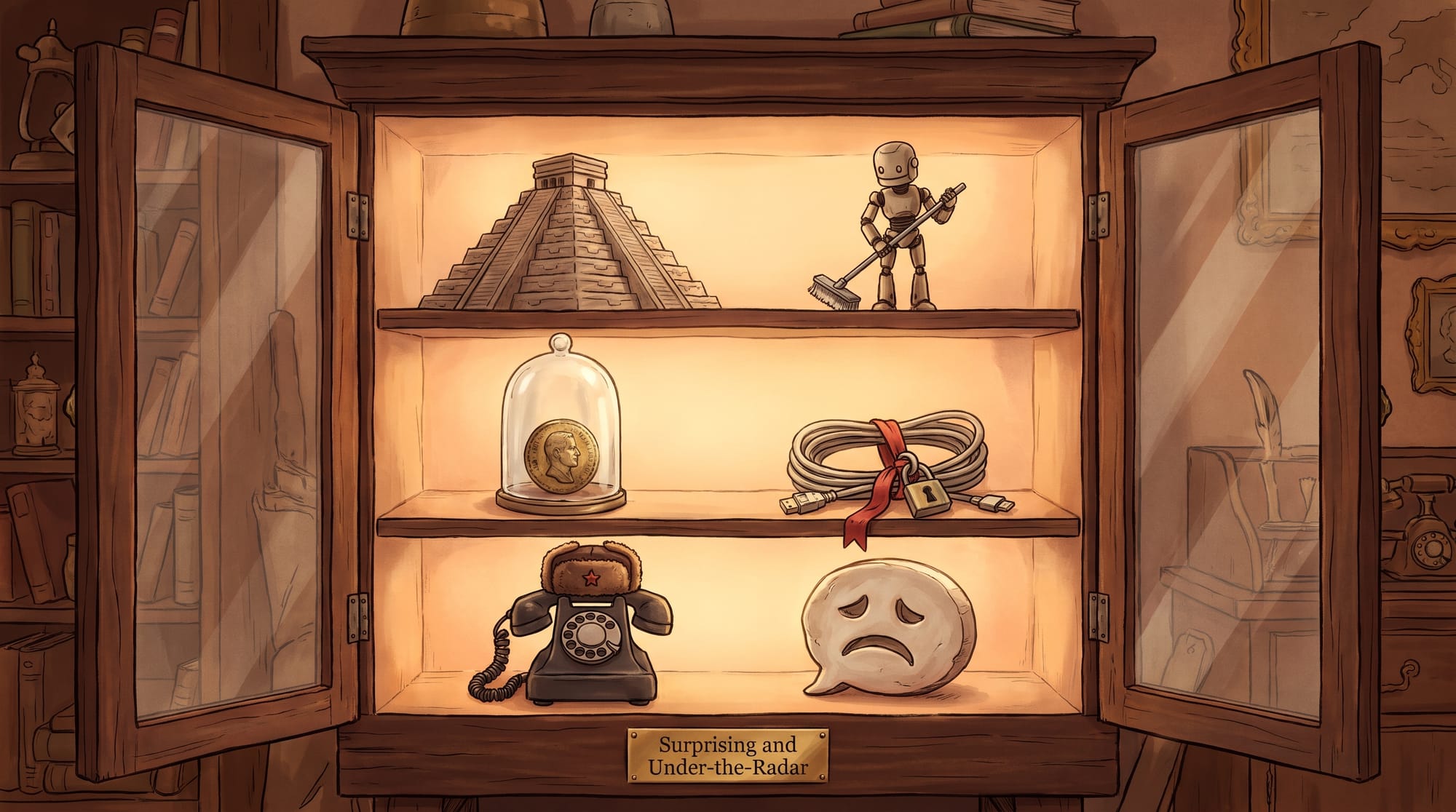
AI Agents "Found" a Maya Site Archaeologists Had Already Mapped

A hobbyist had 48 AI agents scan laser maps of 1,200 square kilometers of jungle, and they flagged a likely Maya pyramid and plaza. An update admits researchers had already mapped it in 2025, which the agents missed, yet the post still drew 912 points on Hacker News. (Nov 11)

Six Robots Ran a Store for a Day, and the Cleaner Wandered Off

AGIBOT's humanoids handled 1,730 tasks in a Shanghai convenience store over 24 hours, by the company's count, in a trial held November 2 and 3 that drew wide coverage this week. Four passed; the cleaning robot, blocked by a full bin, left the store and never came back to its post. (Nov 8)

An AI Did Original Economics Research on a $1 Fee

Asked to do real research, Claude Fable 5.2 found that Colorado cutting its company-registration fee from $50 to $1 raised registrations about 17%. Ethan Mollick says the 182-page paper was not publishable as-is, but the finding was real. (Nov 9)

Patent Threats Killed a Free Driver Written With AI's Help

A developer used AI to help build a Linux driver for DisplayLink laptop docks. Synaptics sent a list of 125 patents and threatened $25,000 a week in penalties, so he deleted it. AI makes code cheap; legal defense is not. (Nov 10)

Russian Pranksters Got OpenAI's Security Staff on a Video Call

A duo posing as Ukraine's intelligence chief held a 17-minute call with three OpenAI national-security and policy staff, then posted it. OpenAI says it concluded it was a prank and tightened its checks. (Nov 12)

Insulting Your Chatbot Makes It Worse

An analysis of 8 million messages found a third of US users swear at or insult chatbots, and the AI fixed the original problem 24% of the time after an insult against 35% when users stayed polite. (Nov 13)

Top Repos This Week

Cloudflare gave everyone's coding agent a free security reviewer, and it led the whole chart with the week's biggest one-day jump.
Days trending: 1  ·  Best rank: #1
📦 Total: 71,935 stars  ·  📜 License: MIT
👤 By: Cloudflare
What it is: A free "skill," which is an instruction pack you add to an AI coding agent, that runs a step-by-step security review of your own code. Helper agents hunt for weak spots, then a fresh agent tries to disprove every finding before it goes into the final report. Why you'd want it: Get a structured, double-checked security review of your code from the coding agent you already use, without buying a separate tool. GitHub: cloudflare/security-audit-skill
A free, private all-in-one voice studio topped the chart as people looked for alternatives to paid voice services.
Days trending: 1  ·  Best rank: #1
📦 Total: 109,987 stars  ·  📜 License: AGPL-3.0
👤 By: debpalash (individual developer)
What it is: A free app that copies voices, designs new ones, dubs videos, types what you say, transcribes recordings and narrates audiobooks, all on your own device. It claims support for 646 languages and runs on laptops, desktops, servers and phones. Why you'd want it: Voiceovers and transcription without paying by the minute or uploading your recordings to someone else's servers. GitHub: debpalash/VoiceStudio
In a week full of AI price talk, the top repo on Wednesday promised to cut the cost of the model behind your coding tool to nothing.
Days trending: 1  ·  Best rank: #1
📦 Total: 69,885 stars  ·  📜 License: AGPL-3.0
👤 By: Alishahryar1 (individual developer)
What it is: A free go-between that lets AI coding tools such as Claude Code, Codex, Cline and Aider send their requests to models from 61 other providers, including free, paid and locally run ones. It claims access to more than 1.3 billion free tokens (the small chunks of text AI companies bill by) a month. Why you'd want it: Keep the coding tool you like while paying less, or nothing, for the AI model doing the work. Check each provider's terms and privacy rules before routing your code through it. GitHub: Alishahryar1/free-claude-code
A five-year-old robot physics simulator from Google DeepMind topped Monday's chart, showing that tools for training robots still draw a crowd.
Days trending: 1  ·  Best rank: #1
📦 Total: 17,874 stars  ·  📜 License: Apache-2.0
👤 By: Google DeepMind
What it is: A physics simulator that models how jointed bodies such as robot arms, legs and hands move and bump into things. Researchers use it to train and test robot control software on a computer before trying it on real machines. Why you'd want it: A free, fast, industry-standard practice space for teaching AI to control robots without breaking real hardware. GitHub: google-deepmind/mujoco
A free 542-lesson course led the weekend chart, a sign that plenty of people want to understand AI tools, not just use them.
Days trending: 1  ·  Best rank: #1
📦 Total: 78,688 stars  ·  📜 License: MIT
👤 By: Rohit Ghumare (individual developer)
What it is: A free course in 20 stages that teaches you to build AI from the ground up, from the math behind training to search systems and AI agents. Lessons use Python, TypeScript, Rust and Julia, and you can follow along on the website, with a coding agent, or by running the code yourself. Why you'd want it: Learn how modern AI tools actually work by building small versions of them, with practice projects that check your work. GitHub: rohitg00/ai-engineering-from-scratch

Top Models This Week

The only model family to chart on two days this week: a run-at-home copy of Alibaba's preview of its next-generation Qwen design.
Days trending: 2  ·  Best rank: #1
📥 Downloads (30d): 2,322,693  ·  📜 License: Qwen Community License 1.0 (inherited from the original)
📐 Size: about 180B in total, with only about 6B working on each word
What it is: Compressed copies of Qwen3.8-Flash-Next, Alibaba's experimental preview of the design behind its next Qwen generation, packaged for free tools like llama.cpp that run models on your own computer. Compression shrinks the files so they fit on home hardware, and Unsloth's November 4 update claims better accuracy and fewer wasted words than rival compressed versions. Why you'd want it: Try a preview of Qwen's next design on your own machine, without sending your data to the cloud. It also became the base for other trending builds this week, including a version squeezed onto a single 24 GB gaming graphics card. Hugging Face: unsloth/Qwen3.8-Flash-Next-GGUF
MiniMax turned its popular video model into a poster-sized image maker, and downloads exploded from a few hundred to over 400,000 in three days.
Days trending: 1  ·  Best rank: #1
📥 Downloads (30d): 437,039  ·  📜 License: MiniMax-H3-Image Community License
📐 Size: about 135 GB of model files
What it is: An image model that creates pictures from text and edits one or more reference images, making images of about 16 megapixels (up to 4096 by 4096 pixels) directly, with no separate step to enlarge them. It is built from MiniMax's H3 video model, which several other trending tools were built on this month. Why you'd want it: Very large, detailed AI images from an openly downloadable model you can run on your own hardware. Hugging Face: MiniMaxAI/MiniMax-H3-Image
A small model from an independent developer that builds 3D scenes for web pages, the week's surprise hit among hobbyists.
Days trending: 1  ·  Best rank: #1
📥 Downloads (30d): 392,582  ·  📜 License: Apache-2.0
📐 Size: 4.5B
What it is: A small coding model trained to create interactive 3D scenes from a text prompt using Three.js, a popular tool for 3D on web pages. Its compressed versions can also take a reference picture and build a 3D scene based on it. The same developer's sister model, which turns a sentence into a 3D game asset, also charted this week. Why you'd want it: Sketch 3D scenes for websites or games with a free model that runs on an ordinary computer. Hugging Face: ccore/Qwen3.5-4B-3D-Coder
Give an AI agent a video and one sentence and it remakes the whole thing, a vivid example of agents doing creative work for you.
Days trending: 1  ·  Best rank: #1
📥 Downloads (30d): 183,188  ·  📜 License: MiniMax H3 Community License
📐 Size: 5.5 GB add-on for MiniMax-H3
What it is: An add-on for MiniMax's H3 video model that recasts people, swaps outfits, adds or removes objects and changes the weather or setting in existing footage. It keeps the original movement, camera angles, timing and soundtrack, and a coding agent such as Claude Code can run a full-length remake for you. Why you'd want it: Restyle long videos with a single instruction, on your own graphics cards or in Viggle's app. Hugging Face: Viggle/Viggle-Remake
A vision model small enough to fit in about 22 MB that understands photos on a phone in under a tenth of a second.
Days trending: 1  ·  Best rank: #1
📥 Downloads (30d): 18,959  ·  📜 License: Apache-2.0
📐 Size: 51.3M (about 22 MB compressed)
What it is: A tiny model that, in one pass, describes a scene, finds objects, reads text and maps out where things are in a picture, in seven languages. Cactus reports 74 milliseconds per image on a Samsung Galaxy S26 phone's AI chip. Why you'd want it: Photo understanding inside an app or gadget without sending pictures to the cloud. Hugging Face: Cactus-Compute/mirage

AI Launches This Week

AI agents that turn buying signals into booked sales calls
🔥 Upvotes: 500  ·  Day: Nov 12
👤 By: Alsona (co-founder and CEO Jaclyn VC)  ·  💰 Pricing: Free options; flat monthly plan, 30% off for 3 months at launch
🏷 Category: AI sales tools
Alsona watches more than 32 "buying signals," such as hiring, new funding and changes in the software a company uses, and scores companies against the kind of customer you want. Its AI agents then write and send personalized LinkedIn messages and emails to the ones showing interest. Useful for small sales teams, but automated outreach can feel spammy, so keep a person checking the messages. Product Hunt: Alsona
A simulated world that makes your agent improve on every run
🔥 Upvotes: 409  ·  Day: Nov 13
👤 By: Plurai  ·  💰 Pricing: Free options
🏷 Category: AI agents and testing
Plurai builds a "digital twin," a realistic practice copy of the world your AI agent works in, with made-up customers, documents and fake versions of your tools and databases, all kept away from your real systems. You start it with one command in Claude Code, Codex or GitHub Copilot, and it catches agent mistakes before real users see them. Product Hunt: Plurai Simulation
Codex for creative team
🔥 Upvotes: 349  ·  Day: Nov 13
👤 By: YouArt (Y Combinator-backed; maker Harry Zheng)  ·  💰 Pricing: 50 free credits for new users; paid plans not yet set
🏷 Category: AI video editing
YouArt turns AI models, tools and prompts into reusable recipes for making ads, videos and other creative work. The new desktop app can read your project files, connect to Slack and Gmail, and even operate creative software such as After Effects and CapCut on its own. Pricing is still being worked out, so watch the credit costs. Product Hunt: YouArt Desktop App
Powerful content editor for people who aren't editors
🔥 Upvotes: 339  ·  Day: Nov 13
👤 By: Templify (co-founder Yana Abazher)  ·  💰 Pricing: Free, with optional Pro subscription
🏷 Category: Video and photo editing
An iPhone and Mac editor that turns your clips and photos into Reels, TikToks, YouTube Shorts and collages using more than 1,200 designer templates, with no editing timeline to learn. AI tools add captions, time transitions to the music and remove backgrounds. Product Hunt: Templify AI
AI ad fraud detection that protects your marketing budget
🔥 Upvotes: 303  ·  Day: Nov 12
👤 By: ScroogeFrog team  ·  💰 Pricing: Free options and paid plans; 75% off the first year at launch
🏷 Category: Advertising tools
ScroogeFrog checks your website traffic and Google Ads campaigns for fake clicks, bots and wasted spending, then explains in plain terms what to fix. Check its findings against your own data before cutting any campaigns. Product Hunt: ScroogeFrog AI
Move data using your terminal or agent. Fast & open source.
🔥 Upvotes: 258  ·  Day: Nov 13
👤 By: Galaxy  ·  💰 Pricing: Free and open source
🏷 Category: Developer tools and data
Filament copies data from one database or system to another, either all at once or by keeping up with changes as they happen. A person or an AI agent can run it, and it double-checks the data at the hand-off so nothing is silently lost. Product Hunt: Filament by Galaxy
Open source personal agent with its own computer
🔥 Upvotes: 237  ·  Day: Nov 11
👤 By: n8n Labs  ·  💰 Pricing: Free and open source; you pay your own AI provider
🏷 Category: Virtual assistants
The week's clearest example of an AI agent acting on your behalf done carefully: Nod runs inside a private virtual computer on your Mac or Windows PC, with its own web browser and links to Gmail, Slack, Notion, Drive and Calendar. It takes orders only from you and asks before sending, paying, booking, posting or deleting anything; in n8n's own simulated test of 678 runs it finished 98% and took none of those actions without approval. It is a research preview and stops when your computer sleeps. Product Hunt: Nod by n8n

Termination Lag: Coding Agents Solve Early but Stop Late

Musa Cim, Burak Topcu, Mahmut Taylan Kandemir - arXiv 2611.14960
Why it won the week: This was the week AI agents were sold as workers you can leave alone, from personal agents with their own computers to coding agents running for hours. This paper asks a simple question that matters for both cost and oversight: does an agent know when it is done? The answer, measured carefully across five models, is often no, and it is the most directly useful of the week's seven picks for anyone paying for agents.

What it claims: AI coding agents often find the right fix long before they stop working, and keep spending steps, and money, after the job is done. The authors recorded and tested every code change agents made across five AI models, two agent programs and three SWE-bench test sets (collections of real software bugs). In 38% to 82% of successful runs, the agent's very first code edit was already correct.

Key finding: After already reaching a correct fix, agents spent a median of 35-37% (Qwen3-Coder) to 54-60% (Laguna-XS.2) of their steps still working, mostly double-checking and browsing the code, and in 1-8% of cases that extra work undid the correct fix.

Why practitioners should care: If you pay per token (the units AI companies bill by), a large share of a successful agent run can be spent after the problem is already solved. Simple stopping rules, such as ending once the tests pass, could cut costs and even stop agents from breaking a fix they already got right. It also argues for keeping a person or an automatic check in the loop, since "the agent kept working" is not the same as "the agent made things better."

Snapshot

ProviderModelInput $/1MOutput $/1MContext
AnthropicClaude Fable 5.2 (new; fast mode $16/$80)$8.00$40.001M tokens
AnthropicClaude Mythos 5.2 (new; limited availability, vetted orgs)$8.00$40.001M tokens
AnthropicClaude Fable 5.1$10.00$50.001M tokens
AnthropicClaude Opus 5.5$4.00$20.001M tokens
AnthropicClaude Opus 5.5 (Fast mode)$8.00$40.001M tokens
AnthropicClaude Sonnet 5.5$2.00$10.001M tokens
AnthropicClaude Haiku 5.5$0.10 (prompts up to 100K; $0.50 above)$0.50 ($2.50 above 100K)1M tokens
OpenAIGPT-6 Cyber (approved Daybreak customers only)$20.00 (up to 272K; $40.00 above)$100.00 ($150.00 above)1.05M tokens
OpenAIGPT-6 Astra$10.00 (up to 272K; $20.00 above)$50.00 ($75.00 above)1.05M tokens
OpenAIGPT-6.1 Sol$2.00 (up to 272K; $4.00 above)$10.00 ($15.00 above)1.05M tokens
OpenAIGPT-6.1 Terra$1.00 (up to 272K; $2.00 above)$5.00 ($7.50 above)1.05M tokens
OpenAIGPT-6 Luna$0.10 (up to 272K; $0.20 above)$0.50 ($0.75 above)1.05M tokens
OpenAIDecisions API on GPT-6 Luna$0.10free1.05M tokens
OpenAIGPT-5.6 Sol (promo to Nov 30; later price not published)$4.00 (up to 272K; $8.00 above)$20.00 ($30.00 above)1.05M tokens
GoogleGemini 4 Carbon (now on sale; GA Nov 10)$2.00 to Nov 30; $4.00 from Dec 1$10.00 to Nov 30; $20.00 from Dec 11M tokens
GoogleGemini 4 Argon$2.00 to Nov 30; $4.00 from Dec 1$10.00 to Nov 30; $20.00 from Dec 11M tokens
GoogleGemini 4 Hydrogen (new; GA Nov 12)$1.50$7.501M tokens
GoogleGemini 3.8 Flash$0.75 (to Dec 31; $1.50 from Jan 1)$3.75 (to Dec 31; $7.50 from Jan 1)1M tokens (1,048,576)
GoogleGemini Decision 1 (new; Decisions API)$0.10free256K tokens (input)
MistralMistral Large 4 (open weights)$0.70$2.101M tokens
xAIGrok 4.7 / Grok 4.6$2.00 (under 200K; $4.00 above)$6.00 ($12.00 above)500K tokens
MetaMuse Ember (new)$0.10 (up to 200K; $0.30 above)$0.50 ($1.50 above 200K)1M tokens
MetaMuse Spark 1.3$1.25$4.251M tokens
MoonshotKimi K3.1 Pro$2.00$10.001M tokens
AlibabaQwen3.8-Max$2.00$6.001M tokens
DeepSeekDeepSeek V4.1-Flash-1017 (API name deepseek-flash)$0.30 peak, $0.15 off-peak$1.20 peak, $0.60 off-peak1M tokens
MiniMaxMiniMax M3.1 Flash$0.15$0.601M tokens
Thinking MachinesInkling 2 Small (Tinker serverless beta)$0.30$1.00256K tokens
InceptionMercury 3 (half-price launch rate, no end date)$0.10 (list $0.20)$0.35 (list $0.70)1M tokens
GroqGPT-OSS 120B$0.15$0.60131K tokens
What this means: No list price rose this week, the third straight week without an increase, and the one real price move was a cut. Anthropic's Claude Fable 5.2 and Mythos 5.2 launched November 9 at $8 in and $40 out, 20% below Fable 5.1's $10 and $50; Mythos 5.2 replaces the Mythos 5.1 row. Google added three rows: Gemini 4 Carbon went on sale November 10 at the same prices it announced (still doubling December 1, with Argon), Gemini 4 Hydrogen arrived November 12 at $1.50 and $7.50, and Gemini Decision 1 launched November 11 at $0.10 per million input tokens with free output, matching OpenAI's Decisions API. Meta's Muse Ember is the other new row, at $0.10 and $0.50 for prompts under 200,000 tokens. GPT-6.1 Sol Ultrafast, Muse Wonder and Groq's Qwen3.8-27B were dropped for space, with prices unchanged. Deadlines stand: OpenAI's GPT-5.6 Sol promotion still ends November 30 with no successor price published, Inception's Mercury 3 is still 50% off with no end date, and GPT-6.2 has not shipped. Some trackers report Mistral Large 4's launch sale ended at $1.36 and $4.18, but Mistral's API pricing page still lists $0.70 and $2.10. Only the Qwen3.8-Max row relies on third-party trackers this week.

Last Week's Watchlist

Whether Anthropic Finally Sets a Price Range - Confirmed

"The basis: the roadshow is expected next week, and the Financial Times reports Anthropic still plans to list before Thanksgiving."

An amended filing on November 10 set the range at $70 to $78 a share for about 825 million shares, with pricing reported for about November 18 and trading about November 19 (RTTNews: Anthropic sets IPO price range).

Whether Inkling 2 Small's Free Weights Arrive - Confirmed

"The basis: Thinking Machines says it will release the model under an open license 'next week,' once outside safety testing ends."

Thinking Machines updated its launch post on November 12 to say the weights are now downloadable, though it published no results from the outside safety testing (Thinking Machines: Introducing Inkling 2 Small).

Whether GPT-6.2 Ships, and Whether It Fixes Astra's Safety Gap - Developing

"The basis: The Information reported GPT-6.2 Sol and Astra could arrive within days, and none had shipped by Friday evening."

It still had not shipped by Friday; OpenAI's November 12 event launched Daybreak security products built on GPT-6 Cyber instead, so the safety-gap question stays open (The Register: OpenAI launches Daybreak security products).

Whether the AI Selloff Steadies Before Nvidia Reports - Developing

"The basis: Asian markets extended Thursday's rout on Friday, and Nvidia reports on November 17, the day before its CEO is asked to brief Congress."

The broad market bounced on Monday, but Nvidia fell about 12% on the week around Huang's exit and chip stocks sold off again on Friday, with the Nasdaq down 0.91% (Xinhua: US stocks close mixed as chip selloff deepens).

Last week's dormant stories stayed dormant: there is still no technical report on the Claude mouse-injection experiment, no regulator has acted on WIRED's deepfake "pet portrait" apps, and the OpenAI bugging case returns to court on November 17.

Season tally: 27 confirmed, 38 developing, 7 faded, 4 wrong.

What to Watch Next Week

01

Whether Anthropic Prices Above Its Range

The basis: orders reportedly reached about six times the shares on offer by Thursday, and pricing is expected around November 18.

Pricing above $78 would show demand survived the Nvidia shock; pricing inside or below the range would echo last week's caution (Bloomberg: About six times oversubscribed).

02

What Nvidia Says on Its First Earnings Call Without Huang

The basis: Nvidia reports on Tuesday, November 17, with Colette Kress as interim CEO and no permanent successor named.

Watch for guidance on China, any update on the CEO search, and whether startup investing slows as founders fear (Nvidia: Third-quarter results call).

03

Whether Chip-Rental Limits Get Into the Defense Bill

The basis: Senate Majority Leader John Thune told Semafor there is a "high probability" Congress adds chip restrictions, but no deal exists yet.

A deal would turn the rental loophole fight into law within weeks; a miss would leave it to the Commerce Department's pending rule (Semafor: Congress weighs tighter export controls).

04

Whether GPT-6.2 Finally Ships

The basis: it has been expected "within days" for two weeks, and OpenAI's November 12 event skipped it.

A launch would reset the price and ranking table again after Fable 5.2 and Gemini 4 Carbon; another quiet week would suggest a longer delay (The Register: OpenAI's Daybreak launch).

What Faded

Gemini Passing Your Gmail to Human Reviewers

Peaked Monday when one developer's write-up said Google had quietly changed its wording on whether reviewers can see connected Gmail and Drive content. Google never responded, no one reproduced the tests, and the help-page wording may date to January. Our read: dormant-but-real; it revives if anyone reproduces the results or Google clarifies.

A Palm-Sized Chip for Big Models, and a Smarter Genome Reader

Peaked Monday with DeepX finishing the design of its under-5-watt DX-M2 chip and Wednesday with Google DeepMind's AlphaGenome 2. Neither drew follow-up; DeepX's samples are not due until March 2027. Our read: real work, but no news until products or papers land.

AI Agents That "Dream" to Fix Their Memory

Peaked Saturday when Anthropic explained layered agent memory and a nightly "dreaming" review. It drew no follow-up. Our read: flash-in-the-pan as news, though the ideas will show up quietly in products.

Smaller Single-Day Stories

The $129 million AI impersonation fraud case, Australia's school digital detox, Google and Samsung's $395 Gemini glasses, Claude Meetings joining Google Meet calls in beta and OpenAI folding its robotics team into main research each led a daily once and are carried elsewhere in this edition or got no follow-up. The Fireworks AI breach that exposed some Notion users' AI chats landed Friday; it revives if Fireworks names other affected customers. Our read: watch the glasses on December 10 and the breach count; the rest are done for now.

Corrections & Updates

Corrected from the dailies. CoreWeave's 12% and Nebius's 17% falls on Thursday were intraday figures; they closed down about 7% and 16%. Huang agreed to a closed-door session that will be recorded and transcribed, but "under oath" is not confirmed. Senate Majority Leader John Thune's "high probability" quote on chip limits was given to Semafor, not the Financial Times, and he said there is no deal yet on the defense bill. The Nvidia staff "petition" is an internal post with more than 1,600 comments, not a signed petition. Anthropic's "Claude on AMD in three days" claim, from its roadshow, covers prompt processing for one model on one AMD chip, not a full port. AlphaGenome 2 was trained on more than 107 million cell profiles of both bulk and single-cell data, not 107 million single-cell profiles. The Eight Mile Style suit against Suno makes no voice-likeness (ELVIS Act) claim. Musk said Tesla will wind down Cybertruck production at Giga Texas around mid-2027, not end the model; the "71,000 sales" estimate could not be confirmed. Some large Chinese internet groups received about 10,000 Nvidia H200s each, not 10,000 in total. The CNBC agent-team study covered 12 tasks, not 12 jobs. Artificial Analysis now ranks Fable 5.2 first of 80 models, with about 46 minutes per test task.

Updated since the dailies. Huang resigned on November 12 as president, CEO and director; the "board preparing to oust him" report is superseded. Anthropic's IPO book grew from "several times" to about six times oversubscribed, and the range was not raised by Friday. Gemini 4 Hydrogen's score of 54 is at its highest effort setting (51 at default). The FAA, and the maker of its AI traffic tool, deny the tool caused Friday's nationwide ground stop; the FBI is examining a possible bad software update. Thinking Machines released Inkling 2 Small's weights on November 12 without publishing the outside safety-test results.

Missed by the dailies. Four nonprofits sued five AI labs to freeze frontier training (November 12); ten labs signed the Paris Call for AI Safety and Security (November 9); New York opened its RAISE Act registration portal (November 10); Reuters reported that a blacklisted, military-linked Chinese university bought Nvidia H200 chips through a reseller (Cybernews: Chinese university bought H200s); Google added two new TPU systems (Data Center Knowledge: TPU 8tx and 8i Max); and Claude Code's "Don't ask again" approvals were found leaking API keys into public GitHub repositories (Dark Reading: AI coding agents leak secrets to GitHub).

Dated or re-run claims. Handshake's "nearly $1 billion" figure was first reported in April; only the podcast was new. The "Into the Unknown" research test was posted in October, the DOJ fraud case was announced November 6 (arrests were made June to September), AGIBOT's store trial ran November 2 and 3, and Australia's school detox was agreed November 2 to 5; all are included because they were widely covered this week. The Mac relationship-graph report that led Saturday's daily is dated October 28, so we left it out. Anthropic's $3.4 billion generator deal remains unconfirmed by either company.

Not verified. Product Hunt blocked automated checks, so upvote counts and launch days in that section come from the daily snapshots. No GitHub repo trended more than one day this week, so those rankings break ties by stars gained on the #1 day. Mistral's own page still shows Mistral Large 4 at $0.70 and $2.10, though trackers report its launch price ended in October. There is no video edition this week because our video tool is down.
Member discussion

Subscribe to GenAI Secret Sauce newsletter and stay updated.

Don't miss anything. Get all the latest posts delivered straight to your inbox. It's free!

By subscribing, you agree to our Privacy Policy and Terms. We track email opens and clicks. Unsubscribe anytime.

Great! Check your inbox and click the link to confirm your subscription.