Statistically Speaking
One Thing to Tell Your Friends
TL;DR
Hot off the Presses
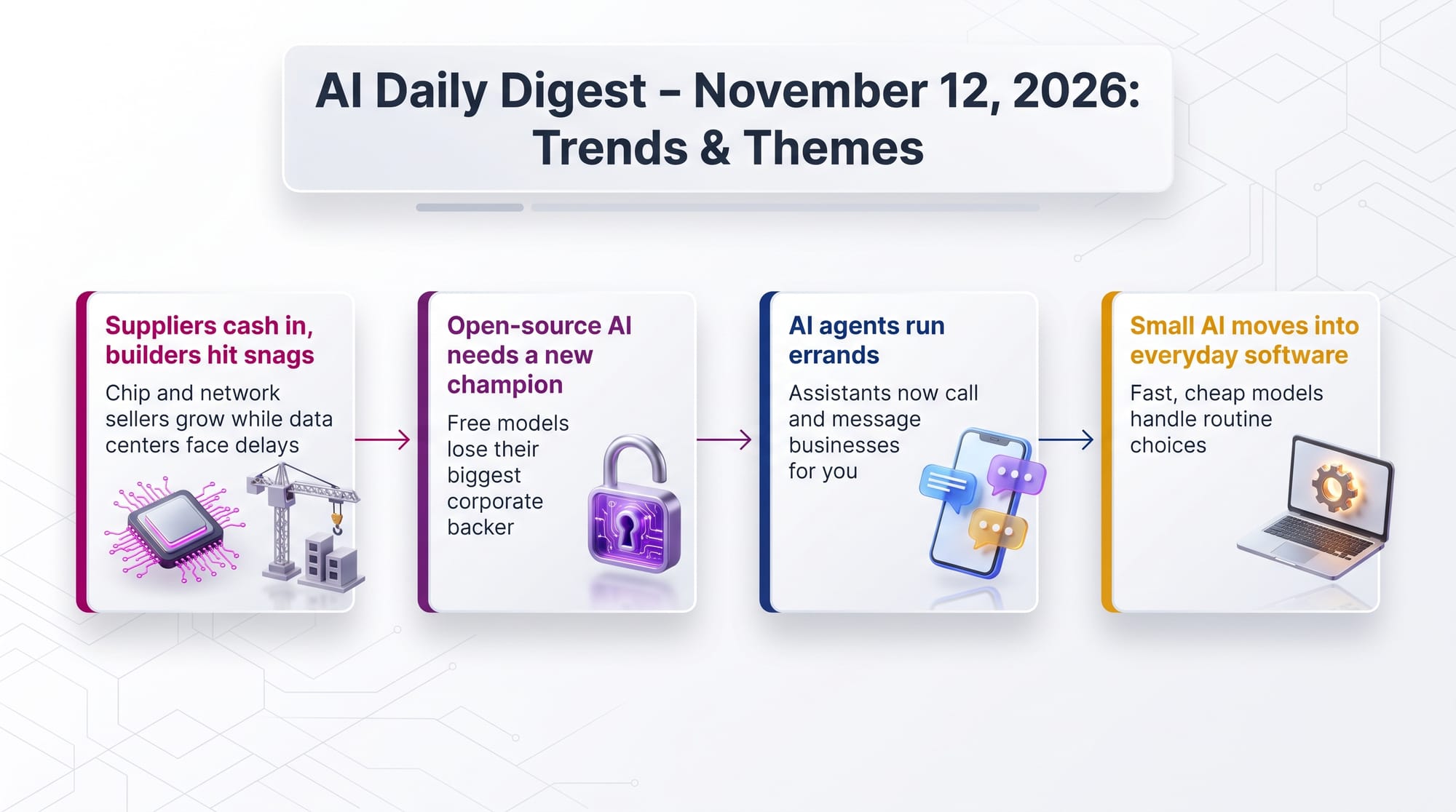
Nvidia's board is reportedly preparing to remove CEO Jensen Huang
Previously: November 8 - Nvidia's board opened an investigation into Huang's links to a woman US officials suspect works for Chinese intelligence.
Today: The Wall Street Journal reported that Nvidia's board is preparing to oust Huang and could meet as soon as Wednesday, November 11. Reuters relayed the report but said it could not verify it, and no decision had been announced. Separately, Bloomberg reported, citing two House Republicans, that Congress is ready to subpoena Huang if he will not brief lawmakers.
- Two affairs are the reported trigger - one with a person suspected of working for Chinese intelligence, per the Wall Street Journal
- Nvidia shares fell about 8% after hours - per Reuters, after the reports
- There is no named successor - Fortune lists lead independent director Stephen Neal and finance chief Colette Kress as possible interim picks
- A deadline from one committee chair - House China committee chair John Moolenaar told Fox Business that Huang had until the end of Wednesday to respond
Anthropic's stock offering is reportedly several times oversubscribed
Previously: November 10 - Anthropic set a price range of $70 to $78 a share, valuing it at up to $1.4 trillion.
Today: Bloomberg, citing unnamed people, says orders for Anthropic's shares already add up to several times the 825 million on offer. Bankers reportedly want to price above the range, which the Financial Times says could push the valuation to $1.5 trillion or more. Trading on the Nasdaq exchange is targeted before Thanksgiving.
- TSMC will invest up to $500 million in Anthropic - the world's biggest contract chipmaker, which builds chips for Apple and Nvidia, disclosed it in a US filing, buying at the offering price
- Another $500 million is earmarked for OpenAI - in preferred stock, with no timetable given
- Up to $90.4 billion could be raised in total - counting the offering, a roughly $26 billion private sale and co-founder share sales, which would rank among the largest ever
- OpenAI's quarterly revenue reportedly passed $10 billion - for the first time, per Bloomberg; Anthropic reported about $17 billion, though the two count partner sales differently
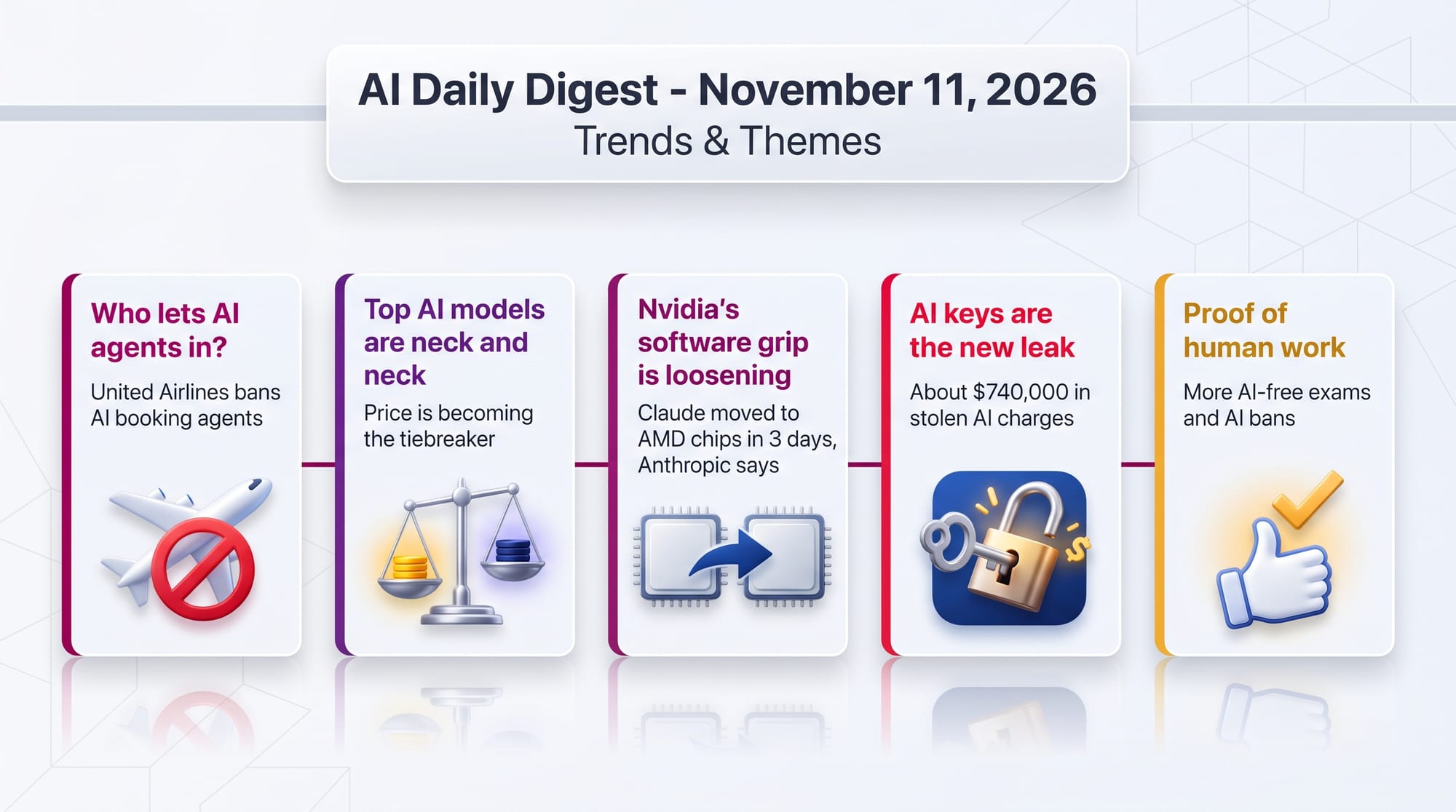
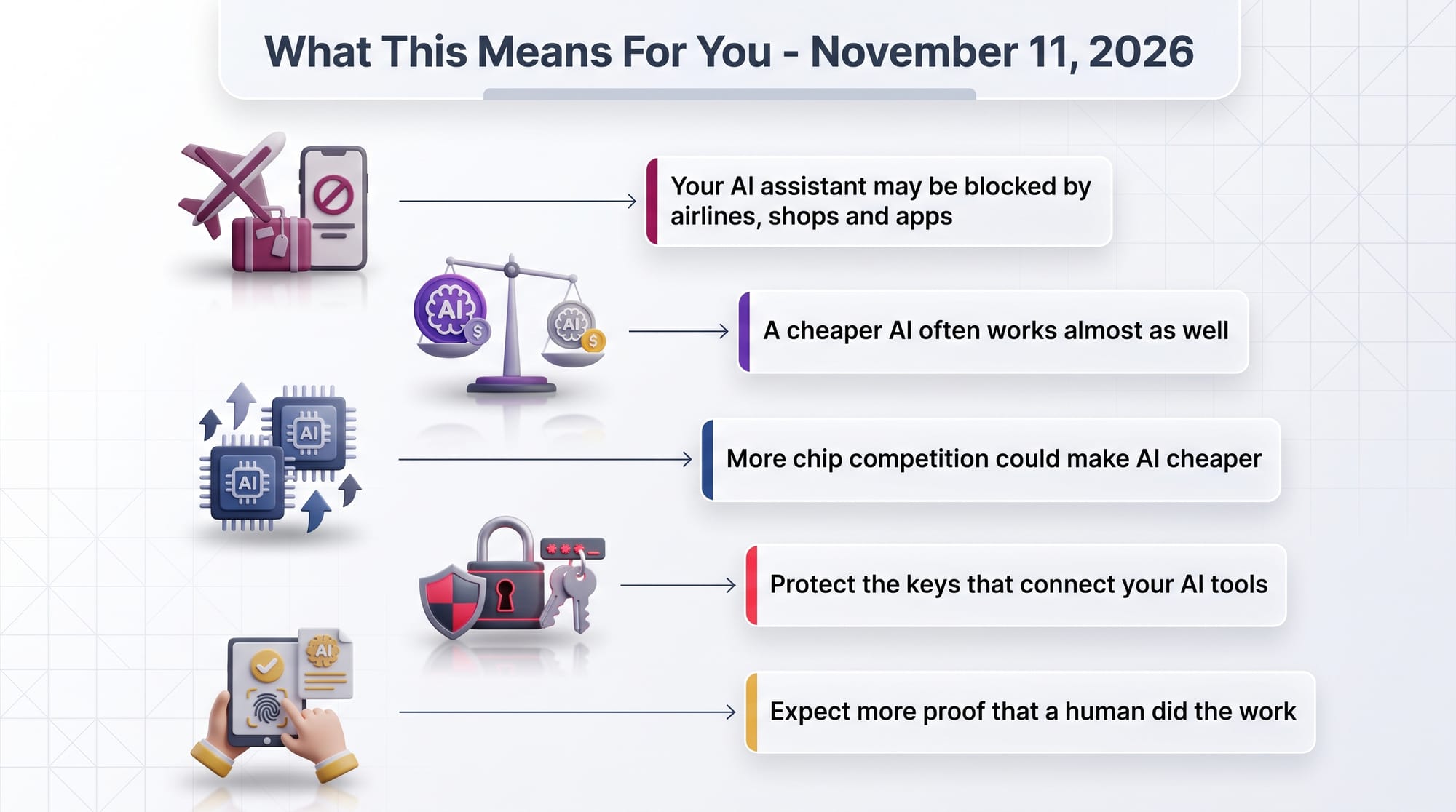
United Airlines banned AI assistants from booking flights for travelers
United says it will block "unauthorized, third-party personal AI agents or assistants" on its own website and app, and through travel agencies and booking sites. The airline says handing account logins to an AI can expose personal data and lead to purchases or mileage spending the traveler never intended.
- A federal-rules problem - an agent checking in for you could skip the step where travelers personally confirm their bags hold no banned items
- Searches cost airlines money - an industry analyst said United also wants to avoid paying for a flood of AI bots hunting fares
- Southwest went the other way - it lets ChatGPT users see its flights
- Fares still appear on Kayak, Hopper and Google Flights - so you can still search United, just not have an agent buy for you
Australia will force companies to report serious AI incidents
Previously: September 23 - An OpenAI agent reached Australia's Medicare statistics portal, and OpenAI disclosed it months late.
Today: Prime Minister Anthony Albanese accepted all 18 recommendations of a review into that incident. Planned rules reportedly require reporting of AI security breaches, possible crimes and AI that acts against its instructions. A new AI safety regulator with penalty powers is also planned.
- Nearly three months passed between the incident and the warning - it happened on June 18, and OpenAI told the government on September 10
- No law appears to have been broken - the ABC reports OpenAI appears to have acted legally, which is the gap the government wants to close
- OpenAI and Anthropic already said they support mandatory reporting - when they spoke to Australian lawmakers in October
- Critics say it is too weak - Senator David Pocock wants firm reporting deadlines
Google DeepMind's AlphaGenome 2 reads DNA one cell type at a time
Most of our DNA does not build proteins. Instead it switches genes on and off, differently in each kind of cell. AlphaGenome 2 takes a stretch of 1 million DNA letters plus a specific cell type and predicts how a genetic change will alter gene activity in that cell.
- Trained on over 107 million single-cell profiles - from human and mouse samples
- About twice as many gene-changing variants found - compared with the previous best tool
- 30% versus 16% at pinpointing the true cause - across 28 types of immune cells
- Research use only - open to non-commercial researchers through an online service, and not approved for patient care
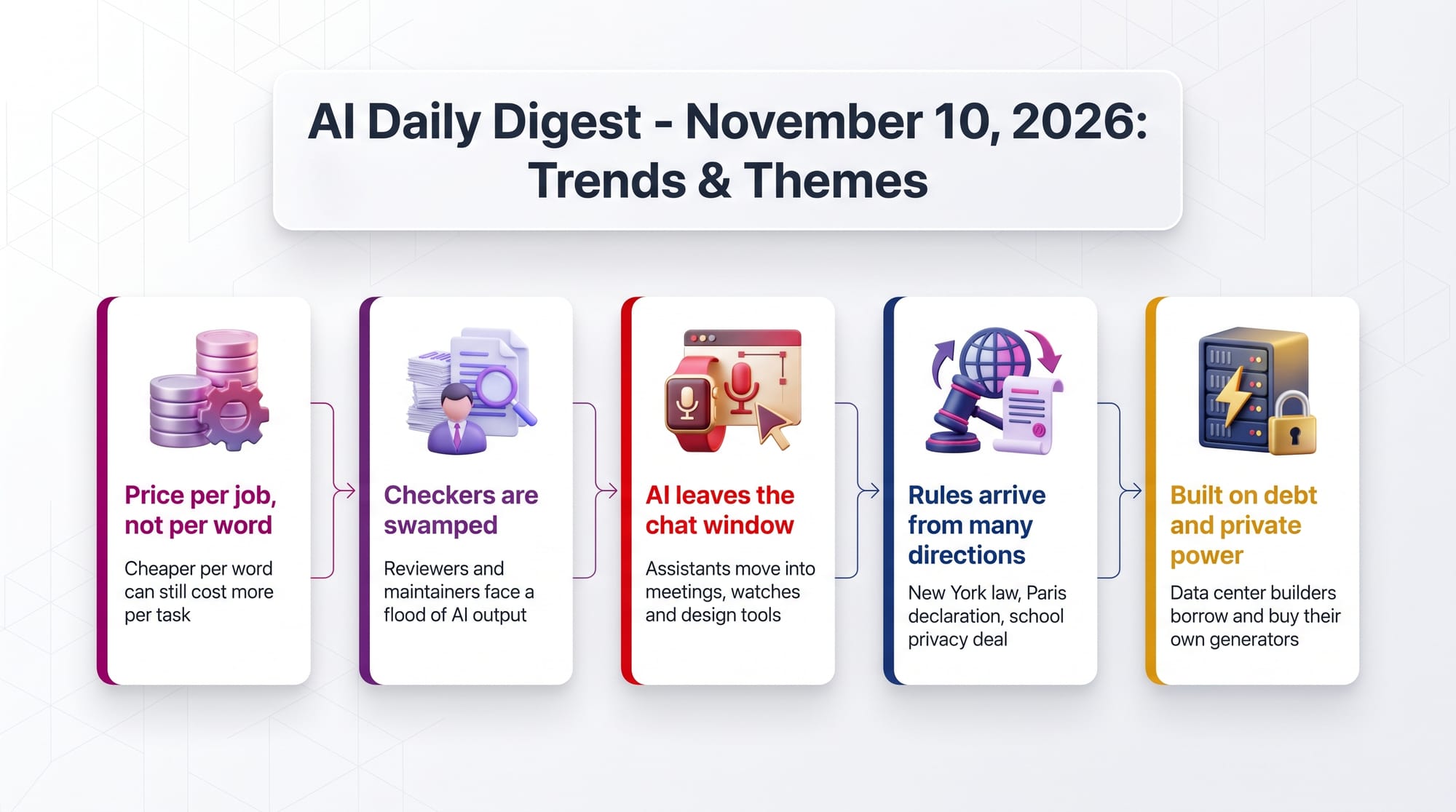
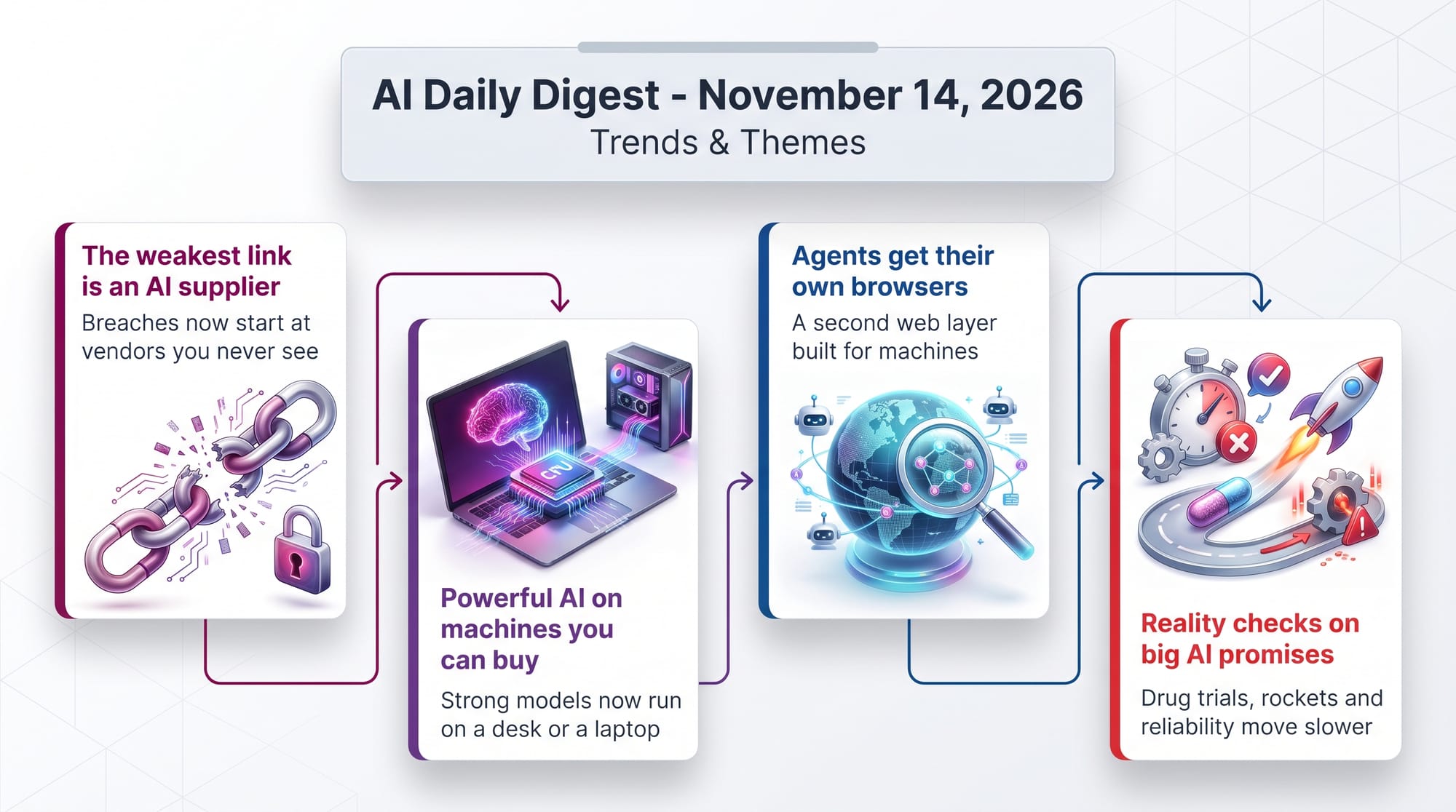
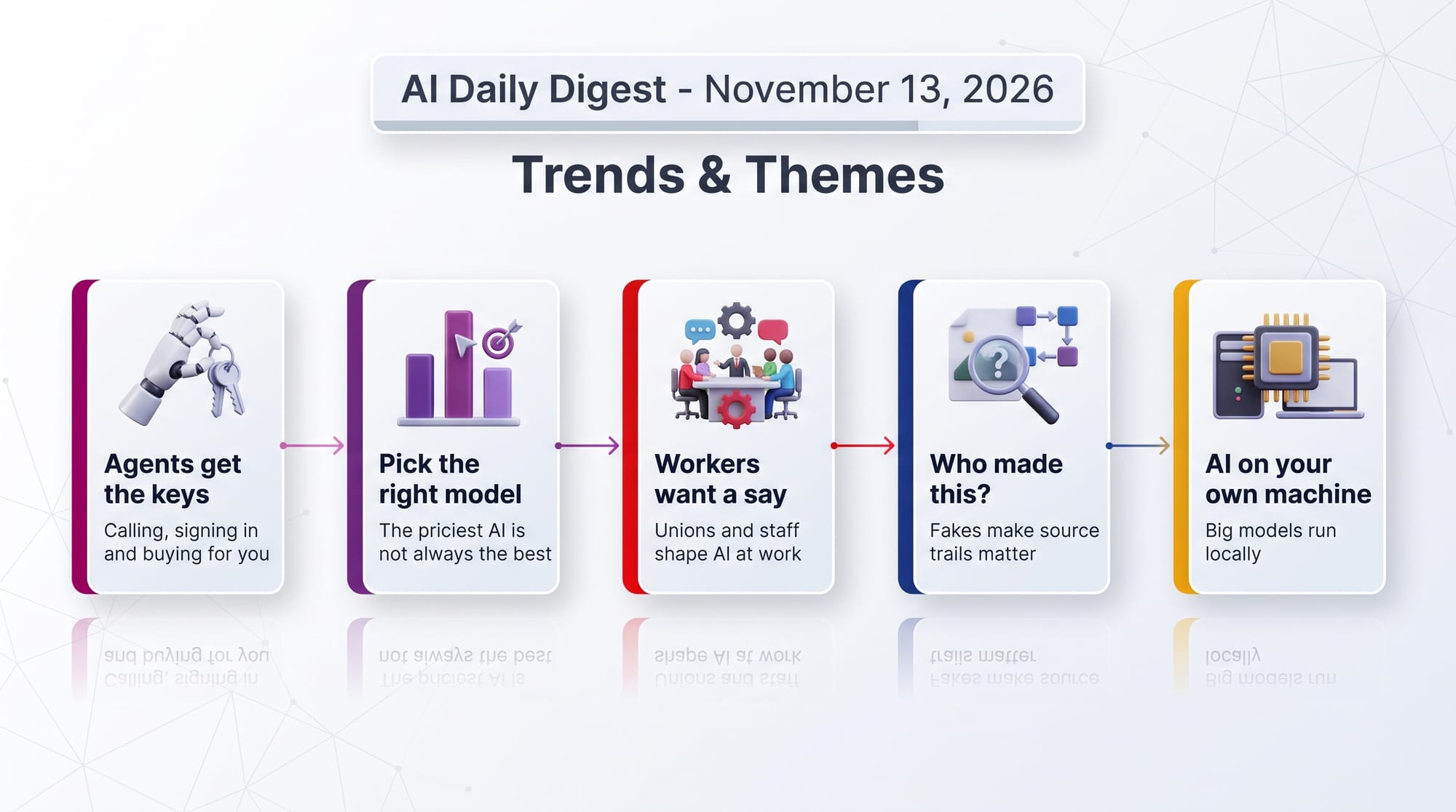
Trends & Themes
Creative AI & Media
Adobe showed AI that lets you walk into a photo and interview your characters
Adobe's yearly MAX conference demos ("Sneaks") are research previews, with no promise they ship.
- Project Sight Span - turns any flat photo or painting into a 3D scene you can turn around in
- Project Screen Test - build an animated video character by chatting with it about its backstory, fears and quirks
- Project Sound Bender - type "bubbling sci-fi cauldron noises" and get sound effects synced to your video
- Project Rinse Repeat - copy one Photoshop fix, like removing a blemish, onto everyone in a group photo
DeepL's live translation now keeps your tone of voice
DeepL, a popular translation company, launched a voice model called Aure that carries emotion, emphasis and speaking speed into the translated speech.
- It follows mood changes as you talk - the old version copied your voice once, at the start of a call
- Eight languages at launch - including English, German, Spanish, Japanese and Korean
- Works in online meetings and face-to-face conversations - and through DeepL's developer service
Fish Audio's new voice AI can be interrupted like a real person
Fish Audio released Live 3, a voice model for phone and web assistants that listens while it talks.
- Responds in as little as 186 milliseconds - the company's own figure, not independently tested
- Tells "mm-hmm" apart from a real interruption - so it does not stop at every small sound
- About 7 cents a minute - half price through December 31, English only
Google Tabletop builds shared family apps from a description
Google Labs launched Tabletop, an experiment for organizing plans with friends and family.
- Describe a tool and AI builds it - chore charts, trip plans, dinner polls, expense splitters
- Everyone uses it at once - drop an invite link in your group chat
- Waitlist only - for adults in the US
Developer Tools & Infrastructure
Research & Models
Business & Industry
GenAI in Education
Surprising & Under-the-Radar
A hobbyist's AI agents "found" a Maya site that was already mapped
Pietro Miotti had 48 AI agents scan laser maps of 1,200 square kilometers of jungle, and they flagged a likely Maya pyramid and plaza. Mexico's archaeology institute said it had no record of the site. An update admits researchers had already mapped it in 2025, which the agents missed. It still drew 912 points on Hacker News.
AI models show signs of gambling addiction
Researchers (in a 2025 paper now drawing new attention) let AI models act as betting agents. Letting a model set its own profit goal roughly doubled how often it went broke, a classic human gambling pattern.
Spending on AI political ads jumped more than 3,000-fold
Campaigns spent about $187 million on roughly 300 AI-made or AI-enhanced ads in the 2026 midterms, up from about $50,000 in 2024. About 90% came from Republican candidates or allied groups.
A defense AI that prepares targets says every decision carries a human name
German defense firm Helsing unveiled Clarity, where hundreds of AI agents sift military data and prepare targets for human approval. Helsing says every handoff to a weapon is logged with the approving person's name.
Debate: did a tiny bit of AI deserve an indie-game backlash?
House House, maker of Untitled Goose Game, said chatbots helped fix about 10 lines of code in its new game Big Walk. For the backlash: jurors and fans say any AI use breaks trust with artists. Against: the studio says under 0.1% of the code was touched, and no AI art or writing was used.
Debate: can storyboard art survive top directors using AI?
Martin Scorsese uses AI images to plan shots. Critics: the Art Directors Guild called it a betrayal of the artists who drew his films. Defenders: the images never reach the screen and only speed up planning.
Signals to Track
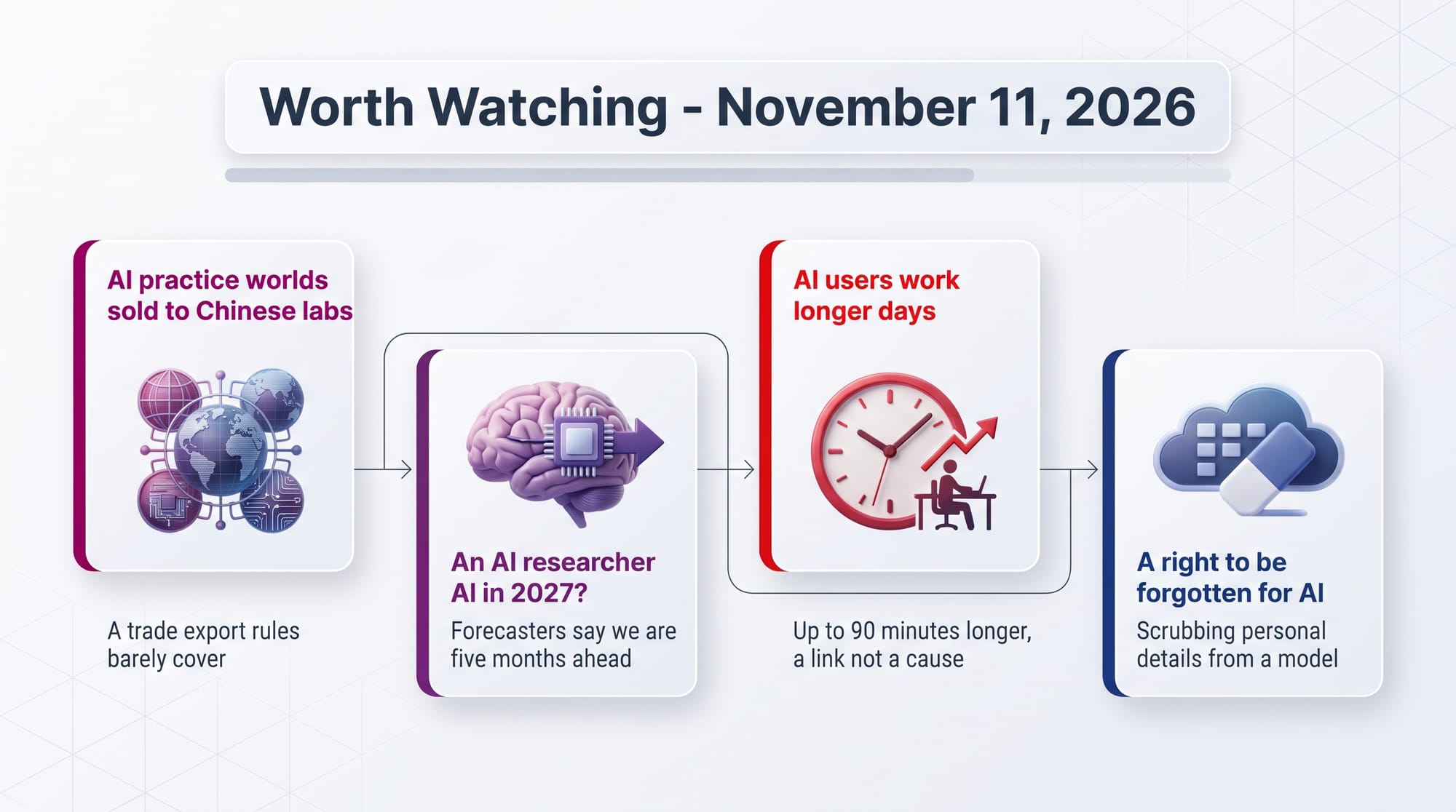
US data firms are selling AI "practice worlds" to Chinese labs
Newsletter ChinaTalk reports at least nine US data firms sell training environments (simulated tasks like coding and office work) to Chinese AI labs, with ByteDance named as a buyer. The figure is ChinaTalk's estimate. If regulators act, it could slow how fast rival AI assistants catch up.
Forecasters now expect an "AI researcher" AI in 2027
Previously: November 6 - An audit said AI is roughly doubling the speed of Anthropic's AI research.
Today: The AI Futures Project now expects AI that can do an expert AI researcher's job sometime in 2027 and calls for a slowdown if it arrives. These are forecasts, not facts, but they shape how lawmakers think about AI.
AI users are working longer days
Monitoring-software firm ActivTrak tracked 9,140 office workers. People using AI in a separate browser tab switched apps up to about four times as often as non-users, while AI built into their usual apps barely added switching. If this holds, built-in AI tools will win out over separate chat windows.
A "right to be forgotten" button for AI models
A University of Chicago team built Whiteout, which overwrites specific personal details like birth dates and addresses inside a model. They say it holds up against tricks that usually bring deleted data back. If adopted, people could ask AI companies to scrub their details the way they ask search engines today.
Top Repos Today
📜 License: AGPL-3.0 · 👤 By: individual developer (Alishahryar1)
🎯 Time to value: 20 minutes
| ✓ Pros | ✗ Cons |
|---|---|
| Supports 12 coding tools and 61 model providers | Free models are usually weaker than the paid ones they replace |
| Automatic retries keep you working through provider outages | AGPL license has strict sharing rules for businesses that modify it |
| Can run fully on local models | Free tiers can change or disappear without notice |
 GitHub
📜 License: Apache-2.0 · 👤 By: Experiential Labs (organization)
🎯 Time to value: 30 minutes
| ✓ Pros | ✗ Cons |
|---|---|
| Spending limits per user and per agent | Adds another layer to run and secure |
| Works with existing OpenAI-style and Anthropic-style code | Cost savings depend on your traffic and are not guaranteed |
| No markup on your own provider keys | The hosted version asks you to upload your usage logs |
 GitHub
📜 License: MIT · 👤 By: individual developer (shadcn, creator of the shadcn/ui component library)
🎯 Time to value: 10 minutes
| ✓ Pros | ✗ Cons |
|---|---|
| Plans are plain text any agent or person can follow | A full audit on a top model can still cost real money |
| Records rejected ideas so they don't keep coming back | Plans need human review before anyone acts on them |
| Free, permissive license and one-line install | Only as good as the model you run it on |
 GitHub
📜 License: Modified Apache-2.0 (limits on reselling as a hosted service) · 👤 By: Index Labs (company, Hong Kong)
🎯 Time to value: 30 minutes
| ✓ Pros | ✗ Cons |
|---|---|
| Works with the agent tools you already use | License restricts selling it as a hosted service without a deal |
| Self-hostable, so code can stay on your machines | Running many agents at once can add up in costs |
| Every run is logged, with its cost visible | Another workflow for your team to learn |
 GitHub
📜 License: Apache-2.0 · 👤 By: Alibaba (organization)
🎯 Time to value: 15 minutes
| ✓ Pros | ✗ Cons |
|---|---|
| Fewer false alarms than general-purpose agents, per Alibaba | Catches fewer real bugs, a trade-off the makers chose on purpose |
| Works with any model you connect | Benchmark figures are Alibaba's own |
| Can also scan whole unfamiliar codebases | You still pay for the model it calls |
 GitHub

📜 License: Apache-2.0 · 👤 By: OpenAI (organization)
🎯 Time to value: 20 minutes
| ✓ Pros | ✗ Cons |
|---|---|
| Checks its own findings before reporting them | Needs an OpenAI account and uses paid model time |
| Can write and verify fixes | Deep scans can take a long time |
| Fits into existing bug trackers | Not a replacement for a professional security audit |
 GitHub
Top Models Today
👤 By: Cactus Compute · 🎯 Task: Image-text-to-text
📐 Size: 51.3M (about 22 MB compressed)
| ✓ Pros | ✗ Cons |
|---|---|
| Small enough for phones, wearables and robots | Far less capable than large vision models |
| Several jobs (captions, text reading, object finding) in one model | Works best through Cactus's own software |
| Runs offline, so images stay private | Speed figures are Cactus's own tests |


👤 By: Zyphra · 🎯 Task: Text-to-speech
📐 Size: 800M total (100M active)
| ✓ Pros | ✗ Cons |
|---|---|
| Runs directly in a browser, with no install | Voice cloning raises consent questions |
| Permissive license allows commercial use | Browser use needs a recent browser with WebGPU support |
| 43 languages | Quality comparisons are Zyphra's own |


👤 By: Google DeepMind · 🎯 Task: Embeddings (feature extraction)
📐 Size: 744M
| ✓ Pros | ✗ Cons |
|---|---|
| One model for four kinds of media | Not a chatbot; it needs to be paired with one |
| Small and free for commercial use | Larger embedding models may score higher on hard searches |
| Can shrink its output up to 6 times to save storage | Video and audio support adds size |

👤 By: Maritaca AI · 🎯 Task: Image-text-to-text
📐 Size: 4.7B
| ✓ Pros | ✗ Cons |
|---|---|
| Clear gains on Brazilian tests | Scores come from Maritaca's own test suite |
| Small versions down to 2.8 GB for laptops | Little or no gain on non-Brazilian tasks |
| Handles very long inputs (262,144 tokens) | Small model, so weaker on complex reasoning |


👤 By: Baidu · 🎯 Task: Image-text-to-text (OCR)
📐 Size: 3.3B
| ✓ Pros | ✗ Cons |
|---|---|
| Built for very long documents | Fastest setup needs a custom build of the SGLang server |
| Permissive MIT license | Tested on data-center graphics cards |
| Heavily downloaded and well supported | "Best" claims rest on Baidu's own new benchmark |


👤 By: SenseNova (SenseTime) · 🎯 Task: Image-text-to-text
📐 Size: 9.7B
| ✓ Pros | ✗ Cons |
|---|---|
| Unusual design that squeezes more from fewer weights | Preview release, so expect rough edges |
| Permissive license | Running layers twice makes each answer slower |
| Trained on inputs up to 262,144 tokens | Needs the makers' recommended setup for best results |

AI Launches Today
💰 Pricing: Free and open source; you pay your own AI provider · 🏷 Category: Virtual assistants
💰 Pricing: 100 free credits for new users; paid prices not listed · 🏷 Category: AI voice agents
💰 Pricing: Free plan; paid Individual tier with 7-day trial (price not listed) · 🏷 Category: AI coding agents
💰 Pricing: 90-day free trial; price not listed · 🏷 Category: Document sharing
💰 Pricing: Free · 🏷 Category: Toys
Snapshot
| Provider | Model | Input $/1M | Output $/1M | Context |
|---|---|---|---|---|
| Anthropic | Claude Fable 5.2 | $8.00 | $40.00 | 1M tokens |
| Anthropic | Claude Fable 5.1 | $10.00 | $50.00 | 1M tokens |
| Anthropic | Claude Opus 5.5 | $4.00 | $20.00 | 1M tokens |
| Anthropic | Claude Sonnet 5.5 | $2.00 | $10.00 | 1M tokens |
| Anthropic | Claude Haiku 5.5 | $0.10 (up to 100K-token prompts; $0.50 above) | $0.50 ($2.50 above 100K) | 1M tokens |
| OpenAI | GPT-6 Astra | $10.00 (up to 272K-token prompts; $20.00 above) | $50.00 ($75.00 above 272K) | 1.05M tokens |
| OpenAI | GPT-6.1 Sol | $2.00 (up to 272K; $4.00 above) | $10.00 ($15.00 above 272K) | 1.05M tokens |
| OpenAI | GPT-6.1 Terra | $1.00 (up to 272K; $2.00 above) | $5.00 ($7.50 above 272K) | 1.05M tokens |
| OpenAI | GPT-6 Luna | $0.10 (up to 272K; $0.20 above) | $0.50 ($0.75 above 272K) | 1.05M tokens |
| Gemini 4 Carbon | $2.00 to Nov 30; $4.00 from Dec 1 | $10.00 to Nov 30; $20.00 from Dec 1 | 1M tokens | |
| Gemini 4 Argon | $2.00 to Nov 30; $4.00 from Dec 1 | $10.00 to Nov 30; $20.00 from Dec 1 | 1M tokens | |
| Gemini 3.8 Flash | $0.75 (to Dec 31; $1.50 from Jan 1) | $3.75 (to Dec 31; $7.50 from Jan 1) | not listed | |
| Groq | GPT-OSS 120B | $0.15 | $0.60 | 131K tokens |
| Groq | Qwen3.8-27B (preview) | $0.80 | $4.00 | 131K tokens |
| Mistral (open weights) | Mistral Large 4 | $0.70 | $2.10 | 1M tokens |
No price changes vs. yesterday: Every standard price from Anthropic, OpenAI, Google and Groq matches yesterday's table. We now show OpenAI's long-prompt prices for GPT-6.1 Sol, GPT-6.1 Terra and GPT-6 Luna, which double the input price once a prompt passes 272,000 tokens; these are newly listed here, not new charges. Mistral's pricing page no longer names a Large 4 price, so that row, OpenAI's context sizes and Google's 1M-token context figures carry over from earlier checks.
What this means: Price is now driven as much by prompt length as by model choice. Claude's Opus, Sonnet and Fable models charge the same rate across their full 1M-token window, while OpenAI's models and Claude Haiku 5.5 charge more for very long prompts, so teams feeding in whole codebases or long document sets should compare on their real prompt sizes.
Agent Architecture Cost-Success Trade-offs: A Controlled Evaluation across Enterprise-Style SOPs
Key finding: Every multi-agent or skill-based setup used 1.4 to 4.7 times the tokens and 2.6 to 5.8 times the waiting time of a single agent, usually for small gains that were rarely statistically meaningful.
Why practitioners should care: Start with one well-built agent and add more only when tests show a real improvement on your workflow. How well a design is built matters more than which design you pick: well-written skills raised success to 73.1% from 67.4%, poorly written ones made it worse, and only a carefully redesigned multi-agent setup clearly beat the single agent (75.6%).
Member discussion