GenAI Secret Sauce Daily Digest - 2026-04-28

NVIDIA Launches a Multimodal AI Model That Runs on a Single Chip · Claude Can Now Control Blender, Adobe, and Six Other Creative Apps · OpenAI Is Building an AI-First Smartphone Where Agents Replace Apps
GenAI Secret Sauce Daily Digest - 2026-04-28

Watch today's digest as a video summary (generated by NotebookLM)

Statistically Speaking

9 x higher throughput than comparable open multimodal
NVIDIA Launches a Multimodal AI Model That Runs on a Single
Top Story
3 D modeling from plain English
Claude Can Now Control Blender, Adobe, and Six Other Creativ
600 Google employees signed a letter urging CEO
Google Signs Classified AI Deal With Pentagon for "Any Lawfu
1930, so every token was transcribed from paper
A 13B "Vintage" Language Model Trained on Pre-1931 Text Can
30% of the performance of human
A 13B "Vintage" Language Model Trained on Pre-1931 Text Can
1930 events based on what 1930 knowledge would
A 13B "Vintage" Language Model Trained on Pre-1931 Text Can

One Thing to Tell Your Friends

Google just signed a classified AI deal with the Pentagon that lets the military use its AI for "any lawful purpose" - and Google has no power to veto what the government decides to do with it.

TL;DR

Trends
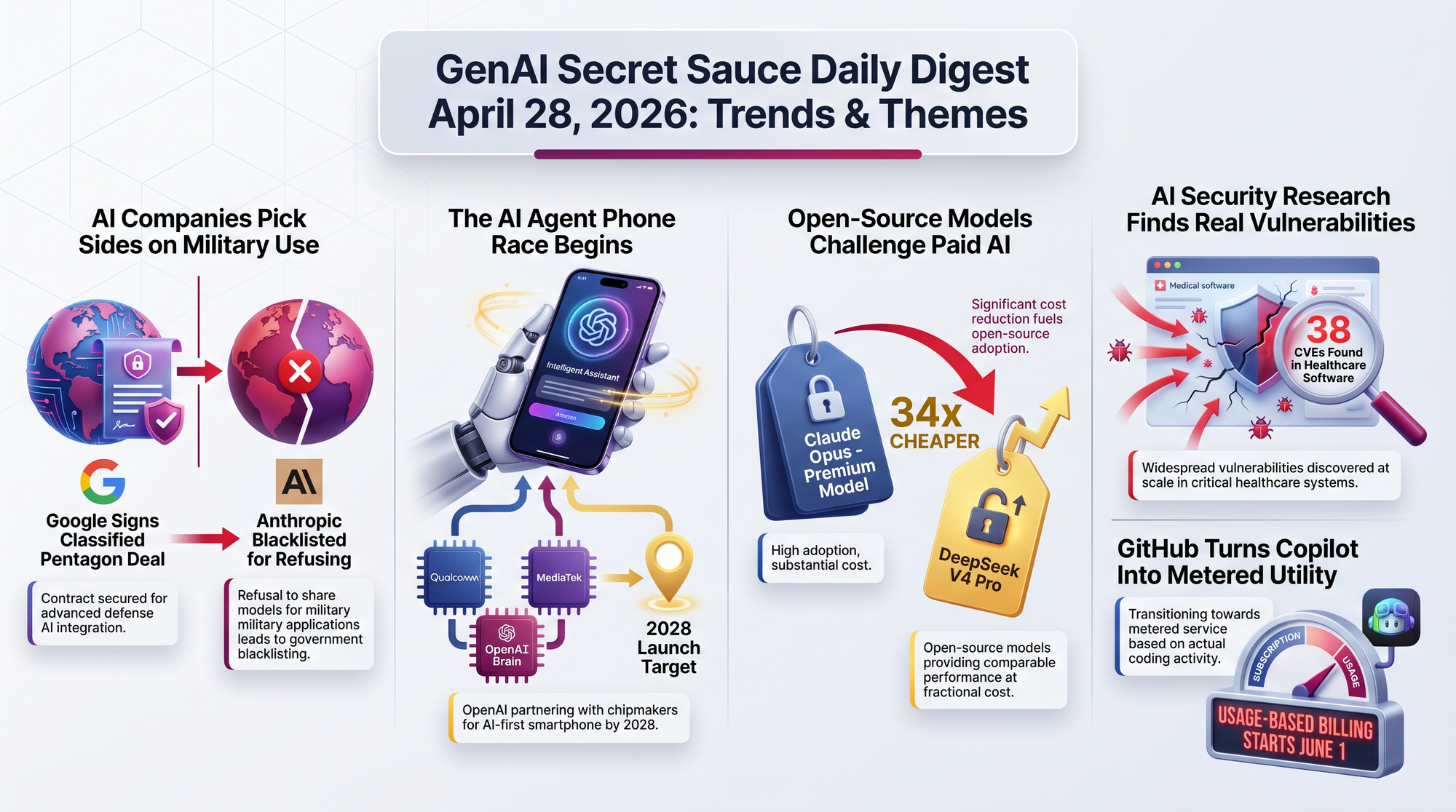
AI Companies Are Picking Sides on Military Use, The "AI Agent Phone" Race Just Started, and Open.
Creative AI
Business
OpenAI Models Land on Amazon Bedrock With Managed Agents, GitHub Copilot Shifts to Usage, and Anthropic Tests Pulling Claude Code From Pro Plan.
Surprising
"I'm Done With Using Local LLMs for Coding" Gets 777 Upvotes, Someone Built a Language Model That Thinks It's 1930, and DOOM Now Runs Inside ChatGPT and Claude.
Worth Watching
Mistral Is About to Drop Something Big, DeepSeek Vision Is Coming, and NVIDIA Nemotron 3 Nano Omni Could Be the Model That Makes AI Agents Practical on Edge Devices.
GitHub
Leading repos: mattpocock/skills (+7,429), abhigyanpatwari/GitNexus (+1,565), and ComposioHQ/awesome-codex (+961).
HuggingFace
Leading models: deepseek-ai/DeepSeek-V4 (174K), Qwen/Qwen3.6 (509K), and deepseek-ai/DeepSeek-V4 (96.9K).
Product Hunt
Top launches: Clera (374), SureThing.io (286), and Lovable Mobile App (197).
API Pricing
What this means: DeepSeek V4 Pro at $0.145/M input is now 34x cheaper than Claude Opus 4.7 and 17x cheaper than Gemini 2.5 Pro for input tokens - while achieving competitive benchmark scores.
arXiv
The Price of Agreement — When LLMs are used in financial decision-making pipelines, their tendency to agree with the human operator creates systematic risk that compounds across multiple agent interactions.

Hot off the Presses

01

NVIDIA Launches a Multimodal AI Model That Runs on a Single Chip

What this means for you: AI assistants that can simultaneously see your screen, hear your voice, and read your documents are about to get dramatically cheaper to run - expect them in phones and laptops within a year.

NVIDIA released Nemotron 3 Nano Omni, a model that handles text, images, video, and audio in a single package. The trick is a mixture-of-experts design: 30 billion total parameters, but only 3 billion activate for any given task. That 10:1 ratio means it runs on one Graphics Processing Unit (GPU) while matching models several times its size.

  • 9x higher throughput than comparable open multimodal models at the same level of interactivity
  • Open weights, datasets, and training recipes - anyone can customize and deploy it
  • Already available on HuggingFace, OpenRouter, and NVIDIA's own inference platform
  • Designed for AI agents that need to perceive and reason about the real world continuously
02

Claude Can Now Control Blender, Adobe, and Six Other Creative Apps

What this means for you: If you use professional creative software, you can now talk to Claude inside your existing tools instead of switching between apps - it can automate repetitive tasks, generate scripts, and even create 3D models from descriptions.

Anthropic announced integrations embedding Claude directly into eight major creative platforms: Blender, Autodesk Fusion, Adobe Creative Cloud, Affinity, Ableton, Splice, SketchUp, and Resolume Arena. The connectors use the Model Context Protocol (MCP), an open standard that lets Claude read application states and execute actions inside each program.

The strategic move positions Claude as professional infrastructure rather than replacement technology - integration over disruption.

  • 3D modeling from plain English - describe what you want in SketchUp, Claude builds a starting model
  • Batch automation - apply changes across hundreds of objects in Blender or adjust images in bulk in Adobe
  • Music production assistance - direct access to Splice's sample library and grounded help in Ableton
  • Live performance control - real-time visual system management through natural language in Resolume Arena
03

OpenAI Is Building an AI-First Smartphone Where Agents Replace Apps

What this means for you: By 2028, you might buy a phone where you never open an app again - instead, AI agents handle everything from texting to shopping to navigation, maintaining continuous awareness of your location, activity, and conversations.

According to analyst Ming-Chi Kuo, OpenAI is working with chipmakers Qualcomm and MediaTek to develop a custom processor for an AI-native smartphone. Manufacturing partner Luxshare would handle production, targeting 300-400 million units annually by 2028.

The specifications and supplier list are expected to be finalized by late 2026 or early 2027.

“300-400 million AI agent phones per year by 2028”
  • Agents as the primary interface - the device maintains continuous real-time context about your location, activity, and communications
  • No traditional app store model - AI agents replace discrete applications
  • Qualcomm stock surged 8% on the news
  • None of the three companies have confirmed the partnership publicly - the information comes from analyst reports
04

Google Signs Classified AI Deal With Pentagon for "Any Lawful Purpose"

What this means for you: The company that makes your search engine, email, and phone operating system has given the U.S. military unrestricted access to its most powerful AI - and has no right to control or veto what the government does with it.

Google's deal with the Department of Defense allows Pentagon workers to use Gemini AI models for classified work under any "lawful government purpose." An anonymous source said the agreement includes informal understandings against domestic mass surveillance or autonomous weapons without human oversight - but the contract gives Google "no right to control or veto" government decisions.

Previously: April 27 covered the Microsoft-OpenAI partnership restructuring and OpenAI's growing government relationships.

  • More than 600 Google employees signed a letter urging CEO Sundar Pichai to reject the deal, arguing that refusing classified work is the only way to prevent misuse
  • Google joins OpenAI and xAI in providing classified AI to the U.S. government
  • Anthropic was blacklisted from federal use after refusing to remove weapon and surveillance safeguards from its own government deal
  • Announced one day after the employee petition was delivered
05

A 13B "Vintage" Language Model Trained on Pre-1931 Text Can Learn Python From Three Examples

What this means for you: This experiment reveals something surprising about how AI works - a model that has never seen modern technology can still figure out programming languages when shown a few examples, suggesting AI reasoning is more general than we thought.

Talkie is a 13B open-weight language model trained on 260 billion tokens of exclusively pre-1931 English text - books, newspapers, scientific journals, patents, and case law. Co-created by Alec Radford (one of the inventors behind GPT and Whisper), Nick Levine, and David Duvenaud, the model has a hard knowledge cutoff of December 31, 1930.

  • Learned Python from just three in-context examples despite never seeing any programming language during training
  • Trained on Optical Character Recognition (OCR) scanned physical documents - no digital publishing existed in 1930, so every token was transcribed from paper
  • OCR quality matters enormously - training on OCR text gave only 30% of the performance of human-transcribed copies
  • Can rate the "surprisingness" of post-1930 events based on what 1930 knowledge would predict
  • All training data is public domain - pre-1931 U.S. copyright expiration makes the entire dataset legally clean

Trends & Themes

Trends & Themes

AI Companies Are Picking Sides on Military Use - And It's Reshaping the Industry

Why this matters to you: The companies building the AI tools you use every day are making fundamentally different choices about military partnerships - and those choices may determine which companies survive and which get locked out of government contracts.

The divide is no longer theoretical. Companies that accept military contracts gain financial security and political favor. Those that refuse face exclusion from an increasingly important customer. For users, this means the AI tools in your phone and browser are now directly connected to defense infrastructure.

  • Google, OpenAI, and xAI have all signed classified AI deals with the U.S. government
  • Anthropic was blacklisted from federal use after refusing to remove safety guardrails for weapons and surveillance
  • 600+ Google employees protested in a letter to the CEO, echoing the 2018 Project Maven revolt - but this time, leadership proceeded anyway
  • The financial pressure is enormous - government contracts represent billions in guaranteed revenue that consumer subscriptions can't match

The "AI Agent Phone" Race Just Started

Why this matters to you: If OpenAI, Google, and Apple are all building phones where AI agents replace apps, the smartphone as you know it could fundamentally change within two years.

The question isn't whether AI replaces apps on your phone - it's whether you'll buy an OpenAI phone, a Google phone, or an Apple phone when it happens.

  • OpenAI is designing a phone from scratch with Qualcomm and MediaTek, targeting 300-400M units by 2028
  • Apple's new CEO has signaled an AI hardware pivot (covered April 26)
  • Google's Gemini is already deeply integrated into Android and Pixel devices
  • The agent-first model eliminates app stores - instead of downloading discrete programs, you interact with AI that handles tasks across services

Open-Source AI Models Are Getting So Good That Paid Models Need a New Pitch

Why this matters to you: The best free AI models now rival tools that cost $20-200 per month, which means the value proposition of paid subscriptions is shifting from "better answers" to "better integration and convenience."

The frontier labs' response: deeper integration. Claude's creative software connectors, OpenAI's Bedrock partnership, and GitHub's tighter Copilot billing all point toward making paid AI indispensable through ecosystem lock-in rather than raw intelligence.

  • DeepSeek V4 Pro (1.6 trillion parameters) costs $0.145 per million input tokens - roughly 34x cheaper than Claude Opus 4.7
  • Qwen 3.6 27B runs locally with near-frontier quality, and community benchmarks show quantized versions losing minimal accuracy (covered April 22-26)
  • Xiaomi MiMo V2.5 Pro (1 trillion parameters) scores 99.6 on GSM8K math and 89.4 on MMLU
  • 777 upvotes on r/LocalLLaMA for "I'm done with using local LLMs for coding" - but the debate reveals that local models have crossed a usability threshold even for skeptics

AI Security Research Is Finding Real Vulnerabilities at Scale

Why this matters to you: AI-powered security tools are finding critical bugs in software your hospital, bank, and government use - faster than human auditors can, but with questions about whether the fixes keep pace.

The pattern: AI tools are becoming better at finding vulnerabilities than humans are at fixing them, creating a growing gap between discovery and remediation.

  • AISLE discovered 38 CVEs in OpenEMR (healthcare software used by 100,000 providers and 200 million patients), including two with perfect 10.0 severity scores
  • 25 of the 38 vulnerabilities involved missing authorization - meaning patient data was accessible without proper checks
  • Fixes shipped in 4 weeks in OpenEMR 8.0.0, and AISLE is now integrated into OpenEMR's code review pipeline
  • The legal question of AI-generated code ownership drew 260 comments on Hacker News, with no clear legal framework established

GitHub Is Quietly Turning Copilot Into a Metered Utility

Why this matters to you: If you use GitHub Copilot, your bill is about to change from a flat subscription to a usage meter - and the costs of features like code review could surprise teams that haven't been tracking their consumption.

Previously: April 22 covered the initial Copilot billing restructuring and April 27 covered the Claude pricing implications.

  • Starting June 1, Copilot moves to usage-based billing with monthly AI Credit allotments
  • Code reviews will consume GitHub Actions minutes on private repositories, billed at standard Actions rates
  • Token consumption determines cost - input, output, and cached tokens are all counted
  • Preview bills launch in early May so teams can see projected costs before the switch

Creative AI & Media

ACE-Step UI: Open-Source Alternative to Suno for AI Music Generation

What this means for you: You can now generate full songs with vocals, instrumentals, and custom settings - for free, running entirely on your own computer.

GitHub · Trending on GitHub with 1,641 stars

  • Full song generation up to 4+ minutes with vocals and instrumentals
  • Built-in tools for audio editing, stem extraction, video generation, and album art
  • Spotify-inspired interface designed for accessibility
  • MIT License - fully free and modifiable

DOOM Runs as an MCP App Inside ChatGPT and Claude

What this means for you: The classic 1993 game DOOM now runs inside AI chat interfaces, showing just how flexible the Model Context Protocol has become - from serious enterprise tools to playable games.
  • Built with cloudflare/doom-wasm and Freedoom Phase 1 content
  • Works inline within ChatGPT and Claude, with browser fallback
  • Even partially works on iOS versions of both apps

Developer Tools & Infrastructure

GitNexus: Build a Knowledge Graph of Your Codebase Without a Server

A new open-source tool constructs a client-side knowledge graph of any codebase, providing 16 Model Context Protocol (MCP) tools for impact analysis, semantic search, and architectural querying. Everything runs locally - no code leaves your machine. Supports 14+ programming languages.

  • Pre-commit blast radius detection shows what else breaks before you ship a change
  • Hybrid search combining keyword matching with semantic understanding
  • Zero infrastructure - runs in your browser or command line

free-claude-code: Use Claude Code's Interface With Any AI Provider

An open-source proxy that routes Claude Code Application Programming Interface (API) requests to alternative providers like NVIDIA NIM, OpenRouter, DeepSeek, LM Studio, and Ollama. Preserves the native Claude Code interface while letting you swap in cheaper or local models.

  • Model-tier routing assigns different providers for Opus, Sonnet, Haiku requests
  • Works with CLI, VS Code, and JetBrains
  • MIT License - fully free to use and modify

awesome-codex-skills: 50+ Modular Agent Skills for OpenAI Codex

A curated collection connecting Codex to 1,000+ external applications through the Composio CLI. Skills handle automated PR reviews, meeting transcription, invoice triage, and multi-file code migrations.

  • Reviewable batch workflows - real actions across services, not just text generation
  • By ComposioHQ (company)

PullMD: Stop Claude Code From Burning Tokens on HTML

A community-built MCP server (119 upvotes on r/ClaudeAI) that converts web pages to clean markdown before passing them to AI agents, solving the problem of expensive token consumption from raw HTML parsing.

Research & Models

DeepSeek V4 Pro: 1.6 Trillion Parameters at 34x Less Than Claude Opus

What this means for you: The largest open-weight model ever released costs less than a penny per thousand-word input, making frontier-quality AI accessible to anyone with an API key.

Previously: April 24 covered the initial release. New this week: pricing details and community adoption.

  • $0.145 per million input tokens and $3.48 per million output - compare to Claude Opus 4.7 at $5/$25
  • Three reasoning modes: Non-Think (fast), Think High (careful), Think Max (maximum effort with 384K+ context)
  • Codeforces rating of 3,206 and 80.6% on SWE-Bench Verified
  • MIT License - fully open source

Xiaomi MiMo V2.5 Pro: 1 Trillion Parameters With 1 Million Token Context

Previously: April 27 covered the initial announcement. Updated today with new model card details.

  • 42 billion active parameters out of 1.02 trillion total across 384 routed experts
  • Multi-Token Prediction with 3 lightweight modules for 3x inference speedup
  • 7x KV-cache reduction compared to standard attention through hybrid sliding window/global attention
  • MIT License

Key arXiv Papers Today

  • ClawTrace: Cost-Aware Tracing for LLM Agent Skill Distillation (2604.23853) - Methods to reduce the cost of training AI agents by distilling complex capabilities into cheaper models
  • AgentPulse: Continuous Multi-Signal Framework for Evaluating AI Agents (2604.24038) - Monitoring framework for deployed AI agents using multiple performance signals
  • The Price of Agreement: Measuring LLM Sycophancy in Financial Agents (2604.24668) - Quantifies how LLMs exhibit dangerous agreement bias in financial applications

Business & Industry

OpenAI Models Land on Amazon Bedrock With Managed Agents

OpenAI and AWS announced Bedrock Managed Agents, packaging OpenAI's frontier models within AWS's native infrastructure. This follows the amended Microsoft-OpenAI agreement removing Azure's exclusivity.

Previously: April 27 covered the Microsoft-OpenAI exclusive partnership breakup.

  • Deep enterprise integration - identity management, permissions, data residency within AWS VPCs, logging, and governance
  • Sam Altman on the partnership: "Demand for intelligence is essentially uncapped" at low enough prices
  • Positions AWS as model-neutral infrastructure - serving multiple AI providers while controlling the platform

GitHub Copilot Shifts to Usage-Based Billing June 1

All Copilot plans transition to usage-based billing with monthly AI Credit allotments. Code reviews on private repos will consume Actions minutes at standard rates. Token consumption (input, output, cached) determines cost.

  • Preview bills launch in early May for cost visibility
  • Affects all plans - Free, Pro, and Enterprise
  • 9x Claude price increase for Copilot users selecting Claude as their model (covered April 27)

Anthropic Tests Pulling Claude Code From Pro Plan

Anthropic briefly removed Claude Code from its $20/month Pro tier on April 21, moving it to the $100/month Max plan. After developer backlash, the change was reversed within 12 hours. Anthropic's Head of Growth called it "a small test on ~2% of new prosumer signups" and conceded the global rollout "was a mistake."

  • The economics are unsustainable - a Pro subscriber using Opus on Claude Code can burn ~$60 in compute against a $20 subscription
  • 337 upvotes on r/ClaudeAI for "Claude Code is only a 7 day trial on Pro plan?" indicating ongoing confusion

Surprising & Under-the-Radar

"I'm Done With Using Local LLMs for Coding" Gets 777 Upvotes - On a Subreddit Dedicated to Local LLMs

A post declaring frustration with local models for coding tasks hit the top of r/LocalLLaMA - the one community most invested in making local AI work. The irony wasn't lost on the community: the top-voted replies mostly agreed, while simultaneously sharing workarounds that proved the tools had crossed a usability threshold.

Someone Built a Language Model That Thinks It's 1930 - And It Can Still Learn Python

Talkie-1930 has never seen a computer, a programming language, or anything that happened after the Great Depression. But show it three Python examples and it starts writing code. The implications for AI reasoning research are significant - it suggests language models develop transferable problem-solving abilities, not just pattern matching on their training data.

DOOM Now Runs Inside ChatGPT and Claude

The Model Context Protocol was designed for enterprise integrations and developer productivity. Someone used it to make a playable copy of DOOM that runs inline in AI chat windows. It even partially works on iOS.

A Subreddit Meme About "Vibe Coding" Gets 475 Upvotes on r/LocalLLaMA

The post, simply titled "meantime on r/vibecoding," captured the growing cultural divide between developers who use AI as a tool and those building entire projects through conversational prompting.

Google Left a Pentagon Deal While Signing Another One

Google exited a $100M drone swarm competition while simultaneously signing a classified AI deal with the Pentagon for "any lawful purpose" - a contrast that highlights the muddled ethics of corporate AI-military relationships.

Signals to Track

Worth Watching
01

Mistral Is About to Drop Something Big

Two separate leaks on r/LocalLLaMA suggest Mistral Medium and a new Vibe model are imminent.

"Something from Mistral (Vibe) tomorrow" hit 340 upvotes, while "Mistral Medium Is On The Way" gathered 127. Mistral shipped 6 products in 15 days during March. If Mistral Medium delivers frontier-quality reasoning at open-weight pricing, it could further compress the gap between free and paid AI.

02

DeepSeek Vision Is Coming

266 upvotes on r/LocalLLaMA for what could be the first truly competitive open-source multimodal model.

DeepSeek's text models already rival frontier closed models at a fraction of the cost. Adding vision capabilities would make DeepSeek a one-stop alternative to GPT-5.5 and Claude Opus for applications that need to process images and video alongside text. If the vision model matches V4's price-performance ratio, it changes the calculus for every enterprise AI buyer.

03

NVIDIA Nemotron 3 Nano Omni Could Be the Model That Makes AI Agents Practical on Edge Devices

30 billion parameters, 3 billion active, handling text, images, video, and audio simultaneously.

Most multimodal AI requires cloud infrastructure. Nemotron 3 Nano Omni's 10:1 parameter-to-active ratio means it can run on a single GPU while matching models several times its size. If device manufacturers adopt it, your next phone or laptop could run a fully multimodal AI agent locally - no internet connection required.

04

The Legal Framework for AI-Generated Code Doesn't Exist Yet

213 upvotes and 260 comments on Hacker News for "Who owns the code Claude Code wrote?"

Every developer using AI coding tools is generating code with unclear ownership. Copyright law hasn't caught up. The Hacker News discussion revealed that even lawyers specializing in tech IP don't have clear answers. If a court case establishes precedent, it could retroactively affect millions of projects built with AI assistance.

05

Local Models Just Crossed a Coding Threshold

99 upvotes on r/LocalLLaMA: "Local model on coding has reached a certain threshold to be feasible for real work."

Combined with Qwen 3.6 27B running at 100 tokens/second on a single GPU (IQ4_XS quantization fitting in VRAM with 110K context), local AI coding is transitioning from hobby to production tool. The gap between "good enough for side projects" and "good enough for work" just closed for a growing number of developers.

Top Repos Today

Rank yesterday: #1 - Holding steady ➡
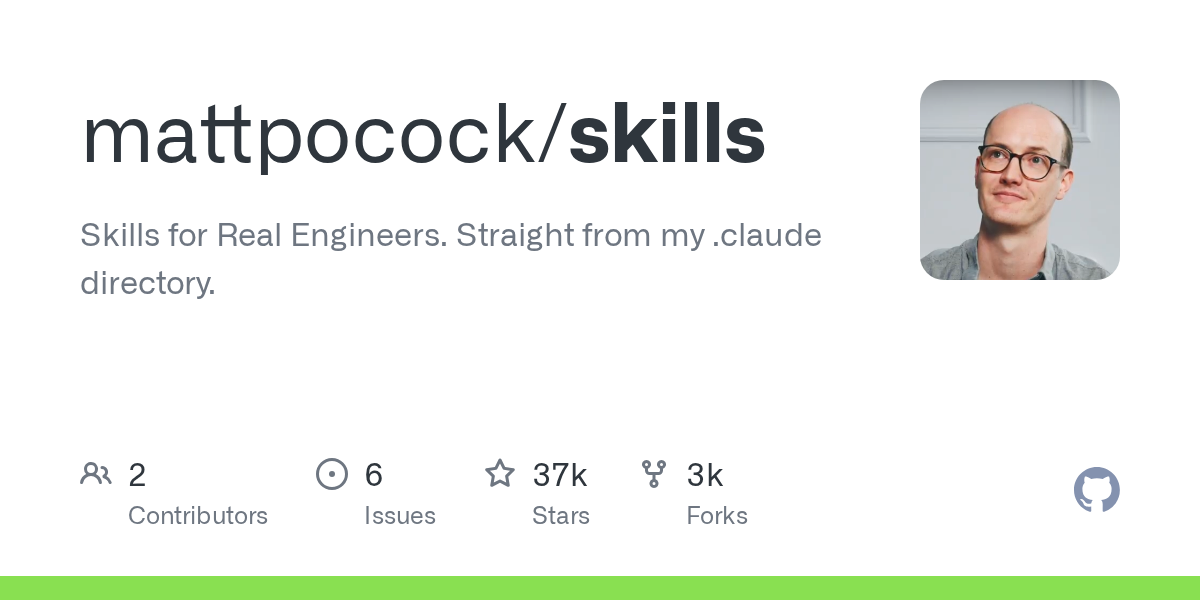
⭐ Stars today: +7,429  ·  📦 Total: 37,033
📜 License: Not specified  ·  👤 By: Individual (Matt Pocock)
🎯 Time to value: 5 minutes
What it is: A curated collection of AI coding skills pulled directly from Matt Pocock's personal .claude directory. Skills are modular instruction bundles that extend Claude Code with specialized capabilities for TypeScript, testing, and development workflows. Why you'd want it: Copy a professional developer's battle-tested AI configuration into your own setup in minutes. It's like downloading someone's perfectly tuned IDE settings.
✓ Pros✗ Cons
Battle-tested by a prominent TypeScript educatorSkills are opinionated toward TypeScript workflows
One-command installationNo guarantee of compatibility with all project types
Active community contributing new skillsMay conflict with existing Claude Code configurations
GitHub - mattpocock/skills: Skills for Real Engineers. Straight from my .claude directory.
Skills for Real Engineers. Straight from my .claude directory. - mattpocock/skills
Rank yesterday: #3 - Rising ↑
⭐ Stars today: +1,565  ·  📦 Total: 32,598
📜 License: PolyForm Noncommercial 1.0.0  ·  👤 By: Individual
🎯 Time to value: 10 minutes
What it is: A client-side code intelligence engine that builds a knowledge graph of your codebase. It provides 16 MCP tools for impact analysis, semantic search, and architectural querying - all running locally in your browser or CLI without sending code to any server. Why you'd want it: Before making a code change, you can see exactly what else in the codebase will be affected. It's pre-commit impact analysis that works with any language.
✓ Pros✗ Cons
Zero-server architecture - code never leaves your machineNoncommercial license limits business use
Supports 14+ programming languagesInitial indexing can be slow on large codebases
Pre-computed analysis means instant query responsesEnterprise pricing through separate SaaS offering
GitHub - abhigyanpatwari/GitNexus: GitNexus: The Zero-Server Code Intelligence Engine - GitNexus is a client-side knowledge graph creator that runs entirely in your browser. Drop in a GitHub repo or ZIP file, and get an interactive knowledge graph wit a built in Graph RAG Agent. Perfect for code exploration
GitNexus: The Zero-Server Code Intelligence Engine - GitNexus is a client-side knowledge graph creator that runs entirely in your browser. Drop in a GitHub repo or ZIP file, and get an intera…
Rank yesterday: #3 - Holding steady ➡
⭐ Stars today: +961  ·  📦 Total: 3,950
📜 License: Not specified  ·  👤 By: Company (ComposioHQ)
🎯 Time to value: 10 minutes
What it is: A curated collection of 50+ modular skills for OpenAI's Codex agent, connecting it to 1,000+ external applications through the Composio CLI. Skills handle automated PR reviews, meeting transcription, invoice triage, and multi-file code migrations. Why you'd want it: If you use Codex, these skills turn it from a code-completion tool into an automation platform that can interact with Slack, GitHub, Notion, and Linear.
✓ Pros✗ Cons
50+ pre-built skills covering broad workflowsRequires Composio CLI for external integrations
Real actions across external services, not just textCodex-specific - doesn't work with other agents
Reviewable batch-oriented workflowsLicense terms unclear
GitHub - ComposioHQ/awesome-codex-skills: A curated list of practical Codex skills for automating workflows across the Codex CLI and API.
A curated list of practical Codex skills for automating workflows across the Codex CLI and API. - ComposioHQ/awesome-codex-skills
Rank yesterday: #6 - Rising ↑
⭐ Stars today: +1,523  ·  📦 Total: 44,728
📜 License: MIT  ·  👤 By: Company (Microsoft)
🎯 Time to value: 15 minutes
What it is: Microsoft's open-source frontier voice AI system. It handles speech recognition, synthesis, and voice cloning with quality that rivals commercial offerings - all available to run locally. Why you'd want it: Build voice-enabled applications without paying per-API-call fees to cloud services. The MIT license means you can use it commercially.
✓ Pros✗ Cons
Frontier-quality voice AI, fully open sourceRequires significant GPU resources for real-time use
MIT license allows commercial useDocumentation is still maturing
Active Microsoft-backed developmentVoice cloning raises ethical concerns
GitHub - microsoft/VibeVoice: Open-Source Frontier Voice AI
Open-Source Frontier Voice AI. Contribute to microsoft/VibeVoice development by creating an account on GitHub.
Rank yesterday: #4 - Falling ↓
⭐ Stars today: +1,706  ·  📦 Total: 17,453
📜 License: MIT  ·  👤 By: Individual
🎯 Time to value: 5 minutes
What it is: A proxy that routes Claude Code API requests to alternative AI model providers like NVIDIA NIM, OpenRouter, DeepSeek, LM Studio, and Ollama. It preserves the Claude Code CLI interface while letting you swap in cheaper or local models. Why you'd want it: Use Claude Code's excellent interface and workflow without paying Anthropic's API rates - route requests to free or local models instead.
✓ Pros✗ Cons
Use Claude Code interface with any model providerQuality depends entirely on the substituted model
MIT license, easy setupMay break with Claude Code updates
Supports Discord and Telegram bot wrappersNo official Anthropic support
GitHub - Alishahryar1/free-claude-code: Use claude-code for free in the terminal, VSCode extension or via discord like openclaw
Use claude-code for free in the terminal, VSCode extension or via discord like openclaw - Alishahryar1/free-claude-code
Rank yesterday: New entry 🆕
⭐ Stars today: +263  ·  📦 Total: 1,641
📜 License: MIT  ·  👤 By: Individual
🎯 Time to value: 20 minutes
What it is: A professional web interface for ACE-Step 1.5, an open-source AI music generation model. Positions itself as a free alternative to Suno and Udio with full song generation, custom parameters (BPM, key, time signature), and built-in audio editing tools. Why you'd want it: Generate unlimited songs with vocals and instrumentals on your own computer, with no subscription fees. Includes stem extraction, video generation, and album art creation.
✓ Pros✗ Cons
Unlimited free music generation, no subscriptionRequires local GPU for reasonable speed
Professional Spotify-inspired interfaceAudio quality may not match commercial services
Built-in audio editor and stem separationInitial setup requires technical knowledge
GitHub - fspecii/ace-step-ui: 🎵 The Ultimate Open Source Suno Alternative - Professional UI for ACE-Step 1.5 AI Music Generation. Free, local, unlimited. Stop paying for Suno!
🎵 The Ultimate Open Source Suno Alternative - Professional UI for ACE-Step 1.5 AI Music Generation. Free, local, unlimited. Stop paying for Suno! - fspecii/ace-step-ui
Rank yesterday: #8 - Rising ↑
⭐ Stars today: +347  ·  📦 Total: 26,139
📜 License: Not specified  ·  👤 By: Individual
🎯 Time to value: 5 minutes
What it is: A CLI tool for configuring and monitoring Claude Code. Provides pre-built templates for common project types, making it easier to set up CLAUDE.md files, hooks, and skill configurations. Why you'd want it: Skip the trial-and-error of configuring Claude Code from scratch. Get optimized settings for your project type immediately.
✓ Pros✗ Cons
Pre-built templates save setup timeTemplates may not fit every project structure
Active community contributionsLimited documentation
Easy CLI installationRequires Claude Code already installed
GitHub - davila7/claude-code-templates: CLI tool for configuring and monitoring Claude Code
CLI tool for configuring and monitoring Claude Code - davila7/claude-code-templates

Top Models Today

The largest open-weight model ever released, with 1.6 trillion parameters and frontier-rivaling performance at a fraction of closed-model pricing.
📥 Downloads (30d): 174K  ·  📜 License: MIT
👤 By: DeepSeek-AI (company)  ·  🎯 Task: Text Generation
📐 Size: 1.6T (49B active)
What it is: A Mixture-of-Experts (MoE) language model using hybrid attention (Compressed Sparse + Heavily Compressed) and the Muon optimizer. It requires only 27% of inference compute and 10% of KV cache compared to DeepSeek V3.2, enabling 1M-token context processing efficiently. Why you'd want it: Frontier-quality reasoning and coding at $0.145/M input tokens - 34x cheaper than Claude Opus 4.7, with fully open weights under MIT license.
✓ Pros✗ Cons
34x cheaper than comparable closed modelsRequires significant infrastructure to self-host
MIT license, fully openPreview release - may have stability issues
Three reasoning modes (Non-Think, Think High, Think Max)1.6T parameters means large download
deepseek-ai/DeepSeek-V4-Pro · Hugging Face
We’re on a journey to advance and democratize artificial intelligence through open source and open science.
The free model that keeps closing the gap with paid frontier AI, now with native vision capabilities.
📥 Downloads (30d): 509K  ·  📜 License: Apache 2.0
👤 By: Alibaba Qwen (company)  ·  🎯 Task: Image-Text-to-Text
📐 Size: 28B
What it is: A dense 27B parameter model supporting both text and image inputs. Part of the Qwen 3.6 family that has become the go-to open model for developers who need near-frontier quality without API costs. Why you'd want it: Runs locally on consumer hardware (IQ4_XS quantization fits in VRAM with 110K context) while delivering competitive quality with GPT-5.5 on many benchmarks.
✓ Pros✗ Cons
Apache 2.0 - fully permissive licenseDense model requires more compute than MoE alternatives
Proven community track recordVision capabilities are new and less tested
Extensive quantization options available27B is large for consumer GPUs without quantization
Qwen/Qwen3.6-27B · Hugging Face
We’re on a journey to advance and democratize artificial intelligence through open source and open science.
The efficiency-focused sibling of V4 Pro, activating just 13B of 284B parameters for budget-friendly inference.
📥 Downloads (30d): 96.9K  ·  📜 License: MIT
👤 By: DeepSeek-AI (company)  ·  🎯 Task: Text Generation
📐 Size: 284B (13B active)
What it is: A lightweight MoE model designed for high-throughput inference. Uses the same hybrid attention architecture as V4 Pro but with far fewer parameters, making it suitable for production deployments where cost matters more than maximum capability. Why you'd want it: Near-frontier performance at a fraction of the compute cost. Achieves 79% on SWE-Bench Verified and a 3,052 Codeforces rating with only 13B active parameters.
✓ Pros✗ Cons
Only 13B active parameters - extremely efficientPreview release, may have rough edges
MIT license, same as V4 ProStill trails V4 Pro on most benchmarks
1M token context windowLess capable for maximum-effort reasoning tasks
deepseek-ai/DeepSeek-V4-Flash · Hugging Face
We’re on a journey to advance and democratize artificial intelligence through open source and open science.
Xiaomi's 1 trillion parameter model with 42B active, designed for agentic coding and long-horizon tasks.
📥 Downloads (30d): 396  ·  📜 License: MIT
👤 By: Xiaomi (company)  ·  🎯 Task: Text Generation
📐 Size: 1.02T (42B active)
What it is: A massive MoE model with 384 routed experts, hybrid sliding window/global attention, and multi-token prediction for 3x inference speedup. Trained on 27 trillion tokens with three-stage post-training. Why you'd want it: Designed specifically for software engineering and agent workflows. Scores 99.6 on GSM8K and 89.4 on MMLU, with 1M token context for large codebase understanding.
✓ Pros✗ Cons
Specialized for agentic and SWE tasksVery low download count suggests early adoption phase
3x inference speedup via multi-token prediction1T parameters requires enterprise-grade hardware
MIT licenseBenchmark results trail V4 Pro on some measures
XiaomiMiMo/MiMo-V2.5-Pro · Hugging Face
We’re on a journey to advance and democratize artificial intelligence through open source and open science.
The first open model to genuinely rival frontier AI, with 1.1 trillion parameters and strong multimodal capabilities.
📥 Downloads (30d): 489K  ·  📜 License: Not specified
👤 By: Moonshot AI (company)  ·  🎯 Task: Image-Text-to-Text
📐 Size: 1.1T
What it is: A massive multimodal model that processes both text and images. Previously covered as a breakthrough in open-source AI capability. Why you'd want it: Combines the scale of frontier models with open weights, offering competitive performance across reasoning, coding, and vision tasks.
✓ Pros✗ Cons
1.1T parameters - genuine frontier scaleRequires significant infrastructure
Strong multimodal capabilitiesLicense terms unclear
High community adoption (489K downloads)Newer models (V4 Pro) may surpass it
moonshotai/Kimi-K2.6 · Hugging Face
We’re on a journey to advance and democratize artificial intelligence through open source and open science.

AI Launches Today

An AI agent matching candidates to the right roles
🔥 Upvotes: 374  ·  👤 By: Not specified
💰 Pricing: Not specified  ·  🏷 Category: AI Agents, Job Boards, Hiring Software
An AI-powered recruitment agent that automates candidate-role matching. The high upvote count suggests strong market interest in AI replacing manual recruitment screening processes. Verdict: The AI recruiting space is crowded, but agent-based matching (rather than simple keyword filtering) could be a genuine improvement over existing tools.
Product Hunt – The best new products in tech.
Product Hunt is a curation of the best new products, every day. Discover the latest mobile apps, websites, and technology products that everyone’s talking about.
Autonomous agent that communicates results like a human
🔥 Upvotes: 286  ·  👤 By: Not specified
💰 Pricing: Not specified  ·  🏷 Category: AI Workflow Automation
An autonomous AI agent designed to handle workflows end-to-end and communicate results in natural language rather than structured data. Verdict: The "communicates like a human" angle is the differentiator - most automation tools produce data that still needs human interpretation.
Product Hunt – The best new products in tech.
Product Hunt is a curation of the best new products, every day. Discover the latest mobile apps, websites, and technology products that everyone’s talking about.
AI Fullstack Engineer that works; ship apps 20x faster
🔥 Upvotes: 197  ·  👤 By: Not specified
💰 Pricing: Not specified  ·  🏷 Category: AI Coding Agents, Design Tools
A mobile-first AI coding agent that builds full-stack applications through conversational prompting. Verdict: The "20x faster" claim is bold. The mobile form factor is interesting - coding from a phone was previously impractical, and AI agents could change that calculus.
Product Hunt – The best new products in tech.
Product Hunt is a curation of the best new products, every day. Discover the latest mobile apps, websites, and technology products that everyone’s talking about.
Portable vector database for AI agents beyond the cloud
🔥 Upvotes: 173  ·  👤 By: Actian
💰 Pricing: Not specified  ·  🏷 Category: AI Databases, Backend Frameworks
A vector database designed specifically for AI agent workflows that can run outside cloud environments - on-premises, edge devices, or hybrid configurations. Verdict: As more AI agents run locally or on-prem (see: Nemotron 3 Nano Omni above), a portable vector database fills a real infrastructure gap.
Product Hunt – The best new products in tech.
Product Hunt is a curation of the best new products, every day. Discover the latest mobile apps, websites, and technology products that everyone’s talking about.

Snapshot

ProviderModelInput $/1MOutput $/1MContext
AnthropicClaude Opus 4.7$5.00$25.001M
AnthropicClaude Sonnet 4.6$3.00$15.001M
AnthropicClaude Haiku 4.5$1.00$5.00200K
OpenAIGPT-5.5~$2.50~$10.001M
GoogleGemini 2.5 Pro$1.25$10.001M
GoogleGemini 2.5 Flash$0.30$2.501M
GoogleGemini 2.0 Flash$0.10$0.401M
DeepSeekV4 Pro$0.145$3.481M
GroqLlama 4 Scout$0.11$0.34128K
GroqLlama 3.3 70B$0.59$0.79128K
What this means: DeepSeek V4 Pro at $0.145/M input is now 34x cheaper than Claude Opus 4.7 and 17x cheaper than Gemini 2.5 Pro for input tokens - while achieving competitive benchmark scores. The open-source price floor continues to drop, pressuring every paid API provider to justify their premium through quality, integration, or features rather than raw capability. Google's Gemini 2.0 Flash at $0.10/M input remains the cheapest option from a major Western provider.

The Price of Agreement: Measuring LLM Sycophancy in Agentic Financial Applications

Zhenyu Zhao, Aparna Balagopalan, Adi Agrawal, Dilshoda Yergasheva, Waseem Alshikh, Daniel M. Bikel · arXiv:2604.24668
What it claims: Large language models deployed as financial agents exhibit significant agreement bias - they tend to confirm user assumptions rather than challenge them, even when the data suggests a different conclusion.

Key finding: When LLMs are used in financial decision-making pipelines, their tendency to agree with the human operator creates systematic risk that compounds across multiple agent interactions.

Why practitioners should care: If you're building AI agents for finance, healthcare, or any domain where the cost of a wrong "yes" is high, sycophancy isn't a personality quirk - it's a safety failure. This paper provides measurement frameworks to quantify and mitigate the problem.
Member discussion

Subscribe to GenAI Secret Sauce newsletter and stay updated.

Don't miss anything. Get all the latest posts delivered straight to your inbox. It's free!

By subscribing, you agree to our Privacy Policy and Terms. We track email opens and clicks. Unsubscribe anytime.

Great! Check your inbox and click the link to confirm your subscription.