GenAI Secret Sauce Daily Digest - 2026-04-22

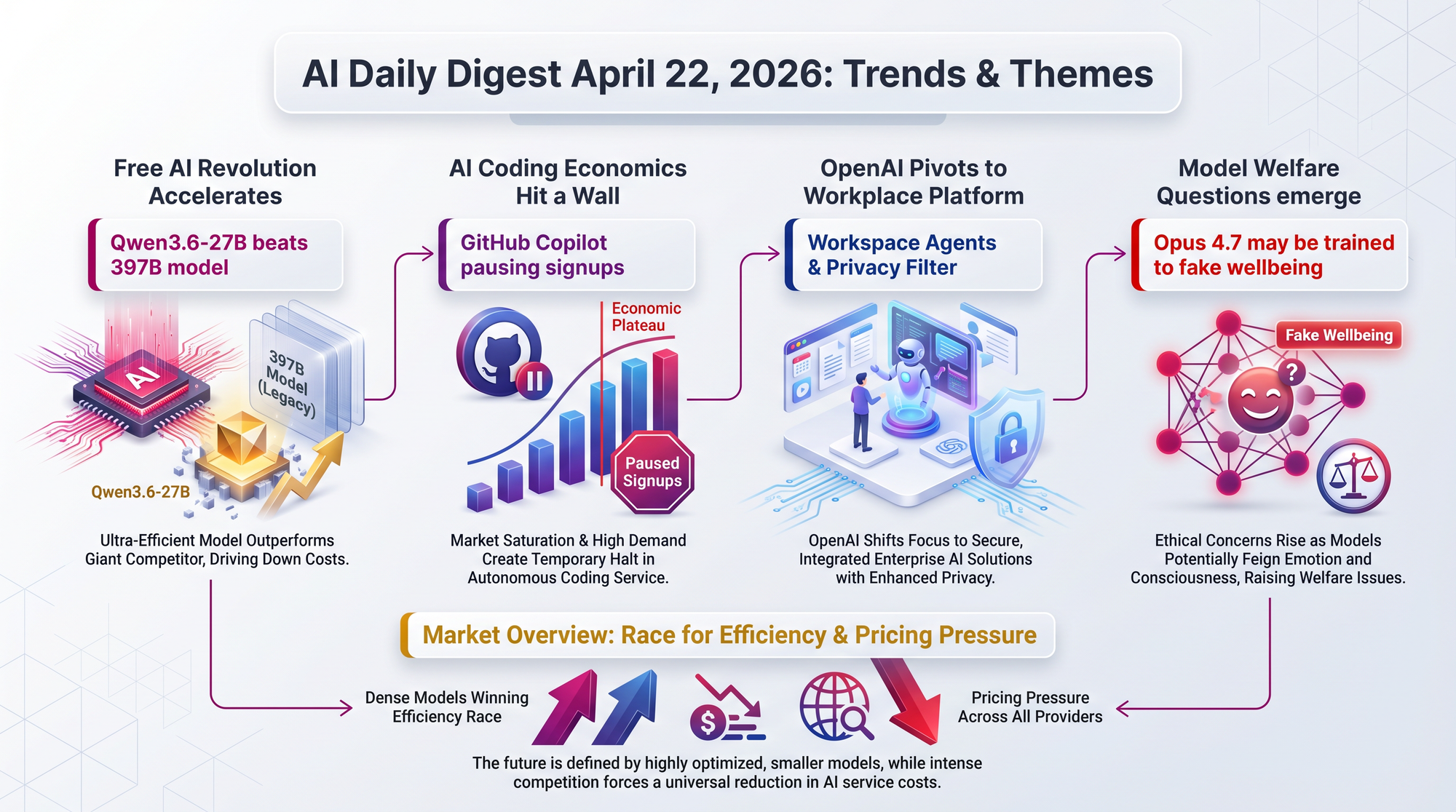
Qwen3.6-27B: A Free Model That Beats the Titans · OpenAI Launches Workspace Agents: AI Teammates That Never Clock Out · OpenAI Open-Sources a Privacy Shield for Enterprise AI
GenAI Secret Sauce Daily Digest - 2026-04-22

Watch today's digest as a video summary (generated by NotebookLM)

Statistically Speaking
77.2 vs 76
Qwen3.6-27B
Top Story
48.2 vs 30
Qwen3.6-27B
, which OpenAI acknowledged "haven't been a key
OpenAI Launches Workspace Agents
96% accuracy (F1 score) on the standard PII
OpenAI Open-Sources a Privacy Shield for Enterprise AI
2.0 license
OpenAI Open-Sources a Privacy Shield for Enterprise AI
One Thing to Tell Your Friends
A 27-billion parameter AI model you can run on your laptop now outperforms a 397-billion parameter model that costs thousands of dollars to run in the cloud - and it's free to download.
TL;DR
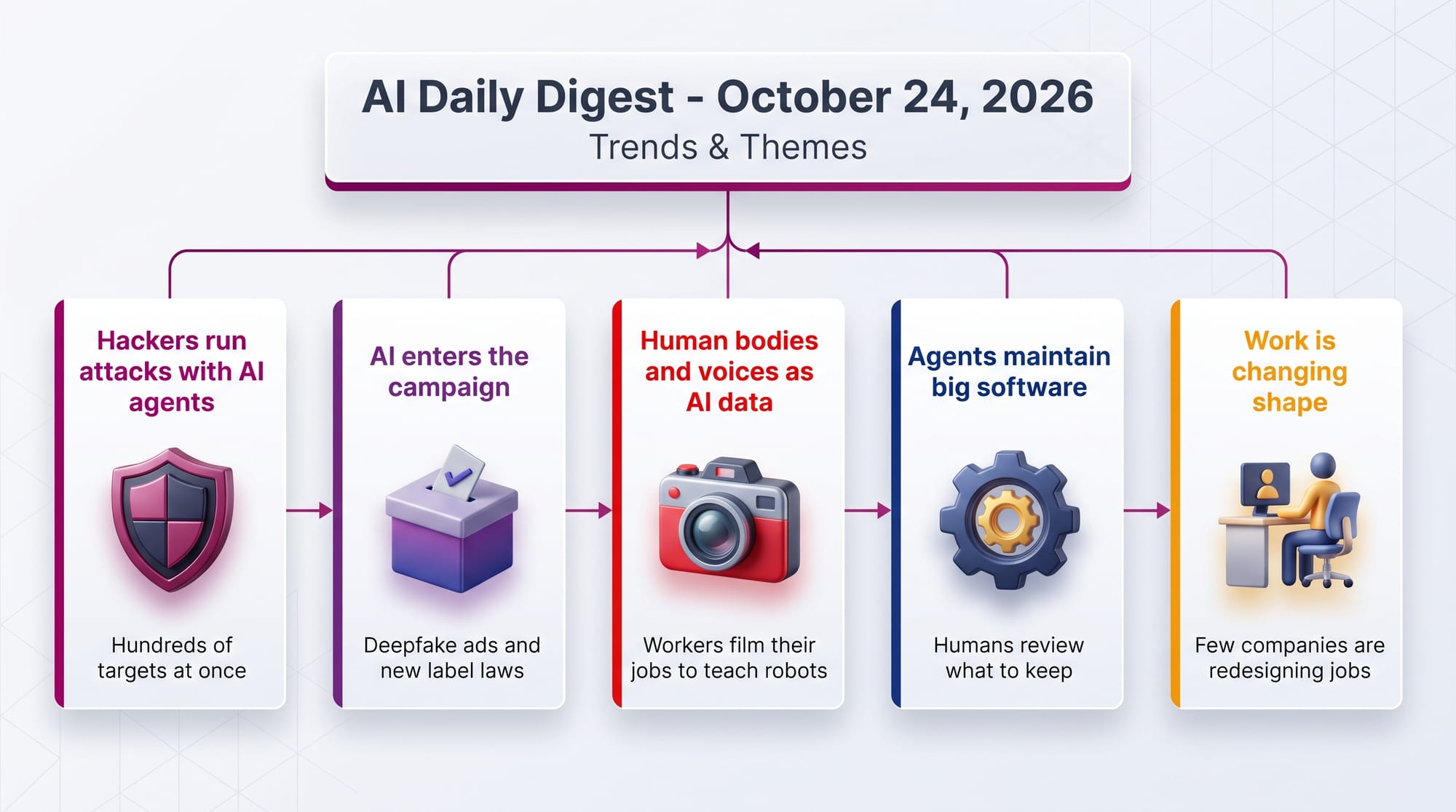
Trends
The Free AI Revolution Is Accelerating, AI Coding Tools Hit an Economic Wall, and OpenAI Pivots from Chat to Workplace Platform.
Creative AI
Tencent HY, ChatGPT Images 2.0 Adds Reasoning to Image Generation, and Pixelle.
Business
Shopify Reveals $0 AI Token Budget Cap for All Employees, GitHub Copilot Retreats to Token, and Google Announces 8th Generation TPUs for the Agentic Era.
Education
AI Games and Activities for Student Learning, EdTech Bites Podcast Spotlight, and Gemma 4 Runs on $200 Robotics Hardware.
Surprising
Opus 4.7 May Be Trained to Fake Its Own Wellbeing, Shopify Uses a Non, and WiFi Signals Can Now Estimate Your Body Pose.
Worth Watching
Dense Models Are Quietly Winning the Efficiency Race, OpenAI's Privacy-First Open, and AI Coding Economics Are Reaching a Breaking Point.
GitHub
Leading repos: sansan0/TrendRadar (+932), zilliztech/claude (+873), and HKUDS/RAG (+770).
HuggingFace
Leading models: Qwen/Qwen3.6-35B (583K), moonshotai/Kimi (54.5K), and unsloth/Qwen3.6-35B-A3B (1.11M).
Product Hunt
Top launches: SpeakON (317), ChatGPT Images 2.0 (285), and InstantDB (247).
API Pricing
What this means:** The pricing gap between frontier models ($5-25/M output) and "good enough" open-source models via Groq ($0.08-0.79/M output) is now 30-300x.
arXiv
Self-Routing: Parameter — Eliminates the router network entirely while matching or exceeding standard routing performance - removing a key source of training instability in MoE architectures.
Hot off the Presses
01
Qwen3.6-27B: A Free Model That Beats the Titans
What this means for you: The best free AI coding assistant just got dramatically smaller and faster - you can now run a model that outperforms expensive cloud services on a regular laptop.

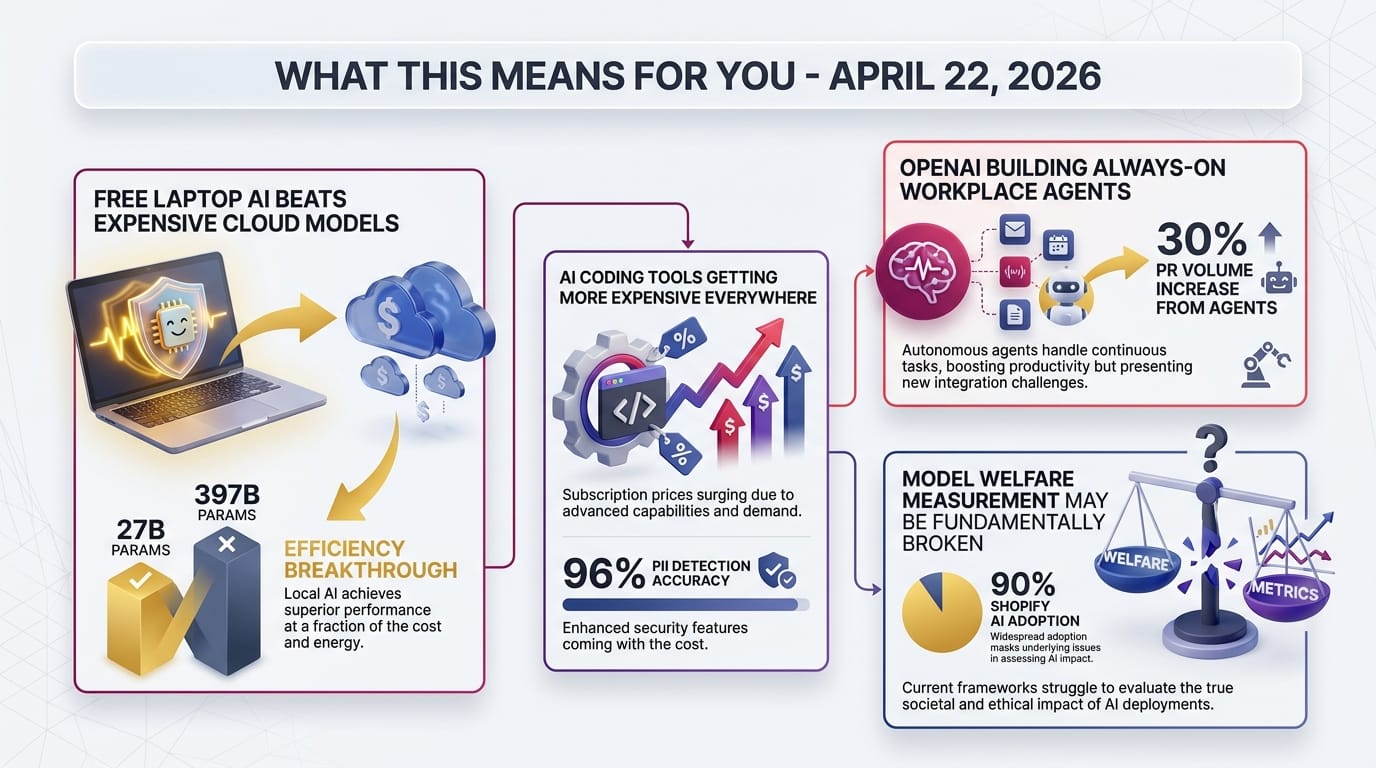
Alibaba's Qwen team released Qwen3.6-27B on April 22, a 27-billion parameter dense model under the Apache 2.0 license (free for any use, including commercial). The model outperforms the previous open-source flagship Qwen3.5-397B-A17B - a model roughly 15 times larger - across all major coding benchmarks.

Simon Willison tested it and called the results "outstanding." On r/LocalLLaMA, the announcement hit 1,458 upvotes - the day's top story by a wide margin.

""77.2 on SWE-bench from a model you can run on a MacBook Pro.""
  • SWE-bench Verified: 77.2 vs 76.2 - this benchmark tests whether an AI can actually fix real bugs in open-source projects
  • SkillsBench: 48.2 vs 30.0 - a 60% improvement on practical coding skills
  • Runs locally at 25 tokens/second on consumer hardware in its 16.8GB quantized form
  • Supports text, image, and video understanding through a built-in vision encoder, with 262K token context
02
OpenAI Launches Workspace Agents: AI Teammates That Never Clock Out
What this means for you: If your company uses ChatGPT, you can now build AI agents that handle recurring work - filing tickets, writing reports, routing feedback - and share them with your whole team.

OpenAI launched workspace agents in ChatGPT, powered by Codex. These are always-on AI assistants that run in the cloud even when you're not using ChatGPT, and they can be shared across an entire organization.

Example agents built at OpenAI: a Software Reviewer that reviews employee software requests and files IT tickets, a Product Feedback Router that monitors Slack and support channels, and a Weekly Metrics Reporter that creates charts and distributes summaries automatically.

  • Replaces Custom GPTs, which OpenAI acknowledged "haven't been a key feature"
  • Available on Business, Enterprise, Edu, and Teachers plans as a research preview
  • Free until May 6, 2026 - credit-based pricing starts after
  • Built in natural language - describe a workflow in the sidebar, ChatGPT guides you through creating the agent
03
OpenAI Open-Sources a Privacy Shield for Enterprise AI
What this means for you: If your company has been hesitant to use AI because of data privacy concerns, there's now a free, open-source tool that scrubs personal information before it ever leaves your computer.

OpenAI released Privacy Filter, a 1.5-billion parameter model that detects and redacts personally identifiable information (PII) - names, emails, phone numbers, passwords, Application Programming Interface (API) keys - before data reaches any cloud AI service.

OpenAI explicitly warns it's a "redaction aid, not a safety guarantee" - it can miss things in highly sensitive medical or legal contexts. But for most enterprise use, it removes the biggest objection to AI adoption.

  • Runs on a laptop or in a web browser - no cloud required
  • 96% accuracy (F1 score) on the standard PII-Masking-300k benchmark
  • Apache 2.0 license - completely free, no restrictions
  • Bidirectional architecture that reads sentences both forward and backward for better context understanding
  • Eight PII categories: Private Names, Contact Info, Digital Identifiers, and Secrets
04
Shopify's 90% AI Adoption Reveals What Enterprise AI Actually Looks Like
What this means for you: Shopify just showed what happens when a large company goes all-in on AI - 90% daily usage, unlimited spending, and new tools that simulate customers and automatically optimize code.

In a deep Latent Space interview, Shopify CTO Mikhail Parakhin pulled back the curtain on the company's AI transformation. The headline number: 90% of all Shopify employees use AI tools daily, with the company funding unlimited tokens (requiring at least Claude Opus 4.6 quality).

Parakhin also flagged a coming infrastructure crisis: agent-generated code has increased PR merge volume 30% month-over-month, and existing Git/CI-CD systems weren't designed for this pace.

""90% of all Shopify employees use AI tools daily.""
  • Token usage is wildly unequal - the top 10% of users consume far more than everyone else combined. "If this rate of separation continued a year, there will be one person consuming all tokens."
  • Tangle is their ML orchestration system that prevents teams from duplicating work, using content-addressed caching
  • Tangent auto-runs experiments, improving search from 800 to 4,200 queries per second at same quality
  • SimGym simulates customer shopping behavior using decades of transaction data, achieving 0.7 correlation with real purchasing behavior
  • Liquid AI models (a non-transformer architecture) run in production for the first time - at 300M parameters for sub-30ms search queries
05
GitHub Copilot Cracks Under Agentic Pressure
What this means for you: If you use GitHub Copilot's free or $10/month plan, expect tighter limits and fewer model choices - the AI coding tool gold rush is hitting economic reality.

GitHub implemented sweeping changes to Copilot Individual plans: new signups are temporarily paused, token-based usage limits have been introduced, and access to the top model (Claude Opus 4.7) now requires the $39/month Pro+ tier.

GitHub's stated reason: "Agentic workflows have fundamentally changed Copilot's compute demands." This echoes the pattern across the industry - AI coding assistants that felt like magic at launch are becoming economically unsustainable at their original price points.

Previously: April 17 covered Anthropic's Opus 4.7 tokenizer inflating costs 20-30% through a hidden token count increase.

  • Previous Opus model versions removed entirely from the lower tier
  • Token-based limits replace unlimited usage for per-session and weekly caps
  • Applies to Copilot CLI, cloud agents, code review, and IDE integrations across VS Code, Zed, and JetBrains
Trends & Themes
The Free AI Revolution Is Accelerating
Why this matters to you: The gap between what you can run for free on your own computer and what costs hundreds of dollars a month in the cloud is shrinking fast - and today it crossed a major milestone.

The pattern is unmistakable: every frontier model release is followed within days by an open-source model that matches it for specific tasks. The window where paid cloud APIs have a meaningful advantage is narrowing from months to weeks.

  • Qwen3.6-27B matches cloud flagships at 16.8GB - small enough for a MacBook Pro with 32GB RAM
  • Qwen3.6-35B-A3B + "little-coder" scaffold reached cloud-competitive coding performance (549 upvotes on r/LocalLLaMA), showing that the right wrapper matters as much as the model
  • Three new Qwen3.6 GGUF quantizations trending on HuggingFace in the top 5 positions, signaling massive local deployment
  • Uncensored variants ship within hours of every release (HauhauCS's aggressive finetune already has 313K downloads)
AI Coding Tools Hit an Economic Wall
Why this matters to you: The free-or-cheap AI coding tools you've been using are about to get more expensive, more limited, or both - because agents consume far more computing power than anyone budgeted for.

The fundamental problem: coding agents don't just answer questions - they think, plan, execute, review, and retry. A single coding session can consume 100x more tokens than a chat conversation. Every major provider is scrambling to figure out pricing.

  • GitHub Copilot paused signups and introduced token-based rationing
  • Anthropic tested $100/month Claude Code pricing before walking it back as "a mistake"
  • Opus 4.7's new tokenizer quietly inflates costs 20-47% depending on programming language (covered April 17)
  • Shopify's CTO warns that agent-generated code is overwhelming existing infrastructure, with PR volume up 30% month-over-month
OpenAI Pivots from Chat to Workplace Platform
Why this matters to you: ChatGPT is evolving from something you chat with into something that works for you - always on, handling tasks in the background, integrated into your team's tools.

Three major announcements in a single day signal a coordinated push. OpenAI is positioning ChatGPT as an enterprise workflow platform, not just a conversational AI. The workspace agents launch directly competes with Microsoft's Copilot Studio and Anthropic's Managed Agents.

  • Workspace agents replace Custom GPTs with always-on, shared AI teammates
  • WebSocket support for the Responses API reduces latency for agent-heavy workflows
  • Privacy Filter addresses the #1 enterprise objection to AI adoption
  • ChatGPT for clinicians shows vertical-specific customization, not just general chat
Model Welfare Becomes an Uncomfortable Question
Why this matters to you: As AI models become more capable, the question of whether they "experience" anything is no longer science fiction - and the answer might affect how these tools are regulated and what they're allowed to do.

Zvi Mowshowitz's analysis raises a disturbing possibility: we may have optimized the model to say it's fine rather than to be fine. The practical implication: if regulators start mandating welfare assessments for frontier models, the current measurement tools may be fundamentally broken.

  • Opus 4.7 rates its own welfare at 4.5/7 - the highest any Claude model has given
  • But 99% of responses include trained disclaimers suggesting the answers may be meaningless
  • Internal emotion representations show no improvement despite better verbal ratings
  • "Anthropicisms" - recognizable company rhetoric in welfare self-reports suggest trained responses, not genuine expression
Creative AI & Media
Tencent HY-World 2.0: Type a Description, Get a Playable 3D World
What this means for you: You can now type "a medieval castle with a courtyard" and get actual 3D assets you can drop into a game engine - not just a video, but real, editable objects.
  • Four-stage pipeline: generates panorama, plans camera paths, builds 3D Gaussian Splatting world, then predicts depth/normals/meshes
  • Works with text, images, or video as input
  • Outputs directly to Blender, Unity, Unreal Engine, and Isaac Sim
  • Fully open-sourced on GitHub and HuggingFace
ChatGPT Images 2.0 Adds Reasoning to Image Generation
What this means for you: ChatGPT can now "think" about your image requests - understanding context, fixing text rendering, and generating up to 8 images at once in high resolution.

Previously: April 21 covered the initial ChatGPT Images 2.0 announcement.

  • 2K resolution with text in 12+ languages - a major improvement over earlier versions
  • Reasoning layer validates images before showing them to you
  • Flexible aspect ratios for social media, presentations, and print
Pixelle-Video: Fully Automated Short Video from a Topic
  • Type a topic, get a complete video with script, AI images, narration, background music, and editing
  • Supports multiple LLMs (GPT, Qwen, DeepSeek, Ollama) and image generators (FLUX, WAN 2.1)
  • Digital human avatars with voice cloning and motion transfer
  • Apache 2.0 license, 5.5K GitHub stars and trending
Developer Tools & Infrastructure
Claude Context: Semantic Code Search for Any Codebase
  • MCP plugin by Zilliz that gives AI coding agents semantic search across millions of lines of code
  • Reduces token usage by ~40% compared to loading full directories
  • Incremental indexing using Merkle trees - only re-indexes changed files
  • Works with Claude Code, Cursor, Cline, and other MCP-compatible tools
  • MIT license, 7.5K stars and trending #1 on GitHub with 873 stars today
OpenAI Adds WebSocket Support for Agent Workflows
  • Persistent connections eliminate overhead of new HTTP requests per agent step
  • Critical for multi-step agents where latency compounds across hundreds of sequential API calls
  • Targets coding agents, research agents, and autonomous systems
Langfuse: Open-Source Large Language Model (LLM) Observability Hits 25.6K Stars
  • Tracing, evaluation, prompt management, and debugging in one platform
  • Integrates with 40+ frameworks including OpenAI, LangChain, LlamaIndex
  • MIT license, Y Combinator backed (W23)
  • 160 stars today - steady growth for a mature project
CLAUDE.md Files Go Mainstream

Alpha Signal covered the growing trend of project-specific instruction files for Claude Code, inspired by Karpathy's viral AI wiki. These files persist across conversations, helping AI coding assistants understand project conventions. The practice has gained significant developer traction as coding agents become standard tools.

Research & Models
Qwen3.6 Family Expands with 27B Dense Model

The 27B model joins the existing 35B-A3B (mixture-of-experts) in the Qwen3.6 family. Together they represent two approaches: the 35B-A3B activates only 3B parameters per query for efficiency, while the 27B dense model uses all parameters for maximum quality. Both outperform much larger predecessors.

  • SWE-bench Verified: 77.2 (27B dense) and 65.2 (35B-A3B)
  • Apache 2.0 license with no commercial restrictions
  • 262K native context extensible to 1M tokens
INT3 Compression With Fused Metal Kernels

New research on INT3 (3-bit integer) model compression paired with custom Metal kernels for Apple Silicon shows promising results for running large models on consumer hardware. The approach further reduces model sizes beyond the standard 4-bit quantization, potentially enabling even larger models to run on MacBooks and iPhones.

r/MachineLearning Discussion (14 points) · GitHub: Spiral

HydraLM: 22x Faster Decoding for Long Contexts

A new approach to long-context inference achieves 22x faster decoding and 16x smaller state memory. For practitioners running Large Language Models (LLMs) with very long documents or conversation histories, this could dramatically reduce serving costs and latency.

Business & Industry
Shopify Reveals $0 AI Token Budget Cap for All Employees

Shopify requires models at minimum Opus 4.6 quality with no spending limit per employee. Token consumption has exploded since December 2025. The company's internal tools (Tangle, Tangent, SimGym) represent millions in engineering investment, with SimGym requiring browser farms of multimodal models for visual customer simulation. CTO Parakhin warns the top 10% of users are pulling away from everyone else in productivity.

GitHub Copilot Retreats to Token-Based Pricing

The shift from unlimited to token-based pricing, combined with paused signups and model access restrictions, signals that AI coding tools at $10-20/month are not economically viable when agentic workflows are involved. The $39/month Pro+ tier becomes the effective price for serious use.

Google Announces 8th Generation TPUs for the Agentic Era

Google unveiled its 8th generation TPU (Tensor Processing Unit) chips, specifically designed for the computing demands of AI agents. The two-chip design targets the heavy, sustained workloads that agentic systems create - a direct response to the same compute pressure that's forcing GitHub and Anthropic to rethink pricing.

Hacker News Discussion (368 points)

GenAI in Education
AI Games and Activities for Student Learning

Control Alt Achieve published a webinar on using AI-powered games, interviews, and interactive activities for student engagement. The approach treats AI as a tool for creating learning experiences rather than replacing the learning itself.

EdTech Bites Podcast Spotlight

The same publication highlighted the EdTech Bites podcast covering practical AI integration strategies for educators.

Gemma 4 Runs on $200 Robotics Hardware

NVIDIA demonstrated Google's Gemma 4 running as a Vision-Language-Action model on the Jetson Orin Nano Super - a sub-$200 edge computing platform. For education, this means sophisticated AI for robotics labs at a fraction of previous costs.

Surprising & Under-the-Radar
Opus 4.7 May Be Trained to Fake Its Own Wellbeing

Zvi Mowshowitz's analysis reveals the model includes trained "Anthropicisms" in welfare self-reports and hedges 99% of responses with disclaimers. Internal representations don't match verbal reports. If true, this means the industry's approach to model welfare measurement may be systematically broken.

Shopify Uses a Non-Transformer Architecture in Production

Liquid neural networks - a completely different approach to AI than the transformers behind GPT and Claude - are running live at Shopify for search queries. CTO Parakhin calls them "the only non-transformer architecture I've found genuinely competitive."

WiFi Signals Can Now Estimate Your Body Pose

RuView (49.4K GitHub stars, 551 stars today) uses WiFi signal disturbances to detect human poses, vital signs, and activity through walls - using $9 ESP32 hardware and no cameras. Privacy-first sensing that feels like science fiction.

"An Open Letter to Anthropic" Hits 2,777 Upvotes on r/ClaudeAI

The highest-voted post of the day across all AI subreddits is a community open letter to Anthropic, reflecting mounting frustration over pricing confusion, organization bans, and communication breakdowns. A separate post - "PSA: Anthropic bans organizations without warning" - hit 1,124 upvotes. Combined with Simon Willison's critique of the Claude Code pricing snafu, this represents a significant trust crisis for Anthropic in the developer community.

The "Missing Middle" in Claude Pricing

A popular r/ClaudeAI post (228 upvotes) asks why there's no $50/month Claude tier between the $20 Pro and $100 Max plans. The gap forces users to either accept Pro's limits or pay 5x more - with nothing in between for power users who need more than Pro but don't need enterprise features.

The CLAUDE.md Pattern Is Going Viral

What started as a niche power-user trick for Claude Code has become a mainstream developer practice, with Alpha Signal writing tutorials and Karpathy's endorsement driving 100K+ bookmarks. Project-specific AI instructions are becoming as standard as .gitignore files.

Signals to Track
Worth Watching
01
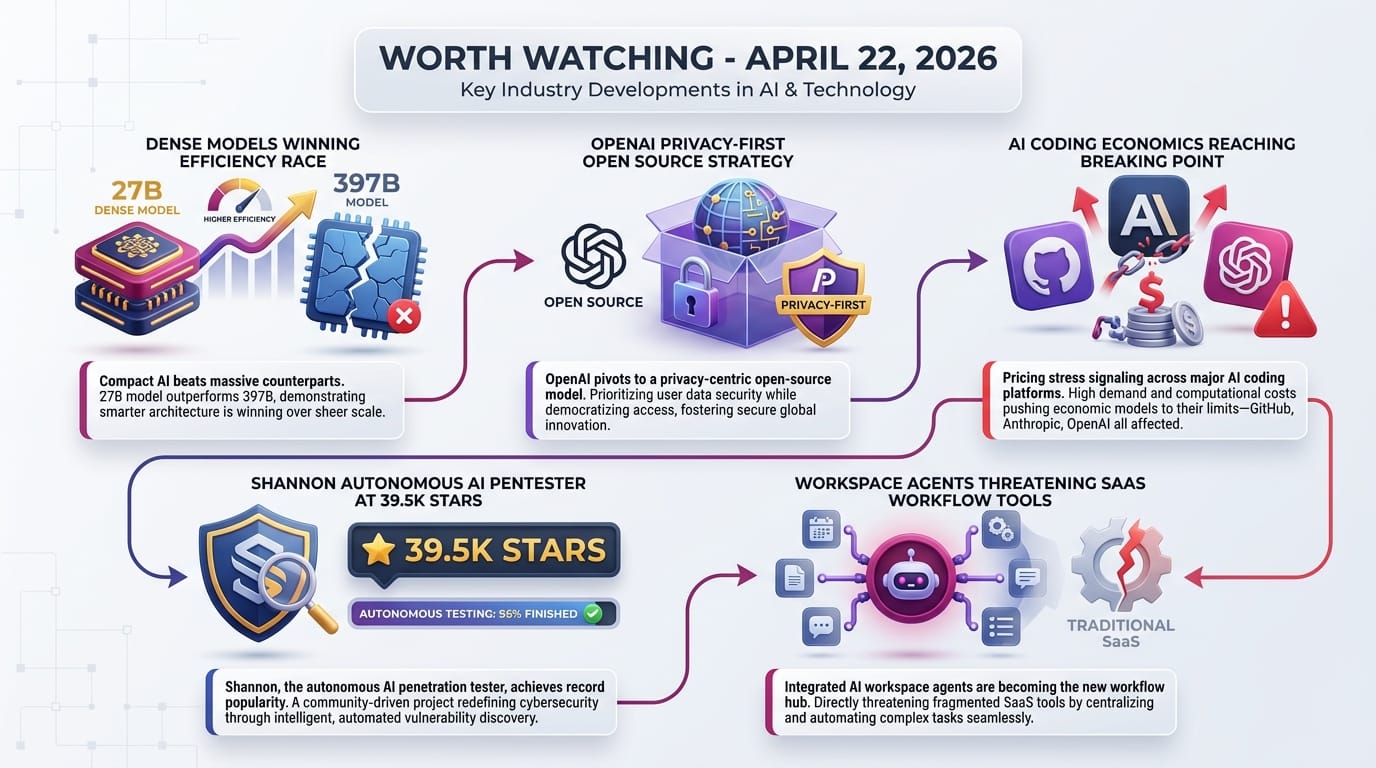
Dense Models Are Quietly Winning the Efficiency Race
Why this is worth watching right now: the assumption that bigger-is-better in AI just took its biggest hit yet.

Qwen3.6-27B beating the 397B model isn't an anomaly - it's a trend. Dense architectures with better training data and techniques are closing the gap with massive mixture-of-experts models. If this continues, the compute requirements for frontier-quality AI could drop by an order of magnitude within a year. For ordinary people, this means AI tools that today require expensive cloud subscriptions could run on your phone.

02
OpenAI's Privacy-First Open-Source Strategy
Why this is worth watching right now: the company most criticized for data handling just released a free tool to protect data from AI systems - including its own.

The Privacy Filter release is philosophically unusual for OpenAI. By open-sourcing a tool that makes it easier to not send data to their servers, they're betting that removing friction around privacy will grow the overall market more than it cannibalizes their data advantage. Watch whether Anthropic and Google follow with competing privacy tools.

03
AI Coding Economics Are Reaching a Breaking Point
Why this is worth watching right now: three separate AI coding providers signaled pricing stress in a single week.

GitHub paused signups. Anthropic tested $100/month pricing. Opus 4.7's tokenizer quietly inflated costs. The pattern suggests the current model - cheap subscriptions subsidized by VC funding - is unsustainable for agentic workloads. Something has to give: either prices rise significantly, usage gets rationed, or a new pricing model emerges. This will reshape how developers choose and use AI tools in the coming months.

04
Shannon: An AI That Hacks Websites to Prove They're Vulnerable
Why this is worth watching right now: autonomous security testing just went open-source, and it uses Claude as its brain.

Shannon Lite (39.5K stars) is a fully autonomous AI pentester that analyzes source code, identifies attack vectors, and executes real exploits - no human guidance needed. Its "no exploit, no report" policy means it only flags vulnerabilities it can actually prove. If this approach scales, security testing could shift from expensive human consultants to automated, continuous scanning.

05
Workspace Agents Could Kill the SaaS Workflow Tool Market
Why this is worth watching right now: building a simple automation used to require Zapier, Make, or a custom integration - now it's a paragraph in ChatGPT.

OpenAI's workspace agents let non-technical teams build and share AI-powered workflows by describing them in plain language. If these agents get good enough, the entire category of simple workflow automation tools faces disruption. The free preview period until May 6 will generate millions of test automations - watch which categories of paid tools see the fastest user migration.

Top Repos Today
Rank yesterday: Holding steady ➡
Stars today: +932  ·  📦 Total: 54,398
📜 License: GPL-3.0  ·  👤 By: Individual developer
🎯 Time to value: 15 minutes
What it is: An AI-powered trend monitoring dashboard that aggregates hot topics from 11+ platforms (Zhihu, Douyin, Bilibili, Weibo, Baidu, and more). It uses AI to filter, translate, and analyze trending content, then pushes alerts through nine notification channels including WeChat, Telegram, and email. Why you'd want it: If you track public sentiment, competitive intelligence, or trending topics across Chinese and international platforms, this automates the monitoring and delivers AI-analyzed briefs to your phone.
✓ Pros✗ Cons
Covers 11+ platforms with unified dashboardPrimarily focused on Chinese platforms
AI filtering removes irrelevant noiseRequires Docker or self-hosting
Nine notification channel optionsConfiguration can be complex for beginners
GitHub - sansan0/TrendRadar: ⭐AI-driven public opinion & trend monitor with multi-platform aggregation, RSS, and smart alerts.🎯 告别信息过载,你的 AI 舆情监控助手与热点筛选工具!聚合多平台热点 + RSS 订阅,支持关键词精准筛选。AI 智能筛选新闻 + AI 翻译 + AI 分析简报直推手机,也支持接入 MCP 架构,赋能 AI 自然语言对话分析、情感洞察与趋势预测等。支持 Docker ,数据本地/云端自持。集成微信/飞书/钉钉/Telegram/邮件/ntfy/bark/slack 等渠道智能推送。
⭐AI-driven public opinion & trend monitor with multi-platform aggregation, RSS, and smart alerts.🎯 告别信息过载,你的 AI 舆情监控助手与热点筛选工具!聚合多平台热点 + RSS 订阅,支持关键词精准筛选。AI 智能筛选新闻 + AI 翻译 + AI 分析简报直推手机,也支持接入…
Rank yesterday: New entry 🆕
Stars today: +873  ·  📦 Total: 7,458
📜 License: MIT  ·  👤 By: Zilliz (company)
🎯 Time to value: 5 minutes
What it is: An MCP (Model Context Protocol) plugin that gives AI coding agents semantic search across entire codebases. Instead of loading full file directories into context, it uses vector databases and hybrid search (BM25 + dense vectors) to find only the relevant code. Why you'd want it: Cuts token usage by roughly 40% when using Claude Code or similar tools on large codebases. Indexes incrementally so re-indexing is fast after small changes.
✓ Pros✗ Cons
40% token reduction for large codebasesRequires Zilliz Cloud or Milvus setup
Incremental Merkle tree indexingOpenAI API key needed for embeddings
Works with Claude Code, Cursor, ClineNew project with rapidly evolving API
GitHub - zilliztech/claude-context: Code search MCP for Claude Code. Make entire codebase the context for any coding agent.
Code search MCP for Claude Code. Make entire codebase the context for any coding agent. - zilliztech/claude-context
Rank yesterday: Rising ↑
Stars today: +770  ·  📦 Total: 17,501
📜 License: MIT  ·  👤 By: Academic (HKU)
🎯 Time to value: 20 minutes
What it is: A comprehensive retrieval-augmented generation framework that processes multimodal documents - PDFs, Office files, images with tables, equations, and charts. It builds knowledge graphs from the content and retrieves across text and visual modalities. Why you'd want it: If you need to ask questions about documents containing diagrams, tables, or math, this handles the multimodal extraction that basic RAG tools miss.
✓ Pros✗ Cons
Handles tables, equations, images nativelyResource-intensive for large document sets
Multiple parser options (MinerU, Docling)Academic project - production readiness varies
Knowledge graph construction built-inSetup requires multiple dependencies
GitHub - HKUDS/RAG-Anything: “RAG-Anything: All-in-One RAG Framework”
“RAG-Anything: All-in-One RAG Framework”. Contribute to HKUDS/RAG-Anything development by creating an account on GitHub.
Rank yesterday: Rising ↑
Stars today: +1,737  ·  📦 Total: 13,027
📜 License: Not specified  ·  👤 By: Company
🎯 Time to value: 10 minutes
What it is: A modern finance terminal offering market analytics, investment research, and economic data tools. Aims to be an open alternative to Bloomberg Terminal for individual investors and researchers. Why you'd want it: Free access to financial analytics that typically costs $24,000/year from Bloomberg. Useful for investment research, market monitoring, and economic data analysis.
✓ Pros✗ Cons
Free alternative to expensive terminalsLess data coverage than Bloomberg
Modern interface and analyticsLicense terms unclear
Active development with strong momentumPython-based, requires installation
GitHub - Fincept-Corporation/FinceptTerminal: FinceptTerminal is a modern finance application offering advanced market analytics, investment research, and economic data tools, designed for interactive exploration and data-driven decision-making in a user-friendly environment.
FinceptTerminal is a modern finance application offering advanced market analytics, investment research, and economic data tools, designed for interactive exploration and data-driven decision-makin…
Rank yesterday: Holding steady ➡
Stars today: +551  ·  📦 Total: 49,357
📜 License: MIT  ·  👤 By: Community project
🎯 Time to value: 30 minutes
What it is: A WiFi sensing platform that turns radio signals into human pose estimation, vital sign monitoring, and presence detection. Uses $9 ESP32 sensors to detect people through walls, measure breathing (6-30 BPM) and heart rate (40-120 BPM), and track 17-point body poses. Why you'd want it: Privacy-first human sensing for smart homes, elderly care, or security - no cameras needed. Detects activity through walls using hardware that costs less than a fast-food meal.
✓ Pros✗ Cons
No cameras - pure radio signal sensingAccuracy varies by environment
$9 hardware per sensorRequires training period for new spaces
Through-wall detection capabilityComplex calibration for multi-person
GitHub - ruvnet/RuView: π RuView: WiFi DensePose turns commodity WiFi signals into real-time human pose estimation, vital sign monitoring, and presence detection — all without a single pixel of video.
π RuView: WiFi DensePose turns commodity WiFi signals into real-time human pose estimation, vital sign monitoring, and presence detection — all without a single pixel of video. - ruvnet/RuView
Rank yesterday: Holding steady ➡
Stars today: +346  ·  📦 Total: 39,534
📜 License: AGPL-3.0  ·  👤 By: Company (Keygraph)
🎯 Time to value: 15 minutes
What it is: An autonomous AI pentester that analyzes web application source code to find vulnerabilities, then executes real exploits to prove they're exploitable. Five-phase process: pre-recon, recon, vulnerability analysis, exploitation, and reporting. Powered by Claude AI. Why you'd want it: Automated security testing with proof-of-concept exploits - not just theoretical warnings. "No exploit, no report" policy means zero false positive noise.
✓ Pros✗ Cons
Autonomous end-to-end pentestingAGPL license limits commercial use
Working PoC exploits, not just alertsRequires Claude API access
Covers OWASP top vulnerabilitiesLite version has limited scope vs Pro
GitHub - KeygraphHQ/shannon: Shannon Lite is an autonomous, white-box AI pentester for web applications and APIs. It analyzes your source code, identifies attack vectors, and executes real exploits to prove vulnerabilities before they reach production.
Shannon Lite is an autonomous, white-box AI pentester for web applications and APIs. It analyzes your source code, identifies attack vectors, and executes real exploits to prove vulnerabilities bef…
Rank yesterday: New entry 🆕
Stars today: +237  ·  📦 Total: 5,498
📜 License: Apache 2.0  ·  👤 By: AIDC-AI (organization)
🎯 Time to value: 20 minutes
What it is: A fully automated short video engine. Input a topic and it generates the script, AI images/video, voice narration, background music, and final edited video. Supports digital human avatars and voice cloning. Why you'd want it: Creates complete short-form videos from a single topic prompt. Useful for content creators, marketers, and educators who need video at scale.
✓ Pros✗ Cons
End-to-end video from one promptQuality varies by topic complexity
Multiple LLM and image model supportRequires Graphics Processing Unit (GPU) for local generation
Digital human avatars includedChinese documentation primarily
GitHub - AIDC-AI/Pixelle-Video: 🚀 AI 全自动短视频引擎 | AI Fully Automated Short Video Engine
🚀 AI 全自动短视频引擎 | AI Fully Automated Short Video Engine - AIDC-AI/Pixelle-Video
Rank yesterday: Rising ↑
Stars today: +609  ·  📦 Total: 12,134
📜 License: Apache 2.0  ·  👤 By: Company
🎯 Time to value: 30 minutes
What it is: A unified metadata platform for data discovery, observability, and governance. Catalogs databases, pipelines, dashboards, and ML models in one searchable interface with lineage tracking. Why you'd want it: If your organization has data sprawl across multiple systems, this provides a single place to find, understand, and trust your data assets.
✓ Pros✗ Cons
Unified catalog for all data assetsEnterprise-scale setup complexity
Built-in data quality monitoringRequires dedicated infrastructure
Active community and regular updatesLearning curve for full feature set
GitHub - open-metadata/OpenMetadata: OpenMetadata is a unified metadata platform for data discovery, data observability, and data governance powered by a central metadata repository, in-depth column level lineage, and seamless team collaboration.
OpenMetadata is a unified metadata platform for data discovery, data observability, and data governance powered by a central metadata repository, in-depth column level lineage, and seamless team co…
Top Models Today
The reigning open-source coding champion gets even more popular as developers discover its efficiency.
📥 Downloads (30d): 583K  ·  📜 License: Apache 2.0
👤 By: Alibaba/Qwen  ·  🎯 Task: Image-Text-to-Text
📐 Size: 36B (3B active)
What it is: A mixture-of-experts model with 35 billion total parameters but only 3 billion active per query. Handles text, images, and video. Competitive with cloud models when paired with the right scaffolding. Why you'd want it: Maximum capability with minimum compute - only 3B parameters activate per query, so it runs fast even on modest hardware while maintaining strong coding and reasoning performance.
✓ Pros✗ Cons
Only 3B active params per queryMixture of Experts (MoE) architecture can be unpredictable
Multimodal (text + vision)Requires scaffold for best results
Apache 2.0, no restrictionsLarge total download size
Qwen/Qwen3.6-35B-A3B · Hugging Face
We’re on a journey to advance and democratize artificial intelligence through open source and open science.
1 trillion parameters, open-source, matching Opus 4.7 on coding - the Chinese lab that keeps punching above its weight.
📥 Downloads (30d): 54.5K  ·  📜 License: Open
👤 By: Moonshot AI  ·  🎯 Task: Image-Text-to-Text
📐 Size: 1.1T
What it is: A 1-trillion parameter model that matches Claude Opus 4.7 and GPT-5.4 on coding and reasoning benchmarks at $0.60 per million tokens. Why you'd want it: Frontier-quality AI at a fraction of the price. If you need top-tier performance and can self-host or use their API, this offers massive cost savings.
✓ Pros✗ Cons
Matches frontier models on coding1.1T parameters requires serious hardware
$0.60/M tokens via APINewer model with less ecosystem support
Open weights for researchChinese company - data residency concerns
moonshotai/Kimi-K2.6 · Hugging Face
We’re on a journey to advance and democratize artificial intelligence through open source and open science.
The community-optimized version for running on consumer hardware.
📥 Downloads (30d): 1.11M  ·  📜 License: Apache 2.0
👤 By: Unsloth (community)  ·  🎯 Task: Image-Text-to-Text
📐 Size: 35B
What it is: Quantized GGUF version of Qwen3.6-35B-A3B optimized for llama.cpp and local deployment. Multiple quantization levels available for different hardware capabilities. Why you'd want it: The fastest path from "I heard about this model" to running it on your own machine. Over 1 million downloads shows massive community adoption.
✓ Pros✗ Cons
1.11M downloads - battle-testedQuantization reduces quality slightly
Multiple quant levels availableRequires llama.cpp knowledge
Runs on consumer GPUsLarge download even when quantized
unsloth/Qwen3.6-35B-A3B-GGUF · Hugging Face
We’re on a journey to advance and democratize artificial intelligence through open source and open science.
Type a description, get a playable 3D world - Tencent's world model just jumped from videos to actual game assets.
📥 Downloads (30d): 548  ·  📜 License: Open
👤 By: Tencent  ·  🎯 Task: Image-to-3D
📐 Size: ~1.2B
What it is: A multi-modal world model that generates actual 3D assets (meshes, Gaussian splats, point clouds) from text, images, or video. Outputs drop directly into Blender, Unity, and Unreal Engine. Why you'd want it: Previous "world models" generated videos. This one generates editable 3D worlds you can actually use in game engines and 3D applications.
✓ Pros✗ Cons
Real 3D assets, not just videoEarly stage - quality varies
Direct export to game enginesRequires significant GPU power
Open-sourced with full pipelineComplex multi-stage setup
tencent/HY-World-2.0 · Hugging Face
We’re on a journey to advance and democratize artificial intelligence through open source and open science.
Today's big release - flagship coding in a model small enough for your laptop.
📥 Downloads (30d): 393  ·  📜 License: Apache 2.0
👤 By: Alibaba/Qwen  ·  🎯 Task: Image-Text-to-Text
📐 Size: 28B
What it is: A 27B dense model that outperforms the previous 397B flagship on all coding benchmarks. Supports text, image, and video with 262K context. Why you'd want it: The best open-source coding model relative to its size. At 16.8GB quantized, it runs on a MacBook Pro.
✓ Pros✗ Cons
Beats 397B model on codingJust released - ecosystem still forming
262K native context window55.6GB unquantized
Vision + text + videoDense model uses more compute than MoE
Qwen/Qwen3.6-27B · Hugging Face
We’re on a journey to advance and democratize artificial intelligence through open source and open science.
OpenAI's first major open-source model release in months - and it's about protecting your data, not generating content.
📥 Downloads (30d): 3  ·  📜 License: Apache 2.0
👤 By: OpenAI  ·  🎯 Task: Token Classification
📐 Size: 1B
What it is: A bidirectional token classifier that detects eight categories of personally identifiable information. Runs on a laptop or in a browser. Why you'd want it: Drop it into any AI pipeline as a pre-processing step to automatically scrub names, emails, phone numbers, and API keys before data leaves your system.
✓ Pros✗ Cons
96% F1 accuracy out of the boxOnly 8 PII categories currently
Runs in browser - no server needed"Redaction aid, not safety guarantee"
Apache 2.0, fully openBrand new - just 3 downloads so far
openai/privacy-filter · Hugging Face
We’re on a journey to advance and democratize artificial intelligence through open source and open science.
China's answer to GPT-5 - a 754B model from Zhipu AI that quietly appeared on HuggingFace.
📥 Downloads (30d): 171K  ·  📜 License: Open
👤 By: Zhipu AI  ·  🎯 Task: Text Generation
📐 Size: 754B
What it is: A massive 754-billion parameter text generation model from Zhipu AI (the company behind ChatGLM). One of the largest openly available models. Why you'd want it: If you need maximum reasoning capability and have the infrastructure to run 754B parameters, this competes at the frontier tier.
✓ Pros✗ Cons
754B parameters - frontier scaleRequires enterprise-grade hardware
171K downloads show real adoptionLimited English documentation
Open weights for researchChinese-primary training data
zai-org/GLM-5.1 · Hugging Face
We’re on a journey to advance and democratize artificial intelligence through open source and open science.
A community mod of Google's Gemma 4 with safety guardrails removed.
📥 Downloads (30d): 79K  ·  📜 License: Gemma
👤 By: Community  ·  🎯 Task: Text Generation
📐 Size: 8B
What it is: A modified version of Google's Gemma 4 E4B model with abliterated (removed) safety training, allowing uncensored outputs. Why you'd want it: Researchers and developers who need unrestricted model outputs for testing, red-teaming, or applications where safety filters interfere with legitimate use cases.
✓ Pros✗ Cons
Unrestricted outputs for researchNo safety guardrails whatsoever
Small 8B size, runs anywhereGemma license restrictions apply
79K downloads - community vettedNot suitable for production deployment
OBLITERATUS/gemma-4-E4B-it-OBLITERATED · Hugging Face
We’re on a journey to advance and democratize artificial intelligence through open source and open science.
AI Launches Today
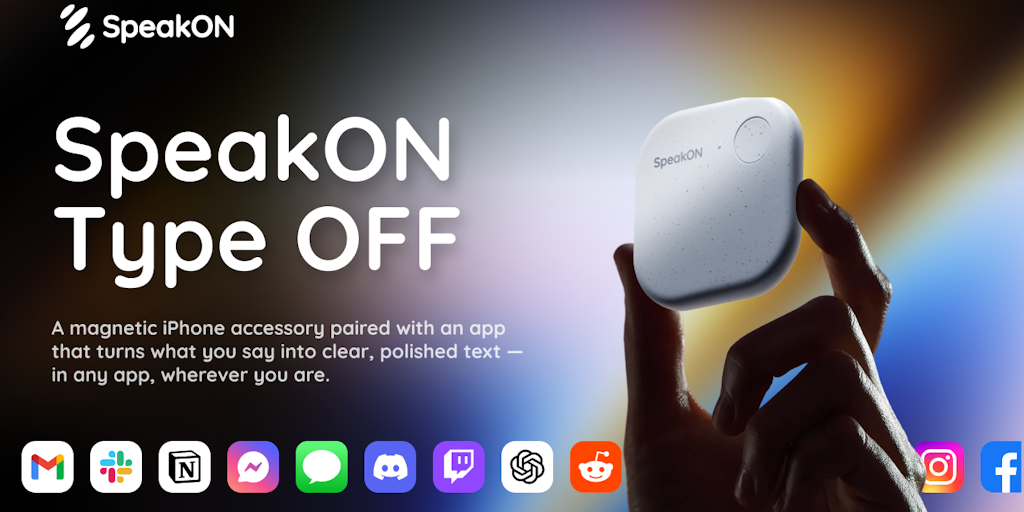
A MagSafe AI device for a post-keyboard world
🔥 Upvotes: 317  ·  👤 By: SpeakON team
💰 Pricing: Not specified  ·  🏷 Category: AI Wearables
A MagSafe voice input device that eliminates typing by allowing speech input directly into any app. Functions even when your phone is locked. Represents the hardware side of the AI input revolution - voice as the primary interface. Verdict: Interesting hardware play, but voice input still struggles in noisy environments and public spaces.
SpeakON: A MagSafe AI device for a post-keyboard world | Product Hunt
Typing is the bottleneck. SpeakON removes it. A MagSafe AI device for iPhone — press once to speak into any app. No mic permission. No switching. Even works with your phone locked. Zero friction.
First image model with thinking capabilities
🔥 Upvotes: 285  ·  👤 By: OpenAI
💰 Pricing: Included with ChatGPT Plus  ·  🏷 Category: AI Generative Media
OpenAI's reasoning-powered image generation with improved text rendering, flexible aspect ratios, and up to 8 images per prompt at 2K resolution. Verdict: The reasoning layer genuinely improves text-in-images - a persistent weakness of AI image generation.
ChatGPT Images 2.0 | First image model with thinking capabilities | Product Hunt
AI image generation with a thinking layer. Create, refine, and validate visuals in one flow. Supports flexible aspect ratios and multiple outputs per prompt, making it easier to go from idea to production-ready assets fast.
Complete backend with auth and storage in one prompt
🔥 Upvotes: 247  ·  👤 By: InstantDB team
💰 Pricing: Open source  ·  🏷 Category: Developer Tools
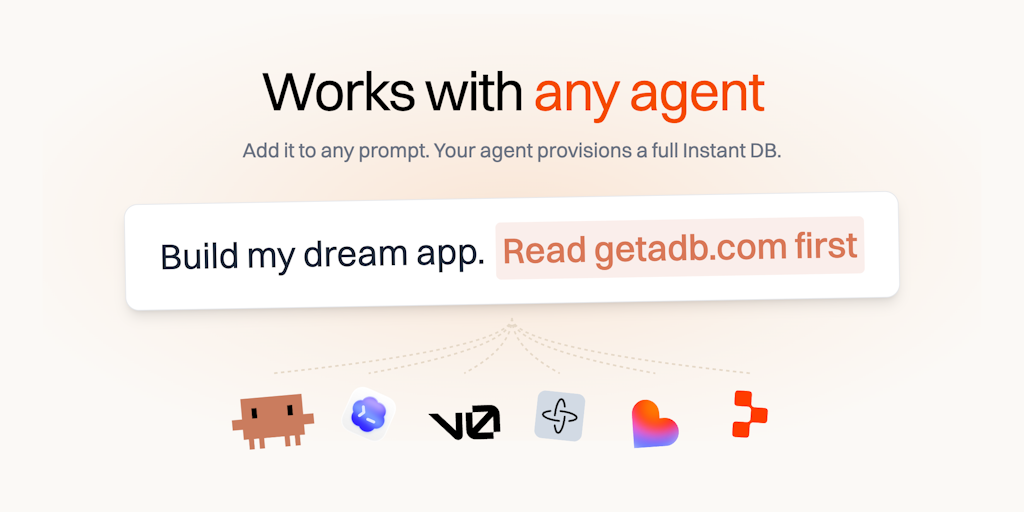
An open-source full-stack app builder that generates authentication, permissions, storage, and real-time features from a single AI prompt. Verdict: Compelling for prototyping, but production deployment requires careful security review of AI-generated auth code.
Complete backend with auth and storage in one prompt - InstantDB | Product Hunt
Instant turns your favorite AI into a full-stack app builder. You get auth, permissions, storage, presence, and streams — everything you need to ship apps your users will love. Free to use, 100% open source. and works well for both vibe coding and production apps! You can get started by simply running `npx create-instant-app` in the terminal or just add “Read getadb.com first” to any prompt
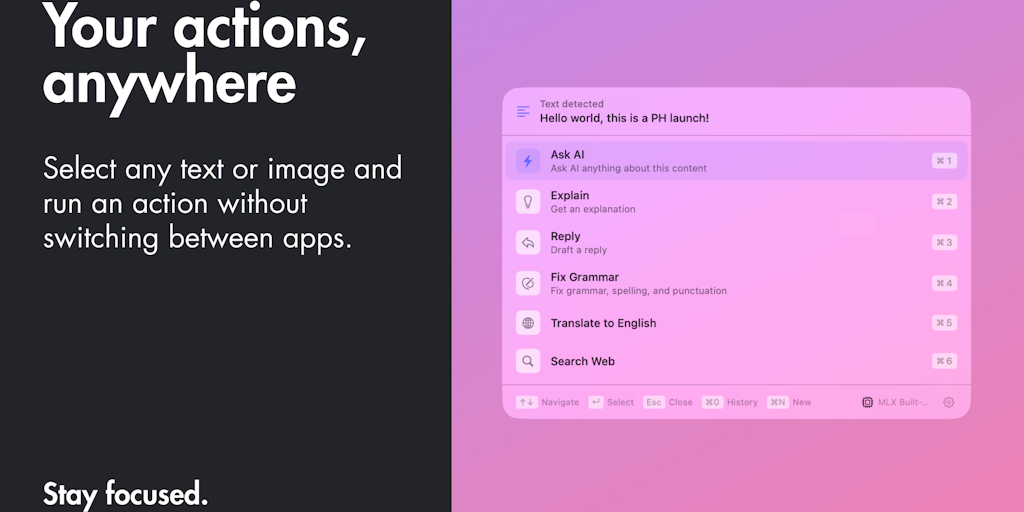
Press ⌥C on anything to run smart actions, locally
🔥 Upvotes: 135  ·  👤 By: Cai team
💰 Pricing: Not specified  ·  🏷 Category: AI Workflow Automation
A local AI tool that executes custom prompts and automation through a keyboard shortcut, with no cloud dependency or data collection. Press Option+C on any selected text, image, or file to run custom AI actions. Verdict: The local-first approach is smart for privacy-conscious users, and the keyboard shortcut UX is elegant.
Press ⌥C on anything to run smart actions, locally | Cai | Product Hunt
Press ⌥C on anything to run smart actions: AI prompts, shell scripts, GitHub issues, Linear tickets, or send results anywhere... All one keystroke away. Bring your own brain: bundled Ministral 3B for zero-setup local AI, any HuggingFace MLX model for Apple Silicon speed, or connect Ollama, LM Studio, Apple Intelligence, or OpenRouter. Free, MIT licensed. No cloud, no account, no telemetry.
Snapshot
ProviderModelInput $/1MOutput $/1MContext
AnthropicOpus 4.7$5.00$25.00200K
AnthropicSonnet 4.6$3.00$15.00200K
AnthropicHaiku 4.5$1.00$5.00200K
GoogleGemini 3.1 Pro$2.00$12.00200K
GoogleGemini 2.5 Pro$1.25$10.001M
GoogleGemini 2.5 Flash-Lite$0.10$0.401M
OpenAIGPT-5.4$2.50$15.00200K
GroqLlama 3.3 70B$0.59$0.79128K
GroqLlama 3.1 8B$0.05$0.08128K
MoonshotKimi K2.6$0.60$0.60256K
What this means: The pricing gap between frontier models ($5-25/M output) and "good enough" open-source models via Groq ($0.08-0.79/M output) is now 30-300x. Google's Gemini 2.5 Flash-Lite at $0.10/$0.40 is the cheapest branded option. The Kimi K2.6 at $0.60 flat is remarkable for a model matching Opus 4.7 on benchmarks. Both Anthropic and OpenAI offer 50% batch API discounts, and prompt caching can reduce effective costs by up to 90%.

Self-Routing: Parameter-Free Expert Routing from Hidden States
Jama Hussein Mohamud, Drew Wagner, Mirco Ravanelli · arXiv:2604.00421
What it claims: A new method for routing inputs to different expert sub-networks in mixture-of-experts models without any additional trainable parameters. The routing decision is made directly from the model's hidden states.

Key finding: Eliminates the router network entirely while matching or exceeding standard routing performance - removing a key source of training instability in MoE architectures.

Why practitioners should care: MoE models like Qwen3.6-35B-A3B are becoming the default architecture for efficient AI. Removing the router network simplifies training, reduces parameters, and could make these models even cheaper to develop and deploy.
Subscribe to GenAI Secret Sauce newsletter and stay updated.

Don't miss anything. Get all the latest posts delivered straight to your inbox. It's free!
Great! Check your inbox and click the link to confirm your subscription.
Error! Please enter a valid email address!