GenAI Secret Sauce Daily Digest - 2026-04-17

Anthropic Launches Claude Design - and the Design Software Market Drops · Canva AI 2.0: From Design Tool to AI Platform · DeepSeek Seeks $300M at $10B Valuation - Its First Outside Funding Ever
GenAI Secret Sauce Daily Digest - 2026-04-17

Watch today's digest as a video summary (generated by NotebookLM)

Statistically Speaking

1.36 x, Python 1
Opus 4.7 Day 2
10 x easier to hack than closed
Cal.com Goes Closed Source - and the Evidence Behind the Dec
21,639 instances)
Cal.com Goes Closed Source - and the Evidence Behind the Dec

One Thing to Tell Your Friends

The company that trained its breakthrough AI model for $6 million now needs $300 million just to keep the servers running - DeepSeek's first-ever fundraise proves that making AI is cheap, but serving it is not.

TL;DR

Trends
AI Is Coming for Design Software, The Hidden Economics of AI Model Upgrades, and The Local AI Compression Race Heats Up.
Creative AI
NVIDIA Nemotron Optical Character Recognition (OCR) v2: 28.9x Faster Than PaddleOCR and Artlist Studio: AI.
Research
Qwen3.6-35B, Ternary Bonsai: Impressive Numbers, Skeptical Community, and Claude Opus 4.7 Benchmark Summary.
Surprising
Your AI Context Is a Professional Asset, A Shoe Company's AI Pivot Moved Its Stock 600%, and AI Regulation Is Crumbling State by State.
Worth Watching
AI Agents That Spend Real Money, Compute Pricing Is Signaling a Crunch, and The Anthropic Labs Incubator Model.
GitHub
Leading repos: obra/superpowers (+1,645), google/magika (+949), and Lordog/dive-into (+949).
HuggingFace
Leading models: MiniMaxAI/MiniMax (188,737), Qwen/Qwen3.6-35B (21,180), and Tencent/HY-Embodied (1,287).
Product Hunt
Top launches: Claude Opus 4.7 (398), Canva AI 2.0 (151), and Arky (120).
API Pricing
What this means: Claude Opus 4.7 and Gemini 3.1 Pro Preview both offer 1M token context at $5 and $2 input respectively, but the tokenizer analysis in today's Top Stories reveals Opus 4.7's effective cost is 20-30% higher than sticker price due to token inflation.
arXiv
Agent Psychometrics: Task — AUC-ROC (Area Under the Receiver Operating Characteristic Curve) of 0.936 for predicting pass/fail on unseen LLM-scaffold combinations on SWE-bench Verified, tested across 4 benchmarks, 38 LLMs, and 112 configurations.

Hot off the Presses

01

Anthropic Launches Claude Design - and the Design Software Market Drops

What this means for you: If you are a founder, product manager, or marketer who spends days going back and forth with designers on mockups and slide decks, you can now produce polished prototypes through a text conversation - no design skills needed.

Previously: April 16 - Claude Opus 4.7 launched with improved vision and reasoning capabilities.

Anthropic unveiled Claude Design under a new "Anthropic Labs" experimental product banner. The tool generates interactive prototypes, presentation slides, one-pagers, and marketing materials from natural language prompts. It reads your codebase and existing design files to build a consistent design system automatically - so every output matches your brand colors, typography, and component patterns.

Available now as a research preview for Claude Pro, Max, Team, and Enterprise subscribers.

“Figma stock has dropped more than 80% from its post-IPO high”
  • The market reaction was immediate - Figma dropped 4.26% (intraday low of 7.28%), Adobe fell 2.7%, Wix dropped 4.7%, and GoDaddy declined 3%. Figma is now down more than 80% from its post-IPO high.
  • Mike Krieger's board exit - Anthropic's Chief Product Officer (CPO) and Instagram co-founder stepped down from Figma's board days before the launch, adding to the competitive narrative.
  • Export flexibility - Outputs go to PDF, PowerPoint (PPTX), standalone HTML, internal URLs, or Canva. Designs can also be packaged into handoff bundles for implementation via Claude Code.
  • Who it's for - Anthropic positions it as complementary to Figma, targeting non-designers. But the stock market disagrees.
02

Canva AI 2.0: From Design Tool to AI Platform

What this means for you: If your team uses Canva for visual content, the tool now connects to your Slack, Gmail, Zoom transcripts, and calendar - meaning it can pull in meeting notes and automatically turn them into branded presentations without you starting from scratch.

Canva unveiled AI 2.0 at Canva Create 2026, restructuring around four pillars: Conversational Design (generate fully editable layouts from text), Agentic Orchestration (coordinate multi-step workflows across tools), Object-Based Intelligence (edit individual design elements without regenerating everything), and Living Memory (remember your style preferences across sessions).

The same-day timing with Claude Design is striking. Two companies from opposite ends of the market - one an AI lab, one a design platform - both concluded that AI-native visual creation is the next battleground.

  • Connected workspace - Canva now integrates with Slack, Notion, Zoom, Gmail, Google Drive, and Google Calendar, pulling external context into design workflows automatically.
  • Speed claims - Canva says its proprietary models are up to 7x faster and 30x cheaper than comparable frontier AI alternatives.
  • Rolling access - Available as a research preview to the first 1 million users, with broader availability planned in coming weeks.
  • The pivot in one sentence - COO Cliff Obrecht: "We are now an AI platform with design tools, rather than a design platform with AI tools."
03

DeepSeek Seeks $300M at $10B Valuation - Its First Outside Funding Ever

What this means for you: If you have been using DeepSeek's Application Programming Interface (API) because it is dramatically cheaper than competitors, this fundraise is about keeping those servers running as demand surges - watch for pricing or rate-limit changes as the company scales.

DeepSeek is in talks to raise at least $300 million at a valuation exceeding $10 billion, marking the first time the Chinese AI startup has accepted external money. Until now, it was entirely funded by its parent company High-Flyer Capital Management, a quantitative hedge fund that posted roughly 56.6% returns in 2025.

“Training cost $6 million. Serving costs $300 million and counting.”
  • Why now - Surging demand for DeepSeek's models and API services has strained infrastructure, causing frequent outages. Training was cheap ($5.6-6 million for R1 using older Nvidia H800 chips); serving millions of users is not.
  • Who's investing - Domestic Chinese investors are expected as primary participants, since U.S. venture firms face regulatory and national security restrictions.
  • The efficiency thesis, tested - DeepSeek proved you can train frontier models cheaply. This fundraise proves that inference at scale is a fundamentally different cost problem.
04

Opus 4.7 Day 2: The Hidden Cost Nobody Advertised

What this means for you: If you are paying for Claude API access, your actual costs may be 20-30% higher than the sticker price suggests - run a side-by-side token comparison on your real workloads before migrating from 4.6.

Previously: April 16 - Opus 4.7 launched at the same $5/$25 per million token pricing as 4.6, with benchmark gains on coding and vision but community concerns about long-context regression.

Today: Independent testing reveals the new tokenizer inflates token counts well beyond Anthropic's documented 1.0-1.35x range. Abhishek Ray's analysis, which hit 501 points on Hacker News, found that technical documentation inflated 1.47x and TypeScript code 1.36x. A typical 80-turn Claude Code session jumped from $6.65 to $7.86-$8.76 - a 20-30% real cost increase with identical sticker prices.

Tokenizer analysis: HN . Boris Cherny tips

  • Code gets hit hardest - TypeScript inflated 1.36x, Python 1.29x, while plain English only increased 1.20x and CJK text barely changed at 1.01x.
  • Cache dynamics degraded - Sessions consume tokens faster, burning through cached prefixes more quickly and hitting rate limits sooner. Cold starts now cost roughly 30% more.
  • The workflow breakage debate - A post with 277 upvotes on r/ClaudeAI reports Opus 4.7 interprets instructions so literally that existing production prompts break. An AMD senior director publicly stated Claude has "regressed to the point it cannot be trusted to perform complex engineering."
  • The other side - Boris Cherny, Claude Code's creator, shared six tips for maximizing Opus 4.7, emphasizing that Auto Mode, effort levels, and verification workflows unlock the model's improvements. Third-party validation from Cursor (+12 points), Notion (+14%, one-third fewer tool errors), and Rakuten (3x more tasks resolved) is strong.
05

Cal.com Goes Closed Source - and the Evidence Behind the Decision Does Not Hold Up

What this means for you: If you rely on an open-source project for a critical business function, this is a reminder that "open-source" can be revoked overnight. Check whether your dependencies have contributor license agreements (CLAs) that allow relicensing.

Cal.com, a 30,000-star scheduling platform handling healthcare bookings and financial data, closed its source code on April 15, releasing Cal.diy as an MIT-licensed fork with authentication and billing systems stripped out. The trigger was a January exploit chain where three chained access control vulnerabilities allowed complete account takeover of any user.

  • The dubious claim - CEO Bailey Pumfleet cited a stat that "open-source software is 5-10x easier to hack than closed-source," attributed to Hex Security, a Y Combinator Winter 2026 startup. No peer-reviewed study supports this number.
  • The counter-example - OpenClaw faced a worse incident (CVE-2026-25253, one-click remote code execution across 21,639 instances). Instead of closing source, they hardened through Docker sandbox isolation and allow-lists.
  • The obsolescence argument - GPT-5.4-Cyber can now analyze compiled binaries for vulnerabilities without source code, undermining the "hide the code" security rationale.
  • Y Combinator CEO Garry Tan endorsed OpenClaw's approach publicly.

Trends & Themes

Trends & Themes

AI Is Coming for Design Software - From Both Sides

Why this matters to you: The tools you use to create visual content - slides, mockups, marketing materials - are being rebuilt from scratch by AI companies and design companies simultaneously, which means prices will drop and capabilities will explode over the next 12 months.

The converging moves suggest a new category is forming: AI-native visual creation, where the starting point is a conversation rather than a blank canvas. The question is whether professional designers adopt these tools as accelerators or reject them as threats to craft. The stock market has already picked a side.

Anthropic . Canva . r/ClaudeAI

  • Claude Design entered the market from the AI side, turning text prompts into interactive prototypes with automatic brand system integration.
  • Canva AI 2.0 entered from the design side, adding agentic orchestration and persistent memory to an existing 200-million-user platform.
  • Figma, Adobe, Wix, and GoDaddy all dropped on the same day - the market views both launches as existential threats to traditional design software.

The Hidden Economics of AI Model Upgrades

Why this matters to you: When an AI company says "same price," look at the tokenizer - the real cost of an upgrade can be 20-30% higher than the sticker price, and your existing cached data may need to be rebuilt from scratch.

The pattern: AI is getting better and nominally cheaper, but the total cost of ownership - including tokenizer inflation, cache changes, and context lock-in - is rising. Users who benchmark only on sticker price are underestimating their actual spend.

Tokenizer analysis . Nate's Newsletter . Reuters on DeepSeek

  • Claude 4.7's tokenizer inflates token counts 1.2-1.47x depending on content type, meaning identical inputs cost more to process.
  • Anthropic's cache TTL change (covered April 14) shortened cache lifetime from 1 hour to 5 minutes, adding 17-32% cost inflation.
  • DeepSeek's $300M fundraise reveals that inference at scale costs 50x more than training - even for the world's most cost-efficient lab.
  • Nate's Newsletter introduces the concept of "AI capital" - six months of personalized context that vanishes when you switch tools, creating hidden switching costs that grow over time.

The Local AI Compression Race Heats Up - and the Community Is Keeping Score

Why this matters to you: AI models that once required a data center are now running on your laptop or even in your browser, but the community is getting better at separating real breakthroughs from marketing hype.

The healthy skepticism pattern is worth noting: the local LLM community now has a reliable immune system against hype. Novel compression claims generate excitement for 24 hours, then rigorous community testing either validates or deflates them.

r/LocalLLaMA . PrismML . IBM

  • Qwen3.6-35B-A3B runs at 120+ tokens per second on a single RTX 4090 despite being a 35 billion parameter model, thanks to sparse Mixture of Experts (MoE) architecture that activates only 3B parameters per token.
  • Ternary Bonsai from PrismML fits an 8B parameter model in 1.75 GB at 1.58 bits, running at 82 tokens/second on Apple M4 Pro. The 1.7B model at just 290MB runs entirely in-browser.
  • The skeptics arrived fast - A 151-upvote post argued Bonsai benchmarks are misleading because they compare against obsolete models rather than properly quantized versions of newer architectures like Gemma 4.
  • IBM Granite 4.0 uses a hybrid Mamba-2/Transformer architecture with 70% lower GPU memory requirements and 2x faster inference, all under Apache 2.0 with ISO 42001 certification.

AI Workforce Anxiety Goes Mainstream

Why this matters to you: The conversation about AI and jobs is no longer confined to tech circles - it is showing up in celebrity Instagram reels, university faculty lounges, and semiconductor company executive statements, which means it is about to shape public policy.

The AMD statement is the buried signal here. When a semiconductor executive casually states that AI was "trusted to perform complex engineering" until a model update broke it, the automation of knowledge work is further along than most people realize.

Variety . r/Professors . r/ClaudeAI

  • Reese Witherspoon told her followers that "the AI revolution has begun" and that jobs held by women are 3x more likely to be automated. Authors and creatives pushed back hard, but Kerry Washington endorsed the message.
  • An AMD senior director publicly stated Claude has "regressed to the point it cannot be trusted to perform complex engineering" - a statement that would have been impossible to imagine two years ago, because it implies AI was trusted for complex engineering until this week.
  • r/Professors continues to dominate with burnout posts - threads about students who cannot read or write, AI-generated submissions, and faculty exhaustion collectively drew over 1,000 upvotes today.

Creative AI & Media

NVIDIA Nemotron Optical Character Recognition (OCR) v2: 28.9x Faster Than PaddleOCR

What this means for you: If you process documents in multiple languages - invoices, medical records, research papers - a single model can now handle English, Chinese, Japanese, Korean, and Russian at 34.7 pages per second on one GPU, replacing language-specific tools.

HuggingFace . Try it: The model, dataset, and demo are publicly available under NVIDIA Open Model License.

  • Two variants - English-only at 54M parameters and multilingual at 84M parameters covering six languages.
  • Speed - 34.7 pages per second on an A100 GPU versus 1.2 pages/second for PaddleOCR v5.
  • Synthetic data breakthrough - Japanese error rate dropped from 0.723 to 0.046, purely through expanded synthetic training data. No architecture changes needed.
  • Adding new languages requires only source text and compatible fonts.

Artlist Studio: AI-Native Video Production

What this means for you: If you create video content and need to extend shots, fill production gaps, or add scenes without reshoots, this tool blends AI-generated footage with your real footage in a single workspace.
  • Hybrid production - Combine real footage with AI-generated scenes to extend shots or fill gaps.
  • Multi-model backend - Blends multiple AI models for faster generation and stronger visual consistency.
  • Professional focus - Built for studios and professional creators, not casual social media use.

Developer Tools & Infrastructure

Claude Code Gets Six New Tips from Its Creator

What this means for you: If you use Claude Code, enabling Auto Mode (Shift+Tab) and the /fewer-permission-prompts skill will immediately reduce the friction of constant permission prompts that interrupt long-running coding tasks.
  • Auto Mode (Shift+Tab) - Uses a model-based classifier to auto-approve safe commands and pause for risky ones.
  • /fewer-permission-prompts - Scans your session history and generates an allowlist of safe commands.
  • Effort levels - Five tiers (low through max) let you trade speed against reasoning depth. Opus 4.7 defaults to xhigh.
  • Verification emphasis - With Opus 4.7 producing 2-3x the output, Boris Cherny argues that giving Claude a way to check its own work is now more important than ever.

Hacktron: AI Pentesting at One-Third the Cost

What this means for you: If you run a startup or small team that cannot afford $20,000-$30,000 for a traditional penetration test, AI-powered security auditing is becoming accessible - Hacktron found 12 vulnerabilities in Gumroad including a critical SQL injection.
  • Agent swarms - Deploys specialized agents built on Gemini 2.5 Pro for different vulnerability classes.
  • Full pipeline - Clones repos, analyzes architecture, generates proof-of-concept exploits, creates patches, and submits pull requests.
  • $3.19M Series A - Founded by DEF CON-published researchers and top CTF competitors.
  • Currently in private beta with a free tier signup available.

Datasette 1.0a28: Built with Opus 4.7

What this means for you: Simon Willison shipped this emergency fix release using Claude Code with Opus 4.7, demonstrating that the model is already being used to build production software in its first 24 hours.
  • Emergency fix for regressions from 1.0a27, including execute_write_fn() callback compatibility.
  • New datasette.close() method for clean database shutdown.
  • Real-world dogfooding - Most changes were implemented using Claude Code with Opus 4.7.

Research & Models

Qwen3.6-35B-A3B: Community Benchmarks Confirm Day 1 Excitement

What this means for you: If you run local AI models, Qwen3.6 delivers cloud-API quality at consumer hardware speeds - 120+ tokens per second on an RTX 4090 with only 3 billion active parameters despite 35 billion total.

Previously: April 16 - Qwen3.6-35B-A3B launched with strong initial benchmarks and community excitement.

Today: Day 2 community testing has confirmed the initial hype. Multiple independent benchmarks show the model solving problems that Qwen3.5-27B could not handle. Users on older hardware like the RTX 2080 Ti (11GB VRAM) report 29 tokens per second with Q6_K_XL quantization. The consensus: this is the first local model that delivers reliability comparable to mid-tier cloud API models for coding assistance.

r/LocalLLaMA . Qwen

  • SWE-Bench Verified - 73.4% using Alibaba's internal agent scaffold (vs Gemma 4-31B at 52%).
  • Context window - Native 262K, extensible beyond 1 million tokens via YaRN scaling.
  • Known issues - Occasional reasoning loops with long contexts, tool-use inconsistencies in some workflows.
  • Apache 2.0 license - Fully open for commercial use.

Ternary Bonsai: Impressive Numbers, Skeptical Community

What this means for you: A working AI model that fits in 290MB and runs in your web browser is genuinely novel - but if you need reliable reasoning, a properly quantized Qwen3.6 or Gemma 4 will outperform it at the same memory budget.

PrismML . r/LocalLLaMA debate

  • The pitch - 1.58-bit weights put an 8B model in 1.75 GB with 82 tokens/second on M4 Pro and 3-4x better energy efficiency.
  • The counter-argument (151 upvotes on r/LocalLLaMA) - Bonsai-8B significantly underperforms Gemma-4-E2B despite having 4x more parameters. Benchmarks compare against obsolete models.
  • The real niche - Ultra-constrained edge deployment (in-browser via WebGPU, IoT devices) where even small quantized models will not fit.
  • Released under Apache 2.0 with native Apple MLX support.

Claude Opus 4.7 Benchmark Summary

What this means for you: Opus 4.7 leads on software engineering and vision tasks, ties with GPT-5.4 and Gemini 3.1 on graduate-level reasoning, but trails both on web browsing tasks - choose your model based on your primary use case.
  • SWE-bench Pro - 64.3% (GPT-5.4: 57.7%, Gemini 3.1 Pro: 54.2%)
  • CursorBench - 70% (up from 58% on Opus 4.6)
  • GPQA Diamond - 94.2% (GPT-5.4 Pro: 94.4%, Gemini 3.1 Pro: 94.3%)
  • Vision - 98.5% visual acuity (up from 54.5%), processing at 3.75 megapixels
  • BrowseComp - 79.3% (regression from 83.7%; GPT-5.4 Pro leads at 89.3%)

Business & Industry

Design Software Selloff Signals Market Shift

What this means for you: If you own stock in design or web-creation companies, the combined Claude Design and Canva AI 2.0 launches triggered a sector-wide repricing - this is not a one-day blip but a structural reassessment of what design software is worth in an AI-native world.
  • Figma - Down 4.26% (intraday low 7.28%), now more than 80% below post-IPO high.
  • Adobe - Down 2.7%.
  • Wix - Down 4.7%.
  • GoDaddy - Down 3%.

Allbirds Stock Surges 600% on AI Pivot

What this means for you: A shoe company pivoting to AI and seeing a 600% stock surge tells you more about market sentiment than about Allbirds' AI capabilities - treat this as a signal of how desperate investors are for AI exposure.

From Zvi Mowshowitz's weekly roundup: Allbirds announced an AI pivot and stock surged over 600%. The same roundup notes Meta stock rose 4-6.5% on Muse Spark launch, and compute spot pricing for Blackwell GPUs (Graphics Processing Units) surged from $2.75 to $4.08/hour in two months.

AI Healthcare Scribes Drive 30% Cost Increases Per Visit

What this means for you: If you visit a doctor and the bill seems higher, AI medical scribes are enabling more detailed billing codes that increase per-visit charges - creating an arms race where providers without AI face competitive disadvantage.

From Zvi's roundup: AI healthcare scribes are causing 30% cost increases per visit through enhanced billing complexity, not through improving care quality. The dynamic creates a compounding cost problem where adoption becomes mandatory for competitive survival.

GenAI in Education

Faculty Burnout Reaches New Highs as AI-Generated Submissions Accelerate

What this means for you: If you are a professor, administrator, or parent of a college student, the front-line experience of university faculty in April 2026 suggests the current academic model is under severe structural stress - not from AI replacing teachers, but from AI enabling a new category of student dishonesty that existing systems cannot detect.

Today's r/Professors subreddit captured the state of higher education in April 2026:

The accessibility rule delay (48 upvotes) adds another layer: web accessibility requirements for course materials have been pushed to next year, extending the compliance burden on already-stretched faculty.

  • "My students cannot read or write and I don't know what to do about it" (177 upvotes) - A professor reports fundamental skill gaps compounded by AI-generated work.
  • "I've Reached My Limit" (69 upvotes) - Faculty exhaustion from policing AI submissions while maintaining teaching quality.
  • "Example of AI run amok" (46 upvotes) - Documenting specific cases of AI-generated academic fraud.
  • "Students thought material from ChatGPT would be on the exam" (20 upvotes) - Students studying AI-generated content instead of course materials.

Surprising & Under-the-Radar

Your AI Context Is a Professional Asset - and It's Not Portable

What this means for you: Six months of training your AI assistant to understand your work style, your codebase, and your communication patterns is now worth measurable productivity - and you lose all of it when you switch tools or jobs.

Nate's Newsletter coined "AI capital" to describe the accumulated context that improves AI outputs from roughly 40% accuracy to 80% over six months of use. This context is distributed across multiple tools, locked in proprietary accounts, and governed by terms of service that allow changes at any time. The practical advice: build with open-tool architectures that let you export and port your AI context between platforms.

A Shoe Company's AI Pivot Moved Its Stock 600%

What this means for you: The Allbirds surge reveals that "AI" is functioning as a financial magic word in public markets, similar to "blockchain" in 2017 - investor demand for AI exposure is so intense that even implausible pivots get rewarded.

AI Regulation Is Crumbling State by State

What this means for you: If you were counting on state-level AI regulation to establish guardrails, two developments this week suggest the regulatory landscape is fracturing rather than solidifying.
  • xAI successfully sued Colorado to block their AI law on constitutional grounds, establishing a potential precedent for challenging state AI regulations.
  • OpenAI endorsed Illinois SB 3444, which provides liability immunity for AI companies in exchange for publishing safety protocols - which Zvi characterizes as a "get-out-of-jail-free card."

Pentagon AI Negotiator Profited from AI Stock Sales

What this means for you: Emil Michael, the Pentagon's AI negotiator, profited up to $24 million from xAI stock sales while overseeing negotiations with AI companies - the kind of conflict of interest that typically triggers congressional investigations.

Signals to Track

Worth Watching
01

AI Agents That Spend Real Money

The line between AI assistants and AI consumers is disappearing.

A live tracker called "wtf are agents buying?" monitors AI agents making actual purchases in real-time. Separately, Canva AI 2.0's agentic orchestration can now coordinate multi-step workflows including scheduling, email integration, and content creation autonomously. When AI agents have credit cards and calendar access, the definition of "commerce" changes.

What changes for ordinary people: your next coworker might be an AI agent with a corporate credit card and the authority to buy software, book meetings, and approve expenses without human oversight.

02

Compute Pricing Is Signaling a Crunch

GPU spot prices doubled in two months and nobody is talking about it.

Blackwell chip spot pricing surged from $2.75 to $4.08 per hour in two months, a 48% increase. DeepSeek's $300M fundraise is explicitly for infrastructure. Anthropic's rate limiting continues despite a de facto trillion-dollar valuation. The compute supply-demand imbalance is tightening, not easing.

What changes for ordinary people: if GPU costs keep rising, the subscription price for AI tools will eventually follow - the current era of flat-rate AI access may be temporary.

03

The Anthropic Labs Incubator Model

Anthropic is building a product lab inside a research lab.

Claude Design launched under "Anthropic Labs," a new experimental product banner separate from the core Claude line. This organizational structure - shipping early-stage products under a distinct brand - mirrors Google's Area 120 and Meta's NPE Team. If Claude Design succeeds, expect Anthropic to launch more experimental products faster through this channel.

What changes for ordinary people: Anthropic may start shipping new AI tools more frequently, each targeting a specific professional workflow (design today, data analysis tomorrow, project management next).

04

Open Source OCR Just Got a 28.9x Speed Boost

NVIDIA's Nemotron OCR v2 processes 34.7 pages per second in six languages.

When OCR reaches this speed - nearly real-time for document processing - it enables applications that were previously impractical: live multilingual document translation, instant digitization of paper archives, and real-time accessibility tools. The model is fully open under NVIDIA's Open Model License.

What changes for ordinary people: scanning and translating a stack of foreign-language documents could take seconds instead of hours, making multilingual work dramatically more accessible.

05

Arky: AI Canvas for Thinking

A visual workspace that turns messy ideas into structured knowledge.

Arky launched this week with backing from Stanford, Oxford, Yale, and UC Berkeley users. The tool sits between a whiteboard and a word processor - dump raw thoughts, then let AI organize them into hierarchical structures. The $100 one-time "Believer" tier suggests a bet against SaaS subscription fatigue.

What changes for ordinary people: the gap between "I have a bunch of scattered notes" and "I have an organized plan" could shrink from hours to minutes.

Top Repos Today

Rank yesterday: #2 - Holding steady ➡
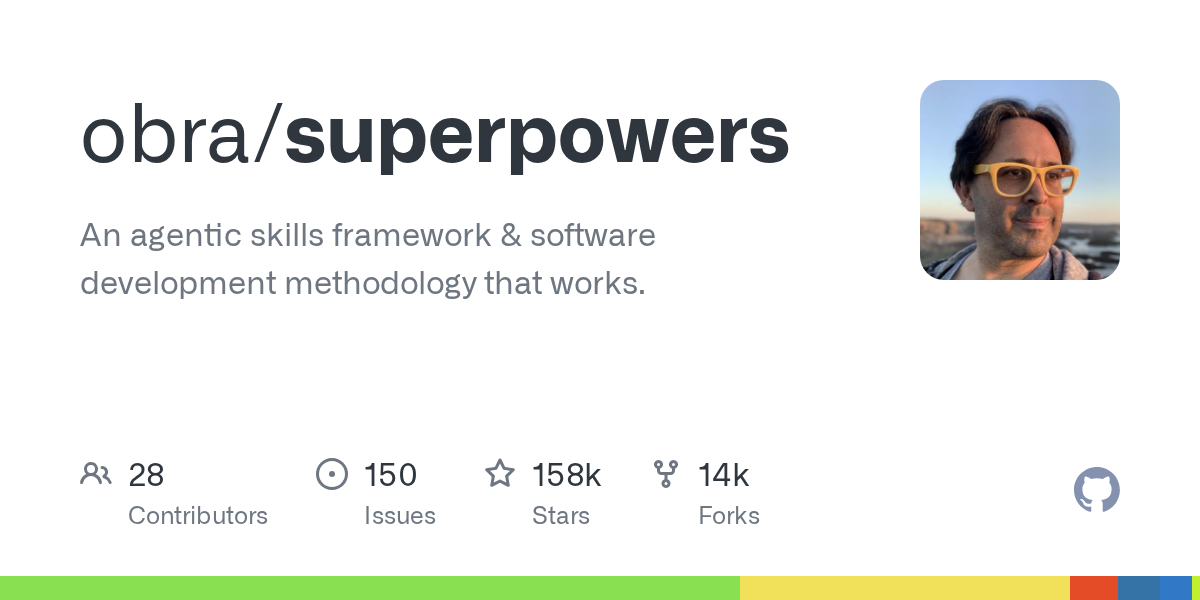
⭐ Stars today: +1,645  ·  📦 Total: 158,000
📜 License: MIT  ·  👤 By: Jesse Vincent / Prime Radiant
🎯 Time to value: 5 minutes
What it is: A comprehensive skills framework for coding agents that provides composable workflows covering brainstorming, design validation, planning, test-driven development, and code review. It works across Claude Code, OpenAI Codex, Cursor, GitHub Copilot CLI, Gemini CLI, and more. Why you'd want it: Instead of ad-hoc prompting, you get structured agent workflows that enforce systematic development practices like TDD and design review across any coding agent you use.
✓ Pros✗ Cons
Works with 6+ major coding agentsDoes not accept external skill contributions
Enforces systematic TDD workflowsShell-heavy, may intimidate non-terminal users
MIT license, battle-tested at 158K starsLarge framework for simple tasks
GitHub - obra/superpowers: An agentic skills framework & software development methodology that works.
An agentic skills framework & software development methodology that works. - obra/superpowers
Rank yesterday: #5 - Rising ↑
⭐ Stars today: +949  ·  📦 Total: 15,428
📜 License: Apache 2.0  ·  👤 By: Google (unofficial)
🎯 Time to value: 2 minutes
What it is: AI-powered file content type detection using deep learning, achieving approximately 99% accuracy across 200+ content types. It processes files in milliseconds on a single CPU and is used at scale by VirusTotal and abuse.ch, processing hundreds of billions of samples weekly. Why you'd want it: Drop-in replacement for unreliable file extension checks. Installable via pip, npm, Homebrew, or cargo with CLI, Python, TypeScript, and Go bindings.
✓ Pros✗ Cons
99% accuracy across 200+ file typesNot an official Google product
Millisecond inference on CPUFocused on detection only, not malware analysis
Multi-language SDK supportONNX model dependency adds complexity
GitHub - google/magika: Fast and accurate AI powered file content types detection
Fast and accurate AI powered file content types detection - google/magika
Rank yesterday: #8 - Rising ↑
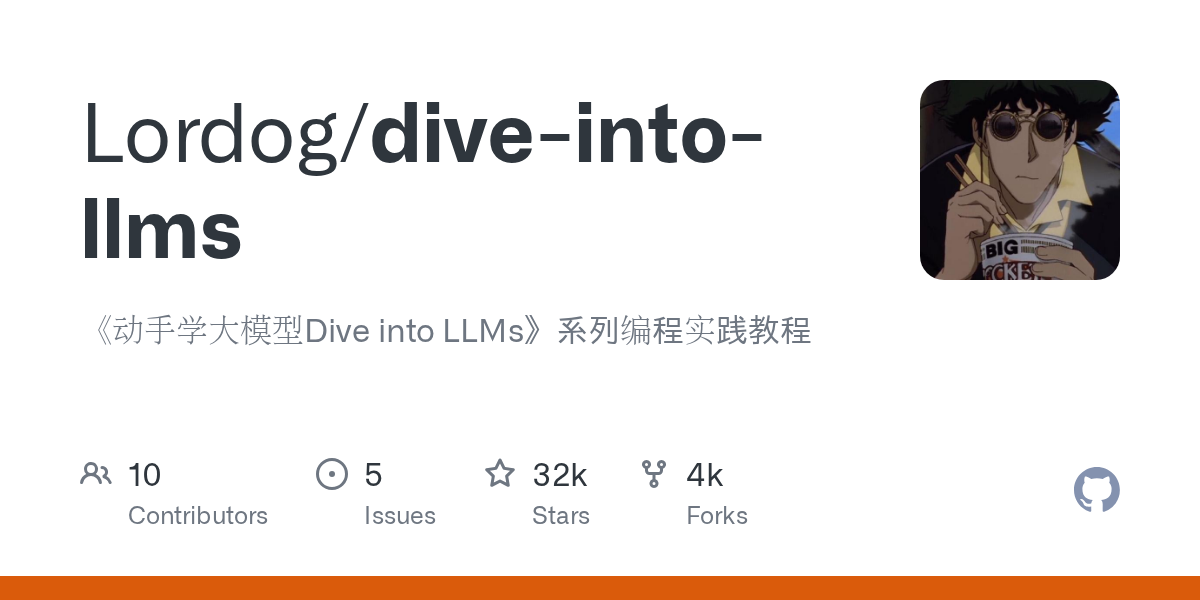
⭐ Stars today: +949  ·  📦 Total: 31,497
📜 License: Not specified  ·  👤 By: Shanghai Jiao Tong University
🎯 Time to value: 30 minutes
What it is: A hands-on Large Language Model (LLM) tutorial series covering fine-tuning, prompt engineering, knowledge editing, mathematical reasoning, watermarking, jailbreak attacks, and multimodal models. Originally developed as university course materials. Why you'd want it: The most comprehensive open LLM curriculum available, covering both practical skills and security topics. Ideal for teams building LLM competency.
✓ Pros✗ Cons
Comprehensive 10+ module curriculumPrimarily Chinese-language content
University-tested course materialsNo specified license
Covers security topics (jailbreaks, watermarking)Jupyter-only format
GitHub - Lordog/dive-into-llms: 《动手学大模型Dive into LLMs》系列编程实践教程
《动手学大模型Dive into LLMs》系列编程实践教程. Contribute to Lordog/dive-into-llms development by creating an account on GitHub.
Rank yesterday: New entry 🆕
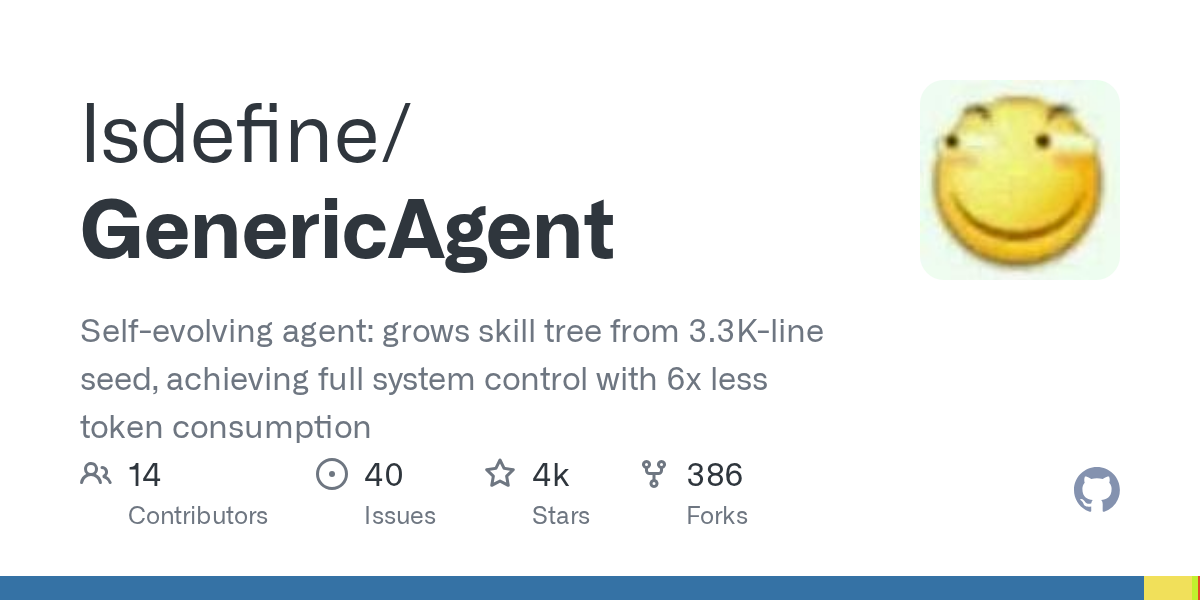
⭐ Stars today: +848  ·  📦 Total: 3,566
📜 License: MIT  ·  👤 By: lsdefine
🎯 Time to value: 10 minutes
What it is: A minimal, self-evolving autonomous agent framework in approximately 3,000 lines of core code. It gives LLMs system-level control over local computers through 9 atomic tools (browser, terminal, file management, keyboard/mouse, screen vision, mobile via ADB). Each completed task auto-crystallizes into a reusable skill. Why you'd want it: Claims 6x less token consumption than comparable systems using under 30K context window. The skill-tree approach means the agent gets better the more you use it.
✓ Pros✗ Cons
6x token efficiency, self-improvingFull system access creates security risk
Supports Claude, Gemini, KimiLimited community (single developer)
3K lines of code - easy to auditNo formal security audit yet
GitHub - lsdefine/GenericAgent: Self-evolving agent: grows skill tree from 3.3K-line seed, achieving full system control with 6x less token consumption
Self-evolving agent: grows skill tree from 3.3K-line seed, achieving full system control with 6x less token consumption - lsdefine/GenericAgent
Rank yesterday: #4 - Falling ↓
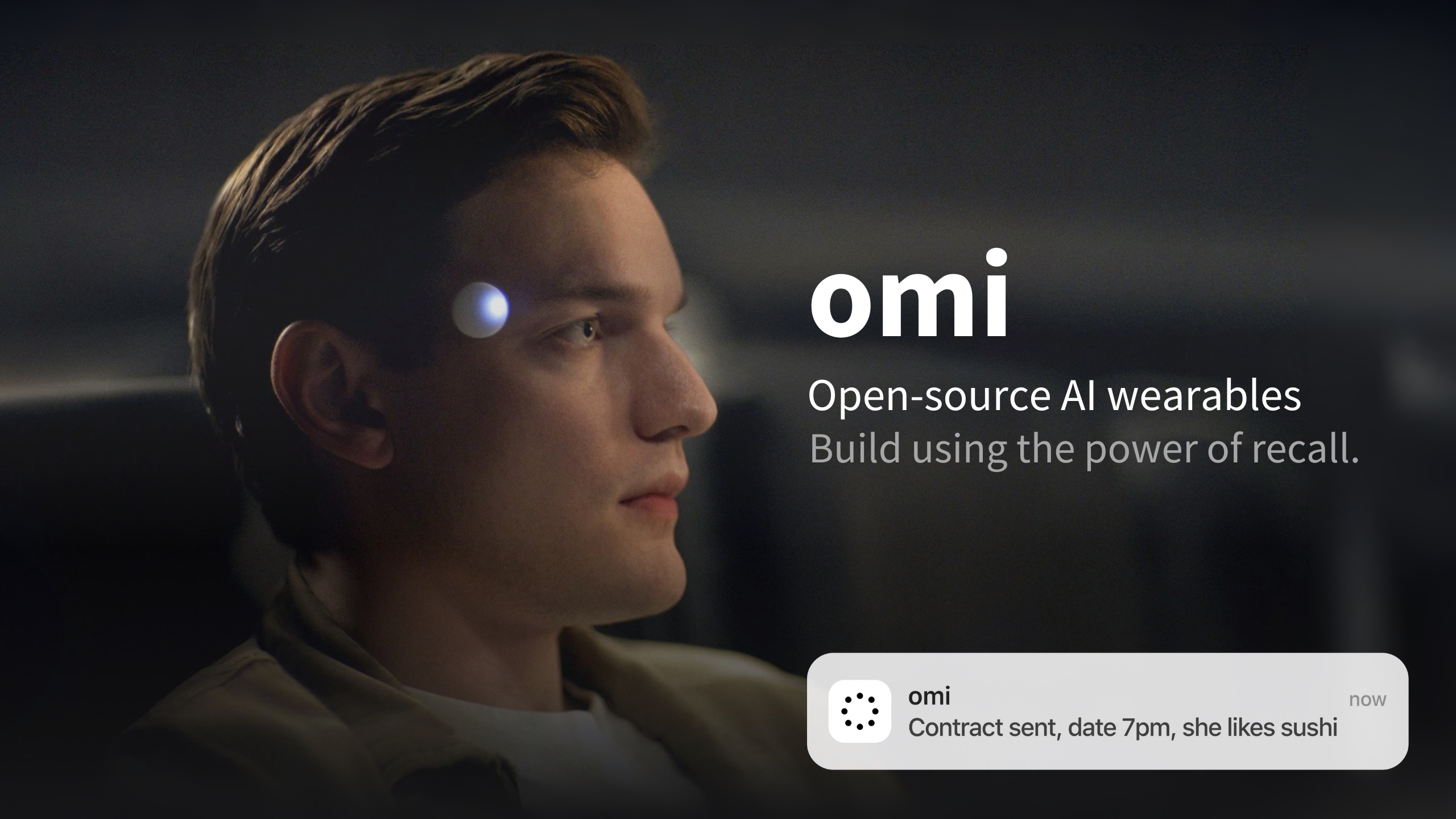
⭐ Stars today: +821  ·  📦 Total: 9,794
📜 License: MIT  ·  👤 By: BasedHardware
🎯 Time to value: 15 minutes
What it is: An AI-powered personal assistant that captures screen content and conversations in real-time, transcribes audio, generates summaries and action items, and provides persistent memory across sessions. Works on desktop, mobile, and wearable devices. Claims 300,000+ professional users. Why you'd want it: Automatic meeting transcription and action item extraction across all your devices, with a dedicated wearable hardware option for always-on capture.
✓ Pros✗ Cons
Cross-platform (desktop, mobile, wearable)Always-on recording raises privacy concerns
300K+ users, actively maintainedProprietary wearable hardware adds cost
MIT license, self-hostableComplex multi-language codebase (Dart/C/Python/Swift)
GitHub - BasedHardware/omi: AI that sees your screen, listens to your conversations and tells you what to do
AI that sees your screen, listens to your conversations and tells you what to do - BasedHardware/omi
Rank yesterday: #3 - Falling ↓
⭐ Stars today: +802  ·  📦 Total: 19,814
📜 License: MIT  ·  👤 By: jamiepine
🎯 Time to value: 10 minutes
What it is: A local-first, open-source voice synthesis studio positioned as an ElevenLabs alternative. Supports voice cloning from brief audio samples, multi-engine Text-to-Speech (TTS) across 23 languages, a timeline editor for multi-track compositions, Whisper transcription, and a REST API. Why you'd want it: Voice cloning and synthesis with no cloud dependency and no per-character pricing. GPU acceleration on Apple Metal, CUDA, ROCm, DirectML, and Intel Arc.
✓ Pros✗ Cons
Local-first, no subscription feesRequires decent GPU for real-time synthesis
23 languages, multiple TTS enginesDesktop app only (Tauri/Rust)
Voice cloning from short samplesQuality varies by engine choice
GitHub - jamiepine/voicebox: The open-source voice synthesis studio
The open-source voice synthesis studio. Contribute to jamiepine/voicebox development by creating an account on GitHub.
Rank yesterday: #6 - Falling ↓
⭐ Stars today: +624  ·  📦 Total: 21,782
📜 License: MIT  ·  👤 By: OpenAI
🎯 Time to value: 15 minutes
What it is: OpenAI's lightweight framework for multi-agent workflows supporting 100+ LLM providers. Features agent configuration with tools, guardrails, and handoffs, sandbox agents in containerized environments, Model Context Protocol (MCP) tool integration, and native tracing. Why you'd want it: The most mature and frequently-released agent framework available (83 releases, latest April 15, 2026). Provider-agnostic despite the OpenAI branding.
✓ Pros✗ Cons
100+ LLM providers supportedPython 3.10+ required
Native tracing and sandboxingVoice support requires separate extras
83 releases, actively maintainedOpenAI ecosystem lock-in risk
GitHub - openai/openai-agents-python: A lightweight, powerful framework for multi-agent workflows
A lightweight, powerful framework for multi-agent workflows - openai/openai-agents-python
Rank yesterday: New entry 🆕
⭐ Stars today: +405  ·  📦 Total: 11,745
📜 License: MIT  ·  👤 By: Donchitos
🎯 Time to value: 20 minutes
What it is: Transforms a Claude Code session into a structured game development studio with 49 AI agents, 72 workflow skills, and 12 hooks. Supports Godot 4, Unity, and Unreal Engine 5 game development. Why you'd want it: If you want to build games using Claude Code, this provides the full pipeline from concept to playable prototype with specialized agents for art, level design, audio, and QA.
✓ Pros✗ Cons
49 specialized AI agents for game devRequires Claude Code subscription
Supports 3 major game enginesLarge skill set may be overwhelming
Full pipeline from concept to prototypeBeta quality, community-driven
GitHub - Donchitos/Claude-Code-Game-Studios: Turn Claude Code into a full game dev studio — 49 AI agents, 72 workflow skills, and a complete coordination system mirroring real studio hierarchy.
Turn Claude Code into a full game dev studio — 49 AI agents, 72 workflow skills, and a complete coordination system mirroring real studio hierarchy. - Donchitos/Claude-Code-Game-Studios

Top Models Today

The most capable open-weight model for agent-driven workflows, with a unique self-evolution capability.
📥 Downloads (30d): 188,737  ·  📜 License: Proprietary-open
👤 By: MiniMax  ·  🎯 Task: Text generation / agentic coding
📐 Size: 229B
What it is: A massive dense language model where all 229 billion parameters are active (not Mixture of Experts). Its standout feature is "self-evolution" - an internal version autonomously optimized a programming scaffold over 100+ rounds, improving performance by 30%. Why you'd want it: On MLE Bench Lite it achieved a 66.6% medal rate, second only to Opus 4.6 and GPT-5.4. SWE-Pro score of 56.2% matches GPT-5.3-Codex. The highest GDPval-AA Elo among open-weight models at 1495.
✓ Pros✗ Cons
Strongest open-weight agentic scores229B dense requires substantial hardware
Self-evolution capability is novelProprietary-open license limits some uses
Matches GPT-5.3 on SWE-ProReleased April 9, still early in adoption
MiniMaxAI/MiniMax-M2.7 · Hugging Face
We’re on a journey to advance and democratize artificial intelligence through open source and open science.
Frontier-class reasoning from only 3B active parameters, running on consumer GPUs.
📥 Downloads (30d): 21,180  ·  📜 License: Apache 2.0
👤 By: Alibaba / Qwen  ·  🎯 Task: Multimodal / agentic coding
📐 Size: 35B (3B active)
What it is: A multimodal MoE model handling text, images, and video with a native 262K context window. Features "thinking preservation" that retains reasoning across turns to reduce compute in iterative conversations. Why you'd want it: SWE-bench Verified at 73.4%, AIME 2026 at 92.7%, and GPQA Diamond at 86.0% - frontier-level reasoning that only activates 3 billion parameters per token.
✓ Pros✗ Cons
12:1 sparsity ratio for efficiencyOccasional reasoning loops in long contexts
Apache 2.0, fully commercial useTool-use inconsistencies in some workflows
120+ tok/s on RTX 4090Requires careful quantization for smaller GPUs
Qwen/Qwen3.6-35B-A3B · Hugging Face
We’re on a journey to advance and democratize artificial intelligence through open source and open science.
The first open-source foundation model explicitly designed for real-world robotics with strong spatial reasoning.
📥 Downloads (30d): 1,287  ·  📜 License: Tencent
👤 By: Tencent  ·  🎯 Task: Embodied AI / robotics
📐 Size: 4B (2.2B active)
What it is: A foundation model purpose-built for robotics and embodied AI, handling spatial-temporal perception, scene understanding, and robot manipulation planning. Trained on 100M+ embodied data points. Outperforms similarly-sized models on 16 of 22 embodied benchmarks. Why you'd want it: If you are building robotics applications, this provides spatial reasoning (3DSRBench: 57.0 vs Qwen3-VL-2B's 39.9) and robot comprehension (RoboBench: 49.2 vs 36.9) in a 2.2B active parameter model deployable on edge hardware.
✓ Pros✗ Cons
Purpose-built for roboticsTencent license may restrict commercial use
2.2B active params fits edge devicesNiche application, not general-purpose
Best-in-class spatial reasoningEarly release, limited community tooling
tencent/HY-Embodied-0.5 · Hugging Face
We’re on a journey to advance and democratize artificial intelligence through open source and open science.
Best-in-class text rendering in an open-source image generation model at 8B scale.
📥 Downloads (30d): 2,254  ·  📜 License: Apache 2.0
👤 By: Baidu  ·  🎯 Task: Text-to-image
📐 Size: 8B
What it is: A text-to-image diffusion transformer with a Prompt Enhancer module. Scores 0.9733 on LongTextBench for text rendering accuracy (approaching state of the art at 0.9882). Handles posters, comics, storyboards, and multi-panel compositions. Why you'd want it: Runs on consumer GPUs with 24GB VRAM. A companion "Turbo" variant achieves comparable quality in 8 steps instead of 50, making it fast enough for interactive use.
✓ Pros✗ Cons
Best open-source text rendering24GB VRAM minimum
Apache 2.0 for commercial useChinese company, limited English docs
8-step Turbo variant availableNew release, ecosystem still forming
baidu/ERNIE-Image · Hugging Face
We’re on a journey to advance and democratize artificial intelligence through open source and open science.
MIT-licensed 754B MoE model that leads SWE-Bench Pro and does not plateau during long agentic sessions.
📥 Downloads (30d): 100,019  ·  📜 License: MIT
👤 By: Z.ai  ·  🎯 Task: Agentic engineering / coding
📐 Size: 754B (MoE)
What it is: Z.ai's flagship model for sustained, iterative problem-solving over hundreds of rounds and thousands of tool calls. Leads on SWE-Bench Pro (58.4%), NL2Repo (42.7%), and Terminal-Bench 2.0 (63.5%). Distinguished by not plateauing during long sessions. Why you'd want it: MIT license on a 754B model is exceptionally permissive. If you run automated software engineering pipelines, this is the strongest open model for sustained agentic work.
✓ Pros✗ Cons
MIT license on 754B modelMassive infrastructure requirements
Leads SWE-Bench Pro at 58.4%MoE active param count not disclosed
Does not plateau in long sessionsRelatively new, limited third-party validation
zai-org/GLM-5.1 · Hugging Face
We’re on a journey to advance and democratize artificial intelligence through open source and open science.
The default open foundation model for multimodal applications with 3.5 million downloads.
📥 Downloads (30d): 3,513,465  ·  📜 License: Apache 2.0
👤 By: Google DeepMind  ·  🎯 Task: Multimodal / reasoning
📐 Size: 31B
What it is: Google's open multimodal model with a 256K context window, native function calling, configurable thinking mode, and support for 35+ languages. Handles text, images, and video. Why you'd want it: With 3.5M downloads in 30 days, this is the most-adopted open model on the list. MMLU Pro 85.2%, AIME 2026 89.2%, LiveCodeBench v6 80.0%.
✓ Pros✗ Cons
3.5M downloads, massive communityDense 31B requires more compute than sparse models
Apache 2.0, Google-backedLess capable than Qwen3.6 on coding benchmarks
35+ language supportTrending for 5+ weeks, no longer novel
google/gemma-4-31B-it · Hugging Face
We’re on a journey to advance and democratize artificial intelligence through open source and open science.
Tokenizer-free TTS in 30 languages with text-described voice design - no reference audio needed.
📥 Downloads (30d): 18,089  ·  📜 License: Apache 2.0
👤 By: OpenBMB  ·  🎯 Task: Text-to-speech / voice cloning
📐 Size: 2B
What it is: A tokenizer-free diffusion-autoregressive Text-to-Speech (TTS) model supporting 30 languages including 9 Chinese dialects. Unique features include creating new voices from text descriptions alone and "ultimate cloning" mode for maximum fidelity. Outputs 48kHz studio-quality audio. Why you'd want it: Real-time synthesis (RTF approximately 0.30 on RTX 4090) with only approximately 8GB VRAM. Fine-tuning requires just 5-10 minutes of audio data.
✓ Pros✗ Cons
Voice design from text description only2B params still requires a decent GPU
30 languages, Apache 2.0Chinese dialect focus may limit Western adoption
5-10 min audio for fine-tuningReal-time factor varies by hardware
openbmb/VoxCPM2 · Hugging Face
We’re on a journey to advance and democratize artificial intelligence through open source and open science.
The first open-source 3D world model that generates actual meshes and Gaussian Splatting, not just video.
📥 Downloads (30d): 0 (requires git clone)  ·  📜 License: Tencent
👤 By: Tencent  ·  🎯 Task: Image-to-3D / world generation
📐 Size: ~1.2B
What it is: Unlike video-based world models that output non-editable pixels, HY-World 2.0 generates real 3D assets - meshes, Gaussian Splatting, and point clouds directly importable into Blender, Unreal Engine, Unity, or Isaac Sim. Accepts text, images, multi-view images, or video as input. Why you'd want it: A paradigm shift from "generating videos of 3D worlds" to "generating actual 3D worlds" with persistent, editable, engine-compatible output.
✓ Pros✗ Cons
Real 3D output, not just videoTencent license restricts commercial use
Engine-compatible (Blender, UE5, Unity)Just released, zero pip downloads
Multiple input modalitiesOnly partial model release so far
tencent/HY-World-2.0 · Hugging Face
We’re on a journey to advance and democratize artificial intelligence through open source and open science.

AI Launches Today

The most capable Claude model yet - with controversy attached.
🔥 Upvotes: 398  ·  👤 By: Anthropic
💰 Pricing: API ($5/$25 per 1M tokens)  ·  🏷 Category: AI Models
Anthropic's latest and most powerful generally available model, with significant gains in software engineering (+11 points on SWE-Bench Pro), vision (3.75 megapixel support), and multi-step reasoning. The community debate centers on whether the tokenizer cost increase and stricter instruction following outweigh the capability improvements. Verdict: Best-in-class for agentic coding and vision tasks, but test your existing prompts before migrating from 4.6.
Product Hunt – The best new products in tech.
Product Hunt is a curation of the best new products, every day. Discover the latest mobile apps, websites, and technology products that everyone’s talking about.
An AI platform with design tools, not a design platform with AI tools.
🔥 Upvotes: 151  ·  👤 By: Canva
💰 Pricing: Freemium  ·  🏷 Category: Design & AI
Complete platform transformation adding conversational design, agentic workflow orchestration, persistent memory, and integrations with Slack, Gmail, Zoom, and Google Calendar. Claims 7x faster and 30x cheaper than frontier AI alternatives. Verdict: The most ambitious design tool update of 2026. If you use Canva, this changes how you use it.
Product Hunt – The best new products in tech.
Product Hunt is a curation of the best new products, every day. Discover the latest mobile apps, websites, and technology products that everyone’s talking about.
The canvas for thinking with AI.
🔥 Upvotes: 120  ·  👤 By: Arky
💰 Pricing: Free beta / $100 lifetime  ·  🏷 Category: Productivity & AI
Visual workspace for turning scattered ideas into organized structures. AI understands relationships between your notes and suggests organizational improvements. Desktop apps for macOS and Windows. Verdict: Promising for researchers and students; the $100 one-time pricing is refreshing amid SaaS fatigue.
Product Hunt – The best new products in tech.
Product Hunt is a curation of the best new products, every day. Discover the latest mobile apps, websites, and technology products that everyone’s talking about.

Snapshot

ProviderModelInput $/1MOutput $/1MContext
AnthropicClaude Opus 4.7$5.00$25.001M tokens
AnthropicClaude Sonnet 4.6$3.00$15.001M tokens
AnthropicClaude Haiku 4.5$1.00$5.00200K tokens
OpenAIo3$10.00$40.00200K tokens
OpenAIGPT-4.1$2.00$8.001M tokens
OpenAIGPT-4.1 mini$0.40$1.601M tokens
OpenAIGPT-4.1 nano$0.10$0.401M tokens
GoogleGemini 3.1 Pro Preview$2.00$12.001M tokens
GoogleGemini 2.5 Pro$1.25$10.001M tokens
GoogleGemini 2.5 Flash$0.30$2.501M tokens
GroqLlama 4 Scout (17Bx16E)$0.11$0.34128K tokens
GroqQwen3 32B$0.29$0.59131K tokens
GroqLlama 3.1 8B$0.05$0.08128K tokens
What this means: Claude Opus 4.7 and Gemini 3.1 Pro Preview both offer 1M token context at $5 and $2 input respectively, but the tokenizer analysis in today's Top Stories reveals Opus 4.7's effective cost is 20-30% higher than sticker price due to token inflation. For cost-sensitive production workloads, GPT-4.1 mini at $0.40/$1.60 with 1M context offers the best price-to-capability ratio among proprietary models. Groq's open-source hosting continues to be 10-100x cheaper than proprietary alternatives for compatible workloads.

Agent Psychometrics: Task-Level Performance Prediction in Agentic Coding Benchmarks

Chris Ge, Daria Kryvosheieva, Daniel Fried, Uzay Girit, Kaivalya Hariharan - arXiv:2604.00594
What it claims: Current agentic coding benchmarks (SWE-bench, Terminal-Bench, GSO) reduce performance to a single pass-rate number, hiding crucial task-level variation. This paper applies Item Response Theory (a statistical framework from educational testing) augmented with code-derived features to decompose agent capability into separate LLM ability and scaffold ability components.

Key finding: AUC-ROC (Area Under the Receiver Operating Characteristic Curve) of 0.936 for predicting pass/fail on unseen LLM-scaffold combinations on SWE-bench Verified, tested across 4 benchmarks, 38 LLMs, and 112 configurations.

Why practitioners should care: If you run expensive agentic coding evaluations, this framework lets you predict performance on new benchmark tasks or new agent configurations without actually running them, dramatically cutting evaluation costs. Budget-conscious teams can achieve reliable estimates with fewer than 30 tasks instead of running full benchmark suites.

Member discussion

Subscribe to GenAI Secret Sauce newsletter and stay updated.

Don't miss anything. Get all the latest posts delivered straight to your inbox. It's free!

By subscribing, you agree to our Privacy Policy and Terms. We track email opens and clicks. Unsubscribe anytime.

Great! Check your inbox and click the link to confirm your subscription.