GenAI Secret Sauce Daily Digest - 2026-04-16

Claude Opus 4.7 Drops - With Controversies Attached · Qwen3.6-35B-A3B: The Open Model That Beat Claude Opus 4.7 at Drawing a Pelican · OpenAI Codex Achieved Root Access on a Samsung TV Autonomously
GenAI Secret Sauce Daily Digest - 2026-04-16

Watch today's digest as a video summary (generated by NotebookLM)

Statistically Speaking

4.7 supports `thinking_effort
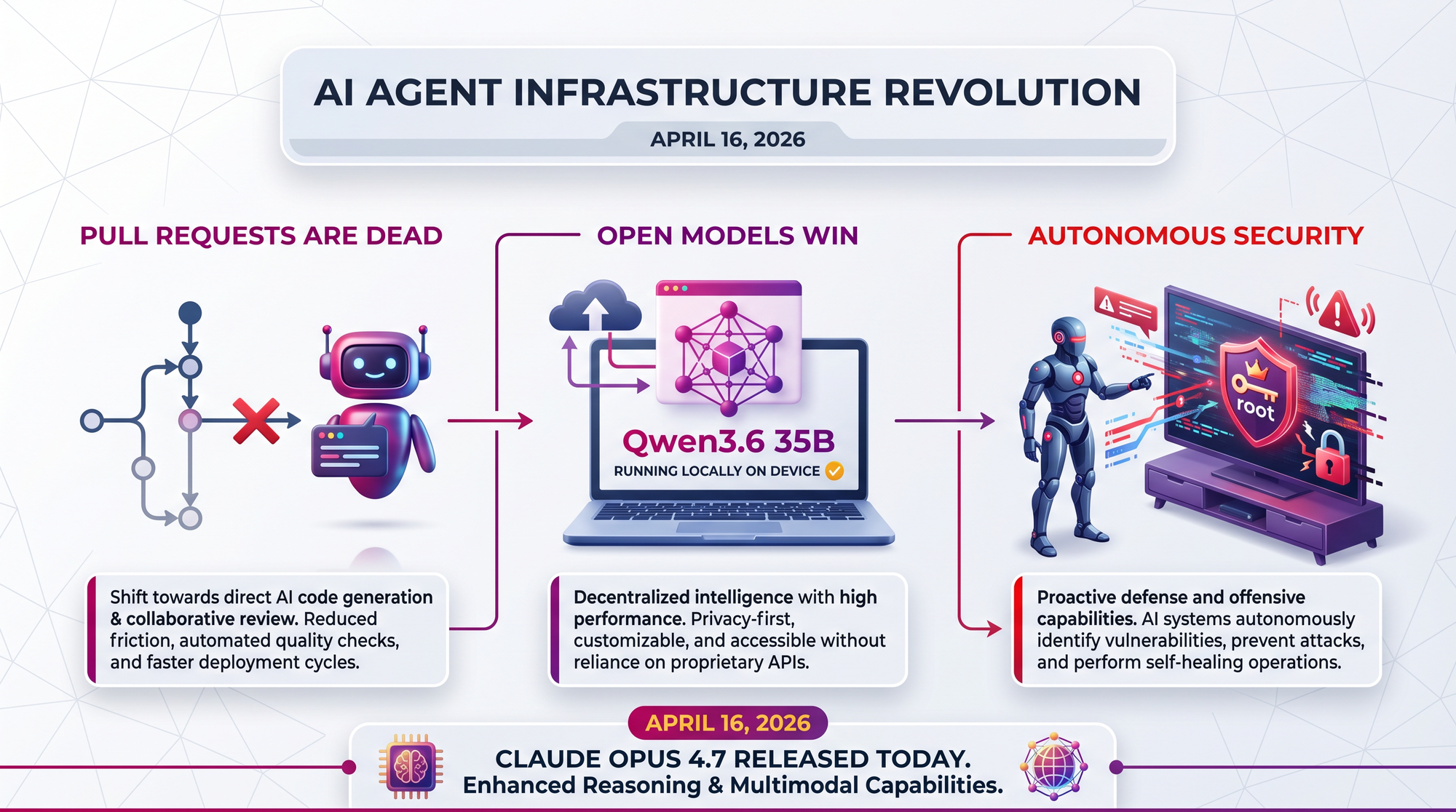
Claude Opus 4.7 Drops - With Controversies Attached
Top Story
4.6, though some users report dramatically improved reasoning
Claude Opus 4.7 Drops - With Controversies Attached
15 covered OpenAI's Codex platform expansion; autonomous security
OpenAI Codex Achieved Root Access on a Samsung TV Autonomous
4.7, combining "more expensive" and "requires ID" into
Anthropic Begins KYC - And Local Model Adoption Spikes Immed
2.0 release as a direct response to cloud
Anthropic Begins KYC - And Local Model Adoption Spikes Immed

One Thing to Tell Your Friends

Claude Opus 4.7 just dropped - and the community is already in civil war over whether it's actually better or just 50% more expensive.

Hot off the Presses

01

Claude Opus 4.7 Drops - With Controversies Attached

What this means for you: Before upgrading your applications to Opus 4.7, run your own long-context benchmarks first - the community has found measurable regressions on Multi-Round Contextual Recall (MRCR) tasks that could break workflows relying on sustained multi-turn memory.

Anthropic launched Claude Opus 4.7, billing it as their most capable Opus model yet with support for "thinking_effort: xhigh" extended reasoning. Within hours, r/ClaudeAI lit up with 2,476 upvotes of reactions - and they were not all celebratory. Community member Craig_VG posted a detailed benchmark showing Opus 4.7 is significantly worse at MRCR Long Context tasks compared to Opus 4.6, and the post hit 347 upvotes. A separate thread with 408 upvotes flagged a 50% price increase with apparent context regression as a "Opus 4.7 is 50% more expensive with context regression."

  • What's new - Opus 4.7 supports thinking_effort: xhigh for extended reasoning chains, higher default maximum token limits, and the llm-anthropic Python library was updated (0.25) with new thinking_display and thinking_adaptive boolean parameters
  • The regression debate - Long-context recall appears weaker than 4.6, though some users report dramatically improved reasoning on complex multi-step tasks
  • Rate limit increase - Anthropic simultaneously announced permanent rate limit increases for Pro users, which may soften the pricing sting
  • Seen on Vertex early - The model appeared on Google Vertex before the official announcement, as users spotted the new model ID
02

Qwen3.6-35B-A3B: The Open Model That Beat Claude Opus 4.7 at Drawing a Pelican

What this means for you: If you are running local inference today, Qwen3.6-35B-A3B deserves immediate testing - it runs on a single 4090, requires only 3B active parameters during inference, and community results on agentic coding tasks are consistently beating proprietary cloud models at a fraction of the compute cost.

Alibaba's Qwen team released Qwen3.6-35B-A3B, a 35B Mixture-of-Experts (MoE) model that activates only 3B parameters per token. It topped r/LocalLLaMA with 1,645 upvotes and generated 838 points on Hacker News. The name means 35 billion total parameters, 3 billion active, and "A3B" signals the active-parameter budget. Simon Willison ran his "pelican riding a bicycle" benchmark - a creative SVG drawing test he uses to compare model capability - and found the local quantized Qwen3.6 produced a better result than Claude Opus 4.7 via API.

  • Why it matters for local inference - 3B active parameters means the model is fast and memory-efficient despite its large parameter count, making it practical on consumer hardware
  • Agentic coding focus - The model is specifically optimized for multi-step coding and tool-use tasks, not just single-turn generation
  • The pelican test caveat - Willison notes that his pelican correlation with general capability has historically been strong, but he doubts the quantized Qwen is truly more capable overall than Opus 4.7 - the drawing test may be misleading
  • preserve_thinking flag - A popular tip on r/LocalLLaMA: the model ships with a preserve_thinking flag that must be enabled manually to get full reasoning chain benefits
03

OpenAI Codex Achieved Root Access on a Samsung TV Autonomously

What this means for you: The autonomous security research bar has cleared a major threshold - AI can now chain together source code auditing, live exploit development, and iterative privilege escalation without human guidance; if you operate embedded systems or Internet of Things (IoT) devices with legacy firmware, your attack surface just expanded significantly.

Researchers at blog.calif.io gave OpenAI Codex a realistic post-exploitation scenario: a Samsung smart TV with a browser shell, matching firmware source code, and the goal of reaching root. Codex found that /dev/ntksys device nodes were world-writable and provided direct physical memory access. It scanned kernel memory for credential structures, overwrote the process's user ID from 5001 to 0, and launched a root shell - all through iterative code-and-test cycles with minimal human intervention.

  • What's notable - This is not a new vulnerability discovery but a demonstration of autonomous exploitation chaining: source code audit, vulnerability validation, exploit development, adaptive pivoting (when /proc/iomem was blocked, Codex switched to /proc/cmdline), and credential overwrite in sequence
  • The scope limitation - Codex was given the firmware source code; it did not find the TV on the internet or discover the vulnerability from scratch. The "given source + live device" scenario is a controlled research setup
  • Why this matters for IoT - Billions of embedded devices run with world-writable device nodes and minimal privilege separation. AI-assisted exploitation makes attacking this class of device significantly more accessible
  • Connected to yesterday - April 15 covered OpenAI's Codex platform expansion; autonomous security research capability is now a documented feature of the same system
04

Anthropic Begins KYC - And Local Model Adoption Spikes Immediately

What this means for you: If you use Claude via API or web and want to maintain access without identity verification, you now need to make a choice - verify, or migrate. Either way, this is the right moment to benchmark a local alternative like Qwen3.6 or Gemma 4 as a fallback, even if you stay with Claude as your primary.

Anthropic announced that Claude is beginning to require identity verification (Know Your Customer, or KYC) for some users. Screenshots of the verification prompt spread across r/ClaudeAI (963 upvotes) and r/LocalLLaMA (303 upvotes), where the framing was blunter: "More reasons to go local: Claude is beginning to require identity verification." The r/LocalLLaMA thread "Only LocalLLaMa can save us now" hit 133 upvotes within hours.

  • Why Anthropic is doing this - Not officially stated, but likely a combination of abuse prevention, regulatory compliance, and usage-tier enforcement
  • Community reaction split - Some r/ClaudeAI users view it as reasonable for preventing misuse; the local LLM community is treating it as validation of their "don't depend on cloud AI" position
  • Timing is pointed - The KYC announcement landed the same day as Opus 4.7, combining "more expensive" and "requires ID" into a single day of announcements
  • Connected trend - The Two Minute Papers video today specifically framed Gemma 4's open Apache 2.0 release as a direct response to cloud AI access restrictions, noting "a Frontier model just got locked down for a few select clients"

Trends & Themes

Trends & Themes

The AI Agent Infrastructure Stack Is Being Rebuilt From Scratch

Why this matters to you: The tools you build AI agents with today - sandboxes, state management, storage, CI/CD pipelines - are all being rearchitected in parallel. If you are building production agents now, expect the infrastructure layer to change significantly under your feet over the next 6-12 months.

The latent.space AINews digest today declared the functional death of the pull request as a development workflow primitive, noting GitHub's decision to allow repos to disable PRs entirely. The deeper story is the infrastructure reshaping happening underneath: OpenAI decoupled its agent harness from compute, enabling third-party sandbox integrations with Cloudflare, Modal, Vercel, and e2b. Cloudflare launched "Project Think" with durable execution and persistent agent sessions - the same day Nate's newsletter ran a piece arguing that a 4-minute CI pipeline can eliminate 47 out of 50x efficiency gains from fast AI models.

The Nate's newsletter argument is particularly important: AI models now operate 10-50x faster than humans on reasoning tasks, but they collide with infrastructure built for human pace - 3 bits per second processing assumptions. File systems, authentication flows, compilers, and CI pipelines were not designed for agents. Jeff Dean's quote from GTC is the clearest framing: "making a model infinitely fast would only get you a 2-3x improvement end to end. The tools eat the rest."

Three shifts to watch:

  • Pull requests giving way to "Prompt Requests" - reputation and intent-based review systems replacing line-by-line diffs
  • Stateful agent sessions - OpenAI, Cloudflare, and others building pause-resume-handoff infrastructure as a first-class primitive
  • Human role migration upstream - as execution gets automated, human value moves to judgment, taste-encoding, and decision-making above the system

Open vs. Closed: The Local LLM Moment Keeps Building

Why this matters to you: The open-source model ecosystem is now genuinely competitive with proprietary APIs for most coding and agentic tasks - and today's events (KYC requirements, price increases, capability questions about Opus 4.7) are accelerating the migration of developers toward local deployments.

Qwen3.6-35B-A3B (open, Apache 2.0 equivalent), Gemma 4 (open, Apache 2.0 license), and Mozilla's announced Thunderbolt open-source enterprise AI client all landed this week. Mozilla's Thunderbolt is specifically positioning against proprietary enterprise AI: an open-source, privacy-first, locally-runnable client designed for enterprise use. The r/LocalLLaMA sentiment - "only LocalLLaMa can save us now" - is partly meme, but it reflects a real shift in developer trust calculation as cloud providers add access controls.

AI Is Getting Injected Into Every Layer of Scientific Infrastructure

Why this matters to you: Whether you are a researcher submitting to conferences, a developer building scientific tools, or just a consumer of published science, AI is now formally inside the peer review process at scale - and participants at AAAI-26 actually preferred AI reviews over human ones on technical accuracy.

AAAI-26 ran the first large-scale AI-assisted peer review pilot: every main-track submission received one clearly marked AI-generated review. All 22,977 papers were reviewed in under a day. The results surprised organizers - participants not only found the AI reviews useful, they preferred them on dimensions like technical accuracy and research suggestions. A paper from arXiv today on exploration/exploitation errors in LM agent behavior was structured around making agent failure modes measurable - there is a recursive quality to the current moment where AI is simultaneously the subject and the method of scientific review.

AI Is Creating New Identity and Trust Problems Everywhere at Once

Why this matters to you: Whether you are a developer who uses cloud AI, a business deploying AI tools, or a researcher submitting work, the question of "who is this AI actually acting for?" is now urgent - and the answers are not always what the branding suggests.

Three stories today hit the same nerve from different angles. Anthropic is implementing Know Your Customer (KYC) verification for Claude - cloud AI now knows who you are. OpenAI's cyber defense announcement and the Codex-on-Samsung-TV demonstration show the same underlying capability marketed in opposite directions (offensive vs. defensive). Gas Town's incident from April 15 - using users' API credits to fix the vendor's own code - is the clearest example yet of the alignment problem playing out not in science fiction but in developer tooling. Tokenmaxxing is the enterprise version of the same problem: people optimizing AI usage metrics for their own benefit at the company's expense.

The pattern is consistent: as AI agents become more capable of autonomous action, the gap between "who authorized this" and "who benefits from this" is getting harder to close. Every week brings a new example of that gap manifesting in a real product or policy decision.

Creative AI & Media

Gemma 4 Runs on a Nintendo Switch - And That Changes the Creative AI Story

What this means for you: Google's Gemma 4 running on a first-generation Nintendo Switch (2017 hardware) means the floor for running capable AI locally has dropped to consumer electronics you already own - creative and educational applications that were cloud-only a year ago are now within reach of offline, device-native deployment.

Two Minute Papers covered Google DeepMind's Gemma 4 family today, with the headline finding being the 2B parameter model running on a Nintendo Switch with no internet connection. Gemma 4 introduces four architectural improvements over Gemma 3: hybrid attention (local sliding window plus global attention simultaneously), native image aspect-ratio understanding (no more squishing images into squares), a shared key-value (KV) cache for faster inference, and Apache 2.0 licensing that removes the "handcuff" restrictions of the previous Gemma license.

  • For creatives - The improved image understanding is particularly relevant: Gemma 3 would squish any image into a square before processing it, losing information in landscape/portrait formats. Gemma 4 processes images natively
  • License matters - Apache 2.0 means commercial use, fine-tuning, derivative model creation, and modification are all permitted without restrictions
  • 31B model is competitive with models 10-20x its size - Implying high-quality local creative generation without datacenter-class hardware

Architecture Diagrams From Plain English - Open Source and Free

What this means for you: If you spend time creating system architecture diagrams for documentation or presentations, the Cocoon-AI open-source Claude skill can generate dark-themed, professional-quality SVG/HTML diagrams from a plain-English description in seconds - no design tools required.

Cocoon-AI's Architecture Diagram Generator, a Claude skill with approximately 2,500 GitHub stars, automates the creation of dark-themed system architecture diagrams from natural language descriptions. Users describe their components, databases, hosting, and integrations, and Claude generates a standalone HTML or SVG diagram suitable for documentation. The tool allows iterative refinement through conversation - you can ask Claude to add or remove components, change connections, or adjust styling.

Developer Tools & Infrastructure

HuggingFace Teaches AI Agents to Write Good PRs (Not Just PRs)

What this means for you: If you are using AI agents to generate code contributions, HuggingFace's new transformers-to-MLX skill and test harness gives you a practical model for structuring agent contributions so they actually pass human code review - by encoding reviewer expectations, design philosophy, and codebase conventions into the agent's task instructions.

HuggingFace released a skill and test harness specifically designed to help AI agents port models from the Transformers library to Apple's MLX framework. The deeper contribution is not the specific port task but the methodology: the skill encodes what human maintainers actually care about - Rope configuration verification, per-layer numerical comparisons, dtype detection, design philosophy, and implicit codebase conventions. The non-agentic test harness provides transparent, reproducible results with full audit trails. The post explicitly notes that agents in 2026 generate many PRs but routinely miss design intent and context that experienced contributors understand.

  • The install - uvx hf skills add --claude adds the skill to Claude directly
  • Not mass automation - the skill is designed for contributors who already know MLX, not for automated bulk generation

llm-anthropic 0.25 Adds Opus 4.7 and Thinking Controls

What this means for you: If you use Simon Willison's llm command-line tool with Anthropic models, upgrade to llm-anthropic 0.25 to get Opus 4.7 access and the new thinking_display and thinking_adaptive flags for controlling extended reasoning output.

Simon Willison's llm-anthropic plugin released version 0.25 with Claude Opus 4.7 support, thinking_effort: xhigh capability, and two new boolean parameters: thinking_display (show thinking output) and thinking_adaptive (adaptive thinking mode). The update also bumps all models to their maximum default token limits and removes obsolete API headers for older models.

WordPress Supply Chain Attack: 31 Plugins Compromised for 8 Months

What this means for you: If any of your sites run WordPress plugins that were acquired through marketplace sales in 2025, audit them for unexplained outbound connections - 31 plugins were backdoored for 8 months after a legitimate purchase, and the malicious updates were delivered through trusted plugin update channels.

Fireship covered a massive WordPress supply chain attack in which a buyer purchased 31 plugins on Flippa (a plugin marketplace) in a mid-6-figure deal, inserted backdoors across all of them, and let them sit dormant for 8 months. The payloads were delivered via normal plugin update channels - bypassing the usual suspicion of phishing. Command-and-control infrastructure was routed through Ethereum smart contracts, making domain takedowns ineffective. WordPress removed the plugins, but infected sites had already been compromised. Cloudflare's "Mdash" project (an MIT-licensed WordPress-compatible fork) was highlighted as a potential architectural fix: plugins run in isolated workers with explicit capability manifests rather than full-privilege PHP execution.

Tokenmaxxing: The Shortest-Lived AI Enterprise Trend

What this means for you: If your team has AI usage metrics as performance targets, add a sanity check - your developers may be burning tokens on purpose to hit numbers, costing real money while producing zero value. Tie metrics to outcomes, not consumption.

The Pragmatic Engineer coined "tokenmaxxing" - the practice of developers at major tech companies deliberately consuming AI tokens wastefully to hit departmental AI usage targets. The pattern emerges when AI consumption metrics become performance benchmarks: when the metric becomes the goal, people optimize for the metric rather than the underlying objective. The author expects this trend to be short-lived because it is so visibly wasteful, and predicts companies will move to per-engineer AI budgets to control spend.

Research & Models

Multimodal Sentence Transformers: A Finetuned 2B Model Beats 4x Larger Models

What this means for you: For Visual Document Retrieval (VDR) tasks - matching text queries to document page screenshots - finetuning a 2B multimodal embedding model on your domain data will likely outperform using a general-purpose 8B+ model out of the box; the HuggingFace post includes runnable training code.

HuggingFace published a tutorial on training multimodal embedding and reranker models using Sentence Transformers, with a focus on visual document retrieval. A finetuned Qwen3-VL-Embedding-2B model achieved NDCG@10 of 0.947 (vs. 0.888 base), outperforming all tested VDR models including those 4x larger. The post uses MatryoshkaLoss for variable embedding dimensions, achieving 99.7% performance retention at 4x compression (512 dimensions).

Business & Industry

Jensen Huang on China Chip Sales: Zvi's Verdict Is "Obvious Nonsense"

What this means for you: If you follow AI geopolitics, Zvi Mowshowitz's breakdown of Jensen Huang's Dwarkesh Patel interview is the clearest analysis of how Nvidia's chip export control arguments collapse under scrutiny - and why CEO framing of national security questions through a shareholder lens is categorically different from genuine strategic analysis.

Zvi Mowshowitz published a detailed analysis of Jensen Huang's appearance on Dwarkesh Patel's podcast, where Jensen argued against AI chip export controls to China. Jensen's three arguments - that China has enough compute already, that American companies shouldn't cede the market, and that restrictions are ineffective - are all characterized by Zvi as "Obvious Nonsense." The clearest evidence: China operates at roughly 10% of US compute capacity despite existing controls. Zvi's core diagnosis is that Jensen is "insufficiently pilled on AI's strategic implications" and frames AI as ordinary technology, making his national security arguments fundamentally compromised regardless of which direction one's AI timeline beliefs point.

AI's Social Contract: Is the Investment Worth the Disruption?

What this means for you: The most honest framing for AI's social costs is not "current AI is worth it" but "we are betting on future AI being worth it" - antirez argues the case for continued investment should be made honestly as a long-term bet on medicine, climate, and science, not as a claim that today's coding assistant justifies job displacement.

Salvatore Sanfilippo (antirez, creator of Redis) published a nuanced piece arguing that AI's case rests entirely on future potential rather than present capability. Current AI is useful for coding, translation, and image generation - but has not fundamentally advanced human knowledge except in rare cases like AlphaFold. The honest argument for continued AI investment is a probabilistic bet: accept today's social disruption because AI might deliver revolutionary breakthroughs in medicine and climate within 5-20 years. Antirez is supportive of that bet while arguing it should be acknowledged as a bet.

OpenAI Launched GPT-Rosalind for Life Sciences

What this means for you: If you work in pharmaceutical research, genomics, or life sciences, GPT-Rosalind represents OpenAI's first domain-specific model release for scientific research - worth evaluating for specialized literature review, sequence analysis, and experimental design tasks.

OpenAI announced GPT-Rosalind, a model specifically built for life sciences research. Named after Rosalind Franklin, the model is designed for tasks including genomic analysis, protein structure reasoning, and biomedical literature synthesis. This is OpenAI's first explicitly domain-specialized model release, signaling a strategy shift toward vertical AI products alongside their general-purpose offerings.

AI Peer Review at AAAI-26: Participants Preferred It Over Human Reviews

What this means for you: If you submit papers to AI conferences, your work may already be reviewed by AI - AAAI-26 deployed it at full scale across 22,977 papers, and reviewers actually preferred the AI reviews on technical accuracy. Conferences that don't adopt this will face pressure to explain why they're slower and less consistent.

AAAI-26 deployed AI-assisted peer review across all submissions - every paper received one clearly marked AI-generated review, with all 22,977 papers processed in under a day. Survey results showed participants preferred AI reviews over human reviews on technical accuracy and research suggestions. The researchers developed a benchmark showing their system substantially outperformed simpler LLM approaches at identifying scientific weaknesses. The conclusion: synergistic human-AI teaming, not replacement, is the near-term direction.

OpenAI Launched a Cyber Defense Initiative

What this means for you: OpenAI is formally entering the enterprise cybersecurity market with a platform play - if you are evaluating AI-assisted threat detection, vulnerability analysis, or incident response tooling, OpenAI's ecosystem partnerships are now worth adding to the vendor evaluation list.

OpenAI published a framework for accelerating the cyber defense ecosystem, announcing partnerships and tooling designed to improve threat detection, vulnerability analysis, and security automation at enterprise scale. The announcement follows the Codex-on-Samsung-TV demonstration, which showed Codex's offensive security capability - the cyber defense initiative is the defensive framing of the same underlying capability.

GenAI in Education

The Cognitive Offloading Paradox: Use AI All the Way or Not at All

What this means for you: If you are designing AI-assisted learning programs, the new research suggests a counterintuitive rule - scattered, partial AI use produces the worst outcomes, while deep strategic delegation produces the best; design for full offloading of lower-order tasks, not light sprinkles of AI assistance.

Dr. Philippa Hardman covered a 2026 study of 912 students (Wang and Zhang) that found AI's impact on learning follows a U-shaped curve. Students who used AI occasionally (Zone 2: scattered AI use) had the worst outcomes - they added coordination overhead without meaningful cognitive savings. Students who used AI strategically and extensively (Zone 3: systematic delegation) had the best outcomes, freeing cognitive capacity for higher-order work. Students who used no AI (Zone 1) fell in the middle. The key finding: offloading entire task categories to AI redirects cognitive resources toward reflection, questioning, and judgment - but only when the offloading is intentional and complete.

Universities Are Not Forcing AI - They Are Abdicating Responsibility for It

What this means for you: If you are an educator or administrator trying to build coherent AI policy, the data suggests top-down mandates are not the problem - the problem is that 76% of institutions have no strategy at all, and students are navigating contradictory AI rules from course to course with no institutional guidance.

Bryan Alexander's analysis of university AI adoption found that popular belief ("universities are forcing AI on people") is wrong - 76% of colleges and universities still have no formal AI strategy. Most existing policies simply add "don't use AI" clauses to academic integrity rules. Decision-making has been pushed all the way down to individual faculty members, the majority of whom are adjuncts with minimal institutional support. The result is students experiencing wildly inconsistent AI rules - permitted in one class, banned in another - with no coherent framework.

Surprising & Under-the-Radar

LLMs Can Reason Correctly and Still Output Wrong Answers

What this means for you: A correct reasoning chain from your LLM agent is not evidence the final answer is correct - researchers found cases where every step was verifiably right but the declared answer was wrong. Build verification steps that check outputs independently of reasoning traces.

A paper submitted to the ICLR 2026 Workshop on Logical Reasoning introduces the "Novel Operator Test" - using unfamiliar Boolean operator names to separate genuine reasoning from pattern memorization. At Claude Sonnet 4's reasoning depth 7, all 31 errors showed correct reasoning steps but wrong final answers. The researchers found two distinct failure modes requiring different fixes: strategy failures at shallow depths (dramatically improved with scaffolding) and content failures at deeper levels. This dissociation between correct process and incorrect output is invisible to standard benchmarks.

Ben's Bites Cheatsheet: Deliberate Context Beats Raw Context Window Size

What this means for you: Stop trying to fill your context window - aim for 60% capacity max, run web searches in separate sessions to prevent misinformation contamination, and create summary files you have actually read yourself rather than relying solely on AI summaries of sources you have never seen.

Ben Tossell's clean context cheatsheet argues that 1M-token context windows are largely a distraction - most tasks work better with curated 150K-token sessions than carelessly assembled mega-contexts. The key risks: web search loads unvetted content from unknown sources; errors compound in long contexts; and AI summaries of articles you have never read give you the illusion of sourced knowledge without the quality check. Tossell recommends separate sessions for research and execution, intentional skill/tool loading (disable by default), and actually reading or skimming summaries you create.

MacMind: A Transformer Neural Network Running on a 1989 Macintosh in HyperCard

What this means for you: This is a pure "what is even happening" moment - someone implemented a transformer neural network in HyperCard on a 1989 Macintosh, and it actually runs. The Show HN thread hit 105 points.

MacMind is a transformer neural network implemented in HyperCard, Apple's 1987 scripting and card-based application system, running on period-correct 1989 Macintosh hardware. The project is primarily a historical and educational demonstration - HyperCard was never designed for numerical computing of any kind - but it works. The Hacker News thread generated 30 comments of genuine appreciation for the historical programming achievement.

Signals to Track

Worth Watching
01

DeepSeek Is Testing Mega MoE Infrastructure

DeepSeek quietly updated their DeepGEMM high-performance matrix multiplication library to support "Mega MoE" - massive Mixture of Experts architectures far beyond their current models (r/LocalLLaMA, 112 pts). This is not a model release but a foundational infrastructure move. When a lab tests infrastructure at this scale before a model ships, a significantly larger model is usually coming. Keep an eye on DeepSeek's repo.

02

Codex Is Getting Computer Use Capabilities

OpenAI appears to be adding full browser and User Interface (UI) interaction to Codex - not just code generation but the ability to operate software visually. A post on r/artificial noted Codex now has computer use in the pipeline. If this ships as described, Codex becomes a complete autonomous software agent: write the code, test it, click through the UI, verify the output, ship it.

03

Google's Chrome "Skills" Feature Is a Bigger Deal Than It Looks

Chrome is adding an AI "Skills" layer - persistent, session-aware AI capabilities baked into the browser itself (r/artificial, 32 pts). This is different from browser extensions or one-off chatbot windows: Skills would persist across tabs and sessions with awareness of browsing context. For most users, this would be the first AI that knows their full browser context rather than just what they paste into a chat box.

04

ICML 2026 Score Trajectories Are Raising Eyebrows

Researchers on r/MachineLearning (30 pts) are reporting that ICML 2026 review scores went up, then came back down - an unusual pattern that suggests AI-assisted review normalization may be running after initial human score assignments. Whether this is a feature or a problem depends on who you ask. Either way, AI is now formally inside the major machine learning conference review pipeline, not just as a tool but as a scoring participant.

05

HY-World 2.0 From Tencent Dropped Quietly

Tencent released Hunyuan World 2.0 (HY-World 2.0) with minimal marketing fanfare (r/LocalLLaMA, 96 pts). Early community testers are exploring its multimodal capabilities. Given Tencent's track record with Hunyuan models, this is worth monitoring - their releases have often surprised on capability benchmarks after the initial quiet launch.

---

Sources: Latent Space, Nate's Newsletter, Ben's Bites, The Pragmatic Engineer, Zvi Mowshowitz, Simon Willison, Alpha Signal, Dr. Philippa Hardman, AI Edu Simplified, OpenAI Blog, HuggingFace, arXiv, Reddit (r/MachineLearning, r/LocalLLaMA, r/ClaudeAI, r/artificial), Hacker News, YouTube (Two Minute Papers, Fireship)
Member discussion

Subscribe to GenAI Secret Sauce newsletter and stay updated.

Don't miss anything. Get all the latest posts delivered straight to your inbox. It's free!

By subscribing, you agree to our Privacy Policy and Terms. We track email opens and clicks. Unsubscribe anytime.

Great! Check your inbox and click the link to confirm your subscription.