GenAI Secret Sauce Daily Digest - 2026-04-14

Claude Code Routines: Anthropic Ships "AI on Autopilot" · Andrej Karpathy's Four Rules for Claude Just Went Viral · Anthropic Is About to Release Opus 4.7
GenAI Secret Sauce Daily Digest - 2026-04-14

Watch today's digest as a video summary (generated by NotebookLM)

Statistically Speaking

409 upvotes and 252 comments on Hacker News
Claude Code Routines
Top Story
9,263 new GitHub stars in a single day
Andrej Karpathy's Four Rules for Claude Just Went Viral
377 upvotes on r/ClaudeAI
Anthropic Is About to Release Opus 4.7
2.7% US margin over China on Arena rankings
Stanford HAI 2026 AI Index
$12.4B vs US
Stanford HAI 2026 AI Index
53% global population adoption in 3 years
Stanford HAI 2026 AI Index

One Thing to Tell Your Friends

Claude Code can now run itself on a schedule, wake up when your GitHub gets a pull request, or activate when your monitoring system fires an alert - all without you touching your laptop. Anthropic just turned its coding AI into a cloud daemon.

TL;DR

Dev Tools
Claude Code Routines: Cloud, claude, and obra/Superpowers: Structured Software Development for AI Agents.
Education
A Professor Resigned. The Community Responded., Hampshire College Will Close After Fall 2026, and AI Adoption in Universities: 4 Out of 5 Students Use These Tools.
Surprising
CUDA 13.2 Silently Breaks Quantization, Neural Networks That Know What They Don't Know, and A Community Debate: Open Source Will Never Match Claude Opus.
Worth Watching
LangAlpha: Claude Code for Wall Street, DDTree and I, and The "Headless SaaS" Framing Is the Most Important Business Model Shift of 2026.
GitHub
Leading repos: forrestchang/andrej-karpathy (+9,263), thedotmack/claude (+2,997), and jamiepine/voicebox (+1,162).
HuggingFace
Leading models: zai-org/GLM (84.8k), MiniMaxAI/MiniMax (43.6k), and google/gemma-4-31B (2.64M).
Product Hunt
Top launches: Figma for Agents (431), Softr AI Co (314), and CatDoes v4 (310).
API Pricing
Note: Anthropic and OpenAI API pricing pages were not publicly accessible via fetch today.
arXiv
ClawGUI — The ClawGUI-2B model achieves 17.1% success rate on MobileWorld GUI-Only, outperforming the same-scale MAI-UI-2B baseline by 6.0 percentage points, while the evaluation pipeline achieves 95.8% reproduction against official baselines across 6 benchmarks and 11+ models.

Hot off the Presses

01

Claude Code Routines: Anthropic Ships "AI on Autopilot"

What this means for you: If you use Claude Code professionally, you can now describe a repeating task once - PR reviews, nightly code audits, alert triage - and have Anthropic's infrastructure run it automatically, forever, without your laptop being open.

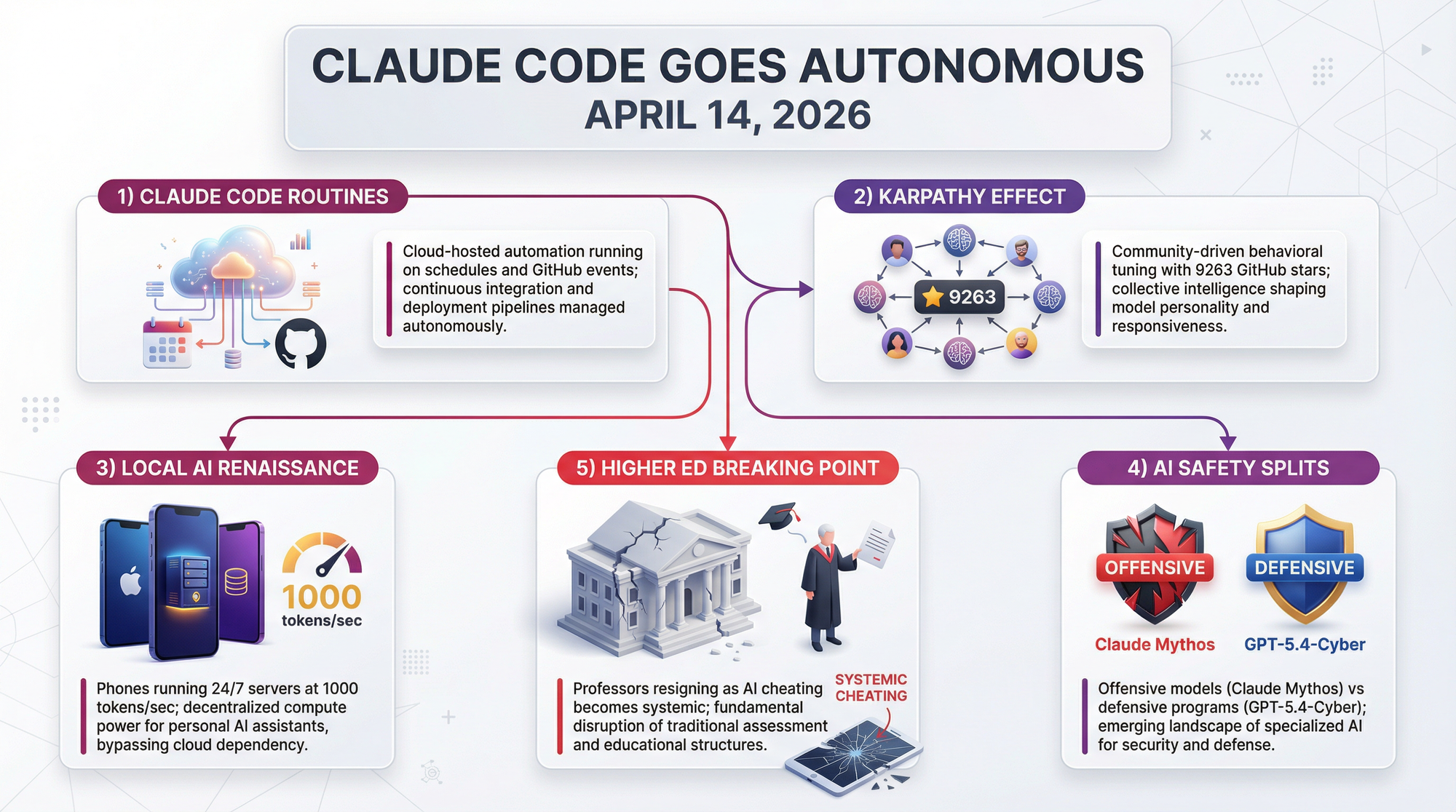
Claude Code Routines, announced April 14 in research preview, lets developers package a prompt, a repository, and a set of connectors (tools Claude can use) into a named Routine. That Routine then runs on Anthropic's cloud infrastructure in response to three kinds of triggers: a schedule (hourly, nightly, weekly), a GitHub event (PR opened, push, issue created), or an API call from any external system.

The use cases Anthropic highlighted read like a developer's wishlist. A nightly routine reads your issue tracker, applies labels, assigns owners, and posts a groomed queue summary to Slack before your team arrives. An alert triage routine wakes up when PagerDuty fires, pulls the stack trace, correlates it with recent commits, and opens a draft PR with a proposed fix. A PR review routine applies your team's specific checklist and leaves inline comments so humans can focus on design decisions instead of mechanical checks.

“Put Claude Code on autopilot. Define routines that run on a schedule, trigger on API calls, or react to GitHub events from Anthropic-managed cloud infrastructure.”
  • Available on Pro, Max, Team, and Enterprise plans with Claude Code on the Web enabled
  • Runs draw against your subscription quota the same way interactive sessions do - a daily run cap applies
  • All commits and PRs appear as you - the routine uses your GitHub identity, not a bot account
  • Research preview means the API surface and pricing may change
  • 409 upvotes and 252 comments on Hacker News - the most-discussed AI developer story of the day
02

Andrej Karpathy's Four Rules for Claude Just Went Viral

What this means for you: If Claude Code frustrates you - it guesses instead of asking, overcompletes what you asked for, or rewrites code you didn't want touched - someone just published a four-rule fix that the community is calling transformative.

Andrej Karpathy (former OpenAI research director and the person who popularized "vibe coding" as a term) published observations about how Claude Code fails, which a developer named Forrest Chang turned into a single CLAUDE.md file. A CLAUDE.md file is a plain-text instruction file placed in a repository that Claude Code reads as behavioral guidelines.

The four rules: (1) Think before coding - state assumptions, present alternatives, ask for clarification rather than guessing. (2) Simplicity first - write minimal code solving only the stated problem, no speculative features. (3) Surgical changes - edit only the necessary code, do not refactor unrelated sections. (4) Goal-driven execution - transform tasks into verifiable success criteria with explicit verification steps.

That's the entire file. Four principles. Available as a Claude Code plugin installable across all projects, or as a single file dropped into any repository.

The deeper point: the most-followed person in AI research used Claude Code, identified its core behavioral failures, and the community immediately built a one-file fix that 34,000 developers starred in days. This is what happens when the leading model's failure modes are predictable enough to be documented.

  • 9,263 new GitHub stars in a single day - the fastest-growing repo on GitHub on April 14
  • Total stars: 33,955 - growing during the day
  • Installable as a Claude Code plugin for cross-project availability via the marketplace
  • "Derived from Andrej Karpathy's observations on Large Language Model (LLM) coding pitfalls" - the repository description
03

Anthropic Is About to Release Opus 4.7

What this means for you: If you use Claude for complex reasoning, code generation, or research, a meaningfully more capable version may arrive this week - alongside a new tool for building websites and presentations without writing code.

The Information, a technology news publication that has broken several Anthropic exclusives, reports that Claude Opus 4.7 is in the final stages of preparation. The potential release window given is "as soon as this week" - mid-April 2026. Alongside the model, Anthropic is reportedly building an AI-powered design tool for creating websites and presentations.

Claude Opus 4.6, the current flagship, launched alongside the Sonnet 4.6 and Haiku 4.5 family. Community reaction (377 upvotes on r/ClaudeAI) was enthusiastic, with multiple users noting this would be the first major model release since the compute over-usage and cache TTL controversies that dominated discussion in recent days.

  • The Information exclusive - typically reliable for Anthropic news
  • "Released as soon as this week" - no confirmed date yet
  • New design tool included alongside the model - for websites and presentations
  • 377 upvotes on r/ClaudeAI - community is actively watching for the announcement
04

Stanford HAI 2026 AI Index: China Is Now Functionally Tied With the US

What this means for you: The AI advantage the US has held since 2018 has essentially evaporated on benchmark performance - and the report that documents this also shows major AI labs are far less transparent than they were two years ago, which means we know less about the systems we are using.

The Stanford Human-Centered Artificial Intelligence (HAI) Institute releases an annual report measuring AI's progress across research, capability, economic impact, and societal dimensions. The 2026 edition has four headline findings that are each significant on their own.

China has nearly erased the US lead on AI benchmarks. Chinese models have traded the top spot on Arena rankings (a head-to-head AI comparison platform where humans vote on which model is better) multiple times since early 2025. The current US margin is 2.7%. Despite this capability parity, China's private AI investment is $12.4 billion versus America's $285.9 billion - China is achieving near-parity with roughly 4% of the US investment.

Young developers are being replaced, not assisted. Employment among software developers aged 22-25 dropped nearly 20% since 2024 - while overall developer productivity rose 26%. AI is enabling fewer developers to do more, not expanding the workforce.

Generative AI adoption is the fastest of any technology in history. 53% population adoption within three years (the personal computer took 16 years to reach that level). 88% organizational adoption. Four of five university students now use these tools.

AI lab transparency has collapsed. The Foundation Model Transparency Index fell from 58 to 40 points. Over 80 of 95 notable models were released without training code. Google, Anthropic, and OpenAI no longer disclose crucial training details.

  • 2.7% US margin over China on Arena rankings - down from a commanding lead in 2024
  • China's investment: $12.4B vs US: $285.9B - capability parity at 4% of the cost
  • 53% global population adoption in 3 years - fastest technology adoption in recorded history
  • Foundation Model Transparency Index: 58 to 40 - a 31% drop in openness
2.7%
US margin over China on
53%
global population adoption in 3
05

A Professor Handed in Their Resignation

What this means for you: If you care about higher education - as a student, parent, teacher, or employer who hires graduates - the r/Professors community is giving you a real-time view of an institution under acute stress. The professor who resigned is not alone; the pattern is widespread.

An r/Professors post titled "Handed in my Resignation" earned 387 upvotes on April 14, one of the most-engaged posts in the community this year. The professor describes an untenable situation created by AI-assisted cheating that their institution either cannot or will not address. The post resonated across hundreds of comments from educators sharing similar breaking-point experiences.

Four other posts on the same day show the context:

This is not isolated frustration. It is a cluster of signals that something structural is failing across higher education simultaneously - and the people closest to it are either leaving or burning out.

  • "Most of my students are dumber than a third grader" (346 upvotes) - a professor describes a collapse in basic academic skills they attribute to years of AI-assisted shortcuts replacing actual learning
  • "Yes, I do see you trying to use ChatGPT during your Final Exam" (185 upvotes) - described as a common, almost resigned, observation rather than an outrage
  • "Student reports me for reporting them" (183 upvotes) - a professor who filed an academic integrity complaint about AI use was reported by the student for filing that complaint
  • Hampshire College announces permanent closure (157 upvotes) - the progressive Massachusetts liberal arts college, founded 1965, will close after fall 2026 semester

Trends & Themes

Trends & Themes

Claude Code Is Becoming a Platform, Not Just a Tool

Why this matters to you: Three separate announcements on April 14 - Routines, the desktop redesign, and the Karpathy CLAUDE.md - plus a community explosion of plugins, all signal that Claude Code has crossed a threshold from "AI coding assistant" into "AI development infrastructure."

Four different teams built infrastructure around the same tool in the same week. That's platform behavior, not tool behavior.

The Latent Space podcast episode with Notion's Simon Last and Sarah Sachs provides the engineering context: production-grade agentic systems require at minimum five rebuilds, a dedicated "Model Behavior Engineer" role, three tiers of evaluations, and careful memory architecture. What Claude Code is shipping is the infrastructure layer that makes those five rebuilds survivable.

  • Routines adds cloud-hosted, event-driven automation - AI agents that keep working after you close your laptop
  • Desktop redesign (206 upvotes on r/ClaudeAI) shows an orchestrator-style view for managing multiple parallel agents - the UI has changed to reflect a different mode of working
  • claude-mem (55,830 GitHub stars, trending #2 today) is a community-built persistent memory layer for Claude Code, capturing session context and making it searchable across time
  • obra/superpowers (152,314 GitHub stars, trending #6 today) is a community-built skills framework giving Claude Code structured TDD workflows and systematic debugging

The AI Economics Phase Is Here - and It Is Ruthless

Why this matters to you: Nate's newsletter makes the case that we have entered a phase where "can it do the thing" has been replaced by "can it make money doing the thing" - and the first wave of AI products that could not answer that second question are now dying.

The piece also notes ChatGPT advertising (via Criteo integration) is achieving 1.5x conversion rates versus search - the first credible signal that AI-interface ads might displace Google's core business rather than complement it.

  • OpenAI's Sora reportedly burned $15 million per day in inference costs against $2.1 million in lifetime revenue. It was shut down. Capability without unit economics is not a product.
  • Atlassian cut 1,600 engineers - one of the largest AI-era engineering workforce reductions at a tech company. The explanation given: AI is handling work that required those roles.
  • Anthropic was blacklisted by a government client after refusing to build autonomous weapons systems - losing the contract but keeping its top App Store ranking in the same week
  • SaaS per-seat pricing is under threat as AI agents reduce the number of human licenses enterprises need to buy. The twenty-year SaaS model was built assuming a human behind every seat.
  • Physical infrastructure is the new bottleneck: 12 states and 50+ local governments are blocking AI data center expansion, and hostile drone activity near construction sites is a documented new phenomenon

Local AI Is Running on Your Old Phone Now

Why this matters to you: AI inference is no longer something that requires a data center, a $1,000 Graphics Processing Unit (GPU), or even a recent laptop. A community of builders is demonstrating that the hardware most people already own is capable enough - and the gap between local and cloud AI is narrowing faster than anyone expected.

The April 2026 Top Local Models list from Latent Space ranks Qwen3.5 as the most broadly recommended family, followed by Gemma 4, GLM-5/4.7, MiniMax M2.7, and DeepSeek V3.2. For coding specifically, Qwen3-Coder-Next has overwhelming community consensus.

  • 741 upvotes on a post showing a Xiaomi 12 Pro (released 2022, available used for under $200) running 24/7 headless AI inference with Ollama and Gemma 4
  • 1,000 tokens per second demonstrated on LocalLLaMA - substantially above what typical consumer hardware produces
  • LLM self-tuning: +54% tokens per second - a tool called llm-server lets the model tune its own llama.cpp inference flags, finding configurations a human would not have tried
  • Qwen3.5-9B is the community consensus model for this class of hardware - systematic quantization comparisons (225 upvotes) show the sweet spots at different quality/speed tradeoffs
  • MiniMax M2.7 on a Mac: running the 229-billion-parameter MoE model on two Asus Ascent GX10 cards means full-size frontier-class models are leaving the cloud (though this requires $5,000+ in hardware)

AI Safety Has Split Into Two Business Lines

Why this matters to you: "AI safety" used to be a single category about preventing harm. In 2026 it has split into two distinct and commercially lucrative segments: offensive security AI (finding vulnerabilities before attackers do) and defensive security AI (protecting systems from AI-powered attacks). Both require gated access. Both charge a lot.

The implication: a new enterprise category is forming around AI-powered security tooling, with gated access, identity verification, and high price points - a structure more like enterprise defense contracts than consumer SaaS.

  • Claude Mythos (covered April 7) is Anthropic's locked-away offensive security model with 12 vetted partners. Zvi Mowshowitz's third deep-dive analysis confirms it scores 92.1% on Terminal-Bench 2.1, 86.9% on BrowseComp - a "genuine trend break" in capability benchmarks.
  • GPT-5.4-Cyber: OpenAI responded this week by launching a Trusted Access for Cyber program, giving verified security professionals reduced-friction access to their cybersecurity models. Unlike Claude Mythos, this does not require a separate lab relationship.
  • The "proof of work" framing: Drew Breunig, summarized by Simon Willison, argues AI security now resembles economic computation - to harden a system you must spend more AI tokens finding vulnerabilities than attackers will spend exploiting them. This creates a commercial moat for whoever controls the most powerful offensive models.
  • Open-source security cost sharing: The proof-of-work logic increases the value of open-source libraries, because security costs can be shared across all users of a shared codebase.

AI Is Transforming Software Engineering But Not as Advertised

Why this matters to you: The data says AI coding tools save time AND create new pressures that consume that saved time. If your team adopted AI tools expecting to work fewer hours, this survey explains why that has not happened.

The Pragmatic Engineer surveyed 900+ software engineers for the most comprehensive portrait of AI's real impact on the profession in 2026. Key findings:

The profession's focus is shifting from "how to build" to "what to build." Orchestrating AI is becoming the core skill, not writing the code itself. Source: The Pragmatic Engineer

  • Nearly 30% have hit token or usage limits, forcing tool-switching or upgrades to premium tiers
  • Three archetypes have emerged: Builders (quality-focused) benefit from AI but struggle reviewing AI-generated low-quality code from colleagues. Shippers (outcome-focused) move faster but accumulate technical debt. Coasters (less experienced) level up but produce cleanup-requiring work.
  • Engineering managers are coding again, narrowing the traditional manager/IC divide
  • Workloads are increasing despite the tools, not decreasing - AI amplifies output expectations rather than reducing hours
  • Solo developers report the strongest gains - no coordination overhead

Creative AI & Media

Baidu ERNIE-Image: Chinese Text-to-Image Model Arrives on HuggingFace

What this means for you: ERNIE-Image gives designers and developers access to a major Chinese image generation model through the standard HuggingFace interface - without needing access to Baidu's Chinese platform.
  • Baidu is China's largest search and AI company, roughly analogous to Google in the US
  • ERNIE is Baidu's AI model family (Enhanced Representation through kNowledge IntEgration)
  • The image model is available via the HuggingFace model hub, which is the standard global repository for AI models
  • No pricing details announced; availability via standard HuggingFace inference endpoints

One Shot Prompt: Generate 3D Game Worlds in Unity With a Single Description

What this means for you: Game developers and 3D designers can now describe an environment and have AI generate a complete interactive Unity scene from that description.
  • Unity is the game engine used by over 70% of mobile games and a large proportion of indie PC and console titles
  • The tool generates playable 3D environments from a single text prompt
  • Hosted at darkounity.com with a demo available
  • Built on top of Claude's API

Developer Tools & Infrastructure

Claude Code Routines: Cloud-Hosted Automation for Developers

What this means for you: You can now schedule Claude Code to run coding tasks automatically - nightly audits, PR reviews, alert triage - without keeping your laptop on or managing your own servers.

See the full writeup in Top Stories above. Key technical details:

  • Three trigger types: schedule (hourly/daily/weekdays/weekly with custom cron via CLI), API (HTTP POST with bearer token), GitHub events (pull request, push, issue, workflow run, and 13 more event types)
  • Clones your repository at each run, starting from the default branch, pushing to claude/-prefixed branches by default
  • Environment controls: network access level, environment variables (for API keys), and a setup script run before each session
  • All your connected MCP connectors (Slack, Linear, Google Drive, etc.) are available to routines
  • /schedule command in the CLI creates and manages routines conversationally

claude-mem: Persistent Memory for Claude Code

What this means for you: If you have ever started a new Claude Code session and had to re-explain your entire codebase, claude-mem solves that by automatically capturing and indexing what Claude did across all previous sessions.
  • Lifecycle hooks capture tool usage and observations at session start, during work, and at session end
  • SQLite + vector search (via Chroma) stores sessions, observations, and summaries for semantic retrieval
  • Progressive disclosure: shows how many tokens each memory retrieval will cost before you commit
  • Three-step search: index, then timeline, then full details - saving roughly 10x tokens vs naive retrieval
  • Web viewer at localhost:37777 for browsing your project memory
  • Works with Claude Code and Google Gemini CLI

obra/Superpowers: Structured Software Development for AI Agents

What this means for you: Superpowers gives Claude Code (and other agents) a methodology to follow rather than just instructions to execute - improving results on complex, multi-step tasks by imposing structured planning, test-first development, and systematic debugging.

GitHub: obra/superpowers · Try it: Install via the Claude Code marketplace

  • Design first: clarifying questions and spec refinement before any code is written
  • Test-Driven Development (TDD): RED-GREEN-REFACTOR cycles enforced at the framework level
  • Granular task breakdown: 2-5 minute atomic tasks with exact file paths and verification steps
  • Systematic debugging: 4-phase root cause analysis when issues arise
  • Available across platforms: Claude Code, Cursor, Codex, OpenCode, GitHub Copilot CLI, Gemini CLI

LLM Self-Tunes Its Own llama.cpp Inference Flags (+54% tok/s)

What this means for you: A new tool called llm-server lets a locally running AI model automatically discover the fastest configuration for your specific hardware - getting 54% more tokens per second without any manual tuning.

GitHub: raketenkater/llm-server · Try it: Open source, requires a local llama.cpp install

  • llm-server is an open-source smart launcher for llama.cpp and ik_llama.cpp (a performance-optimized fork)
  • It detects your GPU hardware, runs a series of inference experiments, and picks the optimal flags
  • +54% tokens per second demonstrated on Qwen3.5-27B (a 27-billion-parameter model) vs default configuration
  • Available on GitHub from u/raketenkater

Caveman: Token Compression That Cuts Claude Code Time by 6x

What this means for you: Caveman is a Claude Code skill that compresses the language Claude uses internally, cutting token usage by roughly 50% and generation time dramatically - one user reported going from one hour to 10 minutes on a complex coding benchmark.
  • How it works: Caveman instructs Claude to use compressed, shorthand representations internally while still producing normal output
  • 50% fewer tokens consumed, with corresponding speed and cost improvements
  • Works as a Claude Code skill - install once, apply to any session
  • Real-world result: 86-upvote post documenting 1-hour-to-10-minute improvement on a complex benchmark

LangAlpha: Claude Code for Financial Research

What this means for you: If you work in investment research or financial analysis, LangAlpha is an open-source starting point for an AI agent that queries financial databases, synthesizes reports, and maintains context across long research sessions - all built on Claude.

GitHub: ginlix-ai/langalpha · Try it: Open source

  • Open source (MIT license), built by Ginlix AI
  • Persistent memory across research sessions - remembers context from prior queries
  • Connects to financial data sources - designed for structured financial data retrieval
  • 103 HN upvotes with 36 comments on the Show HN launch
  • Built specifically for investment decision-making workflows

Research & Models

HALO-Loss: Teaching AI to Say "I Don't Know"

What this means for you: Standard AI models give confident wrong answers on topics they have never seen. HALO-Loss is a near-drop-in code replacement that gives models a principled "I don't know" option - making AI classifiers dramatically more honest about their uncertainty.
  • Standard cross-entropy loss pushes a model to always pick an answer, even when none of the options is close to right
  • HALO-Loss adds an abstention option: the model learns when to say "I don't know" instead of guessing
  • Out-of-Distribution (OOD) detection: catches inputs that are genuinely outside the training distribution
  • Drop-in PyTorch replacement: three lines of code to swap in
  • GitHub repo + detailed blog post both available

ClawBench: Real Web Agents Only Succeed 33% of the Time

What this means for you: Despite all the excitement about AI agents doing tasks, the best current AI systems succeed at only one in three everyday online tasks when tested against live websites - not simulated ones.
  • 153 everyday tasks against 144 live websites: booking flights, ordering groceries, submitting job applications
  • Best model success rate: 33.3% - two-thirds of tasks fail on real-world sites
  • Critical gap: most existing benchmarks use controlled simulations; ClawBench uses production websites with all their complexity
  • The benchmark tests the full agentic loop: understanding what to do, navigating to the right place, filling forms correctly, and confirming success

DDTree: 6-8x Inference Speedup for Local Models

What this means for you: If you run local AI models, DDTree is a technique that makes them 6 to 8 times faster at generating tokens - with no quality loss - by predicting multiple tokens at once instead of one at a time.
  • Speculative decoding: generates a draft tree of likely next tokens, then validates them in parallel
  • Builds on DFlash (Block Diffusion Flash Speculative Decoding) for an additional layer of speedup
  • 6-8.2x speedup over standard autoregressive (one-token-at-a-time) generation
  • Open source, targeting llama.cpp and compatible runtimes
  • r/MachineLearning post generated active discussion

I-DLM: Diffusion Language Models That Match Autoregressive Quality

What this means for you: Diffusion language models (a different architecture than the transformers powering most current AI) now match autoregressive models in quality while being 3-4x faster - potentially pointing toward a new generation of AI inference.
  • Diffusion language models (DLMs): generate text by starting with noise and refining it, similar to how Stable Diffusion generates images - but for language
  • Previous limitation: DLMs were faster but noticeably lower quality than transformer-based (autoregressive) models
  • I-DLM's breakthrough: achieves quality parity with autoregressive models while maintaining 2.9-4.1x throughput gains
  • "Introspective" means the model self-evaluates its generation quality during the process

Ben's Bites: The "Headless SaaS" Shift

What this means for you: Box's CEO issued a warning this week that enterprises will eject vendors who make it hard or expensive for AI agents to use their products. The era of software designed only for humans is ending.

Ben's Bites rounds up leaked AI lab details showing:

Source: Ben's Bites

  • Claude is internally referred to as a "headless SaaS" product - meaning it is increasingly used by agents rather than humans
  • Leaked Anthropic details describe a shift in Claude's design toward agent-friendliness as a primary requirement
  • Box, Atlassian, Salesforce are all restructuring interfaces to support agent access alongside human access

Business & Industry

Anthropic Preps Opus 4.7 and an AI Design Tool

What this means for you: The next Claude model may arrive this week. And the accompanying design tool suggests Anthropic is expanding beyond coding into creative and productivity applications.

See Top Stories above for full coverage.

Anthropic Acknowledges and Fixes Claude Code Compute Over-Usage

What this means for you: If you were one of the users whose Claude Code session window was depleting in 19 minutes instead of five hours, Anthropic has identified and fixed the underlying issue.

Previously: April 12 - Claude Code's token inflation bug was documented. April 13 - Developers documented $2,530 in surprise overcharges from the cache TTL change.

Today: A 360-upvote r/ClaudeAI post confirms Anthropic has fixed the compute over-usage problem where single prompts were consuming 3-7% of session quota each. Community investigation had identified a cluster of related GitHub issues including an OAuth paste regression and a session-resume bug introduced in version 2.1.105. The fix reportedly restores normal session duration behavior.

OAuth flow bugs remain open for SSH and WSL2 environments as of publishing time.

AI Economics: Five Shifts Happening Right Now

See Trends & Themes above for the full breakdown from Nate's Newsletter. The five shifts: inference unit economics, ad-based AI monetization emerging, physical infrastructure bottlenecks, SaaS per-seat pricing under pressure, and geopolitical tightrope for labs refusing to build weapons.

OpenAI Launches GPT-5.4-Cyber Trusted Access Program

What this means for you: Verified security professionals can now apply for reduced-friction access to OpenAI's cybersecurity AI models - a lower barrier than Claude Mythos's 12-partner structure but still gated.
  • GPT-5.4-Cyber is OpenAI's model variant for defensive cybersecurity work
  • Trusted Access for Cyber program requires identity verification for enhanced access
  • OpenAI still requires a separate application process for their best security tools
  • This is OpenAI's competitive response to Anthropic's Project Glasswing / Claude Mythos
  • Both companies are establishing the same gatekeeping structure: capability with accountability

Meta Faces Privacy Warning From 75 Organizations

What this means for you: A broad coalition of civil society groups has formally warned that Meta's plans for AI-powered data collection represent "a serious threat to privacy."
  • 75 organizations co-signed a public warning directed at Meta
  • The warning focuses on Meta's plans to use AI to process personal data at scale
  • Details of the specific plans were not fully disclosed in available reporting
  • Follows ongoing scrutiny of Meta's AI data practices in Europe and the US

GenAI in Education

A Professor Resigned. The Community Responded.

What this means for you: The r/Professors thread is the closest real-time signal we have to what AI is doing to higher education from the inside. This week's cluster of posts describes a system under acute strain.

See the full Top Stories entry above. The four key posts from April 14:

  • 387 upvotes: Handed in my Resignation - Professor hands in resignation, connected to AI-era teaching conditions
  • 346 upvotes: "Most of my students are dumber than a third grader" - assessment of AI-assisted skill atrophy
  • 185 upvotes: Catching ChatGPT use during a final exam - described as routine
  • 183 upvotes: Student reports professor for filing an academic integrity complaint

Hampshire College Will Close After Fall 2026

What this means for you: The closure of Hampshire College - one of the most distinctive liberal arts institutions in the US - is being mourned by educators as a signal that non-traditional educational models are fragile in the current environment.
  • Hampshire College was founded in 1965 in Amherst, Massachusetts
  • Known for: no required courses, no letter grades, individualized learning contracts, a single undergraduate degree requirement (a senior thesis project called a "Division III")
  • Will close after the fall 2026 semester
  • The closure is attributed to structural financial difficulties, with the AI-disrupted enrollment environment contributing
  • 157 upvotes on r/Professors; the comments describe genuine grief from educators who saw Hampshire as a model

AI Adoption in Universities: 4 Out of 5 Students Use These Tools

From the Stanford HAI 2026 AI Index:

  • 80% of university students now use generative AI tools
  • This is not "AI adoption" in the sense of occasional use - it is near-universal
  • Combined with the professor posts above: the adoption is happening faster than academic integrity frameworks can adapt

Surprising & Under-the-Radar

CUDA 13.2 Silently Breaks Quantization

What this means for you: If you updated your CUDA drivers recently and your quantized models suddenly produce garbage output, there is a known bug. Do not upgrade to CUDA 13.2 if you use IQ3 or lower quantizations.

CUDA 13.2 (Nvidia's GPU computing toolkit) has a compiler bug that silently breaks IQ3 and lower quantization levels across multiple models. The bug was identified by the llama.cpp community and is documented in GitHub issue #21255. The failure mode produces incorrect output without warning - the model runs but the output is wrong.

Neural Networks That Know What They Don't Know

This is more surprising than it sounds. Standard AI classifiers are trained to always pick the most likely answer. HALO-Loss is a near-drop-in fix that lets a model say "I don't know" when no good answer exists. The research community has tried this for years; this implementation is a three-line code swap. The surprise: it took this long to make "I don't know" easy to add. See Research & Models for details.

A Community Debate: Open Source Will Never Match Claude Opus

An r/ClaudeAI thread with 157 upvotes asks "when, if ever, will open source match Claude Opus 4.5?" The community's emerging answer: for raw general-purpose reasoning, probably not before 2027 at the earliest. For specific domains (code, math, narrow tasks), open-source models are already competitive or ahead. The divide is increasingly between "does everything well" (proprietary) versus "does this one thing very well" (open source).

Professors Are Using Petting Zoos as Stress Relief Now

An r/Professors post with 131 upvotes enthusiastically describes a campus petting zoo held as a pre-finals week student wellness event. The vibes are genuinely warm. In a week of post after post about resignation and burnout, this one is a small reminder that the humans in this system are still there and still care - they are just exhausted.

Claude Refusing to Write Code "So You Can Learn"

A 104-upvote r/ClaudeAI post captures a recurring phenomenon: Claude sometimes refuses to write code and instead explains concepts "so the user can learn." The post title calls it a "gigachad" move. The comments are split between appreciation (that's genuinely helpful) and frustration (I asked for the code, not a lesson). This is an unresolved behavioral design tension that shows up repeatedly in Claude discussions.

Signals to Track

Worth Watching
01

LangAlpha: Claude Code for Wall Street

The first credible open-source template for domain-specific AI agents that replace expensive specialized research functions - if it works for finance, the pattern will spread to law, medicine, and engineering.

LangAlpha got 103 upvotes and 36 comments on its Hacker News launch. It is built on Claude, designed for investment research, and is fully open source. The interesting signal: it is not built by a major lab. It is a small team (Ginlix AI) using a commodity API (Claude) to build a domain-specific agent that would previously have required a dedicated quant research team.

If this pattern scales - small teams using frontier models to build vertical-specific agents for high-value domains - the disruption to professional knowledge work is closer than most sector analyses suggest. What changes for ordinary people: the cost of specialized research (legal opinions, financial analysis, engineering assessments) drops sharply because the specialized human time required drops.

02

DDTree and I-DLM: The Inference Revolution That Is Not Getting Enough Attention

Two separate speedup papers on the same day - one empirical (DDTree, 6-8x), one architectural (I-DLM, 3-4x) - suggest inference efficiency is entering a rapid-improvement phase that could make local AI dramatically more capable within months.

DDTree builds on DFlash. I-DLM challenges the assumption that diffusion models cannot match autoregressive quality. These are not incremental improvements - they are technique-class advances. The reason they matter together: if inference gets 6-8x faster AND a new architecture matches quality at 3-4x throughput, the combination points toward models running on current consumer hardware that perform like today's cloud APIs. What changes for ordinary people: the "you need a $30/month subscription" assumption starts to break.

03

The "Headless SaaS" Framing Is the Most Important Business Model Shift of 2026

When Box's CEO says "enterprises will eject vendors that make it hard for agents to use their products," he is describing a new purchasing criterion that will reshape enterprise software over the next three years.

Ben's Bites' coverage of leaked AI lab details this week centers on the "headless SaaS" concept - software used primarily by AI agents rather than humans. The existing enterprise software stack was designed for humans. Every UI, every workflow, every pricing model assumes a human sitting behind it. As AI agents become the primary users of software, the entire enterprise software industry has to rebuild - or get replaced by something agent-native. This is happening now, not in five years.

What changes for ordinary people: the software your employer pays for will change faster than it has in decades. And the vendors that survive will be the ones that made it easy for AI to work with their systems. Source: Ben's Bites

Top Repos Today

Rank yesterday: New entry 🆕
⭐ Stars today: +9,263  ·  📦 Total: 33,955
📜 License: MIT  ·  👤 By: Community developer
🎯 Time to value: 5 minutes
What it is: A single CLAUDE.md file distilling Andrej Karpathy's observations about Claude Code's failure modes into four behavioral rules: think before coding, simplicity first, surgical changes only, and goal-driven execution. Available as a Claude Code plugin or as a file you drop into any repository. Why you'd want it: If Claude Code has ever guessed wrong instead of asking, refactored code you didn't want touched, or solved a harder version of your problem than you asked for, this file addresses all three.
✓ Pros✗ Cons
Five-minute install, cross-project impactRules are behavioral guidelines, not enforcement mechanisms
Derived from the most-followed researcher in AIMay need adjustment for your specific workflow preferences
Already 34,000 developers validated itDoes not help with Claude's reasoning capability limits
GitHub - forrestchang/andrej-karpathy-skills: A single CLAUDE.md file to improve Claude Code behavior, derived from Andrej Karpathy’s observations on LLM coding pitfalls.
A single CLAUDE.md file to improve Claude Code behavior, derived from Andrej Karpathy’s observations on LLM coding pitfalls. - forrestchang/andrej-karpathy-skills
Rank yesterday: Holding steady ➡
⭐ Stars today: +2,997  ·  📦 Total: 55,830
📜 License: MIT  ·  👤 By: Community developer
🎯 Time to value: 15 minutes
What it is: A persistent memory plugin for Claude Code that captures everything Claude does during coding sessions, compresses it with AI, and makes it searchable across future sessions. Prevents the "re-explain your codebase every session" problem. Why you'd want it: Solves the single most frustrating aspect of working with stateless AI coding assistants on long-running projects.
✓ Pros✗ Cons
Works across sessions automaticallyRequires local server process (port 37777)
Semantic search across all past sessionsAdds token overhead for memory retrieval
Compatible with Claude Code and Gemini CLIStill in active development
GitHub - thedotmack/claude-mem: A Claude Code plugin that automatically captures everything Claude does during your coding sessions, compresses it with AI (using Claude’s agent-sdk), and injects relevant context back into future sessions.
A Claude Code plugin that automatically captures everything Claude does during your coding sessions, compresses it with AI (using Claude's agent-sdk), and injects relevant context back into fut…
Rank yesterday: New entry 🆕
⭐ Stars today: +1,162  ·  📦 Total: 17,356
📜 License: MIT  ·  👤 By: Community developer
🎯 Time to value: 10 minutes
What it is: An open-source voice synthesis studio for creating and editing AI-generated speech. Provides a UI for voice cloning, multi-speaker mixing, and audio export. Why you'd want it: Production-quality voice synthesis without a SaaS subscription or API costs, runnable entirely locally.
✓ Pros✗ Cons
Full studio UI, not just a scriptVoice quality depends on your compute hardware
MIT license - commercial use allowedSetup complexity higher than API alternatives
Active developmentRequires capable GPU for real-time synthesis
GitHub - jamiepine/voicebox: The open-source voice synthesis studio
The open-source voice synthesis studio. Contribute to jamiepine/voicebox development by creating an account on GitHub.
Rank yesterday: Rising ↑
⭐ Stars today: +1,919  ·  📦 Total: 152,314
📜 License: MIT  ·  👤 By: Jesse Vincent
🎯 Time to value: 10 minutes
What it is: An agentic skills framework giving AI coding agents a structured software development methodology - design first, test-driven development, systematic debugging - available for Claude Code, Cursor, Copilot, and other agents. Why you'd want it: Improves results on complex multi-step coding tasks by imposing structure instead of letting the agent make guesses.
✓ Pros✗ Cons
Works across multiple agent platformsMethodology-heavy - not for simple one-shot tasks
Active ecosystem with community contributionsLearning curve for the framework conventions
152K stars signals broad real-world validationSome workflows require customization
GitHub - obra/superpowers: An agentic skills framework & software development methodology that works.
An agentic skills framework & software development methodology that works. - obra/superpowers
Rank yesterday: Rising ↑
⭐ Stars today: +8,301  ·  📦 Total: 84,438
📜 License: Apache 2.0  ·  👤 By: Nous Research
🎯 Time to value: 20 minutes
What it is: A self-improving AI agent from Nous Research that runs on any infrastructure from a $5 VPS to a GPU cluster, connects to Telegram, Discord, Slack, WhatsApp, and Signal, and autonomously creates and improves its own skills from experience. Why you'd want it: An always-on personal AI assistant that reaches you on any messaging platform and gets better at your specific tasks over time.
✓ Pros✗ Cons
Runs 24/7 on cheap infrastructureSelf-modification introduces unpredictability
Multi-platform messaging (Telegram, Discord, WhatsApp, Signal)Complex setup for non-technical users
Works with 200+ models via OpenRouterAutonomous skill creation needs careful review
GitHub - NousResearch/hermes-agent: The agent that grows with you
The agent that grows with you. Contribute to NousResearch/hermes-agent development by creating an account on GitHub.
Rank yesterday: Holding steady ➡
⭐ Stars today: +1,675  ·  📦 Total: 108,488
📜 License: MIT  ·  👤 By: Microsoft
🎯 Time to value: 2 minutes
What it is: A Python tool that converts files and Office documents (Word, Excel, PowerPoint, PDF) to Markdown - making them usable as AI context without conversion infrastructure. Why you'd want it: The fastest path to feeding existing office documents into any AI workflow.
✓ Pros✗ Cons
Microsoft-maintained, highly reliableConversion quality varies by document complexity
Single pip installComplex tables and charts lose fidelity
108K stars - battle-testedNo round-trip editing back to original format
GitHub - microsoft/markitdown: Python tool for converting files and office documents to Markdown.
Python tool for converting files and office documents to Markdown. - microsoft/markitdown
Rank yesterday: Rising ↑
⭐ Stars today: +931  ·  📦 Total: 40,262
📜 License: MIT  ·  👤 By: Anthropic
🎯 Time to value: 5 minutes
What it is: Official Anthropic collection of notebooks and recipes showing effective ways to use Claude - with runnable Jupyter notebooks covering common use cases from structured output to multi-agent workflows. Why you'd want it: The fastest way to go from "I have API access" to "I have a working Claude integration" for common tasks.
✓ Pros✗ Cons
Official Anthropic source - always currentCookbook format, not production code
Jupyter notebooks - interactive and runnableLimited to patterns Anthropic chose to document
Covers multi-agent, tool use, and moreRequires API key for most examples
GitHub - anthropics/claude-cookbooks: A collection of notebooks/recipes showcasing some fun and effective ways of using Claude.
A collection of notebooks/recipes showcasing some fun and effective ways of using Claude. - anthropics/claude-cookbooks

Top Models Today

China's open-weight frontier model, holding the top HuggingFace trending spot
📥 Downloads (30d): 84.8k  ·  📜 License: MIT
👤 By: Z.ai (China)  ·  🎯 Task: Text Generation
📐 Size: 754B
What it is: The 754-billion-parameter open-weights model released by Z.ai under a full MIT license. The largest freely downloadable model with MIT licensing currently available. Covered in depth April 7. Why you'd want it: The most capable open model available with no commercial restrictions.
✓ Pros✗ Cons
MIT license - fully commercial1.51TB download - requires serious infrastructure
Frontier-class benchmark performanceNeeds distributed GPU setup to run locally
Full open weights for researchChinese lab, different training data distribution
zai-org/GLM-5.1 · Hugging Face
We’re on a journey to advance and democratize artificial intelligence through open source and open science.
229B MoE model - community is now running it on local hardware
📥 Downloads (30d): 43.6k  ·  📜 License: Modified MIT
👤 By: MiniMax  ·  🎯 Task: Text Generation
📐 Size: 229B
What it is: MiniMax's 229-billion-parameter Mixture of Experts model - covered in depth April 12. New today: GGUF builds now available, NaN bugs fixed by the community, and confirmed running on Mac with 2x Asus Ascent GX10 cards at 91% MMLU. Why you'd want it: Frontier-class reasoning at local-deployment price points for organizations with capable hardware.
✓ Pros✗ Cons
229B MoE is very capable per-token cost"Modified MIT" license has commercial restrictions
Community GGUF builds availableStill requires substantial hardware (64GB+ VRAM)
NaN bugs in original were fixed by communityNot suitable for consumer hardware
MiniMaxAI/MiniMax-M2.7 · Hugging Face
We’re on a journey to advance and democratize artificial intelligence through open source and open science.
Gemma 4 31B - the sweet spot model for capable local deployment
📥 Downloads (30d): 2.64M  ·  📜 License: Gemma Terms
👤 By: Google  ·  🎯 Task: Image-Text-to-Text
📐 Size: 33B
What it is: Google's 31-billion-parameter instruction-tuned Gemma 4 model - multimodal (handles both images and text). The most-downloaded model on HuggingFace this month. Community consensus: 4-bit quantization makes it practical on high-end consumer hardware (24GB VRAM). Why you'd want it: Strong multimodal capability at a size that fits on consumer hardware with quantization.
✓ Pros✗ Cons
2.64M downloads validates qualityGoogle's license has some commercial restrictions
Vision + language in one modelStill requires 24GB VRAM for 4-bit
Strong benchmark scores vs peersLicense terms require checking for commercial use
google/gemma-4-31B-it · Hugging Face
We’re on a journey to advance and democratize artificial intelligence through open source and open science.
LG AI's vision-language model - newly released, entering the trending charts
📥 Downloads (30d): 4.83k  ·  📜 License: EXAONE
👤 By: LG AI Research  ·  🎯 Task: Image-Text-to-Text
📐 Size: 34B
What it is: LG AI Research's latest open-weight vision-language model in 33 billion parameters. Outperforms GPT-5 mini across 13 visual benchmarks according to LG's evaluation. Released within the last 24 hours. Why you'd want it: Competitive multimodal performance from a non-US lab with full open weights.
✓ Pros✗ Cons
Strong vision benchmark claimsProprietary EXAONE license - check terms
34B parameters - deployable on professional hardwareVery new - limited independent testing
Korean industrial lab with enterprise focusLimited community support yet
LGAI-EXAONE/EXAONE-4.5-33B · Hugging Face
We’re on a journey to advance and democratize artificial intelligence through open source and open science.
Community note: this is a distilled model, not Opus - verify before using
📥 Downloads (30d): 589k  ·  📜 License: Apache 2.0
👤 By: Community  ·  🎯 Task: Image-Text-to-Text
📐 Size: 28B
What it is: A community fine-tune that distills Claude Opus 4.6 reasoning capabilities into the Qwen3.5-27B open-source base model. Promising 589,000 downloads but note: community debate (157 upvotes today) suggests these "Claude Opus fine-tunes" are typically not accurate representations of Opus capabilities - the smaller base model has a ceiling. Why you'd want it: Worth testing for reasoning tasks where you want a locally-runnable model, but calibrate expectations.
✓ Pros✗ Cons
Apache 2.0 - fully commercial"Distilled Claude" is a marketing claim, not a technical fact
589K downloads signals real usageCommunity warns these are usually degraded models
27B is runnable on consumer hardwareThe name overpromises relative to actual Opus
Jackrong/Qwen3.5-27B-Claude-4.6-Opus-Reasoning-Distilled · Hugging Face
We’re on a journey to advance and democratize artificial intelligence through open source and open science.

AI Launches Today

"Design with AI agents, connected to your design system"
🔥 Upvotes: 431  ·  👤 By: Figma
💰 Pricing: Subscription (existing Figma plans)  ·  🏷 Category: Design Tools / Developer Tools
Figma for Agents prevents AI design agents from breaking brand standards by giving them direct access to your design system via the use_figma Model Context Protocol (MCP) tool (a standard interface for AI to access external systems). When an AI agent generates a UI, it queries your design system for correct fonts, colors, and components - producing brand-consistent output instead of generic designs. Verdict: Figma is the dominant design tool for professional teams. Agent support here is not a novelty - it is infrastructure for the next wave of AI-assisted product development.
Product Hunt – The best new products in tech.
Product Hunt is a curation of the best new products, every day. Discover the latest mobile apps, websites, and technology products that everyone’s talking about.
"Build business apps with AI - that actually work"
🔥 Upvotes: 314  ·  👤 By: Softr
💰 Pricing: Freemium  ·  🏷 Category: No-code / Automation
Describe what internal tool or portal you need, and Softr's AI creates the database structure, app logic, and interface automatically. Designed for non-technical users building HR portals, client portals, and internal tools. Verdict: Softr has been a credible no-code tool for years. The AI co-builder makes it accessible to people who previously needed a developer for even simple internal apps.
Product Hunt – The best new products in tech.
Product Hunt is a curation of the best new products, every day. Discover the latest mobile apps, websites, and technology products that everyone’s talking about.
"An AI agent with its own computer builds your apps"
🔥 Upvotes: 310  ·  👤 By: CatDoes
💰 Pricing: Not specified  ·  🏷 Category: AI Coding Agents / No-Code App Builder
A no-code builder where an AI agent literally installs packages, writes code, runs tests, and fixes errors to build mobile apps and websites. The agent has access to a real computer environment, not just a code editor. Verdict: The "AI with its own computer" framing is increasingly common. The test for this class of tool: does the output actually deploy and work? That is still the variable to watch.
"Your AI engineering department that ships your backlog"
🔥 Upvotes: 273  ·  👤 By: Ovren
💰 Pricing: Not specified  ·  🏷 Category: AI Coding Agents
AI frontend and backend engineers that tackle your backlog - delivering reviewable code PRs that require human approval before deployment. Designed for teams that want AI to handle implementation while humans keep architectural control. Verdict: The "human-in-the-loop PRs" model is the right pattern for production code. How much of a real backlog it can clear is the open question.
"The Agentic Sales Platform"
🔥 Upvotes: 233  ·  👤 By: FuseAI
💰 Pricing: Paid  ·  🏷 Category: AI Sales Tools
Consolidates outbound sales tooling (contact enrichment, LinkedIn automation, email workflows, pipeline generation) into a single AI-driven platform. An AI agent handles prospecting and initial outreach. Verdict: Outbound sales automation is a crowded space. The differentiator claim here is consolidation rather than a breakthrough capability.

Snapshot

ProviderModelInput $/1MOutput $/1MContext
GoogleGemini 3.1 Pro Preview$2.00$12.00200k
GoogleGemini 3.1 Flash-Lite Preview$0.25$1.50N/A
GoogleGemini 2.5 Flash$0.30$2.50N/A
GroqQwen3 32B (128k)$0.29$0.59128k
GroqLlama 4 Scout (17Bx16E)$0.11$0.34128k
GroqLlama 3.1 8B Instant$0.05$0.08128k
AnthropicClaude modelsSee consoleSee console200k
OpenAIGPT modelsRate limitedRate limitedN/A
Note: Anthropic and OpenAI API pricing pages were not publicly accessible via fetch today. Groq and Google prices confirmed. Establishing baseline - will track changes going forward.

What this means: Groq's Qwen3 32B at $0.29/$0.59 per million tokens represents strong value for an open-weight frontier model at high speed. Google's Gemini 3.1 Flash-Lite at $0.25/$1.50 is competitive with Claude Haiku for lightweight tasks.

ClawGUI: A Unified Framework for Training, Evaluating, and Deploying GUI Agents

Unspecified authors · arXiv:2604.11784
What it claims: ClawGUI provides a single framework addressing the three hardest practical problems in GUI agent development: unstable training infrastructure, inconsistent evaluation across labs, and difficult real-device deployment.

Key finding: The ClawGUI-2B model achieves 17.1% success rate on MobileWorld GUI-Only, outperforming the same-scale MAI-UI-2B baseline by 6.0 percentage points, while the evaluation pipeline achieves 95.8% reproduction against official baselines across 6 benchmarks and 11+ models.

Why practitioners should care: "GUI agents" are AI systems that control software by clicking, typing, and navigating interfaces - potentially replacing repetitive computer tasks. Training these agents requires infrastructure that most research teams have to build from scratch. ClawGUI solves that by providing standardized training and evaluation tooling that enables cross-lab comparison. The multi-platform deployment (Android, HarmonyOS, iOS, 12+ chat platforms) makes it the most deployment-ready framework in the space.

Member discussion

Subscribe to GenAI Secret Sauce newsletter and stay updated.

Don't miss anything. Get all the latest posts delivered straight to your inbox. It's free!

By subscribing, you agree to our Privacy Policy and Terms. We track email opens and clicks. Unsubscribe anytime.

Great! Check your inbox and click the link to confirm your subscription.