GenAI Secret Sauce Daily Digest - 2026-04-12

MiniMax M2.7: Frontier Performance, Community-Hostile License · Llama.cpp Goes Fully Multimodal - Audio Lands This Week · Claude Code Version 2.1.100 Has a Token Inflation Bug
GenAI Secret Sauce Daily Digest - 2026-04-12

Watch today's digest as a video summary (generated by NotebookLM)

Statistically Speaking
64 GB+ RAM
MiniMax M2.7
Top Story
2.0 quantizations from 1
MiniMax M2.7
4 E2B and E4B (via mlx
Llama.cpp Goes Fully Multimodal - Audio Lands This Week
2.1.100 inflation
Claude Code Version 2.1.100 Has a Token Inflation Bug
One Thing to Tell Your Friends
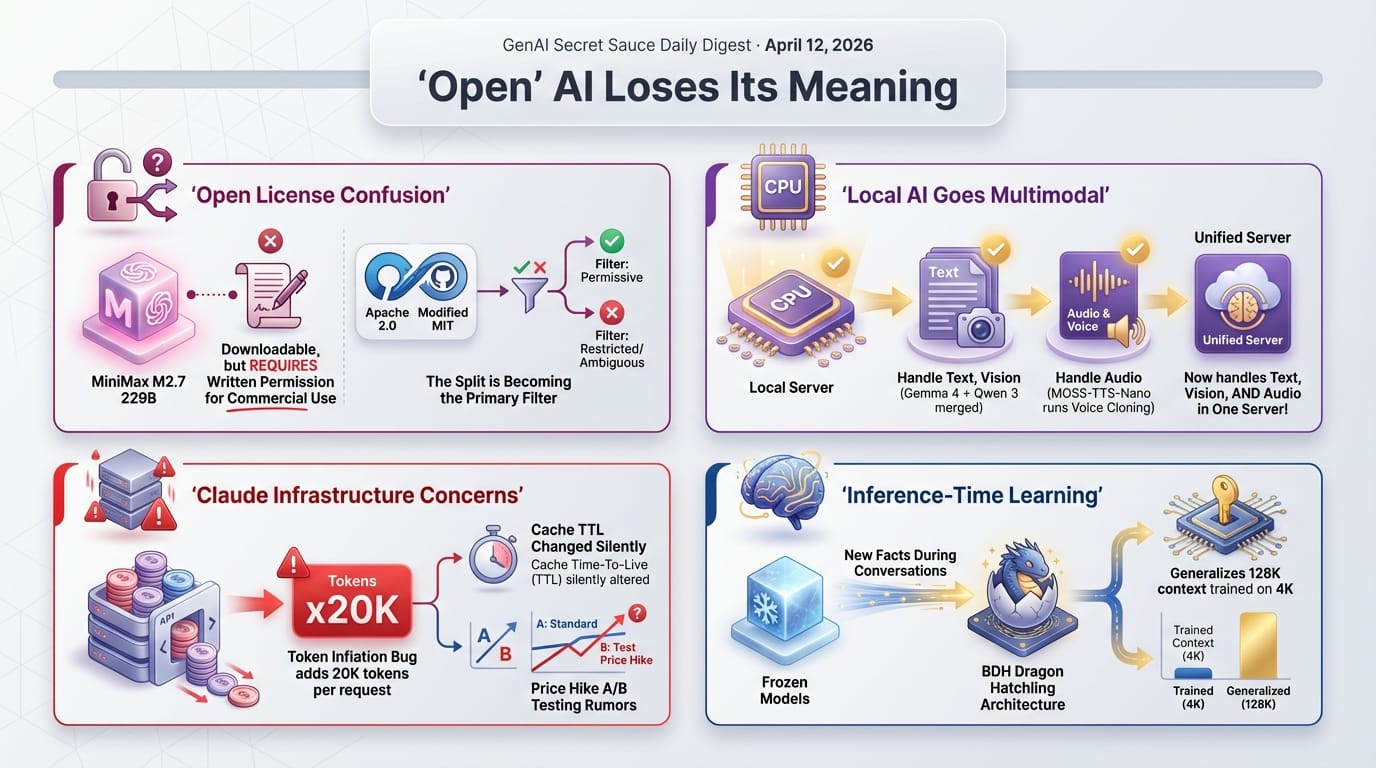
MiniMax released a model that matches GPT-5.3-Codex on software engineering benchmarks - and the open-source AI community immediately declared it "dead on arrival" because the license requires written permission from MiniMax just to use it commercially.
TL;DR
Trends
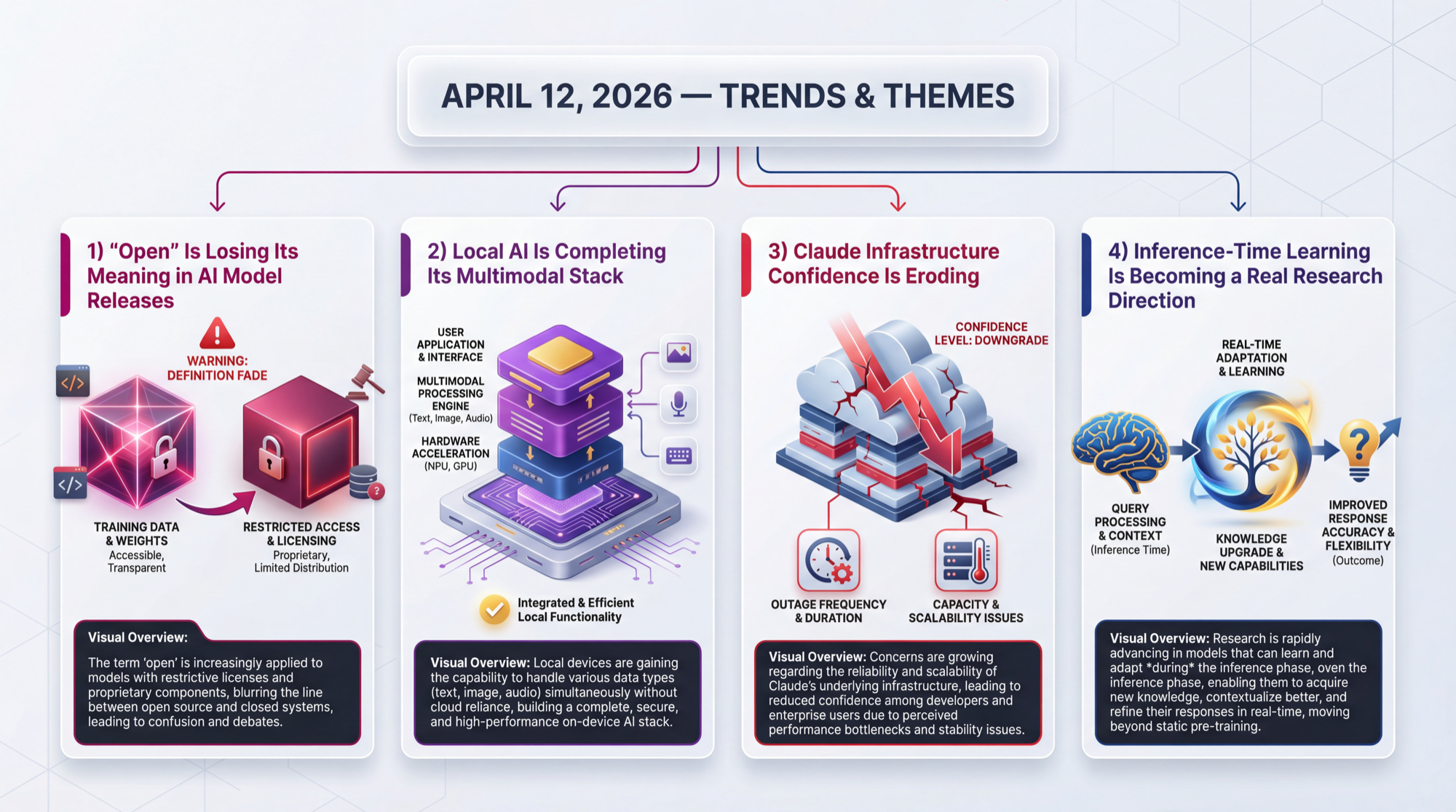
"Open" Is Losing Its Meaning in AI Model Releases, Local AI Is Completing Its Multimodal Stack, and Claude Infrastructure Confidence Is Eroding.
Creative AI
LLM Robot Wars: AI Writes and Improves Its Own Combat Code, Training an AI to Survive Resident Evil: Behavioral Cloning in Practice, and MOSS-TTS-Nano: 0.1B Text-to.
Dev Tools
Claudraband: Persistent, Resumable Claude Code Sessions, Making Gemini Useful With Claude: Free Token Arbitrage via MCP, and LazyMoE: Run 120B Models on 8 GB RAM (With Caveats).
Worth Watching
BDH Architecture: What If the Model Could Rewrite Its Own Weights During a Conversation?, Speculative Decoding Is Becoming the Default Optimization for Local LLMs, and On-Device Wearable AI: Privacy.
Hot off the Presses
01
MiniMax M2.7: Frontier Performance, Community-Hostile License
What this means for you: If you were planning to run this model locally for your business or deploy it in any commercial product, you need written permission from MiniMax first. For personal research, it's free. For anything commercial, treat it like a closed model.

MiniMax released M2.7, a 229-billion parameter Mixture of Experts (MoE) model where only about 10 billion parameters activate per token - meaning it runs at roughly 10B-equivalent speed despite the headline size. On software engineering benchmarks, it scores 56.22% on SWE-Pro (matching GPT-5.3-Codex), 76.5% on SWE Multilingual, and 57% on Terminal Bench 2 (which tests log analysis, bug troubleshooting, and security audits). On professional work automation, it achieves ELO 1495 on GDPval-AA - highest among open-source releases.

The model even helped build itself: an internal version improved 30% through 100+ autonomous optimization rounds and achieved a 66.6% medal rate across 22 ML (machine learning) competitions on MLE Bench Lite, second only to Opus-4.6 and GPT-5.4.

The local LLM community's reaction was swift and negative - multiple threads calling it "DOA" (dead on arrival) relative to Apache 2.0 models like Llama or Qwen3. The license restrictions carry through to all quantized versions.

  • The license problem: Modified MIT terms prohibit commercial use without written authorization from MiniMax ([email protected]). Authorized users must display "Built with MiniMax M2.7" on their product
  • Hardware reality: The smallest quantized version (UD-IQ1_M) runs at 60.7 GB - requiring at least a dual-Graphics Processing Unit (GPU) setup or Mac Studio with 64GB+ RAM
  • Unsloth responded fast: Dynamic 2.0 quantizations from 1-bit to 16-bit BF16 are already uploaded; the community quickly noted the commercial restrictions apply to all quantized variants
02
Llama.cpp Goes Fully Multimodal - Audio Lands This Week
What this means for you: If you're running local AI, you can now send audio files to the same llama-server you use for text and images. No separate Whisper setup, no additional software - one endpoint handles everything.

Two audio-related pull requests merged into llama.cpp this week. The first adds a 12-layer Conformer encoder (a type of audio processing architecture) for Gemma 4 models, converting raw audio waveforms into embeddings the model can process. Simon Willison confirmed it works with a simple uv run command using the Gemma 4 E2B model (10.28 GB download) on Apple Silicon. The second PR adds audio support for Qwen3-Omni (text, vision, and audio) and Qwen3-ASR (audio-only transcription), processing audio in 30-second chunks through a Whisper-like transformer encoder.

A key technical finding from the Gemma 4 audio PR: the multimodal projector is highly sensitive to quantization precision - BF16 (16-bit brain float) is required for reliable results, and lower precision formats cause numerical drift. One community member also reported a 29% tokens-per-second improvement using speculative decoding with the Gemma 4 31B model paired with E2B as a draft model.

  • What's now possible locally: Speech-to-text, audio Q&A, and multimodal text+vision+audio conversations - all without cloud APIs
  • Supported models: Gemma 4 E2B and E4B (via mlx-vlm or llama-server), Qwen3-Omni, Qwen3-ASR
  • The llama-server path: Audio processing uses the same Application Programming Interface (API) endpoint format as image processing - send an audio file, get a text response
03
Claude Code Version 2.1.100 Has a Token Inflation Bug
What this means for you: If you're on a Claude Max subscription with a 5-hour usage limit and you've upgraded Claude Code recently, you're hitting that limit significantly faster - and there's a workaround that takes about 2 minutes to apply.

Starting with Claude Code version 2.1.100, users are reporting approximately 20,000 extra cache-creation input tokens billed per request compared to version 2.1.98, even though the actual payload being sent is smaller. This creates roughly a 40% overhead, hitting the Claude Max usage cap significantly faster than expected.

The evidence points to server-side token injection triggered by the newer User-Agent string sent by the updated client. A parallel GitHub issue documents that Anthropic deliberately changed the prompt cache time-to-live (TTL - how long cached prompts are stored) from 1 hour to 5 minutes around March 6th, based on analysis of 119,866 API calls. Anthropic's response to the cache TTL issue was that this was intentional optimization: 1-hour writes cost approximately twice as much as 5-minute writes, so the shorter TTL actually saves most users money.

  • Workaround for version 2.1.100 inflation: Either downgrade to version 2.1.98 via npx @anthropic-ai/[email protected] or set ANTHROPIC_CUSTOM_HEADERS to spoof the older User-Agent header
  • The cache TTL issue (separate): Anthropic says TTL is now selected per-request based on predicted cache reuse patterns, not uniformly set to 5 minutes
  • Community frustration: Users cannot audit what server-side content is being added, raising questions about hidden system prompt content competing with user CLAUDE.md files
04
LLMs Learn Backwards - And the Scaling Ceiling May Be Closer Than You Think
What this means for you: The next time someone claims a new AI model will soon be able to do everything humans can, ask them about ARC-AGI-3. Frontier models currently score under 1% on it - and that gap may not close by adding more data or compute.

A blog post arguing that large language models (LLMs) "learn backwards" has been making rounds in r/MachineLearning. The core claim: humans develop causal reasoning before accumulating knowledge (infants test physics through exploration), while LLMs accumulate correlational knowledge without ever building the underlying causal model. The result is what the author calls crystallized intelligence without fluid intelligence - vast stored knowledge, minimal capacity for genuinely novel problem-solving.

The hard evidence cited is stark: ARC-AGI-3, a benchmark specifically designed to test real-time learning and hypothesis testing in unfamiliar environments, shows frontier models scoring under 1%. These are the same models that pass bar exams and write production code. Recent gains haven't come from scaling pre-training data - they've come from post-training interventions: RLHF (Reinforcement Learning from Human Feedback), tool use, chain-of-thought prompting. The "bitter lesson" (that human cleverness doesn't scale) is being violated by more and more human-engineered scaffolding. Gary Marcus's response to the leaked Claude Code system prompt made a similar point this week: thousands of words of explicit behavioral instructions reveal a gap between benchmark performance and deployment reliability.

  • ARC-AGI-3: Tests novel pattern recognition in contexts the model has never seen - designed specifically to resist memorization
  • The training data problem: Pre-training is nearing the ceiling of available human-generated text; gains require more intervention, not more scale
  • What comes next: Architectures that learn dynamic world models through interaction, not static pattern matching over text
05
KIV: 1 Million Token Context on a 12 GB Consumer GPU
What this means for you: If you have a gaming GPU with 12 GB of memory (a mid-range card that costs under $400), you can now run 1-million-token conversations with compatible models - enough to fit your entire codebase or novel-length document into a single session.

KIV (K-Indexed V Materialization) is open-source middleware that extends context windows to 1 million tokens without modifying model weights. The key insight is an asymmetry in transformer attention: K (key) vectors are smooth and indexable, while V (value) vectors carry actual content and need exact retrieval. KIV exploits this by keeping only a 2,048-token hot cache plus compressed page summaries in the GPU's memory (constant ~36 MB regardless of context length), while full K and V vectors for the entire context live in the computer's main RAM.

At each step, KIV scores page summaries on the GPU, fetches the top-32 pages' K vectors from RAM, selects the top-256 candidate tokens, fetches their V vectors, and runs standard attention on those 2,304 tokens plus the hot cache. Decode latency scales from 77ms per token at 4K context to 243ms at 1M context - slower than native but viable for chat.

  • Supported models: Works with Gemma, Qwen, TinyLlama, Phi, and other models via HuggingFace's key-value cache interface
  • The tradeoff: Bulk prefill is slow (~4.3 minutes to load 100K tokens upfront), so it's better for incrementally growing chat sessions than one-shot document analysis
  • Hardware requirement: 12 GB GPU VRAM minimum; the full context lives in system RAM (need ~50 GB RAM for 1M tokens)
Trends & Themes
Trends & Themes
"Open" Is Losing Its Meaning in AI Model Releases
Why this matters to you: When you see "open-weight" or "open-source" in a model announcement, check the license before building anything. The gap between "weights are downloadable" and "you can actually use this" keeps widening.

The pattern from Chinese AI labs in particular shows a recurring tension: frontier-class weights released to claim open-source credibility while commercial restrictions preserve revenue potential. The community has become expert at immediately parsing license files and distributing the verdict.

  • MiniMax M2.7 requires written commercial authorization from MiniMax despite being downloadable from HuggingFace - the community reaction was immediate and negative
  • FernflowerAI (Qwen3.5-35B) - an uncensored, "no refusals" variant - shows the opposite pressure: community members are removing restrictions Anthropic and others intentionally add
  • HauhauCS Aggressive variant of Qwen3.5-35B reports over 1 million downloads per month, suggesting massive demand for genuinely unconstrained models
  • The Apache 2.0 vs. Modified MIT split is becoming the primary filter in local LLM communities: Apache 2.0 means build freely, Modified MIT may mean write us first
Local AI Is Completing Its Multimodal Stack
Why this matters to you: The argument for cloud AI - "it handles images, audio, and video better" - is eroding fast. Your local server is catching up.

The trajectory points toward a local AI stack (llama-server + llama.cpp) that handles the full multimodal pipeline with no cloud dependencies by mid-2026.

  • Audio for Gemma 4 and Qwen3 merged into llama-server this week - text + vision + audio now in a single local endpoint
  • MOSS-TTS-Nano (0.1B parameters, 20 languages, runs on CPU) provides local text-to-speech with voice cloning from a short reference clip, free for commercial use under Apache 2.0
  • Gemma 4 on Android running real shell commands appeared in r/LocalLLaMA - multimodal models are now reaching mobile on-device deployment
  • Speculative decoding with Gemma 4 31B + E2B draft model provides a 29% throughput improvement, making the hardware cost of local inference more manageable
Claude Infrastructure Confidence Is Eroding
Why this matters to you: If your workflow depends on Claude Code or the Claude API, this week's collection of infrastructure issues means you should audit your token consumption and verify you're on a stable client version.

These issues individually are manageable. Collectively, they represent eroding trust among the developer community that Claude built its early advantage with.

  • Version 2.1.100 token inflation adds ~20,000 cache-creation tokens per request invisibly, documented in a public GitHub issue with no Anthropic response yet
  • Cache TTL change (1 hour to 5 minutes on March 6th) was intentional but undocumented until users spent weeks investigating their API bills
  • Price hike A/B testing - community speculation is growing that Anthropic is testing higher pricing for a subset of users who see different rate limits
  • The "how dare you" to "running out of tokens" PSA threads on r/ClaudeAI reflect an audience hitting practical limits regularly
Inference-Time Learning Is Becoming a Real Research Direction
Why this matters to you: Current AI models know what they knew at training time - they can't learn new facts. Research this week points toward models that can update their knowledge during a conversation, without any retraining.

If this line of research matures, AI models could be updated with new facts post-deployment without expensive fine-tuning - solving one of the most persistent practical problems with LLMs in rapidly changing domains.

  • BDH (Dragon Hatchling) architecture achieves GPT-2-level performance while supporting Hebbian fast weights (a type of in-session learning based on brain synapse strengthening) - facts encoded at inference time survive checkpoint saves
  • Fast-weight Product Key Memory (FwPKM) achieves 128K-context generalization while trained only on 4K sequences - suggests fast weights encode structural retrieval patterns, not just memorized sequences
  • BDH-fast-weights repository demonstrates a frozen model correctly retrieving all 20 jointly-encoded unrelated facts with p > 0.997 accuracy
Creative AI & Media
LLM Robot Wars: AI Writes and Improves Its Own Combat Code
What this means for you: This project is a playful proof-of-concept that local LLMs can generate domain-specific scripts, observe the results, and improve them - the same feedback loop behind serious agentic coding tools.

Try it (open-source)

  • What it is: A 3D arena where one robot class is written and iteratively improved by a locally-running llama.cpp server
  • The tech stack: C with Raylib (a simple game library) for 3D rendering, Lua for robot behavior scripts, llama.cpp for code generation
  • Why it matters beyond fun: It's a minimal testbed for LLM iterative code improvement in a closed feedback loop - directly applicable to agentic coding workflows
Training an AI to Survive Resident Evil: Behavioral Cloning in Practice
What this means for you: This video shows exactly what "AI learning by watching" looks like in practice - not magic, but a specific technique called imitation learning that has real applications in robotics and industrial automation.
  • Behavioral cloning: The AI watches gameplay recordings and learns to copy the decisions - no hand-coded rules
  • HG-DAgger (Dataset Aggregation): Solves behavioral cloning's failure mode - when the AI encounters situations it never saw in training, a human steps in to correct it, and that correction becomes new training data
  • The result: An AI that "learned to survive a horror game by watching a human" - demonstrating the approach works for complex sequential decision making
MOSS-TTS-Nano: 0.1B Text-to-Speech That Clones Voices for Free
What this means for you: You can now run voice cloning on your own CPU, clone a voice from a short clip with no fine-tuning, output 48 kHz stereo audio in 20 languages, and use it commercially for free.
  • Size: 0.1 billion parameters - small enough to run on any modern computer without a GPU
  • Languages: 20, including Chinese, English, Spanish, French, and Japanese
  • Voice cloning: From a short reference clip with no additional training required
  • License: Apache 2.0 - free for commercial and research use
Developer Tools & Infrastructure
Claudraband: Persistent, Resumable Claude Code Sessions
What this means for you: If you've ever lost a productive Claude Code session because you closed your terminal, Claudraband keeps those sessions alive in the background and lets you pick them back up from the command line.

Try it (open-source)

  • Core feature: Uses tmux (a terminal multiplexer) to keep Claude Code sessions alive after you close the window
  • Bonus features: HTTP API daemon for headless/remote session control, ACP (Agent Communication Protocol) server for editor integration, TypeScript library for programmatic access
  • What it doesn't do: Bypass authentication or replace the official SDK - every interaction still runs through real Claude Code sessions
  • Status: 114 stars, marked experimental, Apache 2.0 license
Making Gemini Useful With Claude: Free Token Arbitrage via MCP
What this means for you: Instead of burning expensive Claude tokens to read your entire codebase, this tool routes large-context tasks to Google's Gemini (which has a free 1M-token context window), then feeds only the summary back to Claude.

Try it (open-source)

  • The math: The author claims up to 2000x savings on certain workflows - reducing Claude token consumption from hundreds of thousands to just a few hundred per large-context operation
  • How it works: A lightweight Python FastMCP server (~200 lines) spawns the Gemini CLI as a subprocess and returns results to Claude via Model Context Protocol (MCP - a standard way for AI tools to communicate)
  • What's included: Five pre-built Claude Code slash commands for general queries, code review, research, summarization, and codebase onboarding
  • Setup: ~15 minutes, no recurring API costs
LazyMoE: Run 120B Models on 8 GB RAM (With Caveats)
What this means for you: The claimed numbers deserve independent testing before you rely on them, but the three techniques combined - lazy expert loading, 1-bit quantization, and key-value cache compression - are genuinely interesting approaches to reducing the hardware floor for large models.

GitHub (open-source)

  • The claim: Run Mixture of Experts (MoE) models up to 120B parameters on 8 GB RAM with no GPU
  • The three techniques: LRU (Least Recently Used) cache paging expert weights from SSD on demand; 1-bit weight quantization (~4x more aggressive than standard Q4); TurboQuant key-value cache compression
  • The caveat: "8 GB RAM + 120B parameters" claims require extraordinary optimization - independent benchmarks are needed before production reliance
  • Target models: Phi-3 Mini (3.8B) through DeepSeek V3 (671B)
AIPass: Multi-Agent Framework With Persistent Memory
What this means for you: If you want AI agents that remember previous conversations and can hand off tasks to each other without you re-explaining context, AIPass provides a local-first architecture for this - no cloud dependencies.

GitHub (open-source)

  • Core feature: Agents store memory in .trinity/ directories; older entries are automatically archived to ChromaDB (a vector database for semantic search) when files grow large
  • Inter-agent communication: Local mail system (.ai_mail.local/) for inter-agent messaging
  • 11 specialized agents: Routing, messaging, quality assurance, monitoring, planning, and LLM access
  • Compatible with: Claude Code (primary), Codex, and Gemini CLI
  • Maturity: 409 commits, 3,500+ tests, 185+ merged pull requests - mature beta
Research & Models
Frozen Transformers That Can Learn New Facts at Inference Time
What this means for you: AI models normally forget everything after a conversation ends and can't learn new facts without expensive retraining. This week's research points toward a different architecture - one where the model can write to its own memory during a conversation and retrieve those facts later.

The Dragon Hatchling (BDH) architecture uses Hebbian learning (based on how brain synapses strengthen with use) for in-session memory. In experiments, facts encoded via 300 gradient steps survived checkpoint saves, multiple unrelated facts coexisted without cross-contamination, and the system correctly retrieved all 20 jointly-encoded unrelated facts. Fast-weight Product Key Memory (FwPKM) achieved a different version of the same goal - generalizing to 128K-token contexts despite being trained only on 4K-token sequences.

  • BDH: Three memory tiers - frozen backbone for general knowledge, updateable slow memory for episodic storage, ephemeral fast state for working memory
  • FwPKM: Sparse activations at both training and inference time; significant perplexity reductions on long-context datasets
  • Why this matters: A model that can learn new facts post-deployment could be updated without retraining - essential for fast-changing domains like news, law, and medicine
FernflowerAI: Community Fixes Corrupted Qwen3.5-35B Weights
What this means for you: A bug in the Qwen3.5-35B model causes context collapse beyond 75,000 tokens - but the open-source community built and published an automated fix, restoring full 262K-token context performance without any official patch from the model's creators.
  • The bug: Two SSM (State Space Model) convolution tensors in blocks 36 and 37 had corrupted weights, causing degraded performance beyond ~50K tokens
  • The fix: Sig-ScaleSync-KL-ReLU method fixed 11 out of 500 tensors, reducing KL divergence (a measure of model output deviation) by 71.3%, restoring tensor error by 88.6%
  • Available formats: GGUF (for llama.cpp, LM Studio, koboldcpp) and MLX 8-bit (for Apple Silicon Macs)
  • Automated repair tool: qwen-ssm-repair lets you fix your own downloaded weights without downloading the repaired version
Stanford Agentic Reviewer: AI Peer Review That Matches Human Reviewer Agreement
What this means for you: If you're writing an academic paper and want feedback before submitting, this tool can give you a structured review in minutes rather than months - and it's about as consistent with human reviewers as human reviewers are with each other.
  • Spearman correlation of 0.42 between AI scores and human reviewer scores - vs. 0.41 between two human reviewers
  • AUC of 0.75 for acceptance prediction vs. 0.84 for human reviewers - directionally useful, not a substitute for actual peer review
  • How it works: Converts your PDF to Markdown, generates search queries, retrieves related arXiv papers via Tavily API, synthesizes context, writes a multi-dimensional review
  • Best for: AI and ML papers where arXiv provides comprehensive coverage; less accurate for fields with less open-access literature
Business & Industry
Mistral AI's European AI Playbook: Own It or Lose It
What this means for you: If you work in AI policy, European tech, or any sector where AI sovereignty matters, Mistral's playbook lays out the specific gaps and concrete proposals - not just complaints about US dominance.

Mistral AI published a four-pillar strategy for European AI competitiveness. The numbers behind the urgency: Europe captures only 5% of global venture capital vs. 52% in the US; 40% of EU companies cannot find AI specialists; only 20% of EU enterprises currently use AI.

The playbook is framed around sovereignty - not just competitiveness - reflecting Mistral's positioning as an alternative to both US and Chinese AI dependency.

  • Talent: AI Blue Card visa program with 15-day processing and 4-year permits; pan-European research institutes modeled on Germany's Fraunhofer network
  • Market scale: Unified corporate banking, streamlined cross-border digital regulations, single compliance portal for all 27 EU member states
  • Adoption: Use the EU's 2 trillion euro annual public procurement budget to prioritize European AI solutions; lower SME adoption barriers
  • Infrastructure: European-controlled, ultra-dense data centers powered by renewable and nuclear energy
The Hidden Cost of Flattening Management With AI
What this means for you: If your company is eliminating management layers and claiming AI will fill the gap, ask which of the three functions management actually performs - routing, sensemaking, and accountability - the AI is replacing. It can only do one of them right now.

Nate's Newsletter analyzed why 44% of U.S. companies eliminating management layers are largely failing, using Valve, Zappos, Medium, and GitHub as case studies.

  • Routing (moving information between people) - automatable with AI right now
  • Sensemaking (interpreting information for decisions) - 18-36 months away from automation
  • Accountability (feedback, performance tracking, development) - may never be automatable; depends on human trust
  • The failure cascade: Flatten all three at once, and teams read the same memo and propose incompatible plans with no one to resolve conflicts
GenAI in Education
AI in Higher Education: The Week in Faculty Voices
What this means for you: If you teach or work in higher education, this week's r/Professors threads reflect the widening gap between institutional AI enthusiasm and classroom-level reality.

From the positive side, Eric Curts is presenting five sessions each at NETA (April 30, Kearney, Nebraska) and ISTE 2026 (June 28-July 1, Orlando) covering practical classroom AI tools including custom Gemini Gems, MagicSchool AI, SchoolAI chatbot rooms, and ESL/ELL support tools.

  • Prompt engineering as corporate rebrand: Faculty discussion arguing "prompt engineering" is a rebranding of critical thinking, structured inquiry, and information literacy - skills academia has taught for decades
  • Luddification of async classes: A thread about institutions rolling back technology access in asynchronous courses in response to AI cheating concerns, with faculty questioning whether restrictions actually help
  • Film professors and AI detection: Discussion about AI-generated film analysis being nearly undetectable in humanities courses, where the writing style is easier to replicate than in technical fields
  • Grading criteria literalism: Growing frustration with students interpreting grading criteria as a minimum checklist rather than a framework for demonstrating understanding - a pattern accelerated by AI-generated responses that satisfy the literal question while missing the point
Surprising & Under-the-Radar
Docker Pull Fails in Spain During Football Matches - By Court Order
What this means for you: Thousands of developers in Spain lose access to Docker, GitLab, and other tools hosted on Cloudflare during La Liga matches - not because of an outage, but because a Spanish court ordered ISPs to block entire Cloudflare Internet Protocol (IP) address ranges.

A December 2024 ruling by Barcelona's Commercial Court authorized La Liga and Telefónica to block IP ranges during matches to stop piracy. The enforcement is technically indiscriminate: smart home security systems, GPS tracking apps for elderly users, and CI/CD (continuous integration and deployment) pipelines all fail alongside the piracy streams the order was meant to stop. The piracy sites simply move to unblocked infrastructure. The legitimate services have no recourse.

The ML Conference Review System Is Under Data-Driven Scrutiny

A community analysis of ICLR 2025 vs. 2026 review scores found a notable shift in score distributions that the poster characterized as "WOW" - without any transparency from the conference about what changed. The Stanford Agentic Reviewer achieves 0.42 Spearman correlation with human reviewers (vs. 0.41 inter-human), raising the question of whether AI-assisted reviewing is already changing the score distribution.

Separately, polarized ICML reviews (one strong accept, one strong reject for the same paper) have prompted multiple confused first-time submitters to post in r/MachineLearning this week. The ML community's reviewing process is becoming a subject of systematic analysis rather than individual anecdote.

Gary Marcus Uses Claude Code System Prompt Leak to Argue AI Still Needs Human Scaffolding

Gary Marcus - a longtime skeptic of deep learning - published commentary on the leaked Claude Code system prompt, arguing that thousands of words of explicit behavioral instructions reveal that capable AI agents require extensive human engineering to function reliably. The community was split: some agreed the scaffolding shows a gap between benchmark scores and real-world reliability; others argued detailed system prompts are good engineering practice, not evidence of model weakness.

What's notable is that the leak itself continues to generate substantive discussion about AI architecture weeks after it happened.

Claude Mythos Coverage Is Still Driving High Engagement

Tom's Hardware's article "Anthropic's Claude Mythos isn't a sentient super-hero" hit 790 upvotes on r/ClaudeAI today, showing the story still has legs weeks after the announcement. Previously covered in depth: April 7 (original announcement) and April 10 (cybersecurity details, US Treasury response). The Tom's Hardware framing - grounding the model's capabilities without the superhero narrative - is apparently what the general tech audience was waiting for.

Someone Built a Tool to Fix an AI Model That's Downloading 1 Million Times a Month

The Qwen3.5-35B model has a documented weight corruption bug causing context collapse beyond 75,000 tokens. Despite this, it downloads over 1 million times per month. The open-source community built an automated repair tool (qwen-ssm-repair) before the model creators issued any official fix. This is becoming a pattern: model bugs discovered by downstream users, patched by the community, distributed before official acknowledgment.

Signals to Track
Worth Watching
01
BDH Architecture: What If the Model Could Rewrite Its Own Weights During a Conversation?

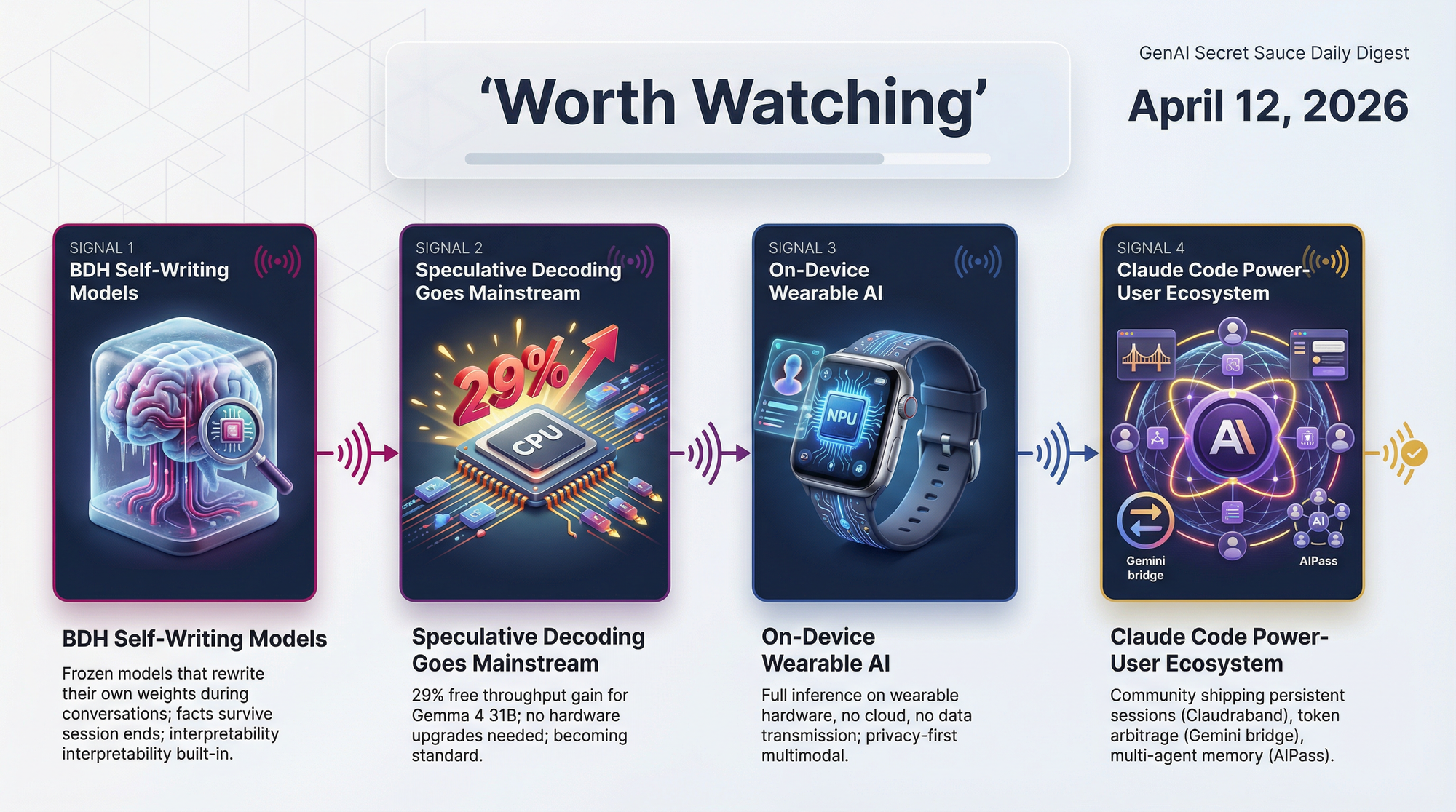
The Dragon Hatchling architecture lets a frozen language model strengthen specific internal connections during inference - based on what the current conversation needs - without any retraining. Facts encoded in one session survive checkpoint saves. If this approach scales, it represents a path to models that update their own knowledge without expensive fine-tuning cycles. The team achieved GPT-2-level performance while incorporating biological memory mechanisms. The kicker: interpretability is an inherent architectural property, not a post-hoc analysis layer.

What changes for ordinary people if this plays out: AI tools that actually get smarter about your specific work and context over time, without you having to re-explain things or a company having to charge for custom fine-tuning.

02
Speculative Decoding Is Becoming the Default Optimization for Local LLMs

Community reports of 29% throughput gains using speculative decoding with Gemma 4 31B + E2B as a draft model, combined with growing tool support in llama.cpp, suggest this is moving from experimental to standard practice. Speculative decoding (using a small model to guess tokens, then verifying in bulk with the large model) adds no hardware cost and requires no model changes - it's pure inference-time efficiency.

What changes for ordinary people if this plays out: Consumer hardware that previously felt too slow for comfortable local AI becomes noticeably faster, without any hardware upgrades or model quality tradeoffs.

03
On-Device Wearable AI: Privacy-First Multimodal Processing

A developer project building a wearable AI that does all inference locally - no cloud, no data transmitted - represents the leading edge of what privacy-preserving AI hardware looks like in practice. The engineering constraints are severe (power, thermal, compute all severely limited on wearable form factors), but the capability trend from this week's multimodal advances in llama.cpp suggests the gap is closing faster than expected.

What changes for ordinary people if this plays out: A wearable device that sees and hears everything you do, helps you in real time, and sends none of it to a server. The privacy vs. capability tradeoff that has defined AI assistant products since Siri gets resolved in privacy's favor.

04
Claudraband and the Power-User Claude Code Ecosystem Is Growing

Claudraband (persistent sessions via tmux), the Gemini-Claude MCP bridge (token arbitrage), and AIPass (multi-agent memory) all shipped this week. The pattern: users are building the infrastructure around Claude Code that Anthropic hasn't built yet. Session persistence, inter-model routing, and multi-agent memory are three of the most-requested features - and the open-source community is shipping them without waiting.

What changes for ordinary people if this plays out: Claude Code goes from a powerful but session-ephemeral coding tool to a persistent engineering partner that remembers your project context, routes expensive tasks to cheaper models automatically, and coordinates multiple agents on your behalf.
Subscribe to GenAI Secret Sauce newsletter and stay updated.

Don't miss anything. Get all the latest posts delivered straight to your inbox. It's free!
Great! Check your inbox and click the link to confirm your subscription.
Error! Please enter a valid email address!