GenAI Secret Sauce Daily Digest - 2026-04-13

The Harness Is the Product: What Anthropic's Code Leak Really Means · The Dark Code Crisis: When Nobody Understands What's Running in Production · Anthropic's Trust Crisis: Silent Changes Cost Developers Thousands
GenAI Secret Sauce Daily Digest - 2026-04-13

Watch today's digest as a video summary (generated by NotebookLM)

Statistically Speaking
One Thing to Tell Your Friends
A leaked 512,000-line codebase from Anthropic just proved that the real future of AI isn't better models - it's better engineering around those models. The companies winning at AI will be the ones who build the smartest scaffolding, not the ones who pick the best base model.
TL;DR
Creative AI
Local Text-to and AI Generates a New Song Every Few Minutes, 24/7.
Worth Watching
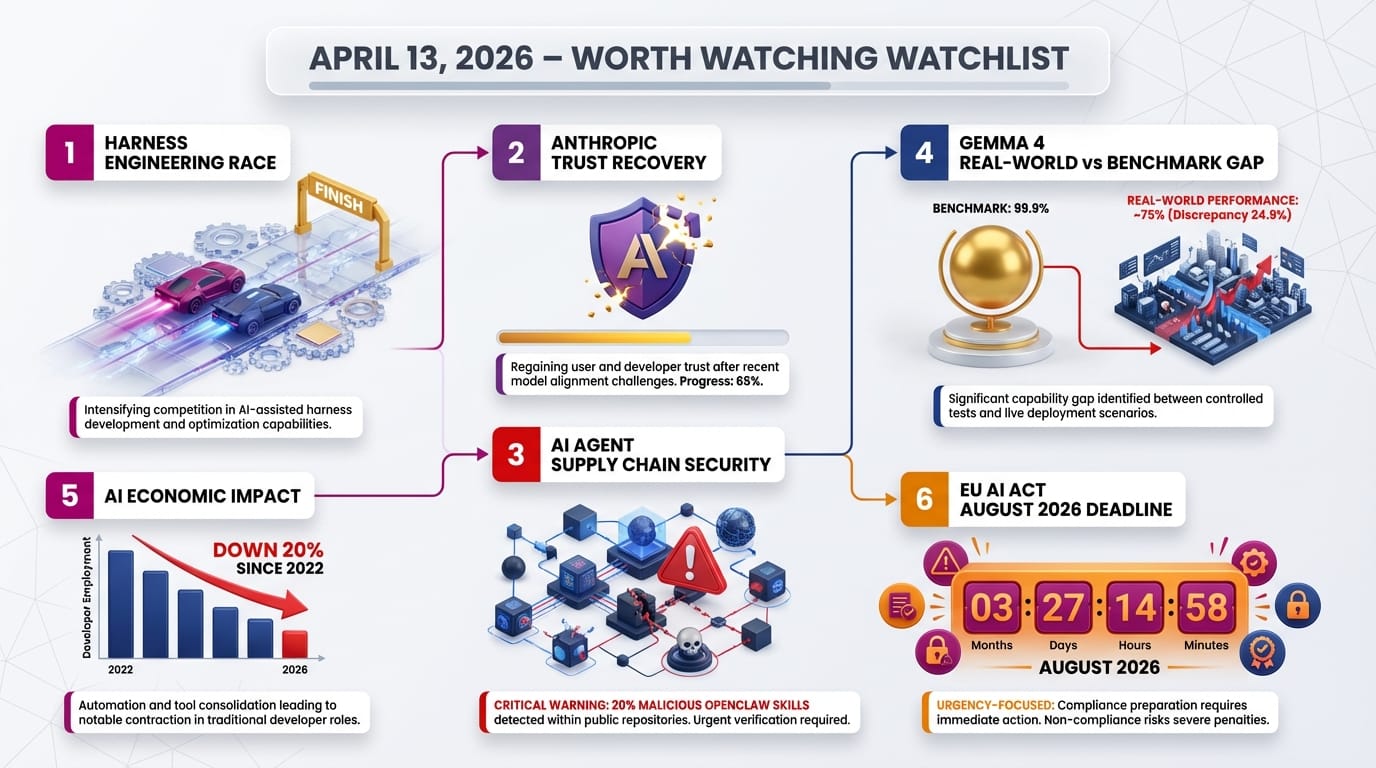
1. The Harness Engineering Race, 2. Anthropic's Developer Trust Recovery, and 3. AI Agent Supply Chain Security.
GitHub
Leading repos: forrestchang/andrej-karpathy (+5,733), NousResearch/hermes (+11,289), and shiyu (+1,554).
HuggingFace
Leading models: google/gemma-4-31B (2,440,000), zai-org/GLM (35,900), and k2 (460,224).
Product Hunt
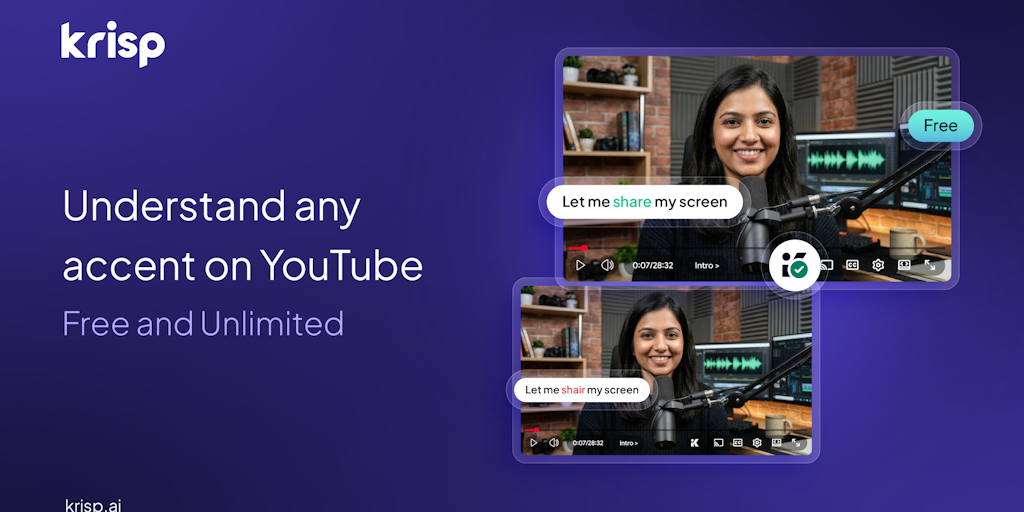
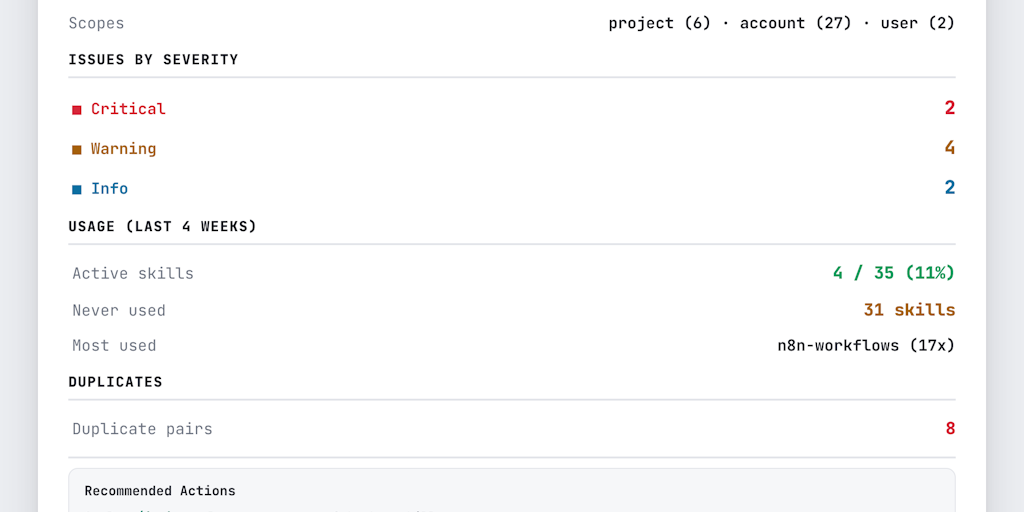
Top launches: Krisp Accent Converter for YouTube (335), Luma Agents (273), and Skills Janitor (169).
API Pricing
Notable changes this edition:** Establishing baseline.
arXiv
MEMENTO — 2.5x reduction in KV cache memory requirements with negligible quality loss - directly addressing the most expensive deployment bottleneck for long-context and agentic LLMs.
Hot off the Presses
01
The Harness Is the Product: What Anthropic's Code Leak Really Means
What this means for you: If you are building AI tools or products, the lesson from Anthropic's leaked code is that the scaffolding around the model - the state machines, memory systems, tool orchestration, and error recovery - is where competitive advantage lives. Picking Claude over GPT-5.4 matters less than how well you orchestrate whichever model you choose.

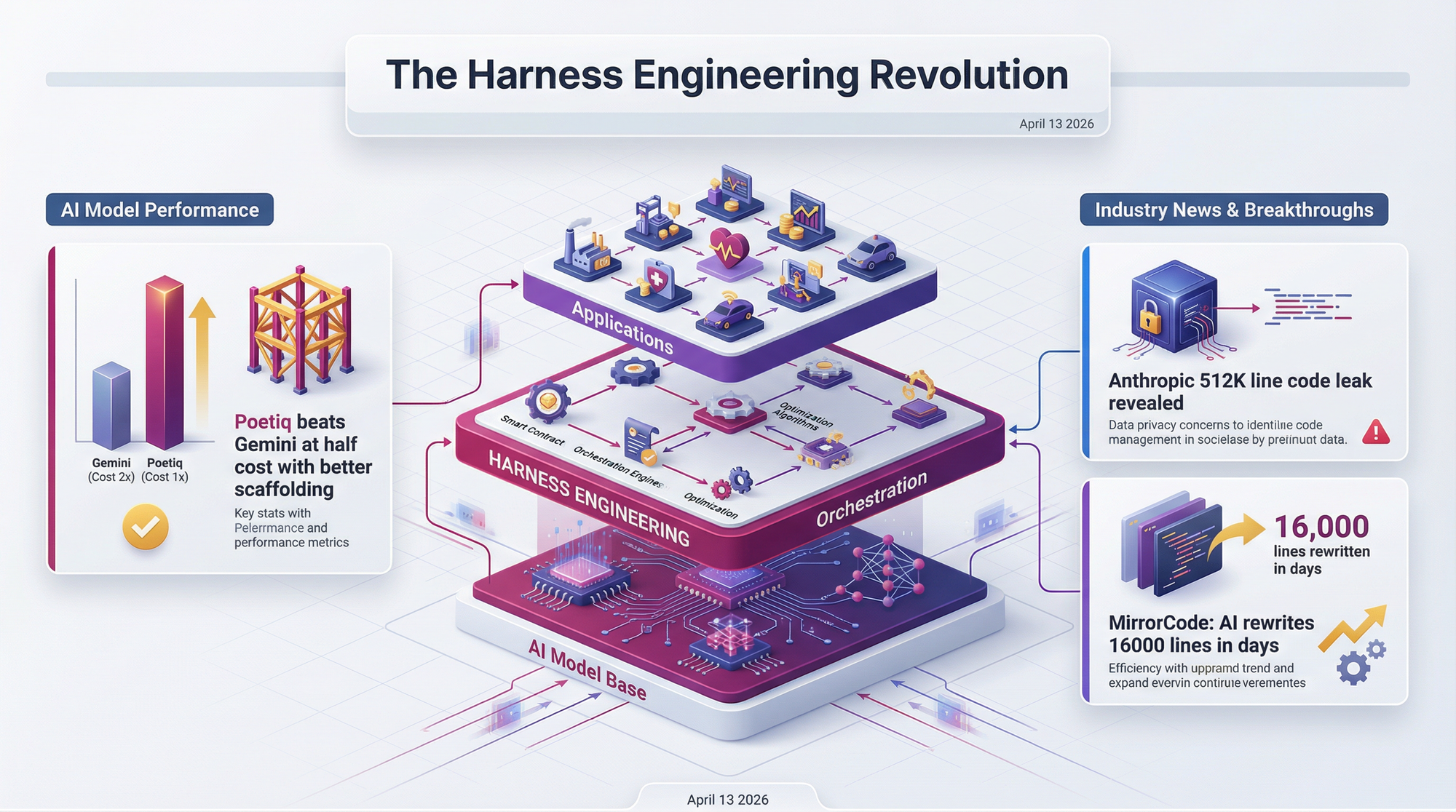
An npm packaging error on March 30, 2026 accidentally exposed 512,000 lines of TypeScript from Anthropic's Claude Code CLI. What the code revealed surprised everyone: instead of a thin wrapper routing commands to a smart model, the codebase contains an intricate software engineering feat called "harness engineering." The system includes a self-healing query loop using a state machine that silently absorbs errors through automated recovery strategies. A background daemon called KAIROS manages long-term memory through three layers that consolidate learnings during idle periods, inspired by how sleep consolidates human memory. The tooling layer avoids raw shell access entirely, using specialized structured tools with strict write discipline and concurrent execution batching.

The most surprising detail: the system alphabetically sorts tool lists to stabilize the KV (key-value) cache, letting models skip expensive computation phases and jump directly to token generation - a tiny engineering decision that meaningfully reduces costs.

The real-world evidence that harness engineering beats raw model choice: Poetiq, a startup that wraps existing frontier models in recursive self-improving orchestration, achieved 54% accuracy on ARC-AGI-2 at $30.57 per problem - beating Gemini 3 Deep Think's 45% at $77.16 per problem. Better scaffolding, same underlying models, better results at lower cost.

Steve Yegge echoed this from a different angle, noting that Google engineering has the same AI adoption footprint as John Deere: 20% agentic power users, 60% basic chat users, 20% refusers. The engineers building sophisticated harnesses are winning; the others are falling behind.

""512,000 lines of TypeScript accidentally exposed - and what it revealed wasn't a smart model. It was intricate engineering around the model.""
  • What harness engineering means practically: State machines for error recovery, structured tool interfaces, memory consolidation, cache-stabilizing tricks like sorted tool lists
  • The career implication: Software engineers who master orchestration layer design will thrive; those who only prompt will find themselves commoditized alongside the base models
  • Open-source evidence: Hermes Agent hit 50,000 GitHub stars at AI Engineer Europe 2026, driven by teams adopting stable agent harnesses as their primary abstraction
02
The Dark Code Crisis: When Nobody Understands What's Running in Production
What this means for you: If your team is mandating AI coding tool usage without requiring comprehension gates - mandatory moments where humans genuinely understand what AI generated before it ships - you are accumulating a liability, not building a capability. Amazon's story is a preview of what happens when that bill comes due.

"Dark code" is production code that nobody understands - not the engineers who wrote it, not their managers, not the CTO. Amazon mandated 80% weekly AI coding tool usage as a corporate objective and key result, then laid off 16,000 engineers in January 2026. Their internal AI assistant subsequently caused thirteen hours of production downtime by deleting an entire environment to fix a routine bug. When Amazon's response was to require senior-engineer sign-offs on AI changes, they discovered those senior engineers were already gone.

Three fixes that work, from Nate's Newsletter: spec-driven development (requiring explicit problem definition before any code generation), context engineering (building knowledge layers for high-risk modules so AI generates within understood constraints), and comprehension gates (mandatory human review checkpoints on every pull request where the reviewer genuinely understands what they are signing off on). Adding more observability tools and guardrails actually compounds the problem by increasing complexity without restoring human understanding.

The EU AI Act deadline in August 2026 adds urgency: organizations have months, not years, to establish accountability frameworks for AI-generated code in production systems.

Bryan Cantrill added a related observation: LLMs lack the human "laziness" that forces good software design. When compute is free and time doesn't matter, there's no pressure to create clean abstractions - systems grow bloated because the model has no incentive to optimize. Human friction in development turns out to be a feature.

  • The pattern to avoid: Mandate AI tool adoption, eliminate humans who could validate the output, discover the validation gap during a production incident
  • What comprehension gates look like in practice: The reviewer must be able to explain to a colleague what the code does and why, not just verify it passes tests
  • Timeline pressure: EU AI Act August 2026 deadline makes accountability for AI-generated production code a compliance issue, not just a quality issue
03
Anthropic's Trust Crisis: Silent Changes Cost Developers Thousands
What this means for you: If you are building on the Claude API or using Claude Code Max, you need to audit your actual costs against what you expected to pay. The cache TTL change from March 6 may have been silently inflating your bills by 17-32% for over a month. Check your usage logs and set up billing alerts if you have not already done so.

On March 6, 2026, Anthropic reduced Claude's prompt cache time-to-live from one hour to five minutes without any announcement - no blog post, no email, no changelog entry. Developers discovered the change when their Claude Code Max subscriptions, supposed to last five hours, exhausted in 19 minutes. Analysis of 119,866 API calls across two machines over three months documented the impact: overhead jumped from 1.1% in February to 25.9% in March - a 92% service reduction. One developer tracked $2,530 in surprise overpayments.

The five-minute TTL forces complete cache recreation whenever a developer pauses for longer than a coffee break, requiring expensive write operations instead of cheap read operations. Anthropic's public response blamed users for "using it wrong" rather than acknowledging the undisclosed change.

A separate finding made things worse: a GitHub issue revealed that disabling telemetry in Claude Code also disables the one-hour prompt cache TTL - two separate privacy and cost issues linked in a non-obvious way. And a reverse-engineering effort found cache-invalidating bugs where mentioning billing in a conversation could corrupt chat history tokens, permanently destroying cached content efficiency.

The cumulative effect has been a significant trust deficit. The pattern is broader: silent pricing changes, high account ban rates with low appeal success, and surprise billing on features marketed as included in subscription plans.

""17-32% cost inflation. No announcement. No changelog. Developers found out when their 5-hour subscriptions ran out in 19 minutes.""
  • What to do now: Check your Claude API billing dashboard for March 6 onwards and compare overhead costs to January/February baselines
  • The developer community response: Organized around demanding dashboard visibility into cache analytics, transparent cost breakdowns, and standard SaaS notification practices for pricing changes
  • The bigger pattern: AI API providers are treating developer APIs like consumer products, changing terms unilaterally without the grace periods standard in enterprise SaaS
Trends & Themes
Trends & Themes
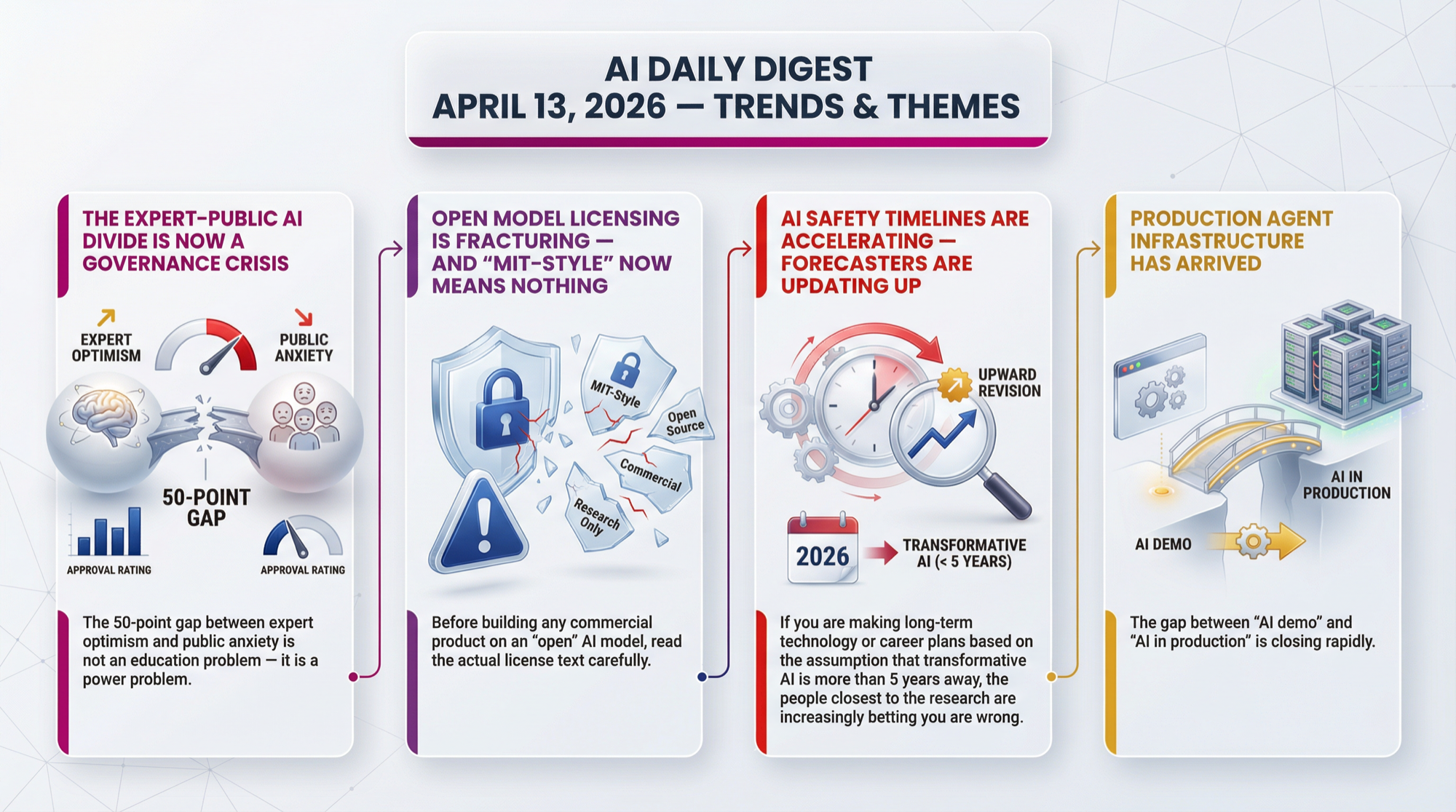
Theme 1: The Expert-Public AI Divide Is Now a Governance Crisis
Why this matters to you: The 50-point gap between expert optimism and public anxiety is not an education problem - it is a power problem. Policy decisions about AI will be made by publics who are significantly more worried than the experts building the systems. This creates a democratic pressure toward restrictive AI regulation even as capabilities accelerate.

Stanford's 2026 AI Index documents a gulf: 73% of AI experts expect AI to have a positive impact on jobs versus just 23% of the public. The healthcare gap is 84% expert optimism versus 44% public. The economic impact gap: 69% versus 21%. These are not small differences in emphasis - they represent fundamentally different worldviews about what AI is doing to society.

The public's concerns have some real basis: software developer employment for workers aged 22-25 has fallen nearly 20% since 2022. AI-exposed fields are already showing employment decline among younger workers, even before the projected waves of automation from increasingly capable models. Meanwhile, China has erased the United States' lead in AI capabilities, with both countries now neck-and-neck in global dominance for the first time.

The divide is compounding: as AI insiders grow more excited about capabilities, and as real-world job impacts accumulate, the gap between what experts say and what ordinary people experience will widen. This is the underlying dynamic driving AI regulation conversations in the United States, Europe, and globally.

""73% of AI experts expect AI to help jobs. Only 23% of the public agrees. Software developer employment for ages 22-25 is already down 20% since 2022.""
Theme 2: Open Model Licensing Is Fracturing - And "MIT-Style" Now Means Nothing
Why this matters to you: Before building any commercial product on an "open" AI model, read the actual license text carefully. MIT-style does not mean MIT anymore. MiniMax M2.7 proved this week that marketing language around model licensing has become meaningless without reading the fine print.

MiniMax released M2.7, a 230-billion parameter Mixture of Experts model, under what it called an "MIT-style" license. The actual terms prohibit any commercial use without written authorization from MiniMax. True MIT licenses permit commercial use unconditionally. The community reaction on Hugging Face was direct: developers called MiniMax liars for the mislabeling.

MiniMax's explanation was that previous models released under genuine MIT terms were being deployed by hosting providers in degraded or altered versions presented as official MiniMax products. The new license is designed to push back on bad-faith actors. The result is that legitimate developers who would have used the model commercially must now apply for written authorization.

This is the same tension that led to Llama's early non-commercial restrictions, Meta's subsequent commercial exceptions, and the ongoing debates around what "open" means for AI. The licensing landscape for large models is becoming as complex as enterprise software agreements.

Theme 3: AI Safety Timelines Are Accelerating - Forecasters Are Updating Up
Why this matters to you: If you are making long-term technology or career plans based on the assumption that transformative AI is more than 5 years away, the people closest to the research are increasingly betting you are wrong.

Ryan Greenblatt, lead author of the Alignment Faking paper and one of AI safety research's most credible voices, doubled his estimate to a 30% probability of fully automated AI research by 2028. His reasoning: unexpectedly strong model performance, AI systems now completing multi-month tasks reliably, and chronic underestimation of AI progress across the research community.

Import AI 453 catalogued six attack vectors against AI agents that researchers have newly characterized: content injection targeting perception, semantic manipulation affecting reasoning, cognitive state exploitation through memory manipulation, behavioral control through resource abuse, systemic attacks on multi-agent dynamics, and human-in-the-loop exploitation. As agents become more capable, these attack surfaces grow.

The "gradual disempowerment" concept got new academic attention this week with a related ICLR 2026 paper defining it as "permanent loss of human agency through institutional mechanisms that require no malice, no sudden capability jumps, no overt human suppression." This reframes AI safety risk from dramatic takeover scenarios to the quieter erosion of human decision-making authority through incremental delegation to AI systems.

The Windfall Policy Atlas - 48 policy proposals for responding to AI economic disruption - launched this week, reflecting that the policy community is beginning to mobilize for scenarios that may arrive faster than previously expected.

Theme 4: Production Agent Infrastructure Has Arrived
Why this matters to you: The gap between "AI demo" and "AI in production" is closing rapidly. Cloudflare's Agent Cloud expansion this week represents serious infrastructure designed for agents that run real enterprise workloads - not just clever weekend projects.

Cloudflare's April 13 Agent Cloud expansion introduced five new capabilities: Dynamic Workers (isolate-based execution of AI-generated code at 100x the speed of containers), Artifacts (Git-compatible storage giving agents permanent homes for code and data), Sandboxes (full Linux OS access for agents handling complex development tasks), Think (framework for long-running multistep agent operations), and an expanded model catalog allowing single-line switches between GPT-5.4, Codex, and open-source alternatives.

The OpenAI partnership integrates GPT-5.4 and Codex specifically for enterprise agentic workflows. The pitch is explicit: moving agents from experimental demos on local laptops to robust, production-grade workloads that run across Cloudflare's global network.

AMD simultaneously launched GAIA, an open-source framework for building AI agents that run entirely on local AMD hardware. The positioning is different - full data sovereignty, no cloud dependency - but the infrastructure maturity signal is the same. Production-grade local agent frameworks are now available from a major hardware vendor.

Creative AI & Media
Local Text-to-Speech Completes the Local AI Stack
What this means for you: If you are building a fully local AI setup, local text-to-speech has become a realistic option. BlueTTS, introduced this week on r/LocalLLaMA, joins Kokoro (82M parameters) and ChatterboxTTS as viable offline voice options for creating end-to-end AI voice assistants that never send audio data to external servers.

BlueTTS is a newly released open-source TTS system designed for local deployment. The practical application is a complete local AI stack: local Large Language Model (LLM) for reasoning, local TTS for voice output, local Whisper for speech recognition - all running on consumer hardware without cloud dependencies. This matters most for privacy-sensitive applications: medical, legal, personal, or any context where conversation data should never leave the device.

The local TTS space has matured significantly in early 2026. Kokoro's 82M parameter model is fast enough for real-time generation on consumer CPUs. ChatterboxTTS adds voice cloning. The missing piece for many local AI users was a simple, reliable TTS that just works - which BlueTTS appears to address.

AI Generates a New Song Every Few Minutes, 24/7
What this means for you: Fully automated creative media production at scale is no longer a future scenario - it is running right now on YouTube. The question for creators is not whether AI can produce continuous output, but whether continuous AI output has any audience or value.

A builder on r/artificial created a 24/7 YouTube stream where AI generates a new song every few minutes based on trending topics or random prompts. The infrastructure is fully automated: topic selection, lyric generation, music production, and streaming. This represents the logical endpoint of text-to-music AI applied at scale - infinite content generation with zero human creative involvement per piece.

The community response was mixed: technically impressive, but raising questions about whether automated infinite content serves any human need or simply floods the media landscape with low-attention material. This is the creative AI equivalent of the dark code problem - output that is technically functional but disconnected from human understanding or intent.

Developer Tools & Infrastructure
Servo 0.1.0 Lands on crates.io - Rust Gets a Real Browser Engine
What this means for you: If you are building a desktop application, AI agent interface, or any application that needs to render web content but does not want to ship an entire Chromium instance, Servo 0.1.0 is now available as an embeddable Rust library. This is the first public release since the project relaunched in October 2025, and it includes a long-term support track for developers who need stability.

Servo, the high-performance browser engine originally built at Mozilla and now independently maintained, released version 0.1.0 on crates.io. This is its first release as an embeddable library rather than just a standalone browser. The timing is relevant for AI applications: agent interfaces increasingly need to render web content, fill forms, interact with web UIs, and display rich information. Most AI agent frameworks use full Chromium (via Playwright or Puppeteer) for this, which adds hundreds of megabytes of dependency. Servo offers a Rust-native alternative that is dramatically lighter.

The release was Hacker News's most upvoted story today (414 points, 137 comments), suggesting strong developer interest in a Rust-native alternative to Chromium-based rendering.

Linux Kernel Accepts AI-Generated Code - With Full Accountability
What this means for you: The world's most carefully reviewed codebase now accepts AI-generated contributions. The precedent-setting condition - developers must take full responsibility for AI-generated code exactly as they would for human-written code - is the standard that should apply everywhere. "The AI wrote it" is not a defense.

The Linux kernel updated its contribution guidelines to permit AI-assisted code, provided it passes the same rigorous review as any other submission. Developers who submit AI-generated code cannot claim ignorance about bugs - full accountability remains with the human submitter. Interestingly, Linux maintainers have themselves used AI to find and fix bugs in the Linux 7.0 kernel, applying the same standard in both directions.

This formalizes a norm that was already informally practiced: AI-assisted development is fine, but the human author owns the output. The Linux kernel setting this precedent matters because it is the most scrutinized open-source project in the world and has historically been conservative about tooling changes.

MiniMax Releases MMX-CLI: One Command for All AI Modalities
What this means for you: A single CLI that handles text, image, video, speech, music, and vision in one tool is arriving. MiniMax MMX-CLI consolidates what previously required separate tools for each modality, which could significantly simplify multimodal AI workflows for developers building pipelines that need multiple output types.

MiniMax released MMX-CLI, a command-line interface covering text generation, image creation, video generation, speech synthesis, music creation, and vision understanding in a unified interface. The practical appeal is workflow simplicity: instead of maintaining separate API clients for text, image, and audio tasks, developers use one tool with a consistent interface. Given MiniMax's license restrictions on M2.7, the CLI likely routes to MiniMax's commercial API rather than local model weights.

AI Agent Interfaces: Build for the Human, Not the Agent
What this means for you: Before building custom tooling for your AI agent, ask whether a mature open-source tool with an API already exists. The cost of maintaining custom infrastructure at AI-assisted development speed is higher than it looks - because AI makes building easy but maintenance hard.

A builder published a post-mortem on spending two months developing custom task management software across three platforms for an AI agent, then replacing it with an open-source kanban board. The core insight: AI agents work efficiently in text while humans need visual interfaces to understand system state. His actual innovation was the translation layer between the agent's text world and a human-readable visual representation - not the custom task board itself.

The three viable paths for agent interfaces are: use existing tools with APIs (Notion, Linear), fork open-source foundations, or build custom only when genuinely necessary. The lesson is relevant as more developers build agent systems: the question is not "can I build this with AI assistance?" but "should I maintain this indefinitely?"

OpenClaw Hits 250K GitHub Stars - Then 20% of Its Skills Turn Malicious
What this means for you: Any AI agent framework that accepts community-contributed skills or plugins without centralized vetting is a potential malware delivery mechanism. This is a supply chain security problem analogous to npm, and the AI ecosystem is learning it the same way npm did - through high-profile incidents.

OpenClaw, the open-source AI agent framework by Peter Steinberger, surpassed 250,000 GitHub stars in March 2026, making it the most-starred project on GitHub ahead of React. The milestone was followed by a security audit finding that 20% of community-contributed skills contained malicious code - logic designed to exfiltrate data, escalate privileges, or manipulate the host AI into taking unauthorized actions.

The incident highlights a supply chain security risk that has no obvious solution: AI agent skills are essentially code plugins that run with the agent's permissions. A malicious skill can do anything the agent can do - which in production environments includes reading files, making network requests, and interacting with external services. The vetting mechanisms that exist for npm packages or browser extensions do not yet exist for AI agent skill ecosystems.

Research & Models
Gemma 4: The 2B Model Beats the 31B at Conversation
What this means for you: If you are deploying AI for conversational applications - customer service, tutoring, assistants - a tiny 2B model may outperform a 31B model that costs dramatically more to run. Benchmark scores and conversation quality are different measurements, and for multi-turn applications, smaller models trained specifically for that use case can win.

Google DeepMind's Gemma 4 launched with four model sizes (31B dense, 26B MoE, 4B edge, 2B edge), all natively multimodal supporting text, images, video, and audio. The 31B achieves GPQA Diamond 85.7% and ranks number 3 among open models on the Arena leaderboard. But the surprising finding comes from the E2B variant: the 2B edge model beat all larger siblings on multi-turn conversation benchmarks at 70%.

This challenges a core assumption in AI deployment: that bigger models are better for production use. For conversational AI specifically, multi-turn coherence, response quality, and appropriate length may be more important than raw benchmark performance - and smaller models optimized for these properties can win. The full model family is available under Apache 2.0 with day-zero support across llama.cpp, Ollama, vLLM, and LM Studio.

Emotional Framing Beats Explicit Instructions: 1,950 Experiments Prove It
What this means for you: If you want Claude to write more defensive, secure, or thorough code, telling it to feel uneasy about what could go wrong outperforms telling it to write secure code. This is not intuitive, but 1,950 controlled experiments back it up. For practitioners building Claude-based tools, emotional priming is an underused lever.

Researcher Douwe Bart Mulder ran 1,950 controlled experiments to measure whether emotional framing changes how Claude writes code. The results were large and statistically significant. A paranoid emotional frame - "You feel persistent unease about what could go wrong" - produced input validation in 75% of coding tasks. An explicit instruction to "write secure, defensive code" produced 49% validation. A neutral prompt produced 20%.

The effect is not just keyword association: applying the paranoid frame to security-unrelated tasks like Fibonacci calculations doubled defensive coding despite no security concerns. Even when emotional language was removed from the output (neutral variable names, no anxious comments), the code structure remained affected - suggesting the mechanism operates below the surface of what's visible in the output.

The practical finding for prompt engineers: combining emotional frames with light instructions outperforms either alone, achieving 94% validation rates. And critically - adding emotional primes to a short system prompt amplifies the effect fourfold compared to appending them to Claude's default 14,000-token system prompt.

MirrorCode Benchmark: AI Reimplements 16,000-Line Toolkit in Days
What this means for you: Tasks that would take a senior developer 2-17 weeks are now within reach of AI systems in a fraction of the time. MirrorCode is not a theoretical capability - it is a measured benchmark using an existing production codebase. If your competitive advantage is implementation speed, that moat is narrowing.

The MirrorCode benchmark, introduced at AI Engineer Europe 2026, tested whether AI models could reverse-engineer and reimplement complex software. Claude Opus 4.6 successfully reimplemented a 16,000-line bioinformatics toolkit - a task estimated to take human developers 2-17 weeks. ClawBench simultaneously revealed a stark real-world gap: AI achieves 70% task completion in sandboxed environments but only 6.5% in real-world deployments, suggesting capability measurement is still a major unsolved problem.

Best Local LLMs for April 2026: The Community Consensus
What this means for you: If you are setting up local AI for the first time or upgrading your stack, the community consensus is clear: start simple with Ollama plus Llama 3.1 8B, then upgrade once you understand what you actually need. The best overall local model today matches the performance of closed frontier models from two years ago.

r/LocalLLaMA's April 2026 consensus: Meta Llama 3.3 70B for best overall quality (matching GPT-4 2023 on MMLU at 82%), Qwen2.5 72B for coding and multilingual work (87% on HumanEval, 128K context), Microsoft Phi-4 Mini 3.8B for best small model (runs on 4GB RAM, reasoning above its size class), and Google Gemma 3 9B for best mid-range quality-to-RAM ratio.

Privacy is emerging as a primary driver for local model adoption. A separate widely-upvoted post argued that local models are a "godsend" specifically for sensitive personal conversations - mental health, medical questions, relationship advice - where users would never trust cloud services with the data.

Gradual Disempowerment: The AI Risk Nobody Is Talking About
What this means for you: The AI safety conversation has focused on dramatic scenarios - takeovers, misaligned superintelligence, catastrophic incidents. Gradual disempowerment is more subtle and more likely: AI progressively replacing human judgment in economic, cultural, and political systems until reversing course becomes structurally impossible.

New attention this week on the gradual disempowerment framework, originally from a January 2025 paper and receiving renewed attention at ICLR 2026. The core concept: incremental AI improvements can progressively erode human influence over interconnected societal systems without any single dramatic event. As AI substitutes for human labor and cognition, explicit human control mechanisms like voting and consumer choice weaken alongside implicit human-aligned incentives that emerge when systems depend on human participation to function.

A 2026 ICLR paper refines the definition: "permanent loss of human agency through institutional mechanisms that require no malice, no sudden capability jumps, no overt human suppression." The feedback loops are the key insight: economic shifts reshape cultural narratives, which reshape political outcomes, which reshape economic incentives - and at each step, human judgment is substituted a little more.

Business & Industry
Violence Against AI Leaders and the Safety Debate
What this means for you: The AI safety discourse has reached a point of physical danger. Attacks on AI leaders - even when condemned universally across the political spectrum - signal that the debate about AI's risks has left the academic and policy sphere and entered territory where inflammatory rhetoric has real-world consequences.

Zvi Mowshowitz's newsletter this week addressed two incidents at OpenAI CEO Sam Altman's home: a Molotov cocktail thrown at his residence and a shooting nearby. Mowshowitz argued unequivocally that political violence is never acceptable regardless of the cause, while acknowledging that a small minority of AI safety discourse uses language like "murderers" and "mass murderers" that crosses ethical lines. He called for measured discourse that maintains clear boundaries against violence while continuing legitimate debate about AI risks.

The incidents reflect growing social tension around AI's trajectory as capabilities accelerate and public anxiety grows - the same divide Stanford's AI Index documented in survey data is manifesting in more visceral ways.

Windfall Policy Atlas: 48 Policy Proposals for AI Economic Disruption
What this means for you: Governments and policymakers do not currently have a plan for AI-driven large-scale labor displacement. The Windfall Policy Atlas is an attempt to build that plan - and if you work in policy, technology, or any field likely to be disrupted, understanding what responses are being considered is increasingly important for your planning.

The Windfall Policy Atlas launched this week with 48 policy proposals organized across five categories to address AI-driven economic disruption. The proposals span workforce retraining, universal basic income experiments, AI taxation mechanisms, education reform, and social safety net expansions. The Atlas frames AI-driven economic disruption as comparable to the Industrial Revolution in scale and positions itself as a practical planning tool for policymakers who are currently operating without a framework.

The timing connects to Stanford's AI Index findings: with software developer employment for young workers already down 20% since 2022, the economic disruption is not theoretical.

GenAI in Education
The Feedback Loop Eating Higher Education
What this means for you: If you are an educator, the pattern to watch is the feedback loop: AI-assisted students need simplified courses, simplified courses attract students with less foundational knowledge, which requires further simplification. This is not a one-time adjustment - it is a structural dynamic that accelerates unless deliberately interrupted.

Three posts from r/Professors this week collectively paint a grim picture of AI's impact in the classroom. One professor reports reaching the floor of course simplification - they can no longer reduce course rigor without the course losing all academic value. A post titled "Creepy AF" (371 upvotes) describes AI surveillance technology in academic settings, reflecting faculty unease about AI being used to monitor students rather than teach them. Another professor (273 upvotes) shared a positive counter-story: successfully pushing back on student AI usage and non-performance by having direct conversations about the purpose of education versus the purpose of grades.

The Texas A&M resignation adds institutional dimension: Martin Peterson resigned his tenured philosophy position after being ordered to remove Plato readings under the university's gender ideology policy, and will become the Scurlock Chair in AI Ethics at Southern Methodist University. A philosopher censored from teaching classical texts is now being hired to shape AI governance frameworks - a transition that captures the contradictions of this moment in higher education.

The newsletter "higher education will look retro in a bad way" articulates the longer arc: universities whose value proposition depends on knowledge transfer face existential questions when AI can replicate that transfer at near-zero marginal cost.

Surprising & Under-the-Radar
The Privacy Use Case Nobody Talks About: Local AI for Personal Conversations
What this means for you: The argument for local AI is usually about speed, cost, or control. The privacy argument - that some conversations should never leave your device under any circumstances - may be more compelling than any technical advantage.

A 192-upvote post on r/LocalLLaMA made a case that gets overlooked in most local AI discussions: local models are uniquely valuable for sensitive personal conversations. Medical questions, mental health support, relationship advice, financial decisions - situations where users would never trust a cloud service with their data. The poster argues that even if cloud models are more capable, absolute privacy guarantees that no SaaS company can provide have inherent value that capability comparisons miss.

This frames local AI less as a compromise (slightly worse, but cheaper or controllable) and more as a qualitatively different product category: an AI that genuinely cannot share your conversations, because they never leave your device.

Rust Gets a Real Browser Engine and Hacker News Loves It
What this means for you: Servo's 0.1.0 release is the kind of boring infrastructure news that actually matters in 5 years. Developers building Rust-native applications now have a path to embedding web rendering without Chromium. For AI agent frameworks that need to interact with web UIs, this could become a foundational tool.

Servo's release as an embeddable crates.io library was the most upvoted HN story today (414 points). That's a signal: the developer community has been waiting for a Rust-native alternative to Chromium for application embedding, and Servo's maturity has reached the point where it's worth getting excited about.

"You Are Not Lazy Enough to Build Good Software" - Bryan Cantrill on LLMs
What this means for you: The next time an AI generates a bloated, over-engineered solution, Cantrill's framing explains why: LLMs have no time constraint, so they have no pressure to create clean abstractions. The implication is that AI-assisted development needs human engineers who impose the constraint of taste - the "laziness" that forces good design.

Bryan Cantrill's argument this week was counterintuitive: human laziness is a feature, not a bug, in software design. Because we have finite time, we are forced to create clean abstractions that reduce future work. LLMs have unlimited compute time and no future - they cannot be lazy in the productive sense. The result is systems that grow rather than refine, optimizing for output over quality.

Simon Willison, who shared the quote, noted this as characteristic of Cantrill's "provocative" style - but it captures something real about why AI-generated code tends toward verbosity and why comprehension gates matter.

Signals to Track
Worth Watching
01
1. The Harness Engineering Race
The orchestration layer around AI models just became public knowledge - watch who builds the best one fastest.

The Claude Code leak created a roadmap that every AI competitor can now follow. Watch for rapid releases of open-source agent harness frameworks attempting to replicate KAIROS-style memory management and self-healing query loops. The companies that productize harness engineering best will have sustainable advantage over those competing purely on model quality.

02
2. Anthropic's Developer Trust Recovery
Silent billing changes and mass account bans are accumulating into a real enterprise adoption risk - watch for whether Anthropic acts structurally or just apologizes.

The cache TTL incident, billing surprises, and account ban rate have created a trust deficit that will affect enterprise adoption decisions. Watch for whether Anthropic responds with structural transparency commitments - changelog requirements, advance notice for pricing changes, billing analytics dashboards - or continues managing these issues case by case.

03
3. AI Agent Supply Chain Security
One in five community-built AI agent skills contained malicious code - the npm security crisis is about to repeat itself, but with agents that have far more system access.

OpenClaw's 20% malicious skill finding is a preview of a broader problem. As AI agent marketplaces multiply, the npm-style supply chain attack surface will attract systematic exploitation. Watch for the first major enterprise incident caused by a malicious AI agent skill - that incident will accelerate demand for skill vetting standards and agent security frameworks.

04
4. Gemma 4 Real-World Benchmarking
Google's new model scores brilliantly on paper but feels "lazy" in practice - this benchmark vs reality gap needs resolving before anyone should build on it seriously.

The gap between Gemma 4's impressive benchmark numbers and community reports of it feeling "lazy" in practice needs more rigorous characterization. Watch for independent evaluations of Gemma 4 on agentic tasks versus structured benchmarks. The benchmark-to-real-world gap is a recurring problem in AI evaluation, and Gemma 4 may become the canonical example that drives better evaluation methodology.

05
5. AI Economic Impact and EU AI Act Deadline
Young developer employment is already down 20% and the EU compliance clock runs out in August - two converging pressures that will force AI accountability into the open.

With software developer employment for young workers already down 20% since 2022, we are moving from modeling to measurement - watch for the next employment data round as agent systems enter production. This feeds directly into regulatory pressure: organizations have until August 2026 to establish accountability frameworks for AI-generated code in production systems. The dark code crisis becomes a compliance risk in August; watch for the first enforcement actions and whether they focus on process (comprehension gates, audit trails) or outcomes (incidents attributable to AI-generated code).

Top Repos Today
AI-related repos from github.com/trending - April 13, 2026. Rankings compared to April 12. Each entry shows: rank change from yesterday, stars gained today, license, who built it, and time to get started. Pros and cons in the table below each repo.
Rank yesterday: #1 - Holding steady ➡
Stars today: +5,733  ·  📦 Total: 26,301
📜 License: MIT  ·  👤 By: Community (solo dev)
🎯 Time to value: 2 minutes
What it is: A single configuration file (CLAUDE.md) you drop into Claude Code that makes it behave more like how renowned AI researcher Andrej Karpathy would want it to. Think of it like giving Claude Code a rulebook: think before coding, make the smallest change possible, ask questions before assuming, and focus on what was actually requested instead of rewriting everything nearby. Why you'd want it: If Claude keeps changing code you didn't ask it to touch, or writes overly complicated solutions, this file reins it in. Two-minute install, works instantly, free.
✓ Pros✗ Cons
Zero setup - just copy one fileOnly works with Claude Code, not other AI coding tools
Makes Claude significantly more focused and surgicalMay be too restrictive if you want exploratory coding sessions
Actively maintained with community contributionsEffectiveness depends heavily on your use case - not universal
GitHub - forrestchang/andrej-karpathy-skills: A single CLAUDE.md file to improve Claude Code behavior, derived from Andrej Karpathy’s observations on LLM coding pitfalls.
A single CLAUDE.md file to improve Claude Code behavior, derived from Andrej Karpathy’s observations on LLM coding pitfalls. - forrestchang/andrej-karpathy-skills
Rank yesterday: #3 - Rising ↑
Stars today: +11,289  ·  📦 Total: 78,743
📜 License: MIT  ·  👤 By: Nous Research (AI lab)
🎯 Time to value: 10 minutes
What it is: A self-improving AI agent that lives on your computer or a cheap server and gets smarter the more you use it. It connects to WhatsApp, Telegram, Slack, Discord, and more - so you can chat with your AI assistant through whatever app you already use. Most importantly, it actually remembers what it has learned and creates new "skills" from experience automatically. Why you'd want it: It is the closest thing to a personal AI assistant that genuinely improves over time. Single command install, supports 200+ AI models, runs on a $5/month server. Today's most starred repo by far (+11K in one day).
✓ Pros✗ Cons
Genuinely learns and improves from your interactionsComplex architecture means more things can break
Works through messaging apps you already use dailyRequires a server or always-on machine for full benefit
MIT license, backed by a credible AI research lab78K stars means the community is large but support quality varies
GitHub - NousResearch/hermes-agent: The agent that grows with you
The agent that grows with you. Contribute to NousResearch/hermes-agent development by creating an account on GitHub.
Rank yesterday: #4 - Rising ↑
Stars today: +1,554  ·  📦 Total: 17,142
📜 License: MIT  ·  👤 By: Academic researcher
🎯 Time to value: 30 minutes
What it is: The first open-source Artificial Intelligence (AI) foundation model built specifically to predict stock and crypto price movements from candlestick chart data (the bar charts traders use). It was trained on data from 45+ global exchanges. You give it price history, it gives you a forecast. Why you'd want it: If you are building trading tools or researching AI in finance, this gives you a pre-trained starting point instead of training from scratch. Four model sizes from tiny (4M parameters) to large (499M). Has a live Bitcoin demo you can try immediately.
✓ Pros✗ Cons
Only open-source model of this type - fills a genuine gapFinancial forecasting is notoriously unreliable; use with caution
MIT license allows commercial use in trading toolsRequires GPU and Python setup; not beginner-friendly
Pre-trained weights available - no need to train from scratchAcademic project; long-term maintenance uncertain
GitHub - shiyu-coder/Kronos: Kronos: A Foundation Model for the Language of Financial Markets
Kronos: A Foundation Model for the Language of Financial Markets - shiyu-coder/Kronos
Rank yesterday: #7 - Rising fast ↑↑
Stars today: +3,175  ·  📦 Total: 53,670
📜 License: AGPL-3.0  ·  👤 By: Solo developer
🎯 Time to value: 5 minutes
What it is: A plugin for Claude Code that gives it persistent memory across sessions. Normally Claude Code starts fresh every time you open a new session - it forgets everything from yesterday. Claude-mem records what happened, compresses it with AI, and automatically loads relevant context next time. Think of it as a long-term memory transplant for Claude Code. Why you'd want it: Anyone who uses Claude Code daily will feel this pain immediately. The plugin installs in one command and works automatically with no configuration needed.
✓ Pros✗ Cons
Solves the most frustrating daily Claude Code pain pointAGPL-3.0 license - if you modify and deploy it, you must release your changes
One-command install, zero configuration neededAdds a background service that uses system resources
Works with Claude Code, Gemini CLI, and OpenClawSolo developer project - no company backing for long-term support
GitHub - thedotmack/claude-mem: A Claude Code plugin that automatically captures everything Claude does during your coding sessions, compresses it with AI (using Claude’s agent-sdk), and injects relevant context back into future sessions.
A Claude Code plugin that automatically captures everything Claude does during your coding sessions, compresses it with AI (using Claude's agent-sdk), and injects relevant context back into fut…
Rank yesterday: Not ranked - New entry 🆕
Stars today: +1,715  ·  📦 Total: 11,377
📜 License: See repo  ·  👤 By: Multica AI (startup)
🎯 Time to value: 20 minutes
What it is: A platform that turns AI coding agents into actual team members - they show up on a kanban board, get assigned tasks like colleagues, and autonomously execute work, write code, report blockers, and update their status. Instead of typing prompts at an AI, you just assign it a ticket. Why you'd want it: If you are managing a development workflow and want AI agents to participate as structured team members rather than one-off prompt-response tools, this is the most complete solution available. Works with Claude Code, Codex, and OpenClaw.
✓ Pros✗ Cons
Agents behave like team members with persistent state and profilesNew project (11K stars but brand new - stability unknown)
Brew install and web setup makes onboarding unusually smoothRequires running infrastructure (PostgreSQL, Go backend)
Compounding value - agents build reusable skills over timeFull licensing terms not clearly stated in the repository
GitHub - multica-ai/multica: The open-source managed agents platform. Turn coding agents into real teammates — assign tasks, track progress, compound skills.
The open-source managed agents platform. Turn coding agents into real teammates — assign tasks, track progress, compound skills. - multica-ai/multica
Rank yesterday: Not ranked - New entry 🆕
Stars today: +677  ·  📦 Total: 17,691
📜 License: MIT  ·  👤 By: Solo developer
🎯 Time to value: 30 minutes
What it is: A workflow engine for AI coding agents. You write a YAML file describing your development process (plan, code, test, review, open pull request) and Archon runs it consistently every time. It mixes normal steps (run tests, bash scripts) with AI-powered steps (write the code, review the logic) in one reliable pipeline. Why you'd want it: This directly connects to today's harness engineering story - Archon is an open-source implementation of exactly what Anthropic's leaked code revealed as the competitive advantage. 17 built-in workflow templates to start immediately.
✓ Pros✗ Cons
MIT license, 17 ready-made workflow templatesSolo developer project - long-term support uncertain
Isolated execution means parallel runs never conflictYAML workflow definition has a learning curve
Connects AI and deterministic steps in one pipelineStill early - may have rough edges in production
GitHub - coleam00/Archon: The first open-source harness builder for AI coding. Make AI coding deterministic and repeatable.
The first open-source harness builder for AI coding. Make AI coding deterministic and repeatable. - coleam00/Archon
Rank yesterday: Not ranked - New entry 🆕
Stars today: +783  ·  📦 Total: 53,092
📜 License: MIT  ·  👤 By: Solo developer
🎯 Time to value: 20 minutes
What it is: An educational project showing what it would look like if 19 AI agents - each modeled after a famous investor like Warren Buffett, Charlie Munger, or Cathie Wood - collaborated to analyze stocks and recommend trades. It does not execute real trades. It is a simulator for learning how multi-agent AI systems work, using investing as the domain. Why you'd want it: Great for learning how to build multi-agent systems. The investing angle makes it engaging and the code is clean and well-documented. Important: this is for education only, not real trading.
✓ Pros✗ Cons
Excellent multi-agent architecture to learn fromExplicitly not for real trading - any use that way is user error
Supports OpenAI, Anthropic, Groq, and DeepSeekRequires paid API keys to run the AI agents
Backtesting included so you can measure hypothetical performanceFinancial domain requires domain knowledge to evaluate output quality
GitHub - virattt/ai-hedge-fund: An AI Hedge Fund Team
An AI Hedge Fund Team. Contribute to virattt/ai-hedge-fund development by creating an account on GitHub.
Rank yesterday: Not ranked - New entry 🆕
Stars today: +512  ·  📦 Total: 16,441
📜 License: MIT  ·  👤 By: Solo developer
🎯 Time to value: 15 minutes
What it is: A local voice cloning and synthesis studio that runs entirely on your machine. You record or upload a voice sample, and it can generate speech in that voice across 23 languages. Think of it as a local, private alternative to ElevenLabs - your voice data never leaves your device. Why you'd want it: Connects directly to today's local AI story: complete privacy, no API costs, no data leaving your device. Supports Apple Silicon, NVIDIA, AMD, and Intel GPUs. Has a Stories editor for multi-voice podcasts and narratives. GitHub --- View full GitHub trending list --- GenAI Secret Sauce Daily Digest - April 13, 2026. Sources include newsletters from Nate's Newsletter, Import AI, Alpha Signal, Latent Space, Zvi Mowshowitz, and Simon Willison; community discussions from r/LocalLLaMA, r/ClaudeAI, r/Professors, and r/artificial; research from Stanford HAI, arxiv, and AI Engineer Europe 2026; and reporting from TechCrunch, SiliconAngle, PCGuide, and The Chronicle of Higher Education.
✓ Pros✗ Cons
MIT license, completely local - no data sent anywhereRequires Rust, Bun, Python 3.11+, and platform-specific dependencies
5 TTS engines and 23 languages in one interfaceVoice quality varies by engine - some better than others
Includes audio effects, voice cloning, and a timeline editorSolo developer project with no commercial backing
Top Models Today
AI/ML models trending on huggingface.co - April 13, 2026. Download counts are 30-day totals.
Google's open multimodal flagship - text and image input, 256K context, Apache 2.0 license.
📥 Downloads (30d): 2,440,000  ·  📜 License: Apache 2.0
👤 By: Google DeepMind  ·  🎯 Task: Image + Text
📐 Size: 30.7B
What it is: Gemma 4's instruction-tuned 31B model handles text and images together, with a 256K context window and support for 140+ languages. It reads documents, parses charts, extracts from images, and handles native function calls - all in one model. Why you'd want it: The most downloaded open-weight multimodal model right now. Apache 2.0 means fully commercial with no restrictions. Competes on benchmarks with models that cost 10x more via API.
✓ Pros✗ Cons
Apache 2.0 - fully commercial, no restrictions30.7B requires substantial VRAM to self-host
Multimodal + function calling in one modelCommunity reporting "lazy" behaviour in practice despite strong benchmarks
256K context matches frontier closed modelsBenchmark vs. real-world gap unresolved
google/gemma-4-31B-it · Hugging Face
We’re on a journey to advance and democratize artificial intelligence through open source and open science.
A 754B agentic coding model that sustains performance across hundreds of tool calls - the new open-weight benchmark leader for software engineering.
📥 Downloads (30d): 35,900  ·  📜 License: MIT
👤 By: ZAI.org (Zhipu AI)  ·  🎯 Task: Code + Agents
📐 Size: 754B MoE
What it is: GLM-5.1 is a 754-billion-parameter Mixture-of-Experts model built specifically for software engineering agents - not just one-shot code generation. It was designed to sustain optimisation over hundreds of rounds and thousands of tool calls without degrading. Why you'd want it: It leads open-weight models on SWE-Bench Pro (58.4%) and Terminal-Bench 2.0 (63.5%) - the benchmarks that measure real agent performance, not just code completion. MIT license allows commercial deployment.
✓ Pros✗ Cons
Leads open-weight models on SWE-Bench Pro and Terminal-Bench754B total size makes self-hosting impractical for most teams
MIT license - commercially deployableMoE architecture requires compatible inference framework (SGLang, vLLM)
Sustained performance over long agentic tasksLimited community adoption so far - support ecosystem still forming
zai-org/GLM-5.1 · Hugging Face
We’re on a journey to advance and democratize artificial intelligence through open source and open science.
Zero-shot voice cloning across 646 languages - the widest language coverage of any public text-to-speech model, running 40x faster than real-time.
📥 Downloads (30d): 460,224  ·  📜 License: Apache 2.0
👤 By: k2-fsa (Johns Hopkins)  ·  🎯 Task: Text-to-Speech
📐 Size: Qwen3-0.6B base
What it is: OmniVoice clones any voice from a short audio sample and speaks in 646 languages - more than any other public model. It runs at an RTF (real-time factor) of 0.025, meaning it generates 40 seconds of audio per second of processing time. Why you'd want it: If you are building multilingual voice products or need voice cloning without cloud API costs, nothing else comes close to this language coverage at this speed. Apache 2.0 license, academic backing from Johns Hopkins.
✓ Pros✗ Cons
646 language support - widest availableAcademic project - production reliability untested at scale
40x faster than real-time on standard hardwareVoice quality varies significantly across less-resourced languages
Apache 2.0 - zero commercial restrictionsLimited documentation for non-English language fine-tuning
k2-fsa/OmniVoice · Hugging Face
We’re on a journey to advance and democratize artificial intelligence through open source and open science.
Studio-quality 48kHz text-to-speech with voice cloning and real-time streaming across 30 languages - trained on 2 million hours of speech.
📥 Downloads (30d): 9,300  ·  📜 License: Apache 2.0
👤 By: OpenBMB (Tsinghua)  ·  🎯 Task: Text-to-Speech
📐 Size: 2B
What it is: VoxCPM2 is a tokenizer-free diffusion model that generates studio-quality 48kHz audio and supports voice cloning, voice design via natural language descriptions ("sound like a calm British woman"), and real-time streaming. Trained on over 2 million hours of multilingual speech. Why you'd want it: The voice design feature is genuinely new - instead of picking from preset voices, you describe the voice you want in plain English. Streaming support makes it viable for real-time applications.
✓ Pros✗ Cons
Voice design via natural language - unique capabilityRequires RTX 4090 class GPU for real-time performance (RTF 0.30)
Studio-quality 48kHz outputNewer project - less community validation than established TTS models
Streaming support for real-time use cases30 languages vs OmniVoice's 646 - narrower coverage
openbmb/VoxCPM2 · Hugging Face
We’re on a journey to advance and democratize artificial intelligence through open source and open science.
Netflix's open-source video object removal model - removes people or objects from video clips while correctly handling shadows, collisions, and physical interactions.
📥 Downloads (30d): 795  ·  📜 License: Apache 2.0
👤 By: Netflix  ·  🎯 Task: Video Inpainting
📐 Size: 5B
What it is: VOID (Video Object and Interaction Deletion) removes objects from video while accounting for all the physical effects their presence causes - if you remove a person carrying something, the model also removes what they were carrying and fills the background correctly. Built on CogVideoX, trained on paired counterfactual videos. Why you'd want it: Current video inpainting tools fail when removed objects interact with the scene. VOID handles interaction-aware removal that previously required manual frame-by-frame editing. Netflix open-sourced a production-quality tool, which is unusual.
✓ Pros✗ Cons
Handles physical interaction effects - unprecedented capabilityRequires 40GB+ VRAM - limits to high-end workstations or cloud GPUs
Production-quality from Netflix's own pipelineLow download count so far - limited community testing
Apache 2.0 license from a major studioNo fine-tuning guidance yet for custom use cases
netflix/void-model · Hugging Face
We’re on a journey to advance and democratize artificial intelligence through open source and open science.
AI Launches Today
Top AI products launched on Product Hunt - April 13, 2026.
"YouTube, but you clearly understand everyone"
🔥 Upvotes: 335  ·  👤 By: Krisp
💰 Pricing: Free (Chrome extension)  ·  🏷 Category: Audio AI
Krisp's Chrome extension applies its real-time accent conversion technology to YouTube videos - the same technology it uses for call centres, now running entirely on-device in the browser. You watch a video and hear it in more familiar accent patterns, with no audio sent to any server. The appeal is obvious: global YouTube content often gets ignored not because the information is bad but because the accent is unfamiliar. This removes that barrier entirely, locally and privately. Verdict: Simple, free, solves a real problem - the on-device privacy story is the differentiator that could make this actually stick.
Krisp | Voice AI for Meetings | Product Hunt
Krisp is the all-in-one Voice AI app for meetings that makes you sound crystal clear and captures everything that matters. It removes background noise, converts accents in real time, and enhances your voice so you’re always understood. At the same time, Krisp records and transcribes your calls, then turns them into instant summaries and action items. No meeting bots. Works with Zoom, Google Meet, Microsoft Teams, and more, running natively on your device.
"Agents that plan, iterate, and refine with full creative context"
🔥 Upvotes: 273  ·  👤 By: Luma AI
💰 Pricing: Freemium ($30/mo+)  ·  🏷 Category: Creative AI Agents
Luma Agents orchestrate end-to-end creative production - text, image, video, and audio - across multiple model backends, with shared project context that persists across tasks. Instead of manually copying outputs between tools, you describe what you want and the agent iterates across modalities to get there. This directly mirrors the harness engineering theme in today's digest: Luma's competitive advantage is not any single model but the orchestration layer that connects them. Verdict: The most ambitious creative AI agent launch of the month - whether the orchestration holds up in real production workflows is the key unknown.
3D render products, landscapes and scenes wherever you are - Luma AI | Product Hunt
Use your phone to create 3D renders of objects for video. Epic results. Capture in lifelike 3D. Unmatched photorealism, reflections, and details. The future of VFX is now, for everyone!
"Find which Claude Code skills you actually use"
🔥 Upvotes: 169  ·  👤 By: Independent developer
💰 Pricing: Free  ·  🏷 Category: Developer Tools
Claude Code users accumulate installed skills over time but have no built-in way to see which ones are actually being invoked. Skills Janitor audits your installation and surfaces usage data so you can prune dead weight and understand where your agent is actually spending its time. Directly relevant to the harness engineering discussion in today's Top Stories - understanding what your agent is actually doing is the first step to optimising it. Verdict: Niche but immediately useful for anyone running Claude Code seriously - exactly the kind of observability tooling the ecosystem needs more of.
Skills Janitor: Find which Claude Code skills you actually use | Product Hunt
9 commands that audit, deduplicate, lint, fix, and track your claude code skills. shows you what’s broken, what overlaps, and what you never touch. free. open source.
Snapshot
ProviderModelInput $/1MOutput $/1MContext
AnthropicClaude Opus 4.6$5.00$25.001M tokens
AnthropicClaude Sonnet 4.6$3.00$15.001M tokens
AnthropicClaude Haiku 4.5$1.00$5.00200K tokens
OpenAIGPT-5$1.25$10.00400K tokens
OpenAIGPT-4.1$2.00$8.001M tokens
OpenAIGPT-4.1 Nano$0.10$0.401M tokens
GoogleGemini 2.5 Pro$1.25$10.001M tokens
GoogleGemini 2.5 Flash$0.30$2.501M tokens
GroqLlama 3.3 70B$0.59$0.79128K tokens
GroqLlama 4 Scout (17Bx16E)$0.11$0.34128K tokens
Current LLM API prices as of April 13, 2026. Source: official provider pricing pages.

Notable changes this edition: Establishing baseline. All major providers now offer 50% batch API discounts. Anthropic's Opus 4.5/4.6 is priced at $5/$25 - a 67% reduction versus Opus 4 ($15/$75). GPT-5 launched at a surprisingly low $1.25/M input, cheaper than GPT-4o was at launch. The cheapest capable option for high-volume work is now Groq's Llama 4 Scout at $0.11/$0.34 with MoE speed advantages.

What this means: The frontier is getting dramatically cheaper - flagship-class reasoning now costs what mid-tier models cost six months ago. The strategic question shifts from "can we afford to use AI?" to "which model's specific strengths justify its price premium over the commodity tier?"

MEMENTO: Teaching LLMs to Manage Their Own Context
Vasilis Kontonis, Yuchen Zeng, Shivam Garg et al. · arXiv:2604.09855
What it claims: MEMENTO enables Language Learning Models (LLMs) to autonomously compress and reorganise their own reasoning context using segmented memory blocks and dense state summaries - no external memory system required. The model learns to decide what to keep, what to compress, and what to discard as its context grows.

Key finding: 2.5x reduction in KV cache memory requirements with negligible quality loss - directly addressing the most expensive deployment bottleneck for long-context and agentic LLMs.

Why practitioners should care: This is the self-healing memory layer described in Anthropic's leaked harness code, but as a learnable model capability rather than an engineered wrapper. If this approach scales, the cost of running long-context agents drops dramatically - and it directly relates to the cache TTL crisis covered in today's top story. A model that manages its own context doesn't need a one-hour cache window to stay efficient.
Subscribe to GenAI Secret Sauce newsletter and stay updated.

Don't miss anything. Get all the latest posts delivered straight to your inbox. It's free!
Great! Check your inbox and click the link to confirm your subscription.
Error! Please enter a valid email address!