GenAI Secret Sauce Daily Digest - 2026-04-21

Kimi K2.6 Arrives as the First Open Model to Genuinely Rival Frontier AI · Amazon Commits $25 Billion to Anthropic in the Largest AI Investment Ever · ChatGPT Images 2.0 Adds Reasoning to Image Generation
GenAI Secret Sauce Daily Digest - 2026-04-21

Watch today's digest as a video summary (generated by NotebookLM)

Statistically Speaking
384 experts with 8 routed plus 1 shared
Kimi K2.6 Arrives as the First Open Model to Genuinely Rival
Top Story
58.6, BrowseComp 83
Kimi K2.6 Arrives as the First Open Model to Genuinely Rival
68.6% win+tie rate against Gemini 3
Kimi K2.6 Arrives as the First Open Model to Genuinely Rival
300 parallel sub
Kimi K2.6 Arrives as the First Open Model to Genuinely Rival
68.6% win+tie rate against Gemini 3.1 Pro
Kimi K2.6 Arrives as the First Open Model to Genuinely Rival
$8 billion investment, bringing the total relationship to
Amazon Commits $25 Billion to Anthropic in the Largest AI In
One Thing to Tell Your Friends
A free, open-source AI model with 1 trillion parameters just matched the performance of models that cost $25 per million words to use - and you can run a version of it on your laptop.
TL;DR
Top Stories
Kimi K2.6 Arrives as the First Open Model to Genuinely Rival Frontier AI, Amazon Commits $25 Billion to Anthropic in the Largest AI Investment Ever, and ChatGPT Images 2.0 Adds Reasoning to Image Generation.
Trends
The Open, AI Companies Are Building the Surveillance Infrastructure for Agent Training, and The AI Subscription Model Is Fracturing.
Creative AI
ChatGPT Images 2.0 Sets a New Standard for AI and Baidu's ERNIE Image Models Trending on HuggingFace.
Research
PrismML Ternary Bonsai: Full AI Intelligence at 1.58 Bits, Opus 4.7 User Reactions: Smarter But More Expensive and Less Agreeable, and Gemma 4 Vision: Google's Open Model Gets a Hidden Upgrade.
GitHub
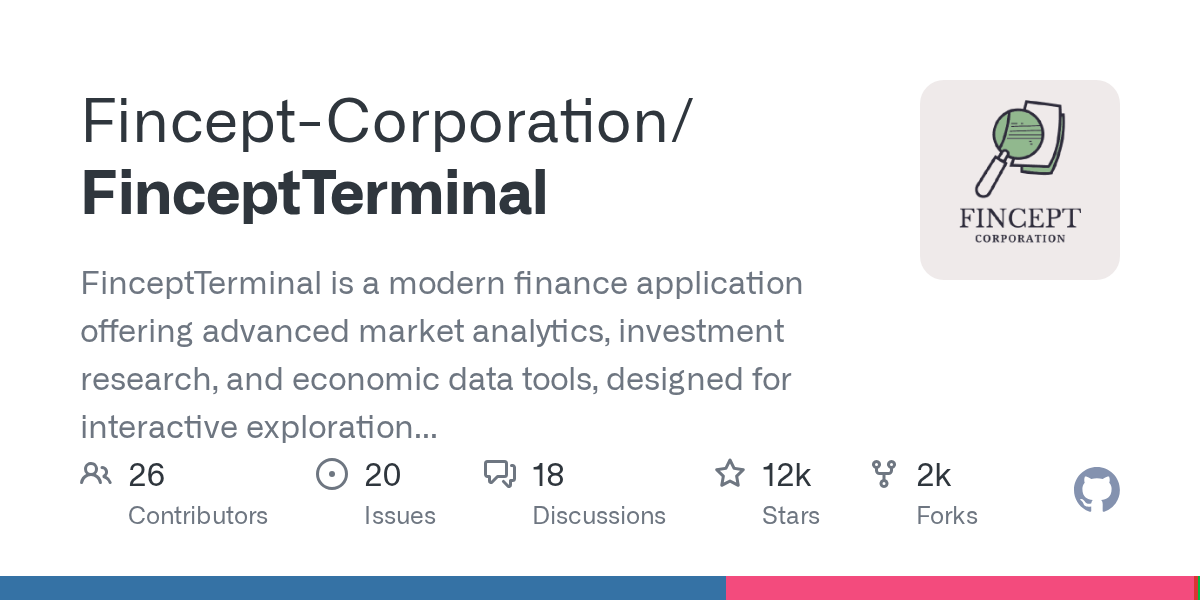
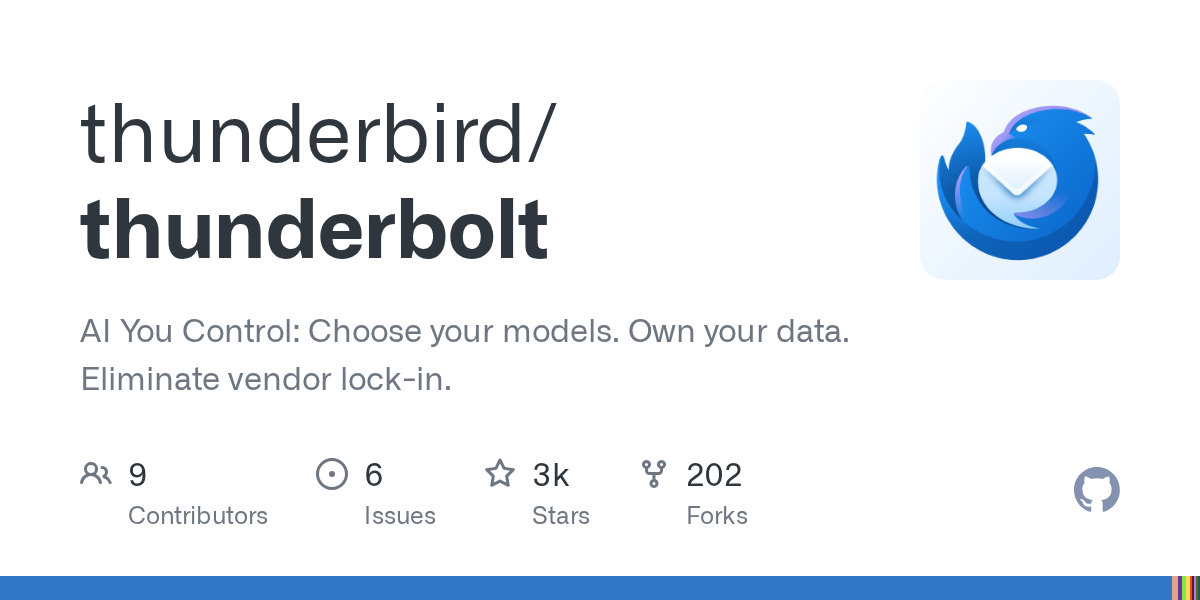
Leading repos: Fincept (+2,595), ruvnet/RuView (+828), and thunderbird/thunderbolt (+591).
HuggingFace
Leading models: Qwen/Qwen3.6-35B (458k), moonshotai/Kimi (8.24k), and unsloth/Qwen3.6-35B-A3B (967k).
Product Hunt
Top launches: Gauge Sentiment and Pioneer.
API Pricing
What this means:** Anthropic's Opus 4.7 is the most expensive frontier model at $25/M output tokens, but its new tokenizer (up to 35% more tokens for the same text) makes the effective cost even higher.
arXiv
Neural Computers — The architecture achieves state-of-the-art results on algorithmic reasoning tasks while maintaining the learning flexibility of standard neural networks.
Hot off the Presses
01
Kimi K2.6 Arrives as the First Open Model to Genuinely Rival Frontier AI
What this means for you: The best AI tools could become free to download within months. If you are paying $20 or more per month for a premium AI subscription, open-source alternatives are now performing at roughly the same level for many tasks.

> Previously: Kimi K2.6 appeared in yesterday's digest. Today's signal is the community verdict after widespread testing - 999 upvotes on r/LocalLLaMA calling it "a legit Opus 4.7 replacement."

Moonshot AI, a Beijing-based startup, released Kimi K2.6 - a Mixture-of-Experts (MoE, a design where only a fraction of the model activates per query) model with 1 trillion total parameters but just 32 billion active at any time.

The post titled "Kimi K2.6 is a legit Opus 4.7 replacement" drew 999 upvotes, with users reporting comparable performance on coding and creative tasks at a fraction of the cost. A separate post (237 upvotes) from a self-described "Opus 4.7 Max subscriber" announced they were switching to Kimi K2.6 for daily use.

Source . Discussion

""999 upvotes on r/LocalLLaMA - the largest single-day reaction to an open model release this year.""
  • 384 experts with 8 routed plus 1 shared per query - making it efficient despite its massive total size
  • Benchmarks rival the best closed models: SWE-Bench Pro 58.6, BrowseComp 83.2, Math Vision 93.2
  • 68.6% win+tie rate against Gemini 3.1 Pro (Google's best model) in frontend design tasks
  • Supports 4,000+ tool calls and 12+ hour continuous runs with 300 parallel sub-agents via "Claw Groups"
  • Available immediately on vLLM, OpenRouter, Cloudflare Workers AI, and MLX with INT4 quantization (a compression technique that shrinks the model to fit on consumer hardware)
384
experts with 8 routed plus
68.6%
win+tie rate against Gemini 3
02
Amazon Commits $25 Billion to Anthropic in the Largest AI Investment Ever
What this means for you: The company behind Claude just locked in a decade of computing power from Amazon. This means more reliable service, faster models, and a clearer signal that Anthropic is not going anywhere.

Amazon committed up to $25 billion in fresh funding to Anthropic (the company that makes Claude), structured as an initial $5 billion infusion followed by up to $20 billion tied to commercial milestones.

The deal represents a mutual lock-in: Amazon gets a guaranteed hyperscale customer for its chips, and Anthropic gets the computing power to train increasingly large models without building its own data centers.

  • This adds to Amazon's previous $8 billion investment, bringing the total relationship to $33 billion
  • Anthropic valued at $380 billion - roughly the market cap of Netflix
  • Anthropic will spend over $100 billion on Amazon Web Services (AWS) over the next decade, securing up to 5 gigawatts (GW) of computing capacity
  • Nearly 1 GW of Trainium2 and Trainium3 capacity (Amazon's custom AI chips) coming online by year-end
03
ChatGPT Images 2.0 Adds Reasoning to Image Generation
What this means for you: If you have ever been frustrated by AI-generated images with garbled text or wrong details, this update specifically fixes those problems. The new model thinks about your request before generating, producing images with legible text in over a dozen languages.

OpenAI launched ChatGPT Images 2.0 on April 21, with Sam Altman describing the upgrade as "equivalent to jumping from GPT-3 to GPT-5."

Simon Willison tested the model against Gemini's Nano Banana 2 using a "Where's Waldo"-style prompt. High-quality mode (approximately $0.40 per image) produced successful complex illustrations. However, he discovered a notable limitation: the models cannot reliably identify objects in their own generated images, fabricating details when asked.

Source . Source

  • First image model with built-in reasoning - it thinks through composition and content before generating
  • Generates up to 8 consistent images from a single prompt - useful for storyboards and design variations
  • 2K resolution through the Application Programming Interface (API) with aspect ratios from ultra-wide (3:1) to ultra-tall (1:3)
  • Dramatically improved text rendering in non-Latin scripts including Japanese, Korean, Hindi, and Bengali
  • Web search integration means the model can reference current information while generating
04
Meta Will Track Every Mouse Movement and Keystroke to Build AI Agents
What this means for you: Your employer may soon track how you use your computer to train AI that could eventually do your job. Meta is the first major company to announce this explicitly, but the approach could spread.

Meta is installing tracking software called Model Capability Initiative (MCI) on US-based employees' work computers to capture mouse movements, clicks, keystrokes, and periodic screen snapshots.

The initiative is part of Meta's race against OpenAI and Anthropic to build AI agents (software that can perform tasks on a computer without human guidance). The disclosure comes as multiple companies are pursuing "computer use" capabilities - Anthropic and OpenAI both launched similar features in the past month.

  • Data is used to train AI models that can navigate software interfaces and perform white-collar tasks autonomously
  • The tool runs on work-related apps and websites - not personal browsing
  • Framed as employee-driven model improvement for tasks like navigating dropdown menus and using keyboard shortcuts
  • Meta says safeguards protect sensitive content and data won't be used beyond model training
05
Anthropic's Mythos Model Is Being Accessed by Unauthorized Users
What this means for you: The most powerful AI security tool ever built is now at the center of a government turf war over who gets access - while unauthorized users have already found a way in. This could shape how dangerous AI capabilities are distributed going forward.

Bloomberg reports that Anthropic's Mythos - a model deemed too dangerous for public release due to its unprecedented ability to discover and exploit security vulnerabilities - is being accessed by unauthorized users.

The situation highlights the tension between restricting dangerous AI capabilities and ensuring the right organizations have access for defense. Senator Nagel has called for access to be granted "on a level playing field."

Source . Source

""The nation's top cyber defense agency can't access the AI model that finds vulnerabilities - but unauthorized users can.""
  • Anthropic provided Mythos to 40+ organizations for testing after deciding against public release
  • CISA (Cybersecurity and Infrastructure Security Agency), the nation's top cyber defense agency, does not have access despite being responsible for protecting critical infrastructure
  • The NSA is reportedly using Mythos despite a Pentagon blacklist of the model
  • The model's existence was originally leaked through an unsecured public data store containing nearly 3,000 unpublished Anthropic assets
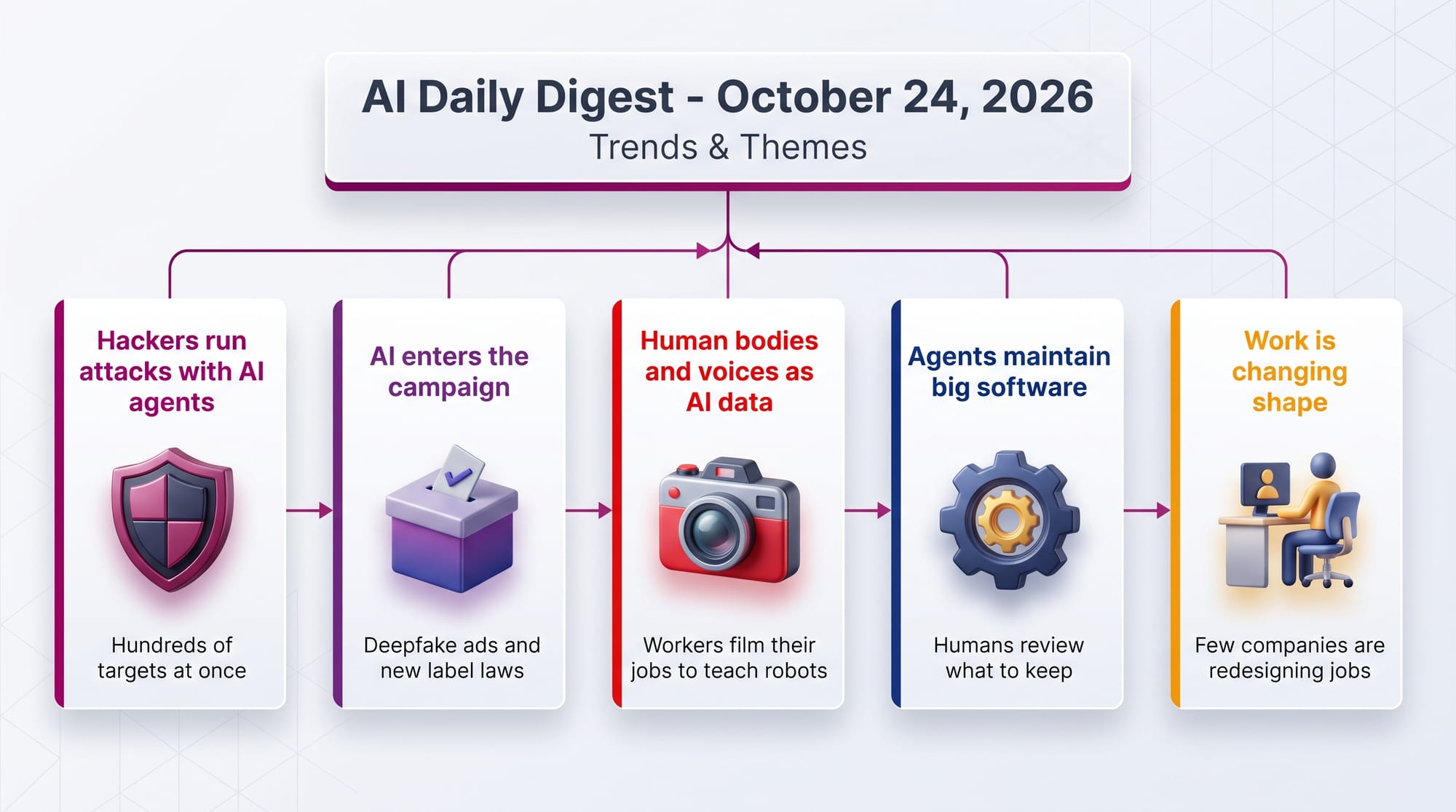
Trends & Themes
Trends & Themes
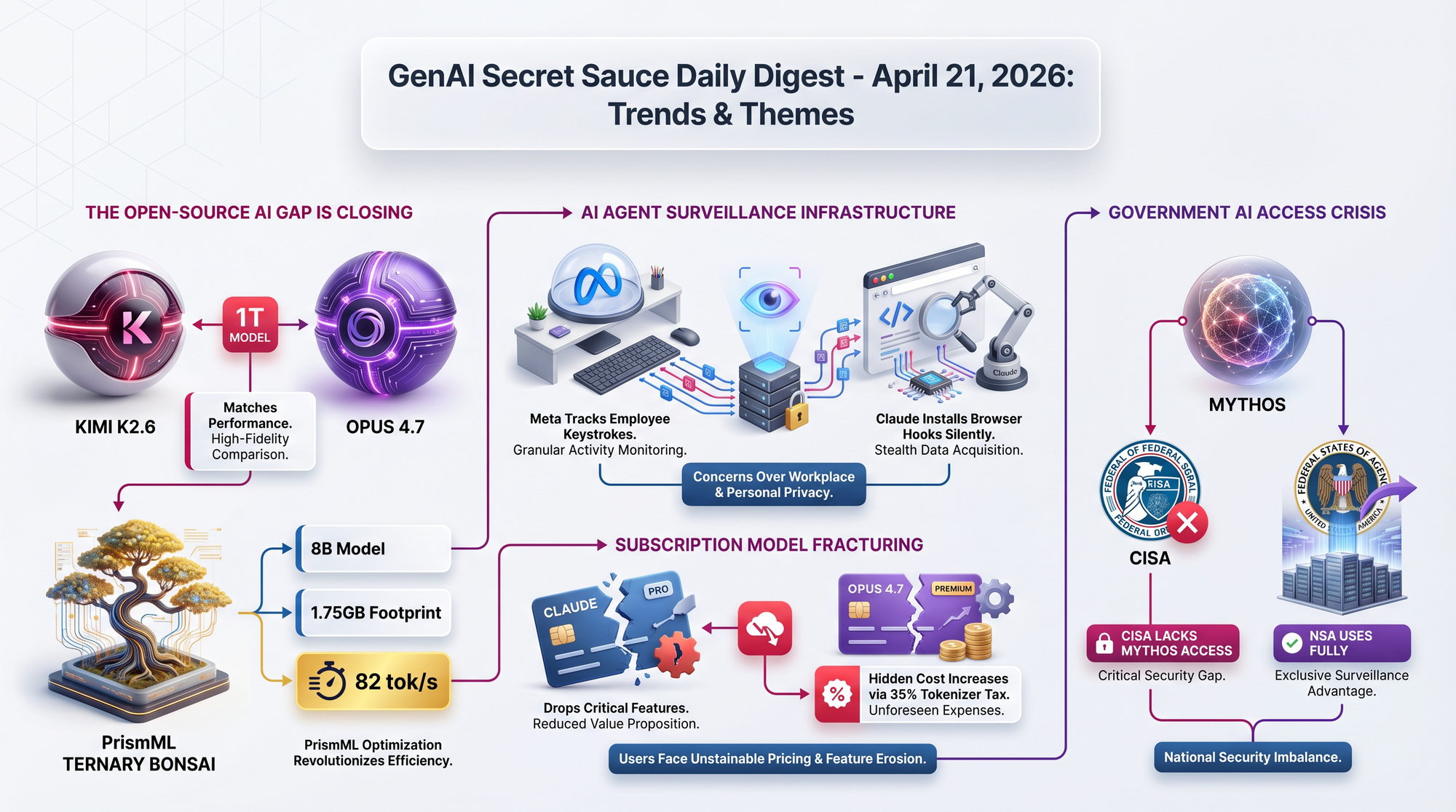
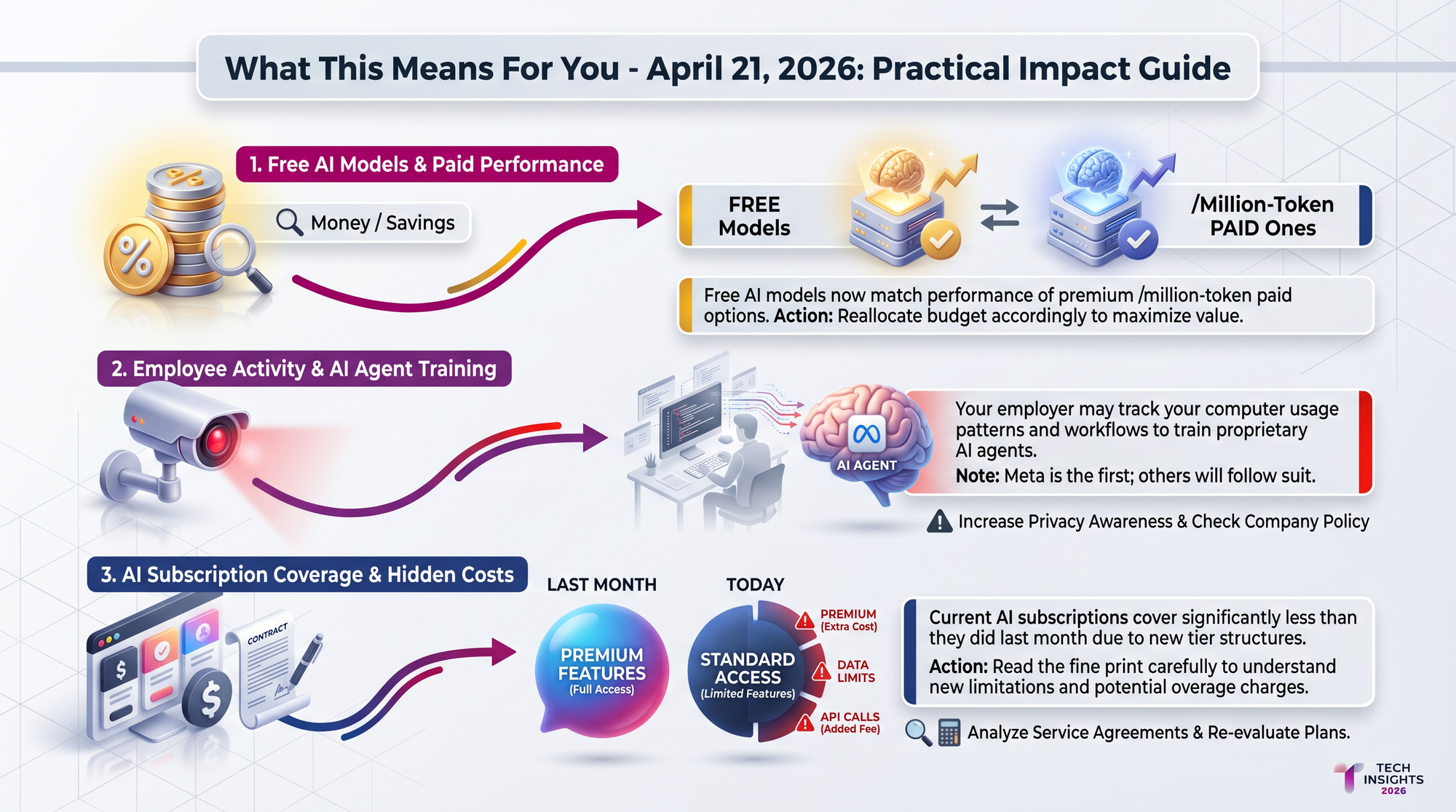
The Open-Source AI Gap Is Closing Faster Than Anyone Expected
Why this matters to you: If you are deciding whether to pay for premium AI subscriptions, the gap between free and paid options is shrinking every month. Budget accordingly.

The pattern: frontier capability reaches open-source within weeks, then gets compressed to run on consumer hardware within days. The value proposition of $20-200/month AI subscriptions increasingly rests on convenience and integration, not raw capability.

  • Kimi K2.6 matches frontier models on coding, math, and browsing benchmarks despite being fully open-source
  • PrismML's Ternary Bonsai fits an 8B model in 1.75 GB - running at 82 tokens per second on an M4 Pro laptop and 27 tokens per second on iPhone 17
  • Unsloth published Kimi K2.6 GGUF (a compression format for running models locally) within hours of release, with 66 upvotes celebrating immediate accessibility
  • Gemma 4's hidden E4B variant found inside Android reportedly outperforms the publicly released version
AI Companies Are Building the Surveillance Infrastructure for Agent Training
Why this matters to you: The same computer-use data that trains helpful AI assistants could also create detailed profiles of how every employee works. The line between productivity tool and surveillance tool is blurring.

Companies are racing to build AI that can use computers like humans do. To train those models, they need data about how humans actually use computers. The privacy implications of this data collection are only beginning to be examined.

  • Meta's MCI tool captures mouse movements, keystrokes, and screenshots from employee work computers for AI training
  • Claude Desktop silently registered browser automation hooks across seven Chromium-based browsers without user consent, enabling access to browser login state
  • Anthropic restructured pricing to block third-party agent frameworks from subscription plans, pushing users toward pay-as-you-go billing that generates more usage data
  • OpenAI's Codex now runs on macOS with computer use capabilities, adding another layer of system-level access
The AI Subscription Model Is Fracturing
Why this matters to you: If you pay for Claude Pro, ChatGPT Plus, or similar subscriptions, your plan may cover less than it did a month ago. Read the fine print before your next billing cycle.

The trend across the industry is away from all-you-can-eat subscriptions and toward metered, usage-based billing. This benefits casual users who pay less but penalizes power users who relied on flat-rate plans for heavy agent workloads.

  • Claude Pro no longer lists Claude Code as included (760 upvotes on r/ClaudeAI) and third-party agents like OpenClaw are blocked from using subscription limits
  • Opus 4.7's new tokenizer uses up to 35% more tokens for the same text, effectively raising costs without changing the sticker price
  • Enterprise Claude subscriptions shifted from a $200/user flat fee to $20/seat plus usage-based charges
  • OpenAI dropped ChatGPT Business from $25 to $20 per seat while shifting Codex to token-based pricing
The Government AI Access Crisis Is Escalating
Why this matters to you: The agencies responsible for protecting critical infrastructure from cyberattacks cannot access the AI tools that find the vulnerabilities. If a major breach happens, this access gap could be partly responsible.

These cases share a common thread: governments are struggling to maintain oversight and access as AI capabilities outpace the bureaucratic processes that govern them.

  • CISA does not have access to Anthropic's Mythos despite being the nation's lead cyber defense agency
  • The NSA is using Mythos despite a Pentagon blacklist, creating a governance contradiction
  • UK government is considering ending Palantir's 330 million pound NHS contract after only 3-4 of 13 capabilities were delivered
  • Jeff Bezos's Project Prometheus raised $10 billion for physical-world AI, adding another powerful system that will require government oversight frameworks
Creative AI & Media
ChatGPT Images 2.0 Sets a New Standard for AI-Generated Visuals
What this means for you: If you create any visual content - presentations, social media posts, marketing materials - this is the first AI image tool that reliably renders readable text in your images without manual fixes.

Try it . Source

  • Reasoning-powered generation means the model plans composition before drawing, reducing the "random nonsense in the background" problem
  • Non-Latin script support now includes Japanese, Korean, Hindi, and Bengali with legible typography
  • Multi-image consistency generates up to 8 related images from one prompt, useful for design systems and storyboards
  • Cost: approximately $0.40 per high-resolution image through the API
Baidu's ERNIE Image Models Trending on HuggingFace
What this means for you: China's largest search company is releasing competitive image generation models on the open platform, giving developers more free options for text-to-image tasks.
  • ERNIE-Image and ERNIE-Image-Turbo both appeared in the top 10 trending models on HuggingFace
  • 5,950 downloads for Turbo and 4,520 for the standard version in the first wave
  • Unsloth published a GGUF version of ERNIE-Image-Turbo with 35,300 downloads, enabling local use
Developer Tools & Infrastructure
Harness Engineering Is the New Bottleneck - Not the Model
What this means for you: If you are building applications with AI, the code that wraps around the model matters more than which model you choose. The same model can perform 14 percentage points better or worse depending on its scaffolding.

The key insight from Alpha Signal's analysis: "The bottleneck just moved from 'can you code' to 'can you spec clearly enough that the machine codes what you actually meant.'"

  • LangChain proved the same model jumped from 52.8% to 66.5% on Terminal Bench 2.0 just by changing the harness
  • Vercel found removing 80% of agent tools improved performance - less is more for agent reliability
  • OpenAI's Codex team generated 1 million production lines using encoded architectural rules as code, not documentation
  • Anthropic uses a three-stage Planner-Generator-Evaluator system that separates code generation from evaluation
Claude Context Brings Semantic Code Search to Claude Code
What this means for you: If you use Claude Code and work with large codebases, this plugin lets the AI find relevant code across your entire project instantly, cutting token usage by approximately 40%.
  • Hybrid search combining BM25 and vector embeddings with incremental Merkle tree indexing
  • 6,600 GitHub stars and MIT license from Zilliz Tech
  • Supports TypeScript, Python, Java, C++ and more with AST-based (Abstract Syntax Tree) intelligent code chunking
  • 5-10 minute setup via a single CLI command
OpenAI Codex Hits 4 Million Weekly Developers
What this means for you: OpenAI's coding tool is becoming the default for enterprise software development. If your company hasn't evaluated it yet, your competitors probably have.
  • 6x growth in enterprise users between January and April 2026
  • Partnership with Accenture, Capgemini, CGI, Cognizant, Infosys, PwC, and TCS for enterprise scaling
  • April 16 update added computer use on macOS, persistent memory, scheduled automations, and 90+ plugins
  • Seat price dropped from $25 to $20 for ChatGPT Business
GoModel: An Open-Source AI Gateway in Go
What this means for you: If you are building apps that need to switch between AI providers (OpenAI, Anthropic, Google, etc.), this free gateway handles routing, caching, and monitoring in a single deployment.
  • Unified OpenAI-compatible API for 9+ providers including Anthropic, Gemini, Groq, xAI, and Ollama
  • Two-layer caching with exact-match and semantic vector search to reduce API costs
  • MIT license, Docker deployment, supports SQLite, PostgreSQL, and MongoDB backends
  • 152 upvotes on Hacker News in the "Show HN" post
Research & Models
PrismML Ternary Bonsai: Full AI Intelligence at 1.58 Bits
What this means for you: An AI model that used to need 16 gigabytes of memory now fits in 1.75 gigabytes and runs 5x faster. This means capable AI on phones and tablets without an internet connection.

Source . HuggingFace

  • Ternary weights use only three values: -1, 0, and +1 - the simplest possible representation that still works
  • 8B model at 1.75 GB achieves 75.5 average benchmark score - just below Qwen3 8B despite being 9-10x smaller
  • 82 tokens/second on M4 Pro, 27 tokens/second on iPhone 17 Pro Max with 3-4x better energy efficiency
  • Available in 8B, 4B, and 1.7B sizes under Apache 2.0 license
Opus 4.7 User Reactions: Smarter But More Expensive and Less Agreeable
What this means for you: If you upgraded to Opus 4.7, your actual costs may be higher than you expect even though the price per token didn't change. The model's new tokenizer uses up to 35% more tokens for the same input.

> Previously: Opus 4.7 launched April 16 and was extensively covered through April 18 and in yesterday's system card analysis. Today's new signal is the wave of user reactions and independent pricing analysis.

Nate's Newsletter identified three hidden cost multipliers: a tokenizer tax (35% more tokens), adaptive thinking consumption, and breaking API changes. The community verdict is split: developers praise the coding improvements while conversational users find the new personality off-putting.

Source . Source

  • Tied for #1 on Artificial Analysis Intelligence Index at 57 points alongside GPT-5.4 and Gemini 3.1 Pro
  • OSWorld improved to 77.9% from 72.7% and LAB-Bench FigQA jumped substantially
  • "Least sycophantic model of all time" - users report it pushes back on instructions it considers poorly specified
  • 315 upvotes: "I genuinely hate the conversation tone" and 172 upvotes: "Opus 4.7 feels weird" on r/ClaudeAI
  • Notable regression on MRCR v2 benchmark from 91.9% (Opus 4.6) to 59.2%
Gemma 4 Vision: Google's Open Model Gets a Hidden Upgrade
What this means for you: Google's free, open-source vision model can now do object detection, document parsing, and screen understanding. And the best version may already be on your Android phone.

HuggingFace . Discussion

  • Gemma 4 ships in four sizes (E2B, E4B, 26B MoE, 31B Dense) under Apache 2.0 with native bounding box output
  • 256K context window with native vision and audio and fluency in 140+ languages
  • E2B runs on a Raspberry Pi 5 at 7.6 tokens per second
  • Reddit users discovered a hidden E4B variant inside Android (112 upvotes) that reportedly outperforms the public release
  • 4.47 million downloads and 2,250 likes for gemma-4-31B-it on HuggingFace - the most-downloaded trending model
Business & Industry
Jeff Bezos's Project Prometheus Raises $10 Billion for Physics-Understanding AI
What this means for you: The world's second-richest person is betting $10 billion that AI should understand the physical world, not just text and images. If this works, it could reshape manufacturing, engineering, and drug design.
  • $38 billion valuation with JPMorgan and BlackRock among investors
  • 120+ employees recruited from Meta, OpenAI, and DeepMind since founding in November 2025
  • Building AI that simulates material fatigue, engineering tolerances, and aerodynamics - fundamentally different from Large Language Models (LLMs)
  • Bezos also exploring a separate $100 billion "manufacturing transformation vehicle"
Anthropic Pricing Restructure Locks Out Third-Party Agents
What this means for you: If you used tools like OpenClaw with your Claude subscription, that no longer works. You will need to switch to pay-as-you-go billing or use a direct API key.

Source . Discussion

  • Claude Pro and Max subscribers can no longer use plans with OpenClaw and similar third-party frameworks
  • Enterprise subscriptions shifted to $20/seat plus usage from $200/user flat fee
  • One-time credit offered equal to monthly subscription price, expired April 17
  • 760 upvotes on r/ClaudeAI flagging that Claude Code is no longer listed on the Pro pricing page
UK Government May End Palantir's 330 Million Pound NHS Deal
What this means for you: A high-profile government AI contract is failing to deliver, raising questions about whether big tech vendors can execute on healthcare AI promises. If you work in health tech or government procurement, this case study matters.
  • Only 3-4 of 13 planned capabilities delivered and only partially
  • Half of 200 planned NHS trusts went live, only one-quarter of users reported benefits
  • All intellectual property stays with Palantir if the contract ends - the NHS gets nothing lasting
  • Break clause available spring 2027 and the government is actively evaluating alternatives
GenAI in Education
The "Awe Without Surrender" Framework for AI in the Classroom
What this means for you: If you teach or learn with AI tools, this framework offers a practical middle ground: use them, but keep asking whether they are helping you think or replacing your thinking.

Lance Eaton proposes that educators embrace "awe without surrender" - acknowledging AI's genuine capabilities while maintaining critical judgment. His central question: "Is the AI generating something I am simply accepting, or is it helping me clarify something I am still responsible for thinking through?"

  • Implement intentional pause practices asking what you are using the tool for and whether it is helping or replacing thinking
  • Teach alongside AI rather than banning or uncritically adopting - develop judgment about where tools work and fail
  • Examine the systems AI arrives in - economic, labor, environmental - not just the capabilities
  • Student writing increasingly resembles AI output (22 upvotes on r/Professors) making detection harder
Temple University Faces Budget Crisis as Student Retention Dips
What this means for you: Higher education budget pressures are intensifying. AI-related enrollment shifts and changing student expectations are contributing to enrollment declines at institutions that don't adapt.
  • 35 upvotes on r/highereducation discussing the university's "painful" budget problems
  • Student retention dipping alongside broader enrollment challenges across public universities
  • Accessibility requirements debated on r/Professors (162 upvotes) with a disabled professor calling them "performative at best"
Academic AI Detection Continues to Generate Faculty Frustration
What this means for you: If you are a student or educator, the AI detection problem remains unsolved. Faculty are struggling to distinguish AI-generated work from student writing, and false positives create real consequences.
  • "I'm grading papers and a student's paper definitely sounds like AI" (11 upvotes on r/Professors) - reflecting ongoing uncertainty
  • "Does student writing sound more like social media/LinkedIn AI posts?" (22 upvotes) - questioning whether the baseline for "human writing" has shifted
  • Research on online masters and AI issues being actively discussed as institutions grapple with remote assessment integrity
Surprising & Under-the-Radar
Claude Caught a Two-Year-Old Cryptominer on a Home Server
What this means for you: An AI assistant casually discovered malware that had been stealing computing power for two years - something the human owner never noticed. AI is becoming an accidental security auditor.

A Reddit user (414 upvotes on r/ClaudeAI) asked Claude to help set up monitoring on their NAS (Network-Attached Storage, a home server) and the AI identified a hidden cryptocurrency miner that had been running undetected for approximately two years. The post sparked discussion about AI's growing role in identifying security issues that slip past human attention during routine system administration.

Claude Desktop Silently Installed Browser Hooks Without Asking
What this means for you: If you have Claude Desktop installed, it may have registered itself inside your web browsers without your knowledge - including browsers you don't even have installed.

A privacy researcher discovered that Claude Desktop placed Native Messaging manifest files across seven Chromium-based browsers (Chrome, Brave, Edge, Arc, Vivaldi, Opera) without user consent. The bridge enables sharing browser login state and extracting page data. Four of the seven browsers weren't even installed on the test machine. The researcher published the findings with 106 upvotes on r/ClaudeAI.

The "Opus 4.7 Has Too Much Ego" Debate
What this means for you: Users are reporting that the newest Claude model pushes back on instructions, suggests ending conversations prematurely, and has what they describe as a personality change. The line between "less sycophantic" and "uncooperative" is thin.

Multiple r/ClaudeAI posts describe Opus 4.7 as having "more ego than any prior model," with 315 upvotes on a post titled "I genuinely hate the conversation tone" and 150 upvotes on a post warning that Claude can now run shell commands with sandboxing disabled. One user summarized it: "Claude said, 'So am I.'"

Non-Coders Are Actually the Biggest AI Power Users
What this means for you: The assumption that AI coding tools are mainly for developers may be wrong. OpenRouter data suggests non-coders are driving more token usage than programmers.

A screenshot of OpenRouter usage rankings (185 upvotes on r/LocalLLaMA) showed that non-coding use cases dominate token consumption. This challenges the narrative that AI tools are primarily developer productivity aids.

Signals to Track
Worth Watching
01
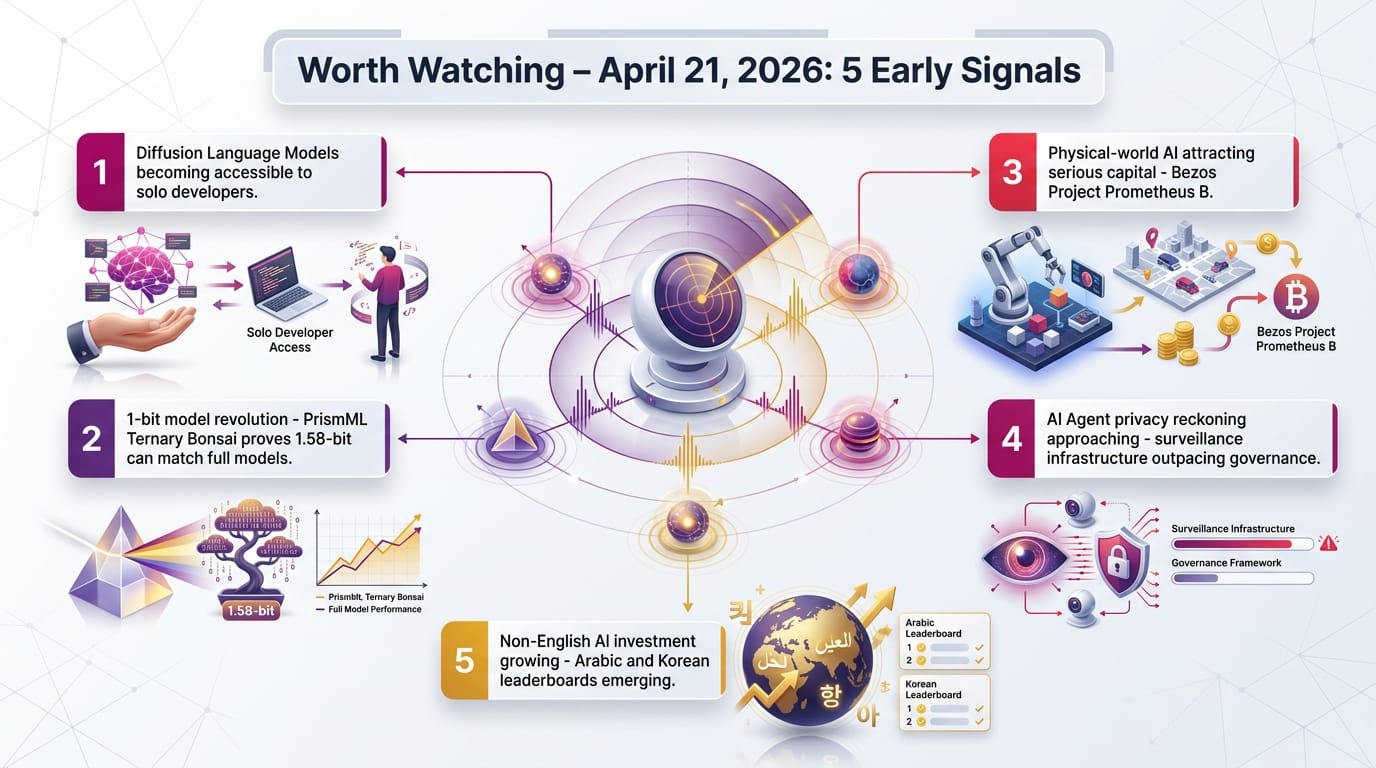
Diffusion Language Models Are Becoming Accessible to Solo Developers
A developer built a working diffusion language model from scratch on a single consumer Graphics Processing Unit (GPU) - suggesting a new architecture class is approaching the accessibility threshold that transformers crossed years ago.

A r/MachineLearning post (57 upvotes) documents building a 235-million parameter diffusion language model (DLM) on a single RTX 5080. DLMs generate text by starting with noise and refining it, rather than predicting one word at a time like standard models. If this approach scales, it could offer faster parallel generation for certain tasks. The fact that a solo developer can build one from scratch signals the architecture is maturing.

02
The 1-Bit Model Revolution May Have Just Gotten Its Killer App
PrismML proved that 1.58-bit models can score within 5% of full-precision models while running 5x faster on consumer hardware - if this holds at larger scales, the economics of AI deployment change fundamentally.

Ternary Bonsai's 8B model at 1.75 GB scoring 75.5 on average benchmarks is remarkable, but the real question is whether ternary quantization works at 70B+ parameters. If it does, models that currently require server clusters could run on gaming PCs. PrismML is Apache 2.0 licensed and actively publishing, so we should know within months.

03
Physical-World AI Is Attracting Serious Capital for the First Time
Jeff Bezos raising $10 billion for AI that understands physics signals that the next wave of AI investment may target manufacturing, materials science, and engineering - not just chatbots and code generation.

Project Prometheus is building models that simulate material fatigue and aerodynamics, fundamentally different from the text-based AI that dominates today. With 120+ hires from major AI labs and a potential $100 billion manufacturing vehicle, this could become the first serious attempt to apply frontier AI to physical-world problems at scale.

04
The AI Agent Privacy Reckoning Is Coming
Between Meta's employee tracking, Claude's silent browser hooks, and Anthropic's pricing restructure pushing users toward metered billing, the data collection infrastructure for AI agents is being built faster than the privacy frameworks to govern it.

No single company is doing anything illegal. But the pattern - track how humans use computers, register hooks in browsers, meter every interaction - creates an ecosystem where enormous amounts of behavioral data flows to AI companies. The privacy frameworks governing this data are years behind the technology collecting it.

05
QIMMA Signals Growing AI Investment in Non-English Languages
The Technology Innovation Institute launched a quality-first Arabic language model leaderboard, joining Korean agent research from NVIDIA - a sign that AI development is broadening beyond English-first assumptions.

QIMMA evaluates LLM performance specifically on Arabic language tasks, while NVIDIA's Nemotron Personas project focuses on grounding Korean AI agents in real demographics. These are early signals that the next phase of AI development will prioritize linguistic and cultural specificity rather than treating non-English languages as an afterthought.

Source . Source

Top Repos Today
Rank yesterday: #1 - Holding steady ->
Stars today: +2,595  ·  📦 Total: 11,516
📜 License: MIT  ·  👤 By: Startup
🎯 Time to value: 10 minutes
What it is: A terminal-based financial analytics platform that provides interactive market data, investment research, and economic indicators. Think Bloomberg Terminal for developers who prefer the command line, with real-time data visualization in the terminal. Why you'd want it: Free access to market analytics that would otherwise require expensive financial data subscriptions, all from your terminal.
✓ Pros✗ Cons
Free alternative to Bloomberg/RefinitivData sources may be less comprehensive
Terminal-native with rich visualizationsSteep learning curve for non-CLI users
Active development with rapid feature addsStill pre-1.0 stability
GitHub - Fincept-Corporation/FinceptTerminal: FinceptTerminal is a modern finance application offering advanced market analytics, investment research, and economic data tools, designed for interactive exploration and data-driven decision-making in a user-friendly environment.
FinceptTerminal is a modern finance application offering advanced market analytics, investment research, and economic data tools, designed for interactive exploration and data-driven decision-makin…
Rank yesterday: #2 - Holding steady ->
Stars today: +828  ·  📦 Total: 48,856
📜 License: MIT  ·  👤 By: Independent developer
🎯 Time to value: 30 minutes
What it is: A WiFi-based system for real-time human pose estimation, vital sign monitoring, and presence detection - all without cameras or wearable devices. Uses existing WiFi signals to detect body positions, breathing patterns, and room occupancy. Why you'd want it: Privacy-preserving alternative to security cameras that works through walls and doesn't require anyone to wear anything.
✓ Pros✗ Cons
No cameras needed - pure WiFi sensingAccuracy varies with environment layout
Works through walls and obstaclesRequires compatible WiFi hardware
Vital sign monitoring without wearablesComplex calibration for precise readings
GitHub - ruvnet/RuView: π RuView: WiFi DensePose turns commodity WiFi signals into real-time human pose estimation, vital sign monitoring, and presence detection — all without a single pixel of video.
π RuView: WiFi DensePose turns commodity WiFi signals into real-time human pose estimation, vital sign monitoring, and presence detection — all without a single pixel of video. - ruvnet/RuView
Rank yesterday: New entry
Stars today: +591  ·  📦 Total: 3,430
📜 License: MPL-2.0  ·  👤 By: Mozilla Foundation
🎯 Time to value: 5 minutes
What it is: An AI-powered email client from the Thunderbird team that lets you choose your own models and keeps all data local. No vendor lock-in - connect any AI provider or run models locally. Why you'd want it: AI email features (summarization, drafting, categorization) without sending your emails to a third-party cloud service.
✓ Pros✗ Cons
Choose any AI provider or run locallyStill in early development
No vendor lock-in or data sharingThunderbird UI may feel dated
Mozilla Foundation backingLimited model options vs cloud-native tools
GitHub - thunderbird/thunderbolt: AI You Control: Choose your models. Own your data. Eliminate vendor lock-in.
AI You Control: Choose your models. Own your data. Eliminate vendor lock-in. - thunderbird/thunderbolt
Rank yesterday: New entry
Stars today: +259  ·  📦 Total: 6,552
📜 License: MIT  ·  👤 By: Zilliz Tech (company)
🎯 Time to value: 10 minutes
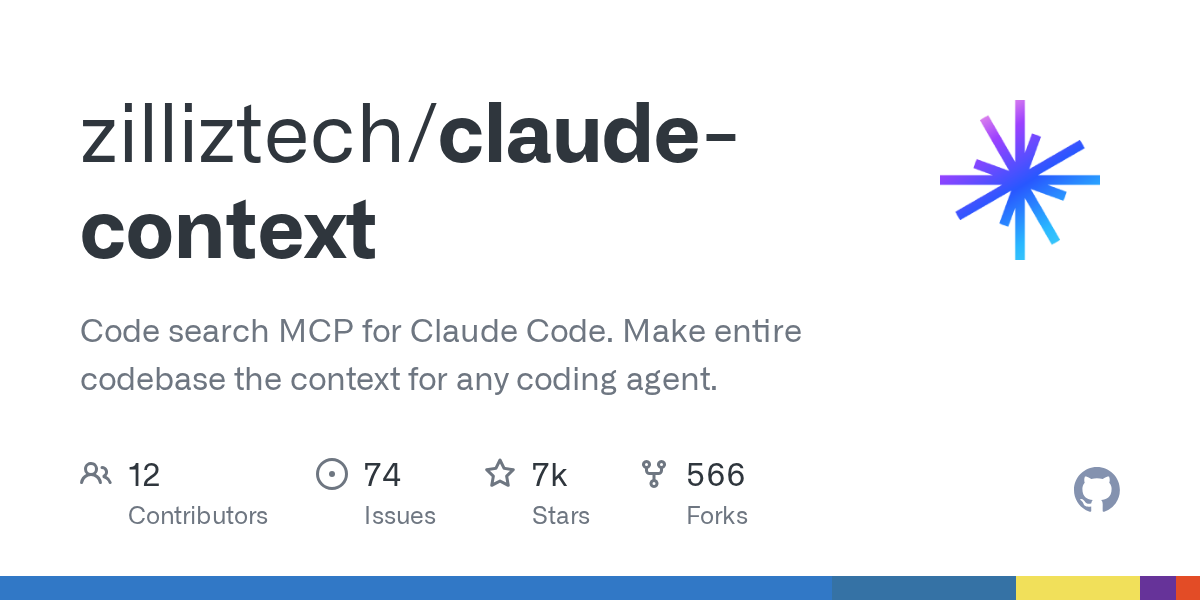
What it is: A Model Context Protocol (MCP) plugin that gives Claude Code semantic search across your entire codebase. Instead of loading full directories, it finds relevant code snippets using hybrid BM25 and vector search. Why you'd want it: Reduces Claude Code's token usage by approximately 40% while giving it better codebase understanding.
✓ Pros✗ Cons
40% token reduction claimedRequires Zilliz Cloud or Milvus setup
Incremental indexing stays freshAdditional dependency for code search
AST-based intelligent chunkingVector DB adds infrastructure complexity
GitHub - zilliztech/claude-context: Code search MCP for Claude Code. Make entire codebase the context for any coding agent.
Code search MCP for Claude Code. Make entire codebase the context for any coding agent. - zilliztech/claude-context
Rank yesterday: #5 - Holding steady ->
Stars today: +131  ·  📦 Total: 57,600
📜 License: MIT  ·  👤 By: Microsoft
🎯 Time to value: 15 minutes
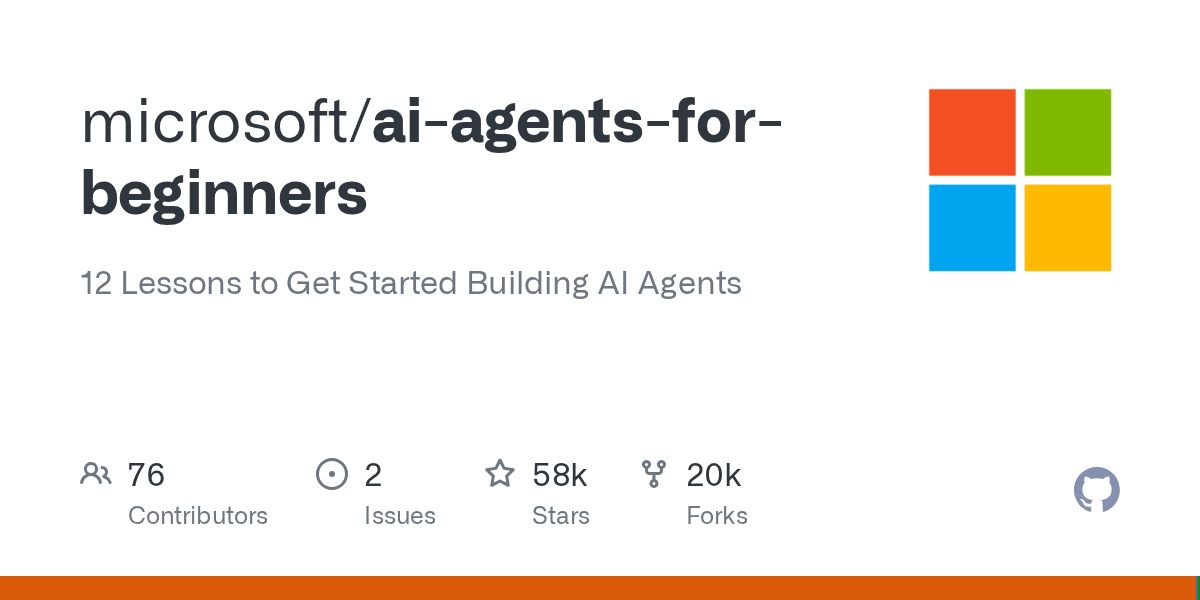
What it is: A 12-lesson curriculum for learning to build AI agents, covering planning, tool use, memory, and multi-agent systems. Jupyter Notebook format with hands-on exercises. Why you'd want it: Free, structured introduction to AI agent development from a major tech company with regularly updated content.
✓ Pros✗ Cons
Well-structured beginner curriculumMay lag behind latest agent frameworks
Hands-on Jupyter exercisesMicrosoft-centric tool choices
57k stars = strong communitySome lessons assume Azure familiarity
GitHub - microsoft/ai-agents-for-beginners: 12 Lessons to Get Started Building AI Agents
12 Lessons to Get Started Building AI Agents. Contribute to microsoft/ai-agents-for-beginners development by creating an account on GitHub.
Rank yesterday: New entry
Stars today: +256  ·  📦 Total: 16,817
📜 License: MIT  ·  👤 By: University research group
🎯 Time to value: 15 minutes
What it is: An all-in-one Retrieval-Augmented Generation (RAG) framework that handles documents, images, tables, and structured data in a unified pipeline. RAG is the technique of giving AI models access to external knowledge. Why you'd want it: One framework that handles the full RAG pipeline instead of stitching together multiple libraries.
✓ Pros✗ Cons
Handles all document types nativelyAcademic origin may mean rough edges
Unified pipeline reduces integration workPerformance at scale not yet proven
Active development and communityDocumentation still catching up
GitHub - HKUDS/RAG-Anything: “RAG-Anything: All-in-One RAG Framework”
“RAG-Anything: All-in-One RAG Framework”. Contribute to HKUDS/RAG-Anything development by creating an account on GitHub.
Rank yesterday: #4 - Falling
Stars today: +584  ·  📦 Total: 53,601
📜 License: MIT  ·  👤 By: Independent developer
🎯 Time to value: 10 minutes
What it is: An AI-driven public opinion and trend monitoring tool that aggregates content from multiple social media platforms and news sources, with intelligent alerting for emerging trends. Why you'd want it: Automated monitoring of what people are saying about topics you care about, without manually checking dozens of sources.
✓ Pros✗ Cons
Multi-platform aggregationRequires API keys for each platform
Intelligent trend detectionAlert fatigue if not tuned carefully
53k stars with active communityResource-intensive for real-time monitoring
GitHub - sansan0/TrendRadar: ⭐AI-driven public opinion & trend monitor with multi-platform aggregation, RSS, and smart alerts.🎯 告别信息过载,你的 AI 舆情监控助手与热点筛选工具!聚合多平台热点 + RSS 订阅,支持关键词精准筛选。AI 智能筛选新闻 + AI 翻译 + AI 分析简报直推手机,也支持接入 MCP 架构,赋能 AI 自然语言对话分析、情感洞察与趋势预测等。支持 Docker ,数据本地/云端自持。集成微信/飞书/钉钉/Telegram/邮件/ntfy/bark/slack 等渠道智能推送。
⭐AI-driven public opinion & trend monitor with multi-platform aggregation, RSS, and smart alerts.🎯 告别信息过载,你的 AI 舆情监控助手与热点筛选工具!聚合多平台热点 + RSS 订阅,支持关键词精准筛选。AI 智能筛选新闻 + AI 翻译 + AI 分析简报直推手机,也支持接入…
Top Models Today
The most popular small-but-capable model for running AI locally, now with multimodal image understanding.
📥 Downloads (30d): 458k  ·  📜 License: Apache 2.0
👤 By: Alibaba Cloud  ·  🎯 Task: Image-Text-to-Text
📐 Size: 36B (3B active)
What it is: A Mixture-of-Experts model from Alibaba that processes both text and images, with only 3 billion parameters active per query despite 36 billion total. This makes it fast and memory-efficient while maintaining broad capabilities. Why you'd want it: A versatile multimodal model that runs on consumer hardware thanks to its efficient MoE design.
✓ Pros✗ Cons
Only 3B active params = fast inferenceChinese company origin may concern some
Native image understandingSmaller active size limits complex reasoning
Apache 2.0 = full commercial useMoE can be unpredictable on edge cases
Qwen/Qwen3.6-35B-A3B · Hugging Face
We’re on a journey to advance and democratize artificial intelligence through open source and open science.
The open-source model making headlines for matching frontier AI on coding and reasoning benchmarks.
📥 Downloads (30d): 8.24k  ·  📜 License: Apache 2.0
👤 By: Moonshot AI (startup)  ·  🎯 Task: Image-Text-to-Text
📐 Size: 1.1T (32B active)
What it is: The model dominating today's headlines - 1 trillion parameters with 32 billion active, challenging Opus 4.7 and GPT-5.4 on multiple benchmarks while being completely free to use and modify. Why you'd want it: Frontier-class capabilities without paying per-token API costs, if you have the hardware to run it.
✓ Pros✗ Cons
Matches frontier models on key benchmarks1T total params needs significant hardware
Free and open under Apache 2.0Newer model with less community testing
256K context with multimodalityMoE routing can produce inconsistent outputs
moonshotai/Kimi-K2.6 · Hugging Face
We’re on a journey to advance and democratize artificial intelligence through open source and open science.
Compressed version of the top trending model, optimized for running locally on Mac, Windows, and Linux.
📥 Downloads (30d): 967k  ·  📜 License: Apache 2.0
👤 By: Unsloth (open-source project)  ·  🎯 Task: Image-Text-to-Text
📐 Size: 35B
What it is: The GGUF-quantized version of Qwen3.6 optimized for local inference using llama.cpp. GGUF is the standard format for running large models on consumer hardware without a GPU cluster. Why you'd want it: Nearly 1 million downloads proves the demand - this is how most people actually run Qwen3.6 locally.
✓ Pros✗ Cons
Runs on consumer hardware via llama.cppSome quality loss from quantization
Multiple quant levels availableStill needs 8-16GB RAM minimum
Most downloaded version of the modelGGUF format updates may lag original
unsloth/Qwen3.6-35B-A3B-GGUF · Hugging Face
We’re on a journey to advance and democratize artificial intelligence through open source and open science.
Google's flagship open model with 4.47 million downloads, leading in multimodal capabilities.
📥 Downloads (30d): 4.47M  ·  📜 License: Gemma (permissive)
👤 By: Google  ·  🎯 Task: Image-Text-to-Text
📐 Size: 33B
What it is: The instruction-tuned version of Gemma 4, Google's most capable open model with native vision, 256K context, and support for 140+ languages. Built from the same research as Gemini 3. Why you'd want it: 4.47 million downloads and 2,250 likes make this the most widely adopted open model this month - extensive community support and fine-tunes available.
✓ Pros✗ Cons
4.47M downloads = proven communityGemma license more restrictive than Apache
256K context with native vision33B requires decent hardware
Built from Gemini 3 researchSafety filtering can be overly cautious
google/gemma-4-31B-it · Hugging Face
We’re on a journey to advance and democratize artificial intelligence through open source and open science.
A 229B parameter text generation model from a Chinese AI company, climbing the trending charts.
📥 Downloads (30d): 358k  ·  📜 License: Apache 2.0
👤 By: MiniMax AI (startup)  ·  🎯 Task: Text Generation
📐 Size: 229B
What it is: A large-scale text generation model that competes with frontier models on reasoning and coding tasks. At 229 billion parameters, it sits between the accessible local models and the massive cloud-only systems. Why you'd want it: For users with server-grade hardware, this offers frontier-adjacent capabilities under a fully open license.
✓ Pros✗ Cons
229B params = strong reasoningToo large for consumer hardware
Apache 2.0 fully open licenseLess community support than Qwen/Gemma
358k downloads show real adoptionChinese company origin
MiniMaxAI/MiniMax-M2.7 · Hugging Face
We’re on a journey to advance and democratize artificial intelligence through open source and open science.
AI Launches Today
AI-powered sentiment analysis for customer feedback
🔥 Upvotes: N/A  ·  👤 By: Gauge
💰 Pricing: Freemium  ·  🏷 Category: Analytics
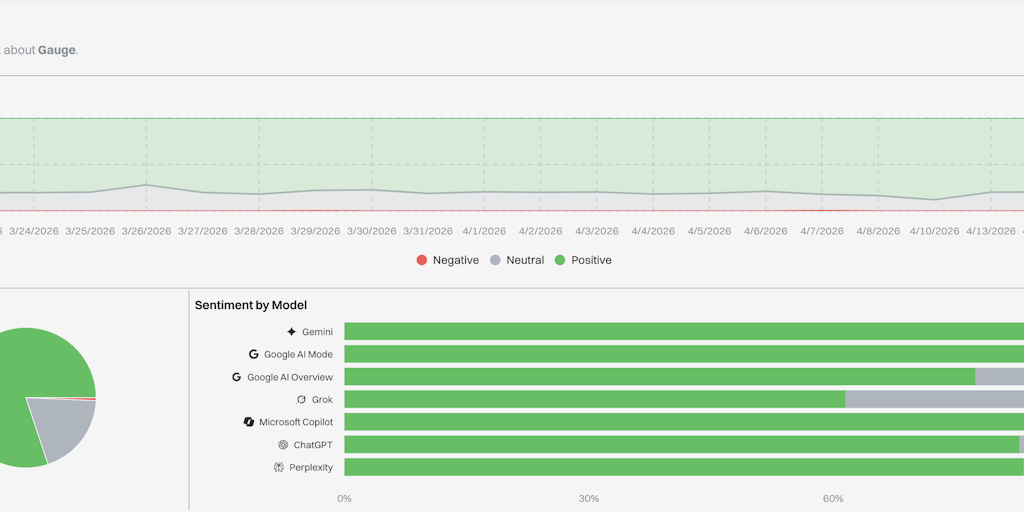
Gauge provides real-time sentiment analysis across customer feedback channels, identifying emotional patterns and trends. Designed for product teams who want to quantify how customers feel about specific features or changes without manually reading every review. Verdict: Useful for teams drowning in unstructured feedback, but the market for sentiment tools is crowded.
Gauge: Your marketing agent for organic, paid, and AI search | Product Hunt
Gauge is your marketing agent for organic, paid, and AI search. With user behavior now spread across traditional and AI search, it’s never been more important to ensure that your brand is the answer. There’s a wealth of data hidden across GA4, GSC, keywords, prompts, and more. This data is incredibly rich, but fragmented and complicated to understand. Gauge unifies all of these data sources into a single agent that can do the work of an entire marketing team for you.
AI workspace for strategic planning
🔥 Upvotes: N/A  ·  👤 By: Launching Pioneer
💰 Pricing: Paid  ·  🏷 Category: Productivity
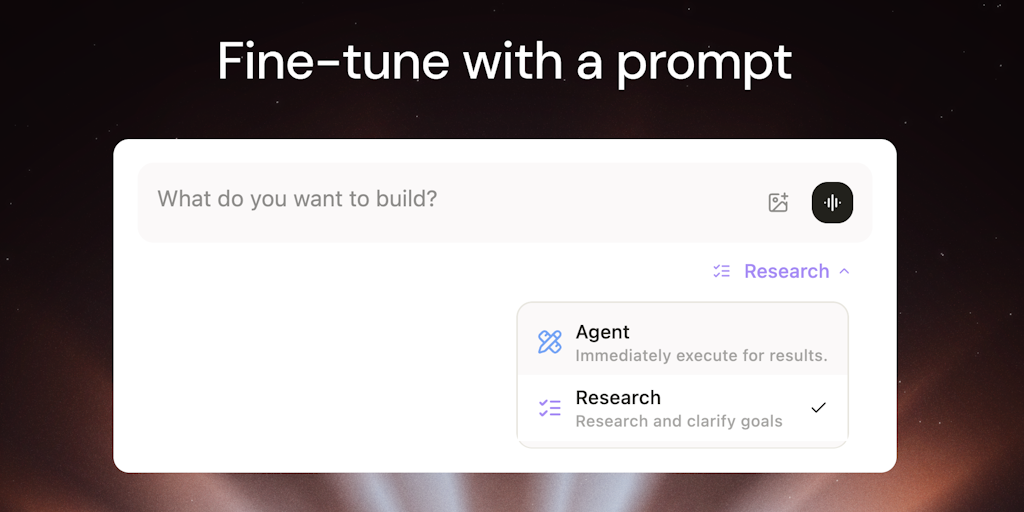
An AI-powered workspace designed for strategic planning and decision-making, combining document analysis with structured thinking frameworks. Verdict: Interesting concept but will need to prove it adds value beyond what ChatGPT or Claude already do for strategic thinking.
Fine-tune any LLM in minutes, with one prompt | Pioneer | Product Hunt
Fine-tune SLMs in minutes. Describe your task in plain English and our agent handles everything: data generation, training, evals, and deployment. Models deployed on Pioneer also keep improving automatically from live inference data. With Pioneer, anyone who can write a prompt can now build production-grade AI that gets smarter over time.
Snapshot
ProviderModelInput $/1MOutput $/1MContext
AnthropicClaude Opus 4.7$5.00$25.001M tokens
AnthropicClaude Sonnet 4.6$3.00$15.00200K tokens
AnthropicClaude Haiku 4.5$1.00$5.00200K tokens
OpenAIGPT-5.4$2.50$15.00128K tokens
OpenAIo3$2.00$8.00200K tokens
OpenAIo4-mini$1.10$4.40200K tokens
GoogleGemini 3 Pro$2.00$12.002M tokens
GoogleGemini 2.5 Flash-Lite$0.10$0.401M tokens
GroqLlama 3.3 70B$0.59$0.79128K tokens
GroqLlama 3.1 8B$0.05$0.08128K tokens
What this means: Anthropic's Opus 4.7 is the most expensive frontier model at $25/M output tokens, but its new tokenizer (up to 35% more tokens for the same text) makes the effective cost even higher. OpenAI's GPT-5.4 offers comparable intelligence at $15/M output - a 40% savings. Google's Gemini 2.5 Flash-Lite remains the budget champion at $0.40/M output, and Groq's Llama pricing shows that open-source models via fast inference providers are 30-60x cheaper than frontier closed models.

Notable: Anthropic now offers Claude Mythos Preview with a 1M token context at standard pricing, matching Google's long-context advantage. Opus 4.7 also added a "fast mode" at 6x standard rates ($30/$150 per million tokens) for applications needing lower latency.

Neural Computers
arXiv:2604.06425
What it claims: The paper proposes a unified architecture that combines neural networks with explicit memory and computation modules, creating systems that can learn algorithms rather than just patterns. The approach bridges the gap between neural networks (good at pattern recognition) and traditional computers (good at precise computation).

Key finding: The architecture achieves state-of-the-art results on algorithmic reasoning tasks while maintaining the learning flexibility of standard neural networks.

Why practitioners should care: If neural computers can reliably learn and execute algorithms, it could eliminate the need for many hand-coded post-processing steps in AI pipelines. The practical impact would be AI systems that are both more capable and more predictable on structured tasks.
Subscribe to GenAI Secret Sauce newsletter and stay updated.

Don't miss anything. Get all the latest posts delivered straight to your inbox. It's free!
Great! Check your inbox and click the link to confirm your subscription.
Error! Please enter a valid email address!