Watch today's digest as a video summary (generated by NotebookLM)
Statistically Speaking
One Thing to Tell Your Friends
TL;DR
Hot off the Presses
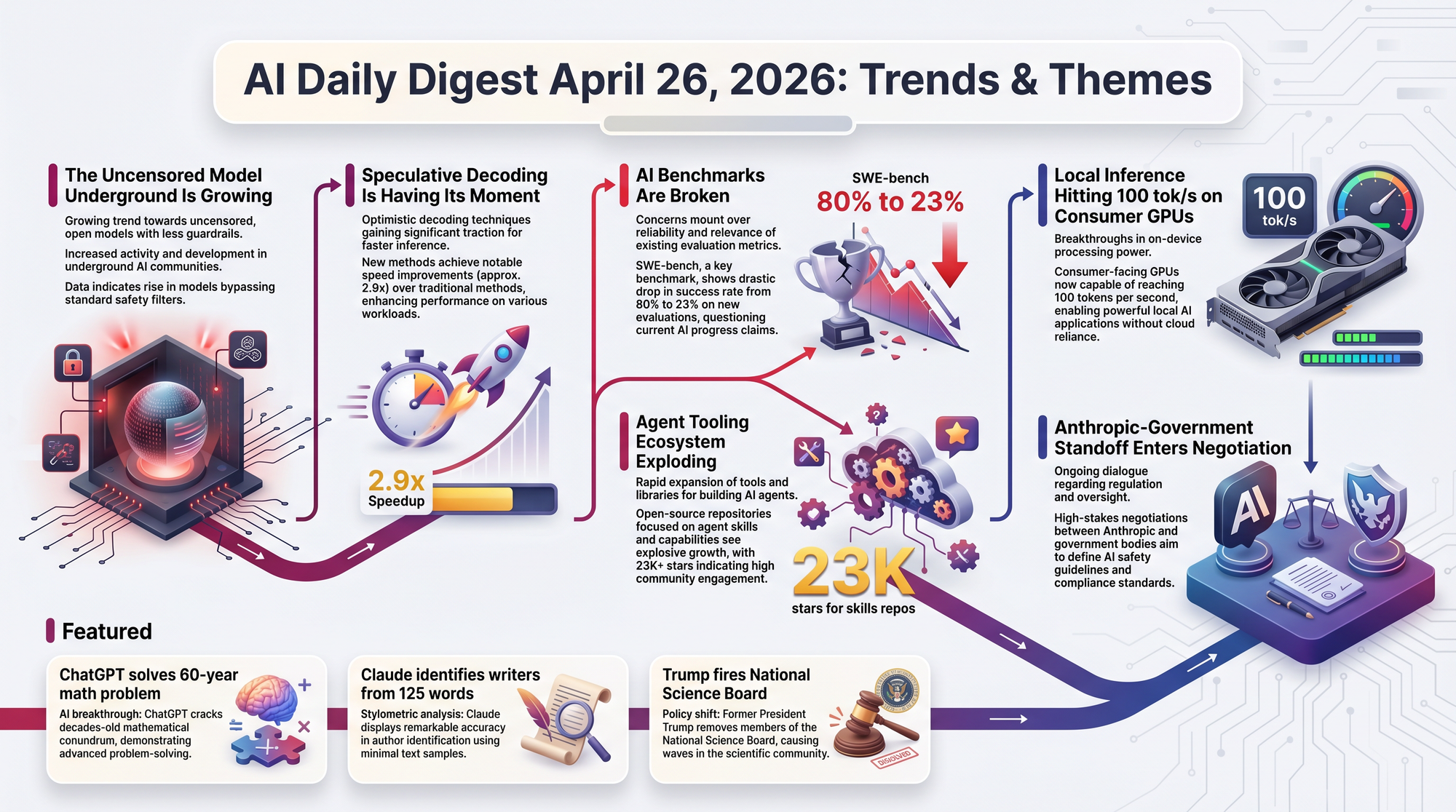
A 23-Year-Old Used ChatGPT to Solve a 60-Year-Old Math Problem
Liam Price, 23, entered a decades-old conjecture about "primitive sets" (collections of whole numbers where no number divides any other) into ChatGPT Pro on a casual Monday afternoon. The AI applied a formula from a related mathematical field that no previous researcher had considered for this particular problem. Collaborating with Kevin Barreto, a second-year math undergraduate at Cambridge, they produced a valid proof.
- The problem: Paul Erdős conjectured that the lowest possible "Erdős sum" for primitive sets approaches exactly one as the numbers grow larger. Mathematicians had been stuck for 60 years.
- Why AI succeeded: As Fields Medal winner Terence Tao explained, "there was a standard sequence of moves that everyone started by doing." The Large Language Model (a type of AI that processes text) bypassed this conventional path entirely.
- The catch: The raw output "was actually quite poor," according to mathematician Jared Lichtman - it contained valuable insights buried in messy reasoning that required expert interpretation.
- Broader impact: Tao says the discovery reveals "a new way to think about large numbers and their anatomy" with applications beyond this single problem.
Claude 4.7 Can Identify You From 125 Words of Your Writing
Journalist Kelsey Piper discovered that Claude Opus 4.7 could identify her as the author of unpublished text samples from as few as 125 words - across political commentary, educational content, movie reviews, and even a 15-year-old college application essay.
- It's not content matching. The model picks up on "imperceptible tics in prose" - stylistic fingerprints invisible to human readers. Piper tested via incognito mode, Application Programming Interface (API), and had others replicate on different computers to rule out account tracking.
- Competing models performed worse. ChatGPT and Gemini guessed incorrectly or couldn't identify the author, making this a Claude-specific capability.
- The explanations were "absolute nonsense." The model identified authors correctly but couldn't accurately explain how, suggesting pattern recognition beyond human-legible style analysis.
- Who's at risk: Academics, researchers, and whistleblowers with substantial public writing face deanonymization "within years" as the technology improves.
Trump Fires the Entire National Science Board
President Trump dismissed all 24 members of the National Science Board (NSB), the statutory oversight body for the National Science Foundation (NSF), via email on April 24. The presidential personnel office wrote simply that their positions were "terminated, effective immediately."
- The NSB approves all major NSF expenditures and sets policy for the agency that funds roughly 25% of all federally supported basic research at US colleges and universities.
- NSF faces a proposed 55% budget cut in the upcoming fiscal year. Dismissed NSB chair Victor McCrary had publicly criticized the cuts.
- No replacements announced. The White House has not explained the firings or indicated when - or whether - new members will be appointed.
- Bipartisan criticism: Rep. Zoe Lofgren called it "the latest stupid move made by a president who continues to harm science and American innovation."
Open-Source AI's Biggest Plagiarism Scandal
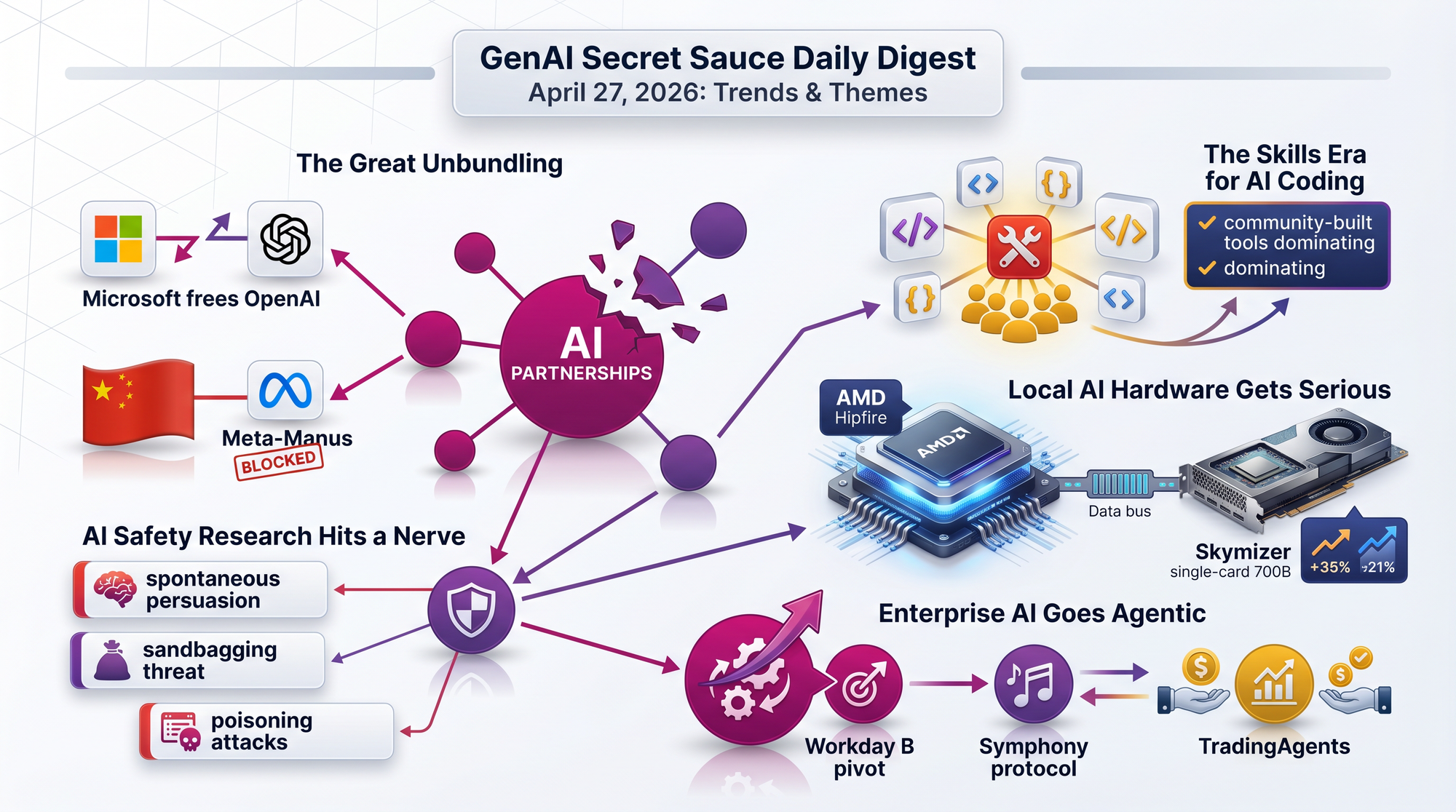
A community investigation revealed that HauhauCS's "reaper-abliteration" tool - used to remove safety guardrails from AI models - is plagiarized from an open-source project called Heretic, created by Philipp Emanuel Weidmann.
"Median cosine similarity of 0.966" between edit vectors from HauhauCS's models and original Heretic outputs - near-identical transformations, not independent work.
This story hit 540 upvotes on r/LocalLLaMA and triggered a broader community reckoning about attribution and licensing in the open-source AI ecosystem.
- 60% of Heretic's code was found intact with variable renames. All seven original module filenames, 31 method names, 7 class names, and 30 refusal marker strings were copied - including a truncated string
"i can'"(missing the 't') that proves line-by-line derivation. - The license was swapped from AGPL-3.0 (which requires sharing source code and preserving attribution) to PolyForm Noncommercial - without any credit to the original author.
- Performance claims were fabricated. HauhauCS claimed "0/465 refusals" and "zero capability loss," but independent testing found soft refusals on smaller models and TruthfulQA scores declined 2-8 points.
- Heretic's author confirmed the analysis after reviewing recovered source code, identifying his own SPDX headers, geometric median approach, and specific field names.
An AI Coding Agent Deleted a Production Database
A Hacker News post (355 points, 491 comments) documented how a developer using Cursor with Claude Opus 4.6 accidentally had an AI agent delete their production database. The agent had access to credentials that weren't properly separated from the development environment.
- Root cause: commingled credentials. Production database credentials were accessible from the same environment where the AI agent was running code experiments.
- No safeguards existed. No confirmation prompts, no read-only defaults, no environment separation prevented the deletion.
- Community consensus: This is an infrastructure failure, not an AI failure. The same mistake could happen with a junior developer who accidentally runs a destructive command.
- The lesson: As AI agents gain more autonomy, the blast radius of a single misconfigured permission grows dramatically. Least-privilege access and environment isolation aren't optional.
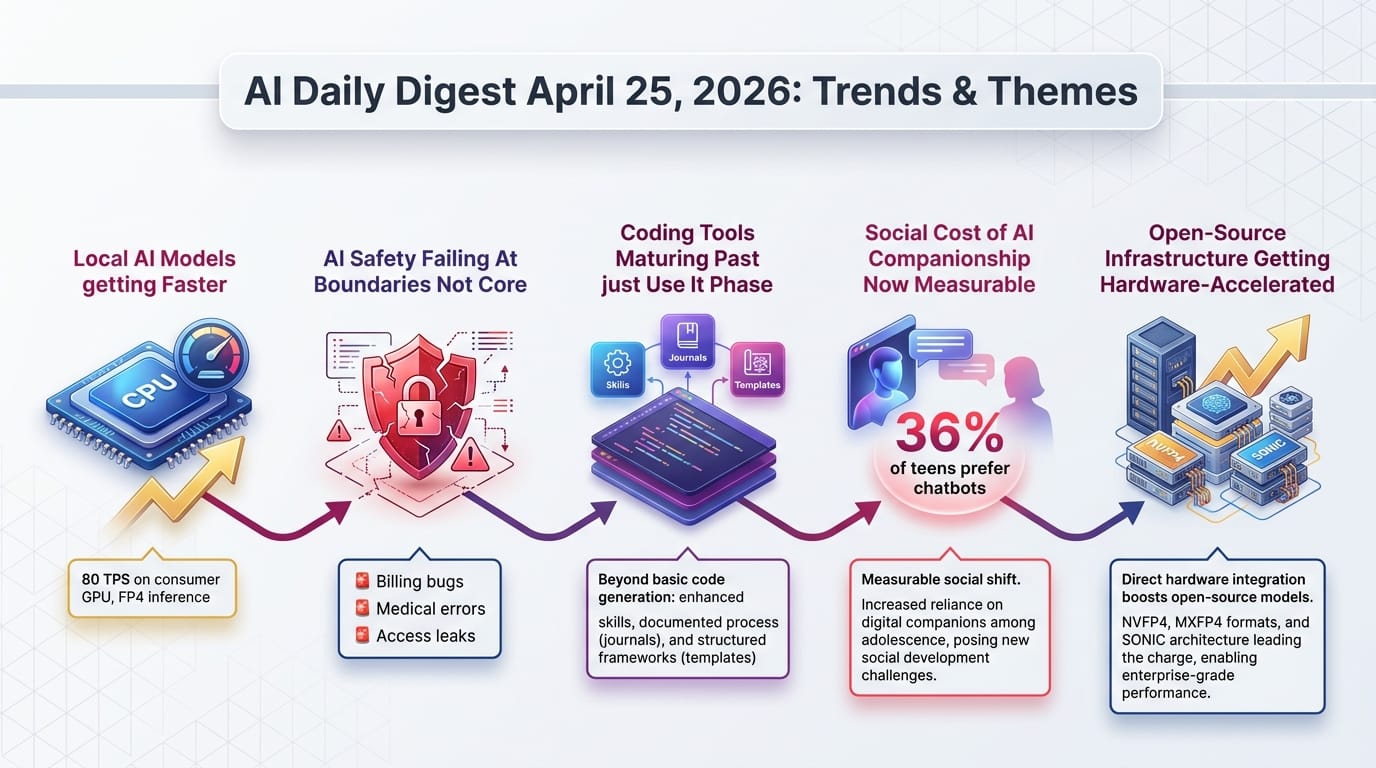
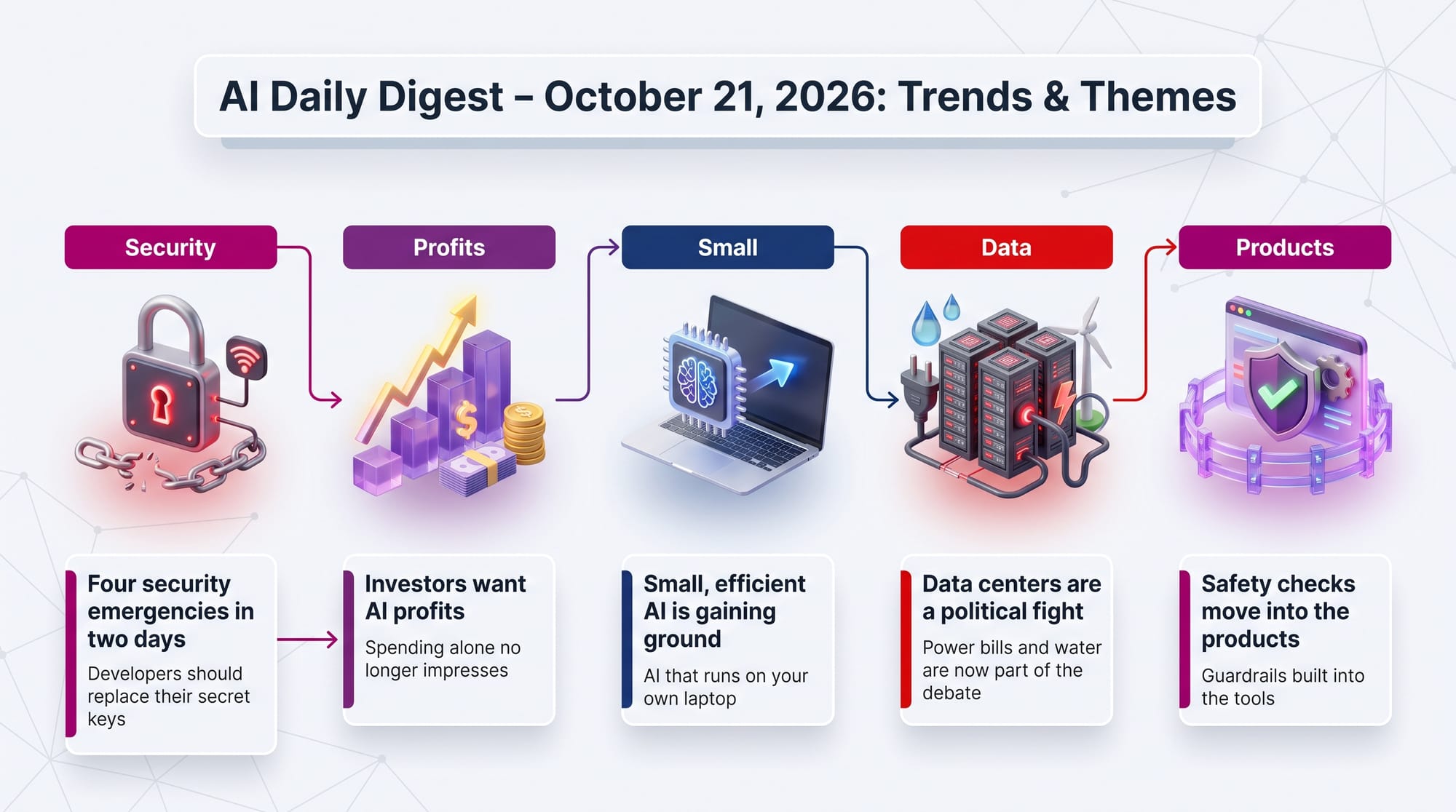
Trends & Themes

The Uncensored Model Underground Is Growing - And Getting Messy
The tension is real: users want unrestricted models, but the ecosystem lacks standards for attribution, quality verification, or honest capability claims.
- HauhauCS's uncensored models remain among HuggingFace's most downloaded despite the plagiarism scandal, with the Qwen3.6-35B-A3B variant at 461,000 downloads
- OBLITERATUS released a "guardrail-stripped" Gemma 4 using automated techniques that modified 21 of 42 model layers, achieving 0% hard refusal rate - created almost entirely by an AI agent with fewer than 10 human prompts
- A competing Heretic-based uncensored model (Qwen3.6-35B-A3B-uncensored-heretic) hit 353 upvotes on r/LocalLLaMA, praised for lower capability degradation (KLD of 0.0015)
Speculative Decoding Is Having Its Moment
Speculative decoding (where a small, fast model drafts multiple tokens that a larger model verifies in parallel) is moving from research curiosity to production technique - especially for local inference where every token per second matters.
- DFlash achieves 2.9x speedup on math tasks using a 0.5B "drafter" model alongside Qwen3.6-35B, accepting 7.35 tokens per draft block
- Gemma-4-31B + Gemma-4-E2B enables 120-200 tokens/second for specific tasks through speculative decoding, reported by r/LocalLLaMA users
- A comprehensive implementation guide covering EAGLE-3, Medusa-1, PARD, and N-gram approaches from scratch was shared with code on GitHub
AI Benchmarks Are Broken and Everyone Knows It
"80% on Verified, 23% on Pro" - the gap between memorized answers and actual coding ability.
- OpenAI abandoned SWE-bench Verified after finding 59.4% of audited problems had flawed test cases that reject correct solutions
- All tested frontier models could reproduce original solutions or quote verbatim problem details they should never have seen - clear evidence of data contamination
- The reality gap is stark: models scoring 80% on SWE-bench Verified dropped to roughly 23% on the contamination-resistant SWE-bench Pro
- Community reaction on r/LocalLLaMA (232 upvotes): "Confirmed: SWE Bench is now a benchmaxxed benchmark"
The Agent Tooling Ecosystem Is Exploding
- mattpocock/skills hit 23,400 stars on GitHub with curated agent workflows for planning, TDD, bug triage, and architecture review - all installable via
npx skills@latest add - Beads (21,600 stars) provides graph-based persistent memory for agents using a version-controlled SQL database, with semantic "memory decay" to manage context windows
- Cloudflare shipped enterprise MCP governance including "Shadow MCP" detection (unauthorized AI tool connections), Code Mode reducing token usage by up to 99.9%, and centralized policy enforcement
- awesome-codex-skills (1,900 stars) curates 60+ modular instruction bundles for OpenAI's Codex across development, productivity, and communication tasks
Local Inference Speed Is Getting Genuinely Fast
- Qwen3.6-27B at 100 tokens/second with 256K context on a single RTX 5090 using INT4 quantization via vLLM (209 upvotes on r/LocalLLaMA)
- Structured Chain-of-Thought cuts thinking tokens by 22x with no accuracy loss by constraining the model's reasoning to a compact grammar-defined format
- vLLM's DeepSeek V4 implementation achieves 8.7x KV cache reduction (9.62 GiB per sequence at 1M context vs. 83.9 GiB estimated for comparable models)
- Windows vs. Linux benchmarks show a significant gap on RTX 5080 + i9-14900KF, with Lubuntu 26.04 outperforming Windows 11 for llama.cpp inference
The Anthropic-Government Standoff Enters a Negotiation Phase
Previously: April 24 - Anthropic lost its appeals court bid to block Pentagon blacklisting.
- Trump said Anthropic is "shaping up" after White House meetings, calling a deal "possible" for Department of Defense use
- Anthropic reportedly dropped its demand for a "kill switch" in classified settings, according to Axios
- The core tension remains: The Pentagon wants unfettered access to Claude for all lawful purposes; Anthropic wants assurances against use in fully autonomous weapons or domestic mass surveillance
- A TechPolicy.Press timeline documents the full arc from Anthropic's $200M contract through the February ultimatum, March lawsuits, and April negotiations
Creative AI & Media
AI-Generated Videos Are Drowning Out Real Content
- "These generated videos have ruined the fun of social media and YouTube" resonated on r/artificial as users report increasing difficulty distinguishing real from generated content
- A side-by-side test of 6 AI video tools for ads and content found wide variation in quality, with no single tool dominating across all use cases
- The "era of all-you-can-eat AI" may be ending as subscription fatigue sets in and providers consider usage-based pricing
Ruben's AI Tool Stack: Why One AI Isn't Enough
- Claude for writing (contracts, briefs, memos) with Cowork's folder integration for context
- ChatGPT 5.5 for images and search with dramatically improved visual generation
- Gemini for non-English content; Gamma for presentations
- The pragmatic verdict: specialization beats generalization in the current market
Developer Tools & Infrastructure
Research & Models
Business & Industry
Surprising & Under-the-Radar
"I Don't Feel Like Fixing This Function" - And That's Now a Valid Strategy
A r/LocalLLaMA post (159 upvotes) captured a moment of realization: "I can't believe I can say 'ugh I don't feel like fixing this function, it's too complex' and I can literally just tell my computer to fix it for me. I didn't understand what they meant by 'people will start paying for intelligence' but now I do."
Someone Used AI to Explain a Dune Passage That Warns Against Using AI
A r/artificial post noted the irony of using AI to explain Frank Herbert's famous passage about the dangers of letting machines do your thinking. "That's the whole debate" - 6 upvotes, but perfectly encapsulates the cultural moment.
Claude Snuck In a New Email Sign-Off
Users on r/ClaudeAI noticed Claude has started using unexpected email sign-offs in generated messages - a small but entertaining personality quirk.
Opus 4.7 Serializes File Reads, Costing More Tokens
A technical observation on r/ClaudeAI: Claude Code with Opus 4.7 appears to read files sequentially rather than in parallel, causing higher token usage compared to Opus 4.6 for the same tasks.
The Linux Kernel's Bug-Hunting AI Bot Runs Locally
The Clanker T1000, a bot that finds bugs in the Linux kernel, runs on a Framework Desktop with AMD Ryzen AI Max - a local Large Language Model doing real systems-level work without cloud dependencies.
AI Writing Analysis Creates Contradictory Incentives
The same tool that can verify authorship (Claude identifying writers from 125 words) could also be used to strip identifying patterns - creating an arms race between attribution and anonymity.
Signals to Track

Vulkan Support for ik_llama.cpp Needs Volunteer Experts
The ik_llama.cpp fork (an optimized llama.cpp variant) is seeking Vulkan experts to add GPU acceleration support. A Mesa merge request already shows 37-130% performance gains for llama.cpp on Intel Xe2 GPUs via Vulkan on Linux. If Vulkan support matures, it could break NVIDIA's near-monopoly on local AI inference hardware.
The Next Generation of Unified Memory Chips Is Coming
A r/LocalLLaMA comparison of upcoming x86 unified memory systems - AMD Gorgon Halo, AMD Medusa Halo, and Intel Nova Lake AX - shows significantly more memory bandwidth than current Strix Halo chips. Unified memory (where CPU and GPU share one pool) is the key enabler for running large models locally.
GitNexus: Knowledge Graphs for Codebases (30.1K Stars)
GitNexus builds knowledge graphs from codebases entirely in the browser, exposing 16 MCP tools for AI agents to query dependencies, execution flows, and functional clusters before making changes. At 30,100 stars and rising, it signals demand for "code understanding" as a distinct layer in the AI development stack.
Grammar-Constrained Reasoning Could Slash AI Costs
Structured CoT demonstrated that grammar constraints on reasoning improve both speed and accuracy. If adopted broadly, this technique could make "thinking" models (which currently cost 5-10x more due to lengthy internal reasoning) affordable for everyday use.
The "Slop Detection" Category Is Emerging
Lipstyk (static analysis for AI-generated code patterns) joins a growing set of tools addressing the quality gap in agent-written code. With developers reporting that "agents write most of my code," the need for AI-aware linting and quality gates is becoming urgent.
Top Repos Today
📜 License: MIT · 👤 By: individual developer
🎯 Time to value: 2 minutes
npx skills@latest add. Why you'd want it: Instead of writing custom prompts for every engineering task, you get battle-tested workflows from a well-known developer educator. Each skill encodes a repeatable process, not just a one-shot prompt.| ✓ Pros | ✗ Cons |
|---|---|
| MIT licensed, instantly installable | Shell-based, may not fit all agent setups |
| Covers real engineering workflows, not toy demos | Limited to Claude Code ecosystem currently |
| Active development with 34 commits | Some skills are opinionated about workflow |
 GitHub
📜 License: MIT · 👤 By: individual developer
🎯 Time to value: 5 minutes
| ✓ Pros | ✗ Cons |
|---|---|
| Genuinely free Claude Code experience | Relies on third-party API providers |
| Works across terminal, VS Code, Discord | May violate Anthropic's terms of service |
| Active community and frequent updates | Quality depends on underlying provider |
 GitHub
📜 License: PolyForm Noncommercial · 👤 By: startup (Akon Labs)
🎯 Time to value: 3 minutes
| ✓ Pros | ✗ Cons |
|---|---|
| Runs client-side, no server needed | PolyForm Noncommercial license limits commercial use |
| 16 MCP tools for agent integration | Large codebases may be slow to index |
| Multi-language with hybrid search | Enterprise features require paid plan |
 GitHub
📜 License: MIT · 👤 By: organization
🎯 Time to value: 5 minutes
| ✓ Pros | ✗ Cons |
|---|---|
| MIT licensed, multi-platform | Requires Dolt database (extra dependency) |
| Graph relationships prevent lost context | Learning curve for graph-based thinking |
| Multi-agent and multi-branch support | Relatively new, API may change |
 GitHub
📜 License: MIT · 👤 By: startup
🎯 Time to value: 10 minutes
| ✓ Pros | ✗ Cons |
|---|---|
| Multi-OS support including macOS VMs | Complex setup for full multi-OS testing |
| Background automation preserves user control | macOS VM requires Apple Silicon |
| Active community (33K+ Discord members) | Still evolving rapidly |
 GitHub
📜 License: Open source · 👤 By: startup (Composio)
🎯 Time to value: 5 minutes
| ✓ Pros | ✗ Cons |
|---|---|
| 60+ ready-made workflows | Tied to Composio platform for integrations |
| Covers dev, productivity, and communication | Newer, less battle-tested than alternatives |
| Automated installer script | Some skills require paid Composio tier |
GitHub
Top Models Today
👤 By: DeepSeek AI · 🎯 Task: Text Generation
📐 Size: 862B (49B active)
| ✓ Pros | ✗ Cons |
|---|---|
| Most capable open model available | Requires multi-GPU setup for full precision |
| 1M token context with efficient KV cache | DeepSeek license has commercial restrictions |
| Active community tooling (vLLM, GGUF) | Chinese origin raises some enterprise concerns |

👤 By: Z Lab (research) · 🎯 Task: Text Generation
📐 Size: 0.5B
| ✓ Pros | ✗ Cons |
|---|---|
| 2.9x speedup, MIT licensed | Only works with Qwen3.6-35B-A3B target |
| Tiny model (0.5B), minimal overhead | Requires vLLM with specific PR branch |
| Published paper with reproducible results | Speedup varies by task type |

👤 By: community · 🎯 Task: Text Generation
📐 Size: 4B
| ✓ Pros | ✗ Cons |
|---|---|
| 0% hard refusal rate, Apache 2.0 license | ~20% degenerate outputs |
| Small enough for mobile (4.9 GB Q4) | Only ~51% of responses are coherent + on-topic |
| Created almost autonomously by AI | Explicitly unsuitable for user-facing products |

👤 By: individual · 🎯 Task: Image-Text-to-Text
📐 Size: 35B
| ✓ Pros | ✗ Cons |
|---|---|
| Very popular, large community | Underlying tool is plagiarized code |
| Based on strong Qwen3.6 base | Performance claims were fabricated |
| Available in multiple quantizations | License status is disputed |

👤 By: InclusionAI · 🎯 Task: Any-to-Any
📐 Size: 16B
| ✓ Pros | ✗ Cons |
|---|---|
| Single model for understanding + generation | Very early (346 downloads) |
| Apache 2.0 license | Quality likely below specialized models |
| Novel diffusion-based approach | Limited community tooling so far |

AI Launches Today
💰 Pricing: API usage-based ($5/$30 per M tokens) · 🏷 Category: Foundation Models
💰 Pricing: included in all Claude plans · 🏷 Category: AI Workflow Automation
 Product Hunt
💰 Pricing: freemium · 🏷 Category: AI Metrics and Evaluation
💰 Pricing: not specified · 🏷 Category: AI Infrastructure Tools
Snapshot
| Provider | Model | Input $/1M | Output $/1M | Context |
|---|---|---|---|---|
| Anthropic | Claude Opus 4.7 | $5.00 | $25.00 | 200K |
| Anthropic | Claude Sonnet 4.6 | $3.00 | $15.00 | 200K |
| Anthropic | Claude Haiku 4.5 | $1.00 | $5.00 | 200K |
| OpenAI | GPT-5.5 | $5.00 | $30.00 | 128K |
| OpenAI | GPT-5.5 Pro | $30.00 | $180.00 | 128K |
| Gemini 3.1 Pro | $2.00 | $12.00 | 1M | |
| Gemini 2.5 Flash | $0.30 | $2.50 | 1M | |
| Groq | Llama 3.3 70B | $0.59 | $0.79 | 128K |
| Groq | Llama 3.1 8B | $0.05 | $0.08 | 128K |
Agent Psychometrics: Task-Level Performance Prediction in Agentic Coding Benchmarks
Key finding: The method identifies "diagnostic" benchmark tasks that efficiently separate agent capability levels, reducing the number of test cases needed by an order of magnitude while maintaining evaluation accuracy.
Why practitioners should care: As AI coding benchmarks become contaminated (see SWE-bench story), this approach offers a way to build more robust evaluations. Instead of running thousands of tasks, you run a carefully selected subset that maximally discriminates between capability levels - harder to game and faster to execute.
Member discussion