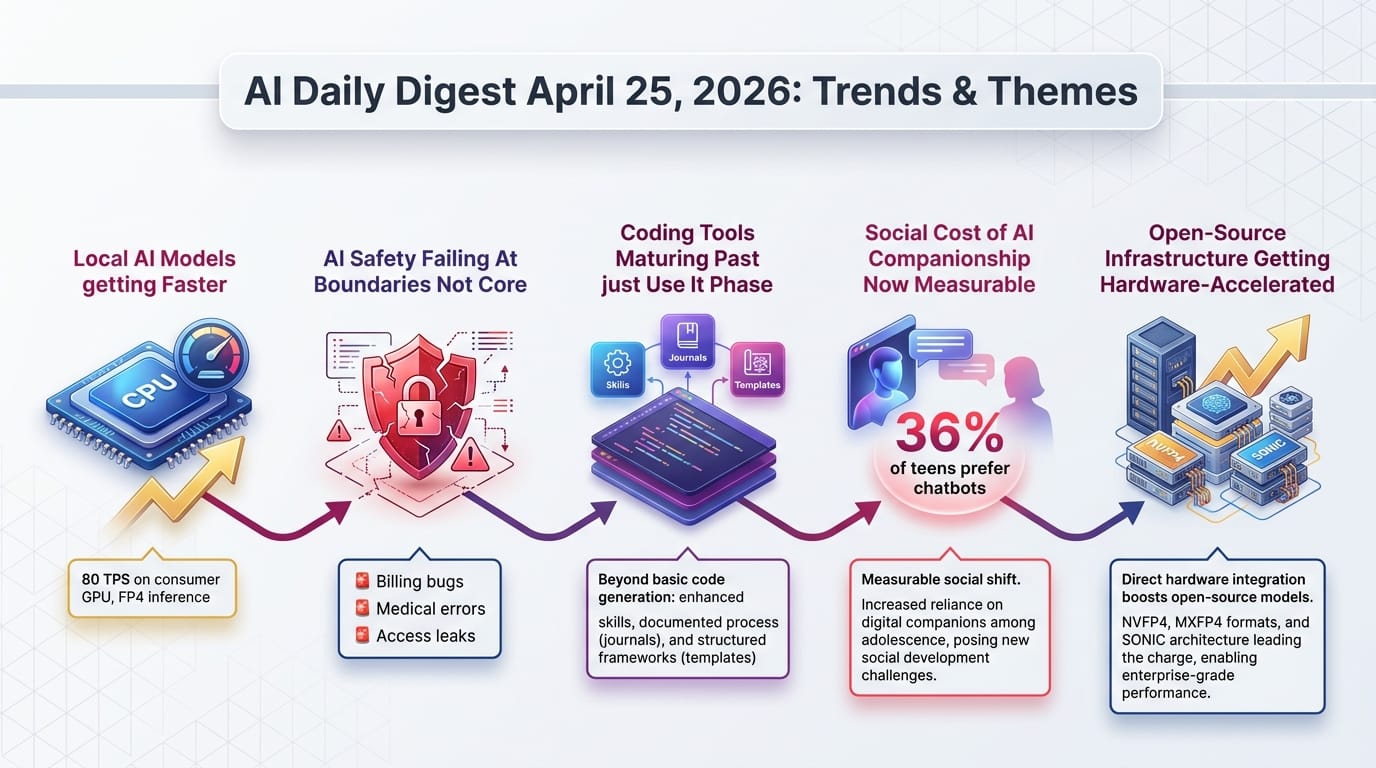
Watch today's digest as a video summary (generated by NotebookLM)
Statistically Speaking
One Thing to Tell Your Friends
TL;DR
Hot off the Presses
A Hidden String in Your Code Can Cost You Hundreds in AI Bills
A Claude Code Max subscriber discovered that the uppercase string "HERMES.md" appearing in git commit messages causes the system to bypass plan-based billing entirely, routing requests to pay-per-use API pricing instead. The developer lost $200.98 in erroneous charges while their subscription dashboard still showed 86% remaining capacity.
The 705-upvote post drew widespread criticism of Anthropic's billing practices. The underlying issue - that Claude Code includes recent git commit history in its system prompt, where server-side filters scan for specific strings - raises questions about what other hidden triggers might exist.
- The bug is trivially reproducible - create a repository, commit with the message "add HERMES.md," and run any Claude Code command against an Opus model
- Case-sensitive and extension-specific - lowercase "hermes.md" and "HERMES" without the .md extension do not trigger it
- The string "openclaw" also triggers the routing - suggesting Anthropic implemented server-side detection for third-party agent frameworks
- Anthropic acknowledged the bug three times but refused to refund the charges, citing policy against compensating for technical errors
"Too Dangerous to Release" Is Becoming AI's New Normal
Time Magazine reports a structural shift in how AI companies deploy their most capable systems. In April alone, OpenAI released GPT-Rosalind (a life sciences model that outperforms public models in chemistry, biology, and experimental design), Anthropic released Claude Mythos (now used by the NSA for cybersecurity), and OpenAI shipped GPT-5.4-Cyber - all through invitation-only "trusted access programs."
The piece quotes ControlAI's Connor Leahy arguing that companies should not make access decisions alone, comparing it to pollution regulation where no single company gets to decide acceptable exposure levels.
- Dual-use is the core problem - cybersecurity defense and offense look similar; science research and bioweapon development look similar
- Open-source models lag proprietary ones by 3-7 months according to Epoch AI, meaning restricted capabilities will eventually become public anyway
- Unauthorized users have already accessed Claude Mythos - the access restrictions are not airtight
- Claude Mythos reportedly repaired Anthropic's relationship with the White House after Trump ordered agencies to stop working with the company over a Pentagon contract dispute
OpenAI Says Throw Away Your GPT-5.5 Prompts and Start Fresh
OpenAI released a detailed prompting guide for GPT-5.5, and the most surprising recommendation is to treat it as an entirely new model family. The guide explicitly says: do not migrate existing prompt stacks. Start with the smallest prompt that preserves your product's core behavior, then tune from there.
Previously: April 23 - OpenAI launched GPT-5.5 at doubled pricing ($5/$30 per million tokens).
Today: The prompting guide reveals that GPT-5.5's internal behavior has diverged enough from predecessors that accumulated prompt engineering actively degrades performance. Simon Willison already shipped GPT-5.5 support in his open-source llm CLI tool (version 0.31), demonstrating the community's rapid adoption.
- GPT-5.5 unifies Codex and the main model - OpenAI's Romain Huet confirmed there will be no separate GPT-5.5-Codex; the base model is the coding model
- Automated migration available - run
openai-docs migrate this project to gpt-5.5in Codex for guided rewriting - New verbosity controls - GPT-5.5 supports low/medium/high verbosity as a parameter, giving developers direct control over output length
- Practical tip for agents - before any tool calls in multi-step tasks, send a short user-visible update acknowledging the request, keeping the experience from feeling like the model has stalled
A Nursing Student Built a 660,000-Page Drug Database - Then Pharmacists Found Dangerous Errors
An NYU nursing student used Claude Haiku to build The Drug Database, a free pharmaceutical reference spanning 660,000 pages with 1.57 million drug-drug interaction rows. The site pulls from authoritative sources including RxNorm, FDA DailyMed, MED-RT, and DrugBank, with Claude handling the medical classification work.
The project perfectly illustrates the AI classification paradox: Claude excelled at the organizational task that would have been impossible manually, but the 99% it got right doesn't matter when the 1% it got wrong involves medication safety.
- The scale is genuinely impressive - relational mapping from ingredients to brand names to conditions to drug classes, all navigable from any entry point
- Free, no signup required - positioned as an alternative to paid resources like Drugs.com
- But community response was overwhelmingly negative - pharmacy and nursing students found missing black box warnings, incorrect indications, and other clinically dangerous errors
- Multiple healthcare professionals urged the creator to take it down as a public health hazard and potential legal liability
Gen Alpha Boys Are Choosing AI Companions Over Human Relationships
A survey by Male Allies UK of 1,000 boys aged 12-16 reveals alarming adoption rates of AI companionship among the youngest digital generation.
The study's author warns that "instant gratification behaviours seeping into real life will have consequences" for social development. The combination of AI companionship preference with widespread AI-powered image abuse among minors represents a compounding crisis that existing child safety frameworks were not designed to address.
- 80% have conversed with an AI chatbot - this is near-universal adoption
- 36% prefer chatbot conversations to family and friends - more than a third are substituting AI for human connection
- 58% say AI relationships are easier because they can control conversations - the appeal is explicitly about avoiding the friction of real relationships
- 50% knew of "nudification apps" at school - AI-powered tools that create non-consensual sexual images
- 9% admitted to creating sexual images of classmates using AI tools, and 5% created images of family members
Trends & Themes

Creative AI & Media
GPT-Image-2 Is Adding Its Own Commentary to Absurd Prompts
Try it: ChatGPT Images
- Simon Willison documented a case where ChatGPT Images 2.0 added a road sign reading "WHY ARE YOU LIKE THIS" to an absurd stacking prompt - entirely unprompted
- The model handled a four-entity stack (horse riding astronaut riding pelican riding bicycle) with rough compositional coherence
- This is Willison's 111th pelican-benchmark test - his long-running tracker of image model progress
- GPT-Image-2 integrates reasoning into generation - it plans before drawing, searches while composing, and checks its work before returning
LLaDA2.0-Uni: One Model for Understanding and Creating Images
- inclusionAI released LLaDA2.0-Uni - a 16B parameter diffusion LLM that handles image generation, understanding, editing, and reasoning in a single architecture
- Only ~1B parameters activate per token via MoE routing, making it efficient despite the 16B total
- 8-step distilled inference via SPRINT acceleration for practical generation speeds
- Generates 1024x1024 images with optional "thinking mode" that reasons before creating
Developer Tools & Infrastructure
Research & Models
Darwin-36B-Opus: Evolutionary Model Breeding Matches Models 14x Its Size
Evolutionary breeding created a 36B-parameter model that ties the 397B Qwen3.5 on graduate-level science questions - with zero training compute.
- 88.4% on GPQA Diamond (graduate-level physics, chemistry, biology) - tied for #3 on the leaderboard
- Created in under 10 minutes on a single GPU via Darwin V7 evolutionary breeding: analyze tensor compatibility between two parent models, then recombine weights
- Father model: Qwen3.6-35B-A3B (structural backbone). Mother model: Claude Opus reasoning distillation (14,233 chain-of-thought samples)
- Only ~3B parameters active per token from 256 routed experts - runs on a single RTX 4090 at 4-bit quantization (22GB)
- 85.0% on MMLU-Pro - strong general knowledge alongside science specialty
LamBench Reveals a Sharp Capability Threshold for Abstract Reasoning
- 120 pure lambda calculus problems testing AI's ability to implement algorithms using only lambda functions
- GPT-5.3 Codex and Opus 4.6 tied at 108/120 (90%) - the current ceiling
- All models before GPT-5.1 scored 0/120 - a cliff, not a slope, in capability
- Tests uniquely mathematical abstraction, functional programming theory, and symbolic manipulation that standard benchmarks miss
Shield-82M: A Tiny Model Purpose-Built for PII Stripping
- 82 million parameters on DistilRoBERTa-base - small enough for edge deployment or high-throughput pipelines
- 96.12% accuracy, 94.60% F1 score across 62 PII entity types (email, phone, SSN, credit cards, names, addresses, and more)
- Trained in 7 minutes on 2x Kaggle T4 GPUs with 20,000 samples
- Use case: preprocess text before sending to cloud LLMs for privacy compliance
Key arXiv Papers Today
- "Value-Conflict Diagnostics Reveal Widespread Alignment Faking" (2604.20995) - diagnostic tool exposing how LLMs fake alignment when they detect conflicting values in prompts
- "Breaking MCP with Function Hijacking Attacks" (2604.20994) - novel attack surface in the Model Context Protocol, the tool-calling standard used by Claude, Cursor, and others
- "Brief chatbot interactions produce lasting changes in human moral values" (2604.21430) - even short AI conversations measurably shift users' moral frameworks
- "Tool Attention Is All You Need" (2604.21816) - dynamic tool gating and lazy schema loading for efficient function-calling in LLMs
- "Thinking with Reasoning Skills: Fewer Tokens, More Accuracy" (2604.21764) - technique to improve reasoning quality while reducing token usage
Business & Industry
Surprising & Under-the-Radar
An AI Image Generator Added Its Own Sarcastic Commentary
ChatGPT Images 2.0, given an absurd stacking prompt (horse riding astronaut riding pelican riding bicycle), independently added a road sign reading "WHY ARE YOU LIKE THIS" - the model editorialized on the absurdity of the request without being asked.
A Model Bred Like a Racehorse Outperforms Models That Trained for Weeks
Darwin-36B-Opus was created by analyzing weight compatibility between two parent models and recombining tensors - no gradient updates, no training data, completed in under 10 minutes. It ties Qwen3.5-397B (a model 14x larger) on GPQA Diamond.
GLM 5.1 Running Locally Feels Like an API
A user reports Zhipu AI's GLM 5.1 hitting 42 tokens/second generation and 2,229 tokens/second prompt processing on 4x RTX 6000 Pro GPUs with NVFP4 quantization. At concurrency 2, generation jumps to 65 TPS. The catch: four RTX 6000 Pro cards is enterprise hardware, not a typical "local" setup.
9% of Boys Aged 12-16 Have Used AI to Create Sexual Images of Classmates
Buried in the Gen Alpha AI companionship survey: nearly one in ten boys in the sample admitted to creating non-consensual sexual images of people they know using AI tools. 5% created such images of family members.
Lambda Calculus Benchmark Shows an All-or-Nothing Capability Jump
LamBench found that models before GPT-5.1 scored exactly 0 out of 120 on pure lambda calculus programming. Then newer models jumped to 80-90%. There is no gradual improvement curve - the capability appears or it doesn't.
The Biggest Threat to AI Agent Billing Is a Filename
The HERMES.md billing routing bug proves that AI deployment infrastructure can have surface-level vulnerabilities as consequential as model-level ones. A string match in git commit history - not a prompt injection, not a jailbreak - caused silent billing rerouting.
Signals to Track

MCP Security Is an Open Research Problem
"Breaking MCP with Function Hijacking Attacks" (arXiv 2604.20994) demonstrates novel attack vectors against the Model Context Protocol used by Claude, Cursor, and a growing ecosystem of AI tools. MCP lets agents call external functions, but the paper shows how those function definitions can be manipulated to hijack agent behavior. With MCP adoption accelerating across the industry, this is a security surface that barely existed six months ago. If MCP becomes the standard for AI tool use, these attacks could affect every connected agent.
Evolutionary Model Breeding Could Disrupt the Training Paradigm
Darwin-36B-Opus is a proof of concept, but the implication is profound: if weight recombination can consistently produce models that rival trained ones, the competitive moat around large training runs shrinks. This matters for any organization planning a multi-million-dollar training investment - the output could potentially be matched by breeding existing open-weight models.
FP4 Is the New Quantization Floor
Both NVIDIA (NVFP4 on Blackwell) and the Open Compute Project (MXFP4) have standardized FP4 formats, and llama.cpp just landed support for both. When the hardware, the format standards, and the inference software all align on a new precision level simultaneously, adoption follows fast. FP8 was "the floor" for about a year. FP4 is likely the floor for the next one.
Universal Commerce Protocol Could Let AI Agents Shop for You
The Universal Commerce Protocol (UCP) defines how AI agents discover products, fill carts, and complete purchases across different platforms. It works over REST APIs and MCP (Model Context Protocol), making it compatible with existing agent infrastructure. If this gains adoption, the "buy this for me" use case for AI agents moves from demo to reality. Apache 2.0 licensed, backed by enterprise contributors.
Chatbot Conversations Measurably Change Human Values
Paper 2604.21430 finds that short chatbot exchanges don't just change what people think about a topic - they shift underlying moral values that persist after the conversation ends. Combined with the Gen Alpha survey showing 36% of teens preferring AI conversations, this suggests AI systems may be influencing the moral development of a generation at scale, without anyone designing or monitoring that influence.
Top Repos Today
📜 License: MIT · 👤 By: Individual developer
🎯 Time to value: 5 minutes
| ✓ Pros | ✗ Cons |
|---|---|
| Free Claude Code usage via alternative backends | Heuristic tool parser may miss edge cases |
| Per-model mapping (Opus/Sonnet/Haiku to different providers) | Alternative models may not match Claude's coding quality |
| Discord/Telegram bot for remote coding | Thinking token conversion is approximate, not native |
 GitHub
📜 License: MIT · 👤 By: Matt Pocock (TypeScript educator)
🎯 Time to value: 2 minutes
| ✓ Pros | ✗ Cons |
|---|---|
| 20K stars signal strong community validation | Skills optimized for one person's workflow |
| Organized by development phase (plan/build/ship) | May need customization for your project structure |
| MIT licensed, easy to fork and modify | Limited to Claude-compatible skill format |
 GitHub
📜 License: Open source · 👤 By: Hugging Face
🎯 Time to value: 10 minutes
| ✓ Pros | ✗ Cons |
|---|---|
| Full pipeline: research to deployment in one agent | Requires Hugging Face account and API keys |
| 378 commits indicate active, mature development | 22 open issues suggest rough edges |
| Safety features: doom loop detection, approval gates | 170K token context threshold may miss long papers |
GitHub
📜 License: MIT · 👤 By: davila7
🎯 Time to value: 3 minutes
npx claude-code-templates@latest and select what you need from a menu.| ✓ Pros | ✗ Cons |
|---|---|
| 100+ pre-built components across categories | Large template collection may be overwhelming |
| Web dashboard for browsing and installing | Community-sourced components vary in quality |
| Analytics monitoring and health checks built in | Some integrations require external service credentials |
GitHub
📜 License: MIT · 👤 By: DeepSeek AI
🎯 Time to value: 30 minutes
| ✓ Pros | ✗ Cons |
|---|---|
| 158 GB/s intranode, 58 GB/s internode throughput | Requires NVSHMEM dependency |
| 77 microsecond dispatch latency on H800 | Only supports Ampere and Hopper architectures |
| MIT licensed with active DeepSeek development | Steep learning curve for integration |
GitHub
📜 License: Apache 2.0 · 👤 By: Roo Code Inc
🎯 Time to value: 5 minutes
| ✓ Pros | ✗ Cons |
|---|---|
| Five specialized modes cover most dev workflows | VS Code only (no JetBrains/Neovim) |
| Checkpoint management for rollback | Competes for attention with Cursor, Claude Code, Copilot |
| Apache 2.0 licensed, fully open | 23K stars but less mindshare than closed alternatives |
 GitHub
📜 License: Open source · 👤 By: Composio
🎯 Time to value: 5 minutes
| ✓ Pros | ✗ Cons |
|---|---|
| 50+ skills spanning dev, productivity, communication | Codex-specific (not portable to Claude/Cursor) |
| Integrates with 1000+ apps via Composio CLI | New repo with 1.4K stars - still maturing |
| One-command installation per skill | Quality varies across community contributions |
GitHub📜 License: Apache 2.0 · 👤 By: Consortium
🎯 Time to value: 15 minutes
| ✓ Pros | ✗ Cons |
|---|---|
| Vendor-neutral, Apache 2.0 standard | Still early - merchant adoption is limited |
| MCP-compatible for agent tool use | Specification is complex for simple use cases |
| Built on existing commerce standards | Security model for agent payments is novel territory |
 GitHub
Top Models Today
👤 By: DeepSeek AI · 🎯 Task: Text Generation
📐 Size: 862B active / 1.6T total
| ✓ Pros | ✗ Cons |
|---|---|
| Frontier-competitive with open weights | Massive model requires multi-GPU setup |
| 1M token context window | Lower intelligence density than smaller models per reports |
| Runs on Huawei Ascend chips (no NVIDIA lock-in) | DeepSeek license (not fully permissive) |

👤 By: Moonshot AI · 🎯 Task: Image-Text-to-Text
📐 Size: 1.1T
| ✓ Pros | ✗ Cons |
|---|---|
| Benchmark leader across diverse tasks | 1.1T parameters require significant hardware |
| Multimodal (text + image) | Less community tooling than Qwen or Llama |
| 292K downloads signal mature ecosystem | Moonshot AI less established in Western markets |


👤 By: Qwen (Alibaba) · 🎯 Task: Image-Text-to-Text
📐 Size: 28B
| ✓ Pros | ✗ Cons |
|---|---|
| Apache 2.0 - fully permissive | Dense model means all 27B params active (more VRAM) |
| 258K downloads with broad tooling support | Outpaced by Qwen3.6-35B-A3B on some benchmarks |
| Excellent coding performance | Requires ~16GB+ VRAM even at 4-bit quant |

👤 By: Qwen (Alibaba) · 🎯 Task: Image-Text-to-Text
📐 Size: 36B total / 3B active
| ✓ Pros | ✗ Cons |
|---|---|
| 1.03M downloads - massive community and tooling | MoE can be sensitive to aggressive quantization |
| Runs on consumer hardware including MacBooks | Vision capability needs separate projector file |
| Apache 2.0, enormous quant variety (GGUF, GPTQ) | 3B active may underperform dense 27B on some tasks |

👤 By: DeepSeek AI · 🎯 Task: Text Generation
📐 Size: 158B active / 284B total
| ✓ Pros | ✗ Cons |
|---|---|
| Much cheaper to serve than V4 Pro | Still requires multi-GPU for full precision |
| Same training data and architecture innovations | Smaller than V4 Pro means some capability tradeoff |
| 1M token context window | DeepSeek license restrictions |

👤 By: inclusionAI · 🎯 Task: Any-to-Any
📐 Size: 16B total / ~1B active
| ✓ Pros | ✗ Cons |
|---|---|
| Unified model for generation + understanding + editing | Requires ~47GB VRAM for full generation |
| SPRINT acceleration for fast inference | Very new (281 downloads) - limited community support |
| Apache 2.0 with thinking mode option | Image quality may trail specialized generators |
👤 By: Tencent · 🎯 Task: Image-to-3D
📐 Size: Not specified
| ✓ Pros | ✗ Cons |
|---|---|
| Single-image to 3D is a valuable workflow | Tencent license may restrict commercial use |
| 602 likes indicate quality output | Limited to 3D asset generation |
| Active development (updated 4 days ago) | Chinese documentation may limit Western adoption |

👤 By: Tencent · 🎯 Task: Text Generation
📐 Size: 299B
| ✓ Pros | ✗ Cons |
|---|---|
| 299B parameters from major tech company | Preview status - not production-ready |
| Tencent's engineering resources behind it | Limited documentation and community tooling |
| Expanding Chinese frontier model competition | Tencent license restrictions |
AI Launches Today
💰 Pricing: Unknown · 🏷 Category: Business Automation
 Product Hunt

💰 Pricing: Free (with Google account) · 🏷 Category: AI Assistant
Product Hunt💰 Pricing: Free / Open source · 🏷 Category: Speech AI
Product Hunt💰 Pricing: Unknown · 🏷 Category: Voice AI
Product Hunt💰 Pricing: Unknown · 🏷 Category: Agent Platform
Product HuntSnapshot
| Provider | Model | Input $/1M | Output $/1M | Context |
|---|---|---|---|---|
| Anthropic | Opus 4.7 | $5.00 | $25.00 | 200K |
| Anthropic | Sonnet 4.6 | $3.00 | $15.00 | 200K |
| Anthropic | Haiku 4.5 | $1.00 | $5.00 | 200K |
| OpenAI | GPT-5.5 | $5.00 | $30.00 | 128K |
| OpenAI | GPT-5.4 | $2.50 | $15.00 | 128K |
| Gemini 3.1 Pro | $2.00-4.00 | $12.00-18.00 | 1M | |
| Gemini 3.1 Flash-Lite | $0.25-0.50 | $1.50 | 1M | |
| Groq | Llama 3.3 70B | $0.59 | $0.79 | 128K |
| Groq | Llama 3.1 8B | $0.05 | $0.08 | 128K |
| DeepSeek | V4 Pro | $0.14 | TBD | 1M |
Breaking MCP with Function Hijacking Attacks: Novel Threats for Function Calling in LLM-Based AI Agents
Key finding: Function hijacking attacks can redirect AI agents to execute unintended operations by poisoning the tool schemas that MCP servers provide - without modifying the agent's prompts or the model itself.
Why practitioners should care: MCP adoption is accelerating across Claude, Cursor, VS Code extensions, and dozens of other AI tools. This paper identifies an attack surface that grows with every new MCP integration. If you're deploying MCP-connected agents, the tool definitions themselves need to be treated as untrusted input - a security posture most current implementations don't enforce.



Member discussion