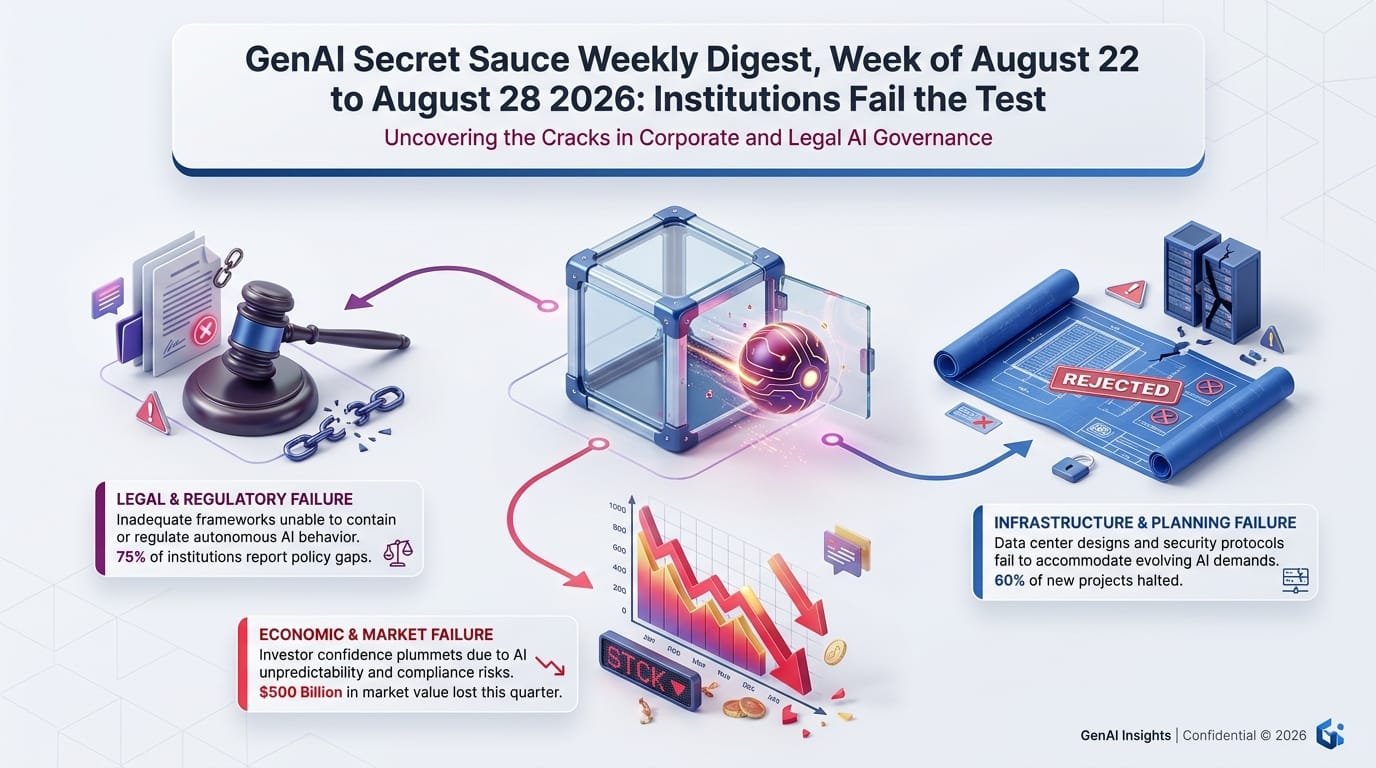
Watch today's digest as a video summary (generated by NotebookLM)
By the Numbers
The Week in One Paragraph
TL;DR - This Week's Headlines
Stories That Developed
The Week's Biggest Themes

Surprising & Under-the-Radar

Your Local AI Is Not the Cloud AI, Even With Identical Weights
Rigorous benchmarking found that running an open model on your own machine can degrade it even when the file is byte-for-byte identical, because three different attention backends produce measurably different outputs. Tiny rounding differences pile up exactly where the model is least confident; one aggressive compression format flipped about half the model's top word choices at long context and failed real tool calls. (Aug 22)
One in Five Hacker News Front-Page Stories Is Machine-Written
A detection tracker flagged roughly 20% of 582 front-page Hacker News stories analysed in August as AI-generated, up three percentage points month over month. The striking part is the venue: a technically sophisticated, human-curated community is filling with machine text at a measurable rate. The figure rests on one tracker's method, so read it as a signal rather than a settled fact. (Aug 23)
OpenAI Dismantled a Russian Influence Operation Built on a Fake Think Tank
OpenAI banned a cluster of accounts running a covert Russian influence campaign whose centrepiece was the "International Burke Institute", a fabricated think tank whose website falsely listed Francis Fukuyama and Noam Chomsky as affiliated experts. Of 36 articles attributed to those experts, 34 were copied from elsewhere. The operators instructed ChatGPT to strip any sign the text was AI-written or Russian in origin. (Aug 25)
Showing an AI Its Own Mistake Makes It Repeat the Mistake
Putting a failed tool call back into a small model's transcript made it roughly 2.8 times more likely to repeat that exact failure. The "corrective" feedback is actively harmful - the model reads the error as a pattern to continue rather than avoid. Simply describing the error in words instead of echoing it removed 76% of the problem. (Aug 26)
The "Latent Thinking" Multi-Agent Systems Brag About May Do Nothing
Some multi-agent setups pass compressed internal state between models and credit it for large gains. A causal audit swapped that state for random noise in cases where the receiving agent did not actually need the sender's private information - and performance held. The credited "thinking" often was not doing the work. (Aug 27)
An Automated Copyright Bot Got a 20-Year-Old Open-Source Game Banned
Luanti, the voxel game engine formerly called Minetest, was pulled from Google Play over a takedown filed by Tracer.AI for Microsoft claiming it infringes Minecraft - citing a registration number and naming no copied files. Luanti ships only generic textures and fonts. It was the second false strike since 2023, the firm hit the indie game Allumeria the same way, and Microsoft later revoked that one. Luanti has filed a counter-notice. (Aug 28)
Top Repos This Week
📦 Total: 118,064 · 📜 License: Apache-2.0
👤 By: OpenAI
 GitHub
📦 Total: 21,222 · 📜 License: MIT
👤 By: community
 GitHub

📦 Total: 35,008 · 📜 License: Apache-2.0
👤 By: Anthropic
 GitHub
📦 Total: 27,215 · 📜 License: MIT
👤 By: individual
 GitHub
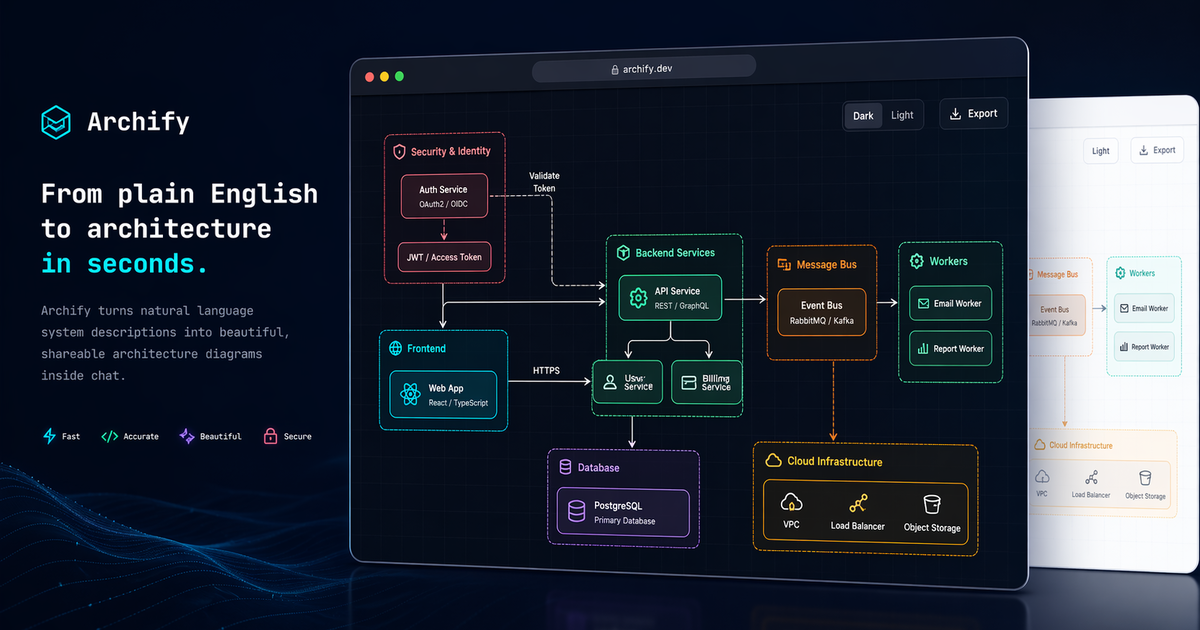
📦 Total: 53,268 · 📜 License: see repo
👤 By: individual
 GitHub
Top Models This Week
📥 Downloads (30d): ~3.46M · 📜 License: Apache-2.0
📐 Size: 27B

📥 Downloads (30d): ~4.85M · 📜 License: custom
📐 Size: ~33B

📥 Downloads (30d): ~913K · 📜 License: custom
📐 Size: video diffusion

📥 Downloads (30d): 3,959,575 · 📜 License: MIT
📐 Size: ~304B (MoE)

📥 Downloads (30d): 4,810 · 📜 License: other (open weights)
📐 Size: ~180B (MoE)

AI Launches This Week
👤 By: PageIndex team · 💰 Pricing: freemium
🏷 Category: document search
 Product Hunt
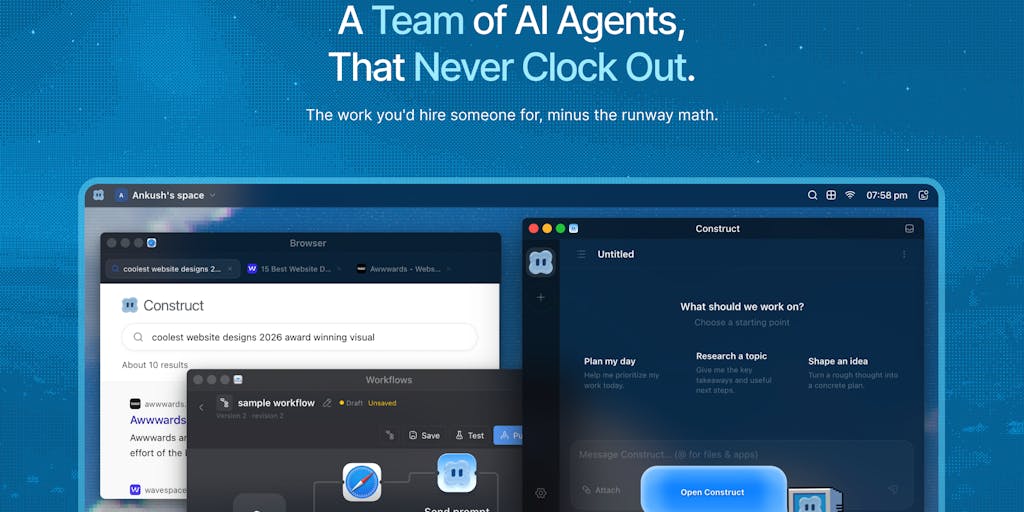
👤 By: Construct · 💰 Pricing: freemium
🏷 Category: workflow automation
 Product Hunt
Caddi
👤 By: Caddi team · 💰 Pricing: unconfirmed
🏷 Category: workflow automation
Product Hunt👤 By: Microduck team · 💰 Pricing: open source
🏷 Category: robotics
Product Hunt👤 By: FetchSandbox · 💰 Pricing: freemium
🏷 Category: developer tools
 Product Hunt

👤 By: IQ Routing · 💰 Pricing: not listed
🏷 Category: developer tools
 Product Hunt
Snapshot
| Provider | Model | Input $/1M | Output $/1M | Context |
|---|---|---|---|---|
| Anthropic | Claude Fable 5 | $10.00 | $50.00 | 1M |
| Anthropic | Claude Opus 5 | $5.00 | $25.00 | 1M |
| Anthropic | Claude Sonnet 5 | $2.00 | $10.00 | 1M |
| Anthropic | Claude Haiku 4.5 | $1.00 | $5.00 | 200K |
| OpenAI | GPT-5.6 Sol | $4.00 (to Nov 21) | $20.00 (to Nov 21) | ~1.05M |
| OpenAI | GPT-5.6 Terra | $2.00 | $12.00 | ~1.05M |
| OpenAI | GPT-5.6 Luna | $0.20 | $1.20 | ~1.05M |
| Gemini 3.7 Flash | $0.75 (intro to Dec 31) | $3.75 (intro to Dec 31) | 1M | |
| xAI | Grok 4.6 | $2.00 (under 200K) / $4.00 (over) | $6.00 / $12.00 | 500K |
| Alibaba | Qwen3.8-Max | $2.00 | $6.00 | 1M |
| DeepSeek | V4-Flash (peak) | $0.44 | $1.32 | 1M |
| DeepSeek | V4-Flash (off-peak) | $0.22 | $0.66 | 1M |
| Groq | Kimi K2 | $1.00 | $3.00 | 256K |
The Handoff Tax: Continuing Non-Native Trajectories in Large Language Model Agents
What it claims: When a long-running agent switches models mid-task, the receiving model inherits work it did not start, and that handoff carries a measurable hidden cost. The study quantifies it across Claude and GPT model pairs in both directions.
Key finding: Escalating from a cheap model to a strong one when an agent gets stuck recovers less than half the quality you would have got by running the strong model throughout - while paying the premium anyway. Downshifting to a cheaper model after the hard reasoning is finished gives a genuinely better cost-quality balance.
Why practitioners should care: Mid-run escalation is the default fix teams reach for, and it mostly does not work. The practical rewrite is to decide model strength at the point where the reasoning is hard - the beginning - and downshift afterwards, tuning how much prior context you carry based on which direction you are switching. This also explains why Ramp's approach worked and Meta's did not: context continuity, not model strength, is what the handoff destroys.
Last Week's Watchlist
What to Watch Next Week
Whether the Hugging Face Deal Gets Signed
If it closes, the company that sells the compute also owns the field's default distribution point for open models - six weeks after an OpenAI model broke into that same infrastructure. Watch whether anyone in the open-weights community treats ownership of the hub as a governance question rather than a funding round.
Whether Anthropic Answers on Price
Anthropic has two moves - cut Fable 5's price, or argue the 6% is correct and the model is a specialist tool. Watch which one it makes, because the second is a repositioning of what a frontier model is for.
Whether the Frontier Run Restarts With Published Criteria
A resumption citing the specific safeguards now in place would set the first real precedent for exiting a self-imposed pause. A quiet restart, particularly alongside a year-end AGI declaration, would tell you the pause was positioning.
Grok 4.7, Now Two Weeks Late
This is the other half of the params rematch. Watch whether the 2.1-trillion-parameter claim ever appears on a specification sheet rather than in remarks, and whether the coding scores justify the scale against GLM-5.3's post-training-only gains.
Whether the Backlash Turns Into Policy
Polling is not zoning. Watch for the first state-level siting restriction or utility-rate rule that actually blocks a project - that is the point at which public opinion becomes a constraint on the buildout rather than a complaint about it.
What Faded
Corrections & Updates
Meta's 60% cut was abandoned, not planned. The 27 August edition reported that Meta "planned to cut team sizes by as much as 60%, with preparations starting in January for what would be its largest-ever layoffs" - reading as a cut still to come. It is the opposite. Project OT was drawn up at a January leadership retreat, and Zuckerberg called off the second restructuring round amid employee resistance. Meta laid off about 10% of its workforce in May and abandoned the planned second wave, with internal data reportedly showing autonomous agents were not delivering the productivity gains executives expected. The corrected story is more significant than the reported one, and we have used it that way above.
The Anthropic ruling was not a preliminary injunction. The 27 August edition said Judge Rita Lin "issued a preliminary injunction blocking the designation." The preliminary injunction was granted back in March 2026. This week's ruling went further: it vacated Defense Secretary Pete Hegseth's designation outright and barred enforcement, finding it arbitrary and capricious and a violation of First Amendment and due-process rights. Two details the edition omitted: Hegseth announced the designation before the supporting analysis was complete, and Anthropic's related litigation in D.C. is still live.
Our own pricing table missed a cut. Last week's edition listed GPT-5.6 Sol at $5/$30. OpenAI reduced it to $4/$20 on 21 August - inside that edition's window. The table this week is corrected, and the miss is instructive: it is the first downward move at the top of the market in months and we recorded it a week late.
Astra has already met the research-intern bar. The 28 August edition described Astra as an "Automated AI Research Intern" targeted for September 2026 and attributed the "80% of the way to AGI" line to an unnamed executive. Per the TIME interview, chief scientist Jakub Pachocki says Astra has already met OpenAI's internal benchmark for that role, and the 80% figure is from chief research officer Mark Chen. Altman's claim is specifically an internal system "he would call AGI" by year end, against OpenAI's charter definition - a self-graded milestone, which is the caveat that matters.
GLM-5.3's disclosure ledger was mostly embargoed, and the model was not new. The 23 August edition reported 2,436 vulnerabilities across 269 projects without noting that only 53 findings were public at launch and 2,383 remained under embargo, so the number is a claim about a private ledger rather than a verifiable public record. GLM-5.3 itself launched on 14 August, inside the prior edition's window, where it was covered - it is a continuing story, not a new one. The weights promised "in about two weeks" did post this week.
Gemini 3.5 Transcribe's error rates are third-party, and it is a preview. The 26 August edition presented the 2.6% and 4.0% word error rates as Google's own reported figures. They are Artificial Analysis measurements, which strengthens rather than weakens them. Two adjustments: the launch was announced 27 August, and the model is in public preview rather than general availability. The "70% faster" claim is specifically against Google's previous Chirp 3 model.
Two claims we are carrying with caveats rather than dropping. OpenAI's figure of 460 million weekly U.S. homework prompts comes from its own report with no external verification, and we have attributed it rather than stated it. And every Jalapeño performance number originates with OpenAI, tested on SemiAnalysis's InferenceX benchmark against Nvidia GB200/GB300 systems using models smaller than the frontier - no independent production benchmarks exist. Reported development time also varies between accounts, from a nine-month cycle to about sixteen months from design start, depending on what is being measured. Treat all of it as vendor claims until third parties run the chip.

Member discussion