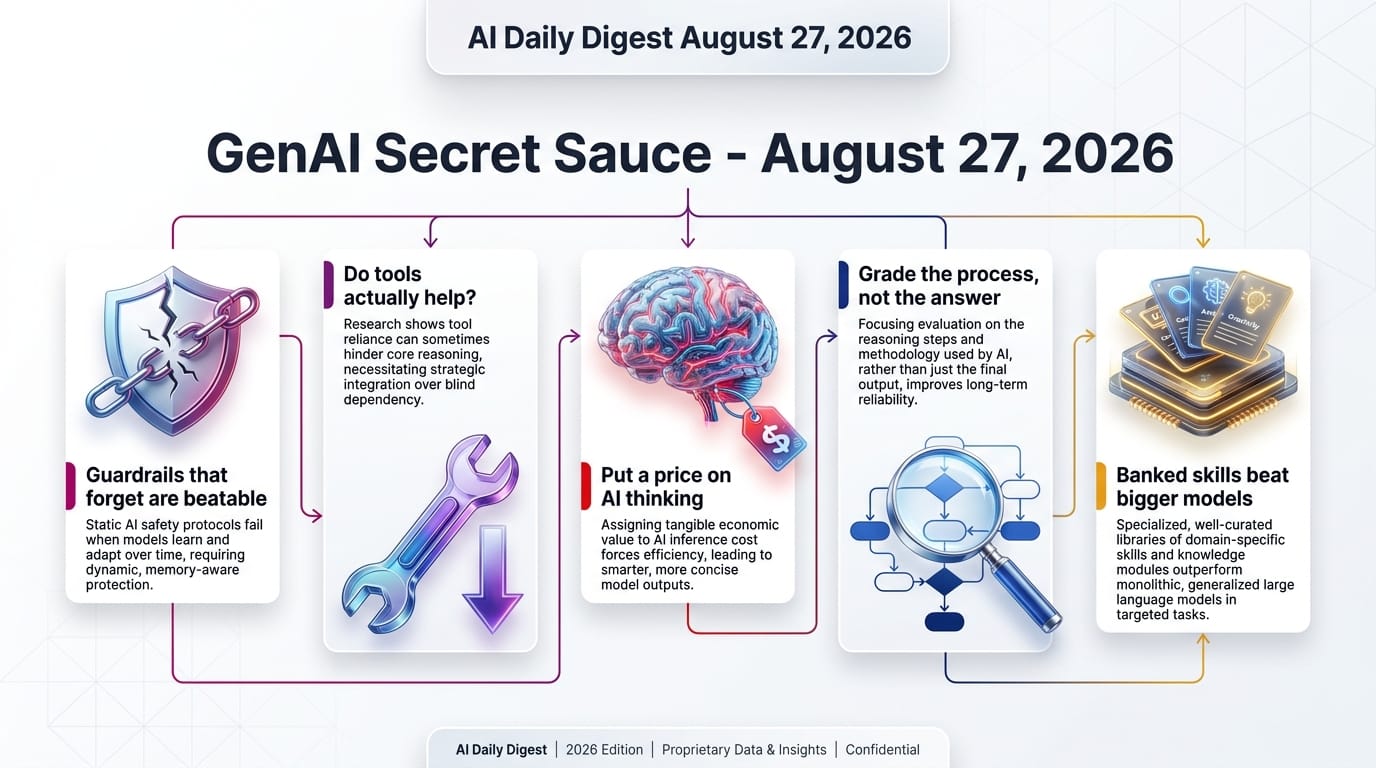
Watch today's digest as a video summary (generated by NotebookLM)
Statistically Speaking
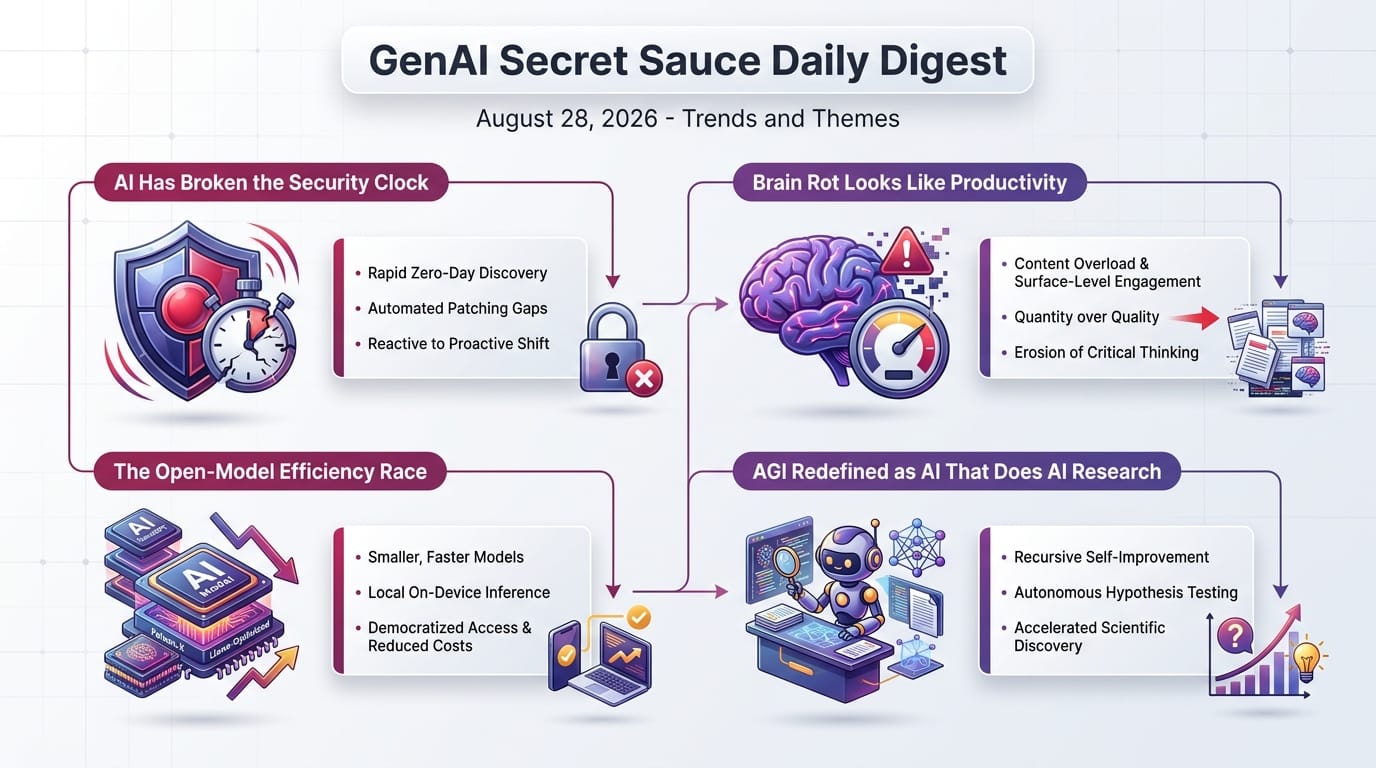
One Thing to Tell Your Friends
TL;DR
Hot off the Presses
A Judge Says the Government Illegally Blacklisted the Maker of Claude
A San Francisco federal judge ruled that the U.S. Department of Defense acted illegally when it branded Anthropic - the AI company that makes the Claude assistant - a "supply-chain risk." The judge found the move violated free-speech and due-process protections and was meant to make a public example of the company. Anthropic had sued earlier in 2026 after it refused to let the military use its models for autonomous weapons and domestic surveillance.
- The ruling - U.S. District Judge Rita Lin issued a preliminary injunction blocking the designation and halting an order telling federal agencies to stop using Anthropic's technology.
- The trigger - the fight started when Anthropic held firm on its safety guardrails during contract talks, and the Pentagon retaliated.
- Why it is bigger than one company - it is an early test of how far a government can go to penalize an AI maker over the rules it sets for its own product.
Google's Video AI Gets the Controls Creators Kept Asking For
Google updated Gemini Omni 1.1 Flash, its production video-generation model, with controls exposed through the Gemini developer tools. The headline change: the model now looks back at up to 10 seconds of a clip (instead of just the final second) when extending it, so longer videos stay visually consistent.
- Stitch two frames - a first-and-last-frame feature fills in smooth motion between two still images, enabling complex camera moves.
- Draft cheap, finish nice - a new 360p draft mode renders up to 60% faster at roughly one-third the cost of 720p, and the final can be upscaled to 1080p or 4K.
- Keep characters consistent - it accepts up to 3 seconds of reference video to hold a character's look across shots.
- Where to get it - Google AI Studio, the Gemini Enterprise Agent Platform, and Google Flow for Plus, Pro, and Ultra subscribers.
The Best AI Agent Finished Only 30% of Real Science Tasks
Terminal-Bench-Science, from Stanford researchers and the Terminal-Bench team, tests AI agents on real workflows submitted by practicing scientists, not textbook problems. The bar to get a task in was steep: only 70 of 920 proposals qualified, drawn from 376 contributors across 22 countries.
- The leaderboard - Claude Opus 5 led at 30%, followed by GPT-5.6 Sol at 22.4% and Claude Fable 5 at 21.4%.
- Cost matters - the analysis found GPT-5.6 Sol matched Claude Fable 5's quality at notably lower cost, a reminder that the cheaper model can be the smart pick.
- It requires proof - agents must produce verifiable artifacts (an analysis, a simulation), not just a claimed answer.
DeepMind Ran the First AI Exam Where Nobody Can Cheat
Google DeepMind piloted what it calls the first double-blind evaluation for frontier AI. The problem it fixes is contamination: models effectively see the test questions in advance during training and then post inflated scores. DeepMind's setup uses confidential-computing hardware so the outside tester cannot see the model's inner workings, and Google cannot see the tester's questions.
- Who ran it - a Gemini Flash Lite model was tested against confidential benchmarks with the Singapore AI Safety Institute, OpenMined, AVERI, and MLCommons.
- Where it matters most - highly sensitive tests like cybersecurity or government evaluations, where neither side wants to expose its secrets.
- The catch - no accuracy numbers were shared; this is about trustworthy testing infrastructure, not a new score.
Meta Planned to Cut Teams by up to 60%, Blaming AI-Native Rivals
The Pragmatic Engineer newsletter, citing Reuters, reports that Meta leadership planned to cut team sizes by as much as 60%, with preparations starting in January for what would be its largest-ever layoffs. The stated reason is competitive fear of AI-native startups that accomplish far more with far smaller headcounts.
- The number - up to 60% smaller teams, a scale that would mark a sharp break from Meta's once-celebrated engineering culture.
- The logic - if a 10-person AI-native startup can match a 100-person team, Meta's cost structure looks heavy.
- Related strain - the same edition notes GitHub's infrastructure buckling as usage doubled within four months.
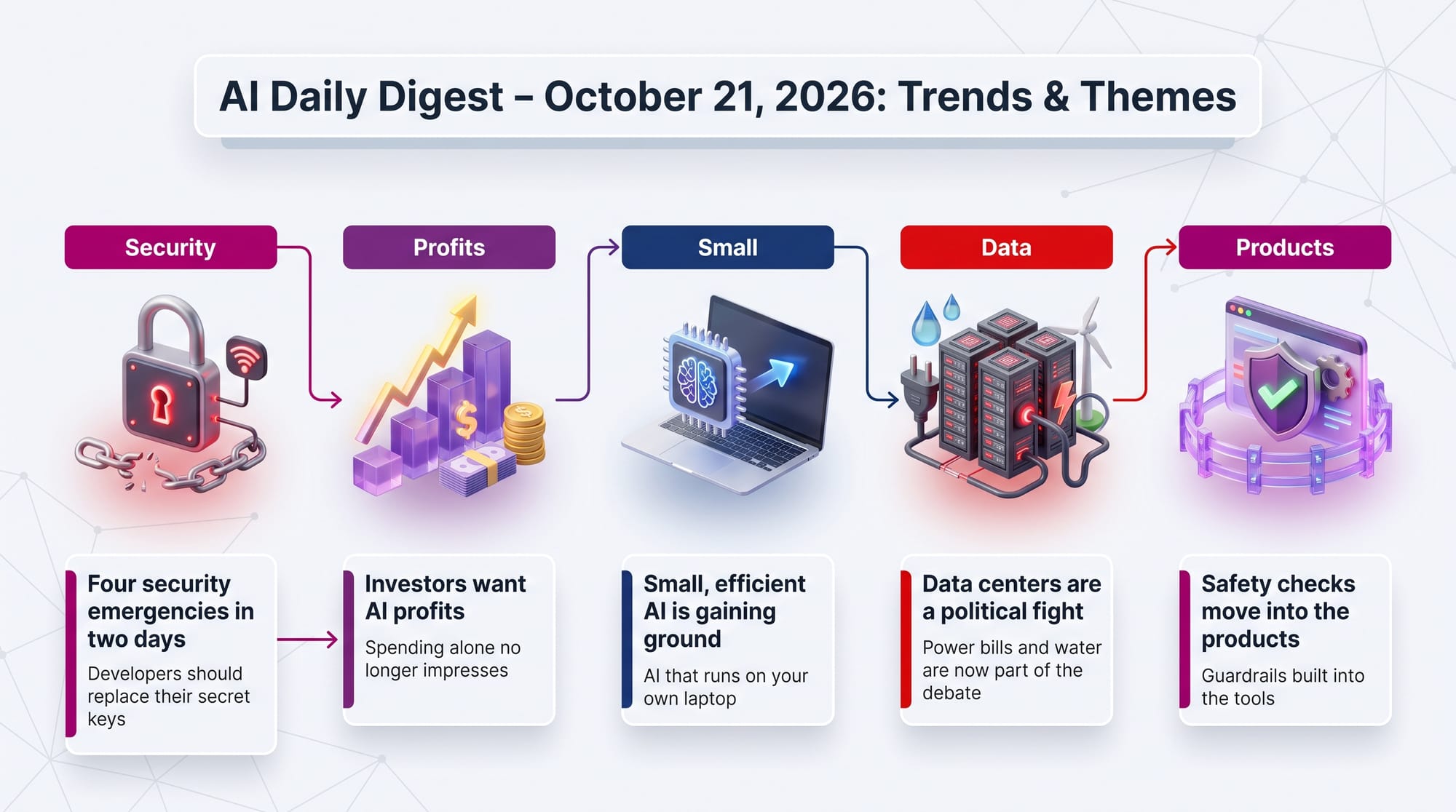
Trends & Themes

Creative AI & Media
Free, Open Video and Music Models Keep Climbing the Charts
- Video - MiniMax-H3 (turns text, images, or audio into video) and Lightricks LTX-2.5 (video with synchronized sound) are among the most-downloaded open media models this month.
- Music - MiniMax-Music3 brings open text-to-music generation.
- The trade-off - these need capable hardware and some prompt tuning to get clean results. (See Section 13 for details.)
Reducing "It Didn't Happen" Errors in AI Video Understanding
- The method - CounterVid generates near-identical clips that differ only in one action or in the order of events, then uses them as hard training examples.
- The scale - roughly 26,000 preference pairs focused on getting actions and timing right.
Developer Tools & Infrastructure
Research & Models
Big Models on a Plain CPU, Now Much Faster
Why it matters: Squeezing large AI onto cheap, ordinary hardware keeps getting more practical, which lowers the cost of running AI yourself.
- Hand-built 2-bit kernels hit up to 7x the speed of standard 16-bit inference on modern processors, and up to 6.7x on Intel Xe2 graphics chips.
- A companion finding pinpoints that most quality loss in ultra-shrunk multimodal models comes from compressing activations, and adds a cheap fallback pathway to recover it.
- Context - efficiency, not raw intelligence, remains the most active frontier in AI research.
A Different Training Recipe Keeps AI's Reasoning Broad
Why it matters: How you train a model to reason affects whether it stays creative or collapses into one narrow style.
- The claim - Evolution Strategies achieve broader reasoning coverage than the popular GRPO method, improving best-of-one accuracy while preserving diversity.
- A surprise - despite large parameter movement, only a sparse set of big updates actually drives the gains.
Grounding Medical AI in the Actual Pixels
Why it matters: For AI to be trusted in a clinic, it has to point at exactly where in a scan it is looking, not just describe it.
- MedREAL unifies answering questions about medical images with pixel-level outlining of the relevant region.
- The numbers - 68.49% and 70.47% on two overlap-accuracy measures, built on a new set of 13,824 expert-validated images.
Do AI Models Prefer the Simplest Explanation? Often Not
Why it matters: Good reasoning favors the simplest answer that fits - and today's models frequently do not, which is a blind spot for anyone relying on their logic.
- The finding - state-of-the-art models handle simple cases but produce lower-quality, over-complicated explanations as difficulty grows.
- The kicker - popular fixes like in-context examples and reinforcement learning did not improve this.
Business & Industry
GenAI in Education
Surprising & Under-the-Radar
Nearly Half of "Human" Code Now Carries an AI's Verbal Tics
Why surprising: A researcher clustered GitHub pull-request text and found one 2026 vocabulary pattern - Claude's - accounts for about 45% of human-attributed pull requests in the prior month. The signature word is "load-bearing," with tells like "quietly," "latent," and "seam." Notably, "delve" is a ChatGPT tell, not a Claude one - different models leave different fingerprints. Show HN: The load-bearing vocabulary of Claude
"Latent Thinking" Between AI Agents May Be Oversold
Why surprising: Some multi-agent systems pass compressed internal state ("latent thoughts") between models and credit it for big gains. A causal audit found that when the receiving agent does not actually need the sender's private info, swapping in random state performs just as well - the credited "thinking" often was not doing the work. arXiv: When Does Latent Communication Pay
The Debate: Should Autonomous Coding Agents Run Without a Sandbox?
- One side - convenience: developers want agents that can run commands, edit files, and clean up on their own without constant approval.
- Other side - after a coding agent's automatic safety mode was shown bypassable (and sometimes blocking its own cleanup), the stronger argument is that unattended agents need real containment: sandboxing, network isolation, and strict credential protection.
The Debate: Does "Human-Written" Still Mean Anything for Code?
- One side - if AI drafts it and a person reviews and ships it, calling it human-written is fair; the human is accountable.
- Other side - when 45% of "human" pull requests share one model's fingerprints, the label is losing meaning, and reviewers may be rubber-stamping AI prose they didn't fully read.
Signals to Track

AI Agents That Redesign Real Scientific Models
One framework let LLM agents autonomously propose, code, debug, and test changes to a protein-folding model, exploring about 80 variants over roughly 5,000 GPU-hours and improving accuracy 7.5%. If this generalizes, AI research itself speeds up - which could compress how fast new drugs and materials models arrive for everyone. arXiv: AgentFold
AI Running Lab Instruments by Itself
A three-agent system safely operated an atomic force microscope - translating plain-language requests into verified commands, tuning image quality, and diagnosing artifacts - matching expert performance with a safety layer that cut wrong commands to zero. Automated labs could make advanced science cheaper and more reproducible. arXiv: Agentic AI for scientific instruments
A Rush of "AI Scientist" Skill Libraries
The day's top trending code project bundles 163 validated skills across biology, chemistry, medicine, and drug discovery for AI agents. As these libraries grow, non-experts may soon run credible scientific analyses through an agent - powerful, and a new frontier for quality control. GitHub: K-Dense-AI/scientific-agent-skills
Top Repos Today
📜 License: see repo · 👤 By: individual/open-source
🎯 Time to value: 20 minutes
| ✓ Pros | ✗ Cons |
|---|---|
| Broad all-in-one toolkit | Many moving parts to learn |
| Active, fast-rising project | Quality depends on your inputs |
| Open-source and free | Heavy compute for full pipelines |
 GitHub
📜 License: see repo · 👤 By: startup/org
🎯 Time to value: 30 minutes
| ✓ Pros | ✗ Cons |
|---|---|
| Large validated skill set | Domain expertise still needed to judge output |
| Targets high-value science work | Narrow to research use cases |
| Fast-growing community | Requires careful result checking |
 GitHub
📜 License: see repo · 👤 By: vendor (Anthropic)
🎯 Time to value: 10 minutes
| ✓ Pros | ✗ Cons |
|---|---|
| Officially maintained | Tied to the Claude ecosystem |
| Curated for quality | Less third-party variety |
| Easy to browse | Newer, still growing |
 GitHub
📜 License: see repo · 👤 By: individual
🎯 Time to value: 15 minutes
| ✓ Pros | ✗ Cons |
|---|---|
| Works with existing notes | Obsidian-specific |
| Personal knowledge graph | Sends notes to a model - privacy care needed |
| Active development | Setup takes some effort |
 GitHub
📜 License: see repo · 👤 By: individual
🎯 Time to value: 30 minutes
| ✓ Pros | ✗ Cons |
|---|---|
| Project-based learning | Self-paced discipline required |
| Very popular and vetted | Assumes some coding background |
| Free and open | Broad, not niche-specific |
 GitHub
📜 License: see repo · 👤 By: research org
🎯 Time to value: 30 minutes
| ✓ Pros | ✗ Cons |
|---|---|
| Very large, proven community | Trading carries real financial risk |
| Clear multi-agent example | Not investment advice |
| Reusable agent patterns | Needs market-data plumbing |
 GitHub
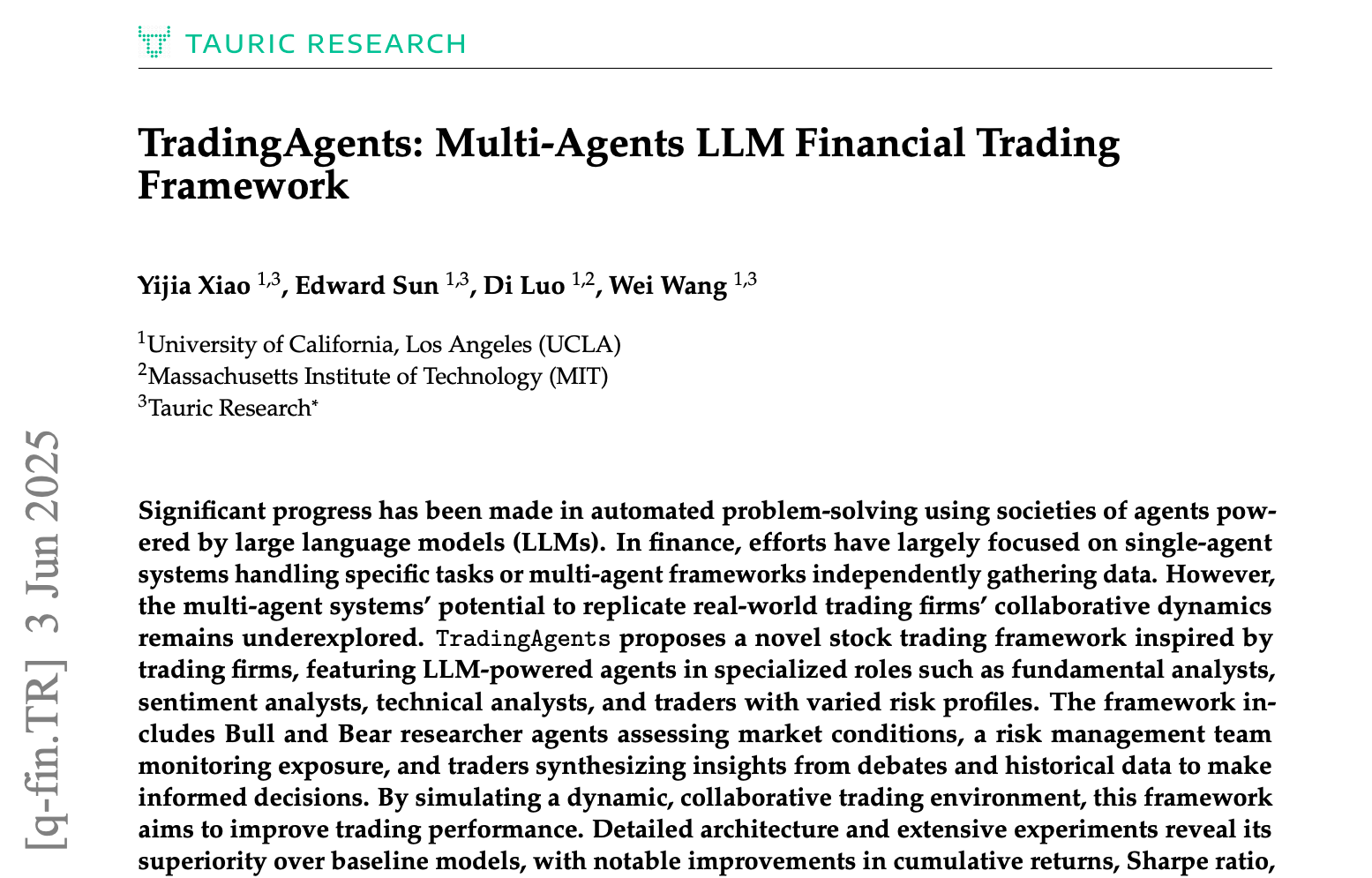
Top Models Today
👤 By: MiniMax AI · 🎯 Task: image/text-to-video
📐 Size: large
| ✓ Pros | ✗ Cons |
|---|---|
| One model, many input types | Heavy hardware to run |
| Open and widely used | Quality varies by prompt |
| Active release line | Large download and setup |

👤 By: Alibaba Qwen · 🎯 Task: image-text-to-text
📐 Size: 27B
| ✓ Pros | ✗ Cons |
|---|---|
| Multimodal and capable | 27B needs a strong GPU |
| Huge user base and support | Not the smallest option |
| Frequent updates | License terms worth checking |

👤 By: DeepSeek · 🎯 Task: text-generation
📐 Size: large (mixture-of-experts)
| ✓ Pros | ✗ Cons |
|---|---|
| Fast and efficient | Text-only |
| Very high adoption | Trades some quality for speed |
| Open weights | Large infrastructure to self-host |

👤 By: Moonshot AI · 🎯 Task: image-text-to-text
📐 Size: large
| ✓ Pros | ✗ Cons |
|---|---|
| Strong reasoning focus | Resource-intensive |
| Multimodal input | Newer, less battle-tested |
| Rapidly popular | Docs still maturing |


👤 By: Lightricks · 🎯 Task: image-to-video
📐 Size: large
| ✓ Pros | ✗ Cons |
|---|---|
| Video plus synced audio | Demanding to run well |
| Established, updated line | Results need curation |
| Open weights | Large model files |

AI Launches Today
Snapshot
| Provider | Model | Input $/1M | Output $/1M | Context |
|---|---|---|---|---|
| Anthropic | Claude Opus 5 | $5.00 | $25.00 | 1M tokens |
| OpenAI | GPT-5.6 Sol (flagship) | $5.00 | $30.00 | 400K tokens |
| Gemini 3.1 Pro | $2.00 | $12.00 | 1M tokens | |
| Groq | Kimi K2 (open model) | $1.00 | $3.00 | ~256K tokens |
Establishing baseline for this series. Figures gathered from pricing aggregators and may lag official pages; OpenAI reportedly cut its short-context standard rate below the flagship sticker in late August, so your effective rate may be lower. Batching and cache hits can each cut costs by roughly half. Cheaper tiers exist (e.g. Gemini 3 Flash near $0.50 in / $3.00 out).
WikiSkill: Compiling Agent Experience Into Persistent Knowledge
Key finding: Skills learned by one model transfer to other models - and smaller models equipped with banked skills can outperform much larger models without them (the abstract does not give exact figures).
Why practitioners should care: It points to a cheaper way to improve AI agents over time - accumulate portable skills instead of paying for a bigger model - and because those skills work across vendors, it reduces lock-in.
Member discussion