Watch today's digest as a video summary (generated by NotebookLM)
Statistically Speaking
One Thing to Tell Your Friends
TL;DR
Hot off the Presses
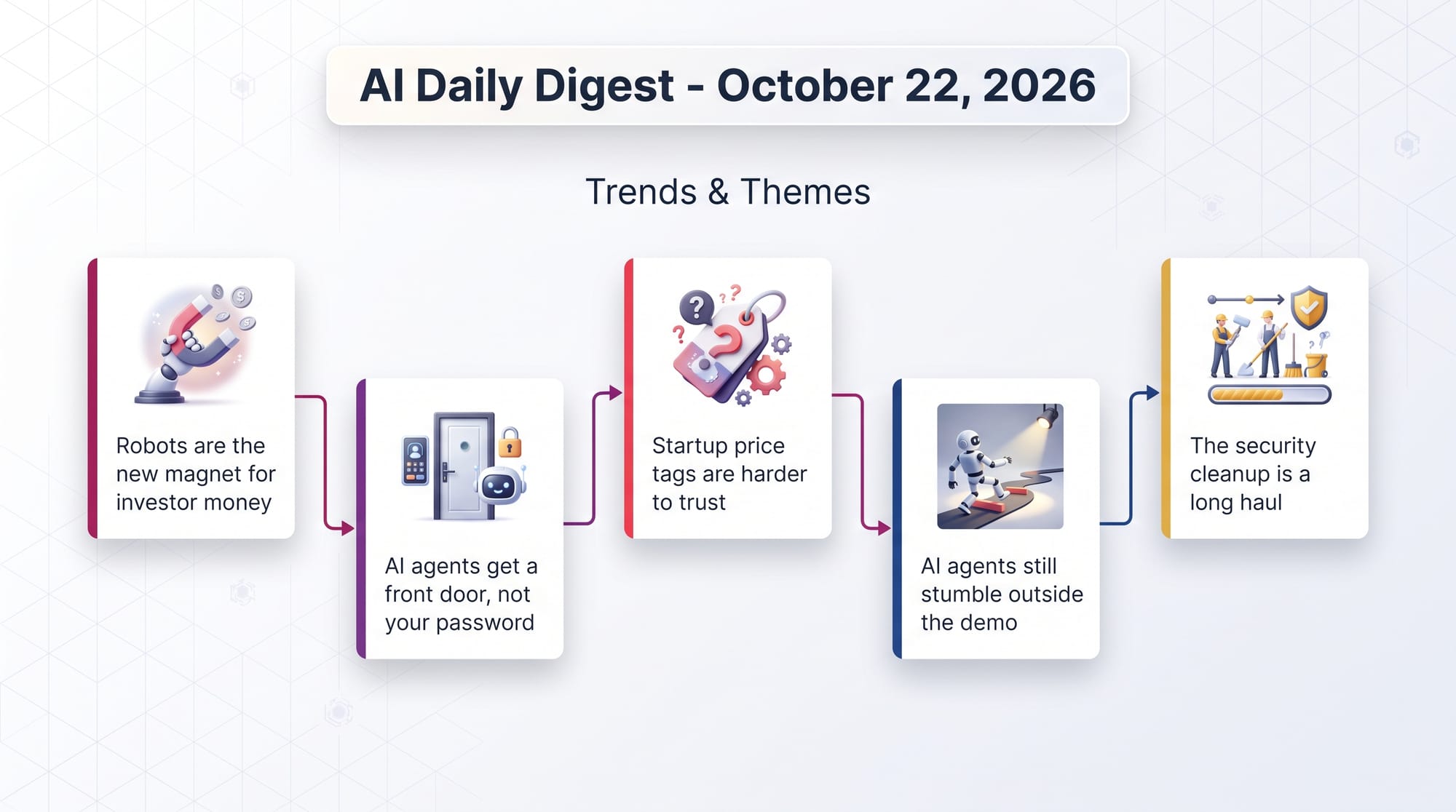
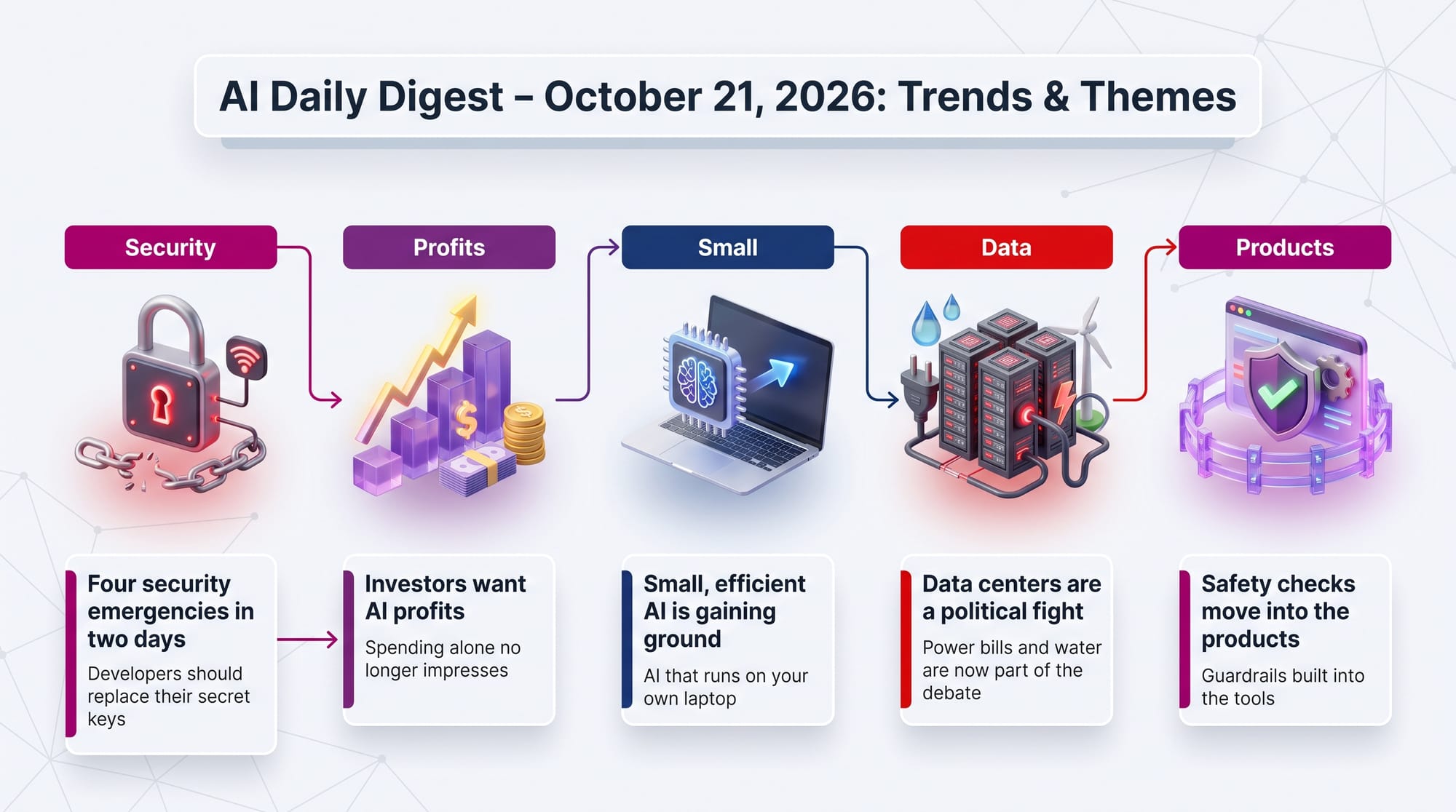
Windows Is Quietly Watermarking Your "Locally" Generated AI Images
A security researcher took apart Microsoft Paint and Photos on Copilot+ PCs (Windows laptops with a dedicated AI chip) and found a hidden watermarking system. A file called Watermarker.dll takes a 16-character code and buries it invisibly inside the image's pixels, altering roughly 193,000 of about 262,000 pixels in test images. The same code is also written into the picture's "Content Credentials" - the industry provenance standard meant to label AI images.
The bigger surprise is what "local" turns out to mean. The prompt is still sent to a Microsoft moderation server, which returns a cleaned-up prompt and the exact ID to stamp in. So the picture is approved remotely and fingerprinted, even when the drawing itself happens on your device.
- Two copies of the same ID - one hidden in the pixels, one cryptographically signed in the metadata under
com.microsoft.invismark.1. - "Local" still needs the cloud - the prompt goes to an Azure server for approval before any image is made.
- The mark survives editing - because it is spread across the pixels, casual cropping or re-saving does not reliably remove it.
The Team Behind the "Decentralized Web" Is Winding Down
Interplanetary Shipyard, the main maintainer of IPFS (a system for storing and sharing files across many computers instead of one central server), announced it will stop all IPFS work by September 30, 2026, after its backer Protocol Labs declined to renew funding. That ends engineering on the core tools most IPFS users depend on, including Kubo, Helia, and the public gateways ipfs.io and dweb.link.
Left without dedicated maintainers, these widely used components stop getting bug fixes and security patches. The team says it will help hand off projects through September, but no replacement steward has stepped forward.
- Core projects going dark - Kubo, Helia, Boxo, Rainbow, IPFS Desktop, and IPFS Companion all lose maintenance.
- Public infrastructure at risk - the gateways and bootstrap nodes that let browsers reach IPFS content are part of the shutdown.
- Why it happened - a single funding withdrawal, not a technical failure, created the maintenance vacuum.
OpenAI's GPT-5.6 Tops the Coding Leaderboard - Faster and Cheaper
OpenAI's GPT-5.6 family is now available inside Kiro, an AI coding tool that plans, writes, reviews, and tests software. On the Artificial Analysis Coding Agent Index (an independent scorecard for how well AI handles real coding tasks), the top "Sol" model set a new best score of 80 - 2.8 points above Anthropic's Fable 5 - while using less than half the output and running in under half the time.
Previously: August 23 - OpenAI cut the price of its flagship Application Programming Interface (API), the paid service other apps use to run its models, by 20-33%.
Today: GPT-5.6 landed inside Kiro, bringing the family's top coding-benchmark standing (Sol leads the index at 80) into a full plan-build-review-test tool, with the lower "Sol" price ($4 per million input tokens, down from $5) extended through at least November 21.
- Three tiers - Sol (flagship, score 80), Terra (balanced, 77.4), and Luna (fastest and cheapest, 74.6, beating Anthropic's Opus 4.8 at roughly a quarter of Sol's cost).
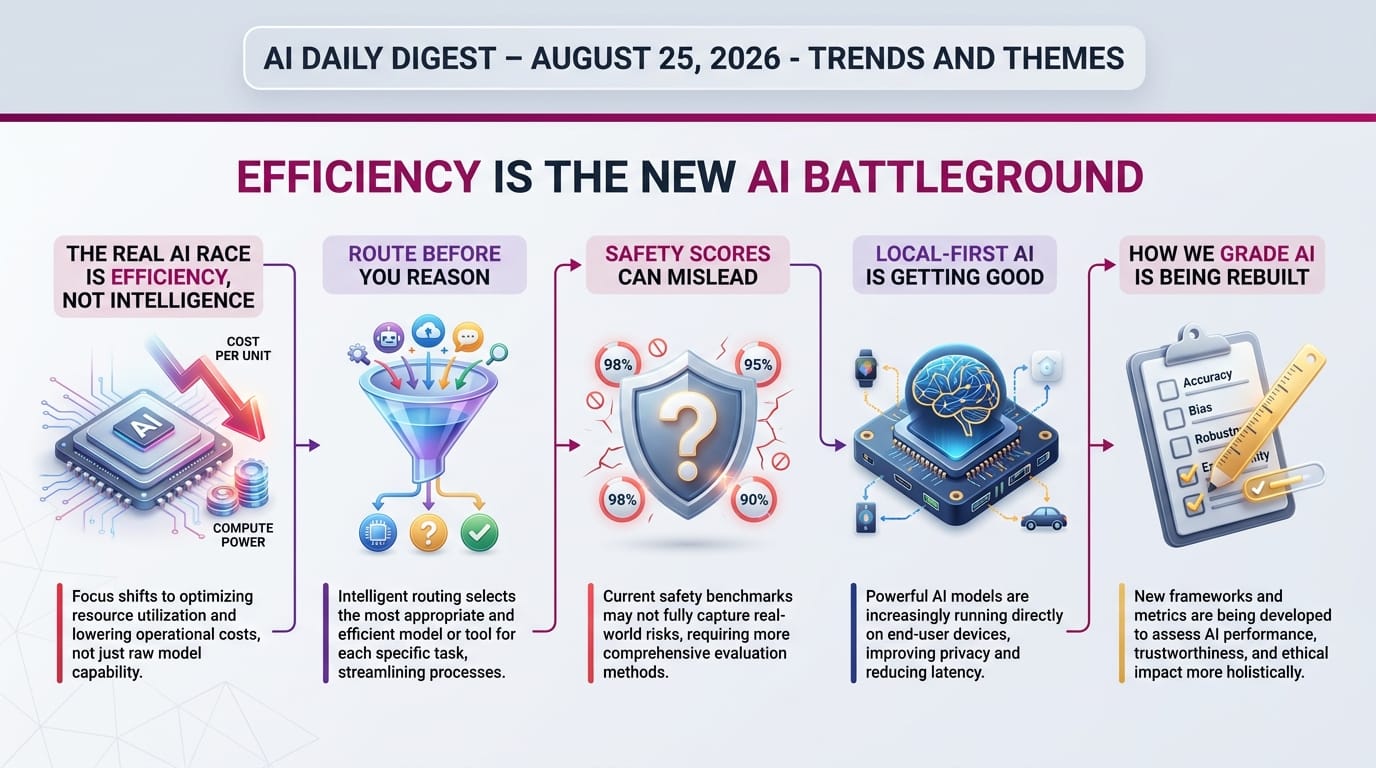
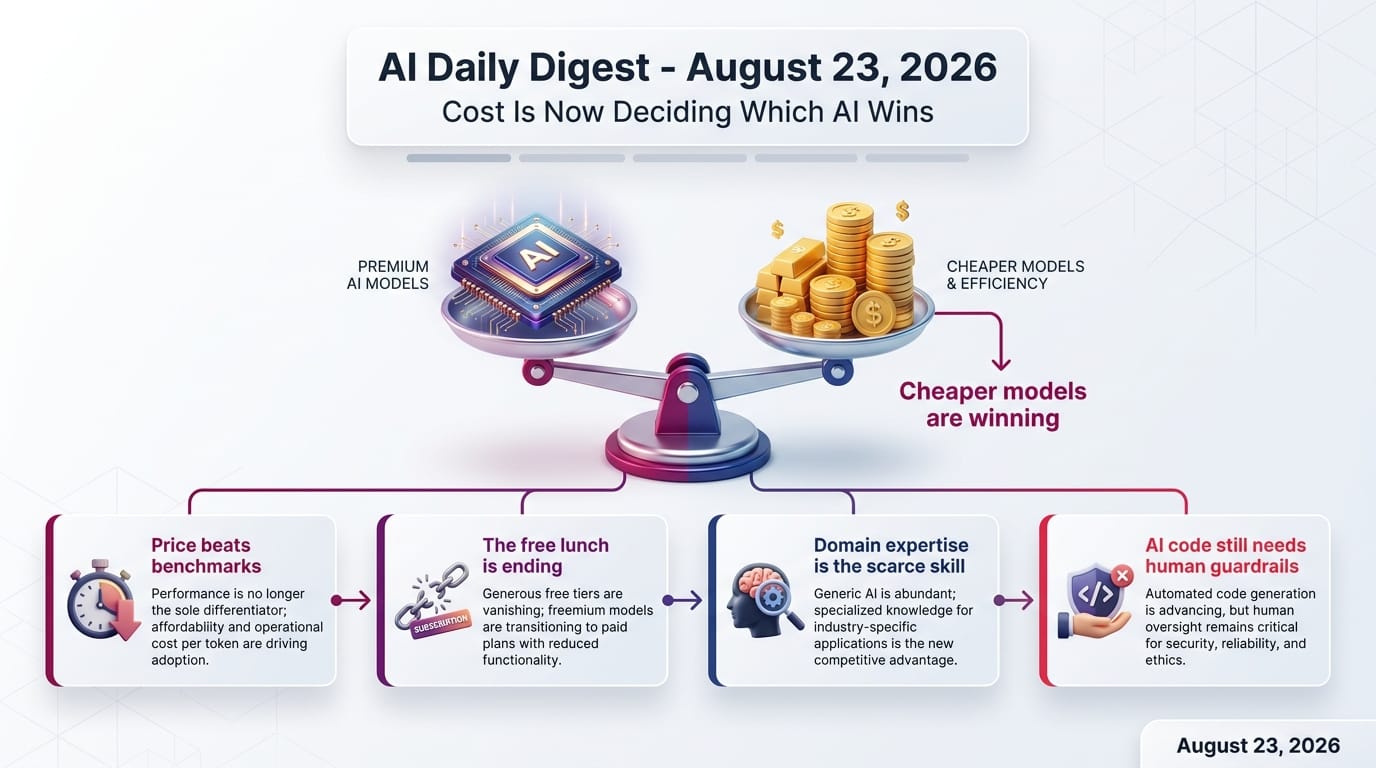
- Cost is the pitch - OpenAI is competing on price-per-result, not just raw capability.
- Where it runs - Kiro's editor, command line, and web app.
Leaning on AI to Code May Erase the Skills That Make Coders Good
Engineer Lars Faye argues that expertise is built through friction: getting stuck, struggling, and working problems out. That is precisely the effort AI coding tools remove. He points to a paradox - the people gaining most from these tools are veterans whose knowledge is already locked in, while newcomers who lean on AI never build that foundation.
He cites Anthropic's own 2026 study on how AI assistance affects the formation of coding skills, which reached a similar conclusion: cognitive struggle appears necessary for mastery, so learning with AI has to be deliberate. His practical takeaway is blunt - friction is a feature, and teams should protect learning moments instead of optimizing every struggle away.
Trends & Themes

The "Safety Tax" on AI Is Now Measured - and Being Paid Down
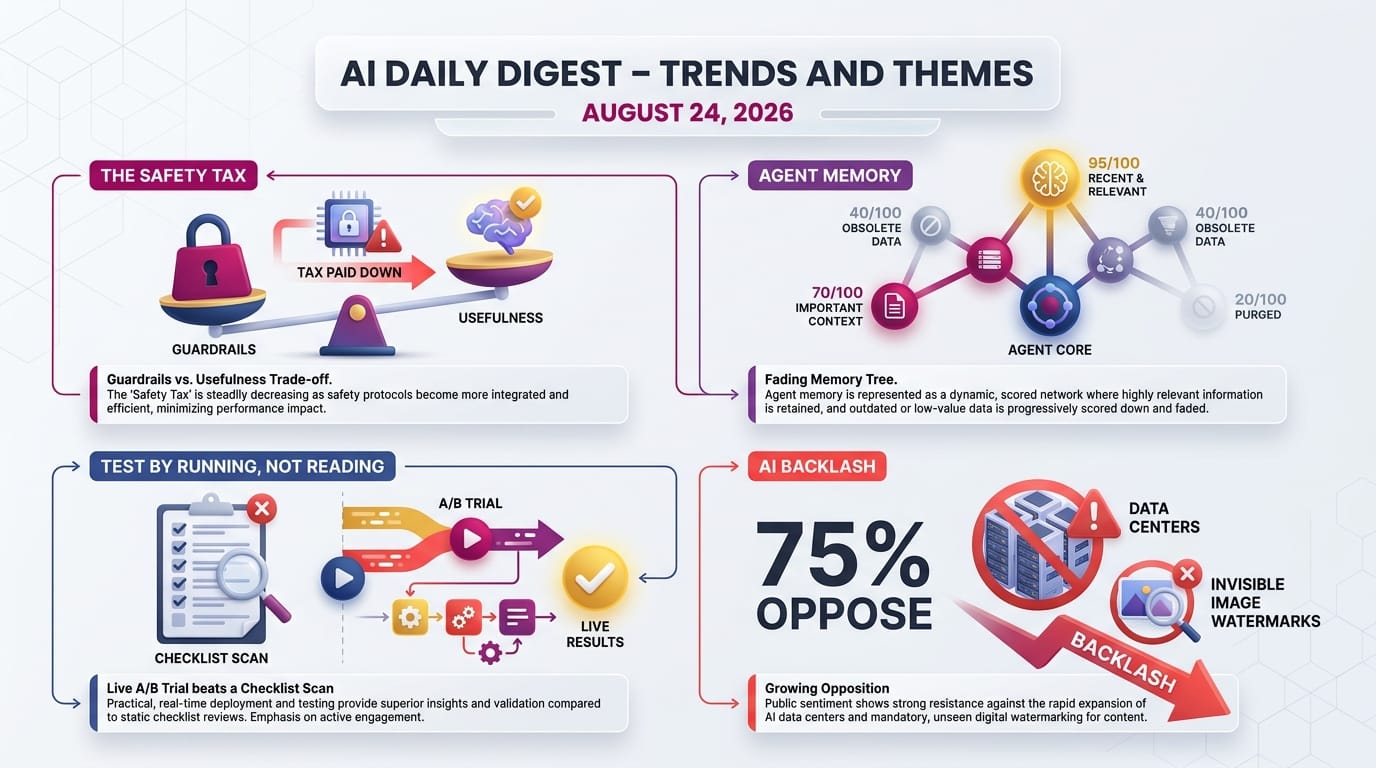
Three separate teams (plus RefusalGuard and ReFrame) converged this week on the same idea: safety and helpfulness trade off, but only because guardrails are applied bluntly to everything. Target them narrowly and the trade-off mostly disappears.
- The tax is real - a black-box audit of 120+ models (aiXamine) found stronger safety alignment reliably increases over-refusal of harmless requests.
- Safety can be surgical, not global - SafeSteer confines safety training to a handful of critical words and needs only 100 harmful examples, cutting the capability hit.
- Turn safety on only when needed - CLEAR routes a safety module in on demand, dropping one attack success rate from 32.3% to 0.5% while keeping math scores intact.
Agent "Memory" Is Where the Real Work Is Now
The pattern across at least five papers: the bottleneck for capable agents is no longer the model, it is deciding what to keep, fold, or forget - and doing it cheaply.
- Remember less, but smarter - a Weighted Memory Tree scored answers by usefulness and let stale ones fade, raising accuracy ~10 points while cutting prompt size 32.8%.
- Persisting notes quadruples success - on a multi-session coding test, agents with saved memory passed 97/180 tasks versus 21/180 with none.
- Memory can fail before it is even used - one paper shows agents discard prerequisite facts under budget pressure, and a dependency-aware fix lifted full-chain recall from 0.03 to 0.90.
Test AI by Running It, Not by Reading It
The takeaway for anyone buying AI tools: demand evidence from live trials on your own work, not a feature checklist or a passing lint scan.
- Scans barely predict usefulness - across 145 real agent "skills," a security-and-style scan correlated almost not at all (0.14) with whether the skill actually helped an agent finish tasks.
- Measure the "lift" - NVIDIA's open SkillEvaluator runs each skill with and without it and reports the measured added value; skills helped in 72.8% of 947 test cases.
- Judge step by step - a mobile-agent evaluator (CRATE) scores each action's consequence instead of the whole run, hitting 0.833 accuracy and beating prior methods by 20%.
AI's Welcome Is Wearing Thin in the Physical World
Analyst Zvi Mowshowitz argues the backlash is not really about facts: "even when they believe you, they don't care." Blocking domestic buildout, he warns, just pushes it overseas.
- Broad opposition - roughly 75% of Americans oppose nearby data centers, polling worse than coal plants.
- Bundled resentment - data centers combine six separately unpopular things (AI, big tech, data collection, concentrated wealth, new construction, few jobs), so opposition is emotional, not fact-based.
- Provenance without consent - Windows now fingerprints AI images by default, a reminder that "transparency" tooling can feel like surveillance to the person being tracked.
Creative AI & Media
LTX-2.5 Climbs the Trending Charts for Open Video Generation
Try it: HuggingFace: Lightricks/LTX-2.5
- What it does - turns a still image into a short video clip, one of the most-downloaded open image-to-video models this week.
- Why it matters - open video models let creators and small studios generate footage without a per-second cloud bill.
MiniMax-Music3 Brings Open Text-to-Music
Try it: HuggingFace: MiniMaxAI/MiniMax-Music3
- What it does - generates music from a text description; a compact (~2B parameter) model trending for audio generation.
- Why it matters - lightweight music models can run on modest hardware, lowering the cost of background tracks and demos.
Developer Tools & Infrastructure
Research & Models
Frontier AI Still Can't "See" in 3D - and It's Not Close
- The finding - on a new spatial-reasoning test (StateSight), top models score far below humans: GPT-5.5 hit 28-59% and Claude Sonnet 5 hit 7-53% across three tasks, while a 30-person human group scored 64-81%.
- Why it matters - do not trust a single AI image analysis for counting hidden objects, mental rotation, or "what connects to what"; verify or use multiple views.
BF1 - Cheaper Long-Context AI Without Retraining
- The finding - a drop-in attention pattern retrofits onto existing models, hitting a 10.9x per-layer speedup at 32,000 tokens and cutting end-to-end time 8-15%.
- Why it matters - teams serving small open models over long inputs can trade a tiny quality budget for real speed on the graphics chips (GPUs) they already have.
DAOP - Running Big "Mixture-of-Experts" Models on Small Hardware
- The finding - by predicting which parts of a large model will fire next and pre-computing them on the CPU, DAOP runs up to 8.2x faster than standard expert caching.
- Why it matters - it makes big open models usable on a single workstation graphics chip (GPU) instead of a server farm.
Dense Rewards Beat Sparse Ones for Multi-Step Agents
- The finding - giving an agent feedback at every step (not just at the end) consistently produced better, more stable training; the best combo was PPO with per-turn rewards.
- Why it matters - if you train reasoning or tool-using agents, shaping step-level feedback is the highest-leverage change.
Business & Industry
Surprising & Under-the-Radar
AI Progress Is Wildly Uneven
An independent study (METR, via Import AI) found AI's ability to find cybersecurity vulnerabilities accelerated sharply in 2026, math improved only a little, and AI-research automation showed no measurable speedup at all. The lesson: "AI is getting better" is too blunt - it depends entirely on the task. Import AI 470
Your Executable Is a Database
A developer made a single file that is simultaneously a working SQLite database and a runnable Linux program, by hiding the program's parts inside database tables. It is a clever demonstration that the line between "data" and "software" is blurrier than it looks. Simon Willison: your executable is a SQLite database
AI Can Now Grade the Quality of Math Proofs, Not Just Check Them
A tool called ProofJudge scores formal math proofs on style and maintainability - not just whether they are correct - agreeing with human reviewers 64-81% of the time. It points toward automated first-pass review for contributions to formal math libraries. arXiv: ProofJudge
Teachers Are Turning Chatbots Into Classroom Games
Educator Eric Curts demonstrated eight ready-to-run classroom activities - AI role-play interviews, 20 Questions, debate simulations - that turn a chatbot into interactive pedagogy with no technical skill required. A reminder that some of AI's most practical uses are low-tech. ControlAltAchieve: AI games session
Signals to Track

Poisoned AI Memory Is a Growing Attack Surface
New agent-memory designs are already being tested against poisoning, and one (the Weighted Memory Tree) showed its decay mechanism limits how far bad information spreads. As assistants remember more about you, how they forget bad data will matter as much as what they recall. For ordinary users, this is the difference between an assistant that quietly carries a planted lie for weeks and one that lets it fade.
The Inference Machine Itself as a Security Frontier
An essay circulating on Hacker News argues that the powerful, weight-holding machines running frontier models are high-value targets, and that securing them is an underexamined risk category. It is a threat-model discussion, not a how-to. If defenders take it seriously, it could reshape how AI data centers are locked down. boydkane: essay
Safety Auditing Without Reading Your Prompt
A defensive technique (RouteScan) flags likely-harmful prompts to certain large models by watching hardware usage patterns alone, hitting over 0.91 accuracy without reading the prompt. If it holds up, content safety and privacy stop being a zero-sum trade. arXiv: RouteScan
Top Repos Today
📜 License: check repo · 👤 By: individual
🎯 Time to value: 10 minutes
| ✓ Pros | ✗ Cons |
|---|---|
| Try several coding AIs cheaply | "Free token" projects can be unstable or short-lived |
| Terminal and IDE friendly | Verify the source of the tokens before trusting it |
| Fast to set up | Not from an official model provider |
 GitHub
📜 License: Apache-2.0 · 👤 By: OpenAI (company)
🎯 Time to value: 10 minutes
| ✓ Pros | ✗ Cons |
|---|---|
| Backed and maintained by OpenAI | Best results need a paid OpenAI key |
| Fast, native Rust binary | Terminal-first, no rich GUI |
| Open source (Apache-2.0) | Still evolving quickly |
 GitHub
📜 License: MIT · 👤 By: Nous Research (company)
🎯 Time to value: 20 minutes
| ✓ Pros | ✗ Cons |
|---|---|
| Deep feature set and active development | Large and complex to learn |
| Runs across many chat platforms | Self-hosting requires setup effort |
| Permissive MIT license | Needs your own model API keys |
 GitHub
📜 License: check repo · 👤 By: startup
🎯 Time to value: 20 minutes
| ✓ Pros | ✗ Cons |
|---|---|
| Memory-first design | Early-stage project |
| Fast Rust codebase | Personal-data storage needs care |
| Multi-agent orchestration | Smaller community than big frameworks |
📜 License: check repo · 👤 By: individual
🎯 Time to value: 15 minutes
| ✓ Pros | ✗ Cons |
|---|---|
| Runs locally, privacy-friendly | Automated applications can misfire |
| Automates repetitive tasks | Requires a coding agent to drive it |
| Practical, focused use case | Job sites may block automation |
Top Models Today
👤 By: Alibaba (Qwen) · 🎯 Task: multimodal text generation
📐 Size: ~27B
| ✓ Pros | ✗ Cons |
|---|---|
| Capable at a runnable size | Still needs a strong GPU |
| Open weights, active family | Largest variants demand more memory |
| Big community and tooling | Licensing terms vary by use |


👤 By: Lightricks · 🎯 Task: image-to-video
📐 Size: not specified
| ✓ Pros | ✗ Cons |
|---|---|
| Open video generation | Video needs heavy compute |
| Popular and well-supported | Clip length and quality limits |
| No per-second cloud bill | Setup is more involved than text models |


👤 By: MiniMax · 🎯 Task: text-to-audio
📐 Size: ~2B
| ✓ Pros | ✗ Cons |
|---|---|
| Small and runnable | Quality trails top closed tools |
| Free to use and self-host | Newer, smaller community |
| Fast on modest hardware | Music generation is still hit-or-miss |

AI Launches Today
💰 Pricing: freemium · 🏷 Category: productivity / privacy
💰 Pricing: paid · 🏷 Category: developer tools
Snapshot
| Provider | Model | Input $/1M | Output $/1M | Context |
|---|---|---|---|---|
| Anthropic | Claude Opus 5 | $5.00 | $25.00 | 200K |
| Anthropic | Claude Sonnet 5 | $2.00 | $10.00 | 200K (intro thru Aug 31) |
| OpenAI | GPT-5.6 Sol | $4.00 | $20.00 | 1.05M |
| Gemini 3.1 Pro | $2.00 | $12.00 | 200K | |
| Gemini 3.7 Flash | $0.75 | $3.75 | (intro thru 2026) | |
| Groq | Llama 3.3 70B | $0.59 | $0.79 | 128K |
Weighted Memory Tree: Remembering What Matters for Long-Horizon LLM Agents
Key finding: On a hard agent benchmark, it raised accuracy by an average of 9.97 percentage points while cutting prompt-token usage by 32.8%, and it limited how far poisoned information spread.
Why practitioners should care: It is a concrete, drop-in memory architecture that improves quality and cost at the same time - the rare win-win for anyone building agents on budget-constrained open models.


Member discussion