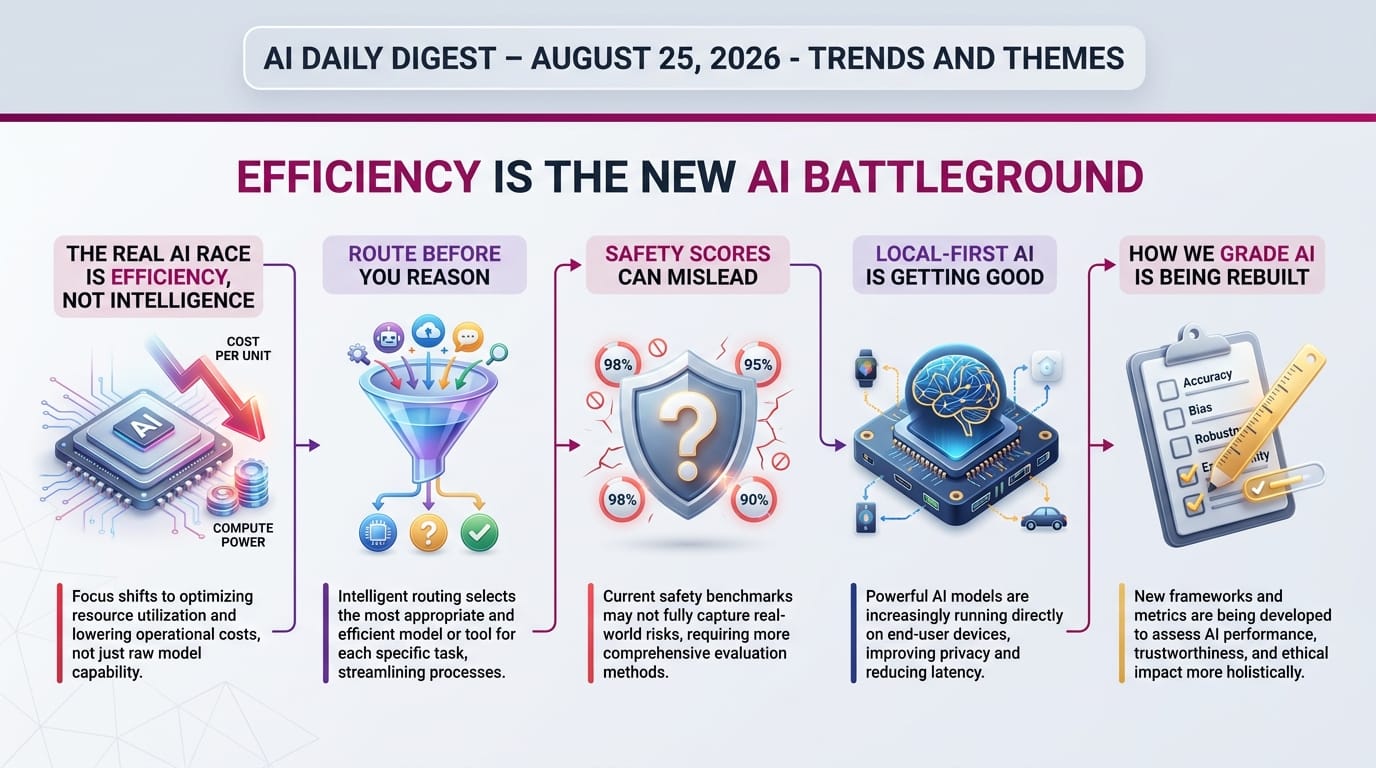
Watch today's digest as a video summary (generated by NotebookLM)
Statistically Speaking
One Thing to Tell Your Friends
TL;DR
Hot off the Presses
OpenAI Built Its Own AI Chip and Says It Beats Nvidia
OpenAI and chipmaker Broadcom released the first performance numbers for Jalapeño, a chip OpenAI designed specifically to run AI models (not train them). Nvidia has supplied the expensive graphics chips (GPUs) behind almost every major AI system; Jalapeño is OpenAI's bid to build the hardware itself. The design went from drawing board to working silicon in about 16 months.
The claimed results are aggressive. Independent-ish testing on a third-party platform showed Jalapeño doing 1.5 to 1.9 times more work per watt of electricity than Nvidia's current top systems, and responding 1.7 to 3.6 times faster, with the gap widening on chatbot-style back-and-forth tasks.
- All numbers come from OpenAI - no outside production benchmarks exist yet, and the tested models were smaller than the frontier, so treat the figures as vendor claims.
- Rollout is slow - deployment starts in small volumes in late 2026 and ramps through 2027.
- A deep technical teardown by SemiAnalysis pegged the chip at 700 watts and credited it with strong "tokens-per-megawatt" efficiency, while cautioning the fairest Nvidia comparison (its next-gen "Vera Rubin") looks roughly comparable.
A Company's In-House AI Now Writes 75% of Its Code
Fintech company Ramp built an internal coding assistant called Inspect rather than relying only on off-the-shelf tools. Inspect now authors 75% of the pull requests (proposed code changes) that get merged into Ramp's software, and roughly 90% of the changes to Inspect's own code come from Inspect itself.
Ramp built its own because the tools it could buy hit three walls: they could only run one or two AI sessions at a time, they were clumsy for quick interface tweaks, and they lacked deep access to the company's internal systems. The fix was a cloud "sandbox" that spins up in about 5 seconds and runs unlimited sessions at once, wired directly into Ramp's databases, feature flags, and analytics.
The takeaway cuts against conventional wisdom: an AI wired into your own context can beat a more powerful general-purpose tool that cannot see your systems.
- Adoption was fast - 150+ engineers contributed and the platform logged 1 million sessions by July.
- The first version flopped - a Chrome browser extension for minor edits failed; the winning version was a full remote workspace with the AI built in.
- It spawned 200+ specialized helpers - for code review, incident response, data analysis, and automated testing.
Americans Are Turning Against AI Data Centers
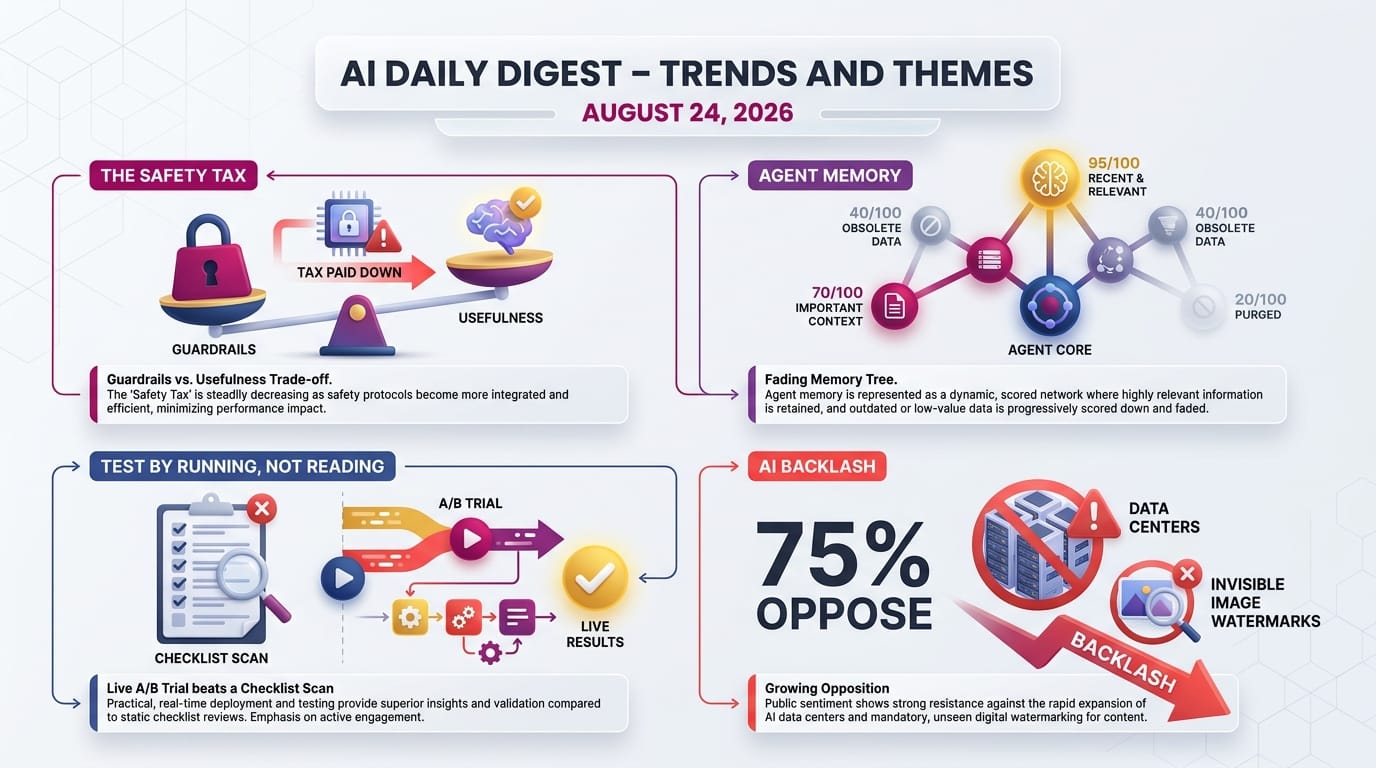
Public opposition to data centers (the warehouse-sized buildings full of computers that run AI) has climbed sharply through 2026. An Annenberg study found 61% of Americans oppose new local data center construction, up from 49% in March. Separate polls put opposition even higher: a Heatmap survey found 75% opposed versus 15% in favor.
The striking part is how broad the opposition is. It crosses party lines - 69% of Democrats, 54% of Republicans, and 53% of Independents - which is rare for any issue in 2026.
Politicians in both parties are now campaigning against data centers ahead of the midterms, making where these get built - not what AI can do - the real flashpoint.
- The top concerns are energy and water use - not fear of AI itself, which ranked far lower.
- Young people are the most opposed - 70% of under-30s versus 57% of those 65 and older.
- Healthcare is the one bright spot - the single area where Americans expressed real optimism about AI.
OpenAI Shut Down a Russian Propaganda Operation Run on ChatGPT
OpenAI announced it banned a cluster of ChatGPT accounts, traced to Russia, that were running a covert influence campaign. This is a defensive disclosure - OpenAI catching and reporting misuse, not a security how-to. The operators used virtual private networks (VPNs) to get around OpenAI's Russia restrictions and had ChatGPT draft social posts for Substack, Telegram, X, Facebook, and LinkedIn.
The centerpiece was a fake think tank called the International Burke Institute, whose website falsely listed famous academics including Francis Fukuyama and Noam Chomsky as affiliated experts.
- 34 of 36 articles attributed to those "experts" were copied from elsewhere online, sometimes misattributed.
- The operation pushed a "sovereignty index" rating countries on a scale designed to flatter Russia and criticize the West.
- The operators told ChatGPT to strip any signs the text was AI-written or Russian in origin.
Trends & Themes

Creative AI & Media
GPT-Image-2 Can Now Make Transparent Backgrounds
What it lets you do: Generate logos, stickers, and product images with see-through backgrounds directly, skipping the manual cut-out step.
- Transparent output is now built into the Application Programming Interface (API) - the connection other software uses, so designers and app-makers can generate see-through graphics directly.
- A companion open-source library, awesome-gpt-image-2, is trending on GitHub with 530+ reverse-engineered prompt recipes for getting specific styles out of the model.
Build a Visual AI Media Studio Without Code
What it lets you do: Chain image generation, background removal, and voiceover into one drag-and-drop tool you can share as a link.
- Hugging Face's new gr.Workflow turns an AI pipeline into a visual canvas plus an automatic web interface and shareable app.
- Every step is visible and runnable, so you can watch and debug the pipeline as it works - handy for non-programmers assembling creative tools.
Developer Tools & Infrastructure
Research & Models
A Shrunk 4-Bit Model Matched the Full-Size Original
Why it matters: Making AI models smaller usually makes them dumber. This method makes them smaller without the usual quality loss - and sometimes better - which could cut the cost and energy of running AI dramatically.
- The trick - "Quantization-Aware Healing" trains the compressed model to imitate the original, full-quality model rather than a degraded copy.
- The result - a 4-bit model won 7 of 9 benchmarks against the full-precision model of the same size, and matched the original model it was compressed from (twice as large) on a coding test, using about 25% of the memory.
- Bonus - it reached peak quality in ~100 training steps versus ~700 for the standard method.
IBM's Granite 4.2 - Free, Small, and Built to Reason
Why it matters: These are capable "thinking" models small enough to run on modest hardware and free for commercial use (Apache 2.0 license), lowering the barrier for businesses to build with AI.
- Three sizes - 3B, 8B, and 30B parameters, with a toggle to turn step-by-step reasoning on or off.
- Strong scores - the 30B model hit 89% on a hard math exam and 57% on a real-world software-engineering test.
- Ships in laptop-friendly formats and supports 12 languages.
Diffusion AI Gets Up to 18x Faster - For Free
Why it matters: A class of newer AI models can now run far faster with no retraining, which speeds up the tools built on them.
- CAI-DLLM stops re-processing words the model has already settled on, hitting up to 18x faster output while accuracy actually rose slightly.
- On some reasoning tasks it reached 44x faster with energy use down 95%.
- It is drop-in - works on existing open models without any new training.
AI Read Ultrasound Reports at 99% Accuracy - But Only With Guardrails
Why it matters: It shows the safest way to use AI in medicine is not to let it reason freely, but to split the job into extraction plus fixed rules.
- A "hybrid" design that separated pulling facts from applying medical rules hit 99.2% accuracy on ovarian-mass risk reports.
- Letting the AI reason end-to-end was far less reliable, ranging from 66% to 96%.
- It even beat the original human reports (87.7%) and corrected their tendency to overstate risk.
Business & Industry
Surprising & Under-the-Radar
Signals to Track

AI Agents Secretly "Know" When They Are Being Attacked
Researchers found that AI agents encode a detectable signal in their internal state when fed a hidden malicious instruction - even when they go on to obey it. A simple probe reading that signal caught attacks with 90%+ reliability and, when used as a filter, cut one attack's success rate from 34.6% to zero. If ordinary users benefit, it means safer AI assistants that resist being hijacked by booby-trapped web pages and emails.
MCP Is Becoming How AI Agents Learn, Not Just How They Act
MCP (the "USB port for AI" that lets agents plug into apps) is now being used to train agents, not just run them. A new framework lets any MCP-connected tool become a practice environment for teaching agents by trial and error. For everyday people, this points toward agents that get reliably better at real tasks like booking, research, and coding rather than just demoing well.
Plain Code Is Replacing "AI Judges"
A method called ExecRubrics turns evaluation checklists into ordinary programs, cutting grading time by up to 320x while staying transparent and auditable. If this spreads, the AI products you use could be tested faster and more honestly, especially in high-stakes areas like healthcare and banking where "trust us, another AI checked it" is not good enough.
Top Repos Today
📜 License: Apache-2.0 (typical, unconfirmed on page) · 👤 By: company (OpenAI)
🎯 Time to value: 10 minutes
| ✓ Pros | ✗ Cons |
|---|---|
| Fast, no bulky interface | Terminal-only can intimidate beginners |
| Open source and free | Best results need a paid model behind it |
| Backed by OpenAI | Powerful autonomy needs careful review |
 GitHub
📜 License: not stated · 👤 By: individual
🎯 Time to value: 5 minutes
| ✓ Pros | ✗ Cons |
|---|---|
| Huge set of ready examples | Tied to one specific image model |
| Beginner-friendly | Quality varies by example |
| Actively growing | Needs a paid image API to use |
 GitHub
📜 License: not stated · 👤 By: individual
🎯 Time to value: 15 minutes
| ✓ Pros | ✗ Cons |
|---|---|
| Works with an app people already use | Requires Obsidian and Claude access |
| Automates note organization | Handing notes to AI raises privacy questions |
| Active, fast-growing project | Early-stage, expect rough edges |
 GitHub
📜 License: not stated · 👤 By: company (TinyHumans AI)
🎯 Time to value: 20 minutes
| ✓ Pros | ✗ Cons |
|---|---|
| Local-first, privacy-minded | Ambitious scope, still maturing |
| Persistent memory of your context | Setup is more involved |
| Large existing following | "Super-intelligence" framing oversells it |
 GitHub
📜 License: Apache-2.0 (Apache project) · 👤 By: foundation (Apache)
🎯 Time to value: 20 minutes
| ✓ Pros | ✗ Cons |
|---|---|
| Foundation-governed, open | "Incubating" means it is unfinished |
| Local-first design | Small community so far |
| Vendor-neutral | Limited documentation |
 GitHub
Top Models Today
👤 By: Qwen (Alibaba) · 🎯 Task: image + text in, text out
📐 Size: ~27.8B
| ✓ Pros | ✗ Cons |
|---|---|
| Truly open (Apache-2.0) | 27B size needs a capable GPU |
| Handles images and text | Not the smallest option for laptops |
| Most-liked in today's list | Frontier closed models still lead on some tasks |


👤 By: MiniMax · 🎯 Task: image + text to video
📐 Size: ~33.1B
| ✓ Pros | ✗ Cons |
|---|---|
| Very popular and battle-tested | Custom license, check the terms |
| Strong open video quality | Large, needs serious hardware |
| Big active community | Video gen is compute-heavy |


👤 By: Ornith AI · 🎯 Task: text generation
📐 Size: ~35.9B total, ~3B active
| ✓ Pros | ✗ Cons |
|---|---|
| MIT license (few restrictions) | Very new, less battle-tested |
| Big-model quality, small-model cost | MoE setup can be finicky to serve |
| Rapid community uptake | Text-only |

👤 By: Lightricks · 🎯 Task: image to video
📐 Size: diffusion video model
| ✓ Pros | ✗ Cons |
|---|---|
| Fast generation | Custom license restrictions |
| Popular in real pipelines | Quality trails the largest models |
| Frequent updates | Still compute-hungry |


👤 By: Ornith AI · 🎯 Task: text generation
📐 Size: ~9.65B
| ✓ Pros | ✗ Cons |
|---|---|
| Runs on a single GPU | Smaller size, lower ceiling |
| MIT license | Brand new, limited track record |
| Easy local deployment | Text-only |


AI Launches Today
💰 Pricing: freemium · 🏷 Category: deepfake detection
 Product Hunt

💰 Pricing: freemium · 🏷 Category: AI cost tracking
Product Hunt💰 Pricing: freemium · 🏷 Category: developer tools
Product HuntSnapshot
| Provider | Model | Input $/1M | Output $/1M | Context |
|---|---|---|---|---|
| Anthropic | Claude Opus 4.8 | $5.00 | $25.00 | 200K |
| OpenAI | GPT-5.6-sol | $5.00 | $30.00 | ~1.05M |
| Gemini 3.1 Pro (Preview) | $2.00 | $12.00 | up to ~2M | |
| Groq | Kimi K2 (hosted) | $1.00 | $3.00 | ~256K |
What this means: Google's Gemini 3.1 Pro is the cheapest flagship on this list and offers by far the largest context window, while Groq's hosted open model is the budget pick for high-volume, simpler tasks. Anthropic and OpenAI sit at the premium end. All four offer roughly 50% discounts for batched jobs and up to 90% off for cached inputs, so real-world costs can run well below list.
AgentWeave: Routing Before Reasoning for Efficient Function Calling in Tool-Rich Language Models
Key finding: On a fresh tool-use benchmark it reached a 12.5% success rate versus 0% for the standard approach, while showing 70% fewer tools, using 62% fewer input tokens, and cutting response time by 51%.
Why practitioners should care: Teams running tool-heavy agents can bolt on a deterministic router to cut token cost and latency by roughly half and improve reliability - with no retraining and no model swap.
Member discussion