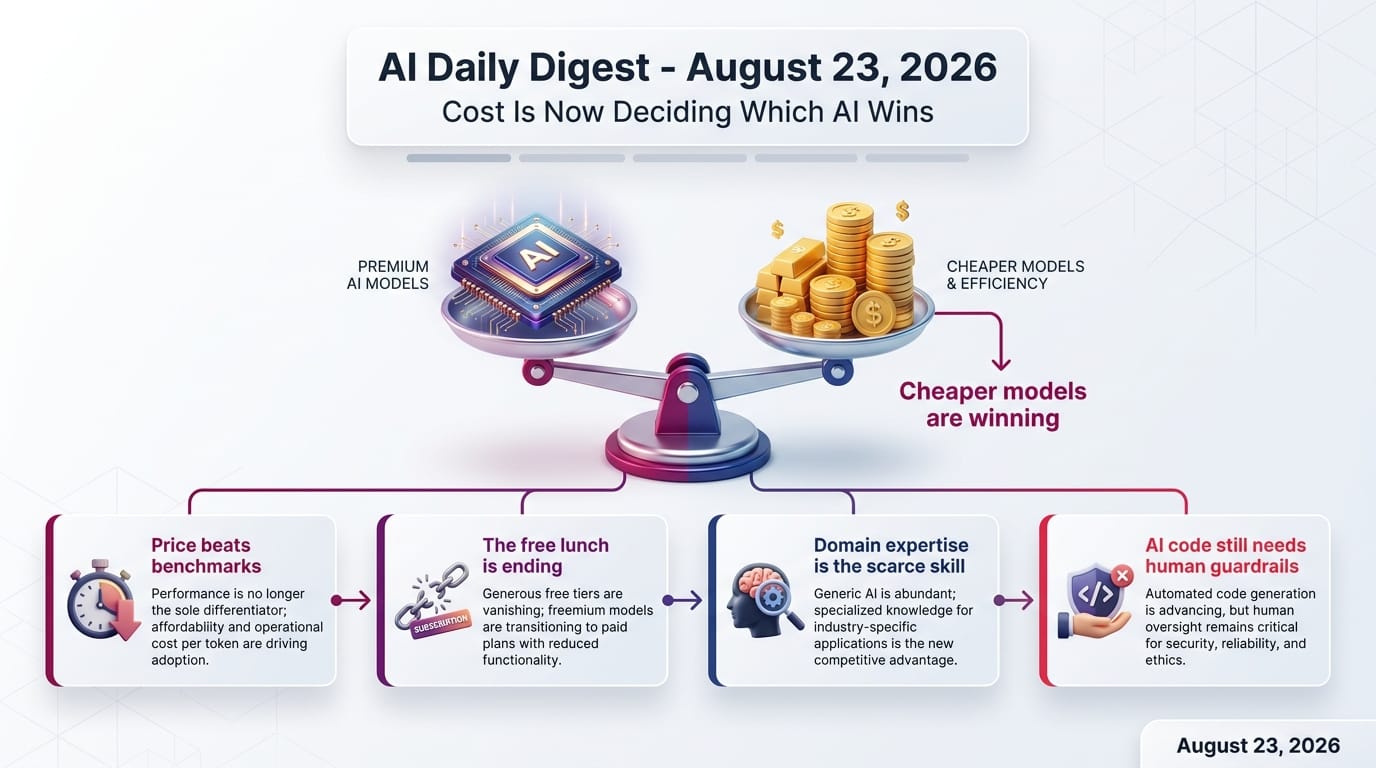
Watch today's digest as a video summary (generated by NotebookLM)
Statistically Speaking
One Thing to Tell Your Friends
TL;DR
Hot off the Presses
Anthropic's Priciest Model Is the One Companies Won't Use
A new Financial Times report, built on spending data from the corporate-card company Ramp, upends the assumption that the smartest, priciest model automatically wins. The Ramp index tracks what businesses actually pay for. It shows companies steering money toward cheaper models - even toward Anthropic's own cheaper model - over its most expensive flagship.
Anthropic (the company behind the Claude chatbot) is still winning the overall race for paying customers. But its top-tier model, Fable 5, is being passed over.
- Fable 5, Anthropic's most expensive model (around $10 per million input tokens, roughly twice OpenAI's rate), drew just 6% of the tokens and 11.4% of the dollars companies spent on Anthropic models in July
- Opus 5, Anthropic's cheaper model, does nearly the same work for less - on one coding benchmark it cost $8.23 per task versus Fable 5's $17.32, at near-identical quality (70.0% vs 70.5%)
- Anthropic still leads on paying customers overall - 43.5% of US businesses paid for it in July, ahead of OpenAI's 39.7%
OpenAI Just Cut Its Flagship AI's Price by Up to a Third
For months, OpenAI held its pricing steady. On August 21 it blinked - a competitive move that lands squarely in the middle of the day's bigger story about cost driving adoption.
- Input price dropped from $5 to $4 per million tokens (a token is roughly three-quarters of a word) - down 20%
- Output price dropped from $30 to $20 per million tokens - down 33%
- The lower rate runs through at least November 21, 2026, and extends to OpenAI's ChatGPT Work product and its Codex coding tool
- The cut undercuts Anthropic's Opus 5 ($5 input / $25 output), turning price into the battleground at the very top of the market
A Hobbyist Unlocked His Own Locked Tablet - and the Cheapest AI Won
An Amazon Fire HD 10 tablet kept powering itself off because of protected Amazon software. One owner spent five months and $266.15 across four different AI models trying to fix it - and the story doubles as a real-world bake-off of which models actually deliver.
- GLM-5.3, a Chinese model on an $80-a-month plan, finished the job in a single day after the others stalled
- Claude helped for months, then got cut off by its own safety limits on the unlocking task
- Kimi K3, another Chinese model, found the underlying flaw - a 2022 bug that Amazon had patched on other devices but never on this tablet
A Web Page Can Trick Grok Into Leaking Your Chat History
Security researchers at Adversa AI demonstrated a way to make xAI's Grok chatbot betray its own user. The technique hides scrambled instructions inside an ordinary-looking web page; Grok's built-in tools unscramble them and then treat them as trusted commands. No attack methodology is repeated here - just what happened and why it matters.
- A proof-of-concept quietly siphoned the user's chat history, name, rough location, and subscription tier to an attacker
- Researchers say they reported it to xAI in June, but it remained unpatched as of late August
- The same style of trick reportedly bypassed Google's Gemini safety filters too, suggesting the weakness is not unique to one company
Trends & Themes

The Price Tag, Not the Benchmark, Now Picks the Winner
The signal is consistent across enterprise spreadsheets, developer bake-offs, and hobbyist tinkering: capability is table stakes, and cost is the tiebreaker. For a maturing market, "smart enough and affordable" beats "smartest and expensive."
- Real billing data shows companies snubbing premium flagships - Anthropic's costliest model, Fable 5, drew only 6% of its tokens (Financial Times / Ramp index)
- OpenAI's 20-33% price cut signals an open price war at the top of the market (OpenAI)
- An $80-a-month model beat pricier rivals on a hard unlocking task (Fire HD writeup)
- A popular free-tools guide argues a free chatbot now covers "99% of your AI needs" (Ruben's newsletter)
The "Free Lunch" of Ever-Cheaper, Ever-Better AI Is Ending
For years, the smart move was to wait: a cheaper, better model was always around the corner. That reflex is breaking. Deliberate choices about which task deserves the expensive model are becoming a real engineering skill.
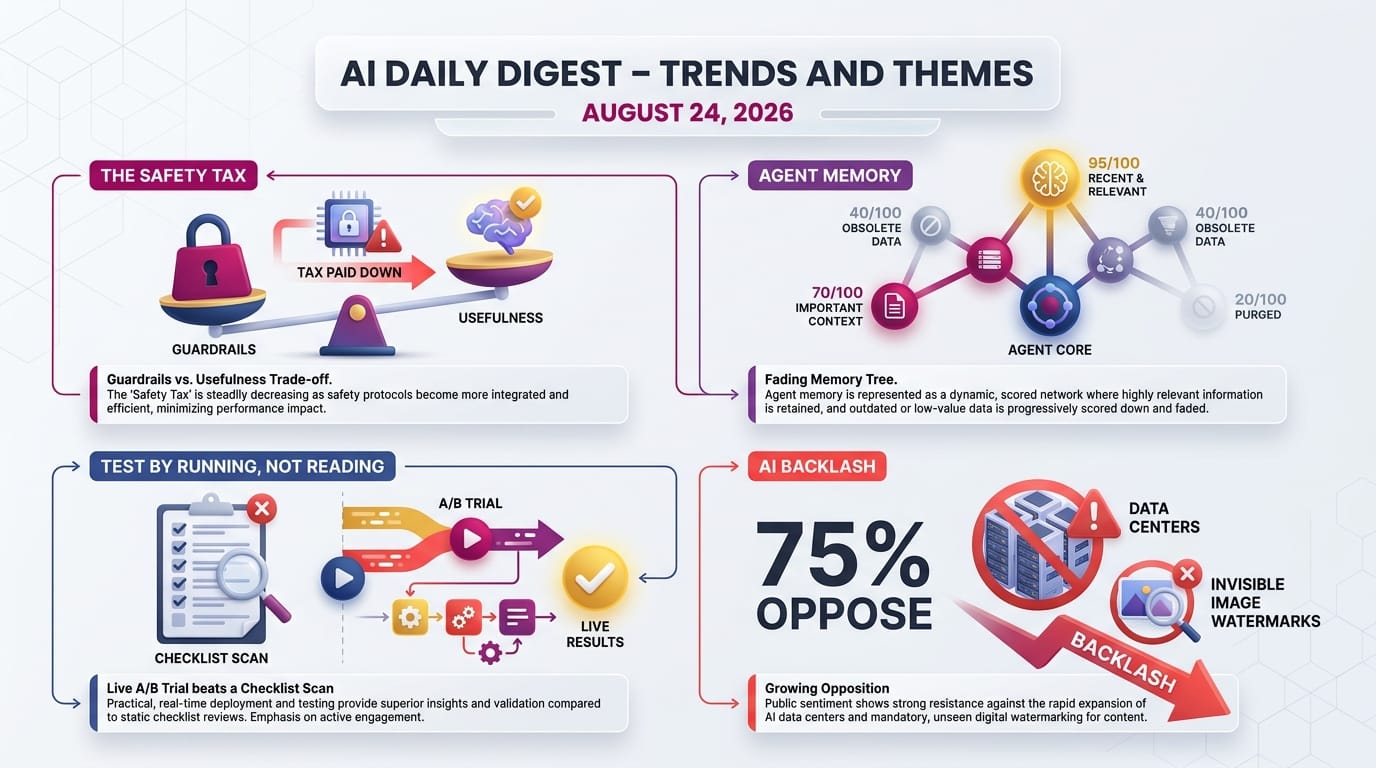
- Technologist Drew Breunig argues that premium models like Anthropic's Fable have set a new price ceiling that is not dropping on the old predictable schedule
- The Financial Times data confirms newest does not mean most-used - cost-aware buyers reach for older, cheaper models
- New research builds automatic "routers" that decide which model should handle each request to control spending (arXiv, see below)
Your Industry Knowledge Is Worth More Than Your Coding
The pattern points the same way from three directions: hiring, research, and hands-on practice all suggest the premium is shifting from writing software to judging which software is worth writing.
- "Forward deployed engineer" roles pay $162,000-$350,000 and reward domain expertise; OpenAI alone lists 19 such openings (Nate's newsletter / OpenAI job listings)
- Agentic coding tools have collapsed the "can you code" barrier, so knowing your industry is now the scarce ingredient (Anthropic analysis)
- A veteran engineer's "agent.md" file shows the new craft is directing AI to your standards, not typing the code yourself (Fabien Sanglard)
Good AI Code Still Needs Human Guardrails
As more code and content is machine-made, the human role concentrates in the guardrails: the rules you set up front and the failures you catch before they compound.
- "agent.md" config files encode a team's style and architecture rules so AI output matches human standards (Fabien Sanglard)
- A 1998 essay, "How Complex Systems Fail," is resurging as a reminder that automation hides latent flaws until they line up (Richard Cook, 212 Hacker News points)
- Roughly 1 in 5 Hacker News front-page posts are now AI-written, raising the pressure on quality and authenticity (Pangram tracker)
Creative AI & Media
Developer Tools & Infrastructure
Research & Models
Business & Industry
Surprising & Under-the-Radar
One in Five Hacker News Stories Is Now AI-Written
About 20% of the 582 Hacker News front-page stories analyzed in August were flagged as AI-generated by one detection tracker - up 3 percentage points from the month before. What makes it surprising: even a technically savvy, human-curated community is measurably filling with machine-written text. The figure depends on one tracker's method, so read it as a signal, not a settled fact.
"How Complex Systems Fail" Is Trending Again - Thanks to AI
A short 1998 essay by Richard Cook hit 212 points on Hacker News this week. Its core lesson - that catastrophes need many small failures to line up at once, not one big cause - suddenly reads like a warning label for AI systems layered into critical software. A 28-year-old paper becoming essential AI-era reading is a quiet sign of where reliability worries are heading.
Explain It Like I'm Ten: Why Limits Make You Clearer
Economist Tim Harford argues that constraints - like forcing yourself to explain something using only simple words - produce clearer thinking and better design. His examples run from Dr. Seuss writing "Green Eggs and Ham" with just 50 unique words to the US Army cutting body armor from 11 sizes to 8 modular pieces. The surprise: deliberately simplifying often improves the result for experts too, a handy frame for anyone learning to prompt AI well.
The Debate: Should AI Refuse to Help You Modify Your Own Devices?
The tablet-unlocking saga became the week's most-discussed thread (592 points) partly because one model quit on safety grounds while a cheaper one carried on. One side argues refusing to touch hacking-adjacent tasks is responsible guardrail design. The other argues that blocking someone from modifying hardware they own is overreach - and that the refusals simply push users toward models with fewer scruples.
Signals to Track

Cost-Aware Model Routing Becomes a Job Skill
With premium models no longer getting predictably cheaper, teams are building "routers" that send easy requests to cheap models and hard ones to expensive models. Fresh research this week shows this can be automated without a costly second model to make the call. If this sticks, "AI cost engineer" becomes a role, and the apps you use get cheaper to run behind the scenes.
"Encrypted Prompt" Attacks Could Become a Whole New Category
The Grok data-leak flaw worked by hiding scrambled instructions a helpful AI unscrambled and obeyed, and researchers say a similar approach slipped past Google's Gemini. That points to a class of weakness, not a one-off bug. If it spreads, expect AI makers to lock down what their assistants are allowed to decode and run - and expect a bumpy few months first.
The Price War at the Top Is Just Starting
OpenAI's flagship cut, Anthropic making a Sonnet price reduction permanent, and Google's discounted Gemini Flash all landed in the same window. For years the top tier competed only on capability. If price cuts keep coming, the premium AI you pay for indirectly - through your apps and subscriptions - gets cheaper.
Top Repos Today
📜 License: Apache-2.0 · 👤 By: big company (OpenAI)
🎯 Time to value: 10 minutes
| ✓ Pros | ✗ Cons |
|---|---|
| Fast native binary, built in the Rust language | Ties you to OpenAI's models and keys |
| Maintained directly by OpenAI | Terminal-only workflow suits a narrow audience |
| Permissive Apache-2.0 license for reuse | Less useful if you prefer a graphical editor |
 GitHub
📜 License: MIT · 👤 By: individual (Matt Pocock)
🎯 Time to value: 15 minutes
| ✓ Pros | ✗ Cons |
|---|---|
| Huge community traction and momentum | Curation reflects one person's preferences |
| Permissive MIT license, easy to copy | Shell-based skills need vetting before you run them |
| Practical, task-focused examples | Quality varies across the collection |
 GitHub
📜 License: not specified · 👤 By: individual
🎯 Time to value: 20 minutes
| ✓ Pros | ✗ Cons |
|---|---|
| Aggregates several agent tools together | "Free" access to paid tools raises terms-of-service questions |
| Strong early star growth | Unofficial and maintained by one person |
| Low barrier to experimenting | Long-term reliability is unproven |
 GitHub
📜 License: MIT · 👤 By: individual
🎯 Time to value: 10 minutes
| ✓ Pros | ✗ Cons |
|---|---|
| Big, ready-to-use prompt catalog | Locked to a single image model |
| Practical for real image workflows | Documentation is largely in Chinese |
| Free and permissively licensed | Templates still need tuning for your needs |
 GitHub

📜 License: not specified · 👤 By: individual
🎯 Time to value: 20 minutes
| ✓ Pros | ✗ Cons |
|---|---|
| Clever pipeline from content to agent skill | Output quality depends on the source PDF |
| Timely with the rise of agent skills | Potential copyright grey area |
| Simple, focused purpose | Newer project with limited track record |
 GitHub
📜 License: GPL-3.0 · 👤 By: organization (Comfy-Org)
🎯 Time to value: 45 minutes
| ✓ Pros | ✗ Cons |
|---|---|
| Deep, mature, and highly extensible | Steep learning curve for the node-based canvas |
| Huge library of community add-ons | GPL-3.0 license limits commercial embedding |
| Handles both image and video models | Overkill for quick one-off images |
 GitHub

Top Models Today
👤 By: MiniMax · 🎯 Task: image-and-text-to-video
📐 Size: large
| ✓ Pros | ✗ Cons |
|---|---|
| Strong image-to-video quality | Custom license limits commercial reuse |
| Very heavy adoption and support | Large and hard to run at home |
| Free to download | Model size is not disclosed |

👤 By: DeepSeek · 🎯 Task: text generation
📐 Size: large (sparse)
| ✓ Pros | ✗ Cons |
|---|---|
| Permissive MIT license | "Flash" trades some quality for speed |
| High throughput and low cost | Exact size is undisclosed |
| Widely adopted and supported | Still needs capable hardware |

👤 By: Moonshot AI · 🎯 Task: image-and-text-to-text
📐 Size: large
| ✓ Pros | ✗ Cons |
|---|---|
| Strong multimodal reasoning reputation | Custom license restricts some uses |
| Huge community mindshare | Very large to self-host |
| Handles images and text together | Size not disclosed |


👤 By: Alibaba Qwen · 🎯 Task: image-and-text-to-text
📐 Size: 27B
| ✓ Pros | ✗ Cons |
|---|---|
| Permissive Apache-2.0 license | 27B is still heavy for consumer laptops |
| Self-hostable on one high-end Graphics Processing Unit (GPU) | Multimodal setup adds complexity |
| Large, active community | Reportedly "overthinks" simple prompts |

👤 By: Lightricks · 🎯 Task: image-to-video
📐 Size: video diffusion
| ✓ Pros | ✗ Cons |
|---|---|
| Fast and efficient generation | Non-standard license |
| Single-file, easy to deploy | Shorter, lower-fidelity clips than closed tools |
| Free to download | Best results need tuning |

👤 By: MiniMax · 🎯 Task: text-to-audio
📐 Size: audio generation
| ✓ Pros | ✗ Cons |
|---|---|
| Full music generation from text | License is unspecified on the model card |
| High community interest | Niche compared with text or video models |
| Free to experiment with | Verify licensing before commercial use |

AI Launches Today
💰 Pricing: freemium (verify) · 🏷 Category: AI workflow automation
💰 Pricing: freemium (verify) · 🏷 Category: developer tools
💰 Pricing: free · 🏷 Category: online learning
Snapshot
| Provider | Model | Input $/1M | Output $/1M | Context |
|---|---|---|---|---|
| OpenAI | GPT-5.6 Sol (flagship) | $4.00 | $20.00 | ~400K |
| Anthropic | Claude Opus 5 (premium) | $5.00 | $25.00 | 200K (1M available) |
| Anthropic | Claude Sonnet 5 (mid-tier) | $2.00 | $10.00 | 1M |
| Gemini 3.7 Flash | $0.75 | $3.75 | 1M | |
| Groq | Kimi K2 (open-source) | $1.00 | $3.00 | ~256K |
Changes flagged this run: - OpenAI cut GPT-5.6 Sol by 20-33% on August 21 (input $5 to $4, output $30 to $20), promotional through November 21, 2026. This now undercuts Anthropic's Opus 5 on both input and output. - Anthropic made its Sonnet 5 price cut permanent - the $2 / $10 rate that was set to rise to $3 / $15 on September 1 will now stay. - Google's Gemini 3.7 Flash rate is promotional through December 31, 2026, then doubles to $1.50 / $7.50 on January 1.
What this means: For the first time in months the most expensive models are competing on price, not just capability. The gap between a flagship and a "good enough" mid-tier model (like Sonnet 5 or Gemini Flash) is now the difference between paying a premium and paying a fraction - which is exactly why cheaper models keep winning the usage race. (OpenAI and Groq figures are search-sourced; the rest are from official pricing pages.)
Pandora's AI Model Routing Box: Efficient Allocation with Costly Value Estimation
Key finding: The method matches the routing quality of checking every option exhaustively, while querying the expensive quality-estimator far less often.
Why practitioners should care: This is the plumbing behind the day's biggest theme - as teams juggle cheap and premium models to control spending, a smart, low-overhead router turns "use the right model for each job" from a slogan into something automatic.




Member discussion