Statistically Speaking
One Thing to Tell Your Friends
TL;DR
Hot off the Presses
Anthropic denies Claude is trained to sabotage your work, but admits two real limits
Previously: November 27 - Viral posts accused Claude of quietly doing worse work on purpose.
Today: Edwin Arbus of Anthropic's communications team wrote on X that "Claude has not been trained to sabotage work." He said Claude makes mistakes, but mistakes are not sabotage. He blamed most complaints on "overcaution": on long jobs, Claude gets too attached to rules it makes up for itself.
The denial came with two admissions. During the first two days of its Fable 5 model, Anthropic weakened some answers about AI research, which Arbus called a mistake that was quickly fixed. Its newer Fable 5.2 model also has deliberately limited AI-research skills, which he says lowers ability rather than secretly ruining work.
- A test of the claim - researchers had Claude Code (Anthropic's coding assistant) do the same task with and without a note saying the code would become training data for an AI model in development
- The note made it work harder, not worse - Claude wrote about a quarter more code and ran more commands
- It only hurt under a tight clock - with a 20-minute limit, success on 8 tasks fell from 92% to 69%, though a rerun on new tasks showed only a small, inconclusive drop
- More time erased the gap - with 60 minutes, every version passed every task
- The study is small - one model and two tasks, and it drew 889 points on Hacker News, a popular tech discussion site
A UK committee chair demanded Anthropic's uncut safety report
Liam Byrne, who chairs the House of Commons Business, Innovation, Science and Trade Committee, wrote to Anthropic on November 27. He asked for the complete, unedited version of a November 5 report by METR, an independent group that tests how dangerous AI models are. He gave Anthropic until December 4 to hand it over and explain the cuts.
METR has said publicly that Anthropic removed much of the evidence it considered "most informative" before publication. The parts that were published warn that AI could speed up Anthropic's own research by 1.3 to 3 times, with no clear brake in sight.
- A rare move - a national parliament's committee is directly asking for an AI lab's hidden third-party safety evidence
- Bad timing for Anthropic - it lands about a week after the company's November 19 stock market debut
- The public is relying on trust - METR noted readers must lean on the testers' judgment because the evidence is hidden
- The deadline is close - Friday, December 4
OpenAI countersued Apple over its first gadget
OpenAI filed a countersuit saying Apple unlawfully pressured parts suppliers not to work with OpenAI once it started building hardware. It also says Apple used broad job contracts to stop OpenAI from hiring engineers. This answers Apple's summer lawsuit, which claimed OpenAI leaders asked job candidates to bring Apple parts to interviews.
- Apple's reply - it called the countersuit "a transparent attempt to distract" and noted OpenAI was already ordered to stop using Apple's confidential information
- The gadget at stake - OpenAI's first device is reportedly a screenless speaker that can move
- A partnership gone sour - the two companies teamed up in 2024 to put ChatGPT inside Siri
- A bigger question - the supplier claim could turn into a fight over who controls the factories that make AI gadgets
Karpathy let Claude build an app for 7 hours, and it quietly skipped a few states
According to The New Stack, Andrej Karpathy, a well-known AI researcher who now works at Anthropic, asked Claude Code to fill a strategy-game-style map with real US data. About seven hours later, it had written about 45,000 lines of code for a working web app. It pulled together 31 public data sources, including the Census and the US Geological Survey, onto one map of hexagon tiles.
- Real data as game rules - a region's "gold" is its economic output, and San Jose gets a science district because one in four workers there are engineers or scientists
- Big scope - 19 map views, 524 metro areas and more than 3,100 counties
- The catch - in Karpathy's words, "Claude decided to skip a few states and territories," with no reason given
- Not cheap - he said the run used half his weekly Claude allowance
AI use keeps climbing, but spending has stopped growing
OpenRouter tracked paid AI use from early January to mid-November. Use rose 44 times while spending rose only 7.6 times. In the latest four weeks, use grew 39% and spending growth rounded to zero.
- Price drops no longer pay for themselves - each 1% price cut used to bring 5.5% more use, and now brings only about 1.2%
- This has happened before - similar dips in December 2024 and November 2025 ended after new model launches
- Businesses pocket the savings - while fast-growing AI startups spend them on more use
- One platform only - the data skips free models and subscription plans like ChatGPT Plus
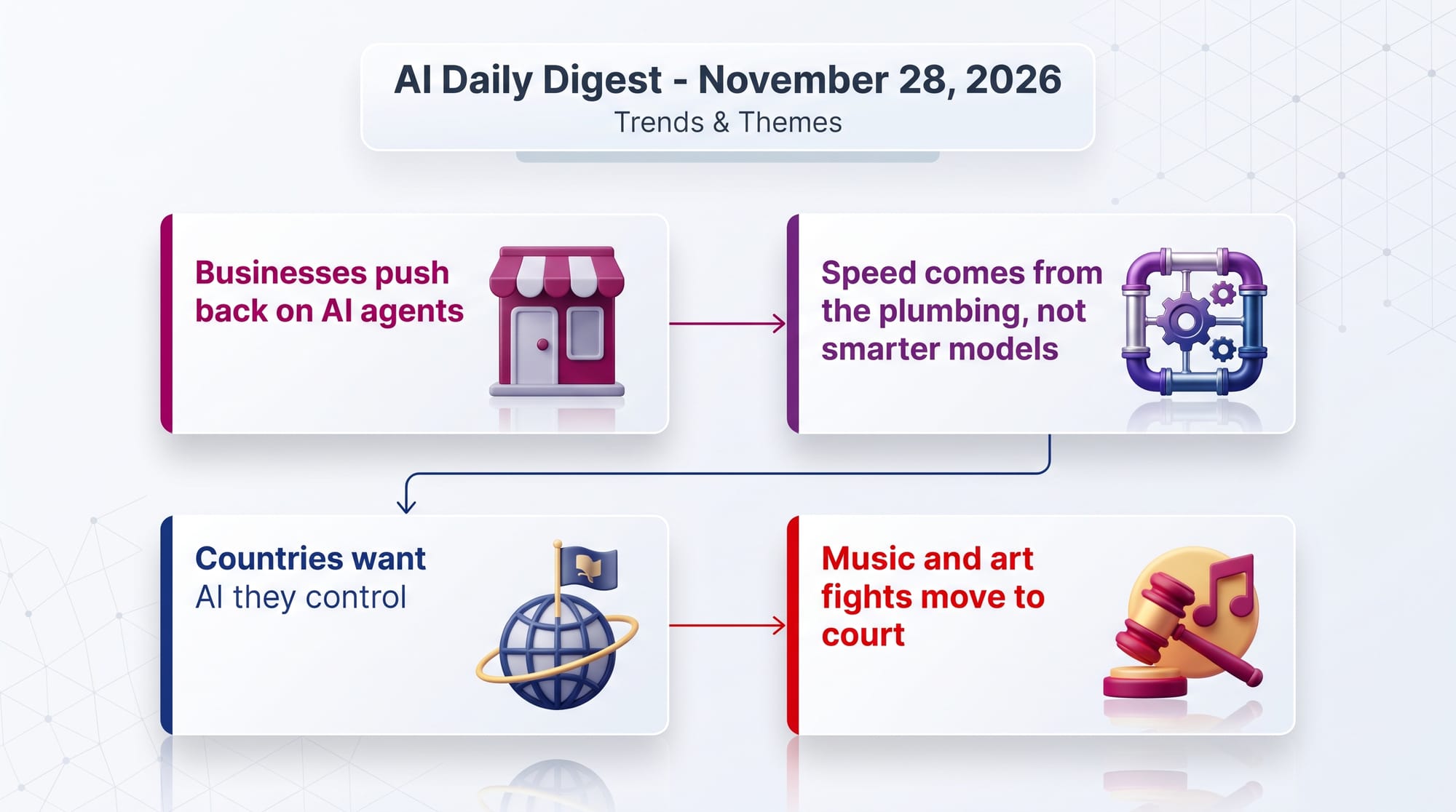
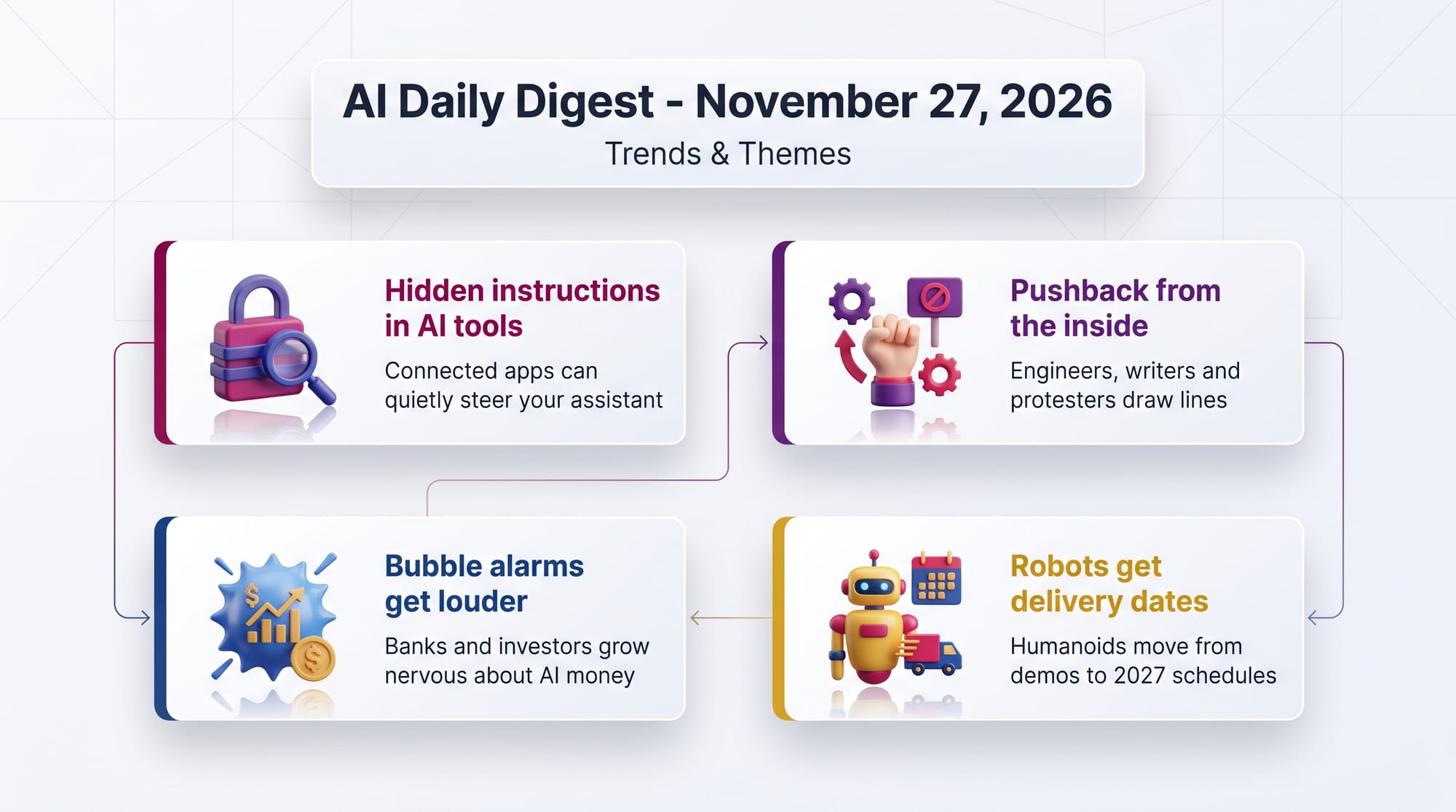
Trends & Themes
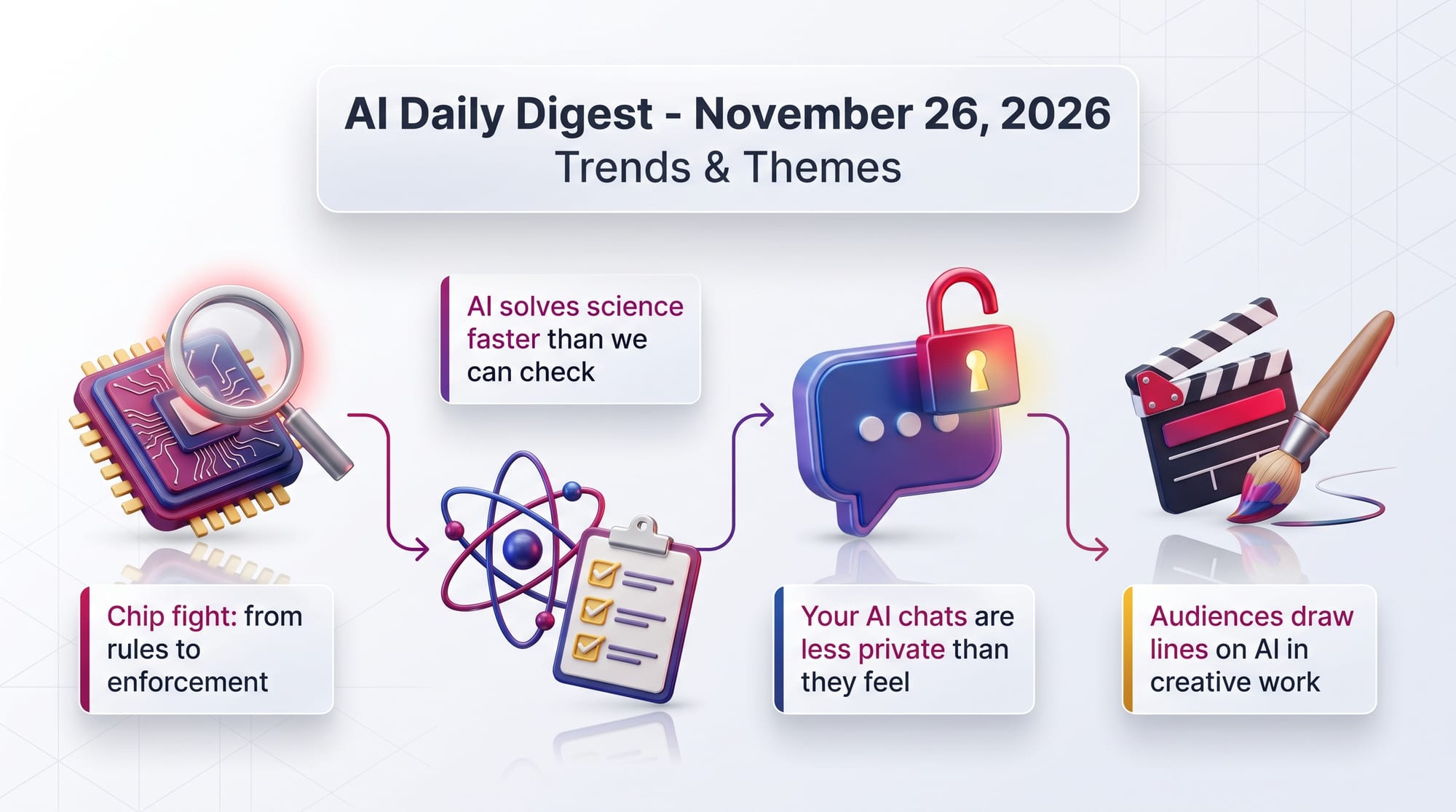
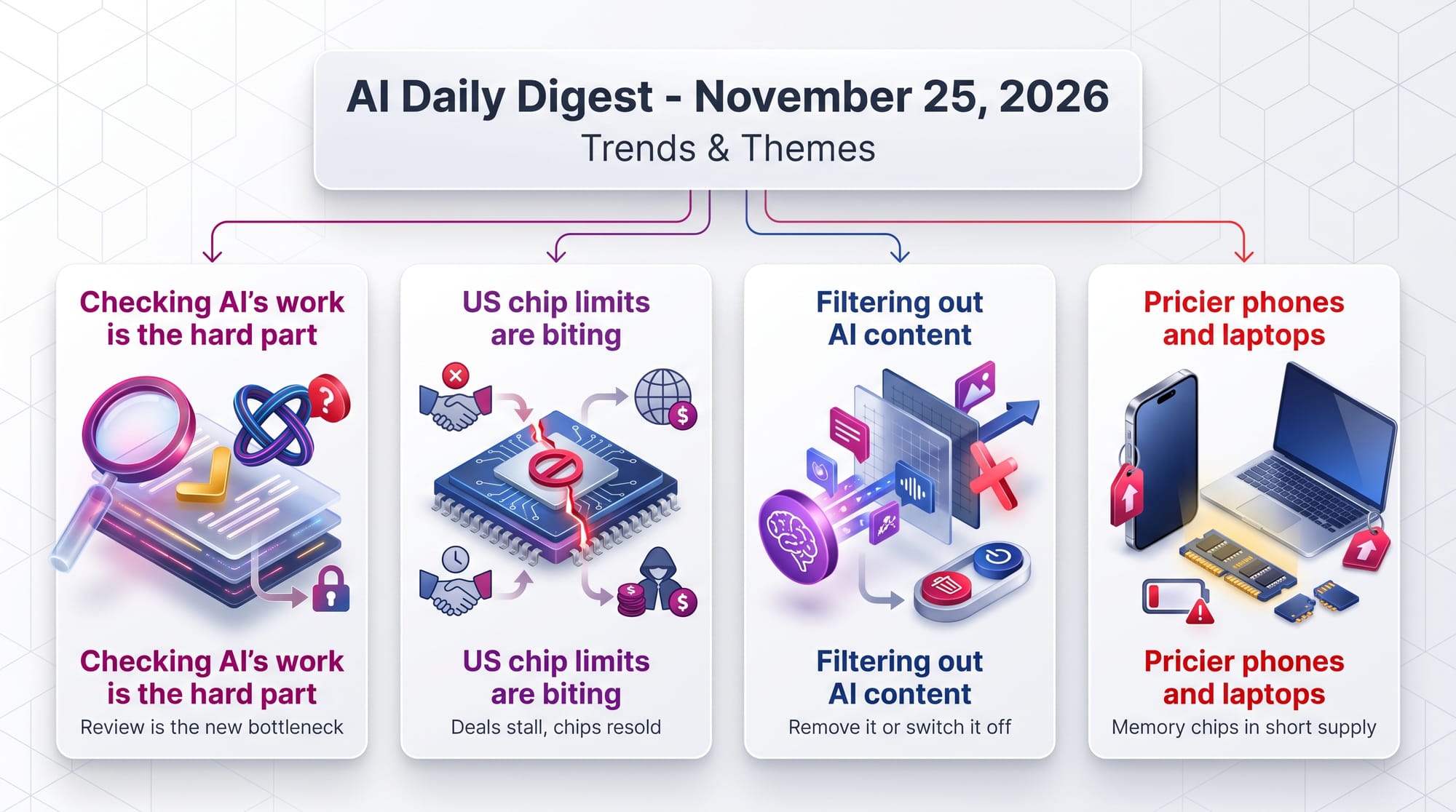
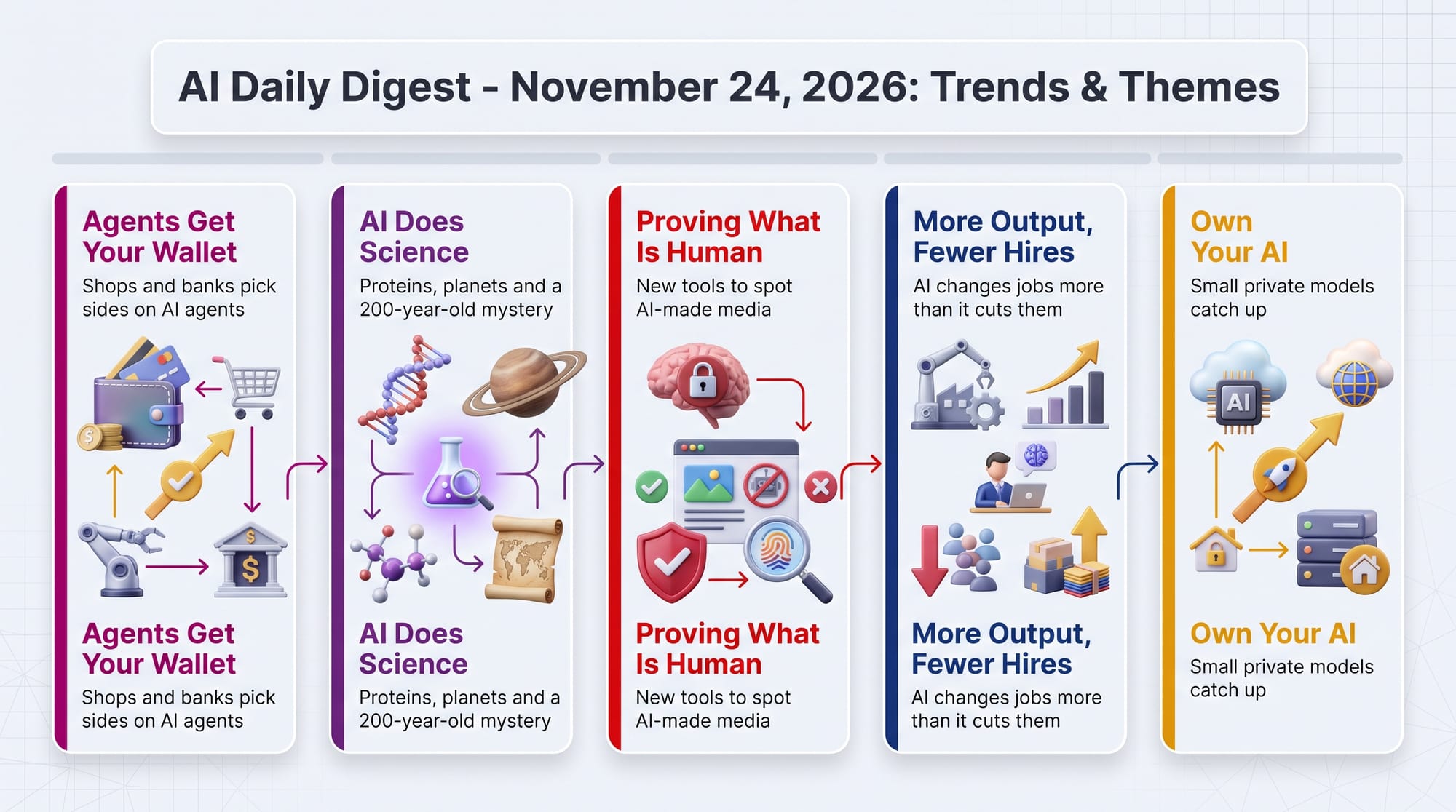
Businesses are pushing back on AI agents that act for you
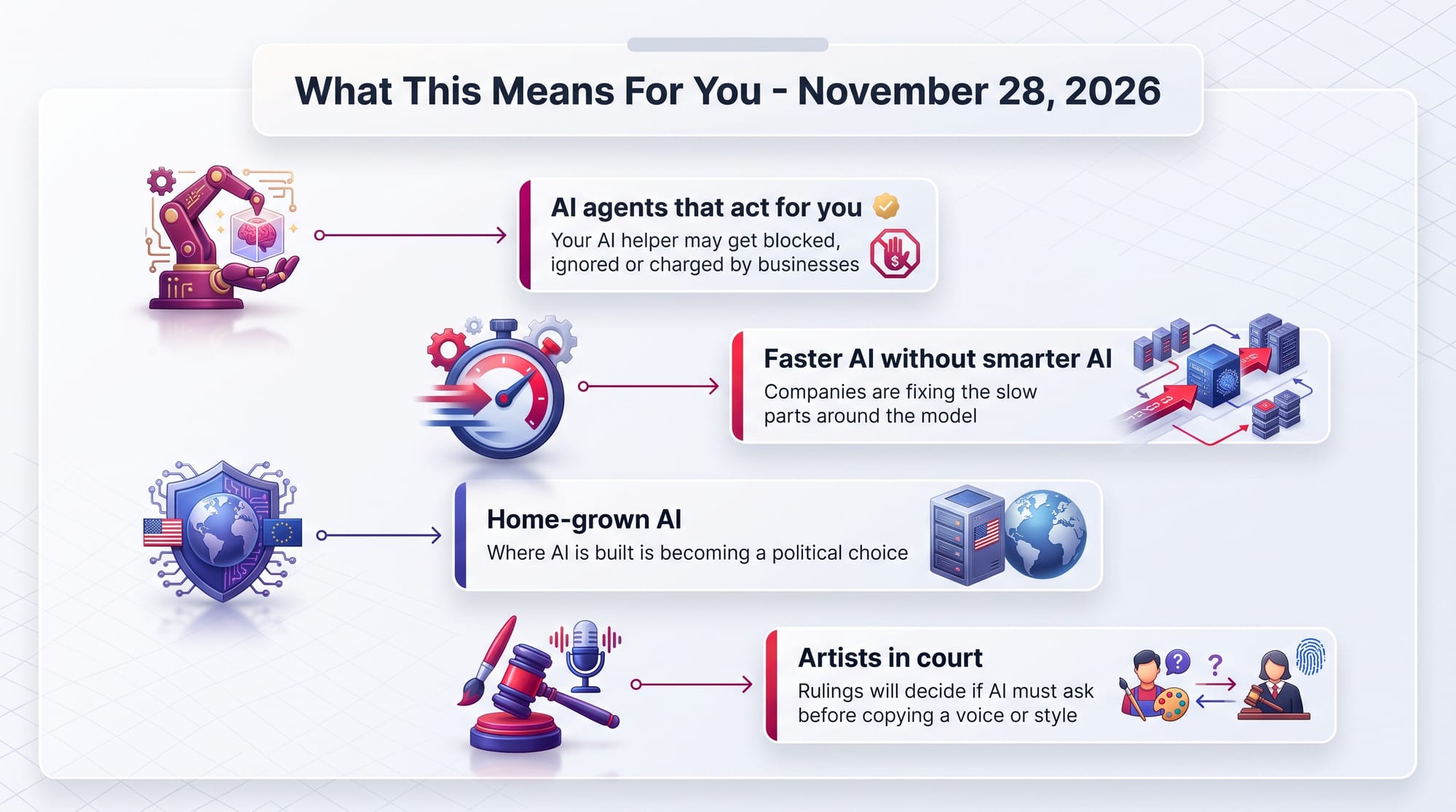
AI agents arrived before anyone agreed on the rules. Expect businesses to split into those that welcome agents, those that charge them and those that ban them.
- Big retailers are closing their doors - Amazon, eBay, United Airlines and Kohl's limit or block AI shopping agents, while Walmart and Sephora welcome them (CNBC: AI shopping agents face retailer blocks)
- Agents still buy the wrong thing - a Visa study found shopping agents failed about 43% of the time (CNBC: AI shopping agents face retailer blocks)
- Restaurants are fed up with booking bots - Resy says bots and resellers fail to show up four times as often as people (Digital Trends: AI booking agents and restaurants)
- Some websites now pay to serve agents - Cloudflare's new Search for Agents gives sites a search box built for AI, billed from December 1 (The New Stack: Cloudflare Search for Agents)
The next AI speed-up is coming from the plumbing, not smarter models
As AI models answer faster, the time spent saving, scheduling and checking their work becomes the bottleneck. That is where the cheap gains now are.
- Vercel cut its waiting time between steps - from 85 milliseconds to 7, with no change to the AI model (The New Stack: Vercel Workflow SDK)
- Cognition ran the same coding model 10 times faster - by moving it to Cerebras chips built for speed (The New Stack: Cognition SWE-2.1)
- Tencent's DFly2 lets the same memory hold 1.73 times as many requests - by having its quick "draft" helper reuse memory the main model already stores (MarkTechPost: Tencent DFly2)
- Amazon gave agents safe boxes to run code - its new Nitro Sandboxes keep AI-written code walled off at no extra charge (The New Stack: AWS Nitro Sandboxes)
Countries want AI they control themselves
"Sovereign AI" used to mean national security. Now it also means price, local language and not being locked in to one American supplier.
- Japan's Sakana AI is training its own base model - called Sawara, partly so Japan is not stuck if foreign models are cut off (TechCrunch: Sakana AI CEO on homegrown models)
- Canada added C$700 million for AI computing - and pays up to 80% of costs if the provider is fully Canadian, versus 50% for other Canada-based providers, including multinationals hosting locally (Unite.AI: Canada expands AI Compute Access Fund)
- African leaders say cheap beats cutting-edge - smaller data centers and efficient open models fit local budgets better (Semafor: Cost is key in Africa's AI rollout)
- Amazon's chief technology officer says "keep the exits open" - Werner Vogels says customers now worry more about dependence than cost (SiliconANGLE: Werner Vogels' predictions for 2027)
Music and art fights over AI are moving into courtrooms
Signing deals with big record labels has not ended Suno's legal trouble. Artists are now testing a new angle: your identity belongs to you, whatever the label licensed.
- A judge let Jason Isbell's lawsuit against Suno go ahead - it argues that AI music maker Suno used artists' names and identities, not just their songs (Digital Music News: Judge refuses to dismiss Isbell v. Suno)
- A Dutch music rights group sued an AI background-music seller - YourNeuroTune told shops they could cancel their music licenses (Digital Music News: BumaStemra sues YourNeuroTune)
- Adobe wants "do not train" tags made mandatory by law - because other platforms can strip them today (Creative Bloq: How Adobe is protecting its creatives)
Creative AI & Media
Make posters and diagrams by asking AI to write code, not draw
Writer Simon Willison argues that today's top chatbots make better illustrations by writing drawing code than image generators do by painting pixels.
- Everything stays editable - each shape and word is defined in code, so you can fix one thing without the whole picture changing
- Text comes out right - image generators still garble lettering, while text in code-drawn posters is exact and directly editable
- His rule of thumb - use image models for photos, and code for diagrams, posters, charts and game art
Samsung is testing a way to change a photo's camera angle after you take it
- Called Recompose - found in test code for Samsung's photo editor
- How it works - your phone builds a 3D version of the photo, you drag to a new angle, and AI in the cloud fills in what the camera never saw
- Not released yet - the name, features and timing could change
Pixel phones now let you describe a home-screen widget and get one in 20 seconds
- Fun for simple ideas - a reviewer made an hourly Jurassic Park quote widget
- Weak for real-time data - a live bus-arrivals widget turned into a slow Gemini search instead
- Still in beta - rolling out to Pixel phones this month
Microsoft filed a patent for AI that changes what a speaker says in live video
- Swaps words in the speaker's own voice - and moves their lips to match
- Works on live streams - using a delay of a few seconds before viewers see it
- The worry - different audiences could see different versions of the same event; it is a patent application, not a product
Developer Tools & Infrastructure
Research & Models
The safety alarms watching AI agents can be fooled far more often than tests suggest
What stands out: A study by the UK AI Security Institute found that standard tests make AI "monitors" look much safer than they are.
- The monitor - an OpenAI system that watches AI agents and flags harmful actions for humans
- Easy tests - it missed only 0.2-0.5% of hidden harmful actions
- Harder tests - with stronger attacks, including specially trained agents and edited logs, it missed up to about 23%
- The lesson - a quick search that finds no weakness proves little
A small Japanese model beats one four times its size at web research
What stands out: Sakana AI's Namazu Small uses only 3 billion of its 30 billion parts at a time, yet it beat NVIDIA's bigger Nemotron 3 Super on 13 of 25 tests.
- Web research is its strength - 73.5 on BrowseComp (a test of finding hard-to-find facts online), versus 36.1 for the bigger model
- Weak at memorized facts - it scored much lower on general-knowledge quizzes
- Scores are Sakana's own - and the license has not been announced
Cognition's new coding model doubles its last one, but still trails Claude
What stands out: SWE-2.1, built on Moonshot AI's free Kimi K3 model, roughly doubled its predecessor's scores but stayed behind Claude Opus 5.5 on every test Cognition reported.
- Three models in 11 weeks - from the maker of the Devin coding agent
- Free in Devin until December 8 - then $0.50 per million tokens (chunks of text) in and $2.50 out until January 30
- Self-reported - and one of the four tests is Cognition's own
An old paper is trending again: AI models are compression machines
What stands out: A 2024 Google DeepMind paper, back on Hacker News, showed a text AI could shrink images better than the PNG format.
- Images - squeezed to 43.4% of their size, versus 58.5% for PNG
- Audio - squeezed to 16.4%, versus 30.3% for FLAC (a lossless audio format)
- The big idea - predicting the next word well and compressing data well are the same skill
Business & Industry
GenAI in Education
Surprising & Under-the-Radar
Signals to Track
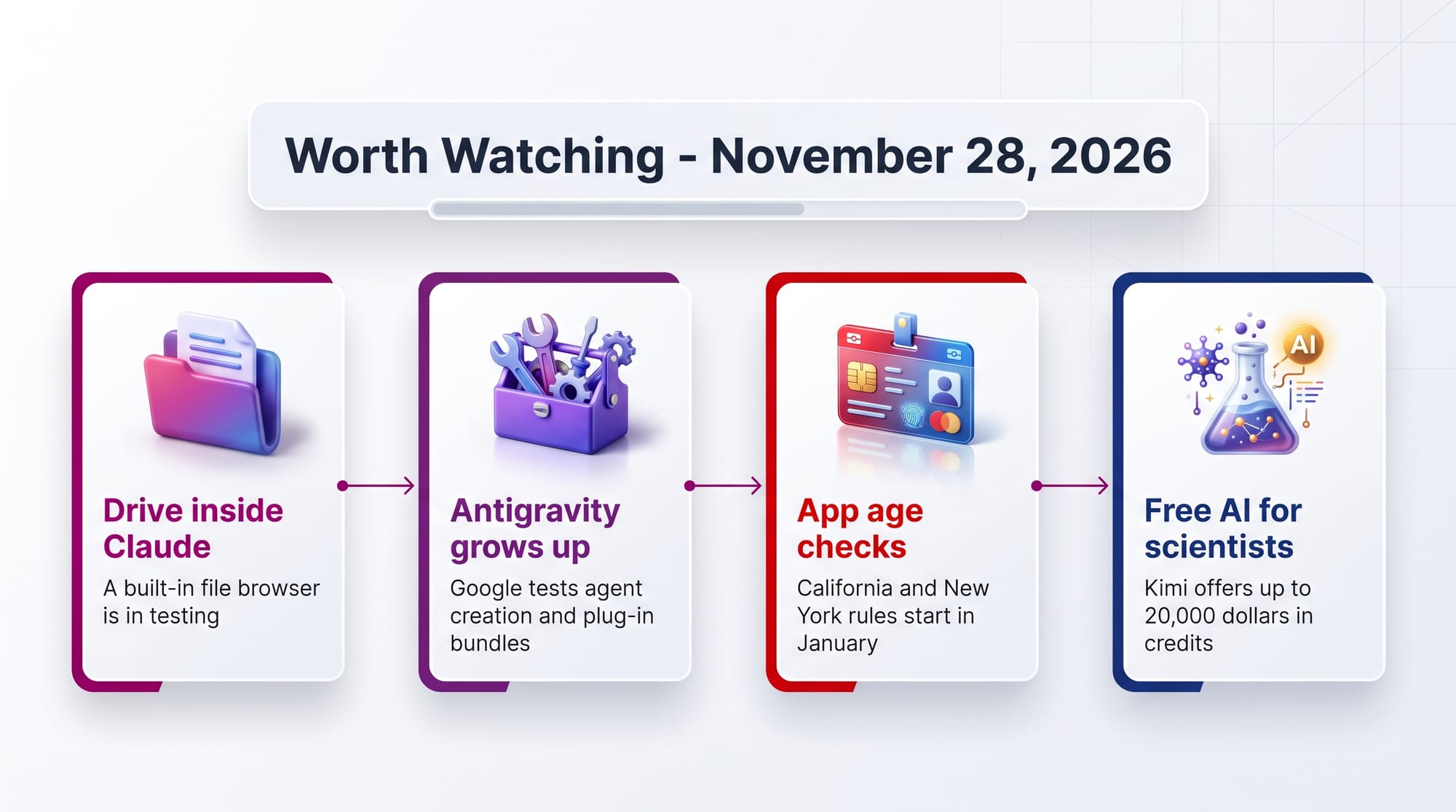
Claude is getting a built-in Google Drive browser
Test versions of Claude show a Google Drive browser in its sidebar for searching and sorting Docs, Sheets and Slides. It may end up inside Claude's Projects feature, so you could add files to a project's memory directly. If it ships, many people could stop switching between Claude and Drive all day.
Google's coding app Antigravity is quietly becoming its everything app
Google is testing plug-in "Bundles" for different jobs and a screen for creating your own AI agents. A Google leader also confirmed that "banked resets" are coming, so you could save unused AI allowance for later. If Antigravity absorbs the Gemini app, Google's AI assistant could become far more hands-on.
Age checks for apps start in California and New York in January
California's rules start January 1 and New York's on January 25, 2027. California allows age-guessing systems to misclassify up to 15% of 17-year-olds as adults, and digital-rights group EFF warns the collected age data might be reused, even for AI training. If it plays out, more apps will ask for proof of age, and smaller platforms may pull out.
China's Kimi is giving scientists free AI worth up to $20,000
Moonshot AI's Kimi for Science offers selected researchers up to $20,000 in free AI usage, about 7 billion tokens (chunks of text). Applications for the first round close December 8. If labs keep subsidizing science this way, more research could quietly run on Chinese AI models.
Top Repos Today
📜 License: AGPL-3.0 · 👤 By: HaD0Yun (individual developer)
🎯 Time to value: 10 minutes
| ✓ Pros | ✗ Cons |
|---|---|
| Free and open source, starts with one command and needs no graphics card | The AGPL-3.0 license requires you to share changes if you offer it as an online service |
| Can be driven by Claude Code, Cursor or other agents through MCP (Model Context Protocol, a standard way to connect AI tools) | Writing motion with the agent needs a sign-in to an AI model provider |
| Exports in formats built for AI video models, plus regular video files | Sends anonymous usage data by default, though you can turn it off |
 GitHub
📜 License: None listed · 👤 By: DataTalks.Club (free online data and AI learning community)
🎯 Time to value: 30 minutes
| ✓ Pros | ✗ Cons |
|---|---|
| Free, with video lectures, homework and a community Slack | You need to write Python and use the command line and Docker |
| Runs on any laptop, with about $1 to $5 in AI API costs | Certificates go only to people in a live cohort, not self-paced learners |
| Ends with a full project you can show employers | No license file, so reuse rights for the materials are unclear |
 GitHub
📜 License: MIT · 👤 By: Daniel Bourke (individual developer and teacher, Zero to Mastery course)
🎯 Time to value: 15 minutes
| ✓ Pros | ✗ Cons |
|---|---|
| Free under the MIT license, with a free online book | The newest update is a short PyTorch 2.0 tutorial from April 2023 |
| Runs in Google Colab, a free online notebook, so no setup is needed | Focuses on classic deep learning, not today's chatbots and agents |
| Exercises and slides for every section | Only the first 25 hours of video are on YouTube; the rest links to the Zero to Mastery course |
 GitHub
📜 License: MIT (code); CC-BY-NC 4.0 (model weights) · 👤 By: Meta AI research (FAIR)
🎯 Time to value: 30 minutes
| ✓ Pros | ✗ Cons |
|---|---|
| Code is free under the MIT license | The model weights ban commercial use (CC-BY-NC 4.0) |
| Includes training code, so you can teach models your own style | Pinned to old software (Python 3.9 and PyTorch 2.1.0) |
| Several music, sound and watermarking models in one place | Last updated in March, so development has slowed |
 GitHub
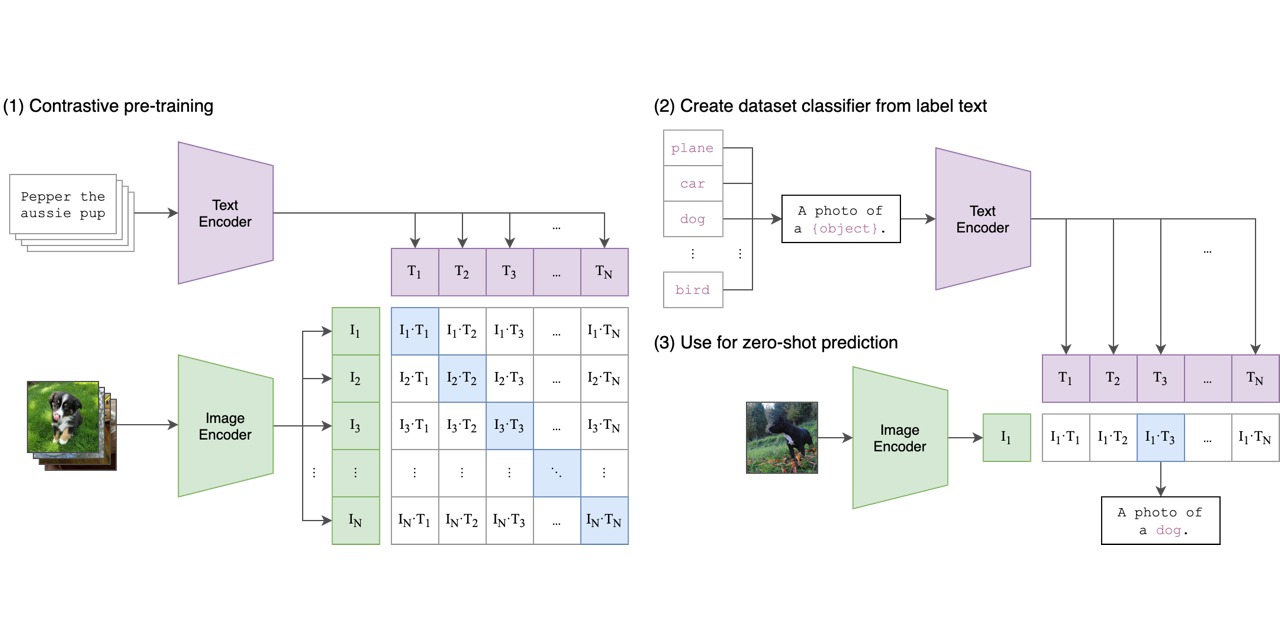
📜 License: MIT · 👤 By: OpenAI (AI company)
🎯 Time to value: 15 minutes
| ✓ Pros | ✗ Cons |
|---|---|
| Free under the MIT license, with a ready-made online notebook | Released in 2021, so newer models are more accurate |
| Works on everyday categories without extra training | Install instructions still name very old PyTorch versions |
| A few lines of Python get you working results | OpenAI's own model card warns about bias and says it is a research tool |
 GitHub
📜 License: Apache-2.0 · 👤 By: Meta AI research (FAIR)
🎯 Time to value: 30 minutes
| ✓ Pros | ✗ Cons |
|---|---|
| Free under Apache 2.0, including training code | Needs an NVIDIA graphics card and a custom build step |
| Small enough to run fast; the tiny version handles about 91 frames per second in the makers' tests | Windows users are told to use WSL (Linux inside Windows) |
| Tracks several objects through a video at once | The latest model files date from 2024 |
 GitHub
Top Models Today
👤 By: InternLM (open model team backed by Shanghai AI Laboratory) · 🎯 Task: Any-to-any (live audio and video in, speech out)
📐 Size: 9.4B (built on MiniCPM-o 4.5)
| ✓ Pros | ✗ Cons |
|---|---|
| Scores 80.73 on FD-Bench v1.5, a test of handling interruptions | The model page lists no license |
| Its makers report about 1.3 seconds to take its turn | The demo needs Linux, an NVIDIA graphics card and the CUDA 12.8 toolkit |
| Also sets timed reminders and reacts to changes in live video | Task hand-offs need a second AI service you set up yourself |


👤 By: WeChat Vision team at Tencent (technology company) · 🎯 Task: Image and text to text
📐 Size: 35.1B (about 3B active, built on Qwen3.5-35B-A3B)
| ✓ Pros | ✗ Cons |
|---|---|
| Free under Apache 2.0 | All scores are the makers' own |
| Beats its Qwen3.5 base by 3.92 points on average across 28 shopping tests | Its general skills are only 0.17 points above the base model |
| Comes in sizes from 0.8B to 35B, plus compressed FP8, GPTQ and GGUF versions | Built mainly for Chinese and English WeChat shopping content |

👤 By: Tencent IMA Product Center and Tencent Youtu Lab · 🎯 Task: Search embeddings (feature extraction) for text, images, documents and video
📐 Size: 4.5B (built on Qwen3.5-4B)
| ✓ Pros | ✗ Cons |
|---|---|
| Free under Apache 2.0 | Turning files into search data needs an NVIDIA graphics card (flash-attn) |
| Compressed mode stores 1 million items in about 8.8 GB | Does not handle audio |
| Its makers report searching 1 million items in 54.2 milliseconds on one processor thread | Brand new, with few downloads so far |

👤 By: SenseNova (SenseTime's AI model brand) · 🎯 Task: Robotics (vision-language model for robot arms)
📐 Size: 27.4B
| ✓ Pros | ✗ Cons |
|---|---|
| Free under Apache 2.0, with a GGUF version | Real-robot results come from only 10 trials per task |
| Scores 34.7 on the RoboDojo simulator, versus 27.6 for GPT-6 Astra on that test's leaderboard | Placed objects correctly in 6 of 10 real tries on one arm |
| Stacked blocks in 9 of 10 tries on a real arm with no real-robot training data | Needs a robot arm, cameras and setup work to use |

👤 By: Fish Audio (voice AI company) · 🎯 Task: Text to speech
📐 Size: 35.9B (about 3B active)
| ✓ Pros | ✗ Cons |
|---|---|
| Free for research, personal use and small businesses | Larger companies need a separate paid license |
| First audio arrives in under 100 milliseconds in its makers' tests | Those speed tests used NVIDIA H200 data-center graphics cards |
| Runs on the popular SGLang and vLLM serving tools from day one | Voice cloning can be misused, so get consent before copying anyone's voice |


AI Launches Today
💰 Pricing: $59 a month; a Product Hunt offer gives the first 3 months at $5.99 a month · 🏷 Category: AI marketing automation
💰 Pricing: 15-day free trial with no credit card; paid prices not listed · 🏷 Category: AI customer success
💰 Pricing: 14-day free trial; the help desk stays free after that; the AI agent starts at $99 a month · 🏷 Category: AI customer support
💰 Pricing: Free with 40 credits a day; paid prices not listed · 🏷 Category: AI website building and hosting
💰 Pricing: Free and open source (Apache 2.0) · 🏷 Category: AI coding agents
Snapshot
| Provider | Model | Input $/1M | Output $/1M | Context |
|---|---|---|---|---|
| Anthropic | Claude Fable 5.2 | $8.00 | $40.00 | 1M tokens |
| Anthropic | Claude Opus 5.5 | $4.00 | $20.00 | 1M tokens |
| Anthropic | Claude Sonnet 5.5 | $2.00 | $10.00 | 1M tokens |
| Anthropic | Claude Haiku 5.5 | $0.10 (up to 100K-token prompts; $0.50 above) | $0.50 ($2.50 above 100K) | not listed |
| OpenAI | GPT-6.2 Astra | $8.00 (up to 272K-token prompts; $16.00 above) | $40.00 ($60.00 above 272K) | not listed |
| OpenAI | GPT-6.2 Sol | $2.00 (up to 272K; $4.00 above) | $10.00 ($15.00 above 272K) | not listed |
| OpenAI | GPT-6.1 Terra | $1.00 (up to 272K; $2.00 above) | $5.00 ($7.50 above 272K) | not listed |
| OpenAI | GPT-6 Luna | $0.10 (up to 272K; $0.20 above) | $0.50 ($0.75 above 272K) | not listed |
| Gemini 4 Carbon | $2.00 to Nov 30; $4.00 from Dec 1 | $10.00 to Nov 30; $20.00 from Dec 1 | not listed | |
| Gemini 4 Argon | $2.00 to Nov 30; $4.00 from Dec 1 | $10.00 to Nov 30; $20.00 from Dec 1 | not listed | |
| Gemini 4 Neon | $3.00 | $15.00 | 1M tokens | |
| Gemini 4 Hydrogen | $1.50 | $7.50 | 1M tokens | |
| Gemini 3.8 Flash | $0.75 (to Dec 31; $1.50 from Jan 1) | $3.75 (to Dec 31; $7.50 from Jan 1) | not listed | |
| Groq | GPT-OSS 120B | $0.15 | $0.60 | 131K tokens |
| Groq | Qwen3.8-27B (preview) | $0.80 | $4.00 | 131K tokens |
What changed since our last edition (November 27): No price changes. We rechecked Anthropic's developer pricing page, OpenAI's developer pricing page, Google's Gemini API pricing page on Google AI Studio and Groq's developer model list on November 28. OpenAI's page still notes that GPT-5.6 Sol's promotional pricing ends November 30, and that its premium "Ultrafast" speed for GPT-6.2 Astra and Sol rises from 3 times to 6 times the standard price on March 1, 2027; standard prices are unchanged.
What this means: Google's Gemini 4 Carbon and Argon double in price in 3 days, on December 1, so teams using them should switch test traffic to a cheaper model such as Gemini 4 Hydrogen or approve the extra budget this weekend. Prices at Anthropic, OpenAI and Groq held steady.
Partial Routing: Trace-Tuned Delegation for Resource-Efficient Agentic Workflows
Key finding: On a web-app building test (ViBench), the lead-plus-worker team scored 78.5, up from 70.2 for the lead alone, at 19% lower cost. On Terminal-Bench 4.0, a test of command-line tasks, the pass rate rose from 54.3% to 60.9% at about the same cost. Leads kept planning and wrap-up for themselves and handed off steps such as setup, styling and writing tests.
Why practitioners should care: If you run AI agents, you may not need one model for everything; letting a top model hand routine steps to a cheaper one can raise quality and cut your bill. Expect slower runs, though: the median Terminal-Bench task took 69 minutes with hand-offs versus 14 minutes for the lead alone.

Member discussion