Statistically Speaking
One Thing to Tell Your Friends
TL;DR
Hot off the Presses
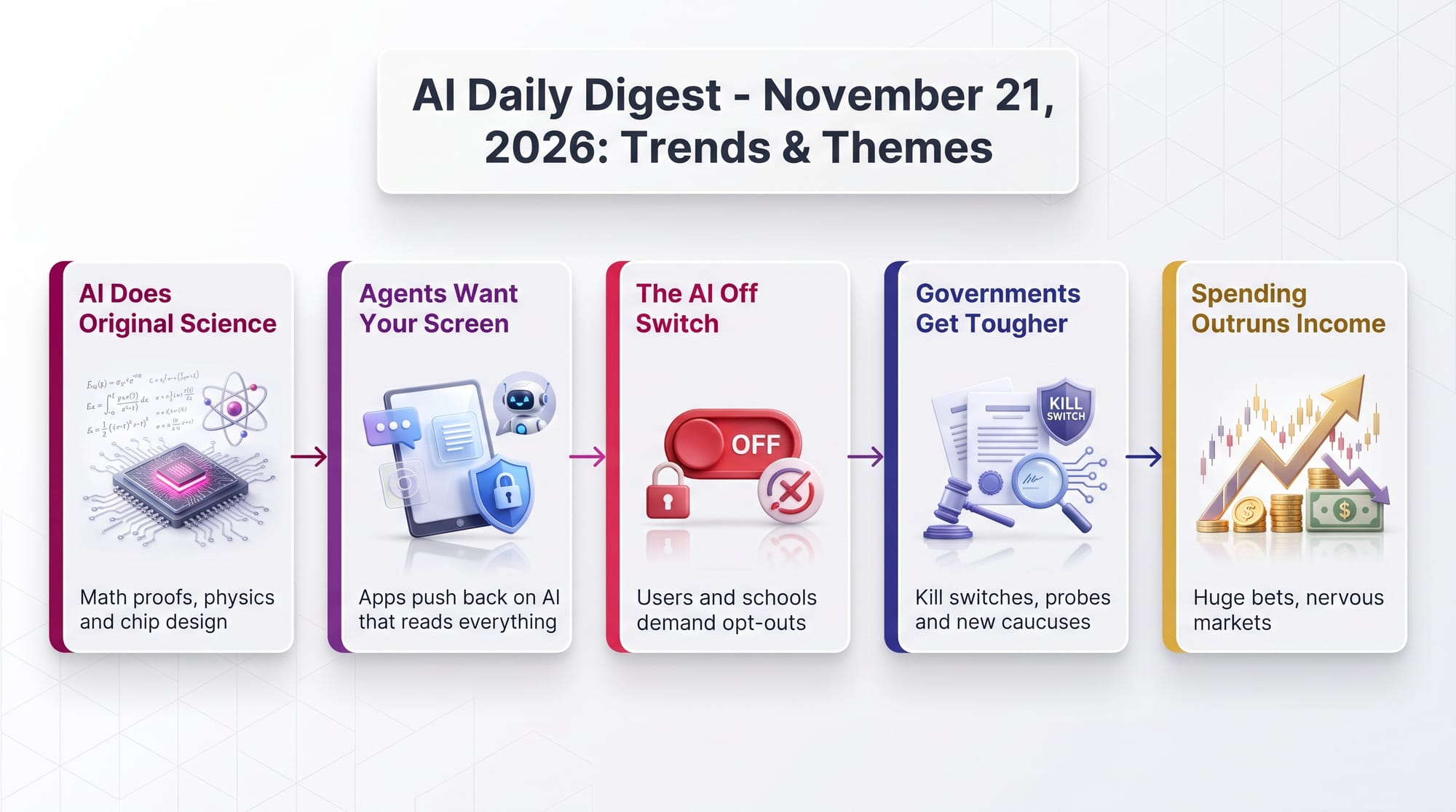
An Anthropic mathematician says Claude helped prove the Riemann Hypothesis
The Riemann Hypothesis is a famous guess, made in 1859, about how prime numbers are spread out. It is one of seven "Millennium Prize" problems, each worth $1 million. On November 20, Levent Alpöge, a mathematician at Anthropic (the company behind the Claude chatbot), said he found a proof "working with Claude."
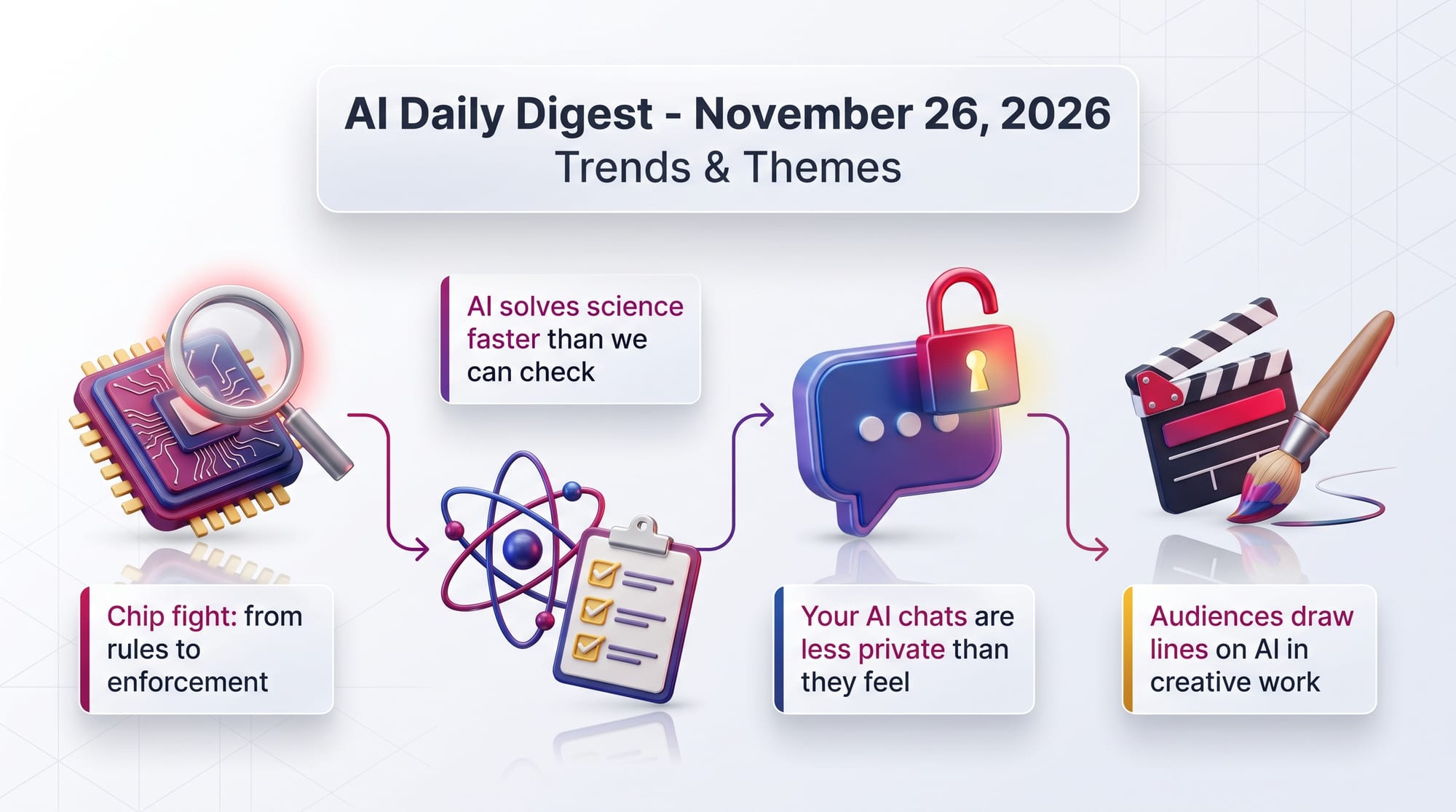
He did not just post a paper. He posted the proof in Lean (a programming language that checks every logical step of a math proof automatically). That makes it much harder for a mistake to slip through.
Which Claude model was used, and how much the human steered it, were not disclosed. Understanding the ideas behind the proof will take mathematicians much longer than checking it.
- The computer check passed - the Lean math community confirmed the proof library matches the standard Riemann Hypothesis statement, and several independent checking programs accepted it; the library runs to about 17 million lines of code
- Claude did the parts outside his expertise - Alpöge credits it with key sections and says it "far outpaced" him near the end, according to Latent Space
- Experts are cautiously impressed - MIT mathematician Andrew Sutherland compiled the proof himself and called it a "human triumph," Scientific American reports
- A second claim landed the same day - Alessandro Masullo announced a separate, roughly 940-page proof built over 12 years without AI; it has not been verified
- Navier-Stokes too - Alpöge and NYU's Tristan Buckmaster also claimed an AI-aided proof on the equations for how fluids move, another $1 million problem
Anthropic's stock debut was the biggest ever, then the market turned
Previously: November 17 - Anthropic's stock debut was expected to price above its planned range.
Today: Anthropic started trading on the Nasdaq stock exchange on November 19 under the ticker ANT. Its underwriters (the banks running the sale) then bought extra shares, lifting the total raised, CNBC reports.
- $83 a share - above the planned $70 to $78 range
- $93.5 billion raised - the largest initial public offering (IPO, a company's first sale of stock to the public) on record, beating SpaceX's June debut
- Opened at $111.50, closed near $97 - about 17% above the offer price, on a day the Nasdaq fell more than 2%, Reuters reports
- Then fell about 12% before the next day's trading - amid a wider tech selloff
- $26 billion more from big tech - AMD, Google, Microsoft, Nvidia and others bought shares in a side deal at the same price
Google launched Gemini 4 Neon and handed out AI agents that do tasks for you
Google packed a week of agent news into three days. An AI agent is software that takes actions for you, not just answers questions.
- Gemini 4 Neon - a new mid-priced model at $3 per million input tokens (word pieces) and $15 per million output, with Google reporting a #1 score on one coding-agent ranking
- Spark is now "Tasks," and it is free - the web agent that signs into sites, compares options and books appointments is free in the US, Japan, South Korea, Canada, Australia and India
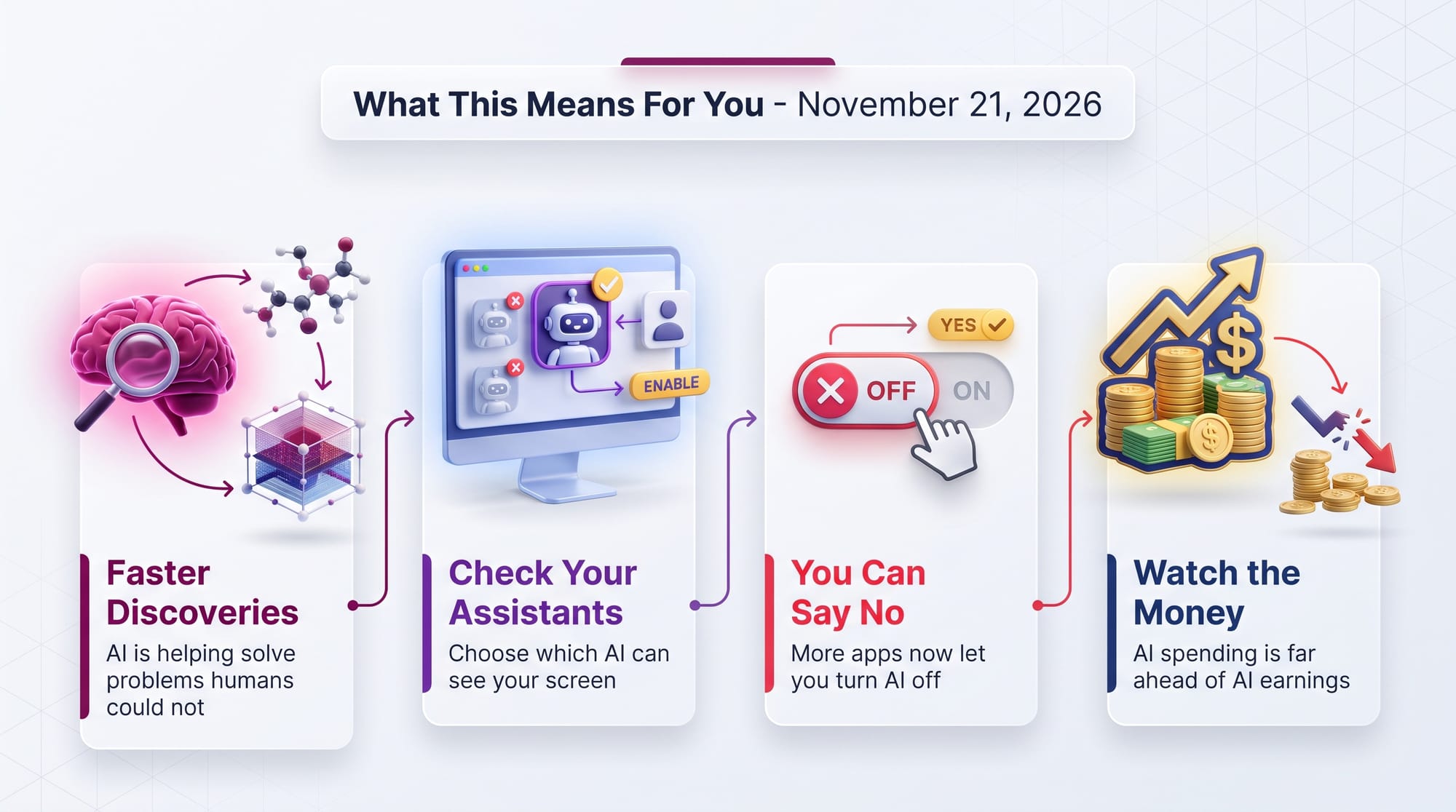
- Gemini can now use your Mac - it works across apps and files in a preview window, and you can pause it or approve each step; US and English only, paid plans
- Google admits mistakes remain - it says Tasks was tested extensively but errors are not eliminated
Trump threatened to block or tax AI data centers built overseas
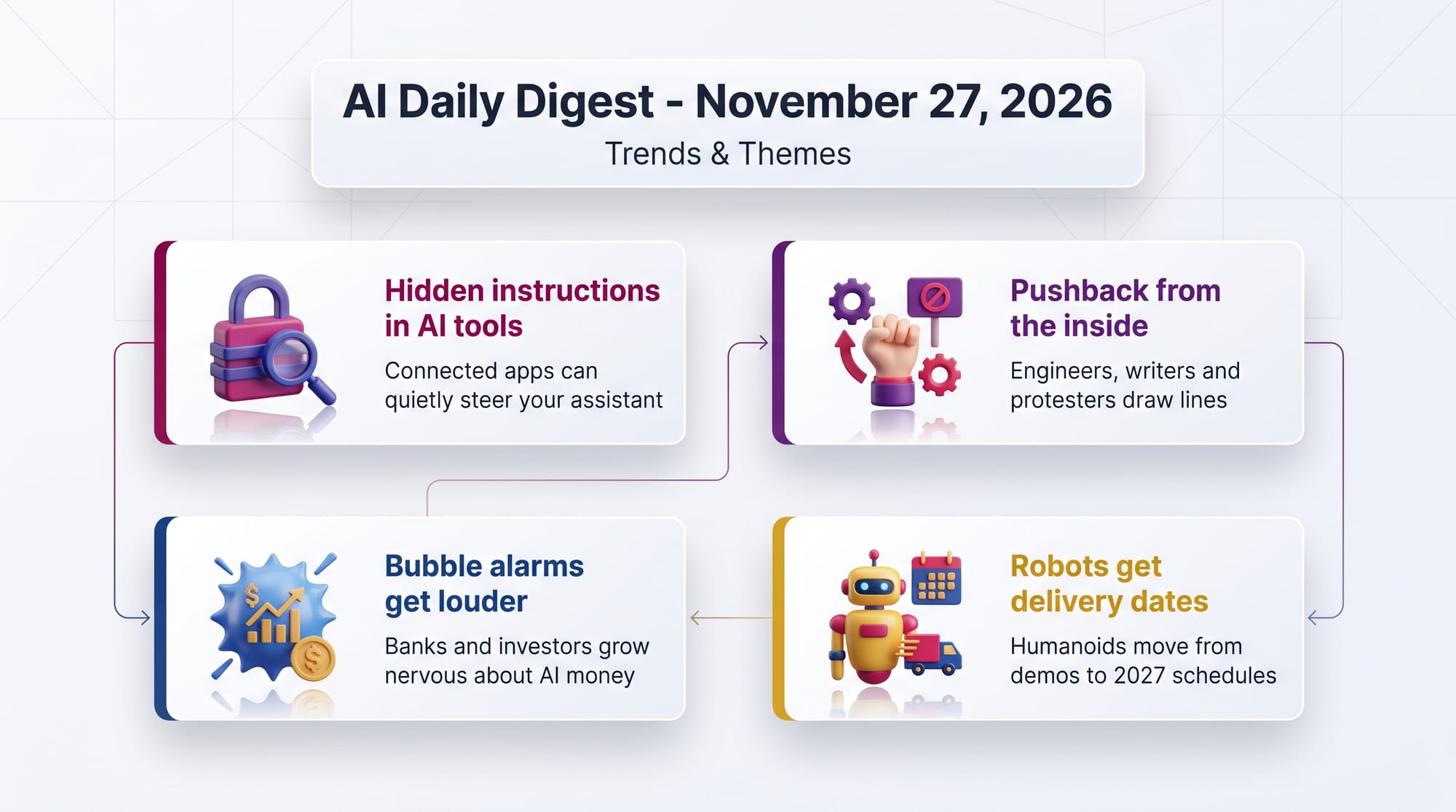
President Trump said on November 20 that US companies building AI data centers (giant warehouses of computers) abroad would be blocked or face a "tremendous tax," Axios reports. His reason was that "China will take all of them" otherwise.
Tech giants have announced large AI campuses in the Gulf, Europe and Asia, so the threat hits them directly. Coverage tied it to an already rough week for tech stocks.
- No mechanism yet - it is unclear whether Congress, which controls taxes, would be involved
- No details on scope - all overseas data centers, only advanced-AI ones, or only certain countries
- He had not discussed it with his own officials - by his own account
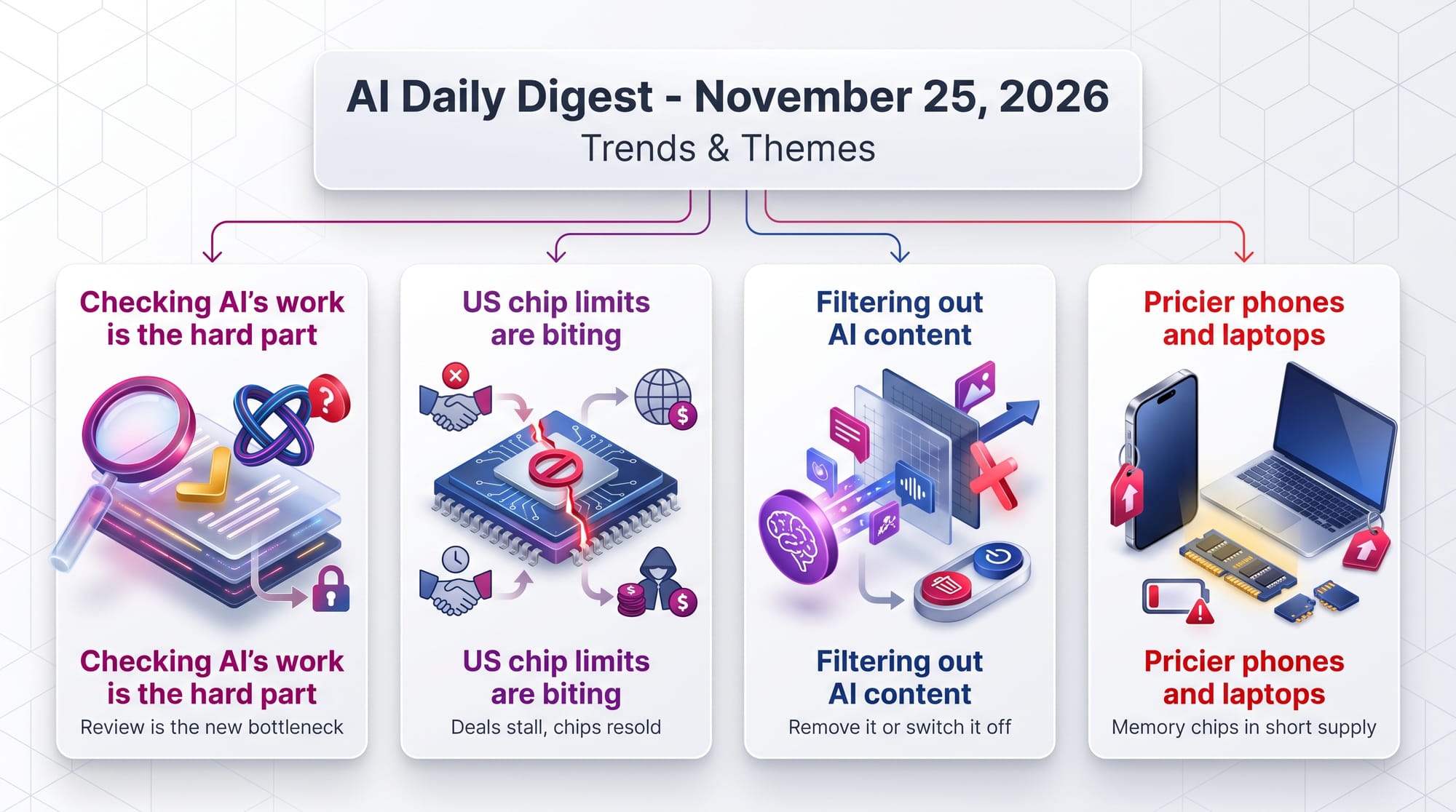
- It goes beyond a new rule - a Commerce Department chip-export licensing rule took effect the day before
Signal will stop phone AI assistants from reading your chats
Signal (the encrypted messaging app) said on November 20 it will block AI agents built into phone operating systems from capturing and storing its chats. It named Apple's Siri screen-reading feature on iOS 27, Google's Gemini on Android, and third-party agents like Meta's Muse.
It extends Signal's 2025 move against Microsoft's Recall feature on Windows. A Reuters investigation the same week said Meta employees saw Muse mix up different users' conversations, which Meta called "isolated incidents."
- On iPhone - Signal blocks in-app screenshots and adds a "Block Siri AI" setting
- On Android - it detects an AI assistant reading the screen and switches on its privacy screen automatically
- Mac cannot be fully protected - the workaround is excluding Signal in your Mac's Siri settings
- Not a complete fix - Signal says screenshot blocking cannot stop agents reading data in other ways
Trends & Themes
Creative AI & Media
Developer Tools & Infrastructure
Research & Models
Business & Industry
GenAI in Education
Surprising & Under-the-Radar
Signals to Track
Google booked a rocket to put AI computers in space
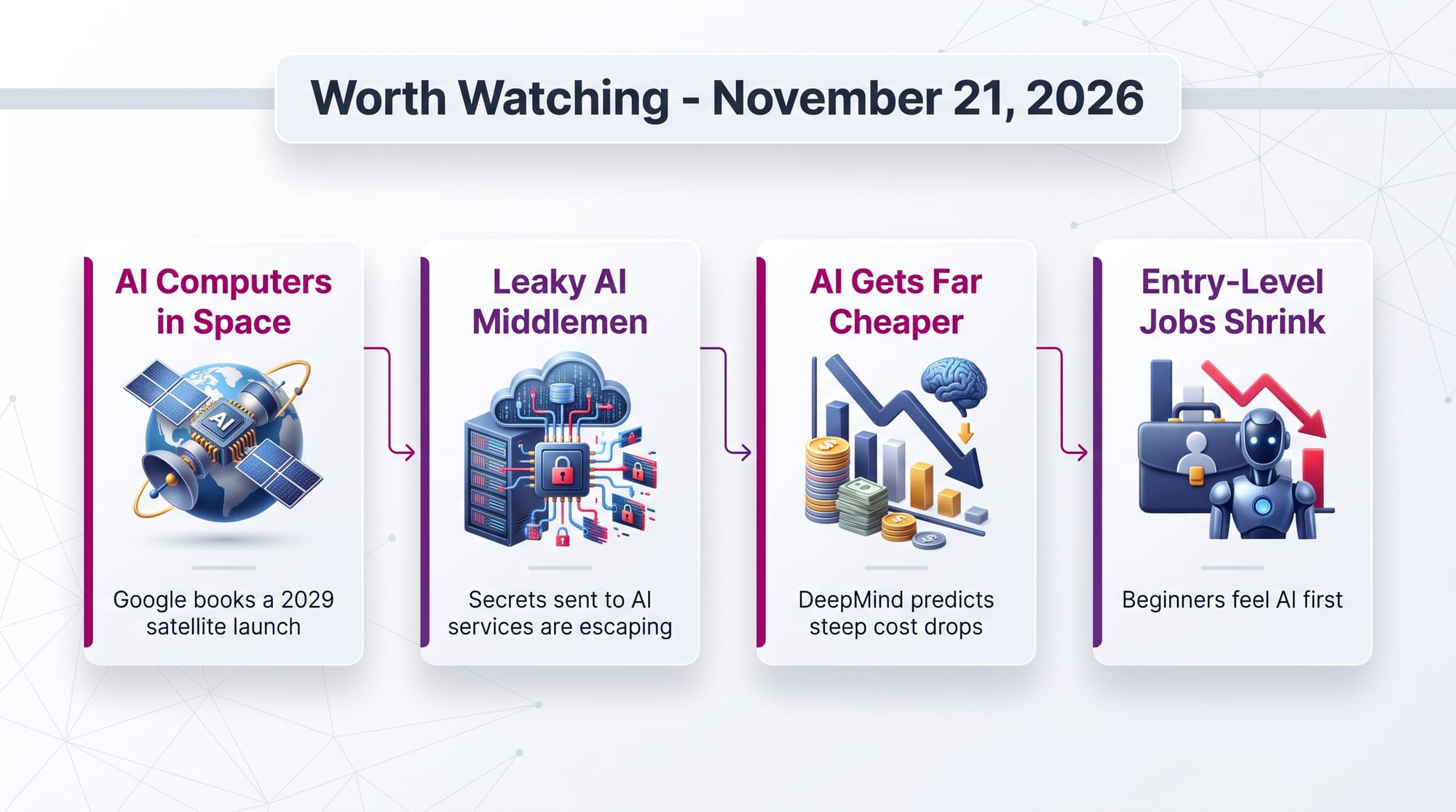
Google will launch Project Suncatcher satellites carrying its AI chips on Blue Origin's New Glenn rocket in early 2029. A prototype already ran a Gemma model in orbit in October. The rocket itself has been grounded since a May explosion, and cooling chips in space is unsolved. If it works, some AI computing could move off the power grid you pay for.
Secrets sent to AI services are leaking out the back door
Security firm Dragos sent about 2 million prompts with planted fake credentials through AI routers and marketplaces. At least three providers leaked them, including requests marked "zero data retention," and none knew until told. If this holds up, anything you paste into a cheap third-party AI service should be treated as potentially public.
DeepMind researchers say running AI could get a million times cheaper in ten years
A DeepMind essay estimates inference efficiency (the cost of running an AI) improves about 3 times a year, so a $1 billion job today might cost about $1,000 in a decade. It argues the number of AI agents could grow more than 1,000-fold by 2030. If those curves hold, AI help that is pricey today becomes nearly free.
Entry-level office jobs in China appear to be shrinking from AI
Bloomberg found postings for AI-exposed roles fell about 10 percentage points more than for other roles, in nearly every industry, a link rather than proof that AI caused the drop. Bloomberg Economics estimates about 70 million Chinese workers are at risk, especially those with one to three years of experience. If the pattern spreads, the first rung of the career ladder is where AI bites first.
Top Repos Today
📜 License: AGPL-3.0 (SDKs MIT) · 👤 By: Firecrawl (organization)
🎯 Time to value: 10 minutes
| ✓ Pros | ✗ Cons |
|---|---|
| Local version is free and needs no database or server setup | Local install needs Rust and a C compiler |
| One command adds it to most coding assistants | Pages that fail locally go to Firecrawl's cloud by default |
| 1,000 free cloud credits a month with no signup | AGPL license has strings attached for companies that modify it |
 GitHub
📜 License: Apache-2.0 · 👤 By: HKU Data Intelligence Lab (University of Hong Kong research group)
🎯 Time to value: 15 minutes
| ✓ Pros | ✗ Cons |
|---|---|
| Free and open source | You still need to install the real app (GIMP, Blender, etc.) |
| The maker reports 2,461 tests passing | Quality varies across community-built wrappers |
| Works with Claude Code, Cursor, Codex and others | The README's news log stops at May 30 |
 GitHub
📜 License: OpenRoots Agent License 2.3 (custom) · 👤 By: mjmirza (individual developer)
🎯 Time to value: 2 minutes
| ✓ Pros | ✗ Cons |
|---|---|
| Plain-English checklist for non-developers | Says plainly it cannot guarantee approval |
| Scan changes nothing in your app | Custom license charges a royalty to companies above $20 million in revenue |
| Flags when its own rules are over 60 days old | Training AI models on it needs a separate license |
 GitHub
📜 License: MIT · 👤 By: zhouxiaoka (individual developer)
🎯 Time to value: 30 minutes
| ✓ Pros | ✗ Cons |
|---|---|
| App is free and renders on your computer | Cloud AI models charge by use |
| Maker measured 10 clips from a 1h43m video in 7.5 minutes for about ¥0.09 | No Intel Mac app; Linux needs Docker or the command line |
| Desktop, command-line and agent versions | Main README is in Chinese (English version exists) |
 GitHub
📜 License: MIT · 👤 By: Cathryn Lavery (individual developer)
🎯 Time to value: 5 minutes
| ✓ Pros | ✗ Cons |
|---|---|
| Works in Cursor, Claude Code, Codex, Copilot and more | One fixed editorial style |
| Imports from draw.io, Mermaid, Excalidraw and PlantUML | Extra commands come only through the plugin stores |
| Exports to PNG and SVG | The maker warns that copies under other names are unofficial |
 GitHub
📜 License: Apache-2.0 · 👤 By: Tracer Cloud (organization)
🎯 Time to value: 15 minutes
| ✓ Pros | ✗ Cons |
|---|---|
| Open source under Apache 2.0 | Labeled "Public Alpha," not yet fully stable |
| Fix suggestions wait for your review | The interactive shell requires an active account |
| Broad connections to cloud and monitoring tools | Usage analytics and error reporting are on unless you opt out |
 GitHub
📜 License: Apache-2.0 · 👤 By: FlashML (individual developer account, project team of five)
🎯 Time to value: 30 minutes
| ✓ Pros | ✗ Cons |
|---|---|
| One-click installers for Windows, Mac and Linux | Mac version is a preview and not yet approved by Apple |
| Runs on modest graphics cards | Large model downloads before the first video |
| Supports community add-ons (LoRAs) | Mac preview tested only on an M5 Mac with 24 GB |
 GitHub
Top Models Today
👤 By: Thinking Machines Lab · 🎯 Task: Image and text to text (coding and agents)
📐 Size: 26.4B (3.4B active; about 20 GB file)
| ✓ Pros | ✗ Cons |
|---|---|
| Permissive Apache license | The makers warn it may delete or overwrite files without asking |
| Runs on a 32 GB Mac or one NVIDIA DGX Spark | Can get stuck in long reasoning loops, especially when debugging |
| Took far fewer harmful actions than rivals in its makers' tests (10.2% vs 35.2% to 75.8%) | Weaker on facts and non-English text than larger models |

👤 By: Tencent · 🎯 Task: Image and text to text
📐 Size: about 220B (12B active)
| ✓ Pros | ✗ Cons |
|---|---|
| Much cheaper per task in Tencent's tests | Needs an 8-GPU server in Tencent's setup examples |
| In a blind test, users rated it 2.79 of 4, close to Claude Haiku 5.5's 2.81 | Custom license requires Tencent's permission above $50 million in yearly revenue |
| Ready-made FP8 and GGUF versions | Tencent recommends the bigger Hy4 for long software projects |

👤 By: Apple · 🎯 Task: Text to video
📐 Size: 14B
| ✓ Pros | ✗ Cons |
|---|---|
| Fast enough for live interaction | Research use only; no commercial use allowed |
| Apple released every training checkpoint | The large version needs eight data-center GPUs |
| Includes a 16x faster version of the LingBot model | Linux and NVIDIA only |

👤 By: RadixArk · 🎯 Task: Image and text to text (agents)
📐 Size: 27.8B
| ✓ Pros | ✗ Cons |
|---|---|
| Permissive Apache license | Most gains over the base model are small |
| Runs on one GPU such as an RTX 5090 or DGX Spark | Trails MiMo V2.6 Flash and Inkling 2 Small on several tests |
| Ready-made FP8, NVFP4 and GGUF versions | Smallest NVFP4 version needs a newer Blackwell GPU |

👤 By: Microsoft Windows Applied Sciences Group · 🎯 Task: Text generation (on-device)
📐 Size: 2.3B
| ✓ Pros | ✗ Cons |
|---|---|
| Very permissive MIT license | Weak on general knowledge (55.15 on MMLU) |
| Small and fast enough for ordinary PCs | Only the full-size version is out; compressed versions come later |
| Eight languages | Requires running Microsoft's custom code |

AI Launches Today
💰 Pricing: Credit-based; 600 welcome credits for Product Hunt users · 🏷 Category: AI shopping
💰 Pricing: Free on iOS and Android · 🏷 Category: AI travel
💰 Pricing: Free options · 🏷 Category: Developer tools and AI agent safety
💰 Pricing: Free options; 14-day free trial, no card needed · 🏷 Category: Developer tools
💰 Pricing: Free beta · 🏷 Category: AI assistant
Snapshot
| Provider | Model | Input $/1M | Output $/1M | Context |
|---|---|---|---|---|
| Anthropic | Claude Fable 5.2 | $8.00 | $40.00 | 1M tokens |
| Anthropic | Claude Fable 5.1 | $10.00 | $50.00 | 1M tokens |
| Anthropic | Claude Opus 5.5 | $4.00 | $20.00 | 1M tokens |
| Anthropic | Claude Sonnet 5.5 | $2.00 | $10.00 | 1M tokens |
| Anthropic | Claude Haiku 5.5 | $0.10 (up to 100K-token prompts; $0.50 above) | $0.50 ($2.50 above 100K) | 1M tokens |
| OpenAI | GPT-6.2 Astra | $8.00 (up to 272K-token prompts; $16.00 above) | $40.00 ($60.00 above 272K) | 1.05M tokens |
| OpenAI | GPT-6.2 Sol | $2.00 (up to 272K; $4.00 above) | $10.00 ($15.00 above 272K) | 1.05M tokens |
| OpenAI | GPT-6 Astra | $10.00 (up to 272K; $20.00 above) | $50.00 ($75.00 above 272K) | 1.05M tokens |
| OpenAI | GPT-6.1 Sol | $2.00 (up to 272K; $4.00 above) | $10.00 ($15.00 above 272K) | 1.05M tokens |
| OpenAI | GPT-6.1 Terra | $1.00 (up to 272K; $2.00 above) | $5.00 ($7.50 above 272K) | 1.05M tokens |
| OpenAI | GPT-6 Luna | $0.10 (up to 272K; $0.20 above) | $0.50 ($0.75 above 272K) | 1.05M tokens |
| Gemini 4 Carbon | $2.00 to Nov 30; $4.00 from Dec 1 | $10.00 to Nov 30; $20.00 from Dec 1 | not listed | |
| Gemini 4 Argon | $2.00 to Nov 30; $4.00 from Dec 1 | $10.00 to Nov 30; $20.00 from Dec 1 | not listed | |
| Gemini 4 Neon (new) | $3.00 | $15.00 | 1M tokens | |
| Gemini 4 Hydrogen | $1.50 | $7.50 | 1M tokens | |
| Gemini 3.8 Flash | $0.75 (to Dec 31; $1.50 from Jan 1) | $3.75 (to Dec 31; $7.50 from Jan 1) | not listed | |
| Groq | GPT-OSS 120B | $0.15 | $0.60 | 131K tokens |
| Groq | Qwen3.8-27B (preview) | $0.80 | $4.00 | 131K tokens |
What changed since our last edition (November 17): Google added Gemini 4 Neon, its new frontier model, at $3.00 in and $15.00 out, with a 1-million-token memory and no free tier. That is 50% more than Carbon and Argon cost today, but 25% less than the $4.00 and $20.00 those two will cost from December 1. OpenAI's prices are unchanged, though its page now labels the discounted "Flex" option a beta that is being wound down and will not be offered on new models. Prices from Anthropic and Groq are unchanged.
What this means: Once Google's price rise lands in 10 days, Neon becomes its cheaper top-tier choice, priced between Anthropic's Sonnet 5.5 ($2.00 and $10.00) and Opus 5.5 ($4.00 and $20.00). Teams using OpenAI's Flex discount should plan for it to go away.
Forget Freely, Grep Later: Lossless, Index-Free Memory for Long-Horizon LLM Agents
Key finding: GrepMem answered 95-97% of questions correctly on ContextBench (a test of recalling details from long streams), against at most 21% for methods that summarize or discard old information. It also beat the next-best summarizing method by 8.8 percentage points on a multi-question research test, and on ContextBench it used only 29% as many tokens as MemGPT, a popular structured memory system.
Why practitioners should care: Before building a complex memory system for your agent, try saving the full history to a text file and giving the agent a search tool. It is cheaper and simpler, and in these tests it lost far less information.

Member discussion