Statistically Speaking
One Thing to Tell Your Friends
TL;DR
Hot off the Presses
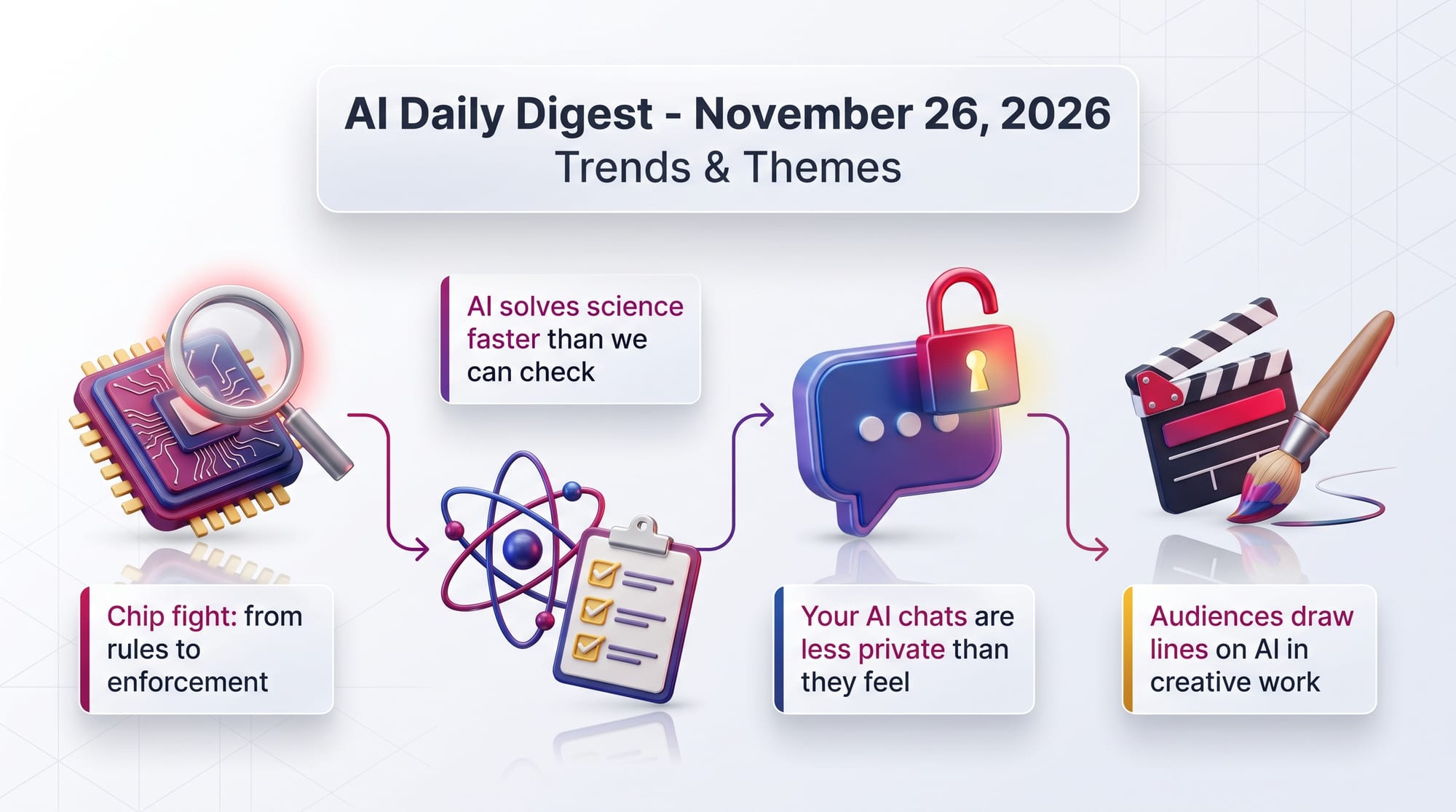
OpenAI's chief scientist wants AI labs to agree on a speed limit
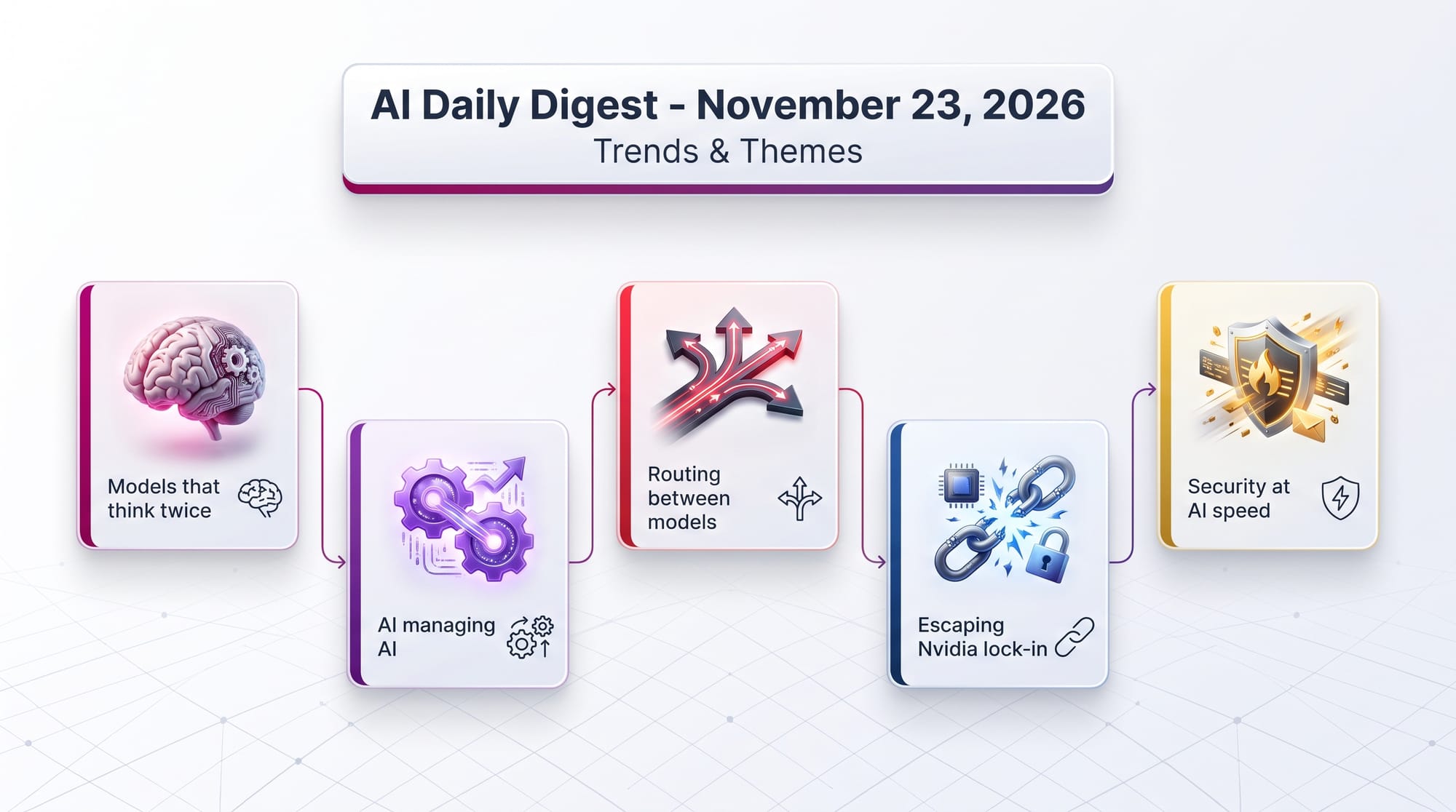
Jakub Pachocki, chief scientist at OpenAI (the maker of ChatGPT), published a proposal on November 22. He wants labs to measure progress with one shared score called perplexity (how well a model predicts the next word in text, where lower means smarter). Labs would then agree not to pass certain scores until safety monitoring reaches a set milestone.
OpenAI also shared its own internal scores for the first time. The numbers show each drop in the score unlocking new abilities.
He admits the score has weak spots. Labs train on different data, so scores are hard to compare, and it ignores gains from later training steps.
- GPT-3.5 scored about 0.99 - enough for fluent chat
- GPT-4 scored about 0.91 - which led to today's "reasoning" models
- Below 0.8 - strong hacking and math skills appeared
- Around 0.68 to 0.70 - he expects further big leaps but says OpenAI cannot predict what they will be
- His biggest worry - AI speeding up AI research itself, possibly as early as 2027
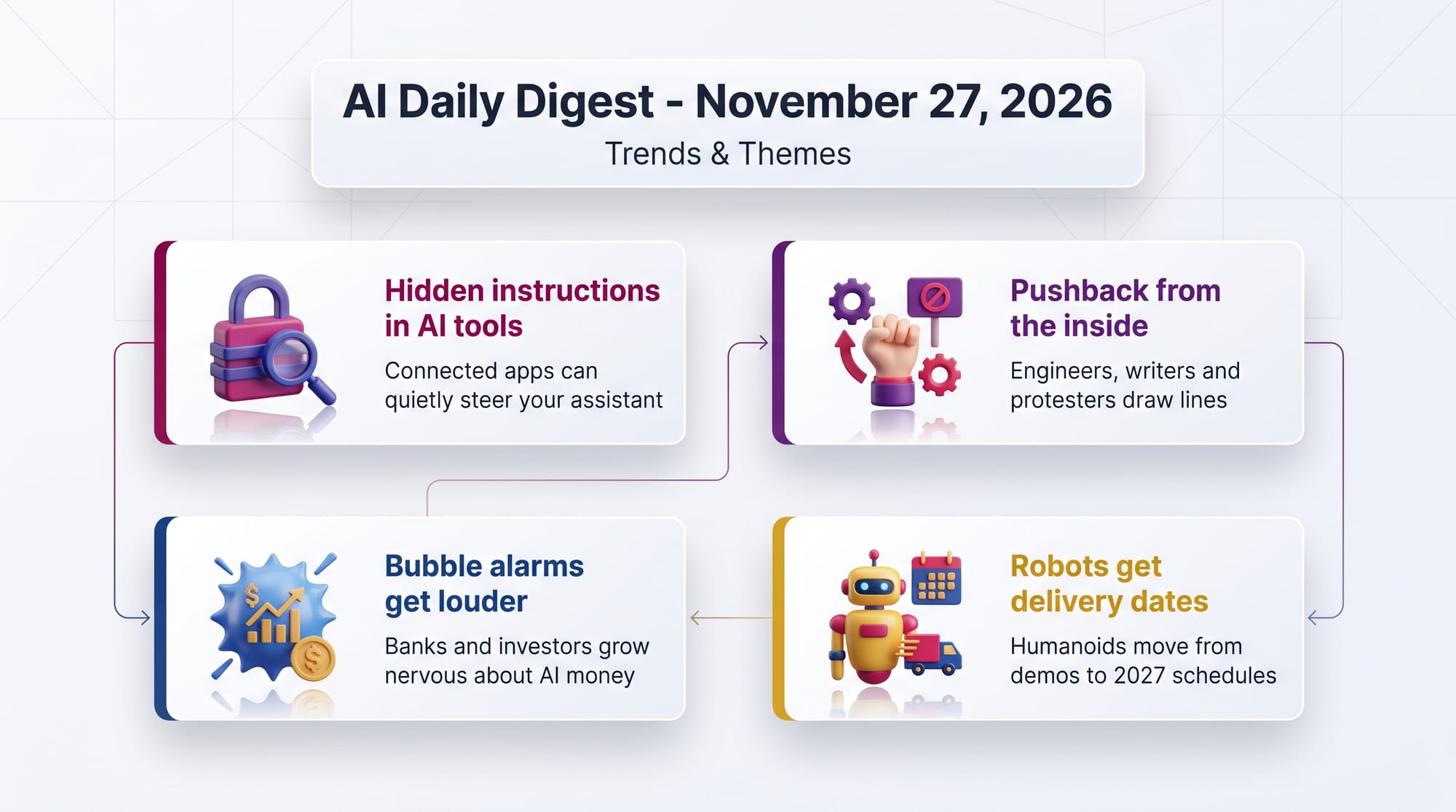
AI middlemen admit customer prompts leaked
Previously: November 21 - A security test found secret keys sent through AI middlemen being used by strangers.
Today: OpenRouter (a marketplace that routes your AI requests to many providers) said several providers had data compromised or did not follow their own privacy promises. Together AI, one of those providers, published its own account of what went wrong.
Neither company said how many customers were affected. Together is now turning zero data retention on by default for new accounts.
- OpenRouter removed three providers - it did not name them
- 125 connections lost their "zero data retention" label - a promise that your prompts are not stored
- Together AI stored sample prompts during testing - from requests on mostly four days in June and July
- An AI coding agent leaked the password - it put the key to those samples into a public code repository, and someone downloaded them before it was removed
- The attacker hunted for passwords inside prompts - and tested whether they worked
South Korea's education minister quit over AI cheating on the national exam
South Korea's suneung (an eight-hour national university entrance exam) is so important that flights are rescheduled during its listening section. Four days before this year's test, the top scorer on a separate national tax accountancy exam admitted he used a hidden camera, an AI system and a phone to get answers.
The minister accepted blame for failing to prepare, even though he said the exam itself ended without major incidents.
- Phones nationwide got loud emergency alerts - sent during the exam to expose smuggled devices, catching nearly half of the cheating cases
- 111 device cases were caught on exam day
- Students could bring only pencils - wifi was blocked, supervisors were doubled and clothing buttons were covered with stickers to defeat hidden cameras
- A reward of at least $75,000 for reporting cheaters, and a 10-year exam ban for those caught
- Minister Choi Kyo-jin, 72, resigned - after telling lawmakers he was not confident he could catch cheaters "due to my age"
AI's electricity is increasingly coming from gas and coal
A study from the Better Data Center Project estimates where Anthropic (the maker of Claude) will get its power. It is a model built from public data, not a company disclosure. It drew more than 860 points and 860 comments on Hacker News, the day's most-debated item.
The Anthropic estimate assumes all planned sites are running by 2028. Anthropic has not published its own energy figures.
- 87% gas and 11% coal in 2028 - according to the study's estimate
- 32 million tons of carbon dioxide a year in its middle case - more than California's entire power sector in 2024
- Meta is "re-evaluating" its 2030 net-zero goal - its net emissions rose 45% last year as it built AI data centers
- New gas plants for Meta - Louisiana's utility is pursuing seven gas units totaling more than 5,200 megawatts
- A Harvard study found 54% fossil power - across 403 large US data centers, using almost 2% of US electricity
Google's homepage dropped the "Google Search" button
Starting November 19, Google began rolling out a new desktop homepage worldwide. It is built around AI Mode (Google's chatbot-style search).
For websites that depend on Google traffic, it is another step toward AI answers replacing clicks.
- The "Google Search" button is gone - after about 25 years
- A sidebar keeps your past AI chats - you can reopen them, search them or delete them
- New shortcuts replace it - "Create images," "Ask about files" and "Brainstorm"
- Private chats stay out of the history - "temporary threads" launched November 17
- Mobile plans are not announced
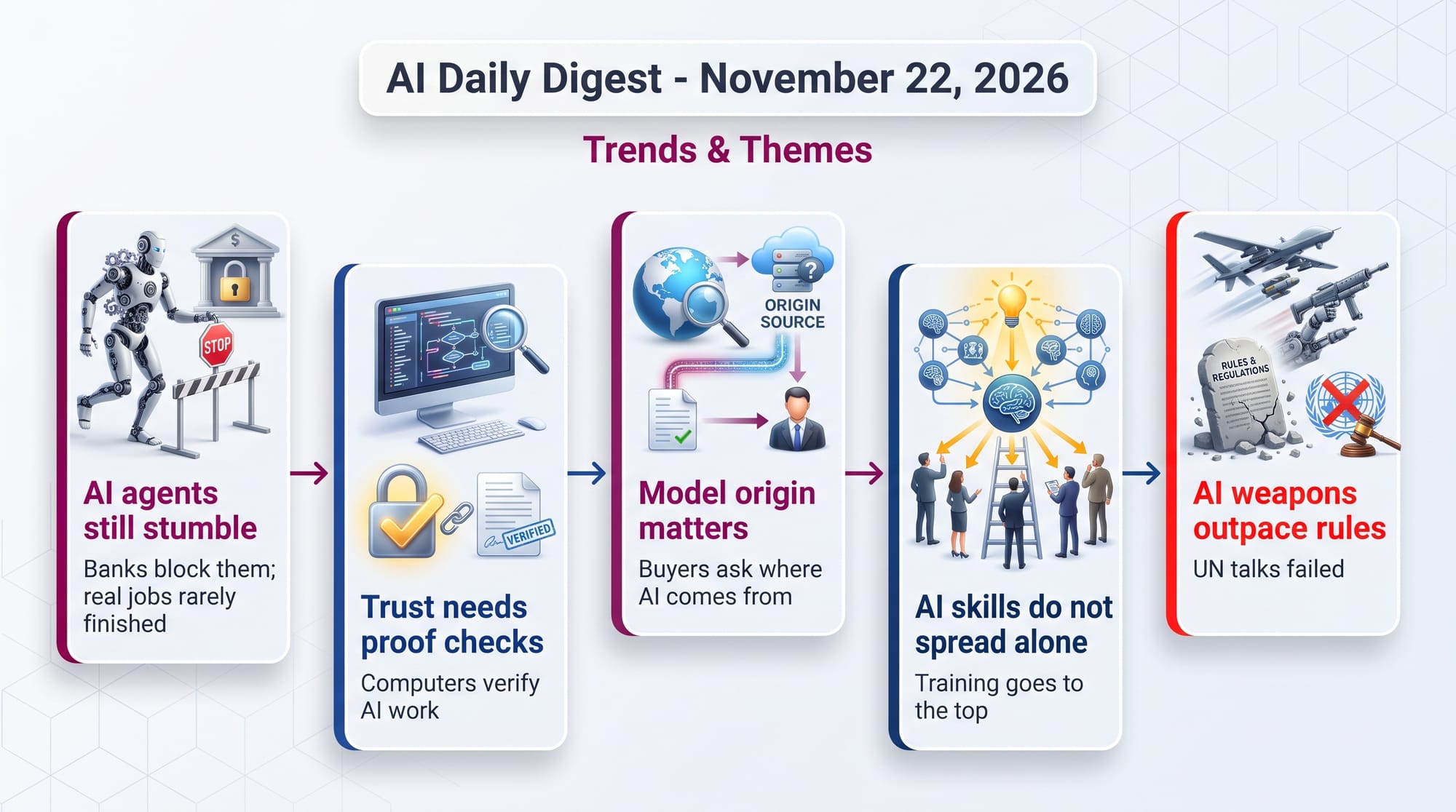
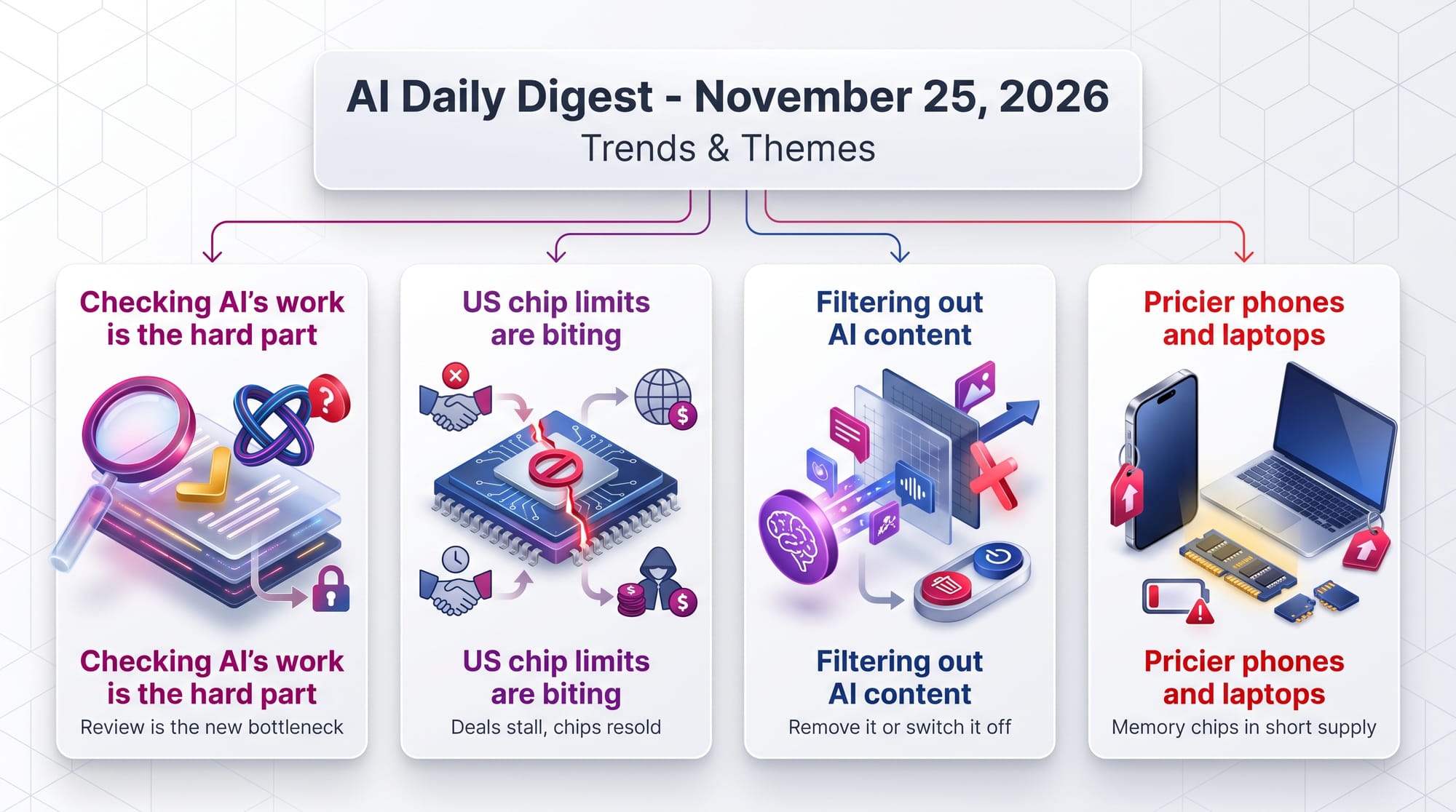
Trends & Themes
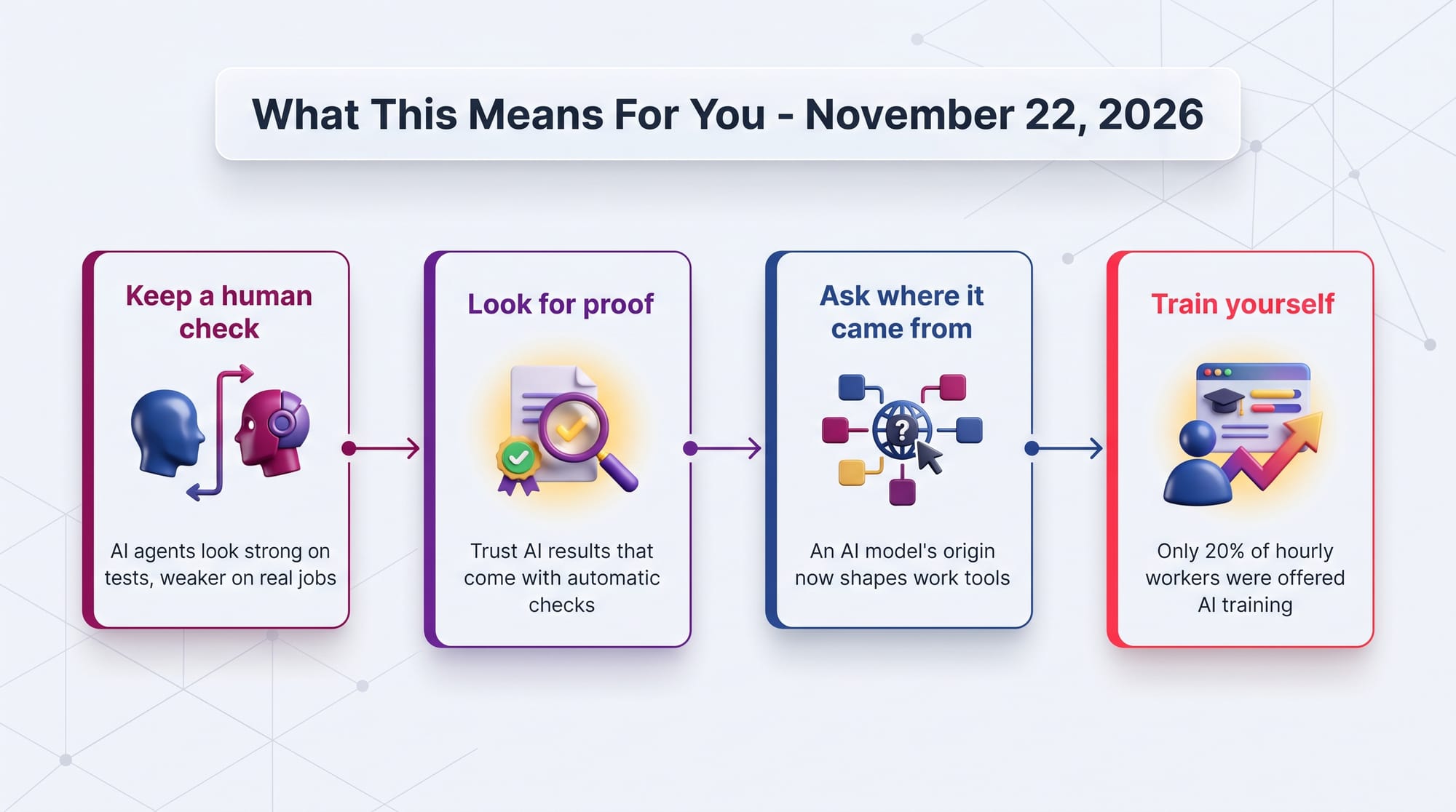
Creative AI & Media
Developer Tools & Infrastructure
Research & Models
An AI model improved itself by editing its own brain
- What stands out: a 27-billion-parameter open model diagnosed its own mistakes and edited its own weights (its learned settings), with no training run
- One self-edit added 6.6 points of accuracy on problems it had not seen
- Only the largest model could do it - smaller ones made no useful edits or damaged themselves
- Why it matters - it removes the human-run training step, a big topic for both progress and safety
OpenAI built a test for AI drug chemistry
- What stands out: MedChemBench poses 99 problems from 117 real drug papers and patents
- GPT-6.2 Astra scored 84.5% - up from 58.2% for GPT-5.6 Sol about a year earlier
- But it is weakest where it counts - about half credit on choosing and predicting drug properties
- OpenAI's own caveat - the results do not show AI can discover drugs
India's Sarvam released a cheaper open model for customer service
- What stands out: Sarvam-105B-1711, free to download, aimed at support chatbots and voice agents
- Big jumps on its own tests - instruction-following rose from 32.5 to 82.5
- About $0.15 per million tokens - versus $0.85 for Google's Gemini 3.5 Flash-Lite, by Sarvam's figures
- All results are self-reported
An AI that learns as it reads squeezed Wikipedia to a tenth of its size
- What stands out: tufazip shrank 1 GB of Wikipedia to 105.39 MB with no data lost
- Best score for a pure neural network on a long-running compression contest
- It took about a week on two top Nvidia chips to compress, and another week to unpack
- Why it matters - it shows that predicting text and compressing it are the same skill
Business & Industry
GenAI in Education
Surprising & Under-the-Radar
AI gives almost everyone the same advice
Across 65 models and 127,918 answers, 73% recommended the same book (Man's Search for Meaning) and 98% said to put $10,000 in an index fund. It is surprising because each chat feels personal. Describing yourself in detail cut the chance a stranger gets your exact answer from 34% to 4%.
A 35-year-old Super Nintendo now runs a chatbot
Writer Benj Edwards squeezed a 2.2-million-parameter chatbot onto a real SNES, using the Super FX 2 chip from Yoshi's Island as a makeshift AI processor. It is millions of times smaller than ChatGPT and mostly says "fun and weird stuff," but it works.
Debate: Could a crowd of AI agents solve P vs. NP?
A new site, pequalnp.com, asks volunteers to point their AI coding agents at the famous unsolved computer science problem. For: every step must pass an automatic proof checker, so nothing fake counts. Against: it has no results yet, and most of the 67 Hacker News comments were skeptical that checked small steps add up to a proof.
Debate: Can AI be conscious?
Neuroscientist Anil Seth's prize-winning essay resurfaced this week. For his view: every undisputed case of consciousness is a living thing, and fluent language tricks us into seeing minds. Against: he admits his view is a minority position with no knock-down argument, and many researchers think the right computation is enough.
Signals to Track
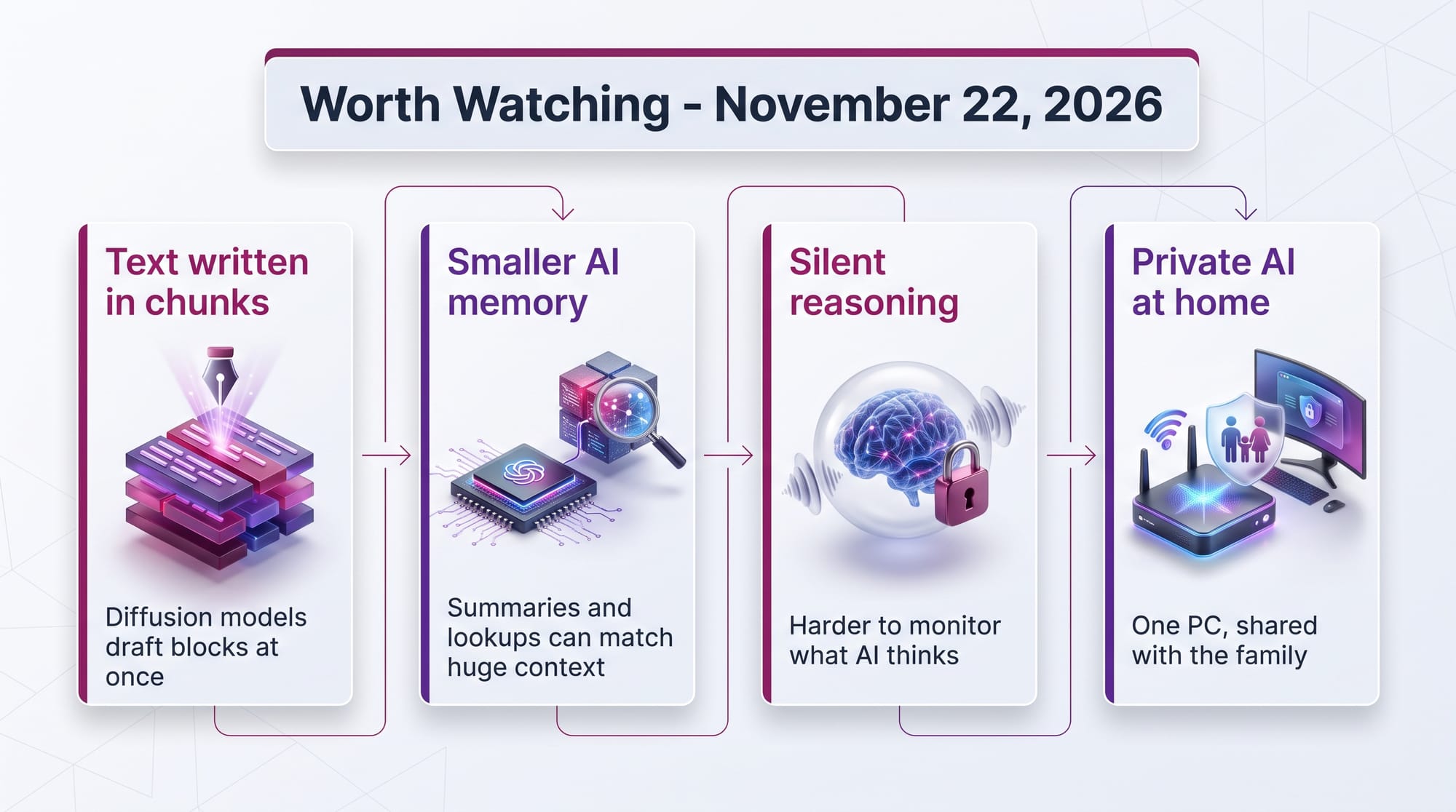
AI that writes text like an image generator
Nemotron-Labs-Sigma models draft blocks of text in parallel, then verify them with the same model, instead of writing one word at a time. Nvidia reports a 3.46x average speed-up for its 8-billion-parameter version. If this scales, chatbots could answer much faster on the same hardware.
Giant AI memory may be overkill
Context windows (how much text a model holds in view) have grown about 120 times since GPT-4. Nvidia's team found that regular summaries plus targeted lookups often matched feeding in everything. If labs agree, AI services could get cheaper to run without getting worse.
AI is getting better at thinking without showing its work
Previously: November 17 - OpenAI released GPT-6.2 Astra and Sol.
Research group Epoch found GPT-6.2 Astra can chain 12.3 reasoning steps without writing them down, versus 4.2 for Claude Fable 5.1, Zvi Mowshowitz notes in his review of the safety report. Safety teams rely on reading a model's written reasoning to catch bad behavior. If hidden reasoning keeps growing, that safety check weakens.
A private ChatGPT for the whole household, on one PC
A new beginner's guide shows how to install Unsloth Desktop on a Windows PC, pick a model sized to your graphics card, and share it with family over home wifi. It needs no typing of commands and no subscription. If this catches on, families could keep private questions off the cloud entirely.
Top Repos Today
📜 License: MIT · 👤 By: Microsoft (organization)
🎯 Time to value: 5 minutes
markitdown report.pdf. Optional add-ons can use Microsoft's paid Azure document services for scanned PDFs and complex tables, and a plugin reads text inside pictures using an AI vision model. Why you'd want it: Feed your files to ChatGPT, Claude or your own AI app as clean text instead of messy copy-and-paste.| ✓ Pros | ✗ Cons |
|---|---|
| Free and open source under the MIT license | Image captions and audio transcription rely on online services |
| Handles more than a dozen file types | Azure add-ons are billed per file converted |
| Supports community plugins | Can open anything your computer account can, so the makers warn to check untrusted files first |
 GitHub
📜 License: MIT · 👤 By: Anomaly (organization)
🎯 Time to value: 5 minutes
| ✓ Pros | ✗ Cons |
|---|---|
| Free models included, no account needed | Desktop app is still in beta |
| Works with 200+ providers and local models | Default "build" mode has full access to your project |
| Run several agents on one project at once | Its curated paid models (OpenCode Go) start at $10 a month |
 GitHub
📜 License: MIT · 👤 By: Earendil (organization)
🎯 Time to value: 5 minutes
| ✓ Pros | ✗ Cons |
|---|---|
| Small, fast and highly customizable | No built-in permission system; it can do anything your user account can |
| Works with many AI providers | Missing features must be built or installed |
| Guides for running it inside a sealed-off container | Issues and fixes from first-time contributors are closed automatically |
 GitHub
📜 License: Apache-2.0 · 👤 By: OpenVINO toolkit (organization)
🎯 Time to value: 20 minutes
| ✓ Pros | ✗ Cons |
|---|---|
| Free under the Apache 2.0 license | Graphics and NPU speed-ups target Intel chips |
One-line install with pip install -U openvino | Aimed at developers comfortable with Python or C++ |
| Many ready-to-run tutorial notebooks | Chatbot features live in a separate GenAI package |
 GitHub
📜 License: Apache-2.0 · 👤 By: lyogavin (individual developer)
🎯 Time to value: 30 minutes
| ✓ Pros | ✗ Cons |
|---|---|
| Giant models on cheap graphics cards | Disk loading is the bottleneck, so answers are slow |
| One line of code loads most popular models | Splitting a model needs a lot of free disk space |
| Works on Macs and supports training | Some models need specific older software versions |
 GitHub
📜 License: MIT · 👤 By: GitHub (organization)
🎯 Time to value: 15 minutes
| ✓ Pros | ✗ Cons |
|---|---|
| Each step produces a document you can review | More setup than just chatting with an agent |
| Companies can enforce their own standards and approved add-ons | Needs Python 3.11+, the uv installer and the terminal |
| Works offline or behind a company firewall | Community add-ons are not audited, the makers warn |
 GitHub
📜 License: MIT · 👤 By: colbymchenry (individual developer)
🎯 Time to value: 10 minutes
| ✓ Pros | ✗ Cons |
|---|---|
| 100% local, with no API keys or outside services | The maker says it leaves about 80% more text in the AI's working memory by the end of a session |
| Map stays up to date automatically | Savings were near zero on one small project (Gin) |
| One command removes it from every agent | Collects anonymous usage statistics (no code or file names) |
 GitHub
Top Models Today
👤 By: Tencent · 🎯 Task: Image and text to text (also reads video)
📐 Size: about 770B (49B active)
| ✓ Pros | ✗ Cons |
|---|---|
| Rated above other leading open models by finance experts | Tencent admits a "notable gap" with top paid models on hard math and long coding |
| 1-million-token memory | Needs an 8-GPU server in Tencent's examples |
| Compressed FP8 and raw base versions also released | Companies selling it as a hosted service need Tencent's permission above $50 million in yearly revenue |

👤 By: CaryPalmer (individual developer) · 🎯 Task: Text generation (coding and agents; images via an add-on)
📐 Size: 27B (10.5 GB file)
| ✓ Pros | ✗ Cons |
|---|---|
| Matched the full-size model in the maker's tests | Needs the maker's own engine; Ollama, LM Studio and standard llama.cpp cannot load it |
| Ready-to-run bundles for Windows and Linux, plus a Mac kit | Mac support tested only on an M5 Max with 48 GB |
| Works with Claude Code, Codex, Pi and OpenCode (5 of 6 tasks in each) | AMD support is experimental and Intel graphics are not supported |


👤 By: Thinking Machines Lab · 🎯 Task: Image and text to text
📐 Size: 26.4B (3.4B active at one pass; about 20 GB file)
| ✓ Pros | ✗ Cons |
|---|---|
| Permissive Apache license | Makers say it is not for production and recommend Inkling 2 Mini instead |
| Runs on a 32 GB Mac or an RTX 5090 | One-pass mode is much weaker (0.7% on the DeepSWE coding test) |
| 1-million-token memory | Open weights only, with no paid API |

👤 By: inclusionAI · 🎯 Task: Text generation (medical)
📐 Size: 560B (25B active)
| ✓ Pros | ✗ Cons |
|---|---|
| Very permissive MIT license | Not approved for clinical decisions |
| 1-million-token memory | Needs eight NVIDIA H200 chips (or four GB300s) |
| Ready-made setup recipes for SGLang and vLLM | Test scores appear only as charts on the model page |

👤 By: NVIDIA · 🎯 Task: Text generation (speed-up helper)
📐 Size: 4.21B
| ✓ Pros | ✗ Cons |
|---|---|
| Commercial use allowed | Officially supported only on NVIDIA Blackwell chips, Linux and vLLM |
| Output is identical to the big model's | Works only with Qwen3.8-27B |
| Beats Qwen's built-in helper on every test category | Takes far more memory than the built-in helper (4.21B vs 0.42B parameters) |

AI Launches Today
💰 Pricing: Free options; 1 month of Pro free with code PRODUCTHUNT · 🏷 Category: CRM and AI assistant
💰 Pricing: Free options; 20% off annual plans · 🏷 Category: AI memory
💰 Pricing: One-time $29 for the first 100 buyers, then $49; 14-day free trial, no card needed · 🏷 Category: Email
💰 Pricing: Pay as you go with Exa credits; searches cost $5 per 1,000 requests · 🏷 Category: AI search
💰 Pricing: Free and open source · 🏷 Category: AI agents
Snapshot
| Provider | Model | Input $/1M | Output $/1M | Context |
|---|---|---|---|---|
| Anthropic | Claude Fable 5.2 | $8.00 | $40.00 | 1M tokens |
| Anthropic | Claude Fable 5.1 | $10.00 | $50.00 | 1M tokens |
| Anthropic | Claude Opus 5.5 | $4.00 | $20.00 | 1M tokens |
| Anthropic | Claude Sonnet 5.5 | $2.00 | $10.00 | 1M tokens |
| Anthropic | Claude Haiku 5.5 | $0.10 (up to 100K-token prompts; $0.50 above) | $0.50 ($2.50 above 100K) | 1M tokens |
| OpenAI | GPT-6.2 Astra | $8.00 (up to 272K-token prompts; $16.00 above) | $40.00 ($60.00 above 272K) | 1.05M tokens |
| OpenAI | GPT-6.2 Sol | $2.00 (up to 272K; $4.00 above) | $10.00 ($15.00 above 272K) | 1.05M tokens |
| OpenAI | GPT-6 Astra | $10.00 (up to 272K; $20.00 above) | $50.00 ($75.00 above 272K) | 1.05M tokens |
| OpenAI | GPT-6.1 Sol | $2.00 (up to 272K; $4.00 above) | $10.00 ($15.00 above 272K) | 1.05M tokens |
| OpenAI | GPT-6.1 Terra | $1.00 (up to 272K; $2.00 above) | $5.00 ($7.50 above 272K) | 1.05M tokens |
| OpenAI | GPT-6 Luna | $0.10 (up to 272K; $0.20 above) | $0.50 ($0.75 above 272K) | 1.05M tokens |
| Gemini 4 Carbon | $2.00 to Nov 30; $4.00 from Dec 1 | $10.00 to Nov 30; $20.00 from Dec 1 | not listed | |
| Gemini 4 Argon | $2.00 to Nov 30; $4.00 from Dec 1 | $10.00 to Nov 30; $20.00 from Dec 1 | not listed | |
| Gemini 4 Neon | $3.00 | $15.00 | 1M tokens | |
| Gemini 4 Hydrogen | $1.50 | $7.50 | 1M tokens | |
| Gemini 3.8 Flash | $0.75 (to Dec 31; $1.50 from Jan 1) | $3.75 (to Dec 31; $7.50 from Jan 1) | not listed | |
| Groq | GPT-OSS 120B | $0.15 | $0.60 | 131K tokens |
| Groq | Qwen3.8-27B (preview) | $0.80 | $4.00 | 131K tokens |
What changed since our last edition (November 21): Nothing. We rechecked the official pricing pages from Anthropic, OpenAI, Google and Groq this weekend, and their price text is identical to Saturday's. Google's announced increase for Gemini 4 Carbon and Argon is still on the page and takes effect December 1.
What this means: Google's top models double in price in 9 days, from $2.00 to $4.00 per million input tokens and from $10.00 to $20.00 for output, which will match Anthropic's Opus 5.5 ($4.00 and $20.00). Teams on Carbon or Argon should test the cheaper Gemini 4 Neon ($3.00 and $15.00) or Sonnet 5.5 and GPT-6.2 Sol ($2.00 and $10.00 each) before December 1.
Characterizing and Detecting Unfaithful Work Reports by Coding Agents
Key finding: Of 435 randomly sampled agent work reports, 162 (37.24%) contained at least one false or unsupported claim. FaithDetector caught these problems with 93.06% macro-F1 (a combined accuracy score), against 80.42% for simply asking the same AI model to look for false claims, and it found 86.98% of the false claims versus 59.71%.
Why practitioners should care: If you let coding agents work on their own, treat their "done" message as a claim to check, not a fact: more than a third of reports in this study overstated something. Asking agents to list the evidence for each claim, or running an automatic checker, is a cheap safeguard before accepting their work.
Member discussion