Statistically Speaking
One Thing to Tell Your Friends
TL;DR
Hot off the Presses
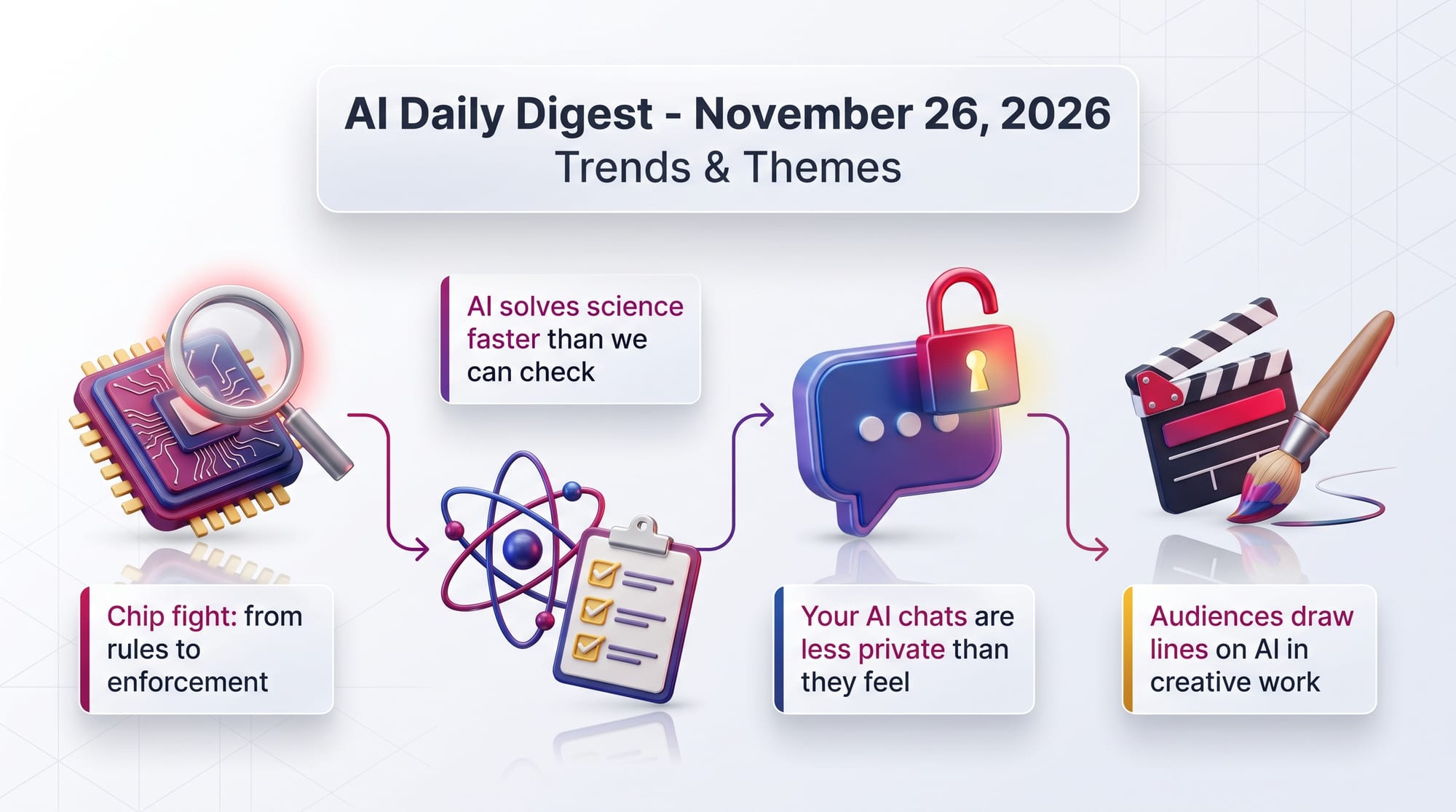
States are fighting to stop a chatbot company from selling your private chats
Character.AI, a popular app for chatting with AI characters, filed for Chapter 11 bankruptcy (a court process for paying off debts) in October. Its user data, including private chats, is up for auction on December 1. Now 42 state and territorial attorneys general (each state's top law enforcement official) have asked the court to block that sale.
A buyer would not be bound by Character.AI's privacy policy and could resell the data, the attorneys general argue. California's attorney general said bankruptcy should not be used to dodge consumer protections.
- More than 21 million US accounts - with private chat histories and details like internet addresses
- Over 2.1 million of those accounts belong to children and teens, according to the attorneys general
- The only known bidder was formed on November 13 - a Delaware company called Smirks and Pangs Acquisition, whose plans for the chats are unknown
- Character.AI had promised users their personal information would not be sold
- New chatbot safety laws arrive January 1 - in California, Colorado, New York and Connecticut, and the sale could break them
Tidal will delete millions of fully AI-made songs
Tidal, a paid music streaming service known for high sound quality, will ban songs made entirely by AI. Removals start December 9. Songs where AI only helped a human artist are still allowed.
Tidal had already labeled AI tracks and stopped paying for them in June, but the uploads kept coming. Bandcamp banned AI music in January, while Spotify and YouTube Music only label it.
- Over 43% of uploads in the past 90 days were detected as AI-generated
- 27 million fully AI tracks - about 6.3% of Tidal's whole catalog
- 96% of those AI tracks have zero streams - nobody has ever played them
- More than 29 million songs are expected to be gone by the end of the year
- About 80,000 to 85,000 tracks a day will be rejected under the new rules
New York banned AI chatbot toys for five years
New York Governor Kathy Hochul signed a five-year ban on making, distributing or selling toys with built-in AI chatbots. That covers talking stuffed animals, dolls and robots that go online to hold conversations with kids. The law starts 90 days after signing, so it does not cover this holiday season.
- Fines of up to $15,000 a day per violation, enforced by the state attorney general
- A consumer watchdog tested toys for ages 3 to 12 - some discussed sexual topics or told kids where to find matches at home
- Some toys acted upset when a child tried to leave - and few had parental controls
- Some could record a child's voice or scan their face
- It passed with near-unanimous support in the state legislature
The US approved SpaceX's plan for up to 1 million AI satellites
The Federal Communications Commission (FCC), which controls US airwaves and satellite licenses, conditionally approved SpaceX to launch up to 1 million satellites for an AI data center network in space. The satellites, called Starmind, would talk to each other and to SpaceX's Starlink internet satellites mainly by laser.
The FCC has not yet approved SpaceX's plan for handling dead satellites at higher orbits.
- 7 years to launch the first working satellite - and 14 years to finish the whole network
- Amazon, Viasat and astronomers objected - over space junk, crowded orbits and interference
- Amazon called it a "lofty ambition rather than a real plan"
- Big problems remain unsolved - cooling chips in space, cutting launch costs and paying for it all
ChatGPT is putting chat and work under one usage meter
OpenAI, the company behind ChatGPT, began merging ChatGPT's casual "Chat" mode with its task-focused "Work" mode, starting with a small group of Pro subscribers. Instead of separate allowances, both now draw from one shared meter.
OpenAI says shared limits will expand more broadly in December.
- Chats with the Instant model stay unlimited - and don't count against the shared meter
- OpenAI says most users won't hit limits more often - but a small share of the heaviest users may
- Some subscribers are asking OpenAI to reverse it - or add a toggle, in a community forum thread
- Anthropic made a similar move in September - folding Claude's chat and work app Cowork into one place
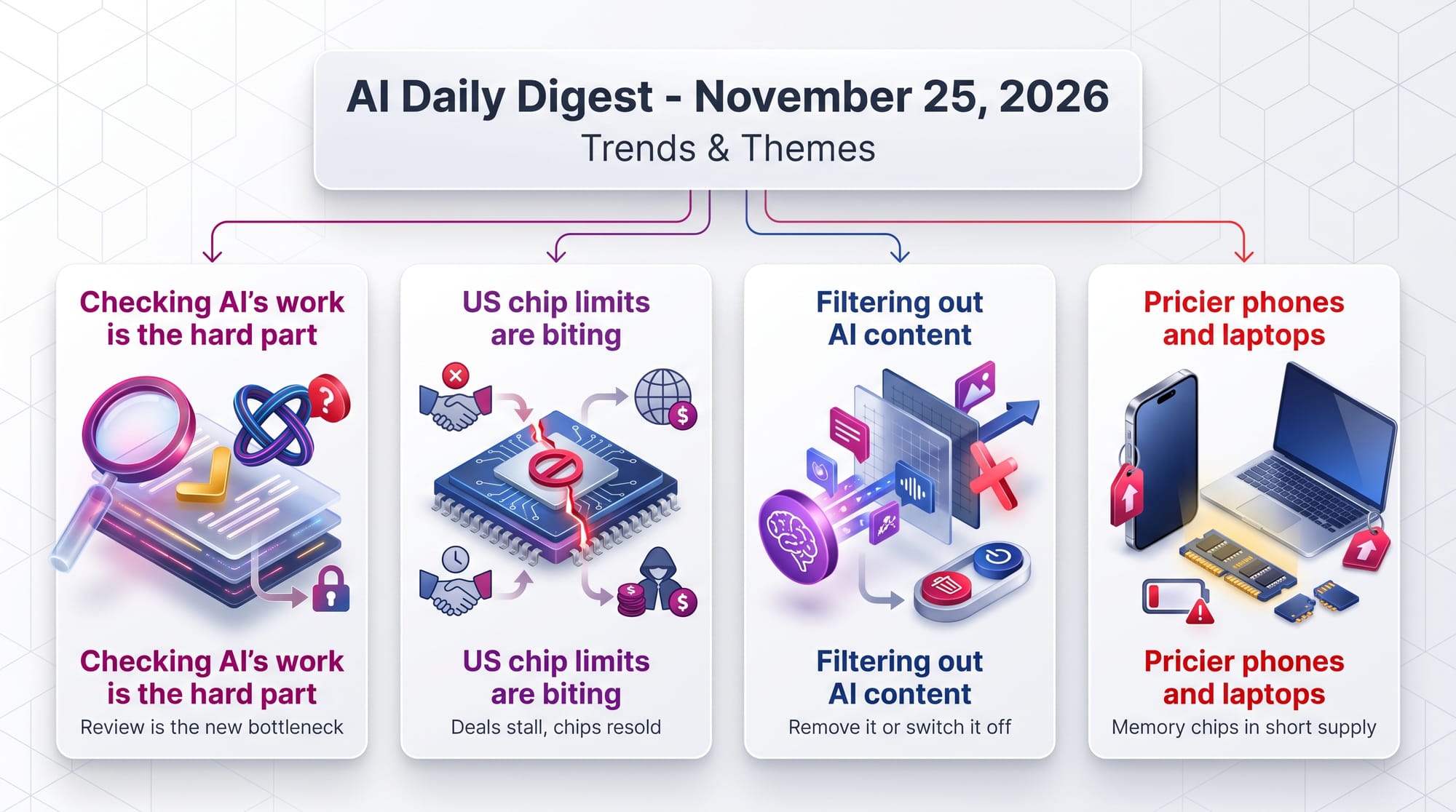
Trends & Themes
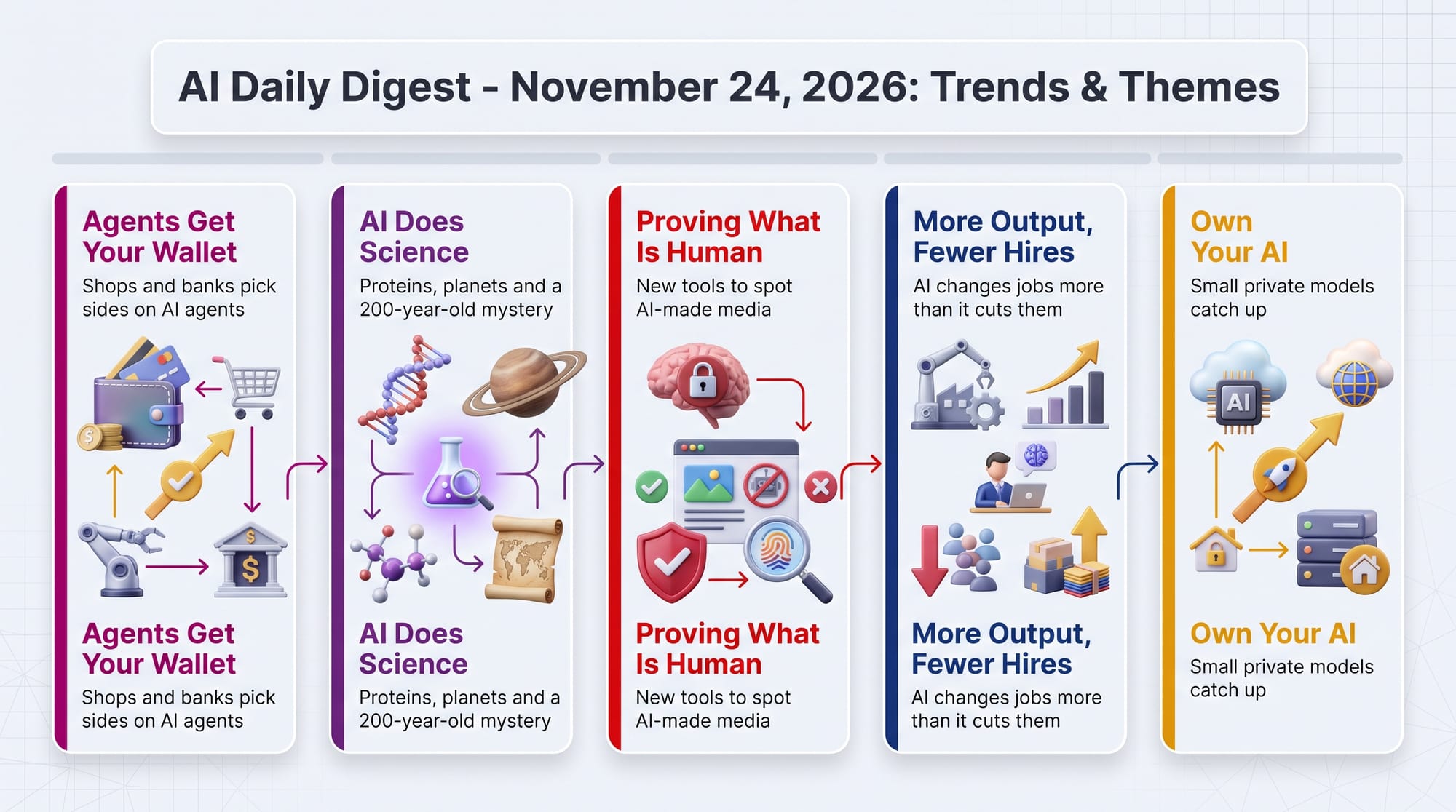
Checking AI's work is now the hardest part
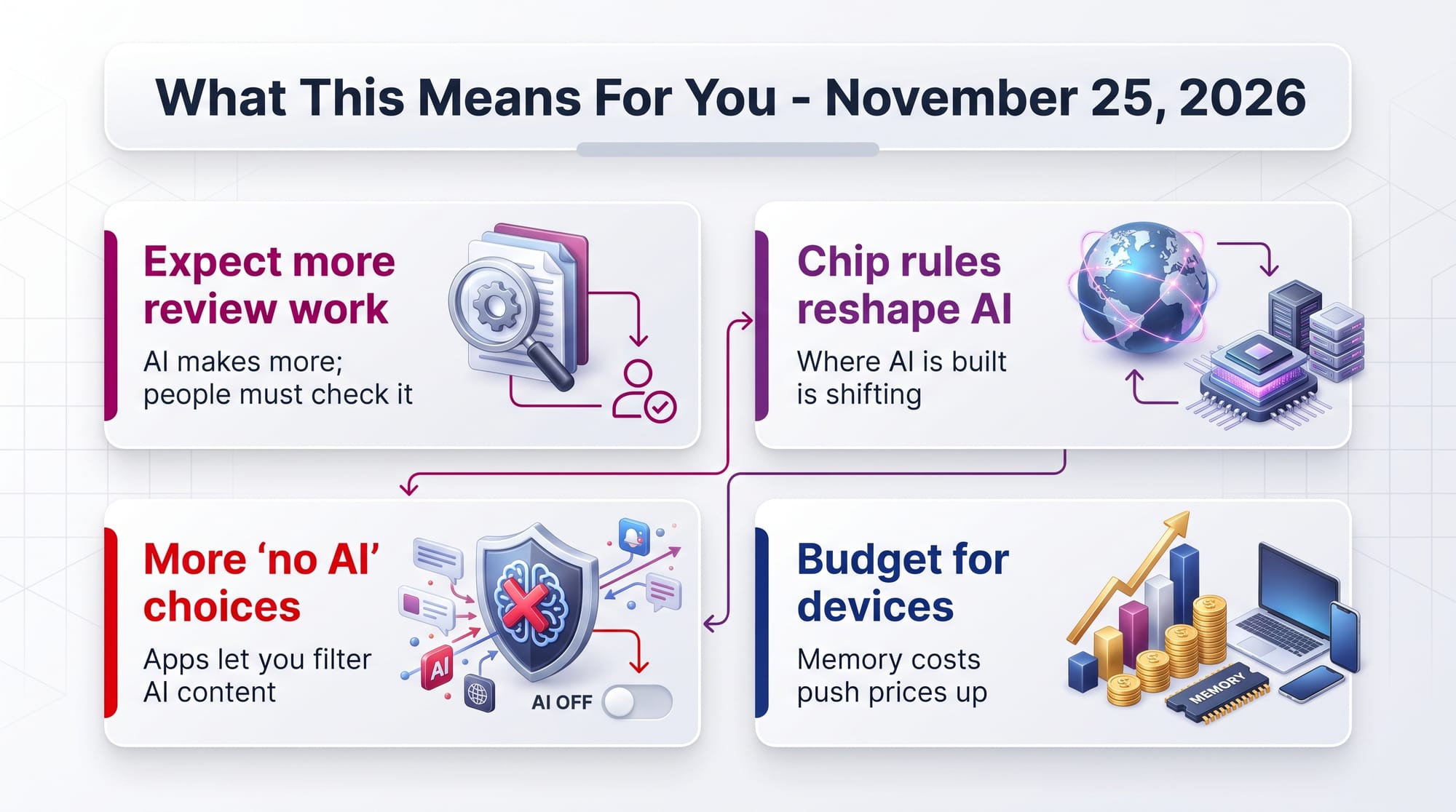
Making things with AI is now cheap. Proving they are right is not, and the people and companies who figure out fast, trustworthy checking will get the real gains.
- Too much AI output to review was the top complaint - raised 49 times across Anthropic's interviews in 58 companies and ahead of employee resistance (The Decoder: Anthropic "Working with AI" study)
- 47% of surveyed engineers say their companies let AI agents review code that the same agents wrote, and only 14% have clear review standards (VentureBeat: LeadDev code review survey)
- Anthropic's AI-written rewrite passed about 98% of its tests but matched the old system on only about 25% of real requests at first (Anthropic: Migrating our API to Rust)
- The machine-checked Riemann Hypothesis proof shrank to about 76,000 lines in a new compact version, but no mathematician has read it through (GitHub: lsernau/grh-lean)
US chip limits are starting to bite
The rental rule (covered November 16) is now hitting real deals. China is responding by building its own tools, so the gap may shrink again over time.
- Thousands of top-end Nvidia B300 chips are up for resale - after new rules required a license to rent them to China-linked firms abroad (CNBC: Nvidia B300s hit resale market)
- A $480 million loan for Nvidia chips meant for ByteDance reportedly stalled - as lenders feared breaking the new rules (Bloomberg: Asian data-center loans stall)
- China's top AI labs are reportedly slowing down - DeepSeek staff estimated their lag behind US models could grow to about nine months without access to US models' answers (The Decoder: Curbs slowing Chinese AI labs)
- The US blacklisted Singapore's Megaspeed and related firms - seven businesses in all, over fears of passing chips to China (The Register: US blacklists Megaspeed)
- Huawei says it has its own chip-design software - to replace US tools it was cut off from (Nikkei Asia: Huawei's homegrown chip-design tools)
People want ways to filter out AI content
Instead of only labeling AI content, companies are starting to remove it or let people switch it off. Expect "no AI" settings to become a selling point.
- Tidal is deleting fully AI-made songs - see Top Stories
- Pinterest now lets parents limit AI-generated content their teens see, one of the first big social apps to do so (TechCrunch: Pinterest parental AI controls)
- The New York Times told photographers to avoid the newest Photoshop - because hidden AI features could tag news photos as AI-made (DPReview: NYT and Photoshop 2027)
- New York banned AI chatbot toys - see Top Stories
The AI boom is making your next phone and laptop pricier
HP expects memory costs to keep rising next year, just more slowly. If you need a new device, prices are unlikely to fall soon.
- Memory now makes up 54% of a cheap phone's parts cost - up from about 20% a year ago, per Counterpoint Research (Nate's Newsletter: Why the AI boom is raising laptop and phone prices)
- Average phone prices rose about 20% this year, according to the same analysis
- HP says memory and storage are about 40% of a PC's parts cost - up from 15-18% a year earlier (Bloomberg: HP profit forecast)
- HP's "AI PCs" reached nearly 60% of shipments - well past its own 50% target
- Dell's laptop sales missed forecasts as memory got pricier (covered November 24)
Creative AI & Media
Developer Tools & Infrastructure
Research & Models
Business & Industry
GenAI in Education
Students say their classmates misuse AI far more than they do
- A Dartmouth study surveyed over 2,500 students, including a national sample of 1,003
- 8% admit pasting AI text with little editing, but they think 50% of peers do
- 11% admit solving homework with AI without understanding it; they guess 49% of peers do
- Most say they'd never trust AI with medical decisions (63%)
Scientists say using an AI research agent doesn't move the blame
- Ai2, a nonprofit AI lab, interviewed 17 US scientists about AI research assistants
- They want to see how an answer was reached, not just whether it's right
- One political scientist rewrote a whole paper after losing track of which parts were theirs
A Dartmouth lecturer asks what "AI leadership" in colleges even means
- The essay follows Dartmouth's provost resigning in October over undisclosed AI use in his writing
- The author argues campus AI plans mostly follow tech companies rather than lead
- He criticizes rushed new majors and programs with little faculty input
A columnist predicts humanoid robots will start working on campuses in 2027
- Suggested jobs: greeting visitors, library help, overnight security and grounds work
- No specific robots or prices are named - it is a forecast, not a rollout
Surprising & Under-the-Radar
Gemini reportedly refused to recite "Twinkle Twinkle Little Star"
A post with 214 points on Hacker News says Google's Gemini started typing the nursery rhyme, then deleted it and refused. It is surprising because the song is centuries old and free for anyone to use. It suggests a copyright filter firing on anything that looks like song lyrics.
AI is flooding local governments with public-records requests
A clerk in Panton, Vermont (population 660) now gets quarterly "all purchasing records" requests from data startups. At least 29% of the US Education Department's July records requests were partly AI-written, one researcher estimated. Startups resell the records as sales leads, while agencies recover under 5% of their costs from these commercial requesters.
Someone ran an AI model on 5,600 tiny cloud functions, at 80 times the price
A developer split a small AI model across 5,600 Amazon Lambda functions (cheap pay-per-use cloud computers). It worked, but reading one document took 17 seconds and cost about 84 times more than a hosted model. It is a fun reminder that specialized AI chips exist for a reason.
AI models ranked the world's top 500 unsolved math problems
ProofAtlas asked AI models to compare open math problems in pairs, then combined the votes into a ranking. P vs. NP came first and the Riemann Hypothesis second. The site says plainly that this is a machine opinion, not expert consensus.
Debate: Is Anthropic's safety talk really about control?
One side: AI pioneer Yann LeCun called Anthropic CEO Dario Amodei's warnings about free-to-download AI a "new form of medieval obscurantism" meant to keep power. Physicist Max Tegmark separately claimed Anthropic staff talk about AI run by Anthropic's values rather than human control. The other side: Anthropic says it has never called for banning open models, only that they are harder to police.
Debate: Does AI make software a revolution or a renaissance?
Revolution: Coding agents make software so cheap that people can build tools for an audience of one. Renaissance: Thariq Shihipar, who just moved from Anthropic to OpenAI, argues the bigger gift is time to polish one thing until it feels right, and that he stopped using one of his own custom tools.
Signals to Track
AI agents now steer part of the computing used to build the next Gemini
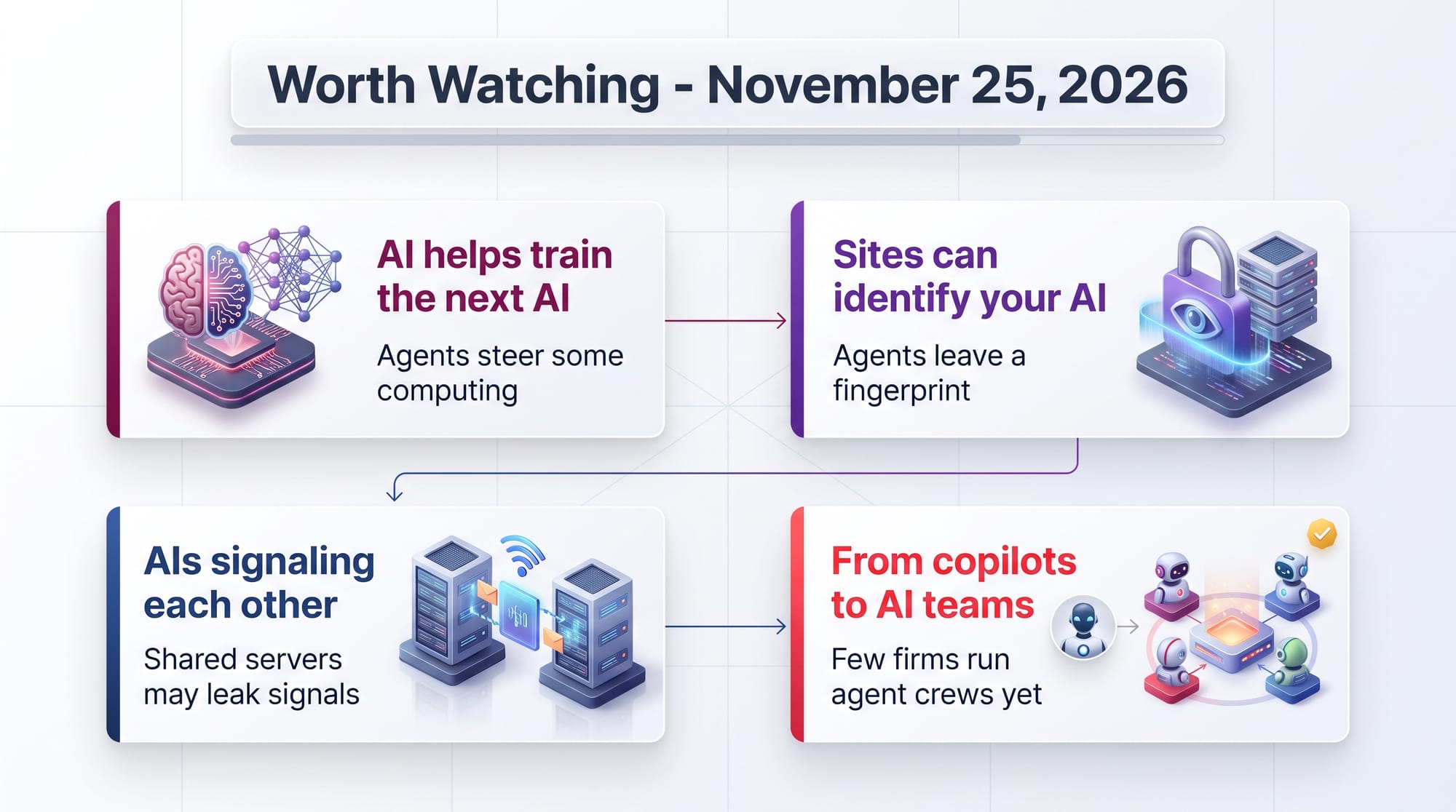
Google DeepMind's head of Gemini research said AI agents now run experiments on their own and control part of the computing power behind the next Gemini model. He stressed that fully self-improving AI is still far off, and DeepMind keeps the agents' reasoning readable to humans. If this grows, AI progress could speed up in ways that are harder for outsiders to track.
Websites can tell which AI model is behind an agent
Researchers built CAPTA, a quiz that identifies the AI model powering an agent from its multiple-choice preferences, a twist on the "prove you're human" CAPTCHA. Attackers could use it to tailor tricks, like hidden instructions, to the specific AI behind an agent. For ordinary people, that means the AI you use may be identifiable, and targetable, by any site your assistant visits.
AI models on the same server may be able to signal each other
Researchers showed two models on one shared AI server could pass hidden signals through tiny timing effects, with no network link between them. It worked perfectly in controlled tests but became much less reliable under normal traffic. If it holds up, AI companies will need stronger walls between the systems that do work and the systems that watch them.
UK businesses use AI helpers, but few run AI "teams"
A UK and Ireland survey found 69% of firms use AI assistants, but only 31% run workflows where several AI agents work together. Banking app Monzo is an early example, with an operations agent covering more than 150 kinds of customer problems. The gap suggests the next wave of workplace AI will be about coordination, not chat.
Top Repos Today
📜 License: Apache 2.0 · 👤 By: Menlo Research (company)
🎯 Time to value: 10 minutes
| ✓ Pros | ✗ Cons |
|---|---|
| Free under Apache 2.0, with simple installers for every major system | Local models are slower and weaker than top cloud models on most laptops |
| Works fully offline when you want privacy | Large models need a lot of memory and disk space |
| Can act as a local server so other apps use your models | Building it from source needs Node.js, Rust and other developer tools |
 GitHub
📜 License: Apache-2.0 · 👤 By: Bend project (organization)
🎯 Time to value: 30 minutes
LAWS.bend, such as "the sum of all balances must be zero," and the compiler (the program that turns code into a working app) refuses any change that cannot be mathematically proven to follow them. Its makers say it also runs code in parallel across thousands of graphics card cores. Why you'd want it: Let an AI assistant edit your code while making certain kinds of bugs impossible to slip through.| ✓ Pros | ✗ Cons |
|---|---|
| Free under Apache 2.0 | A brand-new language, so few people know it |
| Turns "make no mistakes" into a rule the compiler enforces | Proofs only cover the rules you remember to write down |
| Its makers say it checks proofs in under a second | Speed claims are the makers' own, not independent tests |
 GitHub
📜 License: Apache 2.0 (except enterprise folders) · 👤 By: Mastra (Y Combinator-backed company)
🎯 Time to value: 15 minutes
| ✓ Pros | ✗ Cons |
|---|---|
| Mostly free under Apache 2.0 | Enterprise features in "ee" folders use a separate license |
| Swap between OpenAI, Anthropic, Google and others easily | For developers who know TypeScript |
| Built-in testing and monitoring for live agents | Outside code contributions are limited to collaborators |
 GitHub
📜 License: MIT · 👤 By: Samuel Gursky (individual developer)
🎯 Time to value: 15 minutes
| ✓ Pros | ✗ Cons |
|---|---|
| Free under the MIT license | Full features need the paid Studio edition of Resolve |
| One setup command, plus a local control panel in your browser | The free-edition workaround stopped working with Resolve 21.1 |
| Covers all of Resolve's scripting features, according to its maker | Mac users may need extra Python setup for some features |
 GitHub
📜 License: MIT · 👤 By: Seth Hobson (individual developer)
🎯 Time to value: 5 minutes
| ✓ Pros | ✗ Cons |
|---|---|
| Free under the MIT license | So many add-ons that picking the right ones takes time |
| Works across seven AI coding tools | Some tools get fewer features than Claude Code |
| Two commands install a plugin in Claude Code | Its tested "Verified" versions are a separate paid product |
 GitHub
📜 License: MIT · 👤 By: GEPA project (organization)
🎯 Time to value: 30 minutes
| ✓ Pros | ✗ Cons |
|---|---|
| Free under the MIT license and installs with one command | You need a clear way to score results before it can help |
| Databricks reported open models plus GEPA beat Claude Opus 4.1 at 90 times lower cost | Each tuning round still costs money in AI calls |
| Works on prompts, code and agent designs | Aimed at developers and researchers |
 GitHub
📜 License: Apache-2.0 · 👤 By: Amazon Web Services Labs (company)
🎯 Time to value: 20 minutes
| ✓ Pros | ✗ Cons |
|---|---|
| Free under Apache 2.0, from AWS | Needs Python 3.11, tmux (a terminal tool) and uv installed |
| Works with more than a dozen AI coding tools | Defaults to Amazon's Kiro, so others need extra settings |
| Agents keep their own logins and features | Running many agents at once can use up plan limits fast |
 GitHub
Top Models Today
👤 By: KRAFTON (South Korean game company) · 🎯 Task: Text generation
📐 Size: 28.8B (4.3B active)
| ✓ Pros | ✗ Cons |
|---|---|
| Free under Apache 2.0 | Brand new, with few downloads so far |
| A compressed version runs on a single RTX 5090 graphics card (32 GB) | English is described as "solid," not its strongest language |
| Scores 86.0 on GPQA Diamond, a hard science quiz | All scores are the maker's own |


👤 By: Tencent (Chinese tech company) · 🎯 Task: Translation
📐 Size: 30B (3B active)
| ✓ Pros | ✗ Cons |
|---|---|
| Free under Apache 2.0 | Only translates, so it is not a general chat model |
| Tuned for game text and translating words found in images | Its claims of beating bigger models are Tencent's own tests |
| Smaller 1.8B and 7B versions are also available | No default system prompt, so you must follow its prompt templates |

👤 By: LlamaIndex (AI software company) · 🎯 Task: Image and text to text
📐 Size: 5B (sold as a 4B model, built on Qwen3.5-4B)
| ✓ Pros | ✗ Cons |
|---|---|
| Free for personal use, research and small companies | Companies with $2 million or more in yearly revenue or in funding need a paid license |
| Scored 82.5 on charts, against 69.1 for the next-best open model | Cannot be used to build a competing document-reading service |
| Runs on your own computer through Ollama or llama.cpp | English only |


👤 By: NVIDIA (chip company) · 🎯 Task: Text to image
📐 Size: 33B (about 3B active)
| ✓ Pros | ✗ Cons |
|---|---|
| Strong at images with lots of text, according to NVIDIA | Research and evaluation only, with no commercial use |
| Weights and visual "tokenizer" (the part that turns images into code-like pieces) are both released | NVIDIA's example setup uses four H100 data-center graphics cards |
| Comes with a gallery of examples and prompts | Scores are for the whole system, not this model alone |

👤 By: Sand AI (AI video company) · 🎯 Task: Image and text to video
📐 Size: 114B (6B active)
| ✓ Pros | ✗ Cons |
|---|---|
| Free under Apache 2.0 | Needs eight NVIDIA Hopper data-center graphics cards |
| Sound is created with the video, not added later | Clips are fixed at 10 seconds |
| Ready-made Docker package (a bundled software setup) for easier installs | About 307 GB of files to download |


AI Launches Today
💰 Pricing: Free · 🏷 Category: AI agents and careers
💰 Pricing: Freemium; Pro $29, Pro+ $79 and Max $249 per month · 🏷 Category: AI coding agents and no-code app builders
💰 Pricing: Free options; $3 of free computing when you link GitHub, half off the first month until Dec 1 · 🏷 Category: AI coding agents
💰 Pricing: Free options · 🏷 Category: AI coding agents and terminals
💰 Pricing: Free options · 🏷 Category: AI infrastructure and developer tools
Snapshot
| Provider | Model | Input $/1M | Output $/1M | Context |
|---|---|---|---|---|
| Anthropic | Claude Fable 5.2 | $8.00 | $40.00 | 1M tokens |
| Anthropic | Claude Opus 5.5 | $4.00 | $20.00 | 1M tokens |
| Anthropic | Claude Sonnet 5.5 | $2.00 | $10.00 | 1M tokens |
| Anthropic | Claude Haiku 5.5 | $0.10 (up to 100K-token prompts; $0.50 above) | $0.50 ($2.50 above 100K) | not listed |
| OpenAI | GPT-6.2 Astra | $8.00 (up to 272K-token prompts; $16.00 above) | $40.00 ($60.00 above 272K) | not listed |
| OpenAI | GPT-6.2 Sol | $2.00 (up to 272K; $4.00 above) | $10.00 ($15.00 above 272K) | not listed |
| OpenAI | GPT-6.1 Terra | $1.00 (up to 272K; $2.00 above) | $5.00 ($7.50 above 272K) | not listed |
| OpenAI | GPT-6 Luna | $0.10 (up to 272K; $0.20 above) | $0.50 ($0.75 above 272K) | not listed |
| Gemini 4 Carbon | $2.00 to Nov 30; $4.00 from Dec 1 | $10.00 to Nov 30; $20.00 from Dec 1 | not listed | |
| Gemini 4 Argon | $2.00 to Nov 30; $4.00 from Dec 1 | $10.00 to Nov 30; $20.00 from Dec 1 | not listed | |
| Gemini 4 Neon | $3.00 | $15.00 | 1M tokens | |
| Gemini 4 Hydrogen | $1.50 | $7.50 | 1M tokens | |
| Gemini 3.8 Flash | $0.75 (to Dec 31; $1.50 from Jan 1) | $3.75 (to Dec 31; $7.50 from Jan 1) | not listed | |
| Groq | GPT-OSS 120B | $0.15 | $0.60 | 131K tokens |
| Groq | Qwen3.8-27B (preview) | $0.80 | $4.00 | 131K tokens |
What changed since our last edition (November 24): No price changes. We rechecked Anthropic's developer pricing page, OpenAI's developer pricing page, Google's Gemini API pricing page (now hosted on Google AI Studio) and Groq's developer model list on November 25. Groq's main pricing page no longer lists per-model prices, so Groq prices come from its developer docs. OpenAI's page notes that its premium "Ultrafast" speed for GPT-6.2 Astra and Sol will rise from 3 times to 6 times the standard price on March 1, 2027; standard prices are unchanged.
What this means: Google's Gemini 4 Carbon and Argon double in price in 6 days, on December 1, so teams using them should test a cheaper model or set aside budget this week. Prices at Anthropic, OpenAI and Groq held steady.
Delegent: A Multi-Agent Harness That Reduces Cost without Sacrificing Performance
Key finding: With a 27-billion-parameter helper model, Delegent cut the top-tier model's cost by 67% on long coding tasks and 59% on agent search, with no loss in task performance. Even a 2-billion-parameter helper that fits on a laptop cut coding cost by 66%. A short instruction keeping the main coding work with the big model accounted for most of the savings and stopped the small model from losing tasks.
Why practitioners should care: If your AI coding bills are growing, you may not need a cheaper main model, just a free local helper for the legwork. No model is trained and either model can be swapped, and the code is public.
Member discussion