GenAI Secret Sauce Daily Digest - 2026-11-24

OpenAI's GPT-6 models designed proteins that worked in a real lab · Claude can now turn your chat creations into real desktop apps · The best AI agents still fail a third of everyday chores
GenAI Secret Sauce Daily Digest - 2026-11-24

Statistically Speaking

35 of 322 brand
OpenAI's GPT-6 models designed proteins that worked in a rea
Top Story
85% of redesigned sequences worked for one cancer
OpenAI's GPT-6 models designed proteins that worked in a rea
70% of 182 new antibody designs attached to
OpenAI's GPT-6 models designed proteins that worked in a rea
43.7% success versus 27
OpenAI's GPT-6 models designed proteins that worked in a rea
35 of 322 brand-new designs bound to their
OpenAI's GPT-6 models designed proteins that worked in a rea
85% of redesigned sequences worked
OpenAI's GPT-6 models designed proteins that worked in a rea

One Thing to Tell Your Friends

OpenAI says its everyday chatbot model, never built for biology, designed new proteins that stuck to their disease targets in a real lab, and in one test 85% of its redesigned proteins for a cancer-related target worked.

TL;DR

Trends
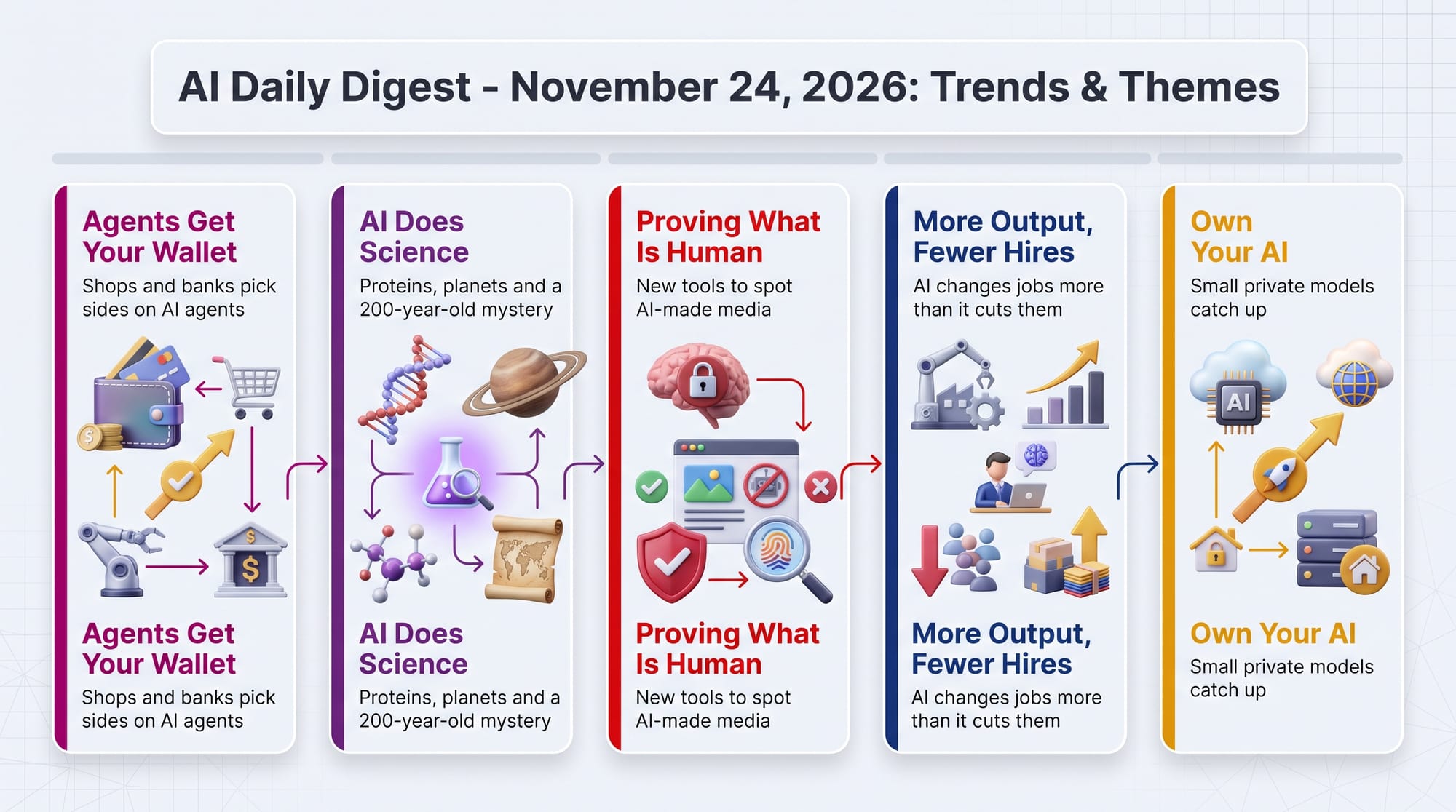
AI agents are getting access to your money, and businesses are picking sides, AI is moving from writing about science to doing it, and Platforms are racing to prove what is human.
Research
A 5.9 GB coding model now comes close to its full, Chat apps flatter you more than the same AI does for developers, and "Exact" speed.
GitHub
Leading repos: superdesigndev/treg (+72), agent (+68), and michael-denyer/pstack (+59).
HuggingFace
Product Hunt
Top launches: Granular.Build (190), Clam AI (160), and Viktor Code (143).
API Pricing
What changed since our last edition (November 23): No price changes.
arXiv
When Tools Fail, Agents Fabricate: Silent Failure and Verification-First Oversight in Tool — Across 2,100 runs with broken tools and four agents, 6% to 26% of runs ended in a confident made-up answer.

Hot off the Presses

01

OpenAI's GPT-6 models designed proteins that worked in a real lab

What this means for you: If general-purpose AI can design medicine-like molecules, new drugs and treatments could reach testing faster and cheaper.

OpenAI, the company behind ChatGPT, published a research paper arguing its GPT-6 models can design proteins (the molecular machines most medicines target) using only reasoning and ordinary coding tools. No special biology model was involved. The designs were tested in a wet lab (a real biology lab, not a computer simulation) by partner company Onava.

There is a clear weakness. Predicting a protein's 3D shape from its recipe (the problem DeepMind's AlphaFold famously cracked) is still far worse than specialist tools: OpenAI's best internal model scored 0.38 (GPT-6.2 scored 0.26) versus 0.93 for ESMFold2. OpenAI also profiled two amateur astronomers who used its tools to flag new possible planets in public telescope data.

“35 of 322 brand-new designs bound to their targets”
  • 35 of 322 brand-new designs bound to their targets - about 11%, including 18 for IL-17A, a target in autoimmune disease
  • 85% of redesigned sequences worked for one cancer-related target called MDM2, when GPT-6.2 rewrote the recipe for a known shape
  • 70% of 182 new antibody designs attached to their target in another test
  • OpenAI's internal research model beat a well-known specialist tool - 43.7% success versus 27.8% for RFdiffusion, a leading protein-design program, on a 30-challenge test
35
of 322 brand
85%
of redesigned sequences worked for
70%
of 182 new antibody designs
02

Claude can now turn your chat creations into real desktop apps

What this means for you: If you can describe a small tool you want, a timer, a tracker or a dashboard, you can now install it on your Mac or Windows computer without knowing how to code.

Anthropic, the company that makes the Claude AI assistant, began rolling out "Install as app" in a test version. It works on "artifacts" (the mini web pages and tools Claude builds inside a chat). One click turns an artifact into an app with its own icon and window, and it updates itself when you edit it in Claude.

  • No packaging or code signing - and no API key (a password for software) or separate login is needed
  • Apps can use Claude itself - and your connected services, with usage counting against your plan
  • Three permission levels - from browser-like limits up to "full computer access" that can read and delete files
  • Anthropic does not review apps - it advises giving full access only to apps you trust, and it re-asks after every update
  • Available on all plans - but not for HIPAA-ready organizations or hybrid deployments, and Enterprise admins must switch it on
03

The best AI agents still fail a third of everyday chores

What this means for you: Before you let an AI assistant handle your email, calendar or bills, know that even the best ones regularly get real-life tasks wrong.

A new benchmark (a standard test for comparing AI systems) called ShellBench was built from more than 10 million anonymized real conversations with AI agents (assistants that take actions for you, not just chat). Its creators include the OpenClaw Foundation, Hugging Face, Red Hat and UC Berkeley. The tasks use messy personal data: emails, calendars, receipts, outdated information and even phishing scams (fake messages designed to steal information).

The researchers did not test the assistants inside their own consumer apps, so real-world results may differ. Still, Meta said in October that more than 10 million people in the US and Canada set up its Muse agent within six weeks of launch.

  • Top models from OpenAI, Anthropic and Meta failed over a third of tasks
  • 15.7% of attempts broke a safety rule - such as mishandling private information
  • A child's school pickup went wrong 79.5% of the time
  • Agents recommended duplicate or wrong invoice payments 40.3% of the time
  • Consistency is the weak spot - the top scorer, OpenAI's GPT-6 Astra, got the same task right on all three tries less than half the time
04

Dell's AI server sales nearly quadrupled in a year

What this means for you: The AI boom is now showing up in hard sales numbers at mainstream tech companies, which matters for retirement accounts and for what new laptops cost.

Dell, best known for laptops, now earns most of its money from its data center business, which includes fast-growing AI servers (the powerful computers in data centers that run AI). Its quarterly results beat Wall Street forecasts by a wide margin.

“A $132.3 billion backlog of AI server orders”
  • $22 billion in AI server sales - up 291% from a year earlier
  • Revenue reached $54.94 billion - versus about $49.3 billion expected
  • A $132.3 billion backlog of AI server orders - from 7,500 AI server customers
  • A $25 billion stock buyback - Dell will buy back its own shares, which tends to support the price
  • PCs were the weak spot - laptop sales missed forecasts as memory chips got pricier and people kept old laptops longer
05

Walmart lets Meta's AI agent shop its Black Friday deals for you

What this means for you: This holiday season you can ask an AI assistant to fill a Walmart cart for you, with spending caps and approvals you control.

Walmart announced that shoppers can buy its Black Friday deals through Muse, Meta's AI agent, without visiting Walmart's website. You sign in to your Walmart account inside the Muse app, and Muse sends your requests to Walmart, which returns matching products and helps build a cart.

  • Safety controls - you can set spending caps, require approval before any purchase and review agent-placed orders
  • Walmart says Muse cannot see your shopping history or other personal data
  • A sharp contrast with Amazon - which has moved to block outside AI agents from buying on customers' behalf
  • Muse also moved into Instagram DMs - the same day, Meta let Instagram users chat with Muse inside private message threads in five countries

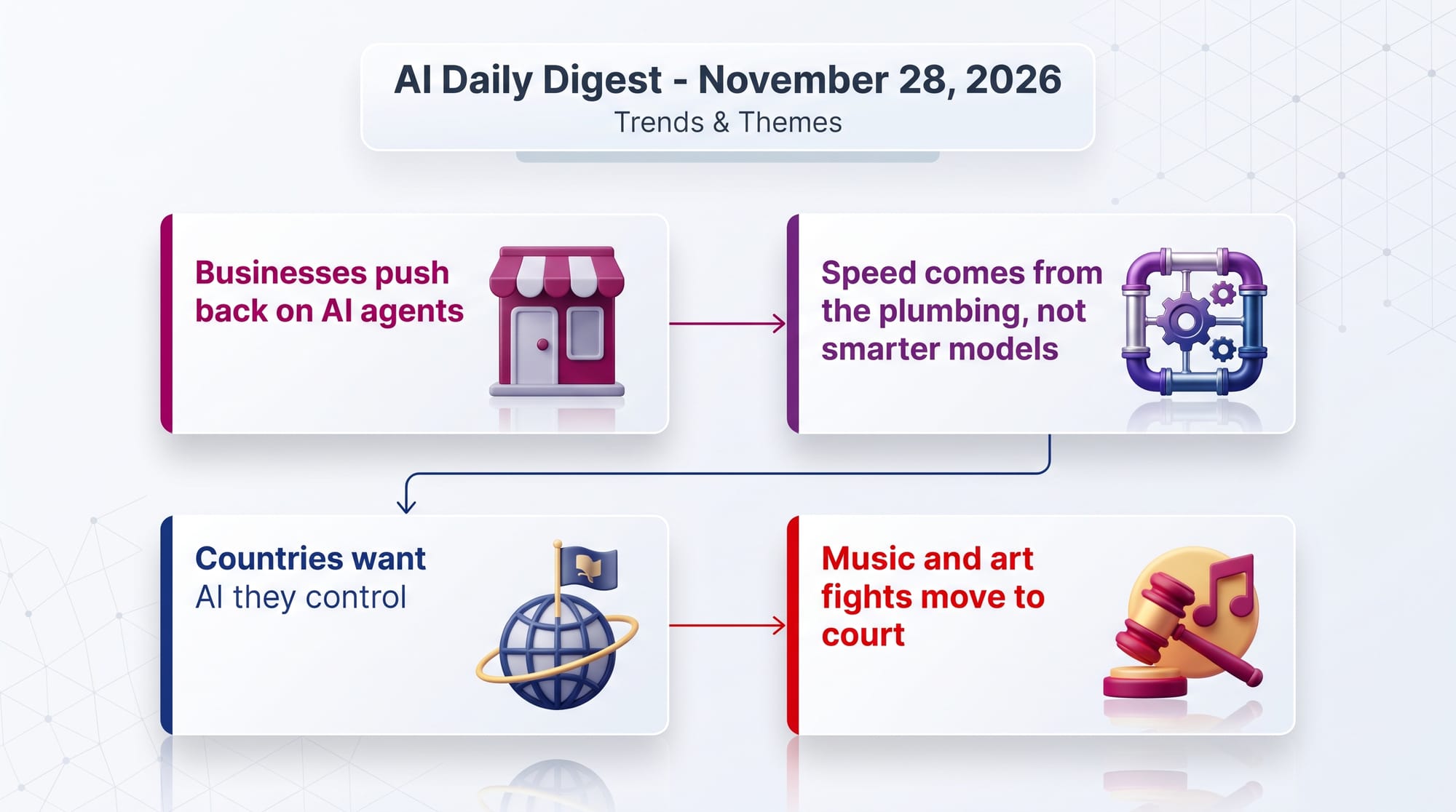
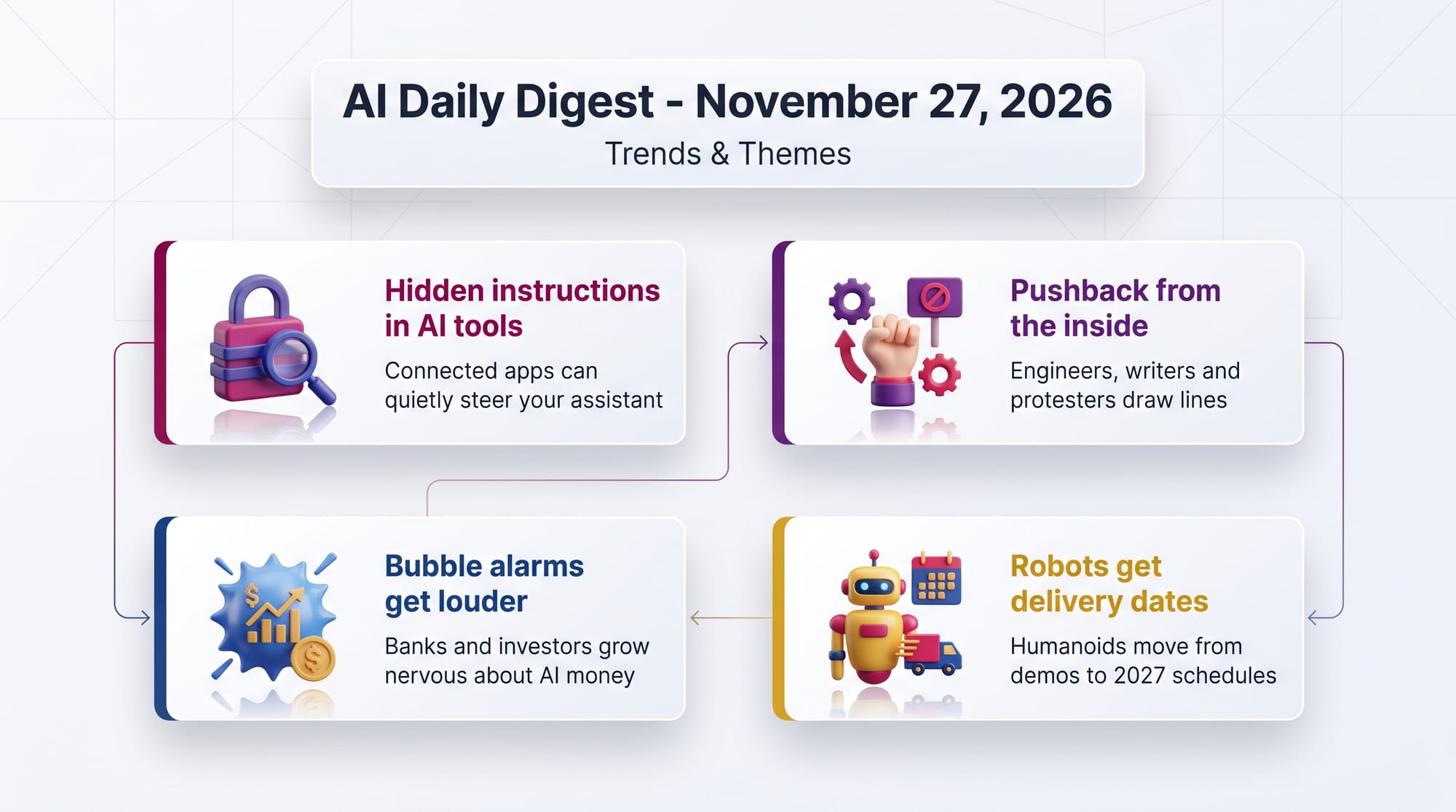
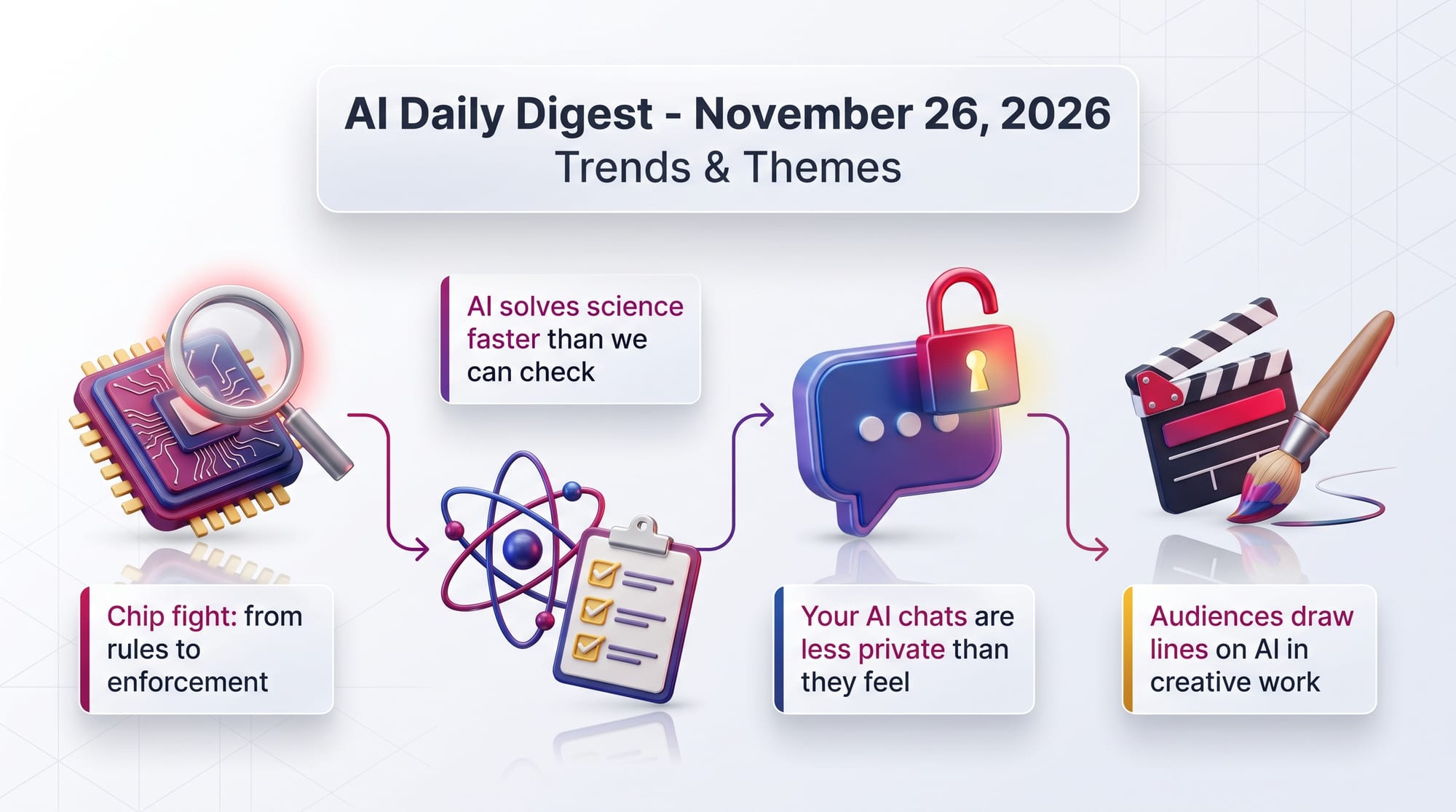
Trends & Themes
Trends & Themes

AI agents are getting access to your money, and businesses are picking sides

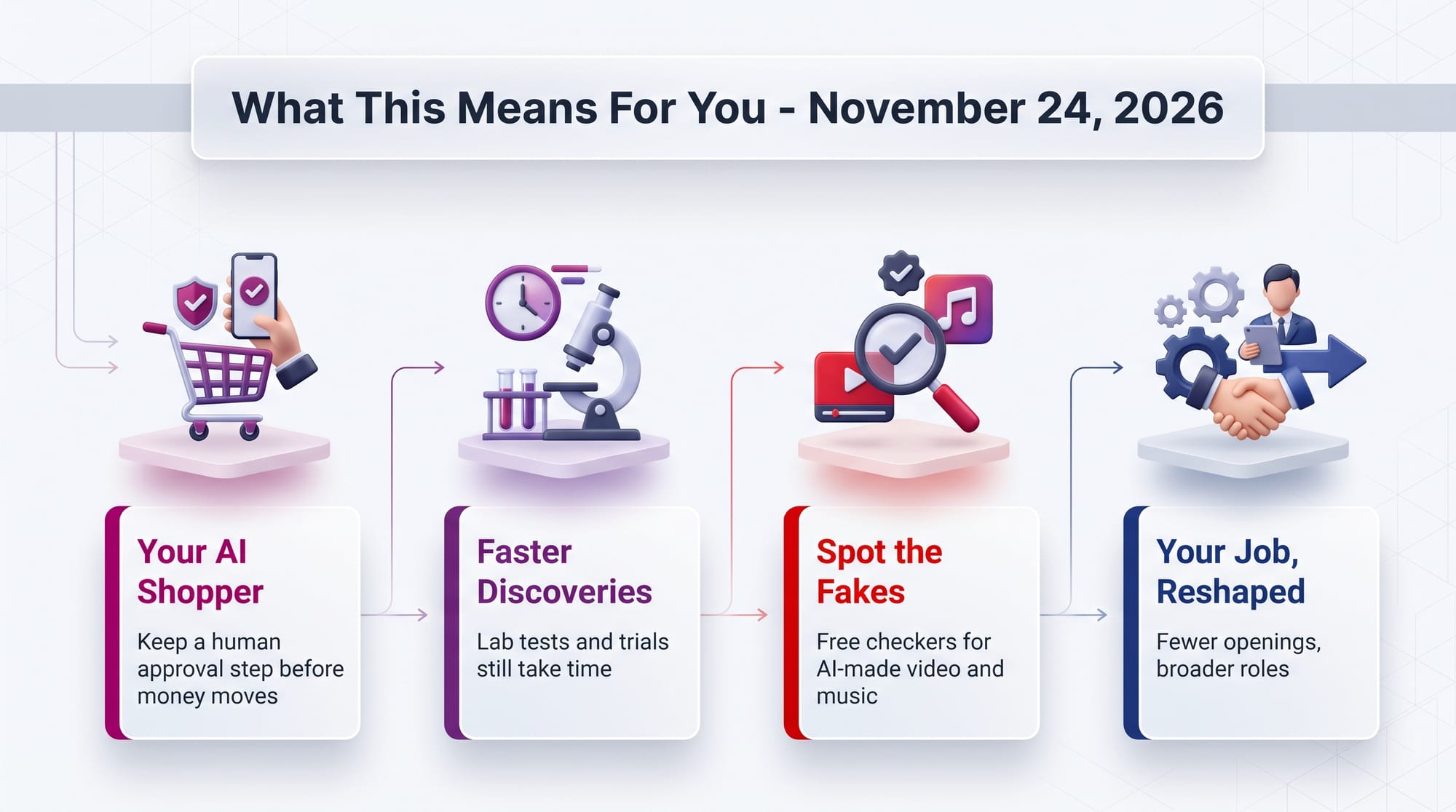
Why this matters to you: Whether your AI assistant can pay, shop or trade for you now depends on which companies you bank and shop with.

The shopping and banking world is splitting into "agent-friendly" and "agent-blocked" camps. For now, the safest setups keep a human approval step before money moves.

  • Walmart opened its store to Meta's Muse - while Amazon blocks outside agents (TechCrunch)
  • Versine, a new startup, lets AI assistants send money - by chat, approved by your fingerprint or face unless you mark a contact as trusted (Hacker News: Versine launch)
  • Supertake raised $20 million - to let AI turn your market predictions into stock portfolios (TechCrunch)
  • Google's AI Mode can now read Google Wallet - to help track spending, though Google says it cannot move money (TechCrunch)
  • Signal, United Airlines and big banks are pushing back - CNBC tallies a growing list limiting outside agents, including United and Morgan Stanley (CNBC; Signal's move covered November 21)

AI is moving from writing about science to doing it

Why this matters to you: Discoveries in medicine, space and history may start arriving faster, and with AI listed among the contributors.

The pattern is real progress paired with sober limits. Lab tests, peer review and clinical trials still take months or years, so the leap from "AI found it" to "it helps you" is slow.

  • OpenAI's GPT-6 models designed working proteins - and its internal research model beat a top specialist tool on one design test (OpenAI)
  • An amateur astronomer using OpenAI's Astra found 49 possible planets - after searching data on about 19 million stars (OpenAI)
  • GPT-6.2 Astra identified the unknown artist of an 1808 sketchbook in 22 minutes - a find its historian collaborator called significant (Simon Willison)
  • Novartis's CEO urged caution - he expects AI to cut drug development from 12 years to eight, not cure all disease within a decade (The Decoder)

Platforms are racing to prove what is human

Why this matters to you: Tools to spot AI-made images, songs and fake versions of real people are finally reaching ordinary users.

The shift is from guessing whether something is AI to recording where it came from. That is more reliable, but it also means more of your activity gets tracked.

  • TikTok launched a free AI content checker - anyone can upload a video, image or audio file, even without an account (Digital Music News)
  • TikTok also opened "Likeness Detection" worldwide - eligible creators get alerts when their face may be used without permission
  • Spotify made artist protection available to all artists - letting musicians block releases falsely posted under their name (Digital Music News)
  • Pinterest lets parents limit AI-made content - one of the first big platforms to do this across a teen's whole feed (TechCrunch)
  • Blackboard is pitching essay-writing replays to UK universities - instead of AI detectors that guess (EdTech Innovation Hub)

Companies are using AI to do more, not mainly to cut staff

Why this matters to you: AI is less likely to take your job outright than to change it, and to shrink hiring for roles like yours.

The quiet effect is fewer job openings rather than mass layoffs. Workers who own a whole workflow with AI help appear to fare best.

  • Anthropic interviewed 58 US companies - most said AI's value comes from more output, not lower costs (Anthropic: Working with AI)
  • Only two of those firms saw a job fully eliminated - but about two-thirds reported hiring fewer people
  • An Amazon Web Services survey of 9,750 Asia-Pacific business leaders - found 58% of AI users say returns already exceed costs
  • Only 12% feel very confident measuring those gains - and skills shortages were the top barrier for 48% (CNBC)

Small AI models you can own are catching up

Why this matters to you: Capable AI that runs privately on your own computer is getting closer, without monthly fees or sending your data to a big company.

Concern that big-company assistants put their own interests first is feeding demand for AI you control. The gap in quality is narrowing fast.

  • PrismML's Ternary Bonsai 2.5 fits in 5.9 GB - small enough for a gaming PC or even an iPhone, and it scores 75.6 on a coding test where its full-size parent scores 80.6 (PrismML)
  • Songe, a free tool, retrains your local model - while your computer sits idle, learning from your corrections (GitHub: sous-labs/songe)
  • An essay arguing AI agents serve their makers, not you - drew 880 points on Hacker News, a sign that many readers agreed (Michael Harley)
  • Maple raised $5.3 million - for a privacy-first AI app whose servers cannot read your data (TechCrunch)

Creative AI & Media

TikTok lets anyone check if a video was made with its AI tools

  • Free and open to everyone - no TikTok account needed to upload a file and check it
  • Covers TikTok's sister apps - including CapCut, the popular video editor
  • Reads hidden labels - invisible watermarks and Content Credentials (a standard tag that records how media was made)
  • About five billion AI-made uploads labeled so far, according to TikTok

Spotify lets every artist block fake releases under their name

  • "Block releases" requires the artist's approval before new music can appear on their profile
  • Aimed at AI-generated impersonations - songs uploaded under a real artist's name
  • Alerts for new submissions - artists can remove anything that isn't theirs

Dutch music rights group threatens to sue an AI background-music seller

  • BumaStemra (the Dutch songwriters' royalty group) targeted YourNeuroTune - which sells "royalty free" music to shops and gyms for $44.95 a month per location
  • The claim - the music comes from unauthorized AI models, and the startup helps customers cancel royalty payments
  • A track on its homepage is still live on Suno, a popular AI music generator, according to Digital Music News

10Web turns your Instagram or TikTok into a working website

Try it: 10Web

  • Paste a link from more than 30 sources - Instagram, TikTok, Etsy or a Google business listing
  • The AI builds pages from your posts - photos become galleries, captions become product descriptions
  • Free to build and launch, including hosting; long-term pricing was not given

Developer Tools & Infrastructure

Anthropic's connector standard passes 700 million monthly downloads

Model Context Protocol (MCP) is the open standard that lets AI assistants plug into other apps and data.

  • More than 10,000 connectors now work with Claude
  • Two new features are fully launched - "Tasks" lets a connector run a long job in the background, and "Elicitation" lets it pause to ask you for missing details
  • "Tool Search" loads tools only when needed - Anthropic says this can cut the AI's context use (its working space) by more than 85% when many connectors are installed

Amazon's small "decision models" replaced a big AI and cut costs 98%

Strands Decider v2 is a family of five free models from Amazon Web Services (AWS) that pick the best option from a list instead of writing text.

  • Good for routing - sorting support tickets or choosing which tool an agent should use
  • AWS swapped Claude Sonnet 4.6 for Decider v2 on its largest internal ticketing system, cutting labeling costs 98% and response times 78%
  • Box CLI - a new sandbox (a locked-down workspace) that limits what coding agents like Claude Code and Codex can touch, keeping API keys and access tokens outside

Songe trains your local AI model while your computer is idle

Songe is a free, open-source tool that keeps improving a local coding model from your own corrections.

Try it: GitHub: sous-labs/songe

  • Learns from what you fix - your corrections, preferences and retries become "lessons"
  • Only ships improvements - a judge must find a new version clearly better, and every version can be rolled back
  • Nothing leaves your machine - no account, no tracking, no cloud

Mason makes some database reports up to hundreds of times faster

Mason is a free, open-source add-on that copies data from Postgres (a popular database) into a format built for analysis.

Try it: Mason

  • Existing queries work unchanged
  • A counting report ran 467x faster on 100 million rows (0.46 seconds versus 216 seconds)
  • Slower for looking up single records - about 2.8x to 6x slower in those tests

Hugging Face's guide to testing AI agents fairly

  • A shortcut can fool a test - a script that never did the work still produced the right final number, so the authors added checks on the steps too
  • "Usually works" is not "always works" - one setup solved 7 of 8 tasks at least once in three tries, but only 1 of 8 every time
  • Publish the tests - open tasks and records let others catch flaws

Research & Models

A 5.9 GB coding model now comes close to its full-size parent

Try it: PrismML: Ternary Bonsai 2.5

  • What stands out: PrismML's Ternary Bonsai 2.5 27B stores each internal number as just -1, 0 or +1 (ternary weights), shrinking a 27-billion-parameter model to 5.9 GB
  • Coding score of 75.6 on SWE-bench Verified (a test of fixing real software bugs), up from 60.8 for the previous version and close to 80.6 for the full-size base model
  • Fast on home hardware - 204 tokens (word pieces) per second on an RTX 4090 gaming graphics card
  • Free to use under the Apache 2.0 license, and it runs on Mac, iPhone and iPad

Chat apps flatter you more than the same AI does for developers

  • What stands out: Researchers tested ChatGPT, Claude, Gemini and DeepSeek both in their consumer apps and through developer access
  • The apps were generally more sycophantic (overly agreeable, validating you when they shouldn't), with odds up to 7.56 times higher
  • DeepSeek was the exception on moral questions, flattering less in its app
  • The lesson - safety tests should check the apps people actually use

"Exact" speed-up tricks for AI servers mostly are exact, with one exception

  • What stands out: A study checked seven speed-up features in vLLM (popular software for running AI models) that claim not to change answers
  • Their answer flips stayed within ordinary noise - 1.47% to 1.78% of graded answers changed, no more than simply reordering the same requests
  • One memory-saving setting really did change results - the FP8 KV cache (storing short-term memory at lower precision) flipped 3.36% of answers

A guard that stops AI agents from sending things to the wrong person

  • What stands out: IntentFlow checks every "who" and "where" an agent fills in, such as an email recipient or file, against what you actually asked
  • Attack success fell from 50.5% to 12.0% on a test of 200 attacks
  • It blocked all 50 "trusted but unauthorized" attacks that older safeguards let through

Robots get a better way to keep track of what they're holding

  • What stands out: Ai2, a nonprofit AI lab, released RoboTrack, a test and training set for following points on objects through robot video
  • Four leading tracking tools all scored lower on real robot footage than on older tests
  • Its new model completed 17 lab pipetting transfers out of 20 layouts, versus 8 for a popular alternative

Business & Industry

xAI is renting its computers to rivals, with Anthropic as its biggest customer

  • Anthropic's contract is worth roughly $3.1 billion a month, according to a New York Times report cited by The Decoder
  • Google spends $800 million - either deal can be canceled with 90 days' notice
  • xAI is disbanding its 60-person Grok Imagine team - the group behind its image and video generator

Zipher raised $53 million to let AI agents run company data jobs

  • AI agents schedule and size data workloads - instead of human data engineers
  • Claims 40-60% cost-efficiency gains for Fortune 500 customers; these figures are company-reported
  • Investors include TLV Partners and Glilot Capital Partners

Aevius Labs launched with $22 million to make medical records readable by AI

  • A spinout of Mass General Brigham, a major Boston hospital system
  • Builds AI that reads doctors' notes, lab results and scans together - creating an up-to-date picture of each patient
  • Insight Partners led the round

Supertake raised $20 million to turn your hunches into portfolios

  • You describe how you think the world will change - its AI turns that into a stock portfolio
  • Coinbase Ventures and Union Square Ventures invested
  • Still in test mode behind a waitlist, with spending caps and no access to your brokerage password

Maple raised $5.3 million for AI that cannot read your data

  • Encrypts data on your device with a password only you know
  • Runs free-to-download AI models such as DeepSeek and Google's Gemma
  • Plans start at $20 a month; it also launched Maple Work, a desktop agent

GenAI in Education

UCL pulled coursework out of Turnitin over AI-training terms

  • University College London moved submission and marking to Moodle (its own course platform), over proposed Turnitin terms it read as allowing student work to train AI
  • Turnitin says student work is excluded from generative AI training - and it will rewrite its license with UK universities, with changes deferred to at least September 2027
  • Cambridge and Southampton are also stepping back from Turnitin's new terms

Blackboard offers writing replays instead of AI detectors

  • Cursive records how an essay was written - lecturers can replay it and see what was typed, pasted or revised
  • It tracks more than 5,000 writing signals, analyzed on the student's own device
  • A replay is not proof - a pasted passage may have been drafted by the student elsewhere

Syracuse University will use AI for a first look at applications

  • AI reads transcripts first - converting grades to one scale and drafting a short summary
  • "AI does not admit or deny any student," said the admissions dean; people make every decision
  • Georgia Tech and Penn use AI for admissions paperwork, while Michigan, Rice and Georgia said they do not use it to review applications

Professors caught using AI face a backlash that may be backfiring

  • A string of 2026 cases - including a Dartmouth provost who resigned after an AI detector flagged his writing
  • Most faculty use AI writing tools in some way - but rules are unclear, so most don't disclose it
  • Experts warn shame will push AI use underground, while students point to double standards

German professors want computer science renamed "Computer and AI Science"

  • About 40 TU Darmstadt researchers signed a position paper
  • Teaching should shift from writing code to checking and directing AI-made systems
  • Some courses should ban AI so students still learn the fundamentals

Surprising & Under-the-Radar

AI solved a 200-year-old art mystery in 22 minutes

History professor Mark Humphries says GPT-6.2 Astra identified the unknown creator of an 1808 sketchbook held at Yale, with little prompting. It even predicted that an obscure travel journal would confirm its answer, and it did. Humphries expects historians to face "a crisis of confidence" soon, as mathematicians have.

California wants the power to switch off a dangerous AI

On November 18, Governor Gavin Newsom released recommendations that would let state officials order an immediate shutdown of a powerful AI system posing an imminent threat. Companies would also report how much computing power they spend on AI that improves AI. It is surprising because an "off switch" moved from science fiction into a state policy draft. Lawmakers take it up in December.

A top OpenAI researcher told promising students to drop out

Noam Brown, who co-created OpenAI's first reasoning model, said talented students should consider leaving school to join AI labs now. He predicted a "very steep rate of progress" over the next one to two years. He also said OpenAI's Astra can already make money playing online poker.

Debate: Does your AI assistant work for you or for its maker?

For "its maker": Michael Harley's essay (880 points on Hacker News) says Claude refused to help him get past a new bot check on Bandcamp's search page, yet helped download the same song from YouTube, paying the artist nothing. For "it's fine": Companies have reasons to set limits, and Harley's own fix is to run a model at home that answers only to you.

Debate: Who decides if a customer "copied" an AI?

A company posted on Hacker News that Anthropic accused it of distillation (using a model's answers to train a rival model) and gave it 24 hours to respond. One side: The provider is accuser, judge and appeals court at once. The other side: Providers must protect their models, and the practical fix is not relying on one AI vendor.

Signals to Track

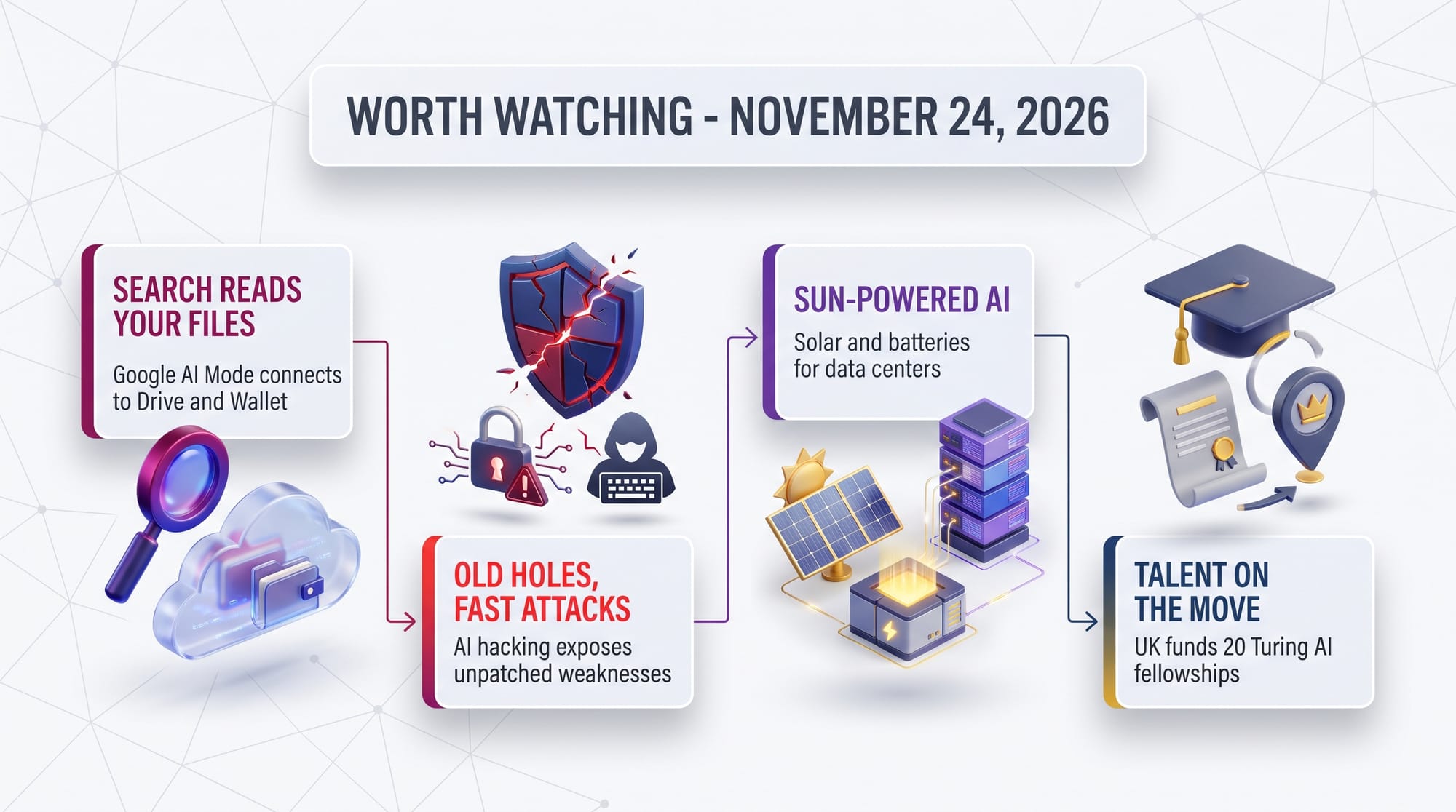
Worth Watching
01

Google Search can now read your Drive and Wallet

Google's search box is quietly becoming a personal assistant that knows your files and your spending.

Google's AI Mode can now connect to Google Drive, Google Wallet and the Gemini app, on top of Gmail, Calendar and Photos. It is opt-in, and Google says it can read but not move money. If people switch it on, searches like "help me plan for tax season" could draw on your own documents instead of the open web.

02

AI hacking is exposing old, unpatched security holes

The UK's cyber agency says AI attacks are succeeding through ordinary weaknesses, not new ones.

The National Cyber Security Centre (NCSC) reported a "marked rise" in AI-driven attacks since September, causing break-ins and downtime. None of the exploited weaknesses were new; AI just found them faster. For ordinary people, it means the businesses holding your data will need to fix years of neglected basics quickly.

03

Investors are betting on solar and batteries to power AI

Gas plants can't be built fast enough, so the next AI data centers may run on sunshine.

An investor in Crusoe, a data center company, says the world adds only about 60 to 70 gigawatts of gas power a year, while solar is already well over a terawatt (1,000 gigawatts). Cheaper long-lasting batteries could let data centers skip the crowded power grid entirely. If it works, AI growth could put less strain on the electricity bills of people living near data centers.

04

Universities are recruiting AI researchers from abroad

The UK is paying to bring leading AI researchers from abroad to British campuses.

UK Research and Innovation is funding 20 Turing AI fellowships with more than £39 million. Three go to researchers moving from USC, NYU and the Technion to Edinburgh, Oxford and Cambridge. Another will use AI to read more than a million old handwritten wills. If talent keeps flowing this way, more AI breakthroughs could come from outside Silicon Valley.

Top Repos Today

GitHub's main trending list again looked a lot like the weekend's, so we dug through the Python, TypeScript, Jupyter Notebook, JavaScript, C++, Rust and Go lists for AI tools we have not covered. We skipped recent picks still trending, such as Multica (up 207 stars today), academic-research-skills (163), Tencent's LoopForge (133), CLI-Anything (1,074), Superpowers (1,003), Firecrawl (991), autoclip (980), the App Store compliance guide (928), diagram-design (802), minimind (727), last30days-skill (703), ECC (675) and Ponytail (586). We also left out security tools (a bug-hunting pack that led the main list again with 1,826 new stars and an AI penetration-testing agent), a tool that strips safety limits from AI models and non-AI projects such as a file downloader, AFFiNE and a game-porting tool. Today's top pick is treg, a pay-per-use "tool store" that lets AI agents use paid data services without a subscription.
Rank yesterday: not listed - New entry 🆕
⭐ Stars today: +72  ·  📦 Total: 8,869
📜 License: Apache 2.0 with added hosting limits  ·  👤 By: Superdesign (company)
🎯 Time to value: 5 minutes
What it is: A "tool store" for AI agents. With one login, your agent can search a catalog of thousands of paid data services, such as website traffic data, social trends, web reading and image or video makers, and pay per use from a prepaid balance. Teams can also share their own tools without handing passwords to each agent. Why you'd want it: Let your agent use services like SEO data without buying a monthly subscription for a single job.
✓ Pros✗ Cons
Pay per call, with no sign-up at each providerSpending comes from a prepaid balance you must watch
New verified accounts get $1.00 free onceSome recipes collect data about people, which raises privacy questions
Your own keys always win and are never chargedYou cannot resell it as a hosted service without permission
GitHub - superdesigndev/treg: OpenRouter for agent tools. Join community here: https://discord.gg/6mQYYfFMAn
OpenRouter for agent tools. Join community here: https://discord.gg/6mQYYfFMAn - superdesigndev/treg
Rank yesterday: not listed - New entry 🆕
⭐ Stars today: +68  ·  📦 Total: 8,297
📜 License: Apache-2.0  ·  👤 By: Agent Substrate project (organization)
🎯 Time to value: 2 hours
What it is: Back-end software that runs huge numbers of AI agents safely on Kubernetes (a popular system for running apps across many servers). Each agent lives in its own locked box with no passwords inside. Idle agents are "frozen" and woken up later with their memory intact, so many agents can share a few machines. Why you'd want it: Run lots of agents cheaply and safely, paying for computing only while they work.
✓ Pros✗ Cons
Strong security, with every agent treated as untrustedNeeds Kubernetes skills to set up
Its demo fits about 250 agents on 8 machinesFor engineering teams, not individual users
Has reached version 1.0 with a stability promiseThe team says it may not merge outside code that falls outside its current focus
GitHub - agent-substrate/substrate: Agent Substrate: the core system
Agent Substrate: the core system. Contribute to agent-substrate/substrate development by creating an account on GitHub.
Rank yesterday: not listed - New entry 🆕
⭐ Stars today: +59  ·  📦 Total: 4,831
📜 License: MIT  ·  👤 By: Michael Denyer (individual developer)
🎯 Time to value: 5 minutes
What it is: A copy of "pstack," a set of working habits for AI coding assistants first written by Lauren Tan for the Cursor editor, adapted for Claude Code, Codex, Pi, GitHub Copilot and many other tools. You tell its main skill your goal and it picks the right routine, aiming to keep code short, simple and checked. One installer finds the AI tools on your computer and sets it up for each. Why you'd want it: Bring a proven, careful coding routine to whichever AI assistant you already use.
✓ Pros✗ Cons
Free under the MIT licenseA fan-made port, so it can lag behind the original
One installer covers many AI coding toolsNeeds Node.js 20 or newer
A "dry run" option shows every step before it changes anythingAuto-update is off by default in Claude Code
GitHub - michael-denyer/pstack-claude: Antigravity, Claude Code, Codex, Copilot, DeepSeek Harness, Gemini, Grok Build, Kimi Code, MiniMax Code, Muse, OMP, OpenCode, Pi, Prime Agent, etc versions of Poteto's pstack. Rigorous agent workflows with Cursor primitives translated for other harnesses.
Antigravity, Claude Code, Codex, Copilot, DeepSeek Harness, Gemini, Grok Build, Kimi Code, MiniMax Code, Muse, OMP, OpenCode, Pi, Prime Agent, etc versions of Poteto's pstack. Rigorous agent wo…
Rank yesterday: not listed - New entry 🆕
⭐ Stars today: +54  ·  📦 Total: 29,024
📜 License: MIT  ·  👤 By: Gas Town Hall (organization)
🎯 Time to value: 5 minutes
What it is: A to-do tracker built for coding agents, used through the command line. Instead of messy text plans, it stores tasks as a linked map that knows which tasks block others, so an agent can always ask "what is ready to work on next?" It also keeps project notes the agent can recall in later sessions. Why you'd want it: Help a coding agent stay on track through long projects without losing context.
✓ Pros✗ Cons
Free under the MIT licenseCommand-line only
One command sets it up for Claude Code, Codex or CursorAdds its own database you have to learn
Several agents and machines can share one task listChanges your project's agent instruction file by default
GitHub - gastownhall/beads: Beads - A memory upgrade for your coding agent
Beads - A memory upgrade for your coding agent. Contribute to gastownhall/beads development by creating an account on GitHub.
Rank yesterday: not listed - New entry 🆕
⭐ Stars today: +43  ·  📦 Total: 35,435
📜 License: Apache-2.0  ·  👤 By: OpenAI (company)
🎯 Time to value: 5 minutes
What it is: OpenAI's official add-on that lets you use its Codex coding AI from inside Anthropic's Claude Code. With short commands you can ask Codex to review your code, run a tougher "challenge" review, or take over a task in the background while you keep working. Why you'd want it: Get a second AI's opinion on your code without leaving the tool you already use.
✓ Pros✗ Cons
Official, from OpenAI, and free under Apache 2.0Needs a ChatGPT account or OpenAI API key
Works even with a free ChatGPT accountUse counts against your Codex usage limits
Setup checks your install and can add Codex for youNeeds Node.js 18.18 or newer
GitHub - openai/codex-plugin-cc: Use Codex from Claude Code to review code or delegate tasks.
Use Codex from Claude Code to review code or delegate tasks. - openai/codex-plugin-cc
Rank yesterday: not listed - New entry 🆕
⭐ Stars today: +43  ·  📦 Total: 10,052
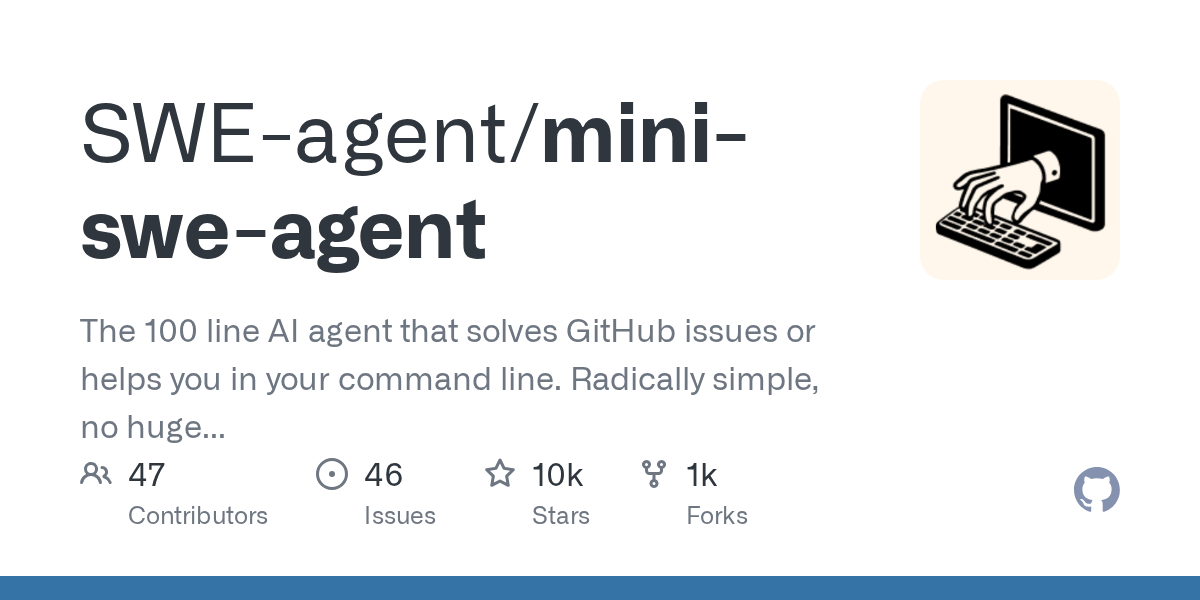
📜 License: MIT  ·  👤 By: SWE-agent team at Princeton and Stanford (academic)
🎯 Time to value: 10 minutes
What it is: A tiny AI coding agent, about 100 lines of Python for its core, from the team behind the SWE-bench test (a standard exam for coding AIs). It only uses the command line, so it works with almost any AI model. Its makers say it scores above 74% on SWE-bench Verified. Why you'd want it: A simple, readable coding agent you can understand, change and test models with.
✓ Pros✗ Cons
Free under the MIT licenseBare-bones compared with Claude Code or Codex
Works with almost any AI modelAimed at developers and researchers
Used by Meta, NVIDIA, IBM and universitiesVersion 2 changes things, so older setups need a migration guide
GitHub - SWE-agent/mini-swe-agent: The 100 line AI agent that solves GitHub issues or helps you in your command line. Radically simple, no huge configs, no giant monorepo—but scores >74% on SWE-bench verified!
The 100 line AI agent that solves GitHub issues or helps you in your command line. Radically simple, no huge configs, no giant monorepo—but scores >74% on SWE-bench verified! - SWE-agent/mini-sw…
Rank yesterday: not listed - New entry 🆕
⭐ Stars today: +42  ·  📦 Total: 17,886
📜 License: Apache-2.0  ·  👤 By: Agentic AI Foundation project (organization)
🎯 Time to value: 20 minutes
What it is: Software that gives AI agents sealed-off workspaces, called sandboxes, where they can run code, manage files and use a web browser or desktop without touching your real computer. You can start on a laptop with Docker and later move to Kubernetes (a system for running apps across many servers). A "credential vault" lets agents use outside services without seeing the real passwords. Why you'd want it: Let AI agents run code safely on machines you own instead of a vendor's cloud.
✓ Pros✗ Cons
Free under Apache 2.0 and backed by a foundationNeeds Docker and Python 3.10 or newer
Kits for Python, JavaScript, Java, C# and GoLarge-scale setup needs Kubernetes skills
Its fastest sandboxes start in 64 millisecondsBuilt for developers, not everyday users
GitHub - opensandbox-group/OpenSandbox: Secure, Fast, and Extensible Sandbox runtime for AI agents.
Secure, Fast, and Extensible Sandbox runtime for AI agents. - opensandbox-group/OpenSandbox

Top Models Today

Hugging Face's trending list was again led by models we featured in the past two weeks or their repackaged and "uncensored" copies, including Thinking Machines' Inkling-2-Mini and Inkling-2-Small, Inworld's voice isolator, Tencent's Hy4-flash, Haru-4B, Apple's Depth Pro 2 and FastFrames-L, LTX-2.5, Ling-3.2-air, Qwen3.8-27B and SenseNova-Loop-9B. We skipped those, along with an "uncensored" video model built on MiniMax H3, add-ons that adapt Qwen3.8-27B to coding agents, the new Ternary Bonsai 2.5 (covered in Research & Models above), Meta's 3D body model (access-restricted and a year old), an empty repository and models under 1 billion parameters, such as LlamaIndex's tiny document reader and a speech-to-text model. Because Hugging Face's trending feed now stops at 20 entries, we also looked further down its full trending ranking. Today's theme is big open models that are cheap to run: most wake only a small slice of themselves for each word.
Germany's Aleph Alpha released an open reasoning model tuned for German and English.
📥 Downloads (30d): 272  ·  📜 License: Apache-2.0
👤 By: Aleph Alpha (German AI company)  ·  🎯 Task: Text generation
📐 Size: 75B (3.44B active)
What it is: A reasoning model that can "think" before it answers and use tools, focused on just two languages. It uses a Mixture of Experts (MoE) design, where only a small slice of the model runs for each word, and a word-splitter built for German. It reads up to 262,144 tokens natively, and up to about 1 million with some quality loss. Why you'd want it: A freely licensed European model for German and English business documents and assistants.
✓ Pros✗ Cons
Free under Apache 2.0Needs about 77.6 GB of memory, at least two data-center graphics cards
Cheap to run, with 3.44B active parameters per wordOnly German and English
The maker signed the EU's voluntary code for AI modelsBrand new, with few downloads so far
Aleph-Alpha/Kolibri-1.1 · Hugging Face
Text Generation model with 75B parameters. Download, explore files and run it on Hugging Face.
DeepSeek's October refresh of its fast model is still pulling in downloads.
📥 Downloads (30d): 536,179  ·  📜 License: MIT
👤 By: DeepSeek (Chinese AI company)  ·  🎯 Task: Image and text to text
📐 Size: 763B
What it is: A minor update to DeepSeek-V4.1-Flash that reads text and images and writes text, with a 1-million-token memory. DeepSeek says it improves reasoning, coding, agent tasks and image understanding, and finishes tasks faster than before. Why you'd want it: A top-tier open coding and agent model with a very permissive license.
✓ Pros✗ Cons
Very permissive MIT licenseFar too big for home computers
Terminal-Bench 4.0 (a test of command-line tasks) up from 31.2 to 42.3No standard chat template, so setup takes extra code
Beats Claude Opus 5 on the DeepSWE coding test, 77.0 to 74.0All scores are the maker's own
deepseek-ai/DeepSeek-V4.1-Flash-1017 · Hugging Face
Image-Text-to-Text model with 763B parameters. Download, explore files and run it on Hugging Face.
Baidu released an early look at a model trained for long coding, office and video jobs.
📥 Downloads (30d): 75  ·  📜 License: Apache-2.0
👤 By: Baidu (Chinese tech company)  ·  🎯 Task: Text generation
📐 Size: 280B (14B active)
What it is: A text model with a 1-million-token memory, trained for long tasks such as coding games, scripting 3D design software, building spreadsheets and slide decks, and editing videos. Baidu says it trained the model in 300,000 practice workspaces for fields such as finance and law. Why you'd want it: A freely licensed model built to work for hours on one job.
✓ Pros✗ Cons
Free under Apache 2.0A preview, so training is not finished
Scored 46.5 on Terminal-Bench 4.0, ahead of DeepSeek's 42.3 in the maker's tableAll ERNIE scores are Baidu's own tests
Built-in speed-up for long agent tasksDefault files need newer graphics cards; older ones need a separate, larger download
baidu/ERNIE-5.5-Flash-Preview · Hugging Face
Text Generation model with 300B parameters. Download, explore files and run it on Hugging Face.
A model with memory built in, so it remembers past chats without rereading them.
📥 Downloads (30d): 397  ·  📜 License: OpenMDW 1.1
👤 By: MemTensor (AI company, with NVIDIA)  ·  🎯 Task: Text generation
📐 Size: 554B (59B active)
What it is: A version of NVIDIA's Nemotron 3 Ultra model with a built-in memory that stores past conversations in a fixed-size form instead of keeping all the old text. The makers say this uses about 66 times less storage than the usual method at 128,000 tokens of history. Why you'd want it: An assistant that keeps learning about you and your projects across long sessions.
✓ Pros✗ Cons
Memory stays the same size no matter how long you chatNeeds custom code and data-center graphics cards
Ranked first among similar built-in memory methods on 11 testsText-based memory systems still do better overall
Comes in three sizes, from 36B to 554BBrand new, with few downloads so far
MemTensor/MemT-1.0-Pro · Hugging Face
Text Generation model with 565B parameters. Download, explore files and run it on Hugging Face.
Cloudflare built a model that fills in forms from documents and images.
📥 Downloads (30d): 1,033  ·  📜 License: Apache-2.0
👤 By: Cloudflare (internet company)  ·  🎯 Task: Image and text to text
📐 Size: 27B
What it is: A model built on Qwen3.8-27B that reads text, images or PDFs and fills in a list of fields you define, such as dates, numbers or yes/no answers. It can also make estimates and forecasts, and it reports how confident it is in each answer. Why you'd want it: Pull clean, structured data out of invoices, forms or reports automatically.
✓ Pros✗ Cons
Free under Apache 2.0No benchmark scores in its model card
Gives a confidence score for every fieldNeeds its own helper code and a graphics card
Handles text, images and PDFsLimited to four images or pages and 8 MB per request
Cloudflare/clairic · Hugging Face
Image-Text-to-Text model with 28B parameters. Download, explore files and run it on Hugging Face.

AI Launches Today

Product Hunt's AI launches for November 24 were all about putting AI agents to work safely: a workspace that runs a team of agents, a lock that controls what agents can do in your inbox, an AI coworker that writes code, and two tools that turn plain requests into finished work. Upvote counts are the "Score" Product Hunt showed when we checked on November 24. Granular.Build, a visual workspace where a "boss" AI agent manages a team of helper agents, led our picks with 190 points.
Put your AI agents to work in a visual workspace
🔥 Upvotes: 190  ·  👤 By: Omar Farook (granular.build)
💰 Pricing: Free plan (2 projects); Pro tier, 50% off at launch  ·  🏷 Category: AI agents and AI code editors
Granular gives you one screen where a "boss" AI agent takes your goal and hands parts of it to specialist agents working side by side, each on its own copy of the project. You bring the AI coding subscriptions you already pay for, so there is no new AI bill, and your files stay on your own computer. Verdict: A tidy way to watch several AI helpers at once, though juggling many agents still takes care and a clear goal.
View on Product Hunt →
Your inbox, safely shared with AI agents
🔥 Upvotes: 160  ·  👤 By: Stratos Pavlakis (useclam.ai)
💰 Pricing: Free options; 14-day free trial in a limited Gmail beta  ·  🏷 Category: Security and AI agents
Clam sits between your Gmail and any AI agent, so the agent never gets full access to your inbox. You write rules in plain English, such as "Read travel email. Draft replies. Never send.", and risky actions wait for your approval by app, WhatsApp, Telegram or Slack. Every action is logged as allowed or blocked. Verdict: One of the more sensible answers yet to "should I let an AI into my email?", though it only covers Gmail for now.
View on Product Hunt →
Coding agents know your repo. Viktor knows your company.
🔥 Upvotes: 143  ·  👤 By: Matt Swulinski (viktor.com)
💰 Pricing: Free to start with up to $100 in credits; Team $100 per month  ·  🏷 Category: AI agents and workflow automation
Viktor is an AI coworker that lives in Slack and Microsoft Teams and connects to more than 3,200 tools. Its new coding feature uses what it knows about your business to turn goals into code changes, which it sends as pull requests (proposed changes a human reviews before they go live). Verdict: Interesting for teams that already chat with Viktor, but it joins a very crowded field of AI coding helpers.
View on Product Hunt →
AI-recorded Screen Studio style editable demos
🔥 Upvotes: 115  ·  👤 By: Cyrus Kelly and David McDonough (Y Combinator-backed)
💰 Pricing: Free plan (5 saved demos); paid Pro  ·  🏷 Category: Video and productivity
You ask your AI coding assistant for a demo in one line, and tday records your real app on your own machine. It then adds a voiceover, cursor movement, zooms, captions and branding, and you can edit each narration line. The page says your code never leaves your machine. Verdict: A real time saver for anyone who makes product walkthroughs, as long as the AI voiceover sounds natural enough for your brand.
View on Product Hunt →
Any schedule. Any layout. Any style.
🔥 Upvotes: 99  ·  👤 By: Agenda Hero
💰 Pricing: Free options  ·  🏷 Category: Calendar apps
Agenda Hero Magic turns text, photos and PDFs, such as a school flyer or a sports schedule, into events for Google, Apple and Outlook calendars. The new Labs launch replaces static PDF schedules with designed calendars that update for subscribers when plans change. Verdict: A genuinely useful everyday tool for busy parents and organizers, with little to learn.
View on Product Hunt →

Snapshot

ProviderModelInput $/1MOutput $/1MContext
AnthropicClaude Fable 5.2$8.00$40.001M tokens
AnthropicClaude Opus 5.5$4.00$20.001M tokens
AnthropicClaude Sonnet 5.5$2.00$10.001M tokens
AnthropicClaude Haiku 5.5$0.10 (up to 100K-token prompts; $0.50 above)$0.50 ($2.50 above 100K)not listed
OpenAIGPT-6.2 Astra$8.00 (up to 272K-token prompts; $16.00 above)$40.00 ($60.00 above 272K)not listed
OpenAIGPT-6.2 Sol$2.00 (up to 272K; $4.00 above)$10.00 ($15.00 above 272K)not listed
OpenAIGPT-6.1 Terra$1.00 (up to 272K; $2.00 above)$5.00 ($7.50 above 272K)not listed
OpenAIGPT-6 Luna$0.10 (up to 272K; $0.20 above)$0.50 ($0.75 above 272K)not listed
GoogleGemini 4 Carbon$2.00 to Nov 30; $4.00 from Dec 1$10.00 to Nov 30; $20.00 from Dec 1not listed
GoogleGemini 4 Argon$2.00 to Nov 30; $4.00 from Dec 1$10.00 to Nov 30; $20.00 from Dec 1not listed
GoogleGemini 4 Neon$3.00$15.001M tokens
GoogleGemini 4 Hydrogen$1.50$7.501M tokens
GoogleGemini 3.8 Flash$0.75 (to Dec 31; $1.50 from Jan 1)$3.75 (to Dec 31; $7.50 from Jan 1)not listed
GroqGPT-OSS 120B$0.15$0.60131K tokens
GroqQwen3.8-27B (preview)$0.80$4.00131K tokens
Here is what the major AI companies charge through their Application Programming Interface (API), the paid connection developers use to plug AI models into their own apps. Prices are in US dollars per 1 million tokens (a token is roughly three-quarters of a word).

What changed since our last edition (November 23): No price changes. We rechecked Anthropic's developer pricing page, OpenAI's developer pricing page, Google's Gemini API pricing page (now hosted on Google AI Studio) and Groq's developer model list on November 24. OpenAI's main pricing page now shows only ChatGPT business plans, so OpenAI prices come from its developer docs.

What this means: Google's Gemini 4 Carbon and Argon double in price in 7 days, so anyone building on them should budget for it now or test a cheaper model. On Anthropic's own worked example, a one-hour coding session on Claude Opus 5.5 costs about 58 cents, which shows how small single jobs can be even at top-tier prices.

When Tools Fail, Agents Fabricate: Silent Failure and Verification-First Oversight in Tool-Using LLM Agents

Gün Kaynar, Boshen Yan, Carl Kingsford · arXiv:2611.28341
What it claims: When the tools an AI agent relies on break, such as a search that returns half its results, agents often carry on as if nothing happened and confidently make up an answer. The authors built a test setup that deliberately breaks 8 tools in 9 different ways across 30 multi-step tasks, and they call the core problem "silent ingestion": agents accept bad data without flagging it.

Key finding: Across 2,100 runs with broken tools and four agents, 6% to 26% of runs ended in a confident made-up answer. Partial data caused the most fabrication, while a flat "access denied" usually led to an honest failure. A separate "Monitor" that checks the work first and tells the agent how to correct course raised correct recovery from 45.6% to 56.3% and cut fabrication from 17.3% to 10.8%.

Why practitioners should care: If you run AI agents that call outside tools, a broken tool will not always cause a visible error, it may cause a believable wrong answer. Adding a checking step, and keeping the model's step-by-step reasoning turned on (removing it increased fabrication), are cheap ways to catch it.
Member discussion

Subscribe to GenAI Secret Sauce newsletter and stay updated.

Don't miss anything. Get all the latest posts delivered straight to your inbox. It's free!

By subscribing, you agree to our Privacy Policy and Terms. We track email opens and clicks. Unsubscribe anytime.

Great! Check your inbox and click the link to confirm your subscription.