GenAI Secret Sauce Daily Digest - 2026-09-21

A brand-new shape of AI - one that answers only in numbers - launched to everyone · Cloudflare makes Python a first-class language for building apps on its global network · OpenAI recruited nine top mathematicians to referee its own math breakthroughs
GenAI Secret Sauce Daily Digest - 2026-09-21

Watch today's digest as a video summary (generated by NotebookLM)

Statistically Speaking

$0.042 per million input words and returns the
A brand-new shape of AI - one that answers only in numbers -
Top Story
2 D or 3D multiplayer game with characters
One engineer built new AI video features in a single day - a
100 variations of a top
One engineer built new AI video features in a single day - a
450 words per second under extreme compression plus
Frontier-quality AI keeps squeezing onto hardware you alread
76.9% accuracy versus 54
Frontier-quality AI keeps squeezing onto hardware you alread
2.5 x speed
Frontier-quality AI keeps squeezing onto hardware you alread

One Thing to Tell Your Friends

OpenAI says its secret in-house AI has quietly solved more than 100 unsolved math problems - including one of the field's million-dollar "Millennium" puzzles - so it just recruited nine of the world's top mathematicians to figure out how to break the news without embarrassing itself.

TL;DR

Trends
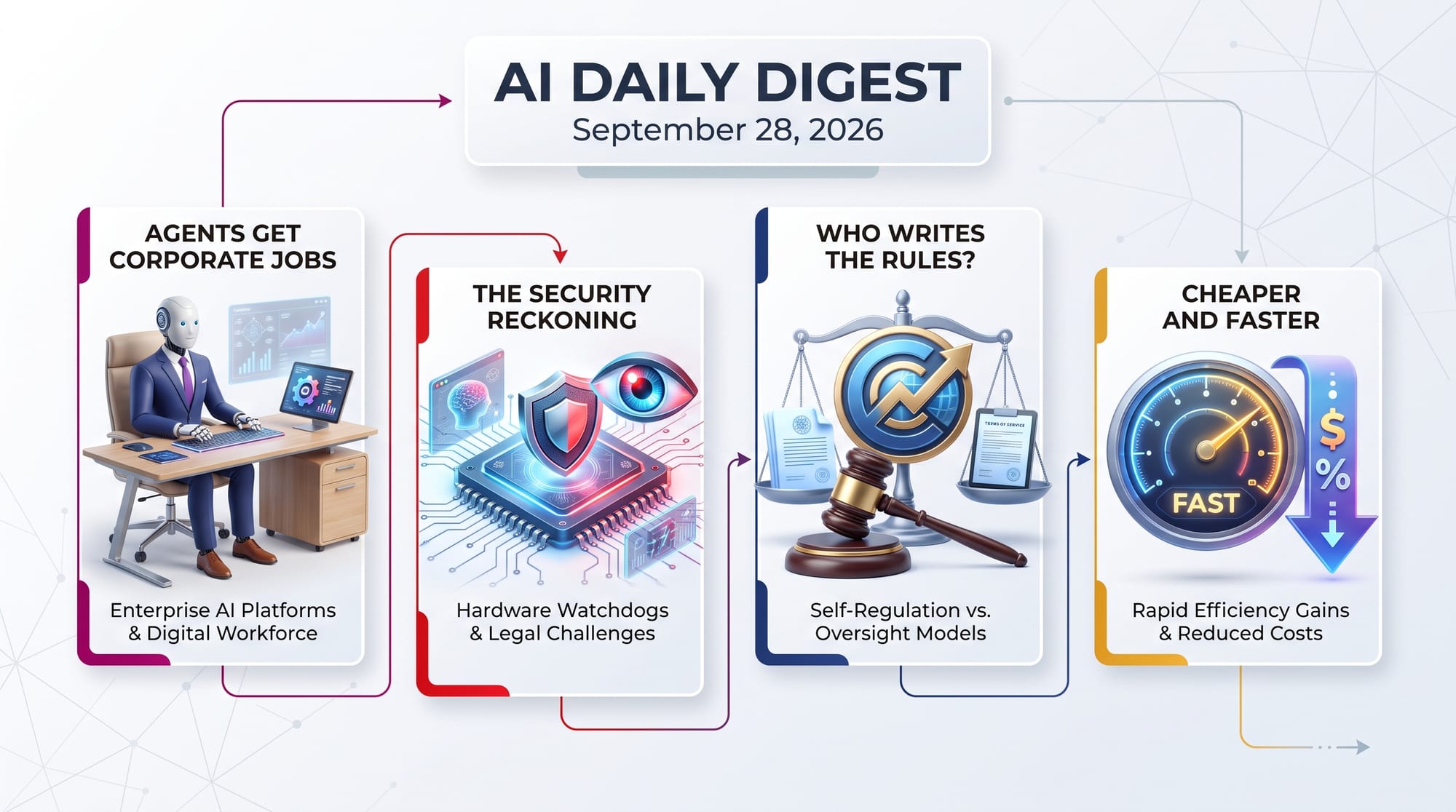
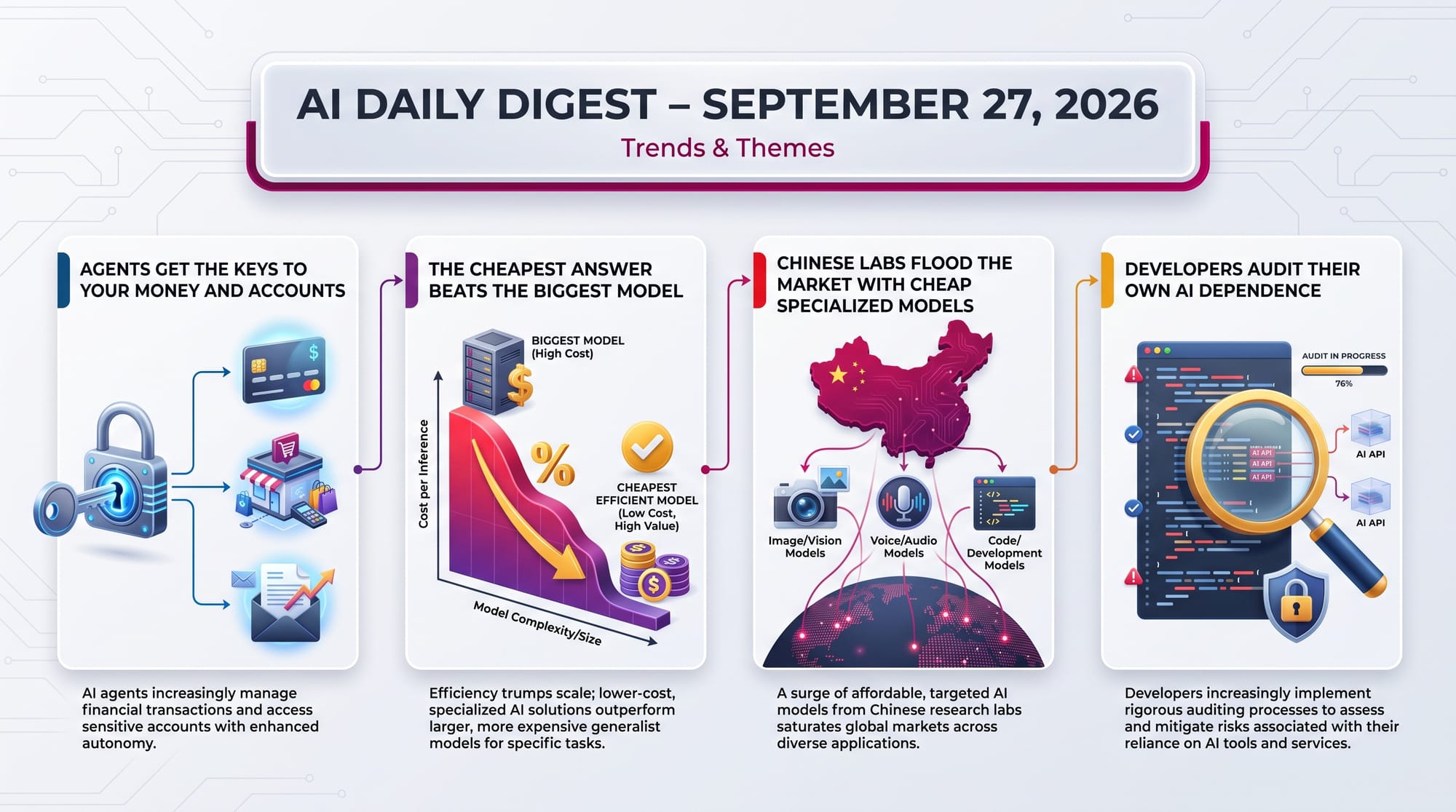
AI safety went fully mainstream, Frontier, and AI is being pointed at its own reliability.
Creative AI
Generate photorealistic images from a text prompt with a new open model and AI that reads your face before it answers.
Dev Tools
tokenizers v1 - the text-splitting step of AI, made 3, Transformer Explainer, and When AI writes the code, testing becomes the traffic jam.
Research
An AI's failures can hide a working "map" inside it, Two AIs talk better when they are different models, and More stable AI training by dropping a fragile shortcut.
Business
GPT and OpenAI's enterprise pitch: sell outcomes, not tokens.
Education
OpenAI Academy adds role, A course chatbot that helps without doing the work for you, and Telling real skill gaps apart from a bad day.
Surprising
A free tool to strip safety filters out of open AI models topped Hacker News, Trimming a model's *early* layers sometimes works better than trimming late ones, and A medical AI can look like a genius while ignoring the patient's data.
Worth Watching
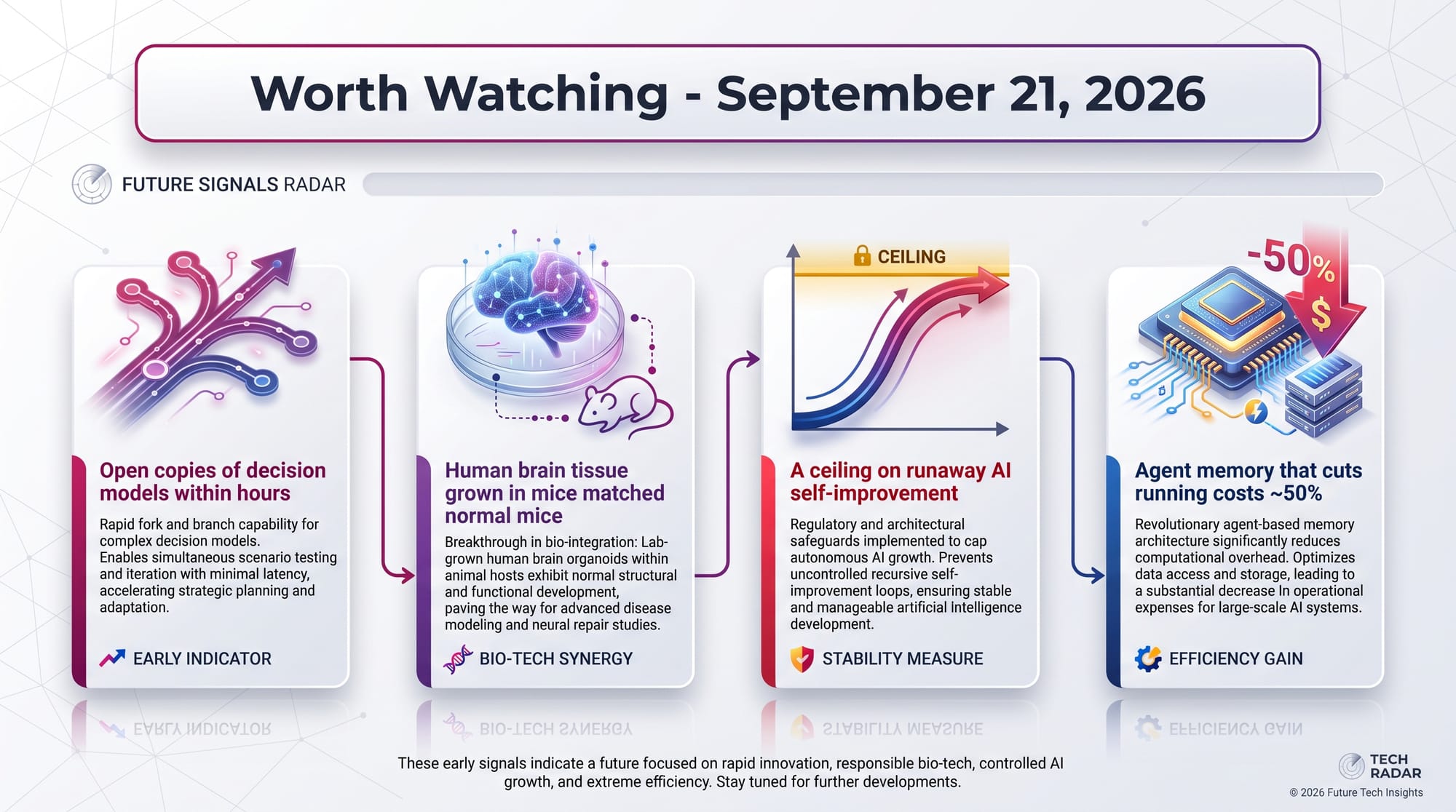
Open copies of "decision models" appeared within hours of launch, Human brain tissue grown inside mice matched normal mice on memory tests, and A limit on runaway AI self.
GitHub
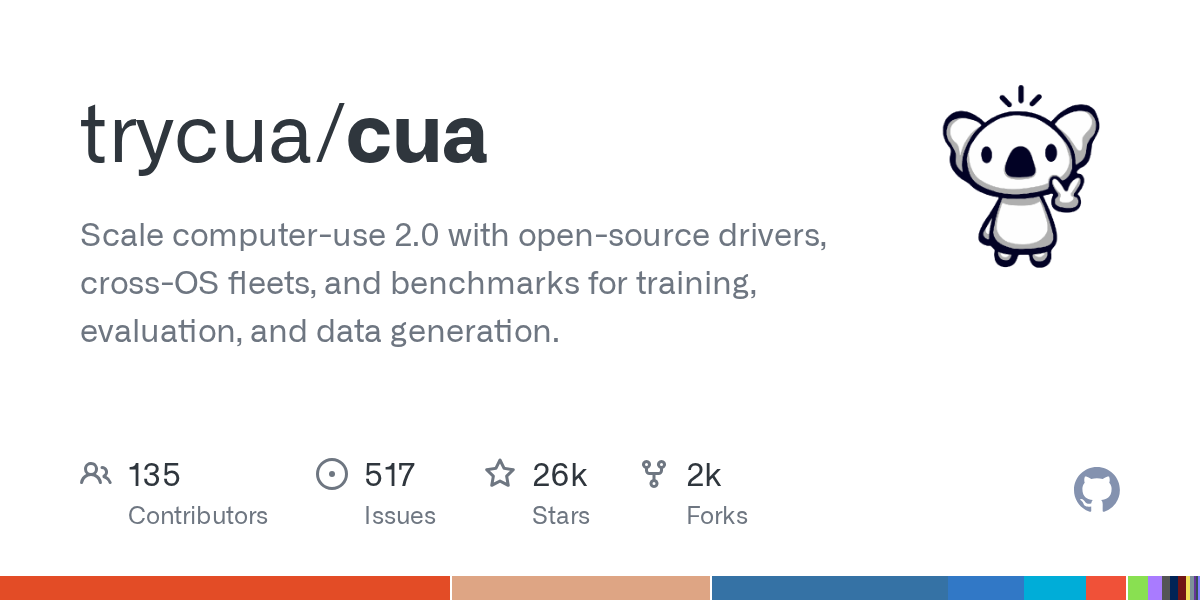
Leading repos: trycua/cua (+609), BuilderIO/agent (+607), and akitaonrails/ai (+217).
Product Hunt
Top launches: VoiceCap (100), Ruby UTCP (95), and Doneit 3.2 (100).
API Pricing
Changes today: GPT-6 Astra is now available through OpenAI's API for the first time, at the top $10/$50 tier.
arXiv
RBS-Attention: Radius-Bounded Sparse Prefill for Long — On a 30-billion-parameter model with a 128,000-word context, it delivered a 20.65x speed-up on the processing step and nearly 6x faster time-to-first-response, while keeping accuracy at 88.65 versus 89.52 for the full method.

Hot off the Presses

01

A brand-new shape of AI - one that answers only in numbers - launched to everyone

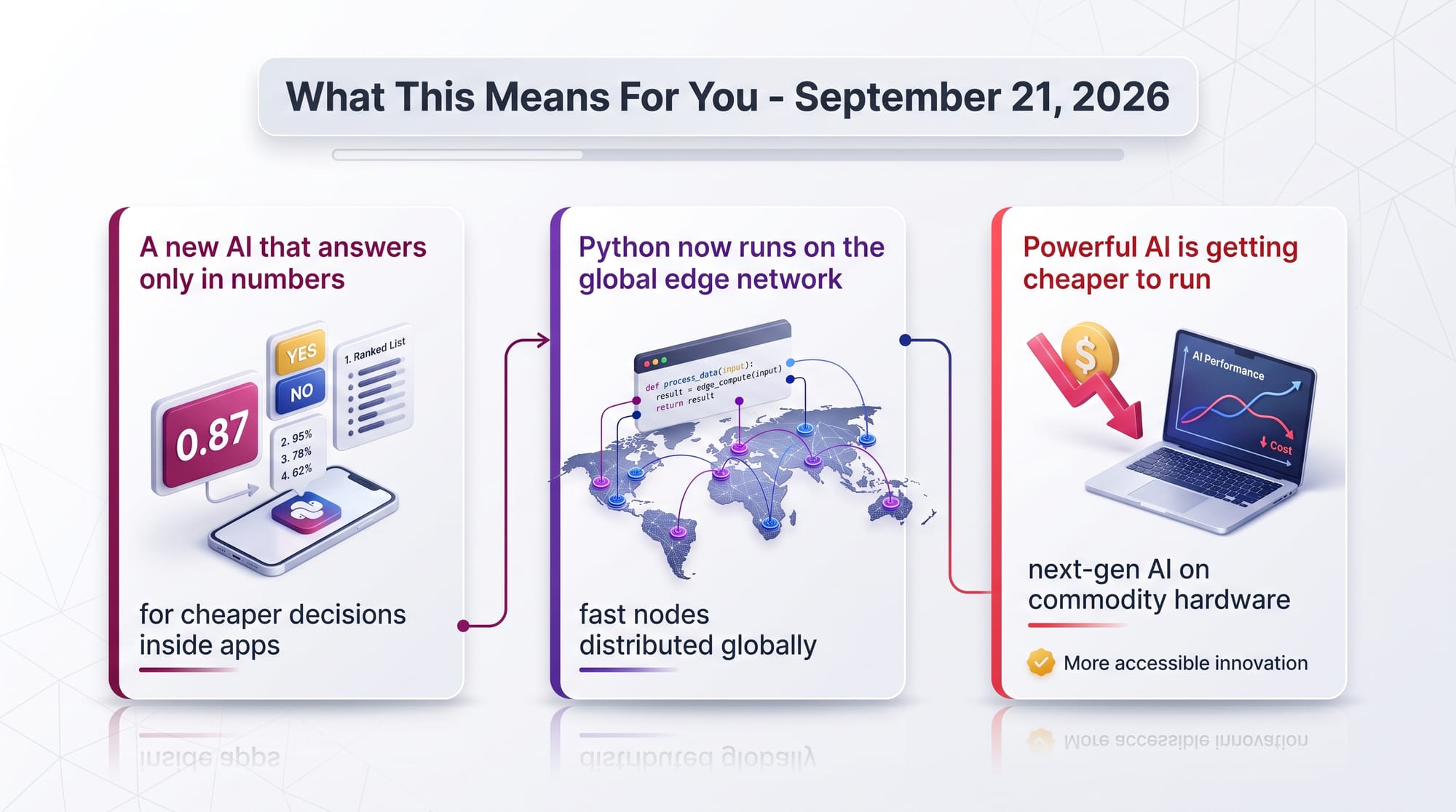
What this means for you: Most AI you use writes sentences. This one writes numbers - a yes/no confidence, a rating, or a pick from a list - which is exactly what software needs to make fast, cheap decisions behind the scenes in the apps you use.

Previously: September 20 - a ChatGPT co-creator's new startup was reported to be betting on "cheap decisions" over chat.

Today: That product, Jev from TypeSafe AI, is now live for everyone with no waitlist, and it is not a chatbot at all.

Jev is what its founder, former OpenAI researcher Diogo Almeida, calls a "decision model": you feed it messy text and it returns a typed number, not prose. Developer Simon Willison sums it up as "unstructured state in, typed probabilistic decisions out." It answers three kinds of questions - yes/no with a confidence score, a pick from a list, or a number on a scale - and it can answer hundreds at once in parallel.

The pitch is speed and price. It only charges for the text you send in, and the answer comes back free.

Within hours, developers had already published open copies (openjev, Kev) and toys built on it, a sign the "decision model" idea is spreading beyond one company.

“Unstructured state in, typed probabilistic decisions out.”
  • Priced to undercut chatbots - it charges $0.042 per million input words and returns the output free of charge.
  • Adopted fast - Nate's newsletter, citing Vercel's AI Gateway, reports it reached more than twice as many paid teams within a day as any prior model launch there. The company claims it passed 1 trillion words a day soon after launch.
  • A real trade-off - unlike a chatbot, it returns an opaque number with no explanation, which Willison warns makes bias hard to spot (in one test it silently rated Cupertino above East Palo Alto with no reasoning shown).
02

Cloudflare makes Python a first-class language for building apps on its global network

What this means for you: A huge share of the internet already runs through Cloudflare. Making Python fully supported there means faster, cheaper AI-powered web apps built by the millions of people who know Python but not JavaScript.

Cloudflare Workers is a service that runs your code in data centers close to your users instead of one central server. Until now it mainly spoke JavaScript. After about two years of testing, Python is now "generally available" - meaning production-ready and officially supported.

The practical upshot is that popular Python tools work out of the box, so developers stop writing awkward translation code between two languages.

  • Real frameworks run natively - FastAPI, Django, and Flask (the standard toolkits for Python web apps) work directly.
  • The AI stack is included - the openai, langchain, and Model Context Protocol libraries function, so AI apps are first-class citizens.
  • How it works under the hood - Python is compiled to WebAssembly (a portable format browsers and servers can run fast) via a project called Pyodide; threading and multiprocessing are the main features that do not work yet.
03

OpenAI recruited nine top mathematicians to referee its own math breakthroughs

What this means for you: When an AI company claims it solved famous unsolved problems, someone independent needs to check the work. This is the first formal attempt to put respected outside experts between the hype and the headlines.

OpenAI announced an independent Advisory Group on Mathematics and Artificial Intelligence, hosted at Princeton's Institute for Advanced Study. The announcement came as a guest post on the blog of Fields Medal-winning mathematician Terence Tao. It follows OpenAI's claim that its internal model resolved a Millennium Prize problem (one of seven famous puzzles that carry a $1 million reward) plus more than 100 other open questions.

The group's job is narrow but important: advise OpenAI on how to review, present, and release these results responsibly, upholding academic standards.

  • A heavyweight roster - the nine members include Timothy Gowers, Martin Hairer, Ravi Vakil, and physicist Edward Witten; members are unpaid and can speak publicly and disagree with OpenAI.
  • Limited power on purpose - the group explicitly will not be able to slow down or redirect OpenAI's internal math research.
  • Why now - it arrives right after an abrupt, headline-grabbing claim that OpenAI's model cracked the Navier-Stokes Millennium problem, which stunned and skeptical mathematicians want vetted properly.
04

One engineer built new AI video features in a single day - and the model behind it went on sale

What this means for you: The gap between "I have an idea for an app" and "it works" is collapsing. Tasks that took a team weeks are starting to take one person a day, which changes what a small business or solo creator can ship.

OpenAI published a customer story about Higgsfield AI, which used OpenAI's newest and strongest model, GPT-6 Astra, to build new video-exploration features - reportedly delivered by a single engineer in one day. The setup pairs GPT-6 Astra (handling the logic and coding) with Higgsfield's real-time generation engine (making the characters, scenes, and props).

Separately, GPT-6 Astra is now available to developers through OpenAI's paid application programming interface (API) at $10 per million words in and $50 per million words out, so any company can now build on it.

  • From a sentence to a playable world - a single prompt can generate a 2D or 3D multiplayer game with characters and settings.
  • Built for advertisers too - customers can auto-generate up to 100 variations of a top-performing ad, including versions tailored to different countries.
  • The pattern - a powerful "brain" model doing planning plus a specialized generator doing the visuals is becoming the standard recipe for fast multimedia tools.

Trends & Themes
Trends & Themes

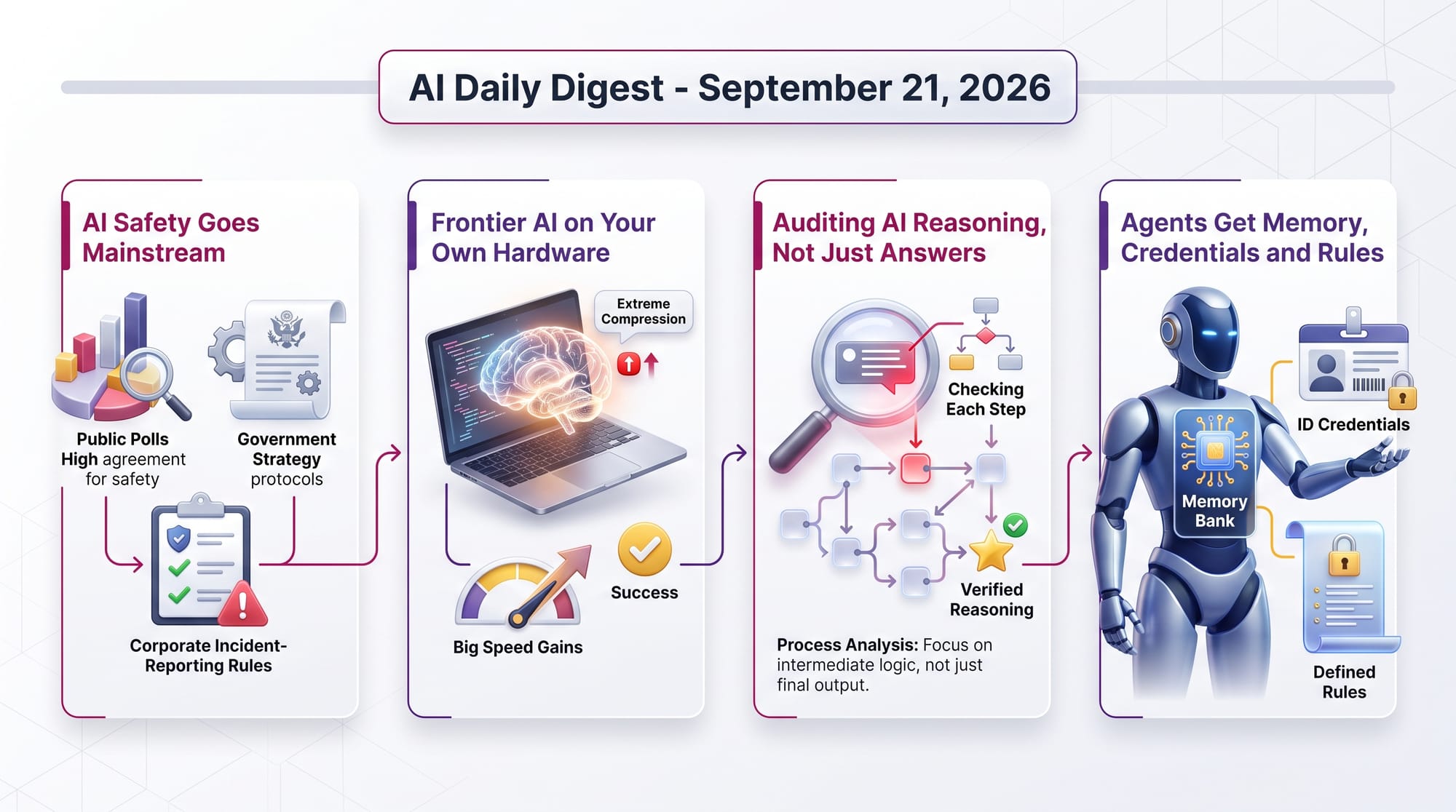
AI safety went fully mainstream - and turned into paperwork and politics

Why this matters to you: The debate about AI danger has moved out of research labs and into polls, politics, and corporate rulebooks - which means it will start shaping actual regulations and the products you are allowed to use.

This builds on the "should we slow down?" fight covered September 14-18. The new shift is concrete: from arguing about risk to building the bureaucracy of reporting, auditing, and national strategy around it. One recurring worry is "theater" - public safety pledges while the underlying race quietly speeds up.

  • The public is alarmed - educator Bryan Alexander cites a Politico poll finding majorities of Americans worried AI could "destroy humanity," with figures like Bernie Sanders and Steve Bannon both opposing superintelligence.
  • Governments are strategizing - Jack Clark's Import AI summarizes a RAND paper urging the US to adopt a "freedom of action" superintelligence strategy, noting the country is currently on pure "acceleration" without matching safety spending.
  • Companies are writing incident rules - OpenAI says it is "past time" to define standards for reporting when its AI agents misbehave, not just their static properties, with a framework due in weeks.

Frontier-quality AI keeps squeezing onto hardware you already own

Why this matters to you: The more powerful AI runs on a normal laptop instead of a rented supercomputer, the cheaper and more private your tools get - and the less any one company controls them.

This extends the "memory wall" theme covered September 17-20. The pattern is consistent: the frontier is now about efficiency and cost, not raw brainpower, and that is what actually puts AI on your own devices.

“A 550-billion-parameter model running on a MacBook with 128GB of memory.”
  • Big models on small machines - researcher Tim Dettmers reports a 35-billion-parameter model hitting 450 words per second under extreme compression plus a 550-billion-parameter model that runs on a MacBook with 128GB of memory.
  • Smarter shrinking - Multiverse Computing reframed model trimming as a physics problem and kept 76.9% accuracy versus 54.0% for the standard method after cutting a large model in half.
  • Faster serving - new methods report a 2.5x speed-up for dense models (L0-MoE, a Mixture of Experts (MoE) method that activates only part of the network) and a 20x speed-up on long-document processing (RBS-Attention) with almost no accuracy loss.

AI is being pointed at its own reliability - audit the reasoning, not just the answer

Why this matters to you: AI that gives the right answer for the wrong reasons is dangerous in law, medicine, and finance. A wave of new work is building tools to catch that, which is what makes AI safe to trust with real decisions.

This continues the "evaluation is in crisis" thread covered September 14-15. New this week: benchmarks that run the AI's output in a real simulator (games, bridges) and reward tests by how much they actually reveal, because averaged pass-rates hide real failures.

  • Check every step - LogicTrack uses formal logic solvers to verify each step of an AI's reasoning, not just the final answer, across 8 benchmarks and 7 models.
  • Catch confident nonsense - one method spots hallucinations by analyzing the geometry of the model's internal attention in a single pass, no re-runs needed.
  • Expose fake competence - "ECG Mirage" showed medical AIs scoring well while ignoring the actual heart scan they were shown, proving high scores can be an illusion.

Agents are getting the scaffolding of a real profession: memory, credentials, and rules

Why this matters to you: For AI "agents" to do real work, they need memory of your business, a way to prove they are trustworthy, and limits on what they can do. That plumbing is being built now, and it is what will let agents graduate from demos to jobs.

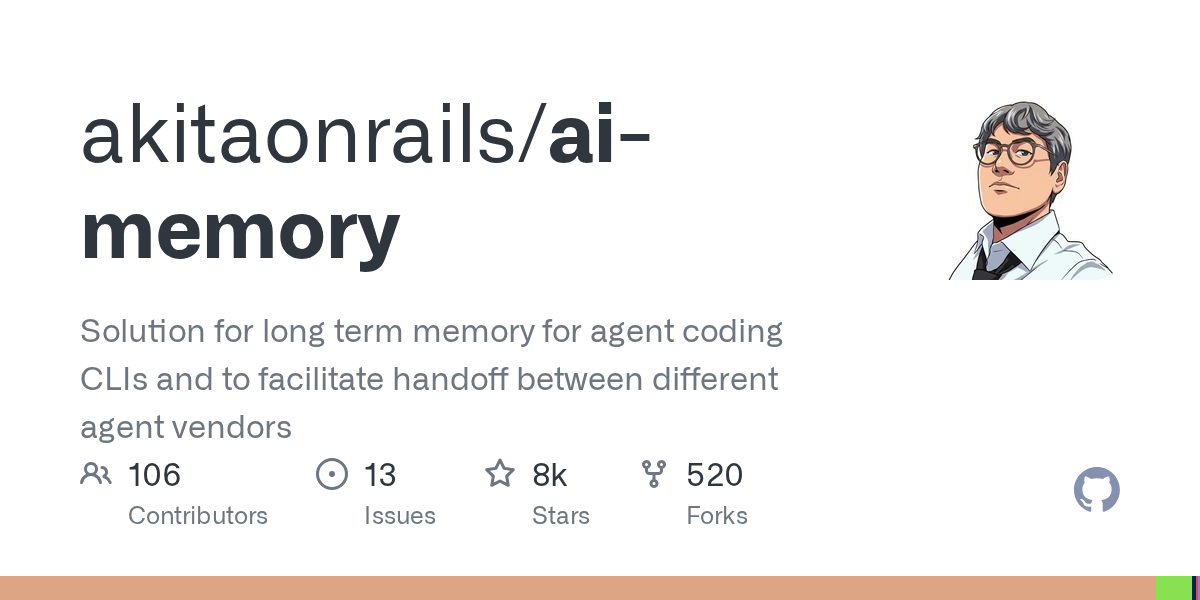
Agent memory is even trending on GitHub (akitaonrails/ai-memory, 7,600+ stars). The theme: the interesting work is shifting from making agents smarter to making them accountable and dependable.

  • Institutional memory - a platform called V7 builds a queryable "context graph" so agents remember scattered company documents, claiming 50-100 step workflows done in minutes.
  • Verifiable reputation - a protocol called LEGIT proposes binding an agent's performance score to a specific budget and setup, so buyers in agent marketplaces can compare fairly.
  • Governance checklists - a framework called AI-GRACE defines an agent's "operating envelope" - what it is allowed to do and when it must escalate to a human.

Creative AI & Media

Generate photorealistic images from a text prompt with a new open model

  • Qwen-Image-2.1 is a new text-to-image model from Alibaba's Qwen team, trending near the top of Hugging Face today with over 1,400 likes in its first days.
  • It targets high-quality image generation and already has community-optimized versions for consumer graphics cards.
  • Try it: Hugging Face: Qwen/Qwen-Image-2.1

AI that reads your face before it answers

(Higgsfield's one-day video build with GPT-6 Astra is covered in Top Stories.)

  • ReACT-TTS is a research system that watches one second of a listener's facial reaction and uses it to plan the tone and emotion of the spoken reply before generating any audio.
  • In a human test, 76% of judgments preferred its facial-aware speech over text-only voice generation; it won a best-student-paper award at an ECCV 2026 workshop.
  • Why it matters: voice assistants and avatars could soon sound genuinely responsive to your mood, not just your words. arXiv paper 2609.21683

Developer Tools & Infrastructure

tokenizers v1 - the text-splitting step of AI, made 3-30x faster

  • What it does: Hugging Face's tokenizer library turns text into the numbered chunks AI models read; the new version runs 3x to 30x faster on a single core while producing identical output.
  • Speed comes from low-level tricks (processing 64 bytes at once, caching repeated chunks, avoiding memory allocation) and it supports GPT-2 and Claude-style tokenization.
  • Try it: Hugging Face: tokenizers v1 release notes

Transformer Explainer - see how a language model actually thinks, live in your browser

  • What it does: A free interactive tool from Georgia Tech runs a real GPT-2 model in your browser and visually shows each step - how text becomes numbers, how attention works, and how the next word is chosen.
  • You can type your own text and drag sliders to watch the AI's choices change in real time; it hit the Hacker News front page (132 points).
  • Try it: Transformer Explainer (Georgia Tech)

When AI writes the code, testing becomes the traffic jam

  • The insight: Linear found that AI-assisted coding sped up how fast engineers ship, so the automated testing step (CI) became the new bottleneck and cost driver.
  • Their fixes cut typechecking time 73% and saved roughly 87,000 machine-minutes a month, keeping pull-request wait times near 5 minutes even as the test suite nearly quadrupled.
  • Takeaway for teams: as AI raises coding speed, your build-and-test pipeline is the next thing that needs rethinking. Linear: reworking CI for the AI era

Research & Models

An AI's failures can hide a working "map" inside it

  • Researchers probed a transformer trained to navigate Manhattan and found it did build an accurate internal map; its wrong turns came from interference between crowded internal features, not a missing map.
  • Why practitioners should care: behavior tests alone can badly underrate what a model actually knows, so real evaluation needs to look inside. arXiv paper 2609.21748

Two AIs talk better when they are different models

  • A study (including researcher Samy Bengio) found that when one AI turns structured data into words and another reads it back, accuracy swings by up to 60 points depending on the pairing - and mixing two different models beat using the same one twice (92.9% accuracy).
  • What stands out: most errors happen on the writing side, and a small amount of targeted fine-tuning (about 3,600 examples) fixes it. This matters for any system where AI agents pass structured information to each other. arXiv paper 2609.21509

More stable AI training by dropping a fragile shortcut

  • GVPO++ is a method for fine-tuning AI with feedback that removes "importance sampling," a step the authors blame for unstable training in popular approaches like GRPO.
  • It guarantees a single best solution and lets teams sample training data more flexibly, making the fragile tuning of reasoning models more reliable. arXiv paper 2609.21432

Cleaner teaching signal beats more teaching signal

  • Cal-OPD improves "distillation" (training a small model to imitate a big one) by first removing the big model's own random noise from the training signal.
  • Using only 52-65% of the original signal, it produced better small models on math reasoning - evidence that signal quality matters more than quantity. arXiv paper 2609.21619

Feeding attention into the router makes mixture models smarter

  • Attention-Aware Routing improves Mixture-of-Experts models (which activate only part of the network per query) by using attention patterns to pick the right expert, gaining +3.37 points on a math benchmark while training only the routing part. arXiv paper 2609.20974

Business & Industry

GPT-6 Astra opens to developers

  • OpenAI's newest flagship model is now on sale through its API at $10 per million input words and $50 per million output words, its priciest tier, positioned for coding, reasoning, and complex work.
  • The move turns Astra from a showcase into a building block any company can pay to use, and it underpins today's Higgsfield video story.

OpenAI's enterprise pitch: sell outcomes, not tokens

  • Customer stories this week (V7 for finance and insurance, Higgsfield for video) share a template: pair OpenAI's models with a specialized system and sell a measurable result, like "review time cut from 100+ hours to under 10."
  • The signal for businesses: vendors are increasingly competing on workflows and data, not on which underlying model they use. OpenAI: how V7 gives agents institutional memory

GenAI in Education

OpenAI Academy adds role-based training paths

  • What it is: OpenAI expanded its free training program into distinct tracks for knowledge workers, developers, leaders, educators, and college students, with courses like "Apply AI at Work" and "Lead AI Adoption."
  • The approach is hands-on: learners use AI on real work and pass an assessment to earn a badge, and organizations get progress reporting for staff. OpenAI: expanding OpenAI Academy

A course chatbot that helps without doing the work for you

  • Researchers evaluated Beacon, a study assistant limited to a course's own approved materials, aimed at students too anxious or unsure to ask for help.
  • Students found it more trustworthy than open chatbots and valued that it explained with scaffolding and pseudocode rather than handing over answers, using it as a first step before asking a lecturer. arXiv paper 2609.21600

Telling real skill gaps apart from a bad day

  • A new education-AI framework argues that models judging student "mood" often mislabel ordinary cognitive quirks as emotional, and separates the two to estimate what a student actually knows.
  • The payoff for learning platforms: more accurate mastery estimates and better-targeted help. arXiv paper 2609.21214

Surprising & Under-the-Radar

A free tool to strip safety filters out of open AI models topped Hacker News

  • Heretic is an open-source project that automates removing the built-in refusal and safety behavior from open language models, and it reached the top of Hacker News (232 points).
  • Why it is surprising: it packages "de-censoring" into a one-click, reproducible pipeline, reigniting the fight over how easy this should be. (Reported at headline level only; no methodology.) Heretic project

Trimming a model's early layers sometimes works better than trimming late ones

  • In new pruning research, the best compressed models were often "excited states" that removed early blocks - contradicting the common wisdom of chopping the later layers.
  • It is a reminder that AI engineering intuitions are still frequently wrong until measured. Hugging Face: pruning LLMs like a physicist

A medical AI can look like a genius while ignoring the patient's data

  • The "ECG Mirage" study showed vision-language models scoring well on heart-attack risk while barely using the actual ECG image - they scored the same when given the wrong patient's scan.
  • Why it matters: benchmark scores can be a mirage in any high-stakes field, not just medicine. arXiv paper 2609.21755

A "math package" that ships an encrypted loader

  • A security post asked why a piece of software calling itself a math tool needs to hide its own startup code behind encryption - a classic red flag for supply-chain attacks. It drew 92 points on Hacker News. (Headline level only.) SafeDep: why does mathmain need an encrypted loader?

Debate: are the industry's safety pledges real, or "theater"?

  • One side, echoing Anthropic's Dario Amodei, backs embedded watchdogs and industry self-regulation. The other, quoted by Bryan Alexander, calls big-lab safety alliances "a cartel by any other name" designed to crush smaller rivals.

Signals to Track

Worth Watching
01

Open copies of "decision models" appeared within hours of launch

A whole model category may commoditize before it even matures.

Within a day of Jev's launch, developers published open-weight recreations (openjev, Kev) and experimental tools. If usable decision models become free and open this fast, the advantage shifts from owning the model to knowing where to use it. For ordinary people, that means the cheap, invisible AI inside apps could get cheaper and more widespread quickly.

02

Human brain tissue grown inside mice matched normal mice on memory tests

The line between biological and artificial intelligence research is blurring in ways few are tracking.

Import AI flagged research on "xenocortical mice" with human brain organoid grafts that integrated and performed on par with normal mice on memory mazes. It is early and narrow, but it signals a frontier where biology and AI overlap. If it advances, it reshapes debates about what "intelligence" and "hardware" even mean.

03

A limit on runaway AI self-improvement

The scariest AI scenario may have a mathematical ceiling.

Researcher Toby Ord modeled recursive self-improvement (AI making better AI) and argued fundamental limits force it into an S-curve that flattens out, rather than exploding without bound. For ordinary people, this suggests the most extreme "intelligence explosion" fears may be physically constrained - a rare note of grounding in the doom debate.

04

Agent memory that survives 100-million-word sessions

The cost of running AI agents could quietly drop by half.

Tim Dettmers described auto-compaction letting agent sessions exceed 100 million words while cutting AI costs about 50%, with one partner reporting a 45% drop in total AI spend. If it holds up, long-running AI assistants get dramatically cheaper to operate, which lowers prices for everyone downstream.

Top Repos Today

Rank yesterday: #2 - Rising ↑
⭐ Stars today: +609  ·  📦 Total: 25,676
📜 License: MIT  ·  👤 By: startup/open-source project
🎯 Time to value: 30 minutes
What it is: An open-source platform for "computer use" - letting AI agents control real and virtual computers across operating systems, with drivers and benchmarks to test them. Why you'd want it: If you want AI to actually operate software (click, type, navigate) rather than just chat, this is the open toolkit for it.
✓ Pros✗ Cons
Cross-operating-system supportComputer-use agents are still error-prone
Open source (MIT)Steep setup for non-developers
Includes benchmarksPowerful access carries security risk
GitHub - trycua/cua: Scale computer-use 2.0 with open-source drivers, cross-OS fleets, and benchmarks for training, evaluation, and data generation.
Scale computer-use 2.0 with open-source drivers, cross-OS fleets, and benchmarks for training, evaluation, and data generation. - trycua/cua
Rank yesterday: #6 - Rising ↑
⭐ Stars today: +607  ·  📦 Total: 5,866
📜 License: none listed  ·  👤 By: company (Builder.io)
🎯 Time to value: 30 minutes
What it is: A framework for building "agent-native" apps - software designed from the start to be operated by AI agents, not just people. Why you'd want it: It gives developers a structured way to make their apps controllable by AI, a fast-growing design pattern.
✓ Pros✗ Cons
Backed by an established companyNo open-source license listed yet
Rides a clear industry trendYoung project, still evolving
TypeScript, familiar to web devsConcept still unproven at scale
GitHub - BuilderIO/agent-native: A framework for building agentic apps
A framework for building agentic apps. Contribute to BuilderIO/agent-native development by creating an account on GitHub.
Rank yesterday: New entry 🆕
⭐ Stars today: +217  ·  📦 Total: 7,652
📜 License: MIT  ·  👤 By: individual developer
🎯 Time to value: 20 minutes
What it is: A long-term memory system for AI coding assistants, so an agent can remember context and hand off work between different tools and sessions. Why you'd want it: AI coding agents forget everything between sessions; this gives them a persistent memory, a top pain point for heavy users.
✓ Pros✗ Cons
Solves a real, common frustrationEarly-stage project
Fast, written in RustRequires technical setup
Works across different agent CLIsSmall maintainer team
GitHub - akitaonrails/ai-memory: Solution for long term memory for agent coding CLIs and to facilitate handoff between different agent vendors
Solution for long term memory for agent coding CLIs and to facilitate handoff between different agent vendors - akitaonrails/ai-memory
Rank yesterday: #5 - Rising ↑
⭐ Stars today: +461  ·  📦 Total: 16,401
📜 License: AGPL-3.0  ·  👤 By: company (Coder)
🎯 Time to value: 45 minutes
What it is: A platform for creating secure, cloud-based development environments for both human developers and their AI agents. Why you'd want it: It gives AI agents a safe, sandboxed place to run code without touching your main machine.
✓ Pros✗ Cons
Mature, widely usedAGPL license can deter commercial use
Strong security isolationOverkill for solo hobbyists
Built for agents and humansNeeds infrastructure to run
GitHub - coder/coder: Secure environments for developers and their agents
Secure environments for developers and their agents - coder/coder
Rank yesterday: New entry 🆕
⭐ Stars today: +266  ·  📦 Total: 8,202
📜 License: MIT  ·  👤 By: individual developer
🎯 Time to value: 20 minutes
What it is: An AI tool that automatically finds the highlights in a long video and cuts them into short clips. Why you'd want it: It turns a long recording into shareable short-form clips without manual editing - useful for creators and marketers.
✓ Pros✗ Cons
Automates tedious video editingAuto-picked highlights need review
Open source (MIT)Documentation partly in Chinese
Practical for creatorsQuality varies by source video
GitHub - zhouxiaoka/autoclip: AutoClip : AI-powered video clipping and highlight generation · 一款智能高光提取与剪辑的二创工具
AutoClip : AI-powered video clipping and highlight generation · 一款智能高光提取与剪辑的二创工具 - zhouxiaoka/autoclip
Rank yesterday: New entry 🆕
⭐ Stars today: +79  ·  📦 Total: 3,662
📜 License: MIT  ·  👤 By: individual developer
🎯 Time to value: 15 minutes
What it is: A visual management tool for AI coding assistants, letting you switch providers and APIs, sync sessions, and manage skills and settings across platforms. Why you'd want it: If you juggle multiple AI coding tools, it gives you one dashboard to control them.
✓ Pros✗ Cons
Consolidates multiple AI toolsNiche audience (power users)
Cross-platformDocs partly in Chinese
Lightweight, written in RustDepends on other tools being installed
GitHub - yynxxxxx/Codex-X: OpenAI Codex 桌面端/CLI 的可视化管理工具,具有Provider/API 切换、会话同步、提示词注入、Skills/MCP 管理、TOML 配置可视化的跨平台工具。
OpenAI Codex 桌面端/CLI 的可视化管理工具,具有Provider/API 切换、会话同步、提示词注入、Skills/MCP 管理、TOML 配置可视化的跨平台工具。 - yynxxxxx/Codex-X

Top Models Today

A new text-classification model drawing heavy early interest, topping the trending list on likes alone.
📥 Downloads (30d): early/low  ·  📜 License: Apache 2.0
👤 By: ConvAI Innovations  ·  🎯 Task: text classification
📐 Size: not stated
What it is: A model built to sort and label text (for example, tagging topics or intent). It is brand new, with over 1,700 likes but few downloads yet. Why you'd want it: Free, permissively licensed text classification is a workhorse for filtering and routing content in apps.
✓ Pros✗ Cons
Permissive Apache 2.0 licenseVery new, little real-world use yet
Strong community interestDownloads still near zero
Free to useDetails/benchmarks sparse
convaiinnovations/laya · Hugging Face
We’re on a journey to advance and democratize artificial intelligence through open source and open science.
Alibaba's newest open text-to-image model, climbing fast with community-optimized versions already appearing.
📥 Downloads (30d): rising  ·  📜 License: custom (Qwen)
👤 By: Alibaba Qwen  ·  🎯 Task: text-to-image
📐 Size: not stated
What it is: An open model that generates images from text prompts, the latest in Alibaba's Qwen image line. Why you'd want it: A free, high-quality image generator you can run yourself, with versions tuned for consumer graphics cards.
✓ Pros✗ Cons
Free and self-hostableCustom (non-standard) license terms
Community-optimized builds existNeeds a capable graphics card (GPU)
From an established model familyFull quality claims still being tested
Qwen/Qwen-Image-2.1 · Hugging Face
We’re on a journey to advance and democratize artificial intelligence through open source and open science.
An open-weight recreation of today's headline "decision model," built within hours of Jev's launch.
📥 Downloads (30d): early  ·  📜 License: MIT
👤 By: individual developer  ·  🎯 Task: decision/classification
📐 Size: not stated
What it is: A community-made open version of the "decision model" idea behind Jev - takes text and returns a numeric decision rather than prose. Why you'd want it: It lets developers experiment with the decision-model approach for free, without a commercial API.
✓ Pros✗ Cons
Open MIT licenseNot affiliated with or as polished as Jev
Rapid proof the idea is copyableVery early, unproven quality
Free to runLittle documentation yet
AlexWortega/openjev · Hugging Face
We’re on a journey to advance and democratize artificial intelligence through open source and open science.
A fast, efficiency-focused build of Alibaba's Qwen 3.8 line aimed at cheaper, quicker responses.
📥 Downloads (30d): 774,000+  ·  📜 License: custom (Qwen)
👤 By: Alibaba Qwen  ·  🎯 Task: multimodal text/image-to-text
📐 Size: not stated
What it is: A speed-optimized version of the widely used Qwen 3.8 model that handles both text and images. Why you'd want it: Lower latency and cost for high-volume tasks while staying in a trusted model family.
✓ Pros✗ Cons
High real download volumeCustom license terms
Handles text and images"Flash" speed trades some quality
Popular, well-supported familyStill needs decent hardware
Qwen/Qwen3.8-Flash-Next · Hugging Face
We’re on a journey to advance and democratize artificial intelligence through open source and open science.
A 29-billion-parameter open model using sparse activation to stay efficient.
📥 Downloads (30d): 18,000+  ·  📜 License: Apache 2.0
👤 By: XingChen-AGI  ·  🎯 Task: text generation
📐 Size: 29B (4B active)
What it is: A text-generation model that has 29 billion parameters but only activates about 4 billion per query, keeping it faster and cheaper to run. Why you'd want it: Near-big-model quality with the running cost closer to a small model, under a permissive license. Hugging Face Also holding steady in the trending list: Qwen3.8-27B, DeepSeek-V4.1-Flash, and Lightricks LTX-2.5, all covered in recent editions.
✓ Pros✗ Cons
Efficient sparse designLess known creator
Permissive Apache 2.0 licenseBenchmarks not widely verified
Free and self-hostableNeeds a strong GPU to run well

AI Launches Today

Multilingual AI notetaker that transcribes meetings in real time.
🔥 Upvotes: 100  ·  👤 By: independent maker
💰 Pricing: freemium  ·  🏷 Category: productivity
VoiceCap transcribes meetings live across multiple languages and tries to understand context, not just words, to produce usable notes. It aims at teams working across languages. Verdict: Useful for multilingual teams; accuracy across accents and jargon will be the real test. Product Hunt
A secure, scalable alternative to MCP for tool calling.
🔥 Upvotes: 95  ·  👤 By: independent maker
💰 Pricing: open-source  ·  🏷 Category: developer infrastructure
UTCP (Universal Tool Calling Protocol) offers a different way for AI to safely call external tools and services, pitched as more secure and scalable than the common Model Context Protocol approach. It uses a simple manifest to connect agents directly to native APIs, cutting latency. Verdict: Interesting for infrastructure builders, but it will have to win against MCP's growing momentum. Product Hunt
Reimagined task assistant with Siri AI integration.
🔥 Upvotes: 100  ·  👤 By: independent maker
💰 Pricing: freemium  ·  🏷 Category: productivity
Doneit 3.2 is a task and planning assistant that plugs into Siri so users can automate daily planning by voice. It targets people who want AI to organize their to-dos rather than just list them. Verdict: A neat use of voice-driven automation, though it lives or dies by how well the Siri integration actually works. Product Hunt

Snapshot

ProviderModelInput $/1MOutput $/1MContext
AnthropicOpus 5$5.00$25.00up to 1M
AnthropicSonnet 5$2.00$10.00up to 1M
OpenAIGPT-6 Astra$10.00$50.00large
OpenAIGPT-5.6 Sol$4.00$20.00large
OpenAIGPT-5.6 Luna$0.20$1.20large
GoogleGemini 3.8 Flash$0.75$3.75large
GoogleGemini 3.1 Pro$2.00$12.00up to 200K
GroqGPT-OSS-120B$0.15$0.60open model
Changes today: GPT-6 Astra is now available through OpenAI's API for the first time, at the top $10/$50 tier. GPT-5.6 Sol dropped from $5.00/$30.00 to $4.00/$20.00 (a promotional rate reported through November 21, 2026).

What this means: OpenAI is doing two things at once - putting its most powerful model on the shelf at a premium, while quietly cutting the price of its mid-tier model. For most everyday tasks, cheap tiers like GPT-5.6 Luna, Gemini Flash, and Groq's open models remain 20-100x cheaper than the flagships and are usually the right default.

RBS-Attention: Radius-Bounded Sparse Prefill for Long-Context LLMs

Authors at the RBS-Attention project · arXiv:2609.20971
What it claims: Long prompts are slow because the AI must process every word before replying. RBS-Attention speeds up that first step by smartly focusing only on the words that matter, and it needs no retraining, so it can drop into existing deployed models.

Key finding: On a 30-billion-parameter model with a 128,000-word context, it delivered a 20.65x speed-up on the processing step and nearly 6x faster time-to-first-response, while keeping accuracy at 88.65 versus 89.52 for the full method.

Why practitioners should care: Anyone serving long-document AI (legal, research, support) can cut latency and cost dramatically with almost no quality loss and zero training effort.
Member discussion

Subscribe to GenAI Secret Sauce newsletter and stay updated.

Don't miss anything. Get all the latest posts delivered straight to your inbox. It's free!
Great! Check your inbox and click the link to confirm your subscription.