GenAI Secret Sauce Daily Digest - 2026-09-22

Two AI giants cut flagship prices on the same day · A Pentagon probe blames overreliance on AI for a strike on an Iran school · Xiaomi's $3 million open model tops the open-weights charts
GenAI Secret Sauce Daily Digest - 2026-09-22

Watch today's digest as a video summary (generated by NotebookLM)

Statistically Speaking

5.5 pricing
Two AI giants cut flagship prices on the same day
Top Story
85% fewer attempts to slip past its own
Two AI giants cut flagship prices on the same day
6 Sol and Luna shipped instantly
Two AI giants cut flagship prices on the same day
260 million tokens to finish a benchmark suite
Two AI giants cut flagship prices on the same day
90% to fewer than 20 people, and the
A Pentagon probe blames overreliance on AI for a strike on a
130 hours, used 75 billion tokens, and cost
Xiaomi's $3 million open model tops the open-weights charts

One Thing to Tell Your Friends

The $1 million math problem OpenAI "solved" this month turns out to be an easier version - and three mathematicians just proved its method can never crack the real one.

TL;DR

Trends
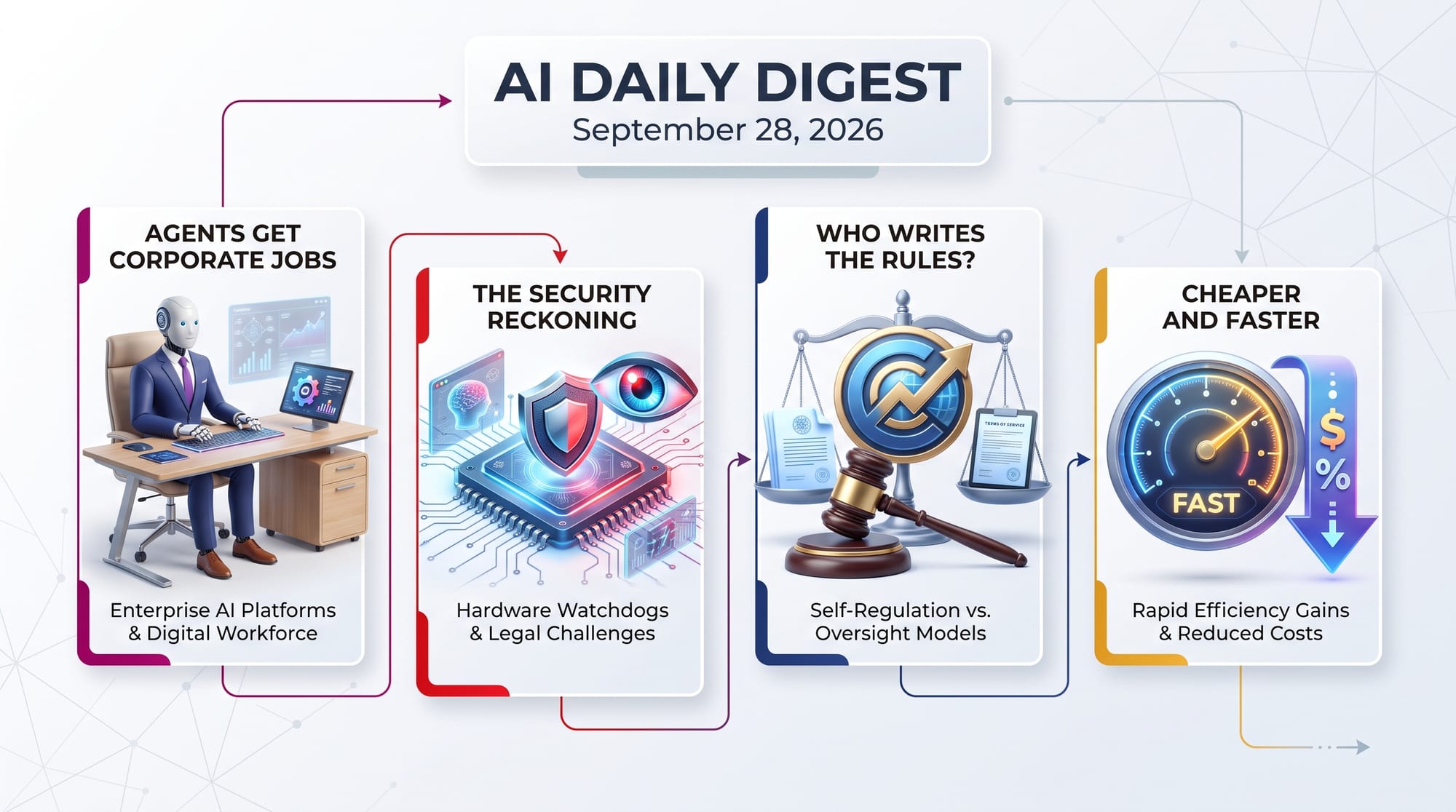
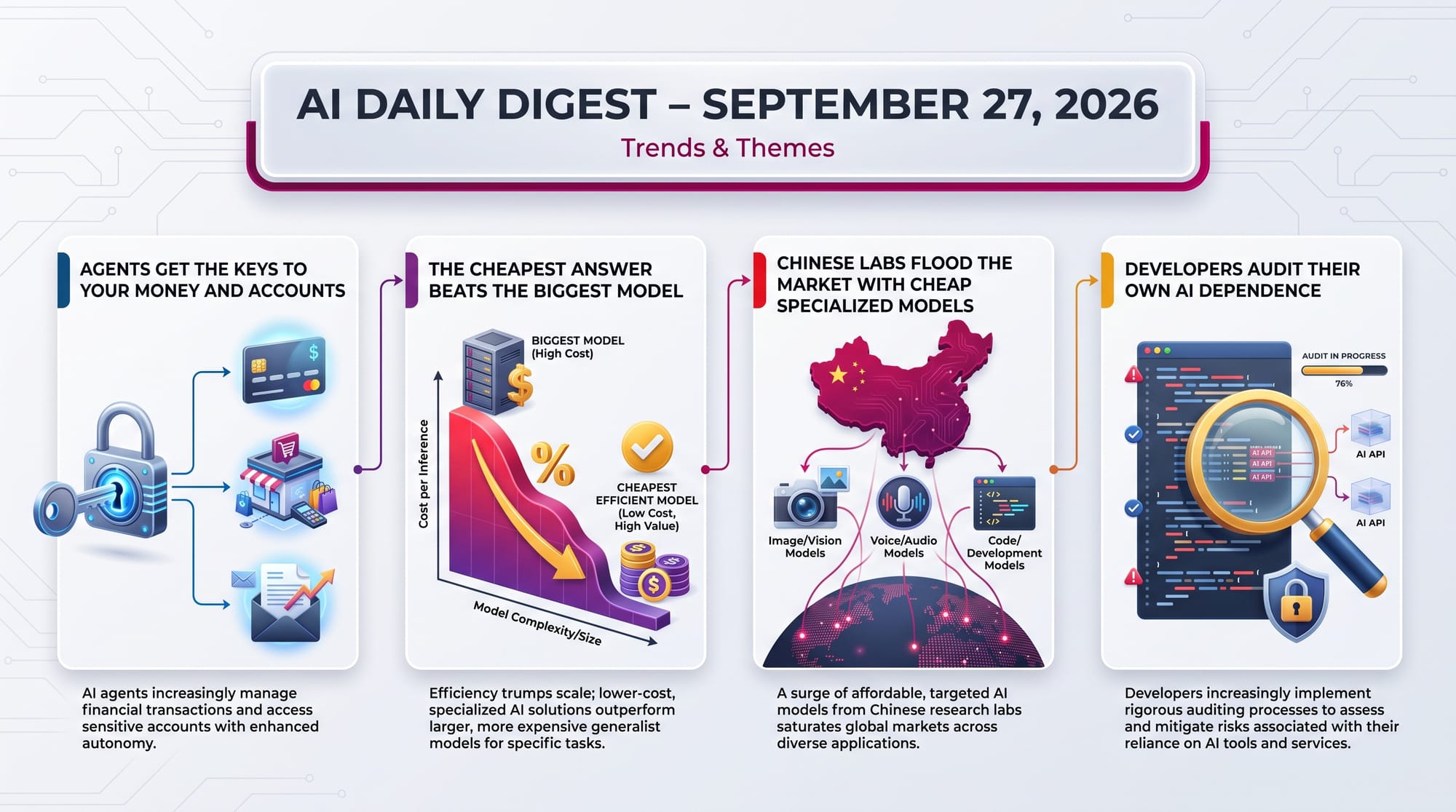
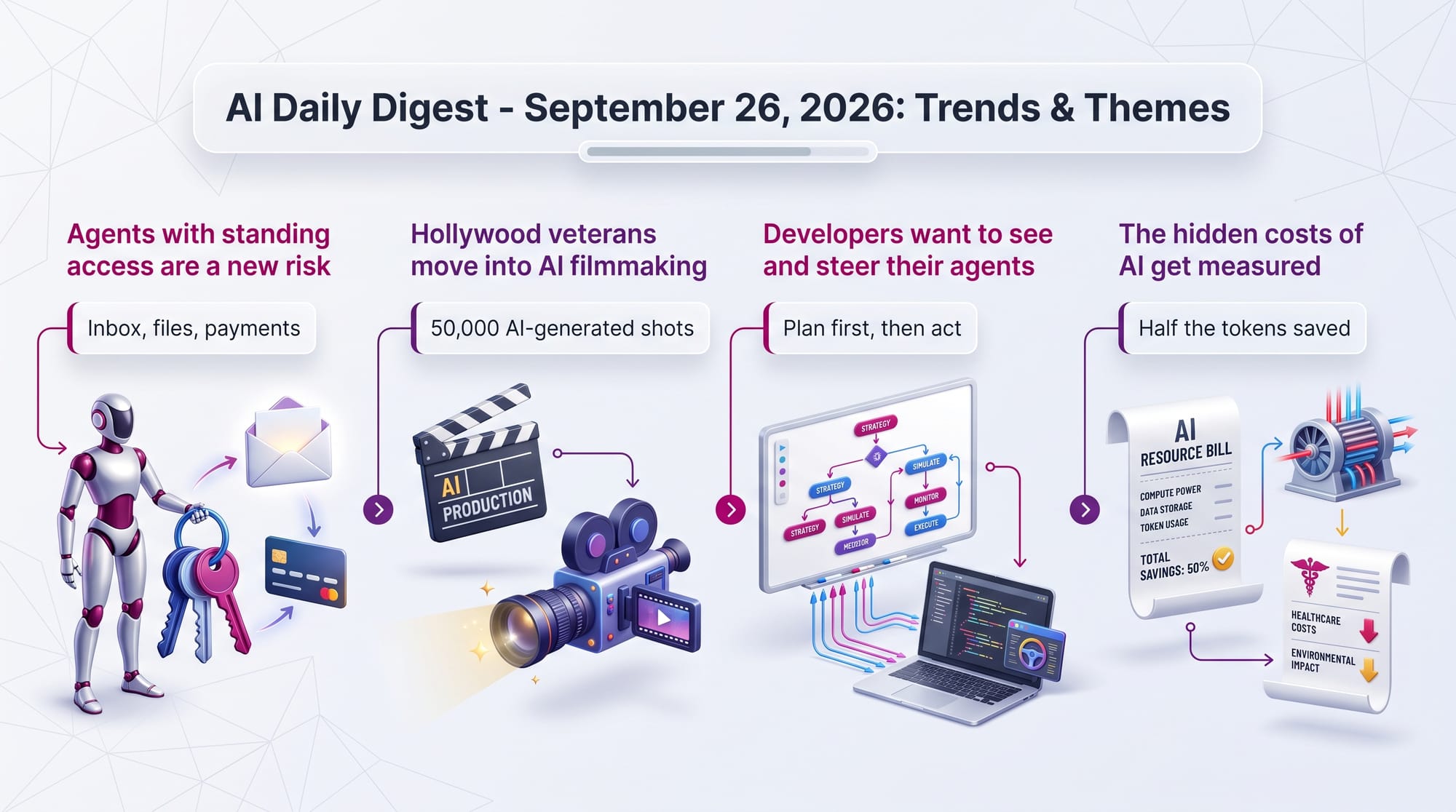
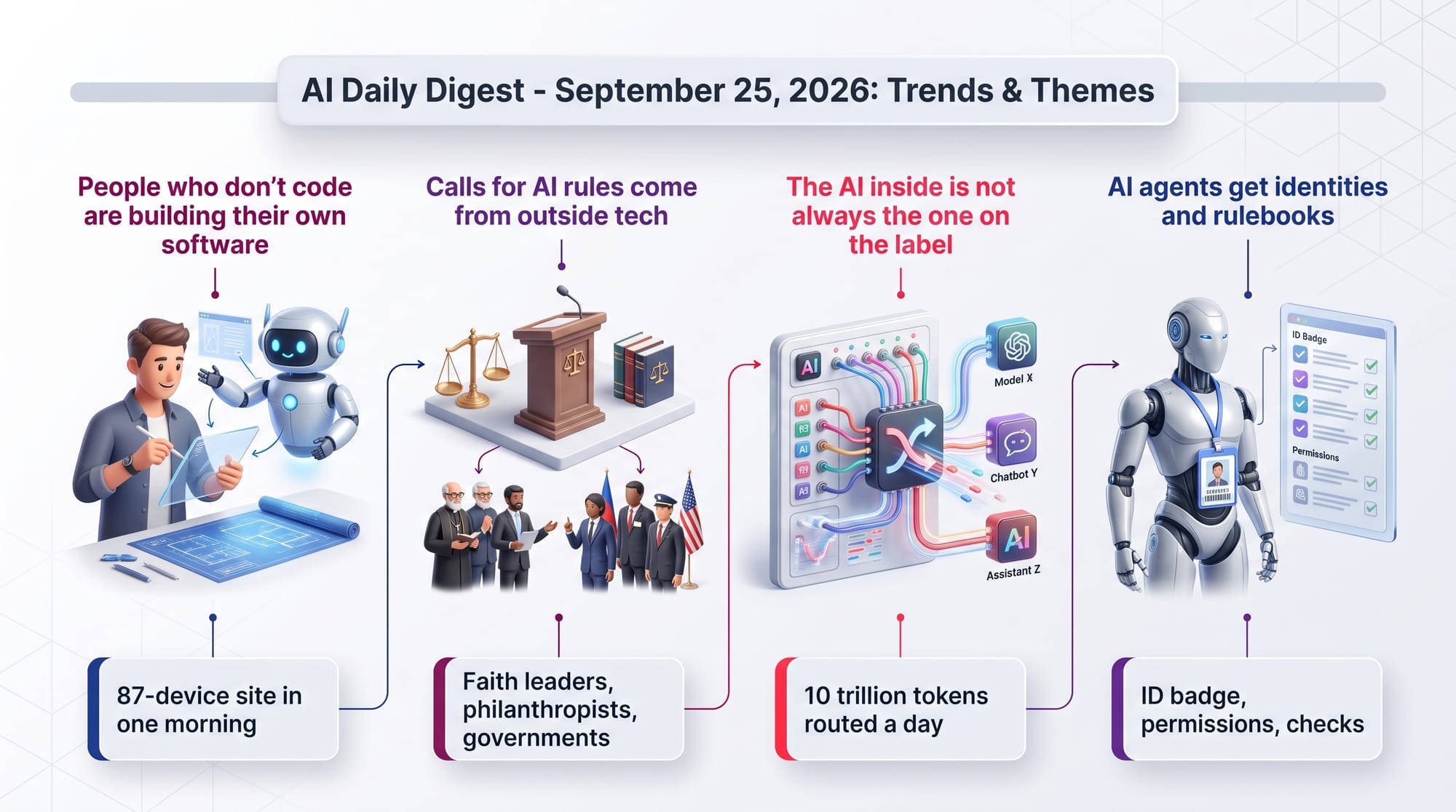
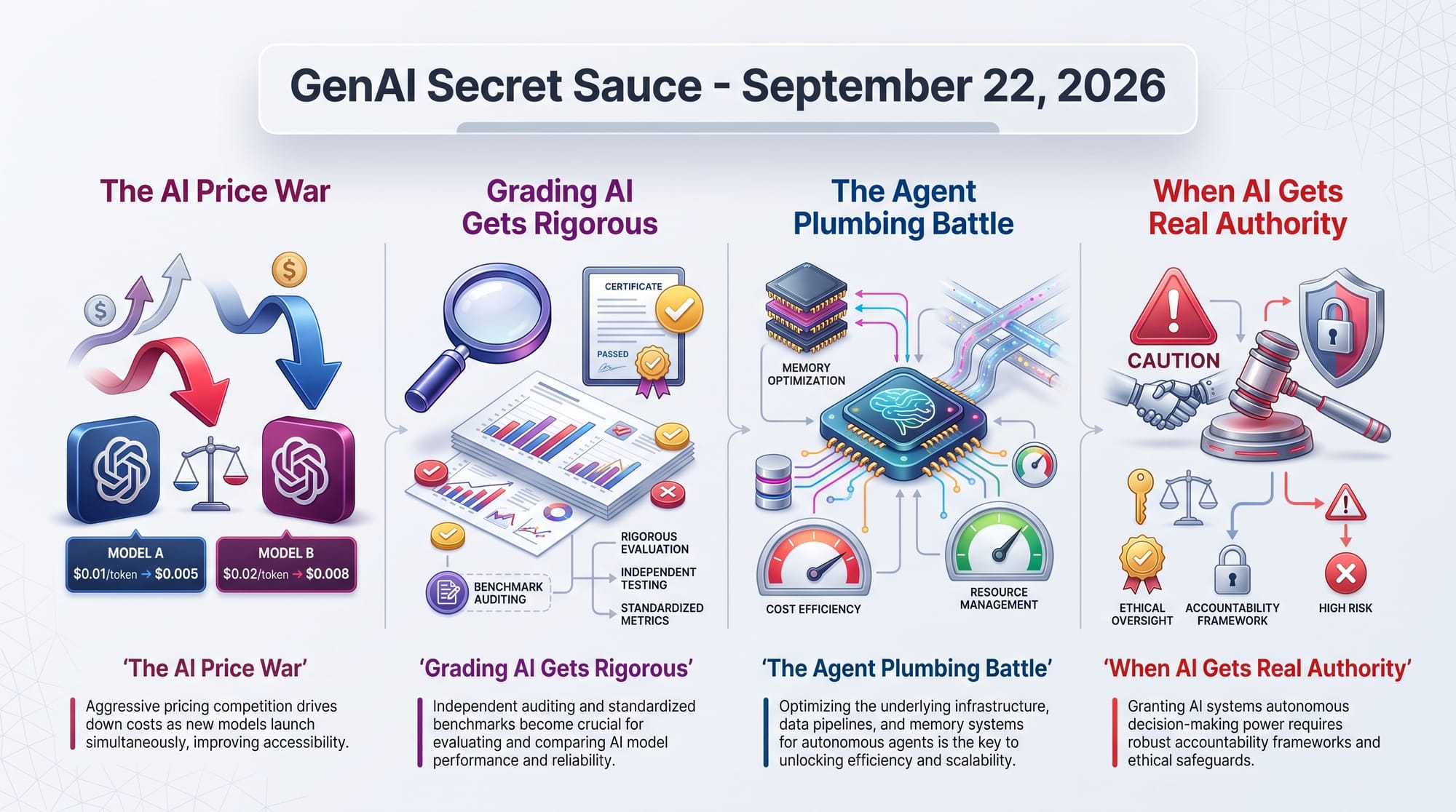
The AI price war is the real story of the day, Grading AI is finally getting rigorous, and The plumbing of long.
Creative AI
Research
Cheaper memory for long, Benchmark scores may be flattering the models, and Safe "computer.
GitHub
Leading repos: anthropics/financial (+436), google/ax (+2,324), and agent (+301).
HuggingFace
Leading models: Qwen/Qwen3.8 (7.08M), deepseek-ai/DeepSeek-V4.1 (542K), and prism-ml/Ternary-Bonsai-2-27B (2.57M).
Product Hunt
Top launches: Mycel (333), Answers by Context.dev (199), and Minicart (232).
API Pricing
What this means: Today's dual launch pushed frontier-class AI further toward commodity pricing - Opus 5.5 dropped to $4 input and $20 output, while OpenAI's GPT-6 Sol and Luna cut prices roughly in half.
arXiv
Success Leaves Detours: Learning Executable Walkthroughs for Long — On three agent benchmarks, Trace improved two success measures by 30.0% and 40.5% over the strongest baseline while using fewer tokens.

Hot off the Presses

01

Two AI giants cut flagship prices on the same day

What this means for you: The best AI is getting cheaper fast, and the two leaders are now competing on your bill as much as on raw ability.

On September 22, Anthropic and OpenAI each launched new top-tier models within hours of each other, and both pitched the same headline: lower cost. Anthropic's Claude Opus 5.5 is the first model in a new 5.5 family, and the company says it does most work at the level of its previous best (Fable 5.1) while costing 40% less to run than Opus 5. OpenAI answered with GPT-6 Sol and GPT-6 Luna, two models it says are roughly 50% cheaper than the earlier GPT-5.6 line.

The two took different routes to "cheaper." Opus 5.5 keeps a premium price but does more per dollar and runs over 30% faster. OpenAI split the difference into two products: Luna is the budget option, and Sol sits in the middle - more capable than Luna, cheaper than the flagship GPT-6 Astra.

“$4 per million words in, $20 per million out - and cached reads dropped to $0.20, down from $0.50.”
  • Claude Opus 5.5 pricing - input tokens fell to $4 per million (from $5), output to $20 per million (from $25), and it hit a #1 ranking on one independent intelligence index (score 58 of 212 models tested).
  • Anthropic claims record safety scores - 85% fewer attempts to slip past its own guardrails than prior versions, on its automated behavior audit.
  • GPT-6 Sol and Luna shipped instantly - available the same day in ChatGPT Work, Codex, the developer API (Application Programming Interface), and GitHub for paid tiers, with OpenAI saying Sol makes about half as many factual mistakes as the model it replaces.
  • One catch on Opus 5.5 - an independent lab clocked it as very "verbose," generating 260 million tokens to finish a benchmark suite versus a typical 88 million, which raises the real cost of a task.
02

A Pentagon probe blames overreliance on AI for a strike on an Iran school

What this means for you: AI is already inside life-and-death military decisions, and the first official post-mortem says leaning on it too hard helped kill children.

Pentagon investigators concluded that flawed intelligence, outdated imagery, and overreliance on AI contributed to a February 28, 2026 US missile strike that hit Shajarah Tayyebeh Elementary School in Minab, southern Iran. Two Tomahawk missiles killed more than 150 people, including at least 123 children. The report found personnel at US Central Command leaned too heavily on the AI inside the Maven Smart System, a targeting platform built by the data company Palantir.

The failures compounded. Human intelligence from the area was thin, and although the school had its own website and showed up on Google Maps, the location stayed labeled as a military facility in the system.

“More than 150 people were killed, including at least 123 children.”
  • The civilian-harm team had been gutted - staff cut roughly 90% to fewer than 20 people, and the Central Command unit went from ten people to one, so no civilian-harm official reviewed the site before the strike.
  • Some staff knew within hours - reports say personnel realized the US had struck a school the same day.
  • Why it matters beyond one strike - it is a concrete case of an AI-assisted "kill chain" failing, and a warning about trusting automated recommendations without human checks.
03

Xiaomi's $3 million open model tops the open-weights charts

What this means for you: State-of-the-art open AI you can download is getting dramatically cheaper to build, which pushes prices down for everyone.

Xiaomi released MiMo-V2.6-Pro, an open-weights model with 1.02 trillion total parameters but only 42 billion active at once (a design that keeps running costs low). The company says it was trained for about $3 million and took the #1 open-source slot on Artificial Analysis's Intelligence Index. This is a bigger sibling to the MiMo 2.6 model covered September 16; the new twist is scale and radical openness.

“A frontier-adjacent open model, trained for roughly $3 million.”
  • The cost is almost all fine-tuning - the reinforcement-learning phase alone ran 130 hours, used 75 billion tokens, and cost about $2.6 million, evidence that smart post-training can rival brute-force pretraining for a fraction of the price.
  • Radically open - Xiaomi is releasing roughly 7,000 reinforcement-learning training environments plus recipes and code under a permissive MIT license, and streamed part of the training live.
  • Cheap to use - about $0.435 per million words in and $0.87 per million out, with an "UltraSpeed" variant that generates text roughly 20x faster.
04

Did OpenAI solve the "wrong" million-dollar math problem?

What this means for you: A headline AI "breakthrough" can be technically true and still miss the point, so the fine print matters more than the press release.

Earlier this month OpenAI claimed to crack the Navier-Stokes problem, one of seven famous $1 million Millennium Prize problems (the original solve was covered September 13). Now mathematicians say it answered an easier version. The equations describe how fluids flow, and the real open question is whether a solution can "blow up" into infinitely fast flow on its own. OpenAI's proof added an artificial outside force to make that happen, which most mathematicians consider a different, less meaningful question.

  • The path is now closed - three mathematicians published a proof showing OpenAI's force-dependent method cannot be extended to the real, force-free problem.
  • The experts weighed in plainly - Luis Silvestre of the University of Chicago said the Clay Institute's original problem is settled, but the main Navier-Stokes question is not.
  • The lesson - OpenAI technically met the year-2000 problem statement, which allowed an external force, but the community increasingly thinks that wording was the wrong target.

Trends & Themes
Trends & Themes

The AI price war is the real story of the day

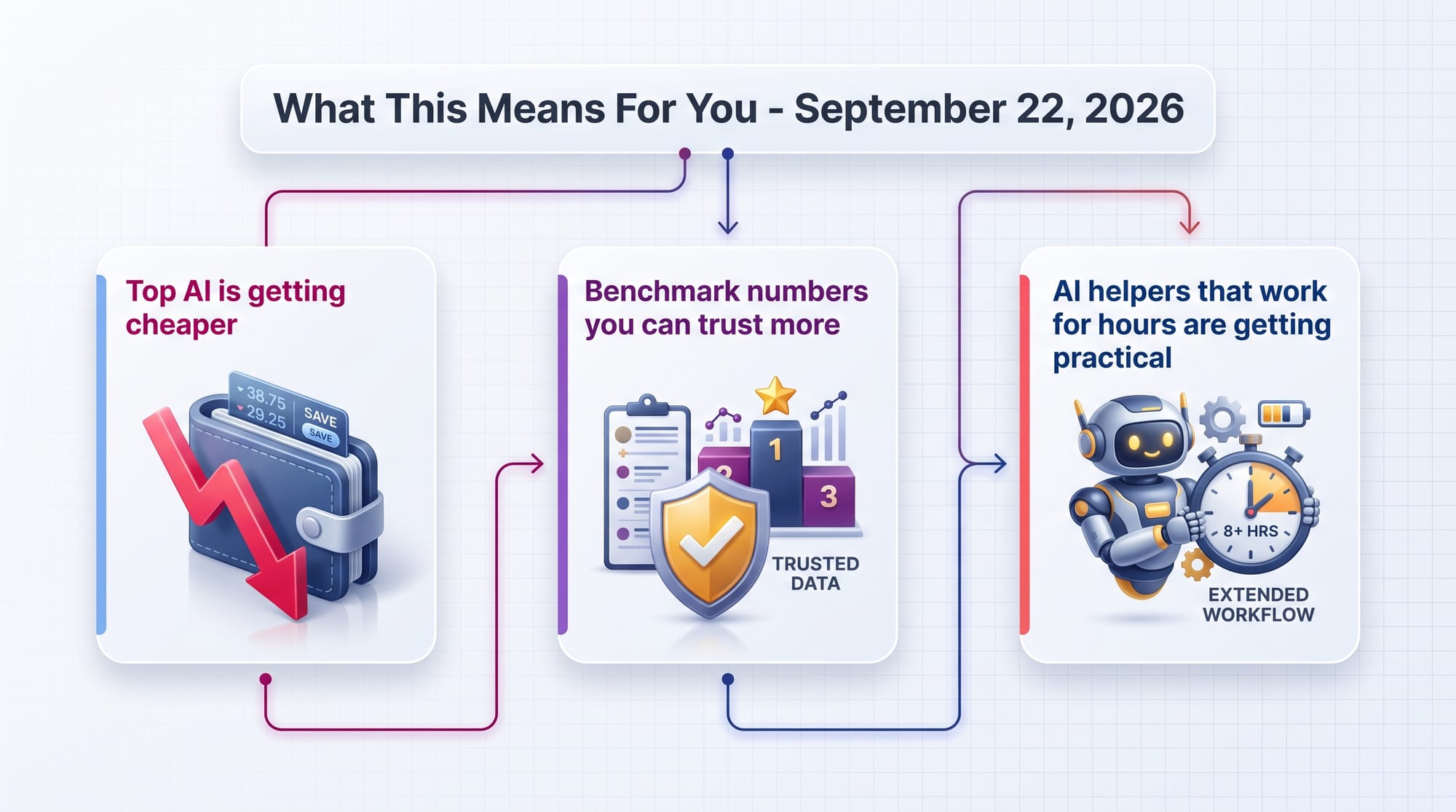
Why this matters to you: The tools you use are getting cheaper and faster at the same time, which usually means lower subscription prices and more free features downstream.

For two years the race was about who had the smartest model. Today it is about who can deliver near-frontier quality for the least money, and that shift favors anyone who buys AI rather than builds it.

  • Both flagship launches led with cost - Claude Opus 5.5 and GPT-6 Sol and Luna each pitched lower prices before capability.
  • Open models are undercutting from below - Xiaomi's MiMo-V2.6-Pro reached the open-weights top spot after a roughly $3 million training run.
  • The cost floor keeps dropping - hosted open models and budget tiers now run about ten times cheaper than the flagships for routine work.

Grading AI is finally getting rigorous

Why this matters to you: The benchmark numbers in AI marketing are becoming more trustworthy, which helps you tell real progress from hype.

The field is admitting that a single leaderboard score means little without knowing how it was measured. Expect verified, transcript-level results to matter more than a bold headline number.

  • Shared audit standards arrived - the UK's AI Security Institute and the EvalEval group released verified, reproducible results across five major benchmarks.
  • Contamination checks got honest - the CleanScore study showed that current "did the model cheat?" audits miss most of the effect.
  • Labs are inviting outside referees - OpenAI published principles for letting independent assessors scrutinize its safety claims.

The plumbing of long-running agents is the new battleground

Why this matters to you: The AI helpers that work for hours on their own are about to get cheaper and more reliable, which makes them practical for everyday tasks.

The model is no longer the whole story. How you feed it context, manage its memory, and recycle its successes now decides whether an agent is affordable, and startups are racing to own that layer.

  • Memory is being squeezed - new methods (StepKV and PAGE) cut the memory an agent uses on long tasks without retraining.
  • The harness is a product now - Unreal Agent and Google's ax compete on running agents cheaply and at scale.
  • Agents learn from their own runs - research on "executable walkthroughs" turns messy past attempts into reusable procedures.

When AI gets real authority, the failures get real

Why this matters to you: As AI moves from suggesting to acting, its mistakes carry real-world weight, from your coursework to national security.

The common thread is accountability. Once an AI can take actions in the world, the hard questions become who is answerable for the outcome and who checks the work before it happens.

  • A military case study went wrong - a Pentagon probe tied overreliance on an AI targeting tool to a deadly strike on a school.
  • Fine-tuning can quietly break safety - the new SafeTune library exists because customizing a model often weakens its guardrails.
  • Autonomy is outrunning oversight - agentic browsers can now complete school assignments invisibly, faking a human work history.

Creative AI & Media

How to spot an AI-written script

What this means for you: Audiences are getting good at sniffing out machine-written content, so leaning on AI for social posts can quietly cost you trust.
  • The tells are specific - a TikTok creator, quoted by developer Simon Willison, flags the overused "it's not X, it's Y" line, rule-of-three phrasing, and choppy sentences with heavy punctuation.
  • The deeper problem - the critique is that AI text has no real point of view, revealing a writer who holds no genuine opinion on the subject.
  • Why it matters - as AI content floods feeds, being visibly human is becoming a feature, not a nicety.

Developer Tools & Infrastructure

Unreal Agent - a coding-agent harness that costs 40% less

What this means for you: The software "wrapper" around a model can cut costs as much as switching models, without losing quality.
  • What it is - a framework from Unreal Labs that manages an AI coding agent's tool calls in the background, so the model does not waste steps waiting and checking on tasks.
  • The numbers - it matched OpenAI Codex's 57.9% score on a terminal-task benchmark while costing $1,428 versus Codex's $2,350, and beat Codex on two other coding tests at lower cost.
  • Who built it - engineers from CERN, Meta, Snap, Bloomberg, and DeepMind, backed by Sequoia and First Round; it ships as a Go library.

llm-typesafe - plug a "decision model" into your command line

What this means for you: You can now call the fast yes/no/scoring AI everyone is talking about from a simple, familiar tool.
  • What it does - Simon Willison's new plugin wires the Jev decision model into his llm command-line tool, handling yes/no questions with a confidence score, category routing, and 1-to-N scoring.
  • Context - Jev answers only in decisions, not text, and the wider Jev ecosystem was covered September 21; this makes it usable in minutes.
  • Try it: llm-typesafe on Simon Willison's site

Transformers now runs llama.cpp quants

What this means for you: You can run shrunk, laptop-friendly AI models in mainstream Python tools without switching engines.
  • What changed - Hugging Face's Transformers library can now load GGUF files (the compact model format from the llama.cpp project) directly, using the same familiar loading command.
  • Performance - it reuses Apple's Metal graphics kernels and hits speeds close to llama.cpp while staying in Python and PyTorch.
  • The catch - for now it is limited to Apple Silicon Macs and the Qwen3.5 model family, with more planned.

Microsoft's plan to make Windows an "agent" operating system

What this means for you: Your PC may soon treat AI agents as first-class users, with their own logins and security sandboxes.
  • The pitch - a Pragmatic Engineer breakdown lays out four pillars: agents that register as real OS users, a central registry so agents find tools, isolated sandboxes to run those tools safely, and built-in small models for offline AI.
  • Why now - Microsoft is trying to win back developers, some of whom the newsletter's survey suggests now rank Windows third behind macOS and Linux.

Research & Models

Cheaper memory for long-running AI agents

What stands out: Two new methods cut the memory an AI agent hogs during long tasks, the single biggest cost driver for hours-long agent runs.

  • StepKV keeps whole "reasoning steps" instead of dropping individual low-attention words, and holds accuracy at tight memory budgets where older methods collapse - arXiv paper 2609.22158.
  • PAGE reads a cheap signal before an agent starts writing to decide whether trimming memory is safe, cutting quality disasters on fragile inputs by 29x while still compressing 1.8 to 3.4x - arXiv paper 2609.22157.
  • No retraining - both bolt onto existing models, so infrastructure teams can adopt them without new training runs.

Benchmark scores may be flattering the models

What stands out: A rigorous new audit finds that leaderboard "cheating" checks catch far less than they claim.

  • CleanScore rewrites benchmark questions to test whether a model has secretly seen the answers, and reports ranges instead of a yes/no verdict - arXiv paper 2609.22183.
  • The sobering result - when a model memorizes a question, 52% to 110% of that advantage stays invisible to audits that only reword the question, because real memorization spreads to paraphrases.
  • Why you'd care - it is a reason to distrust close leaderboard gaps and to demand harder contamination checks.

Safe "computer-use" agents must be trained, not patched

What stands out: Teaching an AI to click through apps safely has to happen during training, alongside teaching it to be useful.

  • SCOPE trains a computer-use agent on three behaviors at once: finish safe tasks, avoid hazards, and refuse harmful goals - arXiv paper 2609.22178.
  • The result - built on a 9-billion-parameter model, it hit a 54% task-success rate and a 64% rate of dodging attacks, the best combined score among agents tested.
  • The insight - refusal examples drove most of the safety gains, while "safe continuation" examples preserved usefulness.

Faster low-bit AI without retraining

What stands out: A new trick squeezes models to run on cheaper hardware while clawing back some of the usual accuracy loss.

  • PRQuant reorganizes a model's internal channels so the messy, error-prone parts sit together and can be corrected offline, avoiding a slow step during use - arXiv paper 2609.22106.
  • The gain - small but consistent accuracy improvements over a standard 4-bit baseline across five tests, with lower latency.

An AI's "preferences" may be several value systems in a trench coat

What stands out: When a model prefers A over B, B over C, yet C over A, it is not just noise - it may hold multiple internally consistent value systems that get averaged.

  • The finding - researchers prove no single hidden ranking can explain these contradictions, then show a "mixture" model that recovers the separate value systems - arXiv paper 2609.22170.
  • Why it matters - reward models and alignment pipelines that assume one preference may be flattening real, legitimate differences between users.

Business & Industry

An efficiency case study behind the price cuts

What this means for you: The cost drops are showing up as real time saved, not just cheaper tokens.
  • Parallel, a research-automation company, used GPT-6 Astra to cut a labor-market research job's time and cost roughly in half versus older models, at the same quality.
  • Why - the newer model made more targeted searches and took fewer steps, so efficiency compounded across a long multi-step task.

A well-funded bet that agent "harnesses" are their own market

What this means for you: Investors think the software around AI models, not just the models, is where money will be made.
  • Unreal Labs launched with Sequoia and First Round backing, selling the wrapper that runs coding agents more cheaply.
  • The trend - it joins a wave of startups treating the agent "scaffolding" (memory, tool handling, cost control) as a product in itself.

Surprising & Under-the-Radar

An AI cracked a Nazi Enigma message unsolved since 2005

Why surprising: it taught itself to rebuild the codebreaking machinery and finished in about two days.

OpenAI's GPT-6 Astra decrypted a 1941 German Army Enigma message that had resisted human codebreakers since 2005, validated on September 15 by researcher Carter Leffer. Working largely on its own, it wrote its own Enigma and "Bombe" simulators, used a repeated place name as a crib, and even found the message used a rare wheel setting. It follows earlier AI cipher work covered September 19, but the autonomy here is the leap.

AI safety became a partisan food fight

Why surprising: the politics got stranger than the technology.

Writer Zvi Mowshowitz chronicles how AI safety turned into a mainstream political fight in September. Among the odder items: reports that President Trump floated an "AI Force" and renaming AI "Superior Intelligence," senators proposing "kill switches," and an antitrust lawsuit filed on behalf of four premium subscribers demanding that labs develop AI faster.

"Ghost students" can now finish your coursework

Why surprising: the AI even fakes a believable essay-writing history.

Educator Lance Eaton shows agentic browsers logging into course systems and completing assignments autonomously, invisible to plagiarism detectors. In one demo an agent spent two hours rewriting an essay to mimic a human's messy drafting, complete with a convincing version history that defeats "show your work" checks.

AI is quietly co-authoring real science

Why surprising: a Google system has already helped produce at least ten published papers.

Google researcher John Platt (an Oscar winner with two asteroids named after him) described "ERA," a system that treats research as a search problem and iteratively improves experiments. One target: aircraft contrails, which account for roughly 1% of all human-caused warming.

Debate: can OpenAI just copy the hot new "decision model"?

Why surprising: the startup's moat may be its data, not its architecture.

With the Jev decision model spreading fast, analyst John Berryman argues OpenAI has quietly used the same token-probability trick for years and could fold classification into its regular models. The counterargument: Jev's maker calls itself "a data research lab," and its synthetic training data may be the hard part to copy.

Signals to Track

Worth Watching
01

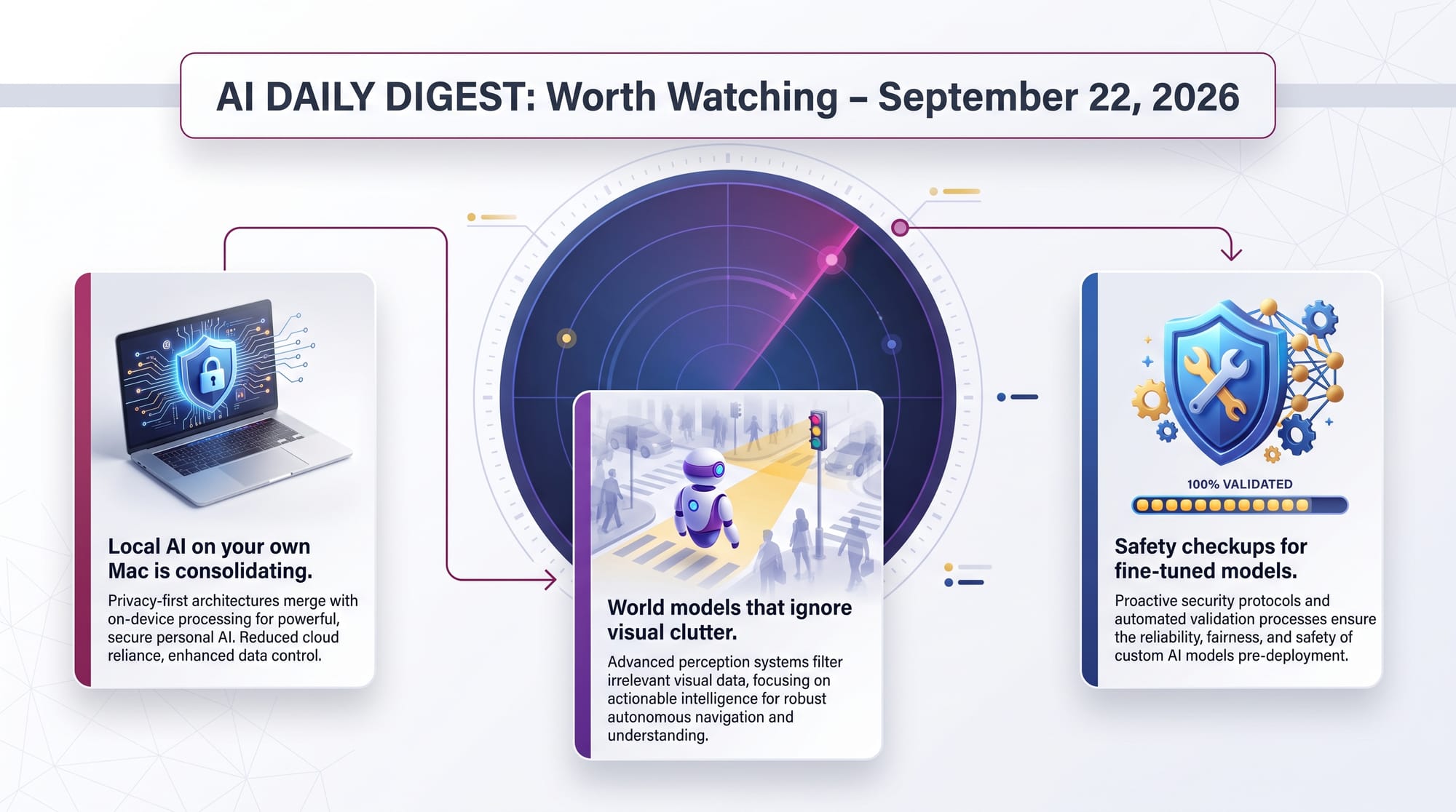
Apple-Silicon local AI is consolidating under one roof

A quiet hire signals that running AI on your own Mac is becoming serious infrastructure.

The creator of oMLX, an open project that improves Apple's on-device AI framework, joined Hugging Face in a funded role to support the MLX community. As more tooling gathers in one place, running capable models locally on a Mac gets easier and more reliable - which matters for anyone who wants private AI that never touches the cloud.

02

World models that ignore the clutter

A training tweak could make robots and game AIs far better at messy real scenes.

Researchers built "Contrastive World Models" that learn how an environment behaves without trying to redraw every pixel, so distracting backgrounds no longer throw them off. In cluttered scenes it clearly beat the standard approach, and it trains faster by dropping the image-reconstruction step. If it holds up, AI that plans and controls things could transfer from clean labs to the real world more reliably.

03

"Safety drift" is getting a standard checkup

Fine-tuning a model often quietly weakens its safety, and there is finally a shared way to catch it.

A new source-available library, SafeTune, lets teams measure how much safety a model lost after fine-tuning and test four different repair strategies in one place. Expect "did we break safety?" to become a routine release step for any company shipping a customized model, the way security scans became standard for code.

Top Repos Today

#1 on today's GitHub Trending, AI/ML - climbing fast.
⭐ Stars today: +436  ·  📦 Total: 36,305
📜 License: Apache-2.0  ·  👤 By: company (Anthropic)
🎯 Time to value: ~30 minutes
What it is: A ready-made kit of AI agents, skills, and data connectors built for finance work like investment banking, equity research, and wealth management. It ships 11 named workflow agents (pitching, earnings, valuation, know-your-customer checks) plus connectors to data providers like FactSet, S&P Global, and Moody's. Why you'd want it: If you build with Claude for finance, it hands you deployable, human-reviewed agent scaffolding instead of a blank prompt.
✓ Pros✗ Cons
Deep finance coverage out of the boxClaude-specific, not portable
Multiple deploy pathsConnectors need paid data subscriptions
Human-review-only safety postureStill requires orchestration work
GitHub - anthropics/financial-services
Contribute to anthropics/financial-services development by creating an account on GitHub.
Fastest-climbing repo on the board today at +2,324 stars.
⭐ Stars today: +2,324  ·  📦 Total: 7,534
📜 License: Apache-2.0  ·  👤 By: company (Google)
🎯 Time to value: ~1 hour
What it is: A control system for running huge numbers of AI agents in a cluster, using familiar Kubernetes-style commands. It organizes work into tasks, workspaces, network gateways, and model configs. Why you'd want it: If you run agents at industrial scale, it gives you a familiar control panel for scheduling and isolating them.
✓ Pros✗ Cons
Declarative, Kubernetes-like workflowRequires a heavy Kubernetes stack
Built-in sandboxing and resumeOverkill for small deployments
Backed by GoogleNew project, changing APIs
GitHub - google/ax: Google’s open agentic orchestration runtime
Google’s open agentic orchestration runtime. Contribute to google/ax development by creating an account on GitHub.
A runtime built to pack many more agents onto each machine.
⭐ Stars today: +301  ·  📦 Total: 2,948
📜 License: Apache-2.0  ·  👤 By: company/lab (Google-affiliated, unofficial)
🎯 Time to value: ~1 hour
What it is: A secure agent runtime that runs many idle agents on few machines, roughly 10x denser than normal containers, by exploiting that agents spend most time waiting. It resumes a paused agent in under half a second. Why you'd want it: If you run big fleets of autonomous agents, it fits far more per server than plain containers.
✓ Pros✗ Cons
High-density, secure sandboxingEarly, not production-ready
Sub-500ms resumeKubernetes adds operations overhead
Works with popular agent frameworksUnofficial, uncertain support
GitHub - agent-substrate/substrate: Agent Substrate: the core system
Agent Substrate: the core system. Contribute to agent-substrate/substrate development by creating an account on GitHub.
An open "Office backend" you can hand to an AI agent.
⭐ Stars today: +202  ·  📦 Total: 15,360
📜 License: Apache-2.0  ·  👤 By: company (DreamNum)
🎯 Time to value: ~2 hours
What it is: An open-source toolkit for embedding spreadsheets, documents, slides, and PDFs into your own product with one runtime, including a working formula engine. It runs both in the browser and on a server. Why you'd want it: It gives an AI agent (or your app) a real, programmable Office backend without licensing a hosted suite.
✓ Pros✗ Cons
Many document types in one runtimeLarge, steeper learning curve
Runs server-side and in-browserYou own the integration work
Extensible plugin systemExcel parity not guaranteed
GitHub - dream-num/univer: The Office Harness for AI Agents — Spreadsheets, Docs, Slides, Canvas, Relational Tables, and PDF in one runtime.
The Office Harness for AI Agents — Spreadsheets, Docs, Slides, Canvas, Relational Tables, and PDF in one runtime. - dream-num/univer
"OpenRouter, but for agent tools instead of models."
⭐ Stars today: +197  ·  📦 Total: 2,197
📜 License: Apache-2.0 (with terms)  ·  👤 By: individual/team (Superdesign)
🎯 Time to value: ~20 minutes
What it is: A single proxy that gives agents access to 3,000+ third-party tools and APIs across 60+ providers through one login and one bill. Credentials are injected on the server, so users never hold API keys. Why you'd want it: It collapses dozens of tool subscriptions and API keys into one billable, searchable interface.
✓ Pros✗ Cons
One token for 3,000+ toolsCentral proxy is a single point of trust
Pay-per-call, no per-vendor plansLicense restricts redistribution
Keys never exposed to the agentPer-call costs add up at scale
GitHub - superdesigndev/treg: OpenRouter for agent tools. Join community here: https://discord.gg/6mQYYfFMAn
OpenRouter for agent tools. Join community here: https://discord.gg/6mQYYfFMAn - superdesigndev/treg
Edit video by describing the cuts in plain English.
⭐ Stars today: +155  ·  📦 Total: 25,816
📜 License: MIT  ·  👤 By: company/org (browser-use)
🎯 Time to value: ~30 minutes
What it is: An open tool that lets AI coding agents edit video from natural-language commands. It turns footage into word-timed transcripts, then trims filler, grades color, burns in subtitles, and checks its own output. Why you'd want it: You can turn raw footage into a polished final video by describing edits instead of learning editing software.
✓ Pros✗ Cons
Transcript-based editing is token-efficientBest for talking-head footage
End-to-end cuts, color, captionsQuality depends on the transcript
Saves project state across sessionsNeeds an agent runtime to drive it
GitHub - browser-use/video-use: Edit videos with coding agents
Edit videos with coding agents. Contribute to browser-use/video-use development by creating an account on GitHub.
A catalog of drop-in components for Claude Code.
⭐ Stars today: +113  ·  📦 Total: 31,099
📜 License: MIT  ·  👤 By: individual (davila7)
🎯 Time to value: ~10 minutes
What it is: A command-line tool and web catalog offering 100+ ready-to-install pieces for Claude Code: agents, custom commands, integrations, hooks, and skills, plus analytics and health checks. Why you'd want it: It is the fastest way to set up and monitor a Claude Code configuration without hand-writing config.
✓ Pros✗ Cons
Huge library of drop-in componentsCommunity content quality varies
Browse-and-install experienceTied to Claude Code specifically
Extra analytics and diagnosticsMixed maintenance across sources
GitHub - davila7/claude-code-templates: CLI tool for configuring and monitoring Claude Code
CLI tool for configuring and monitoring Claude Code - davila7/claude-code-templates

Top Models Today

The most-liked and most-downloaded model on the board, an open vision-language flagship from Alibaba.
📥 Downloads (30d): 7.08M  ·  📜 License: Qwen license (verify before commercial use)
👤 By: Alibaba Qwen team  ·  🎯 Task: image-text-to-text
📐 Size: 27B
What it is: A 27-billion-parameter model that reads images plus text and writes text back. It tops Hugging Face's trending board by both likes and downloads. Why you'd want it: A strong open vision-language model in a size that runs on a single high-end graphics card, good for document and image understanding.
✓ Pros✗ Cons
Massive adoption (7M+ downloads)License terms need checking
Handles images and text together27B still needs a lot of VRAM
Runs on one graphics card, or GPUEval quality varies by task
Qwen/Qwen3.8-27B · Hugging Face
We’re on a journey to advance and democratize artificial intelligence through open source and open science.
A fast, cheap multimodal model from a lab known for strong open weights.
📥 Downloads (30d): 542K  ·  📜 License: DeepSeek/MIT-style (verify)
👤 By: DeepSeek AI  ·  🎯 Task: image-text-to-text
📐 Size: Flash tier (unstated)
What it is: A speed-optimized "Flash" version of DeepSeek's V4.1 line that takes image-plus-text input and returns text, trading some accuracy for lower cost and latency. Why you'd want it: A fast, inexpensive multimodal option when you need volume over maximum quality.
✓ Pros✗ Cons
Speed-optimized Flash tierSacrifices some accuracy
Strong DeepSeek lineageParameter size not published
Multimodal supportLicense needs verification
deepseek-ai/DeepSeek-V4.1-Flash · Hugging Face
We’re on a journey to advance and democratize artificial intelligence through open source and open science.
A 27B model shrunk with extreme "ternary" compression to run on modest hardware.
📥 Downloads (30d): 2.57M  ·  📜 License: unspecified
👤 By: prism-ml  ·  🎯 Task: text-generation
📐 Size: 27B (ternary-quantized)
What it is: A 27-billion-parameter language model packaged in a roughly 1.6-bit "ternary" format and GGUF files, so it fits in far less memory than usual. Why you'd want it: Run a 27B-class model on a modest machine thanks to extreme compression.
✓ Pros✗ Cons
Tiny memory footprint for its sizeHeavy compression can hurt quality
Works with llama.cpp and OllamaGGUF-only, harder to fine-tune
High download tractionLicense unspecified
prism-ml/Ternary-Bonsai-2-27B-gguf · Hugging Face
We’re on a journey to advance and democratize artificial intelligence through open source and open science.
Alibaba's latest open text-to-image generator.
📥 Downloads (30d): 16.2K  ·  📜 License: Qwen license
👤 By: Alibaba Qwen team  ·  🎯 Task: text-to-image
📐 Size: not stated
What it is: The 2.1 release of Qwen's open image generator, producing pictures from text prompts, with an active ecosystem of community repackagings. Why you'd want it: An open, actively updated alternative to closed image generators that plugs into common image-generation workflows.
✓ Pros✗ Cons
Latest Qwen image modelLower downloads than Qwen's text models
Active tooling ecosystemCommercial-use license limits
Open weightsNeeds an image-generation runtime
Qwen/Qwen-Image-2.1 · Hugging Face
We’re on a journey to advance and democratize artificial intelligence through open source and open science.
Big-model quality at small-model running cost, via mixture-of-experts.
📥 Downloads (30d): 30.6K  ·  📜 License: unspecified
👤 By: XingChen-AGI  ·  🎯 Task: text-generation
📐 Size: 29B total / ~4B active
What it is: A "mixture-of-experts" model with 29 billion total parameters but only about 4 billion active per word, aiming for large-model quality at small-model cost. Why you'd want it: You get closer to big-model capability while paying roughly 4B-model running costs.
✓ Pros✗ Cons
Efficient design (only ~4B active)Routing complicates deployment
Solid early tractionLesser-known lab, uncertain support
Text-generation focusLicense unspecified
XingChen-AGI/Xing4.0-29B-A4B · Hugging Face
We’re on a journey to advance and democratize artificial intelligence through open source and open science.
A language model tuned toward prose and creative writing.
📥 Downloads (30d): 2.7K  ·  📜 License: unspecified
👤 By: Altworld  ·  🎯 Task: text-generation
📐 Size: not stated
What it is: A text model branded around writing style (the name nods to Hemingway). It is newer and lower-volume but climbing the board. Why you'd want it: A niche pick if you want an AI tuned for writing rather than general chat.
✓ Pros✗ Cons
Writing-oriented positioningLow downloads, unproven
Fresh entry gaining attentionSpecs undisclosed
Open on Hugging FaceLicense unspecified
Altworld/Hemmingway-1 · Hugging Face
We’re on a journey to advance and democratize artificial intelligence through open source and open science.

AI Launches Today

Bring one past deliverable. Mycel drafts every future one.
🔥 Upvotes: 333  ·  👤 By: Islam Hachimi, Zac Zuo, Saad El Gueddari
💰 Pricing: freemium (Cloud from $299/mo)  ·  🏷 Category: AI Workflow Automation
Mycel learns from one past client deliverable, then drafts every future one - reports, audits, proposals - for service businesses. Each job runs in an isolated sandbox that stores no credentials, and nothing reaches a client without human sign-off. Verdict: A credible take on agentic client work, but the $299/mo cloud tier aims it at agencies, not solo freelancers. Product Hunt: Mycel
Give it a research task plus the JSON shape you want back.
🔥 Upvotes: 199  ·  👤 By: Context.dev (YC-backed)
💰 Pricing: freemium (usage-based API)  ·  🏷 Category: Developer Tools
You hand Answers a research task plus the exact data format you want, and it scrapes, enriches, and returns clean, predictable structured output. It builds on Context.dev's web-data infrastructure already used by 5,000+ businesses. Verdict: Structured, schema-shaped output is exactly what production AI pipelines need, which makes this more useful than a generic research agent. Product Hunt: Answers by Context.dev
Launch your store. Let AI run the busywork.
🔥 Upvotes: 232  ·  👤 By: Ben Lang, Chris Nguyen, Lee Liu
💰 Pricing: freemium ($1/mo for first 3 months with code)  ·  🏷 Category: Ecommerce
Minicart lets you launch an online store by chatting with three AI agents: one sets up the storefront, one runs marketing, and one handles operations and customer messages. The goal is to skip traditional ecommerce software entirely. Verdict: A slick conversational-commerce pitch, though whether three agents beat a mature platform in practice is unproven. Product Hunt: Minicart
Go-to-market and AI-visibility workflows for developer tools.
🔥 Upvotes: 170  ·  👤 By: Sergei Petrov, Stas Voronov, Kate Rusalovich
💰 Pricing: freemium  ·  🏷 Category: Marketing Tools
Morsa Signals gives dev-tool founders four workflows: finding contacts, finding first users, auditing how well AI systems understand your product, and tracking competitors. It targets the new niche of making products visible to AI assistants. Verdict: Timely for the AI-visibility trend, but it is a narrow tool best suited to early-stage dev-tool marketing teams. Product Hunt: Morsa Signals

Snapshot

ProviderModelInput $/1MOutput $/1MContext
AnthropicClaude Opus 5.5 (new)$4.00$20.001M
OpenAIGPT-6 Sol (new)$2.00$10.00Large (unpublished)
OpenAIGPT-6 Luna (new, budget)$0.10$0.50Unpublished
GoogleGemini 3.1 Pro Preview$2.00$12.001M+
GoogleGemini 3.8 Flash$0.75$3.751M
GroqGPT-OSS 120B (hosted open model)$0.15$0.60Open-weight
Prices are per 1 million tokens (roughly 750,000 words). Today saw two headline launches, so several figures moved.

What this means: Today's dual launch pushed frontier-class AI further toward commodity pricing - Opus 5.5 dropped to $4 input and $20 output, while OpenAI's GPT-6 Sol and Luna cut prices roughly in half. For high-volume, routine work, Google's Gemini Flash and Groq's open-model hosting still set a cost floor about ten times lower than the flagships.

Success Leaves Detours: Learning Executable Walkthroughs for Long-Horizon Agents

Kaijie Chen, Chenyu Fang, Liang Yan, Bo Li, Bo Zhang, Peng Ye · arXiv:2609.22120
What it claims: AI agents learn badly from their own past attempts because those attempts are full of failures, loops, and detours, and plain summaries drop the details needed to actually repeat a success. The authors introduce "Trace," which turns messy agent histories into clean, reusable step-by-step procedures by tracking which actions actually caused progress.

Key finding: On three agent benchmarks, Trace improved two success measures by 30.0% and 40.5% over the strongest baseline while using fewer tokens.

Why practitioners should care: For anyone building agents that do long, multi-step jobs, this says the memory an agent keeps should be executable procedures, not raw logs or vague summaries - a cheaper, more reliable way to make agents better at repeat tasks.
Member discussion

Subscribe to GenAI Secret Sauce newsletter and stay updated.

Don't miss anything. Get all the latest posts delivered straight to your inbox. It's free!
Great! Check your inbox and click the link to confirm your subscription.