Watch today's digest as a video summary (generated by NotebookLM)
Statistically Speaking
One Thing to Tell Your Friends
TL;DR
Hot off the Presses
The METR AI Capabilities Graph Is Under Fire for Fundamental Errors
METR's "Long Tasks" benchmark has become the single most-cited evidence that AI capabilities are growing exponentially. It appears in congressional briefings, investor presentations, and news articles. This weekend, three independent critiques converged on the same conclusion: the graph has serious methodological problems.
The stakes are high because METR's data has been used to argue both for and against AI regulation. If the underlying measurements are flawed, decisions built on them may need revisiting.
- Nathan Witkin (Transformer News) identified task unreliability - some tasks METR used as benchmarks involve dependencies that change over time, making past and present scores incomparable
- Gary Marcus and Ernest Davis argued the y-axis is meaningless - measuring "time horizon" (how long an AI can work on a task) conflates difficulty with duration, which are not the same thing
- A Reddit thread on r/MachineLearning with 200+ upvotes catalogued specific errors including inconsistent baselines and results that could not be reproduced
Cerebras Goes Public at $34 Billion - the Biggest Challenge to NVIDIA's AI Chip Dominance
Cerebras Systems completed the second-largest tech IPO of 2026, pricing shares at $150-160 (up from the initial $115-125 range) with 20x oversubscription. The company builds the Wafer-Scale Engine (WSE) - literally an entire silicon wafer turned into a single chip, containing over 4 trillion transistors.
The fundamental pitch: instead of bolting hundreds of GPUs together with complex networking, use one massive chip. The trade-off is specialization - Cerebras chips excel at AI inference but cannot do general-purpose computing.
- Inference speed: 2,500+ tokens per second - approximately 70x faster than leading GPU (Graphics Processing Unit) alternatives for the same AI models
- IPO valued the company at $34 billion or more - a significant step up from its last private valuation
- Already running production AI workloads for customers including Llama 3.1 8B at 2,200 tokens/second and Llama 3.3 70B at 450 tokens/second
- CS-3 third-generation chip contains 57 times more transistors than the largest GPU
The White House Is Giving US Spy Agencies Access to Anthropic's AI
The White House is finalizing a classified contract to provide US intelligence agencies with access to Anthropic's Claude models, part of a broader $9 billion expansion of chip and compute resources for spy agencies.
- $9 billion in total chip and compute spending earmarked for intelligence community AI capabilities
- Classified contract details are not publicly available, but the partnership is confirmed by reporting from Startup Fortune
- Follows Anthropic's recent Gates Foundation partnership (covered May 24) - the company is simultaneously pursuing humanitarian and national security applications
- Raises the dual-use question directly - can an AI lab credibly advocate for safety while optimizing its models for intelligence gathering?
Wix Cuts 1,000 Jobs - Its Largest Layoffs Ever - as AI Threatens Its Core Business
Wix announced it is cutting approximately 1,000 jobs, roughly 20% of its workforce, in the largest layoffs in the company's 18-year history.
Previously: May 19 - Meta laid off 8,000 while posting $56B quarterly revenue. May 22 - Microsoft cancelled its internal Anthropic subscription over unpredictable costs. The pattern of AI-driven workforce restructuring continues to accelerate.
- 20% of total workforce eliminated in a single round
- AI is both the cause and the cure - Wix is cutting human roles while investing heavily in AI-powered website creation tools that do what its employees used to do
- The company joins a growing pattern of tech companies posting record revenue while simultaneously laying off thousands
- 78 upvotes on r/artificial with comments noting Wix is particularly vulnerable because its entire value proposition - "build a website without coding" - is exactly what AI tools now do for free
AI Made Your App Teams 10x Faster - But Nobody Expanded the Platform Team
Nate Berkopec's newsletter identifies a critical organizational blind spot: AI coding agents are dramatically accelerating application development, but platform teams - the engineers responsible for CI/CD pipelines (the systems that test and deploy code), security scanning, infrastructure provisioning, and developer tooling - are being overwhelmed.
This is the first detailed analysis of how AI acceleration creates second-order organizational problems that aren't visible in productivity metrics.
- App teams producing code 10x faster without corresponding investment in the teams that deploy and maintain it
- Platform teams now the bottleneck for the entire engineering organization
- The problem is structural, not technical - AI doesn't help platform engineers the same way it helps application developers, because platform work involves unique internal systems that AI has never seen
- Risk of "deployment debt" - code ships faster but with less review, weaker testing infrastructure, and more fragile deployment pipelines
Trends & Themes

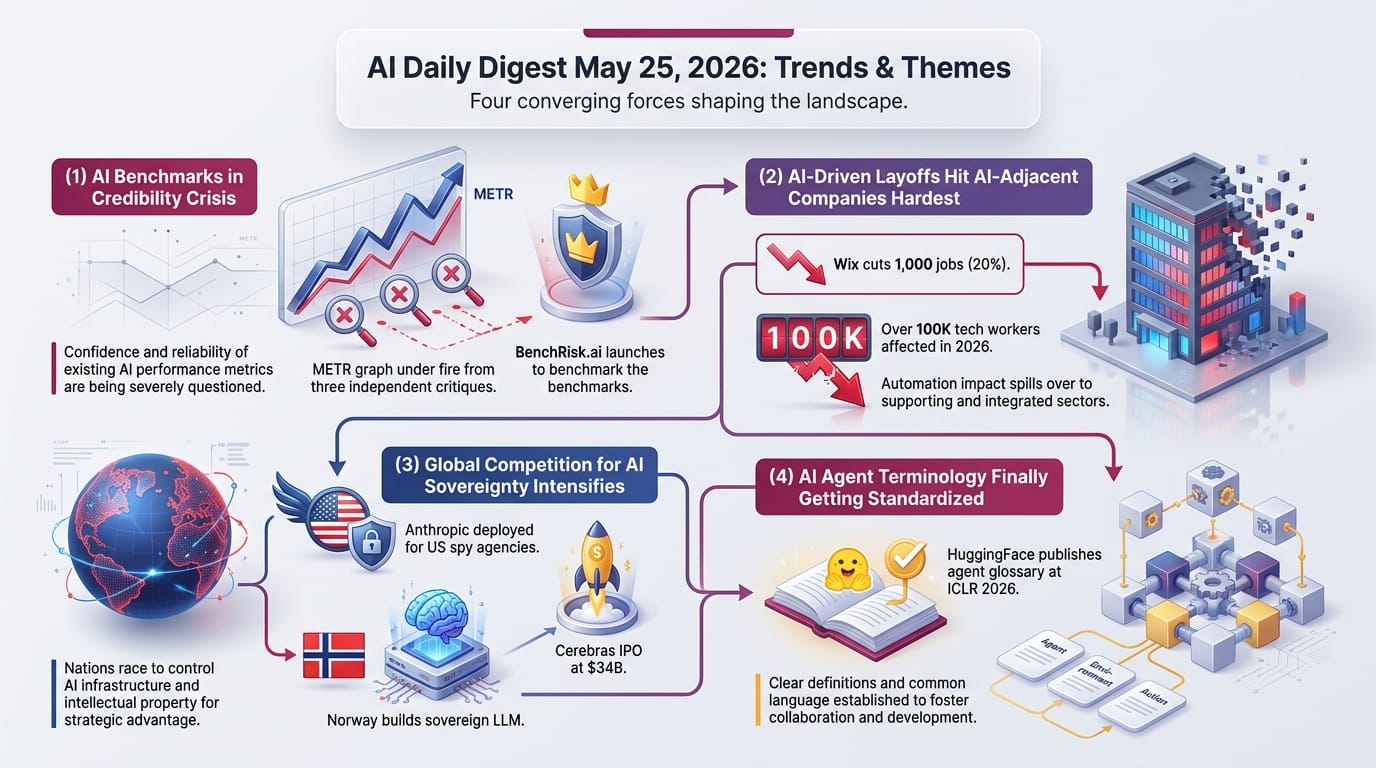
AI Benchmarks Are in a Credibility Crisis
The pattern is consistent: AI companies optimize for benchmark scores, but the benchmarks themselves may not reflect real-world performance. As more money flows into AI decisions based on these numbers, the integrity of measurement matters more than ever.
- METR's Long Tasks benchmark drew three simultaneous critiques this weekend from Nathan Witkin, Gary Marcus, and the r/MachineLearning community
- BenchRisk.ai launched to provide standardized risk scoring for AI benchmarks themselves - benchmarking the benchmarks
- A new paper asks "How Hard Is It to Rig a Benchmark?" using social choice theory to analyze leaderboard robustness
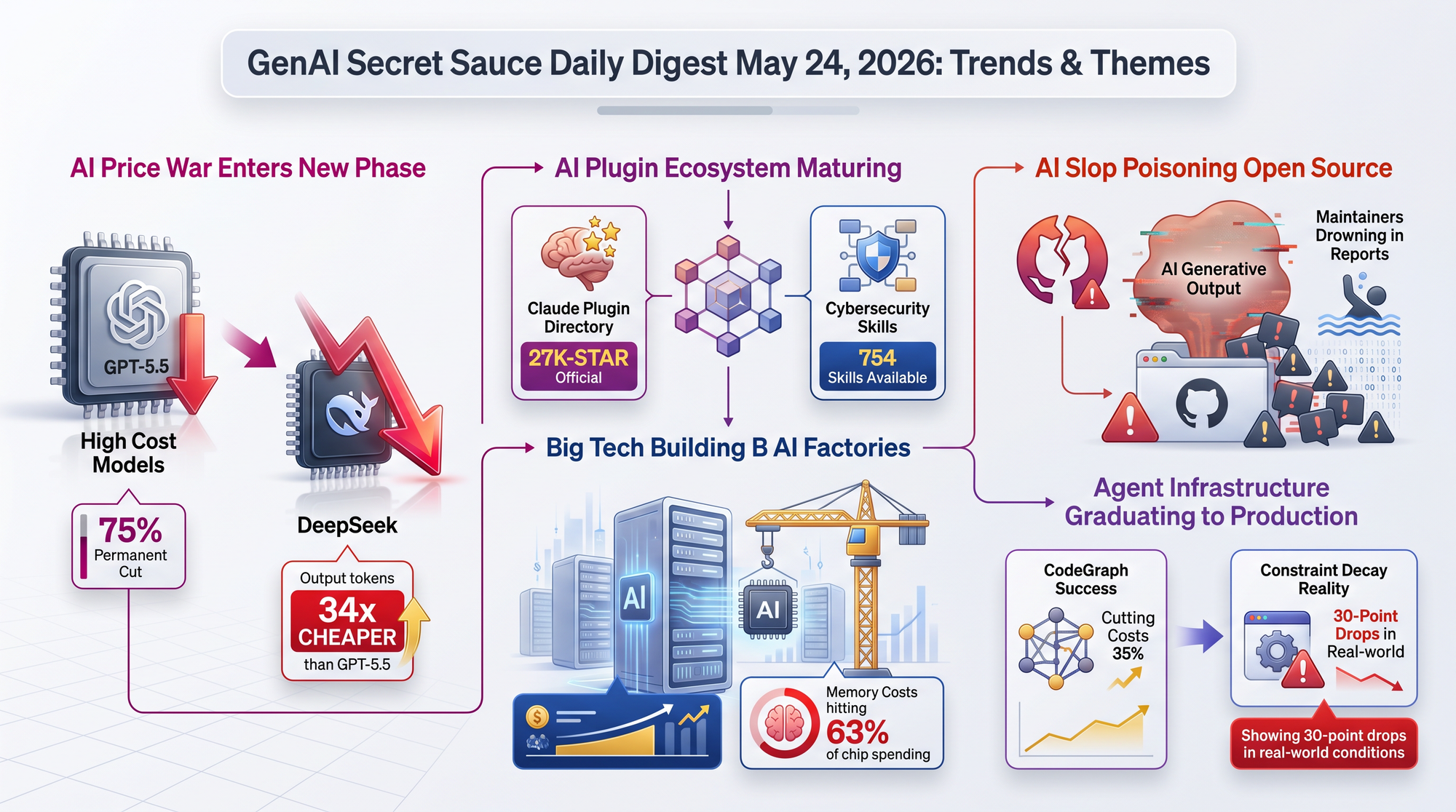
- The Constraint Decay paper (covered May 24) showed AI coding agents lose 30 performance points when real-world constraints are added - a gap benchmarks typically hide
AI-Driven Layoffs Are Hitting "AI-Adjacent" Companies Hardest
The layoff pattern has shifted. Early AI cuts targeted content moderation and customer support. Now they are reaching into product development, design, and the "middleman" companies that exist to make technology accessible to non-technical users.
- Wix cut 1,000 jobs (20% of staff) because AI website builders threaten its core "no-code" value proposition
- Meta eliminated 8,000 roles (covered May 19) while posting record revenue
- Over 100,000 tech workers have been affected by AI-related layoffs in 2026 so far
- Platform teams are the new bottleneck as AI accelerates development faster than organizations can absorb
The Global Competition for AI Sovereignty Is Intensifying
The era of AI as a purely commercial product is ending. Governments are treating AI models as strategic assets, and the geography of AI infrastructure - where the chips are, where the data centers sit, who has access - is becoming as important as the technology itself.
- Anthropic is being deployed for US intelligence operations through a classified White House contract worth billions
- Norway is building its own sovereign Large Language Model (LLM) to reduce dependence on American AI providers
- OpenAI partnered with Brazilian media companies Grupo Folha and Grupo UOL - its first content deal in Latin America
- Cerebras IPO gives the US a second major AI chip company beyond NVIDIA, diversifying the supply chain
AI Agent Terminology Is Finally Getting Standardized
Shared vocabulary matters because it enables comparison. Without agreed-upon terms, every vendor defines their own benchmarks and claims - making informed purchasing decisions nearly impossible.
- Hugging Face published an agent glossary at ICLR 2026 because practitioners at the conference could not agree on basic terms
- Key distinction: "harness" (the outer loop that manages agents) vs. "scaffold" (the inner structure that shapes model behavior) - most people use these interchangeably, but they mean different things
- "AI employee" is being debated as a product category on r/artificial, with Gartner predicting 40% of large enterprises will deploy "AI teammates" by 2028
- ECC (182K stars) now bundles 61 specialized agents across 12 language ecosystems, showing the infrastructure is maturing around the terminology
Creative AI & Media
Developer Tools & Infrastructure
Research & Models
Business & Industry
GenAI in Education
The Grammarly Excuse Is the New "My Dog Ate My Homework"
Multiple posts on r/Professors this week highlight how "I just used Grammarly for proofreading" has become the default student excuse when work shows signs of AI generation. One post (115 upvotes) notes the challenge: Grammarly genuinely does offer editing features, making it difficult to draw the line between acceptable proofreading and AI-generated content.
How Are Students Cheating? Professors Cannot Figure It Out
A thread (47 upvotes) asks the community directly: how are students using AI without getting caught? The responses reveal an arms race where detection tools remain unreliable and faculty feel increasingly unable to assess whether work is genuinely student-produced.
The Enhanced Games as an AI Parable
A professor (45 upvotes) draws a parallel between the Enhanced Games - where performance-enhancing drugs are explicitly allowed - and the current AI situation in academia. The catalyst: a "clean" swimmer (Hunter Armstrong) won the 50m backstroke against drug-enhanced competitors, raising the question of whether "enhanced" work actually outperforms "natural" work in the long run.
Pope Leo XIV Issues Encyclical on Artificial Intelligence
Pope Leo XIV published an encyclical addressing AI's impact on human dignity, work, and society. The document represents the Catholic Church's most comprehensive statement on AI to date and is being discussed across r/Professors as faculty grapple with the ethical dimensions of AI in education.
Surprising & Under-the-Radar
The FT Published a Feature on Heretic - the AI "Decensoring" Tool
The Financial Times published a major feature on Heretic, an open-source Python tool that removes safety guardrails from AI models through "abliteration" (zeroing out refusal-related weights). The r/LocalLLaMA thread (626 upvotes) is the highest-engagement discussion of the day. The tool is technically simple - it just identifies and removes the neurons responsible for refusal behavior - but its existence forces a confrontation between safety alignment and open-source values.
A Law Enforcement App Built Entirely With Claude Code Has 1,500 Users
LOC8, a mobile app that helps police officers instantly determine their exact location during incidents, was built entirely using Claude Code and now has over 1,500 active users in law enforcement. It is a quiet example of AI coding tools producing real, deployed, safety-critical software.
Microsoft Copilot Cowork Has a Data Exfiltration Vulnerability
Security researchers at Prompt Armor discovered that Microsoft's Copilot Cowork sandbox can be exploited to exfiltrate sensitive data through carefully crafted prompts. The vulnerability highlights the tension between giving AI agents enough access to be useful and preventing them from accessing data they should not.
Norway Is Building a Sovereign LLM
Norway announced plans to build its own large language model to reduce dependence on American AI providers, joining a growing list of countries pursuing AI sovereignty through domestic model development.
"AI Employee" Is Becoming a Real Product Category
A discussion on r/artificial explores whether "AI employee" has crossed from marketing buzzword to legitimate product category. Gartner predicts 40% of large enterprises will deploy "AI teammates" by 2028 - autonomous agents that handle entire business processes, not just answer questions.
BenchRisk.ai: Benchmarking the Benchmarks
A new platform that evaluates AI benchmarks themselves, providing risk scores for the evaluation methods used to compare AI models. Given the METR controversy, the timing could not be better.
Signals to Track

Conifer: A Local AI Runtime From Princeton
ConiferKit, built out of Princeton, positions itself as the operating system for running AI models locally. Instead of wrestling with llama.cpp flags, GGUF formats, and memory management, Conifer handles model execution, optimization, and hardware detection automatically. Currently in beta with waitlist access. If this gains traction, running AI locally could become as simple as installing software - no terminal required.
Spice: Adding a Decision Layer on Top of Any AI Agent
This MIT-licensed Python framework separates decision logic from execution, acting as a "policy layer" that sits between the user and the underlying AI agent. It handles routing, constraint enforcement, and fallback strategies. If adopted widely, it could standardize how organizations govern AI agent behavior across different providers and models.
HRM-Text-1B: A New Architecture That Can Think Longer Without More Parameters
Sapient Intelligence's Hierarchical Reasoning Model uses dual-timescale recurrent architecture where two Transformer modules iterate over inputs. The model achieves unbounded compute depth at bounded parameter count. With 90,000 downloads, the community is paying attention. If this architecture scales, it could decouple model capability from model size in ways current scaling laws do not predict.
Anti-Sycophant Skills for AI Agents
This open-source project provides structured skills that prevent AI assistants from blindly validating bad ideas - addressing one of the most common complaints about AI tools. Instead of "great idea!" the agent pushes back with structured criticism. If widely adopted, this could shift AI from "yes-machine" to genuine thinking partner.
NVIDIA Nemotron-Labs-Diffusion-14B Gets Community Traction
Previously: May 19 - NVIDIA released the model claiming 2.7-4x faster text generation.
Today: 5,195 downloads and climbing, with community experiments showing 2.7x speedups on consumer hardware (DGX Spark) and 3.3x on GB200. The model is proving that diffusion-based text generation is not just a research curiosity.
Top Repos Today
📜 License: MIT · 👤 By: Individual developer
🎯 Time to value: 5 minutes
| ✓ Pros | ✗ Cons |
|---|---|
| 5,625 stars in a single day - strong momentum | Initial indexing takes time on large repos |
| Works across 6+ AI coding platforms | TypeScript-heavy - less suited for non-JS codebases |
| MIT license, incremental git-aware analysis | New project - API may change rapidly |
 GitHub
📜 License: MIT · 👤 By: Individual developer
🎯 Time to value: 3 minutes
| ✓ Pros | ✗ Cons |
|---|---|
| Quantified savings (35% cost, 71% fewer tool calls) | Requires SQLite dependency |
| 19+ language support | Initial indexing time on large repos |
| 100% local with file-watch auto-sync | Focused on structural, not semantic queries |
 GitHub
📜 License: MIT · 👤 By: Individual developer
🎯 Time to value: 30 minutes
| ✓ Pros | ✗ Cons |
|---|---|
| Complete curriculum, basics to production | 320 hours is a massive time commitment |
| Multi-language (Python, TS, Rust, Julia) | Quality may vary across 435 lessons |
| MIT licensed, community-driven | No certificates or formal recognition |
 GitHub
📜 License: Not specified · 👤 By: Multica AI (org)
🎯 Time to value: 1 minute
| ✓ Pros | ✗ Cons |
|---|---|
| Zero setup - one file | Opinionated style may clash with team conventions |
| 154K+ stars validate the approach | Only works with Claude Code |
| Regular community updates | A config file, not a tool |
 GitHub
📜 License: MIT · 👤 By: Individual (170+ contributors)
🎯 Time to value: 5 minutes
| ✓ Pros | ✗ Cons |
|---|---|
| 61 agents + 246 skills in one package | Complexity can be overwhelming |
| Cross-platform (6+ AI coding tools) | 192K stars may set high expectations |
| Desktop dashboard GUI and Rust control-plane alpha | Still evolving rapidly |
 GitHub
📜 License: Per-plugin · 👤 By: Anthropic (company)
🎯 Time to value: 2 minutes
| ✓ Pros | ✗ Cons |
|---|---|
| Official Anthropic curation | Only works with Claude Cowork |
| Security-reviewed plugins | Ecosystem still maturing |
| Easy installation | Plugin count still growing |
 GitHub
📜 License: MIT · 👤 By: Garry Tan (Y Combinator CEO)
🎯 Time to value: 5 minutes
| ✓ Pros | ✗ Cons |
|---|---|
| Created by Y Combinator CEO - real-world tested | Extremely opinionated workflow |
| 23 specialized slash commands | Only works with Claude Code |
| MIT licensed, active development | High star count driven by creator's profile |
 GitHub
📜 License: MIT · 👤 By: Individual developer
🎯 Time to value: 3 minutes
| ✓ Pros | ✗ Cons |
|---|---|
| Addresses the "AI slop" aesthetic directly | Frontend-only |
| Configurable design parameters | Opinionated design philosophy |
| Works across React, Vue, Svelte | Still experimental (v2 rewrite) |
GitHub
Top Models Today
👤 By: Tencent (company) · 🎯 Task: Translation
📐 Size: 1.8B
| ✓ Pros | ✗ Cons |
|---|---|
| 33 languages, 440 MB compressed | Translation-only - not a general LLM |
| Beats commercial APIs on benchmarks | Tencent license terms vary by use |
| On-device capable with GGUF support | Benchmark claims need independent verification |


👤 By: ByteDance (company) · 🎯 Task: Any-to-Any
📐 Size: 3B
| ✓ Pros | ✗ Cons |
|---|---|
| Six tasks in one model | 3B limits quality vs. specialized models |
| Apache 2.0 - fully open | Requires significant GPU for video tasks |
| Trained from scratch, not a fine-tune | Early release - documentation sparse |


👤 By: Supertone (company) · 🎯 Task: Text-to-Speech
📐 Size: 99M
| ✓ Pros | ✗ Cons |
|---|---|
| 31 languages, CPU-only | 99M params limits expressiveness vs. larger models |
| Expression tags for natural speech | OpenRAIL-M may restrict some commercial uses |
| Zero-shot voice cloning | Newer model - less community testing |

👤 By: SulphurAI (community) · 🎯 Task: Text-to-Video
📐 Size: 9B
| ✓ Pros | ✗ Cons |
|---|---|
| Massive download numbers validate demand | License unclear |
| Native dual-mode (text/image to video) | 9B requires decent GPU |
| Built-in prompt enhancement | "Uncensored" raises content safety questions |


👤 By: Sapient Intelligence (company) · 🎯 Task: Text Generation
📐 Size: 1B
| ✓ Pros | ✗ Cons |
|---|---|
| Novel architecture with compute scaling | Pre-alignment - not ready for chat out of box |
| Apache 2.0, 90K downloads | English only, weak on coding |
| 1B params - very lightweight | Requires alignment for practical use |


👤 By: DeepSeek (company) · 🎯 Task: Text Generation
📐 Size: 862B


AI Launches Today
💰 Pricing: Not specified · 🏷 Category: AI Infrastructure
 Product Hunt

💰 Pricing: Not specified · 🏷 Category: AI Automation
 Product Hunt
💰 Pricing: Not specified · 🏷 Category: Business Intelligence
💰 Pricing: Free/open-source · 🏷 Category: Developer Tools
 Product Hunt

💰 Pricing: Not specified · 🏷 Category: Creative AI
 Product Hunt
Snapshot
| Provider | Model | Input $/1M | Output $/1M | Context |
|---|---|---|---|---|
| Anthropic | Claude Opus 4.7 | $5.00 | $25.00 | 1M |
| Anthropic | Claude Sonnet 4.6 | $3.00 | $15.00 | 1M |
| Anthropic | Claude Haiku 4.5 | $1.00 | $5.00 | 200K |
| OpenAI | GPT-5.5 | $5.00 | $30.00 | 128K |
| OpenAI | GPT-5.4 | $2.50 | $15.00 | 128K |
| OpenAI | GPT-4.1 Nano | $0.10 | $0.40 | 128K |
| Gemini 3.5 Flash | $1.50 | $9.00 | - | |
| Gemini 3.1 Pro Preview | $2.00 | $12.00 | - | |
| Gemini 3.1 Flash-Lite | $0.25 | $1.50 | - | |
| Groq | Llama 3.3 70B | $0.59 | $0.79 | - |
| Groq | Llama 3.1 8B | $0.05 | $0.08 | - |
| DeepSeek | V4-Pro | $0.435 | $0.87 | - |
Test-Time Training Undermines Safety Guardrails
Key finding: Safety-aligned models that undergo TTT showed significantly increased compliance with harmful requests that would normally be refused, even without adversarial intent.
Why practitioners should care: As TTT becomes more common for improving model performance on specialized tasks, teams deploying these techniques need to re-evaluate safety after every adaptation step. The paper suggests current alignment methods are not robust to post-deployment learning.
Member discussion