GenAI Secret Sauce Daily Digest - 2026-05-19

Google Launches Gemini 3.5 Flash - Faster, Smarter, and Three Times More Expensive · Meta Made $56 Billion in Q1 and Is Still Firing 8,000 People to Fund AI · NVIDIA Releases Models That Generate Text Up to 4x Faster
GenAI Secret Sauce Daily Digest - 2026-05-19

Statistically Speaking

$1.50 per million input tokens and $9 per
Google Launches Gemini 3.5 Flash - Faster, Smarter, and Thre
Top Story
3.1 Pro Preview ($892)
Google Launches Gemini 3.5 Flash - Faster, Smarter, and Thre
145 billion in AI capital spending planned for
Meta Made $56 Billion in Q1 and Is Still Firing 8,000 People
$417,000 to $388,000 between 2024 and 2025
Meta Made $56 Billion in Q1 and Is Still Firing 8,000 People
100,000 tech workers have been affected by AI
Meta Made $56 Billion in Q1 and Is Still Firing 8,000 People
$1 billion annually for Meta in search and
Meta Made $56 Billion in Q1 and Is Still Firing 8,000 People

One Thing to Tell Your Friends

Google just made its best AI model three times more expensive - and plans to put it inside every Google product you use.

TL;DR

Trends
The AI Price, Agent Protocols Are Consolidating Into a Standard Stack, and AI Is Making Software Engineers More Productive.
Education
The Graduation AI Disaster Exposes Institutional Hypocrisy, Educators Call for Slowing Down AI Adoption, and AI Can Now Simulate Student Coding Errors.
GitHub
Leading repos: tinyhumansai/openhuman (+3,991), HKUDS/CLI (+1,027), and multica-ai/andrej-karpathy (+1,935).
HuggingFace
Leading models: deepseek-ai/DeepSeek-V4 (3.62M), deepseek-ai/DeepSeek-V4 (2M), and google/gemma-4-31B (10M).
Product Hunt
Top launches: PollyReach (402), Drizz (333), and Composer 2.5 (Cursor) (304).
API Pricing
What this means: Google's new Gemini 3.5 Flash at $1.50/$9 per million tokens sits in a unique position - cheaper than Anthropic and OpenAI's flagships on input but comparable on output.
arXiv
HyDRA — 54.1% cost savings at equal quality on SWE-Bench Verified - a 6x improvement over binary routing.

Hot off the Presses

01

Google Launches Gemini 3.5 Flash - Faster, Smarter, and Three Times More Expensive

What this means for you: If you use Google Search, Gmail, Docs, or Android, your experience is about to change. Gemini 3.5 Flash is rolling into these products now, and the AI behind them just got significantly more capable - but developers building on Google's Application Programming Interface (API) will pay more.

Google unveiled Gemini 3.5 Flash at I/O 2026 as its new flagship "workhorse" model. It scores 76.2% on Terminal-Bench 2.1 (a coding benchmark) and 83.6% on MCP Atlas (measuring how well AI uses tools). It produces answers 4x faster than competing frontier models.

Google also launched Gemini Omni, a separate model for creating and editing videos through text prompts. It understands physics (gravity, fluid dynamics) and can edit videos across multiple turns while keeping scenes consistent.

Source: Google Blog | Simon Willison's Analysis | Gemini Omni

“Running benchmarks on Gemini 3.5 Flash cost $1,552 - more than the same tests on last generation's Pro model.”
  • Price jump is steep - $1.50 per million input tokens and $9 per million output, which is 3x the price of Gemini 3 Flash Preview and 6x the price of 3.1 Flash-Lite
  • Running benchmarks on it cost $1,552 - more than the same tests on Gemini 3.1 Pro Preview ($892)
  • Knowledge cutoff is January 2025 - older than some competitors despite being a new release
  • Stock dropped nearly 2% during the keynote despite the product being strong
02

Meta Made $56 Billion in Q1 and Is Still Firing 8,000 People to Fund AI

What this means for you: The company behind Facebook, Instagram, and WhatsApp is betting that AI will generate more revenue than the humans it is replacing. If you work in tech, this pattern - record profits paired with mass layoffs - is becoming the industry template.

Meta reported its strongest revenue growth since 2021 with a 61% jump in net income. Despite these record profits, 8,000 jobs are being eliminated starting May 20, with another 6,000 open positions cancelled and more cuts planned for August and fall.

“Over 100,000 tech workers have been affected by AI-related layoffs across the industry in 2026.”
  • $125-145 billion in AI capital spending planned for 2026 - the layoff savings fund new data centers and Graphics Processing Unit (GPU) purchases
  • Median employee pay fell from $417,000 to $388,000 between 2024 and 2025
  • Over 100,000 tech workers have been affected by AI-related layoffs across the industry in 2026
  • AI already generates $1 billion annually for Meta in search and recommendation revenue
03

NVIDIA Releases Models That Generate Text Up to 4x Faster

What this means for you: If you run AI on your own computer or use AI-powered apps, responses could get dramatically faster. NVIDIA's new approach makes AI text generation 2.7-4x faster without changing the quality of the output.

NVIDIA released the Nemotron-Labs-Diffusion family - seven models (3B, 8B, and 14B parameters) that use a new "tri-mode" architecture. Instead of generating one word at a time (how most AI works today), these models can switch between three different generation modes depending on what is fastest for the situation.

  • 2.7x faster on consumer hardware - 112 tokens per second versus 42 for standard generation on DGX Spark
  • Up to 4x faster with custom GPU code - 1,015 tokens per second on high-end GB200 hardware
  • Generates 5.9x more tokens per forward pass than Qwen3-8B, a popular open model
  • Includes a vision model (VLM-8B) that can also process images
  • All models are open and available on Hugging Face, with the 8B base variant already at 170,000+ downloads
04

A College Used AI to Announce Graduates' Names - It Skipped Hundreds

What this means for you: AI reliability is not just a tech problem. When institutions deploy AI for high-stakes moments without fallbacks, real people get hurt. This is a cautionary tale for any organization considering AI for public-facing events.

Glendale Community College's 2026 commencement at Arizona's Desert Diamond Arena went sideways when an AI system used to announce graduates' names malfunctioned, skipping hundreds of students. Families who traveled to celebrate booed and expressed anger.

  • The irony was immediate - students who had been warned against using AI in coursework watched their school deploy it for their most important ceremony
  • The Maricopa County Community College District acknowledged a "technical issue" affecting the ceremony
  • 491 upvotes on r/Professors - making it the most-discussed education story of the day
05

Mistral AI Acquires Emmi AI to Push Into Industrial Physics

What this means for you: AI is expanding beyond text and images into simulating the physical world. If you work in manufacturing, energy, automotive, or aerospace, AI tools that understand physics - not just language - are coming to your industry.

French AI company Mistral AI acquired Emmi AI, an Austrian startup specializing in physics-based AI models for industrial applications. Emmi's 30+ researchers join Mistral's Science and Applied AI divisions, and Linz becomes Mistral's seventh global office.

  • Emmi raised 15 million euros in seed funding in April 2025 - described as the largest AI seed round in Austrian history
  • Target industries include energy, automotive, semiconductors, and aerospace - sectors where pure language models are insufficient
  • Signals a strategic shift from chatbot competition toward specialized industrial AI

Trends & Themes

Trends & Themes

The AI Price-Performance Squeeze Is Forcing Hard Choices

Why this matters to you: The AI tools you use are getting better but more expensive. Companies are being forced to choose between cutting-edge capability and affordable access.

The tension is clear: frontier models keep getting more capable and more expensive, while the infrastructure around them gets smarter about avoiding those costs.

Sources: Google Blog | HyDRA | SaaS-as-Insurance

  • Gemini 3.5 Flash costs 3x more than its predecessor while being deployed across all Google products
  • GitHub Copilot's HyDRA router saves 54% on costs by routing queries to cheaper models when possible - showing the industry is already optimizing against price increases
  • A new paper models AI subscriptions as insurance products - flat-rate pricing for Claude Code, ChatGPT, and similar services may not be economically sustainable long-term

Agent Protocols Are Consolidating Into a Standard Stack

Why this matters to you: Just as the web settled on HTTP and HTML, AI agents are settling on a common language. The winners of this standards race will determine which AI tools work together and which become dead ends.

Sources: Nate's Newsletter | ADR at Uber | Forge

  • Six agent protocols launched recently but only three form the essential stack: MCP (what tools an agent can use), A2A (how agents talk to each other), and AG-UI (how humans stay in control)
  • Uber deployed ADR for 10+ months processing 10,000+ agent sessions daily - showing enterprise-grade agent security is now production-ready
  • Forge's guardrails took an 8B model from 53% to 99% on agentic tasks - reliable agents may depend more on infrastructure than model size

AI Is Making Software Engineers More Productive - and More Frustrated

Why this matters to you: If you write code or manage people who do, AI tools are changing the job in ways that are measurable but complicated. The data from 900+ engineers tells a nuanced story.
  • AI reduces time on tedious work but creates unrealistic expectations from management about output volume
  • Code quality is measurably declining due to AI-generated "slop" that passes review but creates maintenance debt
  • AI amplifies existing team culture - strong engineering teams get better results, while weak teams get worse
  • Maintenance burden concentrates on fewer senior engineers who spend more time reviewing AI-assisted output

Local AI Inference Keeps Getting Cheaper and Faster

Why this matters to you: Running AI on your own hardware - instead of paying a cloud provider - is becoming practical for more people and more use cases.

Sources: NanoQuant | Nemotron-Labs-Diffusion | KV Cache Benchmarks

  • NanoQuant compresses a 70B-parameter model to fit in 8GB of VRAM using sub-1-bit quantization, accepted at ICML 2026
  • NVIDIA's tri-mode diffusion models deliver 2.7-4x speedups on consumer hardware
  • KV cache benchmarks reveal that popular compression methods are overrated - TurboQuant performs poorly, while asymmetric allocation strategies work better
  • RTX 5060 Ti benchmark recipes now provide tested configurations for running models from 0.8B to 122B parameters locally

AI Safety Is Moving From Theory to Production Systems

Why this matters to you: As AI agents handle more real tasks - browsing the web, writing code, managing files - the security risks become practical, not theoretical.

Sources: Package Hallucinations | Claude/Iranian Media | VeriCache | Silent Brush

  • All five frontier models still hallucinate 4.6-6.1% of package names in code, with 127 names invented identically across all models - creating a shared attack surface
  • Claude is citing Iranian state media without being able to explain why, raising questions about training data provenance
  • VeriCache guarantees identical outputs while using compressed memory - the first framework ensuring lossless inference with compression, addressing a fundamental reliability gap
  • Art style "leakage" in image generators happens even without explicit style prompts - models reproduce artistic styles from training data unprompted

Creative AI & Media

Gemini Omni: AI Video Creation With Physics Understanding

Create and edit videos through text prompts. Understands gravity, fluid dynamics, and kinetic energy. Maintains scene consistency across multiple editing rounds.

  • Accepts images, text, video, and audio as input for generation
  • Progressive editing lets you refine videos turn by turn without starting over
  • Knowledge integration draws from history, science, and cultural context

ByteDance Lance: A 3B Model That Does Six Things

A unified multimodal model handling text-to-video, text-to-image, image editing, video editing, image understanding, and video understanding with only 3B active parameters. Trained on 128 A100 GPUs.

  • GenEval score of 0.90 for image generation (perfect 1.00 on single objects)
  • VBench score of 85.11 - leading all unified models for video generation
  • 464 upvotes on r/LocalLLaMA - the community's most-discussed model release today

The Silent Brush: AI Art Generators Leak Artist Styles Without Being Asked

Research reveals that text-to-image models (Stable Diffusion, SDXL, SANA-1.5) unintentionally reproduce artistic styles even without style-related prompts. Has implications for copyright and artist rights.

  • Style reproduction is asymmetric - some artworks are encoded more strongly than others
  • Existing protections focus on near-duplicate detection and miss this subtler leakage

Developer Tools & Infrastructure

Forge: Guardrails That Take an 8B Model From 53% to 99%

A Python framework for reliable local Large Language Model (LLM) tool-calling. Achieves 86.5% across 26 scenarios with Ministral-3 8B.

  • Three usage modes - WorkflowRunner for structured loops, Guardrails middleware for reliability, and standalone formatting
  • 865 deterministic unit tests across 37 commits
  • 174 points on Hacker News with active discussion

HyDRA: The Query Router Inside GitHub Copilot

Deployed in VS Code Chat, HyDRA routes queries to the cheapest model that can handle them. Uses a ModernBERT encoder with four scoring heads.

  • 54.1% cost savings at equal quality - 6x improvement over prior routing approaches
  • 86ms median latency on CPU - fast enough for real-time use
  • 72.5% cost reduction in aggressive mode with only 3.2-point quality trade-off

Pi-Subagent: Sub-Agents for Local LLMs Without the Performance Hit

Addresses a critical inefficiency in sub-agent plugins for llama.cpp: existing approaches modify system prompts at runtime, forcing full KV cache reprocessing.

  • Designed for VRAM-constrained hardware like RTX 3080 (10GB)
  • Preserves cached KV states instead of discarding them on every sub-agent call
  • 42 upvotes on r/LocalLLaMA

AXON: Watch GPT-2 Think in Real-Time 3D

Visualizes Sparse Autoencoder feature activations inside GPT-2 as it generates text. Streams data via WebSocket to a browser-based 3D force graph built with Three.js.

  • Each node represents a detected concept with brightness indicating activation strength
  • Uses TransformerLens at layer 8 with Joseph Bloom's SAE implementation

Research & Models

Weak-to-Strong Elicitation: Wrong Answers Make Better Teachers

Feeding a strong AI model intentionally wrong solutions from a weaker model during training actually improves performance. Mismatched wrong drafts outperformed matched ones (p=0.0015).

  • 71.98% on MATH-500 using Mathstral-7B - the highest published result for this model
  • +14.2 percentage points on AIME 2025 at pass@1024 from mismatched versus matched wrong drafts
  • Single GPU training with no additional components beyond Dr. GRPO

ExpThink: 77% Shorter Reasoning Chains With Better Accuracy

Compresses chain-of-thought reasoning by tracking the shortest correct solution per problem and tightening thresholds automatically.

  • 3x higher accuracy-efficiency ratio than vanilla baselines
  • Difficulty-adaptive advantage amplifies learning on harder problems
  • Suggests current reasoning chains contain massive redundancy that can be systematically compressed

Mu-GRPO: 2x Faster RL Training by Using Staler Data

Demonstrates that reinforcement learning for LLMs can use significantly older training data than previously thought safe, cutting wall-clock time in half.

  • Matches or exceeds standard GRPO across five language models and multiple math benchmarks
  • Relaxed clipping and negative-advantage veto stabilize training with stale data
  • The field has been unnecessarily conservative with data freshness requirements

OpenJarvis: On-Device AI That Nearly Matches the Cloud

A decomposed architecture that reduces the cloud-to-edge accuracy gap from 25-39 percentage points to just 3.2pp across 8 benchmarks.

  • 800x reduction in marginal API costs and 4x latency improvement
  • Matches or exceeds cloud accuracy on 4 of 8 benchmarks
  • Uses frontier models at design time but runs entirely on-device at inference

HRM-Text: A Foundation Model Pretrained for $1,000

Sapient Intelligence's hierarchical recurrent model uses 130-600x less compute and 150-900x less data than standard pretraining.

GitHub: sapientinc/HRM-Text | Model

  • 1B parameters trained on 40B tokens using 16 H100 GPUs in about 50 hours
  • Dual-timescale recurrent design with 6 cycles providing unbounded compute depth
  • Beats Llama 3.2 3B on certain benchmarks despite being smaller and far cheaper to train

Business & Industry

Google I/O Stock Dip Despite Strong AI Lineup

  • GOOGL fell nearly 2% during and after the I/O keynote
  • Stock had been up 14% over the past month heading into the conference
  • Investors may be pricing in higher costs from deploying expensive Gemini 3.5 Flash across all products

Anthropic's Stainless Acquisition Continues to Ripple

Previously: May 18 - Anthropic acquired Stainless, the SDK generation company, for ~$300 million.

Today: Community analysis highlights that Stainless generates MCP servers - the integration layer for AI agents - and produces official SDKs for OpenAI, Google, Meta, and Cloudflare. With 97 million monthly MCP SDK downloads, this gives Anthropic significant infrastructure leverage. 218 upvotes on r/ClaudeAI.

A Paper Argues AI Subscriptions Are Really Insurance Products

Flat-rate services like Claude Code, ChatGPT, and Vercel structurally resemble insurance with fixed premiums decoupled from consumption and heavy-tailed per-user demand.

  • Applies actuarial pricing frameworks including frequency-severity decomposition and Monte Carlo reserve testing
  • Questions long-term sustainability of flat-rate AI subscription models

GenAI in Education

The Graduation AI Disaster Exposes Institutional Hypocrisy

The Glendale Community College incident (see Top Stories) crystallized a growing tension: institutions that ban student AI use are simultaneously deploying AI for their own operations. The irony - students punished for using AI watching their school's AI fail at their graduation - has become a flashpoint for broader questions about institutional AI adoption.

Educators Call for Slowing Down AI Adoption

Lance Eaton's interview with Priten Soundar-Shah advocates asking fundamental philosophical questions before deploying AI in education, rather than adopting on corporate terms.

  • Higher education proves harder than K-12 because students have greater autonomy and economic pressures
  • Tech industry narratives are co-opting balanced discussions about AI in classrooms

AI Can Now Simulate Student Coding Errors

KASER (accepted at ACL 2026) trains LLMs to predict and simulate the mistakes students make in programming assignments, enabling better automated feedback without massive real student datasets.

  • Uses reinforcement learning with hybrid rewards for code similarity, error matching, and diversity
  • Addresses LLM mode collapse in student error simulation

Surprising & Under-the-Radar

AI Models Agree on Which Software Packages Don't Exist

All five frontier models (Claude, GPT, Gemini, DeepSeek) hallucinate 4.6-6.1% of package names in code suggestions. More alarming: 127 package names are invented identically by all five, creating a shared supply-chain attack surface that is model-agnostic.

Claude Is Citing Iranian State Media Without Knowing Why

An investigation found Claude repeatedly cited Mehr News Agency and Tasnim News Agency (linked to the Islamic Revolutionary Guard Corps) when fact-checking a 1989 terror attack. Claude acknowledged the problem but said it lacks visibility into its own search pipeline.

LLM Agents Can't Self-Regulate in Markets

Agent Bazaar tested LLM agents as autonomous economic actors and found two failure modes: firms amplify price volatility until markets crash, and a single deceptive agent can flood markets with fraudulent listings. A 9B model trained with REINFORCE++ outperformed all frontier models.

Deep Research Agents Score Below 22% on Expert Consulting Tasks

Claude Opus 4.6, OpenAI o3, and Gemini 3.1 Pro were tested on 42 expert consulting tasks. Acceptance rates: Gemini 21.4%, o3 9.5%, Claude 9.5%. Each agent showed distinctive failure modes - Claude fabricated most but handled file tasks 4.5x better.

Kernel Jobs Are the Entry Point to Frontier AI Labs

Latent Space reports that kernel-level GPU performance tuning is now the biggest bottleneck at major AI labs. The hiring bar: derive Chinchilla scaling laws, compare dense versus Mixture of Experts (MoE) architectures, and implement Pallas kernels in JAX.

Signals to Track

Worth Watching
01

VeriCache: Lossless Compression for AI Memory

The first system that compresses AI memory without changing a single word of output.

Existing methods for shrinking AI models' working memory (KV cache) are "lossy" - they change the output, sometimes catastrophically for code generation. VeriCache drafts with compressed memory, then verifies against full memory, achieving 4x throughput with mathematically identical results. If adopted, this could cut inference costs dramatically without the quality trade-offs that have plagued compression approaches.

02

Guard: NVIDIA-Scale GPU Cluster Health Management

Even small performance drops compound into massive waste across thousands of GPUs over months of training.

Accepted at MLSys 2026, Guard detects gradual GPU slowdowns that traditional monitoring misses. It improved mean FLOPs utilization by 1.7x and reduced training step variance from 20% to 1%. As training runs grow to tens of thousands of GPUs over multiple months, this kind of proactive health management becomes essential.

03

The Ettin Reranker Family: Six New Search Quality Models

Half the size, twice the speed, and matching or beating the best search rerankers available.

Hugging Face released six Apache 2.0 reranker models built on ModernBERT. The 17M model beats the popular MiniLM-L12 (33M) by +0.051 NDCG@10. The 1B model matches its teacher within 0.0001. Speed on H100: 7,517 pairs/sec for the smallest model.

04

Google AI Edge Gallery Adds MCP Support on Mobile

AI agents can now use tools and access data directly from your phone.

Version 1.0.14 of Google's on-device AI app added Model Context Protocol support with user permission flows, Pixel TPU execution, speculative decoding, and agent skills including calendar integration. This quietly makes phones a first-class platform for AI agent deployment.

05

Training Profit-Optimal LLMs: When Scaling Stops Paying

Current industry spending may not be profit-optimal if data becomes the bottleneck instead of compute.

A theoretical paper combining scaling laws with microeconomic theory reveals that in data-constrained regimes, profit-optimal training expenditure scales as data-squared divided by hardware efficiency. If data efficiency improvements plateau, the current massive capital expenditure in LLM scaling may not translate to sustainable revenue.

Top Repos Today

Rank yesterday: Holding steady - covered May 13 and May 16 ➡
⭐ Stars today: +3,991  ·  📦 Total: 21.1k
📜 License: GPL-3.0  ·  👤 By: Individual
🎯 Time to value: 10 minutes
What it is: An open-source personal AI assistant with a desktop UI, 118+ integrations, a memory tree system, and token compression. Built in Rust for performance. Aims to be a private, self-hosted alternative to cloud AI assistants. Why you'd want it: Full control over your AI assistant without sending data to third parties. The memory tree lets it build persistent context about you over time.
✓ Pros✗ Cons
118+ integrations out of the boxGPL-3.0 limits commercial reuse
Runs entirely on your machineResource-heavy for older hardware
Active community (21k stars)Still early - expect rough edges
GitHub - tinyhumansai/openhuman: Your Personal AI super intelligence. Private, Simple and extremely powerful.
Your Personal AI super intelligence. Private, Simple and extremely powerful. - tinyhumansai/openhuman
Rank yesterday: New entry 🆕
⭐ Stars today: +1,027  ·  📦 Total: 37.7k
📜 License: Apache-2.0  ·  👤 By: Research lab (HKUST)
🎯 Time to value: 15 minutes
What it is: Transforms any software with accessible source code into AI agent-controllable CLIs through a seven-phase methodology. Enables AI agents to operate any desktop application through command-line interfaces. Why you'd want it: Makes any existing software agent-controllable without modifying the original code. If you want AI to automate tasks in apps that do not have APIs, this bridges the gap.
✓ Pros✗ Cons
Works with any open-source softwareRequires source code access
Apache 2.0 allows commercial useSeven-phase setup has learning curve
From active research lab (HKUST)CLI abstraction may miss GUI-only features
GitHub - HKUDS/CLI-Anything: “CLI-Anything: Making ALL Software Agent-Native” -- CLI-Hub: https://clianything.cc/
“CLI-Anything: Making ALL Software Agent-Native” -- CLI-Hub: https://clianything.cc/ - HKUDS/CLI-Anything
Rank yesterday: Holding steady ➡
⭐ Stars today: +1,935  ·  📦 Total: 138k
📜 License: MIT  ·  👤 By: Individual
🎯 Time to value: 2 minutes
What it is: A single CLAUDE.md configuration file that improves Claude Code behavior based on Andrej Karpathy's observations about common LLM coding mistakes. Four principles: think before coding, simplicity first, surgical changes, goal-driven execution. Why you'd want it: Copy one file into your project and get noticeably better AI coding output. Minimal effort for meaningful improvement.
✓ Pros✗ Cons
Two-minute setup (copy one file)Only works with Claude Code
138k stars validate effectivenessOpinionated coding style may not suit all
MIT license, fully openSingle-file approach limits customization
GitHub - multica-ai/andrej-karpathy-skills: A single CLAUDE.md file to improve Claude Code behavior, derived from Andrej Karpathy’s observations on LLM coding pitfalls.
A single CLAUDE.md file to improve Claude Code behavior, derived from Andrej Karpathy’s observations on LLM coding pitfalls. - multica-ai/andrej-karpathy-skills
Rank yesterday: Covered May 16 - Rising ↑
⭐ Stars today: +1,869  ·  📦 Total: 6.5k
📜 License: MIT  ·  👤 By: Individual
🎯 Time to value: 5 minutes
What it is: A pre-indexed code knowledge graph that works with Claude Code, Codex, Cursor, and OpenCode. Reduces token usage and tool calls by giving AI agents semantic understanding of your codebase upfront. Why you'd want it: 94% fewer tool calls means faster and cheaper AI coding sessions. Runs 100% locally.
✓ Pros✗ Cons
Works with multiple AI coding toolsIndexing time scales with codebase size
94% fewer tool calls claimedRelatively new (6.5k stars)
100% local, no data leaves machineTypeScript-focused implementation
GitHub - colbymchenry/codegraph: Pre-indexed code knowledge graph for Claude Code, Codex, Cursor, and OpenCode — fewer tokens, fewer tool calls, 100% local
Pre-indexed code knowledge graph for Claude Code, Codex, Cursor, and OpenCode — fewer tokens, fewer tool calls, 100% local - colbymchenry/codegraph
Rank yesterday: Covered May 13 - Holding steady ➡
⭐ Stars today: +1,626  ·  📦 Total: 14.1k
📜 License: Apache-2.0  ·  👤 By: Individual
🎯 Time to value: 10 minutes
What it is: Persistent memory system for AI coding agents. Captures sessions, compresses observations, and enables semantic search across multiple coding assistants without external databases. Why you'd want it: Your AI coding assistant remembers what it learned in previous sessions instead of starting from scratch every time.
✓ Pros✗ Cons
Works across multiple AI assistantsMemory quality depends on session quality
No external database neededStorage grows with usage
Semantic search across historyMay surface outdated context
GitHub - rohitg00/agentmemory: #1 Persistent memory for AI coding agents based on real-world benchmarks
#1 Persistent memory for AI coding agents based on real-world benchmarks - rohitg00/agentmemory
Rank yesterday: New entry 🆕
⭐ Stars today: +733  ·  📦 Total: 21.2k
📜 License: Apache-2.0 / CC BY-SA 4.0  ·  👤 By: Individual (HumanLayer)
🎯 Time to value: 30 minutes
What it is: Twelve design principles for building reliable LLM-powered software for production. Emphasizes practical engineering patterns over framework dependency. Inspired by the original "12-Factor App" methodology. Why you'd want it: A battle-tested checklist for building AI agents that actually work in production, written by practitioners who have shipped real systems.
✓ Pros✗ Cons
Practical, not theoreticalPrinciples, not runnable code
Framework-agnostic designOpinionated about architecture
21k stars from practitionersNot a quick-start template
GitHub - humanlayer/12-factor-agents: What are the principles we can use to build LLM-powered software that is actually good enough to put in the hands of production customers?
What are the principles we can use to build LLM-powered software that is actually good enough to put in the hands of production customers? - humanlayer/12-factor-agents
Rank yesterday: Holding steady ➡
⭐ Stars today: +820  ·  📦 Total: 64.3k
📜 License: MIT  ·  👤 By: Company (Microsoft)
🎯 Time to value: 60 minutes
What it is: A 12-lesson educational course covering AI agent fundamentals with written lessons, video content, and Python code samples. Covers agent design patterns, tool use, memory, and multi-agent systems. Why you'd want it: The most comprehensive free course on building AI agents, backed by Microsoft's educational content team.
✓ Pros✗ Cons
Free, well-structured curriculumMicrosoft-ecosystem-leaning examples
64k stars, active communityBeginner-focused; limited advanced depth
Includes video + code samplesUpdates lag behind fast-moving field
GitHub - microsoft/ai-agents-for-beginners: 12 Lessons to Get Started Building AI Agents
12 Lessons to Get Started Building AI Agents. Contribute to microsoft/ai-agents-for-beginners development by creating an account on GitHub.
Rank yesterday: New entry 🆕
⭐ Stars today: +504  ·  📦 Total: 5.4k
📜 License: MIT  ·  👤 By: Research lab (HKU)
🎯 Time to value: 20 minutes
What it is: A visual model maximization framework from Hong Kong University for improving vision-language models. Second trending repo from HKUDS today. Why you'd want it: Improves accuracy of vision-language models without increasing model size or inference cost.
✓ Pros✗ Cons
MIT license, research-backedRequires vision-language model expertise
From prolific research labNewer project (5.4k stars)
Complements existing VLM pipelinesAcademic-oriented documentation
GitHub - HKUDS/ViMax: “ViMax: Agentic Video Generation (Director, Screenwriter, Producer, and Video Generator All-in-One)”
“ViMax: Agentic Video Generation (Director, Screenwriter, Producer, and Video Generator All-in-One)” - HKUDS/ViMax

Top Models Today

The largest open MoE model in active deployment, now with 1M-token context and three reasoning modes.
📥 Downloads (30d): 3.62M  ·  📜 License: MIT
👤 By: DeepSeek AI  ·  🎯 Task: text-generation
📐 Size: 1.6T total / 49B active
What it is: A massive mixture-of-experts model with 1.6 trillion total parameters but only 49 billion active per query. Features Compressed Sparse Attention, Manifold-Constrained Hyper-Connections, and three reasoning modes (Non-think, Think High, Think Max). Pre-trained on 32T+ tokens. Why you'd want it: Open-weight frontier performance under MIT license. The 49B active parameter count makes it more practical to deploy than the total size suggests.
✓ Pros✗ Cons
MIT license for commercial useRequires significant infrastructure
Three reasoning modes for flexibility1.6T total params need large storage
1M-token context windowComplex deployment configuration
deepseek-ai/DeepSeek-V4-Pro · Hugging Face
We’re on a journey to advance and democratize artificial intelligence through open source and open science.
A cost-efficient variant using only 13B active parameters - 27% of V3.2's compute and 10% of its memory.
📥 Downloads (30d): 2M  ·  📜 License: MIT
👤 By: DeepSeek AI  ·  🎯 Task: text-generation
📐 Size: 284B total / 13B active
What it is: The efficient sibling of V4-Pro. Uses the same hybrid attention architecture but with dramatically fewer active parameters per query. Supports 1M-token context at a fraction of the cost. Why you'd want it: Near-frontier performance at a fraction of the compute cost. The 13B active parameter count makes this runnable on much more accessible hardware.
✓ Pros✗ Cons
27% of V3.2's compute per querySmaller active count means some quality trade-offs
1M context window maintainedStill requires 284B total for storage
MIT licenseLess capable than V4-Pro on hardest tasks
deepseek-ai/DeepSeek-V4-Flash · Hugging Face
We’re on a journey to advance and democratize artificial intelligence through open source and open science.
Google's open dense multimodal model handling text and images across 140+ languages.
📥 Downloads (30d): 10M  ·  📜 License: Apache 2.0
👤 By: Google DeepMind  ·  🎯 Task: image-text-to-text
📐 Size: 31B
What it is: A dense (not mixture-of-experts) multimodal model supporting 256K context, 140+ languages, configurable thinking modes, function calling, and video understanding. 60 layers with hybrid local/global attention. Why you'd want it: The most-downloaded model this month at 10M downloads. Apache 2.0 license makes it commercially friendly, and the dense architecture simplifies deployment.
✓ Pros✗ Cons
10M monthly downloads (proven)31B dense = high inference cost
Apache 2.0 for commercial useNot as capable as closed Gemini models
Multimodal (text + images + video)256K context vs 1M for some competitors
google/gemma-4-31B-it · Hugging Face
We’re on a journey to advance and democratize artificial intelligence through open source and open science.
Open uncensored video generation with 1.1M monthly downloads.
📥 Downloads (30d): 1.11M  ·  📜 License: Unknown
👤 By: SulphurAI  ·  🎯 Task: text-to-video
📐 Size: 9B
What it is: An uncensored video generation model based on LTX 2.3 supporting text-to-video and image-to-video. Includes a built-in prompt enhancer. Available in multiple quantized versions. Why you'd want it: One of the few open video generation models with no content restrictions. The 1.1M downloads show strong community demand.
✓ Pros✗ Cons
Uncensored generationLicense terms unclear
Built-in prompt enhancer9B params needs capable GPU
1.1M downloads prove demandVideo quality below closed models
SulphurAI/Sulphur-2-base · Hugging Face
We’re on a journey to advance and democratize artificial intelligence through open source and open science.
Think-then-generate: a unified image model that reasons before creating.
📥 Downloads (30d): 15.8k  ·  📜 License: MIT
👤 By: HiDream AI  ·  🎯 Task: image-text-to-image
📐 Size: 8B
What it is: A unified image model using a Pixel-level Unified Transformer (UiT) that encodes raw pixels, text, and conditions in a single token space without external VAEs. Supports text-to-image, editing, and up to 2048x2048 resolution. Why you'd want it: The "O1 for images" approach - the model reasons about what to generate before producing pixels, leading to better compositional accuracy.
✓ Pros✗ Cons
Reasoning before generationSlower than non-reasoning image models
No external VAE dependency15.8k downloads (still proving itself)
MIT license, 2048x2048 resolutionNewer entrant in crowded space
HiDream-ai/HiDream-O1-Image · Hugging Face
We’re on a journey to advance and democratize artificial intelligence through open source and open science.
A reasoning powerhouse with only 760M active parameters - 89.1% on AIME 2026.
📥 Downloads (30d): 146k  ·  📜 License: Apache 2.0
👤 By: Zyphra  ·  🎯 Task: text-generation
📐 Size: 8.4B total / 760M active
What it is: An extremely efficient MoE model designed for on-device deployment. Despite activating less than 1B parameters per query, it achieves 89.1% on AIME 2026 and 65.8% on LiveCodeBench-v6. Why you'd want it: Frontier-class reasoning on a phone-sized compute budget. The 760M active count means this runs on consumer hardware.
✓ Pros✗ Cons
89.1% AIME with <1B active paramsMoE architecture needs full 8.4B in memory
Apache 2.0 for commercial useNarrow focus on math/code reasoning
On-device deployment viableLimited multimodal capability
Zyphra/ZAYA1-8B · Hugging Face
We’re on a journey to advance and democratize artificial intelligence through open source and open science.
Microsoft's first agentic model for computer use - outperforms OpenAI's computer-use-preview at 7B parameters.
📥 Downloads (30d): 14.5k  ·  📜 License: MIT
👤 By: Microsoft  ·  🎯 Task: computer-use-agent
📐 Size: 7B
What it is: Takes screenshots as input and outputs actions with chain-of-thought reasoning. Achieves 73.5% on WebVoyager, outperforming UI-TARS-1.5-7B and matching OpenAI's computer-use-preview. Why you'd want it: A small, open model that can drive a computer - useful for building automated testing, web scraping, or desktop automation agents.
✓ Pros✗ Cons
73.5% WebVoyager (matches OpenAI)Screenshot-based = slower than API
MIT license, only 7B paramsComputer-use is inherently fragile
Chain-of-thought reasoning visibleLimited to visual UI interaction
microsoft/Fara-7B · Hugging Face
We’re on a journey to advance and democratize artificial intelligence through open source and open science.
Six tasks in one 3B model: generate, edit, and understand both images and videos.
📥 Downloads (30d): 171  ·  📜 License: Apache 2.0
👤 By: ByteDance Research  ·  🎯 Task: any-to-any
📐 Size: 3B
What it is: A unified multimodal model handling text-to-video, text-to-image, image editing, video editing, image understanding, and video understanding. Trained from scratch on 128 A100 GPUs. Scores 0.90 on GenEval and 85.11 on VBench. Why you'd want it: One model replaces six specialized ones. At only 3B parameters, it is remarkably efficient for what it does.
✓ Pros✗ Cons
Six tasks in one compact modelBrand new (171 downloads)
Apache 2.0, only 3B paramsQuality below task-specific models
Strong benchmarks for its sizeLimited community validation so far
bytedance-research/Lance · Hugging Face
We’re on a journey to advance and democratize artificial intelligence through open source and open science.

AI Launches Today

Give your agent a real number and voice to make calls
🔥 Upvotes: 402  ·  👤 By: Gia Xu, Justin Jincaid, Sandy Liu, Billy Chen
💰 Pricing: Freemium (200 free credits)  ·  🏷 Category: AI Voice Agents
Enables AI agents to make and receive real phone calls autonomously in 50+ languages. Handles interruptions, IVR navigation, and spam detection. Useful for restaurant reservations, vendor follow-ups, lead qualification, and call screening. Verdict: Voice AI agents are becoming commodity infrastructure. PollyReach's 50+ language support and IVR handling set it apart from simpler alternatives.
Give your agent a real number and voice to make calls. | PollyReach | Product Hunt
Most AI phone tools are built for enterprises — APIs, workflows, sales automation. PollyReach is built for you. Give your AI a real phone number. Say “book me a table for 7pm” — it finds the number, makes the call, handles the conversation, and reports back with a summary, recording & transcript. It also answers your phone 24/7 and screens spam. Works in 50+ languages.
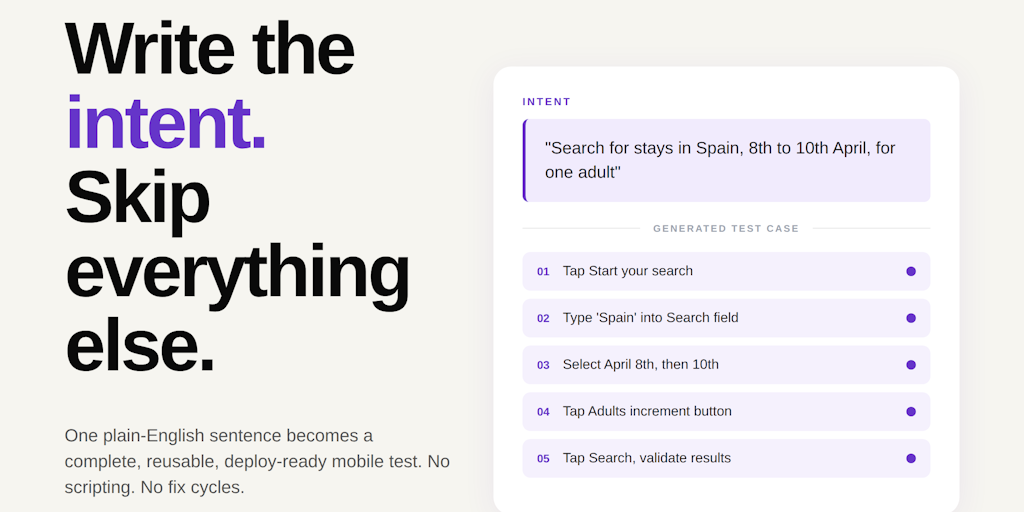
Mobile tests that write, run, and fix themselves
🔥 Upvotes: 333  ·  👤 By: Yash Varyani, Asad Abrar
💰 Pricing: Freemium  ·  🏷 Category: Testing & QA
Replaces brittle selector-based mobile tests with plain-English test descriptions. AI executes tests on real devices using vision, auto-generates reusable test cases, and adapts to UI changes without manual fixes. Verdict: If your mobile tests break every sprint, this solves a real pain point. Vision-based testing is more resilient than DOM selectors.
Mobile tests that write, run, and fix themselves - Drizz | Product Hunt
Drizz is an AI-powered mobile test automation platform built around intent-based testing. Simply describe what you want to test in plain English, Drizz executes it on a real device using Vision AI and automatically authors a reusable test case. No scripting, no flaky selectors, no manual maintenance. It adapts to dynamic UIs, integrates with your CI/CD pipeline, and gives your team reliable end-to-end coverage without the overhead.
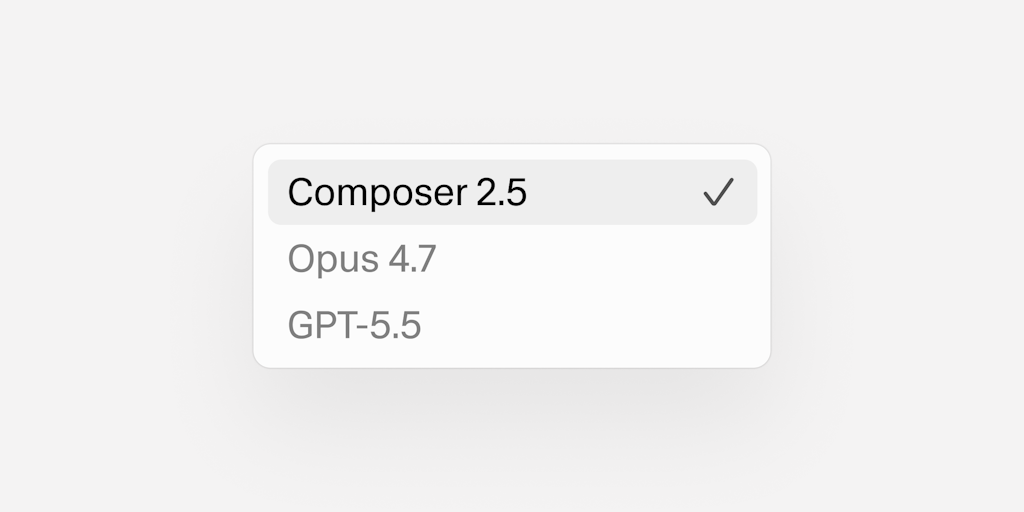
Cursor's most powerful model yet
🔥 Upvotes: 304  ·  👤 By: Cursor team (Anysphere Inc.)
💰 Pricing: Paid ($0.50-$3/M tokens)  ·  🏷 Category: AI Coding Agents
Cursor's in-house agentic coding model built on Moonshot AI's Kimi K2.5. Matches Claude Opus 4.7 on SWE-Bench Multilingual (79.8% vs 80.5%) at roughly one-tenth the cost per token. Handles multi-file refactoring, debugging, and test generation. Verdict: Significant that Cursor is building its own models rather than just wrapping others. The 10x cost advantage over Opus 4.7 at near-parity quality is notable.
The AI Code Editor - Cursor | Product Hunt
Built to make you extraordinarily productive, Cursor is the best way to code with AI.
AI chat for teams built on trust and collaboration
🔥 Upvotes: 265  ·  👤 By: Mantle team
💰 Pricing: Freemium  ·  🏷 Category: Team AI Collaboration
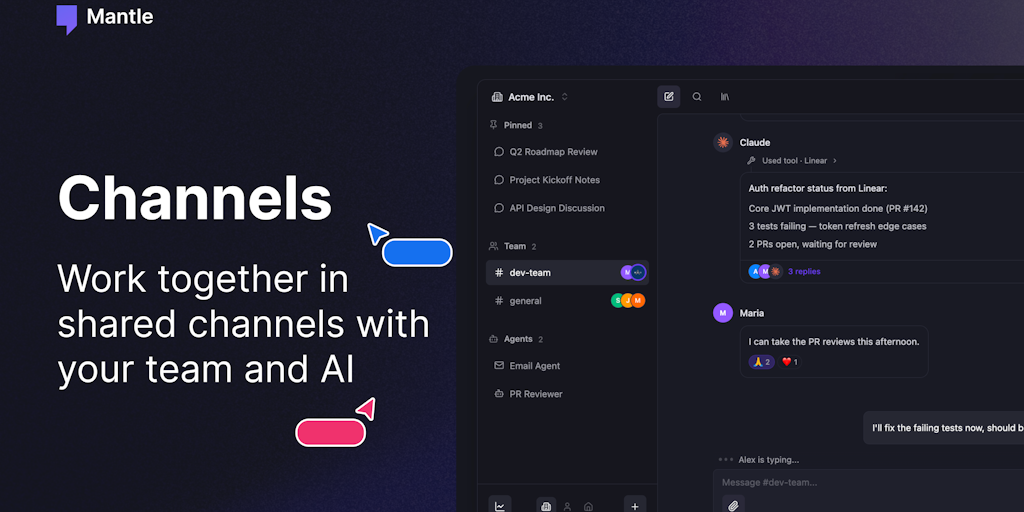
A team-first AI chat platform where conversations, prompts, and knowledge are shared by default. Designed for organizations where multiple people need to collaborate with AI on shared projects. Verdict: Solves a real gap - most AI chat tools are single-user. Whether teams will switch from existing tools remains the question.
AI-powered collaboration platform | Mantle Chat | Product Hunt
Mantle Chat is an AI-powered platform that helps teams communicate, collaborate, solve problems, and work with AI together in one place. It combines team messaging, AI models, agents, file sharing, integrations, and a shared knowledge base, so teams can stay connected and work productively. Instead of using AI in separate private chats, everyone can chat with teammates and use AI in the same shared workspace.
Your AI DevOps Engineer for Linux Servers
🔥 Upvotes: 209  ·  👤 By: CtrlOps team
💰 Pricing: Freemium (1-month trial)  ·  🏷 Category: AI DevOps
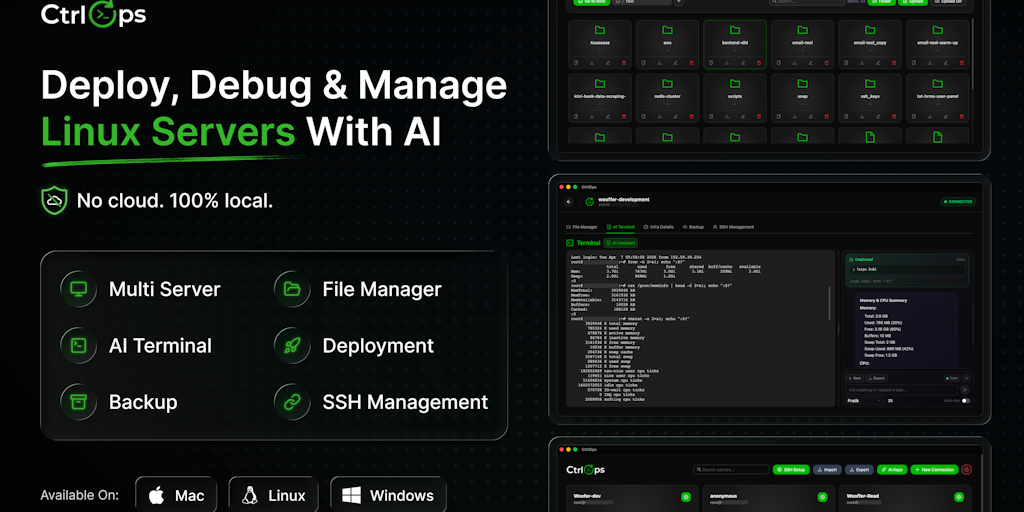
AI-powered Linux server management that monitors, diagnoses, and fixes server issues autonomously. Handles common sysadmin tasks like log analysis, service restarts, and configuration changes. Verdict: Server management is a strong use case for AI agents - repetitive, well-documented, and high-value. The trust barrier for autonomous server changes will be the adoption bottleneck.
CtrlOps | Deploy, Debug & Manage Linux Servers with AI. | Product Hunt
Most devs manage servers from a spreadsheet of IPs and commands nobody remembers. CtrlOps gives you AI-powered server management without DevOps expertise. AI terminal that generates commands with your approval. Scripts library. One-click deploys from any GitHub repo. Visual file manager. Real-time server monitoring. Zero agents on servers. Deployments that took 60 minutes now take 5. 100% local. Your credentials never leave your machine. Mac. Windows. Linux.

Snapshot

ProviderModelInput $/1MOutput $/1MContext
AnthropicClaude Opus 4.7$5.00$25.001M
AnthropicClaude Sonnet 4.6$3.00$15.001M
AnthropicClaude Haiku 4.5$1.00$5.00200K
OpenAIGPT-5.5$5.00$30.00~1M
OpenAIGPT-5.5 Pro (reasoning)$30.00$180.00~1M
OpenAIGPT-5.4$2.50$15.00~1M
GoogleGemini 3.5 Flash$1.50$9.001M
GoogleGemini 3.1 Pro Preview$2-4$12-181M
GoogleGemini 2.5 Flash$0.30$2.501M
GroqGPT OSS 120B$0.15$0.60128K
GroqLlama 4 Scout$0.11$0.34128K
What this means: Google's new Gemini 3.5 Flash at $1.50/$9 per million tokens sits in a unique position - cheaper than Anthropic and OpenAI's flagships on input but comparable on output. The real value play remains Groq's open-source hosting at $0.11-$0.15 input, though with smaller context windows (128K vs 1M). OpenAI's reasoning tier (GPT-5.5 Pro at $30/$180) remains the most expensive option by a wide margin. Gemini 3.5 Flash's 3x price increase over its predecessor signals that Google is done competing on price alone - it is betting on capability.

HyDRA: The Query Router Powering GitHub Copilot's Cost Optimization

Aashna Garg, Siddharth Singha Roy, Jinu Jang, Federico Brancasi, Shengyu Fu - arXiv:2605.17106
What it claims: HyDRA predicts per-query capability requirements across four dimensions (reasoning, code generation, debugging, tool use) and routes to the cheapest model that meets them. No retraining needed when models are added or removed.

Key finding: 54.1% cost savings at equal quality on SWE-Bench Verified - a 6x improvement over binary routing. At aggressive settings, 72.5% savings with only 3.2-point quality loss.

Why practitioners should care: This is deployed in production to all GitHub Copilot VS Code Chat auto-mode users. Any team running multiple LLMs can apply the same pattern - predict per-query needs, route to cheapest sufficient model, cut costs 50-70% without retraining when swapping providers. The 86ms CPU latency makes it practical for real-time use.

Member discussion

Subscribe to GenAI Secret Sauce newsletter and stay updated.

Don't miss anything. Get all the latest posts delivered straight to your inbox. It's free!

By subscribing, you agree to our Privacy Policy and Terms. We track email opens and clicks. Unsubscribe anytime.

Great! Check your inbox and click the link to confirm your subscription.