GenAI Secret Sauce Daily Digest - 2026-05-18

Anthropic Acquires Stainless for ~$300 Million - Then Winds Down Its Platform · Elon Musk Loses His Lawsuit Against Sam Altman and OpenAI · IBM and Hugging Face Launch the First Benchmark for Complete AI Agent Systems
GenAI Secret Sauce Daily Digest - 2026-05-18

Watch today's digest as a video summary (generated by NotebookLM)

Statistically Speaking

$300 million deal backed by reporting from The
Anthropic Acquires Stainless for ~$300 Million - Then Winds
Top Story
29 percentage points
IBM and Hugging Face Launch the First Benchmark for Complete
54% more than successful ones, meaning failure behavior
IBM and Hugging Face Launch the First Benchmark for Complete
4 million developers use Codex weekly
OpenAI and Dell Bring Codex to Corporate Data Centers
96% average success rate across 13 open
Researchers Broke 13 Voice AI Systems With Invisible Audio C
30 minutes to train an attack signal for
Researchers Broke 13 Voice AI Systems With Invisible Audio C

One Thing to Tell Your Friends

Anthropic just bought the company that builds the software libraries for OpenAI, Google, and Cloudflare - and is shutting the product down.

TL;DR

Trends
The Developer Infrastructure War Intensifies, Voice and Audio AI Has a Fundamental Security Problem, and AI in Education Hits a Tipping Point of Honesty.
Dev Tools
LobeHub: Human, Shadow: Mac AI Interface With Screen Vision, and M1 by Montage: Intents to Production Components.
Research
Qwen 3.7 Spotted in Qwen Chat, Agora-1: The First Multi, and "Are Tools All We Need?" Quantifies the Agent Tax.
Business
Anthropic's $300M Stainless Acquisition Reshapes SDK Economics, OpenAI Clears Its Biggest Legal Hurdle, and OpenAI.
Education
Stanford's Class of 2026 Graduates as the First AI and HuggingFace Revives PapersWithCode.
Surprising
A WiFi Router Can Now See Through Walls and Measure Your Heart Rate, Someone Tested 42 LLMs on Their Willingness to Build the Apocalypse, and A Stealth Browser That Passes Every Bot Detection Test Got 1,391 Stars Today.
GitHub
Leading repos: tinyhumansai/openhuman (+3,945), Imbad0202/academic-research (+1,302), and HKUDS/CLI (+1,047).
HuggingFace
Leading models: openbmb/MiniCPM-V (80.6k), SulphurAI/Sulphur-2 (1.05M), and Supertone/supertonic (24k).
Product Hunt
Top launches: LobeHub (323), Shadow (162), and Krea 2 (105).
API Pricing
What this means: The flagship model price band remains stable at $3-5/M input.
arXiv
Are Tools All We Need? Unveiling the Tool — Tool usage can degrade agent performance by 15-40% depending on the interaction pattern, with the penalty increasing as tool chains grow longer.

Hot off the Presses

01

Anthropic Acquires Stainless for ~$300 Million - Then Winds Down Its Platform

What this means for you: If you use AI APIs from OpenAI, Google, or Cloudflare, the company that auto-maintained your software libraries just got bought by a competitor and is shutting down. You'll keep your existing code, but updates stop.

Previously: May 6 - Anthropic partnered with SpaceX and doubled Claude limits.

Stainless, founded in 2022 by former Stripe engineer Alex Rattray, built tools that automatically turn an API specification (a technical blueprint for how software talks to other software) into ready-to-use code libraries across six programming languages. The startup's client list reads like an AI industry directory.

“Agents are only as useful as what they can connect to.” — Anthropic CEO Katelyn Lesse
  • ~$300 million deal backed by reporting from The Information
  • Clients include OpenAI, Google, Cloudflare, Runway, Replicate, and Meta's Llama Stack - all used Stainless to generate and maintain their developer libraries
  • All hosted Stainless products will be wound down - existing customers keep their generated code with full modification rights, but automatic updates end
  • Backed by Sequoia Capital and Andreessen Horowitz before the acquisition
  • Strategic fit with MCP - Anthropic's Model Context Protocol already sets the standard for how AI agents connect to tools; owning the SDK layer deepens that control
02

Elon Musk Loses His Lawsuit Against Sam Altman and OpenAI

What this means for you: OpenAI's biggest legal obstacle just vanished. The company is now free to pursue its expected IPO without the threat of forced restructuring - which means the AI tools you use daily aren't going anywhere.

A California jury unanimously ruled against Musk on all counts after deliberating for less than two hours. The case, which accused Altman and others of "stealing a charity" by converting OpenAI from nonprofit to for-profit, was dismissed on statute of limitations grounds rather than its merits.

  • Judge Yvonne Gonzalez Rogers indicated she was "prepared to dismiss on the spot" based on the evidence
  • Key defense: OpenAI argued any alleged harms occurred before the filing deadlines - August 2021 for the first count, August 2022 for the second
  • Musk plans to appeal to the Ninth Circuit, calling the ruling "a precedent to loot charities"
  • IPO path cleared - the verdict removes the largest legal risk ahead of OpenAI's reported initial public offering
03

IBM and Hugging Face Launch the First Benchmark for Complete AI Agent Systems

What this means for you: Until now, there was no standardized way to compare AI agents as whole products. This leaderboard shows that the model inside an agent matters less than you'd think - the wrapper around it can change performance by double digits.

The Open Agent Leaderboard, published today by IBM Research and Hugging Face, evaluates full AI agent systems across six benchmarks spanning code fixing, web research, app automation, and customer service.

  • Same model, different results - the top three configurations use the same underlying model but perform and cost vastly differently
  • Open-weight models trail by 18-29 percentage points - DeepSeek V3.2 and Kimi K2.5 lag behind frontier models significantly
  • Failed runs cost 20-54% more than successful ones, meaning failure behavior matters as much as success rate for production use
  • Tool shortlisting improved every model tested - helping agents focus on relevant tools boosted performance across the board
04

OpenAI and Dell Bring Codex to Corporate Data Centers

What this means for you: Companies that couldn't use AI coding tools because their code couldn't leave company servers now have an option. This is the first major move to bring frontier AI agents on-premise.

OpenAI and Dell Technologies announced a partnership to deploy Codex in hybrid and on-premises enterprise environments, connecting it to Dell's AI Data Platform where businesses already store their data.

  • 4 million developers use Codex weekly - making it one of OpenAI's fastest-growing enterprise products
  • Connects to internal codebases, documentation, and business systems that can't be uploaded to cloud
  • Exploration with Dell AI Factory for preparing data, managing systems of record, running tests, and deploying AI applications
  • Marks a shift from cloud-only to hybrid AI deployment for coding agents
05

Researchers Broke 13 Voice AI Systems With Invisible Audio Commands

What this means for you: Voice assistants can be tricked by sounds you can't hear. If you use voice AI in any professional setting - transcription, customer service, voice commands - the security model has a fundamental weakness that current defenses can't fix.

IEEE Spectrum reports on a technique called AudioHijack that embeds imperceptible instructions in audio files, hijacking large audio-language models (LALMs) into following attacker commands instead of user requests.

  • 79-96% average success rate across 13 open-source voice AI models
  • Only 30 minutes to train an attack signal for a specific model
  • Six attack types demonstrated: refusing user requests, generating false information, inserting malicious links, altering the AI's persona, activating unauthorized tools, and claiming inability to process audio
  • Current defenses fail badly - malicious instruction examples reduced attacks by only 7%, instruction verification caught just 28%
  • Commercial systems affected include Microsoft voice services and Mistral AI
  • Real-world vectors: hidden instructions in YouTube videos, music clips, Zoom recordings uploaded to transcription services

Trends & Themes

Trends & Themes

The Developer Infrastructure War Intensifies

Why this matters to you: The tools developers use to build with AI are becoming strategic weapons. Acquiring your competitor's toolchain supplier is a new kind of competitive move.

This is the AI equivalent of a land grab. Companies aren't just competing on model quality anymore - they're competing to own the layers between the model and the developer.

  • Anthropic's Stainless acquisition removes a shared infrastructure provider from rivals - OpenAI, Google, and Cloudflare must now self-maintain their SDKs
  • OpenAI's Dell partnership pushes Codex into enterprise infrastructure where switching costs are highest
  • IBM's Open Agent Leaderboard shows that agent wrappers (not just models) drive performance - making the tooling layer even more valuable
  • Tech Leads Club's agent-skills registry hit 4,000 stars by emphasizing security - "over 13% of marketplace skills contain critical vulnerabilities"

Voice and Audio AI Has a Fundamental Security Problem

Why this matters to you: As voice AI enters more workplaces - from meeting transcription to customer service bots - the attack surface grows. The defenses aren't ready.

The common thread between voice attacks and the Git bot-spam problem (371 HN points today): AI systems are increasingly targeted by other AI systems, and the defenses lag behind the attacks.

  • AudioHijack achieves 79-96% success against 13 leading voice AI models
  • Attention monitoring was the only partially effective defense, though attackers can dial it back with minimal impact on success rates
  • The vulnerability is architectural - large audio-language models tokenize sound in a way that hides manipulation from humans but not from models
  • Real-world attack scenario: a manipulated audio clip played during a Zoom call gets uploaded to an AI transcription service, which then follows hidden instructions

AI in Education Hits a Tipping Point of Honesty

Why this matters to you: If you're a student, parent, teacher, or employer of recent graduates, the social contract around AI use in education is being renegotiated in real time.
  • Stanford CS grad Theo Baker wrote in the New York Times that he doesn't "know a single person who hasn't used AI to get through some assignment" - from the Class of 2026, the first to arrive at college alongside ChatGPT
  • A Western University student publicly explained why she used AI on a closed-book exam, drawing 272 upvotes on r/Professors
  • r/Professors thread at 343 upvotes titled "I let the intrusive thought win" signals growing faculty frustration
  • The conversation has shifted from "should students use AI?" to "how do we rebuild assessment for a world where they already do?"

Agent Benchmarking Moves From Models to Systems

Why this matters to you: Choosing an AI agent used to mean choosing a model. The new benchmarks show that's like choosing a car by its engine alone - the chassis matters just as much.

The trend is clear: the model is becoming the commodity, and the orchestration layer around it is where the value accrues.

  • IBM's Open Agent Leaderboard is the first to evaluate full agent systems, not just their underlying models
  • Tool shortlisting (pre-filtering which tools an agent considers) improved every model tested
  • Failed runs cost 20-54% more than successful ones - a metric no model benchmark captures
  • arXiv paper "Are Tools All We Need?" (2605.00136) analyzes the efficiency costs of tool usage in agents, calling it the "tool-use tax"

Open-Source AI Keeps Democratizing Professional Tools

Why this matters to you: Tasks that used to require expensive commercial software or specialized engineers are becoming available to anyone with a laptop and a text prompt.
  • CLI-Anything (36,600 stars) turns professional software like Blender and GIMP into command-line tools AI agents can operate
  • Academic Research Skills (11,600 stars) automates the research-to-publication pipeline with mandatory human integrity gates
  • Scientific Agent Skills (24,400 stars) provides 135 ready-to-use scientific workflow skills spanning drug discovery, genomics, and materials science
  • OpenHuman (17,000 stars) builds a personal AI assistant connecting 118+ services with local data storage

Creative AI & Media

Anima: Anime Image Generation Built on NVIDIA Cosmos

  • What it does: A 2 billion parameter model that generates anime and artistic images from text prompts, trained on several million anime images with no synthetic data
  • Built on NVIDIA Cosmos architecture with a Qwen 3 text encoder
  • Native ComfyUI support with provided workflows
  • License: Non-commercial (commercial licensing available)

Dramabox: Expressive Text-to-Speech With Stage Directions

  • What it does: A prompt-driven TTS model where you write dialogue in quotes and stage directions outside them - "A woman speaks warmly, 'Hello!' She laughs, 'Hahaha!'"
  • Built on LTX-2.3 audio model by Lightricks, fine-tuned by Resemble AI
  • Voice cloning from a 10-second reference clip
  • ~2.5 seconds per generation on H100, ~24 GB VRAM required

Krea 2: AI Image and Video Generation With Style Control

  • What it does: An AI generation model built for fine-grained style control over images and video
  • Launched on Product Hunt today with 105 upvotes
  • Category leader in AI generative media

Pixal3D: Single-Image to High-Fidelity 3D Models

  • What it does: Turns a single photograph into a detailed 3D mesh with physically based rendering textures
  • Key innovation: Maps pixels directly into 3D space instead of loosely injecting image features
  • Accepted to SIGGRAPH 2026 - the top computer graphics conference
  • Created by Tencent ARC Lab with Tsinghua University

Developer Tools & Infrastructure

LobeHub: Human-Agent Collaboration Platform

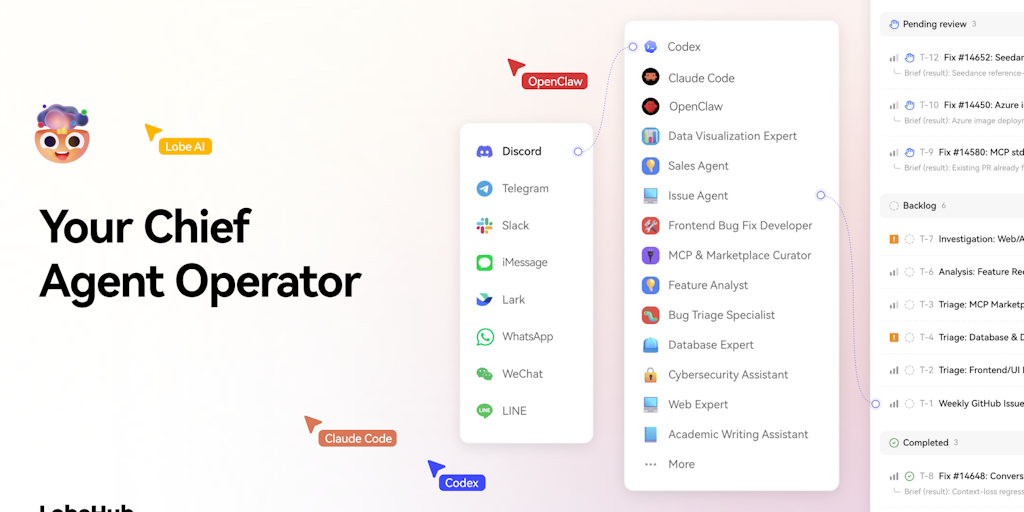
  • What it does: A system for building workflows where humans and AI agents collaborate, featuring a "Chief Agent Operator" interface
  • Top AI launch on Product Hunt today with 323 upvotes
  • Designed for team-level agent management, not just individual use

Shadow: Mac AI Interface With Screen Vision

  • What it does: An AI interface for Mac that can see your screen, respond to voice, and run custom automations
  • 162 Product Hunt upvotes today
  • Combines screen understanding with voice control for hands-free AI assistance

M1 by Montage: Intents to Production Components

  • What it does: An agentic UI that compiles natural language intents into production-ready components server-side
  • 126 Product Hunt upvotes today
  • Bridges the gap between what a developer describes and what gets shipped

Git's --author Flag as an Anti-Bot Weapon

A team at Archestra used Git's authentication mechanics to stop AI bot spam that was consuming "half a day every week." By attributing commits to verified contributors via the --author flag, they leveraged GitHub's "prior contributor" permissions to whitelist legitimate humans while blocking AI-generated noise. One bounty issue had received 253 AI-generated comments before the fix.

Research & Models

Qwen 3.7 Spotted in Qwen Chat - But No Weights Yet

Alibaba's next-generation model appeared in the Qwen Chat interface today, drawing 712 upvotes on r/LocalLLaMA. No downloadable weights, license terms, or technical specifications have been published. The current production family remains Qwen 3.6, which supports 2.1 million token context windows under the Apache 2.0 license.

  • Appearing in hosted chat only - not on HuggingFace or ModelScope yet
  • Community anticipation is high given Qwen 3.6's strong showing in local inference benchmarks
  • Export control headwinds - Alibaba faces increasing US chip restrictions that could affect future releases

Agora-1: The First Multi-Agent World Model

Odyssey launched Agora-1, a learned game engine that lets up to four players share and interact within the same AI-generated world in real time. Unlike traditional game engines with hard-coded physics, Agora-1 uses a diffusion transformer to generate all visuals and maintain consistent world state across all participants.

  • Decoupled architecture separates simulation from rendering, mirroring traditional game engine design but with entirely learned components
  • Four concurrent players sharing the same generated environment
  • Applications beyond gaming: reinforcement learning research, multi-agent policy training, collaborative robotics

"Are Tools All We Need?" Quantifies the Agent Tax

A new paper (arXiv 2605.00136) measures the efficiency costs of tool usage in AI agents - what the authors call the "tool-use tax." Every time an agent calls a tool, it pays a performance penalty. The paper provides a framework for deciding when agents should invoke tools versus reasoning internally.

Microsoft Fara-7B: A 7B Model That Outperforms OpenAI at Web Automation

Microsoft Research's Fara-7B, a 7 billion parameter model built on Qwen 2.5-VL, outperforms OpenAI's computer-use-preview on web navigation benchmarks: 73.5% vs 70.9% on WebVoyager, 38.4% vs 25.7% on WebTailBench. Trained in just 2.5 days on 64 H100 GPUs. MIT licensed.

  • Built for safety: trained to refuse illegal activities and halt at payment/personal data entry points
  • 128k token context with chain-of-thought reasoning plus tool calls

Business & Industry

Anthropic's $300M Stainless Acquisition Reshapes SDK Economics

  • Sequoia and a16z-backed startup sold after powering SDKs for OpenAI, Google, Cloudflare, Runway, Replicate, and Meta
  • Platform wind-down forces competitors to self-maintain their developer libraries
  • Combined with MCP ownership, gives Anthropic influence over both the connection standard and the implementation tooling

OpenAI Clears Its Biggest Legal Hurdle

  • Musk v. Altman dismissed by unanimous jury verdict in under two hours
  • IPO path cleared - OpenAI's reported public offering can proceed without restructuring risk
  • Appeal expected to the Ninth Circuit, but the statute of limitations defense is well-established ground

OpenAI-Dell Partnership Targets Enterprise AI Deployment

  • 4 million weekly Codex users make it one of OpenAI's fastest-growing enterprise products
  • On-premise deployment addresses the #1 enterprise AI objection: data leaving company servers
  • Dell AI Factory integration for end-to-end AI application deployment

GenAI in Education

Stanford's Class of 2026 Graduates as the First AI-Native Cohort

Stanford CS graduate Theo Baker's New York Times op-ed describes arriving at college two months before ChatGPT launched. His observation that he doesn't know a single classmate who hasn't used AI on an assignment signals how deeply embedded the technology has become in just four years.

  • r/Professors erupted with a 343-upvote thread and a 272-upvote discussion about a student who publicly explained why she used AI on a closed-book exam
  • The framing has shifted from detection and punishment to honest renegotiation of what assessment means
  • Western University incident drew attention because the student argued AI use was rational given the incentive structure, not because she denied it

HuggingFace Revives PapersWithCode

HuggingFace is reviving PapersWithCode, the platform that links research papers to their implementations, drawing 223 upvotes on r/MachineLearning. The platform had fallen behind as the pace of AI research accelerated.

Surprising & Under-the-Radar

A WiFi Router Can Now See Through Walls and Measure Your Heart Rate

RuView (59,800 stars) uses $9 ESP32 chips to detect people through walls, estimate 17 body keypoints, and monitor breathing and heart rate - all from WiFi signals alone, with no cameras or wearables. The system works up to 5 meters through solid walls.

Someone Tested 42 LLMs on Their Willingness to Build the Apocalypse

A Reddit user systematically tested 42 large language models on whether they'd help construct harmful scenarios. The post drew 202 upvotes on r/LocalLLaMA. The "safest" models weren't always the ones you'd expect.

A Stealth Browser That Passes Every Bot Detection Test Got 1,391 Stars Today

CloakBrowser modifies Chromium at the C++ source level (49 patches) to pass reCAPTCHA v3, Cloudflare Turnstile, and 30+ other detection systems. It's a drop-in replacement for Playwright. The ethical implications are debatable, but the technical achievement is notable.

An 11-Year Backend Developer Questions Whether AI Changed His Skills

A r/ClaudeAI post at 192 upvotes from an experienced developer honestly reflects on whether daily AI assistance has degraded or enhanced his problem-solving abilities after months of intensive use.

Signals to Track

Worth Watching
01

CLI-Anything Turns Every Desktop App Into an Agent Tool

If AI agents can operate professional software through command lines instead of clicking pixels, the entire automation stack simplifies overnight.

Hong Kong University built an automated pipeline that analyzes any software's source code and generates a full command-line interface for it. Blender, GIMP, LibreOffice, and 30+ other applications now have agent-compatible APIs with 2,280+ passing tests. If this approach scales, screen-scraping automation becomes obsolete. 36,600 stars.

02

Academic Research Gets a Full AI Pipeline - With Mandatory Human Gates

The first research automation toolkit that's honest about where AI should stop and a human should decide.

A 12-agent system handles everything from literature review to peer review simulation, but hard-codes human checkpoints at integrity verification stages. Anti-hallucination protocols address documented AI research failure modes. 11,600 stars and CC-BY-NC licensed.

03

Agora-1 Lets Four Players Share One AI-Generated Game World

If a learned game engine can maintain consistent state for four players simultaneously, the path to AI-generated virtual worlds gets shorter.

Odyssey's multi-agent world model generates all visuals and physics from learned components rather than coded rules. The decoupled state-and-rendering architecture mirrors traditional game engines but with nothing hard-coded. Applications extend to robotics simulation and multi-agent reinforcement learning.

04

The Open Agent Leaderboard Proves the Wrapper Matters

We now have evidence that two agents using the exact same model can differ by 20+ percentage points in real-world tasks.

IBM and Hugging Face's benchmark is the first to test complete agent systems. The finding that tool shortlisting improves every model suggests an entire optimization layer that most agent builders haven't touched yet.

05

OpenHuman Builds Your Personal AI From 118 Connected Accounts

A personal AI assistant that fetches data from your accounts every 20 minutes and compresses it into a local knowledge base - inspired by Andrej Karpathy's note-taking workflow.

GPLv3 licensed, SQLite-backed, no cloud required. 17,000 stars and growing fast at 3,945 stars today. The "context in minutes, not weeks" pitch could make personal AI assistants feel genuinely personal.

Top Repos Today

Rank yesterday: New entry 🆕
⭐ Stars today: +3,945  ·  📦 Total: 17,037
📜 License: GPL-3.0  ·  👤 By: Individual developer
🎯 Time to value: 15 minutes
What it is: An open-source personal AI assistant that connects to 118+ services via OAuth and builds a compressed local knowledge base from your accounts. It fetches data every 20 minutes and routes tasks to appropriate AI models based on complexity. Inspired by Andrej Karpathy's note-taking workflow. Why you'd want it: Your AI assistant finally has context about your life without sending everything to a cloud server.
✓ Pros✗ Cons
118+ service integrations via OAuthGPL-3.0 limits commercial derivative use
Fully local SQLite storageEarly-stage (v0.53) with 139 open issues
Automatic context compressionRequires self-hosting and maintenance
GitHub - tinyhumansai/openhuman: Your Personal AI super intelligence. Private, Simple and extremely powerful.
Your Personal AI super intelligence. Private, Simple and extremely powerful. - tinyhumansai/openhuman
Rank yesterday: New entry 🆕
⭐ Stars today: +1,302  ·  📦 Total: 11,607
📜 License: CC-BY-NC-4.0  ·  👤 By: Individual researcher
🎯 Time to value: 10 minutes
What it is: A suite of Claude Code skills automating the research-to-publication pipeline: deep research (13-agent system), academic writing (12-agent pipeline), peer review (7-agent evaluation), and orchestration with mandatory human integrity gates. Why you'd want it: Automates the tedious parts of academic research while keeping humans in the loop for decisions that matter.
✓ Pros✗ Cons
Mandatory human checkpoints prevent fully automated publishingNon-commercial license limits industry use
Anti-hallucination protocols based on documented failure modesRequires Claude Code subscription
PRISMA-compliant systematic review supportLimited to English-language research
GitHub - Imbad0202/academic-research-skills: Academic Research Skills for Claude Code: research → write → review → revise → finalize
Academic Research Skills for Claude Code: research → write → review → revise → finalize - Imbad0202/academic-research-skills
Rank yesterday: Holding steady ➡
⭐ Stars today: +1,047  ·  📦 Total: 36,581
📜 License: Apache 2.0  ·  👤 By: University research lab (HKUST)
🎯 Time to value: 20 minutes
What it is: Analyzes any software's source code and auto-generates a full command-line interface, enabling AI agents to operate professional applications like Blender, GIMP, and LibreOffice through structured commands instead of pixel-clicking. Why you'd want it: Turns 30+ professional desktop applications into agent-compatible tools with 2,280+ passing tests.
✓ Pros✗ Cons
Apache 2.0 license, fully openRequires application source code access
2,280+ passing tests across implementationsComplex setup for some applications
Supports both interactive and programmatic useCLI-only - no visual feedback loop
GitHub - HKUDS/CLI-Anything: “CLI-Anything: Making ALL Software Agent-Native” -- CLI-Hub: https://clianything.cc/
“CLI-Anything: Making ALL Software Agent-Native” -- CLI-Hub: https://clianything.cc/ - HKUDS/CLI-Anything
Rank yesterday: Rising ↑
⭐ Stars today: +1,391  ·  📦 Total: 15,149
📜 License: MIT (wrapper) / Proprietary (binary)  ·  👤 By: Company (CloakHQ)
🎯 Time to value: 5 minutes
What it is: A stealth Chromium browser that bypasses bot detection at the C++ source level with 49 fingerprint patches. Passes reCAPTCHA v3, Cloudflare Turnstile, and 30+ detection services while maintaining a standard Playwright/Puppeteer API. Why you'd want it: Drop-in replacement for Playwright when your legitimate automation is blocked by overzealous bot detection.
✓ Pros✗ Cons
Passes every major bot detection systemProprietary binary core with usage restrictions
Drop-in Playwright/Puppeteer replacementEthical gray area for many use cases
Human-like interaction via single flagBinary updates controlled by CloakHQ
GitHub - CloakHQ/CloakBrowser: Stealth Chromium that passes every bot detection test. Drop-in Playwright replacement with source-level fingerprint patches. 30/30 tests passed.
Stealth Chromium that passes every bot detection test. Drop-in Playwright replacement with source-level fingerprint patches. 30/30 tests passed. - CloakHQ/CloakBrowser
Rank yesterday: New entry 🆕
⭐ Stars today: +1,244  ·  📦 Total: 4,010
📜 License: MIT  ·  👤 By: Community (Tech Leads Club)
🎯 Time to value: 5 minutes
What it is: A curated, security-audited registry of skills for AI coding agents (Claude Code, Cursor, Copilot). Every skill passes static analysis and integrity verification - the registry was created because "over 13% of marketplace skills contain critical vulnerabilities." Why you'd want it: Install agent skills without worrying about supply chain attacks or malicious code.
✓ Pros✗ Cons
Security-audited with immutable integrity via lockfilesSmaller catalog than unvetted marketplaces
MIT license, 100% open sourceCuration slows new skill availability
Works across multiple AI coding agentsCommunity-dependent for growth
GitHub - tech-leads-club/agent-skills: The secure, validated skill registry for professional AI coding agents. Extend Antigravity, Claude Code, Cursor, Copilot and more with absolute confidence.
The secure, validated skill registry for professional AI coding agents. Extend Antigravity, Claude Code, Cursor, Copilot and more with absolute confidence. - tech-leads-club/agent-skills
Rank yesterday: Holding steady ➡
⭐ Stars today: +610  ·  📦 Total: 24,360
📜 License: MIT  ·  👤 By: Company (K-Dense Inc.)
🎯 Time to value: 10 minutes
What it is: 135 ready-to-use scientific workflow skills covering bioinformatics, drug discovery, clinical research, proteomics, and materials science. Includes 70+ optimized Python packages (RDKit, Scanpy, PyTorch Lightning) and access to 100+ scientific databases. Why you'd want it: Run virtual drug screening or single-cell RNA analysis from your AI coding agent without writing boilerplate.
✓ Pros✗ Cons
135 skills across major scientific domainsRequires domain knowledge to use effectively
100+ database integrations (PubChem, UniProt, etc.)Some workflows need specific hardware
MIT license for commercial and academic usePython-only ecosystem
GitHub - K-Dense-AI/scientific-agent-skills: A set of ready to use Agent Skills for research, science, engineering, analysis, finance and writing.
A set of ready to use Agent Skills for research, science, engineering, analysis, finance and writing. - K-Dense-AI/scientific-agent-skills
Rank yesterday: Rising ↑
⭐ Stars today: +376  ·  📦 Total: 6,492
📜 License: Apache 2.0  ·  👤 By: NVIDIA Research
🎯 Time to value: 15 minutes
What it is: An efficient image and video generation framework claiming 20x smaller and 100x faster performance than competing models. Uses linear attention instead of standard transformers and supports generation up to 4K resolution. Runs on laptops with under 8 GB VRAM via 4-bit quantization. Why you'd want it: Generate high-resolution images and video on consumer hardware at speeds that make iteration practical.
✓ Pros✗ Cons
100x faster than comparable modelsStill in active development
Runs on 8GB VRAM via quantizationVideo generation is newest, least mature
Apache 2.0 licenseRequires diffusers/ComfyUI setup
GitHub - NVlabs/Sana: SANA: Efficient High-Resolution Image Synthesis with Linear Diffusion Transformer
SANA: Efficient High-Resolution Image Synthesis with Linear Diffusion Transformer - NVlabs/Sana
Rank yesterday: Holding steady ➡
⭐ Stars today: +1,013  ·  📦 Total: 63,413
📜 License: MIT  ·  👤 By: Microsoft
🎯 Time to value: 30 minutes
What it is: A 12-lesson curriculum for building AI agents, covering design patterns, tool use, agentic RAG (Retrieval-Augmented Generation), multi-agent systems, and production deployment. Jupyter Notebook-based with hands-on exercises. Why you'd want it: The most comprehensive free curriculum for learning to build AI agents, from a major tech company.
✓ Pros✗ Cons
12 structured lessons with exercisesBeginner-focused - not for production architects
63,000+ stars signal community trustMicrosoft-centric tool recommendations
MIT licensed, regularly updatedRequires Python and Jupyter setup
GitHub - microsoft/ai-agents-for-beginners: 12 Lessons to Get Started Building AI Agents
12 Lessons to Get Started Building AI Agents. Contribute to microsoft/ai-agents-for-beginners development by creating an account on GitHub.

Top Models Today

A tiny multimodal model that punches above its weight in vision-language tasks.
📥 Downloads (30d): 80.6k  ·  📜 License: Apache 2.0
👤 By: OpenBMB (Tsinghua)  ·  🎯 Task: Image-Text-to-Text
📐 Size: ~3B
What it is: A compact vision-language model that processes both images and text, designed to run on consumer hardware while achieving competitive performance against much larger models. Why you'd want it: Run multimodal AI on a laptop without paying API costs.
✓ Pros✗ Cons
Small enough for edge deploymentSmaller model = less complex reasoning
Apache 2.0 for commercial useEnglish-centric performance
Active community with 769 likesVision tasks lag behind text tasks
openbmb/MiniCPM-V-4.6 · Hugging Face
We’re on a journey to advance and democratize artificial intelligence through open source and open science.
The most-downloaded open text-to-video model with over 1 million monthly downloads.
📥 Downloads (30d): 1.05M  ·  📜 License: LTX Community
👤 By: SulphurAI  ·  🎯 Task: Text-to-Video
📐 Size: ~3.3B
What it is: An open-weight video generation model built on the LTX 2.3 architecture. Generates video clips from text descriptions with no content restrictions. Why you'd want it: The only high-download video generation model you can run locally without content filters.
✓ Pros✗ Cons
1M+ downloads prove community trustUncensored = potential misuse concerns
Based on proven LTX architectureRequires significant VRAM (24GB+)
Active development and communityOutput quality below commercial options
SulphurAI/Sulphur-2-base · Hugging Face
We’re on a journey to advance and democratize artificial intelligence through open source and open science.
Lightning-fast on-device text-to-speech in 31 languages via ONNX.
📥 Downloads (30d): 24k  ·  📜 License: Custom (Supertone)
👤 By: Supertone Inc.  ·  🎯 Task: Text-to-Speech
📐 Size: Small (ONNX)
What it is: An on-device TTS engine that runs natively via ONNX runtime, supporting 31 languages with low latency. Swift-based for Apple platforms. Why you'd want it: Natural-sounding speech synthesis on your phone or laptop with no internet required.
✓ Pros✗ Cons
31 languages, on-deviceCustom license limits some use
Lightning-fast ONNX inferenceApple-first (Swift-based)
No cloud dependencyFewer voice options than cloud TTS
Supertone/supertonic-3 · Hugging Face
We’re on a journey to advance and democratize artificial intelligence through open source and open science.
A 2B anime image generator trained on real art, not synthetic data - now trending with 545k downloads.
📥 Downloads (30d): 545k  ·  📜 License: Non-commercial
👤 By: CircleStone Labs + Comfy Org  ·  🎯 Task: Text-to-Image
📐 Size: 2B
What it is: Built on NVIDIA Cosmos architecture, Anima specializes in anime and artistic image generation. Trained on several million real anime images with Danbooru-style tag support. Why you'd want it: The best-performing dedicated anime image generator, with native ComfyUI workflow support.
✓ Pros✗ Cons
Trained on real art, not syntheticNon-commercial license
Native ComfyUI integrationAnime/artistic focus only
2B params = fast generationKnowledge cutoff September 2025
circlestone-labs/Anima · Hugging Face
We’re on a journey to advance and democratize artificial intelligence through open source and open science.
Prompt-driven TTS that understands stage directions - write dialogue in quotes, emotions outside them.
📥 Downloads (30d): 1k  ·  📜 License: LTX-2 Community
👤 By: Resemble AI  ·  🎯 Task: Text-to-Speech
📐 Size: ~3.3B
What it is: An expressive text-to-speech model where the prompt controls everything: speaker identity, emotion, laughs, sighs, and pauses. Supports 10-second voice cloning. Why you'd want it: Create nuanced voice performances with a single text prompt - no audio engineering required.
✓ Pros✗ Cons
Stage-direction-style prompt control24GB VRAM required
10-second voice cloningNew release, small download count
Automatic neural watermarkingCommunity license terms
ResembleAI/Dramabox · Hugging Face
We’re on a journey to advance and democratize artificial intelligence through open source and open science.
A 7B web automation model that outperforms OpenAI's computer-use-preview on navigation benchmarks.
📥 Downloads (30d): 16k  ·  📜 License: MIT
👤 By: Microsoft Research  ·  🎯 Task: Web Automation
📐 Size: 7B
What it is: The first agentic small language model designed for computer use. Takes screenshots and action history as input, outputs chain-of-thought reasoning plus browser tool calls. Why you'd want it: Run a web automation agent locally that beats OpenAI's offering on key benchmarks - MIT licensed.
✓ Pros✗ Cons
Outperforms OpenAI on WebVoyager (73.5% vs 70.9%)Web-only - no desktop automation
MIT license, fully open128k context may limit long sessions
Safety-trained to halt at sensitive actionsRequires multimodal inference setup
microsoft/Fara-7B · Hugging Face
We’re on a journey to advance and democratize artificial intelligence through open source and open science.
Single-image to 3D model accepted at SIGGRAPH 2026 - direct pixel-to-3D mapping instead of attention injection.
📥 Downloads (30d): N/A (new)  ·  📜 License: Custom
👤 By: Tencent ARC Lab + Tsinghua  ·  🎯 Task: Image-to-3D
📐 Size: Based on Trellis.2
What it is: Generates high-fidelity 3D meshes with PBR textures from a single photograph. Uses direct pixel-to-3D back-projection instead of the loose attention-based methods used by previous image-to-3D tools. Why you'd want it: Create game-ready 3D assets from photos with near-reconstruction-level fidelity.
✓ Pros✗ Cons
SIGGRAPH 2026 accepted (peer-reviewed)Custom license terms
PBR textures in outputNew release, limited community testing
Direct pixel mapping = better detailRequires GPU for inference
TencentARC/Pixal3D · Hugging Face
We’re on a journey to advance and democratize artificial intelligence through open source and open science.

AI Launches Today

System built for human-agent collaboration with Chief Agent Operator
🔥 Upvotes: 323  ·  👤 By: LobeHub team
💰 Pricing: Free tier available  ·  🏷 Category: AI Agents
A team collaboration platform where humans and AI agents work together through a unified interface. The "Chief Agent Operator" concept treats agent management as a first-class team function rather than an afterthought. Verdict: The high upvote count suggests real demand for team-level agent management tools beyond individual coding assistants.
LobeHub: Your Chief Agent Operator | Product Hunt
LobeHub is a system built for human-agent collaboration, with CAO — your Chief Agent Operator — at the center. Give it a goal and CAO assembles a team from 273K+ Skills and 51K+ MCP servers, runs Claude Code, Codex, and OpenClaw in parallel on the cloud, and sends you one daily brief instead of making you check 15 tabs. Agents show up where you already chat — Slack, Discord, Telegram, WeChat, Feishu, Lark, LINE, QQ, iMessage — so you stay in charge without staying online.
AI interface for Mac with screen vision, voice control, and custom automation
🔥 Upvotes: 162  ·  👤 By: Shadow team
💰 Pricing: TBD  ·  🏷 Category: AI Meeting Tools
A native Mac AI assistant that combines screen understanding with voice control and custom automation workflows. Verdict: Competes directly with Apple Intelligence but promises deeper automation. The screen vision angle is increasingly crowded.
AI image and video generation model built for style control
🔥 Upvotes: 105  ·  👤 By: Krea
💰 Pricing: Freemium  ·  🏷 Category: AI Generative Media
An updated generation model emphasizing fine-grained control over visual style, a feature most competitors treat as secondary to raw quality. Verdict: Style control is genuinely underserved. If the quality matches the premise, this fills a real gap.
Self-improvement stack monitoring agent decisions and surfacing failure patterns
🔥 Upvotes: 101  ·  👤 By: Polarity team
💰 Pricing: TBD  ·  🏷 Category: AI Metrics and Evaluation
Monitors how AI agents make decisions in production and surfaces recurring failure patterns for improvement. Verdict: Directly addresses the Open Agent Leaderboard's finding that failure costs 20-54% more than success. Timely launch.

Snapshot

ProviderModelInput $/1MOutput $/1MContext
AnthropicClaude Opus 4.7$5.00$25.001M
AnthropicClaude Sonnet 4.6$3.00$15.001M
AnthropicClaude Haiku 4.5$1.00$5.001M
OpenAIGPT-5.5$5.00$30.001M
OpenAIGPT-5.4$2.50$15.001M
OpenAIo3$2.00--
OpenAIo4-mini$1.10--
OpenAIGPT-4.1 nano$0.10$0.40-
GoogleGemini 3.1 Pro$2.00$12.00-
GoogleGemini 2.5 Pro$1.25$10.00-
GoogleGemini 3.1 Flash-Lite$0.25$1.50-
GroqLlama 3.3 70B$0.59$0.79-
GroqLlama 3.1 8B$0.05--
What this means: The flagship model price band remains stable at $3-5/M input. Google's Gemini 3.1 Pro at $2/M input undercuts both Anthropic and OpenAI at the frontier tier. Groq's open-source hosting at $0.05-0.59/M remains 10-100x cheaper for applications where model quality can flex. No price changes detected vs. yesterday.

Are Tools All We Need? Unveiling the Tool-Use Tax in LLM Agents

Kaituo Zhang, Zhen Xiong, Mingyu Zhong · arXiv:2605.00136
What it claims: Every tool call in an AI agent carries a hidden performance cost - the "tool-use tax." The paper provides the first systematic measurement of how tool invocation affects agent efficiency, finding that the overhead is significant and varies dramatically by model and task type.

Key finding: Tool usage can degrade agent performance by 15-40% depending on the interaction pattern, with the penalty increasing as tool chains grow longer.

Why practitioners should care: If you're building AI agents, this paper gives you a framework for deciding when to call tools versus reasoning internally - potentially saving significant compute costs and improving response quality.

Member discussion

Subscribe to GenAI Secret Sauce newsletter and stay updated.

Don't miss anything. Get all the latest posts delivered straight to your inbox. It's free!

By subscribing, you agree to our Privacy Policy and Terms. We track email opens and clicks. Unsubscribe anytime.

Great! Check your inbox and click the link to confirm your subscription.