GenAI Secret Sauce Daily Digest - 2026-05-20

Qwen Launches 3.7 Max and Calls It "The Agent Frontier" · SpaceX S-1 Reveals a $1.25 Billion Per Month Compute Deal With Anthropic · Cohere Releases Command A+ - A 218B Open-Weight Model Supporting 48 Languages
GenAI Secret Sauce Daily Digest - 2026-05-20

Watch today's digest as a video summary (generated by NotebookLM)

Statistically Speaking

27B waiting room" is open
Qwen Launches 3.7 Max and Calls It "The Agent Frontier"
Top Story
3.6 launched just weeks ago, and the 3
Qwen Launches 3.7 Max and Calls It "The Agent Frontier"
$1.25 billion running through May 2029, with a
SpaceX S-1 Reveals a $1.25 Billion Per Month Compute Deal Wi
128 experts with 8 active per token plus
Cohere Releases Command A+ - A 218B Open-Weight Model Suppor
128K input and 64K output context length across
Cohere Releases Command A+ - A 218B Open-Weight Model Suppor
102 upvotes) with users immediately testing quantized versions
Cohere Releases Command A+ - A 218B Open-Weight Model Suppor

One Thing to Tell Your Friends

SpaceX's IPO filing reveals the company is paying Anthropic $1.25 billion per month for access to AI compute across Elon Musk's COLOSSUS data centers - the largest known AI infrastructure deal ever disclosed.

TL;DR

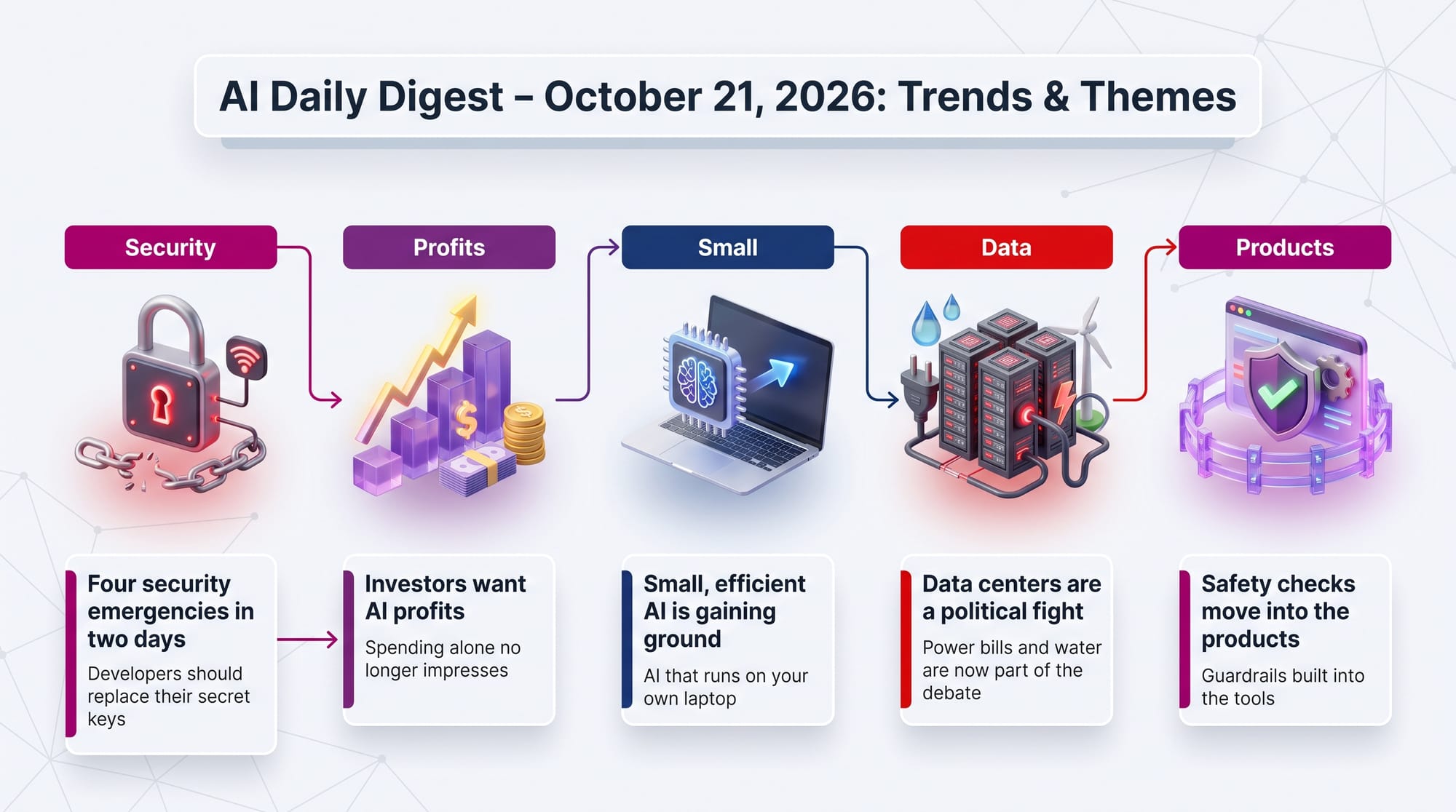
Trends
Multi, The Open, and Students and Faculty Are Pushing Back Against AI in Education.
Business
SpaceX S, OpenAI Bidding on "Claude Down" Search Ads, and Cornerstone Reinvents Corporate Learning With AI.
Education
Harvard Votes to Cap A Grades at ~20% Per Course, Students Booing AI at Campus Events, and Anti.
GitHub
Leading repos: colbymchenry/codegraph (+1,910), tinyhumansai/openhuman (+3,603), and rohitg00/ai-engineering-from (+762).
HuggingFace
Leading models: bytedance (438), SulphurAI/Sulphur-2 (1,157,497), and openbmb/MiniCPM-V (166,049).
Product Hunt
Top launches: StoreClaw (491), mailX by mailwarm (434), and Gemini Omni (284).
API Pricing
No price changes today. The value gap between frontier closed-source models ($3-$5 per million input tokens) and Groq-hosted open-source alternatives ($0.05-$0.59) remains 10-100x.
arXiv
Making Every Verified Token Count — Up to 2.35x speedup over standard generation and 1.21x over the previous best (EAGLE-3), with lossless output quality.

Hot off the Presses

01

Qwen Launches 3.7 Max and Calls It "The Agent Frontier"

What this means for you: If you use AI coding assistants or automated workflows, the best free-to-use option just got significantly better at multi-step tasks.

Alibaba's Qwen team released Qwen 3.7 Max, positioning it explicitly as a model optimized for AI agent tasks - the kind of work where an AI needs to plan multiple steps, use tools, and recover from errors. The launch topped Hacker News with 580 upvotes and 228 comments, the highest-signal AI story of the day.

  • Artificial Analysis benchmarks show it competing with GPT-5.5 on several agent-focused evaluations, according to early community testing on r/LocalLLaMA (303 upvotes)
  • The "27B waiting room" is open - Qwen also signaled that smaller 27B and 35B variants of the 3.7 generation are coming soon (505 upvotes on r/LocalLLaMA for the leak)
  • The model joins an accelerating release cadence - Qwen 3.6 launched just weeks ago, and the 3.7 series suggests the gap between major Chinese model releases is shrinking to days
02

SpaceX S-1 Reveals a $1.25 Billion Per Month Compute Deal With Anthropic

What this means for you: The company building Claude - the AI assistant many people use daily - is backed by the same data centers that process SpaceX rocket telemetry. AI's biggest players are quietly entangled in ways the public rarely sees.

SpaceX's S-1 filing for its upcoming IPO contains a disclosure that Simon Willison flagged: SpaceX has entered cloud services agreements giving Anthropic access to compute resources across COLOSSUS and COLOSSUS II data centers.

  • The monthly payment is $1.25 billion running through May 2029, with a ramp period from May to November 2026
  • COLOSSUS is the largest known GPU cluster in the world - originally built by Elon Musk's xAI to train Grok, it now apparently also serves Anthropic's training runs
  • This makes SpaceX an AI cloud provider in addition to a rocket company - a revenue stream that likely helps justify the IPO valuation
  • The Musk connection is notable - Musk publicly criticizes AI companies while his infrastructure serves them
03

Cohere Releases Command A+ - A 218B Open-Weight Model Supporting 48 Languages

What this means for you: If you need AI that works well in languages other than English, the best open option just got much better - and it's free to download and run.

Cohere quietly dropped Command A+, a Sparse Mixture-of-Experts model with 218 billion total parameters. Despite the large total size, only 25 billion parameters activate per query, making it practical to run on high-end consumer hardware.

Previously: Cohere has been relatively quiet compared to Qwen and Meta in the open-weight space. This release signals they're competing aggressively again.

  • 128 experts with 8 active per token plus one shared expert - a design that balances specialization with efficiency
  • 128K input and 64K output context length across 48 languages, released under Apache 2.0 license
  • Multimodal support for text, code, and image understanding
  • Appeared on r/LocalLLaMA (102 upvotes) with users immediately testing quantized versions for local deployment
  • Cohere co-founder Nick Frosst posted a video on Reddit addressing what happened to the Command-A series, generating 132 upvotes and renewed community interest
128
experts with 8 active per
128K
input and 64K output context
04

Google Is Quietly Fighting People Who Manipulate Its AI Search Results

What this means for you: When you search Google and see an AI-generated answer at the top, someone may have deliberately planted false information to influence what it tells you - and Google's defenses are still catching up.

A BBC Future investigation, which hit Hacker News with 241 upvotes and 170 comments, documents how adversarial actors have developed techniques to manipulate Google's AI Overviews - the AI-generated summaries that appear above traditional search results.

Previously: May 19 covered the Google I/O 2026 announcements including Gemini 3.5 Flash and expanded AI Overviews deployment. Today's story is about the security implications of that expansion.

“If you can SEO your way into a summary, you can SEO your way into a fact.”
  • The attacks exploit how AI Overviews synthesize information from multiple sources, allowing coordinated content to shift what the AI tells users
  • Google's countermeasures are largely invisible to users - the company is making changes behind the scenes but hasn't publicly detailed its defense strategy
  • The 170-comment HN discussion focused on whether AI-generated search summaries can ever be trustworthy when the underlying web content is adversarial
05

AMD Reveals a $3,999 PC With 128GB Unified Memory Built for Running AI Locally

What this means for you: For the first time, a single desktop machine costing less than a used car can run AI models that previously required server-grade hardware - without any of the speed penalties that come from splitting a model across multiple graphics cards.

AMD's upcoming Ryzen AI Halo PC ships with 128GB of on-board unified memory at $3,999, immediately generating 193 upvotes on r/LocalLLaMA.

Previously: May 16 covered Corsair's EUR 2,769 workstation with 96GB unified VRAM. The AMD machine offers 33% more memory at a higher price, targeting serious local AI users.

  • Unified memory eliminates the PCIe bottleneck that forces GPU-only setups to slow down when models don't fit in graphics card memory
  • 128GB is enough to run 70B+ parameter models at full precision, or even larger quantized models comfortably
  • Compared to Apple's Mac Studio (the current local AI champion), the AMD machine offers similar memory at a lower price point with a different performance profile
  • The r/LocalLLaMA community is already calculating which models fit and at what speed, with several users calling it the most practical local AI workstation yet announced

Trends & Themes

Multi-Token Prediction Is Becoming the Default Way to Run AI Locally

Why this matters to you: The AI running on your laptop or desktop is about to get roughly twice as fast, for free, with just a software update.

The pattern is clear: MTP launched as an experimental feature a few weeks ago and is now being baked into every major local AI tool. Within a month, most people running AI locally will have it enabled by default.

Sources: r/LocalLLaMA (5 posts), llama.cpp GitHub (2 PRs)

  • LM Studio added MTP speculative decoding (230 upvotes on r/LocalLLaMA) - the most popular desktop AI app now supports the technique that nearly doubled inference speed when it merged into llama.cpp
  • A pull request adding MTP support for Google's Gemma 4 models appeared in llama.cpp (136 upvotes) - expanding MTP beyond Qwen models
  • Detailed benchmarks comparing NTP vs MTP quantizations appeared on r/LocalLLaMA (138 upvotes), showing that MTP consistently delivers 1.5-2x speedup on NVIDIA GPUs
  • An llama.cpp PR optimizing MTP's backend sampling was merged (42 upvotes), further reducing overhead
  • RTX 5080 benchmarks showed 56 tokens/second on Qwen 3.6 35B at 128K context - but noted MTP gains are smaller on already-fast configurations

The Open-Weight Frontier Keeps Advancing on Multiple Fronts

Why this matters to you: The gap between the best AI you can download for free and the best AI you have to pay for keeps shrinking - and the free options now cover more languages and more tasks.

The pace of open releases has accelerated to the point where community members are creating memes about waiting for the next Qwen drop (155 upvotes). The "waiting room" culture suggests open-weight models have achieved the kind of consumer anticipation usually reserved for product launches.

Sources: Qwen blog, HuggingFace, r/LocalLLaMA (4 posts), r/MachineLearning

  • Qwen 3.7 Max competes with GPT-5.5 on agent benchmarks according to Artificial Analysis - a Chinese model matching the American frontier
  • Cohere Command A+ covers 48 languages at 218B parameters with an open Apache 2.0 license - the most multilingual open-weight frontier model
  • HRM-Text claims a 1B model trained on 1000x less data outperforms 7B models on reasoning (21 upvotes r/LocalLLaMA) - questioning whether massive data is necessary
  • DeepSeek V4-Pro trends on HuggingFace with 3.8M downloads, showing sustained demand for the 1.6T-parameter MoE

Students and Faculty Are Pushing Back Against AI in Education

Why this matters to you: If you're a student, parent, or educator, the rules around AI in classrooms are changing fast - and the direction isn't what the tech industry expected.

The education sector is increasingly polarized: administrators adopt AI while students and faculty resist it. Harvard's grade cap isn't explicitly about AI, but the timing - during an era when AI makes producing A-quality work trivially easy - signals that elite institutions are rethinking assessment fundamentals.

Sources: r/Professors (7 posts), r/highereducation (1 post)

  • Harvard voted 458-201 to cap A grades at ~20% per course (296 upvotes r/Professors), effective fall 2027 - currently over 60% of undergrad grades are A's
  • Students at multiple institutions are booing AI presentations and demos (232 upvotes r/Professors) - a visceral rejection that contrasts with industry assumptions about universal AI enthusiasm
  • A professor's post about anti-AI cheating tools using document version history gathered 93 upvotes, with educators sharing specific detection techniques
  • Utah passed a law allowing students to opt out of assignments that conflict with their beliefs (34 upvotes r/Professors), with educators debating whether this could be weaponized against AI-related coursework
  • A student celebrated realizing they didn't need AI (69 upvotes r/Professors) - framed as a "big semester win" by their professor

Agent Infrastructure Is Moving From Demos to Production Tooling

Why this matters to you: The companies building AI agent tools are shifting from "look what AI can do" to "here's how to deploy it reliably at work" - which means agent features in your apps will start working more consistently.

The signal shift is significant: six months ago, agent demos were about impressive capabilities. Today's trending tools are about token efficiency (CodeGraph), reliability (formal verification), and multi-agent management (Emdash). The infrastructure layer is maturing.

Sources: Latent Space, GitHub Trending (3 repos), Hacker News

  • Railway is rebuilding as an "agent-native cloud" with 3 million users and $124M raised, running entirely on bare-metal data centers (Latent Space podcast)
  • OpenHuman crossed 23,000 GitHub stars as an open-source desktop AI agent, trending #3 on GitHub today with +3,603 stars
  • A formal verification approach for AI coding loops gained traction on HN (93 upvotes), arguing that deterministic structural constraints outperform relying on smarter models
  • CodeGraph hit #1 on GitHub trending (+1,910 stars) - a pre-indexed code knowledge graph that reduces token consumption for AI coding agents
  • Multiple open-source agent orchestration tools are gaining traction, with new entrants offering unified interfaces for managing multiple AI coding agents simultaneously

The AI Talent War Has a New Flashpoint

Why this matters to you: Where the top AI researchers choose to work determines which companies build the best AI - and that directly affects which tools improve fastest.

This story remains developing. The Karpathy claim has low confirmation signals (only 9 upvotes, no official announcement found). But the overall talent dynamics - Anthropic's revenue overtaking OpenAI's, massive compute deals, aggressive recruiting - point to a company positioning for a frontier push.

Sources: r/artificial, Simon Willison, SpaceX S-1 filing

  • Andrej Karpathy reportedly joined Anthropic (r/artificial, 9 upvotes) - if confirmed, this would be a major talent acquisition. Karpathy was a founding member of OpenAI, led Tesla's Autopilot AI, and is one of the most recognized AI educators
  • SpaceX's S-1 confirms Anthropic's infrastructure ambitions - the $1.25B/month compute deal suggests Anthropic is scaling training capacity dramatically, which requires top research talent to utilize effectively
  • OpenAI continues aggressive talent counter-offers - the pattern from May 14 continues, with free Codex offers to enterprise switchers still active

Creative AI & Media

Barnes & Noble CEO Backs Selling AI-Written Books in Stores

What this means for you: The largest bookstore chain in America is now open to stocking books written by AI, which could change what you find on shelves.
  • CEO James Daunt expressed support for AI-generated titles alongside human-written ones (48 upvotes r/artificial)
  • Amazon has already been flooded with AI-generated books, creating quality concerns - Barnes & Noble's endorsement gives the practice legitimacy from a traditional retailer
  • The r/artificial community reacted strongly with 1,728 upvotes on a related "AI vs Creativity" video from what was described as a "pro-AI greedy corpo"

Coffee, Claude, and Remotion: A Video Production Workflow

  • A Claude Code user shared a workflow combining Claude with Remotion (a React-based video framework) to produce launch videos (58 upvotes r/ClaudeAI)
  • InkMotion was highlighted as a tool that automatically transforms written documents into animated explainer videos
  • Remotion itself now has 3 million monthly users and generates MP4 videos programmatically using React

Developer Tools & Infrastructure

LM Studio Adds MTP Speculative Decoding

Previously: May 16 covered the llama.cpp MTP merge that delivered 1.85x speedup. LM Studio bringing this to a GUI app makes it accessible to non-technical users.

  • Multi-Token Prediction support is now available in the most popular desktop AI app (230 upvotes r/LocalLLaMA)
  • Works with Qwen 3.6 models that include MTP heads in their architecture
  • Expected speedup of 1.5-2x on compatible models, matching the gains seen when MTP merged into llama.cpp

Formal Verification Gates for AI Coding Loops

  • Blog post argues deterministic structural constraints beat relying on smarter models for code quality (HN 93 upvotes, 22 comments)
  • Core thesis: behavioral gates (prompts, checklists) fail at scale because models forget rules across thousands of lines
  • Proposes "structural backpressure" - hard verification steps that block progress until code meets formal criteria

Simon Willison: How Fast Is 10 Tokens Per Second Really?

  • Interactive web tool by Mike Veerman lets you experience Large Language Model (LLM) speeds from 5 to 800 tokens per second visually
  • Makes abstract benchmarks tangible - most people can't intuit the difference between 20 and 60 tokens/second until they see it
  • Useful reference for evaluating local vs cloud inference tradeoffs

Seven Questions That Decide Whether Your AI Agent Ships

  • Nate's Newsletter argues agent deployment success depends equally on models and infrastructure considerations
  • Most teams can only answer two of the seven critical infrastructure questions
  • Covers identity, state management, error recovery, and observability as the missing pieces

Research & Models

Qwen 3.7 Max Benchmarks Show Frontier Agent Performance

  • Artificial Analysis scores place it competitive with GPT-5.5 on agent-focused evaluations
  • 580 upvotes on Hacker News with 228 comments - the highest-engagement AI story of the day
  • Smaller 27B and 35B variants expected soon based on leaked signals (505 upvotes r/LocalLLaMA)

HRM-Text: A 1B Model Trained on 1000x Less Data Claims Competitive Reasoning

  • Hierarchical Reasoning Model architecture from Sapient Intelligence, trained on only 40 billion tokens
  • Claims competitive performance with 7B models on reasoning benchmarks despite being 7x smaller
  • Can be pre-trained in roughly one day for approximately $1,000 - dramatically lower than typical training costs
  • 21 upvotes on r/LocalLLaMA with cautious community interest

Delta-Mem: A Third Memory Option for AI Agents

  • Sits between Retrieval-Augmented Generation (RAG) and long-context windows as a memory approach
  • Addresses a real gap - RAG retrieves documents, long context holds everything, delta-mem tracks what changed
  • Covered by Alpha Signal newsletter as an approach worth watching

Guardrails Take an 8B Model From 53% to 99% on Agentic Tasks

Previously: May 19 covered this finding in the Trends section. Today's entry notes the preprint is now available.

  • ACM CAIS 2026 preprint from the Forge project (1.2K GitHub stars)
  • Structured guardrails boosted small model performance from 53% to 99% on agent benchmarks
  • Suggests reliable agents depend more on infrastructure than model size

Business & Industry

SpaceX S-1 Reveals Anthropic Infrastructure Partnership

  • $1.25 billion per month from Anthropic for compute access across COLOSSUS and COLOSSUS II
  • Deal runs through May 2029 with a ramp period through November 2026
  • Makes SpaceX a major AI cloud provider alongside its rocket business
  • Implications for Anthropic's training capacity are significant - COLOSSUS is the largest known GPU cluster

OpenAI Bidding on "Claude Down" Search Ads

  • Screenshot showing Google Search ads targeting the keyword "claude down" captured 61 upvotes on r/ClaudeAI
  • Aggressive competitive marketing suggests the AI pricing war extends to search engine advertising
  • Community reaction was largely amused - users noted the tactic as desperate given Claude's growing market share

Cornerstone Reinvents Corporate Learning With AI

  • Josh Bersin analysis of the dominant corporate learning platform's AI transformation
  • Aims to make learning personalized using AI to adapt content to individual employees
  • Relevant to the broader GenAI in Education trend of AI reshaping how people learn at work

GenAI in Education

Harvard Votes to Cap A Grades at ~20% Per Course

What this means for you: The most prestigious university in America is acknowledging that its grading system is broken - and while AI isn't the stated reason, the timing is hard to ignore.
  • The vote passed 458-201 (69.5% approval), effective fall 2027
  • Currently over 60% of undergraduate grades are A's - a compression that makes transcripts meaningless
  • A separate proposal allowing plus/minus grades passed 484-174 with "high enthusiasm"
  • 296 upvotes on r/Professors with extensive discussion about whether other universities will follow

Students Booing AI at Campus Events

  • 232 upvotes on r/Professors for a post about students vocally rejecting AI presentations
  • Contrasts sharply with industry assumptions that younger users are AI enthusiasts
  • Suggests a generational split between tech-optimist administrators and skeptical students

Anti-AI Cheating Tools Using Document Version History

  • 93 upvotes on r/Professors for a practical guide to detecting AI-assisted cheating
  • Key technique: examining Microsoft 365 and Google Docs version history to verify editing timelines
  • Effective because AI-generated work appears as large paste events rather than incremental writing

Utah's Belief Exemption Law Raises Concerns

  • New law allows students to request alternate assignments if content conflicts with their beliefs (34 upvotes r/Professors)
  • Educators worry it could be weaponized against AI-related coursework or any technology-focused content
  • Highlights the growing intersection of cultural politics and educational technology policy

Surprising & Under-the-Radar

Surprising & Under-the-Radar

Running DeepSeek V4 on Four Used RTX 2080 Ti Cards ($2K Budget)

A developer got the 284B-parameter DeepSeek V4-Flash running locally on four legacy RTX 2080 Ti GPUs (30 upvotes r/LocalLLaMA). The total hardware cost is approximately $2,000. Custom pipeline optimization makes this possible despite the cards being 7 years old.

AWS Secures Rare Mac Studios While Regular Customers Can't Buy Them

AWS has purchased Apple Mac Studio units with M3 Ultra chips and converted them into cloud-accessible instances (40 upvotes r/LocalLLaMA). The irony: ordinary Apple customers face long wait times or unavailability for the same hardware that AWS is buying in bulk.

HalBench: A Custom Sycophancy and Hallucination Benchmark

A developer built and released HalBench (11 upvotes r/LocalLLaMA), a benchmark specifically measuring how much AI models agree with you when they shouldn't (sycophancy) and how often they make things up (hallucination). The benchmark has 12,821 test items and already has a live leaderboard on HuggingFace.

Google Wants Gemini on Smart Glasses This Fall

Google is launching Android XR smart glasses with integrated Gemini AI this fall, developed in partnership with Samsung and Qualcomm (2 upvotes r/artificial). The glasses will provide real-time AI assistance overlaid on what you see.

The "Vibe Coding" Debate Gets Professional

A 50-upvote discussion on r/ClaudeAI tackled how to address "vibe coding" - the practice of generating code with AI without fully understanding it - in professional engineering teams. The tension: AI-generated code ships faster but creates maintenance debt when nobody on the team deeply understands what was built.

Signals to Track

Worth Watching
01

ByteDance's Lance: One 3B Model That Does Everything With Images and Video

A single small model that can understand, generate, and edit images and video might make specialized tools obsolete.

ByteDance Research released Lance, a 3B-parameter "any-to-any" model trending #1 on HuggingFace. It handles image understanding, image generation, video understanding, and image editing in one architecture. If it works as advertised, it replaces four separate models with one that runs on consumer hardware. Watch whether independent benchmarks confirm the claims.

02

Microsoft's Fara-7B: A Small Model Built Specifically for Computer Use

If a 7B model can reliably click buttons and fill forms, every software tool becomes AI-controllable.

Microsoft released Fara-7B, trending #6 on HuggingFace, as their first small language model purpose-built for computer use and web automation. The model is designed to control desktop and browser applications. What changes: if this works, the barrier to AI-automating any software task drops from "needs a frontier model" to "runs on a laptop."

03

Supertonic-3: 31-Language Text-to-Speech in 99 Million Parameters

Voice AI that sounds natural in 31 languages and runs entirely on your phone - no cloud required.

Supertone released Supertonic-3, a 99M-parameter text-to-speech model trending #4 on HuggingFace with 32K downloads. It supports 31 languages with expression tags and runs on-device. What changes for ordinary people: AI assistants that speak naturally in your language without sending your audio to a server.

04

Railway's Bet on "Agent-Native" Cloud Infrastructure

The cloud platform used by 3 million developers is rebuilding around the assumption that most future traffic will be AI agents, not humans.

Railway founder Jake Cooper described their evolution from developer cloud to agent-native infrastructure in a Latent Space podcast episode. With $124M raised and 100K weekly signups, Railway is betting that AI agents need fundamentally different infrastructure than web apps - specifically around state management, identity, and error recovery.

05

The EVICT Paper: 2.35x Faster Inference for MoE Models With No Retraining

A drop-in optimization that makes large AI models serve responses twice as fast could cut cloud costs for every company running MoE architectures.

A new arXiv paper introduces EVICT, an adaptive verification technique for speculative decoding on Mixture-of-Experts models. It achieves 2.35x speedup over standard generation and 1.21x over the previous best method, integrates directly with SGLang's serving framework, and requires zero retraining. What matters: this is the kind of infrastructure-level optimization that reduces Application Programming Interface (API) prices.

Top Repos Today

Rank yesterday: #5 - Rising ↑
⭐ Stars today: +1,910  ·  📦 Total: 9,341
📜 License: MIT  ·  👤 By: Individual developer
🎯 Time to value: 5 minutes
What it is: A tool that creates a pre-indexed knowledge graph of your entire codebase, designed to work with AI coding agents like Claude Code, Codex, and Cursor. Instead of the AI reading files one by one, it gets a structured map of how code connects - which functions call which, what depends on what. Why you'd want it: Reduces the tokens (and therefore cost) that AI coding tools consume when understanding your project. Works with your existing AI coding setup without changes.
✓ Pros✗ Cons
Drops token usage for AI coding sessions significantlyOnly useful if you're already paying for AI coding tools
Works across Claude Code, Codex, Cursor, and OpenCodeNew project (weeks old) - may have rough edges
MIT licensed, simple setupEffectiveness varies by codebase size and structure
GitHub - colbymchenry/codegraph: Pre-indexed code knowledge graph for Claude Code, Codex, Cursor, and OpenCode — fewer tokens, fewer tool calls, 100% local
Pre-indexed code knowledge graph for Claude Code, Codex, Cursor, and OpenCode — fewer tokens, fewer tool calls, 100% local - colbymchenry/codegraph
Rank yesterday: #1 - Falling ↓
⭐ Stars today: +3,603  ·  📦 Total: 23,553
📜 License: GPL-3.0  ·  👤 By: TinyHumans AI (startup)
🎯 Time to value: 5 minutes
What it is: An open-source desktop AI agent that runs locally on macOS, Windows, and Linux. Built with Rust and React, it uses a "Memory Tree" architecture that lets the AI remember context across sessions and tasks, similar to how a human assistant builds knowledge about your preferences over time. Why you'd want it: A free, private alternative to paid AI assistants that keeps all your data on your computer. The Memory Tree means it gets more useful the longer you use it.
✓ Pros✗ Cons
Completely private - nothing leaves your machineGPL-3.0 license limits commercial use
Cross-platform with Rust performanceStill early - community is large but the product is weeks old
20K+ stars signal strong community momentumRequires local compute resources
GitHub - tinyhumansai/openhuman: Your Personal AI super intelligence. Private, Simple and extremely powerful.
Your Personal AI super intelligence. Private, Simple and extremely powerful. - tinyhumansai/openhuman
Rank yesterday: N/A - New entry 🆕
⭐ Stars today: +762  ·  📦 Total: 9,488
📜 License: Not specified  ·  👤 By: Individual developer
🎯 Time to value: 30 minutes
What it is: A comprehensive open-source curriculum for learning AI engineering from scratch. Covers the full stack from fundamentals through deployment, organized as a structured learning path with practical exercises. Why you'd want it: If you want to transition into AI engineering, this is a free, community-vetted curriculum that covers what bootcamps charge thousands for.
✓ Pros✗ Cons
Free and comprehensive curriculumQuality may vary across sections
Practical, hands-on exercisesSelf-directed learning requires discipline
Community-maintained and updatedNo certification or credential
GitHub - rohitg00/ai-engineering-from-scratch: Learn it. Build it. Ship it for others.
Learn it. Build it. Ship it for others. Contribute to rohitg00/ai-engineering-from-scratch development by creating an account on GitHub.
Rank yesterday: #2 - Falling ↓
⭐ Stars today: +930  ·  📦 Total: 38,505
📜 License: Apache 2.0  ·  👤 By: HKU Data Science Lab (research)
🎯 Time to value: 10 minutes
What it is: Automatically generates command-line interfaces (CLIs) for any software with accessible source code, making every application controllable by AI agents. It analyzes a program's capabilities and wraps them in a standardized command interface. Why you'd want it: Makes any software "agent-native" - AI tools can control programs that were never designed for automation, without custom integration work.
✓ Pros✗ Cons
Universally applicable to most softwareGenerated CLIs may not cover all features
38K+ stars indicate proven utilityRequires source code access
Apache 2.0 commercial-friendly licenseQuality depends on source code clarity
GitHub - HKUDS/CLI-Anything: “CLI-Anything: Making ALL Software Agent-Native” -- CLI-Hub: https://clianything.cc/
“CLI-Anything: Making ALL Software Agent-Native” -- CLI-Hub: https://clianything.cc/ - HKUDS/CLI-Anything
Rank yesterday: N/A - New entry 🆕
⭐ Stars today: +237  ·  📦 Total: 5,373
📜 License: Not specified  ·  👤 By: Individual developer
🎯 Time to value: 5 minutes
What it is: An AI coding agent for the terminal that uses hash-anchored edits and an optimized tool harness. It includes Language Server Protocol (LSP) integration, Python support, and browser capabilities. Why you'd want it: A lightweight terminal-native alternative to heavier AI coding environments, designed for developers who prefer working in the command line.
✓ Pros✗ Cons
Terminal-native, minimal overheadNew project - less battle-tested
Hash-anchored edits reduce errorsSmaller community than established tools
LSP integration for code intelligenceLimited language support initially
GitHub - can1357/oh-my-pi: ⌥ AI Coding agent for the terminal — hash-anchored edits, optimized tool harness, LSP, Python, browser, subagents, and more
⌥ AI Coding agent for the terminal — hash-anchored edits, optimized tool harness, LSP, Python, browser, subagents, and more - can1357/oh-my-pi
Rank yesterday: #3 - Falling ↓
⭐ Stars today: +1,121  ·  📦 Total: 15,086
📜 License: Not specified  ·  👤 By: Individual developer
🎯 Time to value: 15 minutes
What it is: A persistent memory system for AI coding agents. It captures coding sessions, compresses them into reusable context, and makes that knowledge available across future sessions. Benchmarked against real-world coding workflows. Why you'd want it: AI coding agents forget everything between sessions. This gives them a memory that persists, so they don't re-learn your codebase every time.
✓ Pros✗ Cons
Solves a real pain point - agent amnesiaStorage grows with usage
15K stars and active developmentMay slow down agent startup time
Works with multiple AI coding toolsCompressed context may miss nuance
GitHub - rohitg00/agentmemory: #1 Persistent memory for AI coding agents based on real-world benchmarks
#1 Persistent memory for AI coding agents based on real-world benchmarks - rohitg00/agentmemory
Rank yesterday: N/A - New entry 🆕
⭐ Stars today: +343  ·  📦 Total: 111,821
📜 License: MIT  ·  👤 By: Open-source community
🎯 Time to value: 15 minutes
What it is: The foundational C/C++ library for running quantized language models locally. It enables AI inference on consumer hardware with minimal setup. It re-entered the trending list today, likely driven by MTP-related PR activity and the Gemma 4 MTP work-in-progress. Why you'd want it: If you want to run AI models on your own computer instead of paying for cloud services, llama.cpp is the engine that makes it possible.
✓ Pros✗ Cons
111K+ stars - the gold standard for local AICommand-line focused, not beginner-friendly
Supports virtually every open modelConfiguration can be complex for optimal performance
Extremely active development (daily updates)Apple Silicon gains from MTP are inconsistent
GitHub - ggml-org/llama.cpp: LLM inference in C/C++
LLM inference in C/C++. Contribute to ggml-org/llama.cpp development by creating an account on GitHub.
Rank yesterday: #8 - Falling ↓
⭐ Stars today: +692  ·  📦 Total: 6,018
📜 License: Apache 2.0  ·  👤 By: HKU Data Science Lab (research)
🎯 Time to value: 20 minutes
What it is: An agentic video generation system that combines the roles of director, screenwriter, producer, and video generator into one AI pipeline. It transforms text descriptions into produced videos with cinematic structure. Why you'd want it: Automates the entire video creation pipeline from concept to finished product, handling shot composition, narrative structure, and visual generation in one system.
✓ Pros✗ Cons
End-to-end video creation from textRequires significant compute resources
Academic research backing (HKU)Output quality unproven at scale
Apache 2.0 license for commercial useEarly stage - limited community feedback
GitHub - HKUDS/ViMax: “ViMax: Agentic Video Generation (Director, Screenwriter, Producer, and Video Generator All-in-One)”
“ViMax: Agentic Video Generation (Director, Screenwriter, Producer, and Video Generator All-in-One)” - HKUDS/ViMax

Top Models Today

Unified 3B any-to-any model from ByteDance that handles image and video understanding, generation, and editing in one architecture.
📥 Downloads (30d): 438  ·  📜 License: Apache 2.0
👤 By: ByteDance Research  ·  🎯 Task: any-to-any
📐 Size: 3B active
What it is: A multimodal model that unifies six different capabilities - image understanding, image generation, image editing, video understanding, video generation, and video editing - into a single 3B-parameter architecture. Instead of separate models for each task, Lance handles everything. Why you'd want it: One model replaces an entire toolkit of specialized image and video AI tools, and at 3B parameters it can run on consumer hardware.
✓ Pros✗ Cons
Six capabilities in one modelVery new - only 438 downloads so far
Small enough for consumer hardwareJack-of-all-trades may mean master of none
Apache 2.0 licenseByteDance models face geopolitical scrutiny
bytedance-research/Lance · Hugging Face
We’re on a journey to advance and democratize artificial intelligence through open source and open science.
Uncensored 9B text-to-video model with built-in prompt enhancement, based on LTX 2.3.
📥 Downloads (30d): 1,157,497  ·  📜 License: Custom (open)
👤 By: SulphurAI  ·  🎯 Task: text-to-video
📐 Size: 9B
What it is: A text-to-video and image-to-video generation model that produces video clips from text descriptions. Built on the LTX 2.3 architecture with added prompt enhancement capabilities. Notably, it describes itself as "uncensored" - meaning it doesn't have the content restrictions typical of commercial video models. Why you'd want it: Over 1.1M downloads suggest it's the most popular open-source video generation model right now. The lack of content restrictions appeals to creative professionals who need unrestricted output.
✓ Pros✗ Cons
1.1M+ downloads - proven demand"Uncensored" raises ethical questions
Built-in prompt enhancement9B parameters requires decent GPU
Active development on LTX 2.3 baseCustom license may limit some uses
SulphurAI/Sulphur-2-base · Hugging Face
We’re on a journey to advance and democratize artificial intelligence through open source and open science.
1B multimodal model that runs on mobile phones while understanding images and video.
📥 Downloads (30d): 166,049  ·  📜 License: Apache 2.0
👤 By: OpenBMB (Tsinghua University)  ·  🎯 Task: image-text-to-text
📐 Size: 1B
What it is: A pocket-sized multimodal model designed to run directly on mobile devices (iOS, Android). It understands images and video alongside text, packed into just 1 billion parameters. Why you'd want it: AI that understands what your phone camera sees, running entirely on your phone with no cloud connection needed. Useful for accessibility, real-time translation of visual content, and private image analysis.
✓ Pros✗ Cons
Runs on actual phones (iOS/Android)1B parameters limits reasoning depth
Apache 2.0 licenseMobile inference still drains battery
Handles images AND videoAccuracy below larger models
openbmb/MiniCPM-V-4.6 · Hugging Face
We’re on a journey to advance and democratize artificial intelligence through open source and open science.
99M-parameter on-device TTS system covering 31 languages with expression control.
📥 Downloads (30d): 31,940  ·  📜 License: Custom
👤 By: Supertone (South Korean AI audio company)  ·  🎯 Task: text-to-speech
📐 Size: 99M
What it is: A lightweight text-to-speech system that supports 31 languages with expression tags for controlling vocal style, emotion, and delivery. At 99 million parameters, it runs entirely on-device without cloud processing. Why you'd want it: Natural-sounding AI voices in 31 languages that work offline. The expression tags give fine control over how the AI speaks - useful for content creation, accessibility, and multilingual applications.
✓ Pros✗ Cons
31 languages, on-deviceCustom license limits commercial use
Expression control tags99M parameters limits voice naturalness
Extremely lightweightNewer model with limited community testing
Supertone/supertonic-3 · Hugging Face
We’re on a journey to advance and democratize artificial intelligence through open source and open science.
1.6T-total / 49B-active MoE with 1M-token context and three reasoning modes.
📥 Downloads (30d): 3,817,887  ·  📜 License: Custom (open)
👤 By: DeepSeek  ·  🎯 Task: text-generation
📐 Size: 1.6T total / 49B active (MoE)
What it is: DeepSeek's flagship model with 1.6 trillion total parameters but only 49 billion active per query (Mixture-of-Experts). Supports a 1-million-token context window and three reasoning modes for different speed/quality tradeoffs. Why you'd want it: Nearly 4M monthly downloads make it one of the most-used open models. The MoE architecture means frontier-quality responses at a fraction of the compute cost of dense models.
✓ Pros✗ Cons
3.8M downloads - massive adoption1.6T total parameters needs serious storage
1M token context windowChinese company raises data sovereignty questions
Three reasoning modes for flexibilityRequires multi-GPU for full precision
deepseek-ai/DeepSeek-V4-Pro · Hugging Face
We’re on a journey to advance and democratize artificial intelligence through open source and open science.
Microsoft's first purpose-built model for computer use and web automation.
📥 Downloads (30d): 15,167  ·  📜 License: MIT
👤 By: Microsoft Research  ·  🎯 Task: computer-use agent
📐 Size: 7B
What it is: A 7-billion-parameter model specifically designed to control computers - clicking buttons, filling forms, navigating websites, and automating desktop tasks. It's Microsoft's first model built explicitly for this use case. Why you'd want it: If a 7B model can reliably automate computer tasks, AI-powered workflow automation becomes possible on consumer hardware instead of requiring expensive cloud APIs.
✓ Pros✗ Cons
MIT license - fully open15K downloads suggests still niche
Purpose-built for computer control7B may struggle with complex multi-step tasks
Runs on consumer hardwareComputer use accuracy is inherently unreliable
microsoft/Fara-7B · Hugging Face
We’re on a journey to advance and democratize artificial intelligence through open source and open science.
Google's 31B dense multimodal model with 256K context and configurable reasoning.
📥 Downloads (30d): 10,170,000  ·  📜 License: Gemma Terms
👤 By: Google DeepMind  ·  🎯 Task: image-text-to-text
📐 Size: 30.7B dense
What it is: Google DeepMind's dense (non-MoE) multimodal model that handles both text and images. With 256K context and configurable reasoning modes, it hits a sweet spot between capability and efficiency at 31B parameters. Why you'd want it: Over 10M monthly downloads make it the most-downloaded model on this list. Dense architecture means more predictable performance than MoE models, and 31B fits on a single high-end GPU.
✓ Pros✗ Cons
10M+ downloads - massively validatedGemma Terms more restrictive than Apache 2.0
Dense architecture - consistent performance31B requires 24GB+ GPU at full precision
Multimodal with configurable reasoningNot frontier-class on pure text benchmarks
google/gemma-4-31B-it · Hugging Face
We’re on a journey to advance and democratize artificial intelligence through open source and open science.

AI Launches Today

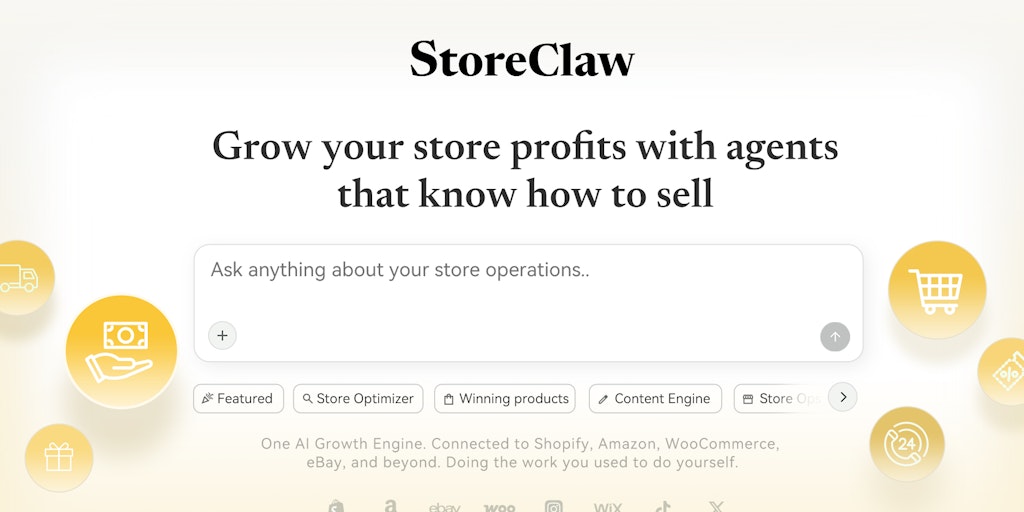
Grow your store profits with agents that know how to sell
🔥 Upvotes: 491  ·  👤 By: StoreClaw
💰 Pricing: Freemium  ·  🏷 Category: Ecommerce AI
Connects to Shopify, WooCommerce, Amazon, and eBay stores to analyze sales data and propose revenue optimization strategies. Uses multiple AI models with a human-in-the-loop approach - the AI suggests, you approve. Notable for MCP integration, making it compatible with AI agent workflows. Verdict: The ecommerce AI space is crowded, but StoreClaw's multi-platform approach and MCP integration distinguish it from single-store tools.
Grow your store profits with agents that know how to sell - StoreClaw | Product Hunt
StoreClaw is the first AI commerce platform with agents that know how to sell, so you can make more money with less effort and less stress. Connect StoreClaw to your existing store and it will study your numbers, current sales figures, and growth trajectory, and then offer proactive suggestions that it can execute on your behalf — once you give it your approval. Ask StoreClaw how your business is doing any time, anywhere. Sell more with less stress: StoreClaw.
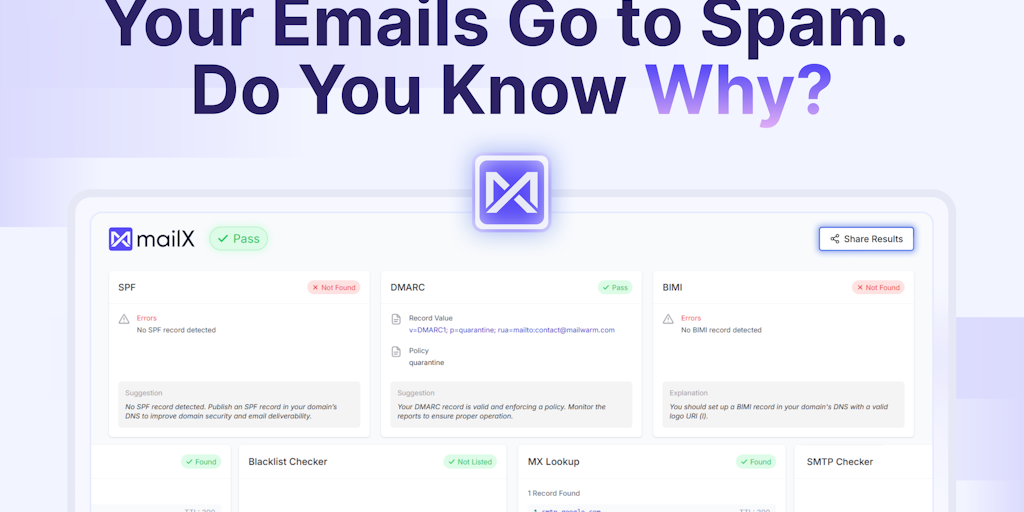
Email deliverability toolkit for humans and AI agents
🔥 Upvotes: 434  ·  👤 By: mailwarm
💰 Pricing: Free  ·  🏷 Category: Email Infrastructure
Diagnoses why emails land in spam and provides step-by-step fixes. The interesting angle: it's built with API and MCP integration specifically for AI agents, so your AI assistant can check email deliverability as part of automated workflows. Verdict: Solves a real pain point (email going to spam) with a unique AI-agent-ready architecture. Free pricing is compelling.
Email deliverability toolkit for humans and AI agents - mailX by mailwarm | Product Hunt
Your emails go to spam. mailX shows you why, and how to fix it in seconds with clear answers and exact steps. Built for humans and AI agents. API and MCP ready.
Create anything from any input - starting with video
🔥 Upvotes: 284  ·  👤 By: Google DeepMind
💰 Pricing: Freemium  ·  🏷 Category: Multimodal AI
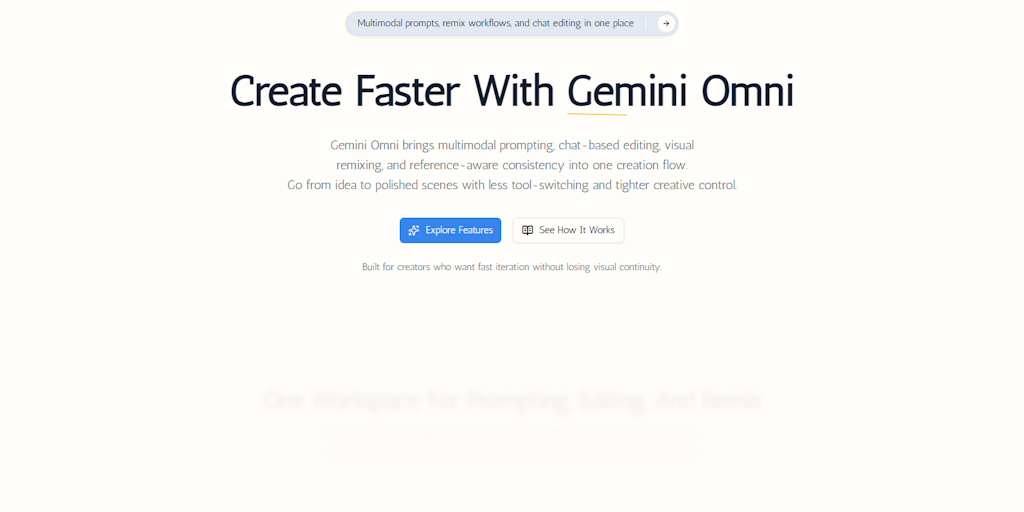
Google's multimodal foundation model that merges reasoning with generative creation, initially focused on video. This is the product launch announcement for the model announced at Google I/O. Verdict: Google's video generation is catching up to dedicated tools like Runway and Pika, but practical value depends on quality vs cost vs speed tradeoffs that aren't yet clear.
Gemini Omni: Gemini Omni , Video Generator | Product Hunt
Create with Gemini Omni using multimodal prompts, chat-based editing, remix workflows, and reference-aware consistency in one faster creative workflow.
One app. Every coding agent. Open-source.
🔥 Upvotes: 275  ·  👤 By: Emdash
💰 Pricing: Free  ·  🏷 Category: Developer Tools
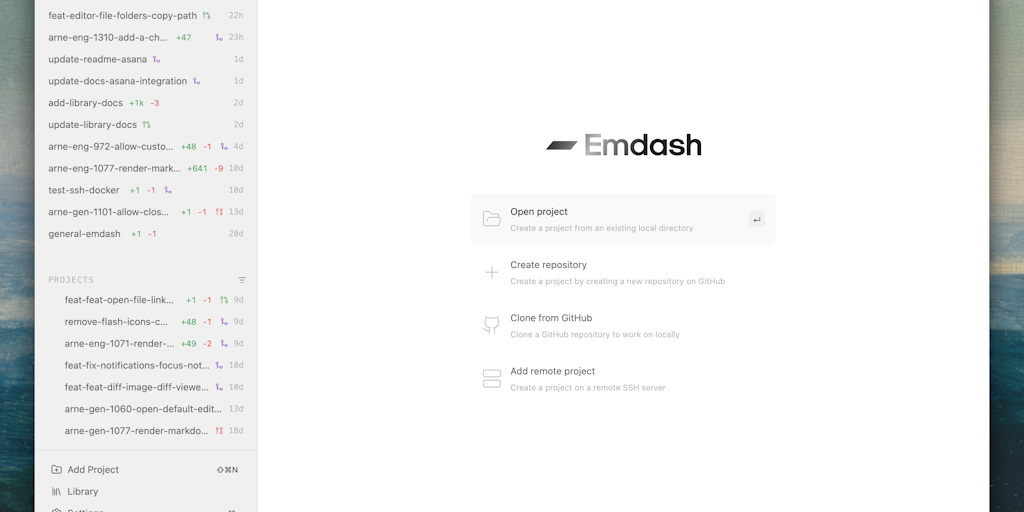
A provider-agnostic Electron desktop app that runs 28+ coding agents (Cursor, Claude Code, Devin, and more) in one unified interface. Open-source, so you can inspect and modify it. Verdict: Addresses a real pain point for developers juggling multiple AI coding tools. The open-source approach builds trust. Worth trying if you use more than one AI coding agent.
One app. Every coding agent. Open-source. - Emdash | Product Hunt
Emdash is an open-source desktop app for running multiple coding agents in parallel; one place to monitor sessions, review diffs, and turn issues into PRs.
Sandboxed coding agents for everyone on your team
🔥 Upvotes: 197  ·  👤 By: Runtime (YC P26)
💰 Pricing: Free  ·  🏷 Category: Developer Tools
Deploys AI coding agents as accessible team members via Slack, Linear, CLI, or API. Each agent runs in a sandboxed environment. Y Combinator-backed. Verdict: The "AI agents as team members" framing is smart. Sandboxing addresses security concerns. YC backing adds credibility, but the crowded field of agent orchestration tools means differentiation will be hard.
Sandboxed coding agents for everyone on your team - Runtime | Product Hunt
Turn coding agents into teammates anyone can use from Slack, Linear, CLI, API or your browser. Ship features, query data, build dashboards, automate workflows. All within your company’s context, skills, integrations, and security guardrails.

Snapshot

ProviderModelInput $/1MOutput $/1MContext
AnthropicClaude Opus 4.7$5.00$25.001M
AnthropicClaude Sonnet 4.6$3.00$15.001M
AnthropicClaude Haiku 4.5$1.00$5.00200K
OpenAIGPT-5.5$5.00$30.001.05M
OpenAIGPT-5.5 Pro$30.00$180.001.05M
GoogleGemini 3.5 Flash$1.50$9.001M
GoogleGemini 2.5 Flash$0.30$2.501M
GoogleGemini 2.5 Flash-Lite$0.10$0.401M
GroqGPT OSS 120B$0.15$0.60128K
GroqLlama 3.1 8B$0.05$0.08128K
No price changes today. The value gap between frontier closed-source models ($3-$5 per million input tokens) and Groq-hosted open-source alternatives ($0.05-$0.59) remains 10-100x. Google's Gemini 2.5 Flash-Lite at $0.10/$0.40 is the cheapest option from a major cloud provider.

Making Every Verified Token Count: Adaptive Verification for MoE Speculative Decoding

Lehan Pan, Ziyang Tao, Ruoyu Pang, Xiao Wang, Jianjun Zhao, Yanyong Zhang - arXiv:2605.00342
What it claims: Tree-based speculative decoding for Mixture-of-Experts models wastes compute because expanding draft branches activates different experts, inflating verification cost. Their method, EVICT, truncates draft trees to retain only cost-effective prefixes, requiring no training or tuning.

Key finding: Up to 2.35x speedup over standard generation and 1.21x over the previous best (EAGLE-3), with lossless output quality.

Why practitioners should care: This is a drop-in optimization that integrates with SGLang's serving framework. No retraining, no configuration tuning - just faster tokens for less compute. For anyone running MoE models in production, this directly reduces serving costs.

Member discussion

Subscribe to GenAI Secret Sauce newsletter and stay updated.

Don't miss anything. Get all the latest posts delivered straight to your inbox. It's free!

By subscribing, you agree to our Privacy Policy and Terms. We track email opens and clicks. Unsubscribe anytime.

Great! Check your inbox and click the link to confirm your subscription.