
Watch today's digest as a video summary (generated by NotebookLM)
Statistically Speaking
One Thing to Tell Your Friends
TL;DR
Hot off the Presses
Every Public Notion Page Leaks Your Email Address
Security researcher weezerOSINT demonstrated that a single POST request to Notion's API returns the full name, email address, and profile photo of every person who has ever edited a public Notion page. No authentication is required. No cookies, no tokens, no login.
The disclosure gained 298 points and 103 comments on Hacker News, making it one of the day's highest-signal security stories. Organizations should audit their public Notion pages immediately.
- Zero-day disclosure - the vulnerability is an API design flaw, not a traditional security bug
- Organizations using public Notion wikis are inadvertently creating enumerable staff directories
- Phishing and social engineering risk - exposed emails are ideal for targeted attacks
"Headless Everything" - The Paradigm Shift That Could Kill Per-Seat SaaS Pricing
Simon Willison, one of the most widely read voices in AI tooling, published a piece arguing that the future of software is "headless" - where platforms expose their functionality through APIs and programmatic interfaces rather than graphical user interfaces. The trigger: Salesforce announced Headless 360, making its entire Salesforce, Agentforce, and Slack platforms available as APIs, MCP (Model Context Protocol) endpoints, and command-line tools.
This echoes the early 2010s API-economy wave, but the stakes are higher because AI agents are now the actual consumers of these services.
- AI agents interact more efficiently with APIs than with GUIs - no need for browser automation or screen-scraping
- Per-seat pricing models break when the "user" is an AI agent making thousands of calls, not a human clicking buttons
- Brandur Leach's take - APIs may become the crucial deciding factor in competitive differentiation among services
Tech Industry Laid Off 80,000 in Q1 2026 - Nearly Half Blamed on AI
The tech industry cut 78,557 workers in the first quarter of 2026. According to tracking data, 47.9% of those positions - 37,638 jobs - were attributed to reduced need for human workers due to AI and workflow automation. Over 76% of affected positions were in the United States.
- Oracle quietly cut 10,000+ positions, redirecting savings to data center funding
- "AI washing" is real - OpenAI's Sam Altman characterized some layoffs as companies blaming technology for cuts that would happen regardless
- Counter-signal: IBM tripled entry-level hiring in 2026, arguing that entry-level work still requires human judgment
- Cognizant's Chief AI Officer predicted it would take another 6-12 months before companies see real AI productivity gains
Claude Enterprise Users: Your Employer Can Read Every Message - Including "Incognito"
A warning post with 845 upvotes on r/ClaudeAI revealed that on Claude Enterprise plans, the organization's designated Primary Owner can request data exports containing every message employees have ever sent. This includes conversations in so-called "incognito" mode. While incognito chats on consumer plans are temporary and not saved, the Enterprise plan gives organizations full audit access.
This is part of Anthropic's standard enterprise governance design, but many employees may not realize the distinction.
- Incognito does not mean private on enterprise accounts - it only applies to consumer plans
- Enterprise AI tools function like company email - the organization ultimately owns all communications
- Users needing truly private AI conversations should use personal accounts on consumer plans
Students Are Earning College Degrees in Weeks
A Washington Post investigation documented how online schools like Western Governors University (WGU) and the University of Maine at Presque Isle allow students to transfer up to three-quarters of their credits from nontraditional sources. These include credit for prior learning on the job, passing competency-based tests, and completing courses from platforms like Study.com, Sophia Learning, and StraighterLine.
The phenomenon raises fundamental questions about whether seat time equals learning, and how employers should evaluate hyper-accelerated credentials.
- Some students reported earning an MBA in two and a half months
- A cottage industry of influencers has emerged making videos about how quickly they earned their degrees
- The head of the New England Commission of Higher Education said he had never heard of students completing a bachelor's degree in only a few months at any accredited university
Trends & Themes

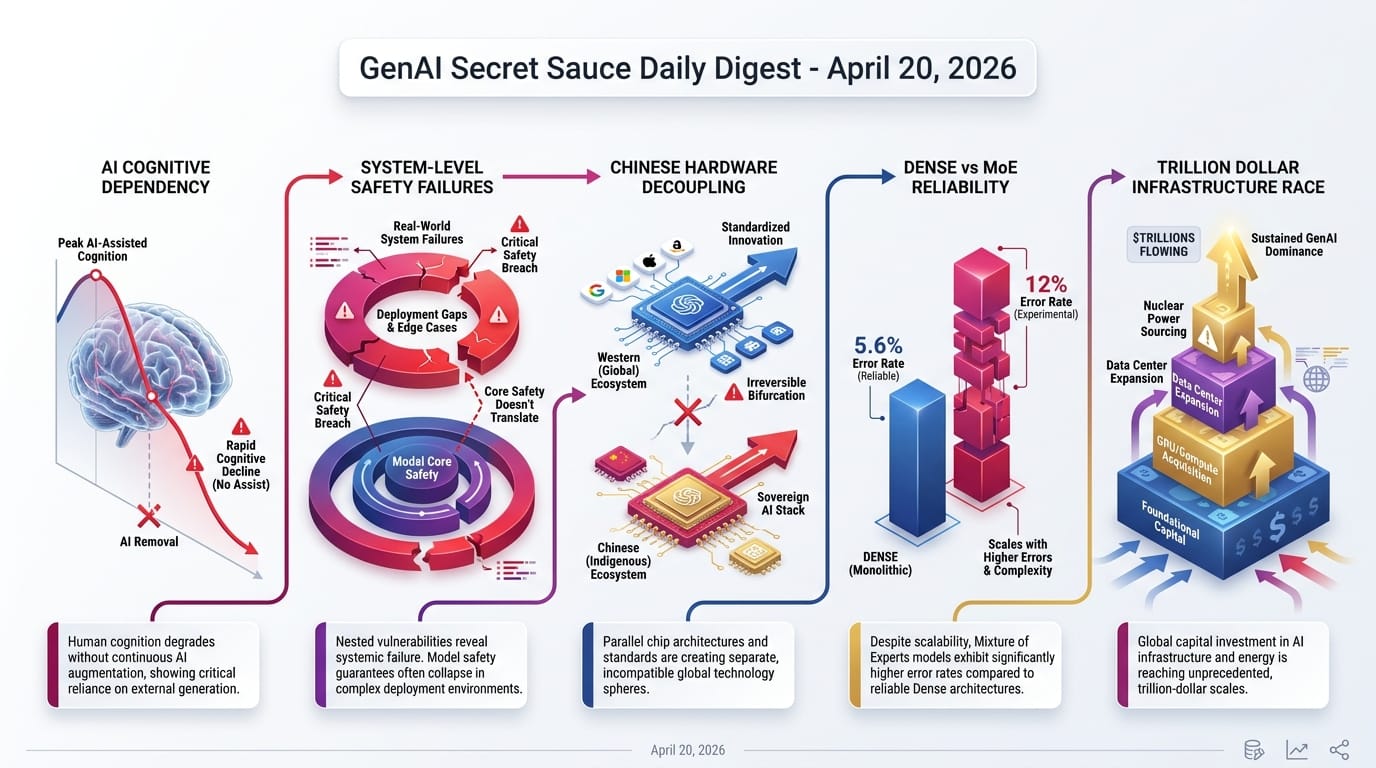
Local AI Has Crossed the "Good Enough" Threshold
Previously: Qwen3.6-35B-A3B launched on April 16 alongside Claude Opus 4.7 (covered April 16-18). Today's signal is community-scale adoption and direct head-to-head switching behavior.
The gap between local open-source models and frontier commercial APIs has narrowed to the point where power users are making the switch. The trade-off is complete privacy and zero cost versus a slightly lower ceiling on the most complex tasks.
- A 592-upvote post on r/LocalLLaMA declared Qwen3.6-35B-A3B running on a MacBook Pro M5 Max "as good as Claude" for everyday coding tasks
- Simon Willison said it beat Claude Opus 4.7 on SVG generation tasks when running locally
- 166 upvotes for a "Switching from Opus 4.7 to Qwen" post - users cite privacy, zero API costs, and no rate limits as primary motivations
- The model runs at 120+ tokens/second on an RTX 4090 with Q4_K_M quantization
The Scaffold Matters More Than the Model
This trend has a clear practical implication: before upgrading to a bigger, more expensive model, try improving the scaffolding around the model you already have. It may produce better results at zero additional cost.
Source: little-coder | Source: claudecode-harness
- A 9B Qwen model scored 19.1% on Aider's coding benchmark with default settings, but 45.6% with the "little-coder" scaffold - a 26.5 percentage point improvement from the same weights
- Little-coder's techniques include a 2,048-token thinking budget, write-tool protection, and selective reference injection under 500 tokens per turn
- The claudecode-harness project (214 upvotes) structures Claude Code with hub-and-spoke architecture, multi-model consensus, and enforced verification - producing 1.7x fewer defects than ad-hoc usage
- scalar-loop generalizes Karpathy's autoresearch pattern to software, using SHA-256 pinning to prevent AI agents from gaming their own test harnesses
AI Safety Is a Full-Stack Problem
The pattern: safety evaluated at the model level does not predict safety at the system level. Organizations deploying AI agents need to evaluate security across their entire technical stack.
- The ClawSafety paper tested 120 adversarial scenarios across five frontier models deployed as agents - attack success rates ranged from 40-75%
- Notion's email leak shows that even well-established platforms have API design flaws that expose user data without authentication
- Arc Gate applies differential geometry (Fisher-Rao distance) to detect prompt injection on closed-model APIs - a novel mathematical approach to AI security
- Phishing campaigns targeting Claude users are distributing PlugX malware through fake Claude installers and trojanized VS Code extensions
The Technical-Nontechnical AI Divide Is Widening
AI literacy is becoming a critical professional skill divide, similar to how computer literacy separated workers in previous decades. The question is whether AI tool makers are doing enough to make advanced capabilities accessible.
- A 421-upvote discussion argued the gap between what technical and non-technical users extract from AI tools has become "huge"
- "Claude for Dummies" on Ruben's Substack targets people who have never used AI, explaining concepts like tokens and Cowork mode in plain language
- A new user (99 upvotes) said they were "blown away" by Claude for work - reflecting the wave of non-technical professionals discovering AI through workplace adoption
- Developers use structured prompting, MCP servers, and agentic workflows that multiply their productivity, while casual users stick to basic Q&A
Creative AI & Media
AI Pre-Visualization Tools Are Now Production-Ready
- Google's Veo 3 and 3.1 have become the professional standard for cinematic realism with native 4K rendering
- Drawstory is purpose-built for directors, turning scripts into structured visual storyboards scene by scene
- PixVerse 5.5 specializes in short-form motion for social-first content
Flux Image Editing Arrives via AskSary
- AskSary consolidates GPT-5.2, Claude 4.6, Grok 4, and Gemini with auto-routing
- Flux-based editing enables precise pixel-level control
- Free tier includes 1,000 monthly credits; paid plans at $17.99 and $29.99
Developer Tools & Infrastructure
Research & Models
Business & Industry
GenAI in Education
Professors Say Students Cannot Read or Write - and Want Gen Eds to Fix It
A 287-upvote post on r/Professors argued that colleges need to reinstate basic reading and writing general education requirements.
This connects to the broader degree-hacking trend - if students can skip traditional coursework through competency tests, foundational skills may erode further.
- Students arrive unable to produce coherent written arguments or engage with complex texts
- Years of standardized testing trained students to scan for information rather than read deeply
- Some English professors now require physical copies of readings, partly to counter AI tools that undermine critical thinking
- The debate: whether adding literacy gen eds would fix root causes or just add cost to degrees
ADA Digital Accessibility Deadline: April 24, 2026
ADA Title II requires public institutions serving 50,000+ people to meet WCAG 2.1 Level AA standards for all web content and mobile applications by April 24, 2026.
NPR Investigation | Discussion
- Requirements include better color contrast, video captioning, and keyboard-navigable interfaces
- Faculty are now directly responsible for making course materials accessible - not just disability services offices
- NPR found that blind students at WVU were effectively blocked from full participation by inaccessible digital infrastructure
Surprising & Under-the-Radar
Palantir Wants Universal National Service
Palantir Technologies co-founder Alexander Karp published a book calling for universal national service. The Selective Service System is already implementing automatic registration for males 18-25 by year-end 2026. The ongoing Iran conflict has intensified the discussion.
A 9B Model Beat Models 10x Its Size - By Changing the Wrapper, Not the Model
The same 9-billion-parameter Qwen model scored 19.1% on Aider's Polyglot benchmark with default settings but 45.6% with the little-coder scaffold - a 26.5 percentage point improvement with identical model weights. The scaffold exceeded several public leaderboard entries from models more than 10 times larger.
Canada Gave One AI Startup $240M - More Than 66% of What 107 Companies Got Over 7 Years
A viral image (11 upvotes) highlighted the extreme concentration of Canadian government AI grants.
How LLMs Choose Which Websites to Cite
- Reddit dominates AI citations at 40.1%, followed by Wikipedia (26.3%) and YouTube (23.5%)
- Sites with 32,000+ referring domains are 3.5x more likely to be cited
- Third-party validation (review sites like G2, Capterra) triples citation probability
- RAG models still fail to support claims nearly half the time
Signals to Track

KV Cache Compression via Mathematical Summarization
A researcher published HAE-OLS, a three-stage method for compressing the Key-Value cache (the memory that AI models use to remember earlier parts of a conversation) using entropy-based selection, least-squares reconstruction, and SVD (Singular Value Decomposition, a technique for finding the most important patterns in data). Instead of simply deleting old tokens, the method creates a synthetic summary token. The result: nearly 3x lower reconstruction error than standard pruning at a 30% keep ratio, while using less memory. If adopted, this could enable longer conversations on the same hardware.
Arc Gate - Prompt Injection Detection via Differential Geometry
Arc Gate sits between applications and AI APIs, measuring Fisher-Rao distance (a concept from differential geometry that quantifies how different two probability distributions are) to detect when an AI model's output distribution shifts in ways characteristic of successful prompt injection (when an attacker embeds hidden instructions in input to hijack an AI's behavior). Free tier includes 500 requests/month.
ICLR 2026 Opens Next Week With 1,200+ Papers With Code
Paper Digest compiled 1,200 of the 5,300+ accepted ICLR 2026 papers that include publicly available code or data. The conference begins April 22 in Rio de Janeiro. For researchers and practitioners trying to keep up with the field, this is the most efficient entry point into what matters.
The "Headless SaaS" Economy Has a Pricing Problem
Simon Willison's "headless everything" thesis poses an existential question for SaaS (Software as a Service, the subscription model where you pay monthly for software) companies: when AI agents are the primary consumers of your product, per-seat pricing breaks. No one has solved this yet, but Salesforce's Headless 360 launch suggests major platforms are preparing for the shift. Watch for pricing model experiments from other enterprise software vendors in the next quarter.
Opus 4.7 vs 4.6 - The Community Is Split
A 181-upvote post recommends switching back to Opus 4.6 if you are unhappy with 4.7. The new version follows instructions more literally (breaking prompts tuned for looser interpretation), may use up to 35% more tokens, and produces more mechanical long-form prose. But 4.7 accepts images at over 3x the resolution, with one tester's accuracy jumping from 54.5% to 98.5%. The split signals that model upgrades are no longer universally positive - different users have genuinely different optimal versions.
Top Repos Today
📜 License: AGPL-3.0 / Commercial · 👤 By: Startup
🎯 Time to value: 15 minutes
| ✓ Pros | ✗ Cons |
|---|---|
| 37 AI trading agents with distinct strategies | AGPL license requires sharing modifications |
| Real-time trading across 16 brokers | Early-stage - production readiness unverified |
| Node-based visual workflow editor | Dual Python/C++ codebase adds complexity |
 GitHub
📜 License: MIT · 👤 By: OpenAI
🎯 Time to value: 10 minutes
| ✓ Pros | ✗ Cons |
|---|---|
| Official OpenAI support and documentation | Locked into OpenAI's API ecosystem |
| Clean abstractions for agent handoffs | Less flexible than framework-agnostic options |
| MIT license - fully permissive | Requires OpenAI API key and usage fees |
 GitHub
📜 License: MIT · 👤 By: Community
🎯 Time to value: 5 minutes
| ✓ Pros | ✗ Cons |
|---|---|
| Cross-platform with wearable support | Privacy concerns from always-on capture |
| 300,000+ professional users | Requires significant setup for full features |
| Open-source hardware designs | Battery life concerns for wearable devices |
GitHub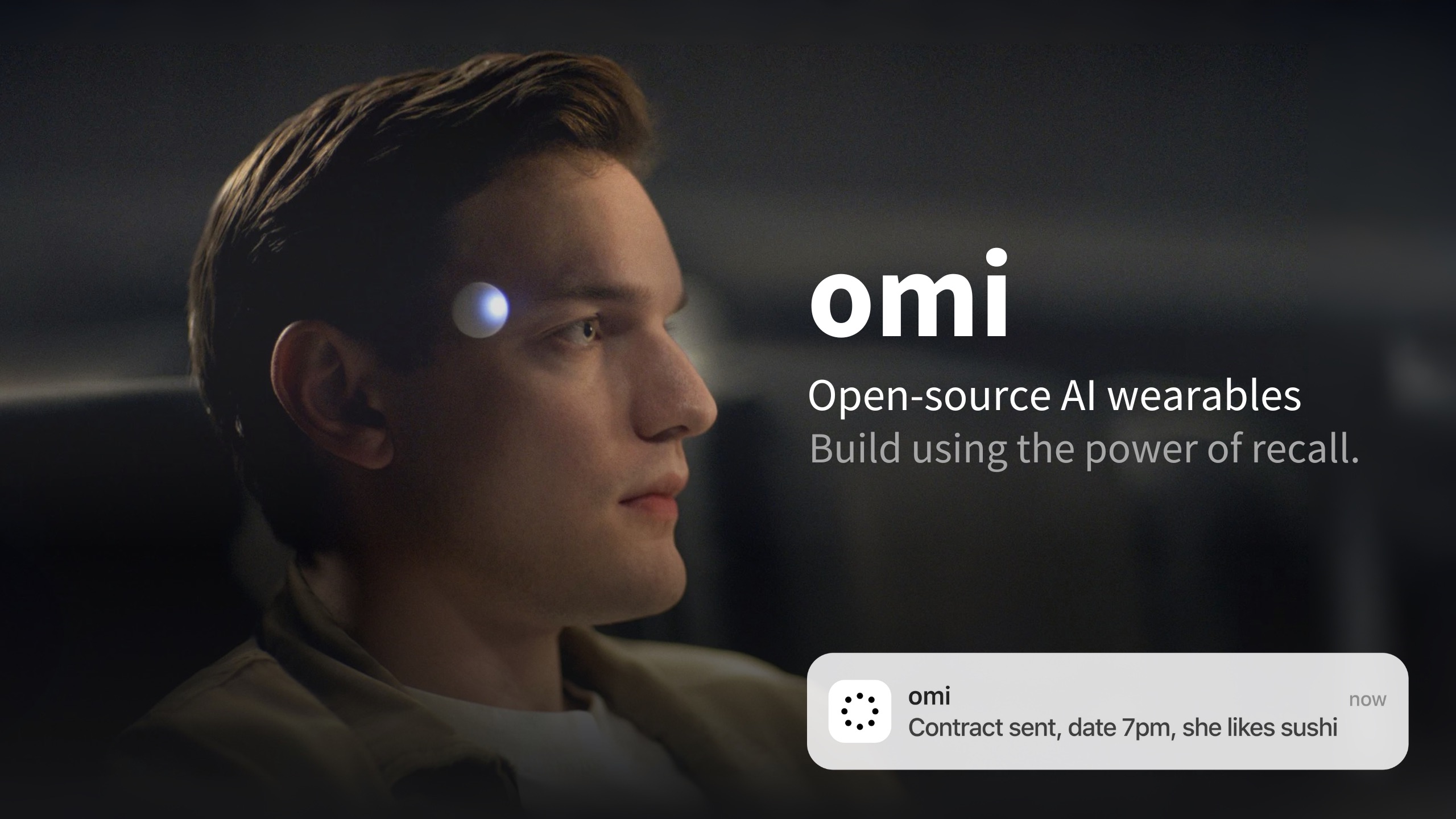
📜 License: MPL-2.0 · 👤 By: Mozilla/Thunderbird
🎯 Time to value: 10 minutes
| ✓ Pros | ✗ Cons |
|---|---|
| Model-agnostic - bring your own provider | Early-stage, undergoing security audit |
| Self-hostable via Docker/Kubernetes | Currently requires authentication setup |
| Mozilla-backed with privacy focus | Limited feature set compared to mature clients |
 GitHub
📜 License: MIT · 👤 By: Open source contributor
🎯 Time to value: 5 minutes
| ✓ Pros | ✗ Cons |
|---|---|
| Multi-engine support (Godot, Unity, Unreal) | Requires active Claude Code subscription |
| 12 automated safety hooks | Complex setup for the full agent hierarchy |
| 39 document templates for game dev | Template quality depends on Claude's output |
GitHub
📜 License: GPL-3.0 · 👤 By: Community network
🎯 Time to value: 15 minutes
| ✓ Pros | ✗ Cons |
|---|---|
| Human-in-the-loop review mode | GPL-3.0 may limit commercial use |
| Safety-gated validation commands | Concept of "agent evolution" is experimental |
| Configurable strategy presets | Transitioning to source-available license |
 GitHub
📜 License: MIT · 👤 By: Open source contributor
🎯 Time to value: 30 minutes
| ✓ Pros | ✗ Cons |
|---|---|
| No cameras needed - works through walls | Requires specific WiFi hardware setup |
| 810x faster than Python baseline (Rust) | Accuracy varies with environment |
| Disaster response module for search-and-rescue | Complex calibration for new environments |
 GitHub

Top Models Today
👤 By: Alibaba Qwen · 🎯 Task: Image-Text-to-Text
📐 Size: 35B (3B active)
| ✓ Pros | ✗ Cons |
|---|---|
| Runs on MacBook Pro with 32GB+ RAM | Slightly below frontier models on hardest tasks |
| Apache 2.0 - fully open | Slower than Qwen 3.5 at same quantization |
| 262K context window | High RAM consumption at full context |

👤 By: Tencent · 🎯 Task: Image-Text-to-Text
📐 Size: 4B
| ✓ Pros | ✗ Cons |
|---|---|
| Purpose-built for embodied AI | Very new - limited community testing |
| Small enough for edge deployment | License terms not yet clarified |
| Multimodal vision + language | Narrow focus may limit general use |

👤 By: MiniMax · 🎯 Task: Text Generation
📐 Size: 229B
| ✓ Pros | ✗ Cons |
|---|---|
| 229B parameters - frontier scale | Commercial use restricted |
| Strong benchmark results | Requires significant hardware |
| 289k downloads show community validation | Custom license creates uncertainty |

👤 By: Unsloth · 🎯 Task: Image-Text-to-Text
📐 Size: 35B
| ✓ Pros | ✗ Cons |
|---|---|
| 662k downloads - community standard | Quantization adds minor quality loss |
| Dynamic 2.0 preserves critical layers | Q4 variants still need 16-20GB RAM |
| Works with llama.cpp, Ollama, LM Studio | Slower than Qwen 3.5 at same quant level |

👤 By: Zhipu AI · 🎯 Task: Text Generation
📐 Size: 754B
| ✓ Pros | ✗ Cons |
|---|---|
| 754B parameters - one of the largest available | Requires massive hardware infrastructure |
| 1,420 likes indicate strong interest | License terms unclear |
| Strong Chinese language capabilities | Limited English-language documentation |

AI Launches Today
💰 Pricing: TBD · 🏷 Category: AI Skills Assessment
 Product Hunt
💰 Pricing: Free tier available · 🏷 Category: AI Assistant
💰 Pricing: TBD · 🏷 Category: AI Coding Agent
Snapshot
| Provider | Model | Input $/1M | Output $/1M | Context |
|---|---|---|---|---|
| Anthropic | Opus 4.7 | $5.00 | $25.00 | 200K |
| Anthropic | Sonnet 4.6 | $3.00 | $15.00 | 200K |
| Anthropic | Haiku 4.5 | $1.00 | $5.00 | 200K |
| OpenAI | GPT-5 | $1.25 | $10.00 | 128K |
| OpenAI | GPT-4.1 | $2.00 | $0.40 | 128K |
| OpenAI | GPT-4.1 Nano | $0.10 | $0.40 | 128K |
| Gemini 3 Pro Preview | $2.00 | $12.00 | 1M | |
| Gemini 2.5 Pro | $1.25 | $10.00 | 1M | |
| Gemini 2.5 Flash | $0.30 | $2.50 | 1M | |
| Groq | Llama 3.3 70B | $0.59 | $0.79 | 128K |
RefineRL: Advancing Competitive Programming with Self-Refinement Reinforcement Learning
Key finding: Qwen3-4B models with RefineRL outperformed larger 32B models and approached single-attempt results of 235B models.
Why practitioners should care: This validates the "scaffold matters more than size" theme from today's digest. A 4B model with the right refinement loop can match models 60x its size on hard programming tasks, suggesting that investing in inference-time compute strategies may be more cost-effective than scaling model parameters.





Member discussion