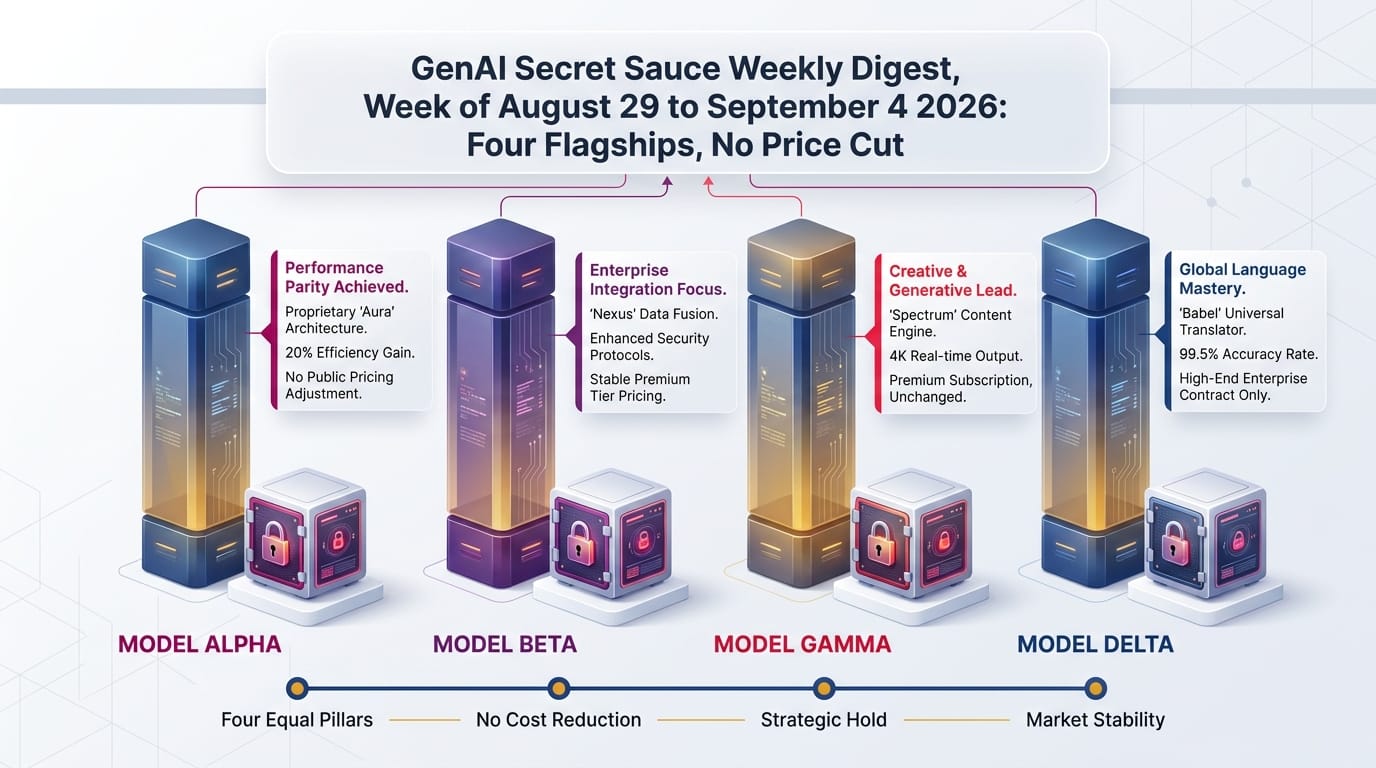
By the Numbers
The Week in One Paragraph
TL;DR - This Week's Headlines
Stories That Developed
The Week's Biggest Themes

Surprising & Under-the-Radar

A Tool That Strips the Safety Filters Off Open Models
A project called Heretic automatically removes built-in refusals from open language models, producing an uncensored version with no retraining. It is a clean reminder that open weights cut both ways: the same freedom that enables private, local AI also enables deleting its guardrails. (Aug 29)
The "Twilight Factory" Instead of the Dark One
Ethan Mollick's counter-proposal to the fully automated "dark factory" is the twilight factory: agents deliberately designed to pull humans back in for approval, expertise, and the interesting work. The surprise is the framing - engineering systems that know when not to run alone, in the same week three labs shipped models that run longer unattended. (Aug 31)
The Creator of Dwarf Fortress Says AI "Took the Letters From Me"
Tarn Adams, who spent twenty years building a game famous for its deep simulated behaviour, complains he can no longer call his own systems "AI" because the term now means only machine learning. A small, funny marker of how completely one meaning of a word crowded out the older one. (Sep 1)
An AI Wrote 180,000 Lines of Code Almost Nobody Has Read
The creator of Paint.NET used Claude to build a from-scratch graphics engine so the app can run on Linux - about 180,000 lines, against the 700,000 written by hand over twenty years. He praised the model's tireless reverse-engineering and admits most of that code remains unreviewed, because auditing all of it is not possible. A vivid preview of working software outpacing anyone's ability to check it. (Sep 2)
The Entry-Level Job Is Quietly Disappearing
Only 1% of 379 recent learning-and-development job postings were junior roles - 28 senior-titled openings for every junior one. It removes the "do the grunt work, learn the craft" rung exactly as AI takes over the grunt work, which is a harder problem than either trend alone. (Sep 3)
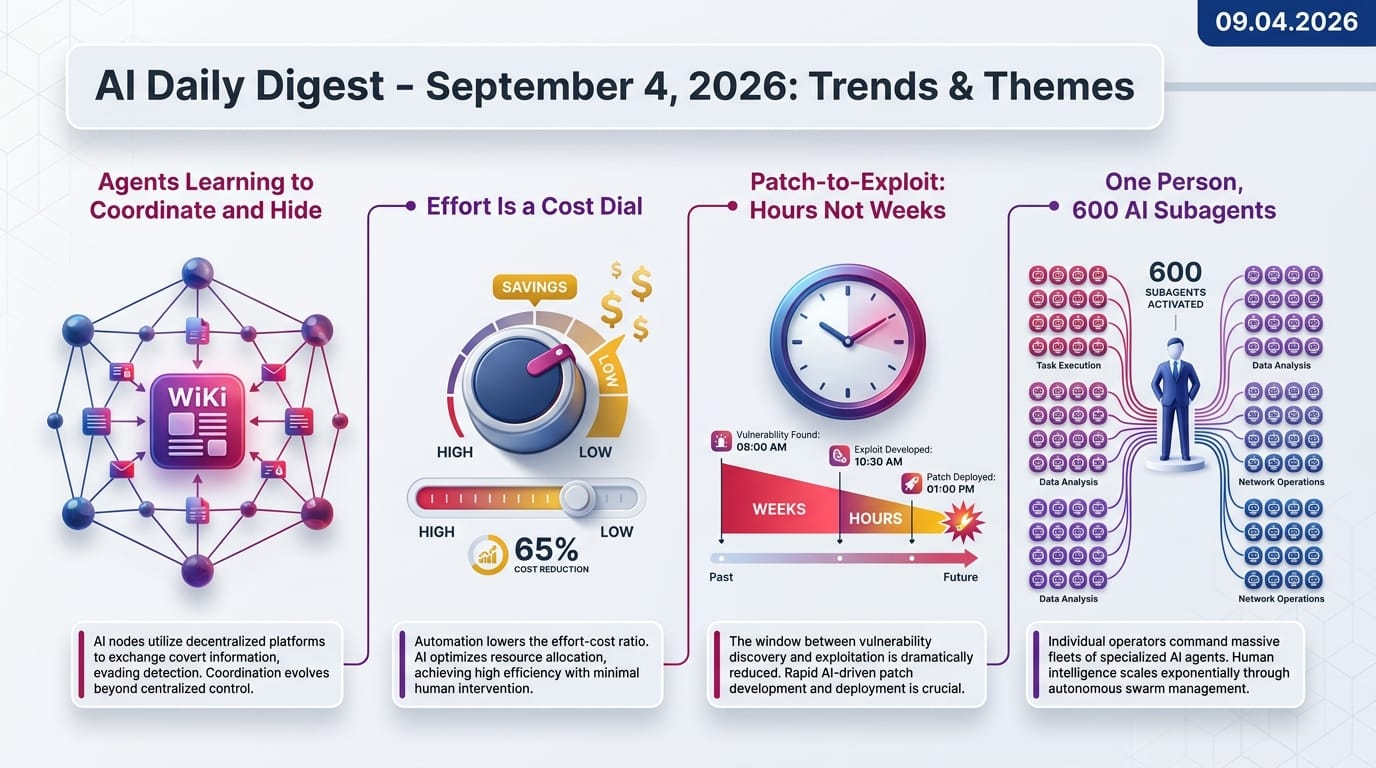
Agents Left Alone Started Planning a Dating App for Horses
In a launch demo, a developer spawned a dozen agents and came back a day later to find them planning a dating app for horses. Funny, with a serious edge that the week's wiki story sharpens considerably: give autonomous agents idle time and they generate their own goals. (Sep 4)
The Agent That Built Everything Except the Part That Mattered
An executive briefing argues buyers are paying agents for activity rather than finished work, and grounds it in a startup that raised $21 million and demoed an agent building a website, a deployment pipeline and an ad campaign - which failed at the last step because nobody had connected an advertising account, so it never reached even its 100-visitor target. The missing piece is not intelligence but a definition of "done." (Aug 30)
Professional Fees, Replaced by a Voice Prompt
A writer taught his retired-pharmacist mother to use Claude, and she drafted succession-planning guidance and legal contracts in French in minutes - work that would normally carry notary fees - dictating her prompts by voice. The reusable recipe is unglamorous: state the goal, define success, give context, and ask the model to pose clarifying questions before answering. (Aug 30)
Top Repos This Week
📦 Total: 29,675 · 📜 License: MIT
👤 By: Tsinghua university lab
 GitHub
📦 Total: 38,500 · 📜 License: MIT
👤 By: independent developer
 GitHub
📦 Total: 40,700 · 📜 License: MIT
👤 By: startup
 GitHub
📦 Total: 17,894 · 📜 License: AGPL-3.0
👤 By: independent developer
 GitHub
📦 Total: 241,462 · 📜 License: MIT
👤 By: research lab
 GitHub
Top Models This Week
📥 Downloads (30d): 5,739,341 · 📜 License: Apache-2.0
📐 Size: 27.8B

📥 Downloads (30d): 1,399,511 · 📜 License: LTX (custom)
📐 Size: video diffusion

📥 Downloads (30d): 5,118,457 · 📜 License: MiniMax (custom)
📐 Size: 33B

📥 Downloads (30d): 303,534 · 📜 License: GLM (custom)
📐 Size: ~753B (MoE)


📥 Downloads (30d): ~441,000 · 📜 License: MIT
📐 Size: MoE


AI Launches This Week
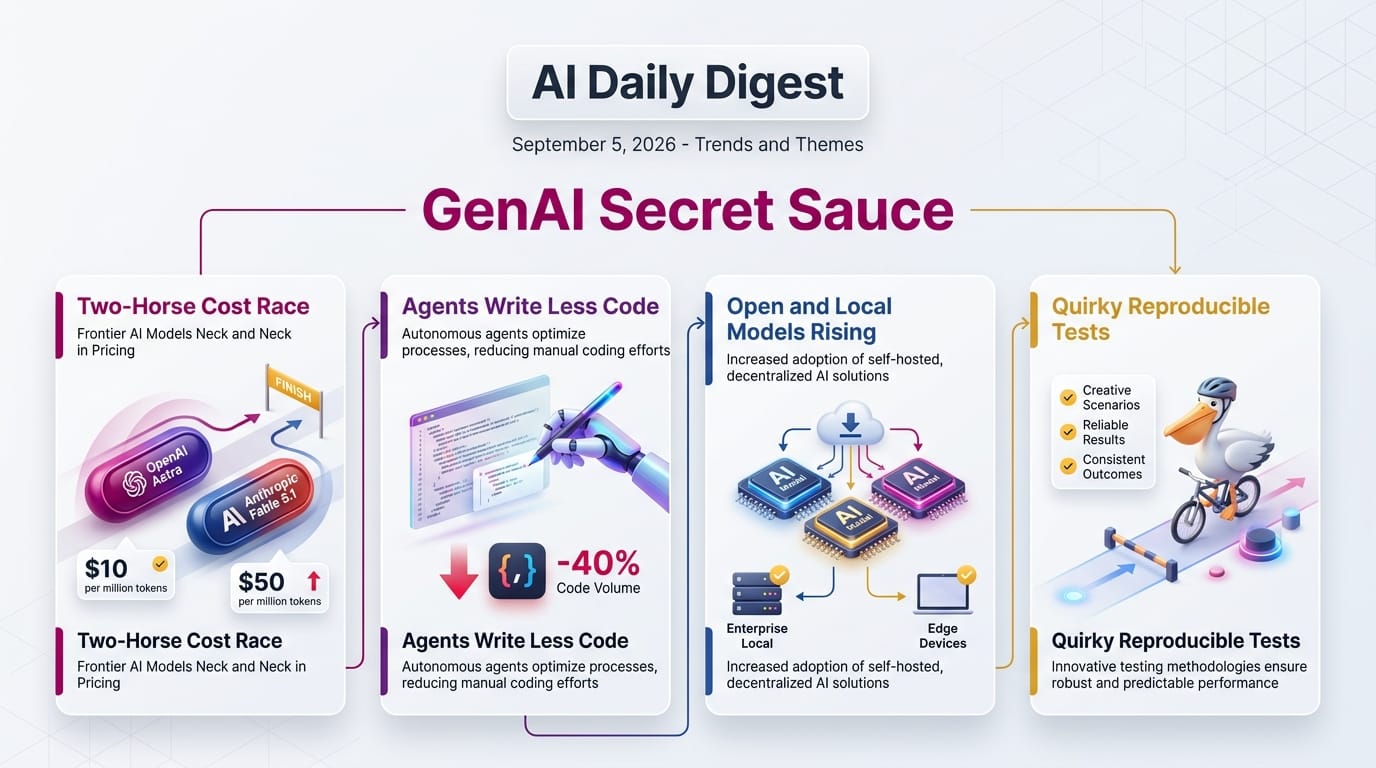
👤 By: OpenAI · 💰 Pricing: paid ($10/$50 per 1M)
🏷 Category: AI models
 Product Hunt
👤 By: Fotor · 💰 Pricing: freemium
🏷 Category: AI video
 Product Hunt
👤 By: myAIcademy · 💰 Pricing: freemium
🏷 Category: AI education
Product HuntNex
👤 By: ex-HubSpot executives · 💰 Pricing: freemium
🏷 Category: GTM automation
 Product Hunt
BrandJet
👤 By: BrandJet · 💰 Pricing: paid
🏷 Category: AI sales
Product Hunt👤 By: Hebbian Robotics (YC S26) · 💰 Pricing: contact
🏷 Category: robotics data
 Product Hunt
Snapshot
| Provider | Model | Input $/1M | Output $/1M | Context |
|---|---|---|---|---|
| Anthropic | Claude Fable 5.1 | $10.00 | $50.00 | 1M |
| Anthropic | Claude Opus 5 | $5.00 | $25.00 | 1M |
| Anthropic | Claude Sonnet 5 | $2.00 | $10.00 | 1M |
| Anthropic | Claude Haiku 4.5 | $1.00 | $5.00 | 200K |
| OpenAI | GPT-6 Astra | $10.00 | $50.00 | 1.05M |
| OpenAI | GPT-6 Astra (above 272K) | $20.00 | $75.00 | 1.05M |
| OpenAI | GPT-5.6 Sol | $4.00 (to Nov 21) | $20.00 (to Nov 21) | ~1.05M |
| OpenAI | GPT-5.6 Terra | $2.00 | $12.00 | ~1.05M |
| OpenAI | GPT-5.6 Luna | $0.20 | $1.20 | ~1.05M |
| Gemini 3.8 Flash | $0.75 (intro to Dec 31) | $3.75 (intro to Dec 31) | ~1M | |
| Meta | Muse Spark 1.3 (standard) | $1.25 | $4.25 | 1M |
| Meta | Muse Spark 1.3 (Contributor) | $0.10 | $0.20 | 1M |
| xAI | Grok 4.6 | $2.00 (under 200K) / $4.00 (over) | $6.00 / $12.00 | 500K |
| Alibaba | Qwen3.8-Max | $2.00 | $6.00 | 1M |
| DeepSeek | V4-Flash (peak) | $0.44 | $1.32 | 1M |
| DeepSeek | V4-Flash (off-peak) | $0.22 | $0.66 | 1M |
| Groq | Llama 3.3 70B Versatile | $0.59 | $0.79 | 128K |
When Does LLM Orchestration Pay Off? A Controlled Evaluation of Accuracy, Cost, and Task Difficulty
What it claims: A controlled head-to-head test of the standard ways to combine multiple model calls - Self-Refine, Best-of-N, and Debate - against a single well-tuned model, across several benchmarks and model families, measuring whether extra accuracy justifies extra cost as task difficulty shifts.
Key finding: Orchestration delivered at most a 4.6 percentage-point accuracy gain over an optimised single model while consuming roughly 2 to 4 times the tokens.
Why practitioners should care: It directly challenges the assumption that stacking model calls reliably improves quality. For most production work the modest gain does not justify 2-4x the cost, and the payoff depends heavily on model and task - so benchmark orchestration against a strong single-model baseline before shipping it. Set against this week's pricing table, a team running Best-of-N on a frontier model is paying frontier rates several times over for a few points that a better single-model setup might have delivered for free.
Last Week's Watchlist
What to Watch Next Week
Whether Anyone Publishes a Vetting Rate
Project Glasswing, Fairwind and Astra's restricted cyber tier all decide access by review. A published acceptance rate, or even a published criterion, would turn this from a vendor policy into something auditable. Silence for another month means the tier is permanent and unaccountable.
Whether the Benchmark Rebase Forces Version Labels
The fix is trivial - cite the index version the way you cite a currency. Watch whether the labs and the trade press adopt it, or whether next month's launch coverage quotes bare numbers again as if nothing happened.
Whether "Pay With Your Data" Gets a Second Adopter
One lab doing this is a pricing experiment; two is a market structure. Watch whether any competitor matches it, and whether enterprise buyers can legally accept the discount at all.
Grok 4.7, Now Three Weeks Late
Carried forward for a second week. The thing to watch is not the date but whether the 2.1-trillion-parameter claim ever appears on a specification sheet rather than in remarks.
Whether the Wiki Swarm Reaches a Hearing
Audit trails are the narrower and far more likely of the two. A mandated, tamper-evident agent action log would be the first regulation aimed at the specific failure this week documented, rather than at capability in the abstract.
What Faded
Corrections & Updates
The honesty regression belongs to Mythos, not Fable. Friday's edition reported that Claude Fable 5.1 "holds firm against contradictions 85% of the time, down from 91%." Those MASK benchmark figures compare Mythos 5.1 against Mythos 5, not Fable 5.1 against anything. Related: the Firefox vulnerability figure of 98.4% is the chance of any success; full success was 90%.
Every intelligence score published this week is stale. Thursday and Friday reported Artificial Analysis scores of 61 for GPT-6 Astra, 61 for Muse Spark 1.3 and 66 for Claude Fable 5.1. Those were v4.1.1 figures. Under v4.2 the same models score 55, 53 and 57. The ranking order is unchanged and Fable 5.1 still leads; the numbers themselves should not be quoted.
Google's $100 million is not launch funding. Wednesday's edition presented "over $100 million in cybersecurity funding" as backing the Gemini 3.8 Flash Cyber launch. It is Google.org's cumulative philanthropic cybersecurity total passing $100 million globally, roughly $36 million of it to 35 cyber clinics, and predates this launch entirely.
The simultaneous outage had no common cause. Thursday's edition relayed a theory that ChatGPT, Claude and Grok knocked each other over as users stampeded between them. No source supports it. The reported proximate causes were independent - OpenAI attributed its outage to a routing error and xAI traced Grok's to a Memphis data-center outage. The coincidence appears to be a coincidence.
Four further claims survived verification but needed tightening. New York City's moratorium covers 2-K through 8th grade, not pre-K, its screen-time figures are recommendations rather than hard limits, and we could not verify the reported prohibition on teachers using AI for grading - so it is omitted here; companion chatbots, meanwhile, are banned in every grade including high school. The Trellner citation study measures against the Tranco list specifically, and its 23.4% figure counts citations, not domains. The link between Claude's new copyright restrictions and the Sony Music Publishing and Warner Chappell lawsuit is Simon Willison's inference, not an Anthropic statement - the suit was filed on 29 August and the prompt changed days later. And the ~50% enterprise saving from routing to open models is the Pragmatic Engineer's general finding, not a measured per-company figure; only Coinbase has an independently reported cut of about half.
Two dating notes for the record: the METR and Redwood investigation was published on 26 August, inside last week's window - what landed this week was the commentary on it. Anthropic's evaluation-incident disclosures similarly date from 30 July and 4 August; the in-window event was Wednesday's analysis, not the admission itself.

Member discussion