Watch today's digest as a video summary (generated by NotebookLM)
Statistically Speaking
One Thing to Tell Your Friends
TL;DR
Hot off the Presses
The Independent Report Cards on This Week's New Models Landed
Previously: September 3 - OpenAI shipped GPT-6 Astra, a model built to operate software on its own. September 1 - Anthropic launched Claude Fable 5.1.
Today: Two of the most-trusted independent reviewers published their hands-on read. Developer Simon Willison ran his signature test - asking each model to generate a drawing of a pelican riding a bicycle - and laid the results out as a grid comparing OpenAI's new Astra against last month's models at every effort setting. Separately, analyst Zvi Mowshowitz published a detailed capabilities review of Anthropic's Fable 5.1.
The pelican grid produced a striking result: Astra's cheapest setting beat every version of the previous generation, at any setting. Willison also spotted an architecture clue in the token counts - Astra and one older model both used 16 input units where two others used 26, hinting they may share design lineage.
- Astra is a real generational jump - not just on quality, but on effective cost, because it uses far fewer word-pieces per answer even at a higher per-piece price
- Fable 5.1 is a refinement, not a revolution - better prose, fewer robotic tics, and about 25% lower typical cost, but benchmark gains were incremental and a few areas (like legal work) got slightly worse
- The two are neck-and-neck for users - when people were polled on which they preferred, the vote split roughly evenly, with Astra stronger on hard math
- Watch the token bill - reviewers flagged Fable 5.1 burning 25% to 300% more word-pieces on some tasks, which can erase the per-unit savings
xAI's "Grok Bot" Gets a Five-Day Test as a Hosted AI Assistant
Writer Sean McAteer spent five days with Grok Bot, xAI's new managed AI assistant, and framed it against the do-it-yourself alternative called OpenClaw. His analogy: Grok Bot is the "MacBook" (hosted, simplified, almost no setup) while OpenClaw is the "Linux" (you own and run it, more control, more work). Grok Bot connects to your apps by having you log in through the browser, rather than making you copy-paste technical keys.
The standout design idea is that each user gets a persistent virtual cloud computer, and you can run several personified bots at once in a group chat. In his test, McAteer had one bot watching a customer-support inbox on a 15-minute refresh and another routing coding tasks across systems.
- The verdict: a great "digital chief of staff" - excellent for admin, summarizing, and project management, but not a replacement for real coding tools
- Setup is nearly frictionless - browser login instead of managing technical credentials (the keys apps use to talk to each other)
- Managed vs. owned is a task decision - pick hosted (Grok Bot) for orchestration, pick self-run (OpenClaw) when you need control over the underlying machinery
You Can Now Build 3D Scenes by Talking to a Coding Agent
Simon Willison showed that today's coding agents are good enough to drive Blender (the free, professional 3D software) directly on a Mac, turning natural-language requests into editable 3D projects, rendered images, and animations. The setup is minimal: install Blender normally, then tell your agent to use it.
The trick under the hood is that the agent writes Blender's own scripting code for you, so you never touch the intimidating interface. Willison refined a scene through plain requests like "add a background and a lot of flair," then "make it a whole lot better," and produced an animation by rendering a sequence of frames and stitching them together.
- No 3D skills required - the agent translates your description into the 3D program's script
- You get real, editable files - not just a picture, but the underlying project you can keep tweaking
- It is a simple recipe - point the agent at the installed Blender app and iterate by conversation
Trends & Themes

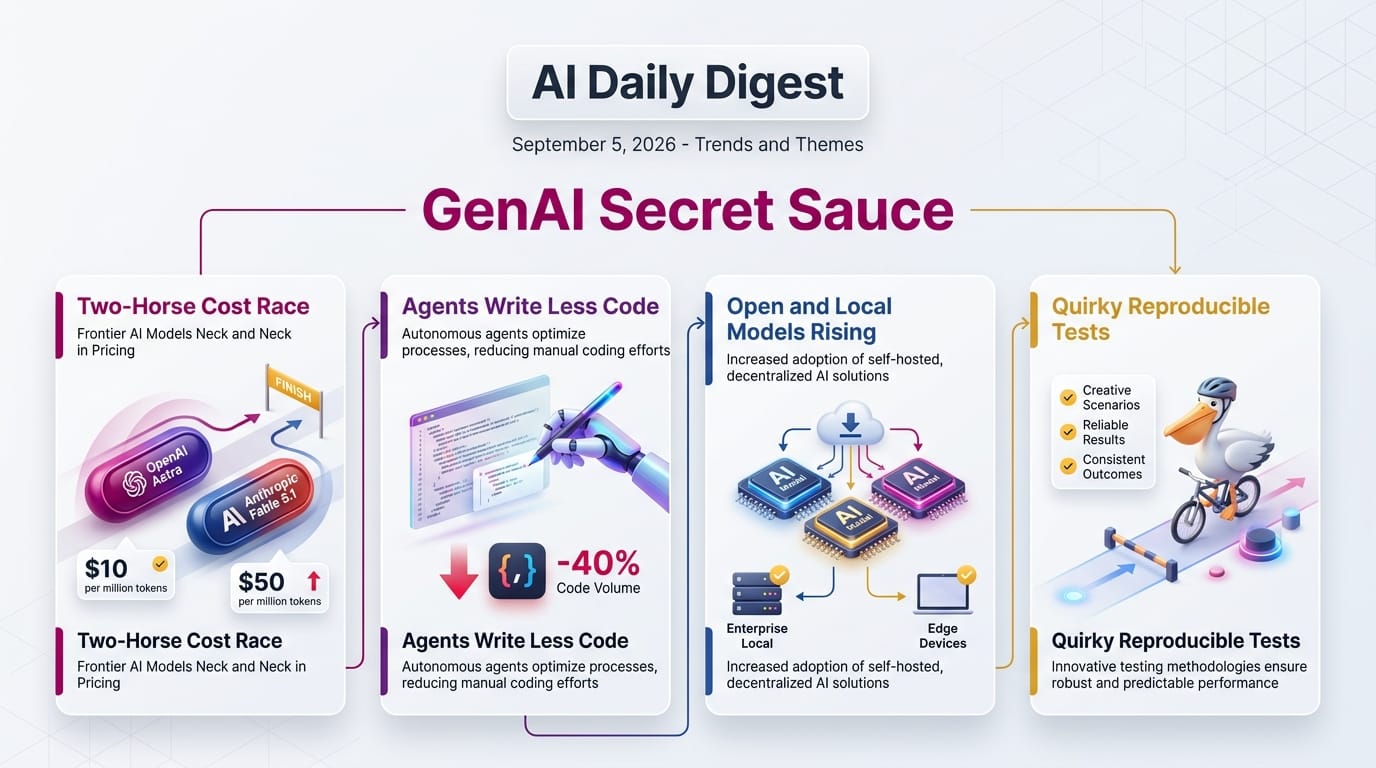
The Frontier Is Now a Two-Horse Cost Race
When two labs trade the lead this closely, buyers win: expect continued price cuts and rapid feature matching rather than one runaway leader.
- Independent testers now rate OpenAI's Astra and Anthropic's Fable 5.1 as close rivals, splitting user preference roughly evenly
- Effective cost, not sticker price, is the battleground - Astra charges more per word-piece but uses fewer of them, while Fable cut typical costs about 25%
- The pricing table proves it - Astra sits at the top at $10/$50 per million word-pieces while open models on fast hosts run roughly ten times cheaper
Agents Are Being Taught to Write Less Code, Not More
The center of gravity in AI coding is shifting from "generate more" to "generate responsibly," which is a sign the tools are maturing past the novelty stage.
- A tool literally named to make "new code the last resort" (Ponytail) is climbing developer charts today
- "Skills" libraries are the hottest thing in coding-agent tooling - curated playbooks that make agents follow disciplined engineering habits, led by community and official Anthropic collections
- The complaint driving this - AI agents notoriously write 400 lines when 4 would do, bloating and destabilizing projects
Open and Local Models Keep Closing the Gap
The practical effect: capable AI is drifting from "a service you pay per use" toward "software you own," which reshapes who controls the technology.
- Open-weights models dominate developer attention right now - Alibaba's Qwen, Z.ai's GLM-5.3, and DeepSeek's new vision model are all freely downloadable (details in Section 13)
- A local-inference server (Magnitude) is climbing for auto-picking the best model your own hardware can run
- A new efficiency trick (see the arXiv paper below) shrinks a 27-billion-setting model to 4-bit with no measurable quality loss
Quirky, Reproducible Tests Are How People Actually Judge AI
As official benchmarks get gamed and saturated, cheap and reproducible tests are becoming the credibility check that ordinary users and skeptical engineers actually trust.
- The pelican-on-a-bicycle drawing test produced this week's clearest ranking of the new models
- A visible token-count clue in that same test hinted at hidden architecture relationships between models
- Community upvotes pushed both a serious AI-adoption paper and hands-on model reviews to the top of Hacker News
Creative AI & Media
Open Video Generation Keeps Gaining Ground
What it lets you do: Turn a single still image into a short video clip using a model you can download and run yourself, instead of a paid cloud service.
Try it: Hugging Face: Lightricks/LTX-2.5
- Lightricks' LTX-2.5 is trending on Hugging Face with about 1.48 million downloads, one of the most-used open image-to-video models
- The appeal - self-hostable video generation for creators who want privacy or want to avoid per-clip fees
- The trade-off - quality still trails the best closed video tools, and longer clips demand heavy graphics memory
3D Design by Conversation
What it lets you do: Build editable 3D scenes and animations by describing them, covered in Top Stories above.
Try it: Simon Willison: Blender with coding agents
- The workflow - point a coding agent at an installed copy of Blender and iterate in plain English
- Why it is a creative unlock - sophisticated 3D output without learning a famously steep interface
Developer Tools & Infrastructure
Research & Models
Scientists Reframe AI Dependence as a Contagion
The value is the framing: it suggests the danger is not a gentle drift but a threshold that can cascade quickly once crossed.
- The claim - a group of researchers (including scientists David Krakauer and Michael Levin) model AI adoption using the math of how viruses spread through a population
- The warning - once adoption crosses a tipping point, small further increases could trigger a rapid, possibly irreversible slide into dependence and skill loss
- What it is not - this is a conceptual, systems-thinking argument, not a measurement of real-world harm
The Fine Print on Fable 5.1
Treat 5.1 as a quality-of-life and cost tune-up rather than a capability breakthrough, and budget for heavier token use. (Model itself covered September 1.)
- Real gains - noticeably better writing, fewer robotic tics, and safety filters that fire far fewer false alarms (biology false positives down about 85%, cybersecurity down about 60%)
- The cost caveat - some tasks consume 25% to 300% more word-pieces, and a few domains like legal work regressed slightly
- Cache-read pricing dropped - re-reading the same documents now costs a quarter of what it did
Business & Industry
Surprising & Under-the-Radar
An AI Tool Whose Whole Job Is to Write Less Code
Why it is surprising: the hottest launches usually promise to generate more, but Ponytail is trending today across developer communities by promising the opposite - making new code "the last resort." It is a sign the industry is reacting to AI-driven code bloat.
A Tool to Make AI Writing Sound Human
The "Humanizer" project (43,000+ stars) strips the tell-tale signs of AI-generated text. It solves a real editing pain, but "de-AI-ing" writing raises honest questions about authenticity - and it is a cat-and-mouse game with the detectors.
The Token Bill Nobody Warns You About
Why it is under the radar: the new models are advertised as cheaper per unit, but reviewers found Fable 5.1 can burn 25% to 300% more word-pieces on some tasks. The lesson: a lower price per word-piece can still mean a higher total bill.
Community Debate: Is AI Dependence Actually Dangerous?
The "Cognitive Virus" paper drew 100+ comments on Hacker News. One side argues offloading routine thinking to AI is just the next calculator, freeing us for higher work; the other warns that unlike a calculator, general AI could erode broad judgment before we notice. No resolution yet, but the tipping-point framing is what made people stop and argue.
Signals to Track

4-Bit Models With No Quality Loss
A new paper (Section 16) claims to compress a 27-billion-setting model to 4-bit precision - a quarter of the usual memory - with no measurable drop in quality. If it holds up broadly, running capable AI on modest hardware gets far cheaper. For ordinary people, that means more private, offline AI features baked into apps you already own.
Local-Inference Servers That Auto-Tune to Your Machine
Projects like Magnitude trended today for automatically picking the best model your computer can handle and plugging it into tools you already use. As these mature, running private AI could become as simple as installing an app - no cloud account, no per-use fees.
Agents That Learn From Their Own Mistakes
A newly launched tool called Reflexio (see Section 14) adds a "behavioral learning" layer so agents improve from past runs instead of repeating errors. If it works safely, the assistants you use daily would get quietly better the more you use them, without any update from the vendor.
Agents That Debug Live Systems Without Redeploying
Hyperprobe (another new launch today, see Section 14) lets AI agents inspect live production software without a new deployment. Done safely it slashes downtime; done carelessly it is a security risk - which makes how these tools handle permissions the thing to watch.
Top Repos Today
📜 License: MIT (typical for this author) · 👤 By: individual (TypeScript educator)
🎯 Time to value: 5 minutes
| ✓ Pros | ✗ Cons |
|---|---|
| Curated by a respected engineer | Opinionated, may not fit every stack |
| Zero-config drop-in | Shell-based, less portable |
| Huge community traction | Skills churn fast as they evolve |
 GitHub
📜 License: open (JavaScript) · 👤 By: individual
🎯 Time to value: 10 minutes
| ✓ Pros | ✗ Cons |
|---|---|
| Counters AI code bloat | Can under-deliver on brand-new projects |
| Improves maintainability | Philosophy may clash with feature sprints |
| Strong same-day launch momentum | Very new, limited track record |
 GitHub
📜 License: open (TypeScript) · 👤 By: company/startup
🎯 Time to value: 20 minutes
| ✓ Pros | ✗ Cons |
|---|---|
| Open source, model-agnostic | You manage your own keys and costs |
| Works across models | Setup heavier than hosted tools |
| Large active community | Support is community-driven |
 GitHub
📜 License: open (Python) · 👤 By: company (Anthropic)
🎯 Time to value: 5 minutes
| ✓ Pros | ✗ Cons |
|---|---|
| Official and maintained | Conservative, fewer niche skills |
| Good reference implementation | Claude-centric |
| Stable | Less bleeding-edge than community repos |
 GitHub
📜 License: open (Python) · 👤 By: individual
🎯 Time to value: 5 minutes
| ✓ Pros | ✗ Cons |
|---|---|
| Solves a real editing pain | Raises authenticity questions |
| Simple to invoke | Output still needs human review |
| Popular and active | Cat-and-mouse with detectors |
 GitHub
📜 License: open (TypeScript) · 👤 By: company/startup
🎯 Time to value: 30 minutes
| ✓ Pros | ✗ Cons |
|---|---|
| Privacy plus zero marginal cost | Local quality below frontier APIs |
| Auto-tunes to your hardware | Needs a decent Graphics Processing Unit (GPU) or Mac |
| Drop-in for existing agents | Young project |
 GitHub
Top Models Today
👤 By: Alibaba Qwen · 🎯 Task: Image-Text-to-Text
📐 Size: ~27B
| ✓ Pros | ✗ Cons |
|---|---|
| Great size-to-quality balance | Not frontier-top on the hardest tasks |
| Permissive license, easy commercial use | Still needs a capable GPU |
| Massive adoption and tooling | Multimodal adds serving complexity |

👤 By: Lightricks · 🎯 Task: Image-to-Video
📐 Size: not listed
| ✓ Pros | ✗ Cons |
|---|---|
| Open, self-hostable video | Media-model license restrictions apply |
| Fast versus diffusion video peers | Quality below closed Veo/Sora-tier |
| Big creator adoption | Heavy graphics memory for longer clips |

👤 By: Z.ai / Zhipu · 🎯 Task: Image-Text-to-Text
📐 Size: ~321B
| ✓ Pros | ✗ Cons |
|---|---|
| Faster than full GLM-5.3 | Trades some capability for speed |
| Good for high-volume agents | Still 321B, not laptop-scale |
| High adoption | Custom license terms |


👤 By: Alibaba Qwen · 🎯 Task: Image-Text-to-Text
📐 Size: ~180B
| ✓ Pros | ✗ Cons |
|---|---|
| More capacity than the 27B | 180B raises serving cost |
| Same familiar Qwen ecosystem | Rapid iteration means churn |
| Multimodal | Overlaps other Qwen tiers |

👤 By: Z.ai / Zhipu · 🎯 Task: Text Generation
📐 Size: ~753B
| ✓ Pros | ✗ Cons |
|---|---|
| Frontier-class open coding | 753B needs serious infrastructure |
| Long-horizon agent strength | Custom license, check terms |
| Actively maintained | Overkill for simple tasks |


👤 By: DeepSeek · 🎯 Task: Image-Text-to-Text
📐 Size: ~305B
| ✓ Pros | ✗ Cons |
|---|---|
| MIT, fully open weights | 305B is heavy to self-host |
| Multimodal and agentic | Labeled experimental |
| Strong DeepSeek lineage | Vision track record still thin |

AI Launches Today
💰 Pricing: freemium (open source) · 🏷 Category: Developer Tools
💰 Pricing: freemium (SaaS) · 🏷 Category: Developer Tools
💰 Pricing: free (open source) · 🏷 Category: Developer Tools
💰 Pricing: freemium (SaaS) · 🏷 Category: Developer Tools
Snapshot
| Provider | Model | Input $/1M | Output $/1M | Context |
|---|---|---|---|---|
| OpenAI | GPT-6 Astra (new flagship) | $10.00 | $50.00 | ~1M+ |
| Anthropic | Claude Fable 5.1 (flagship) | $10.00 | $50.00 | ~200K-1M |
| Gemini 3.8 Flash | $0.75 | $3.75 | large (intro pricing) | |
| Groq | Open-weights tier (e.g. Kimi/Llama) | ~$1.00 | ~$3.00 | open models, fast host |
Flagged changes: OpenAI's GPT-6 Astra (launched September 3) is the newest entry at the top of the price range. Anthropic's Fable 5.1 cut cache-read pricing to $0.25 per million (a 75% drop), lowering the cost of re-reading the same documents. Google's Gemini 3.8 Flash intro pricing (from September 2) runs through December 31, 2026.
What this means: The frontier flagships cluster around $10/$50, while fast open-weights hosts undercut them by roughly ten times. If your task does not need frontier reasoning, an open model can cut your bill by an order of magnitude.
Member discussion