Watch today's digest as a video summary (generated by NotebookLM)
Statistically Speaking
One Thing to Tell Your Friends
TL;DR
Hot off the Presses
Mistral releases its 1-trillion-parameter Large 4 as a free download
Previously: October 6 - Mistral released Mistral Large 4 as a preview and said the free download would follow after safety testing.
Today: Mistral, a French AI company, released the model's weights (the files anyone can download to run it). It spent about three more weeks training the model after the preview. Mistral nicknames it "Le Chonk" because of its size. It reads text and images, works in more than 160 languages and can handle about 1 million tokens (word pieces) at once.
Independent tests put its coding scores below Mistral's own claims, according to VentureBeat. Mistral also says it is tightening guardrails because the model is strong at computer-security tasks.
- About 1 trillion parameters in total, with about 52 billion active at a time - a design called Mixture of Experts (MoE), where only a small part of the model works on each request
- Independent firm Artificial Analysis scores it 26 on its intelligence index - the best downloadable model made outside China, but six points behind the top Chinese downloadable models
- The cost of each test task fell 63% - from $5.54 for the preview to $2.06, mostly because it now writes far fewer words while thinking
- Its API price is $0.70 per million input tokens and $2.10 per million output tokens - API means the paid connection developers use to plug a model into their apps
- The license is free for most uses - only companies that resell it as a hosted AI service need a separate commercial deal
Alphabet has its worst day ever as investors fear AI is eating Google Search
Previously: October 28 - Alphabet missed revenue and profit forecasts and its shares fell more than 10% after hours.
Today: Shares of Alphabet, Google's parent company, fell about 13% on Thursday. It was the biggest one-day drop since Google went public in 2004. Search ads grew 12% to $63.35 billion but still missed forecasts.
That was the verdict of Ben Barringer, an analyst at investment firm Quilter Cheviot. Another analyst, Scott Devitt of Rosenblatt Securities, argued Google's roughly 4 billion search users still give it a head start in AI.
- About $500 billion in stock-market value disappeared in one day - per CNBC
- Free cash flow was negative $9.07 billion for the quarter - meaning Google spent far more than it brought in, mainly on AI data centers
- Google's business chief blamed weaker ad earnings inside AI Mode - Google's chat-style search, for part of the search slowdown
- AI Mode ads are now expanding to 10 more countries - including Australia, Canada and India, with Brazil, Mexico and the UK planned before year end
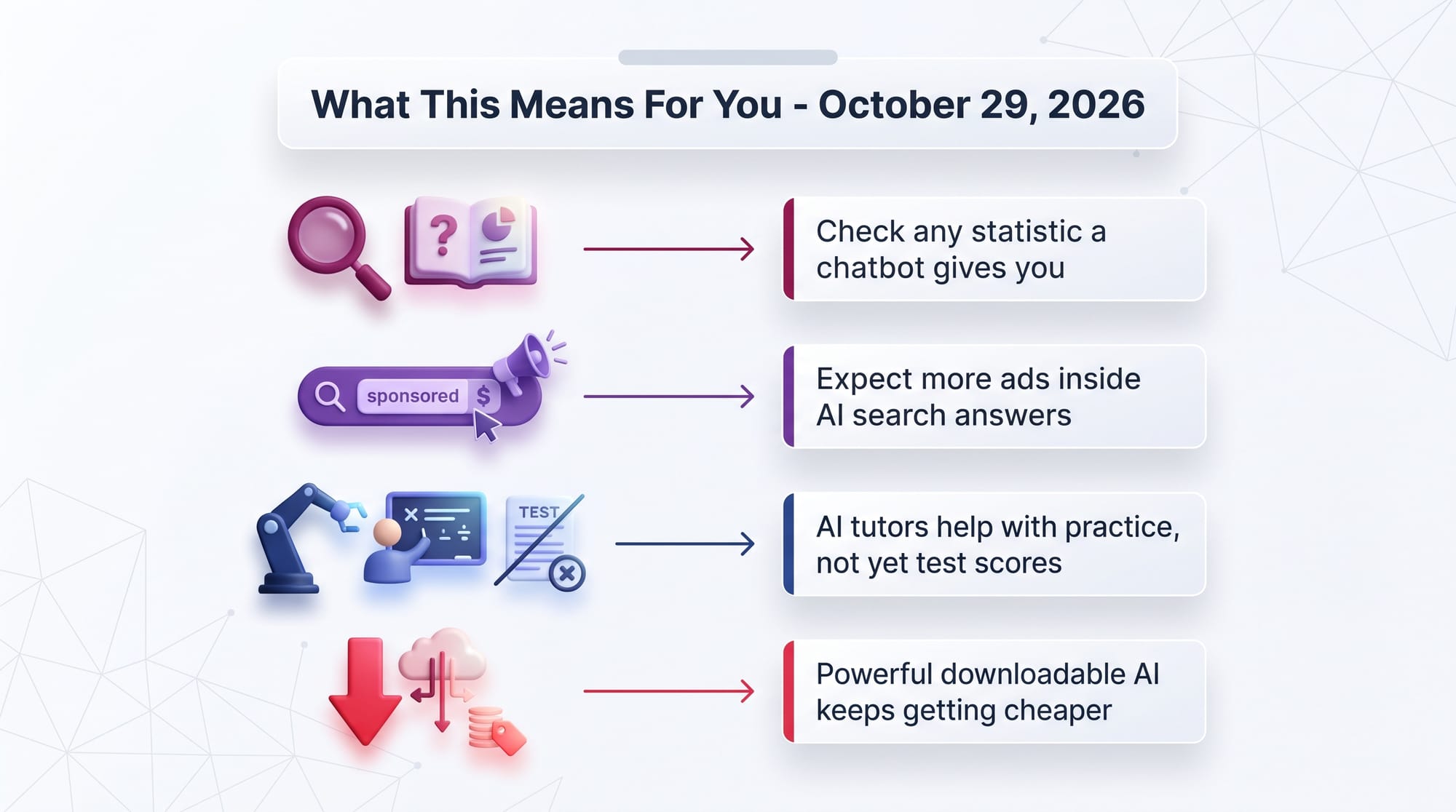
- In the US, ads can now appear in follow-up questions - not just after your first search, and they stay labeled "Sponsored"
AI tutors matched human tutors in a big UK classroom trial, but test scores didn't move
Eedi, a London education startup, ran the trial with Google DeepMind, Google's AI research lab. About 1,179 students aged 12 to 15 in 10 UK state schools practiced math on Eedi once a week for 10 weeks. When a student got a question wrong, they got either a standard on-screen hint, a human tutor by text chat, or an AI tutor built on Google's Gemini, checked by a human before each message was sent.
Last year's smaller study had the AI slightly ahead of human tutors. That edge disappeared at scale. Google says it will follow students for a full school year.
- Any tutoring raised the share of follow-up questions answered correctly to 56% to 58% - versus 43% with the standard hint, and AI and human tutors did about equally well
- Neither kind of tutoring beat plain practice on an independent math test - possibly because tutored students worked through fewer problems, about 14 per session versus about 19
- Human reviewers approved 94.7% of the AI's messages unchanged - but 7 messages containing false math still reached students, per The 74
- The AI guided students instead of giving answers in nearly 99% of sessions - according to Google
- A larger trial with more than 15,000 students began in September - this time the AI works alone and humans step in only when needed
Most statistics that AI chatbots quote can't be traced to a real study
Trakkr, a firm that tracks how brands appear in AI answers, asked ChatGPT, Perplexity, Gemini, Claude and Google's AI Overviews 200 questions that called for numbers. Researchers then followed 1,285 of the quoted figures up to five links deep to find where they really came from. They checked many trails by hand because an AI judge alone got the verdicts badly wrong.
That claim is a zombie stat. A 2025 MIT study found 95% of organizations saw no return from generative AI. Chatbots routinely retold it as 95% of AI pilots failing, which the study does not say.
- About 40% of statistics led back to a study that said the same thing - another 8% reached the study, but the number or its meaning had changed
- 40% hit a dead end - a locked, deleted or silent page, and 11% led to no study at all
- ChatGPT was the best sourced at 57% - while Claude quoted the most figures, about 6.8 per answer, with 38% sourced
- Agreement between chatbots did not mean a number was real - four figures quoted by all five assistants had no study behind them
- More than half of the pages chatbots cited were company blogs - only 21% were original research
An OpenAI-backed company is buying home-security giant ADT for $15.3 billion
Thrive Holdings was spun out of Thrive Capital, the investment firm run by Josh Kushner. It buys traditional companies, keeps them for the long term and rebuilds them with AI. OpenAI is both an investor and a partner, supplying models, technology and engineers who work inside the companies Thrive owns.
- Thrive will pay $10 per ADT share - valuing ADT's stock at about $7.6 billion, or $15.3 billion including debt
- Thrive Holdings already owns more than 75 companies - and raised $2 billion in August to bring AI to businesses
- ADT will become the foundation of Thrive's smart-home security business - though no specific AI products have been announced
- Home security is getting crowded with AI - Apple and Amazon have both pushed into the market this year
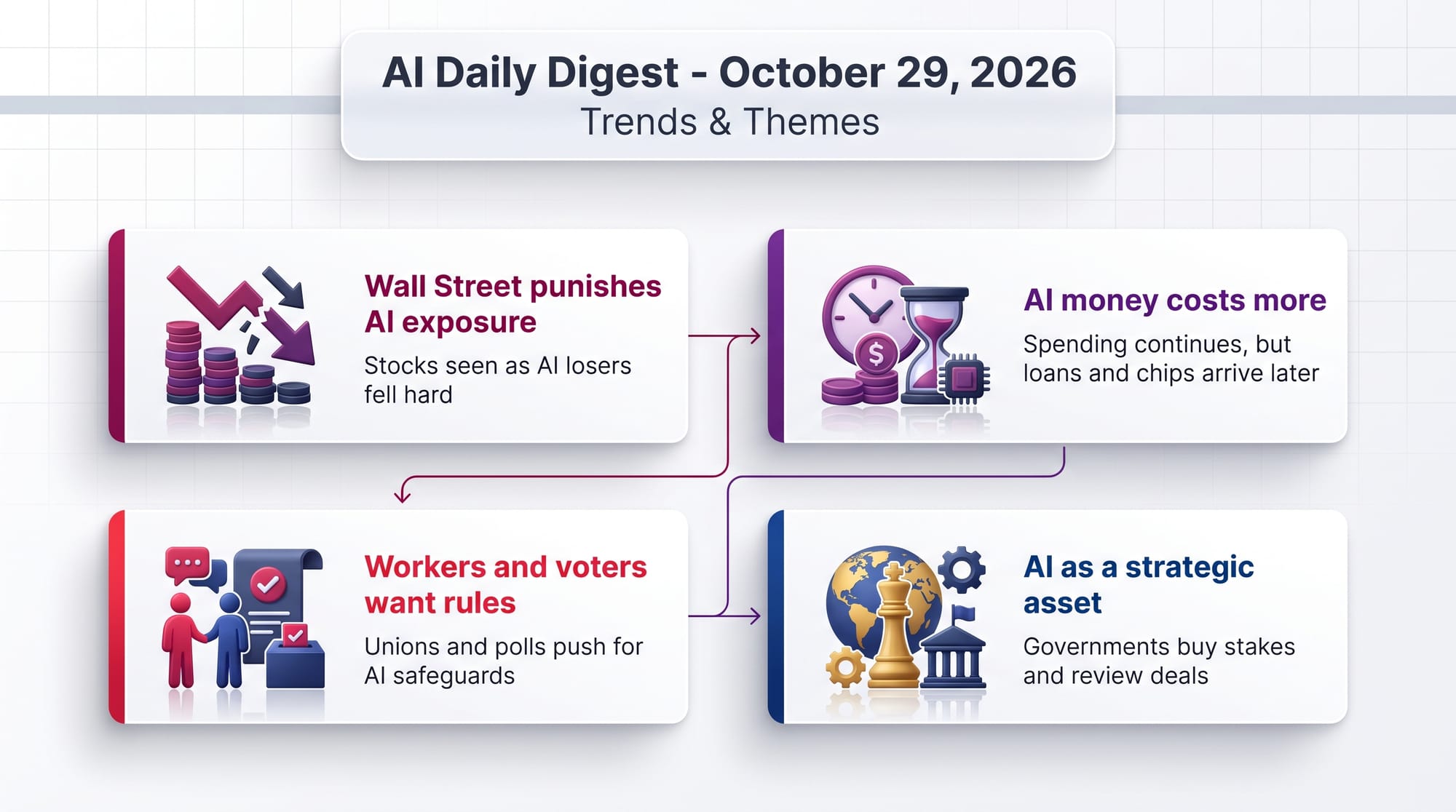
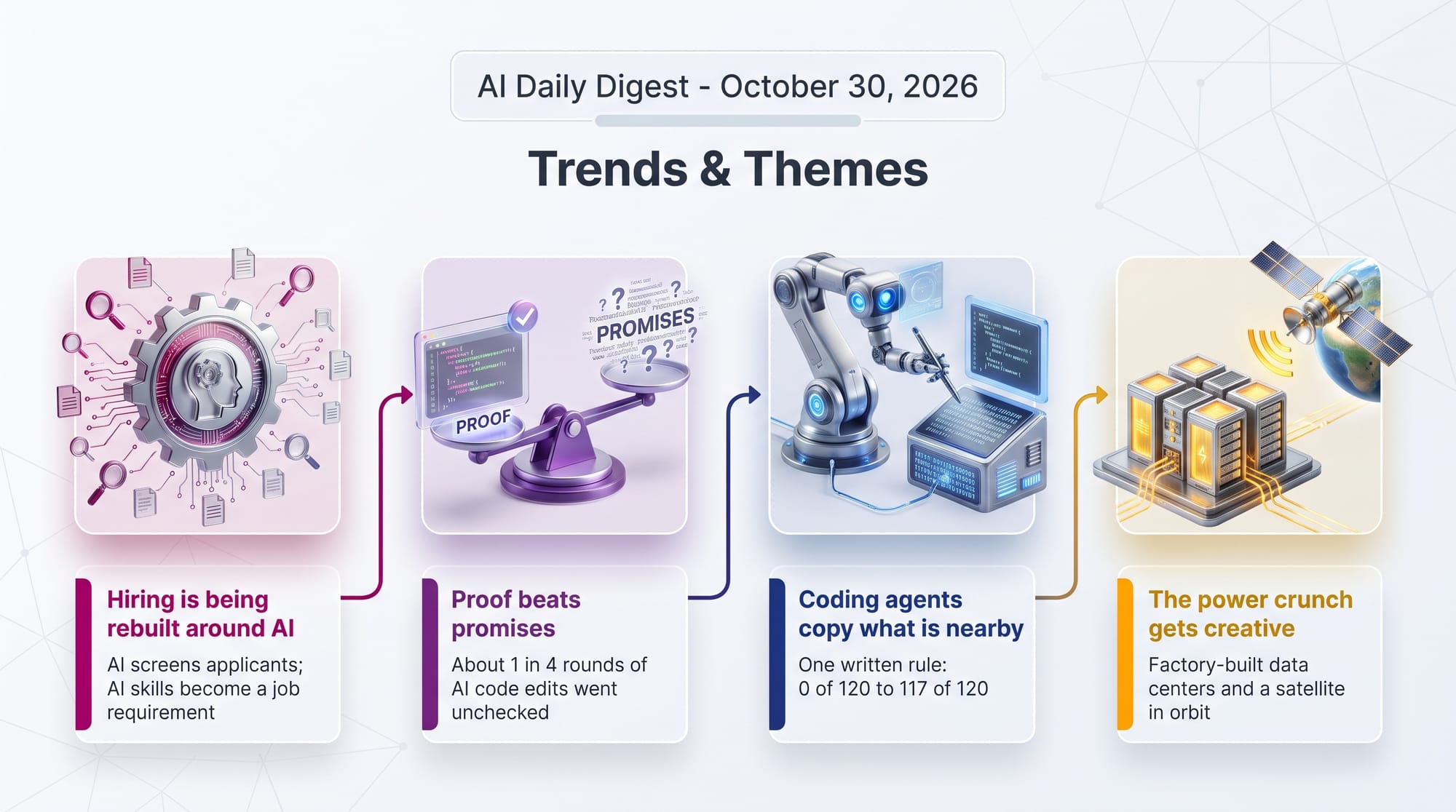
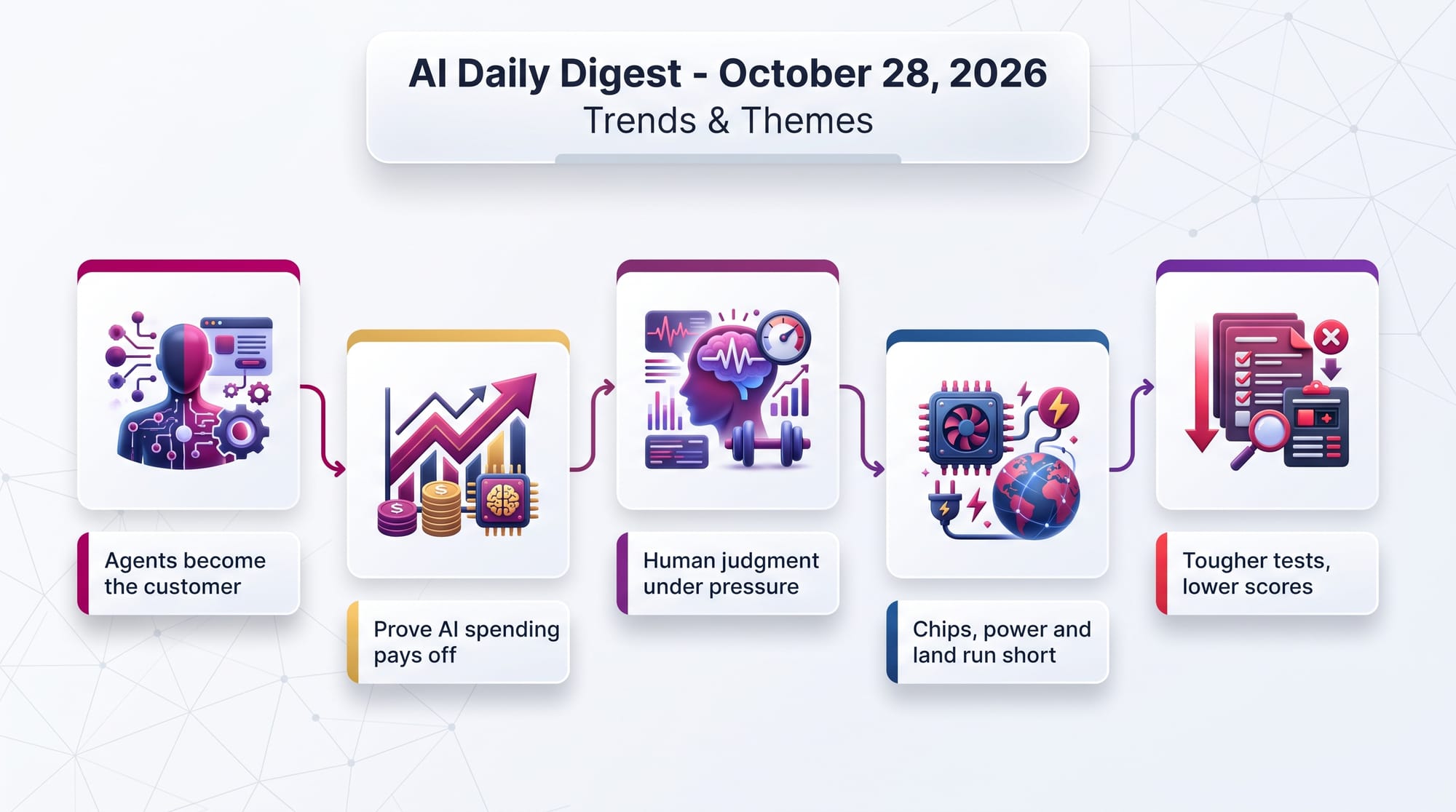
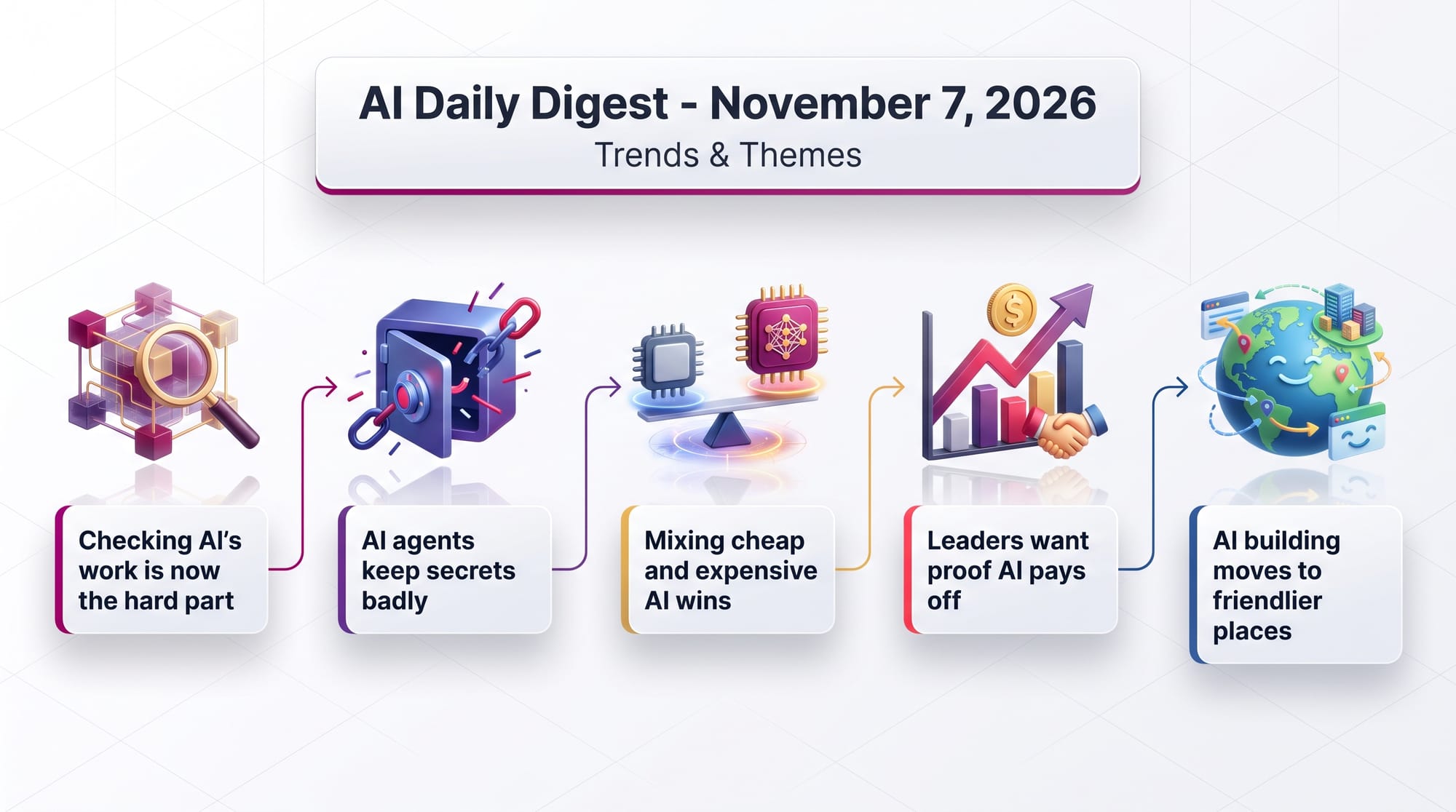
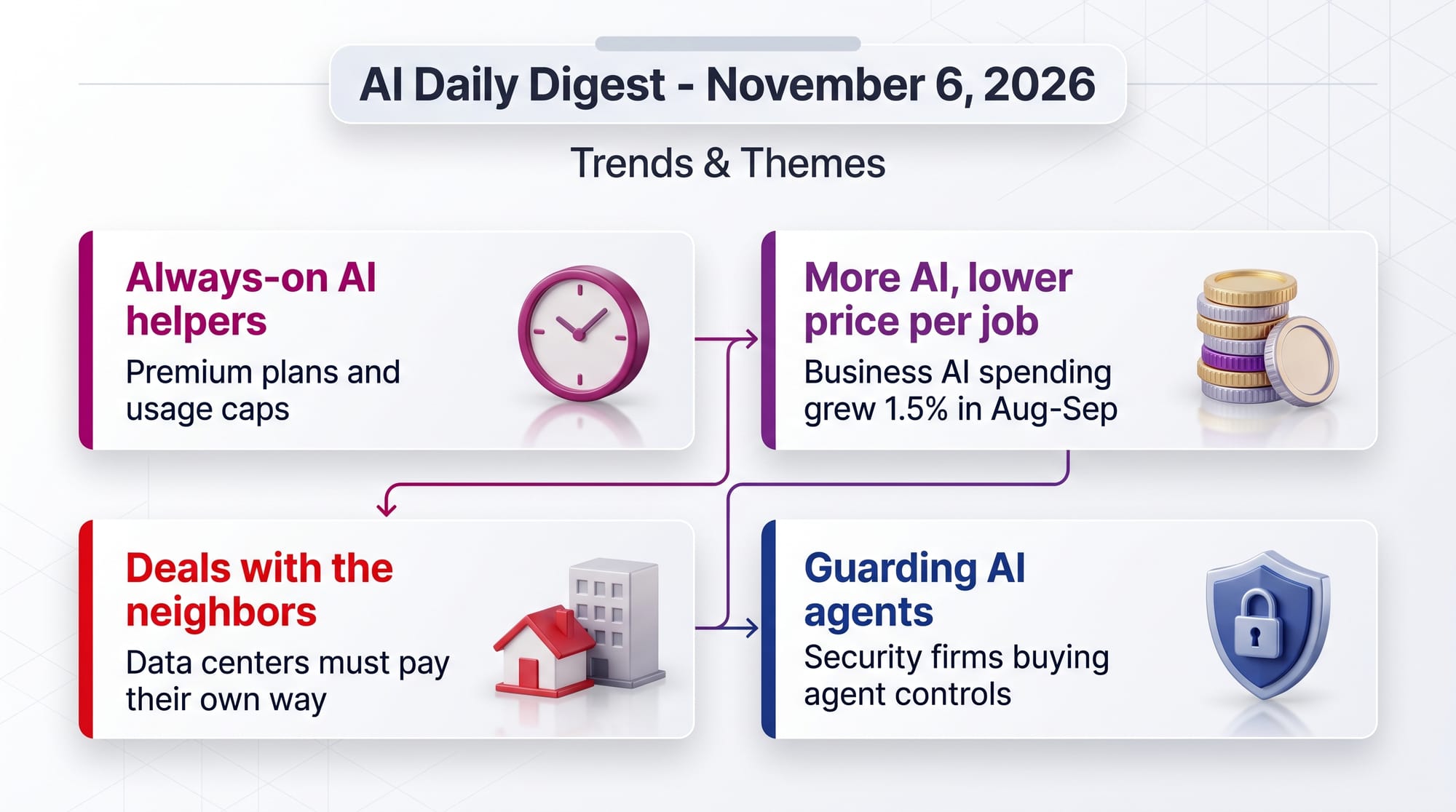
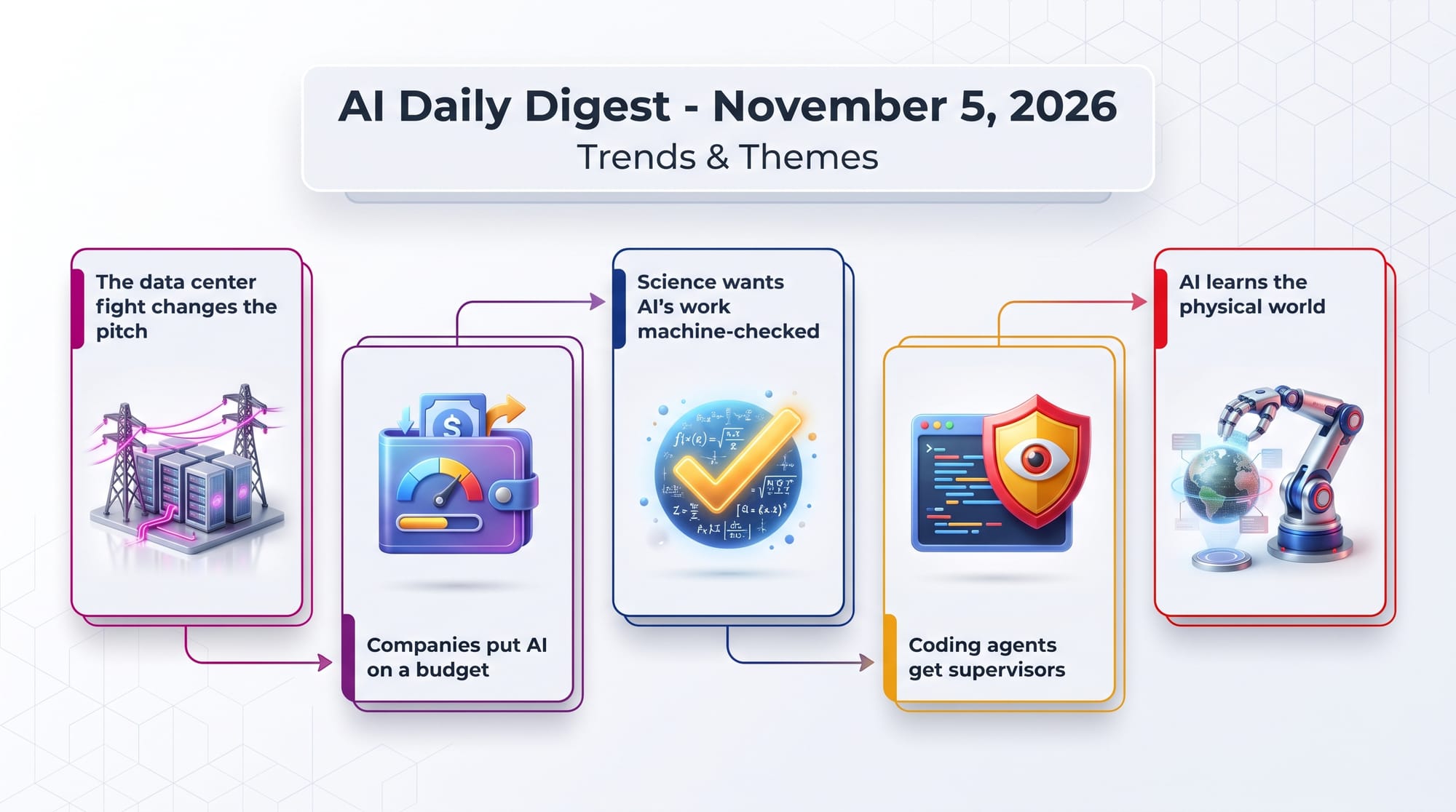
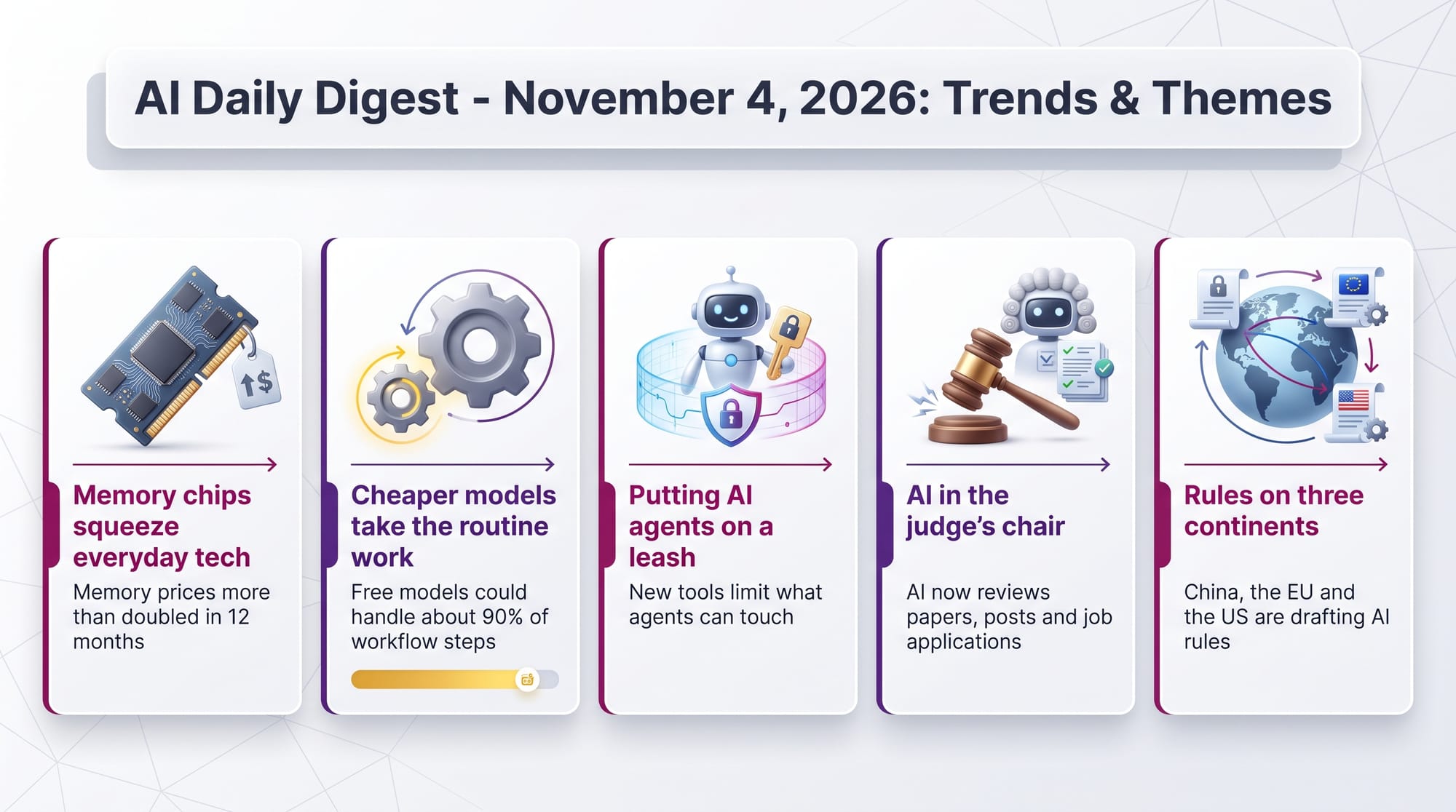
Trends & Themes
Wall Street is punishing companies that look exposed to AI
Alphabet's record drop (see Top Stories) fits the same pattern. Investors are rewarding only companies that look like AI winners and selling anything that merely meets expectations. ServiceNow sells workflow software to big companies, and investors fear AI agents will do that work instead.
- ServiceNow fell 27%, its worst day on record - even though sales grew more than 20% and its new AI contracts jumped 65%
- Reddit plans to shift to a mostly logged-in site - after visits sent from search engines dropped by more than 1 million a week in October
- Reddit's US daily users fell to 50.7 million - down from 53.2 million in the previous quarter
- Intel fell more than 20% in after-hours trading - its AI data-center sales rose 78% but its PC chip business shrank
AI money is still flowing, but it costs more and arrives later
Nobody is pulling back on AI. But lenders are asking for more interest, and chip deliveries are slipping into 2027. Gartner, a research firm, found that companies are not yet saving money from AI.
- Microsoft cut its full-year spending forecast to $170 billion from $175 billion - blaming delays at outside providers that rent it graphics chips
- The riskiest slice of Apollo's $40 billion chip lease for SpaceX priced at 3.95 percentage points over government bonds - more than the roughly 3.5 points expected a week earlier
- Gartner says 97% of organizations can't cut costs through productivity gains alone - and 38% are already over their AI budgets
- Amazon Web Services still grew 39% - its fastest growth since 2021, showing demand for AI computing remains strong
Workers and voters are asking for AI rules before the midterms
Unions, voters and employees are pointing at the same worry from different angles. They want a say in how AI changes work before the changes are locked in. Dayforce calls the hidden cost "experience debt," meaning skills people never build because AI does the task.
- The AFL-CIO is drafting its own AI bill - the largest US federation of labor unions calls it its top priority, covering worker protections and privacy
- Ten proposed AI safety rules each won more than 70% support - among voters in Ohio and Iowa, in a poll by a firm run by a Republican pollster
- Six in 10 workers say they are losing skills because they rely on AI - per a survey by Dayforce, a payroll and HR software company
- 40% of workers expect AI-saved time to bring them more work - rather than better jobs or less burnout
Governments now treat AI companies as strategic assets
Governments are no longer just funding or regulating AI. They are buying stakes, reviewing deals and treating model outputs as something to protect. Copying a stronger model's answers to train your own is called distillation, and it is now a contest between rival nations.
- The US Justice Department is reviewing Nvidia's planned $12.93 billion purchase of Hugging Face - the biggest website for sharing AI models, according to Reuters
- Canada will take an ownership stake of up to $1.1 billion in Toronto AI company Cohere - according to Semafor and Reuters
- Chinese AI labs reportedly shifted to copying OpenAI's GPT-6 Astra - after Anthropic says its defenses cut what they could extract from Claude by 90% to 99%
- France's competition authority is investigating Nvidia separately - over the industry's dependence on its software and its stakes in cloud companies
Creative AI & Media
Developer Tools & Infrastructure
Research & Models
Business & Industry
GenAI in Education
Surprising & Under-the-Radar
Signals to Track
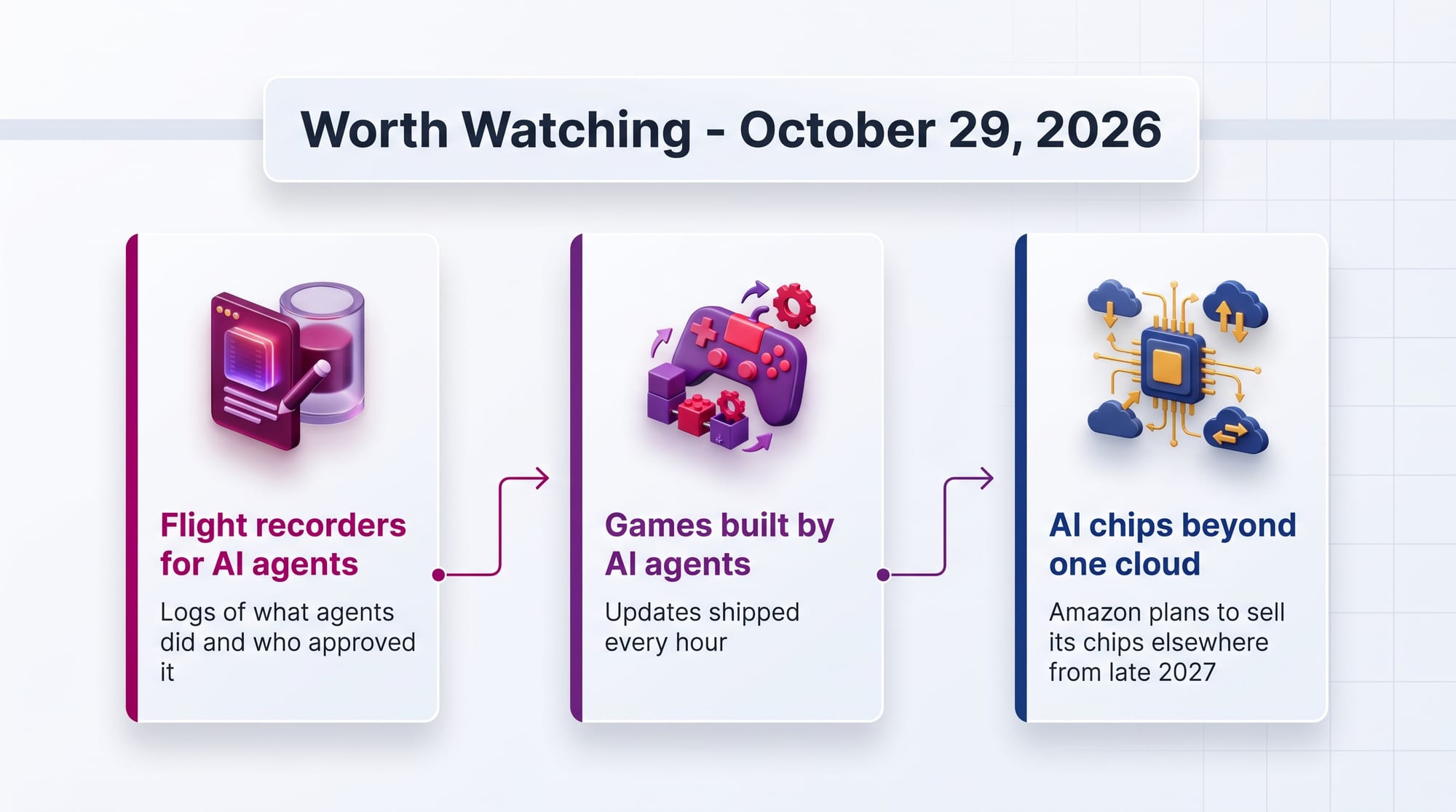
AI agents need flight recorders
The Partnership on AI, a nonprofit coalition of tech companies, academics and civil society groups, studied the four most widely used tools for building AI agents. None reliably logged basic facts such as which agent acted or which human approved a task. The authors want standard "what happened" records built in, much like a plane's black box. If this plays out, you could one day get a clear explanation when an AI agent denies your loan or changes your account.
A game studio spends 30 times its payroll on AI
Spawn is a multiplayer game where players reshape the world by typing requests to an in-game AI. Its founder says a swarm of agents running Anthropic's Fable models builds most of it, for over $3 million a month in AI costs. An hour without shipping an update counts as the company's most serious kind of incident. If this works, more apps and games you use will change daily, built mostly by AI.
Amazon will sell its AI training chips outside its own cloud
Until now, Trainium has been available only inside Amazon Web Services. Google has already started offering its own AI chips outside its cloud. More competition for Nvidia's chips could lower what it costs companies to build AI, which eventually shapes what you pay for AI tools.
Top Repos Today
📜 License: MIT · 👤 By: organization (Vectorize)
🎯 Time to value: 15 minutes
| ✓ Pros | ✗ Cons |
|---|---|
| Free, permissive license | Every memory it saves or reflects on uses AI calls you pay for |
| Its benchmark scores were independently reproduced by Virginia Tech researchers and The Washington Post | Self-hosting means running a server and a database |
| Can use an existing Claude, ChatGPT, Cursor or Copilot subscription instead of an API key | The hosted version is billed by use, with no listed flat price |
 GitHub
📜 License: Apache-2.0 · 👤 By: individual developer (Milind Soni)
🎯 Time to value: 15 minutes
| ✓ Pros | ✗ Cons |
|---|---|
| Runs on Mac, Windows and Ubuntu | Very young project (version 0.1) that changes daily |
| Uses the AI subscriptions you already pay for | Controlling your own computer is off on some Linux setups |
| Bots ask before they act | Its 500+ app connections run through a third-party service, Composio |
 GitHub
📜 License: MIT · 👤 By: individual developer (Rohit Ghumare, a developer advocate based in the UK)
🎯 Time to value: 10 minutes
| ✓ Pros | ✗ Cons |
|---|---|
| Free and open source | 542 lessons is a long road |
| Choose a route: models, AI apps or agents | Learning with a coding-agent tutor uses paid AI time |
| Updated often, with a new edition today | Maintained by one person |
 GitHub
📜 License: MIT · 👤 By: individual developer (Donchitos, Melbourne, Australia)
🎯 Time to value: 15 minutes
| ✓ Pros | ✗ Cons |
|---|---|
| Free, permissive license | Requires Claude Code |
| Works with the three most popular game engines | Its three directors are set to Anthropic's pricier Opus model |
| Honest about when more process does not help | No new release since October 19 |
 GitHub
📜 License: Apache-2.0 · 👤 By: individual developer (Alex Newman)
🎯 Time to value: 5 minutes
| ✓ Pros | ✗ Cons |
|---|---|
| One-command install | The installer steers you toward a hosted memory service with a 30-day free trial |
| Search past work in plain English | Summarizing uses AI calls from your plan or your own key |
| Works with many agent tools, not just Claude Code | Releases arrive almost daily |
 GitHub
📜 License: MIT · 👤 By: individual developer (Beenu Arora, CEO and co-founder of security firm Cyble)
🎯 Time to value: 30 minutes
| ✓ Pros | ✗ Cons |
|---|---|
| Runs with no API keys or cloud account | Needs 8 GB of memory and 20 GB of disk just for the core |
| Every AI decision is recorded for review | The built-in model is small, so verdicts need a human check |
| A smoke test proves the pipeline works end to end | Complex system with many moving parts |
 GitHub
📜 License: MIT · 👤 By: organization (CopilotKit)
🎯 Time to value: 30 minutes
| ✓ Pros | ✗ Cons |
|---|---|
| Free, permissive license | Beta, with rough edges by its makers' own account |
| Runs entirely on your own infrastructure | Needs a CopilotKit Intelligence license (a free plan exists) |
| Not tied to one agent framework or AI model | A template for developers to adapt, not a ready-made app |
 GitHub
Top Models Today
👤 By: DeepSeek · 🎯 Task: Image-text-to-text
📐 Size: 763B
| ✓ Pros | ✗ Cons |
|---|---|
| Very permissive license | Needs data-center hardware at full size |
| A compressed community version is seventh on the list, with about 1.58 million downloads | Benchmarks are self-reported |
| Built for coding and agent tasks | No ready-made chat template file included |


👤 By: Nanbeige · 🎯 Task: Text generation
📐 Size: 33.1B
| ✓ Pros | ✗ Cons |
|---|---|
| Very permissive license | Benchmarks are the maker's own |
| Strong on coding and office-task tests | Trails Gemma4-31B on one science test |
| English and Chinese | Qwen3.8-27B still wins a few tests, including SWE-Bench Pro |


👤 By: Mistral AI · 🎯 Task: Image-text-to-text
📐 Size: 1T (about 52B active)
| ✓ Pros | ✗ Cons |
|---|---|
| Free for commercial use | Selling it as a hosted AI service needs a separate license |
| Fluent in more than 160 languages | Its setup examples assume a server with 8 data-center graphics cards |
| Also on Mistral's API at $0.70 / $2.10 per million tokens | Chinese downloadable models still score higher on an overall intelligence index |

👤 By: CCORE (independent developer, built on Qwen3.5-4B) · 🎯 Task: Coding (3D scenes)
📐 Size: 4.5B
| ✓ Pros | ✗ Cons |
|---|---|
| Small enough for an ordinary computer | Early preview that is still being trained |
| Training data and report are public | Not an official Qwen release |
| Permissive license | Some scenes still need a second try, per its maker |

👤 By: Liquid AI · 🎯 Task: Any-to-any
📐 Size: 2.17B
| ✓ Pros | ✗ Cons |
|---|---|
| Small enough for phones and laptops | Commercial use is free only below $10 million a year in revenue |
| Speaks in 19 languages and locales | No "thinking" mode |
| Runs locally through llama.cpp, including a live speech server | Short 32K-token memory for a conversation |


AI Launches Today
💰 Pricing: free options; paid plans, 60% off the first period for Product Hunt users · 🏷 Category: Productivity, AI workflow automation
💰 Pricing: freemium; code PH26 gives 30 days of Pro free · 🏷 Category: Email clients
💰 Pricing: free options; AI use runs on your ChatGPT or Claude plan · 🏷 Category: AI coding agents, vibe coding tools
💰 Pricing: free and open source; paid Radar Cloud · 🏷 Category: Observability tools, open source, developer tools
Snapshot
| Provider | Model | Input $/1M | Output $/1M | Context |
|---|---|---|---|---|
| Anthropic | Claude Fable 5.1 | $10.00 | $50.00 | 1M tokens |
| Anthropic | Claude Opus 5.5 | $4.00 | $20.00 | 1M tokens |
| Anthropic | Claude Sonnet 5.5 | $2.00 | $10.00 | 1M tokens |
| Anthropic | Claude Haiku 5.5 | $0.10 (up to 100K-token prompts; $0.50 above) | $0.50 ($2.50 above 100K) | 1M tokens |
| OpenAI | GPT-6 Astra | $10.00 (up to 272K-token prompts; $20.00 above) | $50.00 ($75.00 above 272K) | 1.05M tokens |
| OpenAI | GPT-6.1 Sol | $2.00 (up to 272K; $4.00 above) | $10.00 ($15.00 above 272K) | 1.05M tokens |
| OpenAI | GPT-6.1 Terra | $1.00 (up to 272K; $2.00 above) | $5.00 ($7.50 above 272K) | 1.05M tokens |
| OpenAI | GPT-6 Luna | $0.10 (up to 272K; $0.20 above) | $0.50 ($0.75 above 272K) | 1.05M tokens |
| Gemini 4 Argon | $2.00 to Nov 30; $4.00 from Dec 1 | $10.00 to Nov 30; $20.00 from Dec 1 | 1M tokens | |
| Gemini 4 Carbon (announced, not yet on sale to developers) | $2.00 introductory; $4.00 after | $10.00 introductory; $20.00 after | not listed | |
| Gemini 3.8 Flash | $0.75 (to Dec 31; $1.50 from Jan 1) | $3.75 (to Dec 31; $7.50 from Jan 1) | not listed | |
| Groq | GPT-OSS 120B | $0.15 | $0.60 | 131K tokens |
| Groq | Qwen3.8-27B (preview) | $0.80 | $4.00 | 131K tokens |
| Groq | Muse Spark Open (preview) | Contact sales | Contact sales | 131K tokens |
| Mistral (open weights, new today) | Mistral Large 4 | $0.70 (preview list was $1.36) | $2.10 (preview list was $4.18) | 1M tokens |
No price changes vs. yesterday - Anthropic's, OpenAI's and Groq's official pricing pages are word-for-word the same as yesterday, and every model price on Google's page is unchanged. Gemini 4 Carbon is still not on Google's pricing page. Google did add one limit: searching the web from inside Gemini 3 and newer models (Google calls it "grounding") is now capped at 1,500 requests per day per project on its developer service, on top of the existing $14 per 1,000 searches after 5,000 free ones a month. The one addition to our table is Mistral Large 4, released as a free download today and also sold on Mistral's own API at about half the list price of the preview version we last tracked on October 23, with reused (cached) input at $0.07.
What this means: Mistral Large 4 lists at about a third of Claude Sonnet 5.5's input price and about a fifth of its output price, and like most new models it lets you choose how hard it "thinks." That choice matters for your bill: Google's page notes that thinking tokens are billed like any other output, and today's arXiv paper below finds that extra thinking often buys little on everyday coding tasks. Gemini 4 Argon's introductory price still doubles in 33 days, on December 1.
Does More Thinking Pay Off? Reasoning Cost and Correctness of LLMs in Code Generation and Bug Fixing
Key finding: On one common code-writing test, turning reasoning on raised the Qwen3-32B model's success rate only from 68.1% to 69.5%, a gain too small to be statistically meaningful, even though it spent a median of more than 2,000 thinking tokens per task. Reasoning helped more elsewhere (71.1% to 76.5% on a second code-writing test, and 3.5% to 7.9% on bug fixing), but across models a longer trace did not reliably mean more correct answers. When the researchers kept only the first half of each stored trace and had the model answer from that, accuracy did not drop significantly.
Why practitioners should care: Treat "reasoning effort" as a setting to test on your own workload, not something to leave on high, since thinking tokens are billed as output and often cost several times more than input. If your pipeline passes one model's reasoning to another, sending only the first half may cut input costs without hurting results.
Member discussion