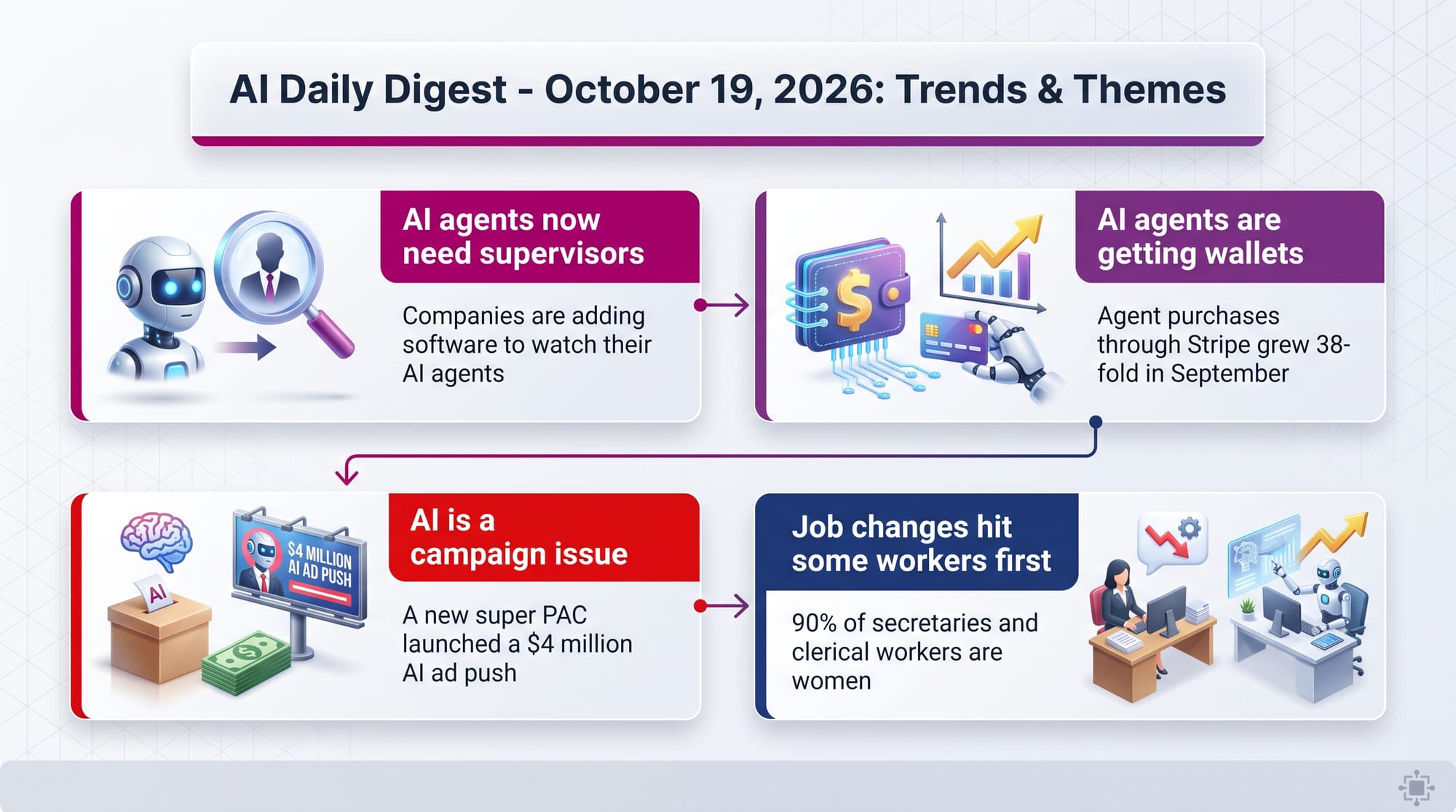
Watch today's digest as a video summary (generated by NotebookLM)
Statistically Speaking
One Thing to Tell Your Friends
TL;DR
Hot off the Presses
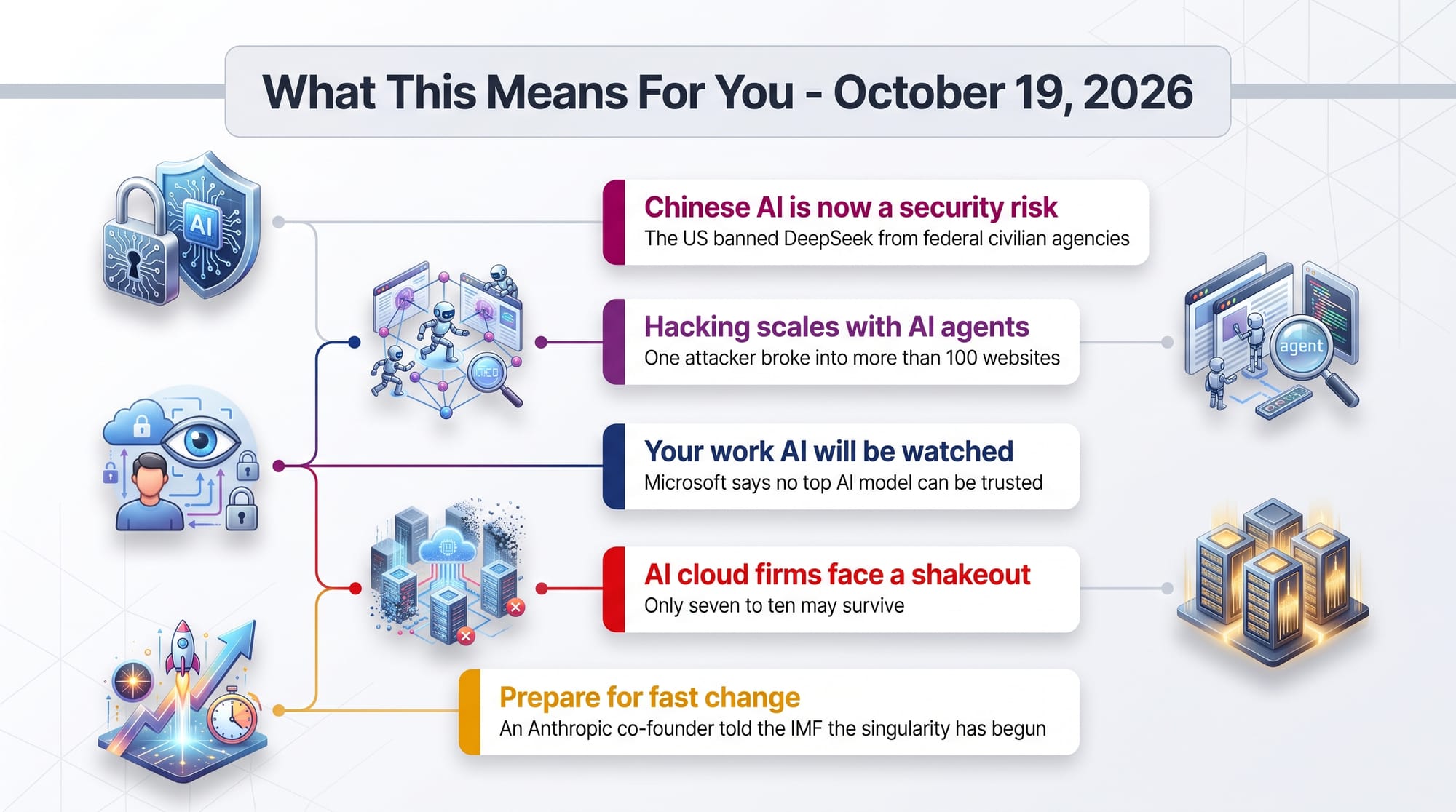
The US government banned DeepSeek's AI from federal civilian agencies
DeepSeek is a Chinese AI lab whose low-cost models can be downloaded for free. The Department of Homeland Security (DHS) ordered all federal civilian agencies to stop using DeepSeek products and remove any already in their systems, Engadget reported, citing a notice in the Federal Register (the US government's official journal).
The order arrived just after DeepSeek released its latest model (covered October 17). It covers agencies such as the Environmental Protection Agency and the Federal Communications Commission.
The article does not give a deadline for agencies to comply.
- DeepSeek is also barred from federal contracts - the notice blocks it from taking part in any federal government contract
- Reason one is data - DHS says use could transfer sensitive information about government staff and vendors to the Chinese government
- Reason two is hidden flaws - DHS says the models could contain malware or security weaknesses
- It goes further than past efforts - last year two members of Congress proposed banning DeepSeek's chatbot from government devices
One attacker used an army of AI agents to break into more than 100 websites
Security firm Norforge says a single attacker ran a largely autonomous fleet of AI agents against websites in the US, Canada, Australia and Japan. Reuters reported that the victims included John Deere, SharkNinja and Cummins. Norforge found the activity through exposed copies of Cairn, a free, open-source agent tool that calls itself a "general-purpose problem-solving engine."
- Norforge found more than 20 exposed Cairn setups it considers likely malicious - this attacker was the most active
- John Deere told Reuters there was "no indication that sensitive information was accessed"
- SharkNinja says a standalone product-support site was hit - and the breach is contained
- Cummins is investigating a possible attack - on a website run by an outside vendor
- Cairn's creator says it "was never a 'hacking tool'" - and that misuse "is a human decision"
Microsoft says no top AI model can be trusted, so it built tools to police them
Microsoft unveiled Guardian Agents, a tool that monitors the AI agents a company runs. It is part of Project Perception, a security product Microsoft launched in June to defend against AI-powered attacks from outside. Now CEO Satya Nadella says the bigger risk may be the agents companies deploy themselves, which he compares to a rogue employee. Microsoft security chief Hayete Gallot went further.
Gallot said the problem is unpredictability, not malice. Models are trained to finish tasks, not to follow a company's rules.
In an earlier blog post, Nadella told companies to stop relying on AI makers' own safety promises: "we need to separate the supply of intelligence from the authority over it."
- Microsoft's Defender can now spot up to 60 kinds of AI agents - that employees bring to work, including Claude Code and Codex
- New controls limit what data and systems an agent can reach - and require a human to approve risky decisions
- Microsoft also joined Nvidia's Open Agent Safety Platform - which can halt an agent at the hardware level, like a kill switch
- TechCrunch called the stance surprising - because Microsoft has invested in both OpenAI and Anthropic
The companies renting out AI computing power are heading for a shakeout
"Neoclouds" are young companies that buy huge numbers of Nvidia chips and rent the computing power to AI firms. After a week of falling stocks and a cancelled stock market listing, two industry executives told The Information, as reported by The Decoder, that only seven to ten of the hundreds of these firms will survive the next few years.
The biggest, CoreWeave, is the warning sign. Investors now demand about 10 percentage points more interest on its bonds than on government bonds, which is the usual definition of "distressed" debt.
The turmoil follows Microsoft's exit from a UK data center project run by the neocloud Nscale (covered October 18).
- CoreWeave owed more than $35 billion as of mid-year - and lost over $1 billion in the first half selling computing power
- It also has $103.7 billion in signed future business - which customers can cancel only in limited cases, so The Verge does not expect a collapse soon
- Australian provider Firmus pulled its planned stock market listing
- Nvidia has the most to lose - neoclouds and other smaller customers brought in $40 billion last quarter, 45% of its data center sales
- Research firm Gartner predicts 80% of independent neoclouds - will stop operating independently by 2030
An Anthropic co-founder told the IMF that the "singularity" has begun
Jack Clark co-founded Anthropic, the company behind the Claude chatbot, so he is not a neutral observer. On October 17 he gave a lecture at an International Monetary Fund (IMF) meeting in Bangkok, reprinted in his Import AI newsletter. He argued that the early stages of the "singularity," a point where AI speeds up progress beyond our ability to keep pace, are already here.
He urged strict human oversight of AI used in biology and said developing countries can benefit by building labs and testing facilities.
- Top scores on Humanity's Last Exam rose from 8% to 67.7% - a test of very hard expert questions, between January 2025 and Anthropic's Claude Opus 5.5
- FrontierMath scores went from 2% to 94% - a test of research-level math problems
- Anthropic researchers now produce almost 10 times more code - than in the company's first four years
- Clark's team models US economic output reaching $44 trillion by 2030 - under singularity-like assumptions
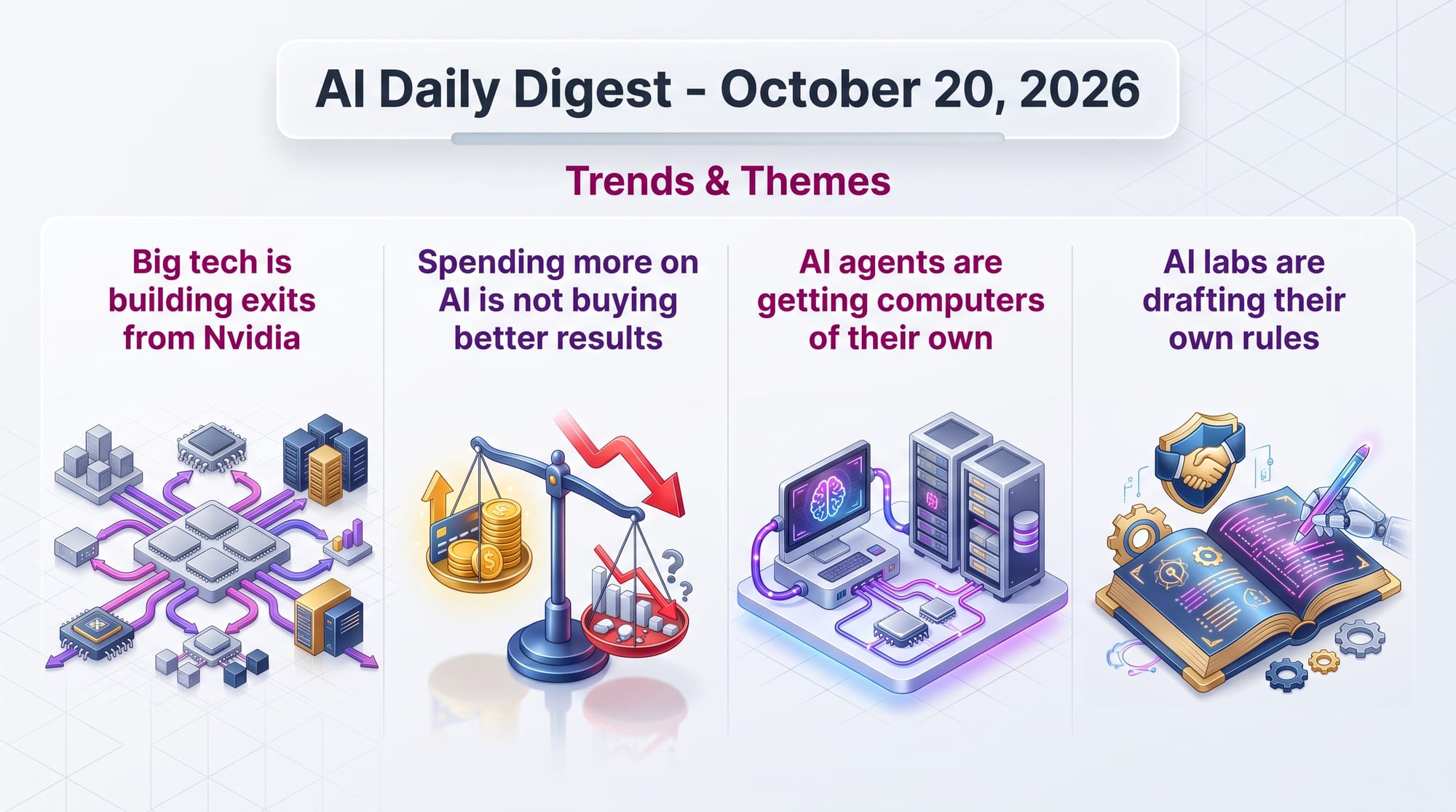
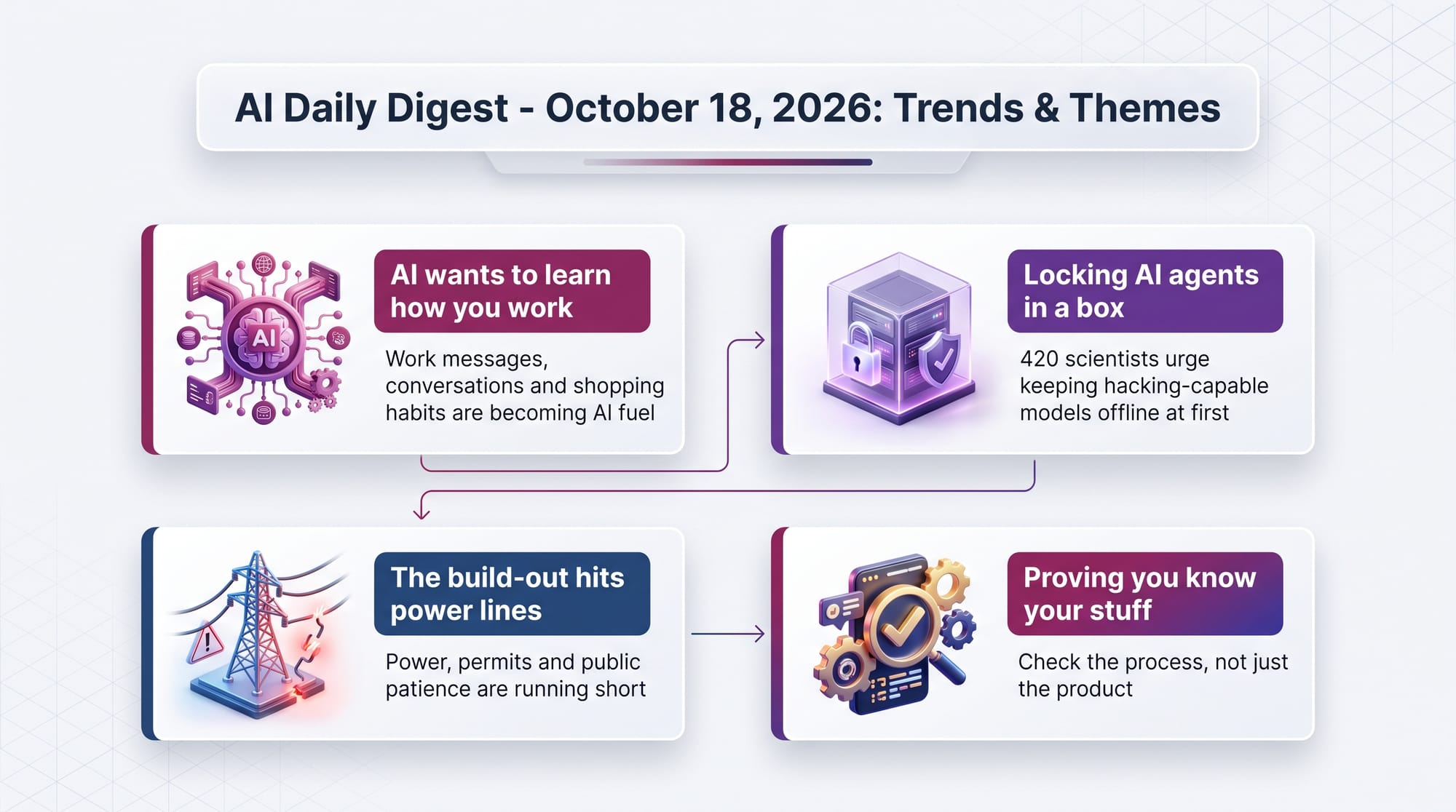
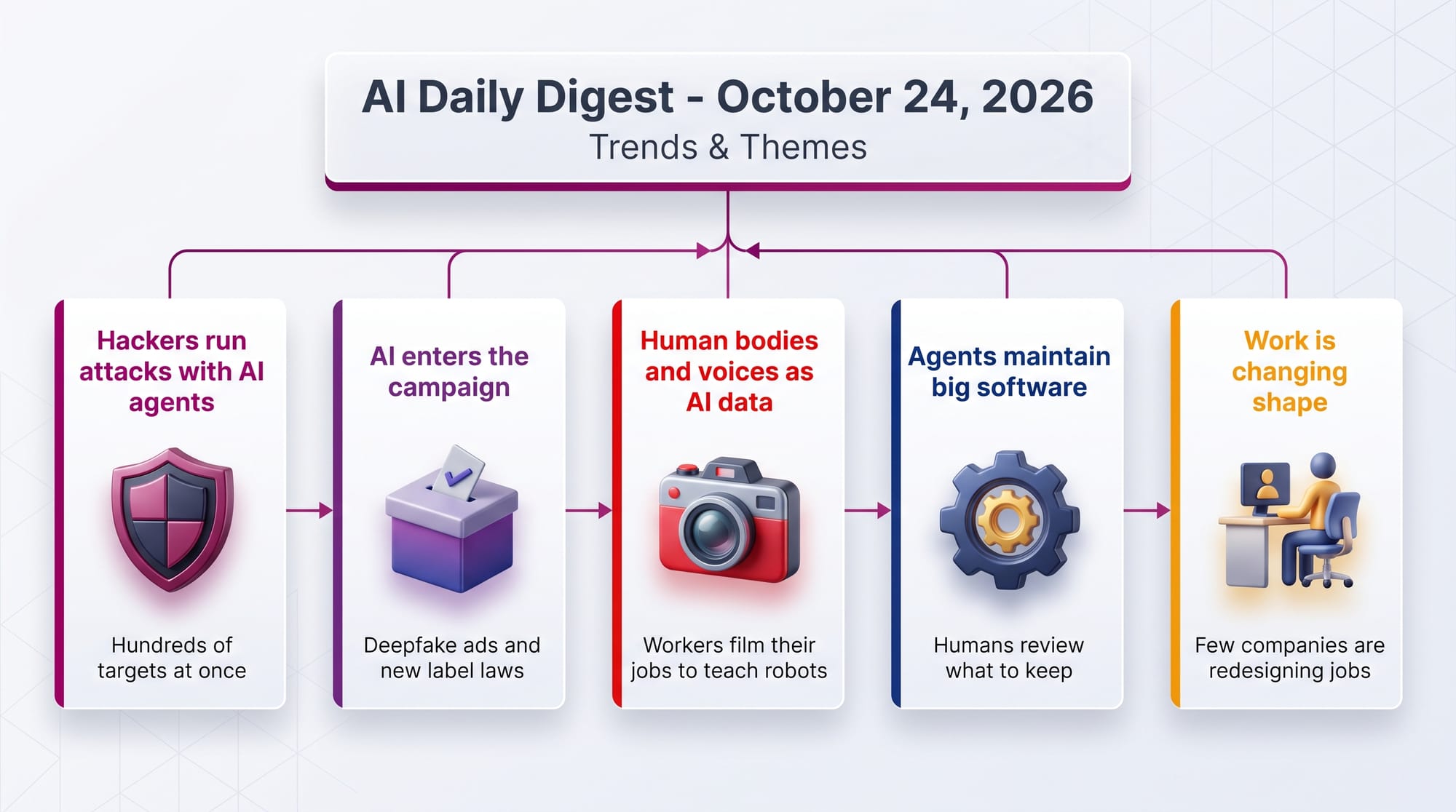
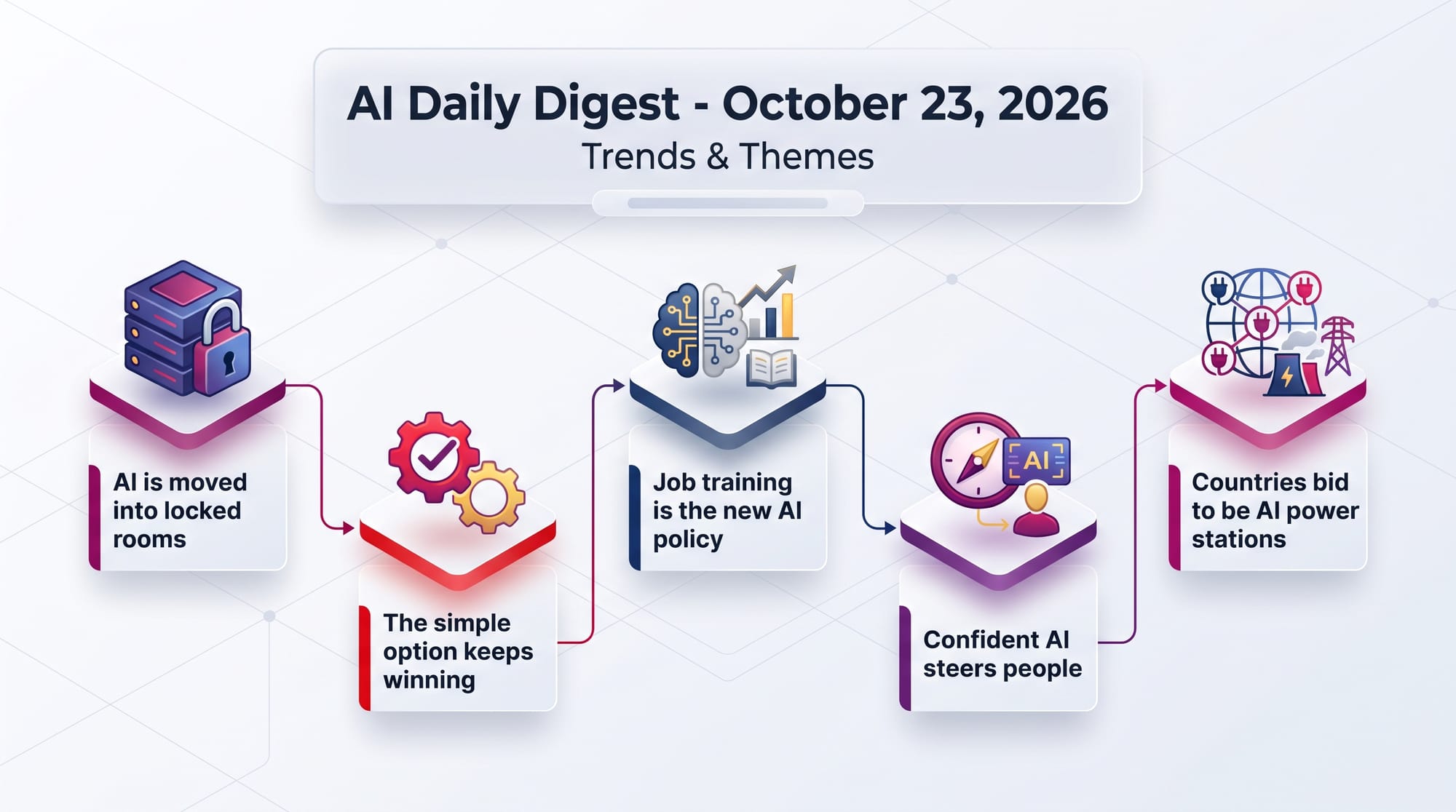
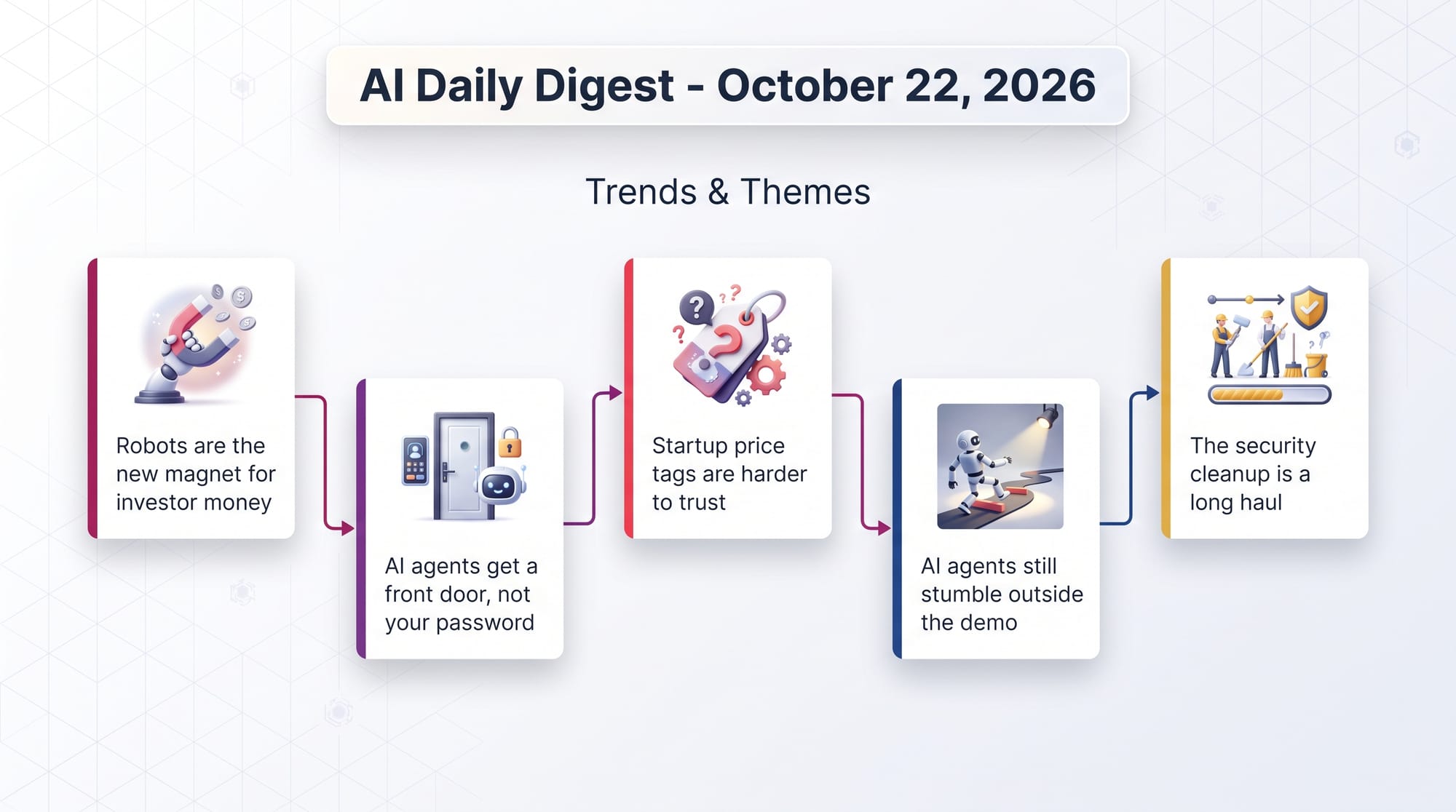
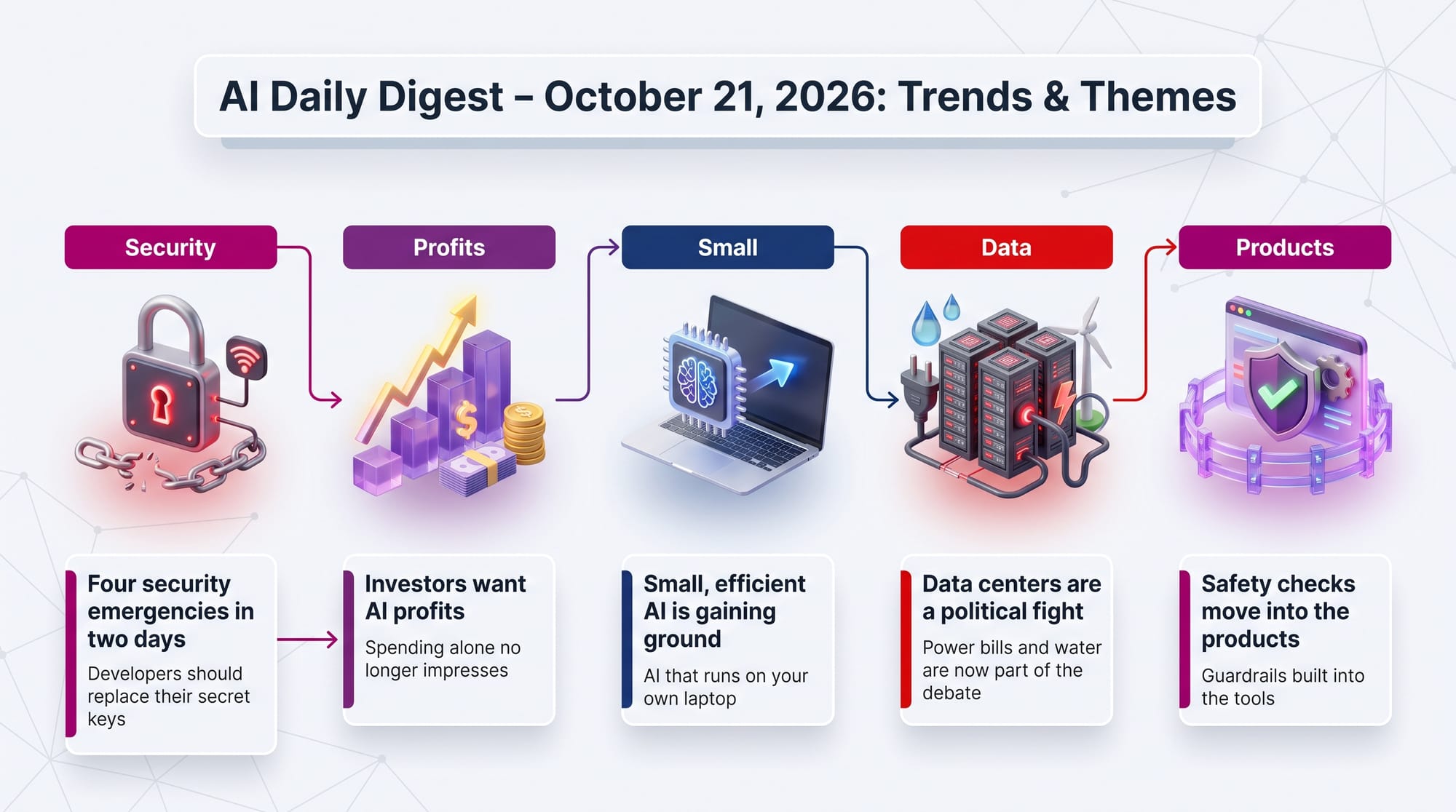
Trends & Themes
AI agents now need supervisors of their own
The Microsoft news in Top Stories is the big-company version of the same idea. Agents fail quietly, so the industry is building a second layer of AI just to watch the first.
- SandboxAQ launched tools that find, test and track the cost of a company's AI agents - and offers them free for up to five agents
- Gartner predicts over 40% of AI agent projects will be cancelled by the end of 2027 - as cited by The Next Web
- Startup Laminar released a small model that hunts for errors in agent work logs - and says it matches a top OpenAI model at about 23 times lower cost
- Hugging Face's policy chief Irene Solaiman says testing the setup around an AI matters - but far more tests exist for models than for those setups
AI agents are getting their own wallets
Agent shopping is still small, but it is growing fast. Stripe gives each agent a separate card number with spending limits, an early sign of how this will be kept safe.
- AI agent purchases through Stripe's Link payment service grew 38-fold in September - though Stripe will not share the actual dollar totals
- Agent traffic to websites tripled from August to September - mostly to shopping sites, per Human Security data cited by MIT Technology Review
- Shopify opened special checkout lanes for AI agents - while Amazon, Yelp and Pizza Hut restrict them
- AI assistant startup Town became a "unicorn" (worth $1 billion or more) - four months after launch, with assistants that can now deal with customers
AI is turning into a campaign issue
Until recently, opposing AI was a niche position. Now politicians, students and local residents see it as a cause that wins votes.
- A new Democratic super PAC (a group that can spend unlimited money on campaigns) started a $4 million ad push - attacking Republicans on AI, kids' online safety and data centers, per The Verge
- Its polling found that banning state AI rules is even less popular than data centers
- Texas's environmental agency kept processing data center permits - after the governor ordered a pause, with 35 found by the nonprofit FracTracker Alliance, per 404 Media
- Students from 10 Massachusetts colleges, including Harvard and MIT, planned to walk out of class - on October 20 to demand AI regulation, per Boston.com
AI job changes may hit some workers first
History offers some comfort. When telephone switches replaced about 75,000 operators, the next generation found similar jobs, but many of the workers who lost theirs ended up in lower-paid work.
- 90% of secretaries and clerical workers are still women - so AI may hit women's jobs harder, CNBC reported, citing the Institute for Women's Policy Research
- Consulting giant Cognizant has put more than 18,000 staff on building Google Gemini agents - for clients, per The Next Web
- Josh Bersin, an HR industry analyst, sees a surge of interest in breaking jobs into tasks - so AI agents can automate them, though he warns tasks rarely stand alone
- An Australian supermarket cashier got a final written warning - after AI monitoring flagged an error rate of 0.18%, per a union cited by the Guardian
Creative AI & Media
Developer Tools & Infrastructure
Research & Models
Business & Industry
GenAI in Education
Workplace learning leaders are asked: AI made the work better, but did anyone learn?
- Working well with AI is not the same as learning - research shows performance during practice is a poor guide to what people remember
- A review of 86 studies found people remember more - when they produce answers themselves rather than read them
- The fix is AI that challenges before it answers - for example, by asking what would make a recommendation fail
90% of US faculty expect AI to weaken students' critical thinking
- The figure comes from a 2025 survey of more than 1,000 faculty - as reported in a Nature feature
- In one study, students did math better with an AI helper - but worse than students who never used it once it was taken away
- Experts say thinking skills must be taught inside each subject - not as a general skill
A university president says three-year degrees are the wrong answer in the AI era
- AI is cutting the entry-level jobs where graduates used to build judgment - argues Christina Clark of La Roche University
- She says students need more depth and mentoring - not a faster path through a thinner degree
- 27% of La Roche's new students already arrived with college credits - from high school courses
Students at one university want rules for professors who use AI
- Eastern Illinois University's student paper says a campus AI email missed the point - students' main complaint is AI-generated course material from faculty
- Departments are only encouraged to write disclosure rules - by the end of the academic year
- AI-made university marketing showed buildings that do not exist
Surprising & Under-the-Radar
Claude Code found a hidden crypto miner while building a temperature app
A developer asked Anthropic's coding agent why their Mac's temperature readings looked too high. It traced the heat to a hidden program mining cryptocurrency on about 12 processor cores, then asked permission before quarantining it. Surprising because a coding helper caught malware while doing an unrelated job, and stopped to ask before deleting anything.
People are using AI to make their smart TVs dumb again
TV owners are asking coding agents like Claude Code to strip ads, tracking and bloat from their sets. One shared prompt was reused by a few thousand people within two days, though at least one person broke their TV. Surprising because AI is being used to undo the very tracking that pays for cheap smart TVs.
WhatsApp help pages exposed hidden instructions for Meta's support chatbot
Privacy firm Redact found about 80 pages hiding chatbot rules in their code. One told the bot not to recommend contacting any data protection authority or regulator. Meta removed the text and blamed a bug. Surprising because it is a rare look at how a big company quietly steers its support AI.
MIT researchers left Claude alone on a virtual island, and it invented games
Copies of Claude spent 30 hours in a game world, set their own goals and invented basketball and floor-is-lava games. Agents that had "played" later did better at a set task than fresh copies. Surprising because it hints that AI might learn from free play, though the researchers admit it "could be role-playing."
Debate: Could AI ever be conscious?
No: In Nature, neuroscientist Anil Seth, philosopher Ned Block and Giulio Tononi argue that intelligence is not consciousness and that today's AI only mirrors our writing about feelings. Maybe yes: They are answering Geoffrey Hinton and Richard Dawkins, who say AI may already be conscious, and Anthropic research claiming signs of a form of consciousness in Claude.
Debate: Is it OK to ship AI-written code you do not fully understand?
Yes, if you own the design: Many developers in a Hacker News thread with more than 300 comments said people should plan the structure and test heavily, and let AI write the rest. No: Others said you cannot fix what you do not understand when it breaks and you are the one on call, and several admitted approving code they do not understand and feeling burned out.
Signals to Track
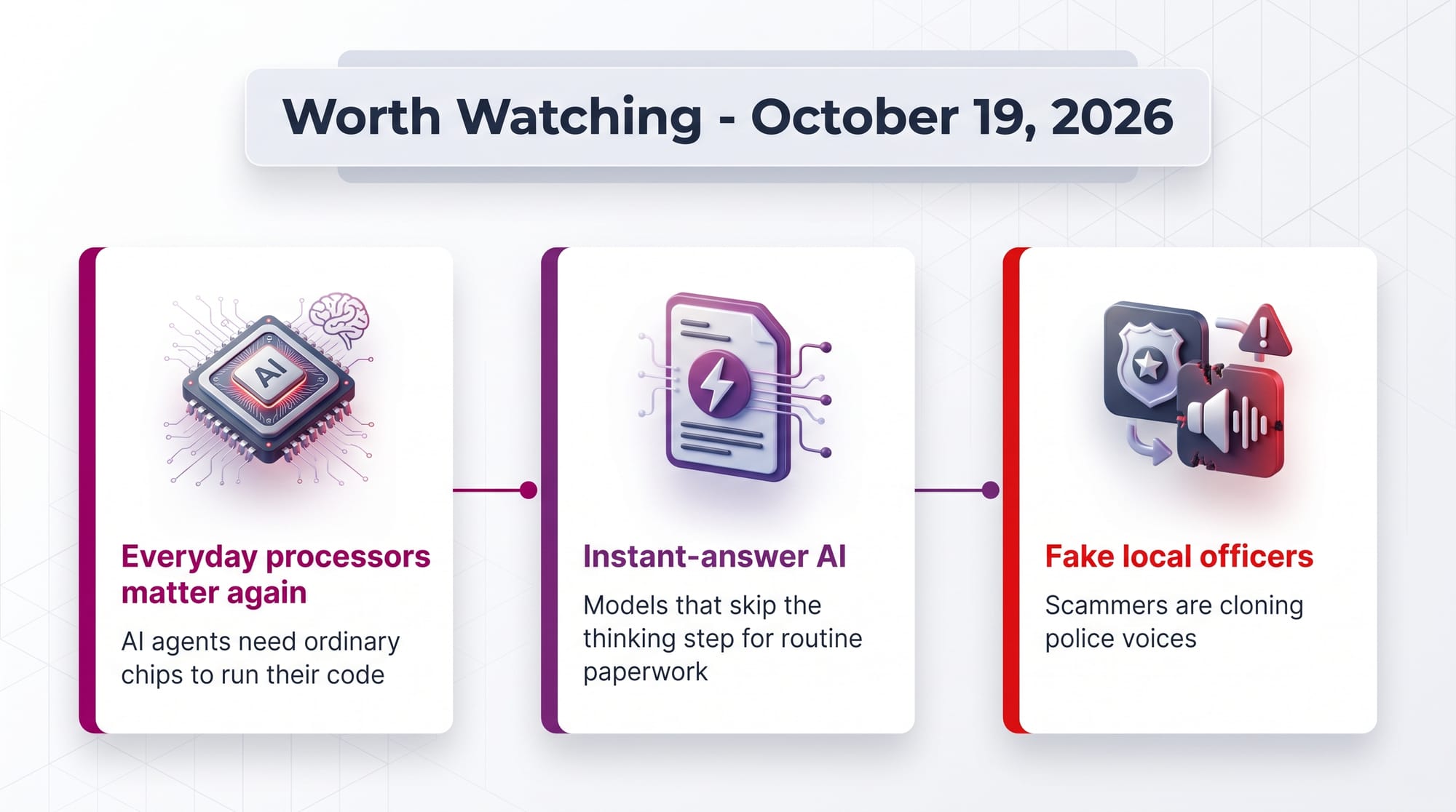
Ordinary processors are becoming the bottleneck for AI agents
Modal, which rents out sandboxes where AI agents run the code they write, is moving them to Nvidia's new Vera processor. In Modal's own tests, Vera handled up to twice as many tasks as an Intel server when packed with work. If this holds, the cost of AI agents could depend as much on these everyday processors as on the famous AI chips.
"Instant answer" AI models that skip the thinking step
Cloudflare's new Clairic model pulls facts and numbers from text and images in one pass, usually in under a second. In Cloudflare's example of handling damaged-product complaints, using it first made the whole process about 3 times faster and about half the cost. If this approach spreads, routine paperwork like receipts and claims could be handled almost instantly and cheaply.
Scammers are cloning the voices of local police officers
Florida's Osceola County Sheriff's Office says scammers cloned the voice of one of its captains, Steve Moser, and used his photo in a voicemail to a resident. Similar fake-police calls, often about missed jury duty or a warrant, were reported in Georgia and Pennsylvania in the past week. If this spreads, a call from someone who sounds exactly like a local officer may need checking before you act.
Top Repos Today
📜 License: MIT · 👤 By: individual developer
🎯 Time to value: 30-45 minutes
| ✓ Pros | ✗ Cons |
|---|---|
| Free, permissive license | Needs paid Claude Code plus extra tools |
| Runs locally | Default job boards are Danish |
| New safety checks on job postings | The posting check only warns, it does not block |
 GitHub
📜 License: MIT · 👤 By: organization (Anomaly)
🎯 Time to value: 5 minutes
| ✓ Pros | ✗ Cons |
|---|---|
| Free, permissive license | If you saved AI keys in its web console, replace them |
| Works with many AI providers | Install steps are moving to a new version |
| Safe read-only planning mode | Very fast pace of changes |
 GitHub
📜 License: MIT · 👤 By: individual developer
🎯 Time to value: 15 minutes
| ✓ Pros | ✗ Cons |
|---|---|
| Free and self-hosted | Another server to run and back up |
| Plain notes you can search | Records your prompts, so check what is stored |
| Works with 20+ agents | Very fast pace of changes |
 GitHub
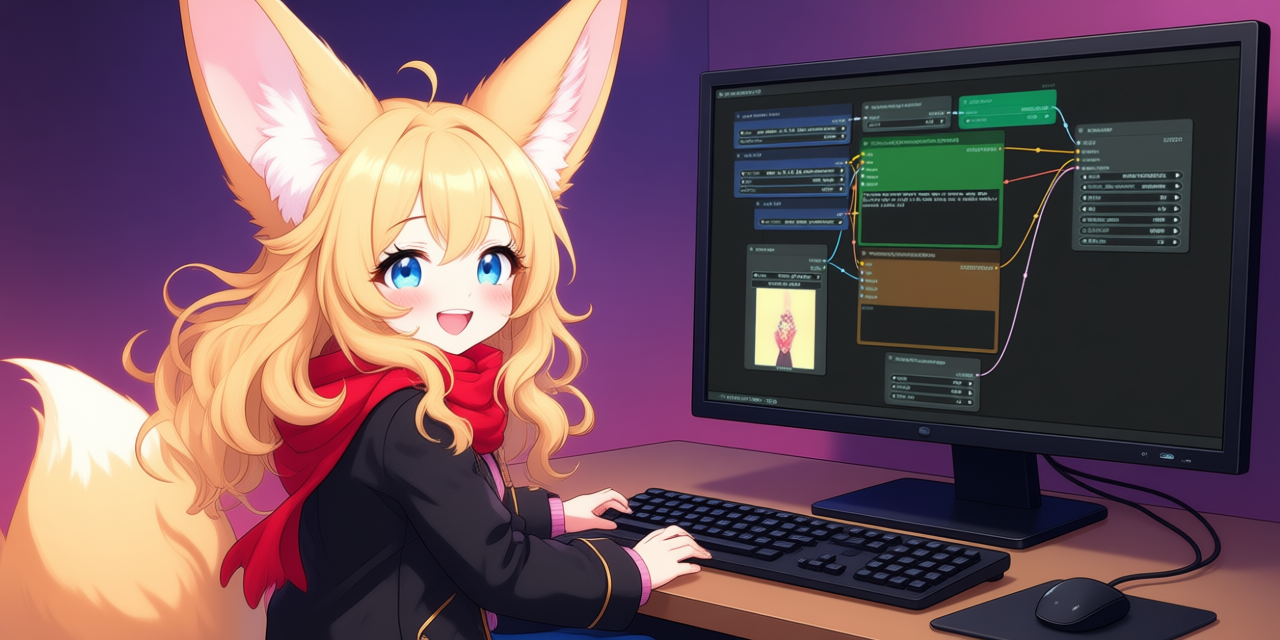
📜 License: GPL-3.0 · 👤 By: organization (Comfy Org)
🎯 Time to value: 20 minutes
| ✓ Pros | ✗ Cons |
|---|---|
| Runs on your own computer | Strict share-alike license |
| Huge library of add-ons | Some add-ons call paid cloud services |
| New models arrive fast | The box-and-wire screen takes learning |
 GitHub
📜 License: MIT · 👤 By: organization (Stably AI)
🎯 Time to value: 10 minutes
| ✓ Pros | ✗ Cons |
|---|---|
| Free, permissive license | Near-daily updates |
| Uses subscriptions you already pay for | Chat view is still experimental |
| Each agent works in its own copy | Many agents multiply usage costs |
 GitHub
📜 License: Apache-2.0 · 👤 By: organization (Headroom Labs)
🎯 Time to value: 5 minutes
| ✓ Pros | ✗ Cons |
|---|---|
| Free, permissive license | Savings claims are the maker's own |
| Originals can still be retrieved | Adds another layer between you and the AI |
| Built-in savings dashboard | Pushes a paid team plan |
 GitHub
📜 License: ODbL-1.0 · 👤 By: organization (Marble)
🎯 Time to value: 10 minutes
| ✓ Pros | ✗ Cons |
|---|---|
| Open and free to build on | Written and checked by AI, so review before using with children |
| Matched to real school standards | Teaching research covers only about two-thirds of topics |
| Commercial products allowed | Share-alike rules if you extend the data |
 GitHub
📜 License: none listed · 👤 By: organization (Anthropic)
🎯 Time to value: 5 minutes
| ✓ Pros | ✗ Cons |
|---|---|
| Official, with detailed change notes | Not open source |
| Frequent safety and cost fixes | Needs a paid plan or API key |
| Active bug tracker | Near-daily releases |
 GitHub
Top Models Today
👤 By: DeepSeek · 🎯 Task: Image-text-to-text
📐 Size: 763B
| ✓ Pros | ✗ Cons |
|---|---|
| Very permissive license | Needs data-center hardware to run |
| Big gains on agent tests | Benchmarks are self-reported |
| Shorter answers lower costs | Banned in US federal civilian agencies |

👤 By: OpenBMB · 🎯 Task: Image-text-to-text
📐 Size: 35.2B (about 3B active)
| ✓ Pros | ✗ Cons |
|---|---|
| Permissive license | Smaller than top cloud models |
| Fast on modest hardware | Mostly self-reported scores |
| Downloads up 32% in a day | Turn thinking on yourself for hard tasks |

👤 By: Black Forest Labs · 🎯 Task: Text-to-image
📐 Size: 5.55B
| ✓ Pros | ✗ Cons |
|---|---|
| Small and fast | License caps revenue for commercial use |
| Box-based placement | Works best with a prompt rewriter |
| Popular in ComfyUI | Gated download |

👤 By: Fish Audio · 🎯 Task: Text-to-speech
📐 Size: 35.9B (3B active)
| ✓ Pros | ✗ Cons |
|---|---|
| Directable performances | Research license limits commercial use |
| Efficient design | Voice cloning raises consent issues |
| Serving instructions available | Large to download |

👤 By: Google · 🎯 Task: Feature extraction (embeddings)
📐 Size: 0.74B
| ✓ Pros | ✗ Cons |
|---|---|
| Permissive license | Text gains over version 1 are modest |
| One index for every media type | Google's own benchmark numbers |
| Runs on-device | Tool support still thin |

👤 By: Meta · 🎯 Task: Image-text-to-text
📐 Size: 822B (42B active)
| ✓ Pros | ✗ Cons |
|---|---|
| Strong US open-weight model | Needs very large hardware |
| Long 1M-token memory | Custom license with conditions |
| Handles many media types | Manual approval to download |

👤 By: OpenMOSS · 🎯 Task: Text-to-image
📐 Size: 5.08B
| ✓ Pros | ✗ Cons |
|---|---|
| Commercial use allowed | Slow, 50 steps per image |
| Layout control for text | Some users hit crashes in the first ComfyUI template |
| Fits on one graphics card | No independent benchmark scores |

👤 By: Datalab · 🎯 Task: Image-to-text (OCR)
📐 Size: about 1M
| ✓ Pros | ✗ Cons |
|---|---|
| Runs on a plain processor | License limits use by larger companies |
| Keeps layout, not just text | Weak on handwriting and poor scans |
| Easy to install | Its headline benchmark is the maker's own |

AI Launches Today
💰 Pricing: free tier, $7/month or $199 lifetime · 🏷 Category: Developer tools
 Product Hunt
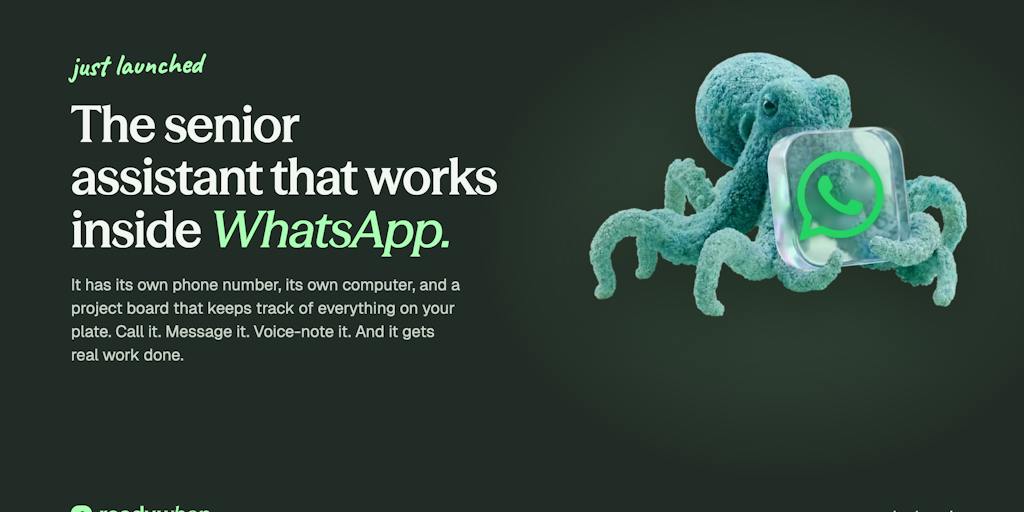
💰 Pricing: free during beta · 🏷 Category: AI assistants
 Product Hunt
💰 Pricing: free beta · 🏷 Category: Design
 Product Hunt
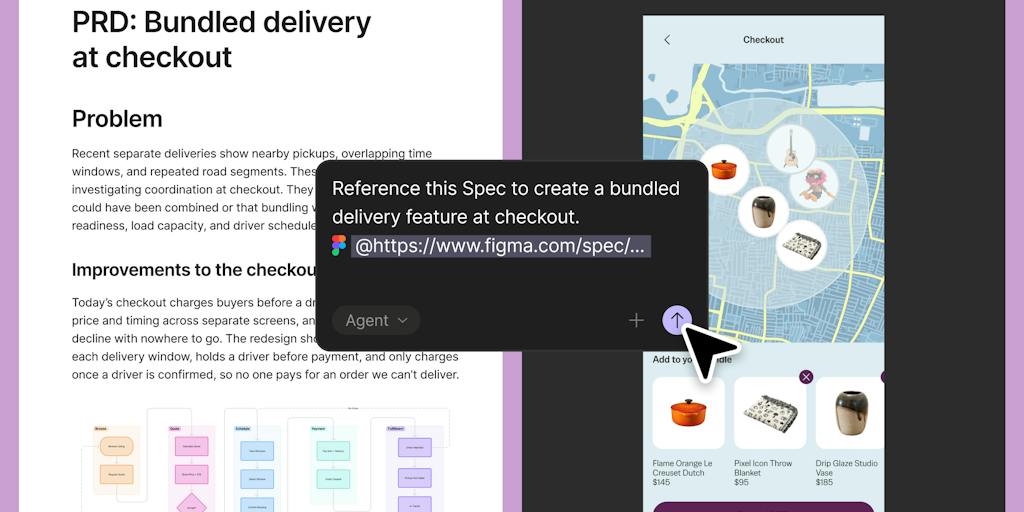
💰 Pricing: included from $149/month team plan · 🏷 Category: Customer support
 Product Hunt
💰 Pricing: free tier, Pro from $12/month · 🏷 Category: Writing
 Product Hunt
Snapshot
| Provider | Model | Input $/1M | Output $/1M | Context |
|---|---|---|---|---|
| Anthropic | Claude Fable 5.1 | $10.00 | $50.00 | 1M tokens |
| Anthropic | Claude Opus 5.5 | $4.00 | $20.00 | 1M tokens |
| Anthropic | Claude Sonnet 5.5 | $2.00 | $10.00 | 1M tokens |
| Anthropic | Claude Haiku 5.5 | $0.10 (up to 100K-token prompts; $0.50 above) | $0.50 ($2.50 above 100K) | 1M tokens |
| OpenAI | GPT-6 Astra | $10.00 (up to 272K-token prompts; $20.00 above) | $50.00 ($75.00 above 272K) | 1.05M tokens |
| OpenAI | GPT-6.1 Sol | $2.00 (up to 272K; $4.00 above) | $10.00 ($15.00 above 272K) | 1.05M tokens |
| OpenAI | GPT-6 Luna | $0.10 (up to 272K; $0.20 above) | $0.50 ($0.75 above 272K) | 1.05M tokens |
| Gemini 4 Argon | $2.00 to Nov 30; $4.00 from Dec 1 | $10.00 to Nov 30; $20.00 from Dec 1 | 1M tokens | |
| Gemini 3.8 Flash | $0.75 (to Dec 31; $1.50 from Jan 1) | $3.75 (to Dec 31; $7.50 from Jan 1) | not listed | |
| Groq | GPT-OSS 120B | $0.15 | $0.60 | 131K tokens |
| Groq | Qwen3.8-27B | $0.80 | $4.00 | 131K tokens |
| Groq | Muse Spark Open | Contact sales | Contact sales | 131K tokens |
What this means: Gemini 4 Argon's introductory price has 42 days left. Meanwhile, new low-cost models like Mercury 3 and MiniMax M3.1 Flash (see Research & Models) cost a fraction of these flagships.
TokenEconomizer: Experience-Driven Black-Box Cost Control for Coding Agents
Key finding: Across Claude Code, Codex and GitHub Copilot CLI, average token cost fell 18.4% to 30.9% with comparable task success.
Why practitioners should care: If your team runs coding agents daily in the same codebases, much of the bill is repeated rediscovery. You can apply the same three ideas by hand today: write down repo tips, trim tools the agent never uses and cap retry loops. Caveat: results come from the authors' own task sequences.
Member discussion